OSS Owner Education Project
Final Report
November 2014
Thurston County Environmental Health
THIS PROJECT HAS BEEN FUNDED WHOLLY OR IN PART BY THE UNITED STATES ENVIRONMENTAL PROTECTION AGENCY UNDER ASSISTANCE AGREEMENT PC-00J32601 TO WASHINGTON DEPARTMENT OF HEALTH. THE CONTENTS OF THIS DOCUMENT DO NOT NECESSARILY REFLECT THE VIEWS AND POLICIES OF THE ENVIRONMENTAL PROTECTION AGENCY, NOR DOES MENTION OF TRADE NAMES OR COMMERCIAL PRODUCTS CONSTITUTE ENDORSEMENT OR RECOMMENDATION FOR USE.
Table of Contents
Project Description . . . 1
Pilot Project . . . 2
Background . . . 2
Process . . . 3
OSS certified owners . . . 3
Certified pumpers . . . . . . . 4
Puget Sound Counties . . . 5
Environmental Health Staff. . . . 6
Test Model Design . . . 8
Methods . . . . . . 9
Results . . . 10
Recommendations . . . 13
Summary . . . 14
Appendices
A Thurston County On-Site Sewage Operation & Maintenance Program – Current Status, December 2013
B Puget Sound County O&M Programs Spreadsheet
C Summary of Puget Sound County Septic System O&M Programs D Henderson Certified Homeowner Survey
E Certified Pumpers Survey
F Survey of Five Puget Sound Counties Online Training G Letters of Invitation to Participate in the Pilot Study H Test Sample
Project Description
Develop curriculum and pilot test an advanced program that will train Thurston County residents how to properly monitor and maintain their on-site sewage systems.
The project was grant funded by Washington State Department of Health and consisted of seven tasks. Tasks 1 and 2 were completed in December 2013. The findings and reports were used by the advisory committee who updated the Thurston County On-Site Sewage Management Plan. The third task, to develop a budget and proposal to implement an educational model, was included as part of the funding
recommendation that the advisory committee made in their final Draft document that was forwarded to the Thurston County Board of Health. Tasks 1 through 3 are described below.
1. Evaluate the effectiveness of current OSS education programs used by the County and Puget Sound local health jurisdictions.
This task was completed December 2013. Thurston County On-Site Sewage Operation & Maintenance Program – Current Status, December 2013 included a section that documented Thurston County’s current education and outreach efforts to educate and train on-site sewage systems owners. (Appendix A)
2. Identify and evaluate homeowner training programs offered by local health jurisdictions to on-site sewage system owners within the Puget Sound area.
This task was completed December 2013: Summary of Puget Sound O&M Programs. The matrix of the twelve Puget Sound counties was reviewed by the respective counties and finalized Summer 2014. (Appendix B & C)
3. Develop a budget and proposal to sustain the desired education and outreach program. The advisory committee who updated the OSS Management Plan recommended a funding mechanism that would in part implement such a model. Thurston County On-Site Sewage
Management Plan Update 2014, Final Draft, July 2014. This draft will be presented to the Board of Health for consideration.
The remaining four tasks, listed below, concern the development and testing of a curriculum pilot project for training septic system owners on how to properly operate, maintain and inspect their own septic system. The following report describes and documents the process of developing and testing the model. The results of the pilot project are included, as well as recommendations for implementation of using a video to train OSS owners on proper maintenance and inspection procedures.
4. Identify key components and outcomes needed for a successful homeowner education program. 5. Develop an advanced curriculum model for OSS owners that are outside of designated Marine Recovery
Areas.
6. Pilot test and evaluate the curriculum.
7. Prepare a final recommendation and report for consideration by the Thurston County Board of Health, the Department of Health and interested stakeholders.
Pilot Project
Background
An inequity exists for owners of on-site sewage systems (OSS) in Thurston County. Training opportunities are available to certain OSS owners, but not to all.
Thurston County has approximately 70,000 on-site sewage systems. Ten thousand (10,000) of these systems are within the county’s designated Marine Recovery Areas (MRAs) – Henderson and Nisqually Reach
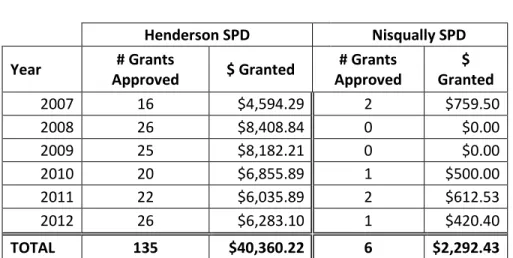
Watershed Protection Areas (WPA). A portion of the annual MRA program charge is designated for OSS owner training education. Within the MRAs, owners of the approximately 9,000 standard gravity, pressure distribution, mound and Glendon biolfilter™ systems are eligible for enhanced education opportunities that enable them to receive training qualifying them to conduct and submit their own inspection reports and to meet the requirements for the renewable operational certificate. The remaining 1,000 OSS are sand filters, aerobic treatment units (ATU) or other systems that require a certified inspector to conduct inspections, do routine maintenance as needed and submit reports to the health department. Therefore, 90% (9,000) of the OSS owners within a Watershed Protection Area can get training and do their own inspection.
Outside these two MRAs, an additional 3,348 OSS have an operational certificate and inspection requirement due to OSS use or system type. The required inspections of all these systems must be
conducted by a certified professional inspector. Resources are not available for an OSS owner training and certification program. If an owner of a mound or Glendon biofilter™ system resides within an MRA, training options are available to become certified to conduct their own inspections to meet the requirement of the operational certificate. However, if the owners of a mound or Glendon biofilter™ system live outside the MRA, they must hire a professional to conduct the inspections and submit the reports. There are 1,479 OSS (44% of the 3,348 OSS) outside the MRAs that are either mounds or Glendon biofilters™.
In addition, approximately 56,500 gravity and pressure distribution systems outside the MRAs do not have an operational certificate requirement. Thurston County does not actively oversee the operation and maintenance of these systems. Nonetheless, state law requires that the owners of these gravity and pressure distribution systems are required to inspect their OSS on a three year and annual basis,
respectively, in order to protect public health, water quality and the homeowner’s investment. Thurston County does have a variety of educational opportunities available to all OSS owners – brochures, on-line information, 2-hour SepticSense workshops and a SepticHelp Line to answer questions. However, there currently is no program to train these OSS owners on how to correctly do an inspection.
An enhanced education curriculum for county-wide training could provide an OSS owner of a gravity or pressure distribution system with the skills to conduct their own inspections. Such a program could provide training opportunities to all OSS owners and make it possible for homeowners to correctly inspect and maintain their systems, forego costs of hiring a professional to conduct the inspections, and promote understanding of how OSS function and how they should be operated and maintained.
Process
The goal of this pilot project was to determine if an efficient and electronic training method could enable county-wide septic system owners to become knowledgeable and skilled at properly inspecting and maintaining their septic system. The process to achieve this goal was to
• Get feedback from those Henderson OSS owners who had taken the county 5 ½ hour training course
• Interview septic system pumpers to get their perspective about OSS owners’ knowledge and skill level
• Identify what other Puget Sound counties offered for owner training – specifically online training options
• Gather information from Thurston County Environmental Health O&M program staff and discuss a vision for an enhanced OSS owner education program
• Draft a model to test
• Test the model
• Report findings
• Make recommendations
OSS Certified Owners
The first step of the pilot project was to survey OSS owners in the Henderson MRA who had been certified to do their own septic system inspections. They each had taken a 5 ½ hour class taught by an environmental health specialist that included classroom lecture with question-and-answer and a visit to a septic
demonstration park. To be included in the survey, their OSS had to be in full compliance with county operation and maintenance requirements, i.e. their operational certificate (OPC) had to be up-to-date, and their inspection certification had to be in good standing. These owners who were surveyed were chosen at random from a list of 2007-2009 class participants. A questionnaire was developed and sent in September 2013 to 150 class attendees. The purpose of the questionnaire was to learn if class participants thought the class was helpful, if they were able to successfully do their own inspection after the training and again three years later and whether they thought the county should keep such a program. Seventy (70) of the 150 questionnaires were returned completed. [The full report is in Appendix D.]
The overall response was very positive. Inspections are being done and are being repeated by the certified owners at time of operational certificate renewal. Participants believe that they have the skills to conduct their own septic system inspections. Training information is recalled or handouts and personal notes are utilized as reminders on how to conduct their inspections. More web-based inspection information was suggested. With the exception of two respondents who didn’t answer – 97% indicated that the county should continue to offer the training program.
Conclusions from certified OSS owners:
•
The county’s current conventional training course is effective.•
Most certified owners are confident to do their own septic system inspections initially and for subsequent renewals.•
Owners saw value in the training for OSS owners and appreciated it.•
A refresher, preferably online, is needed.Certified Pumpers
Next was to get feedback from Thurston County certified professional septic system pumpers regarding OSS owner inspection training. Though pumpers’ primary job is to pump septic tanks and make minor repairs, they also conduct system inspections and file inspection and pump reports electronically. Within the MRAs, many of the tanks that they pump were initially inspected by a certified owner. Therefore, pumpers have first-hand knowledge of how well the certified owners are doing at inspecting their own systems. Pumpers also have many, many years of experience with homeowners. They know how knowledgeable owners are, how willing they are to learn and how well they are doing their inspections. [Full report in Appendix E] The goal of the pumper survey was to learn from the septic pumpers what their professional in-field experience is regarding OSS homeowner inspections.
• What system types can homeowners adequately inspect?
• What system types should homeowners not be inspecting?
• What type of training would ensure proper homeowner inspections?
•
Are certified homeowners doing their inspections correctly?• Would homeowners of gravity systems ‘out in the county’ be interested in training to self-inspect? A questionnaire was sent via e-mail to twenty-six (26) septic tank pumpers who are certified in Thurston County. No responses were received. Phone calls were made to ten pumpers located in Thurston County, and each was interviewed.
In summary …
• All agreed that a gravity septic system could be inspected by a trained owner.
• Most pumpers were concerned about owners inspecting pumps. Owners should ‘keep their fingers off the panel’.
• Most agreed that any alternative system should be inspected by a professional. The systems are either too complex or the functioning nuances are not understood without adequate training and experience.
• Most agreed that the current intensive 5 ½ hour training for owners is good. The ‘hands on’ demonstration park is most helpful to owners.
• Owners do mention that they have taken the class; most are ‘pretty good’ at doing their inspection.
• Some owners simply do not want to do their own inspections even after taking the class.
• If an inspection requirement were to be enforced for all OSS county-wide, then training options for OSS owners are needed in order for the public to accept the requirement. Responsible owners would take the class; for others no amount of incentives will work.
Additional comments included:
• For many pumpers, time of (property) transfer program hasn’t really increased their business; they had already been doing tank pumping for real estate sales.
• The MRA programs have increased business.
• People are surprised / alarmed that their tank is full. The fact that a septic system functions with a full septic tank is not understood by many clients.
• Owners are having trouble measuring the sludge. They need something better than a sock to do so.
Observations;
• Pumpers differ on what their ‘service role’ is – strictly business vs. educator.
• Some pumpers encourage their customers who live in an MRA to take the training.
• Some pumpers are proactive in finding record drawings.
• Most pumpers have an ‘inspection only’ option.
• Some pumpers focus on time of transfer service. Conclusions from Certified Pumpers:
• With adequate training, OSS owners could inspect gravity systems.
• Additional training is needed to inspect a system with a pump.
• County’s current intensive training format is working and certified owners are doing a good job.
• If the county requires all OSS to be inspected, OSS owners need to have training options available.
Puget Sound Counties
Before designing a pilot education project for Thurston County, it was important to learn what type of training options other Puget Sound counties offer to their OSS owners and explore the possibility of using already developed products.
All twelve Puget Sound counties have On-Site Sewage Management Plans as required by state law. Education is an important element in these plans. The table in Appendix C lists the counties and their respective Operation & Maintenance (O&M) program requirements. The column headed ‘OSS Education / Training’ highlights the varied approaches to education and training, whether OSS owners are allowed to do their own inspections and what, if any, fees are required.
Because the goal of the pilot project was to test an efficient and electronic method, program detail was gathered from only those counties where there were online training options for OSS owners: Clallam, Island, Jefferson, Skagit and Whatcom. [Full report in Appendix F]
Following are findings from the review of Clallam, Island, Jefferson, Skagit and Whatcom County programs:
• All offer basic OSS education.
• To qualify to self-inspect, additional online (Septic 201) or in-class training is required.
• Most have different standards / requirements than Thurston County.
• All counties, except Island County, allow mounds and sandfilters to be inspected.
• Online format varies from professional video to PowerPoint with no audio.
• All have an exam requirement to become certified.
• All require submittal of an inspection report.
• OSS owner inspection is not allowed for real estate transfer.
• OSS owner inspection is not allowed for community, commercial, food establishment, ATU OSS.
• Limitations include:
o Must have an existing record drawing / as-built. o First inspection must be done by a professional. o Must have a professional inspection every 9 years.
o Additional training is required if a system has a pump.
o OSS owner inspection is not allowed if the site was non-conforming at time of repair
issuance.
Conclusions from Puget Sound Programs
• Clallam County’s professional video could be used ‘as is’.
• It would be helpful to insert some ‘exceptions/differences’ for Thurston County.
• Exams are already developed and need only editing to use.
• Consider adopting some of the ‘limitations’ implemented by other counties.
Thurston County Environmental Health Staff
The next step in the process was to review with Thurston County staff all the information that had been gathered and discuss a vision for a comprehensive OSS owner education program. In addition, a document summarizing Thurston County’s current O&M program had been prepared for the On-Site Sewage
Management Plan Advisory Committee and was available for staff review. Staff gathered for a 4-hour meeting in January 2014 and began the discussion by reviewing these results / responses from the certified OSS owners in Henderson, the certified professional pumpers in Thurston County and other Puget Sound county programs, as well as the analysis of Thurston County’s current O&M program.
Staff summarized how they saw the strengths and weaknesses of Thurston County’s O&M program.
• Strengths
o The 5 ½ hour OSS training classes are successfully training thousands of OSS owners. o Tons of septic system information is available on the web and in print.
o Environmental Health’s SepticHelp line is available to anyone in the county.
o The department has good financial incentives, i.e. riser rebates, low income assistance, low
interest loans, that are used by hundreds of OSS owners.
• Weaknesses
o Program costs a lot.
o People get lost on website – it can be difficult to navigate. o Brochures can be seen as junk mail and are often thrown out. o Lack of funding for a comprehensive county-wide program. o Class attendees need a refresher – preferably online.
o Training options and financial assistance/ incentives depend on where you live.
The discussion moved to ‘When does an OSS owner want to learn about their septic system?’ The number of certified OSS owners in the MRAs - 2,574 and counting - is evidence that septic system owners are willing to attend a 5 ½ hour class on a Friday or Saturday and learn about their septic system. However, the ‘real’ reason for the excellent attendance is likely that septic system inspections are required within the MRAs and being certified is a way to save money. There is no charge to attend because these classes are funded by the MRA annual program charge. This classroom / demonstration park format is labor intensive and costly and can only be available when funded through an established program.
Staff listed the following as reasons why an OSS owner would want to learn about their system:
• Inspections are required.
• Know someone who spent $$$$ on a repair and want to avoid the cost of an expensive repair.
• Some change in life / first time on a septic.
• System is failing.
• Do the right thing.
The general consensus was that OSS owners aren’t particularly receptive to training options unless there is a compelling reason that the information is important. Though some owners may have good intentions to ‘do the right thing’, other priorities in their lives can take precedence.
What followed was a brainstorming session of ideas that could meet the public health challenges whereby septic systems within the county would be adequately operated and maintained and regularly inspected. How can the current O&M program be improved? With an estimated 56,000 OSS in the county that do not have any inspection oversight, what might be possible?
The following list of ideas was the outcome:
• Create an equal opportunity for education – equity issue.
• An inspection requirement for all OSS in the county.
• At ‘time of transfer’ or permitting, etc. – get O&M information to the new OSS user (not the realtor/seller/contractor).
• First inspection should be done by a professional.
• OSS owners of the following system types could be certified to self-inspect:
o OSS owners of pressure, mound, Glendon and high-risk gravity must attend a class. o OSS owners of low-risk gravity can take on-line instruction.
• All OPC rates / charges would be on the property tax statement – more efficient and cost-saving.
• OSS professional inspection required every 3 – 4 cycles.
• General education classes / workshops held regularly.
• Use adaptive management to evaluate and adjust program. Feedback from public included:
• Reorganize website / make the site easier to use.
• Offer a refresher for certified homeowners.
• Chart the OSS replacement costs to inform owners of what neglect might cost. Conclusions from Environmental Health Staff
•
OSS owners need a compelling reason to be educated about their septic systems.•
County should find options for expanded training opportunities - explore online instruction.•
Inspections by professionals should be required at prescribed intervals.•
Update website.Test Model Design
The goal of this project was to determine if an efficient and electronic method could enable county-wide septic system owners to become skilled at properly inspecting and maintaining their own system. The objective was to design an educational model that could be tested.
Given that for Thurston County:
• MRA OSS owner certification 5 ½ hour class is already established, successful and well attended.
• 2-hour SepticSense workshop curriculum is established and workshops are held when funding is available.
• OSS education information is distributed at public venues, i.e. fairs.
• Expanding OSS owner certification outside the MRAs is not a current directive.
• Updating the EH website ‘education’ segment is not in the current work plan. And …
• Two-thirds of Henderson certified OSS owners responding to a September 2013 questionnaire about their class attendance experience indicated that a ‘refresher’ for conducting subsequent inspections would be helpful. The majority of respondents preferred an online format.
And …
• An outcome from the staff discussion was questioning whether OSS owners of low-risk gravity systems could become proficient in inspecting through online instruction.
Therefore, the proposed model was to ‘test’ an existing OSS inspection online video with OSS owners. Two groups would be targeted: One group, Henderson OSS owners who are already trained and certified to inspect their own systems, would view the video as a refresher. The second group, Nisqually MRA OSS owners who have never inspected their OSS, would watch the video as a training tool for self-inspection certification.
If the video could successfully refresh certified OSS owners and/or train ‘new’ OSS owners on how to operate, maintain and inspect an OSS, it would meet the criteria of the project. It would be equitable – equally available to all on the internet. It would be electronic – done using a home computer. It would be an efficient refresher – less labor intensive than a classroom format. Whether it would be an efficient training tool for self-inspection certification would depend on what percentage of OSS owner inspections would need staff ‘supervision’.
Methods
OSS owners were solicited from the MRA lists. Names chosen at random became the ‘invitation list’. Three hundred (300) invitations were sent via regular mail – 150 to Henderson, 150 to Nisqually – requesting volunteers. Those owners who agreed to participate had to respond by email in order to obtain their email address as all subsequent correspondence was electronic. The survey tool chosen was Constant Contact™. All participants were sent an electronic pre-test to determine current knowledge. After receiving the completed test, a link to the instructional video was sent. After the participants watched the video, they
requested and took a post-test. The Henderson ‘refresher’ group answered a few additional questions and then were done with the survey. Those in Nisqually set up an appointment to do their inspection with a county staff member present to evaluate how well the inspection was done and then provide the owner with additional information or instruction as needed.
Participants were chosen at random from the MRA program roll. Invitations to participate were sent to 150 OSS owners in Henderson MRA and 150 OSS owners in Nisqually MRA. [Correspondence to participants is in Appendix G.]
The Henderson participants had to have
• taken the intensive training class and been certified,
• conducted their initial and renewal inspections,
• have their operational certificate current, and
• have a gravity, pressure distribution, Glendon™ or mound OSS.
The Nisqually participants were chosen at random from the Year 3 renewal cycle list of OSS owners whose first inspection would be due in 2015 and who have a gravity or pressure distribution OSS.
Schedule
When a list of participants was confirmed, the pilot training began by sending the pre-test with an initial memo outlining the sequence of e-mails that would be forthcoming. As the participants completed each step, the next ‘action’ e-mail would be sent. The goal was to complete the survey by the end of September – including the completion of all the owner inspections in Nisqually.
Video
Based on staff review of what the other Puget Sound counties were using for online training, the Clallam County video, which was produced professionally, was chosen as the best fit. The content was accurate and the presentation kept the viewers’ interest. The video content can be used by most anyone and has few details that are specific to Clallam County. The link to YouTube to view the video on a home computer was easy and free to use. http://www.youtube.com/watch?v=udBaGyzJyU8
Survey Tool
Constant Contact™ was the survey tool used to communicate with project participants. Staff were using this tool for other projects and were familiar with it. All correspondence, including both pre- and post-tests were sent, and returned, using Constant Contact™ as well as links to the videos and other online resources. Tests
In order to evaluate whether the video was a good refresher or training tool, it was necessary to find out how much the OSS owner knew before they watched the video – and then again afterwards. Clallam, Island and Skagit counties have all developed a series of questions to test the OSS owners’ knowledge about how septic systems function. With their permission, these test questions were incorporated into a test of 38 questions. [Test sample in Appendix H] This test was used as both the pre-test and the post-test. This was done in order to compare how the participants answered the questions before viewing the videos and then after viewing the videos, as well as to find out which questions were consistently answered incorrectly. Incorrect answers pointed out common misunderstandings and could be used to adapt future training to clarify certain aspects of how septic systems function.
Inspections
The final step for the Nisqually project participants was to do an inspection of their septic system while being observed by department O&M program staff who would evaluate how well the owner performed the inspection. The OSS owner had to schedule an appointment with the department, uncover the tank, have their inspection tools ready and be prepared to do the inspection.
Results
Participants
Three hundred (300) invitations were mailed out in June 2014 – 150 to Henderson OSS certified owners and 150 to Nisqually OSS owners of gravity systems whose first inspection would be due in 2015. Approximately 20% responded that they would be willing to participate in the pilot project – 32 in Henderson and 34 in Nisqually. Of the volunteers who began the project, 78% in Henderson (25 participants) completed the project. In Nisqually 66% (19 0f 29) completed the post-test; 38% completed their inspection and were certified (11 of 29).
Henderson: 32 initial volunteers 5 dropped out 27 took pre-test
25 finished the post-test
Nisqually: 34 initial volunteers 5 dropped out 29 took pre-test 19 finished post-test
11 did their inspection and are certified
The pre-tests were emailed in early July 2014. From this point forward to the end of the project, responses trickled in. This often necessitated an individual response to each participant. After the pre-test was taken and sent back to the department, the links to the videos were sent out. After watching the videos the participants had to request a post-test, which was then emailed. Sending the completed post-test back to the department was the end of the project for Henderson participants. For those from the Nisqually MRA, an appointment had to be made with a department sanitarian who would observe the owner doing their septic system inspection.
Periodically, phone calls were made encouraging participants to complete a test or watch the videos. These calls offered an opportunity to find out if there were any problems with using Constant Contact™ or viewing the videos. Often e-mails had to be resent in order to get the participant back on track. Five people from Henderson and five from Nisqually stopped participating and could not be reached after repeated phone calls where messages were left. The September goal was not met. As of mid-November post-tests are still coming in and appointments for inspections are being made.
Tests
The pre-test and the post-test for both test groups contained the same 38 questions – and in the same order. This made it easy to compare ‘pre’ and ‘post’ test results. The Henderson owners scored well on the pre-test (92% correct answers) – likely from their classroom knowledge as well as doing their own
inspections. Based on the fact that their post-test scores improved after watching the video, it may be concluded that either they learned something new or their memories were ‘refreshed’.
The Nisqually OSS owners had not previously attended any septic training course, so their pre-test answers would have reflected a baseline of knowledge. After watching the video their test scores improved from 84% to 94% correct answers - and ended on par with their Henderson neighbors.
Test Results
(38 questions)Pre-test average: Henderson 34.8 (92% correct) Nisqually 32.1 (84% correct) Post test average: Henderson 36.4 (96% correct) Nisqually 35.7 (94% correct)
Test Questions
An interesting caveat to discuss are the questions most frequently answered incorrectly. The questions are as follows in the order of frequency missed:
Question 37. The alarm for the pump is tested by
- assuring the alarm float is attached to the discharge pipe. - pressing the ‘test’ button on the alarm.
- lifting the alarm float by hand or with a tool.
- turning off the power to the pump and waiting for 2 days.
Question #37 was the question most frequently answered incorrectly. On the pre-test, over half answered in error – 14 of 27 people in Henderson and 18 of 29 in Nisqually. When taking the post-test 10 of 25 people in Henderson and 5 of 19 in Nisqually still answered it incorrectly.
Conclusion: Even after watching the video, OSS owners are confused about how to test a pump.
Question 38. You open the septic tank and see the tank is half full. This is because … - the tank has not refilled since the last pumping.
- the tank leaks and must be repaired or replaced. - the microorganisms in the tank are working properly. - this is normal and what one expects to see.
Question #38 also had a large number of incorrect answers – 11 of 27 Henderson pre-test takers and 17 of 29 in Nisqually. After watching the video, 5 of 25 (20%) Henderson participants still answered the question incorrectly. Eight of 19 people (42%) in Nisqually gave the wrong answer on the post-test. The certified pumpers had commented on this lack of understanding of how a septic tank functions. Their clients are surprised / alarmed that their tank is full. The fact that a septic system functions with a full septic tank is not understood by many.
Question 20. You can determine the scum and sludge levels in your septic tank by - using PVC tools you make yourself to measure levels.
- using just a tape measure. - visually inspecting your tank. - none of the above
Question 20 was also about the septic tank. There were 11 of 27 Henderson and 11 of 29 Nisqually who answered incorrectly on the pretest. After watching the video, everyone taking the post-test answered the question correctly.
Conclusion: The video provided the information on how to measure scum and sludge levels.
Questions 24 and 32 were about septic tanks – their primary purpose and where the liquid level in the tank should be. Prior to watching the video, the Nisqually OSS owners often answered these questions
incorrectly. They did improve after seeing the video. On the pre-test many Nisqually participants incorrectly answered the question about a reserve area. With only a single incorrect answer on the post-test, most now know that they have an area for a replacement drainfield.
Conclusion: The number of incorrect answers to these five questions suggests that training should include more emphasis on septic tanks and how they function, as well as what is normal and what is a deficiency.
Test Comments
Feedback was solicited from Henderson participants as part of the post-test.
• Twenty-three (23) of the 24 said they have been doing their own OSS inspections since attending the class.
• All 24 said they remembered how to do the inspection.
• Nineteen (19) thought the video was a ‘very helpful’ refresher, 4 said it was ‘somewhat helpful’ and 1 said he ‘knew everything before’.
The written suggestions / comments by the Henderson participants for improving the training are listed in Appendix I. Most confirmed that the videos were helpful and well done. Suggestions included putting the link on the county website, providing information on landscaping a drainfield and having ‘dip sticks’ available to purchase. Another suggestion was to provide the correct answers for those questions that had been answered incorrectly.
Inspections
Of the seventeen (17) Nisqually OSS owners who finished the post-test, eleven (11) did the inspection of their septic system. These 11 all have been certified to inspect their own OSS. The same Environmental Health staff member was present for all 11 inspections – which provided a consistent / controlled evaluation.
The conditions for the inspections were 1) an appointment with staff had to be scheduled, 2) septic tank lids had to be uncovered and 3) supplies and tools had to be ready for use.
Staff noted that the biggest confusion for the OSS owner was that ‘their tank’ didn’t look like the one in the video. Only 1 OSS of the 11 inspected looked like the septic tank in the video. Most of the eleven tanks were different, older style tanks. Owners were also confused about where to find the effluent filter as shown in the video – because none of the eleven systems had one. Four of the 11 systems had at least one deficiency. However, only one of the eleven owners recognized that there was a problem – that the baffle was broken and needed replacement. There is more variation of system types in the watershed than the video
described. The consequence was that each of the ten homeowners received a one-on-one tutorial from county staff.
General Conclusions from Testing Pilot Model
• The video is a good refresher for certified OSS owners.
• The video does not provide enough instruction for an OSS owner to do their own inspection and successfully identify problems. In the field there are many variations of septic tank designs and system configurations and components, while the video only shows one version.
• OSS owners have a limited understanding of how a septic tank and system function.
Recommendations
The primary recommendation from staff who conducted the pilot project is that the video should be available to certified OSS owners to be used as a ‘refresher’. (In fact, the link to the video is now being distributed to attendees of the 5 ½ hour training so they might have the video available when they do their next inspections.)
The video is not recommended as the sole training method for an OSS owner to conduct an inspection for a required operational certificate. More detailed instruction is needed to provide an OSS owner with the necessary information and skills to correctly inspect their own system and find deficiencies.
Other staff recommendations are as follows:
• The link to the video should be put on the Environmental Health website as an educational resource to be viewed by the public.
• Request that the video be edited by Washington State Department of Health to include a segment on identifying problems, different septic tank designs, examples of tanks without outlet filters, as well as a brief disclaimer that individual county requirements for inspections and pumps differ across Puget Sound.
• Inspections of OSS should be done by a Septic Professional
o At time of real estate transactions (current requirement). o For alternative systems.
Summary
The goal of the project was to determine if a more equitable, efficient and electronic method could enable county-wide septic system owners to become skilled at properly operating, maintaining and inspecting their own system. An online video is an electronic method and would be more equitable in that anyone with a home computer could view it. As a refresher for certified OSS owners, it would be a more efficient training model than a more labor intensive classroom setting and would be available to the OSS owner when needed to do an inspection. However, OSS owners who viewed the video and took the test online had difficulties inspecting their own systems and identifying problems. As an alternative to certifying OSS owners to inspect their own systems, this training method would be very labor intensive – both from the administration of the tests and videos to the time-consuming staff oversight and coaching of the initial inspections. Therefore, the final determination is that the video does not provide adequate training to certify an OSS owner to correctly do their own inspection and find deficiencies.
The professionally-produced video is a very good tool when used as a refresher for OSS owners who have previously attended the intensive classroom/demonstration park course offered by the county.
The video is a good educational tool for informing OSS owners of the basics of septic system operation and maintenance. It can be made even better by editing to include information on ‘How Septic Systems Fail’. Because the video by itself did not appear to provide adequate training to certify an OSS owner to successfully conduct their own inspections and identify maintenance and repair needs, the county should continue to explore other options for future MRA/Sensitive Area programs.
Appendix A
Thurston County On-Site Sewage Operation & Maintenance Program Current Status, December 2013
Thurston County
On-Site Sewage Operation & Maintenance Program
Current Status
December 2013
Prepared by
Acknowledgements
This document has been written, reviewed and edited in consultation with Environmental Health staff, specifically Art Starry, Director, Steve Petersen, Program Director and Sue Davis, Senior Supervision of the Surface Water Section.
Data was provided by the Surface Water Section of Environmental Health, specifically Business Applications Analyst Joel Plewa.
Funding is from Thurston County Public Health & Social Services 2012-2014 Consolidated Contract C16904 Amendment 8.
The purpose of this report is to capture the current status of the county’s on-site sewage operation and
maintenance program and to evaluate the various elements of the program. This report has been written to be used by staff as well as the advisory committee who is updating the county’s 2008 On-Site Sewage
Management Plan. Linda Hofstad BH Consulting, LLC January 2014
Contents
Introduction
... 21
Background
... 23
Number of Systems
... 24
Notification of O&M Requirements
... 24
Initial OPCs
... 25
Time of Transfer
... 25
Operational Certificate Renewal
... 6
Fees and Budget
... 27
OSS Renewal Notice Response, Inspections and Maintenance
... 28
OSS Notice Response
... 28
Inspections
... 29
Maintenance: Tank Pumps
... 30
Maintenance: Sampling
... 30
Failing Systems
... 31
Dye Test Results
... 32
Repair Records
... 33
Repair Records
……….…... 15
Financial assistance
... 35
Enforcement Effectiveness
... 38
Education / Training
... 39
Workshops
... 39
Website / Online information
... 40
Community Outreach and Events
... 41
Septic Help Line
... 41
Conclusions
... 41
List of Tables
Table 1 Thurston County OSS Stats ... 3 Table 2 Distribution of Number of OSS per Parcel ... 4 Table 3 Number of ‘New System Approvals’ ... 5 Table 4 Time of Transfer Applicants ... 5 Table 5 Operational Certificate Renewal Notices ... 6 Table 6 Thurston County Onsite Sewage Operation and Maintenance Program 2014 Budgets………. 7
Table 7 O&M Renewal Notices Sent and First Response ... 8 Table 8 O&M Program Second Notices and Response ... 9 Table 9 O&M Program Non-conforming Notices ... 9 Table 10 Number of OSS Inspections Reports Submitted ... 10 Table 11 Septic Tank Pump Reports Submitted... 10 Table 12 Monitoring Reports Submitted ... 11 Table 13 Compliance Status of Monitored Systems ... 11 Table 14 Number of Henderson MRA Failed Dye Tests ... 12 Table 15 OSS Repairs Permits ... 13 Table 16 Permitted Tank Replacements ... 13 Table 17 Numbers of Sand filter / Mound OSS and Replacement Permits ... 14 Table 18 Minor Repairs ... 15 Table 19 Riser Rebates Awarded ... 16 Table 20 Small O&M Grants ... 16 Table 21 Repair Grants... 17 Table 22 Repair Loans ... 17 Table 23 Number of OSS in Compliance and Non-conforming ... 18 Table 24 Number of OSS Made Non-conforming and Number of OSS Reinstated ... 19 Table 25 Number Attending 2-Hour Workshops ... 19 Table 26 Number Attending Homeowner Inspection Certification Training ... 20
Figures
Thurston County’s Operation & Maintenance Program
Current program
December 2013Introduction
For more than 40 years, Thurston County has worked to assure that on-site sewage systems (OSS) that pose the greatest risk to public health and the environment are properly managed. These efforts started with the “lakes” program in the late 1970’s when new construction and monitoring requirements were put in place to reduce nutrient levels in lakes. The program has evolved to the recently adopted Nisqually Reach Watershed Protection Area with its special monitoring, maintenance and education programs. In between, the county has implemented, rescinded and modified programs as directed by the Thurston County Board of Health to
address specific problems in defined areas as well as provide baseline services to all on-site sewage system (OSS) owners in Thurston County.
In 2005 and 2006 the State Board of Health and Washington State Legislature adopted laws (WAC 246-272A and RCW 70.118A) that directed the 12 Puget Sound counties to develop and adopt on-site sewage system management plans. These laws require counties to develop programs to:
• Progressively develop and maintain an inventory of all known OSS in operation within Thurston County.
• Find existing failing systems and ensure that system owners make necessary repairs.
• Find unknown systems and ensure that they are inspected and functioning properly, and repaired if necessary.
• Identify areas where OSS could pose an increased public health risk or contribute to degraded water quality.
• Identify operation, maintenance and monitoring requirements commensurate with the risks posed by OSS within sensitive areas.
• Enforce OSS owner permit application, operation, monitoring, maintenance and failure repair requirements.
• Develop a methodology for establishing Marine Recovery Areas (MRAs).
• Develop a database for keeping records associated with MRAs.
• Inventory all OSS in MRAs by 2012 and ensure all failing systems are serviced.
• Educate homeowners regarding their responsibilities for the operation and maintenance of their OSS.
• Remind and encourage homeowners to complete their operation and maintenance inspections.
The Thurston County On-site Sewage System Management Plan was developed by an advisory committee and county staff in response these laws. It was adopted on January 8, 2008. Since that time the county, residents and on-site professionals have done much to implement the plan.
This document is a report of Thurston County’s On-Site Sewage System Operation & Maintenance Program as it exists in October 2013. It describes the program and highlights changes that came about as the county implemented the 2008 management plan to comply with requirements in RCW 70.118A, WAC 246-272A and the goals of the Puget Sound Partnership.
This report is divided into the following sections:
•
Number of Systems
•
Notification of O&M Requirements
•
Fees and Budget
•
OSS Notice Response, Inspections and Maintenance
•
Failing Systems
•
Financial Assistance
•
Enforcement Effectiveness
•
Education / Training
The data for this report is from the AMANDA permit tracking system and various databases maintained by
Thurston County Environmental Health. The purpose of this report is to evaluate Thurston County’s O&M program and compare it against the requirements in RCW 70.118A, WAC 246-272A and the goals of the Puget Sound Partnership.
Background
Thurston County has three active O&M programs:
• Henderson Watershed Protection Area / Marine Recover Area (Appendix A) – Implemented 2007
• Nisqually Reach Watershed Protection Area / Marine Recover Area (Appendix B) - Implemented 2013
• County-wide systems that require an operation & maintenance certificate for large and complex OSS – June 1999
The Henderson and Nisqually Reach Watershed Protection Area (WPA) / Marine Recovery Area (MRA) programs establish specific inspection requirements for every on-site sewage system within the program boundaries. The county-wide program applies to specific systems based on type or use that are outside the MRAs. It includes complex systems like mounds, sand filters, recirculating gravel filters, experimental and proprietary systems, aerobic treatment units (ATU’s), drip dispersal systems, systems with disinfection units, holding tanks, remediation measures, community systems (COSS) and food establishments. Larger onsite sewage systems (LOSS), with design flows greater than 3,500 gpd, are regulated by Washington Department of Health and do not fall under the authority of the local health jurisdiction. Table 1 shows the number of
systems within each program area. There is a combined total of 13,648 OSS in county O&M programs. Of the estimated county-wide 70,000 OSS, 56,000+ do not require an operational certificate (OPC), i.e. gravity systems, pumped-to-gravity and pressure distribution systems that are outside the MRAs. These 56,000 are 80% of all septic systems in the county. They are not in any regulated O&M program at this time. Operation and maintenance information is available to these property owners online and two-hour basic OSS workshops offered by the County as resources are available.
TABLE 1
Thurston County OSS Stats
Henderson 5928 parcels Nisqually 3781 parcels County Required OPCs Known OSS with No Special O&M Requirements
Systems 6510 Systems 4195 Systems 2943
24,782 Total # of Systems in O&M programs: 13,648
A requirement of RCW 70.118A is to develop an inventory of all OSS within the county. Thurston County has an inventory of 38,430 ‘known’ OSS, i.e. a record of the septic system exists in the AMANDA database. [Table 1]
Therefore, approximately 31,570 OSS are ‘unknown’ (70,000 – 38,430) OSS. ‘Unknowns’ become ‘known’ whenever …
• The parcel is transferred at a time of sale
• A permitted repair is applied for
• An inspection report is submitted
• A building permit is reviewed
Number of Systems
To help assure that the OSS is being properly monitored and maintained, a renewable operational certificate is required for each OSS that is part of an active O&M program. This certificate must be renewed at an
established frequency – the majority are every three years (some are annual). In order to renew, the OSS must be inspected by an onsite professional or certified homeowner (MRAs only) and an inspection report
submitted along with documentation of completed maintenance or repairs. The most frequent maintenance item is pumping the septic tank.
There are often more than one OSS on a single parcel, and sometimes components of a single system are on more than one parcel. On some occasions the system components have more than one owner. Table 2 shows the distribution of the number of systems per parcel within the two MRAs and the county. Because of multiple OSS on single parcels, there were almost 600 more systems ‘discovered’ in the Henderson MRA than was first estimated.
TABLE 2
Distribution of Number of OSS per Parcel Number of
OSS Henderson Parcels Nisqually Parcels County Parcels
1 5631 3659 26036 2 237 31 594 3-5 32 10 59 6-10 11 2 8 11-50 8 4 8 51-100 1 2 1 101-200 0 1 0
There are 13,648 OSS that are in regulated O&M programs. 14,108 operational certificates are required for these systems due to the extra OPCs for individual sewage tanks.
Notification of O&M Requirements
Septic system owners need to know the requirements and recommendations for operating and maintaining their OSS. A list of the requirements for proper OSS operation and maintenance is sent to the OSS owner when:
• An initial OPC is issued for a new or repaired OSS
• New O&M requirements are established for an existing OSS
• Ownership of a property with an OSS is transferred
• A postcard is sent to the owner to confirm that the required operational certificate for an existing OSS has been renewed, and that they should contact the department if they want another copy of the O&M requirements.
Initial OPCs
Permit applicants are sent a formal letter listing the O&M requirements for approved designs of OSS that will require a contract with a monitoring specialist or quarterly sampling. When any new or repaired system has been installed, the owner is sent an initial OPC that states the required and/or recommended O&M items. Upon renewal, postcards are mailed in lieu of the entire certificate and conditions. For systems that do not require an operational certificate, County Other in Table 3, the owner only receives an initial document with recommended maintenance.
TABLE 3
Number of ‘New System Approvals’
Year Henderson Nisqually County Required County Other
2007 0 #N/A 0 609 2008 2 #N/A 0 412 2009 4 #N/A 0 242 2010 9 #N/A 0 250 2011 67 #N/A 64 207 2012 58 5 75 150
Time of Transfer
Thurston County adopted a Time of Transfer program in September 2010. A time of transfer report is required before a property served by an OSS can be sold or transferred. The applicant must submit a complete
application and fees, have the OSS inspected, and have the septic tank pumped if it has not been pumped within the last twelve months. If the OSS is failing, it must be repaired. Any system deficiencies, including expired operational certificates, are reported to the applicant. Time of transfer applicants receive the requirements (or recommendations for gravity and pressure distribution systems) for proper operation and maintenance of their septic system. In 2012, 73% (985) of the time of transfer applications were for septic systems that do not currently require an operational certificate. [Table 4] Therefore, maintenance information was sent to almost one thousand septic owners who may not have previously gotten any maintenance
information from the county. The Time of Transfer program has increased the distribution of septic system maintenance information. While one of the goals of the program was to ensure that new owners received information about the OSS they were purchasing, often times the applicant is a realtor, septic professional or current owner, and the information may not be passed on to the buyer.
TABLE 4
Time of Transfer Applicants
Year Henderson Nisqually County Required County Other
2010 34 #N/A 22 239
2011 124 #N/A 78 929
2012 173 100 98 985
Operational Certificate Renewal
The county permit tracking system, AMANDA, is a relational database that integrates all permitting functions,
i.e. building permits, land use applications, OSS permits, food service permits, complaints and property violations, etc. The database includes OSS permit records. An electronic OSS record is created for each system when permitted or when ‘discovered’ in the case of existing ‘unknown’ systems. An operation and
maintenance folder is created for each OSS where inspection and maintenance records can be tracked. If required, Inspection due dates are assigned and tracked. Upon completion of a satisfactory inspection and any needed maintenance or repairs, an OPC is issued.
When the certificate has not been renewed within 120 days of the renewal due date, the operational certificate folder status automatically changes to non-conforming. This places a ‘red flag’ on that property in AMANDA that shows the property has a violation. No other permit can be issued until the septic system and its
operational certificate are brought into compliance. The status and history of inspections and maintenance of each OSS is recorded in the permit tracking system.
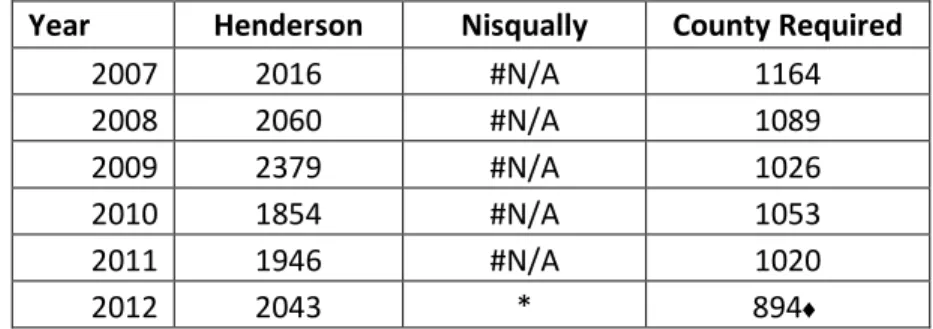
Table 5 lists the number of septic system parcels where the homeowner received operation and maintenance requirement information at time of certificate renewal. The majority of renewal notices for required
operational certificates are on a 3-year renewal cycle; five hundred thirty-seven systems (537) require an annual renewal. In Table 5 the number for any given year is approximately one-third of the total notices for that program area. Note that the Nisqually program began in 2013 with the first notices being sent at the end of 2012.
TABLE 5
Operational Certificate Renewal Notices
Notification of O&M Requirements
Year Henderson Nisqually County Required
2007 2016 #N/A 1164 2008 2060 #N/A 1089 2009 2379 #N/A 1026 2010 1854 #N/A 1053 2011 1946 #N/A 1020 2012 2043 * 894♦
*Nisqually has approximately 1424 notices sent annually.
♦In 2011 the Washington State Department took over management of all OSS t that were designed for flows greater than 3,500 gallons per day. That resulted in a reduction of 100+ County Req’d certificates.
Other than at Time of Transfer and for newly installed systems, the remainder of OSS owners do not receive written O&M recommendations for their OSS. Approximately 6,000 septic owners are annually sent
information regarding operation and maintenance of their specific septic system as a result of the three O&M programs, new OSS installations and the Time of Transfer program.
Fees and Budget
Ongoing O&M activities in Thurston County are supported by a variety of funding sources. The county-wide operational certificate program is funded through an individual fee charged to the owner or applicant at time of initial issuance and upon renewal. The Henderson and Nisqually MRA programs are primarily funded by an annual fee charged through the property tax statement. In the case of Henderson the cost of fully
implementing a successful program was greater than estimated, and grants have been used to supplement the budget. Grants have been used to augment work at Nisqually and dye testing and shoreline survey work along Eld Inlet. Grants have also been used to fund project work such as the current “Onsite Sewage Management in the Scatter Creek Aquifer” project and to fund the Urban Septic Assessment project in Lacey, Olympia and Tumwater and their urban growth areas. Beginning in 2010 a fee is charged for each septic tank pump report filed by pumping companies. This fee funds OSS complaint investigation and compliance activities for OSS reported to have deficiencies. A separate fee is charged for Time of Transfer reports.
Most fees must be paid in person by check or credit card. MRA program charges are collected through the property tax billing and collection system. Appendix C lists 2013 fees and program rates. The pump report fee is paid electronically by OSS pumping firms through a third party online web service and electronically
transferred to the County. The County is exploring the use of a web-based permit application system which would allow the public to apply for permits and pay associated fees online.
The 2014 budget for all O&M program costs is itemized in Table 6. The O&M budget does not include the time of transfer program. The bottom rows of the table identify the revenue source for the different programs and activities, as well as the number of staff for each.
TABLE 6
Thurston County Onsite Sewage Operation and Maintenance Program 2014 Budgets 2014 Budget Henderson MRA Nisqually Reach MRA MRA Compliance OSS Owner Incentives/Financial Assistance County-wide O&M TOTAL Salaries & Benefits $161,551.36 $175,599.72 $35,184.00 $2,253.52 $128,180.64 $502,770.00
Lab Services $3,500.00 $2,500.00 $500.00 $6,500.00 Postage $2,700.00 $2,700.00 $2,500.00 $7,900.00 Supplies $5,500.00 $4,000.00 $4,000.00 $13,500.00 Training $1,200.00 $1,000.00 $1,000.00 $3,200.00 Misc. expenses $2,000.00 $2,000.00 $2,000.00 $6,000.00 Mapping Services $5,000.00 $4,500.00 $5,000.00 $14,500.00 Owner Grants/Rebates $24,000.00 $24,000.00 Overhead/Internal Services $40,387.84 $52,679.92 $10,556.00 $676.06 $32,045.16 $136,345.00 TOTAL $221,839.20 $244,979.64 $45,740.00 $26,930.00 $175,225.80 $714,715.00 Revenue Source Charge on property Charge on
property State grant
Conservation District
Assessment Fee
OSS Renewal Notice Response, Inspections and Maintenance
OSS Notice Response
Septic system inspections are required at time of Operational Certificate renewal. Operational Certificates are required for all OSS within the two marine recovery areas of Henderson and Nisqually as well as 2,943 other systems as required by sanitary code. [Table 1]
When operational certificate renewals are required, the process is as follows: 60 days before inspection due date ….... Renewal Notice
30 days after due date.……… Second Notice – reminder
60 days after due date………. Third Letter – informing of impending noncompliance
120 days after due date……….. OSS automatically flagged as non-conforming; no permits can be issued until system brought into compliance
Upon completion of a satisfactory inspection and any needed maintenance or repairs, an OPC is issued. (If part of the countywide program, fees must also be received.) Table 7 shows that approximately half (range 44 -57%) of those who receive a first notice pay the fee if in the county-wide program, do the necessary inspection and required maintenance (pump tank or complete repairs), and renew their certificate. The compliance is similar for both Henderson and the county’s required OPC program.
TABLE 7
O&M Renewal Notices Sent and First Response
Year Henderson Renewed after 1notice st RequiredCounty Renewed after 1notice st
2007 2016 54% 1164 44% 2008 2060 46% 1089 53% 2009 2379 46% 1026 57% 2010 1854 48% 1053 54% 2011 1946 56% 1020 57% 2012 2043 54% 894 52%
Those who do not renew their certificate – either by not doing an inspection, not paying a renewal fee if in the county-wide program and / or not completing the required maintenance – receive a second notice thirty days after the certificate has expired. (In other words, three months after they receive the first notice.) Table 8 shows that about 40% of these who receive a second notice renew their certificate, i.e. do the required
inspection, pay the renewal fee if required, submit the report and complete any necessary maintenance. Note: Table 8 data is for 2010 – 2012. Second notice and non-conforming notice processes were not fully automated until 2010.
TABLE 8
O&M Program Second Notices and Response
Year Henderson Renewed after 2notice nd RequiredCounty Renewed after 2notice nd
2010 963 42% 485 42%
2011 859 44% 435 43%
2012 929 39% 497 37%
A final notice is sent sixty days after the due date if no inspection report is received or needed maintenance or repairs done, or no payment if in the county-wide program. About 27% of all notices initially sent, get a third letter. [Table 9] This notice informs the owner that their system is about to be out of compliance and gives the owner an additional sixty days to complete the inspection and any necessary maintenance. If the owner does not comply or call for an extension of deadlines, the system is automatically flagged as ‘non-conforming’ in the permit tracking system. In order to bring the system back into compliance, everything that was required to renew the OPC must be completed, and in addition all sewage tanks must be pumped, a county inspection done and a county field inspection fee paid.
Eighty-four percent (84%) of OSS with required OPCs are inspected and needed maintenance is completed in a timely manner. The notification process is labor intensive because approximately 45% of the owners need more than one notice.
TABLE 9
O&M Program Non-conforming Notices
Year Henderson Percent of total notices sent RequiredCounty Percent of total notices sent
2010 563 30% 280 27%
2011 482 25% 249 24%
2012 566 28% 314 35%
Inspections
Prior to 2011 pump and inspection reports could be submitted to the department on paper. Since January 1, 2011 all pump reports have had to be submitted electronically via OnlineRME – Responsible Management Entity. Since January 1, 2012 inspection reports completed by onsite professionals have had to be submitted via OnlineRME.
Effective January 2010, the sanitary code required that OSS requiring renewable OPCs in the county-wide program had to be inspected by an OSS professional. This change was made to ensure that these alternative systems were being inspected by qualified individuals.
TABLE 10
Number of OSS Inspections Reports Submitted
Year Henderson Percent of 1notices sentst RequiredCounty Percent of 1notices sentst Other County Inspections Reports Total Transfer*Time of
2007 1323 66% 824
70%
21 2168 2008 1697 82% 98090%
24 2701 2009 2009 84% 81680%
16 2841 2010 1932 104% 88784%
234 3053 16 2011 1903 98% 85984%
174 2936 86 2012 1957 96% 77987%
867 3603 381* Time of Transfer number is a subset of ‘County other’.
Maintenance: Tank Pumps
The most common OSS maintenance activity occurring is septic tank pumping. Since January 2010 pump reports have been filed electronically. To get an estimate of what percentage of tanks were pumped in Henderson during the first 3-year cycle, the number of pump reports received was divided by the number of notices sent in a given year. Most certainly tanks were being pumped without a renewal notice being sent. Though the almost 70% of septic tanks being pumped during the first 3-year Henderson cycle is a liberal estimate, more than a thousand tanks were being pumped each of the first three years. During the second cycle, 2010-2012, that dropped below 50%. About 3,700 tanks are being pumped annually in Thurston County.
TABLE 11
Septic Tank Pump Reports Submitted
Year Henderson notices sentPercent of County Req'd County Other Transfer*Time of
2007 1294 64% 452 89 2008 1513 73% 554 121 2009 1667 71% 565 249 2010 894 48% 552 1285 76 2011 944 49% 581 2346 370 2012 880 43% 447 2336 383
* Time of Transfer number is a subset of ‘County other’.
Maintenance: Sampling
Certain systems, such as those designed to meet a treatment standard, have required sampling as a condition of the operational certificate. The purpose of the sampling is to track the system’s performance and ensure adequate sewage treatment prior to disposal. Many of these systems were installed in highly sensitive areas, often as repairs, where soil and site conditions were not adequate for installation of conventional systems. Sampling is typically required on a quarterly basis.
Sample results are reported electronically through OnlineRME. All systems that have monitoring requirements have a 1-year renewal frequency and must have a service contract with a Certified Monitoring Specialist (CMS) to do inspections and sampling. As of 2012 all Monitoring Specialists are submitting their reports online. Staff is assigned to track these results on a quarterly basis and notify owners and their CMS if the system is not performing as designed.
TABLE 12
Monitoring Reports Submitted
Year Henderson Nisqually County
Req'd 2007 8 N/A 94 2008 8 N/A 91 2009 17 N/A 128 2010 18 N/A 104 2011 30 N/A 172 2012 86 25 171
Oversight of these complex systems is especially important because they are in highly sensitive areas and need to adhere to treatment standards. If not adequately treating sewage, disposal can pose a risk of fecal coliform or nutrient pollution to ground and surface water. Compliance status for monitored systems is listed in Table 13. Reasons for monitored systems being out-of-compliance include: 1) no CMS contract, 2) sample results not meeting treatment standards, 3) not renewing operational certificate and/or 4) not paying required fees.
TABLE 13
Compliance Status of Monitored Systems
November 2013
Area In Compliance Non-conforming Total
Henderson MRA 98 7 105
Nisqually MRA 44 1 45
County 212 42 254
Failing Systems
The department investigates complaints and reports of failing systems. When a failure is confirmed, the department notifies the owner of their responsibility to repair it and tracks progress for compliance. If the owner does not repair the system, the department uses a variety of methods to enforce compliance, including court orders and civil penalties.
Failing septic systems are currently identified through the following activities:
• Voluntary application of a repair permit
• Complaint report
• Time of transfer inspection report indicates problem
• OPC renewal inspection report indicates problem
• Pump report notes problem
• Failed dye test in MRA or special project area
Dye Test Results
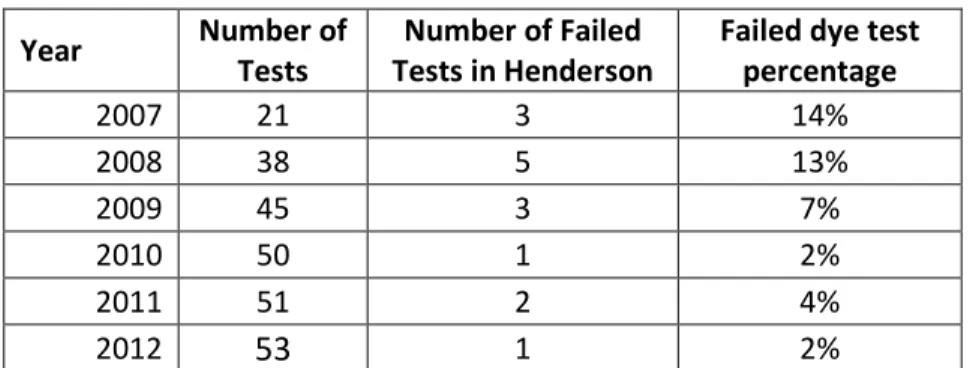
The O&M program in the MRAs uses dye test methodology to identify failing septic systems. Henderson and Nisqually programs require high risk systems, those with close proximity to water and restrictive soils, to have a dye test evaluation once every six years – every other renewal cycle. The methodology used is effective at finding systems failing to surface water. Approximately fifty dye tests are due every wet season in Henderson. Table 14 shows the number of systems found to be failing through dye testing. The dye test failure rate
dropped from 11 % during the first 3-year cycle of the Henderson program to 4% or less in the 2nd cycle
2010-2012. The reason for lower failure rate is unknown at this time.
The county has been conducting dye tests since the early 1990’s. The overall percent of shoreline systems found failing through dye testing has been 13 – 14%. This is the percentage seen during the first 2 years of the Henderson program, in 2007 and 2008. However, that rate has dropped to 2 – 4%. Following this data may help determine if routine dye testing and physical inspections and maintenance are contributing to lower rates of OSS failure.
TABLE 14
Number of Henderson MRA Failed Dye Tests
Year Number of
Tests
Number of Failed Tests in Henderson
Failed dye test percentage 2007 21 3 14% 2008 38 5 13% 2009 45 3 7% 2010 50 1 2% 2011 51 2 4% 2012
53
1 2%When an OSS fails a dye test,
• the owner is notified of the results;
• diagnostics are often performed to determine the cause of failure;
• Notice of Violation is issued with a timeline to repair; and
• O&M staff tracks repair progress through the permitting process.
Repair Records
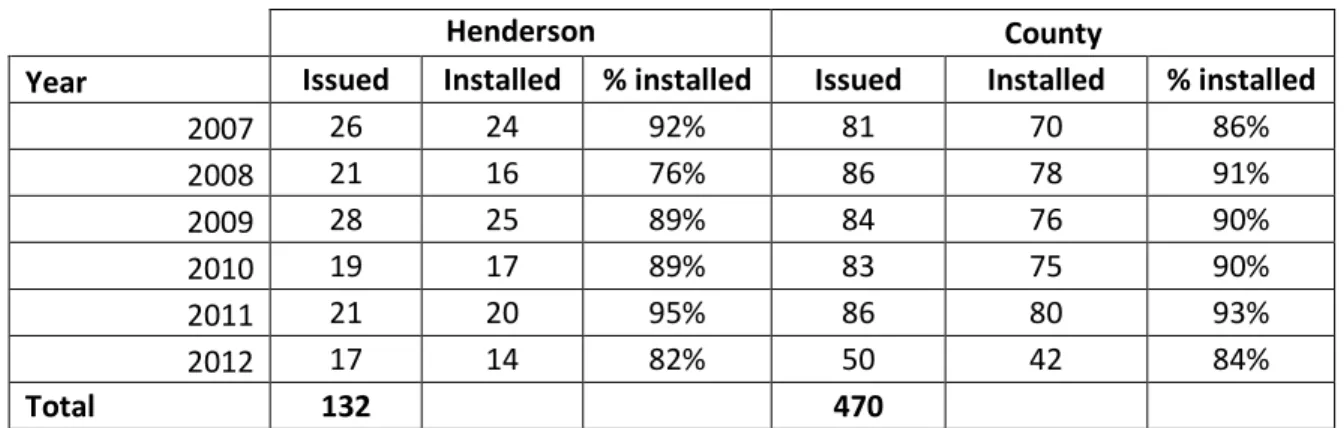
Another way to assess failures is to examine repair permit activity. Table 15 shows the number of system repair permits issued as well as the number installed. The rate of installation is consistent between the marine recovery area and the rest of the county.
For the six years examined, repairs of systems outside the Henderson MRA have been less than 1% – approximately 0.7% (470 permits / 63,490 systems) of the total estimated number of systems. Within the Henderson MRA 2.0% (132 repair permits /6,510) of the systems have been repaired. It is reasonable to conclude that the higher number of repairs within the Henderson MRA is because more failures are found as a result of regular inspections of every system.
TABLE 15 OSS Repairs Permits
Henderson County
Year Issued Installed % installed Issued Installed % instal