A Framework for Co-alignment of Doctor’s Performance and
Computer Mediated Characteristics in Hospitals:
Task and Technology Fit Perspective
Alfred Coleman
School of Computing, University of South Africa, South Africa Telephone: +27116749108, E-mail: [email protected]
KEYWORDS Technologies.Task. Mediated. Performance. Fit
ABSTRACT The evaluation of healthcare service task and how technology (computer mediated tools) support the delivery of such services in rural hospitals is of great concern to doctors at the point of healthcare servicedelivery. The study investigated the relevant set of healthcare service tasks rendered by the doctors in remote areas in South Africa and assessed how computer-mediated technology support users (doctors) to communicate with experienced or specialist doctors for professional advice using Task-Technology Fit Perspective. The case study approach was used. Participants were selected from a population group of doctors. Semi-structured, open-ended interview questions were used to gather evidences from the participants regarding the different task doctors perform, how do they communicate with their counterparts using computer mediated tools and how these tools fit and support the task and vice versa. The findings revealed that “time critical tasks, information dependent task and mobility task were not supported by the characteristics of computer mediated technology available in the hospitals. Thefindings leaded to a proposal of “Fit Task Technology Framework (FTTF). The FTTF is to co-aligndoctors’ tasks with technology (computer mediated tools). The proposed framework of FTTF will lead to high work performance of doctors, which will intend produce satisfaction to the doctors. Besides, the FTTF as a framework will underpin the assessment of doctors task and supportive communication technologies in other hospitals and healthcare institutions
INTRODUCTION
The delivery of healthcare services in Africa is severely affected by massive shortages of doctors, inadequate deployment of ICT infra-structure and unattractive incentives especially to doctors from universities who are deployed to remote rural hospitals in Africa. These doc-tors are often deployed to remote locations where access to knowledge sharing facilities to improve their work performance isunavailable (Colemanet al. 2012). The task of suchdoctors’ in remote environment is often categorized as routine and sometimes non-routine activities. These activities, either routine or non-routine can be aided by computer mediated tools such as (e-mail, Group support system-GSS, intranet, telemedicine system and video conferencing). All these toolsare components of Information and Communication Technology (ICT) systems and can bridge the gap between doctors in re-mote locations and specialist doctors in urban areas (Dates 2008). These tools which can pro-vide support to doctors in remote rural areas are not just mere mechanism for exchange of knowl-edge but a mechanism for creating knowlknowl-edge repository and accessing the knowledge
repos-itory (Walsh and Ungson 1991). They are tools (thus, technology ) which can fit and support the task of doctors if appropriately marched. However, a number of factors influence the effi-ciency of knowledge sharing which include the characteristics of the knowledge being shared and those of the channel and tool being used (Furst et al. 1999). Computer-mediated commu-nication system is a channel that can support and promote such knowledge sharing among health professionals (Dates 2008). Despite the compelling advantages of computer-mediated technology in healthcare, doctors deployed to remote regions in South Africa are unable to ac-cess neither a real time (synchronous) commu-nication nor asynchronous commucommu-nication through computer-mediated tool to communi-cate with their counterparts who are specialist doctors at provincial or teaching hospitals in South Africa for professional advice. This is compounded by a lack of substantive evidence regarding the impact of computer mediated tool (either synchronous or asynchronous) on health care service delivery and whether the tools like Group Support System (GSS) intranet or emails are adequately design to fit with the intended tasks (either routine or non-routine ) which these newly deployed doctors are exposed to.
Objectives
The purpose of this study, therefore, is to determine the relevant set of healthcare service tasks render by doctors in remote areas in South Africa and assess how computer-mediated tech-nology support users (doctors) to communicate with experienced or specialist doctors for pro-fessional advice using Task-Technology Fit Perspective.
Literature and Theoretical Background
‘Fit’ is defined as the matching of the ca-pabilities of technology to the demands of task (Vessey and Galleta 1991)]. Subsequently, Goodhue and Thompson (1995) defined ‘fit’as ‘task-system fit’ which means the degree to which information systems or systems envi-ronments assist an individual in performing a portfolio of tasks. The concept of fit is now well accepted in the Information Systems (IS) domain, where Task-Technology Fit (TTF) has been examined as a theory to assess the extent of technology functions to support user needs (Teo and Men 2008). The TTF model, based on rational choice theory, assumes users will adopt technology provided that it has the character-istics necessary to support their tasks. TTF, thus, refers to the extent of the capability of technology to support at ask (Teo and Men 2008). Technology will be utilized well only if the functions of the technology can support user needs (Dishaw and Strong 1999). It sup-ports the degree at which the functionality of a technology matches the task, and complements the abilities of the individual who is performing the task. This will determine the level of utiliza-tion (Junglas et al. 2009). ‘Under-fit’ denotes minimal technological capability because the tech-nology is ineffective when it does not sufficient-ly meet task requirements. Conversesufficient-ly, ‘over-fit’ implies excessive technological capability, be-cause the technology provides excessive re-sources, causing ‘IT slack’ (Gupta 2003). Thus, it can be implied that the best technology is the ‘fittest’, defined as adequate capability to suffi-ciently meet user needs, thus, aiding task com-pletion (Teo and Men 2008).
Task Characteristics
Tasks are defined as actions carried out by individuals in turning inputs into outputs, and
comprise features that move a user to rely more heavily on certain aspects of the technology (Balasubramanian et al. 2002). Based on a re-view of past TTF research, four task character-istics are deemed most relevant to the context of doctors (Time criticality, interdependence, mo-bility distinguishes and Information dependen-cy). Time criticality refers to the importance with which a task needs to be performed promptly or urgently, and flexibly (Gebauer et al. 2010). Flexibility captures the extent to which comput-er mediated tasks must be pcomput-erformed on time, whilst urgency reflects the degree of rigidity in time structuring and task completion, that is, to start and finish within a time window (Yuan et al. 2010). Interdependence referred to the extent to which an on-going task is related with other tasks and work units. This included the degree to which workers interact with and depend upon others to accomplish their work (Gebauer et al. 2005). This takes into account the extent to which coordination with other work units is required.
Mobility distinguishes mobile from stationary work, and has been measured as the frequency of absence of an individual from his or her stan-dard work location – described as location vari-ety (Yuan et al. 2010). The need for manoeu-vrability in spatially constrained spaces is also indicative of mobility (Junglas et al. 2009). In-formation dependency referred to the extent to which dynamic task related access to informa-tion is required to perform a task. This is also described as the extent to which a task depends on access to information at a service location such as a health service delivered at the point-of-care (Junglas et al. 2009). Information such as routes to a particular destination and envi-ronmental conditions is also critical to task per-formance (Yuan et al. 2010). Doctors may have the need to access field information (for exam-ple, the location of equipment or supplies need-ed) to complete monitoring tasks. Doctors carry out various monitoring, promotional and refer-ral tasks that have varying degrees of rigidity in time structuring that are, to promptly respond-ing to medical emergencies versus occasional follow-up care). In addition, they are engage in interdependent tasks requiring the coordination and sharing of patient and health related infor-mation and material resources with other health-care practitioners and facilities in the health sys-tem like clinics and hospitals (Teo and Men 2008). Doctors by nature work in varying
loca-tions, as they travel to various households in delivering health services at points of care. Con-sidering the nature of their work, time criticality, interdependence, mobility, and information de-pendency are relevant task characteristics and are, thus, examined as user needs important to TTF.
Technology Characteristics
Technologies are viewed as tools used by individuals in carrying out their tasks, and can refer to computer systems and devices, namely -hardware, software, and data (D’Ambra et al. 2013). This study is based Computer mediated Group support system (GSS) tools and email tools used by doctors. Based on a review of past TTF research, four GSS tool characteris-ticsmost relevant to the context of this study were identified. These are time criticality sup-port, interdependence supsup-port, mobility supsup-port, and information dependency support. Time crit-icality support referred to the degree to which the technology offers timely responses to re-quests for information (Wixom and Todd 2005) whilst supporting urgently required interven-tions by providing urgent information (Junglas et al. 2009). This is essential in dealing with emer-gency situations as they occur (Liang and Wei 2004). This aspect of technological functional-ity is instrumental to the provision of emergen-cy or time-critical services. Interdependence support referred to the degree to which technol-ogy supports the coordination of work in col-laborative settings (Teo and Men 2008). Teo and Men (2008) further suggest that users who per-form interdependent tasks should use technol-ogy that supports collaboration and coordina-tion (including informacoordina-tion sharing), as opposed to acting alone (Jarvenpaa and Staples 2000).The use of Group Support System (GSS) as a com-puter mediated tool is a viable option. A key indicator of support for task interdependence is the way in which technology allows data to be integrated from various sources (Wixom and Todd 2005) thereby, facilitating ease of coordi-nation amongst users. Mobility support referred to the extent to which technology enables spa-tial manoeuvrability, by adjusting according to calibrated individual movement, based on loca-tion sensitivity (Yuan and Zheng 2006). Loca-tion-aware services provide timely location
re-lated information to remote doctors as they per-form their tasks. Information dependency sup-port referred to the extent to which technology supports the performance of tasks that rely on the access to and use of information at the point of service. This includes identification and nav-igation mechanisms.
Time critical support is enhanced by Syn-chronous communication. SynSyn-chronous commu-nication is direct commucommu-nication where the com-municators are present at the same time. This includes, but is not limited to, a telephone con-versation, a company board meeting, a chat room event and instant messaging using a tool like Group Support System (GSS). Synchronicity ex-ists among individuals when they exhibit a shared pattern of coordinated synchronous behaviour with a common focus (Harrison et al. 2003). Asynchronous communication on the other hand, does not require all parties involved in the communication to be present at the same time. Asynchronous computer- mediated communi-cation is limited to communicommuni-cation where a net-work infrastructure capability of sustaining real time media connection is not cost-effective (Her-sh et al. 2006). Asynchronous remote communi-cation systems can be divided into the follow-ing: message, storage and discussion centric systems. Message-centric systems are those which function like e-mails (Vassallo et al. 2001). It enables doctors to send questions to special-ist doctors and receive replies. They are easy to use but lack content management features that are useful to establish a community of communi-cators. Storage centric systems are like Web or message-based picture archive communication systems that are often used in tele-radiology (Jirotka et al. 2005). It adds basic search and storage capabilities. Discussion-centric systems implement the functionality of a typical Web-based bulletin-board system (incorporating mes-saging, discussion, and image storage facilities) which allows for two way communication.
The present paper, therefore, positions asyn-chronous computer-mediated communication between storage and discussion-centric system. At the same time the study positionssynchro-nous communication through the use of Group support system (GSS) and assessed how these technologies support the doctors’ task and how these task fit the technology in the hospitals.
METHODS
The study was carried out in the North West Province of South Africa. Ten community hos-pitals in the North West Province of South Afri-ca were purposefully selected. These hospitals were selected based on their geographical loca-tions which span across the entire province and form part of the government owned institutions in South Africa.
The participants for the study were drawn from the entire population of doctors in the ten hospitals. In describing population (Polit and-Beck 2008)indicated that it is the aggregate of cases having a common and designated criteri-on that is accessible as subjects for a study. A purposive sampling technique was used in se-lecting the participants. A doctor from each of these hospitals was selected. The participants were selected by their professions which was relevant to the study. Ten doctors volunteered to participate in the study.
Data was collected using semi-structured open ended interviews. The interviewees repre-sented different roles ranging from specialist doctors to general practitioners. The interviewees were asked to tell in their own words:
1. The different task they perform,
2. The processes used in consultation with other doctors when performing emergency tasks,
3. Availability of computer-mediated commu-nication tools.
4. The level of satisfaction using the comput-er-mediated communication to enhance their task.
The interview lasted for one and a half hours with each interviewee and was audio-recorded and transcribed by the researcher.
Integrity of data entry from the study was checked by another researcher. Transcripts were coded using Wolcott (1994) method of case study analysis techniques. After the initial cod-ing, broad categories were identified by search-ing for patterns in the participants’ responses. The categories were Task Characteristics of doctors; Technology Characteristics; task tech-nology fit (Gss and email and intranet) based on doctors satisfaction.
RESULTS AND DISCUSSION
The results were categorized as indicated above and will be presented and discussed below.
Task Characteristics of Doctors
When the doctors were asked to explain the different tasks they perform, it became evident that some of the task were routine in nature while some were also non routine.
Some of the routine tasks mentioned by the doctors were time critical in nature and included
Performing physical examination and talk-ing to patients to diagnose their medical con-ditions
Admitting patients requiring special care followed by investigations and treatment;
Carrying out specific procedures, for exam-ple, performing operations and specialist investigations.
Prescribing appropriate drugs
Monitoring a patient’s responses to drugs
Modifying the drugs and drug dosages as necessary
In addition to these, the doctors indicated that they have to visit their patients in different wards to examine their condition and this must be done timely. Time criticality task, according to (Gebauer et al. 2010) refers to the importance with which a task needs to be performed promptly or urgently, and flexibly. Flexibility captures the extent to which computer mediated tasks must be performed on time, whilst urgency reflects the degree of rigidity in time structuring and task completion that is, to start and finish within a time window (Yuan et al. 2010)
One doctor stated “I woke up between 5:00-5:30 am to get to the hospital between 6:00-6:30 am, which gave me enough time to pre-round on my patients before pre-rounds at 8:30 am. Rounds usually lasted until 10:00-11:00 am; depending on how efficient we were and how many patients we were carrying”
In carrying out the routine task mentioned-above, doctors were asked to describe the pro-cess of consultation with other doctors when performing emergency tasks.
The doctors, further, indicated that their work is interdependence and work with other units and teams.
One doctor said:
“We work with other doctors as part of a team, either in the same department or within other specialties. We liaise with other medical and non-medical staff in the hospital to ensure quality treatment to promote health education.
And we teach junior doctors and medical stu-dents, as well as auditing and research”
Interdependence of task according to (Ge-bauer et al. 2005) refers to the extent to which an on-going task is related with other tasks and work units. This includes the degree to which workers interact with and depend upon others to accomplish their work and it is more pro-nounced when the task is unstructured in na-ture. This takes into account the extent to which coordination with other work units is required (Gebauer et al. 2005). This, therefore, requires a computer mediated technology to facilitate it.
It was also noted that some task mentioned by the doctors were
The next section will solicit responses from doctors the availability of computer-mediated communication tools to support their routine and non-routine task in the hospitals.
Technology Availability and Characteristics
The findings revealed that there are ICT equipment like computers, fax machines, tele-phones, scanners and Internet connections in the hospitals. The computers were found in the OPD (Out Patient Department) and in the ac-counts department. It was noted that there were computers in the doctors’ consulting rooms. These computers were used by the doctors fore-mails and also for video conferencing. It was also noted that the Internet connection in some of the hospitals (Taung, Ganyesa, Revilon, Bloemhof) was very slow and often down for two to three times per week. GSS was available in many of the hospitals.
Group support systems have frequently been used for group communication and idea genera-tion in synchronous meetings, in which group members meet in one place at the same time. Although, GSSs, in principal, can also be used to support asynchronous group work (in which group members may be temporally and spatially dispersed), research in dispersed groups has, however, been frequently conducted using ei-ther e-mail or computer conferencing. ‘Real-life’, organizational workgroups are considered as continuing, intact social systems engaged in projects that are likely to extend beyond tempo-ral boundaries of a single meeting.
Technologies (like emails and GSS) are viewed as tools used by doctors in carrying out their tasks, and canbe referred to
computer-me-diated tools (D’Ambra et al. 2013). Based on this TTF research, four GSS tool characteristics weremost relevant to the context of this study and were identified. These are time criticality support, interdependence support, mobility sup-port, and information dependency support. Time criticality support refers to the degree to which the technology offers timely responses to re-quests for information (Wixom and Todd 2005) whilst supporting urgently required interven-tions by providing urgent information (Junglas et al. 2009). This is essential in dealing with emer-gency situations as they occur (Yuan et al. 2010). This aspect of technological functionality is in-strumental to the provision of emergency or time-critical services. However, the findings indicated that the GSS used in the hospital could not pro-vide this support because of slow internet speed.
Interdependence support refers to the degree to which technology supports the coordination of work in collaborative settings (Teo and Men 2008).The findings reve1lled those doctors:
Worked with other doctors as part of a team, either in the same department or within oth-er specialties.
Liaised with other medical and non-medi-cal staff in the hospital to ensure quality treatment;
Promoted health education.
Thought junior doctors and medical stu-dents, as well as auditing and research Teo and Men (2008) suggested that doctors who perform interdependent tasks should use technology to support collaboration and coor-dination (including information sharing), as op-posed to acting alone (Jarvenpaa and Staples 2000). The use of Group support system (GSS) as a computer mediated tool in the hospital were not effectively used because of internet con-nectivity speed. Mobility support refers to the extent to which technology enables spatial ma-noeuvrability, by adjusting according to calibrat-ed individual movement, bascalibrat-ed on location sen-sitivity (Yuan and Zheng 2006). Doctors de-pended on asynchronous communication us-ing emails, intranet and internet to;
liaised with other medical and non-medical staff in the hospital to ensure quality treat-ment
undertook managerial responsibilities such as planning the workload of staffing of the hospital.
Besides, doctors could provide information to other remote doctors as they perform their tasks. Information dependency support that was provided to doctors refers to the extent to which emails and GSS supported the performance of tasks that rely on the access to and use of infor-mation at the point of service. This includes iden-tification and navigation mechanisms tosupport:
promotion of health education
Prescribing appropriate drugs
Monitoring a patient’s responses to drugs
Modifying the drugs and drug dosages as necessary and
Obtaining guidelines, protocols and stan-dards documents from many different bod-ies.
Considering the two computer communica-tion technologies reported in our study, GSS were often used in a decision room setting in time-and place-synchronous mode, while E-mail, on the other hand, is generally used by individuals who are temporally and spatially dispersed. The next section will report on doctors’ satisfaction in using these computer mediated communica-tion tools.
The Level of Satisfaction Using the Computer-Mediated Communication to Enhance Their Task
All the doctors (n=10) interviewed expressed their dissatisfaction about the use of the com-puter- mediated tool (e-mail) and cited the slow transmission speed of the Internet and down turn of Internet connectivity. Again the doctors expressed that consultation which involves the usage of GSS to share ideas with expert (special-ist doctor) were difficult because of poor and slow Internet connectivity and lack of adequate software application.
The dissatisfaction expressed by the doc-tors was categorized around, efficiency, adequa-cy and lack of Information which the computer mediated communication tools (GSS, e-mails in-ternet and intranet) could not support their task. According to Teo and Men (2008) Task-Tech-nologyFit (TTF) must promote technology func-tions to support userneeds and vice versa.
Based on the findings the next section ex-plores a Fit Task Technology Framework (FTTF) to improve doctors’ performance in hospitals.
The Need for Fit Task Technology Framework
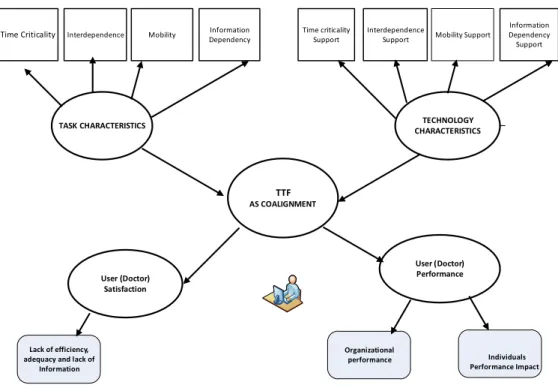
Based on preceding discussions, TTF is the degree to which technology supports tasks, when computer mediated tool functions ade-quately to meet userneeds. This study draws on TTF by emphasising ‘Fit as Co-variation’, one of Venkatraman and Prescott (1990) works. ‘Fit as Co-variation’ has been examined in thecon-text of hospital business unit strategy, and re-source allocation.
This framework perspectiveis defined by ap-attern of co-variation or internal consistency among a set of underlying theoretically related variables (Venkatraman and Prescott 1990). In the study’s context, these variables would com-prise time criticality, interdependence, mobility, and information dependency as a set of four task characteristics, which reflect doctor’s needs. The support for these four variables is provided by a set of four complementary technology char-acteristics, which reflect computer mediated tools (e-mails, GSS, intranet and internet) tool func-tions. ‘TTF as Co-variation’ is represented as a framework pattern of consistent task and tech-nology characteristics, all sufficient for amea-sure of ‘fit’ to be attained. The framework pat-tern is indicated in Figure 1.
‘TTF as Co-variation’ captures the pattern of co-variation amongst this study’s conceptu-ally related and contextuconceptu-ally relevant sets of task and technology characteristics, and their con-stituent dimensions (Venkatraman and Pres-cott1990). The task characteristics, technology characteristics, and the ‘fit’ between them are together illustrated in Figure 1. As per theories of fit, and theories of attitude and behaviour, use and user performance are consequences of the co-alignment between task and technology characteristics.
CONCLUSION
Having reviewed doctors task through a “fit task technology (FTT) perspective” in rural hospitals , unpacked the processes used in con-sultation with other doctors when performing emergency tasksit was noted that computer mediated tools (e-mails, GSS, Internet and Intra-net) do not support doctors activities during time criticality, task. It was further observed that there was no “fit “between the tasks performed by the doctors and computer communication tools available.
The findings lead to a proposal of Fit Task Technology Framework (FTTF). FTTF co align-ing the doctors tasks with technology.The pro-posal of FTTF will further lead to high perfor-mance of the doctors’work which will intend pro-duce satisfaction to the doctors. Besides, the FTTF being adopted as a framework will under-pin the assessment of doctors’ task and sup-portive communication technologies in hospi-tals and other healthcare institutions
RECOMMENDATIONS
It is recommended that high speed internet connectivity be provided to hospitals in rural communities.
REFERENCES
Balasubramanian S, Peterson RA, Jarvenpaa SL 2002. Exploring the implications of m-commerce for mar-kets and marketing. Journal of the Academy of Marketing Science, 30(4): 348-361.
Ballard DI, Siebold DR 2004. Organizational members’ communication and temporal experience: Scale
de-velopment and validation.Communication Research, 31(2): 135-172.
Coleman A, Herselman ME, Coleman M 2012. Im-proving computer-mediated synchronous commu-nication of doctors in rural communities through cloud computing: A case study of rural hospitals in South Africa. International Journal of Computer Science and Information Technology (IJCSIT), 4(5): 13-22.
D’Ambra J, Wilson CS, Akter S 2013. Application of the task-technology fit model to structure and eval-uate the adoption of e-books by academics. Journal of the American Society for Information Science and Technology, 64(1): 48-64.
Dates K 2008. Administrative Supplement for Tele-health/Telemedicine.National center on Minority Health Disparities (NCMHD). From<http:// www.ncmhd.nih.gov.>(Retrieved on 9 January 2012). Dishaw MT, Strong DM 1999. Extending the technol-ogy acceptance model with task-technoltechnol-ogy fit con-structs. Information and Management, 36(1): 9-21. Furst S, Blackbrun R, Rosen B 1999. Virtual Teams: A Proposed Research Agenda. Paper presented to Acad-emy of Management. August. Chicago, Chapel Hill, NC: University of North Carolin Kenan-Flagler Busi-ness School.
Gebauer J, Shaw MJ, Gribbins ML 2005. Towards a Specific Theory of Task-Technology Fit for Mobile Information Systems,Working Paper, 1-52. From < http://www.business.uiuc.edu/Working_Papers/pa-pers/05-0101.pdf.> (Retrieved on 12 November 2014).
Time Criticality Interdependence Mobility Time criticality Support
Interdependence
Support Mobility Support Information Dependency Information Dependency Support Lack of efficiency, adequacy and lack of Information Organizational performance Individuals Performance Impact TASK CHARACTERISTICS TTF AS COALIGNMENT TECHNOLOGY CHARACTERISTICS User (Doctor) Satisfaction User (Doctor) Performance
Gebauer J, Shaw MJ, Gribbins ML 2010. Task- technol-ogy fit for mobile information systems. Journal ofIn-formation Technology, 25(3): 259-272.
Goodhue DL, Thompson RL 1995. Task-technology fit and individual performance. MIS Quarterly, 19(2): 213-236.
Gupta S 2003. Knowledge Management and Perfor-mance: A Fit Perspective. Ninth Americas Confer-ence on InformationSystems. From <www.unf.edu/ ~s.gupta/.../Gupta_KM_ Performance_ Fit_AMCIS% 2003> (Retrieved on 11 December 2014). Harrison D A, Mohammed S, McGrath JE, Floret AT,
Vanderstoep SW 2003. Time matters in team per-formance: Effects of member familiarity, entrain-ment, and task discontinuity on speed and quality.
Personnel Psychology, 56: 633-669.
Hersh WR, Hickam DH, Severance SM, Dana TL, Krag-es KP, Helfand M 2006. Diagnosis, accKrag-ess and out-comes: Update of a systematic review of telemedi-cine services. J Telemed Telecare, 12(S2): 3-31. Jarvenpaa SL, Staples DS 2000. The use of
collabora-tive electronic media for information sharing: An exploratory study of determinants. Journal of Stra-tegicInformation Systems, 9: 129-154.
Jirotka M, Procter R, Hartswood M, Slack R, Simpson A, Coopmans C, Hinds C, Voss A 2005. Collabora-tion and trust in healthcare innovaCollabora-tion: The eDia-MoND case study. CSCW, 14: 369-398.
Junglas C, Abraham B, Ives I 2009. Mobile technology at the frontlines of patient care: Understanding fit and human drives in utilization decisions and perfor-mance, 46: 534-647.
Liang T, Wei C 2004. Introduction to the special issue: Mobile commerce applications. InternationalJour-nal of Electronic Commerce, 8(3): 7-17.
Polit DF, Beck CT 2008. Nursing Research: Generat-ing and AssessGenerat-ing Evidence for NursGenerat-ing Practice.
Philadelphia: Lippincott Williams and Wilkins Teo SH, Men B 2008. Knowledge portals in Chinese
consulting firms: A task-technology fit perspective.
European Journal of Information Systems, 17(1): 557-574.
Vassallo DJ, Swinfen P, Swinfen R, Wootton R 2001. Expe-rience with a low-cost. Telemedicine system in three de-veloping countries. J Telemed Telecare, 7: 56-58. Venkatraman N, Prescott JE 1990. Environment-
strat-egy co-alignment: An empirical test of its perfor-mance implications. Strategic Management Jour-nal, 11(1): 1-23.
Vessey I, Galletta D 1991. Cognitive fit: An empirical study of information acquisition. Information Sys-tems Research, 2(1): 63-64.
Walsh JP, Ungson GR 1991. Organizational memory.
Academy of Management Review, 16(1): 57-91 Wixom BH, Todd PA 2005. A theoretical integration
of user satisfaction and technology acceptance. 16(1): 85-102.
Wolcott HF 1994. Transforming Qualitative Data: Description, Analysis, and Interpretation. Thousand Oaks, CA: Sage.
Yuan Y, Zheng W 2006. The Fit between Mobile. Task and Mobile Work Support: A Theoretical Framework. Pro-ceedings of the International Conference on Mobile.
Yuan Y, Archer N, Connelly CE, Zheng W 2010. Iden-tifying the ideal fit between mobile work and mobile work support. Information and Management, (47): 125-137.