394
Cooperative multi-agents detection
with spatially distributed array sensors
Belkacem BENADDA and Fethi Tarik BENDIMERADDept. of Electrical and Electronic Engineering, University of Abou Bekr Belkaid Tlemcen, BP 230 Pole Chetouane 13000 Tlemcen Algeria
[email protected] [email protected]
KEYWORDS
Array Sensors, Acquisition, Beam-forming, Space filtering, source detection, multi-agent systems.
1 INTRODUCTION
Sensors have different technologies: hydrophone, laser diode, photo transistors, electrodes, antennas.... They can therefore claim to a wide range of applications: medical imaging, radar, sonar, underwater surveillance, astronomy, seismology, detection of mineral and oil deposits as well as communications systems. In our case, an array sensor is nothing than a group of several identical sensors with the same reference. Usually this reference is close to the network, commonly, and for practical considerations, this reference point coincides with one of them [1,2]. In the array the different measured signals will be identical except a delay corresponding to the spatial sensors disposition and geometry. This allows the array to exploit the spatial signals propagation characteristics: directions and location of the information sources [1-6].
Traditionally the basic receiver function consists to produce a very high signal to noise ratio, but in this work the basic function consist to decide effectively on the presence or absence of an information or noise sources. In our research, the treatment of signals measured by our intelligent array sensors is divided into two stages: a stage limited only to listening and spatial filtering, preceded by a
ABSTRACT
The aim of this paper deals with the design of a multi-agents system associated with array sensors dedicated to wireless telecommunications. We will present as first part, the spatially distributed array general modeled as well as the channel spatial propagation stimulus. Indeed, the integration and implementation of these systems is not simple and often goes through heuristics optimization design phases. This synthesis will be useful for selection of the different algorithms related to the beamforming and detection problem. As second part, we present the general multi-agents model proposed as solution. In this case multi-agents systems are presented as a new design paradigm that allows an efficient use of multicore-processor and distributed systems architectures currently widely available and preferred. In our case, multi-agents systems will bring the concepts of artificial intelligence, collaboration principles, autonomy, proactive behavior and communications possibility. The final solution will provide several issues: simultaneous several signals acquisition, effective spatial filttering, optimal performance under the imposed environment circumstances and prompt reaction and treatment.
395 stage of environment signals and
sources parameters detection. In this case, the estimation and detection is used to acquire information on several signals to make a selection decision. The purpose of this work is to create a complete multiagents system able to detect environmental sources and listen to them simultaneously. In our case, multi-agents systems are presented as new paradigm used to design intelligent independent systems. To accomplish this specific task, several agents with different goals, must cooperate on the system. In this paper we are using arbitrary 3D architecture array sensors combined with multi-agents systems. By this approach we are implementing cooperating agents for detection and beamforming.
2 ARRAY SENSORS MODELING Array sensors are formed with multiple elementary sensors, each one with a geometrical position in space and considered as independent observer in respect to a well-defined origin as shown in Figure 1 [1-7]. Each sensor provides a measure, if the array is composed with “N” sensors then the overall answer of the array will be
writes in vectorial form by (1) [2,7]: Figure 1. Array sensors general disposition [2,5-7]. ) ( ) ( ) ( ) ( 2 1 t x t x t x t X N (1)
2.1 Propagation channel modeling
The propagation channel is defined as the medium used by the different signals between transmitters and receivers [1,2,6-10]. Ideal connection is achieved if the received signal is exclusively the same as the emitted one without distortion. Alas, in reality the channel will alter the signals by adding: noise, attenuation, fading, absorption, dispersion, refraction, reflection, Faraday rotation, glitter, Dependence of polarization, Doppler Effect, and multipath (see Figure 2) [1,13,14].
Figure 2. The channel: fading, absorption, dispersion, refraction, reflection and multipath, effects.
We have used the block diagram shown on Figure 3, to simulate the channel effects. In this diagram, we model the multipath, fading and time propagation effects by equation (2) based on narrowband signals [2].
(2) With x(t) signal from the emitter,
path rank i propagation phase shift,
path rank i temporal delay.
x y z Signal wave d Pi P1 P2 sensor sensor sensor Source Array sensors
396 Figure 3. Implementation synoptic for
channel: multipath, fading, propagation delays and noise effects.
2.2 Array sensors signals specifications
The array response, detailed by equation (3), is a linear composition of the noise B(t) and Si(t) the incident signals on the array sensors.
L i Si t t X 1 ( ) ) ( (3)Obviously, based on the channel model, the number of incident signals “L” is greater than the source number
[2,6].
For any signal Si(t), the various sensors
outputs are identical except a certain delay which corresponds to the wave propagation time [2,6]: ) ( ) ( ) ( ) ( 2 1 M i i i i t s t s t s t S (4)
with “M” the array sensors number.
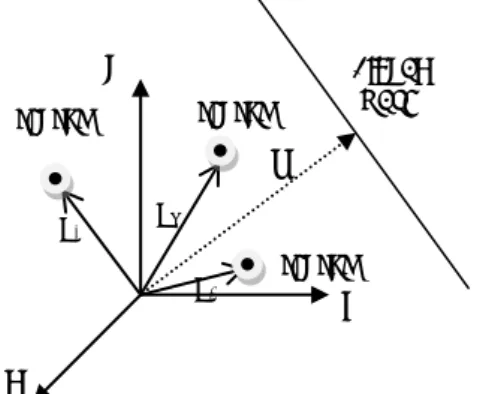
If we know signal Si(t) arrival direction
specified by the unit vector “d” (see
Fig.1), the various propagation delays can be estimated by (see Figure 4) [2,6]: c P d i i (5)
where “c” is the propagation velocity and vector “Pi” the sensor rank i
position.
Figure 4. Thedot product projection principle
used to estimate sensor rank i time propagation delay [2,6].
3 THE DETECTION STRATEGY In our case the array sensors detection problem is formulated by two points:
the estimation of the incident signals number “L”,
the different arrival directions determination.
To carry out spatial signals separation. Figure 5 describes the strategy we have adopted. The different phases, proposed and implemented, with our strategy are describe on the following sections. Randomly path number estimation based on Normal distribution AWGN noise N x(t) Source Output signals Pi d i P d Sig na ls nu m be r de tec ti on Beamforming Id en ti ty d etec ti on Data alignment Array sensors Tr aetme nt Tr aetme nt Tr aetme nt Data association Arriv al dire cti on estima ti on
397 Figure 5. The different phases adopted on the
detection spatial filtering strategy.
3.1 Treatment and data alignment phases
In this work we have considered only narrow band signals; the treatment phase will implement a passband filter. However, the alignment phase will perform an amplitude normalization to cope with the channel attenuation phenomena. Practically this is done through emitted power control [11,12].
3.2 Data association phase
In this phase we will regroup the measures from different “M” sensors in a single entity. According to equations (4) and (5) we can write:
L i si t Si t X 1 ( ) ) ( (6)where Si denote the array space vector. With narrow band assumption, the array space vector expressed by equation:
e
e
e
M j j j i S 2 1 (7)with propagation phase
delay. The matrix notation of the array response can be written by:
T L t s t s t s A t X( ) . 1 2 (8)where “A” denote the array manifold
matrix (9):
S S SL
A 1 2 (9)
It is now possible to calculate the correlation matrix “R” associated with
the measures from the two last phases by (10), which can be expressed with the manifold matrix by the equation (11).
H
t X t X E R . (10) GWN H R A S A R . . (11)where “RGWN” the noise correlation
matrix. This matrix is diagonal expressed by equation (12).
(12)
In this case represent the noise variance, considered the same as the noise power.
The association phase will estimate the correlation matrix “R” from the different sensors outputs and in a limited observation time “k”. The estimated matrix is carried out by [11,12]:
(13)
For important “k” values, the matrix “Ȓ” is considered as a good approximation.
3.3 Detection and beamforming phases
The detection phase based on the preceding ones, is divided onto three parts [2]:
Incident signals number detection,
Detection of signals arrival directions,
Identity detection, this part is introduced to correct the multipath effect by removing redundant signals,
The various sensors responses within the network must be combined by a suitable processing method in order to spatially extract the signals on the different detected directions [2]. Indeed, the detection result, specially the detected incident directions, will be
398 used to implement spatial filtering
approach based on a geometrical Smith algorithm or quadratic error optimization [2,7]. The beamforming phase, after acquisition and demodulation, cooperate with the identity detection to remove redundant signals or improve the acquisition quality.
4 MULTIAGENTS IMPLEMENTATION
Multiagents systems with the characteristics of artificial intelligence, collaborations, proactivity, autonomy, and data exchange capabilities, provide us, an interesting opportunity to implement the above strategy. The major problem encountered concern the roles to be played by the different agents in order to meet the overall detection and simultaneous acquisition objectives. The proposed architecture exploits the logic, reactive and BDI multi-agents architectures [2,16]. The intelligence and roles played by the different agents as well as predominant behavior of our multi-agents system, implementing the strategy of figure 5, are shown on Figure 6, with an indication of the main conversations exchanged.
Figure 6. Predominant behavior proposed for our multi-agents system.
5 SIMULATIONS AND RESULTS
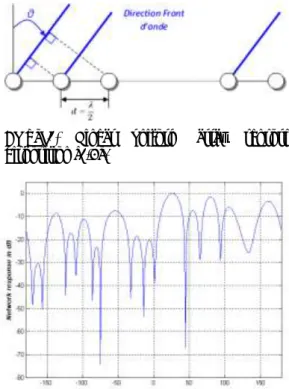
We have done simulations for different array sensors architectures. Some results were previously presented on different publications (see [2, 5, 6]). We present in Figure 8 the beam patterns for 10 sensors linear array (Figure 7); the signals arrival directions are imposed to [-75°; 20°; 40°]. The results shown in Figure 8 shows levels between 70dB and -80dB for directions detected corresponding to the assumed ones.
Figure7. Linear uniform array sensors
disposition [2,5].
Figure8. Multi-agents Detection done with
linear uniform array sensors with -75°, 20° and 40° arrival directions, 20° made-up as useful direction.
The multi-agents detection done with regular planar array Figure 9, is shown on Figure 10 for planar array of 16 elements (4 X 4). In this case three sources were simulated according to the directions (-30 °, -60 °), (50 °, 30 °) and (10 °, 10 °). The directivity obtained and the detected directions represented in Fig.10 show that the multi-agents reacts according to the environment directions.
399 The theme of intelligent array sensors
has received a particular importance, especially with the growth of wireless devices. The interest is mainly due to integration of modern signal processing, detection and artificial intelligence. In this issue, we have addressed the problem of intelligent detection and spatial filtering based on multi-agents systems associated with generic spatially distributed array sensors. However, the presented results are limited to narrowband signals. The problem addressed in this paper deals
with three main topics: the study and modeling of sensor networks with a
three-dimensional distribution, their use for environment sources detection and then perform a simultaneous acquisition. The results obtained with this research, show that the proposed multi-agents systems has ensure effective cooperation between the different detection and beamforming techniques avoiding duplications caused by the channel influence.
Figure 9. Planar uniform array sensors
architecture [2]. REFERENCES
1. Nikolay V. Kirianaki, Sergey Y. Yurish, Nestor O. Shpak, Vadim P. Deynega: Data acquisition and signal processing for smart sensors, John Wiley & Sons, Chichester
(2007).
2. Benadda B. : Détection coopérative multi agents pour réseaux de capteurs, detection des sources, filtrage spatial et acquisition simultanée, Editions Universitaires européennes EUE, Sarrebruck (2011). 3. Dimitris G. Manolakis, Vinay K. Ingle,
Stephen M. Kogon: Statistical and adaptive signal processing spectral estimation, signal modeling, adaptivefiltering, and array processing, Artech House, Boston (2005). 4. Robert J. M., Phased array theory and
technology, Proceedings of the IEEE, Vol.70, NO.3, p.246-302, New York, March (1982).
5. Benadda B., Bendimerad F.T.: Multiagent linear array sensors modelling, Communications in Computer and Information Science, vol.88, part 2, p.366-375, Springer, Heidelberg (2010).
6. Benadda B., Bendimerad F.T.: Cooperative multiagents detection and beamforming with spherical array sensors, Communications in Computer and Information Science, vol.189, part 2, p.460-469, Springer, Heidelberg (2011).
7. Benadda B., Bendimerad F.T.: Quadratic error optimization algorithm applied to 3D space distributed array sensors, Journal of Applied Sciences Research, p.1320-1324, October (2009).
8. Winters H.: Smart antennas for wireless systems, IEEE Personal Communications, Vol.1, p.23-27, New York, February (1998). 9. Robert J. M.: Phased array antenna
handbook, Artech House, Boston (2005). 10. Prabhakar S. N., Sensor array signal
processing, CRC Press, Boca Raton (2000).
11. Coulon F. : Theorie et traitement des signaux, PPUR, Lausanne (1996).
12. Kunt M. : Techniques modernes de traitement numerique des signaux, Vol.1, PPUR, Lausanne (1991).
13. Krim H., Viberg M.: Two decades of array signal processing research, IEEE Signal Processing Magazine, pp.67-94, New York July (1996).
14. Vern A. D.: Wireless data technologies, John Wiley & Sons, Chichester (2003).
15. Jay Guo Y.: Advances in mobile radio access networks, Artech House, Boston (2004).
16. Fabio Bellifemine, Giovanni Caire, Dominic Greenwood: Developing multi-agent systems
with jade, John Wiley & Sons, Chichester
400 a- Array spatially distributed response
b- Array sensors spatial power sensibility
Fig.10. Multi-agents Detection done with planar uniform array 16 (4X4) sensors with (-30 °, -60 °), (50 °, 30 °) and (10 °, 10 °) sources arrival directions, (10 °, 10 °) made-up as useful direction.
![Figure 4. The dot product projection principle used to estimate sensor rank i time propagation delay [2,6]](https://thumb-us.123doks.com/thumbv2/123dok_us/1071991.2642657/3.892.129.743.66.1167/figure-product-projection-principle-estimate-sensor-propagation-delay.webp)