Persistent 9P Sessions for Plan 9
Gorka Guardiola, [email protected]Russ Cox, [email protected] Eric Van Hensbergen, [email protected]
ABSTRACT
Traditionally, Plan 9 [5] runs mainly on local networks, where lost connections are rare. As a result, most programs, including the kernel, do not bother to plan for their file server connections to fail. These programs must be restarted when a connection does fail. If the kernel’s connection to the root file server fails, the machine must be rebooted. This approach suffices only because lost connections are rare. Across long distance networks, where connection failures are more common, it becomes woefully inadequate. To address this problem, we wrote a program calledrecover, which proxies a 9P session on behalf of a client and takes care of redialing the remote server and reestablishing con-nection state as necessary, hiding network failures from the client. This paper presents the design and implementation of recover, along with performance benchmarks on Plan 9 and on Linux.
1. Introduction
Plan 9 is a distributed system developed at Bell Labs [5]. Resources in Plan 9 are presented as synthetic file systems served to clients via 9P, a simple file protocol. Unlike file protocols such as NFS, 9P is stateful: per-connection state such as which files are opened by which clients is maintained by servers. Maintaining per-connection state allows 9P to be used for resources with sophisticated access control poli-cies, such as exclusive-use lock files and chat session multiplexers. It also makes servers easier to imple-ment, since they can forget about file ids once a connection is lost.
The benefits of having a stateful protocol come with one important drawback: when the network con-nection is lost, reestablishing that state is not a completely trivial operation. Most 9P clients, including the Plan 9 kernel, do not plan for the loss of a file server connection. If a program loses a connection to its file server, the connection can be remounted and the program restarted. If the kernel loses the connection to its root file server, the machine can be rebooted. These heavy-handed solutions are only appropriate when connections fail infrequently. In a large system with many connections, or in a system with wide-area net-work connections, it becomes necessary to handle connection failures in a more graceful manner than restarting the server, especially since restarting the server might cause other connections to break.
One approach would be to modify individual programs to handle the loss of their file servers. In cases where the resources have special semantics, such as exclusive-use lock files, this may be necessary to ensure that application-specific semantics and invariants are maintained. In general, however, most remote file servers serve traditional on-disk file systems. For these connections, it makes more sense to delegate the handling of connection failure to a single program, rather than need to change every client (including catandls).
We wrote a 9P proxy calledrecoverto handle network connection failures and to hide them from clients, so that the many programs written assuming connections never fail can continue to be used without modification. Keeping the recovery logic in a single program makes it easier to debug, modify, and even to extend. For example, in some cases it might make sense to try dialing a different file system when one fails.
measurements.
2. Design
Recoverproxies 9P messages between a local client and a remote server. It posts a 9P service pipe in/srvor mounts itself directly into a name space, and then connects to the remote server on demand, either by dialing a particular network address or by running a command (as in sshsrv).
Recoverkeeps track of every active request and fid in the local 9P session. When the connection to the remote server is lost, the remote tags and fids are lost, but the local ones are simply marked ‘‘not ready.’’ Whenrecoverlater receives a new request over the local connection, it first redials the remote connection, if necessary, and then reestablishes any fids that are not ready. To do this,recover must record the path and open mode associated with each fid, so that the fid can be rewalked and reopened after reconnecting. Reestablishment of remote state is demand-driven:recoverwill not waste network band-width or server resources establishing connections or fids that are not needed.
The details of what state needs to be reestablished vary depending on the 9P message. The rest of this section discusses the handling of each message and then some special cases. We assume knowledge of the 9P protocol; for details, see section 5 of the Plan 9 manual [9].
Version. Not directly proxied. Recoverassumes the 9P2000 version of the protocol. It is
consid-ered an error if the remote server lowers its chosen maximum message size from one connection to the next.
Auth. Not directly proxied. Recoverrequires no authentication from its local client, and uses the
localfactotum[2] to authenticate to the remote server. 9P2000 has no mechanism to reinitiate authenti-cation in the middle of a 9P conversation, so using the local factotum is really the only choice. A recoverrunning on a shared server could use the host owner’sfactotumto authenticate on behalf of other users, allowing multiple users to share the connection. This connection sharing behavior, which would need to trust theunamein theTattachmessage, is not implemented.
Attach. Not directly proxied. Recoverkeeps a single root fid per named remote attachment and
treatsTattachas a clone (zero-element walk) of that root fid.
Walk. Recoverreestablishes the fid if necessary and then issues the walk request. On success,
recoverrecords the path associated with newfid in order to recreate newfid if needed in the future.
Open. Recover reestablishes fid if necessary and then forwards the request. On success,
recoverrecords the open mode associated with fid so that it can be reopened in the future.
Create. Handled similarly to open, except thatrecovermust also update fid’s path on success.
Read, Write, Stat, Wstat. Recoverreestablishes fid if necessary, and then forwards the request.
Clunk. If fid is ready,recoverforwards the request. If fid is not ready,recoversimply deletes
the state it is keeping for fid and sends a successfulRclunk. There is one special case: if fid was opened remove-on-close, the fid must be reestablished if it is not ready, andrecoverrewrites theTclunkinto a Tremovewhen forwarding the request.
Flush. If the request named by oldtag has been sent to the remote server on the current connection,
theTflushrequest must be forwarded. Otherwise, if the connection has been lost since the corresponding request was sent, the request is no longer active:recover frees its internal state and responds with a Rflush.
Special cases
Remove on close. Before forwarding a Topen or Tcreate request, recover removes the
remove-on-close (ORCLOSE) bit from the open mode, so that the file will not be removed on connection failure. When forwarding aTclunkof such a fid, recoverrewrites the message into a Tremoveto implement the remove-on-close.
Exclusive-use files. Recover does not allow opening of exclusive-use files (those with the
QTEXCLqid type bit), to avoid breaking the exclusive-use semantics on such files. This prohibition could be relaxed to simply disallowing reestablishment of exclusive-use fids, but disallowing all access seemed
safer, especially in cases such as the mail system where the exclusive-use files are used as locks that protect other, non-exclusive-use files.
Directory reads. 9P imposes restrictions on the offset used in a directory read: it must be zero, to
start reading at the beginning of the directory, or it must be the sum of the offset of the last read and the number of bytes returned by that read. Internally, most 9P servers keep an internal representation of where the last read on a fid left off and treat a zero offset as meaning ‘‘start over’’ and non-zero offsets as mean-ing ‘‘continue from last read.’’ It is not possible to start a directory read in the middle if the connection is lost and the read must be restarted. Recoverhandles a failed mid-directory read by causing it to start over at the beginning of the directory, duplicating entries that were returned on the previous connection. This behavior is not ideal, but is not worse than the other stateless approaches. Perhaps the best approach would be to read the entire directory to implement a zero-offset read and then serve subsequent reads from a saved copy, but this issue does not arise frequently enough to bother us.
3. Implementation
Recover is implemented as two shared-memory procs, one reading local 9P requests (listensrv) and one reading remote 9P responses (listennet). Both procs can manipulate the per-fid and per-request state and can issue new messages to the remote server; they use a single lock to avoid both running at the same time. Errors writing to the remote server connection are ignored: connection fail-ures are noticed as failedreads inlistennet.
The difficult part of writing a program like recover is testing it. One of the authors wrote recoverin 1999 for the second edition of Plan 9. It worked well for day-to-day use mounting file servers across wide-area internet connections, and was used until 9P2000, the current version of 9P, was introduced in 2001. Even so, it occasionally failed in mysterious ways and was never fully debugged.
To testrecoverafter convering it for use in 9P2000, we added a testing flag giving a sequence of deterministic read failures to introduce (for example,3,5means that the third read should fail, and then the fifth read after that should fail). These read failures are interpreted bylistennetas connection failures, causing it to hang up and redial. We tested recover using a small workload that exercised each message, running the workload with all possible combinations of one and two simulated failures. This testing turned up some bugs, but the deterministic framework made them easy to isolate and correct.
4. Performance
Recoverruns on Plan 9 and also on Linux using the Plan 9 from User Space [3] libraries. We mea-suredrecover’s performance using the Postmark benchmark. All measurements are shown as the aver-age of 16,384 transactions.
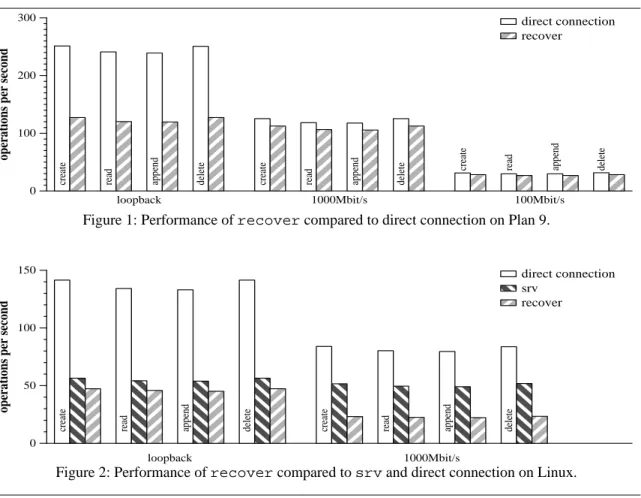
Figure 1 compares the performance of direct file server connections against connections proxied by recover, in three different configurations running on Plan 9: a local user-level file server running on the same machine, a file server connected via a 1Gbit/s ethernet, and a file server connected via a 100Mbit/s ethernet. The local connection is bottlenecked mainly by context switching overhead, so introducing a sec-ond user level process essentially halves the throughput. The overhead ofrecoveris far less noticeable on the ethernets, where local processing is no longer the bottleneck.
Figure 2 shows a similar comparison for Linux, using a local connection and a 1Gbit/s network con-nection. In this case there are three configurations in each comparison. The first is the Linux kernel mounting a user-level 9P file server directly. The second is the Linux kernel mounting a user-level 9P file server via the Plan 9 from User Space programsrv, which multiplexes multiple clients onto a single ser-vice connection. The third is the Linux kernel mounting the user-level 9P file server viarecover. On Linux,recoverposts its 9P service using thesrvprogram, so the comparison between the last two con-figurations isolates the slowdown due to recover. The relatively large difference between srv and recoveron the 1Gbit/s connection, especially in light of the relatively small difference on the local con-nection, is unexplained. Profiling usingoprofile[8] indicated that most of the time was spent in lock-ing routines, suggestlock-ing a performance problem in either the Plan 9 from User Space thread library, but we did not investigate deeply. We did not measure Linux on a 100Mbit/s ethernet connection, nor did we mea-surerecoverposting a service withoutsrv.
0 100 200 300
operations per second
direct connection recover
loopback 1000Mbit/s 100Mbit/s
create read append delete create read append delete
create read append delete
Figure 1: Performance ofrecovercompared to direct connection on Plan 9.
0 50 100 150
operations per second
direct connection srv
recover
loopback 1000Mbit/s
create read append delete create read append delete
Figure 2: Performance ofrecovercompared tosrvand direct connection on Linux.
Overall, the performance ofrecover seems entirely reasonable in the configurations where it is expected to be used. On Plan 9, usingrecoveron a fast network connection incurs approximately a 10% performance penalty. On Linux the penalty is higher, but we suspect performance bugs in other software. Over slower long-distance connections, the performance penalty is hardly noticeable.
5. Discussion
Recoveris not the first attempt to bring persistent 9P connections to Plan 9.
In the mid to late 1990s, Phil Winterbottom added this capability to a development version of the Plan 9 kernel, but it was never robust enough to be relied upon. Writingrecoverin user space made test-ing and debuggtest-ing considerably simpler. Use in high-performance situations might require movtest-ing recoverback into the kernel, but doing so would require finding some way to conduct exhaustive failure testing in order to be robust.
Peter Bosch’s aan [9] protocol is also used to provide persistent 9P connections. It serves as a lower-level transport protocol just above TCP, using a custom protocol to provide the view of a persistent network connection across multiple TCP sessions. Aanis protocol-agnostic but relies on having custom software and persistent state at both sides of the connection. Recoverdepends only on custom software and persistent state on the client side. As a result,recoveris slightly easier to deploy and is robust even against server failures or restarts. Vic Zandy’s TCP racks and rocks [7] also provide persistent network connections, and although they are implemented differently, for the purposes of this discussion they are logically equivalent toaan.
Finally, note thatrecoveris targeted mainly at traditional disk-based file systems and is not appro-priate in all contexts. Synthetic file systems such as/net [6] often assign meanings to individual file operations and destroy state when files are closed. On such systems, simply reconnecting and replaying a sequence of opens and walks does not recreate the state at the time of the connection failure. Handling these situations requires failure-aware applications or infrastructure such as Plan B’s/net[1].
References
[1] Francisco J. Ballesteros, Eva M. Castro, Gorka Guardiola Muzquiz, Katia Leal Algara, and Pedro de las Heras Quiros. ‘‘/net: A Network Abstraction for Mobile and Ubiquitous Computing Environments in the Plan B Operating System. 6th IEEE Workshop on Mobile Computing Systems and Applications, 2004. [2] Russ Cox, Eric Grosse, Rob Pike, David L. Presotto, and Sean Quinlan. ‘‘Security in Plan 9.’’ USENIX Security Symposium, 2002.
[3] Russ Cox. Plan 9 from User Space. http://swtch.com/plan9port
[4] Jeffrey Katcher. ‘‘Postmark: a New File System Benchmark.’’ Network Appliance Technical Report TR3022, October 1997. http://www.netapp.com/tech_library/3022.html
[5] Rob Pike, Dave Presotto, Sean Dorward, Bob Flandrena, Ken Thompson, Howard Trickey, and Phil Winterbottom. ‘‘Plan 9 from Bell Labs.’’ Computing Systems, 8, 3, Summer 1995, pp. 221-254.
[6] Dave Presotto and Phil Winterbottom. ‘‘The Organization of Networks in Plan 9.’’ Proceedings of the 1993 USENIX Winter Conference, pp. 43-50.
[7] Victor C. Zandy and Barton P. Miller. ‘‘Reliable network connections.’’ Proceedings of the 8th annual International Conference on Mobile Computing and Networking, 2002, pp. 95-106.
[8] OProfile a System Profiler for Linux. http://oprofile.sourceforge.net/ [9] Plan 9 manual. http://plan9.bell-labs.com/sys/man/5/INDEX.html