DOI: 10.1051/0004-6361:20030026 c
ESO 2003
Astrophysics
&
Introducing GOLDMine: A new galaxy database on the WEB
G. Gavazzi
1, A. Boselli
2, A. Donati
1, P. Franzetti
3,1, and M. Scodeggio
31 Universit`a degli Studi di Milano-Bicocca, Piazza delle scienze 3, 20126 Milano, Italy e-mail:[email protected]
2 Laboratoire d’Astrophysique de Marseille, Traverse du Siphon, 13376 Marseille Cedex 12, France e-mail:[email protected]
3 Istituto di Astrofisica Spaziale e Fisica Cosmica, CNR, via Bassini 15, 20133 Milano, Italy e-mail:[email protected];[email protected]
Received 15 October 2002/Accepted 11 December 2002
Abstract. The new World Wide Web site “GOLDMine” (Galaxy On Line Database Milano Network) (http://
goldmine.mib.infn.it) contains a multiwavelength data-base of an optically selected sample of 3267 galaxies in the Virgo cluster and in the Coma Supercluster. It is designed for professional astronomers who wish to find data and images for these galaxies. Data gathered in 15 years of observational campaigns by the authors or taken from the literature include general parameters (catalogue names, celestial coordinates, morphological type, recessional velocity etc.), multiwavelength continuum photometry (totalUV,U,B,V,J,H,K, FIR and radio magnitudes/flux densities), line photometry (HI, H2, Hα), dynamical parameters (rotational velocity from the HI and Hαlines, velocity dispersion) and structural parameters (light concentration index, effective radius and brightness, asymptotic magnitude) in the optical (BandV) and Near Infrared (HorK) bands. Images include finding charts, optical (BandV), Hα, Near Infrared (Hand/orK) and true color RGB frames (when available). Radial light profiles obtained from theB,V,HorKband images are also available. Integrated optical spectra along with broad Spectral Energy Distributions (SED) from theUVto the radio domain are given. All images can be obtained in JPG format, but the original (reduced) FITS images can be downloaded as well. The database will be updated regularly and will be extended to other local clusters and superclusters. Astronomers who wish to have their images included in GOLDMine are strongly encouraged to send us their material.
Key words.atlases – galaxies: general 1. Introduction
Galaxies come in many different forms and sizes, but they can be broadly divided into two main species:Spirals, with a flat-tened, disk-like shape, blue colors, much gas and dust, and a widespread star formation activity that results in the pres-ence within them of many young stars, andEllipticals, with a spheroidal shape, red colors, little or no gas and dust, and no star formation activity, thus containing exclusively old stars. While these differences are well documented, and have been extensively studied over the last 70 years, astronomers are not yet able to convincingly explain the origin of such diversity. In fact, one of today’s major open issues in astronomy is to obtain a plausible reconstruction of the processes of galaxy for-mation and evolution. The task is of course enormously com-plicated by the sheer disparity between cosmological and hu-man time-scales, that makes it impossible for astronomers to witness galaxy evolution directly. One possible way to over-come this problem is to take advantage of the “time machine”
Send offprint requests to: G. Gavazzi, e-mail:[email protected]
effect provided by the finite speed of light. Observing today galaxies at different distances means observing them at diff er-ent epochs in the history of the Universe, and thus with dif-ferent ages. Unfortunately distances must be very large be-fore age differences become significant, and therefore unveil-ing the evolution of galaxies with direct observations of very distant objects is becoming a reality only today, with the ad-vent of the 10 m class telescopes. Galaxies at progressively larger look-back times (redshift), thus in a younger evolution-ary stage, will be observed in the near future, back to a small fraction of the present age of the Universe. This will provide us with a sequence of “fossil” galaxies, eventually disclosing the secret of their evolution, much as fossil organisms guided paleontologists tracing back the evolution of species. However, 15 years ago, when we initiated this project, a direct obser-vational approach to the problem was unconceivable, because of the lack of proper telescopes and instrumentation. The only available option was to attack the evolutionary enigma start-ing from the study of evolved systems, i.e. the nearby galaxies. This approach is based on the conviction that “adult” galaxies
a large effort in making the literature data as homogeneous as possible with our own data. GOLDMine is designed to provide access to this massive data-set on local galaxies through the World Wide Web. Numeric parameters as well as the (reduced) scientific FITS images can be downloaded.
2. The sample selection
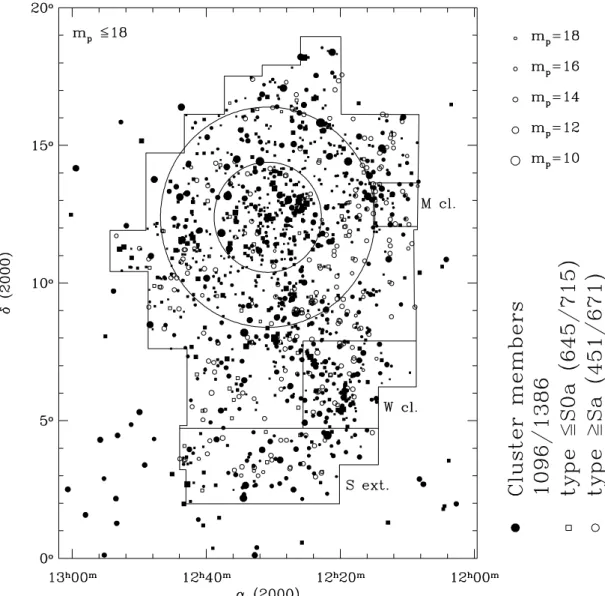
GOLDMine is focused on two regions of the sky: the Virgo cluster and the Coma Supercluster1. Among rich clusters of galaxies, the Virgo cluster is the nearest to us (17 Mpc, Gavazzi et al. 1999b) (see Fig. 1). The Coma supercluster contains two rich clusters (Coma & Abell 1367) corresponding to the den-sity enhancements in Fig. 2. In addition, this region contains a filament of nearly isolated galaxies, the so-called “Great Wall” at a distance of approximately 90 Mpc (7000 km s−1, Gavazzi et al. 1999a) from us (see Fig. 2). The studied regions contain 3 rich clusters of galaxies as well as isolated objects, thus provid-ing the ideal laboratory for a comparative analysis of galaxies in different environments.
As opposed to other more extensive galaxy data-bases (e.g. NED, LEDA) which include all objects with published param-eters, galaxies in GOLDMine were selected with the criterion of optical completeness. All galaxies brighter than a threshold magnitude were selected in both areas. In the Coma superclus-ter all galaxies brighsuperclus-ter than mp = 15.7 were selected from the Catalogue of Galaxies and of Clusters of Galaxies (CGCG) by Zwicky et al. (1961-1968)2. The Virgo region contains all (2096) galaxies brighter thanmp=20.0 from the Virgo Cluster Catalogue (VCC) by Binggeli et al. (1985)3. Obviously, due to the factor of 5 difference in distance between the Virgo and the Coma clusters, this selection limit results in dwarf galaxies from being included in our database only for the Virgo clus-ter. However, globally GOLDMine covers the whole range (4 orders of magnitude) of luminosities spanned by real galaxies. Altogether GOLDMine contains 3267 galaxies, approxi-mately 60% of which are of early-type (elliptical and S0) and the remaining 40% of late-type (spirals and irregulars).
Extensive campaigns were carried out to observe as many as possible of the 3267 target galaxies through all possible ob-servational windows, a task that we have not yet completed. Moreover we collected data from the literature and we made
1 An additional 382 galaxies (withm
p≤15.7) in the A262 (Perseus-Pisces) and Cancer clusters and in the Hercules supercluster (A2147, A2151, A2197, A2199) will be included shortly in GOLDMine.
2 The number of galaxies meeting them
p ≤15.7 criterion is 1082. However 45 galaxies listed as “pairs” in the CGCG were split into fainter (mp ≤ 17.0) components. The resulting Coma galaxies in GOLDMine are 1127.
3 44 additional Virgo galaxies withm
p ≤14.5, 12h <RA<13h, but outside the area covered by the VCC are included.
into 5 categories: General, Continuum and Line photometry, Dynamical and Structural. All parameters are extensively de-scribed and referenced in the section “GOLDMine glossary”. See also the section “GOLDMine tutorial” to learn about using the database.
The parameters can be obtained from GOLDMine in two ways:
1) by querying the database for an individual galaxy name, or 2) by a multiple query “by parameters”. In this case all galaxies in a given range of photographic magnitude and morphological type can be selected. The query criteria include also the avail-ability of continuum, line photometry, dynamical and structural parameters.
General parameters include: CGCG (Zwicky et al. 1961-1968), NGC (Dreyer 1888), IC (Dreyer 1895, 1908), VCC (Binggeli et al. 1985), UGC (Nilson 1973) designations; Celestial coordinates precessed to the year 2000; isophotal di-ameters; photographic magnitude; heliocentric recessional ve-locity; distance and morphological type.
Continuum photometry parameters consist of total magni-tudes from aperture or CCD photometry, uncorrected for ex-tinction either internal or due to our Galaxy. They include:UV
(2000 Å); optical (U,B,V); Near-IR (J,H, K) magnitudes; Far-IR (IRAS 60 and 100 µm); radio continuum (1420 and 610 MHz) fluxes.
Line photometry parameters include: the atomic (HI) and molecular (H2) hydrogen mass (the corresponding fluxes can be derived using the source distance); the Hα+[NII] line equiv-alent width and flux.
Dynamical parameters include: the width of the HI line, with a quality flag; the width of the Hαline and the central velocity dispersion.
Structural parameters include the light concentration in-dex (C31); the effective radiusRe; the effective surface bright-nessµe; the total asymptotic magnitude. These quantities are given separately for theH,VandBbands.
4. Imaging
The novelty of GOLDMine is its image section, where im-ages can be downloaded in JPG and FITS format. They can be accessed via the the queries “by name” or “by parameters”. Images include:
– Finding Charts from the Digitized Palomar Sky Survey. Each selected galaxy appears at the center of the 10 × 10 arcmin2finding chart. When multiple catalogued galax-ies appear in the same finding chart, each of them can be se-lected by clicking on their names. In this case the database and image queries are re-directed to the selected galaxy. – Broad bandimages obtained in theB,V,HandKbands.
Fig. 1.Sky distribution of the 1386 galaxies brighter thanmp ≤ 18.0 in the Virgo cluster. Possible and spectroscopically confirmed cluster members (filled symbols) are 1096.
– Narrow bandimages in the light of Hα. Each galaxy has two Hαimages: the “OFF-band” one which gives the un-derlying stellar continuum near Hα and the “NET” one, obtained by subtracting the OFF-band image from the ON-band one.
– RGBimages. For few miscellaneous galaxies we combined several images to obtain “true” color pictures (only avail-able in JPG format). Some are combinations ofH,VandB
frames, other of HαOFF, ON and NET frames.
– Light profiles. Radial profiles of the light distribution as obtained on the available (B,V,H) images. See Gavazzi et al. (2000). When at least two radial profiles are available the color radial profile is also shown (only available in JPG format).
– Spectroscopy. These are optical spectra integrated over the whole surface of the galaxy (obtained in drift-scan mode, i.e. by drifting the spectrograph slit over the galaxy ex-tension), see Gavazzi et al. (2002). Spectra were obtained in several observational campaigns carried out with optical
telescopes (OHP 1.9m, ESO 3.6m) by Gavazzi et al. (2002). Spectra exist for 141 galaxies, but 80 additional spectra will be included in GOLDMine shortly.
– SEDs. These are Spectral Energy Distributions from the UV to the centimetric radio continuum obtained from broad-band photometry (only available in JPG format). The plotted data are total fluxes (extrapolated to the optical radii), unlike the individual aperture data given by NED. However they are given as observed, i.e. uncorrected for extinction from our Galaxy and for internal extinction4. It is our goal to provide a homogeneous set of keywords in all FITS headers to characterize the data. These will include:
– Galaxy name.
– Effective integration time.
4 some SEDs contain more data points than listed in the GOLDMine database. For example the IRAS 25 µm flux and the fluxes obtained by ISO (CAM and PHOT) are plotted without being listed in GOLDMine.
Fig. 2.Sky distribution of the 1127 CGCG galaxies in the Coma supercluster region. Spectroscopically confirmed supercluster members (filled symbols) are 649.
– Filter. – Telescope. – WCS parameters.
– Photometric effective zero point (when available) in mag/s for broad band images or in erg cm−2 s−1 for Hαimages, such that log Flux =Z p + log Cnts −log Texp. The ef-fective zero point includes the atmospheric extinction term. This homogenization is not yet complete. Its progress will be detailed in the online “GOLDMine news” section.
5. Summary
We undertook a 15 year research project focused on the prop-erties of galaxies in the local universe which brought some new insight into their phenomenology and possibly will help reveal their origin and evolution (see Gavazzi 1993; Gavazzi & Scodeggio 1996; Gavazzi et al. 1996, 2002; Boselli et al. 2001). – A complete, optically selected sample of 3267 galaxies rep-resentative of all morphological types and luminosities was extensively surveyed through various observational win-dows from theUVto the centimetric radio.
– The surveyed regions include the Virgo cluster and the Coma supercluster.
– Numeric parameters and images are made available to the international community through the World Wide Web site http://goldmine.mib.infn.it.
If your research benefits from the use of GOLDMine, we would appreciate the following acknowledgement in your pa-per: “This research has made use of the GOLDMine Database, operated by the Universita’ degli Studi di Milano- Bicocca”. Please also cite the present paper.
Acknowledgements. We wish to thank all people who contributed with data to GOLDMine: Gery Bernstein, Christian Bonfanti, Barbara Catinella, Luis Carrasco, Fabienne Casoli, Alessandra Contursi, Luca Cortese, John Dickey, Anna Gallazzi, Bianca Garilli, Jorge Iglesias-Paramo, Walter Jaffe, Robert Kennicutt, James Lequeux, Silvia Martocchi, Paola Pedotti, Daniele Pierini, Isabella Randone, Gerry Sanvito, Ginevra Trinchieri, Richard Tuffs, Jose M. Vilchez, Stefano Zibetti. In particular the FOCA team (J. Donas, B. Milliard, M. Laget, M. Viton) is acknowledged for UV fluxes made available prior to publication. We also wish to thank the Time Allocation Committee of many observatories where the data here collected were taken. GOLDMine is supported by the Physics Department of Universit`a degli Studi di Milano-Bicocca. A.B. acknowledges financial support from the French Programme National Galaxies (PNG). P.F. acknowl-edges support from CNR/ASI grant I/R/27/00.
The GOLDMine web site has been created using the Python pro-gramming language, the Apache web server software and the MySQL
database. We wish to thank the developers of these packages for freely distributing these resources that have made possible the construction of this site.
References
Binggeli, B., Sandage, A., & Tammann, G. 1985, AJ, 90, 1681 Boselli, A., Gavazzi, G., Donas, J., & Scodeggio, M. 2001, AJ, 121,
753
Dreyer, J. 1888, MMRAS, 49, 1 (NGC) Dreyer, J. 1895, MMRAS, 51, 185 (IC) Dreyer, J. 1908, MMRAS, 59, 105 (IC) Gavazzi, G. 1993, ApJ, 419, 469
Gavazzi, G., & Scodeggio, M. 1996, A&A, 312, L29
Gavazzi, G., Pierini, D., & Boselli, A. 1996, A&A, 312, 397 Gavazzi, G., Carrasco, L., & Galli, R. 1999a, A&AS, 136, 227 Gavazzi, G., Boselli, A., Scodeggio, M., Belsole, E., & Pierini, D.
1999b, MNRAS, 304, 595
Gavazzi, G., Franzetti, P., Scodeggio, M., Boselli, A., & Pierini, D. 2000, A&A, 361, 863
Gavazzi, G., Bonfanti, C., Sanvito, G., Boselli, A., & Scodeggio, M. 2002, ApJ, 576, 135
Nilson, P. 1973, Uppsala General Catalogue of Galaxies, Uppsala, Obs. Ann. 6 (UGC)
Zwicky, F., Herzog, E., & Wild, P. 1961-1968, Catalogue of Galaxies and of Clusters of Galaxies, Pasadena: California Institute Of Technology (CGCG)