2003-2009
University of Michigan Law School Year 2008
Do Delaware CEOs Get Fired?
Murali Jagannathan
∗Adam C. Pritchard
†∗State University of New York at Binghamton, [email protected] †University of Michigan Law School, [email protected]
This paper is posted at University of Michigan Law School Scholarship Repository. http://repository.law.umich.edu/law econ archive/art93
Do Delaware CEOs Get Fired?
Murali Jagannathan AA210, School of Management
Binghamton, NY 13902 [email protected]
(607) 777-4639 A.C. Pritchard* 1039 Legal Research
University of Michigan Law School Ann Arbor, Michigan 48109
[email protected] (734) 647-4048 This Draft: June 2013
Abstract
Critics have charged that state competition in corporate law, which Delaware dominates, leads to a “race to the bottom” making management unaccountable. One metric of management accountability is forced CEO turnover, which we use to test the race to the bottom hypothesis. We compare California firms that choose to incorporate in California – the state with arguably the most restrictive corporate law rules – with those that incorporate in Delaware. We show that aspects of Delaware law attract firms that plan to grow through merger or acquisition and are vulnerable to shareholder lawsuits. We also document differences in corporate governance that correlate with Delaware incorporation. On the ultimate question, we show that firms incorporated in Delaware are no less likely to terminate CEOs in the wake of poor performance. Certain governance measures that correlate with Delaware incorporation increase likelihood of termination. The evidence presented here does not support the race to the bottom hypothesis.
JEL Classification: G30, G34, K22
Keywords: Corporate governance, charter competition, CEO turnover.
1. Introduction
In this paper, we examine the relation between state corporate law and forced CEO turnover. State corporate law determines most questions of internal corporate governance, such as the role of boards of directors and the allocation of authority between directors, managers and shareholders. Under state corporate law, directors are charged with managing the business and affairs of the corporation. Perhaps the most salient aspect of that responsibility is the board’s decision to hire or fire the CEO. The decision to fire the CEO has taken on magnified importance in the last two decades, as the rate of CEO terminations has escalated sharply (Kaplan & Minton, 2012). We focus here on that decision: Does state corporate law influence the decision to terminate the CEO?
Companies have discretion in choosing their state of incorporation. The allocation to the states of primary authority over corporate governance, when combined with the “internal affairs” doctrine, which holds that courts must apply the law of the state of incorporation to corporate law disputes, has created a regime of “issuer choice” in state corporate law. Issuer choice allows corporations to choose their preferred state corporate law without regard to where the corporation is headquartered or principally does business.
Issuer choice implies that states can compete to attract firms by offering the most attractive corporate law regime. Delaware has clearly prevailed in the competition for corporate charters. That state draws a clear majority of the nation’s largest public companies to incorporate under its corporate code, despite its relatively small population and share of the national economy. In 2012, 90% of IPOs in the United States were incorporated in Delaware.1
Subramanian (2002) suggests that the competition for corporate charters is largely bilateral:
1 Delaware Division of Corporations, 2012 Annual Report, at 2, available at http://corp.delaware.gov/pdfs/2012CorpAR.pdf.
states compete with Delaware in an effort to retain corporate charters. This competition for corporate charters is not just about state pride: Winning the competition for incorporations yields tangible benefits in the form of charter fees. Charter fees made up more than a quarter of Delaware’s tax revenues in 2012. 2
Critics of issuer choice argue that Delaware competes for corporate charters by pandering to management. Delaware has won this competition, according to this view, by leaving shareholders vulnerable to overreaching by corporate managers, who dominate the incorporation decision. Most famously, William Cary (1974), a former SEC chairman, charged that states were caught in a “race to the bottom,” providing rules that undermine management accountability to shareholders. The most salient form of management accountability in contemporary corporate governance is CEO firing. Does Delaware incorporation promote governance structures that protect managers from involuntary termination?
In this paper, we shed light on the relation between Delaware incorporation and forced CEO turnover. Cary and other race to the bottom adherents argue that Delaware encourages lax monitoring. If Delaware boards are inattentive, they will be less likely to hold CEOs accountable for poor performance. To test this hypothesis, we first develop a model of incorporation choice based on salient differences between Delaware and California corporate law. We focus on California because of its relatively strict corporate code and the pronounced exodus of California headquartered firms to Delaware found by Subramanian (2002). If there is a race to the bottom, the clearest evidence should be found in firms migrating from California to Delaware.
We argue – and demonstrate – that Delaware lures firms intent on growth through acquisition from California. Mergers attract lawsuits, and growth firms also face a greater risk of securities fraud class actions. Consequently, directors of growing firms may prefer Delaware’s predictable courts and surer protection against personal liability relative to California. The downside of liability protections, however, is that they may reduce the incentive of directors to monitor management. Cary (p. 686) notes in particular Delaware’s director-friendly standard regarding the duty of care and indemnification. Since Cary wrote his famous article, Delaware’s duty of care standard has only been further diluted. We document a number of differences in the corporate governance of Delaware and California firms, including pay and service on multiple boards, which may relate to the quality of monitoring by directors.
Having shown that Delaware firms differ in their financial and governance characteristics, we examine the relation between Delaware incorporation and the likelihood of forced CEO turnover. Overall, we find that Delaware incorporation is associated with higher rates of forced turnover. In our multivariate analysis, we control for governance factors that correlate with Delaware incorporation and which are also likely to affect the likelihood of forced turnover. After controlling for those factors, we find no evidence that CEOs of Delaware firms are less likely to be terminated than CEOs of California firms. Our results suggest that choice of incorporation affects the turnover decision only indirectly through its influence on governance, but Delaware does not protect CEOs from firing. We conclude that the evidence presented here does not support the race to the bottom hypothesis.
We proceed as follows. Section 2 compares Delaware’s corporate law with California’s and explores how those differences may appeal to firms with particular financial characteristics. Section 3 looks at reincorporations during our sample period, confirming the strong trend
identified in prior literature from California to Delaware. Section 4 explores the relation between the choice of incorporation and firms’ financial and governance characteristics. Section 5 presents our analysis of forced CEO turnover. We conclude with a discussion of our results in Section 6.
2. State of Incorporation and Firm Characteristics
Does Delaware corporate law differ from California in a way that is likely to appeal to firms with particular financial characteristics? We argue that growth firms may prefer Delaware law because it facilitates acquisitions and offers directors sure protections against liability. The latter inducement is relevant to the monitoring provided by Delaware directors.
2.1. Facilitating/Discouraging Acquisitions
One source of Delaware’s comparative advantage may relate to facilitating corporate combinations. Romano (1985) finds that firms are likely to reincorporate in Delaware before committing to a program of mergers and acquisitions. Delaware, with its doctrine of “independent legal significance,” gives corporations flexibility in structuring transactions. This doctrine takes on practical importance in allowing acquiring corporations to avoid shareholder votes and appraisal rights in most circumstances.
The flexibility that Delaware affords merging firms may be a particularly important factor explaining the exodus from California noted above. California law affords voting rights to acquiring company shareholders not only in mergers, but also in asset and stock purchases (Cal. Gen. Corp. L. § 181(b) & (c), § 1200(b) & (c), § 1201(a)), if stock is used to complete the acquisition, and triangular transactions, if there is sufficient dilution of the parent company
Delaware in affording appraisal rights to acquiring company shareholders (Cal. Gen. Corp. L. § 1300). Thus, growing firms intent on making acquisitions might opt for Delaware law to eliminate voting and appraisal procedures with their attendant expense and delay.3 Celikyurt et al. (2010) show that newly public firms make acquisitions at a very rapid pace, so Delaware’s voting rules may be an important incentive for companies choosing their incorporation status at the IPO stage (the typical time for reincorporation), particularly if they anticipate rapid growth after going public. On the other hand, more stable firms that plan to continue with an existing business plan would garner less benefit from reincorporating in Delaware and therefore would see less reason to pay the additional expense of Delaware incorporation.
Firms interested in growing through acquisition may also be receptive to being acquired; growth is growth. Daines (2001) presents evidence that firms are more likely to be acquired if they are incorporated in Delaware. Both Subramanian (2002) and Bebchuk and Cohen (2003) find that states that have adopted anti-takeover statutes have more success in retaining the incorporations of firms headquartered there. Kahan (2006), however, after controlling for other factors that might influence choice of incorporation – in particular liability protections – finds no evidence that firms are likely to incorporate in states with anti-takeover statutes. Delaware has adopted an intermediate position with respect to anti-takeover provisions, but it clearly offers more protection than California, which arguably offers the least anti-takeover protection of any state. California does not provide any explicit anti-takeover statutes. Moreover, the validity of the poison pill has not yet been established there; the pill may run afoul of that state’s provision
3 Firms incorporated in California are also subject to cumulative voting (Cal. Gen. Corp. Law § 708), which is intended to afford minority representation on corporate boards. Cumulative voting is unlikely to have much effect for firms with widely-dispersed shareholder bases, and California allows publicly-traded firms to opt out of the provision. (Cal. Corp. Law § 301.5). The opt-out is limited, however, to firms that are listed on the NYSE, Amex, or NASDAQ Global. This means that many smaller public companies will be subject to cumulative voting, unless they opt to incorporate in Delaware or elsewhere at the time of their IPO. They are unlikely to switch back to California when they grow large enough to be listed on a first tier exchange. By that time the marginal cost of Delaware’s charter fees is unlikely to be an overwhelming burden.
precluding discrimination among shareholders (Cal. Corp. Code § 203).4 In Delaware, by contrast, the validity of the pill is firmly established.5 Insulation from hostile takeover may also insulate boards from shareholder pressure relating to the firm’s underperformance; if so, directors of Delaware firms may feel less pressure to terminate underperforming CEOs. Our sample period has a dearth of hostile takeover, however, likely due to stock options which vest upon acquisition and golden parachutes, which have made most takeovers friendly. Consequently, we are skeptical that anti-takeover provisions play an important role in incorporation choice during our sample period. In our view, CEOs face a much greater likelihood of being fired by the board of directors than falling victim to a hostile takeover.
2.2. Liability protection
Delaware may appeal to firms that anticipate greater exposure to shareholder lawsuits by offering liability protection to officers and directors. Moodie (2004) documents that Delaware reincorporations surge after Delaware adopts liability protections for directors. The lawyers who advise officers and directors are also likely to find liability concerns salient, and lawyers are the most common instigators of reincorporation decisions (Romano, 1985; Daines, 2001).
Corporate officers and directors face liability from two primary sources: (1) breach of fiduciary duty under state corporate law; and (2) liability under federal securities law, which may arise in either an SEC enforcement action or in a private class action. The latter is of
4 If the quest for anti-takeover protection were the primary motivation for fleeing California, Delaware seems an unlikely destination: the neighboring state of Nevada not only has a statutory language validating poison pills (Nev. Rev. Stat. §§ 78.195(5), 87.350(4), & 78.378(3)), but also gives director greater discretion in redeeming pills than Delaware does (Nev. Rev. Stat. § 78.139). Moreover, Nevada not only has a business combination statute (Nev. Rev. Stat. § 78.438) with fewer exceptions than Delaware’s (Del. G. Corp. L. § 203), but unlike Delaware, it has a control share statute (Nev. Rev. Stat. § 78.379). In addition to Nevada’s relatively stringent anti-takeover protections, it is also cheaper than Delaware for both franchise fees and potential litigation costs. Thus, it seems
considerably greater magnitude than the former. State law can directly insulate officers and directors from liability for the former, and indirectly – through indemnification – from the latter.
Under the corporate law of virtually every state, the combination of the business judgment rule and stringent demand requirements means that directors of public companies face little prospect of being held personally liable for their acts as directors (Black et al., 2006). Notwithstanding that low probability, directors may nonetheless view the possibility of being personally sued as particularly salient. Suits for breach of fiduciary duty are common only in connection with mergers and acquisitions (Thompson & Thomas, 2004). These suits typically allege that the directors have failed to exercise due care in selling the company or neglected to disclose all of the relevant facts. Thus, state corporate liability is an important exposure only in connection with mergers and acquisitions, and even then, only for directors of the target corporation.
When the Delaware Supreme Court did the unthinkable in Smith v. Van Gorkom6 — holding the directors personally liable in connection with an acquisition — the Delaware legislature quickly restored equilibrium by allowing corporations to eliminate money damages for duty of care violations in their charters (Del. Gen. Corp. L. § 102(b)(7)). The Delaware legislature’s swift response actually accelerated reincorporations to Delaware (Moodie, 2004), particularly from California (Netter & Poulson, 1989). Investors apparently favor this motivation for reincorporation: Heron and Lewellen (1998) find positive abnormal stock returns for firms reincorporating for the purpose of obtaining liability protections for directors. This reaction suggests that shareholders: (1) recognize the role of such protections in attracting outside directors, and (2) are skeptical of arguments that shareholder suits encourage active monitoring by directors. The comparative advantage provided by liability limits is enduring:
Kahan (2006) finds that states that have not adopted a liability limitation are significantly less likely to retain firms headquartered in their states.
California affords directors less protection than Delaware. California exculpates directors from liability for duty of care violations, but reckless acts are not covered (Cal. Corp. Code § 204(a)(10)(A)(iv)); Delaware does not exclude reckless acts. Given the ease with which recklessness can be pleaded, this substantially limits the exculpatory force of California’s provision. More recently, Delaware has allowed corporations to limit the scope of the “corporate opportunity” doctrine under the duty of loyalty.7 This provision likely appeals to directors who have a wide range of business interests, e.g., Silicon Valley venture capitalists. California has no analogous provision.
State law limits on liability for breaches of fiduciary duty cannot bar federal securities liability, which carries liability exposure orders of magnitude greater than state law. For those claims, officers and directors must rely on indemnification and D&O insurance. Once again, California stands out in offering officers and directors less protection: California law excludes indemnification for reckless acts (Cal. Corp. Code § 204(a)(11)). Recklessness is the standard for liability under Rule 10b-5 of the Securities Exchange Act, the principal basis for federal securities claims in private class actions. California also requires that the officer or director reasonably believe that their conduct was in the best interest of the corporation (Cal. Corp. Code § 317(b)), rather than merely “not opposed” to that interest (Del. Gen. Corp. L. § 145(a)), so officers and directors cannot be confident of indemnification for federal securities liability.
Delaware law, by contrast, is particularly generous on indemnification. Defense expenses can be a considerable burden for an individual. Officers and directors of Delaware
guarantee of indemnity from the corporation for the expense of their defense, (Del. Gen. Corp. L. § 145(c) (emphasis added)). California law is more restrictive, omitting the “or otherwise” language, which likely excludes indemnification when the corporation pays the settlement.8 Delaware also requires indemnification for partial success.9 These statutory guarantees are critical because they cannot be rescinded by successor boards if an officer or director is ousted, a common occurrence in the wake of a corporate scandal. Moreover, they protect directors against SEC demands to preclude indemnification.
The importance that Delaware places on indemnification rights – and the responsiveness of the Delaware legislature to any threats to the protections that it affords directors – is highlighted by the recent case of Schoon v. Troy Corp.10 In Schoon, the Delaware Chancery Court surprised many practitioners when it held that a corporate board could eliminate advancement rights to a former director with whom they had a legal dispute by amending the corporation’s by-laws. After the Delaware Supreme Court declined to hear the case,11 the Delaware legislature quickly stepped to overturn the decision—approximately one year after the original decision.12 Clearly, Delaware recognizes the importance of indemnification.
To be sure, differences in indemnification can be muted by D&O insurance policies, which go beyond indemnification in the range of conduct that can be covered. Such policies are universal for public companies, but they are subject to contractual exclusions and coverage limits that may leave officers and directors vulnerable. Of particular significance in connection with securities claims, insurers are unwilling to write policies in excess of $300-$400 million, a limit
8 See American National Bank & Trust Co. v. Schigur, 83 Cal. App. 3d 790, 793-794 (Cal. App. 1978) (construing California law to require a “judicial determination of the actual merits”).
9 See Merrit-Chapman & Scott Corp. v. Wolfson, 321 A.2d 138 (Del. Sup. Ct. 1974). 10 948 A.2d 1157 (Del. Ch. 2008).
11 Bohnen v. Troy Corp., 962 A.2d 916 (2008).
12 DGCL § 145(f) (providing that directors’ indemnification and advancement rights could be eliminated retroactively only if the rights explicitly allow for such modification) (adopted April 2009).
which is exceeded by several settlements each year, and smaller companies typically have much lower policy limits. For directors facing parallel class actions and SEC enforcement actions, legal expenses can quickly burn through a substantial percentage of the policy limits. Moreover, the contractual exclusions in D&O policies provide fodder for potential coverage disputes with the insurer. These limitations mean that officers and directors of companies that may face securities lawsuits need to worry about both indemnification and insurance.
Which companies, and which officers and directors, need to be most concerned with liability exposure in class actions and derivative suits? With respect to state law liability, it is companies that anticipate the possibility of being acquired. Daines (2001) finds that firms incorporated in Delaware are significantly more likely to receive a takeover bid and to be acquired. For federal securities law liability, Johnson et al. (2007) show that lawsuit targets tend to be companies with larger market capitalization, more volatile stock prices, and higher share turnover. Plaintiffs’ lawyers also target firms in industries that are R&D intensive with high variability of outcomes, such as the high tech and pharmaceuticals sectors. Daines (2001) finds a significant positive correlation between R&D expenditures and incorporation in Delaware. CEOs face a real threat of being named as a defendant in a securities class action, as they frequently act as a spokesman for the company, thereby exposing themselves to direct liability. Outside directors have less exposure, but they can be on the hook for SEC filings, particularly registration statements for public offerings. Thus, protection against liability may be a factor allowing Delaware firms to attract executives and directors, particularly if the firms have volatile stock prices and high share turnover.
The downside of protecting directors against liability, however, is that these protections may encourage lax monitoring by directors. This is the hypothesis that we test in the analysis that follows.
3. Reincorporations
In the previous section we developed hypotheses regarding the financial characteristics of firms likely to choose Delaware incorporation. In this section we test our model of incorporation choice developed in the previous section by focusing on reincorporations, particularly from California. We also compare the financial and characteristics of companies reincorporating in Delaware with those incorporated in California and other jurisdictions.
3.1. Reincorporation Sample
Our sample for this portion of the analysis (“Reincorporation sample”) consists of public companies changing their state of incorporation between 1992 to 2010 with data available on Compustat, which we rely on for all accounting data. We initially identify the potential sample of reincorporations using news searches in Factiva, changes in incorporation in historical quarterly Compustat, changes in incorporation from one year to the next in Compact Disclosure (till 2004) and the Edgar text search engine (2007-2010). Only reincorporation proposals that are approved by shareholders and can be verified using SEC filings are included in the sample. Reincorporations to or from a foreign country are excluded from the sample. We hand-collect governance data for the reincorporating firms from Edgar, and hence this data is mostly not available for incorporations prior to 1996. We provide variable definitions in the Appendix..
Based on the bilateral nature of the incorporation choice documented by Subramanian (2002), we sort the Reincorporation sample firms into three categories of headquarters (“HQ”)
and incorporation: (1) Delaware; (2) California; and (3) Other. Table 1, Panel A shows the flow of reincorporations.
<<Table 1 here>>
The reincorporation data confirm the exodus of firms headquartered in California to Delaware. Out of 285 total reincorporations, 54 California HQ firms switched their incorporation from California to Delaware during our sample period, while only one California HQ firm switched from Delaware to California and three switched from Delaware to another state. Another 19 California HQ firms switched their incorporation from Other states to Delaware during our sample period, thereby yielding Delaware 73 of the 79 reincorporations by California headquartered firms during our sample period.
For Other HQ firms, 128 of the 206 reincorporating firms ended up in Delaware, with no firms opting for California. The flow is not all in one direction: more than a quarter of the Other HQ reincorporations (56) shifted their incorporation away from Delaware. Of these, 38 shifted their incorporation to their HQ state. These data confirm that incorporation choice is largely bilateral: HQ state or Delaware.
3.2. Descriptive Statistics: Financial and governance characteristics
Table 1, Panel B provides descriptive statistics on the financial characteristics of the reincorporating firms. Column (1) focuses on California HQ firms that choose to reincorporate in Delaware, comparing those firms with firms that remain incorporated in California (Column (4)). The firms that opt for Delaware have a lower book to market ratio, but somewhat worse operating performance. They invest more in R&D, but the difference is only significant at the median. They are also marginally fewer years away from their IPO. Finally, the firms opting for
Delaware have greater institutional ownership. Overall, it appears that the California HQ firms opting for Delaware have characteristics commonly associated with growth firms.
Turning to characteristics commonly associated with potential exposure to lawsuits, volatility of stock returns is not greater for the firms opting for Delaware, but stock turnover is. In addition, the firms reincorporating to Delaware tend to be in industries with a higher proportion of takeover activity.
We also report the financial characteristics of Other HQ firms that opted for Delaware incorporation during our sample period (Column (2)). Overall, their profiles are similar to the CA HQ firms that reincorporated, with the exception of lower stock turnover and institutional ownership.
Finally, we report the characteristics of firms that reincorporated away from Delaware during the sample period (Column (3)). The salient feature of these firms is that they are not growth firms. Compared to the Other HQ firms remaining in Delaware, they are much smaller, have a substantially greater book to market ratio, less R&D, lower stock volatility and turnover, and are in industries with less takeover activity. They do, however, have better operating performance. Overall, firms leaving Delaware do not appear to be looking to grow.
Table 1, Panel C examines the governance characteristics of California and Other HQ firms that reincorporate in Delaware, along with firms that reincorporate away from Delaware. The boards of the California and Other HQ firms are similar, with the exception of director tenure, which is shorter for Other HQ firms. Comparing the Other HQ firms reincorporating to Delaware, with those reincorporating away from Delaware, the only significant difference is board size, with those leaving Delaware having larger boards.
We next look at the reincorporation decision in a multivariate framework. The first regression uses California HQ firms for its sample. We use a logistic regression with the decision to reincorporate in Delaware as the dependent variable. This variable is coded as 1 for firms that reincorporate in Delaware and 0 if they remain incorporated in California. Based on the hypotheses developed in Section 2, we use the log of Total Assets, R&D, Book to Market, Takeover Activity, and Stock Volatility and for our independent variables. The results are presented in Table 2.
<<Table 2 here>>
The coefficients for Takeover Activity and Stock Volatility are both positive and significant, at the five and one percent levels respectively. This result supports the hypotheses that firms choose Delaware incorporation over California incorporation because of motivations relating to mergers and acquisitions and potential liability.
The second set of regressions compares firms retaining Delaware incorporation with those abandoning Delaware incorporation to reincorporate elsewhere. The dependent variable for this regression is coded as 1 if the firm retains its Delaware incorporation and 0 if the firm reincorporates in a state other than Delaware. The results are consistent with our univariate comparison. Firms with a lower book to market ratio are significantly more likely to retain their Delaware incorporation, confirming our supposition that firms leaving Delaware have limited growth potential. The coefficients for the Takeover Activity and Stock Volatility are positive, although the latter is only marginally significant. These results support the hypothesis that liability concerns are an incentive to retain Delaware incorporation.
that it provides directors against personal liability. If those concerns become less salient for a particular firm, it may then migrate away from Delaware and its higher charter fees.
4. Incorporation, Financial Characteristics, and Corporate Governance
The discussion in Section 2 suggests that Delaware may attract firms confronting legal issues related to growth and attendant volatility: voting rules, which may be important to firms planning rapid growth through acquisition, and protection against personal liability for officers and directors, which may be important both to firms contemplating a sale and those with highly variable returns. The analysis of reincorporations presented in Section 3 is generally consistent with these hypotheses. In this section, we compare the financial and governance characteristics of firms incorporated in Delaware with those incorporated in California and elsewhere.
4.1 Sample description
Our second sample draws on the Execucomp data set, which provides data on S&P 1,500 firms (“Execucomp sample”). Consequently, our sample firms are larger than the average public company and larger than the firms in our reincorporation sample. We limit our sample to firms with CRSP share codes of 10 or 11. We exclude closed end funds, which are subject to different governance regimes. We also exclude firms incorporated in foreign jurisdictions. Accounting data come from Compustat. We get all returns measures and the delisting codes from CRSP. Governance variables are from Execucomp and IRRC. Information about acquirers and targets comes from SDC.
Because many firms choose to reincorporate in Delaware just prior to their IPO, this sample gives us a much broader picture of the implications of incorporation choice for corporate governance than our Reincorporation sample, which does not capture reincorporations before the
IPO. California HQ firms incorporated in either California or Delaware remain the focus of most of our tests, as those firms present the clearest test of the race to the bottom hypothesis. Do Delaware firms have weaker monitoring structures than California firms?
4.1.1. Descriptive Statistics: State of Incorporation
Table 3, Panel A breaks down our sample by state of incorporation and firm headquarters. Consistent with prior work, we find that Delaware incorporated firms represent 59% of the sample. Also consistent with prior work, California is the conspicuous loser in retaining corporations. Although California HQ firms make up 15% of our sample, firms incorporated in California constitute less than 3%, with 82% of the California HQ firms opting for Delaware. By contrast, 54% of Other HQ firms are incorporated in Delaware. These percentages are similar to those reported by Bebchuk and Cohen (2003) for all Compustat firms.
<<Table 3 here>>
Panel B of Table 3 offers descriptive statistics on the survival rates for firms in the sample. Incorporation in Delaware does not appear to offer protection against takeover, although we do not formally test this proposition. Slightly more of the Delaware firms left the sample due to mergers (42%), relative to the overall average (41%). Firms incorporated in California are least likely to leave the sample due to acquisition (38%), which is consistent with Daines (2001).
4.1.2. Descriptive Statistics: Financial and Governance Characteristics
In Table 4, we present descriptive statistics for the financial and governance characteristics of the firms in the Execucomp sample, breaking the sample down by headquarters and state of incorporation. In particular, we break the sample down into four categories: the first two are California HQ firms, incorporated in California and Delaware respectively; the second
<<Table 4 here>>
For the California HQ firms, we see the firms incorporated in Delaware are significantly larger. Notwithstanding their larger size, the Delaware incorporated firms tend to have characteristics commonly associated with growth firms: lower book to market, greater research and development expenditures, fewer years have passed since their initial public offering, and lower dividend yield. Delaware firms also operate in industries with greater takeover activity. Given these characteristics, it is not surprising that Delaware firms also have more volatile stock returns, a key indicator of vulnerability to securities class actions. Delaware firms also have greater stock turnover, another factor for such suits. Our univariate comparison does not, however, suggest that Delaware firms have greater litigation exposure: Delaware firms are sued no more often than those incorporated in California.
The differences in financial characteristics for Other HQ firms generally follow the same pattern. Delaware-incorporated firms in this sub-sample are more likely to show growth characteristics and characteristics likely to make them vulnerable to lawsuits relative to firms incorporated in other states. For these firms, however, those incorporated in Delaware show a significantly greater incidence of lawsuit. Overall, our univariate comparison of financial characteristics suggests that growth firms, in industries with more takeover activity, that are more vulnerable to litigation, are more inclined to incorporate in Delaware.
Next we look at governance characteristics. We are primarily interested in characteristics that may affect the likelihood of CEO termination for poor performance. Starting with board characteristics, outside directors of the Delaware firms in our sample receive larger retainers. They also serve on a significantly greater number of boards than do the directors for the firms in other jurisdictions. Overall, this evidence suggests that Delaware firms are able to attract
directors who have greater demand for their services; the liability protections that the state offers may contribute to this. We note the average tenure of Delaware directors is lower than for firms incorporated in other states.
We also present evidence on shareholder influence. Delaware firms have significantly greater institutional ownership and blockholdings, suggesting that their boards may face greater external scrutiny, which may translate into greater pressure to terminate underperforming CEOs.13 All of these governance characteristics are significantly different from Delaware for both the California HQ subsample and the Other HQ subsample.
We also find significant differences in measures that may influence the CEO’s likelihood of being terminated. Combining the CEO and Chair position may reflect either greater bargaining power wielded by outsider candidates to become CEO or a higher quality CEO candidate. Once established, CEOs may have greater influence if they also serve as Chair, or they may receive the Chair title as a result of prior strong performance. In any event, combining those positions is likely to enhance the CEO’s job security (Goyal and Park 2002). We find that Delaware firms are not significantly more likely to combine the position of CEO and Chair than firms incorporated in other jurisdictions.
Looking at other CEO characteristics, Delaware CEOs have shorter average tenure, although the difference is only marginally significant when compared with CEOs of California incorporated firms. Perhaps related, Delaware CEOs are also slightly younger. Finally, Delaware CEOs hold more outside directorships, although the difference is only marginally significant when compared with CEOs of Other incorporated firms.
4.2. Multivariate Analysis: Financial Characteristics
To assess the differences identified above more rigorously, we run logistic regressions with the Execucomp sample using the same independent variables that we used for our reincorporation analysis: log of Total Assets, Book to Market, Takeover Activity, Stock Volatility, and R&D. We present the results in Table 5.
<<Table 5 here>>
The first column presents the results of the regression using the sub-sample of California HQ firms. The dependent variable is state of incorporation, with Delaware incorporation coded as 1, and California incorporation coded as 0. There are some similarities in the results to the reincorporation results, with Takeover Activity and Stock Volatility both positive and significant (the latter only at the 10% level). The coefficient for Log of Total Assets is positive with this sample, but it is only marginally significant. R&D is insignificant. Overall, we find some support for the proposition that California HQ firms incorporated in Delaware have characteristics that might give rise to liability concerns.
The second column presents the results of the regression using only firms incorporated in Delaware. The dependent variable is HQ: California or Other. Thus, this regression allows us to see if California HQ firms opting for Delaware differ from firms in Other states that make the same choice. The California HQ firms have greater Stock Volatility and more R&D, perhaps suggesting greater liability concerns. Total assets for California HQ firms are smaller, but this difference is only marginally significant. Other differences are insignificant.
In this section, we investigate differences in governance characteristics among Delaware, California, and Other firms more rigorously. We note that there is potential endogeneity between incorporation choice and governance, but valid instruments are difficult to find in this context. Given that we are testing the race to the bottom hypothesis, however, we are primarily interested in describing how Delaware firms’ governance differs from that of firms incorporated in other states, not in drawing causal inferences. Accordingly, we rely on OLS and logit regression models for this analysis based upon the type of dependent variable.
We use two samples for each regression model: 1) California HQ firms; and 2) all Execucomp firms. We include an indicator variable for Delaware incorporation, our main variable of interest, as an independent variable in all governance variable regressions. We present the results of these regressions in Table 6; Panel A shows the results for the California HQ sample, and Panel B presents the results for the entire Execucomp sample.
<<Table 6 here>>
We begin with our regressions for director characteristics. The first regressions use the retainer for outside directors as its dependent variable. For our independent variables, we include the log of Total Assets because directors of larger firms are likely to be paid more. We use book to market and firm age to proxy for the firm’s advising needs. We also include an indicator variable, Post-SOX, which corresponds to the years 2002-2009 in our sample, when listing requirements mandated by the Sarbanes-Oxley Act circumscribed governance choices. The second regression uses the average tenure of the outside directors as its dependent variable. The third regression uses the average number of board seats held by outside directors as its dependent variable. Ferris et al. (2003) present evidence that firm performance affects the
however, might contend that highly paid directors are being paid for acquiescence, and busy directors may be stretched too thin (Fich & Shivdasani, 2006).
The Delaware coefficient is positive and significant for the director retainer and directorships regressions. Delaware directors are paid more and more likely to hold additional board seats, supporting the notion that Delaware directors have greater demand for their services. We note that individuals who serve on multiple boards are most likely to be concerned about the potential for personal liability because each additional board membership increases the threat of liability. The significant negative coefficient for the Post-SOX variable suggests that service on multiple boards has diminished since 2002. The Delaware coefficient is negative and significant for the tenure regression, indicating that Delaware directors have shorter tenure.
Our next set of regressions looks at institutional ownership, which may be one motive for incorporating in Delaware (Daines, 2002),14 but may also provide external pressure to terminate an underperforming CEO. Our model predicting institutional block ownership is based on the institutional ownership model specification in Gompers and Metrick (2001). They use four variables to proxy for institutions’ preference to invest in “prudent” stocks: firm age, dividend yield, S&P membership, and stock-price volatility. They also use firm size and market to book to proxy for institutions’ preference to own liquid stocks. Since institutions appear to prefer “momentum” stock, the prior year’s stock return is also used as control variable. We use the same independent variables to predict institutional and block ownership, except that we omit the S&P membership from the list, since our sample consists of relatively large firms. The Delaware
14 This point is supported by anecdotal evidence from corporate lawyers, who say that they counsel clients to reincorporate in Delaware before their IPOs because Delaware law provides a known quantity for investors attempting to evaluate the firm (Klausner, 1995). Delaware law is predictable because of the large body of precedents to which its courts can look in deciding cases and Delaware’s experienced and expert judges who sit on its Court of Chancery (Fisch, 2001). Delaware incorporation allows investors evaluating firms to economize on information costs, which may be important if they have a large number of portfolio companies.
coefficient is insignificant for both regressions for the California sample, but positive and significant for the Execucomp sample. For this sample, Delaware incorporation correlates with institutional ownership, suggesting that firms succeed in attracting institutional investors when they incorporate in Delaware.
The growth characteristics of Delaware firms imply that directors of those firms need to be concerned about liability risks, and thus, protections against personal liability. The next regression assesses whether Delaware firms are more vulnerable to lawsuits, using securities class actions as our measure of lawsuits. The model for securities class actions is based on Ferris et al. (2003). They use firm size to proxy for the notion that firms with “deep pockets” are more likely to be sued. We also include book to market as a proxy for growth characteristics because failing to launch new products or meet earnings expectations can be a trigger for lawsuits. Prior literature (Johnson et al., 2007) has also documented that stock price volatility and share turnover – key factors for loss causation and damages – are major determinants of lawsuits, so we include these variables in the regression. The Delaware coefficient is insignificant in both models, suggesting that Delaware firms are no more likely to be sued after we control for the characteristics that affect incorporation choice. This finding suggests that Delaware firms may have anticipated their greater potential exposure to lawsuit, based on their financial characteristics, at the time they made their choice of incorporation. Recall from our discussion above that Delaware incorporation cannot limit the incidence of such suits, which arise under federal law; Delaware law only provides assurance that directors will not face personal liability. The race to the bottom hypothesis would suggest that assurance against liability may promote laxity in monitoring. We do not find evidence to support that hypothesis here, however, as
Finally, we examine CEO characteristics that might be thought to affect the likelihood of a CEO’s involuntary termination, including the combination of CEO-Chair positions, the number of outside directorships held by the CEO, whether the CEO is a firm founder, and the CEO’s tenure. In a succession process, the promotion of the CEO to the additional post of Chairman may depend on his prior performance. The number of directorships held by the CEO might be thought of as an outside assessment of the CEO’s strategic skills, or as a proxy for valuable contacts. CEOs who are also founders may have developed credibility with their boards because of their role in building the company. Finally, the board may also let CEOs continue on their jobs based on prior performance, so longer tenure may reduce the likelihood of termination.
We base the model for CEO-Chair duality on Linck, et al. (2008). They use CEO age as an independent variable since the addition of the chairman position has been documented to be part of the planned succession process. Such a promotion is likely based on performance, so we include the stock performance of the firm as an independent variable. As in Linck et al. (2008), we use book to market ratio to proxy for the CEO’s firm-specific information. We also include CEO tenure as an additional measure of the firm-specific ability of the CEO. We use the same variables in our CEO directorships regression. We omit the CEO tenure and CEO age from the CEO Founder and CEO Tenure regressions. We add firm age, however, as older firms are less likely to have CEOs who are also founders of the firm. We also omit the log of total assets from the CEO tenure regression.
The Delaware coefficient is generally insignificant in these models, with two exceptions. The Delaware coefficient is significant with a negative sign in the CEO Founder and CEO tenure regression for the Execucomp sample. Delaware CEOs are less likely to be a founder, which suggests that they are more likely to be managed by professional managers. Delaware CEOs
also have shorter tenure. CEO tenure may not capture likelihood of involuntary termination, however, because it does not distinguish voluntary retirement from termination in the wake of poor performance. Overall, we find no evidence that Delaware CEOs are structurally less likely to be terminated. An analysis of forced CEO turnover follows in the next section.
5. Turnover Analysis
In section 4 we document how the choice of Delaware incorporation relates to corporate governance. In this section, we explore the relation between Delaware incorporation and the likelihood of involuntary CEO turnover. Does the protection that Delaware affords against personal liability for directors also protect CEOs against involuntary termination, as the race to the bottom hypothesis would suggest?
There is a substantial body of literature focusing on CEO turnover, which we rely on for our control variables, but none of these papers focus on the role of state of incorporation. We begin by identifying difference in rates of turnover among jurisdictions. We show that Delaware firms terminate their CEOs significantly more frequently than the average firm in our sample. We then use a multivariate framework to test whether the Delaware incorporation reduces the likelihood of CEO termination, after controlling for performance and governance factors likely to affect the decision.
5.1 Identifying Forced CEO Turnover
Execucomp provides executive names and the date they became CEO, which we use to identify CEOs and their turnover. We then use Factiva to search and classify these turnovers. Based on the methodology in Parrino (1997), news reports which state the CEO was fired, forced
leaves to join another firm, if they die, or if they retire, the turnovers are classified as unforced. We do not include turnover due to mergers; given the decline in hostile mergers over our sample period, however, very few incumbent CEOs leave immediately after a takeover.15
5.2. Descriptive Statistics: Turnover
Table 7 summarizes the proportion of CEOs forced out in each of our four incorporation groups. We sort the turnover by year of the CEO’s tenure (Panel A) and by firm performance (Panel B). Parrino (1997) shows that CEOs with shorter tenure are more likely to be forced out. We focus on the relation between tenure and termination here because growth firms – such as those attracted to Delaware – may have CEOs with shorter tenure. After controlling for tenure, how do forced turnover rates compare across jurisdictions?
<<Table 7 here>>
The forced turnover rates in Delaware incorporated firms are markedly higher than the rate for Other firms throughout the CEO’s tenure. CEOs of California HQ firms incorporated in Delaware appear particularly vulnerable in the first year, with their rate of turnover declining sharply thereafter. Breaking down turnover by performance, Delaware firms in the lowest quintile of industry-adjusted performance are most likely to terminate their CEOs.
5.4. Regression Analysis
The univariate statistics presented in Table 8 show that Delaware firms are more likely to terminate their CEOs. However, Delaware’s corporate code, like California’s and that of other states, does not speak directly to the decision by the board to retain or fire top management. If state corporate law influences management tenure, it seems clear that the effect is indirect, i.e., if the protections Delaware affords directors against liability encourages lax monitoring, this may
15 We earlier documented the higher incidence of Delaware firms being acquired. If turnovers related to takeover were included, Delaware’s rate of CEO turnover is even greater when compared to other states. Thus, excluding such turnovers biases our results in favor of the race to the bottom hypothesis.
be reflected in the governance of those firms. In this section we use a multivariate framework to examine the relation between incorporation, governance characteristics, and the likelihood of forced turnover.
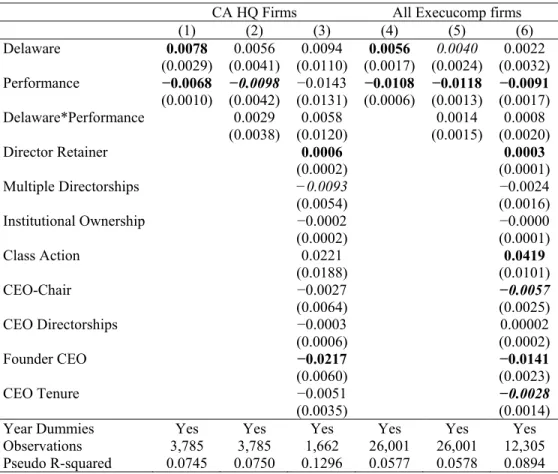
For our regressions we use Forced Turnover as the dependent variable in a series of logistic regressions. We run separate regressions using both the sample of California HQ firms and the entire Execucomp sample. The first sample allows us to directly test the race to the bottom hypothesis, while the latter gives greater statistical power. We control for firm performance by including stock market returns for the past five years or over the CEO’s tenure, whichever is shorter. We industry adjust this measure (using the Fama/French 48 industry classification) to filter out exogenous industry shocks. We compute this industry adjusted return for each CEO-firm year and assign them into quintiles (Jenter & Lewellen, 2010). In the first pair of regressions, we include our performance measure and the indicator variable for Delaware incorporation to assess whether forced turnover is less frequent in Delaware firms after controlling for performance. In the second pair of regressions, we add an interaction variable for the performance measure and the Delaware indicator variable to check whether Delaware firms are less likely to terminate their CEOs for poor past performance. In the final pair of regressions, we include governance measures that might affect the likelihood of CEO termination. The standard errors presented in the table account for potential clustering at the firm level. We present the results in Table 8.
<<Table 8 here>>
None of our tests offer support for the lax monitoring posited by the race to the bottom hypothesis. For both the California HQ sample and the larger Execucomp sample, the Delaware
the Delaware indicator variable is still significant at the ten percent level when we add the interaction variable for the Execucomp sample. When we include the governance variables in the third set of regressions, the Delaware coefficient is positive, but insignificant. This result supports the notion that the influence of incorporation choice on the turnover decision is indirect. In no specification is the Delaware coefficient negative, as the race to the bottom hypothesis would suggest.
The results indicate that a number of the governance variables shown above (in Table 6) to correlate either positively or negatively with Delaware incorporation also correlate with the likelihood of forced CEO turnover in the same direction. For the variables relating to board structure, director retainer is significant. Better paid directors appear more likely to terminate CEOs for poor performance. The coefficient for multiple directorships is negative, but only marginally significant in the California HQ sample. Overall, these results do not support the proposition that Delaware encourages lax monitoring by directors.
The coefficient for institutional ownership is negative, but insignificant. This result does not support the proposition that institutional owners pressure directors to terminate underperforming CEOs. The Class Action coefficient is positive in the regressions for both samples, although only significant for Execucomp sample. The positive coefficient for Class Action suggests firms sued by their investors have a reputational concern above and beyond poor performance. Recall from Table 6, however, that Delaware firms are no more likely to be sued.
On the other side of the termination decision, the coefficient for CEOs who are awarded the Chair position is negative for both samples, as predicted, but it is only significant for the larger Execucomp sample. CEOs who are founders of the firm are less likely to be terminated. These CEO characteristics may be consistent with management protection, although they are
also consistent with directors having more information about the incumbent CEO, and consequently, being less swayed by recent firm performance. In any event, we saw in Table 6 that CEOs of Delaware firms are no more likely to hold the Chair position or be a founder. Finally, CEOs who have longer tenure are less likely to be terminated, although the coefficient is only significant for the Execucomp sample. Again, in Table 6 we saw that Delaware CEOs do not have longer tenure. In sum, CEO characteristics associated with lower forced turnover are not associated with Delaware incorporation.
5.5 Robustness checks
We do a number of tests (untabulated) of the robustness of our conclusions. First, we substitute a linear industry-adjusted performance measure for the performance quintile used in the regressions reported in Table 8. The coefficients and their significance for these regressions are qualitatively similar. An earlier version of this paper used a sample extending from 1993 to 2004 and we found similar results, so our central findings are not time dependent. Finally, we rerun the regressions presented in Table 8 excluding financial institutions from the sample; financial institutions face a substantially different regulatory regime, which may affect turnover. Moreover, financial institutions are unlikely to incorporate in California. The results for these regressions are qualitatively unchanged.
6. Conclusion
This study focuses on the relation between a firm’s state of incorporation and forced CEO turnover. We focus on Delaware, the overwhelming winner in the competition for corporate charters, and California, the conspicuous loser. The race to the bottom hypothesis suggests that
encourage lax monitoring. Our results are inconsistent with that hypothesis. Our findings suggest that Delaware firms are no less likely to terminate their CEOs than firms incorporated in California or other states. Moreover, we show that a number of governance characteristics associated with a greater likelihood of CEO termination are also associated with Delaware incorporation. We caution, however, that we do not examine how turnover affects firm performance, so we draw no conclusions about whether Delaware boards are making efficient termination decisions; we only say that Delaware boards are not lax in making those decisions.
What do these results tell us about the competition among states for corporate charters? Although the statistical methods we have used cannot show causality, a likely impossible task given the inherent noisiness of measures of governance quality, we believe that showing even an association of Delaware incorporation to governance choices and outcomes is relevant to the debate over state incorporation. Overall, we conclude that our findings do not support the race to the bottom hypothesis. The overwhelming winner in the competition for corporate charters, Delaware, has not achieved its dominant market share by promoting lax monitoring of CEOs.
References
Bebchuk, L.A., A. Cohen, 2003. Firms’ Decisions Where To Incorporate. Journal of Law and Economics, 46, 383-425.
Black, B., B. Cheffins, M. Klausner, 2006. Outside Director Liability. Stanford Law Review 58, 1055-1159.
Cary, W., 1974. Federalism corporate law: reflections upon Delaware. Yale Law Journal, 83, 663-705.
Celikyurt, U., M. Sevilir, A. Shivdasani, 2010. Going Public to Acquire? The Acquisition Motive in IPOs. Journal of Financial Economics, 96, 345-363.
Daines, R., 2001. Does Delaware law improve firm value? Journal of Financial Economics, 62, 525-558.
Daines, R., 2002. The Incorporation Choices of IPO Firms, New York University Law Review, 77, 1559-1611.
Ferris, S.P., M. Jagannathan, A.C. Pritchard, 2003. Too Busy to Mind the Business? Monitoring by Directors with Multiple Board Appointments. Journal of Finance, 58, 1087-1111. Fich, E.M., A. Shivdasani, 2006. Are Busy Boards Effective Monitors? Journal of Finance, 61,
689-724.
Fisch, J.E., 2001. The Peculiar Role of the Delaware Courts in the Competition for Corporate Charters. University of Cincinnati Law Review, 68, 1061-1100.
Gompers, P.A., Metrick A., 2001. Institutional Investors and Equity Prices. Quarterly Journal of Economics, 116, 229-259.
Goyal, V.K., C.W. Park, 2002. Board Leadership Structure and CEO Turnover, Journal of Corporate Finance, 8, 49-66.
Heron, R.A., W.G. Lewellen, 1998. An Empirical Analysis of the Reincorporation Decision, Journal of Financial and Quantitative Analysis, 23, 549 -568.
Jenter, D., K. Lewellen, 2010. Performance-induced CEO turnover, Working Paper, Stanford University.
Johnson, M.F., K.K. Nelson, A.C. Pritchard, 2007. Do the Merits Matter More? The Impact of the Private Securities Litigation Reform Act, Journal of Law, Economics, and
Organization, 23, 627-652.
Kahan, M., 2006. The Demand for Corporate Law: Statutory Flexibility, Judicial Quality, or Takeover Protection? Journal of Law, Economics, and Organization, 22, 340-365. Kaplan, S.N., B.A. Minton, 2012. How Has CEO Turnover Changed? International Review of
Finance, 12, 57-87.
Klausner, M., 1995. Corporations, Corporate Law, and Networks of Contracts, Virginia Law Review 757-852.
Linck, James S., J.M. Netter, T. Yang, 2008. The determinants of board structure, Journal of Financial Economics, 87, 308-328.
Mansi, S.A., W.F. Maxwell, J.K. Wald, 2009. Creditor Protection Laws and the Cost of Debt, Journal of Law and Economics, 52, 701-726.
Martin, K.J., and J.J. McConnell, 1991. Corporate Performance, Corporate Takeovers, and Management Turnover, Journal of Finance, 46, 671-687.
Netter, J., and A. Poulsen, 1989. State Corporation Laws and Shareholders: The Recent Experience, Financial Management, 18, 29-40.
Niehaus, G., G. Roth, 1999. Insider Trading, equity Issues, and CEO Turnover in Firms Subject to Securities Class Action, Financial Management, 28, 52-72.
Parrino, R., 1997. CEO turnover and outside succession: A cross-sectional analysis, Journal of Financial Economics, 46, 165-197.
Romano, R., 1985. Law as a Product: Some Pieces of the Incorporation Puzzle. Journal of Law, Economics, and Organization, 1, 225-283.
Subramanian, G., 2002. The Influence of Antitakeover Statutes on Incorporation Choice: Evidence on the “Race” Debate and Antitakeover Overreaching, University of Pennsylvania Law Review, 150, 1795-1873.
Thompson, R. and R. Thomas, 2004. The Public and Private Face of Derivative Lawsuits, Vanderbilt Law Review, 57, 1747-1793.
Appendix: Variable Definitions
Variables Definitions
COMPUSTAT
Total Assets In millions – (at).
Book to Market Ratio of the book value of equity to the market value of equity – (equity/csho*prcc_c).
Operating Performance Operating income divided by lag total assets (opinc/lag(at))
R&D Amount of research and development, scaled by sales –
(xrd/sale).
Dividend Yield Cash Dividend divided by market capitalization –
div/(prcc_c*csho). CRSP
Firm Age Number of years since first date of trading on CRSP.
Stock Volatility Standard deviation of monthly stock returns estimated over the last two years (Year −2 and Year −1) prior to the current fiscal year (Year 0).
Stock Turnover Average Monthly Turnover (Volume / Shares Outstanding).
Momentum Raw return over the past 12 months.
Long-run Returns Past five-year return or the return over the CEO’s tenure, whichever is shorter. Adjusted for returns in the Fama-French industry during the period.
IRRC / Execucomp
Director Retainer Cash compensation paid to directors. Since this data is not available after 2005, we substitute Cash-fees scaled by a multiplier. The Multiplier is calculated as the average ratio of Cash-fees in 2006 to Director retainer in 2005.
CEO-Chair Dummy variable equals one if the CEO is also the chairman of the board; zero if the positions are separated.
CEO Directorships Number of outside directorships held by the CEO.
Board Size Number of members in the board of directors
% (independent) Outsiders Percentage of (independent) outside directors in the board. Other
Takeover Activity Total value of transactions reported on SDC in the prior year for a given Fama-French industry divided by the sum of assets for all firms with positive total assets on Compustat in that industry.
Class Action Federal securities class actions, as reported by Securities Class Action Clearinghouse.
Institutional Ownership Percentage of shares held by institutions; Spectrum data from Thompson Financial
Institutional Blocks Number of 5% institutional owners.
Post-SOX Indicator variable equal to one for observations after the
enactment of Sarbanes Oxley Act (post 2001) and zero for earlier years.
Founder CEO Current CEO is a founder of the company, as reported in
company’s proxy statement.
Forced Turnover Similar to methodology in Parrino (1997). Indicator variable equal to one if newspaper reports indicate that CEO was forced out, if the board mentions dissatisfaction with firm
performance, if there are disagreements between the CEO and the board of directors, or if the departure is unexpected and no particular reason was provided for the departure; zero
Table 1
Reincorporations: Summary Statistics
Table below presents summary statistics of firms that reincorporate after their IPO. Reincorporations during the years 1992-2010 are identified primarily from Factiva news searches and then verified with information in SEC filings. Reincorporations from and to a foreign country, and firms that do not have a CRSP share code of 10 or 11 are excluded from the sample. Panel A presents the number of firms that change incorporations from one state to another, classified by whether the firm is headquartered in California or not. Panel B presents means and medians (in parentheses) of the financial characteristics of firms the year prior to their reincorporation. Panel C summarizes hand collected governance characteristics the year prior to the reincorporation. Variable definitions are in the Appendix. The last four columns in Panel B and the last two columns in Panel C present t-statistics from two-sample t-tests and z-values (in parentheses) from rank-sum tests comparing differences between two groups. Italics, Bold Italics, and Bold, represent statistical significance at the 10%, 5% and 1% levels, respectively.
Panel A: Summary of Reincorporations Initial → Final COMPUSTAT data
pre-reincorporation COMPUSTAT data post-reincorporation CA HQ firms CA → DE Other → DE CA → Other DE → Other DE → CA Other → CA Other → Other 54 19 0 3 1 1 1 105 29 0 4 2 1 1 Total CA HQ 79 142 Other HQ firm Other → DE 128 0 56 (38) 22 (12) 206 194 0 85 (56) 23 (12) 302 Other → CA DE→Other (HQ State) Other → Other (HQ State) Total Other HQ Total 285 444
Panel B: Characteristics of reincorporating firms
CA → DE Other → DE DE → Other CA HQ: CA Other HQ: DE t-values
z-values t-values z-values t-values z-values t-values z-values (1) (2) (3) (4) (5) (2)-(1) (3)-(1) (4)-(1) (5)-(3) Total Assets 650.89 511.48 867.96 1,171.58 4,531.01 −0.34 0.48 0.89 11.47 (65.54) (37.30) (168.07) (83.809) (206.14) −1.93 3.66 1.08 0.19 Book to Market 0.448 0.434 0.830 0.663 0.599 −0.18 3.72 3.72 −2.37 (0.296) (0.365) (0.672) (0.502) (0.456) 0.55 4.72 3.73 −3.54 R&D 0.225 0.175 0.049 0.151 0.156 −0.73 −2.69 −1.38 3.21 (0.081) (0.00) (0.00) (0.00) (0.00) −2.53 −4.80 −3.06 3.08 Operating Performance 0.094 0.012 0.115 0.020 0.042 −1.54 0.50 −1.94 −4.34 (0.121) (0.103) (0.133) (0.062) (0.010) −1.65 −0.31 −2.39 −1.09 Firm Age 5.01 4.50 6.039 6.27 6.27 −0.69 0.98 1.74 0.23 (4.40) (4.01) (6.471) (5.20) (5.05) −0.13 1.37 1.88 −0.13 Stock Volatility 0.182 0.183 0.134 0.175 0.167 0.14 −2.69 −0.36 3.40 (0.171) (0.174) (0.119) (0.149) (0.140) 1.16 −2.68 −0.52 2.39 Stock Turnover 0.115 0.097 0.090 0.120 0.167 −2.93 −1.75 −1.95 3.51 (0.079) (0.061) (0.069) (0.081) (0.140) −2.99 −3.06 −2.40 2.95 Takeover Activity 0.086 0.086 0.034 0.063 0.129 0.05 −3.21 −1.71 4.57 (0.031) (0.027) (0.023) (0.018) (0.094) −1.35 −3.23 −3.64 1.46 Institutional Ownership (%) 32.98 23.07 33.86 27.18 39.74 −2.50 0.18 −1.80 1.49 (28.36) (13.12) (26.84) (18.99) (35.66) −3.02 0.21 −2.14 1.37 N 73 128 60 4,041 59,265
Panel C: Measures of internal governance pre-reincorporation
CA → DE Other → DE DE → Other t-values
z-values z-values t-values
Board Size 6.65 6.59 7.59 −0.15 2.06 (6) (6) (7) −0.44 2.12 % Outsiders 76.96 80.99 76.06 0.69 −0.09 (75.74) (84.52) (76.39) 0.60 0.00 Multiple Directorships 0.68 0.65 0.45 −0.25 −1.67 (0.50) (0.50) (0.33) −0.65 −1.51 Director Tenure 5.81 4.66 7.04 −1.73 1.29 (5.8) (3.90) (5.9) −1.84 1.08 CEO Directorships 0.17 0.13 0.17 −0.44 −0.03 (0) (0) (0) −0.31 0.40 CEO Tenure 8.55 6.71 9.54 −1.22 0.42 (5.07) (3.96) (9.28) −1.09 0.69
Table 2
Logistic regressions predicting the decision to reincorporate
Table below presents the marginal effects (computed at the mean) from logistic regressions predicting the decision of firms to reincorporate. The reincorporation sample used in these regressions is described in Table 1. Clustered Standard errors, clustered at the firm level, are shown in parentheses. Column (1) includes only California HQ firms. The dependent variable equals ‘1’ if the firm reincorporates in Delaware and zero otherwise. The sample used for regression in Column (2) contains the sample of Delaware incorporated firms that remain in Delaware and the sample of firms that move from Delaware. The dependent variable equals ‘1’ if the firm stays in DE and zero otherwise. Characteristics of reincorporating firms are measured in the year prior to the reincorporation. Variable definitions are in the appendix. Italics, Bold Italics, and Bold, represent statistical significance at the 10%, 5% and 1% levels, respectively. CA HQ → DE and CA HQ: CA DE and from DE → (1) (2) Constant −19.64 5.729 (0.758) (0.715)
Log (Total Assets) 0.067 0.058
(0.058) (0.063) R&D 0.021 0.000 (0.088) (0.086) Book to Market −0.354 −0.413 (0.278) (0.113) Takeover Activity 0.722 5.093 (0.320) (2.471) Stock Volatility 1.535 3.550 (0.590) (2.049)
Year Dummies Yes Yes
Table 3
Headquarters and Incorporation
The table shows the frequency of firms’ headquarters state and the state in which they incorporate. The sample includes all firm-years for which CEO data is available on Execucomp from1993-2009. Only firm-years with positive total assets on Compustat and CRSP share code of 10 or 11 are included in the sample. Foreign firms incorporated in the US and US firms incorporated in foreign countries are excluded. Panel B shows the frequency (percentage of firms in the corresponding incorporation state sample) of CRSP delisting codes of the firms in our sample at the end of 2009.
Panel A: Incorporation and Headquarters Incorporation Headquarters DE CA Other Total DE 108 3,660 13,251 17019 CA 0 581 36 617 Other 11 216 10,935 11,162 Total 119 4,457 24,222 28,798
Panel B: Survival rates for firms in sample
Incorporation Trading in 2009 Mergers Exchanges Liquidations Dropped Total DE (48.14) 880 (41.63) 761 (1.09) 20 0.00 0 (9.14) 167 1,828 CA (55.67) 54 (38.14) 37 (0.00) 0 0.00 0 (6.19) 6 97 Other (52.46) 576 (40.26) 442 (0.64) 7 (0.03) 3 (6.38) 70 1,098 Total 1,510