Turun kauppakorkeakoulu • Turku School of Economics
Bachelor’s thesis x Master’s thesis
Licentiate’s thesis Doctor’s thesis
Subject Information Systems Science Date 23.02.2020
Author(s) Markus Meingassner Student number 511599
Number of pages 81 Title Value co-creation through APIs in Multi-sided platforms
Supervisor(s) Ph.D. Hannu Salmela Abstract
This thesis discusses various elements of value co-creation through APIs in the context of Multi-sided platforms. A design science research methodology is applied to answer the main research question of how APIs contribute to value co-creation in a Multi-sided platform environment. During the research, a model is developed that shows the impact of offering APIs to complementors, competitors and individual developers. This model is applied in the context of the E-Mobility industry. The target company, a Multi-sided platform provider that connects EV drivers with charging stations, serves as a real-world context for this thesis. During the application of the model, several artifacts are created, and the theoretical model is refined through direct feedback from business and IT professionals in the E-Mobility field.
Key words Platform economy, Multi-sided platform, boundary resources, API, value co-creation, API economy, API governance, API management, EV charging, interfaces, E-Mobil-ity
Further in-formation
VALUE CO-CREATION THROUGH APIS IN
MULTI-SIDED PLATFORMS
A design science research in the E-Mobility industry
Master´s Thesis in Information Systems Science
Author (s): Markus Meingassner Supervisors: Ph.D. Hannu Salmela 15.11.2019 Turku
The originality of this thesis has been checked in accordance with the University of Turku quality assurance system using the Turnitin OriginalityCheck service.
1 INTRODUCTION ... 11
1.1 Research question ... 12
1.2 Scope of study ... 12
1.3 Research methodology and methods ... 12
2 THEORETICAL BACKGROUND ... 15
2.1 Key characteristics of MSP ... 15
2.1.1 Network effects ... 18
2.1.2 Engineering and economics view on MSP ... 18
2.1.3 Value creation in MSPs ... 20
2.1.4 Open vs. closed platform strategy ... 22
2.1.5 Boundary resources ... 25
2.2 API Economy ... 27
2.3 API Governance ... 29
2.4 API Pricing ... 32
2.5 Value creation through APIs ... 33
3 SYNTHESIS OF API ECONOMY AND PLATFORM ECONOMY ... 39
4 APPLICATION OF THE MODEL ... 41
4.1 The EV charging ecosystem ... 41
4.2 Classification of the case company ... 44
4.3 Value creation in the EV charging industry ... 46
4.4 Openness of the platform ... 47
4.5 Current API offering ... 49
4.6 Design of API governance rules... 50
4.6.1 Capitalizing on innovation ... 50
4.6.2 Dealing with imitation ... 51
4.6.3 Mitigating competition... 52
4.6.4 API Governance principles ... 52
4.6.5 Remodeling of API offering ... 54
5 FEEDBACK AND REITERATION ... 57
5.1 Workshop results ... 57
5.2 Semi-structured interview results ... 58
5.2.1 Feedback on facilitators ... 58
5.2.3 Feedback on blockers ... 60
5.2.4 Types of Openness ... 61
5.2.5 Wrap up ... 62
5.2.6 Implications on the API value-co creation model ... 62
5.3 Reiteration of the API value co-creation model ... 65
5.4 Creation of API governance and management tools ... 67
6 DISCUSSION AND CONCLUSION ... 69
6.1 Main findings ... 69
6.2 Theoretical contributions ... 70
6.3 Limitations and further research ... 70
7 BIBLIOGRAPHY ... 72
8 APPENDIX I: INTERVIEW GUIDE ... 78
Figure 1: Design science research framework (Hevner et al. 2004, p. 80) ... 13
Figure 2: Destination between MSP and other business models (Hagiu and Wright 2015, p. 165) ... 17
Figure 3: Scope of technological platforms (Gawer 2014, p. 1246) ... 20
Figure 4: Roles in a Platform Ecosystem (Eisenmann, Parker, and Van Alstyne 2009, p. 134) ... 23
Figure 5: Boundary resource model (Ghazawneh and Henfridsson 2010, p. 13) ... 26
Figure 6: API economy (adapted from Resch 2018, p. 216) ... 28
Figure 7: Correlation between open interfaces, innovation, and competition ... 34
Figure 8: Value creation model (Grönroos and Voima 2013) ... 35
Figure 9: Synthesized model API and Platform Economics – horizontal openness .. 39
Figure 10: Drivers and blockers for opening interfaces ... 40
Figure 11: MSP business model in the EV charging industry ... 45
Figure 12: Adapted facilitators, drivers and blockers ... 65
Figure 13: API documentation part 1 according to use cases ... 67
Figure 14: API documentation part 2 - EV driver interaction ... 68
Figure 15: Request API key form page one ... 80
List of tables
Table 1: Guidelines for conducting design science research (Hevner et al. 2004) .... 14
Table 2: Technical and business views on Digital Platforms (Asadullah, Faik, and Kankanhalli 2018, p. 4) ... 16
Table 3: Technological and business view on platforms (Gawer 2014) ... 19
Table 4: Vertical and horizontal platform strategies ... 24
Table 5: Mapping of governance tools to openness of APIs ... 31
Table 6: Potential innovation partners dependent on API openness ... 33
Table 7: Value creation drivers, blockers and facilitators ... 37
Table 8: Market Roles in the supply chain ... 42
Table 9: Market roles in the ecosystem ... 43
Table 10: Services and applications by role ... 44
Table 11: Openness of the platform towards its participants ... 48
Table 12: API use cases ... 49
Table 13: Market vs. community approach ... 50
Table 14: Value co-creation evaluation criteria ... 53
Table 15: Mapping of services and applications to API use cases ... 55
API Application Programming Interface BEV Battery Electric Vehicle
CDR Charge Detail Record CPO Charge Point Operator
CRM Customer Relationship Management
DS Design Science
DSO Distribution System Operator
eMI3 eMobility ICT Interoperability Innovation Group E-Mobility Electric-Mobility
EMP Electro Mobility Provider EV Electric Vehicle
IP Intellectual Property KPI Key Performance Indicator MSP Multi-Sided Platform
OCHP Open Clearing House Protocol OCPI Open Charge Point Interface OCPP Open Charge Point Protocol OICP Open Intercharge Protocol PHEV Plug-in Hybrid Electric Vehicle PSD2 Second Payment Service Directive RFID Radio-Frequency Identification SDK Software Development Kid SLA Service Level Agreement
1
INTRODUCTION
This thesis is motivated by a practical problem that the researcher faced while working for a Multi-Sided Platform (MSP) in the Electric-Mobility (E-Mobility) industry. The purpose of the research is to design and validate a model that contributes to the under-standing of value co-creation through APIs in the industry context and can be applied to companies in different industrial areas but with the MSP business model.
E-Mobility has been booming over the past 7 years. Battery electric vehicles (BEVs) adoption between 2012 and 2018 has nearly doubled each year, with 110.000 cars on the roads worldwide in 2012, totaling to approximately 3,3 Million BEVs at the end of 2018 (IEA 2019, p. 210). A crucial factor that facilitates the wide-spread adoption of Electric Vehicles (EVs) - besides BEV attributes like price, range and availability - is the public charging infrastructure, that enables long-distance travel with BEVs and reduces the so-called range anxiety for EV-Drivers. However, the relative amount of public charging poles being constructed has decreased in momentum compared to previous years. Total-ing to a number of 539.000 chargers at the end of 2018, which is “only” a plus of 24 % compared to the previous relative growth of 30 % in 2017 and 80 % in 2016 (IEA 2019, 38-40).
There is a wide range of businesses like energy utilities, car manufacturers, electric installation companies and native EV charging network providers that invest in building up the public charging networks. The target company of this study supports companies that invest in public charging infrastructure. It helps charge point operators (CPOs) by providing a platform that offers tools to manage public charging infrastructure. Further-more, it offers various white-label applications that help E-Mobility providers (EMPs) to offer charging services to end-customers, the EV-drivers.
Previous studies of Korpelainen (2017) and Säde (2019) have examined the business model of the company and concluded it to be that of an MSP provider. Thus, principles of platform economics will be used to determine how value can be co-created by the multiple sides in the platform ecosystem. Furthermore, a review of strategic measures like envelopment and recommendations on how to avoid pitfalls like the chicken and egg problem (Caillaud and Jullien 2003; Evans 2009) will be incorporated to form a model that describes how value is co-created through APIs in an MSP environment.
The second domain that is discussed in this thesis are the principles and strategies in the API economy. Most importantly the positive and negative effects of allowing third-party developers to create additional applications and integrations that generate value for one or multiple sides of MSP actors.
1.1
Research question
This thesis relies on the research done in the disciplines of platform economics and API economics. The research goal is to gain an understanding through literature research what factors – in general - influence value co-creation of MSPs and the ecosystem and how an API offering of an MSP provider – in particular – can facilitate, enable or block value co-creation. Therefore, the main research question that should be answered through this the-sis is:
MainRQ: How value is co-created through APIs in a Multi-sided platform environment?
The research question has practical relevance for the case company, as there are different views in the company on how open or closed interfaces should be. It will contribute to the existing body of knowledge by building on top of existing platform economy and API economy research. Therefore, the findings from applying the model in the industry con-text of an E-Mobility platform provider will contribute to the existing body of knowledge in the named disciplines.
1.2
Scope of study
To keep the research manageable in the context of a master thesis, the scope of the thesis lies on examining value co-creation potential from the supplier of the API point of view. In the case of this research, it will be mainly the MSP provider perspective that is consid-ered. As MSPs however live, grow and perish with their ecosystem, the viewpoint of the API consumers also plays a vital role in this research. Having the MSP provider as main focus point is not only justifiable due to the limitations of the extent of a master thesis but also grounded in previous research in the field of platform economics by Gawer and Cusumano (2008), Evans (2009) and Hagiu and Wright (2015), where strategic decisions and value creation are viewed from the angle of the MSP provider.
1.3
Research methodology and methods
The goal of the thesis is to create a model of factors that influence value co-creation through APIs in the MSP environment. The model should be applicable in practice by companies characterized as MSP in different industries. Hence the outcome of the thesis will be contributing to the body of knowledge and will have a practical use. As stated by Simon (1996) “design science attempts to create things that serve a human purpose”.
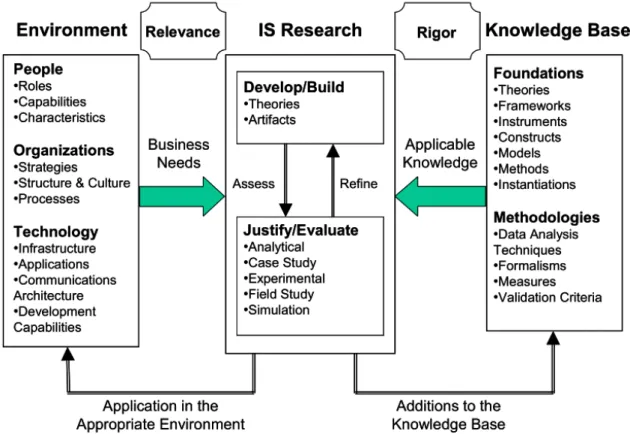
More recently Hevner et al. (2004) introduced a framework and guidelines regarding the application of Design Science (DS) in Information Systems (IS) research. Figure 1 illustrates the framework that will be used as a basis for this thesis. The framework shows the interconnection of design science research with its environment. Business needs are the input and the applicability of the artifact is the output. Secondly, the interconnection of DS to the knowledge base, where existing theories are taken into use to create an arti-fact and the artiarti-fact itself contributes again to the knowledge base.
Figure 1: Design science research framework (Hevner et al. 2004, p. 80)
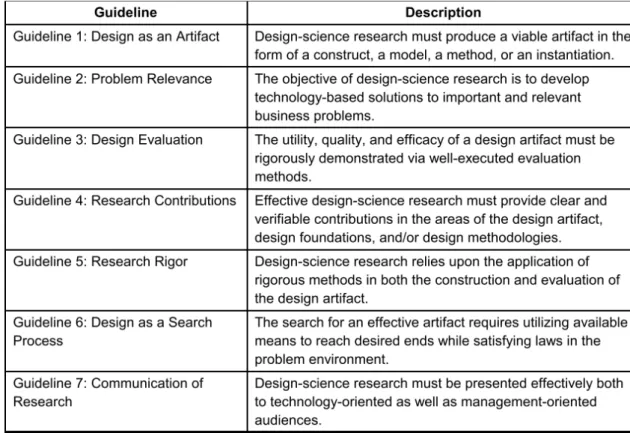
Table 1: Guidelines for conducting design science research (Hevner et al. 2004)
Peffers et al. (2007) summarize in their research different theories of DS in Information Systems to a set of six activities that should be performed:
1. Identification of the research problem and justification. 2. Definition of objectives of the desired solution.
3. Creation of an artifact.
4. Demonstration of the artifact by solving a problem. 5. Observation of applicability of the solution.
6. Communication of results to the proper audience.
The activities identified by Peffers et al. (2007) will be used as a structure for this thesis. Steps 1 and 2 are performed in the introductory part. Step 3 – the creation of the artifact - will be performed in chapter 3 based on a literature review from chapter 2. The demon-stration of artifact will be performed in chapter 4. Observation of the applicability of the solution is part of chapter 4 and will be done through 2 semi-structured interviews. One with the CTO of the case company and one with the Platform Business Director. As the last step, the communication of the results will be done through this master thesis.
The next chapter will introduce the theories and frameworks from previous research in platform economics and API economics. Those are used in chapter 3 to develop the synthesised model for API value co-creation in MSP environments.
2
THEORETICAL BACKGROUND
The literature analysis part will focus on two areas: Platform economics and API eomy. In platform economics, the characteristics of MSPs and the key principles that con-tribute to the success or failure of a platform will be discussed. The theories will be ana-lyzed critically and summarized into following categories: facilitators, drivers and block-ers for the success of the platform.
Secondly, key principals of the API economy are evaluated and synthesized with the findings of the first part of the literature analysis.
2.1
Key characteristics of MSP
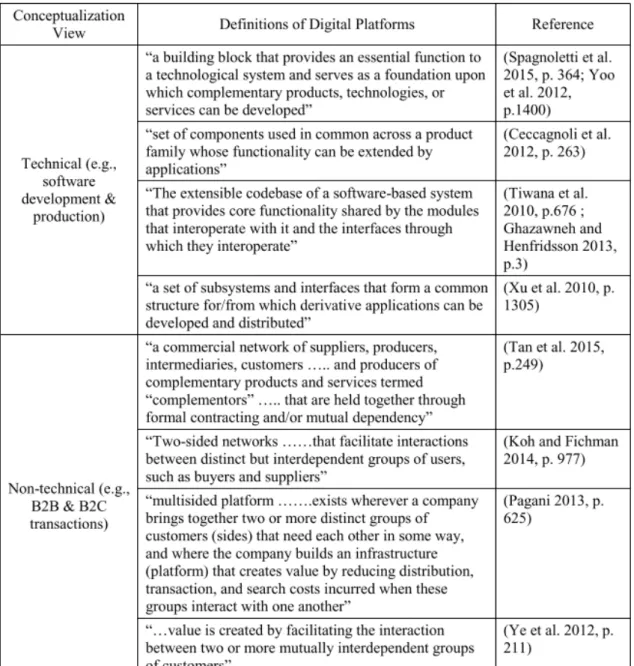
Let’s start with the basic definition of a platform. As the review of prior literature on the topic shows, a distinction can be made between focusing on the technical or business view on the platform concept (Asadullah, Faik, and Kankanhalli 2018, p. 3). Asadullah, Faik, and Kankanhalli (2018) provide an overview of key definitions of previous literature on the digital platform concept.
Table 2: Technical and business views on Digital Platforms (Asadullah, Faik, and Kankanhalli 2018, p. 4)
The definitions of the technical view on platforms focus on the composition of the software. The characteristics of modularity and extensibility of digital platforms is a shared view of Xu et al. (2010), Ghazawneh and Henfridsson (2013), (A. Tiwana, Konsynski, and Bush 2010), Spagnoletti, Resca, and Lee (2015) and Y. Yoo et al. 2012). Starting from the research commentary of Tiwana, Konsynski, and Bush (2010) where they introduce a platform-based software ecosystem as the extensible codebase for third-party developers to develop modules that in turn make the ecosystem more attractive. A wide range of case studies into the technical domain followed. In their case study, Ceccagnoli and Forman (2012)tested the hypothesis if independent complementors ben-efit from participation in a platform ecosystem in the enterprise software industry. Their
findings show that complementors joining the platform ecosystem proved to be more suc-cessful by having higher sales and a greater likelihood of raising capital from public in-vestors.
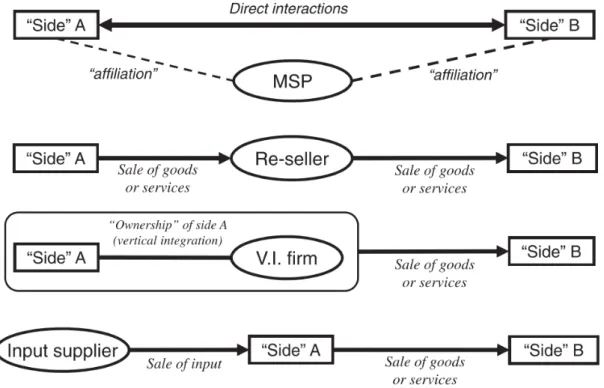
When looking at the non-technical view on digital platforms one key characteristic appears to be the facilitation of transactions between distinct sides of the platform (Pagani 2013, p. 625). Hagiu and Wright (2015) furthermore distinguish MSPs by the involve-ment of the platform in the facilitation of the transaction. Figure 2 shows the distinction between MSPs and other business models.
Figure 2: Destination between MSP and other business models (Hagiu and Wright 2015, p. 165)
Hagiu and Wright (2015) argue that the direct involvement of the intermediary in the sales of a good or service to the end customer makes the company a re-seller instead of a platform provider. On the other hand, the ownership of the supplier side makes it a verti-cally integrated firm. Lastly, a differentiation can be made between input suppliers and MSPs by checking if the company in question is affiliated with both sides. If not, the company can be categorized as an input supplier. Hagiu and Wright (2015) conclude, by comparing the difference between MSPs and the three similar business models, that MSPs have following unique characteristics: Direct transactions between two or more sides that are both affiliated with the same company – the MSP.
2.1.1 Network effects
An important driver that contributes to the success of an MSP is provided by the presence of network effects. Network effects describe the phenomena where the presence of one side benefits the other side and vice versa (Katz and Shapiro 1985, p. 424). In MSPs furthermore, distinctions are made between direct and indirect network effects1. Direct network effects affect the value of the network when the user base of the same side grows. An example that is illustrates the existence of direct network effects is the telephone net-work. The value of having a telephone increases directly with the number of other users also having a telephone.
Indirect network effects, in turn, come into place when the value of the network in-creases by the presence of the other side of the network. These indirect network effects are the focus of several studies (Caillaud and Jullien 2003; Armstrong 2006; Belleflamme and Peitz 2019) that investigate the influence of indirect network effects on its partici-pants. Caillaud and Jullien (2003) propose that the existence of strong indirect network effects makes it harder for competing platforms to enter the market unless they heavily subsidize the supply side of the network. Rochet, Tirole and Industrielle (2003) and Parker and Van Alstyne (2005) confirm this theory and agree that subsidizing one side of the platform provides an effective strategy to tip the market into one direction. Ultimately, the strong feedback loops generated by indirect network effects lead to the conclusion that platform markets are characterized as “winner takes it all” markets (Eisenmann, Parker, and Van Alstyne 2006).
However, network effects are a subset of a concept called network externalities which also include negative influence through the presence of more users or producers (Shapiro and Varian 1999, p. 185). Direct network externalities can lead to increased competition within one side of the platform for resources, both on the supply and demand side. For example, more EV drivers joining a charging network increase the chance of charging stations being blocked by another EV driver. Or on the supply side: The more CPOs a platform join, the fiercer the competition will get between the providers of a charging service, which can, in turn, lead to a price drop of charging services.
2.1.2 Engineering and economics view on MSP
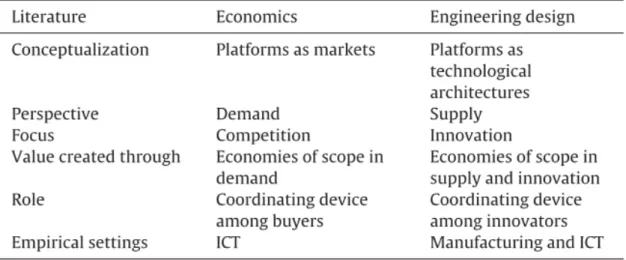
Gawer (2014) intended to form a bridge between the technical and business view on MSPs by providing a holistic framework that incorporates both viewpoints. Table 3 shows an overview of the different views in platform research. Gawner (2014) states that
the technical view, focusing on fostering innovation, and the business view, focusing on the competition between platforms can’t be separated as those objectives often interact with each other. She sees platforms as evolving organizations that are loosely coupled with its agents, following the definition of a meta-organization by Gulati, Puranam, and Tushman (2012).
Table 3: Technological and business view on platforms (Gawer 2014)
Gawer (2014, p. 1240) points out three shared trades of all technological platforms, as they
“(1) federate and coordinate constitutive agents who can innovate and compete; (2) create value by generating and harnessing economies of scope in supply or/and in demand; and
(3) entail a modular technological architecture composed of a core and a periphery”
Additionally, when looking at the scope of a platform Gawer (2014) distinguishes be-tween internal platforms, supply-chain platforms and industry platforms. Figure 3 shows the conceptualization of those three types of platforms.
Figure 3: Scope of technological platforms (Gawer 2014, p. 1246)
It’s important to note that a platform can evolve from an intra firm to an ecosystem plat-form and vice versa. If the platplat-form provider, for example, recognizes that its interfaces are misused by complementors the decision can be made to close those interfaces and only provide them to complementors it has a contractual relationship with. Interestingly Gawer (2014) mentions governance as a key factor in capitalizing on innovation capabil-ities from opening up the platform to a wider audience. Types of governance strategies (Parker and Van Alstyne 2005) and their impact on value co-creation opportunities for the platform owner and complementors (Huber, Kude, and Dibbern 2017; Sarker et al. 2012) have been part of other studies. Due to its relevance to the thesis topic, there will be a whole chapter (see chapter 2.3) about API governance. In the next chapter, an over-view is provided on how value is created in MSPs.
2.1.3 Value creation in MSPs
The previous chapter introduced the main characteristics of MSPs. There have been some notations about value creation by MSPs. In this chapter, the previous literature will be analyzed based on different forms and views on value creation in MSPs.
The examination of value creation by platforms has been part of several studies over the past years. This paragraph gives an overview about the findings from these studies. Be-fore heading into the specifics, an older study that introduces a new paradigm of value creation is introduced. Normann and Ramírez (1993) introduced the concept of shared value creation that relies on two pillars: knowledge and relationships. The authors argue that companies need to constantly increase their knowledge base to reconfigure and ena-ble value-creating relationships with their customers. They call this pursuit “value co-creation activities”.
Pagani (2013) defines a platforms’ value creation in the form of a reduction of trans-action and search costs. Rochet, Tirole, and Industrielle (2003) and Evans (2009) go into the same direction by defining the value that is created by platforms as the enabler of transactions between multiple sides that would not otherwise make business with each other. Gawer (2014) adds to these approaches that platforms must effectively influence the terms of transactions by governance tools such as subsidizing one side of the platform. The examination of the effectiveness of these governance tools has been part of earlier case studies in the enterprise software industry (Ceccagnoli and Forman 2012), video gaming industry (Rochet, Tirole, and Industrielle 2003) and social networks (Evans 2009).
Summarizing the previous paragraph, value is created by platforms by
• enabling transactions between parties that would not otherwise interact with each other
• making transactions more efficient through diminishing transaction costs
• making transactions more effective by improving matching between potential transaction partners
• reducing the number of steps required to make a transaction
• improving the matchmaking process by providing better search tools
There is a second source of value generation that arises from the engineering view on platforms. Gawer (2014) states that platforms create value by enabling innovation and collaboration through a modular architecture and the existence of interfaces. Those inter-faces can be used by customers and complementors of the platform to produce comple-mentary services and products. The degree of openness of the interfaces of a platform provider has a direct influence on the number of innovation resources that are attracted to the platform and diminish the costs for innovation (Gawer 2014, p. 1245).
Despite the positive drivers that increase speed, reliability and likelihood of innovation and collaboration, trade-offs through imitation and competition of competitors and com-plementors arise as pointed out by Pil and Cohen (2006). According to Gawer (2014), a platform provider can use governance tools to avoid negative impacts from misuse. As
the topic of governance tools for APIs plays a crucial part in forming the model for this thesis there will be a whole chapter dedicated to this topic. Chapter 2.3 gives an overview of research in this domain.
The next chapter will provide an overview of drivers and blockers arising from open and closed platform strategies.
2.1.4 Open vs. closed platform strategy
As discussed in the previous chapter, value is generated by platforms in a dual way. Plat-forms enabling transactions between two or more supply and demand sides and foster innovation through customers and complementors by open interfaces. This chapter will focus on the latter by examining different kinds of open and closed platform strategies.
The technical requirement for a platform to innovate effectively is a modular architec-ture or how Katz and Shapiro (1994) puts it, a system that consists of individual compo-nents. As Gawer (2014) identified, a higher degree of openness leads to a higher degree of innovation. Eisenmann, Parker, and Van Alstyne (2009) describe an open platform as
• unrestricted accessible for third party contribution, use and commercialization
• indiscriminate in its pricing and conformity to technical standards.
Hence indicating that there are different degrees of openness that a platform can strife to, each with individual gains and tradeoffs. Those tradeoffs have been concretized as the balance between adoption and appropriability of the platform (West 2003, p. 1260). Eisenmann, Parker, and Van Alstyne (2009) describe the benefits of more widespread adoption as gaining momentum by increased network effects, less user concern about lock-in and increased production of complementary goods and services. On the contrary, reducing the appropriability of the platforms provider by reducing switching costs for users and increasing competition between rival platforms.
Boudreau (2010) distinguishes openness of a platform by two strategic decisions a platform provider can make: Granting access and devolving control. Granting access is defined as opening the platform for outside innovation while devolving control is the act of giving up control of the platform (Boudreau 2010, p. 1849). While the latter inevitably leads to a higher degree of openness of the platform, opening a platform can be governed by the platform provider without losing control completely.
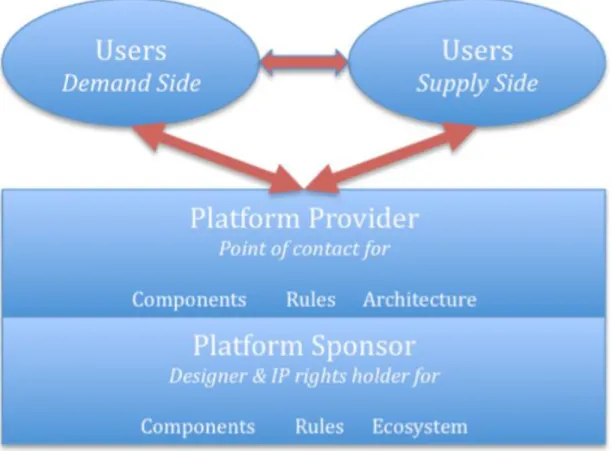
Eisenmann, Parker, and Van Alstyne (2009) distinguish the degree of openness in more detail based on the interconnected roles in a platform ecosystem. Figure 4 depicts the different roles of the platform participants. Starting from the bottom with the platform
sponsor as a governing role. This role determines the extent of participation of the plat-form users to the technology and economic development of the platplat-form and is executing IP rights. Second up the platform provider that acts as a communication hub to its two distinct user groups: The supply and demand side. For each role, individual decisions can be made towards a more open or closed platform.
Figure 4: Roles in a Platform Ecosystem (Eisenmann, Parker, and Van Alstyne 2009, p. 134)
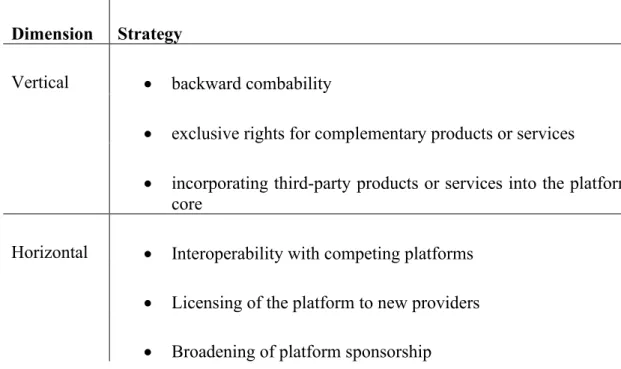
Additionally, Eisenmann, Parker, and Van Alstyne (2009) distinguish between vertical and horizontal openness. Vertical openness is described as openness towards the users of the platform and towards external contributors. Horizontal openness is described as the act of giving up a certain degree of control by the platform provider by making the fol-lowing strategic decisions:
• fostering interoperability with rivaling platforms
• licensing the platform to other platform operators
Eisenmann, Parker, and Van Alstyne (2009) furthermore introduce three strategies for each dimension of openness of the platform. Table 4 shows an overview of strategies affecting the openness of a platform.
Table 4: Vertical and horizontal platform strategies
Dimension Strategy
Vertical • backward combability
• exclusive rights for complementary products or services
• incorporating third-party products or services into the platform core
Horizontal • Interoperability with competing platforms
• Licensing of the platform to new providers
• Broadening of platform sponsorship
Starting with the first strategy of the vertical dimension of platform openness, back-ward combability of the platform assures complementors that their applications will also run with newer versions of the platform. This area increases in importance if third party applications are an essential feature of the platform. However, Choi (1994) connects the backward combability of a platform with trade-offs due to higher development costs and limitations in the technologic development of the platform.
Continuing with the second vertical strategy, making sure that certain complementary products are just available via one platform has according to Eisenmann, Parker, and Van Alstyne (2009) two dimensions: First, the platform sponsor can agree with a mentor that the product or service is just offered on the platform. Second, the comple-mentor can agree with the platform sponsor that the product or service of this category is the only one that is offered on the platform. The first right of exclusivity leads to compet-ing platforms becompet-ing less open. The second agreement of exclusivity leads to the own plat-form being less open.
The third strategy of vertical openness according to Eisenmann, Parker, and Van Alstyne (2009), incorporating complementary goods or services into the platform core, describes the process of gradually including complementary applications into the plat-form core as the platplat-form matures. This strategy leads to the platplat-forms being characterized
as less open, due to the bundling of the platform with the prior complementary applica-tions.
Moving on to strategies for horizontal openness, Eisenmann, Parker, and Van Alstyne (2009) describe the first important factor to consider as the interoperability to competing platforms. Allowing users of one platform to interact with users of another rivaling plat-form is seen as a strategic move towards a more open platplat-form. In young markets with strong user growth usually no interoperability is desired between rivaling platforms. However, if the user base doesn’t grow that much anymore, interoperability is becoming an increasingly important factor to consider, especially in markets with high direct or indirect network effects. The most important factor to consider is the market size of each platform. Interoperability is usually desired between similar-sized platforms.
The second horizontal strategy described by Eisenmann, Parker, and Van Alstyne (2009) is licensing the platform to additional providers. This move makes the most sense when the user base of the platform has very different needs and licensees can adapt the platform to those unique needs. However, this strategy can impose severe pricing com-petition that can be mitigated by the platform provider by charging licensing fees from its licensees.
According to Eisenmann, Parker, and Van Alstyne (2009), a more extreme form of the licensing strategy is broadening the sponsorship of a platform. Whereas licensing the plat-form still retains the control rights of the platplat-form sponsor over the platplat-form core, broad-ening the sponsorship aims to give up the control rights of the platform sponsor over the core technology of the platform. This strategy proves to be effective when the platform operator generates more revenue through complementary products and services than through licensing of the platform.
In more recent research, Parker and Van Alstyne (2018) investigate the economic im-pact of innovation by examining the growth rate of the whole ecosystem depending on two decisions of the platform sponsor: Closing the platform to third-party innovators and disclosing Intellectual Property (IP). Their findings show that platforms should put their focus on designing contracts with third-party developers in a way that reuse of IP rights is granted within the ecosystem. This effectively leads to a larger innovation ecosystem that – although it limits the revenue the platform sponsor can generate from licensing IP – promotes spillovers of innovation that benefits the whole ecosystem and in return the platform sponsor.
2.1.5 Boundary resources
A widely adopted model for balancing platform control and innovation has been intro-duced by Ghazawneh and Henfridsson (2010) with the concept of boundary resources.
Through their case study of the iPhone ecosystem, Ghazawneh and Henfridsson (2010) deducted a model for governing third-party-development in software ecosystems.
Figure 5: Boundary resource model (Ghazawneh and Henfridsson 2010, p. 13)
Figure 5 shows the four steps involved in governing third-party development. Those steps must be reiterated with every change in the boundary resources, as changing them leads necessarily to attracting different types of knowledge resources, which in turn can change the dynamics of control over the platform.
Ghazawneh and Henfridsson (2010) describe the goal of this process as opening boundary resources as a player in a software ecosystem without losing control. Choosing the option of opening up a platform versus devolving control has been identified by Boudreau (2010) as the preferred way a platform owner should operate, as it produces a higher amount of complementary goods and services according to his case study of sold handheld devices.
In the first phase of the boundary resource process, an increased need for openness is requested, typically by the ecosystem (Ghazawneh and Henfridsson 2010, p. 13). This proposition has been confirmed in later research by Bianco et al. (2014). Bianco et al. (2014) conclude that boundary resources are created for the innovator, rather than emerg-ing out of the technical architecture of the platform owner. However more recently, the impact of regulations and policy changes, like the second Payment Service Directive (PSD2) regulation of the European Union, can be identified as an additional driver for companies to open their systems to outside innovation (Borgogno and Colangelo 2019, p. 3).
In the second phase of Figure 5, policies and agreements between the platform owner and its third-party developers must be updated to secure platform control. This step in-cludes revising the terms of service on which complementors can use the boundary re-sources.
The next step involves opening distribution channels to a wider range of users. Ac-cording to Yoo, Henfridsson, and Lyytinen (2010) attracting a wider variety of knowledge resources creates a greater variety of innovation.
The last step of the continuous process involves restricting certain applications and technologies from participating in the software ecosystem. For example, Gawer and Cusumano (2002) identified one tradeoff of open platforms that arises if a complementor and platform providers’ innovation clashes. On the contrary, a wide range of complemen-tary innovation can lead according to Gawer and Cusumano (2008) to a more secure mar-ket position by being an effective barrier for the entry of competitors.
In later research, Ghazawneh and Henfridsson (2013) divide the form of boundary resources into two distinct groups: Social and technical boundary resources. Defining technical boundary resources in the forms of APIs, SDKs, Scripts and Integrated Devel-opment Environments (IDEs). Those technical enablers are accompanied by social boundary resources that in turn focus on delivering knowledge about how to develop ap-plications using the technical tools provided. Social boundary resources can come in the form of documentation, governance rules, incentives or IP. This model has been applied and developed further by Bianco et al. (2014). Their findings after applying the boundary resource model in a case study show that an additional distinction should be done between technical and development resources. Technical resources refer according to Bianco et al. (2014) just to the technical enabler: APIs. Development resources to tools that directly support the third-party developer in programming, testing, debugging, deploying, and maintaining the applications. Social boundary resources are according to Bianco et al. (2014) primary endeavors towards transferring knowledge from the platform owner to third-party developers. The second function of social boundary resources is the coordina-tion possibility of the platform provider towards third-party contributors.
This chapter introduced APIs as the technical enabler of innovation in software eco-systems. The next chapter will provide a more comprehensive overview of how APIs are having an economic impact on software ecosystems.
2.2
API Economy
APIs are defined by IEEE (2019) as a way to share information between software sys-tems. Another definition comes from Berlind (2015) who compares APIs with user inter-faces, just with different users in mind: software instead of humans. However, the devel-oper brings still the human perspective into play, which is well reflected in the social part of Ghazawneh and Henfridsson's (2013) boundary resource model.
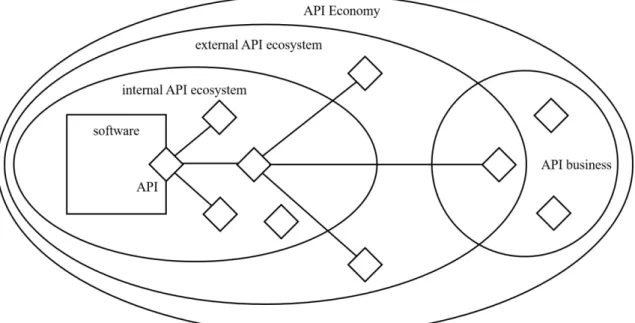
Figure 4 shows the layers of the API Economy. Starting from the internal software architecture that is modular and interconnected through APIs. The first layer indicates
that APIs are used internally, or in the context of this thesis, the scope of the API offering and consumption indicates that of an internal platform. The second layer, the external API ecosystem, is distinguished by offering and consuming APIs solely within companies that have a contract with the platform. Following again the definition of Gawer (2014) the API offering is open to a firms’ supply chain. The even wider ecosystem means offering and consuming APIs without limitations, which would define the company as an industry platform. In addition to the ellipses that define the degree of openness of a companies’ APIs, Resch (2018) defines the circle of API business as monetization of the APIs of a company.
Figure 6: API economy (adapted from Resch 2018, p. 216)
Figure 4 combined with figure 6 leads to following categorization of APIs:
• Degree of openness: Private APIs are used within a firm. Partner APIs are made available to customers and complementors and public APIs to everyone. As mentioned in chapter 2.1. an industrial platform is characterized by the availa-bility of APIs to everyone.
• Monetization: A company can offer their APIs for free or for a fee.
Gawer (2009) mentions as a driver that fuels the usage of APIs by complementors the so-called “Economy of Scope”. Traditionally it has been viewed as an advantage from cheaper production costs in manufacturing when jointly producing a product is cheaper than manufacturing each output individually. Gawer (2009) brings the concept of “Econ-omy of Scope” to the digital platform world by describing its influence on innovation.
Hence, the Economy of Scope in platform economics is archived by joint innovation be-tween the platform and its complementors under the premise that innovation is cheaper by joint production in a network, than by each company separately. A prerequisite for effective joint innovation is a modular architecture and the use of interfaces between those modules (Gawer 2014, p. 1242). According to Chesbrough (2003), opening those inter-faces to complementors have mainly two effects: Acquiring outside resources and knowledge and also independent knowledge. Yoo, Henfridsson, and Lyytinen (2010) em-phasize the importance of diversity of knowledge resources in the innovation process as a competitive advantage.
However, there are also downsides to a modular architecture. Pil and Cohen (2006) propose that besides the positive implications on a firms’ performance through increased speed, reliability and likelihood of innovation, there is the threat of imitation by compet-itors that distributes those innovations to competcompet-itors. There are strategies that can miti-gate the risk of imitation. According to Lippman and Rumelt (1982) complex system de-sign limits effectively the imitation capabilities of competitors.
Gawer (2014) additionally mentions the threat of complementors turning into compet-itors. These are the main two threads that could be identified through literature research. The next chapter will introduce the concept of API governance that includes a compre-hensive review of mitigation tools and strategies for the previously mentioned negative effects.
2.3
API Governance
To maintain the necessary degree of control and limit the unwanted negative effects over the APIs of a platform provider it is necessary to govern them effectively. There is a limited body of research specifically on API governance. However, there is a substantial amount of research related to governance practices in platform ecosystems. Two main governance practices could be identified by literature research: The arm’s length and the dyadic way.
The arm’s length governance practice is described by Parker and Van Alstyne (2005) as uniform rules for all participants in the platform ecosystem. Choosing this type of gov-ernance style has the advantage of relatively low govgov-ernance costs for the platform pro-vider, but can limit the value creation opportunities with some partners, as it doesn’t take local needs of certain partners into account (Huber, Kude, and Dibbern 2017, p. 3).
The alternative to the arm’s length governance principle has been termed by Sarker et al. (2012) as the dyadic way of governance. It describes the process of taking specific local needs of partners into account and deciding based on those needs what kind of re-sources the partner can access and the conditions of accessing those rere-sources. According
to the case study in the ERP ecosystem of Sarker et al. (2012), taking local needs into account can lead to greater value co-creation within the platform ecosystem, but it has the trade-off of higher governance costs. Huber, Kude, and Dibbern (2017) suggest two main decision criteria for opening resources towards complementors: High impact on emergent value-co creation and insufficient resources of the platform owner.
In practice, there are several tools (eg. Amazon API Gateway; Apigee; Azure API Gateway; WSO2 API Manager) available that support the API governance process. When it comes to managing a companies’ API offering these tools provide solutions for infor-mation sharing, onboarding and securing APIs. Key elements of API Management tools are summarized by Fremantle, Kopecký, and Aziz (2015):
• Developer portal including API documentation, SDKs (Software Development Kits), onboarding guide
• User management by enabling registration of applications and user accounts
• Authentication and authorization through API keys
• Enforcement of specific Service Level Agreements (SLAs) through API keys
• Monitoring of client usage through API keys
Krintz et al. (2014) identify four additional topics specifically relevant for cloud plat-form API governance:
• Change control: Versioning of API and policies of the API provider that spec-ifies the extent of changes to the API and the possibility to roll back to previous versions.
• Policy specification and analysis: Formulation of the degree of openness of the API and analysis of the enforcement
• Consistent policy implementation: Ongoing checks if the specified policies are implemented consistently
• Implementation portability: Renewing or removing modules should not im-pact the integrity of the APIs
In addition to the individual governance topics, Bonardi et al. (2016) urge the implemen-tation of those governance tools through organizational roles and processes. Bonardi et al. (2016) suggest dividing API governance between three aspects:
• Strategic governance: Includes a plan on how to generate value from APIs, a set of objectives and Key Performance Indicators (KPIs)
• Technical governance: Definition of the technical architecture and standards, monitoring of technical trends and their implementation and following technical KPIs
• Monitoring of partners: Ongoing process of identification of partners in the API ecosystem
Complementing the identification of possible partners in the ongoing monitoring process Gawer (2014) identified two threats that might arise from open interfaces by partners: imitation and competition. Hence, she proposes also two effective strategies for dealing with those threads: Closing interfaces and/or enveloping the competing party. The envel-oping strategy has been initially introduced by Eisenmann, Alstyne, and Parker (2007). It describes the process of one platform entering the market of another platform by leverag-ing its user base and makleverag-ing use of common platform components.
When looking at the classification of platforms according to scope by Gawer (2014) it can be seen that the lower the degree of openness of the interfaces, the lower the effects on innovation and the lower the governance requirements are for APIs. Table 5 indicates the interconnection between platform openness and the need for more governance. Table 5: Mapping of governance tools to openness of APIs
closed partner open strategic
governance
company hierarchy contracts partnerships, joint ventures, licensing
technical governance
modular architecture, usage of technical stand-ards,
design rules
SLAs,
monitoring of us-age,
rate limits and throttling
scaling up
monitoring of partners
within the firm within the contrac-tual partners
within the ecosys-tem
When looking back to chapter 2.1.5 where the boundary resource model by Ghazawneh and Henfridsson (2010) was introduced, it gives a process view on how and why to adapt a companies’ governance rules. It’s based on the design of new boundary resources, which are in the scope of this thesis. Ghazawneh and Henfridsson (2010) state that the process is usually triggered by the need of ecosystem actors for a higher degree of openness of the boundary resources of the platform provider.
This adds a new dimension to the governance model by introducing a feedback channel for ecosystem actors. This feedback channel can be designed in a relatively simple way if the ecosystem just consists of internal innovation resources, as according to Gawer and Cusumano (2014) the hierarchy and roles and responsibilities within a company regulate the information flow.
When moving out to the partner mode, this feedback should be relatively easy to get through partnership managers and regular feedback loops. When governing the API eco-system and getting feedback from there, more advanced methods of feedback generation should be applied, by for example providing forums, live chat or identifying key innova-tion resources and getting feedback from them. The case study of Bianco et al. (2014) furthermore emphasizes the importance of short feedback loops to avoid frustration on the API consumer side.
Another approach to designing the API offering of a company was introduced by Boudreau and Lakhani (2009). They argue that the innovation ecosystem can be orga-nized by the platform provider either with the market or community approach. The market approach provides tighter control over its participants by imposing formal rules, whereas the community approach leads to more informal governance. Value for the platform pro-vider is directly created through the market approach by contracts and sublicensing of the boundary resources of the platform. Whereas the community approach creates value for the platform provider indirectly through increased demand for the platform by leveraging outside innovation. Boudreau and Lakhani (2009) additionally recommend incorporating mixed approaches. They emphasize the importance of considering the mechanisms of innovation arising from the different needs of the diverse user groups of a platform.
Although using different terminology, Boudreau and Lakhani's (2009) model share the same traits as the arm’s length (Parker and Van Alstyne 2005) vs dyadic (Sarker et al. 2012) way governing platform ecosystems. The market approach requires arm’s length governance whereas the community approach should rely on the dyadic governance principles.
The next chapter introduces pricing as an additional way of managing access to the APIs of a platform.
2.4
API Pricing
This chapter will provide a short overview of pricing methods for APIs. Gawer (2014) mentions pricing as the only governance tool for open interfaces. Furthermore, gaining revenue from the API offering is directly related to value creation for the platform pro-vider. Therefore, this topic is relevant to the research question of this thesis. However, this chapter will be kept short, because it’s not in the scope of this thesis to define a pricing
method for an API offering, rather the various options about API pricing will be dis-cussed.
Beginning with the first and simplest option, an API provider can choose is to offer the usage of its APIs for free. This is a common pricing model for platform providers where innovation from third-party developers is crucial and part of the supply side of the platform. Examples of these platforms are third party developers of apps in Android and iOS.
The second option for an API provider is to give access to API through a flat fee. This approach appropriates some rents for the platform provider. It, however, lacks the neces-sary scaling that the next approach brings with it. It can be however used if there is no possibility to manage and monitor the usage of a user account through API keys.
The third approach is the scalable approach of charging customers per API call which is a common practice used by cloud computing providers like AWS or selling contingents of API calls. Webservices like EBAY, Twitter or Facebook usually offer a combination of both, a free tier to get started and after the amount of API calls exceeds certain limits the user has to pay.
This chapter is intendedly short and stays out of common software pricing methods, as designing the pricing for a digital service of a company would be an entire research question in itself.
2.5
Value creation through APIs
This chapter will introduce the first instance of the API value creation model for MSPs. To reduce complexity, the common approach of depicting the MSP environment as two-sided markets is used. This means that the MSP is affiliated with only two sides in the model. The goal of the model is to answer the question of how (and if) APIs contribute to value co-creation in an MSP environment from the perspective of the platform pro-vider.
The first component of the model is based on the degree of openness of the API and hence defines the ecosystem players that can access the API. Table 6 shows the distinction between closed, partner and public APIs.
Table 6: Potential innovation partners dependent on API openness
closed intra-firm
partner intra-firm complementor customer
open intra-firm complementor customer competitor independent de-velopers
The second component is the degree of innovation a platform can capture by providing open interfaces. Figure 5 summarizes the hypothesis from Gawer (2014) where she shows the correlation between the innovativeness and increased competition of a platform. Gawer (2014) argues that open interfaces “reduce the platform owner’s search cost for
complementary innovators and extend the pool of accessible innovative capabilities that
will indirectly create value for the platform” (Gawer 2014, p. 1245).
Figure 7: Correlation between open interfaces, innovation, and competition
The third dimension will introduce the view on value and value co-creation from the ser-vice perspective and three core processes of open innovation. As Vargo and Lusch (2008) argue, all goods and services are designated to benefit the customer and importantly, in the context of this thesis, all other parties in the process. Grönroos and Voima (2013) introduce a model that depicts the form of value creation between the provider and the customer.
Figure 8: Value creation model (Grönroos and Voima 2013)
Figure 8 shows that the provider of a service is just able to create real value by interacting with the customer. However, the customer can create value by independently using the services of a provider. In Grönroos and Voima's (2013) model the provider is the producer of resources and the facilitator of value.
This model shows a lot of similarities with Chesbrough (2003) three core processes of open innovation: Inside out, outside in, and coupled innovation. The inside out process refers to the usage of the APIs of a company through partners in different markets, focus-ing on leveragfocus-ing the IP of a company. The outside-in approach refers to companies ben-efitting from outside innovation inside their market. And lastly, the third type, coupled innovation, where the company creates partnerships through sharing resources with com-plementors and other market participants to create innovation.
Another form of defining the value an API is creating is by following the Job To Be Done (JTBD) framework by Christensen et al. (2016). It works by identifying what a customer wants to accomplish under certain circumstances. Christensen et al. (2016) urge that understanding a customers’ circumstances, meaning what hinders or enables the buy-ing decision of the customer, needs to be taken into account to offer the right product or service to the customer. Consequently meaning that the JTBD framework intents to steer innovation in the right direction, which is a fitting definition for the main value proposi-tion of open interfaces according to Gawer (2014).
According to Medjaoui et al. (2018), APIs should be treated as products that solve a business problem. Thus, co-creation of value in the context of the API offering of a plat-form means exposing the right resources to customers or complementors, who in turn collaborate with the platform provider to generate innovative products or services. The creation of value is facilitated by a platform provider by offering APIs to customers or complementors who in turn independently work on innovative products and services that open new markets for the platform provider.
When moving further into detail how co-creation of innovative products and services can be examined, a recent case study of Huber, Kude, and Dibbern (2017) sheds light on possible types of value co-creation. They introduce two categories of value co-creation: The immediate and emergent value-co creation potential.
Immediate forms of value-co creation:
• Extension of the platforms’ functionality
• Revenue from implementation projects
• License fees
Emergent forms of value-co creation:
• Potential new future customers
• Potential to better serve existing and future customer needs
To conclude the third dimension of the value creation model through APIs the platform provider must provide APIs that get the customers' job done. According to Christensen et al. (2016), the requirement for getting the job done is knowing the customer. This can in turn just be accomplished in the industry context. Thus, this dimension will be reintro-duced in the practical application part of the model.
However, increasingly open interfaces must be governed carefully. As Pil and Cohen (2006) identified, there is the threat of imitation and competition that negatively influ-ences the value gained from innovation.
Table 7 summarizes the driving forces towards a more open or closed API strategy of an MSP. The facilitators list the entry ticket to the API economy, a modular architecture that is interconnected through internal APIs. If this condition is met, the platform provider can decide if and how far to move into the next circle of the supply chain or partner APIs or even further to the industry or open API ecosystem. The positive drivers show an over-view of the drivers that let the MSP move to a more open API strategy. The blockers list all the negative drivers that limit the API offering of a platform and suggest a more closed API strategy.
Table 7: Value creation drivers, blockers and facilitators
Value creation Dimension Source
positive additional innovation resources and decreased cost of innovation
(Gawer 2014),
(Eisenmann, Parker, and Van Alstyne 2009), (Youngjin Yoo,
Henfridsson, and Lyytinen 2010), (Boudreau and Lakhani 2009)
higher adoption rate of platforms that increases network effects
(West 2003), (Eisenmann, Parker, and Van Alstyne 2009)
less concern from users about lock in (Eisenmann, Parker, and Van Alstyne 2009) additional revenue stream (Boudreau and Lakhani
2009) negative imitation and competition from
com-plementors
(Pil and Cohen 2006) lower appropriability through
re-duced lock in
(West 2003) limitations to technologic
develop-ment of the platform
(Choi 1994b)
duplicate innovation (Gawer and Cusumano 2008)
facilitator modular platform architecture (Katz and Shapiro 1994) The additional innovation resources that build applications and integrations on top of the platform providers’ API offering lead to a higher vertical specialization of the platform. The vertical specialization towards special customer needs is broadening at the same time the knowledge base of the platform provider and additionally helps build relationships with customers. This can lead in turn to the usage of the platform in new markets by diversifying the user base of the platform and lead to additional revenue streams through leveraging on increased transaction volume.
On the level of technical development, fulfilling all special use cases by implementing them into existing applications and services might not be feasible resource-wise for the platform provider. However, a higher degree of openness of the APIs of a platform re-quires additional pricing and non-pricing instruments for the platform owner to capitalize
on the above described positive effects and limit the unwanted negative implications to a minimum.
3
SYNTHESIS OF API ECONOMY AND PLATFORM
ECON-OMY
The previous chapter sets the frame for designing the API value co-creation model. Its building blocks consist of elements of platform economy and API economy research. More specifically, a platforms’ characteristics and the various forms of value co-creation through APIs.
When looking at the model shown in Figure 3, which depicts the three different types of platforms by Gawer (2014) and combine it with the view on the API economy of Resch (2018) an interesting new perspective develops. Figure 9 shows the synthesized model that describes the value co-creation possibilities through APIs in an MSP environment.
Figure 9: Synthesized model API and Platform Economics – horizontal openness
The further an MSP provider moves out in the circle, the more open its interfaces are. The more open a platforms’ interfaces are, the higher the influence of innovation by comple-mentors is (Chesbrough 2003; Gawer and Cusumano 2014). For the context of this thesis following assumption is used: If governed in the right way, innovation is always good for the platform provider. However, there are tradeoffs like imitation that can outweigh the gains from increased innovation capabilities (Gawer 2014).
According to (Resch 2018) negative effects of open interfaces can be limited through a higher degree of governance. Typical API governance tools are terms of service, tech-nical restrictions such as rate limits and throttling,
Following the paradigm that an MSP generates value by facilitating transactions be-tween the supply and demand side (e.g. Pagani 2013; Gawer 2014; Hagiu 2015) the goal of an MSP should be to make the strategic decisions to accelerate network effects between the two sides. As there are also network externalities that can be negative, those have to be evaluated in the context of the industry. This evaluation will be part of the application of the model.
The next hypothesis is based on the correlation between the degree of openness of the interfaces of a platform to the increased need for governance of the interfaces. As theo-rized in previous research by Gawer (2014), as a platform is expanding its focus from internal to supply chain and finally to the ecosystem, the amount of innovation resources increases and a value co-creation environment is established. When combining the view from Figure 9 with the identified drivers and blockers from Table 7, the following model is synthesized:
Figure 10: Drivers and blockers for opening interfaces
The individual facilitators, drivers and blockers are explained in detail in Table 7. In the next chapter, this model will be applied to examine value-co creation through APIs in the context of an MSP in the E-Mobility industry.
4
APPLICATION OF THE MODEL
Following the paradigm of design science research, to serve a human purpose, the model should be applied in practice. This chapter includes the introduction to the ecosystem of the case company, the classification of the case company and the application of the pre-viously introduced API value co-creation model.
To validate the findings, a single case study approach is followed. The research mate-rial is gathered through a workshop and a semi-structured interview. Due to the research area being located in the intersection of business and IT, one person from each area has been chosen. The workshop has been held with the platform business director. The inter-view has been held with the CTO of the case company.
A semi-structured interview, combined with a workshop has been chosen due to two main reasons:
• The theoretical framework consists of independent variables that influence the degree of openness of the interfaces of an MSP. According to Yin (1994), a semi-structured interview should give the practitioners the possibility to add to the theoretical knowledge through practical experience.
• The second reason for a semi-structured interview combined with a workshop is the two distinct interview groups that should bring in two different view-points to the discussed openness of APIs.
Yin's (1994) proposed analytical method of following up the theoretical propositions from the conceptual framework will be used to structure this paragraph. First, an overview of the EV charging ecosystem will be presented, partly based and prior literature on the subject but also on the practical experience of the researcher. Subsequently, the company and its services will be introduced in more detail before following up on the theoretical propositions from Figure 10.
4.1
The EV charging ecosystem
Earlier research (Korpelainen 2017; Madina, Zamora, and Zabala 2015; Säde 2019; Weeren et al. 2018) in the field of EV charging networks suggests several different roles in the EV charging ecosystem. However, all contributions so far use slightly different terminology. This thesis will use the most common definitions in the industry. Table 8 introduces the market roles in the supply chain of EV charging networks. Table 9 intro-duces the market roles in the wider ecosystem of EV charging networks.
To stay within the boundaries of the theoretical framework the roles will be divided between parties within the supply chain and within the industry. Parties within the supply chain have a contract with the marketplace operator. Parties within the industry might have a contract with one or several participants in the supply chain or play a vital role within the EV charging ecosystem. Table 8 shows an overview of market roles.
Table 8: Market Roles in the supply chain
Role Description
EMP The EMP is the contract owner of one or more EV drivers. An EMP offers a wide va-riety of different services to its end-custom-ers.
CPO A CPO operates and owns charging stations.
E-Mobility Clearing House The party that facilitates transactions be-tween EMPs and CPOs by aggregating Charge Detail Records (CDRs), managing authentication and authorization and han-dling settlements.
Search and Find Provider Aggregation and discovery of charging sta-tion informasta-tion
Smart Charging Provider Scheduling and adaption of charge events based on energy, EV and EV driver infor-mation
EV driver The party that consumes the charging ser-vice.
External roaming hub The party that manages contracts and interop-erability between EMPs and CPOs in differ-ent charging networks.
EV OEM Producers of electric vehicles
Beginning from the core interaction in EV charging networks, charging cars, the involved parties are the EV driver and the Charging Station. The EV driver is an individual that uses either a BEV or a Plug-in Hybrid Electric Vehicle (PHEV). To charge the BEV or PHEV the EV driver needs the service of a Charge Point Operator (CPO2) who in turn operates, monitors and maintains one or more physical charging stations. Additionally,
an EV driver has a contract with an Electric Mobility Service Provider (EMP3) that offers services like registration, identification, payment and support to the EV driver.
The interconnecting role between the EV driver and its EMP and the charging station and its CPO is the marketplace operator (Madina, Zamora, and Zabala 2015; p. 285). The grey marked roles in Table 8 belong to the marketplace operator. As indicated by the multitude of roles, a marketplace operator offers a wide variety of services to its B2B market par-ticipants. This is also the key role of the case company that is examined further in the next chapter, where the services will be explained in more detail.
When looking at the roles in the wider ecosystem, additional market participants can be identified. Weeren et al. (2018) suggest connections to the following entities: City service provider, Vehicle Service Provider, Mobility Service Provider and Energy Service Provider. Out of the four participants in the wider ecosystem, the connection to the energy system has been identified as the most prominent (Korpelainen 2017). With the upscaling market size of EVs (demand), combined with the increased fluctuation of energy produc-tion of renewables (supply), there is also a growing interest in using the battery capacity of EVs as balancing element for the grid (Asaad et al. 2018; Lund and Kempton 2008; Madina, Zamora, and Zabala 2016). This value-added service helps Distribution System Operators (DSOs) to balance the voltage level of the power system through dynamic charging and discharging EV batteries (Eurelectric 2013, p. 8). Table 9 shows an over-view of market participants in the wider ecosystem.
Table 9: Market roles in the ecosystem
Role Description
Energy Service Provider Energy supply and grid operation.
Mobility Service Provider Services for EV drivers other than charging. For exam-ple, parking, route planning, car sharing, car rental Vehicle Service Provider Information about EV data like the state of charge or
vehicle failures
City Service Provider Information about local traffic conditions, public transport, etc.
The next chapter introduces the classification of the case company and its role in the EV charging ecosystem.
4.2
Classification of the case company
The case company in focus of this study is a Finnish EV-charging platform provider that is operating worldwide and connects EV drivers with charging stations. It facilitates the transactions between those two parties by offering white label services to EMPs and CPOs. Table 7 shows an overview of the services and applications provided by the case company.
Table 10: Services and applications by role
Role Applications and services
EMP • Registration
• Billing and receipt generation
• Finding and starting charging stations
• RFID handling
• B2C Support
• In special cases, when the EMP has B2B customers like fleets, electric busses or car rental companies also B2B support
CPO • Building and maintaining charging infrastructure
• Contract with energy supplier
MSP • Development, maintenance and governance the technical plat-form, including APIs
• Customizing of white-label applications for EMPs
• Settlement between EMPs and CPOs
• Facilitates connection to external roaming partners EV Driver • Registers to one or more EMP.
• Uses mobile or web applications to find charging stations
• Uses mobile or web applications to see the availability of charg-ing stations
• Uses RFID, mobile or web application to start a charging station
• Pays the EMP for providing the charging service
As shortly described in the overview of the EV charging ecosystem, EMPs are the com-mercial contract owner of one or several EV drivers. Through affiliating with the EV charging platform provider, the EMP can offer services like mobile apps or web applica-tions for finding and starting charging staapplica-tions to automated billing for end customers. These services enable the EV driver to find and start charging stations of different CPOs, which in turn use the platform to manage their charging stations. Affiliated CPOs use the
platform mainly through a web application that allows them to manage smart charging stations that mainly support the Open Charge Point Protocol (OCPP) protocol. Through the web application CPOs can see different reports and statistics about the performance of their charging stations.
Furthermore, the EV-charging platform mediates transactions between EMPs and a multitude of different CPOs within the platform. This practice of mediating access of EMPs to multiple CPO-Networks is called in industry terms and scientific literature roam-ing (e.g. Madina, Zamora, and Zabala 2015). The e-mobility platform has a very open strategy towards roaming between EMPs and CPOs in their network. Every public station is reachable through a global revenue-sharing model for all EMPs in the network.
Outside of the platform, other EV charging networks exist. Access to these ne