Advances in
CHEMICAL PHYSICS
New Methods in
Computational Quantum Mechanics
Edited by I. PRIGOGINE University of Brussels Brussels, Belgium and University of Texas Austin. Texas and STUART A. RICE Department of Chemistry andThe James Franck Institute The University of Chicago
Chicago, Illinois VOLUME XCIII
AN INTERSCIENCE@ PUBLICATION JOHN WILEY & SONS, INC.
ADVANCES IN CHEMICAL PHYSICS
EDITORIAL BOARD
BRUCE, J. BERNE, Department of Chemistry, Columbia University, New York, New York, U.S.A.
KURT BINDER, Institut fur Physik, Johannes Gutenberg-Universitat Mainz, Mainz, Germany
A. WELFORD CASTLEMAN, JR., Department of Chemistry, The Pennsylvania State University, University Park, Pennsylvania, U.S.A.
DAVID CHANDLER, Department of Chemistry, University of California, Berkeley, California, U.S. A.
M.S. CHILD, Department of Theoretical Chemistry, University of Oxford, Ox- ford, U.K.
WILLIAM T. COFFEY, Department of Microelectronics and Electrical Engineering, Trinity College, University of Dublin, Dublin, Ireland
F. FLEMING CRIM, Department of Chemistry, University of Wisconsin, Madison, Wisconsin, U. S. A.
ERNEST R. DAVIDSON, Department of Chemistry, Indiana University, Blooming- ton, Indiana, U.S.A.
GRAHAM R. FLEMING, Department of Chemistry, The University of Chicago, Chicago, Illinois, U.S.A.
KARL F. FREED, The James Franck Institute, The University of Chicago, Chicago, Illinois, U.S. A.
PIERRE GASPARD, Center for Nonlinear Phenomena and Complex Systems, Brus- sels, Belgium
ERIC J. HELLER, Institute for Theoretical Atomic and Molecular Physics, Har- vard-Smithsonian Center for Astrophysics, Cambridge, Massachusetts, U.S.A.
ROBIN M. HOCHSTRASSER, Department of Chemistry, The University of Penn- sylvania, Philadelphia, Pennsylvania, U. S. A .
R. KOSLOFF, The Fritz Haber Research Center for Molecular Dynamics and Department of Physical Chemistry, The Hebrew University of Jerusalem, Jerusalem, Israel
RUDOLPH A. MARCUS, Department of Chemistry, California Institute of Technolo- gy, Pasadena, California, U.S.A.
G. NICOLIS, Center for Nonlinear Phenomena and Complex Systems, Universite Libre de Bruxelles, Brussels, Belgium
THOMAS P. RUSSELL, Almaden Research Center, IBM Research Division, San Jose, California, U.S.A.
DONALD G. TRUHLAR, Department of Chemistry, University of Minnesota, Minneapolis, Minnesota, U.S.A.
JOHN D. WEEKS, Institute for Physical Science and Technology and Department of Chemistry, University of Maryland, College Park, Maryland, U.S.A. PETER G. WOLYNES, Department of Chemistry, School of Chemical Sciences,
Advances in
CHEMICAL PHYSICS
New Methods in
Computational Quantum Mechanics
Edited by I. PRIGOGINE University of Brussels Brussels, Belgium and University of Texas Austin. Texas and STUART A. RICE Department of Chemistry andThe James Franck Institute The University of Chicago
Chicago, Illinois VOLUME XCIII
AN INTERSCIENCE@ PUBLICATION JOHN WILEY & SONS, INC.
This text is printed on acid-free paper An Interscience@ Publication
Copyright
0
1996 by John Wiley & Sons, Inc.All rights reserved. Published simultaneously in Canada. Reproduction or translation of any part of this work beyond that permitted by Section 107 or 108 of the 1976 United States Copyright Act without the permission of the copyright owner is unlawful. Requests for permission or further information should be addressed to the Permissions Department. John Wiley & Sons, Inc. Library of Congress Catalog Number: 58-9935 ISBN 0-471-14321-9
CONTRIBUTORS TO VOLUME XCIII
KERSTIN ANDERSON, Department of Theoretical Chemistry, Chemical Center, Lund, Sweden
DAVID M. CEPERLEY, National Center for Supercomputing Applications and Department of Physics, University of Illinois at Urbana, Cham- paign, Illinois
MICHAEL A. COLLINS, Research School of Chemistry, Australian National University, Canberra, Australia
REINHOLD EGGER, Fakultat fur Physik, Universitat Freiburg, Freiburg, Germany
ANTHONY K. FELTS, Department of Chemistry, Columbia University, New York, New York
RICHARD A. FRIESNER, Department of Chemistry, Columbia University, New York, New York
MARKUS P. FULSCHER, Department of Theoretical Chemistry, Chemical Center, Lund, Sweden
K. M. Ho, Ames Laboratory and Department of Physics, Iowa State University, Ames, Iowa
C. H. MAK, Department of Chemistry, University of Southern California, Los Angeles, California
PER-AKE MALMQVIST, Department of Theoretical Chemistry, Chemical Center, Lund, Sweden
MANUELA MERCHAN, Departamento de Quimica Fisica, Universitat de ValCncia, ValCncia, Spain
LUBOS MITAS, National Center for Supercomputing Applications and Materials Research Laboratory, University of Illinois at Urbana, Champaign, Illinois
STEFANO Oss, Dipartimento di Fisica, Universita di Trento and Istituto Nazionale di Fisica della Materia, Unita di Trento, Italy
KRISTINE PIERLOOT, Department of Chemistry, University of Leuven, Heverlee-Leuven, Belgium
W. THOMAS POLLARD, Department of Chemistry, Columbia University, New York, New York
vi CONTRIBUTORS TO VOLUME XCIII
BJORN 0. Roos, Department of Theoretical Chemistry, Chemical Center,
LUIS SERRANO-ANDR~S, Department of Theoretical Chemistry, Chemical
PER E.
M.
SIEGBAHN, Department of Physics, University of Stockholm,WALTER THIEL, Institut fur Organische Chemie, Universitat Zurich,
GREGORY A. VOTH, Department of Chemistry, University of Pennsyl-
C. Z. WANG, Ames Laboratory and Department of Physics, Iowa State
Lund, Sweden
Center, Lund, Sweden Stockholm, Sweden Zurich, Switzerland
vania, Philadelphia, Pennsylvania University, Ames, Iowa
INTRODUCTION
Few of us can any longer keep up with the flood of scientific literature, even in specialized subfields. Any attempt to do more and be broadly educated with respect to a large domain of science has the appearance of tilting at windmills. Yet the synthesis of ideas drawn from different subjects into new, powerful, general concepts is as valuable as ever, and the desire to remain educated persists in all scientists. This series,
Advances in Chemical Physics, is devoted to helping the reader obtain general information about a wide variety of topics in chemical physics, a field that we interpret very broadly. Our intent is to have experts present comprehensive analyses of subjects of interest and to encourage the expression of individual points of view. We hope that this approach to the presentation of an overview of a subject will both stimulate new research and serve as a personalized learning text for beginners in a field.
I. PRIGOGINE
STUART A. RICE
CONTENTS
QUANTUM MONTE CARLO METHODS IN CHEMISTRY
B y David M . Ceperley and Lubos Mitas
MONTE C A R L 0 METHODS FOR REAL-TIME PATH INTEGRATION
By C. H . Mak and Reinhold Egger
THE REDFIELD EQUATION IN CONDENSED-PHASE QUANTUM
DYNAMICS
By W. Thomas Pollard, Anthony K. Felts, and Richard A. Friesner
PATH-INTEGRAL CENTROID METHODS IN QUANTUM STATISTICAL
MECHANICS AND DYNAMICS
B y Gregory A. Voth
MULTICONFIGURATIONAL PERTURBATION THEORY :
APPLICATIONS IN ELECTRONIC SPECTROSCOPY B y Bjorn 0. ROOS, Kerstin Anderson, Markus P. Fulscher, Per-Ake Malmqvist, Luis Serrano- Andris, Kristine Pierloot, and Manuela Merchan
ELECTRONIC STRUCTURE CALCULATIONS FOR MOLECULES CONTAINING TRANSITION METALS
By Per E . M . Siegbahn 1 39 77 135 219 333
THE INTERFACE BETWEEN ELECTRONIC STRUCTURE THEORY
AND REACTION DYNAMICS BY REACTION PATH METHODS 389
By Michael A. Collins
ALGEBRAIC MODELS IN MOLECULAR SPECTROSCOPY 455 B y Stefan0 Oss
TIGHT-BINDING MOLECULAR DYNAMICS STUDIES OF COVALENT
SYSTEMS
B y C. Z. Wang and K. M . Ho
65 1
X CONTENTS
PERSPECTIVES OF: SEMIEMPIRICAL MOLECULAR ORBITAL
THEORY By Walter Thiel AUTHOR INDEX SUBJECT INDEX 703 759 785
ADVANCES IN CHEMICAL PHYSICS
QUANTUM MONTE CARL0 METHODS
IN
CHEMISTRY
DAVID M. CEPERLEY
National Center for Supercomputing Applications and Department of Physics, University of Illinois at Urbana-Champaign, Illinois
LUBOS MITAS
National Center for Supercomputing Applications and Materials Research Laboratory, University of Illinois at Urbana-Champaign, Illinois
CONTENTS Abstract I. 11. 111. IV. V. VI
.
VII. VIII. IntroductionQuantum Monte Carlo Methods A. Variational Monte Carlo
B.
C. Path-Integral Monte Carlo Trial Wavefunctions
Treatment of Atomic Cores in QMC A. Nonlocal Pseudopotentials
B. Local Pseudo-Hamiltonians
C. Nonlocal Pseudopotentials and DMC Excited States
Exact Fermion Methods Applications
A. Atoms and Small Molecules
B. Transition Metal Atoms
C. Clusters
D. Extended Systems Conclusions
Diffusion Monte Carlo and Green’s Function Monte Carlo
Acknowledgements References
Advances in Chemical Physics, Volume XCIII, Edited by I. Prigogine and Stuart A. Rice ISBN 0-471-14321-9 0 1996 John Wiley & Sons, Inc.
2 D . M . CEPERLEY AND L. MITAS
ABSTRACT
We report on recent progress in the development of quantum Monte Carlo methods, including variational
,
diffusion, and path-integral Monte Carlo. The basics of these methods are outlined together with descrip- tions of trial functions, treatment of atomic cores, and remaining problems, such as fixed-node errors. The recent results for atoms, molecules, clusters, and extended systems are presented. The advantages, achievements, and perspectives demonstrate that quantum Monte Carlo is a very promising approach for calculating properties of many-body quantum systems.I. INTRODUCTION
This review is a brief update of the recent progress in the attempt to calculate properties of atoms and molecules by stochastic methods which go under the general name of quantum Monte Carlo (QMC). Below we distinguish between basic variants of QMC: variational Monte Carlo (VMC), diffusion Monte Carlo (DMC), Green’s function Monte Carlo (GFMC), and path-integral Monte Carlo (PIMC).
The motivation for using these methods to calculate electronic struc- ture, as opposed to methods of expanding the wavefunction in a basis, arises from considerations of the computational complexity of solving the Schrodinger equation for systems of many electrons. By the complexity we simply mean the systematic answer to the question: How long does it take to compute some property of a system to a specified absolute error?
So the complexity is the study of the function T ( E ,
. .
.), where T is the needed computer time and E is the error. The absolute magnitude of Tdepends, of course, on such features as the type of computer, the compiler, and the skill of the programmer, which are difficult to specify systematically. But the basic scaling of T with the required error, with the number of electrons, and with the type of molecule should be in- dependent of such details.
The error E in this expression must be the true error (Le., all the systematic and statistical errors). Uncontrolled approximations cannot be allowed; otherwise, the complexity problem is not well posed. Chemistry is unique in that, first, there is a well-tested, virtually exact theory (the Schrodinger equation), and second, the mean-field estimates of chemical energies are often surprisingly accurate. Unfortunately, very accurate estimates are required to provide input to real-world chemistry, since much of the interesting chemistry takes place at room temperature. Currently, the level of chemical accuracy is considered to be a 1 kcal/
QUANTUM MONTE CARL0 METHODS I N CHEMISTRY 3 mol. However, in many cases, higher accuracy is necessary; for example to calculate energy differences (say, between two isomers, energy levels, or a binding energy) to better than room temperature requires an error of
E 5 100 K = 0.01 eV= 0.35 mH = 0.1 kcal/mol. Of course, there are many
phenomena for which even higher accuracy is required (e.g., supercon- ductivity).
To obtain errors of 1 kcal/mol or better, it is essential to treat many-body effects accurately and, we believe, directly. Although com- monly used methods such as the density functional theory within the local density approximation (LDA) or the generalized gradient approximation (GGA) may get some properties correctly, it seems unlikely that they, in general, will ever have the needed precision and robustness on a wide variety of molecules. On the other hand, methods that rely on a complete representation of the many-body wavefunction will require a computer time that is exponential in the number of electrons. A typical example of such an approach is the configuration interaction (CI) method, which expands the wavefunction in Slater determinants of one-body orbitals. Each time an atom is added to the system, an additional number of molecular orbitals must be considered, and the total number of deter- minants to reach chemical accuracy is then multiplied by this factor. Hence an exponential dependence of the computer time on the number of atoms in the system results.
Simulation methods construct the wavefunction (or at positive tem- perature the N-body density matrix) by sampling it and therefore do not need its value everywhere. The complexity then usually has a power-law dependence on the number of particles, TmN', where the exponent typically ranges from 1 5 8 5 4, depending on the algorithm and the property. The price to be paid is that there is a statistical error which decays only as the square root of the computer time, so that Tm E - * .
Recently, very accurate QMC calculations have been reported on few-electron systems with H, He, and Li atoms and on many-electron systems in the jellium model. QMC results are rapidly approaching chemical accuracy on much more complicated systems, such as clusters of carbon and silicon, so the method is quickly becoming of practical importance. This progress is coming about through improvements in methods (e.g., the use of pseudopotentials and fermion path integral methods), programming advances (interfacing to standard chemistry packages for building high-quality trial wavefunctions) , and advances in computer hardware (parallel computation).
We do not mean to imply that QMC has rigorously been shown to have a more favorable complexity; this is the crux of the infamous fermion sign problem of QMC that we discuss later. Rather, we argue
4
D . M . CEPERLEY A N D L. MITASthat QMC has a number of desirable features which, even if the fermion sign problem is not solved, indicate that the method will still be useful:
1. QMC has a favorable scaling with the size of the system, with 2. One can introduce thermal effects naturally, both for electrons and
3. Besides energies, QMC can compute properties such as the optical 4. QMC has general applicability for both isolated systems such as
5. QMC has been shown to reach chemical accuracy or beyond for computational demands growing as = N 3 .
ions and zero-point motion for ions.
and electric response, geometries, and so on. molecules and extended systems such as solids. small systems.
Therefore, QMC has many of the ingredients of a method that can really “solve” the computational quantum many-body problem. We know of no other general methods with these characteristics. In addition, QMC and PIMC methods offer new ways of understanding chemical concepts and translating that understanding into a computationally efficient ap- proach.
The idea of using a statistical approach for quantum many-body problems was mentioned rather early by both Wigner [1] and Fermi. Serious application began with McMillan’s [2] calculation of liquid helium by the VMC method. Simultaneously, Kalos et al. [3,4] had developed the GFMC methods, which go beyond the variational approximation. Ceperley [5] generalized the VMC method to treat fermions in 1978 and generalized the importance-sampled GFMC methods to fermion systems in 1980 [6]. Anderson introduced the fixed-node approximation to avoid the fermion sign problem in 1975 and did the first simple molecular applications [7]. The first major applications to electronic systems were performed by Ceperley and Alder on the electron gas model [6] and solid hydrogen [8]. These authors also introduced the release-node method to go beyond the fixed-node approximation for small and medium-sized systems [9] and applied it to systems of up to 54 electrons.
We will not exhaustively review previous applications and methods, as there is a recent book on the subject [lo] as well as reviews [11, 121 with details of methods and overviews of many applications. There are also very recent reviews by Anderson on rigorous QMC calculations for small systems [13] and on fixed-node applications [14]. The focus here is on examining to what extent QMC could perform calculations of chemical
QUANTUM MONTE CARLO METHODS IN CHEMISTRY 5 accuracy for larger chemical systems, to assess recent developments relevant to this quest, and to point out the remaining fundamental problems. We summarize only a few of the computational results that have been obtained, point to changes since previous review articles were written, and present our point of view with regard to future applications. We do not discuss the application of QMC methods to study vibration energies in atoms, quantum effects of nuclear motion, quantum Monte Carlo for real-time dynamics (see the chapter by Mak and Egger), or path integral calculations of single electrons in classical liquids [15].
The review is organized as follows. In the next section we introduce the three main methods: VMC, DMC, and PIMC. In the following section we describe the forms and optimization of trial wavefunctions. Then we discuss the treatment of atomic cores. Next, we outline selected applications to atoms, molecules, clusters, and a few results for extended systems. We conclude with prospects for future progress.
11. QUANTUM MONTE CARLO METHODS
Here we summarize the various quantum Monte Carlo methods that have been used for calculations of electronic structure.
A. Variational Monte Carlo
In variational Monte Carlo (VMC), one samples, using the Metropolis rejection method, the square of an assumed trial wavefunction, I+,(R)I '/
J
dRIt,l~,(R)1~, where R = {ri} are the coordinates of all the particles (possibly including their spin coordinates.) Using the sampled coordi- nates, one can calculate any simple matrix element with respect to the trial wavefunction. In the most common example, the estimate of the variational energy is taken as an average over the sampled points:where
{Ri}
with 1 c i % M are points sampled from the distributionI
+,(R)1
'
/ J" dRI+,(I?)
I
2 . The variational energy is obtained as the average of the local energy E L @ ) = q!rf'(R)%'+,(R). The zero variance principle applies: As the trial function becomes more accurate, the fluctuations in the local energy are reduced. The trial wavefunction is then chosen either (1) to minimize the variational energy, (2) to minimize the dispersion of the local energy (the variance), or (3) to maximize the overlap with the exact ground state. Any of these criteria could lead to a good trial6 D.M. CEPERLEY AND L. MITAS
function, but there are important differences in using them in practice. The reweighting method [ l l , 161 is used to carry out this optimization efficiently.
VMC is a wavefunction-based QMC method and hence is the most closely related to standard basis-set approaches. In methods such as configuration interaction, based on expanding the wavefunction in Slater determinants, correlation appears indirectly through sums of products of one-body orbitals. However, in VMC, correlation can be put into a trial wavefunction directly, once the problem of doing the expectation value integrals is solved. Using the pair product (Jastrow) trial function, the correlation is included directly. On the other hand, one pays the price of having a statistical error from Monte Carlo integration, which implies scaling of the computer time as E - * . Fortunately, the prefactor can be reduced with good trial functions. The complexity of VMC versus the number of electrons is quite favorable, as it scales as N 3 , which is similar to scaling of mean-field approaches such as Hartree-Fock (HF). This enabled Ceperley [5] in the first VMC calculations to deal with 162 electron systems. The dominant piece as N - w is evaluating the deter- minants during the random sampling.
The difficulty with VMC is exactly identical in spirit to all the problems of traditional methods: the basis-set problem. Although the wavefunction is vastly improved in VMC, it is difficult to know when the wavefunction form is sufficiently flexible, and therefore it is always necessary to show that the basis-set limit of a given class of trial function has been reached. Moreover, the accuracy of energy in no way implies accuracy of other properties. One can assume that many of the variational errors cancel out in going from one system to another, but it is not very hard to find counterexamples. With the current class of wavefunctions it seems that we are far from getting chemical accuracies from VMC when applied to systems more complex than the electron gas or a single atom. In addition, in VMC one can waste a lot of time trying new forms rather than have the computer do the work. This problem is solved in a different way in the next two methods we discuss.
B. Diffusion Monte Carlo and Green's Function Monte Carlo
DMC goes beyond VMC in that the wavefunction is sampled auto- matically during the Monte Carlo process but without an analytic form being generated. The mathematical basis of DMC is that the operator, exp(-&), acting on any initial function, will filter out the lowest-energy eigenfunction of
2
from any initial state with given symmetry. Hence theQUANTUM MONTE CARL0 METHODS IN CHEMISTRY 7
following procedure is iterated until convergence is reached:
4 ( R ,
t+
T ) = j d R ’ ( R / exp[--T(R-- E T ) ] l R ’ ) 4 ( R ’ , t ),
(2)where E , is an adjustable trial energy. If we interpret the initial state as a probability distribution, this process can easily be seen to diffuse the points and cause them to branch (split or disappear). The branching originates in renormalization of the kernel in Eq. (2), which comes from the potential energy term. We already see the difficulty with the DMC method: The wavefunction cannot be interpreted as a probability dis- tribution because it has both positive and negative regions for more than two electrons.
The simplest way around this problem is the fixed-node (FN) approxi- mation introduced by Anderson [7]. Using the nodes of some good trial function, we put an infinite potential barrier at those nodes. Then we can use the projection technique in one nodal region at a time (in fact, there are typically only two of them [ll]) to solve for the energy and wavefunction. This additional potential has no effect if the nodes happen to be in the right location; otherwise, it can be shown always to increase the ground-state energy [8]:
E , s E , , s E , . (3)
Hence we find the best wavefunction consistent with an assumed set of nodes. The nodes are not exactly known except for the simplest systems. However, we can also go beyond the fixed-node approximation, as will be mentioned later.
In 1974, Kalos [4] introduced the idea of importance sampling by asking the following question: What is the expected number of walkers resulting from a walker at position R,? The answer is seen to be $o(Ro),
the ground-state wavefunction. With importance sampling we try to reduce the branching by putting in the best estimate of C$~(R). Therefore, we work with the distribution f(R, t ) = $,(R)+(R, t ) and the new Green’s function: $,(R)$;’(R’)(R’I exp(-TRlR). With importance sampling, branching is greatly reduced. A way of seeing this in detail is by taking the continuous time limit of the iteration process and writing down the evolution equation for the importance sampled distribution f(R, t). Ceperley and Alder [6] showed that
8 D.M. CEPERLEY AND L. MITAS
where h = hz/2m. This equation is the basis for the diffusion Monte Carlo approach. The three terms on the right-hand side correspond to diffusion, drift, and branching, respectively. The branching now is with respect to the local energy and thus is under control. The details of the algorithm and its application to molecules can be found elsewhere [19]. Umrigar et al. [20] have recently studied very carefully issues concerning the diffusion Monte Carlo method and its speedup.
GFMC is a very similar algorithm (but developed earlier
[4])
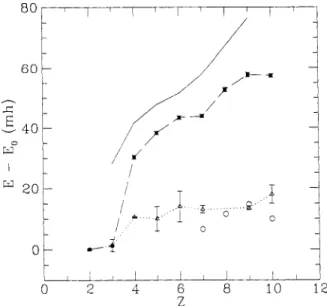
which has no time step error as it samples not only the wavefunction but also the Green’s function itself. It is to be preferred when highly accurate results are needed and computer time requirements are not overwhelm- ing.We show in the next section that using the simplest nodes (a single Hartree-Fock determinant) gives more than 90% of the correlation energy for first-row atoms and dimers (Fig. 1) [21] and essentially 100% of the binding energy for dimers. One can do better by using multicon- figuration nodes or even nodes from the natural orbital determinant.
Figure 1. Error in the nonrelativistic total energy (in millihartrees) for the first-row atoms of atomic charge 2. The upper line is from coupled cluster calculations [27]. The dashed lines with symbols and error bars denote VMC calculations [30], with a single Slater determinant and the correlation factor with 17 variational parameters. The dotted lines with symbols are results of fixed-node DMC calculations with a single Slater determinant. The circles are CI calculations [83,84].
QUANTUM MONTE CARL0 METHODS IN CHEMISTRY 9 However, although using many Slater determinants does allow very good upper bounds, as more and more atoms are added to a system the computer time will grow exponentially quickly (to keep the same accuracy), and hence it is really a solution only for small systems.
C. Path-Integral Monte Carlo
PIMC is mathematically similar to DMC and shares many of its advan- tages [23]. In fact, it goes further, since a trial function is not specified and the method generates the quantum distribution directly from the Hamiltonian. We define PIMC to be a QMC method that is formulated at a positive temperature. Instead of attempting to calculate the properties of a single quantum state, we sum over all possible states, occupying them according to the Boltzmann distribution. This might sound hopeless, but Feynman’s [22] imaginary-time-path integrals makes it almost as easy as DMC. The imaginary-time paths, instead of being open-ended as they are in DMC, close after an imaginary time
fl
= ( k B T ) - ’ , where T is thetemperature. Because of the absence of boundaries in imaginary time, it
is not necessary to have a trial wave function. In DMC, the trial wavefunction is needed to start the paths and to predict the future outcome of a path, but if the whole world line of a path is there, it is not needed. A very important advantage of PIMC is that all observables are obtained exactly, while in DMC only energies are gotten correct. The rest have a bias caused by the importance function, and removal of the bias causes additional uncertainties.
Instead of having imaginary time evolution as in DMC, one keeps the entire path in memory and moves it around. PIMC uses a sophisticated Metropolis Monte Carlo method to move the paths. One trades off the complexity of the trial function for more complex ways to move the paths
[23]. One gains in this trade-off because the former changes the answer while the latter changes only the computational cost.
Particle statistics come in rather differently in PIMC. A permutation operation is used to project Bose and Fermi symmetry. (Remember that in DMC the fixed-node method with an antisymmetric trial function was used.) The permutations lead to a beautiful and computationally efficient way of understanding superfluidity for bosons, but for fermions, since one has to attach a minus sign to all odd permutations, as the temperature approaches the fermion energy a disastrous loss of computational ef- ficiency occurs. There have been many applications of PIMC in chemis- try, but almost all of them have been to problems where quantum statistics (the Pauli principle) were not important, and we do not discuss those here. The review article by Berne and Thirumalai [lo] gives an overview of these applications.
10 D.M. CEPERLEY AND L. MITAS
Recently, there has been some progress in generalizing the path- integral method to treat fermion systems, which is called restricted PIMC (RPIMC) [24]. One can also apply the fixed-node method to the density matrix. The fermion density matrix is given by
where the integral (dR) is over all continuous paths starting at PRO and ending at R , with the restriction that
P is a permutation of atoms with the same spin and necessarily must be even because of the restriction [V(R) is the potential energy] [23]. The exact density matrix will then appear both on the left-hand side of Eq. ( 5 )
and implicitly in the restriction on the right-hand side of Eq. (6). This implies that there exists a restriction which does not have a fermion sign difficulty. In the fixed-node approximation, a trial density matrix is used for the restriction on the right-hand side of Eq. ( 6 ) .
In the most relevant calculation to date using this method, Pierleoni et al. [25] placed 64 electrons and 64 protons in a periodic box and cooled it down to temperatures as low as 5000 K = 0.5 eV. At higher temperatures and pressures the expected behavior for a correlated hydrogenic plasma was recovered. But at the lowest temperature, evidence for a first-order phase transition, where the electrons spontaneously went from an ionized state to a molecular H, state, was seen. This transition had been conjectured, but the simulations have been the first strong evidence.
Although the computer time requirements were large (several months on a workstation), the human input to the calculation was much less than in very similar studies with VMC and DMC (at zero temperature) [26].
RPIMC appears to be a very promising direction for constructing a black-box program for many-electron systems where correlation may be important. Also, PIMC seems to lead more easily to a physical interpreta- tion of the results of a simulation, although very little work has yet been done on understanding the restricted paths of fermion systems. As an example, PIMC could lead to a more direct understanding of bond formation, electron pairing, and localization.
There are several technical difficulties with RPIMC. The first is that the time step is smaller than 1 H-I, on the order of 1 million degrees. Hence to work down to a temperature of 1000K takes on the order of
QUANTUM MONTE CARL0 METHODS IN CHEMISTRY 11
1000 points on the path, which is rather slow. A more serious difficulty is
to come up with automatic ways of generating accurate restrictions.
111. TRIAL WAVEFUNCTIONS
One of the main advantages of the Monte Carlo method of integration is that one can use any computable trial function, including those going beyond the traditional sum of one-body orbital products (i.e., linear combination of Slater determinants). Even the exponential ansatz of the coupled cluster (CC) method [27,28], which includes an infinite number of terms, is not very efficient because its convergence in the basis set remains very slow. In this section we review recent progress in construc- tion and optimization of the trial wavefunctions.
The trial function is very important for both the VMC and DMC methods. That one needs a good trial function in VMC is obvious. There are at least two reasons for having a good trial function in DMC. First, as mentioned earlier, the error in the nodes of the trial wavefunction gives rise to the fixed-node error. Second, it is utilized for the importance sampling, which increases the efficiency of the DMC simulations substan- tially (typically, by more than two orders of magnitude) by decreasing the energy fluctuations resulting from sampling the local energy instead of potential energy. One can show [29] that the DMC error bar depends on the trial function as
where T is the time step and P is the number of steps on the walk. Thus it is advantageous to improve the variational energy as long as that is not too costly in computer time per step.
Currently, the ubiquitous choice for the trial function is of the Sluter-
Justrow or puir-product form. It is a linear combination of spin-up and spin-down determinants of one-body orbitals multiplied by a correlation factor represented by an exponential of one-body, two-body, and so on, terms [16,30]:
TIT@)
=2
d, DetJ [{4&i)>l Deti[{4L3,(r,)>l
x exp(U,
+
U,+
U,+
.).
(8)The sum of determinants in Eq. (8) can accommodate multiconfiguration wavefunctions, which are especially important in systems with a near- degeneracy features. Perhaps the simplest manifestation of this is in the
12 D.M. CEPERLEY AND L. MITAS
Be atom [16,20] where inclusion of an additional configuration has a very significant impact on the final energies.
The terms in the correlation factor can be expressed formally as
and so on (lowercase index letters denote electrons and uppercase letters correspond to ions).
One of the important features of the Slater-Jastrow form is that it can describe the electron-electron cusp in the wavefunction directly and efficiently. The cusp is an important nonanalytic feature of the true wavefunction whenever any two charged particles approach each other. The electron-electron cusp region gives rise to the dynamical correlation.
Because electrons repel each other, by introducing the cusp term, the electronic density is spread from high-density to low-density regions
[9, 311. To get the density back to the optimal value, which is usually rather close to the mean-field density, it is necessary either to reoptimize the orbitals (which can be rather difficult) or to optimize the one-body term simultaneously with the electron-electron and higher-order terms. Therefore, the one-body term U , is retained in the correlation factor, although formally it can be absorbed into the orbitals.
One can include the leading terms of three-particle nonanalytic points with logarithmic terms from the Fock expansion, but their impact on the variational energy is small [20]. Several forms for the correlation terms have been proposed and tested. For example, Umrigar et al. [16] used a Pad6 form of polynomials in a linear combination of electron-electron
(rii) and electron-ion (Ti) distances,
which was then further refined [20]. Schmidt and Moskowitz [30] also provided an interpretation of the correlation part in terms of an average
QUANTUM MONTE CARL0 METHODS I N CHEMISTRY 13
r / ( l + br):
u2
+
u3 =c. c
c k ~ , u ( r i ~ ) k u ( r j , ) ‘ a ( r j , ) m > (13) i,j,Z klmwith b and {cklm} as variational parameters. Mitas [32] used a similar form, but instead of higher powers he introduced a tempering scheme for the Pad6 constant which controls the steepness of the transformed distance, and for the nonanalytic part employed a separated exponential term [34]
where
2
b,(r) =
(&)
7P,
= Po/2m-1 7 m>
0,
(16) with uo(r) = b,(r) = 1, while {cklm}, a,, andPo
are variational parameters.Very recently, a systematic expansion of the correlation factor (8) in polynomial invariants has been proposed by Mushinskii and Nightingale These forms are good at capturing the dynamical part of the electron- electron correlation, as shown in Fig. 1. Typically, one obtains about 85%
of the correlation energy. To obtain the same amount of the correlation with an expansion in determinants, one would need a large basis set that generates an enormous number of determinants even for a rather small number of correlated electrons.
An important step for getting high-quality trial function is the optimi- zation process. One usually takes a set of configurations (Monte Carlo samples of electron positions) from previous runs and minimizes the variational energy or the fluctuations of the local energy [16]:
[331.
where
A4
is the number of configurations (for simplicity we omitted the reweighting factors). With the new trial function, new configurations are generated and the optimization process is repeated until the improvement14 D.M. CEPERLEY AND L. MITAS
It is also important to consider the fact that orbitals, which are generated by a one-body approach, are not necessarily optimal when the correlation is included [20,31]. In general, the reoptimization of orbitals in the presence of correlation is an unsolved task. For small systems such as atoms or small molecules, one can use an expansion in a suitable basis set and reoptimize the expansion coefficients [20]. For larger systems the number of expansion coefficients grows rapidly. In addition, for larger systems the number of sampling points
[M
in Eq. (17)] used for optimization must grow in order to find a stable minimum. Therefore, the computational demands grow rapidly and currently make the orbital optimization very slow.Grossman and Mitas [55] tried another approach for improving the orbitals. For small silicon molecules they replaced the Hartree-Fock orbitals by the natural orbitals which diagonalize the one-body density matrix. The correlated one-body density matrix was calculated within the multiconfiguration Hartree-Fock using standard quantum chemistry approaches. Natural orbitals improved the agreement with experimental binding energies by about a factor of 2, with resulting discrepancies of 1-2% (i.e., 0.05 eV/atom).
In uniform systems there has been more progress on forms of the trial function, going beyond that of Eq. (8) [56]. Translation symmetry greatly reduces the possible forms of wavefunctions. Recently, Kwon et al. [99] carried out calculatic ns of the two-dimensional electron gas with wave- functions, including a backflow effect derived by a current conservation argument [35]. Backflow affects the nodes of the trial wavefunction, so by optimizing it, one can lower the fixed-node energy. The backflow trial function is given by
where the quasi-particle’ “coordinates”
xi
and xi in the Slater deter- minants are given aswhere f(r) is a variational function. The argument of the one-body orbital is a “dressed” position of the electron: It is a sum of its actual position plus a correction that depends on the positions of remaining electrons. The results have shown that a significant amount of the fixed-node error
QUANTUM MONTE CARL0 METHODS IN CHEMISTRY 15 (up to 90%) was recovered by using backflow nodes in the two- and three-dimensional homogenous electron gas.
In addition to a speedup in efficiency and higher accuracy, calculations with the trial functions (8) have also brought an important insight into the nature of the electron-electron correlation: Once the nodes of the wavefunction are sufficiently close to the exact ones (e.g., by using a few configurations and/or optimized orbitals), about 85% (or more) of the correlation can be described by rather simple analytical forms [Eqs. (12)-( 16)] of order 20-30 variational parameters. This is observed for all systems studied: atoms, molecules, medium-sized clusters, surfaces, and solids-some of these included more than 200 valence electrons. In this way QMC has helped our understanding of electron-electron correlation and has demonstrated a significant gain in efficiency for describing these many-body effects.
IV. TREATMENT OF ATOMIC CORES IN QMC
The core electrons pose a problem for QMC methods because the core energy is much higher than chemical energies and the relevant distance scale of core states is much smaller. It has been shown [29] that the scaling of computer time grows =Z6 with the atomic number, Z . Obviously, all-electron calculations quickly become unfeasible (at least to reach a fixed accuracy on the energy) as 2 increases.
Shown in Fig. 2 [21,36] is the Monte Carlo efficiency as a function of 2 using GFMC and DMC. In the GFMC algorithm the statistical efficiency is seen to scale at Z - 9 . 5 , while in DMC it scales as
r5.’.
The GFMC method has particularly unfavorable scaling with Z compared with DMC, presumably because very small steps are taken. While all-electron calculations of Li and Be are within our stated chemical accuracy of 0.01 eV, clearly the all-electron algorithm cannot be used for heavier atoms and reach the needed accuracy. For the QMC methods to become practical for heavy-atom systems, one has to deal with core degrees of freedom in a different way.The core electrons create two basic problems. The first is that the very small size of the core region requires a different strategy for sampling the core region; otherwise, the time step that controls the movement of electrons will scale as Z2. Although this might be difficult technically, it is not the primary obstacle. One can modify the propagator [20] so that it reflects the strong localization of the core charge and thus to a large extent avoid substantial slowing down of the simulations.
Far more severe are the local energy fluctuations caused by the strong potentials and large kinetic energies in the core. Because of a rapidly
16 D.M. CEPERLEY AND L . MlTAS
lo6I
1 0 5 - l O - ' L 10-2 0 A ' A A A 0 0Figure 2. QMC efficiency as a function of atomic charge. The efficiency is defined as lI(CPU time's'). The filled squares are for GFMC calculations of the dimers (LiH, BeH,
.
. . , FH) and the triangles are for GFMC calculations of the homonuclear diatornics (L&, B,, . . . ,O,) both on the CRAY YMP [21]. It is seen that the efficiency of GFMC calculations scale as Z?. The circles are DMC calculations of Hammond [36]. The efficiency of those results scale as Z-'.'.changing density, it is very difficult (although, perhaps, not impossible) to design a trial function that can decrease these fluctuations. Even though correlation is relatively less important in the core, on the absolute scale it is still very large. The core, because of the high density, large potentials, and large kinetic energy, is always the strongest fluctuating term of the local energy.
First, we mention briefly two methods in which the core electrons are kept but their deleterious effects are reduced somewhat. In the damped core approach introduced by Hammond et al. [37], the efficiency was improved by dampening the core energy fluctuations. In this method the wavefunction is written as a product of the core and valence deter- minants, and electrons in the core region are treated variationally while the valence space is treated by the DMC method. There is a smooth transition between the valence and core region by suppressing the DMC branching with a smooth cutoff function. Although the resulting energy depends to a certain extent on the particular choice of the cutoff, successful calculations have been carried out for the atoms C, Si and Ge