Ideas for Implementing and Participating in
the Integrated Licensing Process (ILP)
Tools for Industry, Agencies, Tribes,
Non-Governmental Organizations, Citizens, and FERC Staff
Version 2.0
Federal Energy Regulatory Commission
Office of Energy Projects
Washington, DC
March 2011
Table of Contents
Introduction ... 5
Integrated Licensing Process Timeline ...9
Tips for All Stakeholders throughout the ILP ... 10
Integrated Licensing Process Steps ... 12
Chapter 1: Integrated Licensing Process Preparation ... 12
Applicants Should Plan the Process, Be Pro-Active, and Open the Lines of Communication ...12
Agencies, Tribes, NGOs, and Citizens will Benefit from Early Preparation and Coordination...13
FERC Can Assist Applicants and Stakeholders...14
Chapter 2: Developing the Pre-Application Document... 16
Cast a Wide Net to Gather Information for the PAD...16
Agencies, Tribes, NGOs, and the Public Can Help ...17
Create a Good PAD; One Size Doesn’t Fit All ...18
The Process Plan and Good Lines of Communication Will Keep Things Moving ... 19
FERC Can Assist Applicants and ILP Participants to Prepare a Good PAD and a Realistic Process Plan... 20
Chapter 3: Scoping ... 21
Applicants Can Help Promote Effective Scoping Meetings ...21
All Participants Need to be Prepared for Interaction ...22
FERC Should Encourage Interactive Scoping Meetings ...23
Chapter 4: Study Requests and Study Plan Development... 25
Details, Details, Details ...25
Communication, Collaboration, and Planning Can Improve Efficiency and Effectiveness of the Study Plan Development Process...27
FERC Can Clarify Elements of the Study Plan Development Process ... 28
Formal Dispute Resolution... 29
Chapter 5: Study Results Review and PM&E Measures... 30
Applicants Can Lead Collaboration and Sharing of Information... 30
Stakeholders are also Responsible for Keeping Things Moving Forward...31
Chapter 6: Preliminary License Proposal (or Draft License Application), Final License Application, and Post-Filing
Activity ... 32 Applicants Should Use the PLP or DLA as Appropriate; One Size does Not
Fit All ...33
FERC and Agencies Should Better Educate Participants and Coordinate Regulatory Activities...33
Conclusion... 35
Executive Summary
In 2005 and again in 2010, Federal Energy Regulatory Commission (FERC or Commission) staff explored with applicants, tribes, agencies, non-governmental agencies (NGO), and citizens how well the integrated licensing process (ILP) was achieving its goal of providing a predictable, efficient, and timely licensing process that ensured adequate resource protection. We asked what was going well and what might be done better. This document contains those shared ideas, tools, and techniques that have been successfully implemented (or could be implemented) to assist future ILP participants without unduly extending the licensing process or changing existing regulations. Key suggestions are listed below:
Applicant
Create an open and transparent process by actively identifying and working with interested stakeholders throughout the process, including developing and
adhering to a detailed process plan that permits stakeholders to understand what is expected of them and when.
Consider establishing a website or a file sharing site to distribute reports, meeting summaries and other documents quickly and efficiently; establish a distribution protocol and stick to it to ensure that stakeholders receive documents on time and well ahead of scheduled meetings.
Ensure participants understand your project and the ILP by providing a good project description in the pre-application document, conducting site visits, and sponsoring workshops and outreach efforts to explain the process; invite FERC to assist in explaining the ILP.
Plan your process such that you can complete the application timely; consider the seasonality of studies, regulatory timeframes of the ILP, and when you need to file a license application.
Prepare detailed study plans; consider providing study plans in the PAD; and work collaboratively with stakeholders to develop study plans that are as responsive to stakeholder needs as possible.
Include draft resource management plans in the preliminary licensing proposal or draft license application to promote constructive review and input such that final plans can be developed and filed with the final license application.
Agencies, Tribes, and NGOs
Get involved early and stay involved; become familiar with the ILP regulations and research the project.
Take advantage of any applicant or FERC-sponsored meetings or training to understand the project, the ILP, and your responsibilities and time commitments; seek adequate staffing and/or notify the applicant and other stakeholders of your resource constraints early; and look for ways to coordinate with other
stakeholders to achieve resource efficiencies and overcome resource constraints.
Share available information with the applicant early to better define information gaps.
Work with the applicant, FERC staff, and other stakeholders to explain your regulatory requirements, timelines, process steps, and information needs up-front
to help set expectations and to establish a more coordinated licensing process timeline.
Work with the applicant, FERC staff, and other stakeholders to explain your resource interests and management goals and objectives, and develop thorough study requests that address the ILP study criteria.
Keep up to date by using available resources (project websites, subscribe to FERC’s eLibrary).
Review materials in advance of meetings, with comments prepared for the productive use of meeting times.
Work closely within your organization to achieve clarity and consensus on information and resource needs.
Be open to discussing protection, mitigation, and enhancement measures before studies are completed.
FERC Staff
Continue to hold ILP workshops and training to inform stakeholders of ILP timelines and requirements.
Participate in ILP meetings to the extent possible to ensure a thorough understanding of stakeholder interests and information needs.
Explore different formats for scoping meetings to promote more interaction with stakeholders.
Prepare guidance that explains the ILP study criteria and how to develop good study requests; make these available at meetings and on the web.
Facilitate discussions of issues and study proposals to ensure that there is a clear link between a study request and project effects.
Provide more thorough and clear study determinations so that participants understand why their studies were rejected.
Introduction
The Integrated Licensing Process (ILP) is intended to streamline the Commission’s licensing process by providing a predictable, efficient, and timely process that continues to ensure adequate resource protections. The efficiencies expected to be achieved through the ILP are founded on three fundamental principles:
Early issue identification and resolution of studies needed to fill information gaps, thus avoiding studies post-filing.
Integration of state and federal agency and tribal permitting process needs, including the Commission’s scoping pursuant to the National Environmental Policy Act (NEPA), the license applicant’s pre-filing consultation, and federal and state permitting needs such as water quality certification pursuant to section 401 of the Clean Water Act and Endangered Species Consultation pursuant to the Endangered Species Act.
Established timeframes to complete process steps for all stakeholders, including the Commission staff.
In 2005 and again in 2010, Federal Energy Regulatory Commission (FERC or Commission) staff explored with applicants, tribes, agencies, non-governmental
agencies (NGO), and citizens how well the ILP was achieving its goals and what might be done better. Participants in the effectiveness study found that the ILP principles were generally achieving its goals. This document is a culmination of the shared ideas, tools, and techniques that have been successfully implemented (or could be
implemented) within the framework of existing regulations. Methods
In 2005, Commission staff engaged participants involved in the first seven ILP cases (“pioneer projects”) through probing personal interviews, by-sector (i.e., applicants, agencies and tribes, and NGOS) teleconferences, regional workshops, and a technical conference. The 2005 study was limited to the ILP steps leading up to the Office of Energy Project’s director’s study determination because few projects had completed the ILP steps beyond that point. This feedback informed an Ideas for Implementing and Participating in the Integrated Licensing Process handbook that was released in March 2006.
In 2010, we repeated the study, using the same approach as in 2005, but included all of the process steps leading to the filing of the license application. Thus, the first four steps (Chapters 1 – 4) of this revised guidance document represent input from both the 2005 and 2010 evaluations while the last two steps (Chapters 5 – 6) represent input solely from the latter evaluation. A total of 30 projects were included in the second evaluation.
Content and Organization of the Guidance Document
The feedback collected through these two evaluations is the basis for the concepts, actions, and activities that each of the sectors (applicants, state and federal agencies, tribes, NGOs, citizens, and FERC staff) may consider implementing. This document is formatted to first provide a description of the ILP steps and goals, followed by a
summary of the ideas provided during the evaluation. The compilation of ideas presented herein represents those ideas put forth that the Commission staff believes would best help future ILP participants without unduly extending the licensing process or changing the existing regulations.
Because solutions to some of the comments do not fit into the framework of this document, Commission staff has also developed an ILP Action Plan. It will address such topics as study criteria, outreach and education, and interagency coordination, and is available on Commission’s web page at: www.ferc.gov.
Summaries of all comments provided during the interviews, by-sector dialogues, and regional workshops, and the transcripts of the technical conference can be found on the Commission web page at (www.ferc.gov). The 2005 technical conference transcript is also available on the eLibrary under docket AD05-6-000, and the 2010 technical conference transcript is available under docket AD10-7-000.
Implementation and applicability of the ideas contained herein must be considered based on the specifics of a particular project because every licensing project is different in size, complexity, location, public interests, resource issues, participant relationships, and the amount of participant experience. The ideas are tools that may help improve participant involvement and process outcomes; they are not a substitute for the regulations, which must be reviewed and followed.
Steps evaluated during the ILP Effectiveness Studies
ILP Preparation: This step involves planning the license application process, including developing the process plan and schedule, identifying and consulting with appropriate federal and state agencies, tribes, and other interested participants, and gathering information that is in the applicant’s possession or that the applicant can obtain from others with the exercise of due diligence to prepare the Pre-Application Document (PAD).
PAD Development: This step involves organizing existing, relevant and reasonably available information in such a way that all participants understand what is known about the project, its resources, and any known project effects on those resources. This should enable participants to understand the project proposal; identify potential project effects, issues, and information gaps; and develop study requests.
Scoping: This step initiates the FERC’s scoping process to identify issues to be examined pursuant to the National Environmental Policy Act of 1969. It provides interested participants an opportunity to review and discuss existing information and conditions, resource management objectives, issues, and the process plan and schedule.
Study Plan Development: This step involves developing detailed studies and study methods to fill information gaps needed to address issues identified during scoping.
Study Results Review and PM&E Measures: This step involves reviewing study results, and ideally, identifying potential protection, mitigation, and environmental (PM&E) measures. During this time, the applicant and stakeholders review studies to ensure that they have been completed as approved by the Commission, and whether modifications to the studies are needed. Information from the studies, in conjunction with information identified during the PAD, should enable participants to develop PM&E measures that would mitigate any project’s impacts on the environment and other resources.
Draft and Final License Application and Post-Filing Activity: This step involves the applicant developing its preliminary licensing proposal (PLP) and Final License Application (FLA). The applicant may choose to submit a Draft License Application (DLA) instead of the PLP. Post-filing activities also begin, including, the issuance by the Commission of an Environmental Assessment (EA) or Environmental Impact Statement (EIS), with a public comment period; Endangered Species Act consultation; action on a 401 certification; and final action by FERC.
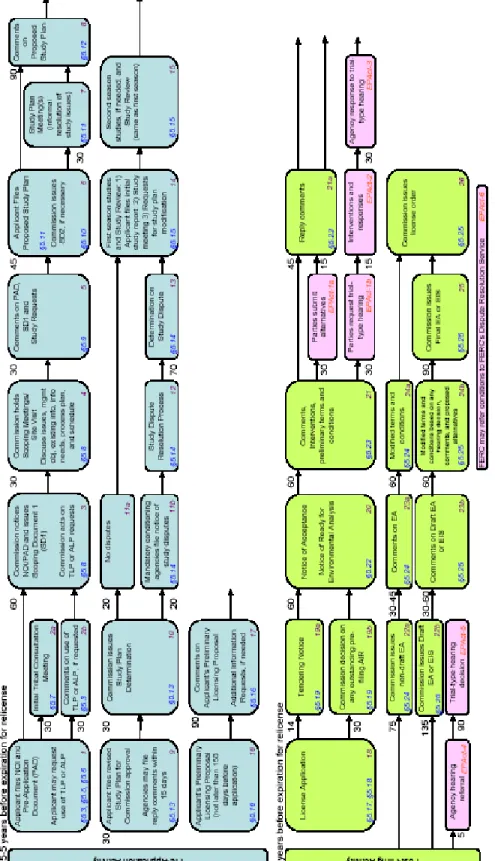
The ILP regulations can be found on FERC’s web page and the process steps are illustrated in the process flow chart (Figure 1).
Helpful Websites
ILP Final Rule and Tribal Policy Statement Order 2002
http://www.ferc.gov/industries/hydropower/indus-act/hl-over.asp
ILP General Information
www.ferc.gov/industries/hydropower/gen-info.asp
Ideas for Implementing and Participating in the Integrated Licensing Process (ILP)
www.ferc.gov/industries/hydropower/gen-info/licensing/ilp/eff-eva/ideas.pdf
Figure 1: ILP Process Timeline
Tips for All Stakeholders throughout the ILP
Understand the Process, Get Involved Early, and Stay Involved
Participants from all the sectors in the effectiveness study emphasize that understanding the process and what is expected of each stakeholder is key to
participating effectively in an ILP and meeting the regulatory timeframes. Some found that the ILP is easier to understand than other processes, particularly for stakeholders with a smaller role in the licensing process. Deadlines and timelines helped to keep everyone on schedule. Participants in the effectiveness studies found the following to be helpful in improving understanding and participation in an ILP:
Read the ILP regulations and become familiar with the process steps and timelines. This is a fast moving process that requires early involvement by all stakeholders for it to be fully effective.
Closely follow the process plan and any updates.
Become involved early. This is particularly important for mandatory conditioning agencies, which have requirements that need to be met during the ILP.
Attend workshops or other training held early in the process to educate participants. Such training not only informs participants of the regulatory
requirements and project management objectives of the ILP, but also serves to define the roles and needs of the participants. The presence of FERC staff at such trainings is beneficial. Applicants should invite FERC participation in early outreach efforts.
Use FERC’s internet e-filing and e-subscription services to ensure timely filings and efficient use of available time (http://www. ferc.gov/docs-filing/elibrary.asp) and to stay abreast of filings with the Commission.
Schedule meetings up front to save time in scheduling later. Then, cancel meetings if they are not needed.
Establish and Maintain Open Lines of Communication
Participants in the effectiveness studies feel that early preparation and sustained open communication are key to a more efficient and quality process. Collaboration with other stakeholders is important to avoid miscommunication and understand responsibilities. It also can lead to mutually-agreeable products and measures for the license
application. Participants in the effectiveness studies found the following to be helpful in establishing and maintaining open lines of communication:
Applicants should identify and establish key contacts with participants from all sectors. Participants in the process can assist the applicant in these efforts by identifying other stakeholders who may want to become involved in the process; participants can then share the stakeholders’ contact information with the
applicants.
Everyone should keep in mind that working together on a complex project
requires a thorough understanding of how the project operates and its regulatory requirements, and patience from all participants. Such transparency and a willingness to understand others’ interests can lead to fewer obstacles in the licensing process for all stakeholders. Everyone needs to remember that each project is different. What happened in one case may not be applicable or relevant to others.
Applicants should consider providing a project website or a file-sharing site to facilitate access to documents and meeting materials; applicants might consider regular newsletters or other updates, as a means to allow stakeholders to follow and understand a project’s progress. It is also helpful when meeting materials are shared well ahead of scheduled meetings (one week in advance) to provide time for review.
Applicants may want to use a facilitator to help manage discussions, the study results review process, keep participants on track, and foster collaboration. When new stakeholders join the process, facilitators can help bring them up to speed without hampering the overall process.
Integrated Licensing Process Steps
Chapter 1
Preparing for the Integrated Licensing Process
An applicant notifies FERC that it intends to file an application for a license to construct and operate or continue to operate a hydroelectric project by filing a notice of intent (NOI) and a Pre-Application Document (PAD). The PAD describes the project proposal, what is known about the project environment, and any known or potential project effects on environmental or other resources. An applicant seeking to relicense an existing project must file the NOI and PAD five to five and a half years prior to the expiration of the existing license. An applicant seeking an original license has greater flexibility when to file its NOI. In general, such an applicant should file its NOI and PAD when it is confident of the project’s feasibility and prepared to begin developing its license
application. A license applicant is required to demonstrate due diligence in obtaining all existing, relevant, and reasonably available information for the PAD.
Participants in the effectiveness studies shared the following thoughts about when to get started; what to consider when developing the ILP process plan; how to ensure all interested participants and issues are identified and all available, relevant information is obtained; and what FERC should do to promote a more efficient and effective process.
Applicants Should Plan the Process, Be Pro-Active, and Open the Lines of Communication
A lot of the responsibility for ensuring the ILP is timely and efficient falls on the license applicant. An extra effort to open lines of communication and include participants early in the process is appreciated and can help improve the efficiency of the process. Tips for ensuring a timely and efficient process include:
Make sure everyone is ready to jump into the process by holding or sponsoring an early training course to introduce the project and the ILP. Such efforts will facilitate a strong start and help build a solid foundation of participant
understanding and working relationships.
It may be helpful for some applicants to start working with stakeholders well in advance of filing the NOI with the Commission. It has been shown to allow for a smoother process in some complex cases because it gave participants more time to gain an understanding of the project, gather existing information, and identify information gaps and the means to fill those gaps. This is particularly true in complex projects that might require multiple years of study to address resource issues.
An applicant-sponsored field trip to the project site can help participants understand the specific project and issues.
Holding one-on-one meetings with interested stakeholders who are unfamiliar or inexperienced with hydroelectric licensing can aid in timely stakeholder
participation, facilitate a better understanding of each stakeholder’s concerns, and help uncover relevant existing data.
A clearly defined process schedule helps define when and how agencies, NGOs, and citizens can most effectively contribute to the process. Make sure everyone understands that once the NOI and PAD are filed, the process moves quickly. Cast a wide net for interested
stakeholders and relevant information. Ask community leaders and state and federal agency representatives for help contacting and identifying
stakeholders who may not be aware of the project or may have relevant
information and interests.
A list of contacts who are
commonly involved in hydropower licensing can be found on the FERC web page at:
http://www.ferc.gov/industries/hyd
ropower/enviro/consult-list.asp
In deciding when to file the NOI and PAD, applicants should consider the
seasonal needs for studies as well as such regulatory timeframes as the license expiration date. Such consideration may provide more time for studies and may help avoid scheduling conflicts, such as holidays. It is preferable to have
approved study plans in place in advance of the appropriate study seasons so there is adequate time to conduct the studies.
Conduct an initial meeting with FERC for guidance prior to filing the NOI to discuss roles, expectations, process steps, and study criteria.
Agencies, Tribes, NGOs, and Citizens will Benefit from Early Preparation and Coordination
Increased public involvement is one of the goals of the ILP. All participants play a key role in the ILP from the very beginning of the process. Many of the participants in the effectiveness studies acknowledged the benefits of the tightened structure of the ILP, but also noted that it requires early involvement, early dedication of time and energy, and substantial preparation. Participants in the effectiveness studies offered the following suggestions for agencies, tribes, NGOs, and citizens to consider in preparing for an ILP:
Become familiar with the ILP regulations and research the project. That way, stakeholders can participate with a foundation of understanding about the process and the project.
Take advantage of ILP trainings to get up to speed on the process and the project.
Ensure that decision makers and managers are alerted and involved early in the process so that issues and personnel needs are adequately considered in planning. Make the necessary arrangements to provide adequate
representation, to the extent possible, at meetings.
Assist applicants in gathering existing, relevant, and reasonably available information by identifying and sharing information with the applicant and other entities that may be interested in the project.
Introduce yourself to applicants, and identify your regulatory responsibilities and process needs early. It is helpful when resources agencies with specific
regulatory responsibilities introduce themselves and their role in the process. All participants have looked to FERC staff as educators, facilitators, mediators, and regulators.
Coordinate and collaborate with stakeholders who have similar interests and technical expertise in order to gain resource efficiencies and additional
information. This may be particularly useful to concerned citizens and others who lack the resources, time, and technical training to participate in all aspects of the ILP, but want to ensure that their concerns are known by the applicant, FERC and public agencies.
FERC Can Assist Applicants and Stakeholders
Participants in the effectiveness studies offered the following recommendations that FERC could undertake to educate participants in the ILP. They encouraged the Commission to:
Prepare FERC staff such that they have a clear understanding of the ILP and can promptly and consistently answer questions about the process, regulatory
requirements, and the study criteria. Clearly define roles during outreach meetings, ILP training sessions, and throughout the process.
Continue to develop and distribute educational materials such as the “FERC Hydroelectric Licensing under the Federal Power Act Final Rule & Tribal Policy Statement,” “Handbook for Hydroelectric Project Licensing and 5 MW
Exemptions from Licensing,” and the “Small/Low Impact Hydropower Program” website.
Continue to hold FERC ILP workshops and training sessions.
“When FERC is active and involved, we have better outcomes.”
-NGO Representative
Attend all meetings. Having FERC staff at meetings encourages participants to collaborate, helps clarify roles, and helps answer questions that smooth the process.
Remain open and accessible to questions; reaffirm the Commission’s neutrality and respond promptly and consistently to all participants’ concerns.
Facilitate and encourage cooperation and involvement of as many interested stakeholders as early as possible by:
Establishing working relationships with the stakeholders.
Supporting transparent communications.
Encouraging the applicant to cast a wide net to identify stakeholders to participate in the process.
Continuing to update the Initial Consultation Contact List
(http://www.ferc.gov/industries/hydropower/enviro/consult-list.asp).
Chapter 2
Developing the Pre-Application Document (PAD)
The PAD is the cornerstone of the ILP. Itprovides the basis for identifying issues, data gaps, and study needs. It forms the foundation for future documents, including the license application, as well as providing participants with an initial understanding of the project. Because of its importance, many of the suggestions provided by the participants in the effectiveness studies revolve around information for the PAD; soliciting and portraying information in a useable form; providing the right level of detail in the PAD and in study needs; and involving ILP participants in developing the process plan and methods for distributing information.
What must be included in the PAD is outlined in the FERC’s
regulations [see 18 CFR 5.6(d)]. In sum, the PAD must include:
Project description (facilities and operation)
River basin description
Description of the existing environment and resource impacts to the extent that they are known
List of issues
List of studies proposed to fill identified information gaps
List of relevant comprehensive plans
Process plan
Summary of contacts
Cast a Wide Net to Gather Information for the PAD
The PAD provides participants with existing information relevant to the project proposal that is in the applicant’s possession or that the applicant can obtain with the exercise of due diligence. However, while an applicant is not required to conduct studies to gather information for the PAD, it is expected that the applicant will diligently attempt to gather all relevant and reasonably available material. Participants in the effectiveness studies suggest that an applicant give consideration to the following in gathering existing information:
Applicants should meet early with stakeholders to identify baseline information that will inform all potential project effects.
Applicants might consider using a questionnaire or other survey-type tool to solicit existing information. This can help participants search for relevant
information and uncover all potential information sources. Follow-up phone calls can help probe for issues, uncover additional available information, and ensure a common understanding of project operations. These interactions and
discussions demonstrate an applicant’s efforts to obtain information. Applicants need to provide entities with enough time to identify, gather, and
provide information for the PAD. Participants stated that helping to collect and coalesce this information is mutually-beneficial in identifying study needs and adding clarity to the process.
Applicants might consider forming work groups and meeting with individual agencies and other stakeholders to gather information and to dig deeper into potential issues that would benefit from a more thorough discussion in the PAD. Such efforts can also be useful in communicating available information.
Applicants should provide participants with a list of information currently in an applicant’s possession to help avoid needless searching for redundant information.
Applicants may want to consider conducting some basic studies to supplement available information for the PAD. This was done voluntarily by
some of the applicants and in consultation with the participants. Such efforts need to be considered carefully because without a FERC-approved study plan an applicant might have to duplicate efforts.
“Even though we started a couple years early, it was very measured and incremental. This early start added some time and costs to the ILP, but it saved a great deal of time and money through the [remainder of the] process. ”
-Applicant
Agencies, Tribes, NGOs, and the Public Can Help
Maximum participation by all stakeholders in identifying information for the PAD ensures that everyone starts with a common understanding of the issues and eventually in the development of study plans to fill information gaps. Participants in the effectiveness studies offered the following advice for future participants in an ILP:
Do not assume the applicant has all the available information. If you receive a request for information from an applicant, provide as much information on project environmental resources, project effects, and management objectives as
possible.
Be pro-active. Stakeholders aware of an upcoming licensing effort might
consider researching their files for available information prior to a request by an applicant. This provides greater lead time in responding to an applicant’s request.
Consider dividing responsibilities based on areas of expertise. This can improve time and resource efficiencies. Support other agencies in collecting data for the PAD.
Create a Good PAD; One Size Doesn’t Fit All
An organized and well-developed PAD is crucial to get the process off to the right start. However each PAD will be different based on the range and complexity of issues and availability of information. Participants in the effectiveness studies offered the following advice to applicants and ILP participants:
Applicants should provide a thorough and clear description of project facilities and operations, including a map of project boundaries with the location of project facilities and federal lands clearly delineated. This is fundamental to
understanding potential project effects. Applicants should use the PAD as a
working document and framework for the process. There is flexibility in formatting the PAD. Following a format similar to that of an environmental assessment helps in drafting future documents, including the preliminary licensing proposal, the license application, and FERC’s environmental documents.
“I like the ILP. It’s front-end loaded with the PAD and other things. That’s an improvement over other licensing processes.”
-Federal Agency
Applicants should strive to make the PAD concise and easy to read. Consider using summary statements and clearly reference available information. Post the referenced information, or relevant links, on a website.
Applicants should use layman’s terms to make the document user-friendly. This is particularly useful for those unfamiliar with hydroelectric projects and the licensing processes.
Applicants should clearly describe all the issues or potential issues based on potential project effects identified in developing the PAD. A thorough review of the issues will foster candid and open discussions during scoping and study plan development.
Applicants should strive to provide as much detail as possible in describing proposed studies in the PAD. Participants in the effectiveness studies recognize that applicants may be unable to provide detailed study plans until the issues are fully scoped, but they found greater efficiency in developing their study requests by responding to more detailed study plans. It also assists their understanding of what is feasible for, and proposed by, the applicant. In some cases, it may be useful to develop study plans collaboratively. This also helps stakeholders to understand the study criteria and how it applies to the specific licensing.
ILP participants should clearly communicate to the applicant the level of detail they would like to see in the description of potential studies, and ultimately, in the studies themselves.
The Process Plan and Good Lines of Communication Will Keep Things Moving
The process plan describes the overall plan and schedule for licensing, consistent with the time frames established in the ILP regulations. It helps participants keep up with the process and describes how information will be distributed. Integrating other agency process needs (such as the state water quality certification process and endangered species consultations) into the ILP is expected to result in substantial efficiencies and time savings in the ILP. Participants in the effectiveness studies offered the following suggestions for developing a good process plan and disseminating information.
The applicant and ILP participants should review the process plan timeline collaboratively to make sure everyone understands their roles and
responsibilities, and the timing and deadline requirements.
Agencies should discuss their process needs, their regulatory requirements and implications for the process, and associated deadlines. Discussing these
regulatory needs relative to the ILP process plan will help ensure state and federal regulatory processes are integrated, to the greatest extent practicable, with FERC’s licensing process.
Applicants should post the process plan in a venue accessible to the public. Applicants should bring the timeline to all meetings and make sure participants
are aware of any changes.
Applicants should include a Distribution Protocol in the PAD to outline means for information distribution and access. This is strongly encouraged by the
regulations.
Applicants may want to consider
establishing a project website and/or file-sharing site. This provides a convenient and consistent way of accessing
information. It can be helpful in ensuring timely notification and availability of information.
Mechanisms for communication:
Electronic reminders
Outreach meetings
Project website
File sharing
Applicants may want to consider distributing documents by electronic mail or posting documents on an FTP site, and notifying participants when new materials
are posted. Send hard copies of required information to stakeholders without electronic mail access.
Applicants may want to consider giving personal reminders about important meetings, including scoping and proposed study plan meetings. An applicant also may want to consider developing a mechanism for tracking issues and studies. They should also encourage the use of FERC’s eLibrary, which may help ensure active and timely participation by stakeholders.
FERC Can Assist Applicants and ILP Participants to Prepare a Good PAD and a Realistic Process Plan
Participants in the effectiveness studies said stakeholders benefit from the
Commission’s expertise. Applicants, agencies, tribes, and NGOs would like to get a better understanding of what a PAD looks like, what needs to be included, and how to identify issues. Commission staff was encouraged to:
Work closely with applicants and agencies to integrate permitting processes (401 and ESA) into the ILP schedule.
Continue to review draft documents as may be requested to identify missing information.
Continue outreach efforts to explain the process and how to identify all potential issues.
Chapter 3
Scoping
Scoping is the process used by federal agencies to identify affected public, tribal, and agency concerns about a proposed undertaking and
to identify and define the scope of issues and alternatives that will be examined in detail in its environmental analysis required by the National Environmental Policy Act of 1969 (NEPA).
Conducted effectively early in the process, it can help ensure that project effects and issues are identified early and properly studied; that issues of no concern
do not consume time and effort; that the environmental analysis is balanced and thorough; and that the delays caused by late-rising issues are avoided.
Project documents can be found by searching the FERC’s eLibrary under the project’s number (for example, P-1111).
Toward that end, within 60 days of an applicant’s filing of notice of intent to file an application and its PAD, FERC will notice in the Federal Register and in a newspaper with circulation in the project area notice the time and location of a public scoping meeting and site visit. It will also issue a scoping document describing the project facilities and operation and the issues FERC staff identified based on the contents of the applicant’s PAD. At the scoping meeting, FERC staff will encourage applicants to provide a detailed explanation of project facilities and operations, and then lead a discussion about the project effects and issues, existing conditions, available
information, resource management objectives, preliminarily identified information gaps and study needs, and the appropriateness of any federal or state agency or Indian tribe acting as a cooperating agency for the development of an environmental document pursuant to NEPA. FERC staff also intends to finalize, if possible, the process plan to incorporate other agency process needs into the ILP to the greatest extent practicable. Suggestions provided by the participants in the effectiveness studies for improving the scoping process revolved around actions that would increase stakeholder participation and preparation.
Applicants Can Help Promote Effective Scoping Meetings
Although the scoping meeting is run by FERC staff, an applicant can play an important role in organizing and helping make sure the scoping meeting works well. Participants in the effectiveness studies suggest that the following actions be considered by an applicant to organize an effective scoping meeting.
Work with FERC staff early to identify locations for the scoping meetings that are convenient and promote agency, tribe, and public participation. The regulations require an applicant to include a proposed date and location for scoping in the PAD. Working with FERC staff before filing the PAD will provide an opportunity to reserve rooms and make site visit arrangements, resulting in greater certainty
for all participants that the arrangements proposed in the PAD will be implemented.
Work with FERC staff to design creative meeting formats and supporting
materials to ensure an effective scoping meeting. A kiosk approach with posters and flip charts, for example, allows the participants to view enlarged details of the project features and to list additional issues and information needs based on ensuing discussions. Round-table discussions help participants talk through issues or concerns together in order to provide more thorough and direct scoping comments.
Be prepared to describe project facilities and operations, talk about information collected for the PAD, and discuss possible project effects and the basis of proposed studies at the scoping meeting.
Check-in regularly with participants, via email and telephone, to remind them of scoping meetings and to encourage them to prepare for discussions by reading the PAD.
Encourage participants to use scoping as an opportunity to voice concerns or focus attention to issues that have not been previously identified, rather than repeating issues and information sufficiently captured in the PAD.
Consider providing logistical support for site visits. Such efforts were appreciated by the effectiveness studies’ participants and helped them get a better
understanding of the project, potential project effects, and the issues.
Keep track of comments or concerns raised during scoping. Making an effort to track scoping comments helps an applicant stay on top of the issues, develop the proposed study plans, and promote a sense of trust in the process by all
participants
All Participants Need to be Prepared for Interaction
An early and open discussion about the project effects and issues helps ensure a better and more efficient NEPA analysis and can help prevent surprise issues and study requests later. It simultaneously places responsibilities on public, tribal, and agency participants alike to share their concerns early. To achieve ILP goals, participants need to come prepared to discuss their issues and concerns. FERC staff wants and expects participants to play an active role in scoping meetings. Participants in the effectiveness studies suggested the following to help participants come prepared to the scoping meeting.
All participants should read the PAD and be familiar with the project prior to the scoping meeting. If this is a relicense, participants may find it helpful to review
Agency and tribal representatives should be prepared to discuss their respective resource management goals and objectives, information gaps and study needs, and process needs, particularly based on each agency’s regulatory requirements (e.g. endangered species act consultation, 401 water quality certification, and section 4(e) and 18 of the Federal Power Act conditioning authority).
NGOs and the public should be prepared to discuss their concerns and information needs.
All participants should be prepared to discuss and explain issues that should be included in the scope of the environmental analysis that may have been omitted or not fully explained in the PAD.
All participants should attend the site visit and scoping meeting.
All participants should feel free to contact FERC staff with any questions about the format or the purpose of the meetings, or how to submit comments.
All participants should provide the applicant with a copy of any scoping
comments filed with the Commission so that the applicant is immediately aware of any concerns.
Stay up-to-date by subscribing to FERC’s eSubscription service http://ferc.gov/docs-filing/esubscription.asp
Register to receive email notification of filings and issuances about selected docket(s).
FERC Should Encourage Interactive Scoping Meetings
Participants in the effectiveness studies believe FERC’s role is to encourage attendees to be interactive, place an emphasis on the value of scoping, and act as an impartial facilitator to help identify issues. Commission staff is encouraged to:
Prepare for scoping meetings by sending official notice and a scoping document that clearly describes the purpose of meeting and the issues so that interested participants will know how to prepare.
Publish official notice of scoping meetings in more local newspapers.
Consider holding meetings at different locations within the project vicinity to accommodate interested participants who do not have the resources available to travel.
Consider alternative meeting times for citizens with professional commitments outside of the relicensings.
Explore the format of meetings with the applicant to encourage more interaction.
Explore stakeholder concerns to understand and accurately reflect and consider their issues. Ensure that sufficient time is allotted for questions and concerns to be addressed at the scoping meetings.
Consider different formats for scoping meetings. In certain situations, a one-on-one conversation among agencies and other stakeholders may be more
productive than a full group discussion.
Chapter 4
Study Requests and Study Plan Development
Early agreement on studies needed to fill information gaps is a critical element of the ILP and important to ensure timely decisions once the application is filed. Yet, getting to an approved study plan can be one of the more challenging and time consuming efforts stakeholders face in the ILP. Participants in the effectiveness studies stated that
understanding and effectively using the study criteria is one of the most difficult challenges. While some felt that the criteria helped to focus efforts to identify appropriate studies, others felt that some criteria, such as the project nexus or
estimating costs and levels of effort, are not clear, leading to misunderstandings as to why certain study requests are rejected.
The ILP has a defined process and timeframe to develop a study plan that is approved by the Office of Energy Projects’ Director. That process formally begins with the filing of study requests by agencies, tribes, NGOs, and the public in response to FERC’s
scoping notice, but the ground work for the study plan and study request is based on the information gathered while developing the PAD and during scoping.
Participants in the effectiveness studies offered a number of suggestions to improve the efficiency and effectiveness of the study plan development process. Most revolve around effective communication and planning.
ILP STUDY PLAN DEVELOPMENT PROCESS
Applicant includes list of proposed studies in the PAD
Participants file Study Requests in response to FERC’s Scoping Notice
Applicant files Proposed Study Plan
Applicant, Participants, and FERC Staff meet to resolve study disputes
Applicant files Revised Study Plan
OEP Director issues Study Plan Determination
Details, Details, Details
Development of good study plans is an iterative process in which the level of detail increases with each step until a study plan is developed and approved. A good study defines the “what, when, where, and how,” so that, ideally, anyone should be able to pick up the approved study plan and implement it. Participants in the effectiveness
studies offered the following advice to applicants and ILP participants for developing good study plans.
Applicants should provide as much detail as possible in the list of proposed studies included in the PAD. While applicants may be unable to provide detailed studies until the issues are fully scoped, many agency representatives and other participants found resource efficiencies and greater comfort responding to detailed study plans included in the PAD, rather than crafting study requests that may not fit well with an applicant’s plans and capabilities.
Participants should provide study requests that address each of the study criteria thoroughly, are as detailed as possible, and clearly relate how the information to be
gathered pertains directly to any mandatory conditioning authority under section 4(e) or 18 of the Federal Power Act, or section 401 of the Clean Water Act.
The Seven Study Criteria
1. Describe the goals and objectivesof the study.
2. Explain relevant resource management goals. 3. Explain any relevant public
interest considerations. 4. Describe existing information
concerning the subject of the study proposal.
5. Explain the nexus between
project operations and effects on the resources to be studied. 6. Explain how any proposed study
methodology is consistent with generally accepted practice. 7. Describe considerations of level of
effort and cost.
Applicants should provide a proposed study plan that is as detailed as possible in terms of methodology, timing, and scope. They must clearly describe the
rationale for not adopting a study request.
Applicants might consider creating and populating a study plan template that includes the seven study criteria to facilitate better study requests. This may be particularly useful to the public and some NGOs that may lack a scientific
background yet have concerns that require additional information. If a phased approach to a study is contemplated, then Applicants and ILP
participants should craft study requests and study plans that clearly define anticipated future steps, based on the study results.
Applicants should make copies of obscure publications available (on the web, for example) if they are the source of a proposed study protocol.
Communication, Collaboration, and Planning Can Improve Efficiency and Effectiveness of the Study Plan Development Process
Participants in the effectiveness studies offered the following suggestions to help applicants and participants to effectively and efficiently move through the study plan development process.
“It’s better to work things out informally; local solutions are the best solutions.”
-State Agency Everyone is responsible for
educating themselves on the study criteria. Understanding the study criteria is critical to participate fully in the discussion.
Applicants might consider forming resource work groups to develop study plans. Work groups bring together technical experts, resource managers, and others with a common interest, allowing participants to better manage their time. However, an applicant needs to carefully plan work group meetings in
consultation with participants because many agencies and other participants are either responsible for, or have an interest in, multiple resources and may need to participate in multiple work groups.
Applicants may want to consider working through proposed study plans with stakeholders as early as possible. Working through study plans prior to filing the proposed study plan can give the participants more time to focus on the more problematic issues during the 90-day informal dispute resolution process provided in the ILP.
Agencies, tribes, and NGOs may also want to coordinate their efforts in
developing study requests. Such coordination allows participants to build on the expertise of others, increases participant understanding of the issues, and can decrease work load by reducing duplication of efforts for common issues. However, agencies (particularly those with mandatory conditioning authority) and other participants should ensure that their requests and the basis for their study requests are accurately reflected in the record.
Applicants and agencies should anticipate and discuss the need to obtain permits required to conduct studies for threatened and endangered species. This will resolve later issues that could delay the study implementation process.
NGOs and the public should ask questions and work with the applicant, FERC, and agency representatives if they experience difficulty in addressing the seven criteria.
“Nexus can be kind of challenging, but it makes you think about what you’re asking for. I don’t think that’s bad, but it’s one of the more
important points.”
- Federal Agency It is important that all participants also consider how study results will be
reviewed after the study is
completed. For example, will there be resource groups with special expertise to help? How will the study findings be used to determine whether additional studies are needed?
All participants should consider how
this information will be used to develop protection, mitigation, and enhancement measures (PM&E), including resource management plans that would be filed with the license application.
All participants should work together to develop “if, then” scenarios to help determine whether a second study season or a second phase of a study is needed. Defining specific triggers now can facilitate more timely and efficient decisions latter in the process.
FERC Can Clarify Elements of the Study Plan Development Process
Commission staff was encouraged to:
Continue emphasizing the importance of including as much detail as possible in both study requests and study plans.
Make the “Understanding the Study Criteria” handout available at meetings and online to assist stakeholders’ understanding of the study criteria. Improve that guidance to better clarify the study criteria. Such guidance would be most helpful if it used real projects as examples. Develop tools and/or examples to help stakeholders understand how to develop an accurate cost estimate.
Frequently review the study criteria with stakeholders and clarify how it applies to the specific license situation, particularly the project nexus criteria.
Facilitate discussions of issues and study proposals to help define the link between a study request and potential project effects. This would aid both successful informal dispute resolution, as well as perhaps avoid formal dispute resolution altogether.
Provide thorough explanations when study requests are rejected in the FERC study plan determination. This would help stakeholders understand what is required or what is missing should they decide to request formal dispute resolution.
Clarify how the Commission will consider the cumulative effects of various developmental purposes (for example water supply as well as hydropower) of a project when considering studies.
“In negotiations, they did bring in a facilitator and that added a lot to our process and productivity.”
-NGO Representative
Explain how FERC evaluates study requests, how the study criteria are used, and whether some criteria are more important than others. For example, identify if a study that requires a
significant level of effort can be rejected even if there is a clear project nexus.
Clarify that the applicant can conduct studies not included in the FERC Study Plan Determination, particularly if the additional studies satisfy resource agencies’ regulatory requirements, even if it is beyond what FERC deems it needs for its regulatory requirements.
Formal Dispute Resolution
The formal dispute resolution process provides agencies with mandatory conditioning authority the opportunity to file a notice of study dispute should the Commission reject a study pertaining directly to the exercise of their authorities under sections 4(e) and 18 of the Federal Power Act or section 401 of the Clean Water Act. This process is resource-intensive within tight timeframes. Feedback for successful formal dispute resolution included:
FERC should make clear early in the process (e.g., at scoping or during the study development process) who can file a notice of study dispute and what the formal study dispute process entails.
The applicant, agencies, and other stakeholders should try to find an agreeable outcome during the informal dispute resolution process to avoid sending the issue into formal dispute resolution.
Representatives of agencies should work closely within the agency to achieve clarity and consensus on information needs. Disparate opinions within an agency can cause disputes.
Chapter 5
Study Results Review and PM&E Measures
During this step, the study plan is implemented, with periodic review of the study results to determine if the studies are being conducted as approved and if they are in need of modification. After the first year of study, the applicant files an initial study report, holds meetings to discuss the study results, and it and other participants may request a
modification to the study plan. A second year of studies is not always required, but may be needed depending upon the results of the first year of studies or by a showing of good cause. The information from the studies is used to develop protection, mitigation and enhancement (PM&E) measures and for the Commission’s environmental analysis. Participants in the effectiveness study commented that issues and challenges in this phase of the ILP revolve around the timing of implementing studies, sharing study results, providing comments on those results, and developing PM&E measures. Study results come in at different times of the year, so it can be difficult to review all the results and provide comments on them within the ILP timeframes. Similarly, without all the results there can be delays in the development of PM&E measures.
Applicants Should Lead Information Sharing
Participants in the effectiveness study shared the following thoughts on how applicants could promote greater efficiency during this stage of the ILP:
Take the lead in promoting collaboration and transparency to assist others during this stage. Working collaboratively to analyze study results and develop PM&E measures
can help avoid delays caused by miscommunication.
“It was great that all materials were available on the licensee’s
website.”
-NGO Representative
Provide a schedule with the expected times for receiving study results and opportunities for commenting and developing PM&E measures and stick to it. Keep participants advised when deviations are necessary. This helps participants understand what is expected of them and plan how they can best participate during this timeframe.
Consider providing study results as they are completed to allow more time for review, instead of providing them all at once in conjunction with the initial and updated study reports.
Consider holding meetings before finalizing study reports. This adds transparency and helps participants better understand the study results.
Consider ways in which everyone can participate in the development of a single study report or resource plan that shows collective comments. This improves transparency and a sense of joint ownership.
Consider sharing technical memos throughout the process that capture findings and analysis to date. This is appreciated by stakeholders, and makes digesting the information easier and providing comments on study reports more timely.
Develop draft PM&E measures that the group can comment on. It is difficult to develop PM&E measures as a group for the first time.
Stakeholders are also Responsible for Keeping Things Moving Forward
In addition to becoming involved early and staying involved throughout the ILP, agencies, tribes, and NGOs can improve the review of study results and the development of PM&E measures by:
“We convened a working group meeting to discuss results and what potential PM&E measures would be appropriate.”
-Applicant
Come prepared to study plan meetings and PM&E discussions. Understanding what is in the study reports and proposed PM&E
measures can save time and foster more productive discussions.
Actively engage and meet regularly with other stakeholders to address each others’ needs; this helps the entire group understand overall concerns and goals.
Be open to discussing potential PM&E measures prior to all study results being available. When some study results are available for some resources, consider developing any related potential PM&E measures.
Consider adaptive management approaches to address uncertainties based on limited study results and to foster early discussions of PM&E measures. If adaptive management is used, be sure to include monitoring (how will additional studies or feasibility assessments be monitored), and triggers (that clarify up front
if this is found, then what action will be taken to address it).
Chapter 6
Preliminary License Proposal (or Draft License
Application), Final License Application, and Post-Filing
Activity
During the pre-filing stage, an applicant prepares a preliminary licensing proposal (PLP) that describes its proposed project, including project operations and maintenance plans and environmental measures to address any potential project effects. The PLP must also include a draft environmental analysis of the effects of the preliminary licensing proposal, considering the results of the studies conducted under the approved study plan. An applicant may prepare a draft license application in lieu of the PLP.
Stakeholders have 90 days to review and comment on the PLP or DLA, and can request additional studies only on demonstration of extraordinary circumstances. The applicant then files the Final License Application (FLA), addressing the comments it received on the PLP or DLA. In the case of applicants seeking a new license for an
existing project, the FLA must be filed no later than two years prior to license expiration. The submittal of the FLA begins post-filing activity. When the FERC determines that the application is complete and has all the information needed to complete an
environmental analysis, it will solicit comments, recommendations and prescriptions from interested parties (ready for environmental analysis (REA) notice) on the license proposal. The FERC then may issue a single environmental assessment (EA) or either a draft EA or a draft environmental impact statement (EIS) analyzing the applicant’s proposal and any alternative measures filed in response to the REA notice. During this period, the Commission also completes consultation under the Endangered Species Act, and the applicant must request, if it has not already done so, a water quality certification from the state water quality certifying agency and a coastal zone
consistency determination, as appropriate. Once all the statutory requirements are in place, the Commission issues a decision on the license application.
A number of issues and challenges surfaced in this phase. Some participants in the effectiveness study found the post-filing regulatory steps (ESA, 401, and filing 4(e) conditions) confusing and did not understand their purpose or how they affect and interact with the ILP. Some agencies suggested that the FERC environmental
document was not developed in a way that could also fulfill their needs. Others thought it was unclear when and how stakeholders may comment and stay involved in the process after the filing of the application. Also, state and federal resources agencies said staffing constraints can make timely processing of their documents a challenge. Participants in the effectiveness study offered the following suggestions to improve stakeholder participation:
Applicants Should Use the PLP or DLA as Appropriate; One Size Does Not Fit All
The applicant is given some flexibility in filing a PLP or DLA. Applicants can also request a waiver of the requirement to file a PLP or DLA based on a consensus of the participants in favor of such a request. Given this flexibility, the applicant should be clear with project participants on which document they intend to prepare and why.
Applicants should include draft resource management plans in the PLP or DLA. This would permit stakeholders to provide more constructive input on the plans and better enable the applicant to file final management plans with the FLA.
Applicants should consider holding a meeting during the comment period for the DLA or PLP to share concerns and mutually develop solutions.
FERC and Agencies Should Better Educate Participants and Coordinate Regulatory Activities
Participants in the effectiveness study offered the following suggestions to improve inter-agency coordination and stakeholder participation in the various regulatory processes:
FERC, agencies, and the applicant can help participants remain engaged by explaining what milestones are upcoming and when comment opportunities will be available.
“The ILP saves time and is more efficient, but we still don’t have strong coordination with ESA agencies and the 401 agency in terms of completing the biological opinions and the 401 water
quality certificate. This delays issuance of the license. Improved agency coordination would be helpful.”
-Applicant
FERC and state and federal agencies should better coordinate their respective processes with the ILP. This could be done by being clear about each agency’s regulatory deadlines, information needs, and consequences of missed deadlines and missing information. Having an ongoing and updated interagency consultation timeline can be helpful.
The licensing process timeline should be as detailed as possible, so participants can plan accordingly.
Participants need to make agency leaders aware of the need for adequate staff resources to complete regulatory requirements.
FERC and the applicant should improve communications after the filing of the license application so that stakeholders remain engaged, are aware of
opportunities to comment, and are aware of any decisions that are ultimately made In some ILPs, participants believed their role was complete after the license had been filed. In other cases, participants were unable to find opportunities to follow the project or continue being involved.
35
Conclusion
The ILP process is time-intense but, with its distinct milestones and timeline, offers many benefits. The suggestions and ideas contained in this guidance document can improve implementation of the ILP. When entering into an ILP, FERC staff encourages all participants to consider the ideas offered in this document and incorporate them as appropriate to the circumstances of each case in order to make the process as efficient and effective as possible.