Working Paper
BANK OF GREECE
HOW HOMOGENOUS ARE
CURRENCY CRISES?
A PANEL STUDY USING
MULTIPLE - RESPONSE MODELS
No. 52 December 2006
Tassos G. Anastasatos Ian R. Davidson
BANK OF GREECE
Economic Research Department – Special Studies Division 21, Ε. Venizelos Avenue
GR-102 50 Αthens
Τel: +30210-320 3610 Fax: +30210-320 2432 www.bankofgreece.gr
Printed in Athens, Greece
at the Bank of Greece Printing Works.
All rights reserved. Reproduction for educational and non-commercial purposes is permitted provided that the source is acknowledged.
HOW HOMOGENOUS ARE CURRENCY CRISES?
A PANEL STUDY USING MULTIPLE-RESPONSE MODELS
Tassos G. Anastasatos
Bank of Greece and Business School, University of Loughborough
Ian R. Davidson
Business School, University of Loughborough
ABSTRACT
This paper presents evidence that currency episodes display heterogeneity in terms of their evolution, their impact on the inflicted economy and their links with financial, political and macroeconomic fundamentals. Limited-dependent variable models for ordered and unordered outcomes along with their heteroskedastic and random effects extensions are applied to a large panel of data comprising 40 years of monthly observations on 23 developed countries. Heterogeneity, complemented by indications of self-fulfilling expectations and noise, suggest that time and region specific predictive approaches and policy responses are more useful than trying to base analysis and policy decisions on more general patterns. Results are established with formal specification tests.
Keywords: Currency crises; speculative pressure; exchange rate; devaluation; Limited-dependent variable models.
JEL classification: F31; C23; C25; E44; G15
Acknowledgements: The authors would like to thank Heather Gibson, Eric Pentecost, Lucio Sarno, Michael Moore, and George Tavlas for useful comments. Any remaining mistakes are our own responsibility. The views expressed are those of the authors and should not be interpreted as those of the respective institutions.
Address for correspondence: Tassos G. Anastasatos
Economic Research Department
Bank of Greece, 21 E. Venizelos Ave., 102 50 Athens, Greece
Tel.: +30 210 3202644, Fax.: +30 210 3233025
1.
Introduction
A currency crisis can be defined as an occasion of extreme speculative pressure experienced by the foreign exchange market, often, but not always, followed by an abrupt devaluation of the exchange rate. Crisis episodes, including the Mexican default in 1982, the 1992-93 ERM crisis, the 1994 Mexican crisis and Tequila effect and the South-eastern Asia crisis in 1997-98 have revived the debate about the nature, frequency and scale of the phenomenon and its impact on the broader macroeconomy. The problem is of utmost concern to policymakers, as attacks and the ensuing exchange rate policy defences can cause the collapse of their entire macroeconomic strategy. ‘Crashes’ can also incur severe costs for agents managing market exposures. In an era of financial integration and globalisation, questions of both the feasibility and the timing of pre-emptive measures are crucial.
The purpose of this article is to assess empirically whether all crises are induced by a common set of generating factors or they differ from each other with respect to magnitude, geographical vicinity, process of evolution, timing, outcome and the exchange rate regime upon which an attack is launched. This is explored using a range of advanced Limited Dependent Variable (LDV) estimation procedures applied both universally and in various sub-samples in monthly frequency. Subsequently, various episodes are classified according to the scale, the success and the exchange rate regime of occurrence. Structural differentiations among them are tested for directly.
The paper is organised as follows. Relevant prior studies are discussed in section 2. The econometric methodology, pre-testing analysis, and data features are presented in section 3. The empirical analysis is presented in Sections 4 and 5, with Section 4 containing the results of ordered models on crises of different scale, together with statistical tests, and Section 5 containing the findings of multinomial models for unordered outcomes, which also distinguish crises according to scale and, in addition, distinguish successful attacks from successful defences. Finally, attacks are separated according to the exchange rate regime upon which they occurred. The conclusions are presented in Section 6.
2.
Relation to previous studies
There is no consensus among those who develop theoretical models of currency crises as to the existence of a sequence of causally inter-related events that alter the dynamics of an economy (and the foreign-exchange market in particular) that lead to speculative attacks. The survey conducted by Flood and Marion (1998) shows that many classical models approximate the idiosyncrasies of the particular wave of episodes that motivated them. The literature originated with ‘First Generation Models’ (FGM hereafter, see Agenor et al. (1992) for a survey), a seminal paper being Salant and Henderson (1978), who utilised the Hotelling (1931) model of exhaustible resource pricing to study attacks on a government-controlled price of gold. Krugman (1979) applied the principle to fixed exchange rates, a refinement of this model being devised subsequently by Flood and Garber (1984). FGMs postulate that the initial spark for all crises is the inconsistency between expansionary domestic policies and rigid exchange rate targets. More specifically, crises are instigated by a government’s adherence to the priority of an exogenously given policy goal, as in the original Krugman (1979) model in which this takes the form of a steadily increasing fiscal deficit. Although this context is deterministic, it allows for alternating attacks and recoveries of confidence if the amount of international assets that governments are willing to commit in defence is uncertain.
Second Generation Models [SGM hereafter] are based on extensions of the Kydland-Prescott (1977) and Barro-Gordon (1983) models of time inconsistency of monetary policy as exemplified by Obstfeld (1994). These posit an indirect relationship between the occurrence of crises and fundamentals. We would still expect to see some variables assuming extraordinary values; these provide the motive for governments to apply an expansionary monetary policy, thereby jeopardising a fixed exchange rate. Nevertheless, it is reduced public confidence in the preservation of a fixed rate that results in the rate being difficult to defend and not the policy conflict
itself.1 SGMs imply that any equilibrium is “fragile” because expectations can be
self-fulfilling, and multiple equilibria in the exchange rate are possible. Consequently, no
single process can characterise all crises, and any variable can act as a “sunspot”, that
1 Fundamentals that are considered to be unhealthy can spur expectations of inflation. The latter are incorporated into wages and can cause fundamentals to deteriorate and hence exacerbate the impact of an adverse demand shock. In turn, this increases the government’s temptation to devalue. This circular
is, a co-ordination device for expectations, and thereby initiate a crisis if the market believes it to be pertinent.
Third Generation Models (TGM) focus on the interaction between currency crises and financial markets. This strand of research, which includes studies such as Mishkin (1992, 1996), Calvo and Mentoza (1997), and Caplin and Leahy (1994), is not new but it came to prominence after the 1997-98 Asian crisis. Within the more general
framework of asymmetric information models, the concepts of moral hazard and
adverse selection are invoked to show how financial markets' imperfections coupled with implicit or explicit bailout guarantees to banks by the state, can lead to excessive and risky lending. Exogenous shocks (such as a major bankruptcy, a recession, a stock market crash, political instability or bank panics) can then evolve into a generalised financial turmoil, which is sequentially transmitted to the foreign exchange market (resulting in “twin crises”).
All these theoretical perspectives regard currency episodes as discontinuities in the foreign exchange market, inherently different from the general question of exchange rate determination. In essence, there is a need to explain in a rational way the sharp but infrequent movements occurring in crises, which seem to contradict the rational expectations hypothesis and the treatment of the exchange rate as an asset price. Hence, empirical exploration of the relevance of fundamentals in explaining the occurrence, extent, timing and transmission of crises is a crucial test of economic theory, as well as a tool for the prediction, management and repulse of crises. So far,
success in this empirical task has been limited.2
As discussed in Section 3, identification of currency crises is a challenging task since the process appears to vary across episodes and several macroeconomic indicators are involved. This diversity, which motivated the different streams of theory, casts doubt on whether crises show an adequate degree of resemblance to each other. The successful prediction of future crises depends critically on determining whether or not all crises have a common set of driving forces behind them. If this
relationship implies that the cost of defence depends on endogenous variables, e.g. interest rates. 2 This fact reinforced perspectives of predominance of market sentiment and self-fulfilling expectations. If this is the case, the exact timing of crises is practically unpredictable but a zone of vulnerability might still be detected. Relative severity of crises in different countries could also be forecasted by approximating susceptibility to a shock, like a global decrease of confidence.
were the case, generalisations from previous experience would be permissible. It is this question that is the main focus of this paper.
To address this question requires the adoption of an empirical approach capable of investigating systematically the nature of the crisis-fundamentals relationships in a unified manner and quantifying the extent to which crises are similar and therefore predictable. Early empirical studies, like Blanco and Garber (1986) or Cumby and van Wijnbergen (1989), are inappropriate for this purpose since they analyse collapses of specific pegs. Those episodes are not necessarily representative of the underlying population of collapsing pegs, which again is not representative of the total population of successful and unsuccessful speculative attacks on various exchange rate regimes. For example, some pegs are abandoned without being attacked.
Closer to our aim is the “indicators” approach of Kaminsky et al. (1997), which monitors unusual digressions of a series of fundamentals and accordingly signals a crisis. However, the most rigorous efforts utilise binary Limited-Dependent Variable (LDV) models applied in multi-country panels of data. Notable examples are Eichengreen et al. (1996), Klein and Marion (1997) and Frankel and Rose (1996). LDV methods have the advantage that they summarise all underlying relationships in a single probability measure. While this methodology can avoid episode selection biases, the above papers (in contrast to the approach adopted in this paper) implicitly impose the assumption of homogeneity of examined episodes, without formally testing for it. The typically mediocre performance of empirical models is usually attributed to loose links with fundamentals, without allowing for the possibility of it coming, at least partly, from the inherent dissimilarity of episodes under consideration. Better results were obtained by Eichengreen et al. (1995), who juxtapose revaluations with regime switches, e.g. from fixed to free float, finding the former to be mirror images of
devaluations but the latter largely unpredictable. However, they use ad hoc definitions
of crises instead of gleaning them from the data, bringing into question the objectivity used to identify them. This renders this approach inappropriate for predictive purposes
since it can only be applied a posteriori.
While the understanding of heterogeneity between different waves of crises has gained ground, the existence of structural differences among episodes of different scale and outcome, even if contemporaneous, has not to date been formally explored. This study contributes towards this end by applying advanced econometric techniques, in
the novel framework of multiple-response models, but enriched with a series of innovations that extend the most successful of previous attempts. We maintain that the failure of previous empirical studies to obtain robust findings and high out-of-sample prediction, and subsequently to establish universally applicable predictive and policy rules, is related to the degree of heterogeneity among crises. Analysis is supported by specially configured specification tests and performance measurement. Of key importance are the data, which constitute the largest panel assembled on the study of the topic to date and are unusual in this literature in that they are of monthly rather than annual or quarterly frequency. Higher periodicity helps to achieve a more comprehensive sampling of crises, by capturing smaller and shorter duration episodes, especially the unsuccessful ones, whose effects on indices would have faded away long before quarterly or annual figures were aggregated for publishing. Thus, we examine all occasions of speculative pressure instead of just extraordinary crashes. We show that there is a trade-off between the use of updated data and the increase of noise due to the higher frequency, which seems to obscure the relationships between crises and fundamentals. As a remedy, we propose heteroskedastic and random effects extensions of the basic LDV models. Then, any sensitivity that remains is attributable to inherent dissimilarities of the studied episodes. Finally, we establish that our results are not driven by a mix of exchange rate regime under which an attack occur, by structural breaks or by contagion.
3.
Methodology and data
3.1. The LDV methodology and extensions
Previous studies employing an LDV methodology use Binary Response Models. In those, speculative demand for foreign exchange is approximated by a continuous composite index and then transformed into a qualitative variable of just two outcomes: “tranquillity” and “crisis”. However, this approach cannot account for structural differences among various crises, e.g. as grouped by unbiased in-data rules. Subsequently, the universal applicability of any revealed pattern is questionable. We propose an appropriate methodology for identifying structural differences; this
involves the use of non-linear LDV models for multiple outcomes. Firstly, we ask
or if differentiation among them can render gains of any sort to the estimation process. To deal with this question, we employ the Ordered Response Model (ORM). This addresses one of the criticisms levied at the use of binomial LDV models, namely that the results are a function of the threshold used to separate “crisis” from “tranquillity”. ORM estimates thresholds and tests their validity. In this study the threshold setting could have a stronger impact on the qualitative characteristics of the sample of “crises” due to the ability of monthly data to capture smaller and short-lived crises. With this consideration in mind, our modelling strategy aims to include as many occurrences of speculative pressure as possible, from minor repelled episodes to major crashes. Subsequently, we classify them in different “crisis” categories, according to intensity, and test for differences among them. ORM is obtained by assuming an underlying
response variable y*, linearly related to a vector of explanatory variables. So, for each
observation (country i, month t):
yi,t* = α+xi,tβ+ εi (1)
In our application, yi,t*is a “speculative pressure” index (see below). yi,t* is assumed to
be latent (in our application it is actually directly observable, without this affecting the derivation of the model). Instead we observe a categorical variable y, here a “crisis” outcome, that is strictly ranked according to the relation:
yi,t = m if τm-1 ≤yi,t* < τm m=1,…,J (2)
where τ is a threshold. Since yi,t* is unobservable the model has to be estimated with
maximum likelihood methods. The probability of an observed outcome y=m, given x,
is:
Prob (yi,t = m | xi,t) = F (τm - xi,tβ) – F (τm-1 - xi,tβ) (3)
The model is identified by assuming either τ1 = 0 or α = 0, the rest of the
thresholds being stochastic and estimable. The choice is arbitrary and has no impact on coefficients, probabilities or significance tests. Assumption of a logistic or normal
distribution for errors ε generates the ordered logit or ordered probit model
respectively. The two models are equivalent and produce results comparable up to the
4th decimal, so we use the probit specification throughout for reasons of statistical
Previous studies overlooked the possibility of heteroskedasticity, even when lengthy panels were used. However, this can result in inconsistent as well as inefficient estimators. Data of higher frequency are even more likely to have heteroskedastic disturbances. In this study we formally test for heteroskedasticity in the estimated models with an LM test. Having detected its presence, we estimate heteroskedastic counterparts of the univariate ordered probit models, employing Harvey’s (1976) specification that allows for multiplicative heteroskedasticity. Harvey’s (1976) general
model specifies errors of (1) as as εi ~ N[0, {exp (γ′ wi)}2], where γ΄ is a parameter vector
and w the vector of all variables entering the skedastic function. This formulation is
preferred over simple heteroskedastic models since it can accommodate various forms of heteroskedasticity and it can also address a problem with a more general functional form.
We also estimated models for random effects in panel data to account for month-specific idiosyncrasies. The ‘random effects’ approach tests for parameter
heterogeneity by treating α in (1) as a random variable. If this is the case, errors are
serially correlated across time and resulting estimates are consistent but inefficient. Previous studies using pooled data ignored this possibility. We used the equicorrelated model evaluated by the efficient computational algorithm of Butler and Moffitt (1982).
However, prospective benefits from the use of the ORM in comparison with its binary counterpart are limited by the Parallel Regression Assumption (PRA). More
specifically, in the ORM, the coefficientsβ are constrained to be the same across
outcomes and equal to the coefficients obtained from the respective binomial model. If this assumption is violated, the ORM is unattainable and outcomes cannot be ordered
with respect to x, even when y is putatively ordered a priori, as in this application.
Anderson (1980) refers to this as multidimensionality of the relationship between x and
y, meaning that more than one linear functions are needed to describe it. This
assumption is formally tested, and in the case of rejection alternative models for unordered outcomes are examined.
Next, the problem of empirically defining “crisis” (y*) has to be dealt with.
Criteria employed to determine episodes for study have to be in-data, so that models are not inappropriate for prediction. Also, voluntary devaluations have to be excluded. Identification of currency crises is a delicate task since the processes appear to vary
across episodes and several economic indicators are involved. Symptoms accompanying different episodes include reversals of capital inflows, bankruptcies of banks and non-financial corporations, government bailouts, repudiation of international debt, excessive volatility in all capital markets and usually sharp declines in GDPs subsequently.
The evidence for the existence of a crisis can be gleaned from the manifestation of “speculative pressure”. We measure this by extending the Girton and Roper (1977)
model which is essentially an ad hoc construction. This approach endorses the spirit of
theoretical models and it is also capable of capturing attacks on exchange regimes less rigid than pegs. According to it, excess demand for foreign exchange is manifested through up to three non-mutually exclusive channels, namely devaluation, sales of reserves and/or raising of interest rates. A weighted average of some or all of these
serves as the ‘latent’ variable yi,t*. Then, crisis is defined as an observation larger than
a certain multiple of a standard deviation above the in-sample mean. The rule is explained analytically in each model, as it differs among them. We follow Eichengreen et al. (1995, 1996) in referring to this as the ‘Exchange Market Pressure’ index (EMP) and in scaling the variables against those of Germany, chosen as the reference country because of its post-war monetary stability. Hence:
EMPi,t = [ ( a Δ si,t ) + (βΔ ( inti,t - intR,t )) - (γ (Δ ri,t - Δ rR,t ) )] (4)
where, s is the nominal bilateral exchange rate w.r.t. the DM, int the short-term interest
rate and r a ratio of international non-gold reserves to monetary liquidity, usually M1;
all variables enter in differences of natural logarithms (int also in percent changes in
levels to avoid measurement errors). Δ denotes the rate of change, subscript R denotes
the relevant values of the reference country α, β and γ are positive constants acting as
weights.
Scaling provides some form of “standardisation” but has the drawback of rendering the data-based episode selection endogenous to movements in the reference country. In fact, the choice of Germany is undermined (in theory) by the event of the German unification: any idiosyncratic shocks that may have prevailed as a consequence of that event translate into base comparators for identifying other
episodes. We test to see if this is the case. As an alternative, we also construct an index of the form:
EMPi,t = [( a Δ si,t ) + (βΔ inti,t ) - (γΔ ri,t )] (5)
Here, exchange rates are typically expressed against the U.S. dollar. Sachs, Tornell and Velasco (1996) and Frankel and Rose (1996) have also chosen to express their “speculative pressure” variables with respect to the US dollar.
A further innovation is applied to our EMP indices. Most authors use weights
α, β and γ for “equalising” volatilities of the three series so that no single component
dominates the index. Although plausible, this is clearly an ad hoc practice and it could
seriously affect results since use of different metrics may lead in capturing different “crisis” situations. We test the weighting scheme in our comprehensive sensitivity analysis. However, components and especially exchange rates and reserves also have large differences of scale, and thus of variability, across countries as well. Furthermore reserves are measured in U.S. dollars while M1 and M2 are measured in local currency, which, in addition, is a different multiple of 10 of each country’s currency unit in order to agree with other macroeconomic measures. Therefore, the use of a single volatility measure for all countries’ data is bound to create cross-country biases
in favour of larger-scale observations. In fact, even if Δ RR,t/MR,t is used instead of Δ
rR,t, as in Girton and Roper (1977), differences in scale cannot be eliminated
altogether. In order to avoid averaging and biases, we compute country-specific means
and respective standard deviations for each of the three components of the index.3
Then these country-specific weighted series are integrated in a new single index as in:
EMPi,t = [(si,t/3σsi) + (( inti,t- intG,t) / 3σinti) - ( (% Δri,t - %ΔrG,t) / 3σri)] (6)
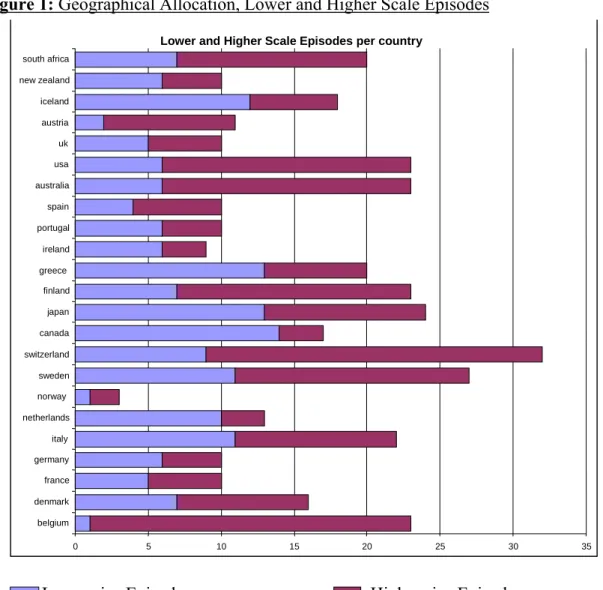
Figure 1 illustrates the temporal and geographical allocation of episodes for study gleaned by our technique. In this case, the ordinal index is assembled by defining “episodes of lower size” as deviations of 1.5 to 2 standard deviations larger than the
3 The index could still be criticised for the fact that conditional volatilities of the components of the EMP may not be constant and hence the weights should be time-varying. No empirical study applies this; a justification can be deduced from the De Vita and Abbott (2004) conclusion that, for exchange rates, no volatility measure has superior performance over alternative definitions. Thus, the most straightforward one may be used.
sample mean of this EMP index and “major episodes” as deviations larger than 2 standard deviations apart from the mean. The index leaves 8880 non-missing observations; after applying the ‘exclusion window’, around 4200 are left (missing data preclude a few to be used in estimation); ‘crisis’ observations are 384, of which 170 are “lower scale” and 214 are “higher scale”. The large number of crisis observations reflects our strategy to examine “experienced speculative pressure” in the broad sense and not just extraordinary crashes. The picture that emerges deviates to some extent from accepted wisdom; although the so called “safe havens” experienced mainly repelled episodes and not crashes, no country is immune to attacks as evidenced by the combined effect of the multi-dimensional manifestation of speculation pressure in the index.
In the time dimension, peaks of “speculative pressure” coincide with major events known to have influenced the “mature” currency markets: the crises of the dollar in late 1960’s that ultimately led to the floats in 1972 and early 1973, the two oil crises of the 1970’s, the Latin America debt crisis of 1982, the U.S. interest rates rise and appreciation of the dollar in 1983-84 and the destabilisation of EMS in 1992 after the attacks on the British pound and the Italian lira. The Mexican crisis of 1994 had limited impact on industrial countries while the Asian crisis of 1997-98 influenced them more.
Despite improvements, the construction of the EMP index is constrained by two important data-related limitations. Firstly, Klein and Marion (1997) note that in a world of risk-neutrality and perfect capital mobility the probability of devaluation should be given by interest rate differentials. However, several factors may hinder the correspondence of interest rate differentials and expected rate of depreciation, such as the existence of controls on capital account transactions, risk premiums and interest rates being set by authorities instead of being freely determined by a mature market to reflect market conditions. Thus, the argument for including interest rates among
constituents of speculative pressure is questionable. Secondly, Eichengreen et al.
(1996) remark that reserves data may not capture foreign exchange intervention adequately since they omit or reflect poorly factors like off-balance sheet transactions, third-party intervention, stand-by credits and foreign liabilities.
The above points highlight the difficulty in deciding whether or not an attack, especially an unsuccessful one, has occurred and capturing it with a composite index.
One could argue that the imposition of capital controls is an equally informative indication of mounting of speculative pressure and it could substitute reserves in the
EMP index, as the two are alternatives for a Central Bank defending its currency. 4
Then, reserves’ losses could be included among explanatory variables. This ambivalence of the direction of causality raises methodological and economic questions and it casts doubts on the correct specification of the model as a whole. Several authors have advocated the lagging of regressors by one period as a possible remedy or partial attenuation of the problem of interdependence. Clearly, this is not a theoretically founded and sound solution.
Subsequently, the question arises as to whether we are interested in attacks or real episodes of devaluations? A monetary authority pays a cost when it loses reserves or raises interest rates to levels incompatible with its targets of internal policies, even when no devaluation occurs. On the other hand, an international investor is only concerned with the present and future levels of exchange and interest rates. Authors like Frankel and Rose (1996) and Klein and Marion (1997) chose to focus exclusively on exchange rate episodes that include devaluations. We implement this specification too but we integrate it in our wider modelling strategy. We use it alongside EMP indices in order to limit the danger of including instances of voluntary abandonment. This is a prerequisite for pronouncing on the heterogeneity question. Again, we let the
sample select episodes for study instead of defining them ad hoc. Hence, “actual”
episodes are detected by the use of only the exchange rate, for example:
Δsit >κσiΔς and Δsit > λ (7)
where is the standard deviation of Δs and κ, λ are positive constants. Frankel and
Rose (1996) and Goldfajn and Valdes (1997) used variants of this criterion. Its logic is to capture instances in which the devaluation is both extraordinary, after conditioning on the inflation rate, and also large enough to noticeably reduce the purchasing power
ς
κσΔ i
4 However, the quantification of capital controls, so that they can be used as an ordinal measure-component of an index, is a problem without an obvious solution. The IMF has constructed some semi-continuous indices by aggregating several categories of restrictions that central banks impose on the capital account. Choice and quantification of all these elements is dubious. Also, these series are available only for the last few years so that use with a long data set is impossible. Furthermore, Klein, and Marion (1997) note thatfalse invoicing, black market transactions and other measures taken to circumvent capital controls slowly erode the reserve position and repress the policymaker’s ability to
of a currency. This implies a short-run alteration of the real exchange rate e, providing an equivalent definition of a crisis. This specification gives rise to a whole sub-category of models focused on explaining and signalling crashes exclusively. All of the aforementioned variations have been applied to this family of models too and respective sensitivity tests have been performed. Analysis is accompanied by performance measurement; in particular, the Akaike Information Criterion (AIC) is
preferred over pseudo R2’s as it is appropriate for comparing non-nested models.
Lower values of the AIC suggest better fit.
In this framework, we can now propose a second important categorisation to be investigated, the one between successful and repelled attacks. If it is established that crises are related to any economic, financial or political fundamentals of the local and peripheral economy and its phase, it is plausible to ask if these fundamentals help to determine whether the Central Bank will repel an attack or devaluation will occur. For this task, we need a model able to discriminate between events that are structurally different. A suitable choice is the Multinomial Logit Model (MNLM). In contrast with the ORM and other multinomial alternatives for unordered outcomes, such as the McFadden (1973) Conditional Logit or the Discrete Choice Model derived from Luce
(1959), the MNLM allows its coefficients βm to differ for each outcome, depicting the
possibility of structural differences among the determinants of various outcomes. The basic MNLM can be presented as:
Pr (y = ym ¦ x) =
∑
= J j i 1 i T j T m ) exp( ) ( exp β x β x where β1 = 0 (8)The underlying structural equation is assumed to have i.i.d disturbances (the
individual heterogeneity terms) with extreme value distribution. The constraint β1 = 0
is imposed for reasons of identification, with j=1 being “tranquillity” in this notation;
as in ORM, the choice is arbitrary. Since the MNLM permits the coefficient vector to differ for each outcome, it is not constrained by the PRA. Thus, it also offers a cross checking of the results of the ORM, as it allows to impose a strictly ranked classification structure onto the data, without the need to formally establish ordinality.
Next, we devise novel in-data quasi-qualitative criteria in order to empirically divide “successful” and “failed” attacks. “Successful” describes an attack that ends with an abrupt and sizeable devaluation of the exchange rate. Although the exchange rate is a focal point in the process, the employment of the composite indices, which are also influenced by interest rates and reserves, minimises the risk of capturing voluntary devaluations instead of genuine instances of crisis. So, a “successful” attack is postulated to have occurred when: 1) the EMP index signals an instance of crisis, of whichever sort, and 2) at the same month, an abnormal devaluation of considerable magnitude, as captured by the a dual exchange rate criterion of the sort of (7), has occurred in the country. If the composite index signals “1” but the devaluation dummy does not, this is said to be a “failed” attack. The rule is detailed for each model separately as we have tried several definitions.
Upon estimating the model, we can formally test whether the two “crisis” outcomes are indistinguishable with respect to the variables in the model, indicating that the two outcomes can be combined. We construct the LR test of indistinguishability suggested by Long (1997, p.163) as follows: firstly, the observations with outcomes “successful attack” and “failed attack” are selected. Secondly a binary logit model is estimated on the new sample. Then a LR test of simultaneous insignificance of all slope coefficients is conducted in the binary logit model. If the specification is significant, the presence of multidimensionality is established.
Finally, an important question to be tackled is whether crises vary with different exchange rate regimes. FGM and SGM were specifically made to describe attacks on fixed regimes; the degree of applicability to more flexible regimes, such as
crawling bands, managed and more free floats5 has to be examined empirically.
Possibly, the degree of flexibility allowed by the regime and related institutional factors affect the speculators’ co-ordination problem by altering the expectations on the authorities’ future targets for the exchange rate policy. Hence, we examine attacks and their relationships with the nature of the exchange rate regime. In contrast to
Duttagupta and Otker-Robe (2003), we exclude orderly exits, defined ad hoc. This
5 Whoever doubts that free floats can be attacked should think of the U.S. dollar moves in the spring of 1995.
class of models serves the additional purpose of verifying that our results on heterogeneity derived from other models are not driven by a mix of exchange rate regimes.
Exchange rate regimes in the sample were classified according to the information contained in the chart book of Reinhart and Rogoff (2003). This was
preferred for the reason it offers a de facto rather than de jure classification and
therefore it is a more realistic description of the regime in place. Subsequently, regimes were grouped in two broad categories as follows: free floats, managed floats and mini
floats formed the category “floats”; all sorts of bands and pegs (pre-announced, de
facto and moving) and currency unions formed the category “hard and intermediate regimes”.
3.2. Definition of the Explanatory Variables
The choice and construction of the explanatory variables is guided by the requirements of the theoretical models, taking into consideration data availability. Unusual movement in some or all of these variables is reported to have preceded most crisis episodes. We now explain how our variables are linked with theoretical models and empirical regularities and, accordingly, what impact they are expected to have. We employ the widest range of explanatory variables to have appeared in the literature, combining the successful results of previous empirical studies with innovative definitions of variables. Regressors can be divided in two broad categories: variables mimicking the factors invoked by FGM and TGM, and fundamentals acting as sunspot variables and spurring self-fulfilling crises as described in SGM. This classification should not be considered rigorous, as several variables have been invoked in all classes of models.
1st Generation Models Regressors
Accumulated real exchange rate (RER) misalignment: Fiscal deficits can cause an overheating of the economy, higher inflation than competitors and, if combined with a peg or a managed float, real appreciations. Thus, overheating is often also manifested in a current account deficit. Similarly, free-floating exchange rates may fail to reflect the true level of economic activity in the short term if the foreign exchange market is noisy or inefficient. Expectations-driven capital inflows can also lead to appreciations,
even in the absence of a nonzero real interest rate differential. A simple RER index as a measure of appreciation is tried against the percentage cumulative deviation of the
RER.6 A prior appreciation (increase in the RER index) is expected to increase the risk
of an attack.
Money growth: All models predict that monetary expansion, whether used to relieve pressure on financial organisations and the real economy or to serve a budget deficit, will, sooner or later, inevitably lead to an increase in the price level. This can only be balanced by a devaluation if competitiveness and reserves are to be kept constant. Last-minute corrective action to the money supply is usually ineffective, especially if sterilised. For the variable to produce an abnormal and abrupt devaluation, detectable as a crisis by our EMP indices, the rate of money creation has to be significantly in excess of the percentage of depreciation allowed by the exchange rate regime (zero in a fixed peg but significantly higher in managed or free floats). Otherwise, inflation can be matched by a similar deprecation rate, which evolves in a relatively smooth and predictable pattern, without provoking attacks. Therefore, we use real money supply, defined as the percentage change of real M1 or M2 (M1/P, M2/P); inflation is included separately. We test empirically to discover whether a narrow or broader liquidity basis is more relevant. We also use money supply’s counterpart, the growth of domestic credit (as a percentage of nominal GDP). The theoretical importance of this factor is inflated by the unrealistic assumption of the original Krugman (1979) model that there is no access to international capital markets, which does not hold in modern, open economies, as those in the sample.
The current account surplus(+) or deficit(-) (as a percentage of GDP). Most attacked countries are reported to have experienced trade deficits and capital flights pre-crisis. The variable’s effect is expected to be negative but moderated by the inclusion of the RER appreciation variable. Still, it can reflect differences in the external sector policies across countries, for a given appreciation, as well as cross-country variations in the relative price of tradeables to non-tradeables not picked up by the RER.
6 Klein and Marion (1997) found that the probability of abandonment increases with the time already spent on the peg. Thus, our measure of RER misalignment should account for its duration as well as its size. Empirical studies show that, in floating regimes, mean reversion to an aligned (competitive) exchange rate can endure for up to more than two years. Most pegs cannot last beyond 24 months also if the RER is appreciating. Hence, we cumulate over the last 24 months. We also compute cumulative forms as a surplus over the pre-2-year 60-month average RER, to address any cross-country significant inequalities of accumulated misalignment in the base year and thus preserve the comparability of
Budget surplus(+) or deficit(-) as a percentage of GDP: It may also be a poor indicator of crises if sufficient international credit lines are available, so that the central bank need not monetize a fiscal deficit and thus trigger an instant monetary expansion. We expect a deficit to have a negative effect.
The presence of capital controls:the complementarity of capital controls with interest rates and changes in reserves as tools for defending a currency leads us to expect a significant correlation among them and the imposition of capital controls to be an important predictor of crises. However, this action may trigger conflicting expectations of the market. If markets perceive the restriction of certain capital transactions as a sign of difficulty of the authorities to face capital outflows, or if controls are imposed
post-factum to limit panic market reactions and a recurring attack, the effect of the variable should be positive. If the central bank has credibility and fundamentals are healthy enough, the measure may be deemed sufficient to fence short-term reversible outflows and speculators may turn their attention elsewhere; then, the impact of the variable should be negative. This fact also raises concerns that capital controls may be endogenously chosen. The constructed measure is necessarily imperfect since Central Banks also impose capital restrictions, which are not explicit and thus detectable.
The state of the banking sector-financial crisis. The complexity of financial markets and involvement of many institutional factors makes the empirical modelling of financial turmoil difficult. We follow previous approaches and approximate it by bank loans to the private sector as a percentage of GDP. The rationale is that a rapid increase in private loans signifies that the economy has moved into a vicious boom-and-bust cycle favouring the undertaking of excessive and risky investment. In that case, a possible run on the currency would be a by-product of the collapse of the financial bubble and the abrupt reversal of massive capital inflows, often accumulated in the pre-crisis years. Dooley (1997) showed how the phenomenon can occur even when macroeconomic fundamentals are healthy and there is little motivation for future expansionary policies (low unemployment, high growth), and how it is exacerbated if bandwagon effects exist. The variable is expected to have a positive impact.
2nd Generation Models Regressors
Growth expectations/ real growth Both a lack of growth and poor growth expectations have been depicted as a possible motivation to abandon a system of fixed exchange rates or, more generally, to adopt a more expansionist policy. Growth is measured directly as the change in GDP. As for growth expectations, we follow Persaud (1998) in approximating it by the 1-month change in equity prices lagged 3 months; concurrent values are also tried. Obviously this choice assumes some capital market
efficiency. Note that falling share prices might also translate into a wave of capital
flights or a more generalised financial turmoil. However, Eichengreen et al. (1995)
report that on the immediate wake of an event, stock prices may rise to reflect the
favourable impact of the forecasted devaluation on exports-oriented firms. Therefore, since the variable is very volatile and adjusts rapidly, use of concurrent values with higher frequency data could yield a positive coefficient in some instances. Both forms of the variable are expected to affect negatively the likelihood of an episode.
Electoral victory or defeat of the government. In the context of SGM, such as Obstfeld (1994), the political commitment of the government to the exchange rate regime is among the fundamentals whose perceived vulnerability can trigger an attack. Changes in office are clearly chances for speculation or even herding behaviour on this commitment. Furthermore, political business cycles may cause lax monetary and fiscal policies just before elections, suggesting that attacks might coincide with elections. On the other hand, the public can expect a new government with a stricter monetary and fiscal policy. Also, Klein and Marion (1997) note that governments can gain credibility and reputation by keeping up a peg. Thus, close to the end of their administration, the cost of abandonment should increase and the blame cannot be shifted to the previous government, especially when there has been an “irregular transfer of power”. The variable is configured as a dummy of occurrence of election, replaced in later models by twin dummies of victory of the ruling coalition/change in office.
Degree of openness. This is approximated by (exports + imports) /GDP. A large ratio means a greater impact of a given devaluation on the aggregate price level and thus a greater cost for the policymaker, so it should reduce the motive to abandon a peg. On the other hand, it can increase the cost of a given appreciation of the RER and hence necessitate a relief via devaluation, so that the direction of the final causality is
The unemployment rate. High unemployment has been depicted by SGM as a strong motive to follow an expansionist policy of Keynesian type to stimulate demand, so it should be associated with occurrence of crises. Of course the authorities could address unemployment with supply policies, such as the abolishment of minimum wage or the liberalisation of the labour market. Often markets react positively to massive lay-offs in troubled firms, viewing them as a limit to claims of trade unions and thus a containment of competitiveness erosion. However, these policies require a longer political process, so unless their global imposition is guaranteed by e.g. a neo-classical political environment, they could hardly prevent speculative attacks.
Wages. This variable lies at the core of the Obstfeld (1994) analysis; it reflects the inflationary expectations of economic agents that interact in the game-theoretic determination of equilibrium prices and thus the exchange rate. Even if actual and expected growth of the economy is high, an even higher rate of wages’ growth may be deemed by the market as an erosion of competitiveness that will, sooner or later, be addressed with devaluation. In a later model the variable is replaced by the change of the Consumer Price Index (CPI), to test whether direct measurement of total inflation is more relevant. Then, the change in the CPI is maintained along with the unemployment rate in order to embrace potential trade-offs between the two of the type of a Keynesian Phillips curve. Note however that in periods of stagflation, such as in the aftermath of the two oil crises, low wage growth can lead to a weakening of demand and drag the economy into a downward spiral of negative growth.
Contagion. This is captured by a dummy that takes the value of 1 if a crisis occurs at
the same month in any other country within the sample (according to the particular y
used in each model) and 0 otherwise.7 The variable should capture pure herding as
well as all three aspects of “structural” contagion explained in SGM, namely: (i) trade links, as in Gerlach and Smets (1995); (ii) macroeconomic similarities, as in Buiter et al (1996), and (iii) financial links. In interpreting the results, caution is required in that the variable may not reflect true contagion but unobservable common shocks, i.e. “monsoonal effects”.
7 Making the measure regional, as in other studies, by assigning countries to several geographic areas and signalling “1” accordingly, would have little meaning in our panel. Developed countries are treated by markets and institutions as, more or less, similar.
We propose that the logic of accumulation applied to the RER can be extended to all variables. It is plausible to test whether at least some of the regressors have a significant impact only when their misalignment is protracted over a longer period. Some theoretical models offer examples of influences, which work only when accumulated, such as a gradual build-up of financial excess or external sector deficits. This technique costs some lost observations but our panel’s length compensates for that.
3.3. Composition of the sample
The database assembled is the largest and most comprehensive in the crisis literature to date. It comprises 11,316 monthly observations: 23 countries in time series of 40 years, extending from 1960 to 2000. The sample includes all the nations classified in IMF’s publication International Financial Statistics (IFS) under the
subgroup Industrial Countries.8 We do not include post-2000 observations as 2001 saw
the substitution of several European national currencies by the Euro; for the European countries in our sample, this could introduce biases.
This study utilises monthly data.9 The variables’ impact is explored in several
time horizons, from contemporaneous to one month lagged, jointly with current values or by themselves, and also on a cumulative basis. Using lags can help with potential endogeneity problems. We make limited use of moving averages in order to avoid generating serial correlation. The “predictive” model using only one-period lagged variables can help to differentiate genuine leads from effects of the attack itself. It can also address the possibility of non-synchronous acquisition or processing of the relevant information from market agents. For a few indicators that are unavailable monthly in a few particular years, we employ their quarterly counterparts and repeat the values for 3 consecutive months. Flows are apportioned across the months. The underlying assumption is that agents use the last piece of publicly available
8 The data set draws from sources like the IMF, OECD, Eurostat, Keesing’s Record of World Events etc. Details can be found in: http://www.lboro.ac.uk/departments/bs/research/response-models.html 9 Prior approaches had used quarterly or annual data. Lower frequency offers better availability and also makes the longer-term links of crises with fundamentals more visible but it eliminates the usefulness of the approach as a predictive tool. Furthermore, it is of interest to examine whether fit deteriorates in higher frequency. This would lend support to the hypothesis of short-run speculative bubbles, supported by Frankel and Rose (1995), inter alia. Lastly, as said, monthly data can capture short-duration attacks and thus support our strategy to offer a comprehensive study of all occasions of speculative pressure instead of just extraordinary crashes.
information in order to form expectations and decide their action. The reduced variability resulting from the repetition is far outweighed by the wealth of information for a host of variables that is updated monthly.
We adopt the “exclusion window” technique applied by all existing studies. Observations immediately preceding and following the “crisis” observations are excluded in order to prevent double counting of lengthier episodes. To avoid the sample becoming highly unbalanced, thereby drowning any relationship, the same is applied to the ‘tranquil’ (non-crisis) periods as well, which are then used as the control group. However, the use of monthly data leads to a significant imbalance remaining; caution is needed not to attribute this to short-run speculative bubbles. In addition, exclusion windows deliberately create biases in favour of “crisis” observations; hence the models’ likelihood estimates should not be interpreted as exact probabilities of an attack.
However, the adoption of the exclusion window leads in the loss of important information, namely, that more intense crises last longer than a month and cannot be assigned to a specific month. In general, a crisis’ importance is not only showed by its magnitude but also by its duration. In addition, Flood and Marion (1998) note that the use of extreme values of the EMP index for signalling an episode may lead to loss of many predictable crises. This would happen if interest rates start rising and reserves start dropping before the attack due to uncertainty and a longer-term interest rate applying (Krugman’s initial model assumed zero-maturity interest rate). To address these issues we devised an alternative signalling rule to account for the possibility of crisis jumps being somehow allocated in a number of periods before the attack. More specifically, speculative pressure was approximated as a weighted average of three consecutive observations of the EMP index exceeding a set limit. The potential of this lagging construction to capture the short and medium-run dynamics of the built-up to a crisis is possible because of the use of monthly data; with quarterly or annual data, it would not be possible.
Most variables enter the estimation in the form of differences of natural logarithms. Details on their configurations are described subsequently in the exposition of each model.
4.
Ordered models
A graphical analysis juxtaposing the behaviour of variables in periods of crisis and tranquillity revealed some systematic links of crises with fundamentals. However, in the immediate months surrounding crises, there is little movement in these variables. This fact is bound to make prediction of the exact timing of crises very difficult. To investigate this problem we firstly estimated binomial LDV models, which implicitly assume that the relationships between crises and fundamentals are the same across all countries, and we tested for structural differences among crises. Models revealed some important regularities but are also characterised by noise and low performance, the latter being increased by divisions of the sample. Formal specification tests verify that the hypothesis of temporal stability can be rejected; in particular, a structural break is found at the point of German unification in 1989. Recent crises seem to be driven primarily by international factors while earlier episodes are more closely associated with traditional domestic fundamentals. We also tested whether safe-havens, i.e. currencies consistently under-performing their multilateral forward rate for a number of years, are likely to experience attacks or capital inflows in times of crisis. Although “Safe havens” appeared to differ from other countries and to have stronger links with domestic imbalances, the hypothesis of cross-sectional stability cannot be rejected. Comparison with studies in lower frequency and smaller panels showed increased levels of inter-temporal heterogeneity. However, random effects did not improve classification accuracy. We also detected significant time-dependent heteroskedasticity in our panel and found that taking account of it improved performance considerably.
These facts provide the rationale for a formal testing of the hypothesis of heterogeneity. The first question we investigate is whether crises of different scale are
similar. The benchmark is the ordered Model 1, presented in the first column of Table
1. Variables enter in differences of natural logarithms scaled against German values. The model uses the country-specific weighted EMP index of (6) with an 1.5 and 2 standard deviations above the mean thresholds for defining “episodes of lower size”
and “major episodes” respectively.10
10A comparison of Model 1 with binomial models identically specified for regressors and y* reveals that sizes of coefficients of the ORM are very similar to a binomial model with a lower 1.5 sd threshold but noticeably different from those of a model utilising a 2 sd threshold. Interestingly, longer-term factors, such as growth, were more important for higher scale episodes, while smaller
Model 2 is estimated on unscaled data, with variables entering in the form of
differences of natural logarithms, but it maintains Model 1’s setting of threshold
values. Model 3 employs cumulative variables. Since cumulative variables smooth out
large 1-month deviations, thresholds have to be lowered for this model, so “lower-size episodes” and “major episodes” are signalled if an observation exceeds the mean by at least 1 and 1.5 standard deviations respectively. ORMs capturing exclusively
devaluations were also constructed. Model 4 employs the dual rule of (7) for capturing
currency plunges but it divides them into “minor” and “major” devaluations and vests the criterion with an ordinal structure. Analytically, “1” and “2” observations are defined as: ⎪ ⎩ ⎪ ⎨ ⎧ = > − + > = > − + > = − − − − otherwise 0 Index 5% )/y y (y and 1.2σ y y if 1 Index 10% )/y y (y and 1.5σ y y if 2 Index 1) i(t 1) i(t it it it 1) i(t 1) i(t it it it i i (9)
Model 4b follows the same logic but one more category is added to signify “crashes”, so that devaluations are allocated across three categories:
⎪ ⎪ ⎩ ⎪ ⎪ ⎨ ⎧ = > − + > = > − + > = > − + > = − − − − − − otherwise 0 Index 5% )/y y (y and 1.2σ y y if 1 Index 10% )/y y (y and 1.5σ y y if 2 Index 15% )/y y (y and 1.75 y y if 3 Index 1) i(t 1) i(t it it it 1) i(t 1) i(t it it it 1) i(t 1) i(t it it it i i i σ (10)
In both Models 4 and 4b regressors enter in differences of logarithms scaled against
German values and the deutschemark cross-exchange rate, serving as the latent y*, is country-specific standardised.
Comparative analysis of all ordered models verifies that the main driving forces of crises are the RER, excessive money supply growth and inflation, contagion, weak real growth and the current account. Contagion is highly significant; as noted, the evidence is not conclusive as it could reflect monsoonal effects. Some weaker evidence is also provided in non-reported models for unemployment. The significance of ‘Deficit’ seems to have been limited by the availability of international credit lines.
scale episodes seem to be related to more ephemeral, inflation-driven, competitive disadvantages. A divergence was apparent also for the capital controls, RER, government victory and contagion variables. Subsequently, we formally tested the PRA by Wald tests for equality of coefficients among the ORM and each of the binomial models. The hypothesis of equality could not be rejected for neither of them, so that PRA is satisfied and estimation is valid. Similarly, PRA was satisfied for all ORMs estimated but in some cases statistics approach the critical value of rejection and respective tests
‘Openness’ seems to reduce the motive to abandon a peg by magnifying the cost of a given devaluation on the aggregate price level but the pattern is not stable as it reverses in other models. Capital controls seem to be an important deterrent if imposed early but positively correlated with crises otherwise. It is also interesting that the private loans variable was insignificant in all estimated models. To the extent that the proxy captures financial weakness, it shows that the informational asymmetries framework is applicable to shallow and illiquid markets and not to the developed countries of our sample. This reinforces the heterogeneity hypothesis.
An important result contradicting previous studies in lower frequency is that, in all estimated models, binomial and multinomial, the RER appears with a negative sign, unless cumulative. It seems that appreciation, in the short-term, leads the market to expect even more appreciation, rather than mean reversion of the RER. Conversely, when devaluation starts, it lasts for a few months on average, as evident from visual inspection of data, and hence the negative sign. So, short-term dynamics and the psychology of the market reflect a steady-as-going expectation. In the longer term, if accumulated to a considerable degree and duration, real appreciation is a significant driving force behind crises. This result provides support for the lagged mean-reversion hypothesis that had gained credibility from findings in previous studies.
Sensitivity analysis reveals that basic findings are sufficiently robust but results are influenced to some extent by specification. Overall, sensitivity cannot be attributed to the ordinal specification as the results from binomial models and their ordinal counterparts are very similar; only the significance of less relevant variables changes.
Sensitivity rather comes from different specifications of y* and X, mainly from four
sources: (i) the definition of a crisis, as reflected in the construction of the limited-dependent variable; (ii) the composition of the sample used in estimation, particularly where model requirements have discarded certain observations; (iii) the high frequency of data; and (iv) collinearity among regressors. The remaining sensitivity should be attributed to the inherent dissimilarity of the episodes examined.
More specifically, changing the set of regressors as described in section 3.2 has limited impact on results. Exclusion of consistently insignificant variables (tests confirmed their irrelevance) from models enhances revealed patterns slightly but does
cannot be considered decisive. Multinomial models address this issue as they do not impose the ordinality structure on the data and thus are not limited by the PRA.
not reduce collinearity and sensitivity notably. We report the full models for completeness only. Cumulated variables depict more clearly causalities described by theoretical models but fail to improve classification. Lagging variables resulted in a dramatic fall of the fit and classification scores. This is in contrast with the finding of Frankel and Rose (1996) that, with annual data, lagging strengthens relationships. This shows that higher data frequency magnifies noise and possible seasonal effects, and obscures longer-term relationships of crises with fundamentals. Models capturing only actual devaluations [by the criterion of (7)] perform better than models employing EMP indices. Evidently, repelled attacks are harder to capture and explain. Among EMP indices, the country-specific weighted index (6) performs better but none improves markedly in classification. The EMP constructed as a weighted average of three consecutive observations of the EMP yielded an improvement in the fit of the models but not in predictability. So, crises having a lengthier build up are not necessarily more predictable in terms of their relation with given fundamentals. Scaling against German values does not change results significantly.
The AIC suggests that ORMs have slightly worse fit than binomial models that follow the same specification of explanatory variables. Indeed, the more ordinal structure is imposed onto the data, the higher the AIC becomes, indicating a worse fit. Given that the transformation of the continuous y* into limited-dependent variables is an ad hoc construction, a finer categorisation of episodes leaves mores space for misclassification among crisis outcomes, as well as between “crisis” and “tranquillity”. Furthermore, if the satisfaction of the PRA is ambiguous or unattainable, this should be reflected in performance measurement.
Therefore, the most interesting finding is in respect of the accuracy of classification, as it is closely related to the heterogeneity question. The models are quite successful in correctly classifying larger crashes, even if some are misclassified in the lower category, but its performance in capturing smaller scale episodes is poor. This should be no surprise. Intuitively, episodes of larger scale should include more pronounced misalignments of fundamentals if any causal relationship exists. In smaller episodes, especially repelled attacks, it is difficult to distinguish empirically between tranquillity and crises. This finding is analogous to the tendency of binomial models to perform worse when a lower threshold is set. Setting a sufficiently high threshold to
the ORM’s lower category would increase the percentage of correct calls but at the cost of excluding smaller episodes from the analysis.
4.1. Heteroskedastic and Random Effects Ordered Models
In order to conduct the LM test for heteroskedasticity, all regressors of the respective models enter the skedastic function. As an illustration, we report results of
the LM test for Models 2-4b, in the foot of Table 1. It can be seen that the
homoskedasticity hypothesis for all models is convincingly rejected, even at the 97.5% level. To deal with this, we estimate heteroskedastic ordered probits using Harvey’s (1976) specification. Variables with sizeable standardised variance terms that approach significance are included in the skedastic function, up to the extent that allows convergence, as indicated in Table 2. The heteroskedastic ORMs exhibited in Table 2
relate to the numbering of the equivalent ORM in Table 1 but with the letter h added.
These heteroskedastic models have behaviour comparable to their simple ordered counterparts but with improved fit as indicated by the AIC measure. The reduction in the size of the coefficients of significant variables attests to the importance of allowing for heteroskedasticity in the model specification. Overall, the heteroskedastic specification improved the classification performance of all ordered models noticeably, between 10-25%, by exploiting the time-series features more effectively. In total, heteroskedastic models correctly called around 25-50% of all crisis instances. This is a fairly good outcome given the increase in noise associated with using higher frequency data.
The random effects models showed that month-specific idiosyncrasies exist. However, in contrast to heteroskedastic models, they did not improve classification
accuracy. Whether it is heteroskedasticity per se that was addressed or some other
specification flaw, e.g. neglected non-linearities, it is not easy to say. In any case, even after the improvement, prediction remains mediocre. Thus, episode dissimilarity remains the prime suspect explaining any remaining faults.
5.
Multinomial models
The next task is to distinguish between successful attacks and successful
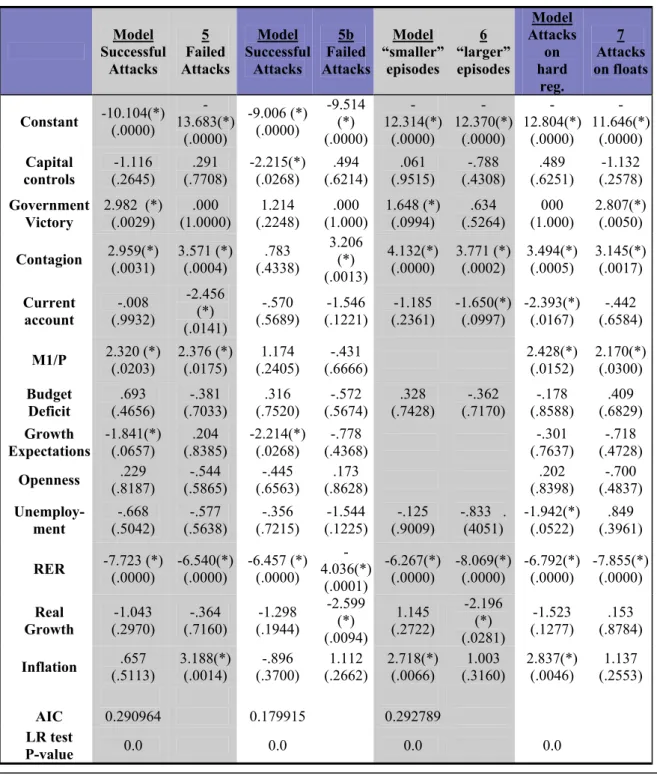
defences; for this, we estimate Multinomial Logit models. In Model 5 of Table 3, a
weighted EMP index (6) with a 1.5 sd threshold signals an instance of crisis, of whichever sort, and (ii) in the same month, an abnormal devaluation of considerable magnitude occurs in the country. The latter requires the fulfilment of a dual criterion: IndexIndex 10 ifotherwise 1.5 i ( ( 1))/ ( 1) 4%
⎩ ⎨
⎧ = > + − >
= yit yit σ and yti yit− yit− (11)
If the EMP index signals “1” but the devaluation dummy does not, this is said to be a “failed” attack. Both these indicators employ the country-specific weighted deutschemark exchange rate in the composition of their latent y*, so that they are directly comparable. Also, the criterion of the devaluation dummy is strict enough to allow a clear segregation of crises. Variables enter in differences of natural logs scaled against German values.
A variation of the model, Model 5b, employing a stricter criterion for
identifying crises, is also estimated. In Model 5b, a “successful” attack is postulated to
have occurred when the country-specific weighted EMP index (6) is at least 2 standard
deviations larger than the sample mean, and the dual criterion signals an abnormal
devaluation of considerable magnitude according to:
IndexIndex 10 ifotherwise 1.75 i ( ( 1))/ ( 1) 15%
⎩ ⎨
⎧ = > + − >
= yit yit σ and yti yit− yit− (12)
If only the first condition is satisfied, the attack is classified as “failed”. The
specification of informational variables is identical to that of Model 5. The two models
are comparatively presented in Table 3. The two sets of results are remarkably dissimilar. Importantly, since coefficients for different categories come from a single model, estimated on the same data set, the possibility of sample selection driving any differentiation due to missing values can be ruled out.
AIC shows a stronger fit of the models in comparison to equivalent binomial
models, with the best performer again being Model 5b with the stricter rule for
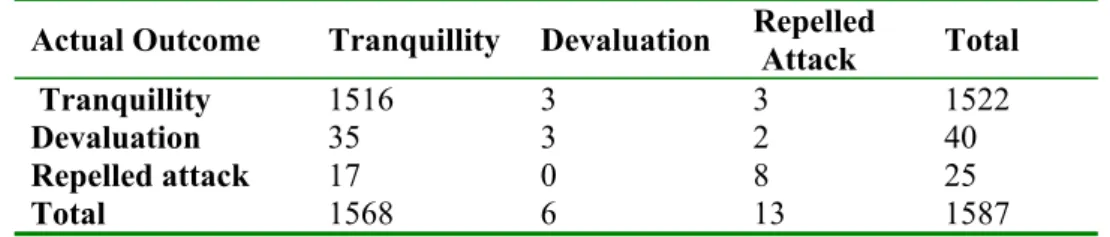
detecting instances for study. Overall, episodes ending in a major devaluation are more readily correctly classified than ‘repelled’ or ‘minor’ attacks. However, classification accuracy as a whole does not improve. The stricter categorisation of crises, even though of quasi-qualitative nature and not ordered, makes the classification task more ambitious and rather predisposes in favour of “tranquillity”. For an illustration, the
Next, we construct the LR test for multidimensionality11. The result is LR
=20.3067; with a 95% critical value of the χ2 distribution for df = 10 of 18.31, we can
reject the null of indistinguishability. This result is much more than simply a technical justification for the use of multinomial models for unordered outcomes. It is formal evidence that not all crises are alike. If episodes classified in various categories, on whichever criterion, cannot be described by a single equation then systemic differences among them exist. Thus, the application of a general model without proper consideration of the geographical, temporal and economic features of crises this examines is destined to fail. The result also partially contrasts with that of Eichengreen et al. (1995) who report only a few significant differences when they separate
successful and unsuccessful attacks by ex post and ad hoc criteria.
In economic terms, economic and political fundamentals seem more strongly associated with successful attacks. Collinearity among regressors affects the significance and robustness of factors separating successful and repelled attacks. However, this conclusion can be reached by considering other, non-reported, models and also insignificant impacts as indications. Especially for contagion, which becomes insignificant in the instances of successful attacks, this may not be the sole explanation. It could be assumed that for episodes of more than temporary importance to occur, fundamental domestic imbalances are required, in addition to international transmission.
An important result is that poor expectations of real growth rather than the objective lack of it are associated with successful attacks. This fact verifies that expectations are important but they tend to focus on longer-term considerations too. If so, any growth problems existing before the attack may be aggravated by both the prevailing pessimism in the market and the objective effects of the crisis per se. Rising interest rates, turbulence in markets, and possible inflationary pressures if the attack forces a devaluation, can adversely affect the recovery of investment activity. The afflicted country may pay a high cost in terms of output lost and possibly a setback of trust in transitory and adjustment policies. Another result not clearly established in previous studies gains support from our findings, that the absence of capital controls
11 The government victory dummy had to be excluded because its limited variability was blocking estimation. This should not lead to a false rejection of indistinguishability. The variable has limited significance anyway.