External MPC Unit
Discussion Paper No. 31: revised and
expanded version*
Optimal bank capital
David Miles, Jing Yang and Gilberto Marcheggiano
April 2011
External MPC Unit
Discussion Paper No. 31: revised and expanded
version
Optimal bank capital
David Miles,
(1)Jing Yang
(2)and Gilberto Marcheggiano
(3)Abstract
This paper reports estimates of the long-run costs and benefits of banks funding more of their assets with loss-absorbing capital, or equity. Measuring those costs requires careful consideration of a wide range of issues about how shifts in funding affect required rates of return and on how costs are
influenced by the tax system; it also requires a clear distinction to be drawn between costs to individual institutions (private costs) and overall economic (or social) costs. Without a calculation of the benefits from having banks use more equity no estimate of costs — however accurate — can tell us what the optimal level of bank capital is. We use empirical evidence on UK banks to assess costs; we use data from shocks to incomes from a wide range of countries over a long period to assess risks to banks and how equity funding (or capital) protects against those risks. We find that the amount of equity capital that is likely to be desirable for banks to use is very much larger than banks have used in recent years and also higher than targets agreed under the Basel III framework.
Key words: Banks, capital regulation, capital structure, cost of equity, leverage, Modigliani-Miller.
JEL classification: G21, G28.
(1) Monetary Policy Committee, Bank of England. Email: [email protected] (2) Bank for International Settlements. Email: [email protected]
(3) Bank of England. Email: [email protected]
The views expressed in this paper are those of the authors, and not necessarily those of the Bank of England or the Monetary Policy Committee. The authors are grateful to Anat Admati, Claudio Borio, John Cochrane, Iain de Weymarn,
Andrew Haldane, Mervyn King, Vicky Saporta, Jochen Schanz, Hyun Shin and Tomasz Wieladek. Jochen Schanz helped greatly to clarify our thinking about the link between our estimates of optimal capital ratios and Basel III rules. We also thank him for Annex 2.
Information on the External MPC Unit Discussion Papers can be found at
www.bankofengland.co.uk/publications/externalmpcpapers/index.htm
Contents
1. Introduction and summary ... 3
2. Capital requirements and regulatory reform ... 5
3. How costly is equity? ... 9
3.1. To What Extent Does Modigliani-Miller hold for banks? ... 11
3.2. Translating changes in bank funding costs into changes in output for the wider economy ... 22
3.3. Alternative scenarios ... 24
4. Quantifying the benefits of higher capital requirements ... 26
4.1. Probability of crisis and bank capital ... 26
4.2. Expected cost of crisis and bank capital ... 33
5. Calibrating optimal capital ... 34
6. Conclusion ... 39
References ... 42
Annex 1: The model of shocks to incomes ... 45
Optimal Bank Capital
1. Introduction and summaryThis paper reports estimates of the long-run costs and benefits of having banks fund more of their assets with loss-absorbing capital – by which we mean equity – rather than debt. The benefits come because a larger buffer of truly loss-absorbing capital reduces the chance of banking crises which, as both past history and recent events show, generate substantial economic costs. The offset to any such benefits come in the form of potentially higher costs of intermediation of saving through the banking system; the cost of funding bank lending might rise as equity replaces debt and such costs can be expected to be reflected in a higher interest rate charged to those who borrow from banks. That in turn would tend to reduce the level of investment with potentially long lasting effects on the level of economic activity. Calibrating the size of these costs and benefits is important but far from straightforward.
Setting capital requirements is a major policy issue for regulators – and ultimately governments – across the world. The recently agreed Basel III framework will see banks come to use more equity capital to finance their assets than was required under previous sets of rules. This has triggered warnings from some about the cost of requiring banks to use more equity (see, for example, Institute for International Finance (2010) and Pandit (2010)). But measuring those costs requires careful consideration of a wide range of issues about how shifts in funding affect required rates of return and on how costs are influenced by the tax system; it also requires a clear distinction to be drawn between costs to individual institutions (private costs) and overall economic (or social) costs. And without a calculation of the benefits from having banks use more equity (or capital) and less debt no estimate of costs – however accurate – can tell us what the optimal level of bank capital is.
In calculating cost and benefits of having banks use more equity and less debt it is important to take account of a range of factors including:
1. The extent to which the required return on debt and equity changes as funding structure changes.
2. The extent to which changes in the average cost of bank funding brought about by shifts in the mix of funding reflect the tax treatment of debt and equity and the offsetting impact from any extra tax revenue received by government.
3. The extent to which the chances of banking problems decline as equity buffers rise – which depends greatly upon the distribution of shocks that affect the value of bank assets.
4. The scale of the economic costs generated by banking sector problems.
Few studies try to take account of all these factors (one notable exception being Admati et al (2010)); yet failure to do so means that conclusions about the appropriate level of bank capital are not likely to be reliable1. This paper tries to take account of these factors and presents estimates of the optimal amount of bank equity capital. We conclude that even proportionally large increases in bank capital are likely to result in a small long-run impact on the borrowing costs faced by bank customers. Even if the amount of bank capital doubles our estimates suggest that the average cost of bank funding will increase by only around 10-40bps. (A doubling in capital would still mean that banks were financing more than 90% of their assets with debt). But substantially higher capital requirements could create very large benefits by reducing the probability of systemic banking crises. We use data from shocks to incomes from a wide range of countries over a period of almost 200 years to assess the resilience of a banking system to these shocks and how equity capital protects against them. In the light of the estimates of costs and benefits we conclude that the amount of equity funding that is likely to be desirable for banks to use is very much larger than banks have had in recent years2 and higher than minimum targets agreed under the Basel III framework.
1 The Basel Committee did undertake several impact studies of its new framework, published in December 2010. This
included a macroeconomic assessment of the impact of higher capital (BIS 2010a and 2010b). But these estimates did not take into account the first two of the factors listed here. (In large part this may be because these studies were designed to guide a judgement about minimum acceptable levels of capital rather than optimal capital). The calculations reported in the Bank of England Financial Stability Report (June 2010) do allow for some of the factors mentioned here; that analysis makes a serious effort to measure the benefits of banks holding more capital, one which we build upon in this paper.
The plan of this paper is this: section 2 presents an overview of the issues; in section 3 we estimate the economic cost of banks using more equity (or capital). In section 4 we assess the benefits of banks becoming more highly capitalised. In section 5 we bring the analysis of costs and benefits together to generate estimates of the optimal levels of bank capital.
2. Capital requirements and regulatory reform
In the financial crisis that began in 2007, and which reached an extreme point in the Autumn of 2008, many highly leveraged banks found that their sources of funding dried up as fears over the scale of losses – relative to their capital – made potential lenders pull away from extending credit. The economic damage done by the fallout from this banking crisis has been enormous; the recession that hit many developed economies in the wake of the financial crisis was exceptionally severe and the scale of government support to banks has been large and it was needed when fiscal deficits were already ballooning.
Such has been the scale of the damage from the banking crisis that there have been numerous proposals – some now partially implemented – for reforms of banking regulation and the structure of the banking system. Proposals for banking reform broadly fall into two groups. The first group requires banks to use more equity funding (or capital) and to hold more liquid assets to withstand severe macroeconomic shocks. The second group of proposals are often referred to as forms of ‘narrow banking’. These proposals aim to protect essential banking functions and control (and possibly eliminate) systemic risk within the financial sector by restricting the activities of banks. But in an important sense proposals of both types can be seen to lie on a continuous spectrum. For example, ‘mutual fund banking’ as advocated by Kotlikoff (2009) is equivalent to having banks be completely equity funded (operate with a 100% capital ratio); while a pure ‘utility bank’ of the sort advocated by Kay (2009) can be seen as equivalent to a bank with a 100% liquidity ratio.
Measuring the cost and benefits of banks having very different balance sheets from what had become normal in the run up to the crisis is therefore central to evaluating different regulatory reforms.
The argument that balance sheets with very much higher levels of equity funding, and less debt, would mean that banks’ funding costs would be much higher is widely believed. But there are at least two powerful reasons for being sceptical about it. First, we make a simple historical point. In the UK and in the USA economic performance was not obviously far worse, and spreads between reference rates of interest and the rates charged on bank loans were not obviously higher, when banks made very much greater use of equity funding. This is prima facie evidence that much higher levels of bank capital do not cripple development, or seriously hinder the financing of investment. Conversely, there is little evidence that investment or the average (or potential) growth rate of the economy picked up as leverage moved sharply higher in recent decades. Chart 1 shows a long run series for UK bank leverage (total assets relative to equity) and GDP growth. There is no clear link. Between 1880 and 1960 bank leverage was – on average – about half the level of recent decades. Bank leverage has been on an upwards trend for 100 years; the average growth of the economy has shown no obvious trend.
Furthermore, it is not obvious that spreads on bank lending were significantly higher when banks had higher capital levels. Bank of England data show that spreads over reference rates on the stock of lending to households and companies since 2000 have averaged close to 2%. Evidence indicates that the spread over Bank Rate of much bank lending at various times in the twentieth century was consistently below 2% – though as Chart 1 shows bank leverage was generally very much lower. The Banker (1971) reports ‘traditionally bank advances are made at rates of interest very close to the Bank rate – at the most customers might be asked to pay 2 percent above Bank rate, with the bulk of funds being placed at somewhat less than this’. Over a decade earlier (in 1959) the Radcliffe report stated:“Most customers pay 1 percent over Bank rate subject to a minimum of 5 percent; exceptionally credit-worthy private borrowers pay only 0.5 percent above Bank rate”. Almost thirty years before the MacMillan Report (1931) on UK banking noted that: “The general position, with occasional deviations, is that ... the rate of interest charged on loans and overdrafts is ½ a per cent to 1 per cent above Bank rate”. Going back even further, Homer and Sylla (1991) report that in 1890, 1895 and 1900 English country towns banks charged
average rates of respectively 5.1%, 4% and 4.5% on overdrafts. UK Bank rate averaged 4.5%, 2% and 3.9% in those years, so the average spread was about 1%.
Chart 1. UK Banks leverage and real GDP growth (10-year moving average)
Source: United Kingdom: Sheppard, D (1971), The growth and role of UK financial institutions 1880-1962, Methuen, London; Billings, M and Capie, F (2007), 'Capital in British banking', 1920- 1970, Business History, Vol 49(2), pages 139-162; BBA, ONS published accounts and Bank calculations. (a) UK data on leverage use total assets over equity and reserves on a time-varying sample of banks, representing the majority of the UK banking system, in terms of assets. Prior to 1970 published accounts understated the true level of banks' capital because they did not include hidden reserves. The solid line adjusts for this. 2009 observation is from H1.
(b) Change in UK accounting standards.
(c) International Financial Reporting Standards (IFRS) were adopted for the end-2005 accounts. The end-2004 accounts were also restated on an IFRS basis. The switch from UK GAAP to IFRS reduced the capital ratio of the UK banks in the sample by approximately 1 percentage point in 2004.
The absence of any clear link between the cost of bank loans and the leverage of banks is also evident in the US. Chart 2 shows a measure of the spread charged by US banks on business loans over the yield on Treasury Bills. The chart shows that the significant increase in leverage of the US banking sector over the twentieth century was not accompanied by a decrease in lending spreads, indeed the two series are mildly positively correlated so that as banks used less equity to finance lending the spread between the rate charged on bank loans to companies and a reference rate actually increased. Of course such a crude analysis does not take into account changes in banks asset quality or in the average maturity of loans or changes in the
5 10 15 20 25 30 35 40 ‐3% ‐2% ‐1% 0% 1% 2% 3% 4% 5% 1880 1900 1920 1940 1960 1980 2000
Real GDP growth 10y‐MA Leverage (rhs)(a)
(c) (b)
degree of competition. Nevertheless this evidence provides little support for claims that higher capital requirements imply a significantly higher cost of borrowing for firms.
Chart 2. Leverage and spreads of average business loan rates charged by US commercial banks over 3-month Treasury bills
Source: Homer and Sylla (1991).
The second reason for being sceptical that there is a strong positive link between banks using more equity and having a higher cost of funds is that the most straightforward and logically consistent model of the overall impact of higher equity capital (and less debt) on the total cost of finance of a company implies that the effect is zero. The Modigliani-Miller (MM) theorem implies that as more equity capital is used the volatility of the return on that equity falls, and the safety of the debt rises, so that the required rate of return on both sources of funds falls. It does so in such a way that the weighted average cost of finance is unchanged (Modigliani and Miller 1958). It is absolutely NOT self-evident that requiring banks to use more equity and less debt has to substantially increase their costs of funds and mean that they need to charge substantially more on loans to service the providers of their funds.
There are certainly reasons why the Modigliani-Miller result is unlikely to hold exactly, and in the next section we consider them and assess their relevance for measuring the social cost of having banks use more equity to finance lending. But it
0 2 4 6 8 10 12 14 16 18 20 0 1 2 3 4 5 6 1920 1930 1940 1950 1960 1970 1980
Spread Spread ‐5yr MA Leverage (rhs)
would be a bad mistake to simply assume that the reduced volatility of the returns on bank equity deriving from lower bank leverage has no effect on its cost at all. Indeed recent empirical research for the US suggests that the Modigliani-Miller theorem might not be a bad approximation even for banks. Kashyap et al (2010) find that the long-run steady-state impact on bank loan rates from increases in external equity finance is modest, in the range of 25-45 basis points for a ten percentage point increase in the ratio of capital to bank assets (which would roughly halve leverage). One of the aims of this paper is to try to test empirically the extent to which the Modigliani-Miller offsets operate for banks – cushioning the impact of higher capital requirements on their cost of funds – and to explore the sensitivities of optimal capital rules to different assumptions.
The paper also quantifies the benefits of having banks finance more of their assets with loss-absorbing equity so reducing the chances of financial crises. Reinhart and Rogoff (2009) show that financial crises are often associated with reductions in GDP of 10% or more, a substantial proportion of which looks permanent. This suggests that the benefits of avoiding financial crises are substantial. A key question is how the probability of crisis falls as more capital is held by banks.
We show that the social cost of higher capital requirements is likely to be small, while the social benefit of having higher capital requirements is likely to be substantial.
3. How costly is equity?
The Modigliani-Miller (MM) theorem states that, absent distortions, changes in a company’s capital structure do not affect its funding cost. There are several reasons why the theorem is not likely to hold exactly for banks, though to jump to the conclusion that the basic mechanism underlying the theorem – that equity is more risky the higher is leverage – is irrelevant would certainly be a mistake. The key question is to what extent there is an offset to the impact upon a bank’s overall cost of funds of using more equity because the risk of that equity is reduced and so the return it needs to offer is lowered. Some of the reasons that this offset will be less than full are well known and apply to both banks and non-financial companies. The most
obvious one is the tax treatment of debt and equity. Companies can deduct interest payments, but not dividends, as a cost to set against their corporation tax payments (though this effect can be offset – possibly completely – if returns to shareholders in the form of dividends and capital gains are taxed less heavily at the personal level than are interest receipts).
Econometric evidence suggests that tax distortions have a significant influence on financial structure (Auerbach (2002), Cheng and Green (2008), Graham (2003)). For example, Weichenrieder and Klautke (2008) conclude that a 10-point increase in the corporate income tax rate increases the debt-asset ratio by 1.4 - 4.6 percentage points; Desai et al (2004) estimate the impact on the debt-asset ratio at 2.6 percentage points3. Stricter capital requirements will mean banks are less able to exploit any favourable tax treatment of debt. But the extra corporation tax payments are not lost to the economy and the value of any extra tax revenue to the government offsets any extra costs to banks. Indeed the extra tax receipts could, in principle, be used to neutralise the impact on the wider economy of any increase in banks’ funding costs. So it is not clear that in estimating the wider economic cost of having banks use more equity, and less debt, we should include the cost to banks of paying higher taxes. We will show what difference this makes below.
Another friction or distortion that may create a cost to banks of using less debt stems from (under-priced) state insurance. Deposit insurance – unless it is charged at an actuarially fair rate – may give banks an incentive to substitute equity finance with deposit finance4. If governments insure (either implicitly or explicitly) banks’ non-deposit debt liabilities the cost of that funding will also fall relative to equity5. With non-deposit debt such insurance is usually not explicit so it is less clear that there is an
3 That is, a 10 percentage point increase in the corporation tax rate increases the debt-asset ratio by 1.4% to 4.6%, or by
2.6% in the Desai study.
4 But this point does not mean there are net economic costs in making banks use more equity because the extra private
costs banks face if they use more equity is offset by lower costs of state-provided insurance.
5Haldane (2010) analyses differences between rating agencies’ “standalone” and “support” credit ratings for banks. The
former is a measure of banks’ intrinsic financial strength while the latter reflects the agencies’ judgement of government support to banks. The widening difference between these ratings for UK banks during the period 2007-2009 indicated that ratings agencies were factoring in government support of banks. Haldane (2010) estimates that this public support for the five largest UK banks, through lower borrowing costs, comprised a subsidy of £50 billion annually over the period 2007-2009.
incentive for banks to lever up by using wholesale (un-insured) debt. Nor does the existence of insurance – either explicit or implicit and on some or all of the debt liabilities of a bank – nullify the mechanism underlying the MM result. The essence of MM is this: higher leverage makes equity more risky, so if leverage is brought down the required return on equity financing is likely to fall. That is true even if debt financing is completely safe – for example because of deposit insurance or other government guarantees. In fact the simplest textbook proofs of the MM theorem often assume that debt is completely safe.
Because of the existence of these distortions – potential tax advantages for issuing debt and under-priced (implicit and explicit) guarantees for debt – it should not be surprising if the MM irrelevance theorem does not hold to the full extent. There are also agency arguments as to why banks might find it advantageous to use debt (see Calomiris and Kahn (1991) and for an example of a model relying on those agency effects see Gertler, Kiyotaki and Queralto (2010)). The basic idea behind the agency arguments is that the management of banks is better disciplined by the prospect of debt funding being withdrawn than by the presence of shareholders that suffer first losses from any mis-management of funds. But whether this sort of discipline requires such high leverage as has been typical for banks (with debt representing 95% or more of funds) is not at all clear. Indeed the empirical evidence for these agency effects is rather limited.
In the next section, we use data on UK banks to assess to what degree the MM theorem holds.
3.1. To What Extent Does Modigliani-Miller hold for banks?
Kashyap, Stein, and Hansen (2010) use data on US banks and find evidence of a positive relationship between a bank’s equity risk and its leverage. They conclude that an increase in equity financing will not affect the cost of bank funding significantly, aside from tax factors. In this section, we use data on UK banks to assess the nature of the link between bank leverage and the cost of bank equity.
In the widely used Capital Asset Pricing Model (CAPM), the equity risk of a firm is reflected in its beta ( ) which depends upon the correlation between the rate of return of a firm’s stock and that of the market as a whole. The CAPM also implies that the risks of bank assets ( ) can be decomposed into risks born by equity holders ( ) and by debt holders ( ) as follows:
= + (1)
D is the debt of the bank; E is its equity. Assuming 0, . that the debt is roughly riskless6, (1) implies:
(2)
(D+E)/E is the ratio of total assets to equity – that is leverage. Equation (2) – which shows the link between the CAPM and the MM theorem – states that if there is no systematic risk of bank debt the risk premium on equity should decline linearly with leverage. When a bank doubles its capital ratio (or halves its leverage) – holding the riskiness of the bank’s assets unchanged – the same risks are now spread over an equity cushion that is twice as large. Each unit of equity should only bear half as much risk as before, i.e. equity beta, , should fall by half. The CAPM would then imply that the risk premium on that equity – the excess return over a safe rate – should also fall by one half. We test to what extent this is true for UK banks.
We first estimate equity betas using publically traded daily stock market returns of UK banks, together with the returns for the FTSE 100 index, from 1992-2010. The banks in our sample are Lloyds TSB (subsequently Lloyds Banking Group), RBS, Barclays, HSBC, Bank of Scotland, Halifax (and subsequently HBOS). For each bank, we obtain its equity beta by regressing its daily stock returns on the daily FTSE returns over discrete periods of six-months. Chart 2 shows the average of the equity betas across banks for the period 1997-2010.
6 The deposit liabilities of banks are close to riskless because of deposit insurance. The assumption of zero risk is less
obviously appropriate for non-deposit debt. But note that what we mean by riskless in the context of the CAPM is not that the default probability of debt is zero but the weaker condition that any fluctuation in the value of debt is not correlated with general market movements.
Chart 3. Average beta across major UK banks 1997-2010
We regress these estimates of individual banks’ semi-annual equity betas on the banks’ (start of period) leverage ratio. We want to explore the link between beta and a measure of leverage that is affected by regulatory rules on bank capital. Ideally we would measure leverage as assets relative to the measure of loss absorbing capital which regulators set requirements for. Under the Basel III agreements the ultimate form of loss absorbing capital is Common Equity Tier 1 capital (CET1), which is essentially equity. But it is not possible to get a time series of that measure of capital. So for the regressions we instead define leverage as a bank’s total assets over its Tier 1 capital. Tier 1 capital includes equity and some hybrid instruments which have more limited loss absorbing capacity. It is likely that Tier 1 Capital and the purer measure of loss absorbing capital defined under Basel III as Common Equity Tier 1 move closely together so that results we get from any link between the required rate of return on equity and leverage defined using Tier 1 Capital are informative about how the required rate of return would move with changes in the amount of truly loss absorbing capital. (Common Equity Tier 1 (CET1) was about 60% of Basel II Tier 1 equity in 2009, see footnote 10. But what matters is the impact of a given proportionate change in leverage).
The regression we estimate is:
(3) for banks i = 1... J and time periods t = 1,2,...T
Where is a matrix of regressors which include (lagged) leverage and year dummies and b is a vector of parameters.7 The subscript i indicates bank i, and J is the total
number of banks. Equation (2) shows that the coefficient on leverage is an estimate of the asset beta. (We also report results from estimating a log specification below). Our data set contains observations for a panel of banks at a semi-annual frequency from H1 1997 to H1 2010.8 We use semi-annual estimates of beta since with semi
annual published accounts leverage is only measured at that frequency. We show three estimates for the model: a pooled OLS estimate and two versions which allow for bank specific effects – the fixed effects (FE) and random effects (RE) estimators. In choosing between the two estimators which allow for bank specific influences on beta the issue is whether the individual effects, αi, are correlated with other regressors.
The FE estimator is consistent even if bank specific effects are correlated with the regressors Xit. The RE estimator is consistent if the αi are distributed independently
from Xit, in which case it is to be preferred because it is more efficient.
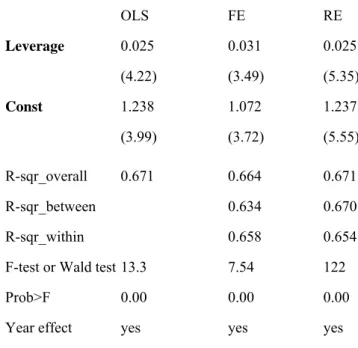
Table 1 shows the regression results. In all cases, standard errors are adjusted for clustering on banks. The pooled OLS estimation gives very similar results to the RE model with the coefficient on leverage being around 0.024. In the fixed effect regression, changes in leverage have a somewhat bigger impact on equity beta with the coefficient around 0.03.
7 It is difficult to assess the impact of changes in the risks of bank assets over time. Including time dummies in the
regressions should allow for factors that impact the average riskiness of bank assets in general from year to year. That would still leave the impact of shifts in risks of assets that are specific to each bank. We think these might be reflected in a range of factors: the likelihood of incurring losses on its assets as reflected in the provision for potential losses; on the ease of selling assets without suffering sharp drop in their values; and on their overall profitability. We attempt to control for these risks by including the loan loss reserve ratio, the liquid assets ratio and ROA in the regression. But in fact these variables did not appear significant in our regressions. So in the following discussion, we focus on the results using just leverage and year dummies as regressors.
8 Halifax merged with Bank of Scotland in 2001 to create HBOS. We treat the merged bank HBOS as a continuation of
Halifax and Bank of Scotland stops existing after the merge.This leads to an unbalanced panel. An unbalanced panel is not a problem for our panel estimation so long as the sample selection process does not in itself lead to errors being correlated with regressors. Loosely speaking, the missing values are for random reason rather than systemic ones.
Table 1. Bank equity beta and leverage: Pooled OLS, Fixed and Random Effect
Regression of bank equity beta on leverage, measured as total assets/tier 1 capital. All specifications include year effects. In all three regressions, standard errors are robust to clustering effects at the bank level. Coefficient t statistics are in parenthesis. A Hausman test is used to compare FE and RE estimators. The null hypothesis is that the differences in coefficients are not systemic. Chi-square (12) = 2.84 with P-value = 0.99. OLS FE RE Leverage 0.025 0.031 0.025 (4.22) (3.49) (5.35) Const 1.238 1.072 1.237 (3.99) (3.72) (5.55) R-sqr_overall 0.671 0.664 0.671 R-sqr_between 0.634 0.670 R-sqr_within 0.658 0.654 F-test or Wald test 13.3 7.54 122
Prob>F 0.00 0.00 0.00 Year effect yes yes yes
Note: where bank specific effects are included the reported constant is the average of such estimated effects.
All the estimates of the impact of leverage upon beta are highly significant and the equations explain around two-thirds of the variability in betas. But the results do not conform to equation (2) since the constant in the regressions is positive and significant. This suggests the conditions implied by the joint hypothesis of full Modigliani Miller effects and the CAPM do not hold.
Given that the FE estimator is consistent both under the null and the alternative hypotheses, we take those as our central estimate – though the difference is not large. (A Hausman test is used to compare FE and RE estimators. At standard levels we cannot reject the null hypothesis that the differences in coefficients are not significant. (Chi-square (12) = 2.84 with P-value = 0.99)).
We use the estimated relationship between bank leverage and the equity beta to assess how changing leverage affects the weighted average cost of funds. We express banks’ average cost of funding (typically referred to in corporate finance theory as the weighted average cost of capital, WACC) as the weighted sum of the cost of its equity and the cost of its debt. Here we assume that debt is free of systematic risk (
0 , so that the cost of debt should be similar to the risk free rate ( . We regard this as a conservative assumption in assessing how the cost of bank funds varies with leverage, one which is designed not to under-state the increase in funding costs that lower leverage might bring. By simply assuming away any beneficial impact on the cost of debt from its being made safer as leverage falls we are neutralising one of the routes through which the MM effects might work. Making this assumption the WACC may be written as:
1 (4)
The Capital Asset Pricing Model (CAPM) states that the required return on equity, , can be written as a function of the equity market risk premium ( ) and the (bank specific) equity beta:
(5)
Using the coefficients from the fixed effects regression between leverage and
, and (4) and (5), we get
leverage (6)
Where is a constant and is the coefficient on leverage from the beta regressions. Since is estimated to be positive (6) implies that the higher the leverage of a bank the greater is the required return on its equity.
Total assets of the major UK banks averaged about £6.6 trillion between 2006 and 2009; risk-weighted assets were about £2.6 trillion (or 40% of total assets9). The
9 For the banks in our sample risk weighted assets were a slightly lower proportion of total assets than for all UK banks
average leverage of our banks over that period – that is total assets over capital (which for the purposes of the regressions we have taken to be Tier 1 capital) – is 30. Since CET1 might be only around 60% of Tier 1 capital then leverage defined as assets to CET1 would have been substantially higher – perhaps averaging around 5010.
Assuming a risk free rate of 5% and a market equity risk premium of 5%, and plugging our fixed effect estimates of and from Table 1 into (6), suggests that at leverage of 30 investors require a return on equity of:
5% + (1.07+0.03*30)*5% = 14.85%
At leverage of 30 E/(D+E) is 1/30 and D/(D+E) is 29/30 so the weighted cost of capital would then be:
(1/30)*14.85% + (29/30)*5% = 5.33%
If leverage falls by half (from 30 to 15 on an assets to Tier1 definition or from 50 to 25 when measured as assets to CET1) , our regression results (Table 1, FE estimates) suggests a fall in the required return on equity to 12.6%, ie, 5% + (1.07+0.03*15)*5%.
If MM did not hold at all, then changes in leverage would have no impact on the required return on equity. By comparing changes in the WACC based on our regression results to those based on the assumption that there is no MM effect, we can get a sense of the extent to which the theorem holds.
10 According to Table 2 in the BIS Quantitative Impact Study (QIS, BIS (2010c)), the Basel II T1 ratio was 10.5%, and
the gross CET1 ratio relative to Basel II risk weights was 11.1%, for the QIS sample of large banks (Group 1 banks) at the end of 2009. According to Table 4, ‘net CET1’ – which we take as reflecting truly loss-absorbing equity – is 41.3% less than gross CET1. Finally, Table 4 suggests that there is an additional effect of changes in risk weights of 7.3% that is counted towards the redefinition of equity. Taking all this together, we infer: (net) CET1 = [11.1/10.5] * [(1-0.413)/(1+0.073)] * Basel II T1 = 58% * Basel II T1. We use a conversion of 60% in this paper.
We used the same source to infer the translation of Basel II risk-weighted assets into Basel III risk-weighted assets. According to Table 6 in BIS (2010c), risk weighted assets increased by 23% from Basel II to Basel III for the QIS sample of large banks (Group 1 banks) at the end of 2009. We use a conversion of 25% in this paper.
Based on a risk free rate of 5% and a market equity risk premium of 5%, at a leverage of 30 our estimate of the required return on equity is 14.85%, and the average cost of bank funds is 5.33%. If leverage halves to 15, our estimates would suggest that the required return on equity would fall to 12.6%, and the WACC under this scenario would rise to 5.51% (i.e. (1/15)*12.6% + (14/15)*5%). If MM did not hold at all, the required return on equity would have stayed at 14.85% and the WACC would have risen to 5.66%, (i.e. (1/15)*14.85% + (14/15)*5%).
We estimate bank WACC rises by 18 bps (5.51%-5.33%); with no MM offset this rise would be 33bps (5.66%-5.33%). So the rise in WACC is about 55% of what it would be if there was no MM effect (18/33). Put another way, the M-M offset is about 45% as large as it would be if MM held exactly. Note that this calculation of the degree to which MM holds would have been very similar had we defined leverage as assets to CET1 capital, provided that CET1 has consistently moved in line with Tier 1 capital11.
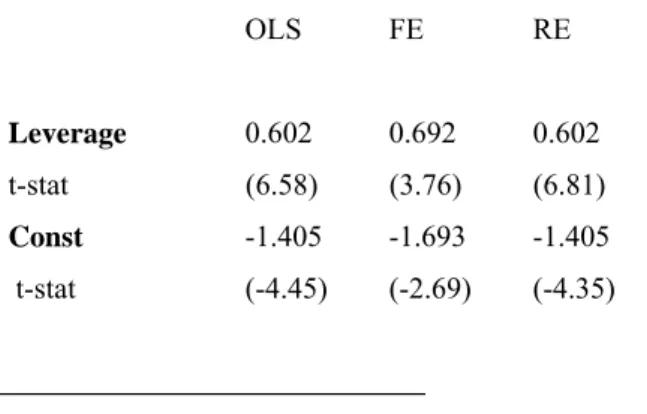
Table 2. Bank equity beta and leverage (log specification)
Regression of the log of bank equity beta on log leverage, measured as total assets/tier 1 capital. All specifications include year effects. In all three regressions, standard errors are robust to clustering effects at the bank level. Coefficient t statistics are in parenthesis.
OLS FE RE Leverage 0.602 0.692 0.602 t-stat (6.58) (3.76) (6.81) Const -1.405 -1.693 -1.405 t-stat (-4.45) (-2.69) (-4.35) 11
Using the factor of 60% to convert T1 into CET1, a leverage ratio of A/T1 of 30 corresponds to a leverage ratio of A/CET1 of 50, and a leverage ratio A/T1 of 15 corresponds to a leverage ratio of A/CET1 of 25. The WACC at a leverage ratio of A/T1 = 30 is therefore just the same as the WACC at a leverage ratio of A/CET1 = 50.
This has implications for the marginal cost of increasing the ratio of capital to risk-weighted assets (RWA). RWAs under Basel III are just under 25% greater than RWAs under Basel II. A one percentage point change in the Basel II ratio of T1/RWA is equivalent to a (CET1 / 60%) / (RWA*1.25) = 0.5 percentage point change in the Basel III ratio of CET1/RWA. So increasing the Basel III ratio of CET1/RWA by 1pp is about twice as costly as increasing the Basel II ratio of T1/RWA.
OLS FE RE R-sqr_overall 0.62 0.66 0.67 R-sqr_between 0.54 0.61 R-sqr_within 0.64 0.636 F or Wald test 13.7 11.3 202 Prob>F 0 0 0 year effect yes yes yes
The results reported in Table 1 are based on regressing beta on leverage – a natural specification given equation (2). But equation (2) could just as well be estimated in log form. Table 2 shows the log version of equation (2) where we regress log beta on log leverage. With a full MM effect we would expect the coefficient on log leverage to be 1 – so a doubling in leverage doubles risk. The coefficient estimates in Table 2 are all highly significant but less than 1. The fixed effect specification generates a point estimate of 0.692 (with a standard error of 0.18). So the rise in risk is about 70% as great as the MM theory would suggest. Using that coefficient the implied required rate of return on equity with leverage of 30 (and a safe rate of 5% and equity risk premium of 5%) would be about 14.7% and the weighted average cost of bank funds would be 5.32%. (These are close to the figures implied by the levels regression). At a leverage of 15 the log specification implies that cost of bank equity would fall to 11% – a bigger fall than implied by the levels regressions. In this case the weighted average cost of funds would rise to 5.4% – a rise of 8bp. If there were no MM effect a fall in leverage from 30 to 15 would raise the weighted cost of funds from 5.32% to 5.64% – a rise of 32bp. So with the log regression results the predicted rise in the weighted cost of funds (8bp) is one quarter what it would be if there was no MM effect (32bp). Put another way, the results from the log specification suggest the MM effect is about 75% of what it would be if the MM theorem held precisely. This is rather larger than the estimate based on the levels specification which was that the MM effect was about 45% of the full effect.
Notice that we have assumed no change in the required rate of return on debt as leverage changes. This is a conservative assumption and potentially understates MM effects. For subordinated wholesale debt which is not covered by deposit insurance, a reduction in leverage is likely to reduce the required return on debt – though perhaps
only very marginally. But notice also that, thus far, we have not factored in the impact of the tax deductibility of interest payments.
An alternative way to gauge the extent to which the MM effect holds (setting aside tax effects for the moment) is to test more directly the relationship between the required return on bank equity and bank leverage. This has the advantage of not assuming the CAPM holds. But it is difficult to measure the required return on equity. Ideally, we would like to have expected earnings data for each of the banks in the sample. But we are unable to find a time series of such data. We instead use the realised actual earnings over share price (E/P) as a proxy for required returns and we regress this on leverage. We omit four observations where earnings are negative on the grounds that a negative level of required future returns on equity is highly implausible. Nonetheless the earnings yield is not a very accurate proxy for required returns and the mis-measurement of the dependent variable is likely to make the estimators noisy, though it is less obvious that it generates bias.
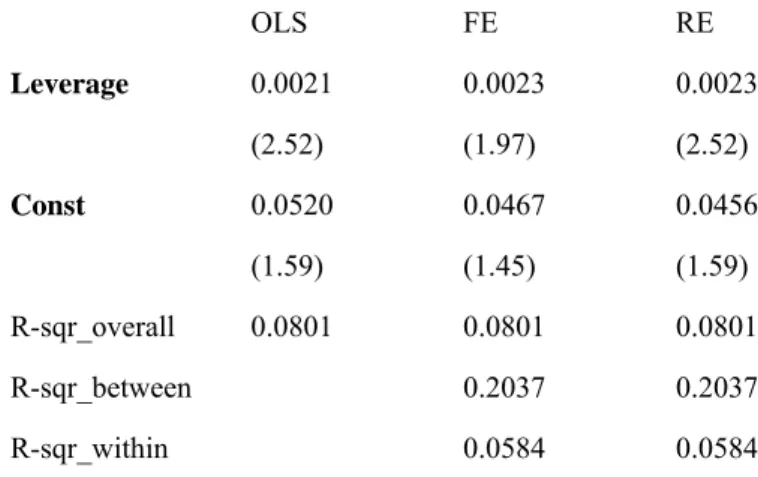
Table 3 summarises the estimation results using OLS, fixed effect and random effect models. Leverage is significant in explaining the movement in the required return on bank equity in all the regressions: the higher the leverage, the larger the required return on equity. For a one unit increase in leverage, the required return on equity is estimated to increase by about 0.002 (that is 20bp).
Table 3: Required return on capital and leverage
Regression of banks’ required return on equity (E/P) on leverage. In all three regressions, standard errors are robust to clustering effect at the bank level.
OLS FE RE Leverage 0.0021 0.0023 0.0023 (2.52) (1.97) (2.52) Const 0.0520 0.0467 0.0456 (1.59) (1.45) (1.59) R-sqr_overall 0.0801 0.0801 0.0801 R-sqr_between 0.2037 0.2037 R-sqr_within 0.0584 0.0584
OLS FE RE F-test or Wald test 4.1781 3.8941 6.35*
Prob > F 0.05 0.05 0.01
*In the random effect regression, this is the Wald test statistics for overall significance of the repressors
Using the estimators from the FE regression, at a leverage of 30, the required return on equity is about 11.5% ie., 0.0467+0.0023*30. Assuming the risk free rate is about 5%, the equity risk premium of a bank with this leverage would be around 6.5%. What would happen if the leverage falls by half to 15? At a leverage of 15, the required return on equity would be 8.1% and the risk premium would be around 3.1%. So a halving in leverage roughly halves the risk premium on bank equity. That is exactly what the MM theorem implies.
The regression using equity betas suggests that the cost of bank equity is higher than the results based on the earnings yield regressions imply. The levels version of the beta regressions also suggest that the MM theorem effect is about 45% as large as it would be if MM held exactly; the log version suggests a 75% MM effect. The regression using the earning yield as a proxy for the required return on equity suggests that the MM effect is larger again – indeed the impact on the required return on equity of changing leverage is about as big as if MM held exactly (assuming riskless debt). In the above calculation we have ignored tax. Arguably if banks pay more tax as leverage falls the value of the extra tax revenue to the government pretty much exactly offsets the loss to banks. So from the point of view of measuring true economic costs it should be ignored. While having sympathy for that argument we will also show below the impact of treating tax costs as if they were true costs. In this calculation we will ignore any offset from the lower taxation of equity returns to holders of shares; this will generate an upper bound of the estimate of the extra cost of banks using more equity and less debt. We will also use as our base case the lowest of the estimates of the MM offsets from higher leverage, assuming that such offsets are about 45% of what they would be if MM held exactly.
3.2. Translating changes in bank funding costs into changes in output for the wider economy
To estimate the economic cost of higher capital requirements, we calibrate the impact of higher funding costs for banks on output. We assume any rise in funding costs is passed on one-for-one by banks to their customers. The impact of higher lending costs on GDP could be assessed using a structured macroeconomic model that incorporates banks (see, for example, BIS (2010a), and Barrell et al (2009). We follow the strategy used in the Bank of England Financial Stability Review (June, 2010), which is more transparent and focuses on the key transmission channels between banks’ cost of funding, firms’ cost of capital, investment, and GDP. We assume that output (Y) is produced with capital (K) and labour (L) in a way described by a standard production function. Shifts in the cost of borrowing to finance investment alter the equilibrium capital stock and it is the impact of that upon steady state output that gives the long run cost of higher bank capital requirements.
For a production function with constant elasticity of substitution, Y = f (K, L) the responsiveness of output to cost of capital can be written as follows using the chain rule:
(7)
=
The first term in brackets on the right hand side of (7) is the elasticity of output with respect to capital, denoted he second term is the responsiveness of capital to changes in the relative price of capital to labour P, ( ⁄ . This is the elasticity of substitution between capital and labour (. The last term is the elasticity of relative price with respect to the cost of capital, which we can show is 1/(1-12
12 Total income can be written as , where we assume factors are paid their marginal product so that is
wage and is the cost of capital. The cost of capital equals the marginal product of capital, ie , we can rewrite the equation as . Total differentiation of this equation yields:
. This can be rewritten as , given the shares of income that flows to capital and labour are and 1-respectively. Then using the definition of relative price ⁄ , we can get
Equation (8) says that if the firms’ cost of capital increases by 1%, output falls by %. The share of income that flows to capital, is about one third. We set the elasticity of substitution between capital and labour at 0.5, (as suggested by Smith (2008) and Barnes et al (2008)). This implies that a 1% increase in firms’ cost of capital could lead to a reduction in output of 0.25%.
In the previous section, we estimated that if capital relative to assets doubles – meaning that leverage defined using Tier 1 capital falls from around 30 to 1513 – banks’ cost of funding increases by around 18 bps (assuming the lowest estimated MM effect). That figure is based on the estimates in Tables 1 (FE regression); it assumes an equity risk premium of 5% and a safe rate of 5%; it also excludes tax effects. (In the next section we consider the impact of varying all those assumptions). Assume that banks pass on an increase in funding cost of 18bp so lending rates go up one-for-one. In the UK bank lending typically represents less than 1/3 of firms’ total financing. (In the US, the figure would be lower – in some European countries, it would be slightly higher). Using a 1/3 reliance on bank loans, firms’ overall cost of capital is likely to rise by about a third of 18bp, so by about 6bps. Assuming the cost of capital for firms is around 10% (which with a safe rate of 5% and an equity risk premium of 5% is the cost of equity for a firm with a unit beta), this 6bps increase translates into a 0.6% increase in the cost of capital for firms in proportional terms. This suggests that output might fall by about 0.15% or 15bps (that is 0.6 x σ x α / (α - 1)). This would be a permanent fall in output. Using an annual discount rate of 2.5%,14 this would mean a fall in the present value of all future output of about 6% or 600bps (i.e. 0.15%/2.5%). That is, a capital ratio increase which would halve leverage leads to a permanent fall in GDP whose present value is equal to 6% of current annual output. This is the way in which we estimate the cost of higher capital requirements, whose magnitude needs to be weighed against the benefits of lower leverage from a reduced risk of banking crises. Clearly the calculation of the costs of higher bank capital has many moving parts, so before turning to the benefits of banks having more capital we consider the sensitivity of costs to alternative assumptions.
13 Or on a leverage ratio defined as CET1 to assets it falls from around 50 to 25.
14 The discount rate 2.5% is a real social discount rate, which is different from the assumed nominal rate of 5% that banks
offer on debt. This gap between 2.5% and 5% also reflects the difference between the time preference of agents and the government (or a social planner).
3.3. Alternative scenarios
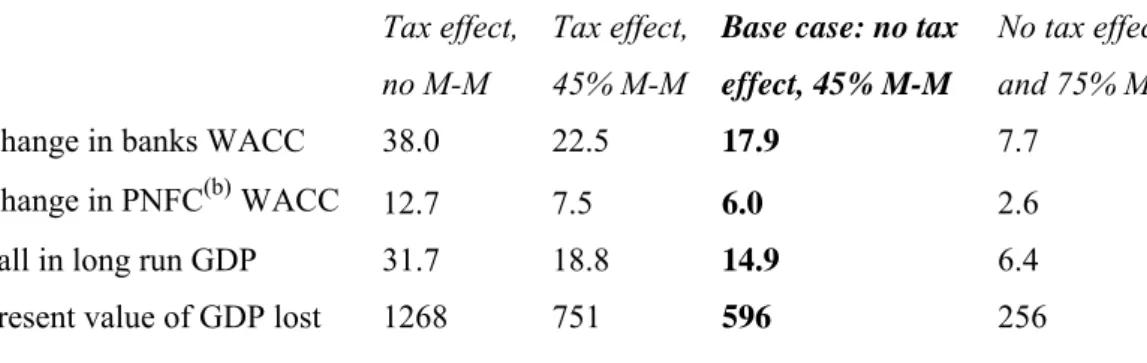
Estimates of the economic cost, in terms of lower output, of higher capital requirements on banks depend on several things: the magnitude of the market wide equity risk premium; whether or not tax factors affect the impact upon non-financial firms of banks having to use more equity; the extent of any MM offset so that the required return on bank equity falls with lower leverage; the importance of bank lending in firms total finance; the elasticity of substitution between labour and capital; and the choice of discount rate. In Tables 4 and 5 we report estimates of the impact upon banks’ cost of funds, and of the present value of lost output, under different assumptions about some of these key factors. The economic cost is the present value of all lost GDP out to infinity expressed as a percentage of current annual GDP. We consider the following cases: 1) a scenario in which it is assumed that there are no MM effects and the required return on bank equity is invariant to leverage; we also assume that if banks pay more tax this is a real economic cost15; 2) We allow for a 45% MM offset to banks’ cost of equity. 3) We do not count any extra tax that banks pay as an economic cost. (One can think of this as the government using more tax receipts from banks to offset the impact upon companies of banks charging higher loan rates – for example through a reduction in corporation tax that is overall revenue neutral). 4) a bigger MM offset of 75% (as suggested by the log specification).
Table 4: Economic impact of halving leverage(a) – basis points
Tax effect, no M-M
Tax effect, 45% M-M
Base case: no tax effect, 45% M-M
No tax effect and 75% M-M
Change in banks WACC 38.0 22.5 17.9 7.7
Change in PNFC(b)WACC 12.7 7.5 6.0 2.6
Fall in long run GDP 31.7 18.8 14.9 6.4
Present value of GDP lost 1268 751 596 256
(a) From 30 to 15 based on assets relative to Tier 1 capital; or from 50 to 25 based on assets to CET1. (b) Private Non-Financial Corporations.
15 and is not offset by providers of funds to banks paying less tax because dividends and capital gains might be taxed at
The impact of a doubling in capital (halving in leverage) is to increase the average cost of bank funds by about 38 bps when there is no MM offset and we assume that all of the impact of the extra tax paid by banks is included as an economic cost. That would reduce the present value of the flow of annual GDP by 13% of current annual output (1268 basis points); it would mean the level of GDP was permanently about one third of a percent lower. If we allow a 45% MM offset the impact on bank cost of funds falls to about 22bp and the effect on GDP falls to under 0.2% (generating a present value loss of about 7.5% of annual GDP). Of that impact on WACC just under 5bp is a tax effect; the effect of higher capital on WACC without tax is slightly under 18bp, generating a hit to GDP of about 0.15% (creating a present value loss of just under 6%). If the MM effect is bigger (75%) the rise in WACC falls to around 8bps and the fall in long run level of GDP is just over 6bps.
Table 5 shows the impact of varying other assumptions relevant to the impact upon GDP of higher bank funding costs. Here we use the base case assumptions (column 3 of Table 4) on MM and tax effects. If we double the discount rate (from 2.5% to 5%) the present value of lost output is halved. If instead of assuming that non financial companies finance 33% of investment with bank loans we set that rate at 16% (closer to the recent average in the UK) the impact of higher capital upon GDP is also roughly halved. But raising the overall market equity risk premium from 5% to 7.5% rather substantially raises the cost of higher bank capital – which is about 50% higher than in the base case.
Table 5. Sensitivity of base case estimates to changes in various assumptions – basis points
Base case (no tax effect & 45% MM) Higher discount rate (@ 5%) Lower share of banks in PNFC finance (@ 16%) Higher Equity Risk Premium (@ 7.5%)
Change in banks WACC 17.9 17.9 17.9 26.8
Change in PNFC WACC 6.0 6.0 2.9 8.9
Fall in long run GDP 14.9 14.9 7.1 22.3
Present value of GDP
These estimates illustrate that under reasonable assumptions even doubling the amount of bank capital has a relatively modest impact upon the average cost of bank funds – ranging from just under 40bps to under 10bps. If we allowed the cost of debt raised by banks to fall with leverage, the estimated cost of higher capital would be even smaller. One reason why the cost of bank debt may not be responsive to changes in leverage may be its implicit insurance by the government. We do not attempt to make any explicit calculation of the value of such insurance but its existence only reinforces the argument for higher capital requirements to be imposed on banks.
4. Quantifying the benefits of higher capital requirements
Higher capital makes banks better able to cope with variability in the value of their assets without triggering fears of (and actual) insolvency. This should lead to a more robust banking sector and a lower frequency of banking crises. The benefit of having higher capital levels can be measured as the expected cost of a financial crisis that has been avoided. In this section, we try to calibrate how much the chances of banking crises are reduced as bank capital ratios rise and how costly such crises typically are. Both those things are hard to judge.
4.1. Probability of crisis and bank capital
We think of a banking crisis – at least of the sort that higher capital can counter – as a situation where many banks come close to insolvency. That is where the fall in the value of their assets is close to being as large as (or is greater than) the amount of loss-absorbing equity capital they have. The type of fluctuations in asset values that would generate such a situation are generalised falls in the value of bank assets – things not specific to a particular bank.
It is difficult to predict the likely volatility of banks’ asset values and therefore the probability of extreme events that could lead to a financial crisis. A common starting point is to assume a normal distribution for the value of bank assets. But this normality assumption very likely understates the likelihood of extreme events; historically extreme events occur with a frequency much higher than implied by a normal distribution.
A large part of banks’ assets are debt contracts whose value depends on the ability of borrowers to honour interest and principal repayments from their income and savings. There is likely to be a close link between the value of bank assets (in aggregate) and a country’s national income (GDP). So our basic assumption is that losses in the value of assets are linked to permanent falls in GDP16. Specifically we will assume that the percentage fall in the value of risk-weighted assets moves in line with any permanent fall in the level of GDP. In aggregate our sample of big UK banks have had total assets that are almost 3 times risk-weighted assets (RWA) on the Basel II definitions. The Basel III measures of RWA are greater than the Basel II measures by a little under 25% (See Basel (2010c), Table 6). On a Basel III definition of RWA the total assets of major UK banks are probably closer to 2.25 times RWA. So on a Basel III RWA definition the typical risk weight is about 45%. We assume that a bank sees a fall in the value of each of its assets that is equal to the permanent fall in GDP (in percent) multiplied by the risk weight of that asset. If GDP permanently falls by 1% an asset worth £1 and with a risk weight of 0.45 would see its value fall by 0.45%, so it would be worth 99.55p. If GDP fell by 10% in a year (a very large fall), and using the average risk weight of 0.45, the fall in assets would be 4.5% – so assets would be worth 95.5% of their start of year value. A bank with leverage less than 22.2 (1/0.045) would have enough capital to absorb this loss.
One way to think about this assumption – that risk weighted assets fall by the same as a fall in incomes – is to see assets with a positive risk weight as ones where the ability of the borrower to repay the loan is less than certain and depends on their income. More specifically, assume that an asset with a risk weight of 0 is always repaid but that an asset with the average risk weight (relative to all those which are judged risky) has a repayment profile which is eroded in line with falls in average incomes in the economy. So an average risky asset is one which, so long as average incomes do not fall, is repaid in full; but if income falls x% the value of interest and capital repayments also falls by x%. This would imply that risky agents who have borrowed
16 Our empirical model of falls in GDP is a random walk with drift and a stochastic term which has a mixed distribution.
This model implies that changes in GDP are permanent – there is a unit root in GDP. Evidence on whether there is a unit root in GDP is not entirely conclusive though many papers do find support for the unit root hypothesis (see the influential original contribution of Nelson and Plosser (1982) and later work by Campbell and Mankiw (1987); Perron (1988), Banerjee, Lumsdaine and Stock (1992). Fleissig and Strauss (1999) find some evidence for trend stationarity using panel unit root tests..
from banks and find that their incomes fall cannot devote more of their lower incomes to debt repayment.
This way of looking at the assumption we make of the link between falls in incomes and in the value of risk weighted assets helps in interpretation but it does not in itself throw much light on its consistency with the evidence. So in Annex 2 we describe the evidence on the relative size of recent falls in banks’ assets and falls in GDP. We find that in recessions that are associated with banking crises the fall in the value of (un-weighted) bank assets is often equal to the decline in GDP. It is very likely that the proportionate fall in risk weighted assets is greater than the decline in total assets because risky assets are more exposed to falls in incomes. In recent years Basle III measures of RWA would probably have been a bit under ½ of total assets for large UK banks17. So if – as some evidence seems to suggest – declines in total assets are of roughly the same order as declines in GDP, then the proportionate fall in RWA should be expected to be greater – perhaps twice as great18. This is why we consider our assumption of an equal percentage fall in risk weighted assets and GDP as a conservative one for calibrating the exposure of bank assets to economy wide shocks. Based on this assumption, we can use an assumed probability distribution for changes in annual GDP to calculate the probability of a banking crisis in any given year for different levels of bank capital. This means we are assuming that our way of modelling GDP largely reflects shocks that cause bank asset values to fluctuate – rather than shocks that emanate from banks and cause movements in incomes. What we do is to calibrate a model of shocks to incomes (i.e. GDP) using data from a large group of countries over a nearly two hundred year period during which most of the biggest movements in GDP reflect wars and political turmoil that are likely to be substantially independent from banking conditions. (In estimating optimal bank capital we will not however assume that banks need to be able to withstand extreme events).
17 Basel III RWA are about 25% larger than Basel II RWA. They are therefore a larger share of total assets than are RWA
under Basel II, as well as better reflecting the relative risk of assets. That is why we think our results on optimal bank capital relative to RWA should be interpreted in terms of Basel III RWA.
18 Consider an extreme example where there are two types of assets: those that are risky and those that are completely
safe. If risk weighted assets are 45% of total assets then if total assets are 100, those exposed to risk are worth 45. By assumption all the falls are concentrated in the risky assets. If total assets fall in line with falls with GDP then the value of risky assets needs to fall by about 2.2% for each 1% fall in GDP (i.e. by 1/0.45%).
Historical data on changes in GDP strongly suggests that the frequency of such large negative shocks is very much greater than would be implied by an estimated normal distribution, a distribution which most of the time matches the GDP data well. A much better way to match the distribution of risks that end up affecting GDP is to assume that most of the time risks – or shocks – follow a normal distribution, but once every few decades a shock comes that is very large and which is not a draw from a normal distribution. This assumption – that GDP changes are normal, but with the added chance that there are low probability quite extreme outcomes – is one made by Robert Barro in a series of important studies of rare events that hit economies (see Barro (2006)).
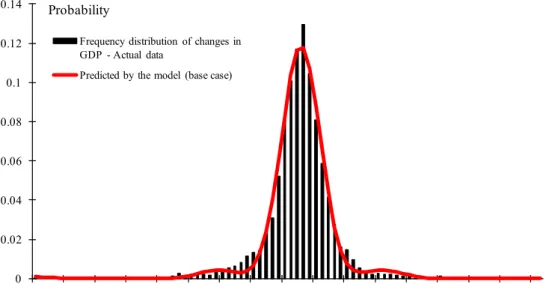
Chart 4 illustrates a slight generalisation of the Barro model calibrated to match historical experience going back almost 200 years. The data is for the change in GDP per capita for a sample of 31 countries and starts, in some cases, in 1821 and comes up to 2008. We have almost 4500 observations of annual GDP growth across the sample of countries (see Annex 1 for more details and also Miles et al (2005)). Here we assume that total incomes (A), by which we mean per capita GDP, follows a random walk with a drift and two random components
log log
The parameter captures average productivity growth. The first random component,
ut is the shock in normal times, i.e. it reflects the typical level of economic volatility.
This shock follows an independently and normally distributed process ~ 0, .
The other random component is zero in normal times, but with given probabilities it takes on significant values. There is a small chance (probability p) that takes on a very large negative value, equal to -b. The parameter b represents the scale of the asymmetric shock; there is no chance of an equally large positive shock. There is a second type of shock, which is symmetric, and whose scale is denoted by c. This shock has a higher probability of occurring (probability q > p) and it is smaller,
though still large relative to the volatility of the normally distributed shock. Formally, the random component can be written as following
0 with probability 1‐p‐q with probability p
with probability q/2
with probability q/2
Note that our model is one where shocks that hit incomes are permanent – we are not estimating a process where there are temporary shocks to GDP. We believe this is a model better suited to calibrating shocks to income that hit the value of bank assets; temporary shocks to incomes would be much less likely to affect the value of bank assets.
We choose the six parameters ( , , b, c, p, q) to roughly match these four moments – mean, variance, skewness and kurtosis – based on 4472 observations of historical annual real GDP growth; but we also want to match as best we can the chances of extreme events based on the frequency of big changes in the GDP data going back 200 years. Table 6 presents the chosen parameters for the model.
Table 6: Key parameters
Std. deviation of GDP growth in normal times ( 3.1% Average productivity growth ( 2.1% Annual probability of extreme negative shock (p) 0.7% Scale of extreme negative shock (-b) -35% Annual probability of less extreme, symmetric shock (q) 7.0% Scale of less extreme, symmetric shock (c) ±12.5%
For given values of the parameters we can calculate the mean, variance, skewness, and kurtosis of the income process, as shown in Table 7. The implied expected per-capita GDP growth (in logs) is 1.8% with an overall standard deviation of annual growth of 5.9%, a negative skew of -2.65% and excess kurtosis of about 20.
Chart 4. Annual GDP Growth: Comparing the economic model with data (1821-2008)
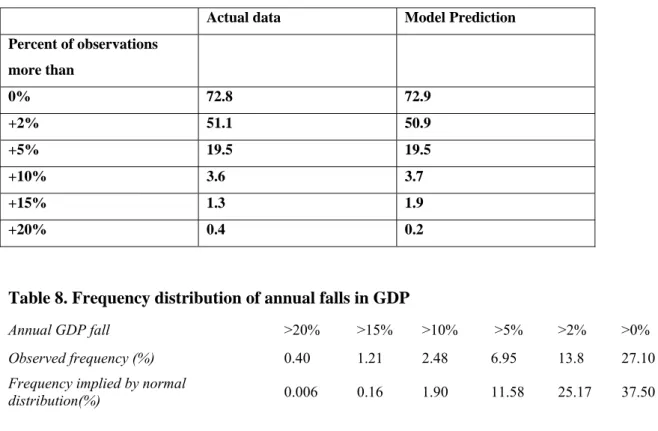
The changes in annual GDP for a large sample of countries over long periods have two significant characteristics: changes in annual GDP do not follow a normal distribution (they have much bigger chances of extreme movements) and the chances of big falls are much greater than the chances of big rises (there is clear downwards skew). Table 7 shows our estimated distribution reflects this very well. Table 8 shows the frequencies with which GDP fell by various amounts in one year.
Table 7. Actual and predicted growth in GDP per capita (data from 1821-2008)
Actual data Model Prediction
Mean (%) 1.81 1.80
Standard deviation (%) 5.7 5.9%
Skewness -2.40 -2.65
Excess Kurtosis 39.0 20.0
observations 4472 Percent of observations less
than -20% 0.4 0.7 -15% 1.2 1.1 -10% 2.5 2.9 -5% 7.0 5.0 -2% 13.8 12.7 0% 27.1 27.1 0 0.02 0.04 0.06 0.08 0.1 0.12 0.14 -0.40 -0.35 -0.30 -0.25 -0.20 -0.15 -0.10 -0.05 0.00 0.04 0.09 0.14 0.19 0.24 0.29 0.34 0.39
Frequency distribution of changes in GDP - Actual data
Predicted by the model (base case)
Probability
Actual data Model Prediction Percent of observations more than 0% 72.8 72.9 +2% 51.1 50.9 +5% 19.5 19.5 +10% 3.6 3.7 +15% 1.3 1.9 +20% 0.4 0.2
Table 8 suggests that occasions when generalised falls in real incomes might be 5% or more occur roughly once every 15 years. Falls in excess of 10% might be about once every 40 year events. Declines of 15% or more are roughly once-every-80-year events. The final row in the table shows the chances of falls in GDP based on a normal distribution which has mean and variance equal to the empirical distribution. The difference between that and the actual frequency is striking. For example, with the normality assumption, a decline of 15% GDP or more is a one-in-600-years event, compared to an historic frequency of about once every 80 years. Self-evidently a normal distribution greatly understates the probability of tail events – the very events we are interested in.
Table 8 suggests that if risk-weighted assets fall in line with GDP then banks would need far more capital than has been typical in recent years to be truly robust. For example, the probability that banks’ risk-weighted assets fall in value by 15% or more is 1.2%. It follows that banks should have loss-absorbing capital of at least 15% of risk weighted assets (which might correspond to about 7% of total assets using Basel III risk weights) to weather such an event.
Table 8. Frequency distribution of annual falls in GDP
Annual GDP fall >20% >15% >10% >5% >2% >0%
Observed frequency (%) 0.40 1.21 2.48 6.95 13.8 27.10
Frequency implied by normal
We define a generalised banking crisis as a situation where the loss in the value of bank assets is as large as their equity capital. In many ways this is a conservative criterion as the early failure of less-capitalised institutions would likely freeze funding markets well before the sector as a whole falls into negative equity. We assume that the percentage fall in asset values is equal to the risk weight multiplied by the fall in GDP. Annex 2 suggests that this is likely to be a conservative assessment of bank losses.
4.2. Expected cost of crisis and bank capital
To assess the impact of a financial crisis, one needs to make some assumptions about the size of its initial effect on incomes (GDP) and their persistence. We make the same assumptions as in the Bank of England’s FSR (June 2010), this is that if a banking crisis occurs, GDP falls initially by 10% and three quarters of this reduction lasts for just five years whilst one quarter is permanent. Based on that assumption, and a discount rate of 2.5%, the present value gain of permanently reducing the likelihood of a systematic crisis in any one year by one percentage point is around 55% of current annual GDP19. The initial impact of a 10% fall in GDP is in line with
the IMF estimate of the typical cost of a financial crisis. It also accords with the recent experience of the UK: the level of UK GDP in the first half of 2010 was around 10% below what it would have been if growth from 2007 H1 had been equal to the long-run UK average.
The estimate of the cost of crisis is, of course, sensitive to our assumptions about the impact of the financial shock and its persistence. If we assumed no permanent effects
19
The expected loss in output per crisis, LPC, can then be computed as
% 10 1 1 4 1 1 1 4 3 LPC 5
where δ is the discount factor. Using a discount rate of 2.5% (which implies a discount factor of 0.975), this amounts to a cumulated discounted cost of about 140% of GDP per crisis, and 1.4% of GDP per percentage point reduction in the likelihood of this crisis. As higher capital requirements would not only reduce the likelihood of a single crisis but of all future crises, the expected benefit of higher capital requirements would be
1 1 LPC % 1
per percentage point reduction in the probability of crises, or about 55% of GDP. A similar approach is used in Haldane (2010).