Jannike Gottschalk Ballo
How and to what extent did private actors
influence Basel III?
No. 13
2012
© 2012 by the author(s)
Papers on International Political Economy are working papers from the current research of the Center for Interna-tional Political Economy at the Free University of Berlin. They appear in irregular intervals and are available for download free of charge from the homepage of the Center.
Downloads
http://www.polsoz.fu-berlin.de/polwiss/forschung/oekonomie/ipoe/index.html PIPE Working Papers
Arbeitsstelle Internationale Politische Ökonomie Center for International Political Economy Freie Universität Berlin
Ihnestraße 22 14195 Berlin Germany Tel. (+49-30) 838-56470 Fax. (+49-30) 838-56474 http://www.polsoz.fu-berlin.de/polwiss/forschung/oekonomie/ipoe/index.html Jannike Gottschalk Ballo
How and to what extent did private actors influence Basel III? PIPE Working Paper No. 13 / 2012
Arbeitsstelle Internationale Politische Ökonomie, Berlin Center for International Political Economy, Berlin Hrsg. von Prof. Dr. Susanne Lütz
2. November 2012
Papers on International Political Economy ISSN 1869-4985 (Print)
ISSN 1869-8468 (Internet)
Jannike Gottschalk Ballo, 1986, studied journalism and comparative politics at the University in Bergen, and politi-cal economy at the Free University of Berlin. She has a special interest for quantitative methodology and the po-litical economy of labor market policies. Her master's thesis explores spatial policy diffusion and determinants of active labor market policies through quantitative methods.
Abstract
This paper deals with the actors and the changing power relations involved in global financial regulation. It explores the private sector’s influence on Basel III regulatory reforms, which were formulated by the Basel Committee on Banking Supervision as a response to the global financial crisis following the US subprime mortgage crisis in 2007-2008. Scholars argue that the dynamic between market actors and regu-lators of international finance has experienced a shift in power during the last couple of decades. Banks and other financial institutions have become more influential at the expense of states and regulatory insti-tutions. This essay argues that private actors are important to ensure legitimacy and efficiency of regula-tion, and finds that they possess far greater powers than their consultative positions towards regulators might indicate.
iterature ...13 Table of Contents 1. Introduction...1 2. Basel III ...1 2.1 Capital requirements ...2 2.2 Liquidity requirements...2
2.3 Systemically important financial institutions...2
3. Governance of global finance ...2
4. Actors of interest...4
4.1 Basel Committee on Banking Supervision ...4
4.2 Institute for International Finance ...4
5. Methods and data...5
6. Preferences...5
7. Channels of influence...6
8. The Basel III process...7
9. Opinions on bank lobby influence ...10
10. Conclusion ...12 L
1. Introduction
This essay studies the impact of private actors’ preferences on Basel III – a set of global capital and liquidity requirements formulated by the Basel Committee on Banking Supervision (BCBS). The intention is to contribute toward greater insights into the role and influence of private actors within global financial regulation. I use a qualitative method analyzing press releases and official statements from the bank lobby and the BCBS, as well as opinion articles from reporters, com-mentators, experts and scholars.
The research question is inspired by Copelovitch’s (2010) call for more research on the private-public dynamic in international financial regulation. Scholars argue that the private sector is be-coming increasingly influential in international financial regulation, and that power is moving from states to private institutions (Cohen 2008; Mosley 2005; Copelovitch 2010; Underhill and Zhang 2008). It’s important to pay closer attention to this process in order to know who actually makes the decisions, who benefits and whose preferences are compromised. I attempt to use the case of Basel III to study this shift in power within international financial regulation.
The essay is structured as follows. First, the main aspects and intentions of Basel III are pre-sented. Second, I briefly outline the agents within global financial regulation and explain how power has shifted between the actors during the last couple of decades. Third, I identify and pre-sent the actors of interest in this analysis: the BCBS and the Institute for International Finance (IIF). Fourth, the method of analysis and sources of data are presented. Fifth, I discuss the re-spective preferences of regulators and the private sector in terms of financial regulation. Sixth, the channels of influence available to the IIF are discussed. The analysis consists of two parts. First, I look at the communication between the IIF and the BCBS chronologically in the process toward the final formulation of Basel III. The second part is an evaluation of expert opinions on how the bank lobby has influenced Basel III. Finally, I sum up the most important findings and point to further research.
2. Basel III
The following paragraphs lay out the most important elements of Basel III, and explain the inten-tion of the regulatory reform. The Basel III accord is a set of capital and liquidity requirements, which was initiated in 2009 as a response to the global financial crisis that started with the US subprime mortgage crisis. The intention behind Basel III is to improve global financial stability and reduce the risk of future crises (BCBS 2011). To achieve these goals, Basel III capital and liquidity standards require raising the level and quality of capital in the banking system, increasing liquidity buffers and reducing unstable funding structures (BCBS 2010a). Basel III is the Basel Committee on Banking Supervision’s (BCBS) second revision to Basel I, which came into being in 1988. Basel III is consistent with the overall framework of Basel II, but the mechanisms of the requirements are improved (Elliott 2010). Basel II had left loopholes allowing banks to take risks that were not covered by capital and to securitize debt to cover up its size (Morrison 2012). The
Basel III reform is both micro- and macro-prudential, targeting the resilience of individual banks and institutions, as well as system wide risks (BCBS 2012c).
Basel III is complex and detailed, however, the presentation below provides a general explanation of the categories, with extra attention paid to the elements of dispute between the bank lobby and the BCBS. The requirements of Basel III concern capital, liquidity and systematically impor-tant financial institutions (SIFIs).
2.1 Capital requirements
The capital requirements of Basel III are organized into three pillars. Pillar one includes require-ments regarding quality and level of capital, a capital conservation buffer of 7%, and a counter-cyclical buffer of 0-2,5% of common equity in situations where credit growth is resulting in unac-ceptable systematic risk. In addition pillar one includes diverse requirements for risk coverage, and a leverage ratio. The non-risk-based leverage ratio includes off-balance sheet exposures and is supposed to serve as a backstop to risk-based capital requirements. The second pillar concerns risk management and supervision and the third pillar deals with market discipline and securitiza-tion (BCBS 2012b).
2.2 Liquidity requirements
The liquidity standards of Basel III contain four elements: 1) liquidity coverage ratio; 2) net stable funding ratio; 3) sound liquidity risk management and supervision; and 4) supervisory monitor-ing. The liquidity coverage ratio requires banks to have enough liquid assets to survive a 30-day stressed funding scenario. The net stable funding ratio is a long-term ratio, which encourages banks to use stable sources of funding. It is designed to uncover liquidity mismatches. Sound liquidity risk management and supervision principles are based on the lessons learned from the crisis and have been fundamentally reviewed since the original principles from 2008. The last element, supervisory monitoring, is a set of metrics to assist supervisors in identifying and analyz-ing liquidity risks, at both micro- and macro-level (BCBS 2012b).
2.3 Systemically important financial institutions
In addition to the requirements outlined above, Basel III prescribes stricter measures to globally systemically important financial institutions (SIFIs).The SIFIs pose a greater threat to global fi-nancial system, and must therefore have a higher loss absorbency capacity. The loss absorbency requirement depends on the individual systemic banks importance. BCBS has developed a meth-odology to identify the SIFIs, which includes both quantitative indicators and qualitative elements (BCBS 2012b).
3. Governance of global finance
To evaluate the impact of the private sector on regulation, it’s essential to have some understand-ing of the mechanisms of global financial government, the actors involved and the changunderstand-ing role of the private sector.
Governance of global finance is exercised by a range of agents: governments, “clubs” of powerful states (G7, G20), public-private initiatives, international organizations and by private financial institutions themselves (Mosley 2005). The most important international regulatory institutions in the governance of global finance today are the Basel Committee for Banking Supervision (BCBS), the Financial Stability Forum (FSF), the International Monetary Fund (IMF), the Joint Forum and the International Organization of Securities Commissions (IOSCO). These institutions in-volve the private sector on a consultative basis, or invite the industry to formal participation (Mosley 2005). The private sector is an important source for information and effective imple-mentation of regulatory reforms. Compliance and effectiveness of regulatory reforms are likely to increase when the industry has had a say in the formulation of requirements. This is because pri-vate sector participation increases legitimacy and reputation of regulatory institutions (Broome 2008). However, when private actors are engaged in regulation, the outcome may be compro-mised in favor of the industry, and to the disadvantage of the public good (Mosley 2005). The intention behind regulation is to promote financial stability, prevent global crises and to limit the immense social costs they incur. Both regulators and the industry agree on the importance of regulation, but when private actors become too influential, regulation is watered down and may lose effects (Mosley 2005).
Nevertheless, private actors have become increasingly influential in global finance regulation, although they have no formal say or vote at the table of regulators. Cohen (2008) suggests that the power relation in international monetary affairs are becoming more diffuse and ambiguous. Most importantly, power is moving from states to private actors (Underhill and Zhang 2008). Cohen (2008) mentions three major developments, which account for this shift in power rela-tions: 1) creation of the euro, 2) increased global payment imbalances and, 3) globalization of financial markets. The third factor is crucial to understanding the increased power of private ac-tors. “By promoting capital mobility, financial globalization enhances the authority of market agents at the expense of sovereign governments” (Cohen 2008:463). Financial globalization has given market agents a wider range of options and greater freedom to maneuver. This in turn means less freedom for states, which are forced into the trade-off between currency stability and monetary policy autonomy.
Now, one can ask why states are willing to cede power to private actors. Underhill and Zhang (2008) suggest two explanations: 1) finance is technical, common people have no understanding of and thus no interest in having their say; 2) when states disagree on regulation, private actors can enter and exercise their influence in the vacuum (Underhill and Zhang 2008).
Whether the increased power of the private sector is favorable, is a question of a different paper all together. The important thing is that due to globalization and the complex interdependence of markets, private actors have become increasingly important to world politics – in financial regula-tion, as well as in other areas (Mosley 2005). For the sake of democracy, the compromised autonomy of states through vague and diffuse mechanisms deserves greater focus in research. It is important to know who makes the decisions, to uncover whether the public good is being compromised to the advantage of capitalists.
This essay looks at the concrete case of Basel III and evaluates how and to what extent the pri-vate sector has influenced the final regulatory outcome. I have chosen to let the IIF represent the private sector. It is easier manageable to evaluate influence on policy outcome, when one institu-tion is taken to represent the interest of a whole sector. Of course, this is a simplificainstitu-tion of real-ity, but I believe it is fair to assume that the IIF represents roughly the average interests of the private financial institutions. IIF is the only global association of private financial institutions, its members include all types of institutions from insurance companies to rating agencies, and it is considering to speak the voice of global banking (Westlake 2010).
The following paragraphs provide a brief presentation of the actors of interest in this paper; the Basel Committee on Banking Supervision (BCBS) and the Institute for International Finance (IIF).
4. Actors of interest
4.1 Basel Committee on Banking Supervision
The BCBS is a regulatory body consisting of banking supervisory representatives from a number of industrialized countries. The core members are from the traditional banking powers in Europe, USA and Japan. The BCBS is situated in the Bank of International Settlements (BIS) in Basel, but is only loosely affiliated with it. The Committee has no supranational authority, but serves as an advisory body to governments. It is best known for its international standards on capital adequacy: the Core Principles for Effective Banking Supervision and the Concordat on cross-border banking supervision. Countries are expected to implement the codes and standards formulated by the BCBS, but in practice implementation is often only partially conducted and with delay. In addition to regulating the BCBS provides a forum for cooperation and common understanding of banking supervisory matters, including the circulation of research to its mem-bers (Elliott 2010; BCBS 2012a).
4.2 Institute for International Finance
The IIF is the biggest and most important actor of the international financial industry. The IIF is the only global association of financial institutions representing over 450 leading institutions worldwide (IIF 2012a). It is viewed as “the global voice of international banking” (Westlake 2010). Its members include the most important financial institutions worldwide ranging from commercial and investment banks, sovereign wealth funds, asset managers, hedge funds, insur-ance companies, multinational corporations, law firms, export credit agencies, multilateral agen-cies, development banks, to other organizations providing products and services to the financial community. The mission of the IIF is to manage risks, develop best practices and advocate regu-latory, financial and economic policies in the interest of its members (IIF 2012a). In addition to providing a forum of cooperation among its members, the IIF is a lobby agent, targeting policy-makers and regulators and aiming to shape public debate on financial regulation.
5. Methods and data
The method applied is a qualitative analysis of press releases, official statements and letters issued by the IIF and the BCBS. In addition, I use opinion articles from reporters, commentators, ex-perts and scholars. Statements by the bank lobby itself are not an ideal source for understanding its power and influence, as pointed out by Salmon (2010): “The problem is that all this noise coming from the IIF comes with zero credibility, because it’s the IIF’s job to say these things, whether or not they’re true”. Therefore, op-eds and evaluative articles contribute toward a more balanced understanding of the negotiating process toward Basel III.
The main challenge in the analysis is the measurement of influence. According to Cohen (2008:456) influence is defined as the ability to shape events and outcomes, which in practice means to have the capacity to control the behavior of others (Cohen 2008). It is impossible to measure influence on a scale, therefore I will first look at how the IIF has attempted to exercise its influence. Then, as far as possible, I will look at how the BCBS made amendments to Basel III in response to the bank lobby. Third, by summarizing opinions of experts, I hope to paint a rough picture of the impact of the bank lobby on Basel III.
6. Preferences
When evaluating actors’ impact on policy outcome, one cannot avoid discussing preferences and interests. As expressed by Kapstein (2006:4): “Clearly, it is impossible to speak meaningfully of financial agreements like the Basel capital adequacy accords, and associated demands by banks and other institutions for a “level playing field,” without making reference to private sector prefe-rences and interests“. In this section I outline the general prefeprefe-rences and intentions of the BCBS in formulating Basel III, and the interests at stake for the industry.
Historically, the reason for regulating financial markets was the desire to avoid systemic instabil-ity, and the “…contagious spread of losses across financial institutions that threatens to harm the real economy” (Kapstein 2006:2). Kapstein (2006) argues that the globalization of financial mar-kets has led to interdependencies, which generate tougher competition among financial agents and increased risks for international spillovers of domestic crises. Thus, stricter and more com-plex regulations are essential to protect the system from shocks. The BCBS explicitly states that the aim of Basel III is to 1) improve the banking sector's ability to absorb shocks arising from financial and economic stress, whatever the source; 2) improve risk management and governance; and 3) strengthen banks' transparency and disclosures (BCBS 2012c).
Just like regulators, private actors seek stability in the financial system because financial crises bear significant economic and political costs. Financial institutions have called out to regulators to ensure a more level and stable playing field for international finance (Kapstein 2006). Stability is the common objective, which make regulators and private actors capable of working together. There is broad consensus between the IIF and the BCBS about the need for higher capital buff-ers and stricter regulations (Elliott 2010; IIF 2012b). Even before the BCBS announced to review Basel II, the IIF published a report in response to the ongoing global financial turmoil emphasiz-ing the need for stricter regulation of various areas within global finance (IIF 2008). The IIF have
been consistently supportive of regulatory reforms, which aim at strengthening the resilience of the system. “The IIF's Board of Directors, […] welcomes the progress being made in formulating a package of core regulatory reform proposals”, were the words of former IIF board member Dr. Josef Ackermann in response to the early drafts of Basel III (IIF 2010c). However, the bank lobby stresses the importance of adequately targeted reforms, and that the impact of regulation on the different financial sectors is well understood (IIF 2012b). “[…] it will be important to consider carefully the content, the timing and the calibration of the reforms in order to achieve the right balance between stability and growth”, continued Dr. Ackermann (IIF 2010c). Hence, the IIF were positive toward the intention of the reforms, but disagreed on a number of the con-crete measures proposed to achieve stronger system resilience. The industry argued that the initial Basel III proposals would increase cost of lending and other financial services, and thus slow down growth unnecessarily.
Initially, the main elements of Basel III to which the bank lobby disagreed were the following: 1) The net stable funding ratio; 2) higher capital ratio; 3) use of a leverage ratio; 4) elimination of softer forms of capital; and 5) the exclusion of some balance sheet items from capital (Elliott 2010).
The industry pushed hard against the net stable funding ratio, even though they did not oppose to Basel III covering liquidity. The argument was that safety gains would be minimal, while it would incur immense costs for the industry because they would have to change the way they fund themselves and the way they invest their assets. Further, the industry argued that the capital ratios needed only be raised moderately, because of all the other ways Basel III implied higher capital levels (Elliott 2010). The IIF also argued against the leverage ratio, claiming it would run the risk of undermining its own objectives. “Any measure to contain leverage should take ac-count of the differences in business models and funding structures”, the IIF stated (Madigan 2009). The elimination of softer forms of capital is a threat to banks that rely on cheaper and riskier capital. Common stocks are the strongest forms of capital, but also by far the most expen-sive. The industry therefore lobbied against the elimination of soft capital. Similarly, banks op-posed the exclusion of some balance sheet items from capital, because banks benefit from some of these (Elliott 2010).
7. Channels of influence
Before analyzing the IIF’s concrete influence on Basel III, I’ll briefly discuss the tools and chan-nels available to the Institute for advocating its interest toward the BCBS. The IIF does not have a seat at the table of regulators in Basel. Therefore the financial industry exercises influence either 1) through direct lobbying and policy advocacy; or 2) through the power of the market. The sec-ond, passive type of influence is the dispersed power of the market, also called externalities by the economists (Cohen 2008). The focus in this paper is to examine the active influence of the bank lobby on Basel III. However, as we will see, the IIF indirectly makes use of market power by using threat scenarios as leverage to pressure regulators (Morrison 2012).
Active lobbyism is the IIF’s most important mission. Considering its long list of members, the IIF occupies a significant position in the global financial system. To communicate the industry’s opinion on regulatory affairs, the Institute closely monitors such developments, mobilizes opin-ions among its members, assesses potential impact of new regulatopin-ions and maintains a close dia-logue to public regulators through written communication and face-to-face-discussions (IIF 2012b). The IIF was invited by the BCBS to informal dialogue on the process toward Basel III (IIF 2010c). It also published reports on the consequences of proposed changes to capital and liquidity regulation and “[…] commented extensively on all stages of the process” (IIF 2010a). The BCBS insisted it was not deaf to the interests of the industry and that the process would be a pragmatic one (Bryant and Masters 2010). In addition to the open and official communication between the two organizations, there has been a tradition for behind-the-scenes interaction based on personal relationships. An example is Peter Cooke, who is the longest serving chairman of the BCBS, and also a co-founder of the IIF. Managing director at the IIF, Charles Dallara, is close associates with BCBS chairman during the 1990’s, Tommaso Padoa-Schioppa (Lall 2010). Ac-cording to Lall (2010), these relationships have had enormous influence on the work and deci-sion-making of the BCBS. As shown above, the IIF has numerous opportunities of influence, even though the formal vote is lacking.
8. The Basel III process
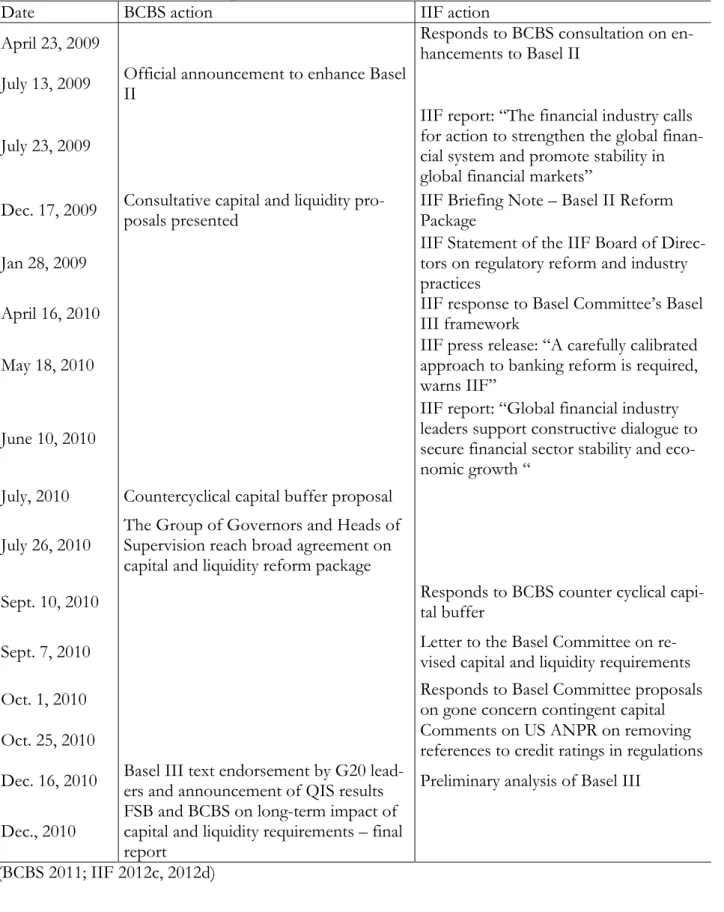
In table 1 below I present a rough timeline of the development of Basel III including the actions of the BCBS as well as the subsequent official reactions by the IIF. The timeframe of analysis ranges from the announcement of enhancement of Basel II in July 2009 to the final document, which was endorsed at the G20 summit in Seoul on December 16, 2010. Lobbyism and amend-ments of details continued beyond this date, but the core requireamend-ments were set by the end of 2010 (KPMG 2010).
As shown in the table below, the IIF was consulted (April 23, 2009) by the BCBS regarding re-views of Basel II before the official announcement was made (July 2009). The package presented in July 2009 was a strengthening of the Basel II framework, but introduced elements that later came to be part of Basel III. The Basel II enhancement emphasized level and quality of capital, as well as the introduction of a leverage ratio (BCBS 2009a).
Just a few days after the BCBS announcement to strengthen capital and liquidity standards, the IIF published a report reflecting the views of global financial leaders on the need for stricter fi-nancial regulation. The industry welcomed the opportunity to build a more efficient and effective regulatory system, but stressed that misjudged regulation could have great consequences in terms of jobs, investment and growth. Therefore, a coordinated approach to regulation between regula-tors and the financial sector would be necessary, the IIF argued. Among other things, the report argued against the creation of formal categories for systemically important financial institutions (SIFIs).
Table 1. Timeline of Basel III process and IIF reactions
Date BCBS action IIF action
April 23, 2009 Responds to BCBS consultation on en-hancements to Basel II July 13, 2009 Official announcement to enhance Basel II
July 23, 2009
IIF report: “The financial industry calls for action to strengthen the global finan-cial system and promote stability in global financial markets”
Dec. 17, 2009 Consultative capital and liquidity pro-posals presented IIF Briefing Note – Basel II Reform Package Jan 28, 2009 IIF Statement of the IIF Board of Direc-tors on regulatory reform and industry
practices
April 16, 2010 IIF response to Basel Committee’s Basel III framework May 18, 2010
IIF press release: “A carefully calibrated approach to banking reform is required, warns IIF”
June 10, 2010
IIF report: “Global financial industry leaders support constructive dialogue to secure financial sector stability and eco-nomic growth “
July, 2010 Countercyclical capital buffer proposal July 26, 2010 The Group of Governors and Heads of Supervision reach broad agreement on
capital and liquidity reform package
Sept. 10, 2010 Responds to BCBS counter cyclical capi-tal buffer Sept. 7, 2010 Letter to the Basel Committee on re-vised capital and liquidity requirements Oct. 1, 2010 Responds to Basel Committee proposals on gone concern contingent capital Oct. 25, 2010 Comments on US ANPR on removing references to credit ratings in regulations Dec. 16, 2010 Basel III text endorsement by G20 lead-ers and announcement of QIS results Preliminary analysis of Basel III
Dec., 2010 FSB and BCBS on long-term impact of capital and liquidity requirements – final report
(BCBS 2011; IIF 2012c, 2012d)
The IIF saw this as a counterproductive measure, arguing that systemic risk can emerge from complex interaction between institutions, markets or products, and that focusing on a list of insti-tutions only, would not contribute to the detection of systemic risk. “Artificial restrictions on size could produce materially distorting effects and unmanageable risk patterns within the system”, argued the IIF (IIF 2009).
In December 2009, the BCBS published consultative proposals to strengthen both capital and liquidity regulations. The capital requirements presented in July the same year were further strengthened paying closer attention to risk management, and minimum liquidity standards were introduced. The Committee also announced to review the need for special requirements for sys-temically important institutions (SIFIs) (BCBS 2009b).
In response the IIF called for substantial modifications of the proposals, by referring to “the tradeoffs between layers of protection and prudent credit provision for economic growth” (IIF 2010e). The Institute argued that if the reforms were to be implemented as proposed, they would create severe economic consequences for the financial industry and for the global economy as a whole. The general need for stricter financial regulation was supported, but the Institute set forth that:
Revisions to the proposals, their judicious calibration, consideration of the interdependen-cies among the proposed measures, full assessment of their cumulative impact and the de-termination of priorities, and a realistic implementation calendar are all essential before a fi-nal set of standards is issued for implementation by the global financial industry (IIF 2010e).
In July 2010, the BCBS proposed a countercyclical capital buffer regime (BCBS 2010b), which later came to be part of pillar 1 in the final formulation of Basel III (BCBS 2012b). The intention behind this buffer regime as to avoid the build up of systemic risk during periods of excess credit growth (BCBS 2010b). The IIF commented on this proposal by embracing the principle of re-ducing procyclicality, but questioned the macroeconomic methodology of the proposal and warned against implementation of “[…] such an untested mechanism” (IIF 2010f)
The same month, the Group of Governors and Heads of Supervision1 of the BCBS reached a broad agreement on a revised set of capital and liquidity requirements. The agreed upon stan-dards represented an amended and moderated version of the consultative package proposed in December 2009. The BCBS admitted that certain aspect of the proposed requirements could potentially have adverse consequences for businesses and for the provision of credit. On capital requirements the BCBS made concessions to the common equity component of the Tier 1, the treatment of counterparty credit risk and to the definition and transition timing of the leverage ratio. The proposals for capital conservation buffer and countercyclical buffer remain unchanged. Regarding liquidity, moderations were made concerning the liquidity coverage ratio, including a revised definition of qualifying liquid assets. The net stable funding ratio remained, but modifica-tions of the initial proposal were under consideration (BCBS 2010c).
In its response the IIF, although recognizing the modifications made to the standards, the Insti-tute continued to push for “[…] significant revisions to avoid seriously hampering the credit ca-pacity of the banking sector […] (IIF 2010d). The IIF specifically pointed out deductions of capi-tal, liquidity ratios, counterparty risk and forward-looking provisioning where further modifica-tions were needed. A pressing concern for the IIF was also the phase-in schedule of the
ments. The IIF expressed dissatisfaction about the BCBS ignoring earlier issues of concern raised by the IIF (IIF 2010d).
In December 2010 Basel III was endorsed by G-20 leaders, and the results of the Quantitative impact study (QIS) of the BCBS was presented (BCBS 2011). Subsequently the IIF presented preliminary analysis of both capital and liquidity requirements (IIF 2012c). Again, a few amend-ments were made to the standards. In the capital requireamend-ments, the requirement to externally credit rate guarantors was eliminated, however, the requirement was kept for securitization pur-poses. Revisions also entailed some concessions to the counterparty risk requirements, although the IIF notes that the modifications in this respect only address part of the concerns raised by the industry. The capital conservation buffer, the countercyclical buffer and the leverage ratio were maintained as proposed (IIF 2010a).
Regarding liquidity the important modifications concerned a delay in the phase-in of the liquidity coverage ratio and the net stable funding ratio, although the ratios remained as strict as earlier proposed (IIF 2010b).
In their preliminary analyses, the IIF points out that a lot of the elements are still under consid-eration and therefore are lacking in specification and detail. The version of standards presented at the G-20 summit in Seoul in December 2010 is the core of Basel III, even though details contin-ued to be calibrated and refined for months ahead.
The above chronological run-through of BCBSs work toward Basel III and the IIF reactions show that there are strong issues at stake for the bank lobby. They’ve followed the process closely, published impact studies and analyses of potential economic consequences, and they have clearly expressed their opinions in written letters addressed to the BCBS, or as public statements. However, it is impossible to measure the exact influence the bank lobby had on Basel III judging from this process. These regulatory requirements are a product of many variables. As pointed out by Simon Gleeson, a partner at a law firm: “I think there are some significant concessions her, although in many respects they are concessions to common sense, rather than industry lobbying” (Reuters 2010). To be able to evaluate the extent of the IIF’s influence I review the opinions of financial experts and commentators.
9. Opinions on bank lobby influence
There are diverging views among commentators and scholars on the strength of the bank lobby with respect to Basel III. However, there seems to be consensus about the fact that the industry did have a tangible impact on the end result. Morrison (2012), for example, argues that the bank lobby emerged victorious from the battle on Basel III, due to simple tactics: exploitation of the changing mood of global finance, and scaremongering. When Basel III was on the table in Basel, the financial crisis had turned into an economic crisis, with politicians being more concerned with getting the wheels rolling again, rather than regulating finance. This atmosphere was used by the IIF to spread threat scenarios of reduced credit provisions, job creation and staggering growth. Early 2010, Ranjit Lall, a member of the BCBS, even admitted that the lobby was making head-way: “While it is clear that some reform will happen, it’s also clear that what’s adopted will be a
heavily watered down version of what appears now. It’s inevitable” (Morrison 2012:4). In Morri-son’s analysis, the fingerprints of the bank lobby are visible in three key areas of Basel III: level of capital requirements, loopholes and leverage ratio. The capital requirements fall short of securing a stable banking system, argues Morrison (2012). The BCBS however, claim that the require-ments are still rigorous enough to ensure long-term stability in the system (Reuters 2010). The second influence of the bank lobby is the maintenance of loopholes from Basel II. If banks can still creatively get around capital requirements they are of no worth, and according to Morrison (2012), they still can. The toning down of the leverage ratio is also credited the bank lobby. In Morrison’s (2012:7) opinion the leverage ratio in the final version is “[…] of little or no signifi-cance – if not outright a waste of paper.” His assessment of the bank lobby is that they are able to dominate the regulatory debate and that the time to rein in markets effectively will not arrive. Several financial commentators shared this view of a strong and influential bank lobby. In June 2010, Jenkins and Masters (2010) reported that Basel III were to be thinned down due to the intense lobbying by the industry. Murphy and Jenkins (2010) reported that “[…] regulators ap-pear to have responded to politicians and banks, who argued that excessive tightening of the rules could constrain growth and lending amid a still-fragile economic recovery […]”. An edito-rial from The Financial Regulation Forum claimed that the Basel III requirements had been amended in response to the pressure put on the BCBS by the IIF. The requirements changed in three respects: 1) they are now less aggressive in the redefinition of capital and the timing of that redefinition; 2) they are less aggressive in the introduction of global liquidity proposals; and 3) they are less aggressive in the timing, but not the levels of key capital ratios (The Financial Regulation Forum 2010). Ross (2011) goes as far as to say that “Banks win, we lose. Banks do in fact rule the world”. His statement rests on the assumption that the Basel III requirements ended up being dangerously low, and not sufficient to prevent another credit-crunch.
However, not everyone seems as convinced as the above. Salmon (2010), although acknowledg-ing that the IIF is pushacknowledg-ing as hard as it gets, claims that the “the Basel technocrats, happily, seem unconvinced, although they have gone so far as to commission an official macroeconomic impact assessment to help counter the spin coming from the bank-lobby types at the Institute of Inter-national Finance”. Elliott (2010) referred to his own discussion with regulators when claiming that the key decision-makers heavily discounted the industry’s own analyses, and instead relied on the BCBS’ own view that the benefits of greater systemic safety offset the relatively small costs to the economy. Even though concessions were made to Basel III due to inevitable lobbying, one cannot deny that the BCBS stuck to a set of requirements that are substantially stricter than Basel II (Klein 2010).
10. Conclusion
This essay aimed to shed light on the influence of private actors on Basel III. The analysis shows that the IIF exercised significant influence on BCBS and contributed to concessions in several areas of the Basel III. The private sector possesses significant powers beyond its consultative role with respect to regulation. This paper is an attempt to contribute to the body of literature explor-ing the power relations and interactions between governments, international organizations and private actors within global financial regulation. However, the results are specific to the case of Basel III and do not necessarily apply to other situations of cooperation within financial regula-tion. Further research is needed to reach conclusions on general terms. The analysis relies heavily on actions and statements made by the IIF, which was taken to represent the entire private finan-cial industry. This is a major simplification, and studies using data from a wider set of private actors will most probably be able to generate more robust results. The ideal research design would also aim at pinpointing exactly where the BCBS made concessions because of, and only because of, the bank lobby. Due to my limited understanding of technical finance and the limited extent and timeframe of this essay, I was not able to go through with such a rigorous analysis.
Literature
BCBS. 2009a. "Basel ii capital framework enhancement announcement by basel committee". July 13, Basel: Bank of International Settlements, available from [cited July 31, 2012]
BCBS. 2009b. "Consultative proposals to strengthen the resilience of the banking sector announced by the basel committee". December 17, Basel: Bank of International
Settlements, available from http://www.bis.org/press/p091217.htm [cited July 31, 2012]
BCBS. 2010a. "Basel iii: International framework for liquidity risk measurement, standards and monitoring". December, Basel: Bank of International Settlements, available from
http://www.bis.org/publ/bcbs188.htm [cited July 31, 2012]
BCBS. 2010b. "Countercyclical capital buffer proposal - consultative document ". July, Basel: Bank of International Settlements, available from http://www.bis.org/publ/bcbs172.htm
[cited July 31, 2012]
BCBS. 2010c. "The group of governors and heads of supervision reach broad agreement on basel committee capital and liquidity reform package". July 26, Basel: Bank of International Settlements, available from http://www.bis.org/press/p100726.htm [cited August 1,
2012]
BCBS. 2011. "Basel committee's response to the financial crisis". July 19, Basel: Bank of
International Settlements, available from http://www.bis.org/bcbs/fincriscomp.htm [cited
July 24, 2012]
BCBS. 2012a. "About the basel committee". May 23, Basel: Bank of International Settlements, available from http://www.bis.org/bcbs/about.htm [cited July 28, 2012]
BCBS. 2012b. "Basel committee on banking supervision reforms - basel iii". April 12, Basel: Bank of International Settlements, available from
http://www.bis.org/bcbs/basel3/b3summarytable.pdf [cited July 29, 2012]
BCBS. 2012c. "International regulatory framework for banks (basel iii)". April 12, Basel: Bank for International Settlements,, available from http://www.bis.org/bcbs/basel3.htm [cited July
28, 2012]
Broome, André. 2008. "The importance of being earnest: The imf as a reputational intermediary."
New Political Economy 13 (2):125-51.
Bryant, Chris, and Brooke Masters. 2010. "Bankers fear effect of basel rules". June 10, London: Financial Times, available from http://www.ft.com/cms/s/0/92a3e422-747c-11df-b3f1-00144feabdc0.html#axzz21SE5GU8t [cited July 30, 2012]
Cohen, Benjamin J. 2008. "The international monetary system: Diffusion and ambiguity". Santa Barbara: UC Santa Barbara: Global and International Studies, available from
http://www.escholarship.org/uc/item/97r5n8jx [cited July 23, 2012]
Copelovitch, Mark S. 2010. The international monetary fund in the global economy : Banks, bonds, and bailouts. Cambridge: Cambridge University Press.
Elliott, Douglas J. 2010. "Basel iii, the banks, and the economy". July 23, Washington, DC: The Brookings Institution, available from
http://www.brookings.edu/research/papers/2010/07/26-basel-elliott [cited July 27, 2012]
IIF. 2008. "Global finance leaders release comprehensive proposals to strengthen the financial industry and financial markets ". July 17, Washington, D.C.: Institute for International Finance, available from [cited July 29, 2012]
IIF. 2009. "The financial industry calls for action to strengthen the global financial system and promote stability in financial markets". July 23, New York City: Institute of International Finance, available from http://www.iif.com/press/press+76.php [cited July 31, 2012]
IIF. 2010a. "Basel iii - capital standards, iif preliminary analysis". December, Washington, D.C.: Institute of International Finance, available from
IIF. 2010b. "Basel iii - liquidity standards, iif preliminary analysis". December,
http://www.iif.com/regulatory/article+936.php [cited July 30, 2012]
IIF. 2010c. "Global financial industry leaders support constructive dialogue to secure financial sector stability and economic growth". Vienna: The Institute of International Finance, Inc., available from http://www.iif.com/press/press+151.php [cited July 24, 2012]
IIF. 2010d. "Iif letter to basel committee on revised capital and liquidity standards". September 7, Washington, D.C.: Institute for International Finance, available from
http://www.iif.com/regulatory/comment/article+824.php [cited August 1, 2012]
IIF. 2010e. "Iif response to basel committee's basel iii framework". April 16, Washington, D.C.: Institute for International Finance, available from
http://www.iif.com/regulatory/comment/article+944.php [cited July 31, 2012]
IIF. 2010f. "Iif response to basel committee's countercyclical capital buffer response". September 10, Washington, D.C.: Institute for International Finance, available from
http://www.iif.com/regulatory/comment/article+813.php [cited July 31, 2012]
IIF. 2012a. "About iif". Washington, DC: Institute of International Finance, available from
http://www.iif.com/about/ [cited July 28, 2012]
IIF. 2012b. "Mobilizing opinion on regulatory issues". Washington, D.C.: Institute of
International Finance, available from http://www.iif.com/regulatory/aboutreg/ [cited July
28, 2012]
IIF. 2012c. "Regulatory affairs: Comment letters and notes". Washington, D.C.: Institute for International Finance [cited July 28, 2012]
IIF. 2012d. "Regulatory affairs: Reports". Washington, D.C.: Institute for International Finance, available from http://www.iif.com/regulatory/reports/ [cited July 28, 2012]
Jenkins, Patrick, and Brooke Masters. 2010. "Banks win battle for limits to basel iii". June 26, London: Financial Times, available from http://www.ft.com/intl/cms/s/0/96ca4a38-7fbb-11df-91b4-00144feabdc0.html#axzz21SE5GU8t [cited July 24, 2012]
Kapstein, Ethan B. 2006. "Architects of stability? International cooperation among financial supervisors." In BIS Working Papers. Basel: Bank of International Settlements.
Klein, Ezra 2010. "Why you should care about basel iii". July 27, Washington, D.C.: Washington Post, available from
http://voices.washingtonpost.com/ezra-klein/2010/07/why_you_should_care_about_base.html [cited July 31, 2012]
KPMG. 2010. "Basel 3 - pressure is building...". December, KPMG International, available from
www.kpmg.com/regulatory-challenges [cited July 28, 2012]
Lall, Ranjit. 2010. "Reforming global banking rules: Back to the future?" DIIS Working Papers
2010 (16).
Madigan, Peter. 2009. "Leverage ratios are "counterproductive", says iif". July 24, Risk Magazine, available from http://www.risk.net/risk-magazine/news/1500706/leverage-ratios-counterproductive-iif [cited August 13, 2012]
Morrison, Ed. 2012. "Addicted to risk". May, CEO, available from
http://www.scribd.com/doc/94013523/Addicted-to-Risk [cited July 31, 2012]
Mosley, Layna. 2005. "Private governance for the public good? Exploring private sector participation in global financial regulation". June 17, Dept. of Political Science UNC Chapel Hill, available from www.unc.edu/~lmosley/ [cited July 27, 2012]
Murphy, Megan, and Patrick Jenkins. 2010. "Banks rebound on Basel concessions". July 27, Lon-don: Financial Times, available from http://www.ft.com/intl/cms/s/0/169c14b6-99a8-11df-a852-00144feab49a.html#axzz2AnTROCCa [cited July 24, 2012]
Reuters. 2010. "Basel bank plans eased in face of sector lobbying". July 27, New York City: Thomson Reuters, available from http://www.abndigital.com/page/news/top-business-stories/657859-Basel-bank-plans-eased-in-face-of-sector-lobbying [cited August 1,
Ross, Carne. 2011. "Basel iii: Business as usual for bankers". June 6, London: The Guardian, available from
http://www.guardian.co.uk/commentisfree/cifamerica/2011/jun/06/basel-iii-banking-volcker [cited July 31, 2012]
Salmon, F. 2010. "Basel iii: Grounds for optimism". May 26, New York City: Thomson Reuters, available from http://blogs.reuters.com/felix-salmon/2010/05/26/basel-iii-grounds-for-optimism/ [cited July 27, 2012]
The Financial Regulation Forum. 2010. "Iif follows up its predictions of basel iii output loss". October 15, The Financial Regulation Forum, available from
http://www.financialregulationforum.com/wpmember/iif-follows-up-its-predictions-of-basel-iii-output-loss-5083/ [cited August 13, 2012]
Underhill, Geoffrey R. D., and Xiaoke Zhang. 2008. "Setting the rules: Private power, political underpinnings, and legitimacy in global monetary and financial governance." International Affairs 84 (3):535-54.
Westlake, Melvyn. 2010. "Regulators to stand their ground over basel iii". May, Essex: Global Risk Regulator, available from