How dev/test in the public cloud is
accelerating agile delivery
Ryan Shriver
September 24, 2013
This report was underwritten by HP Public Cloud and Intel.
Cloud
TABLE OF CONTENTS
Executive summary ... 3
Current challenges ... 5
Historical organization silos ... 6
Time to provision dev/test environments ... 6
Lack of automation ... 7
Cost center to innovation partner transition ... 7
Growth of shadow IT ... 7
Cost to provision and operate ... 8
Business value ... 9
Evaluating dev/test in the public cloud ... 11
Do we want public, private, or hybrid cloud? ... 11
Do we want IaaS, PaaS, or both? ... 12
What technology stacks do we want supported? ... 12
Do we care about technology standards? ... 13
What about security? ... 13
How important are costs? ... 14
How should we manage our environments? ... 14
What types of applications fit best? ... 15
What tools should we integrate? ... 16
How important is the level of support? ... 17
How concerned are we about performance? ... 17
How important is time to value? ... 18
Things to consider ... 19 Performance ... 19 Availability ... 19 Costs ... 20 Security ... 20 Conclusions ... 21
About Ryan Shriver ... 23
About GigaOM Pro ... 23
Executive summary
Technology leaders in organizations adopting agile delivery are increasingly turning to the public cloud to solve the challenge of quickly and efficiently provisioning and managing dev/test environments. Early cloud customers tended to focus on operational server consolidation and cost savings. Today, however, customers are focused more and more on leveraging cloud computing for improving business agility and productivity. And they are seeing results for their investments; 80 percent of mature cloud adopters report faster time to market.
"We had a challenge managing our dev/test environments before we introduced agile. Now with agile, we need more of these environments than we needed before with faster turnaround. We have more than 100 agile teams, and we're still growing. Our existing solutions don't scale, and we've got to find better ones.”
Fortune 500 technology executive interviewed for this report
Today, agile methods are the preferred way software is delivered in organizations ranging from startups to Fortune 1000s. With a focus on delivering value and flexibility, leading organizations see agile as a competitive advantage in helping deliver innovative products and services to their customers more quickly. One recent CHAOS report1 finds that agile methods are three times more successful than traditional methods and considered “a universal remedy for software project failure.” It is no wonder agile is the preferred method for innovative products and services development.
A new breed of organization, including those of Web 2.0 brand names Facebook and Netflix, has been leading the shift toward a continuous delivery model. They continually release new features in small batches, often daily, to dev/test as well as to production environments. As GigaOM analyst Paul Duvall describes it, “In these organizations, the entire release pipeline is automated with quality built into every step toward production. Small releases are less risky and become a routine part of business.” The success of these organizations in continually creating and delivering innovative products and services is inspiring others to follow suit.
1 The 2011 CHAOS Report is available from The Standish Group for a fee. See Mike Cohn’s website for the specific reference cited.
The 2013 State of the Cloud report confirms that dev/test is the top use for cloud users at all levels of cloud maturity. This same report reveals that, more and more, enterprises are taking a multi-cloud strategy approach to cloud adoption but are often starting with a “public-first” approach.
In response, public cloud vendors are differentiating themselves on their ability to help organizations further accelerate agile development—from Platform-as-a-Service (PaaS) vendors who provide complete integrated development platforms to Infrastructure-as-a-Service (IaaS) vendors who bundle automation tools, simple user interfaces, and enhanced support.
Together the convergence of agile, devops, and the cloud are enabling progressive organizations to move toward a continuous delivery of products and services to their customers—an advantage that's
increasingly required in today's fast-paced, consumer-driven market.
Current challenges
Many organizations still plan and release new enhancements a few times a year to big fanfare—the traditional “build and ship" delivery model. Teams typically work a long time building new features before they fully integrate and test their code. They carefully forklift release candidates between
inconsistent environments with largely manual processes that they hope are consistent. Eventually, once the suite of regression tests pass, they release the code to production—with fingers crossed. In this model, software takes a long time to envision, plan, build, test, and release, and customers must wait a long time between new features or bug fixes they value. In today's competitive market, this model is becoming outdated as organizations seek faster time to market and more flexibility to adapt.
As a result, progressive organizations are adopting agile methods with devops practices that are increasingly integrated with cloud computing and lots of automation. Implementing agile requires organizations to collaborate in new ways, such as continually building, deploying, testing, and releasing software throughout the delivery process. With agile, teams that historically had limited interaction throughout the development lifecycle now collaborate daily using common methods and tools, including dev/test environments.
This approach to delivering customer value compliments The Lean Startup and other innovative methods that focus on continual customer exploration and validation. Today, companies of all sizes are adopting these innovative practices so they can gain more customer insight and respond more quickly to demands from customers and pressure from competitors. Not surprisingly, the cloud is becoming the preferred platform for making this practice possible.
Although these progressive organizations are more the exception than the rule, they demonstrate the possibilities with existing methods and tools. They are showing that agile development plus devops plus cloud is a winning formula for rapidly developing innovative products and services.
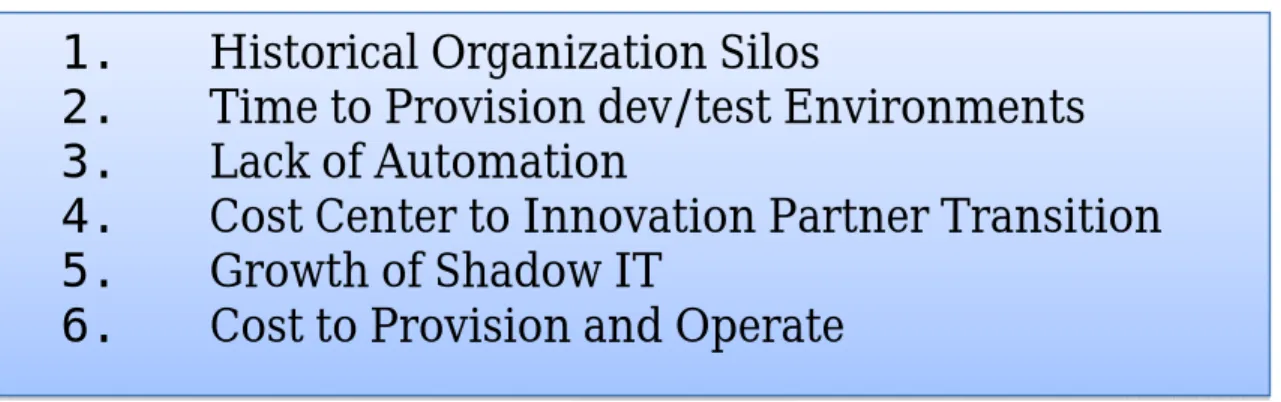
So what about the majority of organizations that aren't there yet? Most, whether they use agile or not, face six key challenges in accelerating their delivery:
FIGURE 1: Six key delivery challenges in accelerating delivery
Source:GigaOMResearch
Historical organization silos
Historically, the development and operations teams in an organization, each with different goals, priorities, responsibilities and leadership, rarely work together to deliver software from concept to customer. In agile, these teams should collaborate and work closely together, but often priorities aren't aligned. As a QA leader recently said, “I like our TechOps guys, but I'm at the bottom of their priority list. Provisioning new dev/test environments is secondary to production items. Yet my demand is high
because of the number of dev/test environments I need to test our software before each release.” For this QA leader, dev/test in the public cloud was the way he could offload work from his TechOps team while feeling like he was at the top of the priority list for his pubic cloud vendor.
Time to provision dev/test environments
Today, most organizations take weeks or even months to get a dev/test environment provisioned, configured correctly with supporting software, and loaded with test data, and then get the application deployed. The current state for many organizations of relying on highly specialized resources using manual processes inevitably creates a bottleneck. This bottleneck becomes more acute with agile, which condenses development cycles and promotes building, testing, and deployment throughout delivery.
1.
Historical Organization Silos
2.
Time to Provision dev/test Environments
3.
Lack of Automation
4.
Cost Center to Innovation Partner Transition
5.
Growth of Shadow IT
Lack of automation
While virtual servers have largely replaced physical servers, the steps to fully provision and configure dev/test environments in many organizations is still a series of mostly manual steps performed by highly skilled and overburdened teams. Today, many agile teams have adopted continuous integration for automatically building and unit testing code; however, automating the provisioning of new environments, deploying releases, and fully regression testing a release are still mostly manual processes. While specific steps in these processes may be automated, rarely is the entire release process itself automated, which leads to a lack of repeatability and consistency with new deployments. The integrated tools that many public cloud vendors provide help organizations address this challenge, especially when using PaaS solutions.
Cost center to innovation partner transition
IT is increasingly transitioning from a back-office cost center, in which the goal is keeping the systems up and technology costs low, to a strategic business partner that collaborates to deliver innovative products and services quickly. Customers are putting pressure on businesses to deliver value more quickly in order to stay competitive. Businesses in turn are putting pressure on their IT organizations to deliver value more quickly and not just be a low-cost technology provider. While progressive IT organizations are making this transition toward agility, more traditional ones are slower to adapt to this changing reality. With growing numbers of customers using web and mobile channels to interact with organizations, IT organizations must find ways to balance low costs with agility. Today's IT goals are often tied to
operational efficiency and cost metrics. In the future, these must be balanced with business agility metrics, such as time-to-market and flexibility, if they are going to help their entire organization become more competitive and nimble.
Growth of shadow IT
When internal business stakeholders and agile development teams are faced with long lead times to provision dev/test environments, whether a custom build or a commercial solution, they will often turn to “shadow IT” (i.e., infrastructure necessary to run their applications but not under the direct ownership and control of IT).
Increasingly these stakeholders are turning to the public cloud to get their solutions running quickly on someone else's infrastructure. While some IT organizations are getting out in front of this challenge by proactively working with these stakeholders to create self-service dev/test environments built in the cloud, others are being dragged kicking and screaming, furthering the growth of shadow IT. The latter also are potentially spending more on cloud services than needed because each stakeholder is working separately with cloud vendors instead of combining forces to standardize agreements and explore volume discounts.
Costs to provision and operate
For many organizations, the largest costs are the people to provision, configure, and operate dev/test environments and the development teams who use them. This is usually a result of process inefficiencies, friction between departments, and a lack of automation. Costs for infrastructure (compute, storage, and network) and software licenses are not insignificant and can vary greatly by business model and industry, but the costs of highly skilled employees working within inefficient systems is a big challenge for many organizations. Agile methods can help address the friction and process inefficiencies but aren't a silver bullet.
For certain dev/test environments, such as performance testing, the traditional way to size and purchase software and hardware up front can be especially costly. As the growth of agile continues and demand for dev/test environments increase, the associated costs to scale these environments up may be driving higher costs because of the need to pay for a fixed capacity up front, perhaps even more capacity than is actually needed at present. In the case of performance test environments, the move to the public cloud, where you pay only for the environments in active use, means less upfront investment to begin.
Business value
One of the principle tenets of agile development is the focus on delivering business value early and often. While business and IT may not always agree on what is most valuable, both can agree that faster time-to-market is a desired outcome that delivers value. Two recent reports show the relationship between faster time-to-market, agile development, and organizations that adopt cloud computing:
The State of Agile Development survey finds time-to-market was the No. 1 reason for agile adoption.
The State of the Cloud report finds that 80 percent of cloud-focused organizations reported faster time-to-market with apps and faster access to infrastructure.
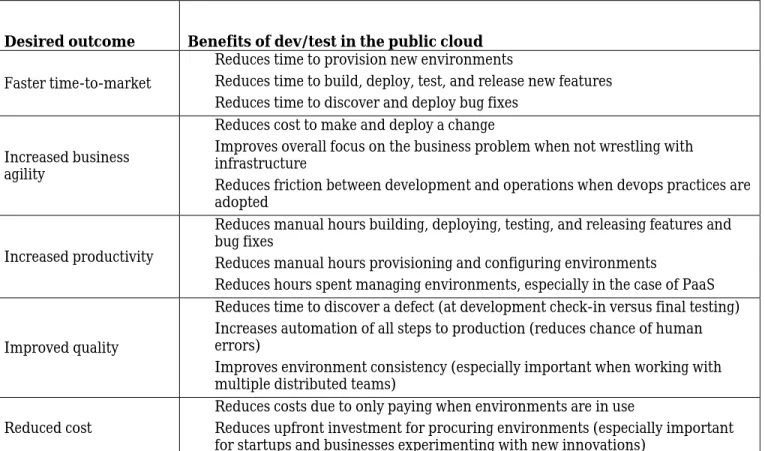
Based on users surveyed for this article and related research, five key outcomes for agile delivery in the public cloud have emerged.
FIGURE 2: Five key outcomes for agile delivery in the public cloud
Desired outcome Benefits of dev/test in the public cloud
Faster time-to-market
Reduces time to provision new environments
Reduces time to build, deploy, test, and release new features
Reduces time to discover and deploy bug fixes Increased business
agility
Reduces cost to make and deploy a change
Improves overall focus on the business problem when not wrestling with infrastructure
Reduces friction between development and operations when devops practices are adopted
Increased productivity
Reduces manual hours building, deploying, testing, and releasing features and bug fixes
Reduces manual hours provisioning and configuring environments
Reduces hours spent managing environments, especially in the case of PaaS
Improved quality
Reduces time to discover a defect (at development check-in versus final testing)
Increases automation of all steps to production (reduces chance of human errors)
Improves environment consistency (especially important when working with multiple distributed teams)
Reduced cost
Reduces costs due to only paying when environments are in use
Reduces upfront investment for procuring environments (especially important for startups and businesses experimenting with new innovations)
Other benefits can include improved morale and camaraderie among the development and operations teams. When devops practices are adopted in conjunction with agile and the cloud, cross-team
collaboration improves because the teams work together to deliver ideas to customers in continuous delivery.
Evaluating dev/test in the public cloud
Organizations evaluating the use of dev/test in the public cloud to accelerate their agile delivery face many options and decisions. There's a veritable jungle of acronyms, hype, and buzzwords all mixed together to confuse even the most experienced leader.
While each organization will have its own unique requirements that impact its decision process, our research reveals a dozen key criteria organizations should consider when evaluating whether the public cloud for dev/test environments can improve their agile delivery
Do we want a public, private, or hybrid cloud?
Today, enterprises are pursuing multi-cloud strategies that leverage a mixture of public and private clouds. The State of the Cloud report found that 77 percent of organizations plan to pursue a multi-cloud strategy and that “hybrid and multi-cloud implementations are today's strategy of choice for the
enterprise.”
In general, while the public cloud has faster time-to-market and is typically the starting point for agile teams doing dev/test in the cloud, some organizations may be uncomfortable with outsourcing their infrastructure and environments. The private cloud keeps the infrastructure in-house but requires time, skills, and investments to build out properly. Hybrid combines the benefits, as well as the risks, of both models because application workloads can run in a private cloud and failover or scale-over to a public cloud when demand peaks.
For organizations planning a multi-cloud strategy, aligning around a standard like OpenStack makes a lot of sense given the broad vendor support and ability to run applications in public and private.
Alternatively, moving to a PaaS solution, such as Pivotal or CloudBees, that supports multiple underlying IaaS solutions is another popular strategy.
Whether public, private, or hybrid, agile delivery teams need to build their devops skills and practices to take full advantage of the benefits of the cloud, especially around the areas of automation, self-service environments, and provisioning infrastructure with version-controlled code.
Do we want IaaS, PaaS, or both?
Organizations adopting cloud that have existing operations teams tend to start with IaaS and then
migrate toward PaaS over time. Starting with a public IaaS solution for dev/test environments is often the first step for agile teams new to the cloud. IaaS also tends to be the initial option for porting existing applications that were not designed to take advantage of horizontal scalability and other cloud features. Newer startups lean toward public PaaS solutions in order to focus their energy on solving a business problem quickly and not configuring infrastructure. PaaS solutions are usually more agile developer-friendly with a focus on technology stack and tool integration to improve productivity. PaaS tends to work best for development of new applications with cloud-aware architectures that are built into public
dev/test environments from the start. The ease of integration between PaaS, devops, and agile can make PaaS a simpler route for new agile teams, especially those building new apps.
What technology stacks do we want supported?
When organizations evaluate whether dev/test in the public cloud will improve their delivery, ensuring their preferred current (and hopefully future) technology stacks is an essential requirement. Depending on the agile team's chosen technologies, some cloud vendors, IaaS, and/or PaaS may be a better fit than others.
Generally speaking, agile teams developing on the Java/JVM platform tend to migrate toward
OpenStack-based solutions, especially enterprise IT organizations that may have existing relationships with members of the OpenStack community. While Java the language may be getting dated, the JVM platform continues to grow, now supporting popular languages including Ruby, Python, Scala, Clojure, and Groovy.
While agile teams developing in Microsoft .NET tend to align with the Azure platform because of the tight integration with Microsoft's development stack, this is not universal as most public cloud IaaS vendors offer Windows Server instances alongside Linux in their technology stack.
Finally, agile teams developing in Ruby, Node.js, Python, or PHP tend to migrate to PaaS solutions such as Heroku, although increasingly OpenStack solutions, such as HP Cloud, are adding support for these
Do we care about technology standards?
When evaluating the use of dev/test in the public cloud, agile teams must decide how important
technology standards are in their decision-making process. The market leader in IaaS, Amazon, continues to set the pace for cloud computing but does this using their own standards. If your runtime workload needs to be portable across multiple cloud providers, this might be a problem. Amazon's approach is contrasted with the growing list of technology vendors who are throwing their support behind the OpenStack Foundation and platform built with open cloud standards and open-source software.
This broad array of vendors is betting that customers like choices for moving their applications between different cloud providers using a common standard in public or private clouds. This, combined with access to customizable open-source components, makes a lot of sense for organizations pursuing a multi-cloud approach.
What about security?
Security (especially data and application security) is often the top concern for organizations migrating to the public cloud. As the State of the Cloud survey reveals, this security concern often diminishes as
organizations increase their cloud maturity. Indeed, agile teams that have sound development and devops practices can mitigate the security concerns through automation of security code checks as part of their continuous integration/delivery processes and by not storing live customer or other sensitive data in their dev/test instances.
Increasingly, public cloud vendors have virtual private clouds that allow users to decide if their dev/test instances are available from the internet. When securely configured, virtual private cloud instances appear as part of an organization's trusted network—a model increasingly in use by agile teams to securely integrate their public cloud with their on-premise network. Practices such as not exposing your database server directly to the internet are common for many agile teams developing in the cloud. Finally, the security concern is creating a growing market for Security-as-a-Service providers, such as CloudPassage, that can integrate with popular public and private clouds using a SaaS model. For agile teams that don't want to set up and configure their own security software and code checks, these services may be of interest.
How important are costs?
Virtually all public cloud vendors offer free trial licenses or small instances so agile teams new to the cloud can explore with little upfront investment aside from their time. This is a popular way for agile teams to get comfortable working with public dev/test instances. Some vendors offer discounts for signing longer-term contracts that can be appealing if an organization moves all their dev/test instances to the cloud. For organizations that can predict their cloud demand, this can be an effective way to lower overall costs.
Comparing the total cost of ownership for public cloud versus private data center or cloud can be a complex calculation that's beyond the scope of this paper. With most vendors offering a transparent way to tag utilization (such as compute, storage, and network instances) and itemize it on the monthly statement, agile teams can see exactly how much their dev/test instances cost and make adjustments to lower their costs. Common examples include shutting down dev/test instances when not in use (e.g., overnight or weekends).
Through these best practices, costs can be lowered but may not be as low as private data centers/clouds, depending on your circumstances. But as stated earlier, for agile teams pursuing faster time-to-market, the tradeoffs are worth it, especially if opportunity costs are factored in.
How should we manage our environments?
All public cloud vendors offer both web-based portals and application programming interfaces (APIs) for managing environments. For new agile teams, the web-based portals are ideal for learning how to
manage their dev/test environments. One of the devops best practices is to expose these portals directly to the agile development teams so they have self-service environments in which they can manage and troubleshoot their applications during development and testing. They also can provision new instances with a single click.
Code APIs work better for more experienced agile teams by automating the provisioning and management of environments using tools like Chef and Puppet. Automating the provisioning and
management of environments with code are essential devops practices for continuous delivery. The APIs provide a reliable way to script all aspects of cloud management in a transparent form that's
version-Which types of applications fit best?
Agile teams should understand which types of applications lend themselves better toward the elastic capabilities of cloud deployments. Emerging patterns include:
Big data and analytics apps: Perhaps the best application fit for cloud computing, especially the public cloud, is the analysis and processing of very large data sets given the almost unlimited scalability of cloud. The cloud is creating a new breed of big data and analytics applications that can bring deeper insights through data, often built around technologies including Hadoop, MongoDB, or other newer technologies.
Highly scalable apps: Because of the cloud's elasticity, applications with high scalability requirements and dynamic workloads are another good fit. Dynamic transaction processing and marketing operations systems fall into this pattern.
Customer-facing apps: Customer-facing web and mobile applications are generally better fits for the public cloud than back-office applications, which tend to be tightly integrated with existing data center apps (although this is changing). Initially companies may focus on apps that have limited integration with backend systems to minimize complexity and enable faster time-to-market.
Content-heavy apps: These applications are another good fit, with many public cloud vendors offering content delivery networks (CDN) as a part of their solutions for improving website performance and user experience.
Highly available apps: Applications with high availability requirements fit well, especially when they can take advantage of geographically distributed availability zones and global load-balancing. Although infrequent, high-profile outages at Amazon, Azure, and others remind us that even the biggest clouds stumble at times and that applications need resilient architectures and redundant infrastructure to mitigate outages.
Built with popular stack: Those apps that leverage popular development stacks, such as LAMP2, Java/JVM, Ruby on Rails, and .NET, are great candidates for PaaS solutions that can accelerate time-to-market. These stacks are very popular with agile development teams and are a natural place to start using public dev/test environments.
What tools should we integrate?
Integration with existing tools is a big concern for agile teams that don't want to have to completely retool to move to the cloud. IaaS solutions generally have the least impact to existing tools because cloud
instances appear as any other server with an IP address. Simply replace your existing server with a public dev/test server, and your existing tools should work fine. On the flipside, with IaaS, organizations must integrate and manage their own agile development tools, including source control, continuous integration, automated testing, and others. This is generally not too much of a challenge for agile teams with existing devops skills, but for those without, this can lead to headaches coming up the learning curve.
Increasingly, PaaS vendors are bundling these integrated tools as part of their solutions to simplify life for agile teams. This is good if these are intuitive tools that teams will learn to use quickly. This is bad if everyone on the team has to learn a bunch of new tools in order to use the PaaS solution, creating an upfront hurdle to adoption.
In addition to source control, continuous integration, and automated testing, agile teams typically integrate the following tools with dev/test environments:
Agile project management: System for managing the backlog of requirements and current work in process. Typically integrated with source control commit messages via APIs to
associate changes directly to the requirements
Defect tracking: System for managing incidents and bugs. Also typically integrated with source control commits and monitoring via APIs
Monitoring: System(s) for monitoring application and environment health with alerts sent via API to the defect tracking system. Increasingly, public cloud vendors are baking
monitoring into their stacks, requiring less custom integration from agile teams.
Configuration management: System(s) to keep track of which versions of software are compatible together, which have been thoroughly tested, and which environments they're in. This is especially important if public dev/test instances will be transient or the application needs to scale to many public cloud instances.
While these tools are standard for all agile teams and likely to be integrated with dev/test environments, there are more advanced tools applicable to agile teams moving to continuous delivery. One of the biggest challenges with continuous delivery is how to safely and quickly release new features when there is a large functional and performance regression testing cycle (even when automated). Leading Web 2.0 companies have solved this problem largely through big investments in proprietary technology and processes run on elastic cloud services. Emerging open source and commercial solutions are leveraging elastic public dev/test cloud environments to massively parallelize regression tests and dramatically reduce the testing times from hours to minutes. For organizations moving to continuous delivery today, investments like these are required but ideally not at the scale of investment made by the early Web 2.0 pioneers.
How important is the level of support?
As new agile teams migrate to public cloud, vendors are increasingly differentiating themselves through their levels and channels of support. While some do-it-yourself developers will be fine with email support and posting to public forums, others will want live support via web chat or phone to quickly resolve production issues or help deploy apps to a dev/test cloud environment the first time. Vendors that offer live support increasingly offer some design consulting services to help you best plan your new cloud-aware architecture or migrate an existing app. Sometimes these services are included for all customers and sometimes as optional levels of support, so it pays to shop around.
How concerned are we about performance?
Application performance is often a concern for many agile teams and rightly so. The performance of an application under load and stress tests can be impacted by the underlying cloud environment's
performance. The so-called "noisy neighbor problem" is a very real concern in testing and production cloud environments as the underlying hardware you are using is shared with others and performance deviations can distort your test results.
The best way to ensure an application performs well in the public cloud is through continuous monitoring, proactive performance testing, and devops practices that continually (and, ideally, automatically) alert the right people when issues occur. Intuitive tools with dashboards for quick diagnosis and the ability to
drill deep on an issue to pinpoint problematic code are essential tools for agile teams accelerating their delivery. Integrating these tools and practices as part of the agile culture and practicing them in dev/test environments often ensures performance is optimized when issues do occur because the teams are drilled in how to respond.
How important is time to value?
In general, the fastest time to value will be with SaaS platforms because all a company needs to do is sign up, configure, and go. They are often the simplest to get started but may not offer dev/test environments or enough flexibility. SaaS platforms often work well for project management, source control, defect-tracking, monitoring, analytics, and other supporting tools of application development.
Next are PaaS platforms that offer the flexibility to design, build, and deploy products or business applications using an integrated technology stack. Users can create unlimited dev/test environments easily by choosing common pre-integrated development images. If an organization is solving a business problem, wants fast time-to-market, and doesn’t want to mess with infrastructure, PaaS is often a good solution but may not offer the flexibility or control needed.
IaaS platforms offer time to value for provisioning new instances with a full range of flexibility and control, but customers are responsible for having skilled resources with the knowledge to set up and configure entire dev/test environments correctly. However, in the hands of skilled agile developers and systems administrators with devops skills, IaaS platforms can provide the flexibility to create custom environments perfectly suited to their application's needs.
Things to consider
While dev/test is the top use for public cloud usage, it is not a panacea for all delivery challenges. As organizations evaluate whether dev/test in the public cloud is a good fit, they should be aware of specific challenges, including:
Performance
While dev/test environment performance isn’t typically as big a concern as production, when doing regression performance testing, the application's performance should be consistent between test runs. If performance test results show degradation between them, teams might logically start looking for issues in their monitoring tools and log files. This could lead to misdiagnosis of a performance problem when, in fact, the underlying cloud instance got slower due to a noisy neighbor. This could waste time and resources by chasing a phantom problem.
One QA leader interviewed for this report has found up to a 20-percent difference in performance testing results between test runs while running the same load test on the same application version in the same public cloud at different times. His team did extensive research and eventually narrowed the problem to the difference in public cloud infrastructure performance between test runs. They've since mitigated the problem through the use of more frequent, smaller performance baseline tests that are compared to each other but not until after time and money were spent falsely heading down a wrong path.
Availability
Although public cloud outages are rare and tend to be relatively short, they do happen. Cloud outages such as those that have hit Amazon, Azure, Heroku, and others can bring development and testing to a halt. When dev/test environments and supporting tools in the cloud go down due to an outage, an expensive team could be idled, which could have a negative impact on schedule and costs.
Dev/test environments deployed across multiple availability zones help mitigate this risk but with increased costs and complexity. For PaaS solutions built on top of public IaaS solutions, they too can be impacted by IaaS outages. Developing a multi-vendor cloud strategy is one way to mitigate this risk but also comes with increased complexity and costs. Mature agile teams are increasingly turning toward open
source tools, such as Chaos Monkey and Simian Army, to test continually for resiliency and availability by randomly shutting down services to see how the app responds. For teams moving toward continuous delivery, tools like these are a must.
Costs
With the public cloud, organizations pay only for resources being used, but if a team provisions some large machine instances and leaves them running nights and weekends even when not doing development, the result is sticker shock on the first bill. The costs for uploading large data sets to the public cloud can also be costly, so it pays to shop around and compare prices based on an application's topology and usage. One way to minimize costs with dev/test in the public cloud is scheduling instances to automatically start up and shut down at certain times of day to avoiding paying when resources are not in use. Anyone needing them outside office hours can start easily via the web portal. Another solution more popular in continuous delivery is creating transitory instances that are provisioned automatically for a short period of time, such as a single regression test run, and then go away.
Security
When running in the public cloud, applications and data reside on hardware owned by other companies. Depending on the sensitivity of the data, this can be a real concern for organizations, as it should be. Some regulations make it illegal for data to be stored outside specific countries, so some cloud solutions may not be feasible.
Security-as-a-Service is one way to mitigate this, but so are best practices, such as always encrypting data in transit and possibly at rest and automating the security screening of your app as part of your
continuous integration process. Using SSL and HTTPS is also a good practice as well as setting up virtual private clouds for a company’s environments. Especially in dev/test environments, only scrubbed non-production data should be used, so even if an instance were compromised, it would have a limited impact.
Conclusions
As we've seen, the cloud's integrated development stacks combined with automation and near-limitless scalability are offering technology leaders the ability to accelerate agile development. This is translating to faster time-to-market and improved business agility—benefits today's innovative companies require to deliver products and services to their customers.
It's clear that the future of software development combines cloud computing with agile development and devops practices. This combination is helping progressive organizations continuously deliver value to their customers, and leveraging dev/test environments in the cloud is a key component.
In today's competitive marketplace, organizations looking for faster time-to-market and more flexibility are finding that the “build and ship" delivery model is outdated, so they are combining agile methods with devops practices, increasingly with cloud computing integration and plenty of automation.
The six inhibitors to accelerating delivery are: silos in the organization, time needed to provision dev/test environments, lack of automation, IT’s transition from cost center to innovation partner, growth in shadow IT, and the costs to provision and operate.
Five key benefits of agile delivery in the public cloud are: faster time-to-market, increased business agility, increased productivity, improved quality, and reduced costs.
The key evaluation criteria for dev/test in the cloud are:
o Public, private, or hybrid? o IaaS, PaaS, or both? o Technology stack o Technology standards o Security o Cost o Manageability o Application fit o Tool integration o Support
o Performance o Time to value
In deciding whether dev/test in the public cloud is a good fit, an organization should weigh performance, availability, costs, and security.
About Ryan Shriver
Ryan Shriver is the director of technology with Dominion Digital, an award-winning consulting firm based in Virginia. There he leads a team of passionate agile developers focused on helping customers improve the experiences of their customers through creative designs, scalable architectures, and agile approaches to delivery.
Working with internet technologies since 1995 and helping organizations transition to agile since 2003, Shriver has deep experience in systems architecture and large-scale agile product development. He’s presented internationally on topics including scaling agile, measurable business value, and agile engineering.
About GigaOM Pro
GigaOM Research gives you insider access to expert industry insights on emerging markets. Focused on delivering highly relevant and timely research to the people who need it most, our analysis, reports, and original research come from the most respected voices in the industry. Whether you’re beginning to learn about a new market or are an industry insider, GigaOM Research addresses the need for relevant,
illuminating insights into the industry’s most dynamic markets.
About HP
HP Public Cloud (hpcloud.com) is committed to delivering public cloud infrastructure, platform services, and cloud solutions for developers, ISVs, partners, service providers, and enterprises of all sizes.
Designed to run large-scale production workloads and powered by the performance and security of Intel processors, the HP Public Cloud is built with HP’s world-class hardware and software with key elements of HP Converged Infrastructure and a developer-friendly integration of OpenStack technology. HP
provides customers with a hybrid delivery model supporting interoperability and portability across public, private, and managed clouds.
Visit us at:
pro.gigaom.com.
© 2013 Giga Omni Media, Inc. All Rights Reserved.
This publication may be used only as expressly permitted by license from GigaOM and may not be accessed, used, copied, distributed, published, sold, publicly displayed, or otherwise exploited without the express prior written permission of GigaOM.