Engineering Properties of Soils Based on Laboratory Testing Prof. Krishna Reddy, UIC
EXPERIMENT 11
CONSOLIDATION TEST
Purpose:
This test is performed to determine the magnitude and rate of volume decrease that a laterally confined soil specimen undergoes when subjected to different vertical pressures. From the measured data, the consolidation curve (pressure-void ratio relationship) can be plotted. This data is useful in determining the compression index, the recompression index and the
preconsolidation pressure (or maximum past pressure) of the soi. In
addition, the data obtained can also be used to determine the coefficient of consolidation and the coefficient of secondary compression of the soil.
Standard Reference:
ASTM D 2435 - Standard Test Method for One-Dimensional Consolidation Properties of Soils.
Significance:
The consolidation properties determined from the consolidation test are used to estimate the magnitude and the rate of both primary and
secondary consolidation settlement of a structure or an earthfill. Estimates of this type are of key importance in the design of engineered structures and the evaluation of their performance.
Equipment:
Consolidation device (including ring, porous stones, water reservoir, and load plate), Dial gauge (0.0001 inch = 1.0 on dial), Sample trimming device, glass plate, Metal straight edge, Clock, Moisture can, Filter paper.
Engineering Properties of Soils Based on Laboratory Testing Prof. Krishna Reddy, UIC
Engineering Properties of Soils Based on Laboratory Testing Prof. Krishna Reddy, UIC
Test Procedure:
(1) Weigh the empty consolidation ring together with glass plate. (2) Measure the height (h) of the ring and its inside diameter (d).
(3) Extrude the soil sample from the sampler, generally thin-walled Shelby tube. Determine the initial moisture content and the specific gravity of the soil as per Experiments 1 and 4, respectively (Use the data sheets from these experiments to record all of the data).
(4) Cut approximately a three-inch long sample. Place the sample on the consolidation ring and cut the sides of the sample to be approximately the same as the outside diameter of the ring. Rotate the ring and pare off the excess soil by means of the cutting tool so that the sample is reduced to the same inside diameter of the ring. It is important to keep the cutting tool in the correct horizontal position during this process. (5) As the trimming progresses, press the sample gently into the ring and
continue until the sample protrudes a short distance through the bottom of the ring. Be careful throughout the trimming process to insure that there is no void space between the sample and the ring. (6) Turn the ring over carefully and remove the portion of the soil
protruding above the ring. Using the metal straight edge, cut the soil surface flush with the surface of the ring. Remove the final portion with extreme care.
Engineering Properties of Soils Based on Laboratory Testing Prof. Krishna Reddy, UIC
(7) Place the previously weighed Saran-covered glass plate on the freshly cut surface, turn the ring over again, and carefully cut the other end in a similar manner.
(8) Weigh the specimen plus ring plus glass plate.
(9) Carefully remove the ring with specimen from the Saran-covered glass plate and peel the Saran from the specimen surface. Center the
porous stones that have been soaking, on the top and bottom surfaces of the test specimen. Place the filter papers between porous stones and soil specimen. Press very lightly to make sure that the stones adhere to the sample. Lower the assembly carefully into the base of the water reservoir. Fill the water reservoir with water until the
specimen is completely covered and saturated.
(10) Being careful to prevent movement of the ring and porous stones, place the load plate centrally on the upper porous stone and adjust the loading device.
(11) Adjust the dial gauge to a zero reading.
(12) With the toggle switch in the down (closed) position, set the pressure gauge dial (based on calibration curve) to result in an applied pressure of 0.5 tsf (tons per square foot).
(13) Simultaneously, open the valve (by quickly lifting the toggle switch to the up (open) position) and start the timing clock.
Engineering Properties of Soils Based on Laboratory Testing Prof. Krishna Reddy, UIC
(14) Record the consolidation dial readings at the elapsed times given on the data sheet.
(15) Repeat Steps 11 to 13 for different preselected pressures (generally includes loading pressures of 1.0, 2.0, 4.0, 8.0, and 16.0 tsf and unloading pressures of 8.0, 4.0, 2.0, 1.0 and 0.5 tsf)
(16) At the last elapsed time reading, record the final consolidation dial reading and time, release the load, and quickly disassemble the consolidation device and remove the specimen. Quickly but carefully blot the surfaces dry with paper toweling. (The specimen will tend to absorb water after the load is released.)
(17) Place the specimen and ring on the Saran-covered glass plate and, once again, weigh them together.
(18) Weigh an empty large moisture can and lid.
(19) Carefully remove the specimen from the consolidation ring, being sure not to lose too much soil, and place the specimen in the previously weighed moisture can. Place the moisture can containing the specimen in the oven and let it dry for 12 to 18 hours.
(20) Weigh the dry specimen in the moisture can.
Analysis:
Engineering Properties of Soils Based on Laboratory Testing Prof. Krishna Reddy, UIC
(2) For each pressure increment, construct a semilog plot of the consolidation dial readings versus the log time (in minutes).
Determine D0, D50, D100, and the coefficient of consolidation (cv) using Casagrande’s logarithm of time fitting method. See example data. Also calculate the coefficient of secondary compression based on these plots.
(3) Calculate the void ratio at the end of primary consolidation for each pressure increment (see example data). Plot log pressure versus void ratio. Based on this plot, calculate compression index, recompression index and preconsolidation pressure (maximum past pressure).
Engineering Properties of Soils Based on Laboratory Testing Prof. Krishna Reddy, UIC
Engineering Properties of Soils Based on Laboratory Testing Prof. Krishna Reddy, UIC
Consolidation Test Data Sheets
Date Tested: October 05, 2002
Tested By: CEMM315 Class, Group A Project Name: CEMM315 Lab
Sample Number: GB-08-ST-13’-15’ Visual Classification: Gray silty clay Before test
Consolidation type = Floating type
Mass of the ring + glass plate = 465.9 g
Inside diameter of the ring = 6.3 cm
Height of specimen, Hi = 2.7 cm
Area of specimen, A = 31.172 cm2
Mass of specimen + ring = 646.4 g
Initial moisture content of specimen, wi (%) = 19.5 % Specific gravity of solids, Gs = 2.67 After test
Mass of wet sample + ring + glass plate = 636.5 g
Mass of can = 59.3 g
Mass of can + wet soil = 229.8 g
Mass of wet specimen = 170.50 g
Mass of can + dry soil = 208.5 g
Mass of dry specimen, Ms = 149.2 g Final moisture content of specimen, wf = 14.27 %
Engineering Properties of Soils Based on Laboratory Testing Prof. Krishna Reddy, UIC
Calculations
Mass of solids in specimen, Ms =149.2 g (Mass of dry specimen after test)
Mass of water in specimen before test, Mwi = wi x Ms
= 0.195*149.2 = 29.094 g Mass of water in specimen after test, Mwf (g) = wf x Ms
= 0.1427*149.2 = 21.29 g Height of solids, Hs = 1 2.67 31.172 149.2 × × = × × s w s G A M ρ = 1.792 cm
(same before and after test and note ρw = 1 g/cm3) Height of water before test, Hwi =
1 31.172 29.09 × = × w wi A M ρ = 0.933 cm
Height of water after test, Hwf =
1 31.172 21.29 × = × w wf A M ρ = 0.683 cm
Change in height of specimen after test, Σ∆H =0.257 cm (Σ∆H for all pressures – see t vs Dial Reading plots)
Height of specimen after test, Hf = Hi - Σ∆H = 2.7-0.257 = 2.443 cm Void ratio before test, eo =
1.792 1.792 2.7− = − s s i H H H = 0.506
Void ratio after test, ef =
1.792 1.792 -2.443 = − s s f H H H = 0.3617
Degree of saturation before test, Si = 100 1.792 2.7 0.933 × − = − s i wi H H H =102.7 %
Engineering Properties of Soils Based on Laboratory Testing Prof. Krishna Reddy, UIC
Degree of saturation after test, Sf = 100
1.792 2.443 0.683 H H H s f wf × − = − =105.08% Dry density before test, ρd =
31.172 2.7 149.2 A H M i s × = × = 1.77 g/cm3 =(110.6 pcf)
Engineering Properties of Soils Based on Laboratory Testing Prof. Krishna Reddy, UIC
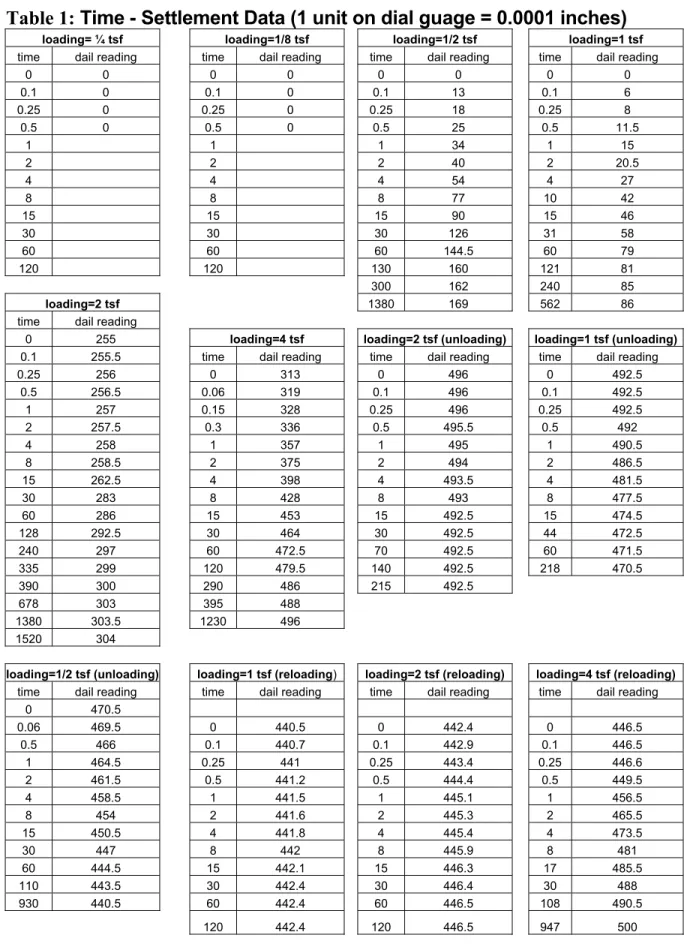
Table 1: Time - Settlement Data (1 unit on dial guage = 0.0001 inches)
loading= ¼ tsf loading=1/8 tsf loading=1/2 tsf loading=1 tsf
time dail reading time dail reading time dail reading time dail reading
0 0 0 0 0 0 0 0 0.1 0 0.1 0 0.1 13 0.1 6 0.25 0 0.25 0 0.25 18 0.25 8 0.5 0 0.5 0 0.5 25 0.5 11.5 1 1 1 34 1 15 2 2 2 40 2 20.5 4 4 4 54 4 27 8 8 8 77 10 42 15 15 15 90 15 46 30 30 30 126 31 58 60 60 60 144.5 60 79 120 120 130 160 121 81 300 162 240 85 loading=2 tsf 1380 169 562 86
time dail reading
0 255 loading=4 tsf loading=2 tsf (unloading) loading=1 tsf (unloading)
0.1 255.5 time dail reading time dail reading time dail reading
0.25 256 0 313 0 496 0 492.5 0.5 256.5 0.06 319 0.1 496 0.1 492.5 1 257 0.15 328 0.25 496 0.25 492.5 2 257.5 0.3 336 0.5 495.5 0.5 492 4 258 1 357 1 495 1 490.5 8 258.5 2 375 2 494 2 486.5 15 262.5 4 398 4 493.5 4 481.5 30 283 8 428 8 493 8 477.5 60 286 15 453 15 492.5 15 474.5 128 292.5 30 464 30 492.5 44 472.5 240 297 60 472.5 70 492.5 60 471.5 335 299 120 479.5 140 492.5 218 470.5 390 300 290 486 215 492.5 678 303 395 488 1380 303.5 1230 496 1520 304
loading=1/2 tsf (unloading) loading=1 tsf (reloading) loading=2 tsf (reloading) loading=4 tsf (reloading)
time dail reading time dail reading time dail reading time dail reading
0 470.5 0.06 469.5 0 440.5 0 442.4 0 446.5 0.5 466 0.1 440.7 0.1 442.9 0.1 446.5 1 464.5 0.25 441 0.25 443.4 0.25 446.6 2 461.5 0.5 441.2 0.5 444.4 0.5 449.5 4 458.5 1 441.5 1 445.1 1 456.5 8 454 2 441.6 2 445.3 2 465.5 15 450.5 4 441.8 4 445.4 4 473.5 30 447 8 442 8 445.9 8 481 60 444.5 15 442.1 15 446.3 17 485.5 110 443.5 30 442.4 30 446.4 30 488 930 440.5 60 442.4 60 446.5 108 490.5 120 442.4 120 446.5 947 500
Engineering Properties of Soils Based on Laboratory Testing Prof. Krishna Reddy, UIC
loading=8 tsf loading=16 tsf loading=32 tsf
time dail reading time dail reading time dail reading
0 500 0 652 0 867 0.1 510 0.1 672 0.1 877 0.25 518 0.25 687 0.25 893 0.5 528 0.5 702 0.5 908 1 542 1 727 1 928 2 561.5 2 754 2 953 4 580 4 800.5 4 983 8 604 8 816 8 1012 15 619.5 15 836.5 15 1027 30 631.8 30 850 30 1040 60 640 60 860 50 1047.5 127 642 115 867 76 1052.5 205 651 138 1060 228 652 240 1063
Engineering Properties of Soils Based on Laboratory Testing Prof. Krishna Reddy, UIC
Consolidation Test (ASTM D 2435) Sample: GB-08-ST-13'-15' Pressure = 1/2 tsf 0 20 40 60 80 100 120 140 160 180 0.01 0.1 1 10 100 1000 10000 Time (min) D a il R ea d in g (x 0 .0 0 01 in ) ∆Η = 0.0153 in t50=10 min D0 = 8 D100 = 159 5 . 83 2 159 8 2100 D 0 D 50 D = + = + =
Consolidation Test (ASTM D 2435) Sample: GB-08-ST-13'-15' Pressure = 1 tsf 170 180 190 200 210 220 230 240 250 260 0.01 0.1 1 10 100 1000 10000 Time (min) D a il R eadi ng (x 0. 0001 i n ) t50 = 11.5 min ∆H = 0.008 in
Engineering Properties of Soils Based on Laboratory Testing Prof. Krishna Reddy, UIC
Consolidation Test (ASTM D 2435) Sample: GB-08-ST-13'-15' Pressure = 2 tsf 240 250 260 270 280 290 300 310 320 0.01 0.1 1 10 100 1000 10000 Time (min) D a il R eadi ng ( x 0. 0001 i n ) ∆H = 0.0048 in t50 = 30 min
Consolidation Test (ASTM D 2435) Sample: GB-08-ST-13'-15' Pressure = 4 tsf 300 320 340 360 380 400 420 440 460 480 500 520 0.01 0.1 1 10 100 1000 10000 Time (min) D a il R eadi n g ( x 0 .0001 in ) ∆H = 0.0156 in t50 = 3.3 min
Engineering Properties of Soils Based on Laboratory Testing Prof. Krishna Reddy, UIC
Consolidation Test (ASTM D 2435) Sample: GB-08-ST-13'-15' Pressure = 2 tsf (Unloaded) 492 492.5 493 493.5 494 494.5 495 495.5 496 496.5 497 0.01 0.1 1 10 100 1000 10000 Time (min) D a il R ead ing ( x 0. 0001 i n ) ∆H = 0.00035 in t50 = 1.9 min
Consolidation Test (ASTM D 2435) Sample: GB-08-ST-13'-15' Pressure = 1 tsf (Unloaded) 465 470 475 480 485 490 495 0.01 0.1 1 10 100 1000 10000 Time (min) D a il R eadi ng (x 0. 0001 i n ) t50 = 3.5 min ∆H = 0.00203 in
Engineering Properties of Soils Based on Laboratory Testing Prof. Krishna Reddy, UIC
Consolidation Test (ASTM D 2435) Sample: GB-08-ST-13'-15' Pressure = 1/2 tsf (Unloaded) 430 435 440 445 450 455 460 465 470 475 480 0.01 0.1 1 10 100 1000 10000 Time (min) D a il R eadi ng ( x 0. 0001 i n ) ∆H = 0.0029 in t50 = 6.0 min
Consolidation Test (ASTM D 2435) Sample: GB-08-ST-13'-15' Pressure = 1 tsf (Reloaded) 440 440.5 441 441.5 442 442.5 443 0.01 0.1 1 10 100 1000 10000 Time (min) D a il R eadi ng ( x 0. 0001 i n ) t50 = 1.2 min ∆H = 0.00018 in
Engineering Properties of Soils Based on Laboratory Testing Prof. Krishna Reddy, UIC
Consolidation Test (ASTM D 2435) Sample: GB-08-ST-13'-15' Pressure = 2 tsf (Reloaded) 442 443 444 445 446 447 448 0.01 0.1 1 10 100 1000 10000 Time (min) D a il R eadi ng ( x 0. 0001 i n ) ∆H = 0.00038 in t50 = 0.6 min
Consolidation Test (ASTM D 2435) Sample: GB-08-ST-13'-15' Pressure = 4 tsf (Reloaded) 445 455 465 475 485 495 505 0.01 0.1 1 10 100 1000 10000 Time (min) D a il R eadi n g ( x 0. 0001 i n ) t50 = 2.4 min ∆H = 0.0043 in
Engineering Properties of Soils Based on Laboratory Testing Prof. Krishna Reddy, UIC
Consolidation Test (ASTM D 2435) Sample: GB-08-ST-13'-15' Pressure = 8 tsf 500 520 540 560 580 600 620 640 660 0.01 0.1 1 10 100 1000 10000 Time (min) D a il R eadi ng ( x 0. 0001 i n ) t50 = 3.0 min ∆H = 0.0143 in
Consolidation Test (ASTM D 2435) Sample: GB-08-ST-13'-15' Pressure = 16 tsf 650 670 690 710 730 750 770 790 810 830 850 870 0.01 0.1 1 10 100 1000 10000 Time (min) D a il R eadi ng ( x 0. 0001 i n ) ∆H = 0.02 in t50 = 2.0 min
Engineering Properties of Soils Based on Laboratory Testing Prof. Krishna Reddy, UIC
Consolidation Test (ASTM D 2435) Sample: GB-08-ST-13'-15' Pressure = 32 tsf 850 870 890 910 930 950 970 990 1010 1030 1050 1070 1090 0.01 0.1 1 10 100 1000 10000 Time (min) D a il R eadi n g ( x 0. 0001 i n ) t50 = 3.0 min ∆H = 0.0192 in
Engineering Properties of Soils Based on Laboratory Testing Prof. Krishna Reddy, UIC
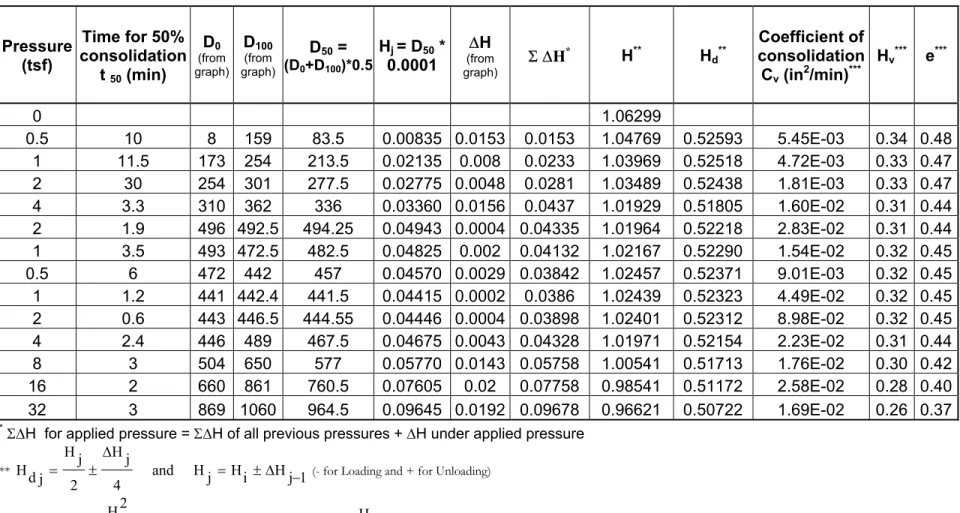
Table 2: Analysis of Consolidation Test Data
Pressure (tsf) Time for 50% consolidation t 50 (min) D0 (from graph) D100 (from graph) D50 = (D0+D100)*0.5 Hj = D50 * 0.0001 ∆H (from graph) Σ ∆H* H** H d** Coefficient of consolidation Cv (in2/min)*** Hv*** e*** 0 1.06299 0.5 10 8 159 83.5 0.00835 0.0153 0.0153 1.04769 0.52593 5.45E-03 0.34 0.48 1 11.5 173 254 213.5 0.02135 0.008 0.0233 1.03969 0.52518 4.72E-03 0.33 0.47 2 30 254 301 277.5 0.02775 0.0048 0.0281 1.03489 0.52438 1.81E-03 0.33 0.47 4 3.3 310 362 336 0.03360 0.0156 0.0437 1.01929 0.51805 1.60E-02 0.31 0.44 2 1.9 496 492.5 494.25 0.04943 0.0004 0.04335 1.01964 0.52218 2.83E-02 0.31 0.44 1 3.5 493 472.5 482.5 0.04825 0.002 0.04132 1.02167 0.52290 1.54E-02 0.32 0.45 0.5 6 472 442 457 0.04570 0.0029 0.03842 1.02457 0.52371 9.01E-03 0.32 0.45 1 1.2 441 442.4 441.5 0.04415 0.0002 0.0386 1.02439 0.52323 4.49E-02 0.32 0.45 2 0.6 443 446.5 444.55 0.04446 0.0004 0.03898 1.02401 0.52312 8.98E-02 0.32 0.45 4 2.4 446 489 467.5 0.04675 0.0043 0.04328 1.01971 0.52154 2.23E-02 0.31 0.44 8 3 504 650 577 0.05770 0.0143 0.05758 1.00541 0.51713 1.76E-02 0.30 0.42 16 2 660 861 760.5 0.07605 0.02 0.07758 0.98541 0.51172 2.58E-02 0.28 0.40 32 3 869 1060 964.5 0.09645 0.0192 0.09678 0.96621 0.50722 1.69E-02 0.26 0.37
* Σ∆H for applied pressure = Σ∆H of all previous pressures + ∆H under applied pressure
** and Hj Hi Hj 1 4 j H 2 j H j d H = ±∆ − ∆ ±
= (- for Loading and + for Unloading)
*** 50 t 2 d H 197 . 0 v C = × , Hv =
(
Hi −Hs)
−Σ∆H and s H v H e=Engineering Properties of Soils Based on Laboratory Testing Prof. Krishna Reddy, UIC
Consolidation Test (ASTM D 2435) Sample: GB-08-ST-13'-15' Void Ratio vs Log Pressure
0.35 0.37 0.39 0.41 0.43 0.45 0.47 0.49 0.1 1 10 100 Pressure (tsf) Void R a tio Cr=0.013 Cc=0.11 Pc=3.5 tsf Final Results: Compression Index (Cc) = 0.11 Recompression Index (Cr) = 0.013
Preconsolidation pressure (Pc) or Maximum past pressure (σvmax) = 3.5 tsf Coefficient of consolidation (Cv)= 1.54x10⁻² to 9.01x10⁻³ in2/min
(depends on the pressure)
Coefficient of secondary compression (Cα) = 0.001
(It is the slope of time vs settlement curve beyond the end of primary consolidation)
Engineering Properties of Soils Based on Laboratory Testing Prof. Krishna Reddy, UIC
Engineering Properties of Soils Based on Laboratory Testing Prof. Krishna Reddy, UIC
Consolidation Test Data Sheets Date Tested: Tested By: Project Name: Sample Number: Sample Description: Before test Consolidation type =
Mass of the ring + glass plate =
Inside diameter of the ring =
Height of specimen, Hi =
Area of specimen, A =
Mass of specimen + ring =
Initial moisture content of specimen, wi (%) = Specific gravity of solids, Gs = After test
Mass of wet sample + ring + glass plate =
Mass of can =
Mass of can + wet soil =
Mass of wet specimen =
Mass of can + dry soil =
Mass of dry specimen, Ms = Final moisture content of specimen, wf =
Engineering Properties of Soils Based on Laboratory Testing Prof. Krishna Reddy, UIC
Calculations
Mass of solids in specimen, Ms =
(Mass of dry specimen after test)
Mass of water in specimen before test, Mwi = wi x Ms= Mass of water in specimen after test, Mwf (g) = wf x Ms=
Height of solids, Hs = w s s G A M ρ × × =
(same before and after test and note ρw = 1 g/cm3) Height of water before test, Hwi =
w wi A M ρ × = Height of water after test, Hwf = =
× w
wf A
M
ρ =
Change in height of specimen after test, Σ∆H = (Σ∆H for all pressures – see t vs Dial reading plot)
Height of specimen after test, Hf = Hi - Σ∆H = Void ratio before test, eo =
s s i H H H − =
Void ratio after test, ef =
s s f H H H − =
Degree of saturation before test, Si =
s i wi H H H − = Degree of saturation after test, Sf =
s f wf H H H − =
Dry density before test, ρd =
A H M i s × =
Engineering Properties of Soils Based on Laboratory Testing Prof. Krishna Reddy, UIC
Time - Settlement Data
Conversion: 0.0001 inch = 1.0 on dial reading (confirm this before using)
LOADING = _____ tsf ELAPSED TIME, min DIAL READING 0 0.1 0.25 0.5 1 2 4 10 15 30 60 120 240 LOADING = _____ tsf ELAPSED TIME, min DIAL READING 0 0.1 0.25 0.5 1 2 4 10 15 30 60 120 240 LOADING = _____ tsf ELAPSED TIME, min DIAL READING 0 0.1 0.25 0.5 1 2 4 10 15 30 60 121 240
Engineering Properties of Soils Based on Laboratory Testing Prof. Krishna Reddy, UIC
Analysis of Consolidation Test Data
Pressure (tsf) Time for 50% consolidation t 50 (min) D0 (from graph) D100 (from graph) D50 = (D0+D100)*0.5 Hj = D50 * 0.0001 ∆H (from graph) Σ ∆H* H** H d** Coefficient of consolidation Cv (in2/min) Hv*** e***
* Σ∆H for applied pressure = Σ∆H of all previous pressures + ∆H under applied pressure
** and Hj Hi Hj 1 4 j H 2 j H j d H = ±∆ − ∆ ±
= (- for Loading and + for Unloading)
*** 50 t 2 d H 197 . 0 v C = × , Hv =