Dimitrios DAPONTAS Technological Institute of Ionian Islands
Zakynthos, Greece [email protected]
Abstract
This paper is comparing the currency crises in Turkey for 20 years (from 1990 till today) and to distinguish their causes divided in three periods (1990-1995), (1995-2002) and (2002-2009). My goal is to compare these incidents to find similarities and differences among them for the very first time for the country’s analysis. The forward spread is selected as a dependent variable along with a set of independent macroeconomic and social variables (balance of payments, crisis elsewhere, real effective exchange rate, foreign exchange reserves, gold price, lending rate, money, external debt and consumer price level) examining these variables for a twenty year period (January 1990- December 2009) the largest set availiable in refered literature I examined their relation to the forward spread, following the feasible least squares methodology. This innovative approach is used for the first time in the field and it has the major advantages of least squares methodology along with panel data analysis flexibility. The results show that the crisis of 1994 had to do with fundamentals (first generation theoretical framework), the 2001 crisis with economic condition and policy (modified first generation) and the 2008 crisis with contagion and the global credit crunch (third generation).None of these crises were linked as previous works mentioned and the 2008 turbulence can be rated as a crisis according to my criteria.
Keywords: currency crisis, developing economies, structural reforms. JEL classification: F41, P33
1. INTRODUCTION
Turkey has a long and rich history in currency crises. Older approaches focused on theoretical and empirical models that cannot be applied to the recent events of 2008-9. In 1994 fundamentals and mainly public debt, led to an extended currency crisis. In 2000-1 the crisis has to do with modified first generation model, and the 2008 crisis with the third gen-eration models. I refer to them analyzing data based on Feasible General Least Squares methodology, splitting the 20 years sample to three parts. The first part refers to the 1994 crisis (1990-1995), the second to the 2001 crisis (1995-2002) and the third to the most re-cent crises period (2002-2009) respectively. This is the first analysis implying all three periods of crises to compare their characteristics as separate incidents implying the largest timeseries ever and introducing variables which seem to work better than the literature on the country currency crisis analysis has presented.
The paper is structured as follows: the second part makes a historical overview of the Turkish crises history and their remedy, whereas section 3 presents the models of financial crises and their estimation. Finally, the fourth part draws some policy lessons and offers some concluding remarks.
2. THE FACTS OF THE CRISES 2.1 The 1994 crisis
The liberalization of the Turkish economy begun in the mid 80’s. Citizens were al-lowed to hold deposits in foreign currency. The government supported structural reforms, tariffs lowered and in 1990 nearly all quantity and price restrictions were removed in order to keep inflation, the government applied to IMF to leave Turkish currency lira to free float [Ozatay, 2000]. These liberating measures were the cause of many crisis incidents. The im-mediate effect of the transform was a currency appreciation and an import boom. The deficit doubled in 1990.
In the public sector the borrowings become increasingly dependent on foreign savings. The policy of the Central bank restricted domestic credit to commercial banks and their li-quidity based on foreign assets. As the foreign exchange purchases of the Central Bank became the main source of money creation, the ultimate source of public debt financing were short term capital inflows. The absence of any physical adjustment, the increased bur-den of domestic debt and the eventual shift towards Central Bank financing of the treasury led to the 1994 crisis. The accumulated debt trebled by the end of 1993, and 53% of 1994 proposed budget spent within 3 first weeks. Central bank reduced its amount of international reserves and money supply increased in order to provide liquidity. The share of domestic currency deposits declined 53% from November 1993 to March 1994.Until May 1994; do-mestic borrowing market collapsed reaching a historical overnight interest rate high of 1000%. The depreciation reached a cumulative 75% within the first four months of 1994.
On April 5th the government announced a stabilization plan using price increases of SEE goods such as communications and transportation from 70 to 100 per cent and then freeze for six months. Public sector wages also froze. Domestic borrowing revived through a three month maturity T-bond issue on 50 percent rate. This program aid by IMF $742 mil-lion bailout. The fund demanded structural reforms such as the implementation of a wide privatization program, and social security tax reform. The program led to rapid development in the next two years, but the reforms didn’t progress and IMF resigned in the summer of 1995[Celasun ,1998]..Excesive liquidity build up, domestic credit expansion and high infla-tionary expectations were named as causes of the crises The perils of fast capital account capitalization and real exchange rate call fo fiscal adjustment.
2.2 The 2000-2001 crisis
The second and more severe crisis in Turkey took place in the period between Novem-ber 2000 and spring of 2001. The disinflation program introduced in 1995, appeared to work and macroeconomic stabilization lasted until the late 1999. The Turkish economy was up-dated by Moody’s and its future seems bright. The slow and preannounced depreciation by the Central bank reduced risk to foreign investors to zero. This investor optimism and capi-tal inflows raised foreign currency liabilities and increased risk exposure due to maturity and
currency mismatches in the balance sheet of domestic banks. Short term external term in the first quarter of 2000 reached the level of central banks foreign reserves. A “run equilibrium” begun. As the bank didn’t engage any sterilization efforts market liquidity fell and interests raised. When the earthquakes and the contagion from the Russian crisis hit the economy the inflation was still higher than the depreciation rate. The current account deficit raised, cred-itability loss due to government policies and a bank probe involving ten commercial banks. A lack of commitment by the Government involving countries inflation history, and the loss of confidence by the foreign investors who begun to shut lines with commercial banks ex-posed in high risk because of their high holding of domestic bond. On November 20th they dumped their holdings and a major turbulence occurred in the bond market. Central bank heavily bought government bonds, leaving stability program in order to stimulate liquidity. The Turkish Liras were converted to foreign currency immediately and the Central bank lost $6 billion reserves. The speculative attack stopped when the IMF intervened and funded Turkey with $ 7.5 billion on December 6th to defend them. On 18th December the level of foreign exchange reserves raised from $ 18 Billion to $ 26 billion. This action calmed down the markets.
The economic circumstances didn’t change from the bailout investor confidence re-mained weak and the country’s increased premium reflected the demand for higher interest rates, making economy vulnerable to a second successive shock. The collapse of the Ilhas Finans financing house in February 2001 charged with a stock market fraud followed by major capital flight of $5 billion. The central bank refrained from injecting liquidity and the interest rates soared. On 19th February a major political crisis begun in Turkey between the prime minister and the president. On February 20th the overnight interest skyrocketed reach-ing 4,000 percent as banks demanded liquidity. The US money markets were closed on February 21st and central bank of Turkey lost over than $ 7.5 Billion in reserves. The fol-lowing two days were disastrous and the bank accepted to leave the rate to collapse on February 23rd. By the announcement of freely float the Turkish lira lost 30% of its value and a cumulative 100% until the end of May.
There is a question about the generation that this crisis belongs. [Ozaltay ,2002] be-lieves that the crisis has elements and similarities with all the three generations. From the first generation it takes the fact that the process had to do with international reserves amount falling, current account deficit, public debt is rising and interest rates rising, in a two years process. From the second generation he takes the issue of domestic debt and the authors fail to defend the speculative attack. But, also the bank collapses who led to crisis is a third gen-eration characteristic.
2.3 The 2008 crisis
The global financial crisis following the global credit crunch of 2008 in the United States had also affected Turkish Lira. After a period of stability following the IMF interven-tion in 2001. Turkish GDP returned to growth in the first quarter of 2002. The government followed a strict program of financial stability and interest reductions. In the period 2002-6 the GDP grew by an average of 6 per cent per year, FDI has doubled, and portfolio invest-ment increased on a 70 per cent rate.
The industry of Turkey is heavily dependent on raw material and semi-finished goods imports. The strong Turkish lira policy rose current account deficit from $1.5 billion in Jan-uary 2002 to $31.9 billion in October 2006. The development had to do with imports and
borrowing. However this sign was taken as a temporary fluctuation in a strong real econo-my. Also liquidity provided to the commercial banks was high. In May 2005 the government signed a three year $ 10.8 billion loan agreement with the IMF. In May 2008 the government didn’t renew it and the pace of economic growth started to faint. The current account rose by 19.7 per cent to 38.2 billion in 2007.
When the crisis hit in October 2008, the entrepreneurs and the society thought that the economy will recover immediately. The Turkish lira though lost over than 40 per cent against US dollar. The commercial banks didn’t alter their policy because they believed that Turkey will overcome the crisis and none of them fell to insolvency in 2008. The prime minister declared that the crisis bypassed Turkey. In late 2008, main export markets in Eu-rope fell, and domestic borrowers struggled to make payments. The government began discussing a loan agreement on January 26th 2009. The negotiations lasted two weeks be-cause of the prime minister’s objection on government spending limits and greater transparency. Real economy recession shown in industrial production fall by 21.3 per cent in January of 2009 compared to January 2008. Non performed loans increased to 12.3 per cent from 10.1 in November 2007. [Jenkins, 2009], Turkey and IMF negotiated a 2-year loan of $ 50 billion in early 2010’s. The lending processes stopped due to Turkey’s deny receiving further external funding. There is no significant literature on 2008 crisis because under the used criteria by earlier studies on currency crises this incident cannot be rated as a crisis.
3. METHODOLOGY, DATA SETS AND RESULTS 3.1 Feasible Generalized Least squares
Feasible generalized least squares (FGLS or Feasible GLS) is a regression technique. It is similar to generalized least squares except that it uses an estimated variance-covariance matrix since the true matrix is not known directly. The following description follows loosely the references presented in Heteroscedasticity-consistent standard errors. The dataset is as-sumed to be represented by:
Where X is the design matrix and β is a column vector of parameters to be estimated. The residuals in the vector u, are not assumed to have equal variances: instead the assump-tions are that they are uncorrelated but with different unknown variances. These assumptions together are represented by the assumption that the residual vector has a diago-nal covariance matrix Ω.Ordinary Least Squares estimation can be applied to a linear system with heteroskedastic errors, but OLS in this case is not Best Linear Unbiased Estimator (BLUE). To estimate the error variance-covariance Ω, the following process can be iterated: The ordinary least squares (OLS) estimator is calculated as usual by:
And estimates of the residuals are constructed.
Construct :
This estimation of can be iterated to convergence given that the assumptions out-lined in White hold.
Estimations from WLS and FGLS are as follows:
3.2 Variables used
The variables used in the analysis are chosen in light of theoretical considerations and empirical determinants of crises. We apply a set of variables that have been proved useful by a large number of empirical studies. In order to enhance the possibility of identifying the crisis factors, the process of evaluating the model applies ten variables, grouped into four categories: variables related to monetary policy, to the external sector, to contagion and spe-cific institutional variables. The data sources are the International Financial Statistics, the central bank of Turkey and the Heritage foundation. Data frequency is monthly with the ex-ception of Economic Freedom index which is annual.
A. Variables related to monetary policy
1. International reserves (FOR_EX): Foreign exchange reserves expressed in USD. All the past theoretical or empirical models used this fundamental as the main (and before first generation models the only) measure of crisis likelihood. It is clear that the lower reserves are, the higher the probability of speculative attacks and currency crisis (negative effect). We should note, however, that the central bank can also keep other reserves beyond foreign exchange (gold, SDR etc.). Therefore, the variable is expected to have negative effect if the reserves are used as a measure of remedy or savings and positive if not.
2. Money (Money): The money offer including quasi money. Previous studies have used the measure of money offer by central bank (M2) excluding other means of money. According to the first generation models, the months preceding the crisis should be characterized by highly expansionary monetary policy (positive effect). However the effect can be negative if the bank policy aims to preserve the money supply level and continuously finances the foreign exchange demand [Copeland, 2008,446-447 and 450-451]. Also the use of broad money (M3) is broader than M2 used in the past empirical framework.
3. Domestic Inflation (PRICE_LE): The change of CPI over the last month of Turkey. It is a proxy of macroeconomic mismanagement that is having an adverse effect on a country’s economy. It is related positively with the occurrence of a crisis and the money supply.
4. Lending rate (LENDING): Official annual lending rate given by the national bank of the country. Interest rates can play a crucial role if there is a collapse in the con-fidence in the macroeconomic policy stance. In the case of an expansionary monetary policy for example, a collapse of the confidence of forward looking par-ticipants in the foreign exchange market pressures monetary authorities to steeply increase interest rates and devalue the official rate. Therefore, the variable is ex-pected to have positive effect.
5. Debt(Debt): Is the Gross external debt position provided by Central bank of the re-public of Turkey expressed in US dollars. When the external debt is higher than the expected or it rises suddenly during crises periods, the forward spread rises and vice versa. We didn’t use this variable in our previous case studies but in the case of Turkey we believe that this fundamental could be crucial for the explanation of the crises history of the country. We expect though a positive sign.
B. Variables related to the external sector
6. Balance of Payments (BALANCE): The balance of payments expressed in USD. The conventional view is that this variable is expected to have negative effect if there is deficit cause of the capital flight it will extend. When the country has sur-plus though the devaluation is expected to have positive effect on its balance of payments. However, the theoretical discussion regarding the effect of current ac-count deficit on the occurrence of currency crises is not so clear. According to Edwards (2001, p.37) deficits “may matter”. [Sasin ,2001] provided an overview of the empirical studies which have tried to provide links between current account deficits and currency crises.
7. Gold price (Gold_Pri): The price of fine troy ounce in London exchange market in USD. The variable has to do with the significance that gold has on global market. Even after the gold standard there are central banks keeping gold reserves which can be sold in the international markets for foreign exchange (usually USD). The “safe port” of gold seems to be very attractive as remedy in crisis periods when the gold price usually rallies. Thus, the gold price has an effect on currency crises and it is connected to the money reserves. The effect depends on central bank policy. If the bank tends to keep gold reserves the effect is positive, if not it is negative. C. Variables related to contagion
8. Crisis elsewhere (CRISIS_E): It is a categorical binary variable which denotes the presence of a crisis in other country (1) or not (0). The so called crisis elsewhere or, in chaos theory, “butterfly effect”, has a significant role in an external currency cri-sis development. If a country has economic relations with a country hit by an incident it is possible to be infected. The main reasons have to do with the econom-ic contagion between the two countries but also with the speculators’ behavior. If a major trading partner of a regional economy collapses then the other partners will collapse with a time lag of one or two months. In the rubble crisis of 1998 the rub-ble collapse was followed by a delayed collapse in other countries of the former Soviet Union. When a speculator decides to attack he will hit multiple markets in the same region on the same time as it happened in the Asian crisis of 1997. Though we expect positive effect.
D. Institutional variables
9. Economic Freedom (ECO_FREE): The Heritage index of economic freedom is a total score consisting of indicators on trade, fiscal burden, government intervention, monetary policy, foreign investment, banking, wages and prices, property rights, regulation and informal market. It is provided annually by the Heritage Foundation and it represents the progress that countries might have achieved regarding the im-plementation of structural reforms. Market and institutional reforms (e.g. the establishment of a sound financial and banking system, the well functioning of fis-cal institutions etc) offer great assistance to the countries in their effort to prevent a crisis. The effect of this variable is expected to be negative.
Based on [Esquivel and Larrin, 1998], we try to combine variables which represent the main predictions of both the first, and the third generation models. Variables 1-5 are closely associated with first-generation models. Variable 9 is closer to the second generation mod-els. Variables 6 to 8 are associated with the third generation models [Kaminsky, Lizondo and Reinhart,1998]. The empirical literature provides little guidance as regards a generally accepted definition of “currency crisis”. The majority of the studies refer to devaluation as large, unique and infrequent or a set of small and repeated incidents.[Edwards,1989] , [Mi-lesi-Ferretti and Razin, 1998] and [Flood and Marion 1999]Others use the weighted average of monthly depreciation compared to depreciation of the previous year. [Kaminsky, Lizorno and Reinhart, 1998] and [Frankel and Rose, 1996)] . Newer research [Chionis and Liargo-vas, 2002] define as a “currency crash” the nominal depreciation of the monthly average exchange rate of national currency against USD of at least 10%, no matter if this comes as result of a speculative attack or not (95% of the international money transfer is powered by speculation). Pressure indexes concluding official rate, interest rates and reserves are also used [Eichengreen, Rose and Wyplosz,1995].
Others use the official rate as a measure. But, for the case of Turkey, this cannot be good measures on crisis explanation. As [Dornbusch, 1980] suggested, we assume that the exchange rate market is efficient, and then any difference between the spot rate and the for-ward rate of the previous month (Forfor-ward spread, = ) can change only through unexpected risk premium and fundamentals change. If the official rate rises then the econo-my faces higher devaluation than the expected, in cases of projected devaluation as happened in Turkey, this variable can explain volatility that exceeded month’s forecast.
My dataset covers a twenty year period (January 1990- December 2009) with monthly frequency and it is divided in three samples the first has to do with 1994 crisis (1990-1995), the second with the 2001 crisis (1996-2002) and the third with the 2008 crisis (2002-2009). I used the feasible generalized least squares (FGLS) methodology analyzed in section 3.1. First I did ordinary least squares (OLS) analysis and then I run a Breusch-Pagan / Cook-Weisberg test for heteroskedasticity test and an autocorrelation test for the three samples. All three samples were heteroskedastic and there was no autocorrelation. Finally I run in STATA™ FGLS regression in panel data.
3.3 The results
The results for the 1990-1995 period are shown on the next table:
Table no. 1 First explanation model results for 1990-1995 period under 5% significance
Variable Coefficient(std. error)
Effective Rate -0.0011 (0.002) Balance of Payments 0.0266 (0.0051) International Reserves -0.019 (0.003) Crisis elsewhere -0.007 (0.002) Gold Price 0.0024 (0.038) Money supply -0.002 (0.124) External Debt 0.028 (0.006) Lending Rate 0.031 (0.002) Price Level 0.002 (0.01) Constant 0.005 (0.009) P-value 0.000 R2 0.80 (0.011)
The results show that the crisis was a first generation one. The fundamentals Effective rate and International Reserves were negative and important as expected. Effective rate, Debt, Lending rate and Price level as proposed by literature Gold Price used for first time in Turkish crisis literature were significant and negative The findings were similar to the ones that [Celcun, 1998] and [Ozatay, 2000].. Crisis elsewhere is negative and important. That can be explained because the major crises of the period (EMS and Tequila crises) didn’t oc-cur the same time with the Turkish one and they didn’t have effect on it. Balance of Payments is the most interesting result. During the crisis Turkey had a surplus on its balance of payments as [Liargovas, Dapontas,2008] proposed and found that the positive effect of balance of payments in Belarus was important; Turkey had the same effect as also theory proposes. Positive constant means that there are also other variables that effect forward spread positive. Money supply didn’t seem to be important in my analysis.
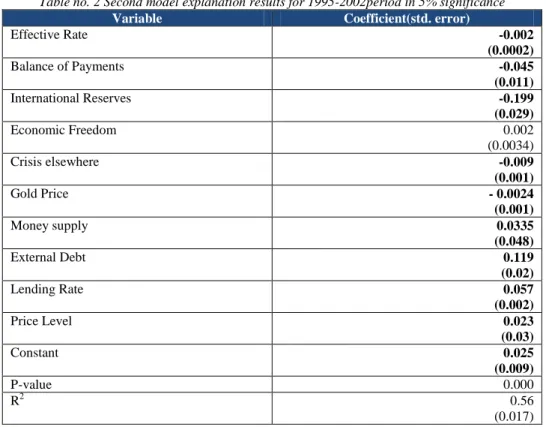
The results for the 1995-2002 period are shown below:
Table no. 2 Second model explanation results for 1995-2002period in 5% significance
Variable Coefficient(std. error)
Effective Rate -0.002 (0.0002) Balance of Payments -0.045 (0.011) International Reserves -0.199 (0.029) Economic Freedom 0.002 (0.0034) Crisis elsewhere -0.009 (0.001) Gold Price - 0.0024 (0.001) Money supply 0.0335 (0.048) External Debt 0.119 (0.02) Lending Rate 0.057 (0.002) Price Level 0.023 (0.03) Constant 0.025 (0.009) P-value 0.000 R2 0.56 (0.017)
As we can see, the fundamentals also had crucial role in 2001 crisis. Effective rate and International reserves were also negative and External debt , Lending rate, price level and constant were positive as happened in 1994 and mentioned y [Ozatay, 2002] The introduced social variable economic freedom was not important. That means that the structure of the Turkish economy didn’t lead to the crisis. Money supply in contrast with 1994 and previous analyses was important and positive, explaining the fact that the speculators expected more money supply raise before the IMF intervention. Crisis elsewhere is also important and neg-ative. The explanation is that Turkey didn’t had an effect from the Russian and Eastern Europe economies spread crises or the Asian, Brazilian or Argentinean ones. Balance of payments is important and negative because Turkey had a deficit on the time of crisis and the capital flight was high. The 2000-1 crisis can though be named as a second generation crisis which cannot be strictly connected to the previous one in 1994. All past literature tried to find similarities and explain the later worst crisis to the first one. But the results shown that even though there are similarities in fundamentals the characteristics have changed thus the hit to Turkish economy was more severe than the earlier’s one.
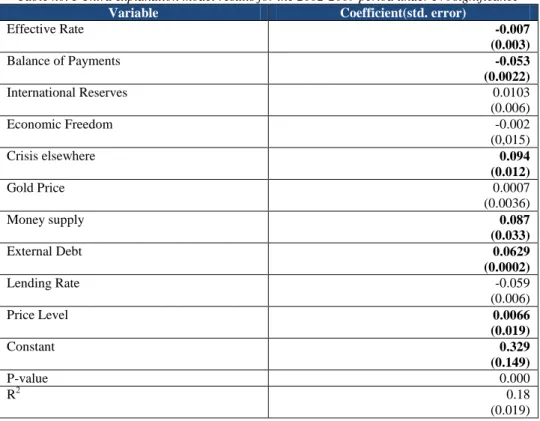
Finally, the results of the period (2002-2009) are shown on the third table.
Table no. 3 Third explanation model results for the 2002-2009 period under 5% significance
Variable Coefficient(std. error)
Effective Rate -0.007 (0.003) Balance of Payments -0.053 (0.0022) International Reserves 0.0103 (0.006) Economic Freedom -0.002 (0,015) Crisis elsewhere 0.094 (0.012) Gold Price 0.0007 (0.0036) Money supply 0.087 (0.033) External Debt 0.0629 (0.0002) Lending Rate -0.059 (0.006) Price Level 0.0066 (0.019) Constant 0.329 (0.149) P-value 0.000 R2 0.18 (0.019)
According to literature the 2008 turbulence is not mentioned as a crisis though using [Liargovas, Chionis, 2003] criteria we can rate it as an incident smoother but similar to the 1994 and 2000-1 ones. The results show that effective rate is important and negative and ex-ternal debt lending rate and constant are important and positive. On the other hand international reserves, economic freedom, gold price, lending rate didn’t seem to be im-portant. For this crisis the balance of payments is important and negative. That sign seems to indicate a capital flight following the credit crunch and money transfer to more secure in-vestments because Turkey had increased risk on the same time. The most interesting result though, is the crisis elsewhere importance. The credit crunch in the US and its aftermaths had crucial role in creating the crisis. This contagion effect can explain the cause of the cri-sis.
4. COMPARISON AND CONCLUSION REMARKS
In this work I presented the currency crises of the last 20 years in Turkey. The 1994 and 2001 crises based on fundamentals dramatic change, the 2008 crisis had to do with the credit crunch. The two first incidents had similarities but they cannot be linked and ex-plained with the same model as previous literature tried. The effective rate is in every case negative and important. The balance of payments is important but in the 1994 crisis the ef-fect was positive due to surplus and in the 2001 and 2008 crises deficit where the efef-fect was negative. International reserves reduction was important in the 1994 and 2001 crises but in the 2008 wasn’t significant. Economic freedom didn’t seem to be important in 2001 and 2008 crises. Crisis elsewhere was important and negative in 1994 and 2001 crises because the country didn’t have incidents during the major crises of the period. In contrast, the 2008 crisis had to do with the incidents and the reduction of investment risk to more safe ports in major financial and product markets. The gold price had positive effect on the crisis of 1994, negative on the 2001 and non significant on 2008. Money supply had negative effect on 1994 when the speculators expected more increase in monetary base and positive in 2001 and 2008 when the raise in supply led to depreciation of Turkish lira. External debt was pos-itive and important in the three cases as expected. Lending rate was significant and pospos-itive in the crises of 1994 and 2001, but it wasn’t significant in the 2008, when the lending rate didn’t raise significantly and liquidity didn’t drain. Price level was positive and important in all cases. Finally, constant seems to be positive and important in all cases. That means that there is further research to be done on the field by future works related on Turkey and cur-rency crises generally.
The major policy lesson has to do with the structure of the economy. In the 2008 crisis the economy surpassed the crisis easier than the previous two due to economic development and freedom increase and the IMF loan use was more efficient than in the past. Also the pol-icy of introducing a new with 6 less digits and harder Turkish lira had effect on currency crisis avoiding. Policy stability introduced a new stable era for economy as whole.
References
[1] Batavia, B., Lash, N., Self-perpetuating inflation, the case of Turkey, Journal of economic de-velopment, vol. 2, 1983.
[2] Celasun, O., The 1994 currency crisis in Turkey, Macroeconomics and Growth Group, Devel-opment Research Department, World Bank, 1998.
[3] Chionis, D., Liargovas, P., Currency crises in transition economies: An empirical analysis, Akademai Kiado, Budapest, 2003.
[4] Copeland, L. Exchange rates and international finance, 5th edition. Prentice Hall, 2008. [5] Dapontas, D., Currency crises the case of Hungary 2008-9, Working Paper, University of
Pelo-ponnese, Tripolis, Greece, 2010.
[6] Dornbusch, R. Exchange rate economics: Where do we stand?, Brookings papers on economic activity, vol. 1, 1980.
[7] Edwards, S., Does the Current Account Matter?, NBER Working Paper No. W8275, 2001. [8] Eichengreen, B., Rose, A.K., Wyplosz, C., Exchange market mayhem: The antecedents and
af-termath of speculative attacks. Economic Policy, 10(2), 1995.
[9] Esquivel, G., Larrain, F.B., Explaining Currency Crises, Harvard development Discussion Pa-per, No. 666, 1998.
[10] Ghosal, A., Anatomy of a currency crisis: Turkey 2000-2001, International Journal of emerging markets, vol. 1 no. 2 2006.
[11] Gujarati, D., Basic Econometrics, 4th edition Mc Grow Hill, New York, 2004.
[12] Jenkins, G., Government pride and populism threaten to deepen recession in Turkey, Turkey An-alyst, vol. 2, no. 5, 13th March, 2009.
[13] Kaminsky, G., Lizondo, S., Reinhart, C.M., Leading indicators of currency crises, IMF Staff Pa-pers, 1998.
[14] Keyder, V., Legal Highlights of 2001-02 in Turkey, Jurist legal intelligence, Bilgy University, Istanbul Turkey, 2001.
[15] Krugman, P., A Model of Balance-of-Payments Crises, Journal of Money, Credit and Banking, Blackwell Publishing, vol. 11(3), 1979.
[16] Liargovas, P., Dapontas, D., Currency crises in transition economies some further evidence, Journal of Economic Issues, volume XLII, no. 4, 2008.
[17] Ozatay, F., The 1994 currency crisis in Turkey, Journal of economic policy reform, 2000. [18] Ozatay, F., Sak, G., The 2000-2001 financial crisis in Turkey, Executive Summary, Central Bank
of Turkey and Ankara University, 2002.
[19] Sahin, M., Uyzal, O., The effects of global crisis in Turkish economy and existing physical poli-cies for this crisis, Canakkale Onsekiz Mart University, 2009.
[20] Sarno, P., Taylor, M., The economics of exchange rates, Cambridge Press, 2001.
[21] Sasin, M., Predicting Currency Crises: the Ultimate Significance of Macroeconomic Fundamen-tals in Linear Specifications with Nonlinear Extensions, CASE S&A 224, 2001.
[22] Yeldan, E., Behind the 2000/2001 Turkish crisis: Stability, credibility and governance for whom?, Bilkent University, Department of Economics, Ankara, Turkey, 2002.
[23] Yeldan, E., Turkey and the long decade with the IMF 1998-2008, International development economic associates, June, 2008.