2016 Status Report
on Faculty Development
and Diversity Efforts
April, 2016
Introduction
This report is a ten-year review of efforts in Arts, Sciences & Engineering (AS&E) regarding faculty diversity. It was prepared by Beth Olivares and Jeffrey Runner, AS&E’s faculty development and diversity officers, and commissioned by Peter Lennie, dean of the faculty.
A strong faculty is the most important determinant of Arts, Sciences & Engineering’s long-term success. Key to maintaining that strength is that our faculty is diverse and that we work continuously to ensure that our searches reach the broadest pool of potential applicants. Our strategic plan defines the faculty as the school’s most precious asset, and one of the plan’s important goals is to attract the most talented and diverse faculty possible.
AS&E began explicitly focusing on faculty diversity approximately ten years ago, with a more intense focus over the past six. Our approach has been to strengthen the pipeline of women and underrepresented minority (URM) students feeding into faculty positions nationally while concurrently making a substantial investment locally to implement best practices in faculty recruitment and retention.1
This report discusses these efforts in some depth; it also examines recruitment and retention of underrepresented minority graduate students and identifies areas for improvement.2
1 Underrepresented minority (URM) is defined federally as Black or African American, Hispanic, Native American, and Native Hawaiian or Native Pacific Islander. In many disciplines, women are also underrepresented.
2 We start with 2005–06 as baseline data for faculty, because our specifically directed efforts at recruitment and retention began in that academic year. For external comparisons, we use a 2009 versus 2015 comparison based on the Association of American Universities Data Exchange (AAUDE) data of a set of comparable peers. For graduate student applications, we start with 2012, during which year AS&E instituted a new data collection program (SLATE) and enrollments since 2010, when specific recruitment and retention efforts started in AS&E.
Arts, Sciences &
Engineering
tenure-track faculty data
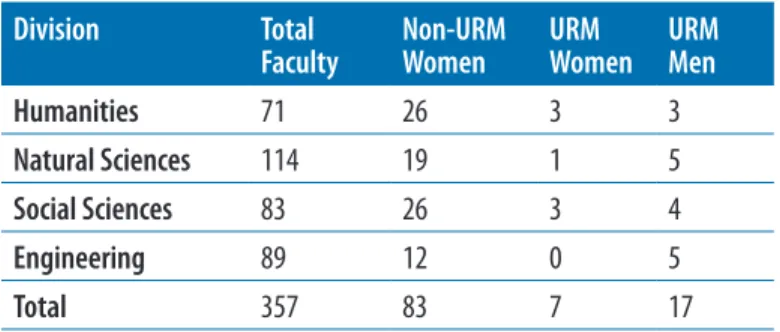
Overall, Arts, Sciences & Engineering has 357 tenured and tenure-track faculty during the academic year 2015–16. Table 1 provides a current snapshot of AS&E faculty demographics by division.
Table 1.
AS&E faculty demographics 2015–16
Division Total
Faculty Non-URM Women URM Women URM Men
Humanities 71 26 3 3
Natural Sciences 114 19 1 5
Social Sciences 83 26 3 4
Engineering 89 12 0 5
Total 357 83 7 17
The total faculty of AS&E has grown by 20.2 percent in the past decade, from 297 to the current total of 357. The numbers of women (up 44 percent) and minorities (up 57 percent) have grown faster than the faculty as a whole. Table 2 shows the overall growth in the tenure-track faculty since 2006 alongside the growth in the number of women and underrepresented minority faculty, and Figures 1 and 2 show this growth over time graphically.
These data show that AS&E has increased the numbers both of underrepresented minority and of women faculty; however, context is necessary to determine whether this is progress.
Table 2.
Underrepresented minority and women faculty in AS&E, 2005–06 through 2015–16
Year ’05–06 ’06–07 ’07–08 ’08–09 ’09–10 ’10–11 ’11–12 ’12–13 ’13–14 ’14–15 ’15–16 Total 297 311 307 328 325 338 349 348 351 362 357 URM 14 15 13 15 15 14 15 15 17 19 22 % URM 4.7% 4.8% 4.2% 4.6% 4.6% 4.1% 4.3% 4.3% 4.8% 5.2% 6.2% Women 61 67 70 77 77 82 82 83 84 86 88 % Women 20.5% 21.5% 22.8% 23.5% 23.7% 24.3% 23.5% 23.9% 23.9% 23.8% 24.6% Women faculty, 20.5% Women faculty, 24.6% 61 Women Faculty 88 Women Faculty 0 10 20 30 40 50 60 70 80 90 100 2006 2016 2006 2016Figure 1a.
Number of women faculty in 2006 and 2016
Figure 1b.
Percentage of women faculty in 2006 and 2016
2006 2016 URM faculty, 6.2% 14 URM Faculty 22 URM Faculty 0 5 10 15 20 25 2006 2016
Figure 2a.
Number of URM faculty in 2006 and 2016
Figure 2b.
Percentage of URM faculty in 2006 and 2016
URM faculty, 4.7%
2006 2016
Peer set faculty data
In order to determine whether our efforts are successful, we turn to comparisons of peer set data, to see how we rank against similar institutions. Data from the American Association of Universities Data Exchange (AAUDE) allow us to equate our demographic profile with those of a group of private universities against which we often compare ourselves: Case Western, Chicago, Duke, MIT, Northwestern, Vanderbilt, and Washington University in St. Louis. While we typically compare ourselves with a larger set of AAU non–Ivy League private universities, data are only available for the institutions listed and from 2009 through 2015.
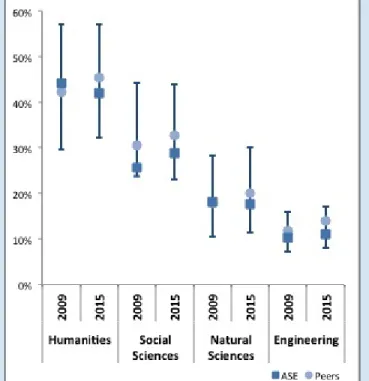
Figure 3 shows the average percentages of women and minority faculty in these universities calculated for sets of academic departments that match those in AS&E from 2009 to 2015.3 Vertical bars show the interquartile range.4 The light blue squares indicate the peer set mean, and the blue diamonds indicate the AS&E mean.
The AS&E fraction of women faculty falls very close to our peer set mean with little growth over time. AS&E’s fraction of URM faculty has grown over time, though we remain below the mean of our peer set, and our growth appears to be slower. Figures 4 and 5 provide a more detailed view of changes across disciplines. Fig 4 shows that, although the fraction of women in AS&E does not make AS&E an outlier in any disciplinary division, we fall below the mean in all divisions. However, the AS&E social sciences departments have seen the largest increase in women faculty during this time period.5
Figure 5 shows the fraction of URM faculty by division. As with women, our complement of underrepresented minority faculty does not make us an outlier, and in engineering we are doing better than our peers. We have seen growth in all divisions except the social sciences, but in the humanities and natural sciences we are still far below the average.
3 2009 data were available for the entire peer set of seven schools. 2015 data were available for four of the seven. 2014 data were substituted for the missing 2015 data in Figures 3–5.
4 This figure illustrates that the interquartile range for many of the peer set departments reaches zero. This means that at least 25 percent of the departments have no URM faculty. This is also the case for AS&E. 5 While AS&E categorizes the Department of History within the social sciences, many other institutions consider it within the humanities. For the purposes of comparison we counted our peer set history departments as social sciences departments.
Figure 3a.
Percent women faculty in 2009 and 2015
3with vertical
bars indicating interquartile range
4Figure 3b.
Percent URM faculty in 2009 and 2015
3with vertical
Summarizing, AS&E has strengthened the overall representation of women and URM faculty in the decade from 2006 to 2016, though not uniformly across all disciplines. For women, faculty growth has been mainly in the social sciences; for URM faculty, growth has been in all divisions except social sciences. Our profile does not make us an outlier among other private research universities, but for both women and minority faculty we generally fall below the means of the distributions across different academic divisions and—in some cases (e.g., women in social sciences, URM faculty in the humanities)—conspicuously so.
Faculty development and
diversity efforts in AS&E
since 2006
In 2006 President Seligman created the Office for Faculty Development and Diversity. Since then each school has appointed one or two faculty diversity officers to work within the schools to help diversify the faculty.
Within AS&E, in an acknowledgement of the importance of diversity in faculty development generally, the dean of the faculty appointed faculty development and diversity officers (FDDOs). AS&E’s FDDOs are charged with advising the deans and departments on best practices in the hiring and retention of faculty. Beth Olivares, dean for diversity initiatives, has served as an FDDO since 2007. She has been joined in this role by Honey Meconi, professor of music (2008–09), Laurel Carney, professor of biomedical engineering (2010–13), and Jeffrey Runner, professor of linguistics (2013–current). The FDDOs meet regularly with Deans Lennie, Culver, and Clark.
Current goals: faculty diversity in AS&E
With guidance from AS&E’s deans and coordinating their work with the vice provost for faculty development and diversity, the FDDOs pursue the following goals:
1. steadily increase the diversity of our faculty—specifically, the number of underrepresented minorities and women— across all disciplines and through the ranks
2. ensure that all search committees have access to pool data and are familiar with best practices in faculty searching 3. work closely with the deans to ensure that AS&E provides
the resources necessary for active recruitment and that school or departmental policies and procedures do not add unnecessary barriers to success
Figure 5.
Percent URM faculty in comparison set in 2009 and
2015 with vertical bars indicating interquartile range
Figure 4.
Percent women faculty in comparison set in 2009 and
2015 with vertical bars indicating interquartile range
4. conduct new faculty orientation and provide robust support to help new faculty acclimate to AS&E and support their development and retention.
Tenure-track faculty hiring procedures in AS&E
We outline the faculty hiring process here, highlighting efforts to increase diversity of the faculty.
Opening a search
AS&E typically authorizes up to 25 searches each academic year. Department chairs, in conjunction with Deans Lennie, Culver, and Clark, determine curricular and research areas of need. These decisions are based on multiple factors, including school strategic plans and budget forecasts, planned retirements and other potential departures, and planned disciplinary growth. The deans typically approve searches in the summer and early fall, although searches can be approved at any time.
Advertising the position
Once a description of the position is completed, the deans’ office ensures that it includes appropriate language regarding the school and department’s interest in attracting a broadly diverse candidate pool. Research has proven that such statements have a positive impact on the eventual hiring of diverse candidates (Smith, 2004). After the advertisement is approved, it is distributed electronically and in appropriate print outlets. All AS&E faculty openings are accessible online. Departments are encouraged to advertise in print and online locations that tend to have an audience of women or underrepresented minority candidates.
The search committee
The department chair appoints a search committee based on the subfield for which the department is searching; committee membership is approved by the appropriate dean. (In a small department a search committee may be a committee of the whole.) Dean Culver oversees all searches in the School of Arts & Sciences, and Dean Clark those in the Hajim School of Engineering & Applied Sciences. Each committee has a chair and a number of members (typically four to six) who run the search and recommend short-list candidates to the department. AS&E deans encourage departments, when possible, to include faculty of color, both men and women, and senior and junior faculty members in all search committees. The deans and FDDOs are sensitive to the delicate balance that obtains between protecting the time of URM and women faculty, and ensuring that search committees are as diverse
as possible. We encourage search committee chairs to weigh this balance carefully. One Arts & Sciences department also includes graduate student representatives. Although the graduate students do not vote on candidates, they have input at each stage of the process. This is excellent preprofessional training for the graduate students and is a practice the FDDOs encourage other departments to adopt.
The applicant pool
The FDDOs use the Integrated Postsecondary Education Data System (IPEDS), a federal database, to provide each search committee seeking junior faculty with data on the racial and gender makeup of their potential applicant pool. We can give search committees relatively detailed information on recent PhD recipients by subfield and institution. We provide pool data from all American Association of Universities (AAU) schools and from a subset, the AAU 25, a smaller list of private universities with whom we most frequently compare ourselves (see an example set of pool data in Table 3). We also urge the search committees to continually seek out and communicate with departments producing URM and women PhDs.
Table 3.
Example of AAU 25 pool data, 2015–16 search year
Department AAU 25 Women # Women % URM # URM %
Art History 306 234 76.5 14 4.6 Economics 950 268 28.2 22 2.3 History 655 319 48.7 59 9.0 Physics 1134 199 17.5 26 2.3 Political Science 592 265 44.8 55 9.3
AAU 25 PhDs (2012, 2013, 2014) IPEDS
We expect the actual applicant pools for searches seeking junior faculty to broadly reflect the national pool with respect to percentages of URM and women candidates. The national data are not a perfect representation of the pool (for example, not all of our hires are from the AAU; some departments look for candidates who have had one or more postdoctoral appointments, and many attract international applicants); however, it is a good proxy for the available pool of candidates.
Best practice training
Once the search committee is established, every committee meets with the FDDOs for a discussion of best practices in searches, with a focus on ensuring that departments do everything possible to ensure that their candidate pools contain underrepresented minority and women candidates, and that all candidates receive unbiased review.
The FDDOs engage search committees—in many ways the most crucial agents in our efforts to diversify the faculty—in frank discussions about the value of diversity at the University. Search committees are urged to consider diversity explicitly in their deliberations; increasing the diversity of their departments and thus our school is an explicit part of their task. These discussions often reveal that faculty members are quite concerned about the homogeneity of the potential pool. The FDDOs’ role is in part to help them to broaden their pool as much as possible and show them how to direct their efforts most effectively in attracting talented applicants from all backgrounds. Since these meetings were implemented in the fall of 2010, the members of more than 130 committees have been part of these conversations.
The FDDOs’ advice to committees is grounded in the national literature on best practices in faculty hiring, their work with specialists, and broad knowledge of the culture of AS&E and our departments.
Best practices include
• actively seeking out women and minority graduate students and postdoctoral appointees working in specific curricular areas • inviting such scholars for talks as graduate students or
postdoctoral fellows
• being in “search mode” even when there is not an authorized departmental search
• becoming aware of one’s own implicit biases prior to candidate review
• not ranking candidates until the very end of the process • reading the research statement prior to letters of
recommendation or reviewing the Curriculum Vitae so as not to be unduly swayed by the opinions of others or by academic pedigree
• including graduate students as nonvoting members • ensuring the participation of undergraduate and graduate
students during all campus visits.
In addition to outreach done by individual departments or search committees, AS&E actively recruits candidates annually at the Institute on Teaching and Mentoring6 held by the Compact for Faculty Diversity. In addition, the University of Rochester subscribes to the National Registry7, a clearinghouse for the Curriculum Vitae (CVs) of minority and women candidates who have expressed an interest in being recruited for faculty positions at Rochester and elsewhere.
6 www.instituteonteachingandmentoring.org/attendee-information
7 Contact either FDDO for information.
Faculty Online Recruiting Tool (FORT) and candidate review
AS&E uses a web-based system (FORT) to manage all applications and to organize committee review. Prior to submitting an application, each candidate must answer several demographic questions with respect to gender, ethnicity, ability, and veteran status. Although each question must be answered, candidates may select “prefer not to answer” for any or all demographic questions. Search committees do not have access to this information until they have selected their short-list candidates (those they would like to invite to campus for an interview). Even then, committees receive demographic information on their applicants in aggregate only.Implicit bias in the review process
All of us—men and women, regardless of race, class, ethnicity, or socioeconomic status—are subject to unconscious bias. Unconscious thoughts and feelings can influence the seemingly objective decisions and actions of even the most well-intentioned person. Much social science research suggests that people are more prone to implicit bias when they are under time pressure, when the task involves ambiguity, and when the process includes nonverbal automatic processes such as sorting CVs. Examples of findings from the research include “blind” auditions, or having musicians sit behind a screen for symphony chairs, which result in an approximately 50 percent increase in hiring of women (Goldin and Rouse 2000). Both male and female scientists are more likely to “hire” male applicants and at a higher rate of pay, despite identical résumés (Moss-Racusin, et al. 2012). Identical résumés with “white-sounding” names and “African-American-sounding” names resulted in the “white” candidates being offered 50 percent more interviews (Bertrand 2004). Letters of recommendation written for male medical school faculty applicants are longer than those for female applicants and have more references to research, while those written for women tend to be shorter, refer to personal traits, and contain more faint praise and irrelevant information (Trix and Psenka 2003). The good news is that when reviewers are conscious of the role implicit bias can have on the process, its potential adverse impact can be substantially reduced. Having briefly reviewed this literature during our conversations, the FDDOs recommend that each member of a search committee spend some time online participating in the Harvard Implicit Bias Project8 (or similar sites) prior to reviewing applicants.
Short lists and campus visits
When the search committee determines which candidates they would like to interview, it requests a FORT-generated aggregate demographic report on the entire applicant pool and on the short list. The committee then explains in writing why these are the top candidates. If the short list is homogeneous, the deans request a discussion of the absence of women or minority candidates on the list. The deans may request that a department revise a list that does not appropriately represent the pool. Both Deans Clark and Culver have done this. Some departments conduct first-round interviews at
disciplinary conferences or by Skype. Many invite their short-listed candidates to campus for interviews and to give a talk to which graduate and undergraduate students as well as faculty from associated fields are invited.
After the visits are concluded, a department, with the approval of the dean, will make an offer to the preferred candidate, if any. The dean and department chair enter into a negotiation with the candidate. Many searches are unsuccessful; sometimes this is because our top candidate accepts an offer elsewhere, and sometimes it is because no sufficiently qualified applicant emerges from the pool. In cases where URM candidates have multiple offers, one of which is from AS&E, the Special Opportunity Fund (described below) can be leveraged to make our offer more competitive. This is one of the ways in which we try to increase the diversity of our faculty: if a search committee identifies a candidate, the school works very hard to make the hire. Faculty members hired in a given search year may begin their appointment the following July 1 or at a later date more amenable to their professional schedule or the department’s needs.
Pool data with hiring results, 2014–15
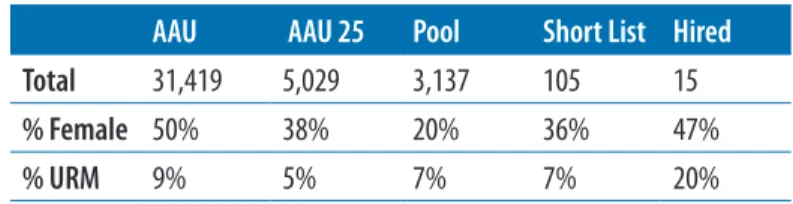
The following chart summarizes the larger and smaller sets (AAU and AAU 25) we consider as the national pool of potential applicants, the actual applicant pool for all of AS&E’s searches during the 2014–15 academic year, and the demographics of our short lists and the candidates we hired. Note that the AAU and AAU 25 columns correspond with the number of doctoral degrees earned during the preceding three years in the specific fields in which we searched.
Table 4.
Applicant pool data for 2014–15 search year
AAU AAU 25 Pool Short List Hired
Total 31,419 5,029 3,137 105 15
% Female 50% 38% 20% 36% 47%
% URM 9% 5% 7% 7% 20%
Although this chart demonstrates results for just one search year, it illustrates recent progress with women as well as with underrepresented minority faculty hires. Our goal is that women and URM candidates be at least as well represented in our applicant pools as they are in the overall pool. In this year, our percentages of women and URM applicants were lower than the national pool, but they were relatively well represented on short lists, and we were successful in hiring.
Target of opportunity hiring in AS&E
In addition to searches conducted through the mechanisms described above, AS&E faculty are also encouraged to seek outstanding faculty members who would add to the diversity of the department or school at any time. The deans encourage departments to advise them of unanticipated hiring opportunities that would greatly strengthen the department and AS&E as a whole, despite there being no approved search in the candidate’s discipline. The deans emphasize their willingness to make opportunistic hires at all levels that will bring AS&E exceptional faculty, including, but not limited to, faculty members from groups that are underrepresented in their disciplines.
A special hire would be one that brings a department a faculty member who would not normally be accessible to the department because
• the department does not have an active or promised search • the department has an active search, but the potential
faculty member’s domain of expertise is so far outside the disciplinary scope of the search that he or she could not reasonably be considered a candidate.
In recent years, this mechanism has resulted in successful hires in several departments.
Office for Faculty Development and Diversity’s
Special Opportunity Fund
The Office for Faculty Development and Diversity has special funds available to help offset hiring costs. These funds can be accessed by all of the schools in the University, including those in AS&E. This fund can provide supplements to start-up packages, additional salary, or other resources needed to attract diverse faculty candidates to the University. AS&E has leveraged this fund in recent years to attract a number of faculty members, including those affiliated with the Frederick Douglass Institute. For more information on this fund, departments can contact their school dean or the FDDOs.
Faculty retention
To create and sustain a welcoming and inclusive climate for all members of our community, we must provide the faculty we hire with the support they need to thrive. The FDDOs work with other faculty and staff to create multiple opportunities for new faculty to find others with similar research or personal interests. In particular, women and underrepresented minority faculty members can feel isolated, especially early on and especially when they are the only or one of a small number of women or URM faculty in their departments. One of our goals is to make sure new faculty never feel isolated in their departments and can develop friendships and collaborations of various sorts across departments. We are a small school with small departments that do not hire frequently, so it is essential that new faculty have as many opportunities as possible to develop a sense of “home” in AS&E.
Over the past three years, the FDDOs have developed a series of informational and networking events that help us to achieve that goal.
AS&E-specific new faculty orientations
in August and January
During orientation, new faculty members are introduced to all the deans and a variety of offices with which they will work as they develop their research and teaching careers in AS&E. The FDDOs begin preliminary discussions of the process of tenure and promotion. They discuss the value of mentorship and encourage new faculty to identify mentors in their departments and elsewhere. They establish their role as faculty development officers by making themselves available to new faculty to assist with transition to life in AS&E. Making new faculty feel welcome is an important part of this first event and a big part of that is having the new faculty meet each other and begin to develop relationships, both professional and personal. Retention of newly recruited and hired faculty begins already at this stage.
Other faculty development efforts
In addition to the formal orientation, the FDDOs provide opportunities for new faculty to meet their specific deans in a more casual atmosphere. This allows the faculty to get to know their dean as well as for that dean to get to better know her or his faculty. FDDOs also sponsor monthly lunches for pretenure faculty to get together in an informal setting to further develop their connections with one another. During the year FDDOs offer a variety of workshops on teaching, research, tenure, and promotion that will be useful for all faculty.
Mentoring
As AS&E focuses more deeply on faculty recruitment, the deans and FDDOs also attend to issues of faculty development and retention specifically in regard to mentoring of junior faculty. An acceptable mentoring framework for Arts, Sciences & Engineering must accommodate wide variation across disciplines in the needs of faculty, and a uniform policy is unlikely to be useful or acceptable to departments. Nevertheless, there are core elements that the deans and FDDOs believe should be present in all policies and practices: • Each department should make explicit its procedures for
fostering and monitoring the early career development of faculty and should clarify a procedure for assessing the effectiveness of teaching and for providing assistance in strengthening it.
• Each department should identify a mechanism through which junior faculty are offered help with key skills (such as grant writing and book publishing) for managing research and scholarship.
Academic pipeline
development
A significant impediment to establishing a more diverse faculty is the small number of women and minority candidates in some disciplines. AS&E has made explicit investments to increase the diversity of our graduate programs and invests heavily in the preparation of underrepresented undergraduates for careers in academia. These efforts are coordinated through the David T. Kearns Center for Leadership and Diversity in Arts, Sciences & Engineering. The mission of the Kearns Center is to expand the educational pipeline through the doctoral degree for low-income, first-generation college, and underrepresented minority students.
Graduate student recruitment
In 2010, the Kearns Center created a full-time position for a staff member to work closely with the Office of Graduate Studies. Currently, Kevin Wilson, assistant director for graduate diversity, has primary responsibility for the recruitment and retention of graduate students of color in AS&E. He works closely with departments and helps recruit students at many high-impact events each year, as described below.
In the 2015–16 academic year, the recruiter attended twelve high-impact recruiting events (those that attract 500-plus student participants). Attendance at these events allows AS&E to make direct contact with thousands of potential applicants each year.
The University of Rochester is part of the GEM Consortium, the National Consortium for Graduate Degrees for Minorities in Engineering and Science—a group that provides external fellowships to minority candidates for engineering degree programs. Through this partnership, AS&E departments are in contact with more than 600 GEM applicants each year. Each September since 2012, the Kearns Center has invited from 10 to 20 underrepresented, low-income, first-generation, and women students from across the country to visit their chosen department as part of Graduate Visitation Program (GVP). This is an all-expenses-paid trip that includes meetings with current graduate students, faculty, and administrators; workshops on applying to graduate school; and a tour of the city of Rochester. The Kearns Center also hosts a Graduate Visitation Program for Administrators (GVPA) for college administrators (such as research program directors) who work with underrepresented populations.
These efforts serve multiple purposes. In the short term, they help to increase the number of applications to our graduate programs we receive from students of color, and from individuals who are low-income or the first persons in their families to attend college. In the longer term, they can pave the way for new partnerships between departments and minority serving institutions, and they increase our recognition as an institution who cares deeply about the successes of students of color.
Graduate applications and enrollment
Since AS&E started devoting resources to this effort, applications from underrepresented minority students to our graduate programs have grown from 63 in 2010 to 206 in 2015—a 226 percent increase.
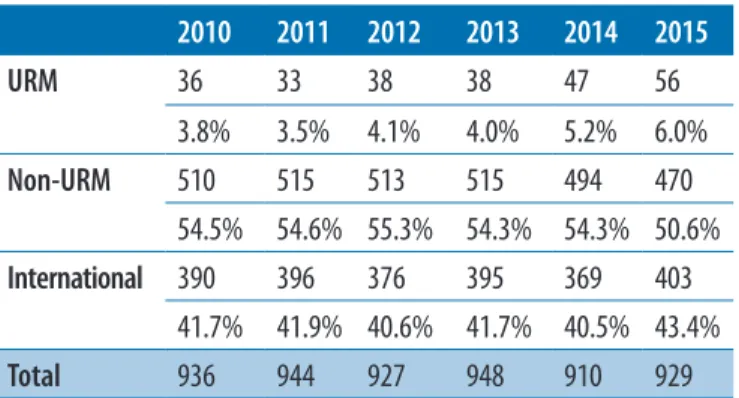
Tables 5 and 6 show the growth in AS&E’s enrollment of full-time master’s and doctoral students in AS&E from 2010 through 2015. The growth in enrollment of URM students from 40 to 69 (73 percent) has far outpaced the overall growth in enrollment (16 percent).
Table 5.
Master’s enrollment demographics 2010–15
2010 2011 2012 2013 2014 2015 URM 4 4 10 15 22 13 2.7% 2.3% 4.3% 5.2% 7.2% 4.0% Non-URM 84 84 85 102 101 115 57.5% 48.6% 36.3% 35.4% 33.2% 35.6% International 58 85 139 171 181 195 39.7% 49.1% 59.4% 59.4% 59.5% 60.4% Total 146 173 234 288 304 323
Table 6.
PhD enrollment demographics 2010–15
2010 2011 2012 2013 2014 2015 URM 36 33 38 38 47 56 3.8% 3.5% 4.1% 4.0% 5.2% 6.0% Non-URM 510 515 513 515 494 470 54.5% 54.6% 55.3% 54.3% 54.3% 50.6% International 390 396 376 395 369 403 41.7% 41.9% 40.6% 41.7% 40.5% 43.4% Total 936 944 927 948 910 929
Graduate student retention
and professional development
The Kearns Center Professional Development Diversity Travel Award was created in 2015. The award provides graduate students in Arts, Sciences & Engineering up to $750 toward their attendance at and participation in diversity-related professional and academic conferences. Three students have received the award thus far.
The Graduate Students of Color (GSoC) association was formed by students, is advised by the Kearns Center, and is cofunded by the Kearns Center and AS&E’s dean of graduate studies to support underrepresented students of color across all University of Rochester campuses with social and professional events.
A bimonthly dinner and discussion for underrepresented AS&E students sponsored by the Kearns Center fosters community and social support for students. The robust discussions engendered here allow students to share their concerns, generate ideas for social and professional events, and provide opportunities for networking.
Center for the Integration of Research,
Teaching and Learning (CIRTL)
CIRTL is an NSF-funded consortium of American universities whose mission is to enhance excellence in undergraduate education through the development of a national faculty committed to implementing effective teaching practices for diverse learners. The University of Rochester is a member of this consortium and has several efforts aimed directly at increasing the racial and gender sensitivity of STEM graduate students and faculty, so they can be well prepared to teach the next generation of diverse undergraduates.
Kearns CIRTL Fellows
Kearns-CIRTL Fellows, who are all graduate students in the STEM fields, assist in faculty-led short courses for urban high school students through the Center’s Upward Bound Math/ Science Program. These fellows develop a wide range of new skills that assist them to become strong faculty members, particularly in teaching racially, ethnically, and linguistically diverse student populations.
Ronald E. McNair Post-Baccalaureate
Achievement Program (Kearns Center)
This program’s goal is to increase the numbers of low-income, first-generation college, and underrepresented minority undergraduate students who continue their education by pursuing PhD degrees. Each McNair Scholar completes a mentored research experience and attends seminars from sophomore through senior years; they meet and network with faculty, prepare for the General Record Exam, learn about life in the academy, and apply to graduate schools. In addition, they each complete at least one in-depth mentored research project and present that research at several conferences, both at the University of Rochester and nationally. Since the program’s inception in 1992, more than 80 percent of the University’s McNair graduates have enrolled in graduate school, and more than 100 have already earned doctoral degrees. More than a dozen are currently faculty members at colleges and universities across the country in fields such as math, computer science, psychology, education, and political science.
Recommendations
AS&E has a set of policies and practices designed to enforce best practice in faculty hiring and thereby strengthen the recruitment and retention of women and underrepresented minority faculty and graduate students. We have made clear but insufficient progress in increasing the number of underrepresented minority faculty and graduate students; we have made much less progress with women faculty. AS&E should pay attention to the areas noted below.
Faculty hiring
• AS&E should continue to actively seek a robust pool of underrepresented minority and women faculty candidates. • AS&E deans should remind department chairs at regular
intervals of the importance of diversity to the school and of the availability of special funding when appropriate. • Search committees have ready access to information and
training on best practices, but we do not know how fully these practices are adopted. AS&E currently does not collect follow-up information on what committees did to attract a broadly diverse applicant pool and ensure unbiased review and what explicit consideration was given to diversity. AS&E should implement an annual process to assess the use of these practices and evaluate their effectiveness.
Faculty development
• At least once a year, a discussion should occur between the department chair (informed by other senior faculty, as appropriate) and junior faculty members, covering general career progress and, where relevant, providing guidance on what might be done to accelerate it. This discussion should be distinct from the annual performance review, with its retrospective focus. Effective mentoring is based on a review of progress but goes beyond it in diagnosing potential weaknesses or shortfalls and offering specific recommendations for overcoming them, typically by suggesting appropriate resources to which the faculty member may turn and establishing time frames within which particular work should be accomplished. To
emphasize the distinction between the mentoring discussion and the annual performance review, we recommend that the former occur early in the academic year. The outcome of the mentoring discussion, including any recommendations for action by the faculty member, should be summarized in writing by the chair, and a copy given to the faculty member. • The FDDOs suggest to junior faculty members that no later
to identify a mentor. The FDDOs and department chairs should collect this information.
Pipeline development
• AS&E should strengthen current methods and continue to implement additional methods of increasing the pipeline of women and underrepresented minority undergraduates into doctoral programs both nationally and locally.
• Faculty diversity is an issue of national scope, and AS&E has a strong commitment not just to hiring a more diverse faculty but also to ensuring that the pipeline of candidates into PhD programs remains deep. Yet the fact remains that many undergraduate students of color do not see value in pursuing careers in academe. An important task has to be to ensure that these students better understand—and see as a potential career path—the life of a faculty member or researcher.
• Graduate admissions committees should be charged to seek to broaden participation of underrepresented groups. This may mean developing partnerships with specific undergraduate schools or programs, engaging more intensely with current recruitment efforts aimed at women and underrepresented minority undergraduates, or reconsidering the relative weight assigned to various aspects of a graduate application. Insofar as possible, and in conjunction with the dean of graduate studies, graduate admissions committees should absorb the practices developed for tenure-track faculty searches.
Non–tenure-track faculty and instructional staff
• AS&E has not devoted the same effort to diversifying its non–tenure-track faculty as it has its tenure-track faculty. The diversity of this group of employees is critical, as they teach many undergraduates who are generally unaware of the differences between various kinds of faculty. Searches for non–tenure track faculty should, where possible, also absorb the practices we have developed for tenure-track searches. • AS&E does not currently maintain comprehensive data on
non–tenure-track faculty or instructional staff. This data should be assembled, maintained, and reported on annually in the same manner as is done with tenure-track faculty.
Evaluation and reporting
• The FDDOs should report to the deans and AS&E faculty on progress in this domain on no less than an annual basis. • The FDDOs should report to the graduate and
undergraduate students on progress in this domain on no less than an annual basis.
• To increase the overall transparency of these processes, the FDDOs should maintain a robust online reporting mechanism available to the University of Rochester community on progress, challenges, and opportunities in this domain.
If enacted, the totality of these recommendations will help to ensure that AS&E continues into the next decade with a strong and ever more diverse faculty.
For more information
To learn more about any of these efforts, please visit www.rochester.edu/college/faculty, or contact: Beth Olivares
Dean for Diversity Initiatives and Executive Director of Kearns Center; Faculty Development and Diversity Officer, Arts Sciences & Engineering
[email protected] Jeffrey Runner
Chair, Department of Linguistics; Faculty Development and Diversity Officer, Arts, Sciences & Engineering
Prepared by
Faculty Development and Diversity Officers
University of Rochester