Mining Syntactically Annotated Corpora with XQuery
Gosse Bouma and Geert Kloosterman
Information Science University of Groningen
The Netherlands
g.bouma|[email protected]
Abstract
This paper presents a uniform approach to data extraction from syntactically annotated corpora encoded in XML. XQuery, which incorporates XPath, has been designed as a query language for XML. The combina-tion of XPath and XQuery offers flexibility and expressive power, while corpus specific functions can be added to reduce the com-plexity of individual extraction tasks. We il-lustrate our approach using examples from dependency treebanks for Dutch.
1 Introduction
Manually annotated treebanks have played an im-portant role in the development of robust and ac-curate syntactic analysers. Now that such parsers are available for various languages, there is a grow-ing interest in research that uses automatically an-notated corpora. While such corpora are not error-free, the fact that they can be constructed rela-tively easily, and the fact that they can be an order of magnitude larger than manually corrected tree-banks, makes them attractive for several types of re-search. Syntactically annotated corpora have suc-cesfully been used to acquire lexico-semantic infor-mation (Lin and Pantel, 2001; Snow et al., 2005), for relation extraction (Bunescu and Mooney, 2005), in IR (Cui et al., 2005), and in QA (Katz and Lin, 2003; Moll´a and Gardiner, 2005).
What these tasks have in common is the fact that they all operate on large amounts of data extracted from syntactically annotated text. Tools to perform
this task are often developed with only a single ap-plication in mind (mostly corpus linguistics) or are developed in an ad-hoc fashion, as part of a specific application.
We propose a more principled approach, based on two observations:
• XML is widely used to encode syntactic anno-tation. Syntactic annotation is not more com-plex that some other types of information that is routinely stored in XML. This suggests that XML technology can be used to process syn-tactically annotated corpora.
• XQuery is a query language for XML data. As such, it is the obvious choice for mining syn-tactically annotated corpora.
The remainder of this paper is organised as fol-lows. In the next section, we present the Alpino tree-bank format, which we use for syntactic annotation. The Alpino parser has been used to annotate large corpora, and the results have been used in a number of research projects.1
In section 3, we discuss the existing approaches to data extraction from Alpino corpora. We note that all of these have drawbacks, either because they lack expressive power, or because they require a serious amount of programming overhead.
In section 4, we present our approach, starting from a relatively straightforward corpus linguistics task, that requires little more than XPath, and end-ing with a more advanced relation extraction task,
1
See www.let.rug.nl/∼vannoord/research. html
that requires XQuery. We demonstrate that much of the complexity of advanced tasks can be avoided by providing users with a corpus specific module, that makes available common concepts and functions.
2 The Alpino Treebank format
As part of the development of the Alpino parser (Bouma et al., 2001), a number of manually an-notated dependency treebanks have been created (van der Beek et al., 2002). Annotation guidelines were adopted from the Corpus of Spoken Dutch (Oostdijk, 2000), a large corpus annotation project for Dutch. In addition, large corpora (e.g. the 80M word Dutch CLEF2corpus, the 500M word Twente News corpus3, and Dutch Wikipedia4) have been annotated automatically. Both types of treebanks have been used for corpus linguistics (van der Beek, 2005; Villada Moir´on, 2005; Bouma et al., 2007). The automatically annoted treebanks have been used for lexical acquisition (van der Plas and Bouma, 2005), and form the core of a Dutch QA system (Bouma et al., 2005).
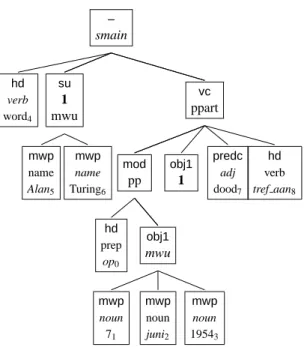
The format of Alpino dependency trees is illus-trated in figure 1. The (somewhat simplified) XML for this tree is in fig. 2. Nodes in the tree are labeled with a dependency relation and a category or POS-tag. Furthermore, the begin and end position of con-stituents is represented in attributes,5 and the root and word form of terminal nodes is encoded. Note that heads do not have their dependents as children, as is the case in most dependency tree formats. In-stead, the head is a child of the constituent node if which it is the head, and its dependents are siblings of the head. Finally, trees may contain index nodes (indicated by indices in bold in the graphical repre-sentation and by theindexattribute in the XML) to indicate ’secondary’ edges. The subjectAlan Turing
in fig. 2 is a subject of the passive auxiliary word, but also a direct object of the verb aan tref. Thus, Alpino dependency trees are actually graphs.
A large syntactically annotated corpus tends to
2 www.clef-campaign.org 3www.vf.utwente.nl/∼druid/TwNC/ TwNC-main.html 4nl.wikipedia.org 5
Note that constituents may be discontinuous, and thus, the yield of a constituent may not contain every terminal node be-tweenbeginandend. See also section 4.2.
– smain hd verb word4 su 1 mwu mwp name Alan5 mwp name Turing6 vc ppart mod pp hd prep op0 obj1 mwu mwp noun 71 mwp noun juni2 mwp noun 19543 obj1 1 predc adj dood7 hd verb tref aan8
Figure 1: Op 7 juni 1954 werd Alan Turing dood aangetroffen (On June 7, 1954, Alan Turing was found dead)
give rise to even larger volumes of XML. To sup-port efficient storage and retrieval of XML data, a set of tools has been developed for compression of XML data (using dictzip6) and for efficient visuali-sation and search of data in compressed XML files. The tools are described in more detail at the Alpino website.7
3 Existing approaches to extraction
Users have taken quite different approaches to cor-pus exploration and data extraction.
• For corpus exploration, Alpinodtsearchis the most widely used tool. It allows XPath queries to be matched against trees in a tree-bank. The result can be a visual display of trees with matching nodes highlighted, but alterna-tive outputs are possible as well. Examples of how XPath can be used for extraction are pre-sented in the next section.
• For relation extraction (i.e. finding symptoms of diseases), the Alpino system itself has been
6www.dict.org 7
www.let.rug.nl/∼vannoord/alp/Alpino/ TreebankTools.html
<node begin="0" cat="smain" end="9" rel="--">
<node begin="4" end="5" pos="verb" rel="hd" root="word" word="werd"/> <node begin="5" cat="mwu" end="7" index="1" rel="su">
<node begin="5" end="6" pos="name" rel="mwp" neclass="PER" root="Alan" word="Alan"/> <node begin="6" end="7" pos="name" rel="mwp" neclass="PER" root="Turing" word="Turing"/> </node>
<node begin="0" cat="ppart" end="9" rel="vc"> <node begin="0" cat="pp" end="4" rel="mod">
<node begin="0" end="1" pos="prep" rel="hd" root="op" word="Op"/> <node begin="1" cat="mwu" end="4" rel="obj1">
<node begin="1" end="2" pos="noun" rel="mwp" root="7" word="7"/> <node begin="2" end="3" pos="noun" rel="mwp" root="juni" word="juni"/> <node begin="3" end="4" pos="noun" rel="mwp" root="1954" word="1954"/> </node>
</node>
<node begin="5" end="7" index="1" rel="obj1"/>
<node begin="7" end="8" pos="adj" rel="predc" root="dood" word="dood"/>
<node begin="8" end="9" pos="verb" rel="hd" root="tref_aan" word="aangetroffen"/> </node>
</node>
Figure 2: XML encoding of the Alpino depedency tree in fig. 1
used. It provides functionality for converting dependency trees in XML into a Prolog list of dependency triples. The full functionality of Prolog can then be used to do the actual extrac-tion.
• Alternatively, one can use XSLT to extract data from the XML directly. As XSLT is primarily intended for transformations, this tends to give rise to complex code.
• Alternatively, a general purpose scripting or programming language such as Perl or Python, with suitable XML support, can be used. As in the Alpino/Prolog case, this has the advantage that one has a full programming language avail-able. A disadvantage is that there is no specific support for working with dependency trees or triples.
None of the approaches listed above is optimal. XPath is suitable only for identifying syntactic pat-terns, and does not offer the possibility of extraction of elements (i.e. it has no capturing mechanism). The other three approaches do allow for both match-ing and extraction, but they all require skills that go considerably beyond conceptual knowledge of the treebank and some basic knowledge of XML.
Another disadvantage of the current situation is that there is little or no sharing of solutions be-tween users. Yet, different applications tend to
en-counter the same problems. For instance, multiword expressions (such as Alan Turing or 7 juni 1954) are encoded as trees, dominated by acat=’mwu’ node. An extraction task that requires names to be extracted must thus take into account the fact that names can be both nodes with a label pos=’name’as well ascat=’mwu’nodes (dom-inating a pos=’name’). The situation is further complicated by the fact that individual parts of a name, such as Alan in Alan Turing, should nor-mally not be matched. Similar problems arise if one wants to match e.g. finite verbs (there is no single attribute which expresses tense) or NPs (the cat=’np’ attribute is only present on complex
NPs, not on single words). A very frequent issue is the proper handling of index nodes. Searching for the object of the verbtref aanin fig. 2 requires that one finds the node in the tree that is coindexed with therel=’obj1’node with index 1. This is a challenge in all approaches listed above, except for Alpino/Prolog, which solves the problem by con-verting trees to sets of dependency triples.
Some of the problems mentioned above could be solved by introducing more and more fine-grained attributes (i.e. a separate attribute for tense, as-signing both a category and a POS-tag to (non-head) terminal-nodes, etc.) or by introducing unary branching nodes. This has the obvious drawback of introducing redundancy in the encoding, would
mean another departure from the usual conception of dependency trees (in the case unary branching is introduced), and may still not cover all distinctions that users need to make. Also, finding the content of an index-node cannot be solved in this way.
One might consider moving to a radically differ-ent treebank format, such as Tiger XML8 for in-stance, in which trees are basically a listing of nodes, with non-terminal nodes dominating a number of edge elements that take (the index of) other nodes as value. Note, however, that most of the problems mentioned above refer to linguistic concepts, and thus are unlikely to be solved by changing the ar-chitecture of the underlying XML representation.
4 XQuery and XPath
Two closely related standards for processing XML documents are XSLT9 and XQuery10 . Both make use of XPath11, the XML language for locating parts of XML documents. While XSLT is primarily in-tended for transformations of documents, XQuery is primarily intended for extraction of information from XML databases. XQuery is in many respects similar to SQL and is rapidly becoming the standard for XML database systems.12 A distinctive differ-ence between the XSLT and XQuery is the fact that XSLT documents are themselves XML documents, whereas this is not the case for XQuery. This typi-cally makes XQuery more concise and easier to read than XSLT.13
These considerations made us experiment with XQuery as a language for data extraction from syn-tactically annotated corpora. Similar studies were carried out by Cassidy (2002) (for an early version of XQuery) and Mayo et al. (2006), who compare the NITE Query Language and XQuery. Below, we first illustrate a task that requires use of XPath only, and then move on to tasks that require the additional functionality of XQuery. 8www.ims.uni-stuttgart.de/projekte/ TIGER/ 9www.w3.org/TR/xslt20 10 www.w3.org/TR/xquery 11www.w3.org/TR/xpath20 12
e.g.exist.sourceforge.net,monetdb.cwi.nl, www.oracle.com/database/berkeley-db/xml
13
See Kay (2005) for a thorough comparison.
4.1 Corpus exploration with XPath
As argued in Bouma and Kloosterman (2002), XPath provides a powerful query language for for-mulating linguistically relevant queries, provided that the XML encoding of the treebank reflects the syntactic structure of the trees.
Inherent reflexive verbs, for instance, are verbal heads with arel=’se’dependent. A verb with an inherently reflexive can therefore be found as fol-lows (remember that in Alpino dependency trees, dependents are actually siblings of the head):
//node[@pos="verb" and @rel="hd"
and ../node[@rel="se"] ]
The double slash (’//’) ensures that we search for nodes anywhere within the XML document. The material in brackets ([ ]) can be used to specify additional constraints that matching nodes have to meet. The@-sign is used to refer to attributes of an element. The double dots (’..’) locate the parent el-ement of an XML elel-ement. Children of an elel-ement are located using the single slash (’/’) operator. The two can be combined to locate siblings.
Comparison operators are available to compare e.g. attributes that have a numeric value. The follow-ing XPath query identifies cases where the reflexive precedes the subject:
//node[@pos="verb" and @rel="hd"
and ../node[@rel="se"]/@begin < ../node[@rel="su"]/@begin ]
Note that we can also use the ’/’ to locate attributes of an element, and that thebeginattribute encodes the initial string position of a constituent.
Reflexives preceding the subject are a marked op-tion in Dutch. We may contrast matching verbs with verbs matching the following expression:
//node[@pos="verb" and @rel="hd" and ../node[@rel="se"]/@begin > ../node[@rel="su"]/@begin and not(../node[@rel="su"]/@begin="0") ]
Here we have simply reversed the comparison op-erator. As we want to exclude from considera-tion cases where the subject precedes the finite verb (e.g. is in sentence-initial position), we have added a negative constraint with this effect.
REFL-SU SU-REFL verb (gloss)
% # % #
94.3 33 5.7 2 vorm (to shape) 91.7 11 8.3 1 ontvouw (to unfold) 74.1 234 25.9 82 doe voor (to happen) 73.5 36 26.5 13 teken af (to form) 58.8 10 41.2 7 wreek (to take revenge) 57.1 44 42.9 33 voltrek (to take place) 56.0 42 44.0 33 verzamel (to assemble) 54.6 309 45.4 257 bevind (to be located) 50.0 18 50.0 18 dring op (to impose) 48.3 58 51.7 62 dien aan (to announce) Table 1: Relative frequency ofREFL-SUvsSU-REFL
word order
Using the two queries above to search one year of newspaper text, we can collect the outcome and compute, for a given verb, the relative frequency of
REFL-SUvs. SU-REFLorder for non-subject initial
sentences in Dutch. A sample of verbs that have a high percentage ofREFL-SUoccurrences, is given in table 1. The result confirms an observation in Hae-sereyn et al. (1997), thatREFL-SUword order occurs especially with verbs having a somewhat ’bleeched semantics’ and expressing that something exists or comes into existence.
It should be noted that XPath offers consider-able more possibilities than what is illustrated here. XPath 2.0 in particular is an important step forward for linguistic search, as it includes far more func-tionality for string processing (i.e. tokenization and regular expressions) than its predecessors. Bird et al. (2006) propose an extension of XPath 1.0 for lin-guistic queries. The intuitive notation they intro-duce might be useful for some users. However, the examples they concentrate on (all having to do with linear order) presuppose trees without ’cross-ing branches’. The introduction ofbeginandend attributes in the Alpino format makes it possible to handle such queries for dependency trees (with crossing branches) as well, and furthermore, does not require an extension of XPath.
4.2 Data Extraction with XQuery
The kind of explorative corpus search for which XPath is ideally suited is supported by most other treebank query languages as well, although not all
alternatives offer the same expressive power. There are many applications, however, in which it is neces-sary to extract more than just (root forms of) match-ing nodes. XQuery offers the functionality that is required to perform arbitrary extraction.
XQuery programs consist of so-called FLWOR
expressions (for, let, where, order by, return, not all parts are required). The example below illustrates this. Assume we want to extract from a treebank all occurrences of names, along with their named entity class. The following XQuery script covers the base case.
for $name in
collection(’ad1994’)//node[@pos="name"] let $nec := string($node/@neclass)
return
<term nec="{$nec}"> {string($name/@word)} </term>
The for-statement locates the nodes to be pro-cessed. Nodes are located by XPath expressions. Thecollection-predicate defines the directory to be processed. For every document in the collection, nodes with aPOS-attributenameare processed. We use alet-statement to assign the variable$necis assigned the string value of the neclass-attibute (which indicates the named entity class of the name). The return-statement returns for each matching node an XML element containing the string value of the word attribute of the name, as well as an attribute indicating the named entity class.
The complexity of XQuery scripts can increase considerably, depending on the complexity of the underlying XML data and the task being performed. One of the most interesting features of XQuery is the possibility to define functions. They can be used to enhance the readibility of code. Furthermore, func-tions can be collected in modules, and thus can be reused across applications.
For Alpino treebanks, for instance, we have implemented a module that covers concepts and tasks that are needed frequently. As pointed out above, names in the Alpino treebank are not just single nodes, but, in case a name consists of two or more words, can also consist of mul-tiple node[@pos=’name’] elements, with a node[@cat=’mwu’] as parent. This motivates the introduction of anameandneclassfunction,
as shown in fig. 3. Assuming that thealpino mod-ule has been imported, we can now write a better name extraction script:
for $name in collection(’ad1994’)//node where alpino:name($name) return <term nec="{alpino:neclass($name)}"> {alpino:yield{$name)} </term>
As we are matching with non-terminal nodes as well, we need to take into account that it no longer suffices to return the value of word to obtain the yield of a node. As this situation arises frequently as well, we added a yield function (see fig. 3). It takes a node as argument, collects all descen-dant node/@wordattribute values in the variable $words, sorted by thebeginvalue of theirnode element. Theyieldfunction returns the string con-catenation of the elements in$words, separated by blanks. Note that this solution also gives the correct result for discontinuous constituents.
We used a wrapper around the XQuery processor Saxon14to execute XQuery scripts directly on com-pacted corpora. The result is output such as:
<term nec="ORG">PvdA</term>
<term nec="LOC">Atlantische Oceaan</term>
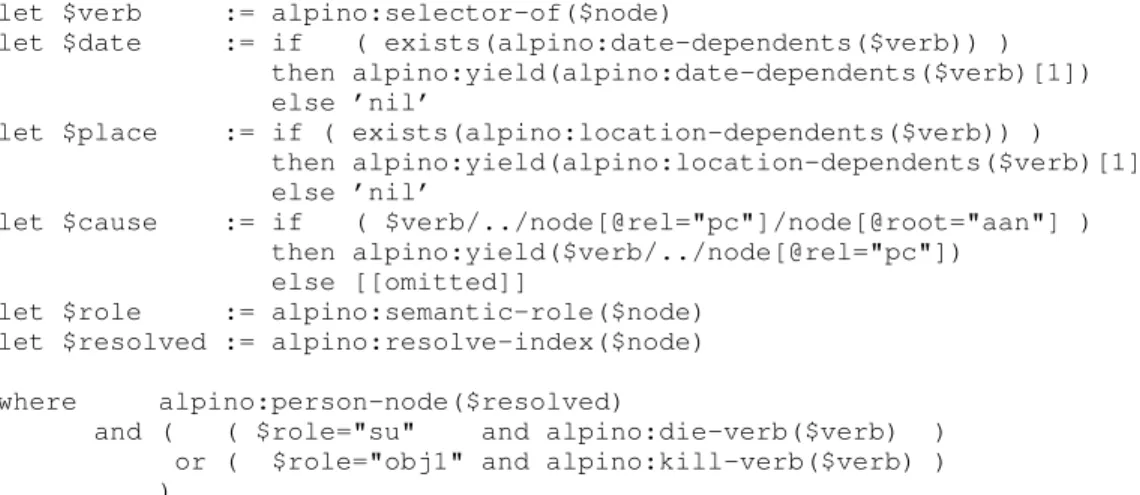
A more advanced relation extraction example is given in fig. 4. It is a script for extraction of events involving the death of a person from a syntactically annotated corpus (Dutch wikipedia in this case). It will return the name of the person who died, and, if these can be found in the same sentence, the date, location, and cause of death.15 The script makes heavy use of functions from the alpino module that were added to facilitate relation extrac-tion. Theselector-offunction defines the ’se-mantic head’ of a phrase. This is either the sibling marked rel=’hd’, or (for nodes that are them-selves heads) the head of the mother. For apposi-tions and conjuncts, it it the selector of the head. Note that the last case involves a recursive function call. Similarly, the semantic role is normally iden-tical to the value of therel-attribute, but we go up
14www.saxonica.com 15
Questions about such facts are relatively frequent in Ques-tion Answering evaluaQues-tion tasks.
one additional level for heads, appositions and con-juncts. The value of $resolved is given by the resolve-indexfunction shown in fig. 3, i.e. if a node is just an index (as is the case for the object of
aan trefin fig. 1), the ’antecedent’ node is returned. In all other cases, the node itself is returned. Date and place are found using functions for locating the date and place dependents of the verb. Finally, rel-evant events are found using the die-verb and kill-verbfunctions.
Some examples of the output of the extraction script are (i.e. John Lennon was killed on Decem-ber 8, 1980, and Erasmus died in Basel on July, 12, 1536):
<died-how place="nil" file="1687-98" person="John Lennon" cause="vermoord" date="op 8 december 1980"/>
<died-how place="in Bazel" file="20336-37" person="Erasmus" cause="overlijd" date="op 12 juli 1536"/>
The functions illustrated in the two examples can be used for a range of similar data extraction tasks, whether these are intended for corpus linguistics re-search or as part of an information extraction sys-tem. The definition of corpus specific functions that cover frequently used syntactic and semantic con-cepts allows the application specific code to be rel-atively compact and straightforward. In addition, code which builds upon well tested corpus specific functions tends to give more accurate results than code developed from scratch.
5 Conclusions
In this paper, we have presented an approach to min-ing syntactically corpora that uses standard XML technology. It can be used both for corpus explo-ration as well as for information extraction tasks. By providing a corpus specific module, the complexity of such tasks can be reduced. By adopting standard XML languages, we can benefit optimally from the fact that these are far more expressive than what is provided in application specific languages or tools. In addition, there is no shortage of tools or platforms supporting these languages. Thus, development of corpus specific tools can be kept at a minimum.
module namespace alpino="alpino.xq" ;
declare function name($constituent as element(node)) as xs:boolean
{ if ( $constituent[@pos=’name’] or
$constituent[@cat = ’mwu’]/node[@neclass=’PER’] ) then fn:true()
else fn:false() };
declare function neclass($constituent as element(node)) as xs:string
{ if $constituent[@neclass]
then fn:string($constituent/@neclass)
else if $constituent/node[@neclass]
then fn:string($constituent/node[1]/@neclass) };
declare function alpino:yield($constituent as element(node)) as xs:string { let $words :=
for $leaf in $constituent/descendant-or-self::node[@word]
order by number($leaf/@begin)
return $leaf/@word
return string-join($words," ") };
declare function alpino:resolve-index($constituent as element(node)) as element(node)
{ if ( $constituent[@index and not(@pos or @cat)] ) then $constituent/ancestor::alpino_ds/
descendant::node
[@index = $constituent/@index and (@pos or @cat)] else $constituent
};
Figure 3: XQuery module (fragment) for Alpino treebanks
for $node in collection(’wikipedia’)/alpino_ds//node
let $verb := alpino:selector-of($node)
let $date := if ( exists(alpino:date-dependents($verb)) )
then alpino:yield(alpino:date-dependents($verb)[1]) else ’nil’
let $place := if ( exists(alpino:location-dependents($verb)) )
then alpino:yield(alpino:location-dependents($verb)[1]) else ’nil’
let $cause := if ( $verb/../node[@rel="pc"]/node[@root="aan"] ) then alpino:yield($verb/../node[@rel="pc"])
else [[omitted]]
let $role := alpino:semantic-role($node)
let $resolved := alpino:resolve-index($node)
where alpino:person-node($resolved)
and ( ( $role="su" and alpino:die-verb($verb) ) or ( $role="obj1" and alpino:kill-verb($verb) ) )
return
<died-how file="{alpino:file-id($node)}" person="{alpino:root-string($resolved)}" cause="{$cause}" date="{$date}" place = "{$place}" />
References
Steven Bird, Yi Chen, Susan B. Davidson, Haejoong Lee, and Yifeng Zheng. Designing and evalu-ating an XPath dialect for linguistic queries. In
Proceedings of 22nd International Conference on
Data Engineering (ICDE), 2006.
Gosse Bouma and Geert Kloosterman. Querying de-pendency treebanks in XML. In Proceedings of the 3rd conference on Language Resources and
Evaluation (LREC), Gran Canaria, 2002.
Gosse Bouma, Gertjan van Noord, and Robert Mal-ouf. Alpino: Wide-coverage computational analy-sis of Dutch. InComputational Linguistics in The
Netherlands 2000. Rodopi, Amsterdam, 2001.
Gosse Bouma, Ismail Fahmi, Jori Mur, Gertjan van Noord, Lonneke van der Plas, and J¨org Tiede-man. Linguistic knowledge and question
answer-ing. Traitement Automatique des Langues, 2(46):
15–39, 2005.
Gosse Bouma, Petra Hendriks, and Jack Hoeksema. Focus particles inside prepositional phrases: A comparison of Dutch, English, and German.
Jour-nal of Comparative Germanic Linguistics, 10(1),
2007.
Razvan Bunescu and Raymond Mooney. A short-est path dependency kernel for relation extraction.
InProceedings of HLT/EMNLP, pages 724–731,
Vancouver, 2005.
Steve Cassidy. XQuery as an annotation query lan-guage: a use case analysis. In Language
Re-sources and Evaluation Conference (LREC), Gran
Canaria, 2002.
Hang Cui, Renxu Sun, Keya Li, Min-Yen Kan, and Tat-Seng Chua. Question answering passage re-trieval using dependency relations. In Proceed-ings of SIGIR 05, Salvador, Brazil, 2005.
W. Haesereyn, K. Romijn, G. Geerts, J. De Rooy, and M.C. Van den Toorn. Algemene Nederlandse
Spraakkunst. Martinus Nijhoff Uitgevers
Gronin-gen / Wolters Plantyn Deurne, 1997.
Boris Katz and Jimmy Lin. Selectively using rela-tions to improve precision in question answering.
InProceedings of the workshop on Natural
Lan-guage Processing for Question Answering (EACL
2003), pages 43–50, Budapest, 2003. EACL.
Michael Kay. Comparing XSLT and XQuery.
In Proceedings of XTech 2005, Amsterdam,
2005. URL www.idealliance.org/ proceedings/xtech05.
Dekan Lin and Patrick Pantel. Discovery of infer-ence rules for question answering. Natural
Lan-guage Engineering, 7:343–360, 2001.
Neil Mayo, Jonathan Kilgour, and Jean Carletta. Towards an alternative implementation of NXT query language via XQuery. InProceedings of the EACL Workshop on Multi-dimensional Markup in NLP, Trento, 2006.
D. Moll´a and M. Gardiner. Answerfinder - ques-tion answering by combining lexical, syntactic and semantic information. InAustralasian
Lan-guage Technology Workshop (ALTW) 2004,
Syd-ney, 2005.
Nelleke Oostdijk. The Spoken Dutch Corpus: Overview and first evaluation. InProceedings of
LREC 2000, pages 887–894, 2000.
Rion Snow, Daniel Jurafsky, and Andrew Y. Ng. Learning syntactic patterns for automatic hyper-nym discovery. In Lawrence K. Saul, Yair Weiss, and Lon Bottou, editors, Advances in Neural
In-formation Processing Systems 17, pages 1297–
1304. MIT Press, Cambridge, MA, 2005.
L. van der Beek, G. Bouma, R. Malouf, and G. van Noord. The Alpino dependency treebank.
InComputational Linguistics in the Netherlands
(CLIN) 2001, Twente University, 2002.
Leonoor van der Beek. Topics in Corpus Based
Dutch Syntax. PhD thesis, University of
Gronin-gen, GroninGronin-gen, 2005.
Lonneke van der Plas and Gosse Bouma. Auto-matic acquisition of lexico-semantic knowledge for question answering. In Proceedings of
On-tolex 2005 – Ontologies and Lexical Resources,
Jeju Island, South Korea, 2005.
Bego˜na Villada Moir´on. Linguistically enriched corpora for establishing variation in support verb constructions. In Proceedings of the 6th Inter-national Workshop on Linguistically Interpreted
Corpora (LINC-2005), Jeju Island, Republic of