!
!
!
!
!
!
!
!
!
!
!
This is an author-generated version.!
!
The final publication is available at link.springer.org!
!
DOI: 10.1007/978-3-540-79588-9_23! Link: http://link.springer.com/chapter/10.1007%2F978-3-540-79588-9_23!!
Bibliographic information:!!
Martín Soto, Alexis Ocampo, Jürgen Münch. The Secret Life of a Process Description: A Look into the Evolution of a Large Process Model. In Making Globally Distributed Software Development a Success Story, volume 5007 of Lecture Notes in Computer Science, pages 257-268, Springer Berlin Heidelberg, 2008.
The Secret Life of a Process Description:
A Look Into the Evolution of a Large Process Model
Martín Soto Alexis Ocampo
Jürgen Münch
Fraunhofer Institute for Experimental Software Engineering Fraunhofer-Platz 1
67663 Kaiserslautern, Germany {soto, ocampo, muench}@iese.fraunhofer.de
Abstract: Software process models must change continuously in order to re-main consistent over time with the reality they represent, as well as relevant to the task they are intended for. Performing these changes in a sound and disci-plined fashion requires software process model evolution to be understood and controlled. The current situation can be characterized by a lack of understand-ing of software process model evolution and, in consequence, by a lack of sys-tematic support for evolving software process models in organizations. This pa-per presents an analysis of the evolution of a large software process standard, namely, the process standard for the German Federal Government (V-Modell® XT). The analysis was performed with the Evolyzer tool suite, and is based on the complete history of over 600 versions that have been created during the de-velopment and maintenance of the standard. The analysis reveals similarities and differences between process evolution and empirical findings in the area of software system evolution. These findings provide hints on how to better man-age process model evolution in the future.
Keywords: process modeling, process model change, process model evolution, model comparison, V-Modell® XT
1 Introduction
In his seminal paper from 1987 [1], Leon Osterweil pointed out the similarities be-tween software processes and software programs. 20 years later, however, it is clear to us that his vision of process descriptions similar in its degree of formality and de-tail to actual computer programs has been much harder to realize than he actually en-visioned. In fact, the majority of contemporary, practical software process descrip-tions still contain a large proportion of informal material in the form of natural lan-guage text. This does not mean, however, that process descriptions must be complete-ly informal. Indeed, they are often highcomplete-ly structured and use standardized, uniform terminology. They also often contain an intricate lattice of internal and external cross-references that are not only intended to guide the reader in navigating the description but also ensure the description's internal consistency. The presence of this complex
internal structure, and the consistency requirements associated with it, clearly make process descriptions look similar to software systems in many respects.
One aspect of this analogy that has undergone little research until now is the evolu-tion of large process descripevolu-tions and its relaevolu-tion to the much better understood field of software evolution. As every process modeling practitioner can attest to, changing a process description over time while preventing its structure from deteriorating or its consistency from being lost is a difficult task. Still, it remains unclear up to what ex-tent maintaining a software process description is similar to maintaining a software system, and how much of the existing software maintenance knowledge can be ex-trapolated to the process realm. While considering this fundamental question, a num-ber of more concrete questions may arise, for instance:
– if an evolving process description increases its complexity over time unless work is done to reduce it;
– if most changes of process models are performed only on a few parts of a process description;
– if changes performed shortly before a release cause more post-release changes than changes performed earlier before a release;
– if parts of process models that have been changed many times have a higher proba-bility of additional changes.
We expect the answers to such questions to be useful for supporting process man-agement activities better than they can be supported nowadays. Knowing, for exam-ple, that changing certain areas of a process description may potentially imply further changes in the near future, could be used to inspect these changes more carefully or to avoid changing certain parts of a process description for minor reasons.
Our current knowledge of process model evolution is not sufficient to answer these questions on an empirical basis. This is caused, in part, by the fact that mechanisms and tools for analyzing process model evolution and visualizing the results are widely missing. Another reason is that only few organizations have a history of the versions of their process models in sufficient detail, that is, including versions in between re-leases and documented justifications (i.e., rationale) for the changes introduced in each new version.
In this article, we present preliminary results aimed at understanding process model evolution. Our findings are based on detailed evolution data for a large and complex process description: the German V-Modell® XT. This description is interesting not only because of its significance for the German information technology domain, but also because of its large size and complexity. The V-Modell describes about 1500 process entities, and its printed documentation is over 700 pages long.
In order to perform our analysis, we applied novel comparison and annotation tech-niques to identify the changes made to the model over its versioning history, and to link these changes, whenever possible, with their underlying rationale. By doing this, we obtained a comprehensive, integrated representation of the V-Modell's life along three major public releases and over 600 individual versions. With this information as a basis, we have been able to answer a number of basic questions related to the V-Modell's evolution. These questions, as well as the way we approached them, form the core of this article.
The rest of the paper is structured as follows: Section 2 gives a short overview of the evolution of the V-Modell® XT. Section 3 briefly discusses the techniques used to perform our analysis of the model. Section 4 presents our analysis in more detail, and discusses its results.. The paper closes with an overview of related work, a sum-mary, and an outlook on future work.
2 The German V-Modell® XT and the History of its Evolution
The German process standard V-Modell [2] (not to be confused with Royce’s V-Mod-el [3]) has a long history, and an ever increasing significance for the German IT land-scape. Its origin dates to the mid-eighties. In 1997, the so-called V-Modell 97 was of-ficially released as a software development standard for the German federal govern-ment. The standard remained unchanged until 2004, when a consortium of industrial and research institutions received public funding to perform a thorough update of the model. The result was the new V-Modell® XT, which was established as German federal standard for software development. Since its inception, the model has seen continuous updates, represented by three major and two minor releases. Also, since a few months ago, an English version has also been available, which is kept synchro-nized with the original German version.The V-Modell® XT is a high-level process description, covering such aspects of software development as project management, configuration management, software system development, and change management, among others. In printed form, the lat-est English version at the time of this writing (version 1.2.1) is 765 pages long and de-scribes about 1500 different process entities.
Internally, the V-Modell® XT is structured as a hierarchy of process entities inter-connected by a complex graph of relationships. This structure is completely formal-ized, and suitable for automated processing. The actual text of the model “hangs” from the formalized structure, mainly in the form of entity and relationship descrip-tions, although a number of documentation items (including a tutorial introduction to the model) are also integrated into the structure in the form of text module entities. Actual editing of the model is performed with a software tool set created specially for the purpose. The printed form of the V-Modell® XT is generated automatically by traversing the structure in a predefined order and extracting the text from the entities found along the way.
The V-Modell® XT contents are maintained by a multidisciplinary team of ex-perts, who work, often concurrently, on various parts of the model. In order to provide some measure of support to this collaborative work, the model is stored as a single XML file in a standard code versioning system (CVS). As changes are made by the team members, new versions are created in this system. As usual for a versioning sys-tem, versions can, and often do, include a short comment from the author describing the changes. Also, an Internet-based issue tracking system is available so that model users can report problems with the model. This system often includes discussions be-tween team members and users about how certain issues should be resolved. Not all actual changes in the model can be traced to a particular issue in the tracking system, but many of them can.
The change logs show that, since its initial inception, the model has been changed often and for a wide variety of reasons. Changes can be as simple as individual spelling or grammar corrections, or as complex as the introduction of a whole set of processes for hardware development and software/hardware integration. The richness and complexity of this change history makes the V-Modell a very interesting target for evolution analysis.
3 Analyzing the Evolution of a Process Description
The first step in order to analyze the evolution of this process description was to read its versioning history into our Evolyzer model comparison system. Although a de-scription of the internal operation of Evolyzer is beyond the scope of this paper (see [4] for details), a short explanation of its workings is in order. The basis of the sys-tem is a model database that can contain an arbitrary number of versions of a model. The formalism used for representing the models is the RDF notation [5] and the whole model database can be queried using a subset of the SPARQL [6] query lan-guage for RDF.
The central characteristic that distinguishes Evolyzer from other RDF storage sys-tems is its ability to efficiently compare versions of an RDF model. Given two arbi-trary versions, the system is able to compute a so-called comparison model that con-tains all model elements (RDF statements, actually) present in the compared versions, marked with labels indicating whether they are common to both versions, or are only present in one of them, and, in the latter case, in which one of the versions they are present. Given the high level of granularity of this comparison, identifying changes in it by direct inspection is generally a difficult task. For this reason, change identifica-tion is performed by looking for special change patterns in the comparison model (see [4] for a detailed explanation.) This not only makes it possible to look for changes that are specific, in their form or structure, to a particular model schema, but allows for restricting change identification to particular areas of the model or to spe-cific types of model elements.
For the present study, we attempted to read 604 versions from the original version-ing repository into our system. These versions were created in somewhat more than two years time, with three major and one minor public releases happening during that period. Since Evolyzer uses the RDF notation for model representation (this is neces-sary in order for our comparison technique to work at all), each V-Modell version was mechanically converted from its original XML representation into an RDF model be-fore reading it into the system. This conversion did not add or remove information, nor did it change the level of formalization of the original process description. Process entities described in the original XML through XML elements were translated into RDF resources (the original XML already contained unique identifiers, which were reused for the RDF resources) and the text associated to them was stored as RDF property values. Relations encoded in XML as element references were converted into RDF relations. The conversion process was successful for all but 4 of the 604 an-alyzed versions. These 4 versions could not be read into our repository because their corresponding XML files contained syntax errors.
After importing the version history, we proceeded to compare the versions pairwise to identify individual changes happening from one version to the next. As changes, we considered the addition or deletion of entities, the addition or deletion of relations between entities, and the alteration of text properties. We identified these changes by defining corresponding change patterns and searching for them in the version compar-isons. Information about each of the identified changes including type, version num-ber and affected process entities was encoded in RDF and stored in the repository to-gether with the model versions. This allowed us to easily go from the change informa-tion to the actual model contents and back from the models to the changes as neces-sary for our analysis (see [7] for the details of how this cross referencing works.)
4 An Exploratory Look Into a Process Description's Evolution
The resulting RDF repository containing detailed information about the V-Modell's change history provided the basis for our exploratory analysis of the model's evolu-tion. Our long-term research goal is to formulate explicit verifiable hypotheses about process model evolution, but in order to do that, observation is a first, indispensable step. For this reason, the fundamental objective of the present analysis was to observe and informally characterize the evolution of the model. We attempted to do that by formulating rather open questions and then trying to extract data from the change repository and visualize them in such a way that we could attempt to address the questions by direct observation.Given the complex structure of the V-Modell® XT, we concentrated our analysis on only one part of it, namely, the so-called process modules,1a number of large
enti-ties that act as containers for a good number (but not all) of the finer-grained entienti-ties in the model. We did this for two reasons. First, the process modules contain the “meat” of the description, namely, the process entities used to describe the actual pro-cess steps and products: activities, products, roles, and the relationships among them. Second, since process modules are the official means for tailoring the model to specif-ic project types, they correspond to sensible components of the whole description, and are thus more likely to produce meaningful results when observed independently from each other.
Additionally, and for the sake of simplicity, we decided to reduce this analysis to changes affecting the text descriptions contained in the entities, and to exclude the re-lationships connecting entities. In the following, we present the analysis questions, to-gether with the approach we took to analyze them, the resulting visualization, and the results we derived from it.
1 In German, process modules are called Vorgehensbausteine, a term that would rather
corre-spond to process building blocks. We decided, however, to stick to the translation used by the official English version of the V-Modell® XT.
4.1 Complexity Over Time
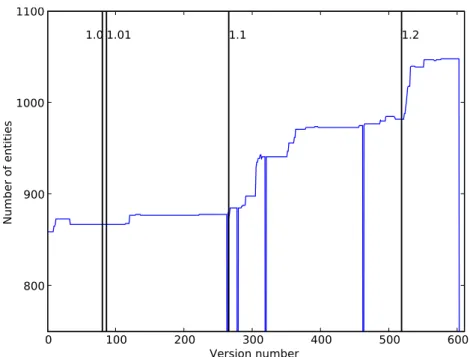
The starting point of the analysis is the question of whether the V-Modell has in-creased its complexity over time. This question is related to Lehman’s law with re-spect to system evolution, which states that the complexity of a system increases over time unless work is done to reduce it ([8], cited in [9]). To address this question, we chose a simple metric for the model complexity, namely, the total number of entities contained in each process module. By running a special query and performing simple postprocessing of the results, we determined this number for each process module and for each of the 604 analyzed versions, and produced individual plots displaying the process module's size for each version number. Due to space limitations, we are omit-ting the individual plots (22 in total) but Figure 1 shows the total size accumulated over the 22 process modules for each version number.
0 100 200 300 400 500 600 Version number 800 900 1000 1100 Num b er o f ent it ies 1.0 1.01 1.1 1.2
Fig. 1. Number of entities in the process modules along the version history.
The curve in Figure 1 shows a clear growing tendency, going from around 850 to over 1000. Pronounced growth is observed after two of the releases, probably point-ing to major changes that were held back until the release. The analysis of the plots covering specific process modules (not included here) shows a similar growing ten-dency. Significant reductions of the entity count can only be observed in cases where a module was split at some point. As the cumulative graph shows, however, this did not affect the total element count. Some “dents” can be observed at the 4 points were versions could not be read.
Even despite major restructuring, the total number of entities in the V-Modell® XT increased significantly during the observed period. This growth can be attributed, at least in part, to model enhancements such as the introduction of processes for
hard-ware development. Still, these results suggest that monitoring the complexity of pro-cess descriptions and possibly taking measures to keep it under control can be a valu-able strategy for maintaining complex process models.
4.2 Distribution of Changes Over Time and Over the Model
The next questions are concerned with the way changes affect different parts of the model: How are changes distributed among versions, and how do they relate to releas-es? How are they distributed over the process modulreleas-es?
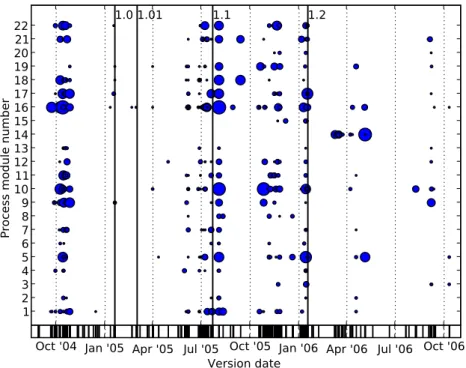
Our approach to addressing these questions was to display the changes in such a way that the process module affected by the change, as well as the time and size of the changes, become visible. Figures 2 and 3 are two such displays.
0 100 200 300 400 500 600 Version number 1 2 3 4 5 6 7 8 9 10 11 12 13 14 15 16 17 18 19 20 21 22
Process module number
1.0 1.01 1.1 1.2
Fig. 2. Changes discriminated by process module along the version history
The X-axis in Figure 2 shows the version number (from 1 to 604), whereas the Y-axis shows the process modules (numbered arbitrarily). There is a circle wherever a version changed an entity in a particular process module. The size of the circle is pro-portional to the number of changes affecting entities in the module. Figure 3 is similar to Figure 2, but the X-axis corresponds to actual calendar times. Changes are dis-played at the locations where their corresponding versions were checked in. Since versions are not distributed uniformly across time, this figure also contains a “version density” bar at the bottom that has black bars at the points in time where versions ac-tually happened.
1 2 3 4 5 6 7 8 9 10 11 12 13 14 15 16 17 18 19 2021 22
Process module number
1.0 1.01 1.1 1.2
Oct '04 Jan '05 Apr '05 Jul '05 Oct '05 Jan '06 Apr '06 Jul '06 Oct '06 Version date
Fig. 3. Changes discriminated by process module, against time.
Several points are worth mentioning about these figures. First, activity concentrates around releases. Activity before a release probably corresponds to release preparation, whereas activity after a release points to changes held back and introduced after the release. Both of these points were corroborated verbally by members of the V-Modell development team, and can also be confirmed by inspecting the version logs. An in-teresting observation is that the version-based graph (Figure 2) also looks busy around releases, implying that versions close to a release often collect more changes in a sin-gle version than versions far from the release. If this were not the case, the “conges-tion” around releases would only be observable on the time-based graph. A partial ex-planation for this phenomenon is that a number of the versions grouping several changes are related to reviews or to other bulk corrections that result in many small changes spread over the model. Still, it is possible that some of the “congested” ver-sions are the result of changes being rushed into the model shortly before a release.
One aspect that is evident on the time-based graph is that release 1.0 looks delayed with respect to its preparatory “burst” of activity, with a period of low activity before the actual release date. According to the team members, the bulk of the preparatory work was done for the model's “presentation in society” at a public event in Novem-ber 2004. Only minor corrections were made until the official release in February 2005. This can also be observed by looking at the version density bar, which shows clear peaks of activity around the releases, except for release 1.0.
Finally, the version-based graph shows us a number of process modules that present more activity than the remaining ones: 10, 16, 5 and, to some extent, 1. Al-though this is often related to their larger size, change activity seems not to be strictly
proportional to size, and also seems to depend on the relative importance of the vari-ous modules (we need to investigate both of these points in more detail). The graphs also show that process modules often undergo “bursts” of activity that calm down lat-er on, such as the one obslat-erved in process module 10 between releases 1.1 and 1.2. This suggests that, similar to what happens in software development, complex changes have to be performed step-wise and often introduce errors that must be cor-rected later.
The previous observations point in different ways to the similarities between pro-cess model and software evolution. In particular, one should not believe that change management is simpler or less risky for process models than it is for software sys-tems. Practices such as inspections, configuration management, or issue management are most probably advisable for complex modeling projects and may even be neces-sary in order to achieve high-quality results over time.
4.3 Changes in Detail
Our last question is concerned with the relationship between local and global changes: Does the evolution of individual modules look similar to the evolution of the whole model? To address this question, we decided to analyze the change history of one sin-gle process module in more detail.
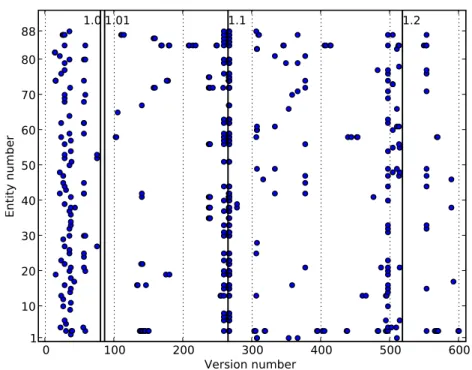
Fig. 4. Changes in process module System Development.
Figure 4 shows the changes happening to single entities in one particular module,
System Development, (number 10 in the previous two figures). The X-axis
corre-sponds to the version number, whereas the Y-Axis shows the entity number (entities
0 100 200 300 400 500 600 Version number 1 10 20 30 40 50 60 70 80 88 E nt ity num b er 1.0 1.01 1.1 1.2
were numbered arbitrarily). A dot is present where a version changes a particular enti-ty.
The first observation is that this figure presents a pattern similar to the one in Fig-ure 2, with changes concentrating around the releases. Also, shortly before the releas-es, there are versions affecting many entities at a time. This corroborates a similar ob-servation made in the previous section.
An interesting point is that several instances of changes happening in sequence to a particular entity can be seen on the graph. Although the change logs show that this may happen for a variety of reasons, it would be interesting to analyze whether it has a statistical significance, that is, when an entity was changed, there is a higher proba-bility that it will be changed in the near future. Also, it would be interesting to deter-mine which types of changes are more likely to cause such follow-up changes. Know-ing this would make it possible to better handle similar changes in the future.
5 Related Work
Several other research efforts are concerned, in one way or another, with comparing model variants syntactically, and providing an adequate representation for the result-ing differences. Most of them, however, concentrate on UML models representresult-ing di-verse aspects of software systems. Coral [10], SiDiff [11], UMLDiff [12] and the ap-proach discussed in [13] deal with the comparison of UML models. Although their basic comparison algorithms are applicable to our work, they are not concerned with providing analysis or visualization for specific uses. Additionally, FUJABA [14] manages model versions by logging the changes made to a model during editing, but is not able to compare arbitrary model versions. Models must also be edited with the FUJABA tool in order to obtain any useful change information.
Mens [15] presents an extensive survey of approaches for software merging, many of which involve comparison of program versions. The surveyed works mainly con-centrate on automatically merging program variants without introducing inconsisten-cies, but not, as in our case, on identifying differences for analysis. The Delta Ontolo-gy [16] provides a set of basic formal definitions related to the comparison of RDF graphs. SemVersion [17] and the approach discussed by [18] are two systems current-ly under development that allow for efficientcurrent-ly storing a potentialcurrent-ly large number of versions of an RDF model by using a compact representation of the raw changes be-tween them. These works concentrate on space-efficient storage and transmission of change sets, but do not go into depth regarding how to use them to support higher-lev-el tasks (such as process improvement).
We are not aware of any previous work on analyzing the evolution of process de-scriptions.
6 Summary and Future Work
Software process descriptions are intended to be faithful representations of the actual processes used to develop and maintain software systems. This fact implies a twofold
challenge for process engineers: On the one hand, descriptions must be continuously improved in order to make them closer to the actual process and to make them more accessible to their users. On the other hand, as processes are improved and expanded to deal with new development challenges, descriptions must be changed accordingly. We have used novel tools and techniques to gain some insight into the evolution of a large, practical process description. We expect to use the results of the initial observa-tions, such as those presented here, for formulating specific hypotheses to guide our future research.
A number of research directions seem promising. Currently, we are in the process of analyzing the results of the connection of the V-Modell's change history with two sources of information related to the rationale of the changes: the human edited ver-sion log and the issue tracking system [7]. We expect this to give us more insight into the dynamics of the change process: what causes changes in the first place and how the various motivations for change affect process descriptions at different points in their evolution. In particular, this may help us identify areas of the process that may be continuously causing problems, so that future improvement efforts can concentrate on them.
A final, more general question is related to process adoption. The introduction of good practices to an organization's software process involves complex learning and an increase in the necessary level of discipline. For this reason, finding an appropriate strategy for introducing good practices over time in a non-disruptive, coherent way can be very difficult. We consider that studying process evolution may teach us how to effectively introduce good practices into new organizations or into groups within an organization.
Acknowledgments. We would like to thank Rubby Casallas from Los Andes Univer-sity, Bogotá, Colombia, for her valuable comments on a draft of this article. We would also like to thank Sonnhild Namingha from Fraunhofer IESE for proofreading this paper. This work was supported in part by the German Federal Ministry of Edu-cation and Research (V-Bench Project, No. 01| SE 11 A).
7 References
1. Osterweil, L.: Software processes are software too. In: Proceedings of the 9th International Conference on Software Engineering, IEEE Computer Society (1987).
2. V-Modell® XT. Available from http://www.v-modell.iabg.de/ (last checked 2007-12-20). 3. Royce, W. W.: Managing the development of large software systems: concepts and
tech-niques. In: Proceedings of the 9th International Conference on Software Engineering (1987), IEEE Computer Society.
4. Soto, M., Münch, J.: Focused Identification of Process Model Changes. In: Proceedings of the International Conference on Software Process (ICSP 2007), Minneapolis, MN, USA, May 19-20, 2007. Springer-Verlag (2007).
5. Manola, F., Miller, E. (eds.): RDF Primer. W3C Recommendation, available from http://www.w3.org/TR/rdf-primer/ (2004) (last checked 2007-12-20)
6. Prud'hommeaux, E., Seaborne, A. (eds.): SPARQL Query Language for RDF. W3C Work-ing Draft, available from http://www.w3.org/TR/rdf-sparql-query/ (2006) (last checked 2006-10-22)
7. Ocampo, A., Soto, M.: Connecting the Rationale for Changes to the Evolution of a Process. In: Proceedings of the 8th International Conference on Product Focused Software Develop-ment and Process ImproveDevelop-ment (PROFES 2007) Riga, Latvia, July 2-4, 2007. Springer-Ver-lag (2007)
8. Lehmann, M. M.: On Understanding Laws, Evolution, and Conservation in the Large-Pro-gram Life Cycle. The Journal of Systems and Software 1, 3 (1980), 213-231.
9. Endres, A., Rombach, D.: A Handbook of Software and Systems Engineering. Pearson, (2003).
10. Alanen, M., Porres, I.: Difference and Union of Models. In: Proceedings of the UML Con-ference, LNCS 2863 Produktlinien. Springer-Verlag (2003) 2-17.
11. Kelter, Udo., Wehren, J., Niere, J.: A Generic Difference Algorithm for UML Models. Ger-man Software Engineering Conference 2005 (SE2005). (2005)
12. Xing, Z. Stroulia, E.: UMLDiff: an algorithm for object-oriented design differencing. In Proceedings of the 20th IEEE/ACM International Conference on Automated Software Engi-neering, Long Beach, CA, USA (2005).
13. Lin, Y., Zhang, J., Gray, J.: Model Comparison: A Key Challenge for Transformation Test-ing and Version Control in Model Driven Software Development. In: OOPSLA Workshop on Best Practices for Model-Driven Software Development, Vancouver (2004).
14. The Fujaba Manual, available from http://wwwcs.uni-paderborn.de/cs/fujaba/. (last checked 2007-09-06)
15. Mens, T.: A State-of-the-Art Survey on Software Merging. IEEE Transactions on Software Engineering, Vol. 28, No. 5, (2002).
16. Berners-Lee, T., Connolly D.: Delta: An Ontology for the Distribution of Differences Be-tween RDF Graphs. MIT Computer Science and Artificial Intelligence Laboratory (CSAIL). Online publication http://www.w3.org/DesignIssues/Diff (last checked 2006-03-30). 17. Völkel, M., Enguix, C. F., Ryszard-Kruk, S., Zhdanova, A. V., Stevens, R., Sure, Y.:
Sem-Version - Sem-Versioning RDF and Ontologies. Technical Report, University of Karlsruhe (2005).
18. Kiryakov, A., Ognyanov, D.: Tracking Changes in RDF(S) Repositories. In: Proceedings of the Workshop on Knowledge Transformation for the Semantic Web, KTSW 2002. Lyon, France. (2002).