doi:10.1016/j.ijrobp.2006.04.038
PHYSICS CONTRIBUTION
GEOMETRIC ACCURACY OF A REAL-TIME TARGET TRACKING SYSTEM
WITH DYNAMIC MULTILEAF COLLIMATOR TRACKING SYSTEM
P
AULJ. K
EALL, P
H.D.,* H
ERBERTC
ATTELL, B.E.,
†D
AMODARP
OKHREL, M.S.,*
S
ONJAD
IETERICH, P
H.D.,
‡K
ENNETHH. W
ONG, P
H.D.,
§M
ARTINJ. M
URPHY, P
H.D.,*
S. S
ASTRYV
EDAM, P
H.D.,*
!K
RISHNIW
IJESOORIYA, P
H.D.,*
ANDR
ADHEM
OHAN, P
H.D.
! *Department of Radiation Oncology, Virginia Commonwealth University, Richmond, VA;†Varian Medical Systems,Palo Alto, CA;‡Department of Radiation Medicine, Georgetown University Hospital, Washington, DC;§Department
of Radiology, Georgetown University Hospital, Washington, DC; and!Department of Radiation Physics, The University of Texas M.D. Anderson Cancer Center, Houston, TX
Purpose: Dynamically compensating for target motion during radiotherapy will increase treatment accuracy. A laboratory system for real-time target tracking with a dynamic MLC has been developed. In this study, the geometric accuracy limits of this DMLC target tracking system were evaluated.
Methods and Materials: A motion simulator was programmed to follow patient-derived tumor motion paths, parallel to the leaf motion direction. A target attached to the simulator was optically tracked, and the leaf positions adjusted to continually align the DMLC beam aperture to the target. Analysis of the tracking accuracy was based on video images of the target and beam alignment. The system response time was determined and the tracking error measured. Response time– corrected tracking accuracy was also calculated to investigate the accuracy limits of an improved system.
Results: The response time of the system is 160!2 ms. The geometric precision for tracking patient motion is 0.6 to 1.1 mm (1") for the 3 patient datasets tested, with tracking errors relative to the original patient motion of 35, 40, and 100%.
Conclusions: A DMLC target tracking system has been developed that can account for detected motion parallel to the leaf motion direction. The tracking error has a negligible systematic component. Reducing the response time will further increase the overall system accuracy. © 2006 Elsevier Inc.
Tumor tracking, Geometric accuracy, Dynamic multileaf collimator, Dynamic motion compensation.
INTRODUCTION
The multileaf collimator (MLC) is a widely available
technol-ogy for radiation therapy delivery. The technoltechnol-ogy to adjust
leaf positions during beam delivery based on a predetermined
leaf sequence facilitating intensity modulated radiation therapy
is also quite mature (
1
). Another obvious application, though
technically challenging, is to use the MLC to continuously
realign the radiation beam to the target during therapy,
dynam-ically compensating for any detected target motion.
Proof-of-principle studies of this approach have been performed, (
2–6
)
however to date no studies have reported on the
implementa-tion of dynamic MLC (DMLC) target tracking.
Other options for aligning the radiation beam with a
moving target during radiotherapy with dynamic motion
com-pensation are robotic control of the linear accelerator (
7, 8
)
(clinically available), block motion (
9
), and couch motion
(
10
) (investigated, though not clinically available).
A system for real-time tracking of targets with DMLC
has been developed in a laboratory setting at Virginia
Com-monwealth University. The aim of the current work was to
characterize the limits of geometric accuracy of a DMLC
target tracking system.
METHODS AND MATERIALS
DMLC target tracking system
A schematic diagram and photograph of the DMLC target tracking system are shown inFig. 1. A motion simulator (11, 12) was programmed to follow patient tumor motion paths. Details of Reprint requests to: Paul J. Keall, Ph.D., Radiation Oncology,
Stanford University, 875 Blake Wilbur Dr., Stanford, CA 94305-5847. Tel: (650) 723-5549; Fax: (650) 498-5008; E-mail: [email protected]
Supported by Grant Nos. R01CA93626 and R21CA119143 from the National Institutes of Health and by a sponsored research agreement between Varian Medical Systems and VCU.
Acknowledgments—Dorin Todor helped to write the image anal-ysis software. Hassan Mostafavi and Sergey Povzner gave
timely technical support and advice. Chris Bartee, Mark Hile, and Matthew Schaefer provided engineering support. Elisabeth Weiss and Michelle Svatos offered useful critique on the manu-script. Many others from VCU Radiation Oncology and Varian Medical Systems have also contributed to the VCU 4D Radio-therapy project.
Received Feb 8, 2006, and in revised form April 18, 2006. Accepted for publication April 18, 2006.
Printed in the USA. All rights reserved 0360-3016/06/$–see front matter
the patient data are given below. The motion was optically de-tected using the Varian (Palo Alto, CA) Real-Time Position Man-agement (RPM) system in which images acquired with a camera (labeled as camera 1 inFig. 1a) of a marker box with two infrared reflecting markers are segmented and positions calculated. These positions were sent via serial port to a computer. Software was written to calculate the required leaf positions to track the target based on the incoming position signal. These leaf positions were then communicated via ethernet to the MLC controller, which actuated the mechanical leaf motion of the MLC (Varian Millen-nium 120-leaf). For the studies described herein leaf sequences describing a circle were used, though the choice of leaf shape could be chosen to fit an arbitrary target.
A separate beam’s eye view camera (camera 2 inFig. 1a) was used to synchronously measure the target and leaf motion. The camera-MLC-target distances (18 cm and 17 cm respectively) were a similar ratio to the actual source-MLC-target distances in a linear accelerator. Video images of the target motion, and DMLC motion were recorded and analyzed. The ‘target’ for these studies was a reflective marker. To facilitate obtaining the DMLC posi-tion, reflective markers were placed on 2 of the leaves, 1 on each leaf bank, and the 2 marker positions averaged. The DMLC positions and the target motion were both measured by segmenting each image frame from the camera above the motion simulator. Thus the 2 signals (DMLC and target motion) were simultaneously
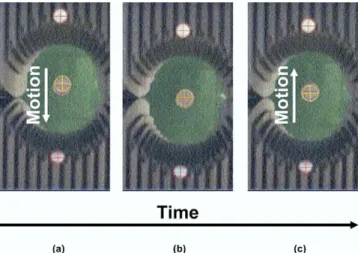
recorded by the same device. Image analysis software was written using Matlab (Mathworks, Natick, MA) to segment the target and leaf reflective markers. Example images of the video files analyzed to obtain the data are shown inFig. 2.
A motion simulator was programmed to reproduce either peri-odic sinusoidal motion or nonperiperi-odic patient motion. A sinusoidal curve with a 2 cm range of motion and a 6 s period was used for the response time calculation, motion calibration, and accuracy determination under known conditions. Three representative pa-tient motion examples, covering a range of breathing types and tumor locations, were simulated. The tumor motion data were acquired under IRB protocol at Georgetown University Hospital from Cyberknife (Accuray, Sunnyvale, CA) Synchrony treatments. Note that the motion data are periodically measured using orthog-onal X-ray, and predicted between X-ray images based on an external optical signal (7). Brief details of the patient tumor motion are given below:
● Patient 1 was a middle-aged man with a lower lobe lung tumor. The tumor motion was regular with a range of motion of 10 to 15 mm.
● Patient 2 was a middle-aged woman with an advanced-stage right central lung tumor. The tumor motion was small and very irregular, with a motion period of approximately 1 s.
● Patient 3 was an elderly woman with a lower lobe lung tumor. The tumor motion was fairly regular with a range of motion of 6 to 10 mm.
The DMLC tracking system currently only accounts for motion in the superior-inferior (SI) direction, parallel to the leaf motion; the RPM system only tracks motion in the anterior-posterior (AP) direction. For these reasons only the SI component of the patient data were used (this has the largest magnitude of the 3 dimensions) to simulate both SI and AP motion so that the RPM system could acquire the motion data, and the DMLC tracking system compen-sate for it. For each of the cases, video images were acquired for approximately 60 s.
Fig. 2. Images of the dynamic multileaf collimator (DMLC) target tracking for (a) downward target motion (inhale to exhale), (b) no motion (end exhale), and (c) upward target motion (exhale to inhale). The red circles/crosses are the segmented leaf and target center positions, the yellow circle/cross is the DMLC targeting center position. The DMLC is seen to be lagging behind the target motion because of the system response time.
Fig. 1. Experimental set-up of the dynamic multileaf collimator (DMLC) target tracking system. (a) Schematic diagram; (b) la-beled photograph.
EXPERIMENTAL PROCEDURES
First, the uncertainty of the system needed to be established, to ensure the tracking errors found were credible. Next, we were interested in determining the system response time to understand to what extent the tracking error is limited by the present techno-logic implementation. The response time (or system latency),i.e., the time for the DMLC to respond to a given target motion, is the sum of the time for the tasks of image acquisition, segmentation and processing by the RPM system, leaf position calculation, data transfer, and leaf motion execution. We passively tracked the target first to determine the alignment between the DMLC and the target. The response time was estimated and the response time– corrected average DMLC position was matched to the average target position. The subsequently recorded target and DMLC po-sitions were used for analysis. This scenario is not dissimilar to what would occur for patient applications—the DMLC would passively track the patient motion without radiation delivery until beam-target alignment occurred at which time radiation delivery would be initiated. This approach would also be used for resump-tion of an interrupresump-tion during delivery (e.g., an interrupresump-tion caused by a cough).
Determining the uncertainty of the tracking system in the
absence of target motion
To determine the uncertainty of the measurement system, video images were recorded with the target static. The target and leaf MLC positions were segmented in the images using custom-written software. The high contrast of the image of the reflective markers used made the segmentation process relatively trivial. No relative motion of the two inputs was expected; any observed motion is an estimate of the system measurement uncertainty, which was used to put the subsequently analyzed tracking errors in context.
Calibrating motion and calculating system response time
The motion simulator was programmed to exhibit sinusoidal motion with a known range of motion (2 cm). Tracking the sinusoidal motion enabled the calibration of the requested leaf position change based on the incoming position information from the RPM system. The system response time is the time taken to complete the feedback loop shown inFig. 1a. The effect of the response time on the DMLC position can be seen inFig. 2, where the DMLC position is lagging behind the target position when in motion. Figure 3 also shows the DMLC positions are slightly offset from the target positions. The system response time was determined by computing the phase difference from a sinusoidal fit to the target motion and DMLC motion.
Characterizing geometric tracking accuracy
To determine the alignment between the DMLC and the target, both the DMLC and target motion were recorded for 6 s. The choice of 6 s is arbitrary, and is used to yield a reasonable estimate of the target position for alignment. The response time– corrected (see following) average DMLC position was matched to the aver-age target position over this time period. Subsequent recordings of the target position (beyond 6 s) and the DMLC positions were used for analysis.
The analysis included computing the tracking error (difference between DMLC and target position), response time–corrected track-ing error (difference between response time–corrected DMLC and
target position) and the time integrated distributions (probability density functions) of these parameters. The response time– cor-rected DMLC positions were computed by shifting the DMLC positions in the time axis by 2 image frames (130 ms). This data yields an estimate of the system accuracy if the feedback loop shown inFig. 1were completed in!30 ms. It should be noted that the response time– corrected data cannot be realized with the current system, however is included to estimate the accuracy limits of an improved DMLC tracking system.
RESULTS
Determining the uncertainty of the tracking system in the
absence of target motion
With the target static, the system detected target motion of
less than 0.1 mm (1!), and recorded a tracking error of less
than 0.15 mm (1!). This measurement error is an estimate of
the accuracy attainable with the current set-up, and is much
lower than the tracking errors measured in their presence of
motion (described below) indicating that the following
re-sults are reasonable estimates of their true values.
Calculating system response time
By computing the phase difference based on a sinusoidal
fit to the target motion and DMLC motion for repeat
track-ing of sinusoidal motion, the average system response time
was computed to be 160
"
2 ms. This average value varies
because of discrete events such as the RPM image
acquisi-tion (33-ms period), leaf posiacquisi-tion calculaacquisi-tions (20-ms
pe-riod) and the MLC cycle period (50-ms pepe-riod).
Characterizing geometric tracking accuracy
The target tracking accuracy of the DMLC for sinusoidal
and patient motion can be seen in
Fig. 3
. The DMLC is
observed to lag behind the target (as expected based on the
response time measurements). Because of this response
time, the tracking error is largest when the target velocity is
highest. If this response time were significantly reduced, the
response time– corrected DMLC curve matches very closely
with the target motion. The resultant response time–
cor-rected tracking errors are very small. By integrating over
time, probability density functions (pdfs) of these tracking
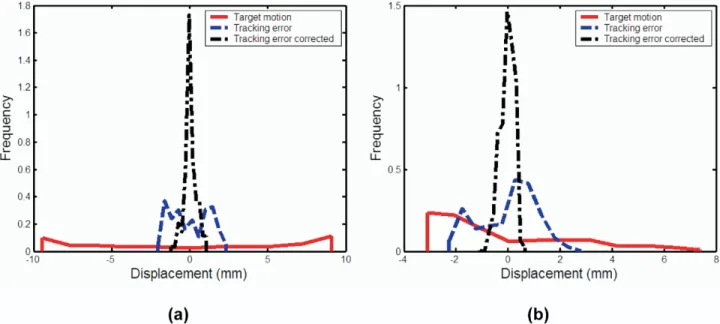
errors were generated and are displayed in
Fig. 4
. The
tracking error distribution is significantly lower than the
initial target motion distribution; however, still has an
ap-preciable width. Reducing the response time would further
reduce the tracking error.
The pdfs were quantified based on their means and
stan-dard deviations. The results are shown in
Table 1
. There are
several interesting features. In the first column, the mean
displacements are small, though nonzero, indicating that a
shift had taken place since the initial alignment of the
DMLC and target in the first few seconds. For Patient 3 a
1-mm mean difference was observed. Had the data
acqui-sition been for longer than a minute, larger systematic
differences may have been observed. The systematic
track-ing error is very small in all cases. For Patient 2, though the
target motion was on average small, because of the extremely
high frequency and irregular breathing motion the tracking
error was the same as the target motion indicating no benefit of
tracking for this patient. The tracking error for patients 1 and 3
were 40% and 35% of the target motion respectively.
Correct-ing for the response time of the system yields significantly
lower tracking errors, of the order of 0.3 mm (1
!
).
DISCUSSION
The geometric accuracy of a DMLC target tracking
sys-tem to track sinusoidal and patient motion has been
inves-tigated. The observed tracking errors for the patient data, 0.6
to 1.1 mm (1
!
) are encouraging, and give an estimate of
what geometric errors may be expected of such a system
when clinically implemented. The magnitude of tracking
error is approximately equal to that calculated by Vedam
et al.
(
13
) for a response time of 160 ms (
!
1 mm), though
the patient data were different in these studies. The lack of
improvement in the tracking results for Patient 2 are a
reminder to be careful; indeed if the response time were
longer it is likely the use of tracking would have reduced
targeting accuracy over not tracking. Overall, the tracking
errors are random in nature with a small systematic
com-Fig. 3. Position vs. time plots of the target position (red solid line), the dynamic multileaf collimator (DMLC) position(blue dashed line) and the response time– corrected DMLC position (black dash– dot line) for (a) a sinusoidal curve and (c) Patient I data. Position vs. time plots of DMLC tracking error (blue solid line) and the response time– corrected DMLC tracking error for the sinusoidal curve (b) and Patient 1 data (d).
ponent. According to published margin formulas, random
errors are less deleterious than systematic errors as shown,
for example, in the table in van Herk
et al.
(
14
). However,
their magnitude should still be quantified and accounted for
appropriately. The dynamic motion compensation offered
by DMLC-based target tracking means that if variations in
the patient’s initial treatment position are observed during
treatment then the tracking system can automatically
ac-count for the change in position.
An important component of any dynamic compensation
system is the target position monitoring system. Any errors
in this process will manifest themselves as tracking errors.
The motion detection system used here was optically based.
As the target was visible for the experiments, the input
signal was highly correlated with the target motion. The use
of optical motion signals as a surrogate for internal motion
should be used with caution, as variations in correlation and
phase shifts (
15–20
) have been observed between
monitor-ing systems and internal structures. An ideal position
mon-itoring system would have high accuracy, high update
fre-quency, low processing time and give a large volume of
information about the target (and normal structure)
posi-tions. The motion detection system used in the current work
was limited to one dimension, thus the target tracking was
also limited to accounting for motion along the leaf motion
direction. Tumor motion has been observed to be
predomi-nantly in one direction, (
21
) however hysteresis was observed
in some cases. For DMLC tracking it would be prudent to align
the DMLC with the major axis of tumor motion.
High-fre-quency (relative to target motion) 3D motion detection systems
are available or becoming available, based on dual
fluoro-scopic, (
22
) combined fluoroscopic and optical, (
7, 8
) and
electromagnetic technology (
23
). These 3D motion detection
systems would integrate well with a DMLC tracking system.
The results of the hypothetical response time– corrected
tracking error scenario show a clear pathway for where to
focus future development efforts. An alternative to reducing
the response time to improve accuracy is to incorporate
motion prediction algorithms (
13, 24 –26
). On reviewing
results published by Vedam
et al.
(
13
), at the response time
measured here (160 ms) motion prediction is likely to
reduce the tracking error by 30%.
The patient motion data used was well within the
me-chanical velocity and acceleration constraints of the DMLC
Fig. 4. Probability density functions for (a) a sinusoidal curve and (b) Patient 1 data. Each plot shows three curves: theinput target motion (red solid), the dynamic multileaf collimator (DMLC) tracking error (blue dashed line) and the response time– corrected DMLC tracking error (black dash– dot line).
Table 1. Mean (x!) and standard deviation (!) of the target motion, tracking error and response-time– corrected tracking error over a 60-s tracking period
Data source
Target displacement Tracking error (response-time–corrected)Tracking error
x! (mm) !(mm) x!(mm) !(mm) x!(mm) !(mm)
Sine curve 0.12 7.22 0.05 1.22 0.04 0.41
Patient 1 #0.36 2.77 0.01 1.12 #0.01 0.30
Patient 2 0.02 0.61 #0.01 0.61 #0.02 0.31
for measurements of the same MLC type, (
27
) and the
addition of a beam hold during extremely rapid target
mo-tion would not have significantly increased the accuracy of
the system. Such a beam hold would be desirable for the
clinical implementation of DMLC tumor tracking to avoid
treating during times of rapid target motion,
e.g.
, coughing.
The DMLC tracking system investigated here was only
applied to lung applications, since this is one of the most
challenging sites for tracking. However the technology is
general enough to account for detected motion for other
sites,
e.g.
, prostate, pancreas, and liver.
CONCLUSIONS
A DMLC target tracking system has been developed that
can account for detected motion parallel to the leaf
direc-tion. The response time of the current system is 160 ms. The
geometric precision for tracking patient motion is 0.6 to 1.1
mm (1!) for the three patient datasets tested, with tracking
errors relative to the original patient motion of 35%, 40%,
and 100%. The tracking error has a negligible systematic
component. Reducing the response time will further
in-crease the overall system accuracy.
REFERENCES
1. Webb S. IMRT delivery techniques. In: Bortfeld T,Schmidt-Ullrich R, De Neve W,et al., editors. Image-guided IMRT. Heidelberg: Springer-Verlag; 2006. p. 73–90.
2. Keall PJ, Kini VR, Vedam SS,et al.Motion adaptive x-ray therapy: a feasibility study.Phys Med Biol2001;46:1–10. 3. Suh Y, Yi B, Ahn S,et al.Aperture maneuver with compelled
breath (AMC) for moving tumors: a feasibility study with a moving phantom.Med Phys2004;31:760 –766.
4. Neicu T, Shirato H, Seppenwoolde Y, et al. Synchronized moving aperture radiation therapy (SMART): average tumour trajectory for lung patients.Phys Med Biol2003;48:587–598. 5. Papiez L, Rangaraj D. DMLC leaf-pair optimal control for
mobile, deforming target.Med Phys2005;32:275–285. 6. Papiez L, Rangaraj D, Keall P. Real-time DMLC IMRT
delivery for mobile and deforming targets.Med Phys2005; 32:3037–3048.
7. Schweikard A, Glosser G, Bodduluri M,et al.Robotic motion compensation for respiratory movement during radiosurgery. Comput Aided Surg2000;5:263–277.
8. Schweikard A, Shiomi H, Adler J. Respiration tracking in radiosurgery.Med Phys2004;31:2738 –2741.
9. Uematsu M. CT-guided focal high dose radiotherapy. 4th S. Takahashi International Workshop on 3 Dimensional Confor-mal Radiotherapy. Nagoya, Japan; 2004. p. 81.
10. D’Souza WD, Naqvi SA, Yu CX. Real-time intra-fraction-motion tracking using the treatment couch: a feasibility study. Phys Med Biol2005;50:4021– 4033.
11. Zhou TJ, Dieterich S, Cleary K. A robotic 3-D motion simu-lator for enhanced accuracy in Cyberknife radiosurgery. In: Lemke HU, Inamura K, Doi K, Vannier MW, Farman AG, Reiber JHC, editors. Computer aided radiology and surgery. London: Elsevier; 2004. p. 323–328.
12. Tang J, Dieterich S, Cleary K. Respiratory motion tracking of skin and liver in swine for CyberKnife motion compensation. In: Galloway RL Jr, editor. SPIE Med Imaging Proceedings; 2004;5367:729 –734.
13. Vedam SS, Keall PJ, Docef A, et al. Predicting respiratory motion for four-dimensional radiotherapy.Med Phys2004;31: 2274 –2283.
14. van Herk M. Errors and margins in radiotherapy.Semin Radiat Oncol2004;14:52– 64.
15. Vedam SS, Kini VR, Keall PJ, et al. Quantifying the
predictability of diaphragm motion during respiration with a noninvasive external marker. Med Phys 2003;30:505– 513.
16. Mageras GS, Pevsner A, Yorke ED, et al. Measurement of lung tumor motion using respiration-correlated CT.Int J Ra-diat Oncol Biol Phys2004;60:933–941.
17. Ahn S, Yi B, Suh Y,et al.A feasibility study on the prediction of tumour location in the lung from skin motion.Br J Radiol 2004;77:588 –596.
18. Hoisak JD, Sixel KE, Tirona R, et al. Correlation of lung tumor motion with external surrogate indicators of respiration. Int J Radiat Oncol Biol Phys2004;60:1298 –1306.
19. Koch N, Liu HH, Starkschall G,et al.Evaluation of internal lung motion for respiratory-gated radiotherapy using MRI: part I– correlating internal lung motion with skin fiducial mo-tion.Int J Radiat Oncol Biol Phys2004;60:1459 –1472. 20. Tsunashima Y, Sakae T, Shioyama Y,et al.Correlation
be-tween the respiratory waveform measured using a respiratory sensor and 3D tumor motion in gated radiotherapy. Int J Radiat Oncol Biol Phys2004;60:951–958.
21. Seppenwoolde Y, Shirato H, Kitamura K,et al.Precise and real-time measurement of 3D tumor motion in lung due to breathing and heartbeat, measured during radiotherapy.Int J Radiat Oncol Biol Phys2002;53:822– 834.
22. Shirato H, Shimizu S, Kunieda T,et al.Physical aspects of a real-time tumor-tracking system for gated radiotherapy.Int J Radiat Oncol Biol Phys2000;48:1187–1195.
23. Balter JM, Wright JN, Newell LJ,et al.Accuracy of a wireless localization system for radiotherapy.Int J Radiat Oncol Biol Phys2005;61:933–937.
24. Sharp GC, Jiang SB, Shimizu S,et al.Prediction of respiratory tumour motion for real-time image-guided radiotherapy.Phys Med Biol2004;49:425– 440.
25. Murphy MJ. Tracking moving organs in real time. Semin Radiat Oncol2004;14:91–100.
26. Isaksson I, Jalden J, Murphy MJ. On using an adaptive neural network to predict lung tumor motion during respiration for radiotherapy applications.Med Phys2005;32:3801–3809. 27. Wijesooriya K, Bartee C, Siebers JV,et al.Determination of
maximum leaf velocity and acceleration of a dynamic mul-tileaf collimator: implications for 4D radiotherapy.Med Phys 2005;32:932–941.