Technical Note
Wavelet-Based Hydrological Time Series Forecasting
Yan-Fang Sang
1; Vijay P. Singh
2; Fubao Sun
3; Yaning Chen
4; Yong Liu
5; and Moyuan Yang
6Abstract:These days wavelet analysis is becoming popular for hydrological time series simulation and forecasting. There are, however, a set of key issues influencing the wavelet-aided data preprocessing and modeling practice that need further discussion. This article discusses four key issues related to wavelet analysis: discrepant use of continuous and discrete wavelet methods, choice of mother wavelet, choice of temporal scale, and uncertainty evaluation in wavelet-aided forecasting. The article concludes with a personal reflection on solving the four issues for improving and supplementing relevant wavelet studies, especially wavelet-based artificial intelligence modeling.DOI:10.1061/ (ASCE)HE.1943-5584.0001347.© 2016 American Society of Civil Engineers.
Author keywords:Hydrological forecasting; Artificial intelligence modeling; Wavelet analysis; Temporal scale; Hydrological time series analysis; Statistical significance.
Introduction
Understanding the variability of hydrological processes is an essen-tial and important scientific topic in hydrology studies, but it is also a difficult problem due to the complex stochastic nature of hydro-logical processes (Shoaib et al. 2014). Hydrological time series analysis and forecasting is an effective approach to determine the variability of hydrological processes and predict future values. During recent years wavelet modeling has become popular for hydrological time series forecasting because the wavelet analysis method has the superiority of handling the nonstationary variability of hydrological processes (Nourani et al. 2014;Sang et al. 2015). For wavelet model inputs, the original hydrological series are usu-ally decomposed into a set of subsignals by continuous or discrete wavelet method, called data preprocessing. Each subsignal plays a different role in the original series, and the behavior of each sub-signal is distinct. Therefore, a wavelet model is constructed such that wavelet decomposition results of the original input series are the input data vector and the original output series are still
the output data vector (Kisi 2009). Compared with conventional single models, the process of hydrological time series forecasting by wavelet models is more easily guided because it takes the vari-ability of hydrological processes into consideration. However, a set of key issues influences the wavelet-aided data preprocessing and modeling practice, and the choices of proper mother wavelet and temporal scale are two of the most important issues. In fact, these two issues constitute the essential basis of all wavelet analyses. Although there are a multitude of relevant studies (Sang 2012; Nourani et al. 2014;Shoaib et al. 2014), these issues have not been completely resolved, and there is no universal method for the choice of mother wavelet and temporal scale yet.
Following the theories of wavelet analysis (Percival and Walden 2000), the suitable mother wavelet and temporal scale should ac-curately reflect the deterministic characteristics and true compo-nents (periodicities, trend, etc.) in a hydrological time series under multitemporal scales. Although we clearly know the math-ematical equations and properties of all wavelets, the true compo-nents in the raw hydrological data are not known. Thus, there forms a paradox: on one hand, we need to choose a suitable wavelet and temporal scale to identify the true components, but on the other hand, we should first know the true components to choose a suit-able wavelet and temporal scale. This is the primary reason for the difficulty in the choice of mother wavelet and temporal scale. In this article the authors offer personal opinions and sugges-tions for wavelet modeling, hopefully as an improvement and a supplement for relevant studies. Because a large number of studies describing various types of wavelet models have been reported, they are not repeated here. Four issues of concern in wavelet modeling here are (1) discrepant use of continuous and discrete wavelet method, (2) choice of mother wavelet, (3) choice of tem-poral scale, and (4) uncertainty evaluation in wavelet-aided fore-casting. These issues are now discussed.
Key Issues in Wavelet Modeling
Discrepant Use of Continuous and Discrete Wavelet Method
The basic objective of wavelet analysis is to achieve a complete representation of the localized and transient phenomena occurring at different temporal scales (Percival and Walden 2000; Labat
1Associate Professor, Key Laboratory of Water Cycle and Related Land Surface Processes, Institute of Geographic Sciences and Natural Resources Research, Chinese Academy of Sciences, Beijing 100101, China (corre-sponding author). E-mail: [email protected]; [email protected]
2Distinguished Professor, Caroline and William N. Lehrer Distin-guished Chair in Water Engineering, Dept. of Biological and Agricultural Engineering and Zachry Dept. of Civil Engineering, Texas A&M Univ., 321 Scoates Hall, 2117 TAMU, College Station, TX 77843-2117.
3Professor, Key Laboratory of Water Cycle and Related Land Surface Processes, Institute of Geographic Sciences and Natural Resources Research, Chinese Academy of Sciences, Beijing 100101, China.
4Professor, State Key Laboratory of Desert and Oasis Ecology, Xinjiang Institute of Ecology and Geography, Chinese Academy of Sciences, Urumqi 830011, China.
5Associate Professor, State Key Laboratory of Hydrology-Water Resources and Hydraulic Engineering, Nanjing Hydraulic Research Institute, Nanjing 210029, China.
6Ph.D. Candidate, Key Laboratory of Water Cycle & Related Land Surface Processes, Institute of Geographic Sciences and Natural Resources Research, Chinese Academy of Sciences, Beijing 100101, China.
Note. This manuscript was submitted on July 15, 2015; approved on November 19, 2015; published online on February 12, 2016. Discussion period open until July 12, 2016; separate discussions must be submitted for individual papers. This technical note is part of theJournal of Hydro-logic Engineering, © ASCE, ISSN 1084-0699.
2008). Generally, wavelet analysis can be divided into two types: continuous and discrete. Both of them have been widely applied in hydrology. In the specific area of wavelet-aided modeling, the dis-crete wavelet method has gotten more applications compared with the continuous wavelet method. Many studies discussed the prob-lem and gave the reason that the continuous wavelet method gen-erates large amounts of data and requires more computational time and resources (Adamowski and Sun 2010;Tiwari and Chatterjee 2010). However, they did not clearly explain the problem, and more convincing reasons should be given.
In the authors’ opinion, the continuous and discrete wavelet method has different superiority for hydrological time series analy-sis. The continuous wavelet method is superior for determining both the scale contents of a series and how they vary in time. In their excellent work, Torrence and Compo (1998) placed the con-tinuous wavelet transform method in the framework of statistical analysis by formulating a significance test. This has made the con-tinuous wavelet method become more effective and rapidly de-velop. The continuous wavelet method of course can be used for wavelet modeling, just as discussed by Shoaib et al. (2014). Generally, more data can give more useful information, which would be favorable for the data-driven modeling practice (Singh 1998). The continuous wavelet method can identify the complex characteristics of a time series under multitemporal scale, based on which the continuous wavelet-based models can perform better than those single models. However, there is much repeated infor-mation (called data redundancy) in the continuous wavelet results of a time series, and the results get more impacts from the boundary effects, which would influence the stability of wavelet modeling structure and correspondingly cause more uncertainty. It is the main reason causing the worse performance of the continuous wavelet models compared with the discrete wavelet models, so the former has limited application in wavelet modeling practice.
The superiority of the discrete wavelet method is to decompose a series into subsignals given proper wavelet and temporal scale, and the result can guide wavelet threshold denoising and wavelet decomposition. Because those wavelets used for discrete wavelet transform must meet the orthogonal properties, the results can over-come the problem of data redundancy in the continuous wavelet transform. On the basis of the discrete wavelet results of series, we can avoid the influences of noise and multi components over-lapping on the hybrid wavelet–artificial intelligence models. There-fore, the discrete wavelet method is commonly employed for hydrological time series forecasting.
As a result, the continuous and discrete wavelet methods have different advantages for time series analysis. If our purpose is to understand complex localized and nonstationary variability of a time series, we can use the continuous wavelet method. If we want to do denoising, identification of true components, especially wave-let modeling, we should use the discrete wavewave-let method.
Choice of Mother Wavelet
Differing from other transform techniques whose basis functions are fixed, the choice of proper mother wavelet is the foremost task in all wavelet analyses because results of time series analysis are very sensitive to the wavelets used. There is a large number of wavelets which are available for time series analysis. Different wavelet functions are characterized by their distinctive support region and vanishing moment. The support region of a wavelet reflects its feature of localization ability, and the vanishing moment of a wavelet reflects its ability of representing polynomial behavior or information of the data. Generally, all mother wavelets can be divided into two types, orthogonal or nonorthogonal. Seven
wavelet families, Haar, Daubechies (dbN), Coiflets (coifN), Sym-lets (symN), BiorSplines (biorM.N), ReverseBior (rbioM.N), and DMeyer (dmey), are orthogonal wavelets. Three wavelet families, Morlet (morl), Mexican hat (Marr), and Gaussian (gaus), are non-orthogonal wavelets. The use of an non-orthogonal wavelet implies the use of the discrete wavelet transform whereas a nonorthogonal wavelet can be used with either the discrete or the continuous wave-let transform (Torrence and Compo 1998).
The essence of wavelet transform is to discover the similarity between the analyzed series and wavelet (Walker 1999), but it can-not be easily carried out in practice, and an appropriate wavelet cannot be easily chosen. Many studies have discussed the choice of wavelet function. For instance, Torrence and Compo (1998) sug-gested choosing a nonorthogonal wavelet by comparing“width and shape”similarity between wavelet and series; Schaefli et al. (2007) suggested that the chosen wavelet should have progressive and linear phases, exhibit good time-frequency localization, and be adapted to the trade-off between time and scale resolutions; and Nourani et al. (2014) suggested that similarity in the shape between wavelet and raw series is often the best guide in choosing a reliable wavelet. These suggestions are mainly qualitative and empirical, and cannot be easily implemented in practice. Besides, many other studies tried to find out one or some suitable wavelets for wavelet modeling through experiments (Nourani et al. 2011;Maheswaran and Khosa 2012;Singh 2011;Shoaib et al. 2014). However, the universality and usability of these selected wavelets are limited by a lack of evidence.
In the authors’opinion, both the properties of wavelets and the composition of series should be considered for choosing a wavelet, and three key points should be clarified for the issue. The first is that four key properties of wavelets should be concerned: (1) the wavelet should have the progressive and linear phase; (2) the wave-let should exhibit good localization both in time and frequency do-mains; (3) the wavelet should be adapted to the trade-off between time and scale resolutions (Schaefli et al. 2007); and (4) the wavelet should also meet the orthogonal condition, because it is required for wavelet decomposition, denoising, multiresolution analyses, and many other wavelet analyses (Sang et al. 2013). The second is that because observed hydrological data usually include noise, which contaminates the true components of the series (Yevjevich 1972), the similarity between wavelet and those true components in raw noisy series, but not raw noisy series, should be the basis for choos-ing the proper mother wavelet; in other words, the appropriate wavelet should at least meet the need of accurately separating the true components from noise through wavelet denoising practice (Donoho 1995). The third is that because different time series usu-ally show different characteristics and include different true com-ponents, it may be more feasible to establish a universal rule or criterion for the choice of wavelet, but not to find a specific method or wavelet for the problem. Sang et al. (2013) discussed the prob-lem, and used the statistical indices to establish the criteria for choosing a proper wavelet (Table1). The criteria quantify the sim-ilarity between the denoised series and raw series, and restrict the pure random characteristics of noise. To be specific, the mean val-ues of the raw and denoised series should be similar; the standard deviation value of the denoised series should be smaller than that of the raw series; the coefficient of skewness of the raw and denoised series should be similar; the lag-1 autocorrelation coefficient of the denoised series should be bigger than that of the raw series; and the lag-1 autocorrelation coefficient of the removed noise should be close to zero. Analyses of various synthetic and observed series have verified its reasonableness, and the results accord well with the essence of wavelet transform. Hence, the criteria can be an approach to choosing a wavelet.
Choice of Temporal Scale
The choice of proper temporal scale, called decomposition level for the discrete wavelet analysis, is another important issue for wavelet analysis, especially for wavelet modeling, because it directly deter-mines the accuracy of the characteristics identified in a time series under multitemporal scales. In many previous studies, an algorithm of log10n, which is based on historical data length n, is recom-mended for choosing a temporal scale (Wang and Ding 2003; Belayneh et al. 2014;Nourani et al. 2014). Besides, another algo-rithm of log½n=ð2v−1Þ=logð2Þ, which is based on both series length nand the numberv of vanishing moments of wavelet, is also widely used for choosing a temporal scale (de Artigas et al. 2006; Nalley et al. 2012). These algorithms may be arguable. Hydrological time series usually show dominant characteristics under multitemporal scales, and various time series with the same length show obviously different characteristics. Therefore, the choice of proper temporal scale should be closely based on the composition and characteristics of the analyzed data, but not the series data length, properties of wavelet, or other factors.
In the authors’opinion, two key points must be considered for the choice of a temporal scale: purpose and uncertainty. Discrete wavelet analysis is usually used for denoising or separating the true components of a series, as the basis of wavelet modeling, so two types of temporal scale need to be chosen for the two purposes, respectively. Besides, decomposition results of the series and the identified true components using the chosen temporal scale have uncertainty; therefore, the evaluation of uncertainty is another im-portant problem. Sang (2012) discussed this problem and proposed the significance testing of discrete wavelet transform (DWT). He first established a stable reference energy function by doing Monte Carlo simulation to diverse noise types. Then, by comparing the energy function of the hydrological time series with the reference energy function, he presented a step-by-step guide for wavelet de-composition of series (Fig.1), in which a suitable temporal scale can be chosen, and uncertainty can also be quantitatively evaluated using a proper confidence interval. Following the guide, we can easily judge whether a component under a certain temporal scale is noise or a true component, and the result can guide artificial in-telligence modeling. Hence, the significance testing of DWT for hydrological time series analysis is recommended here for choos-ing a proper temporal scale.
Uncertainty Evaluation in Wavelet-Aided Forecasting The combination of wavelet analysis with artificial intelligence models improves hydrological time series forecasting. Various studies have demonstrated the effectiveness of this practice due
to the ability of wavelet analysis (Wang and Ding 2003;Sang 2013; Nourani et al. 2014;Tiwari and Adamowski 2013;Rathinasamy et al. 2013). However, forecasting results of hydrological extremes (including both maximum and minimum) have not been obviously improved in many case studies. These hydrological extremes reflect the complex influence of various random factors on hydro-logical processes and cause the uncertainty in hydrohydro-logical time series forecasting. On the whole, present studies about wavelet mod-eling mainly focused on improving the accuracy of forecasting value through diverse combinations of models, but there is a limited study about uncertainty evaluation.
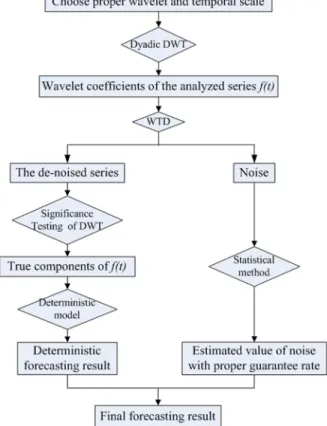
Hydrological processes generally have uncertainty, and the fore-casting result with a single optimal value is not convincing and “honest.”The optimal results do not take uncertainty into account effectively, so they cannot meet the practical needs adequately (Krzysztofowicz 2001). Sang (2013) tentatively proposed a wavelet modeling framework for hydrological time series forecasting (Fig.2). The framework first separates different true components and removes noise in the original series through the discrete wave-let method. It then forecasts the former and quantitatively describes the random characteristics of noise. Finally, it adds them up and obtains the final forecasting results. Forecasting of true components is for obtaining the deterministic forecasting results, and noise analysis is for estimating the occurrence possibility of extremes. In the future, more efforts should be made to employ proper methods of uncertainty evaluation into the wavelet modeling Fig. 1.The steps for comparing energy function of hydrological series with the reference energy function, and the steps for choosing decom-position level. “DWT”is discrete wavelet transform (reprinted from
Sang 2012, © ASCE)
Table 1. Criteria for Assessment of the Reasonability of the Chosen Wavelet and the Denoising Result of Series
Series’type
Statistical indices
¯
X σ Cs r1
Original series Xo¯ σo Cso r1o Denoised series Xm¯ ≈Xo¯ σm<σo Csm≈Cso r1m>r1o Noise Xn¯ ¼Xo¯ −Xm¯ — — r1n≈0 Note: Denoised series = true components in original series; Noise = random components removed from original series; Original series = observed series data. For the original series, denoised series, and noise,X¯o,X¯m, andX¯nare their mean;σo,σm, andσnare their standard deviation;Cso,Csm, andCsn are their coefficient of skewness; and r1o, r1m, and r1n are their lag-1 autocorrelation coefficient, respectively. — = it is unknown about the statistical character of noise. It is cited from Sang et al. (2013).
processes and further to make the results of hydrological time series forecasting more reliable.
Conclusions
In this paper four key issues related to wavelet modeling are dis-cussed, and the methods and suggestions for solving them are given. On the whole, the continuous and discrete wavelet methods have different advantages for time series analysis. We can use the continuous wavelet method to identify complex localized and non-stationary variability of a time series and use the discrete wavelet method to do denoising, identification of true components, espe-cially wavelet modeling. In the process of wavelet analysis, both the properties of wavelets and the composition of series should be considered for choosing a proper mother wavelet; the choice of proper temporal scale should be closely based on the composi-tion and characteristics of the analyzed data, and both the purpose and uncertainty should be considered in the choice of a proper tem-poral scale.
In conclusion, the wavelet models can improve hydrological time series forecasting. Because accurate wavelet analysis of time series is the kernel of wavelet modeling, more studies should focus on it in future studies. Especially, uncertainty evaluation is still an open issue in wavelet-aided modeling, and more studies should be given to the problem.
Acknowledgments
The authors gratefully acknowledged the most appropriate com-ments and suggestions given by the editors and the anonymous
reviewers. The author also thanks Ms. Feifei Liu for her assistance in the preparation of the manuscript. This project was financially supported by the Strategic Priority Research Program of the Chinese Academy of Sciences (XDB03030202); the National Natural Science Foundation of China (41330529, 41201036); the Program for the“Bingwei”Excellent Talents from the Institute of Geographic Sciences and Natural Resources Research, Chinese Academy of Sciences; the Chinese Academy of Sciences Pioneer Hundred Talents Program; and the Opening Fund of the State Key Laboratory of Desert and Oasis Ecology, Xinjiang Institute of Ecology and Geography, Chinese Academy of Sciences.
References
Adamowski, J., and Sun, K. (2010).“Development of a coupled wavelet transform and neural network method for flow forecasting of non-perennial rivers in semi-arid watersheds.”J. Hydrol., 390(1–2), 85–91. Belayneh, A., Adamowski, J., Khalil, B., and Ozga-Zielinski, B. (2014).
“Long-term SPI drought forecasting in the Awash River basin in Ethio-pia using wavelet neural network and wavelet support vector regression models.”J. Hydrol., 508, 418–429.
de Artigas, M. Z., Elias, A. G., and de Campra, P. F. (2006).“Discrete wavelet analysis to assess long term trends in geomagnetic activity.” Phys. Chem. Earth., 31(1–3), 77–80.
Donoho, D. H. (1995).“De-noising by soft-thresholding.”IEEE T. Inform. Theory, 41(3), 613–627.
Kisi, O. (2009).“Wavelet regression model as an alternative to neural net-works for monthly streamflow forecasting.”Hydrol. Process., 23(25), 3583–3597.
Krzysztofowicz, R. (2001). “The case for probabilistic forecasting in hydrology.”J. Hydrol., 249(1–4), 2–9.
Labat, D. (2008).“Wavelet analysis of the annual discharge records of the world’s largest rivers.”Adv. Water Resour., 31(1), 109–117. Maheswaran, R., and Khosa, R. (2012). “Comparative study of different
wavelets for hydrologic forecasting.”Comput. Geosci., 46, 284–295. Nalley, D., Adamowski, J., and Khalil, B. (2012).“Using discrete wavelet
transforms to analyze trends in streamflow and precipitation in Quebec and Ontario (1954-2008).”J. Hydrol., 475, 204–228.
Nourani, V., Baghanam, A. H., Adamowski, J., and Kisi, O. (2014).“ Ap-plications of hybrid wavelet–artificial intelligence models in hydrology: A review.”J. Hydrol., 514, 358–377.
Nourani, V., Kisi, O., and Komasi, M. (2011).“Two hybrid artificial intel-ligence approaches for modelling rainfall-runoff process.”J. Hydrol., 402(1–2), 41–59.
Percival, D. B., and Walden, A. T. (2000).Wavelet methods for time series analysis, Cambridge University Press, Cambridge, U.K.
Rathinasamy, M., Adamowski, J., and Khosa, R. (2013). “Multiscale stream flow forecasting using a new Bayesian model average based ensemble multi-wavelet Volterra nonlinear method.”J. Hydrol., 507, 186–200.
Sang, Y. F. (2012).“A practical guide to discrete wavelet decomposition of hydrologic time series.”Water Resour. Manage., 26(11), 3345–3365. Sang, Y. F. (2013).“Improved wavelet modeling framework for hydrologic time series forecasting.”Water Resour. Manage., 27(8), 2807–2821. Sang, Y. F., Singh, V. P., Wen, J., and Liu, C. M. (2015).“Gradation of
complexity and predictability of hydrological processes.”J. Geophys. Res. Atmos., 120(11), 5334–5343.
Sang, Y. F., Wang, D., Wu, J. C., Zhu, Q. P., and Wang, L. (2013).“ Im-proved continuous wavelet analysis on the variation of hydrologic time series’dominant period.”Hydrol. Sci. J., 58(1), 118–132.
Schaefli, B., Maraun, D., and Holschneider, M. (2007).“What drives high flow events in the Swiss Alps? Recent developments in wavelet spectral analysis and their application to hydrology.” Adv. Water Resour., 30(12), 2511–2525.
Shoaib, M., Shamseldin, A. Y., and Melville, B. W. (2014).“Comparative study of different wavelet based neural network models for rainfall-runoff modeling.”J. Hydrol., 515, 47–58.
Fig. 2.Steps of hydrological time series forecasting by the wavelet modeling framework. “DWT” is discrete wavelet transform, and “WTD” is wavelet threshold de-noising (reprinted fromSang 2013, © ASCE)
Singh, R. M. (2011).“Wavelet-ANN model for flood events.”Adv. Intel. Software Comput., 131, 165–175.
Singh, V. P. (1998). Entropy-based parameter estimation in hydrology, Kluwer Academic Publishers, Boston, London.
Tiwari, M., and Adamowski, J. (2013). “Urban water demand fore-casting and uncertainty assessment using ensemble wavelet-bootstrap-neural network models.” Water Resour. Res., 49(10), 6486–6507.
Tiwari, M. K., and Chatterjee, C. (2010). “Development of an accurate and reliable hourly flood forecasting model using
wavelet-bootstrap-ANN (WBANN) hybrid approach.” J. Hydrol., 394(3–4), 458–470.
Torrence, C., and Compo, G. P. (1998). “A practical guide to wavelet analysis.”B. Am. Meteorol. Soc., 79(1), 61–78.
Walker, J. S. (1999).A primer on wavelets and their scientific applications, Chapman and Hall, CRC, New York.
Wang, W. S., and Ding, J. (2003).“Wavelet network model and its appli-cation to the prediappli-cation of hydrology.”Nature Sci., 1(1), 67–71. Yevjevich, V. (1972).Stochastic process in hydrology, Water Resources
Publications, Littleton, CO.