Detection of Cognitive Process during
Differentiating Task with
Electroencephalography
Tan Trong Dang Vo
February 2012
A thesis submitted for the degree of Master of Philosophy of the Australian National University
Declaration
The work in this thesis is my own except where otherwise stated.
Acknowledgements
The work in this dissertation would not be a possible without the help of the people listed below,
• My foremost appreciation is to both of my supervisors Prof. Tom Gedeon and Dr. Sumudu Mendis. I would like to thank Tom for his kind and calm approach to many issues I faced - and yet still can pursue me to get things done during my time here. I am also thankful for your invaluable ideas and suggestions, as well for the never-give-up attitude. As for Sumudu, being supervised by him only for one year, yet I have learnt a lot from him on how to be a conventional researcher - especially at the beginning of my time here. To me it is invaluable to have both of you as my supervisors as you always the:ce to guide me with just research directions and there to support me.
• I would like to thank my family: my mother, father and sister for supporting me throughout my time here. Studying away from home was not easy for them to support me and I do appreciate your occasional unexpected long drive trip down here to visit me.
• The people in my research group from ANU: Gareth, Dingyun, Nandita for the useful discussions during meetings. Especially Gareth for his insights on various aspects of this research field.
• I also would like to thank all the friends I have made here in ANU for your great companionship and inspiration: Xi, Grace, Richard, Pete, Ting, Nguy en.
• Also, I would like to thanks all members of the Research School of Computer Science at ANU for their help and support in various ways (administrative, tech-nical and so on). My life would be much harder without you .
. . vu
Abstract
Human beings notice differences in their environment and make explicit and implicit differentiations between events and activities. These are very intuitive activities that humans perform on a regular basis, studying the cognitive processes behind them will help gain more knowledge on mental tasks, opening up possibilities for better brain-computer interaction (BCI) mechanisms in the future. In this study, these cognitive processes were measured using a non-invasive brain measuring method, Electroen -cephalography (EEG) as well as a behavioural measure (eye gaze path). Separate experiments were carried out to examine both scenarios of explicit (voluntary) and implicit (involuntary) differentiations. Using a combination of machine learning tools for signal analysis, a high correct rate of classification results in combination with s ig-nificant statistical figures achieved has shown that one can effectively identify those mental tasks from studying the brainwave and eye gaze measurements.
Organisation of the Dissertation
In Chapter 1, we (you, the reader and I) will discuss the background knowledge that is the foundation of this research work. The chapter starts by introducing the funda-mental components that my research is based on: Brain-Computer Interface (BCI) and Electroencephalography(EEG). This goes as far as discussing two conventional BCI methods, Visual Evoked Potential and Mental Tasks that represent two different ap-proaches in designing BCI systems. They are related to our research because they are already proven BCI systems and, to some extent, provide mechanisms of communi-cating commands to a computer via EEG. The chapter finishes with a discussion on fine-textured differentiating actions in the context of BCI, which will put into some perspective about Chapter 2.
Chapter 2 of this dissertation is dedicated for describing our work on detecting explicit differentiating actions from EEG signals in detail. We start this chapter by examining the challenges that we could encounter as well as investigating the future potential of the work. Subsequently, we introduced considerations taken into account for the pur-pose of designing suitable EEG experiments to achieve the research goal. The chapter then moves on to describe the experiment in terms of set-up, hardware and software op-tions, methods in signal processing and data classification. The chapter also explains in detail the two machine learning techniques employed for the purpose of classify-ing experimental data: Support Vector Machines and Artificial Neural Networks. The analysis section of the chapter summarises the results in various aspects and is fol-lowed by a discussion of the future work that could be done as an extension to this work.
Chapter 3 describes our investigation on the ability to detect the existence of implicit differencing activities from studying EEG signals. For this purpose, we carried out reading experiments to confirm our assumptions: by studying a person's EEG signals,
we can pick up his/her unintentional differentiating activities while reading English paragraphs. For that reason, a portion of the chapter is dedicated for explaining the experiment's background while the rest of it describes the experiment in term of set-up and the methods by which the EEG data is processed. Finally, the chapter concludes by detailing the classification results from the two aforementioned classification tech-niques and summaries the outcomes of this work.
Chapter 4 describes further research on human behaviour in reading tasks. Unlike the general theme set so far by this dissertation, gaze tracking was used as the mean to capture biological features for studying. Our aim is to investigate if we can associate certain gaze behaviours to reading tasks. Our hypothesis is that if we could capture a person's gaze points while he is reading, we would be able to either tell what subjects he/she is interested in, how quickly or thoroughly he/she can read or simply if he/she is paying attention to certain screen areas. The chapter also proposes a novel method of detecting the level of engagement in reading based on a person's gaze-pattern. In the conclusion of the chapter, we compare the performance of data classification using gaze tracking with EEG. We can then confirm the correlation between the two.
In the concluding chapter, we summarise the results of the research work as a whole, reflect on lessons learnt and make some suggestions for future work.
List of Publications
My contributions have been published in internationally refereed conferences as listed below:
-1. Tan Vo, B. Mendis, and Tom Gedeon. Gaze Pattern and Reading Comprehen-sion. Neural Information Processing. Models and Applications - 17th Interna-tional Conference, ICONIP 2010.
2. Tan Vo, and Tom Gedeon. Reading Your Mind: EEG during Reading Task. Neural Information Processing. Models and Applications - 18th International
Conference, ICONIP 2011.
Contents
Acknow~edgements Abstract 1 Introduction 1.1 Background . . . . 1.1.1 Differentiation Tasks . . . 1.1.2 Brain-Computer Interface 1.1.3 Electroencephalography . 1.2 EEG and Visual Evoked Potential1.2.1 VEP Fundamentals . . . . 1.2.2 Current Research in VEP . 1.2.3 Drawbacks of VEP . . . . 1.2.4 Advantages and Opportunities 1.3 EEG and Mental Tasks
1.3.1 Background .. 1.3.2 Success Story . 1.3.3 Discussion . .
1.4 Differencing Task and EEG . 1.4.1 Background . ·.
1.4.2 Research Goals 1.4.3 Considerations
Diversity in Types of Differentiation . Influential Factors . . . .
Existing Effort in Modelling Differentiating Process The Time versus Complexity Factor
2 Explicit Differentiation and EEG 2.1 Introduction . . . . xv
..
VII.
IX 1 1 1 2 3 5 5 5 6 7 8 8 9 10 11 11 12 12 12 13 13 1315
152.1.1 2.1.2 2.1.3 2.1.4 Research Goals . . . . Methods Brain-Computer Interface Discussion on EEG . Introduction . . . . Influential Factors Discussion . . . .
2.1.5 Support Vector Machine (SVM) Introduction . . . . Kernel Functions . . . . 2.1.6 Artificial Neural Network (ANN) 2.2 BCI Experiments . . . .
2.2.1 Introduction . . . . 2.2.2 Design Considerations
The Noise in EEG Data.
The Non-stationary Nature of BCI
Triggering Mechanism used in Experiment Studied Differentiation Types . . . .
Using Gaze-tracking Device in Conjunction with EEG 2.2.3 Experiment Details . .
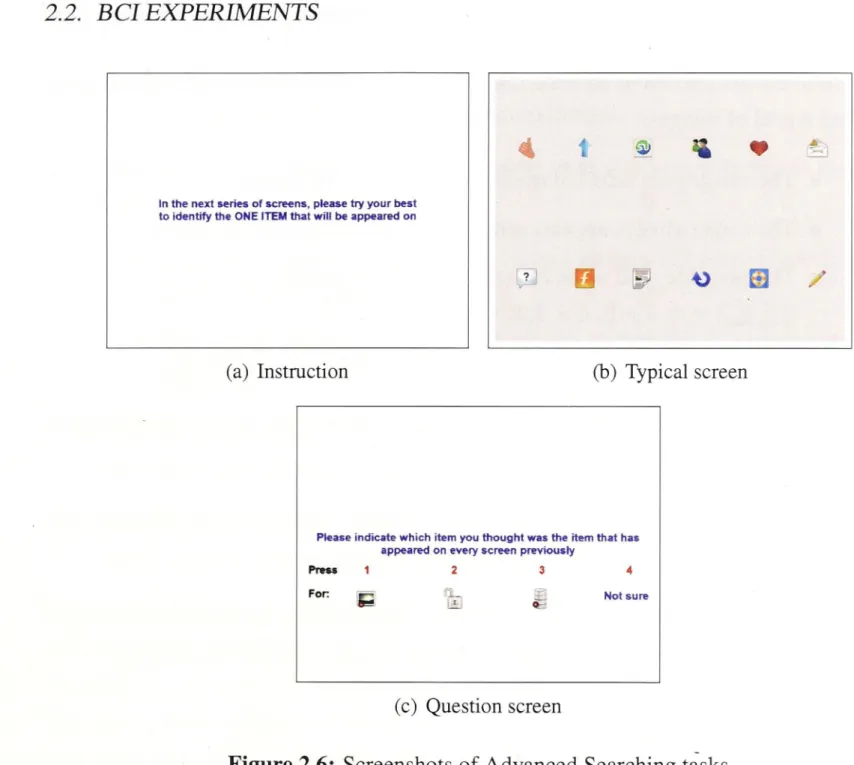
Visual Selection Task . Searching Task . . . . Advanced Searching Task 2.2.4 Offline BCI Experiment
Visual Selection Task . . . Searching Task . . . . Advanced Searching Task 2.2.5
2.2.6 2.2.7
Hardware Option 1 - BioSerni ActiveTwo Hardware Option 2 - Emotiv EPOC headset Software Option 1 - BCI2000 Project
Introduction . . . . . Strategies . . . .
Issues with BCI2000
2.2.8 Software Option 2 - Custom Built Application
2.3 Signal processing . . . . 2.3.1 Fast Fourier Transform (FFT)
2.3.2 Key-press or Not Key-press
15 16 16 18 18 18 19 20 20 20 22 23 23 24 24 24 25 25 26 26 26 27 28 28 28
29
30 31 32 34 34 34 35 35 36 36 37CONTENTS
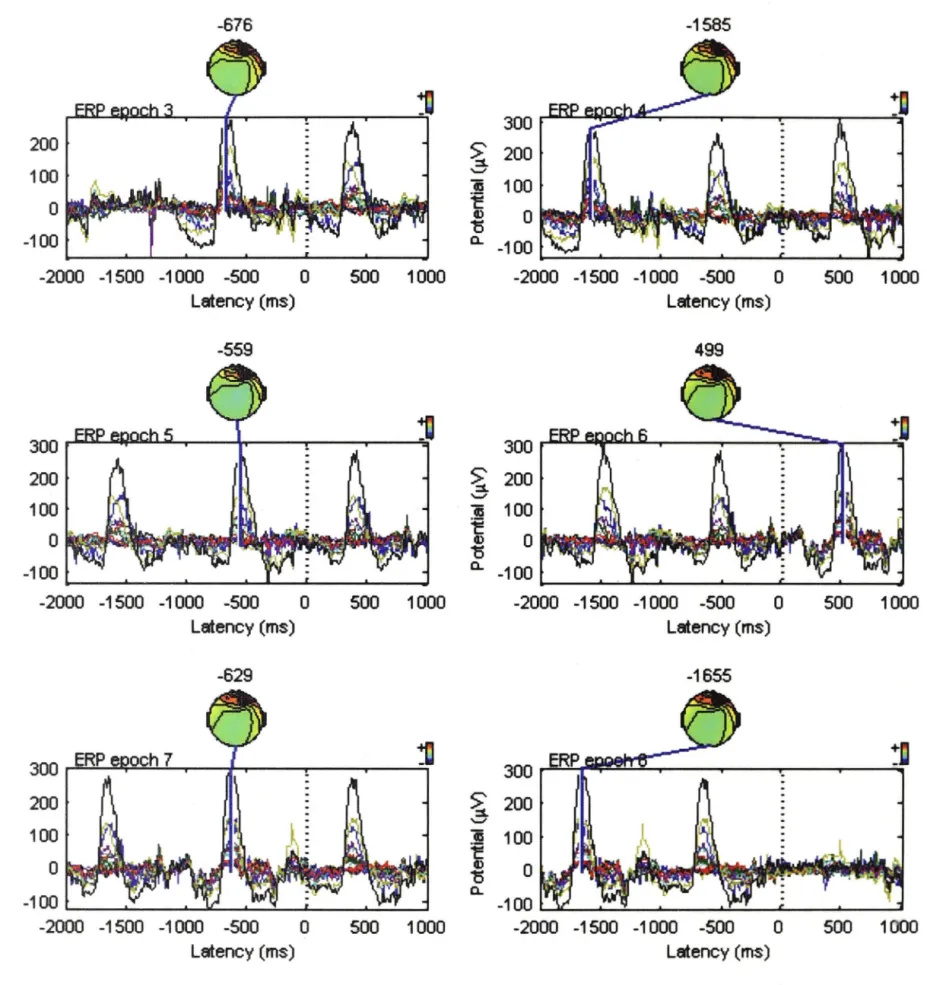
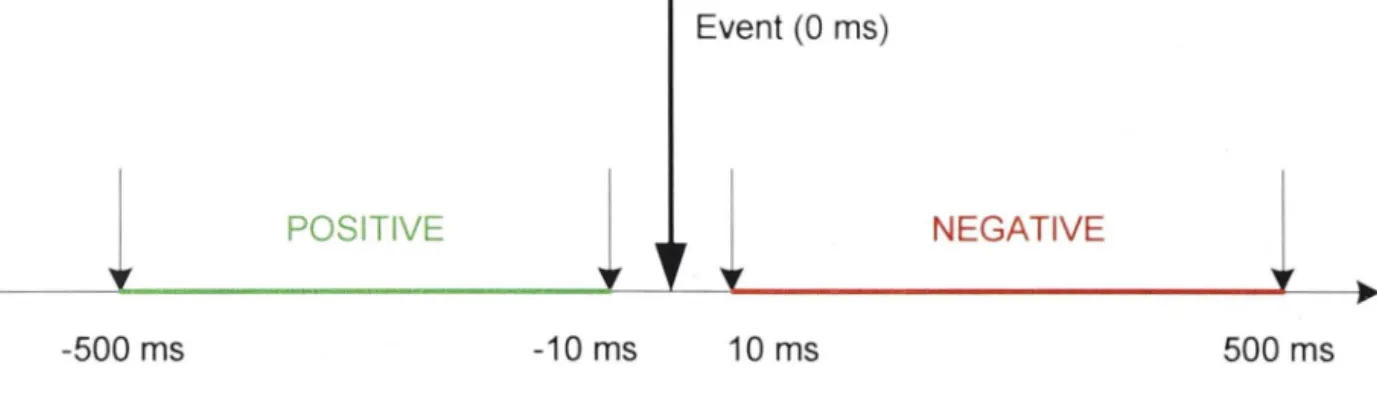
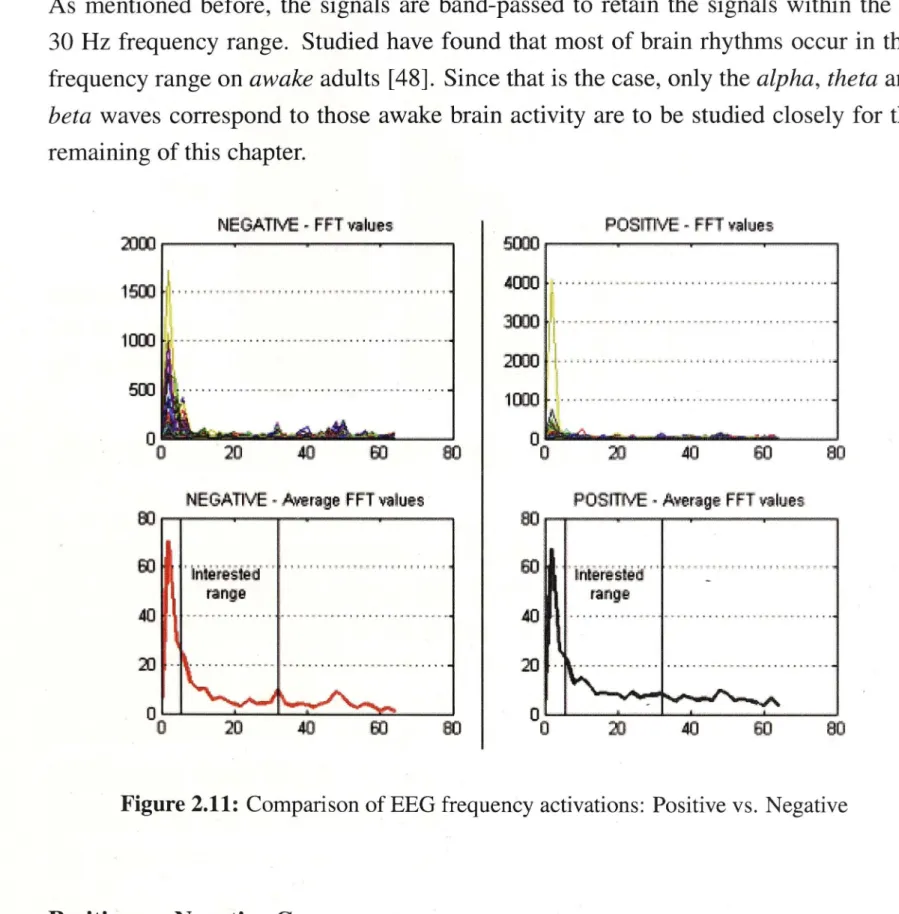
2.4 Preliminary Trial and Offline Analysis 2.4.1 Background . . . . 2.4.2 Pre-processing . . . . 2.5 Preliminary Trials: Initial Observations
2.5 .1 Statistical Analysis . . . . . Signal Preparations . . . . . Positive vs. Negative Cases 2.5.2 Discussion . . . . 2.6 Preliminary Trials: Classification . .2.6.1 Methodology . . . .
Normalisation of Vectors in Input Space . Features Space
Cross-validation 2.6.2 . SVM Results ..
Radial Basis Kernel . Polynomial Kernel
Multilayer Perceptron Kernel Overall . . . . 2.6.3 ANN Results . . . .
2.6.4 Validating the Effects of Key-press on EEG Signals . Channel Selection
Signal Processing . Feature Selection . Classification . . . Result and Discussion 2. 7 Lessons Learnt . . . .
2. 7 .1 Complexity of Differentiation Activities EEG Hardware Sampling Rate . . . . .
The Variety in Lenghts of Differentiation Period The Delays ( or Tentative) in Differentiation Suggestions . . . . 2. 7 .2 Experiment Design . . . . Lack of Room to Properly Identify Signals
Utilise other Mechanisms to Notify Differentiation A More Robust Strategy for Marking Events
Experimantal Sample Size
2. 7 .3 Data Analysis . . . . XVll 38 38 39 39 41 41 43
45
45
46 46 46 47 47 47 48 48 49 50 51 51 5253
53
53
54
54
54
54
55 55 5555
56 5758
58
The Possibility of a General Pattern in Differentiation . 58 The Variety in Durations of Differentiation . . . 58 Study of Beta waves as an individual component 59 Study of Task 3 Data . . . 59
3 Implicit Differentiation and Reading 61
3 .1 Introduction 61
3.2 Background 61
3.2.1 Reading and Implicit Differentiation . 61
3.2.2 Reading Activity . . . 62
3.2.3 EEG and Eye-movements 63
3.2.4 Methods 63 3 .3 Experiment . . . 3.3.1 I-Iardware Visual computer Capturing computer EEG Device . . . . 3.3.2 Software and Calibration
BioSemi ActiView . . .
In-house EEG capturing application In-house Event Notifier application 3 .4 Preliminary Analysis . . . .
3 .5 Signal Processing . . . . 3.5.1 Fast Fourier Transformation 3 .5 .2 Peak Detector and Feature Set 3 .6 Classifications . . . .
3.6.1 Support Vector Machine Polynomial Kernel . . . Radial Basis Function Kernel 3.6.2 Artificial Neural Network 3.7 Results - Individual Participants
3.7.1 Summary . 3.7 .2 Discussion
Accuracy . Performance 3.8 Re ults - A11 Participants 3.9 Sum1nary . . . . 64 66 66
67
67
67
69
69
69
69
71 71 72 72 72 73 73 73 73 73 73 73 7576
77CONTENTS
4 Implicit Differentiation with Gaze-tracking 4.1 Introduction . . . .
4.2 Background . . . . 4.2.1 Eye-gaze and Reading . 4.2.2 Reading Comprehension 4.3 Experiment . . . . . 4.3.1 Background . 4.3 .2 Participants Group A Group B .. 4.3.3 The Paragraphs 4.3 .4 Equipment Setups
4.3 .5 Data Collection and Preparation 4.4 Proposed Method . . . .
4.4.1 Effective Reduction of Data Resolution
4.4.2 Focus on Back Tracking and Forward Tracking 4.4.3 Levenberg-Marquardt based Neural Network 4.5 Evaluation and Comparison . . . .
4.5.1 Neural Network Results . . . . 4.5 .2 Support Vector Machine Comparison 4.5 .3 Comparison with EEG Results . . . .
XlX 79
79
79
79
8082
82
82
82
83 84 84 87 8888
8990
90
90
92 93 4.6 Future work and Opportunities . . . 934.6.1 Analysing other information gathered from participants of Group A . . . 93
4.6.2 Attempt at different sets of feature 94
4.7 Summary . . . 94 5 Conclusions and Future Work
5.1 Conclusion . . . .
5 .1.1 Explicit Differentiation and EEG . 5 .1.2 Implicit Differentiation and EEG . 5.1.3 EEG and Eye-gaze Correlations 5.2 Future Work . . . .
5 .2.1 Signal Processing . General . . . . Feature Extraction
5 .2.2 Investigate other Machine Leaming Methods
95 95 95 95 96 96 96 96 96
97
Alternative SVM Kernel Methods . . . 97 Nonnegative Tensor Factorization for Classification . 97
A Reading Paragraphs 99
List of Figures
1.1 Multi-trial averaged bandpass filtered P300 signal from one electrode (Task versus Non-task stimulus cases) . . .
2.1 Brain-Computer Interface Building Blocks . 2.2 Support Vector Machine with hyperplane . 2.3 Screenshots of Visual Selection task . . . . 2.4 Screenshots of Sean;hing task (With Pictures) 2.5 Screenshots of Searching task (With Shapes) . 2.6 Screenshots of Advanced Searching tasks .. 2.7 Event sequence of a typical experiment unit . 2.8 Plotting of ERP data with scalp maps for Epochs
7 17 21 27 27 28 29 37 40 2.9 Brain activities of a differentiating task: Activations and Raw signals. 41 2.10 Relative positions of Positive and Negative epochs . . . 43 2.11 Comparison of EEG frequency activations: Positive vs. Negative 44 2.12 Comparison of EEG frequency bands distribution on one participant:
Positive vs. Negative . . . 44 2.13 EEG channel selections: SMR vs. Differentiation 52
2.14 Different type of epochs between screens 56
2.15 Added delay between screens . . . 56
3 .1 An example of reading paragraphs 65
3 .2 EEG electrode placements . . . . 68
3.3 EEG computers and the software set-up 69
3.4 Visualisation of EEG :readings activity of paragraphs 70 3.5 Signal processing process . . . 71 3. 6 Visualisation of an FFf transformed for 16 channels of an epoch 71 3. 7 Comparison of classification accuracy of methods 7 6
4.1 The setup of the experiment 85
4.2 Measurements of experiment setup. . . 86 4.3 Interactions between GazeTracker and FaceLab. 87 4.4 An example of 2 reading patterns of the same paragraph by two
differ-ent participants. . . 88 4.5 A paragraph is divided into cells by a 4-by-5 grid. Each identified by
a cell number . . . 89 4.6 A distribution of cell movement distances throughout reading activity
of a paragraph . . . 90 4.7 Performance (MSE) of one run of training the ANN 91
Chapter 1
Introduction
1.1 Background
1.1.1 Differentiation Tasks
Within the context of this research, only differentiating activity of human as the act of perceiving the difference in or between objects was considered. In other word, it is to mentally discriminate one thing from the others, a very common activity that humans perform on regular basis.
In general, this mental differentiating process is a process that may have been
stud-ied over the years. However, this very topic may have been studstud-ied under different name or contexts. Up until now, various theories have been introduced to explain how people differentiate objects they observe, as well as identify influencing factors. It is
however, still a very challenging research area as there are a lot of unknown variables_ involved.
One could broadly categorise differentiation activities into two types according to
the way a person perform them:
• Explicit differentiation Refers to the voluntary discriminating actions that are
performed by human when provided with "choices" to decide between.
• Implicit differentiation On the other hand, study of implicit differentiation deals with hidden discriminations/ judgements made by a person without their acknowledgement.
Because of that, the study of this tasks could be devided into two sections: one for
investigating the nature of explicit differentiation while the other deals with implicit
differentiation. The goal is to see if one can computationally recognise those mental tasks from studying EEG signals captured from test participating.
So how do one to achieve this goal? Electroencephalography (EEG) was used to measure the brain activities from electrodes placed on the human scalp and attempt to determine various cognitive processes by studying those EEG measurements (signals). In this scenario, a black-box approach was considered: If one could feed accurate and steady enough inputs to a person's brain, he could potentially be able to observe certain outputs from the person's EEG signals captured during scenarios. The inputs in this context are stimuli sent to the person that result in cognitive reactions from his brain. Two different approaches for both of types of differentiation are required in regard to experiment designs.
With regards to studies of Explicit differentiating tasks, it would be desirable to design experimental scenarios that guides a person ( equipped with EEG) into making various differentiation tasks and expect those EEG captures to exhibit some patterns that can be recognised by machine (i.e. with the use of machine learning algorithms and so on).
On the other hand, a more subtle approach is needed for designing ·experiments on Implicit differentiation actions. In this dissertation) Reading task was used as the mechanism to conceal the differencing tasks from the knowledge of the person (hence implicit). The selection of reading because of its familiarity to most people, also the complexity of the activity will help distract the person from recognising any discrimi-nation he makes about the contents he is reaqing.
The goal of this work is to confirm EEG's potential in detecting series of differen-tiations made· by humans while performing another mental activity such as reading.
Studies of human brain activities have generally been done within the perimeter of either neuroscience or psychology research fields. This research, however, belong to a relatively new trend of research on human brain that takes advantage of modern computing power to aid to the study of human brain.
1.1.2
Brain-Computer Interface
Traditionally, humans interact with computers via peripheral devices such as keyboards and mice. Mice and keyboards are not necessarily the most natural interaction methods with computers and, in some circumstances, may not be capable enough. There are al o other input methods that are considered alternatives to keyboard and mice. Tho e are method that utilise eye-gazes and voice. However, the prospect of them being used a conventional peripherals is well in the future.
1.1. BACKGROUND 3 Brain-Computer Interface (BCI) is, in a sense, an alternative human-computer in-teraction method that involves a bi-directional link between human brain and com-puter. Being Bi-directional in the sense that a person's brain issues commands, in-structions to a machine and the machine provide feedbacks (visual, auditory) to the person - not directly to his brain. In some cases, such as for people who have severe damage to their spinal cord, BCI is not just a convenience but a necessity. Think about those with a severed spinal injury and cannot use computers with their limbs, BCI is technically a very suitable solution for them. According to Lebedev and Nico~elis [35], in general, BCI systems can be classified as either Invasive or Non-Invasive:
Invasive BCI Electrodes are implanted within the cranium of the brain. By BCI standards, this methodology provides neural signals of the best quality and has a high potential for further development. However, its biggest drawback is that it carries risks associated with neurosurgery. Neurosurgery also greatly limits this technique's
accessibility for general use.
Non-invasive BCI These methods do not require any invasive surgical procedure. Popular examples of these are the ones that based on magnetic resonance of blood vessels to identify brain activities (brain-mapping) - ±RMI for instance. On the other hand, techniques such as Electroencephalography (EEG) utilise electrodes to study the brain activities from the outside of the human head (normally over the scalp area). Being without the need for neurosurgery, these methods are considered more accessible than their counterpart. Nowadays, some EEG devices are sold as consumer products.
From this point of the dissertation onward, the only type of BCI will be referred to
. . . 1s non-1nvas1ve.
1.1.3 Electroencephalography
As for the present, the use of EEG readings as a non-invasive technique for Brain-Computer Interaction (BCI) is a popular choice among research institutes as it is con-sidered safer and more accessible than the aforementioned invasive ( direct brain con-trol) methods. EEG fundamentally is the recording of the electrical activity of the brain from the scalp with electrical electrodes. The recorded signals reflect the electrical ac-tivities on the surface of the brain, which is influenced by the electrical activities from the brain structures underneath the cortex. These signals are measured in microvolts (µ V) due to their s,nall nature.
The first recordings on human were made by Hans Berger in 1929 although similar studies had been carried out in animals as early as 1870 (Henry [27]). Since then, EEG has been involved, developed and still being used widely for clinical purposes
1.e. evaluation of brain disorders; yet there exists a new trend in research that utilise
EEG as means to interact with machines. That is also the focus of this research work:
making use of EEG signals from the HCI perspective.
The studies of EEG signals generally required transforming EEG channels into
frequency bands. The amplitudes ( or combination of) belong to those frequency bands
are normally used as features to study with [27]: Delta band Less or equals to 3 Hz.
Theta band Between 3 .5 Hz to 7 .5 Hz. Alpha band Between ·7.5 and 13 Hz.
Beta band Between 14 Hz to 30 Hz (beyond 30 Hz is generally considered as noises). In term of amplitude, there are brain activities identified to be associated with the
activations of an individual band, or a combination of more than one bands. However
those activities will not be discussed here as for this research, the interest in studying
the activations of those bands purely on the statistical basis; it was not planned to
explain them in any other perspective. There are also other methods to study EEG such
as those that study voltage, morphology, synchrony or periodicity or EEG waveforms.
They also will not be discussed in this dissertation as EEG signals only been analysed
within the frequency domain.
In regards to that, generally, there are two broad categorisations for EEG-based
BCI systems [21
J:
Synchronous BCI driven by the brain event-related response to external stimuli,
nor-mally provided by the BCI system's GUI. The most well known example of this
types is the Visual Evoked Potential (VEP) system. The synchronous approach
has certain successes in recent years in terms of accuracy and the information
data throughput.
Asynchronous BCI driven by the voluntary modulation of the brain activities. These
systems do not depend on brain reaction to the stimuli; instead, they depend on
detection of steady, pre-defined brain activities to drive the system. One example
of these is a system that based on mental tasks, which requires its user to perform
a set of mental tasks repeatedly to indicate his commands
In the next two sections 1.2 and 1.3, VEP and Mental Tasks will be di cu sed to
demon-strate the differences in approaches that utilise EEG in research. Al o, from _this point
of the di ertation onward, the only type of BCI sy terns referred to i the BCI ystems
·1.2. EEG AND VISUAL EVOKED POTENTIAL 5
1.2 EEG and Visual Evoked Potential
1.2.1 VEP Fundamentals
VEP fundamentally depends on a distinct phase of cortical processing that can be cap-tured from the cerebral surface by EEG at the very moment a response occurs to a visual stimulus occurs on the user interface. A simple system that could demonstrate VEP would be:
• A menu-based interface is given to the user on a computer screen.
• One after another, each menu item will repeatedly flash for about 0.5 seconds. • To select an item of the menu, user just need to focus on that item and wait for
the item to flash.
• At the time the focused item. flashes, the EEG can capture the neurological re-sponses from the user's brain and will consider the user has selected the item. Responses are recorded from electrodes that are placed on the back of the head and are observed as a reading on an electroencephalogram (EEG). _The reason for that is because the visual cortex, the area of the brain that is responsible for receiving and pro-cessing visual information, is located just above one's neck towards the back. Hence, one would expect certain brain activities to happen around that area when a person re-ceives a visual stimulus. There are certain benefits of VEP system over different types of EEG-based interface systems:
• Input accuracy is generally high. In some special cases, for instance the brain ac-tivities used as the binary input in experiment by Ferreira at el. [19], the accuracy can reach 94%. Galn et al. [21], who developed a new VEP-based wheelchair claims an approximate 65 % accuracy for the system.
• Relative ease of training effort required from users. The nature of the system does not require users to produce intense and exhausting level of concentration required by other approaches.
1.2.2 Current Research in VEP
In the early 2000s, researches on visual evoked responses reported that brain reaction to visual stimulus is actually a combination of EEG components that can be recorded
from different brain areas (apart from the area around the visual cortex). The reports from Makeig [ 40], Smith [30] and Hoson [28] have identified such components. De-tailed findings are as follow: Mazaheri [7] and Hanslmayr [26] on the Alpha compo-nent and Edwards [17] on the Gamma compocompo-nent.
Odom et al. [ 44] proposed guidelines for VEP experiments and practices. The paper pays attention to the EEG procedures and the interface aspect of VEP. The pa-per however does not cover some specialized VEP types and also leaves the detailed analysis of the response patterns as an open topic.
Kimuchi [32] and Klistorner [33] took a more detailed look at the use of multifocal VEP(m VEP). The outcomes of these papers indicate that the results of VEP are highly dependent to the electrode locations. Given the findings of Ian [12] on the topographic EEG mapping to local brain functions, one could assume that left-right brain nature of test subjects could affect the VEP test. This is interesting because these are involuntary activities of the brain, which are known not to be influenced much by the left-right brain nature of the test subjects.
Positive 300 wave is a positive deflection in voltage at latency of roughly 300 ms after the point of visual stimulus occurs (Figure 1.1 ). The reason P300 is mentioned in this paper is because most of the implementation of a VEP system base around the activities of P300. Salil and Pierre [ 45] have reported their finding on P300 and its relation to Negative 200 wave, which happens right before it. Until recently, research groups have used P300 to develop EEG-based interface for their projects. From a
simplified menu-driven command system [ 46] to a more sophisticated system where
stimulus are placed on a representation of a real world navigation scenarios [21]. Other possible usages of P300 with VEP are more complicated input devices such as virtual keyboards.
1.2.3 Drawbacks of VEP
The main drawback of VEP is the relatively low information transfer rate [21][46]. There are quite a few approaches to address this drawback:
• Eliminate unnecessary visual cue (noise) on the interface. It is essentially to
reduce the failure rate. But one can compensate that with a better recognition
algorithm
• Optinli e the visual stimulate cue patterns. One possible way is trying to predict
what the user would like to choose next in the context and then sub equently
•
1.2. EEG AND VISUAL EVOKED POTENTIAL 8 6 4 >
s
2 0 > 0 -2 ,·~
-
-- Ta Related Stimulus ... Background Stimulus i i I ., -·....
200 400 600 ·cmlB COi'(f) 7Figure 1.1: Multi-trial averaged bandpass filtered P300 signal from one electrode (Task versus
Non-task stimulus cases)
Another disadvantage of VEP is that it still inherits the non-stationary nature of EEG-based system. This means that complicated calibration process and low accuracy in the long run are still inevitable.
1.2.4 Advantages and Opportunities
A recent demonstration of a user using VEP to use twitter on a virtual keyboard with a reasonable input rate [1]. It is suspected that he could have used a built-in dictionary to predict what letter would likely to be chosen next, hence the system could allow him to select the next character faster. Other opportunities that one could explore with VEP are to experiment with different way for laying out the commands/choices on the interface so that:
• Users could select an item by fully concentrate on the chosen item. • Users could select more than one items or a group of related items.
• Users could interact with a dynamic interface rather than being driven by it. Those proposed ideas above could be used in conjunction with other HCI techniques like eye-gaze or head-tracking to make them possible.
1.3
EEG and Mental Tasks
Being research that focuses on the EEG patterns of differentiating tasks, it would be valuable to investigate another EEG research area - BCI systems driven by the brain activities performing mental tasks. This is a recently popular class of BCI solution used for commuting commands from the brain to the machine-side of the·system. Dur-ing an EEG Mental task session, the system user performs various mental tasks such as counting, rotating imaginary objects, etc in his head. These mental tasks, being selected based on their distinctive activities in brain regions [41], are then associated with various designated actions/commands the subject would like to perform through-out the sessions.
1.3.1 ~ackground
Utilising mental tasks in BCI has been referred to as a clever trick to enable BCI sys-tems, with minimal effort, interpret a set of multiple commands based on brain signals. Designated mental tasks are chosen so that if one performs them inside his head, they will triggers brain activities in different combinations of brain regions. Those combi-nation patterns can then be recorded by brainwave recording devices, then "translated" into commands that are assigned to them. The study of mental tasks is known as Cog-nitive Task Analysis (CTA). This research area is generally carried out by psychology research groups. In fact, the research methods employed are categorised into three broad categories [ 4 7]:
1. Observation and interviews 2. Process tracing
3. Conceptual techniques
Those above are also essentially psychological research methods in studying such tasks. Understanding the complexity of a task in term of ,nental load is the key fac-tor to determine the potential task candidates of the research. A more recent research movement in this area is the use of neuroiniaging techniques such as Magnetic
res-onance i,naging (RMI) or Functional niagnetic resonance i,naging (!RMI) to aid the study of brain activities. (fRMI is the preferred method out of the two). These device offer exce11ent spatial resolution (can be as good as 1mm accuracy), making them the ideal choices for ob erving activities in brain regions while performing different men-tal task . That movement has tied the bond between CTA and BCI re earches tighter
·1.3. EEG AND MENTAL TASKS 9
than ever. Detailed studies of each mental task by studying fRMI capturing are in fact very relevant to EEG-based BCI systems. Unlike fRMI, EEG is biased towards the cortical surface, results in a very low spatial resolution compared to fRMI's brain im-agery. So where does EEG fit into the picture? It would be toward the end of the chain. fRMI helps studying the brain activities in regions for mental tasks and researchers in EEG benefit from those findings:
• Tasks selection: choosing tasks based on the brain activities that would yield the best result. A task requires a left cerebral hemisphere lobe activity vs. a task that requires right cerebral hemisphere activities, for instance.
• Signal processing: optimising signal processing components to fine-tune the sys-tem in detecting the expected mental tasks.
With the raw EEG channels, it is very difficult to clearly separate signals from each individual channels. It, however, is still practical enough to identify brain activ-ities (hot spots) on different areas of the brain, giving there are enough repetitions of mental task activities (a very common practice in dealing with noisy signals like EEG captures). With the appropriate use of filters, data cleansing techniques, the accuracy of recognising mental tasks could range from medium to high. Furthermore, EEG of-fers better temporal resolution compared to fRMI as well as EEG equipment is much more accessible than fRMI equipments. The combination of those has made EEG and
Mental tasks a very feasible solution for realtime BCI sys~ems.
1.3.2 Success Story
• This is just one example of this type of achievement. Craig [ 14] and his team designed a brain-controlled wheelchair using this approach: utilising mental tasks such as Mental Arithmetic, Figure Rotation, Mental Counting and Letter Composition to map to navigating instructions of the wheelchair. According to Craig [14
J,
one can effectively recognise those four complex brain patterns in the frequency domain.• EPOCH Emotiv: one of the very first fully capable EEG devices that is being sold to the consumer market. The device SDK has the ability to study mental tasks such as Push, Pull, Lift and then allows users to map them into actions of their applications, such as games. On Jul 2010, Tan Le, head of Emotiv Systems, demonstrated this device's capability on TED [6].
1.3.3
Discussion
In summary, thls area of the research is well understood and closely followed by psy-chological researchers (Iain [38]). Many of its success in recent years is due to the use of neuroimaging technologies such as ±RMI method, and since then, has provided a wealth of information on cognitive activities behlnd numerous mental tasks. fRMI, with a relatively good spatial resolution is a great candidate to be used with CTA based systems. EEG, despite its significantly lower spatial resolution than ±RMI, is still a very popular choice to be used with CTA because of its far more superior temporal resolution and accessibility compared to the other methods. Mental tasks and EEG together produce potentials in both practical applications and theoretical research. However, at the end of the day, it is still a mechanism for transferring co,nniands to machlne by making use of differences in brain activities between mental tasks. In other words, the focus of these researches was never to be on the nature of mental tasks in the context of BCI. However, the background study of thls research area provides the idea of analysing the EEG patterns on the frequency domain rather than in time domain. If one could model the mental task in frequency, modelling the brain activities during differentiating tasks would be quite plausible.
1.4. DIFFERENCING TASK AND EEG 11
1.4 Differencing Task and EEG
1.4.1 Background
In practice, a differentiating process is a process that may have been studied over the years. The use of the word may here because this have been studied in different con-texts or to serve different purposes that are not related to this work. Up until now, various theories have been introduced to explain how people differentiate objects they observe, as well as identify the factors that influence it. It is however, still a very challenging research area as there are a lot of unknown variables involved.
A person, given the task of differentiating two or more objects, will eventually reach a definite conclusion/choice. However, the process of differentiation that leads to the conclusion has already completed by then. The process finishes in a very quick, almost instantaneous, manner. He normally perceive the conclusions, but he rarely recognises the processes that lead to them. This would apply regardless of whether it is of implicit type or not. Within the BCI perspectives, however, studying the outco,nes
of such conclusions would be quite inipracticable; it would be more plausible to shift the focus to the differentiating processes associated with them instead.
It is anticipated that these processes, even under different circumstances, still share something in common that can be detected from analysing captured EEG signals. Ac-cording to Vanrullen and Simon [50], the mental differentiating process starts with a perceptual, task-independent process followed by another task-related, category-independent process. So under controlled experiment condition, in which one are ex -pecting to extract out those precious EEG patterns, the whole process normally just takes about 75-80 milliseconds [50], provided the differentiating task is fairly simple. If one could design an experiment, in which he:
• Guide a test participant to demonstrate all of these above cognitive processes. • Capture his brain activities.
• Repeat the above steps, as many times as needed so that it's possible accumulate a dataset with sufficient data in it.
• Study the dataset.
If the results are positive and statistically significant enough, one could then claim that he has identified the cognitive process of differentiating via the use of EEG.
1.4.2 Research Goals
The main goal of this research is to focus on using machine learning techniques in detecting the mental process happening during human differentiation especially with machine learning tools such as Artificial Neural Networks and Support Vector Ma-chines. Having considered various alternative approaches, the problem was tackled by overlooking certain relevant background knowledge, such as mental tasks theories or perspectives of neuroscience on the topic. Instead, sensible assumptions were made in places while just focusing solely on reaching the goals. The main goal is to answer the following questions:
• In regard to differentiation, is there a pattern of EEG signals that exists for
spe-cific types of differentiation? (Individual case)
• In regard to differentiation, is there a pattern of EEG signals that exists across different types of differentiation? (General case)
• Are there any interesting and distinctive features of EEG signals that one could benefit from?
1.4.3 Considerations
In reality, the nature of EEG and the complexity of almost every human cognitive process make the above assumption somewhat naive. These are the briefs of significant
challenges that researchers doing similar work have to face:
Diversity in Types of Differentiation
A human has to make differentiation at all levels on a daily basis. It is o much that
establishing a categorisation system for those is a challenge all by itself. For instance,
could one hypothetically take difficulty level as a category for cla sifying the differ -entiation types? If instinctual reactions were considered as the least difficult type of differentiation for a person to make, how would one then define instinctual? How
would one go and design an experiment to produce that? On the other hand, if the
most contradictory paradox wa chosen a a guideline for the most difficult differenti
-ation. the proce to get to the conclu ion may take too long and it would involve quite
a few undetermined variables. Could one afford to capture and tudy the EEG ignal
. 1.4. DIFFERENCING TASK AND EEG 13
on difficulty. Hence one can choose some features/attributes for the purpose of cate-gorising differentiation, but would not be expected to come up with a definitive scheme for that purpose.
Influential Factors
There are several factors that influence this very intricate process. Some of these fac-tors were briefly listed by Cindy [16] as past experience, cognitive biases, age and individual differences, belief in personal relevance, levels of commitment, influence on the choices that people have to make. The importance of understanding those fac-tors could help to know the differentiating process better, as they effectively shape the outcome of this differentiation. However, the very similar problem will be faced in terms of comprehensively categorising and understanding such factors.
Existing Effort in Modelling Differentiating Process
Everyone in different fields that is interested in studying the differentiating process will likely to have his very own model for it. Such models in philosophy, psychology, economics, statistics and even mathematics are normally concerned with the values, uncertainties and other issues that are specifically relevant to th_e corresponding field. The issue arises when one need to study differentiating process, suddenly finds this situation when these models are overlapping, or even contradict each other. This is due to the nature of the problem domains, which generally span across multiple research fields. Because of that, designing a BCI system according to existing models is a sizable challenge for BCI researchers.
The Time versus Complexity Factor
This is one of the more relevant challenges to this research. As one can only capture brainwave activities as fast as the computing power allows, the resulting data can never be as realtime as he would like it to be. Unfortunately, differentiating processes can be very quick (in term of factions of a second), there is a good chance that he could not fully capture, or in the worst case, miss them completely. Designing the scenarios so that test participants have to take longer to make a differentiation would introduce more variables and complexity in data analysis. This challenge is indeed the most difficult one to properly address.
Chapter 2
Explicit Differentiation and EEG
Throughout the day, a typical person would be overwhelmed with activities of differen-tiating different things and at various scales. A differentiation is considered as explicit if the users are provided with the options forthrightly (visually or auditory etc. ) and that he voluntary makes the distinction between them. Making such differentiation, lit-tle or big, easy or hard, still requires combinations of cognitive processes occur across sections of the brain. It is believed that studying the underlying mental processes hap-pen during those activities could lead one to more knowledge on the properties/features of the differentiation that have just been made. And to go one step further, one could be able to tell the outcomes of them (conclusions). An EEG based BCI experiment was organised to study the nature of these processes. The result obtained was strong enough to confirm that it is possible to computationally detect explicit differentiation activities from the EEG signals.
From this point onward till the end of chapter, any reference to differentiation will be considered as of the explicit type only.
2.1 Introduction
2.1.1 Research Goals
The main goal of this research is to focus on using machine learning techniques in detecting the mental process happening during human differentiation especially with machine learning tools such as Artificial Neural Networks and Support Vector Ma
-chines. Having considered various alternative approaches, it is decided to tackle the problem by overlooking certain relevant background knowledge, such as mental tasks
theories or perspectives of neuroscience on the topic. Instead, sensible assumptions were made in various places. The main goal is to answer the following questions:
• In regard to differentiation, is there a pattern of EEG signals that exists for spe-cific types of differentiation? (Individual case)
• In regard to differentiation, is there a pattern of EEG signals that ·exists across
different types of differentiation? (General case)
• Could the patterns, if existed, be consistently found on multiple test subjects as well as on each individual?
An EEG-based BCI experiment will be desinged to helps achieving that research goal. It will require efforts in areas such as signal processing, pattern learning and classification of EEG data.
2.1.2 Methods
The main goal of this research is to focus on using machine learning techniques in detecting the mental process happening during human differentiation especially with machine learning tools such as Artificial Neural Networks and Support Vector Ma-chines. Having considered various alternative approaches, the problem was tackled by overlooking certain relevant background knowledge, such as mental tasks theories or perspectives of neuroscience on the topic. Instead, sensible assumptions were made in places while just focusing solely on reaching the goals.
2.1.3 Brain-Computer Interface
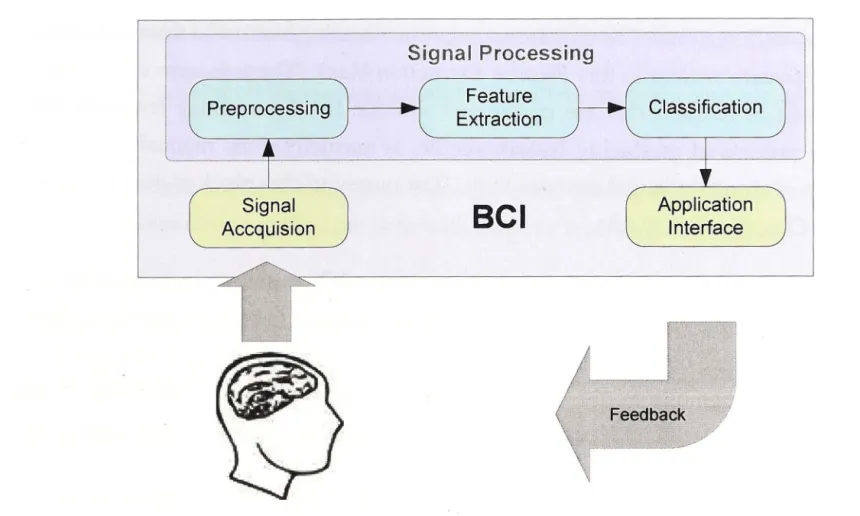
The fundamental principle of BCI systems is the interaction between the human brain and computers. In practice, a typical BCI system would comprise of more than one component to be able to fulfill that purpose successfully. These building blocks of the BCI system are shown in Figure 2.1 :
The interactions in this context can be described as either one-way (brain -+ computer) or two-way (brain f-7 computer), which depends on how important the feedback loop is to the system. For synchronous BCI systems, the systemfeedback is critical as the user has to be constantly fed stimuli from the computer and then conveys his differentiating action based on his reactions to them. Such systems are the types that take the advan-tage of Vi ual Evoked Potential and P300 signals. For asynchronous BCI systems, that feedback is not as important (hence the interaction is one-way). Ideally, the u er of
2.1. INTRODUCTION
I
l
Preprocessing Signal Accquision Signal Processing Feature ExtractionBCI
Classification Application InterfaceFigure 2.1: Brain-Computer Interface Building Blocks
17
the system would actively and voluntarily feed commands/instructions to the computer by his brain activities that can be captured with EEG. The feedback from the PC is
mostly to confirm the issued instruction. In general, asynchronous systems are harder to construct properly as EEG signals are too noisy and unpredictable to deliver robust and timely enough interactions. The system to be built in this research is considered to be among these types of BCI system.
The explanations of the remaining building blocks(Figure 2.1) will be related to this specific project:
The Signal Acquisition block in this chapter basically covers the Hardware aspect of
the project. EEG raw signal are captured using either:
• ActiveTwo system from Biosemi: A medical-graded EEG system. It currently
supports capturing with 16 EEG channels.
• EPOC EEG headset from Emotiv: One of the new consumer BCI devices. The
system records with 14 EEG channels.
As also from Figure 2.1, these following building blocks are generally done with Soft
-ware:
• Pre-processing: EEG signals will be band-passed for noise reduction and then be transformed into frequency domain to be ready for the next block. The Fast Fourier Transform (FFf) algorithm will be used for this transformation duty.
• Feature Extraction: The data from the pre-processing block will then be reduced into feature vectors in this Feature Extraction block. These feature vectors only consist of features that are considered suitable for the machine learning task. The process of producing feature vectors is normally done manually with the help of some statistical analysis tools. The output of this block is now ready for the Classification block.
• Classification (with Machine Learning): For a BCI system to be considered ef-fective, a supervised learning method is recommended to be used as the classifier.
At this stage, because only two-class classification is interested, any machine learning technique would suffice for this requirement. Support Vector Machine (SVM) and Artificial Neural Network (ANN) are the preferred classifiers to be used in this project.
• Any visual feedback will be given back to the user by the Application Interface block.
The two 1nost important blocks of this BCI experiment are the Pre-processing and the Classification blocks. The explanations for each of these blocks will be discussed in more detail later into the chapter.
2.1.4
Discussion on EEG
Introduction
Many bio-signals contain a significant random component (stochastic), especially those which are produced by the averaging of many signal sources like EEG. Identify and address the uncertainties found in the EEG signals from the brain's processes dur-ing differentiatdur-ing is indeed a challengdur-ing task. Furthermore, EEG, being electrodes "hooked up" to human brain via the scalp, will also inherit factors that will greatly reduce the fidelity of the captured signals compared to the original sources.
Influential Factors
This is the list of factors that most likely to affect the recording and the study of EEG signals from test subjects:
• Unpredictable changes at the stress level of te t subjects.
2.1. INTRODUCTION 19
• Unpredictable changes in the external environment around a test subject.
• Other unpredictable biologic changes that affect the brain activities of a test sub-ject.
• Undetermined behaviours and times for a test subject to make different types of differentiation (applied for both with same or with different types).
Apart from these, capturing brain activities by EEG signals also has the following undesired attributes that attention should be paid to:
• Signal noise.
• Inaccurate captures because of improper equipment preparation on test subjects.
• Degradation in signal strength as the experiment progresses (conducting gel get-ting dried up, for instance).
• Unpredictable changes in signal strength because of equipment malfun.ction (elec-trodes get worn out, for instance)
The usual approach of signal processing EEG data is to performed effective noise
-filtering (band-pass, detrending, etc.). And if it was not enough, there are extensive range of signal processing tools that could be used in this area that could be employed to aid the researchers: Independent Component Analysis, Blind Signal Separation, or simply other types of filters (static/ adaptive) that may raise better results.
Discussion
The difficulties in identify and eliminate the non-deterministic components of the cap-tured signals are the main reason why most of EEG-based BCI systems are clunky and impractical in real life usage.
EEG signals, being the summation of multiple electrical activities captured from human scalp, do indeed heavily suffer from signal noise. To deal with this problem, researchers normally utilise statistical techniques such as blind source separation or methods that are based on Gaussian Distribution to select the significant components over the other components. These significant components are candidates considered to be used as the features in pattern recognition/classifying step. The above point implies that EEG-based BCI systems require calibration sessions. These sessions normally involve EEG researchers capturing short EEG sessions that cover all possible operat-ing scenarios of the system for offline study. They are considered inevitable and are
prerequisites to any online BCI operation. An indication of a successful BCI system
would be a correct balance between the efforts put into calibration and the effective-ness of the produced feature vectors afterward. Another way to reduce the significance
of these problems is to address them at the signal processing step. For non-stationary
signal processing, adaptive filtering [49],[18] is one of the solutions. Adaptive filtering does employ cost functions to adjust its coefficients (weights) during signal processing. The goal is to progressively obtain more accurate reduction of irrelevant components in
source signals. The changes in the filtering parameters are also accordant to the current
state of signal capturing (hence adaptive). If time allows, the performance of popular
adaptive filter methods such as Kalman filter [31] against EEG signals should be eval-uated. The ideal outcome of this work is to see if adaptive filtering can help addressing the reduction in signal quality as the EEG session prolongs, when the conductivity of electrodes. placed on the scalp degrades.
2.1.5 Support Vector Machine (SVM)
Introduction
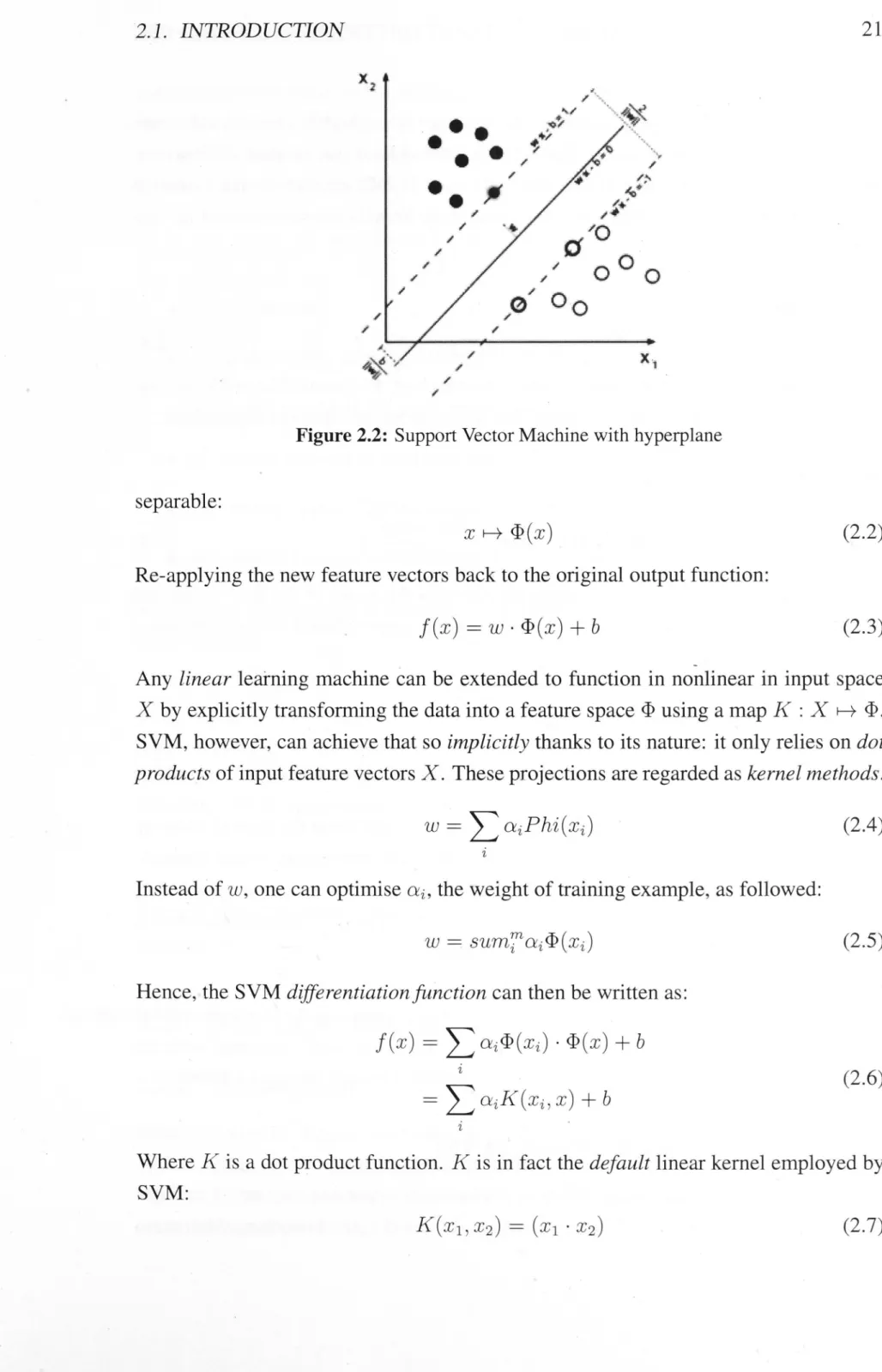
This this work, Support Vector Machine(SVM) will be used to classify processed EEG signals. In general, SVM is considered to be a margin classifier because its goal is to
identify the maximum-margin hyperplane that can separate the data points during the training stage. This hyperplane is defined so that it has the largest separation (hence maximum-margin) between the data points belong to two classes. Although SVM can
also be configured to be used a multi-class classifier, only two-class SVM was focused on in this dissertation. According to Boser [9], the formula for the output of a linear
SVM is as followed:
f
(x)
=
W · X+
b (2.1)f
(
x)=
0 is the separating plane(hyperplane) between the two clas . The supportvectors are the data points that lie on the two margins from the hyperplane. w i the
normal vector to the hyperplane and x is the input vector. This dissertation will not
dwell into the details of SVM optimisation problems. Instead discus ion on
theNon-linearity and kernel method aspects of SVM will be skipped.
Kernel Functions
Non-linearity: If the data could not be linearly separated one could projected them into an higher dimen ional pace where the data point effectively become linearly
2.1. INTRODUCTION
/
/
Figure 2.2: Support Vector Machine with hyperplane
separable:
X f--t
<J>(x)
Re-applying the new feature vectors back to the original output function:
f(x)
=
w ·<I>(x)
+
b21
(2.2)
(2.3)
Any linear learning machine can be extended to function in nonlinear in input space X by explicitly transforming the data into a feature space <I> using a map K : X r-t <I>.
SVM, however, can achieve that so implicitly thanks to its nature: it only relies on dot products of input feature vectors X. These projections are regarded as kernel methods.
(2.4)
'I,
Instead of w, one can optimise ai, the weight of training example, as followed:
(2.5)
Hence, the SVM differentiation function can then be written as:
'I,
(2.6)
i
Where K is a dot product function. K is in fact the default linear kernel employed by
SVM:
In regards to classifying problems that are not linearly separable, one can substitute a non-linear kernel function K ( ·, ·) in place of the default dot product K function. According to Lotte [37], the kernel generally used in BCI research is the Gaussian or Radial Basis Function (RBF) kernel. These three kernels were considered for this work:
Polynomial Function
(2.8) For problems where all the training data is normalised, Polynomial kernel is recom-mended. The polynomial order d allows one to customise the feature conjunctions. Radial Basis Function[29]
(2.9) The a- parameter is adjustable. It essentially defines the width of the RBF curve and would dictate the performance of the kernel. This parameter should be carefully tuned to individual problems.
Multilayer Perceptron (MLP) kernel:
(2.10)
Also known as the Sigmoid kernel. This kernel is inherited from the Neural Network field. A SVM using a MLP is equivalent to a two-layer, perceptron neural network. So it will be interesting to consider the general performance (accuracy, speed, etc.) between this SVM equipped with this kernel and a ANN model. The two variables r;, and c are adjustable, with r;,
>
0 and c<
0 in general.The effectiveness of SVM in this work was verified by contrasting the performances/efficiencies of different kernels on the dataset. The result obtained here were compared with the
one from another machine learning technique: Artificial Neural Network (ANN).
2.1.6
Artificial Neural Network (ANN)
For thi work, Artificial Neural Network was u ed as either the alternative to SVM or a benchmark to mea ure SVM performance. In this chapter, Levenberg-Marquardt
2.2. BCI EXPERIMENTS 23 optimisation was used as the training function in a Neural Network to classify EEG data. The neural network constructed is a two-layer, feed-forward back-propagation network that has one single output node. Hence the output value regarding to a pattern Tis described as [10],[24],[42]:
y'[
=
go(b1+
L
W1j · 9H(bj+
L
Wjk · x[)) , (2.11)J k
• b1 , bj : the bias
• w1j is the weight of the jth hidden neuron to the single output neuron • Wjk is the weight of kth input neuron to the jth hidden neuron
•
x
[
the kth element of the input pattern T• g0 transfer function on the output layer - linear transfer function
• g H transfer function on the hidden layers - sigmoid transfer function
The training performance of the network were evaluate with.this error function (mean square error):
l
NE
=
NL(YE
-yp)2, (2.12)k=l
where
Y
E
is the vector of predict outcomes and yp represents the vector of predicted outcome. The back-propagation training algorithm, being·Levenberg-Marquardt opti-mization, will be represented by the formula [24] :6w
= (
JT J+
I · µ )-1 JT e (2.13) where J is the Jacobian matrix of the error function calculated in equation(2), µ is the learning rate which is updated after iteration. diag being the diagonal of JT J.2.2 BCI Experiments
2.2.1 Introduction
Human-Computer Interaction research projects rely heavily on the outcomes of the HCI experiments. The fundamental difference between a BCI experiment and other types of HCI experiments is that it is driven by a very noisy and unpredictable compo-nent, the human brain.
BCI experiments were conducted throughout the course of this research. Just like any other HCI experiment, it will involve test subjects to navigate through a series of
scenarios on a user-interface. As brain patterns being dealt with have yet to be identi-fied, it would be convenient to divide the experiments into two stages: an Offiine stage
and, if possible, an Online stage. The main difference separating the two stages is that
with an Offiine system, only EEG signals accordant to various pre-defined scenarios, regardless of the f orms/pattems of those signals are captured. That means the Offiine
BCI system will be driven by another mechanism (please see section 2.2.4 for more information) rather than the brain-wave signals. On the other hand, the Online system is supposed to be driven solely by the brain-wave signals.
2.2.2 Design Considerations
The experiments involve test participants and a BCI system. The BCI system will present the test subjects with a variety of differentiating tasks and at the same time, record test subject's brain activities with EEG. Among the challenges discussed in Section 2 that one would be facing, the most significant issue is that he will not have the best spatial resolution available with EEG. It would be very difficult to tell if the EEG capture signals accurately reflect the brain activities EEG being tried to measure. Because of that, the BCI systems being considered have to deal with the following issues:
The Noise in EEG Data
BCI systems depend on high levels of concentration of the mind to deliver clear enough brain-wave patterns. In contrast, human brains can be very easily distracted and in-fluenced. Because of that, it is desirable to have a user interface as simple as possible
for BCI system. Extra details that draw unnecessary attentions of the mind are not recommended.
The Non-stationary Nature of BCI
It is expected to get a large variety of EEG activities even over the same mental task.
The factors that produce such different signal output are very difficult to identify and fully addres : type of differentiation, time, human per onality, stress level, concentra-tion, etc.
2.2. BCI EXPERIMENTS 25
Triggering Mechanism used in Experiment
During the offiine stage, only the EEG signals was captured for analysing. So in order to navigate around the user-interface, the test subject has to rely on another trigger
mechanism.
The action of pressing a key on a standard keyboard is the preferred option for this purpose. It is known that the brain activities happening during trivial action (such as key-presses, where the palms are firmly placed over the keyboard) over the mo-tor/sensory cortex are less significant than that performed by fall hand movements or other alternatives method. The alternative could be participants' pressing a foot pedal to trigger the event. The issue with that is foot movements are not as natural and
ag-ile as the ones performed by hands. Ideally, one would like to be able to isolate the EEG activities of the trigger mechanism from the analysis of the captured EEG data. Section 2.6.4 at later stage has a discussion on this matter.
Studied Differentiation Types
The ambition for this research work is to find the pattern of mental differentiating in EEG signals with or without regards to the types of the task. However, the difficulties have to be overcome in this work are:
• It is difficult to design BCI experiment scenarios that cover an extensive range
of such mental tasks.
• The task of categorising and identifying differentiation activities comprehen-sively is very challenging.
• The "black box" approach being attempted does incur a risk of not being able to fully reason the behaviours of the EEG signals over different task types. Yet, it would be beneficial to build the scenarios around many types of differentiation to gain more background understanding on the nature of them.
Hence the realistic goal set for this research is to focus on only a number of differ-entiation types. In fact, it is eventually decided to pay special interests in the differen-tiation that produces binary outcomes: Yes/No and Left/Right are among the possible pair of conclusions. An example for this is to study the EEG activities when a person decides if one item is more than another item in term of a visual attribute. This BCI experiment should only be build around this philosophy.
Using Gaze-tracking Device in Conjunction with EEG
As mentioned above, EEG signals are difficult to work with. If one relied only on it
could run into the risk of not getting enough data to interpret meaningful information.
Having gaze-tracking device that runs during the EEG experiment would add another
source of data into this. This is an appropriate proposal given most of the process of differentiating based around visual inputs.
So to be considered a success, the system should be able to cope with those uncertain-ties and inconsistencies mentioned above. However, it would be near impossible to address all of those factors as in one go. They should be addressed individually as the research progresses.
2.2.3 Experiment Details
The BCI experiment involves a subject performing the three following tasks to be able to study the differentiating processes related to each of them:
Visual Selection Task
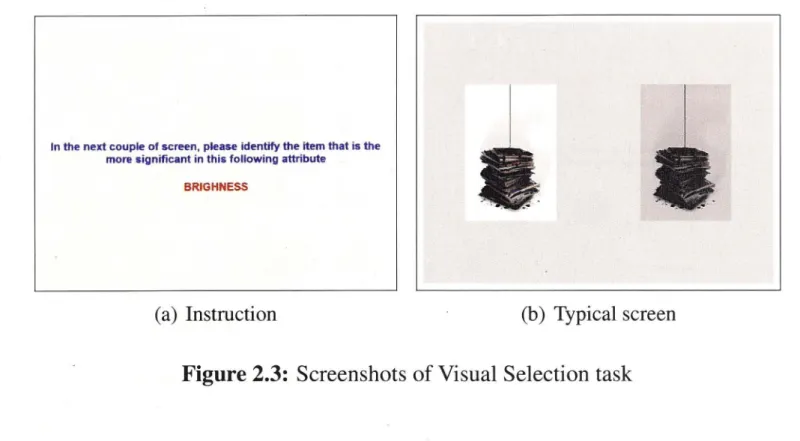
This task involves test participants to select images (in his head) based on visual
at-tributes that they have been aware of. This task constrains the test subjects into making
quick, fast differentiation based on visual clues 2.3(b ). The difficulty level of this task
ranges from easy to medium, depend on how much different the two on-screen images
are. B~low is the suggested list of visual attributes associated to the images that the BCI provides to test subject:
• Brightness
• Colour vs. Greyscale
• Edgy vs. Roundness
• Shades of colours
• Pictures of various types of objects • Shapes
2.2. BCI EXPERIMENTS
In the next couple of screen, please identify the Item that is the more significant in this following attribute
BRJGHNESS
(a) Instruction (b) Typical screen
Figure 2.3: Screenshots of Visual Selection task