Training SpamAssassin with Active Semi-supervised
Learning
Jun-Ming Xu
†Giorgio Fumera
‡Fabio Roli
‡Zhi-Hua Zhou
† †National Key Laboratory for Novel Software Technology, Nanjing University, Nanjing 210093, China‡Dept of Electrical and Electronic Eng., University of Cagliari, Piazza d’Armi, 09123 Cagliari, Italy
{xujm, zhouzh}@lamda.nju.edu.cn
{fumera, roli}@diee.unica.it
ABSTRACT
Most spam filters include some automatic pattern classifiers based on machine learning and pattern recognition tech-niques. Such classifiers often require a large training set of labeled emails to attain a good discriminant capability be-tween spam and legitimate emails. In addition, they must be frequently updated because of the changes introduced by spammers to their emails to evade spam filters. To address this issue active learning and semi-supervised learning tech-niques can be used. Many spam filters allow the user to give a feedback on personal emails automatically labeled dur-ing filter operation, and some filters include a self-traindur-ing mechanism to exploit the large number of unlabeled emails collected during filter operation. However, users are usually willing to label only a few emails, and the benefits of self-training techniques are limited. In this paper we propose an active semi-supervised learning method to better exploit un-labeled emails, which can be easily implemented as a plug-in in real spam filters. Our method is based on clustering un-labeled emails, querying the label of one email per cluster, and propagating such label to the most similar emails of the same cluster. The effectiveness of our method is evaluated using the well known open source SpamAssassin filter, on a large and publicly available corpus of real legitimate and spam emails.
1.
INTRODUCTION
Most current commercial and open source spam filters in-clude automatic pattern classifiers based on machine learn-ing and pattern recognition techniques. Such classifiers usu-ally require a representative and large training set of la-beled emails to attain a good discriminant capability tween spam and ham (legitimate) emails. Moreover, be-cause spammers always devise new tricks to evade spam filters, spam filtering task is a typical adversarial classifi-cation problem. To deal with ever-changing characteristics of spam emails and keep the filter effectiveness high, classi-fiers require to be frequently retrained with updated training samples. Such update can be done by the producers of the
CEAS 2009 - Sixth Conference on Email and Anti-Spam July 16-17, 2009, Mountain View, California USA
filter, who can collect large email corpora and analyze them manually or automatically, or by the end users, who can manually confirm or correct the label assigned by the filter to their own emails, collected during filter operation. While the latter method can build user-specific filters by using the ham emails of a given user, it suffers from the drawback that users are usually not willing to label too many emails. This is true especially for server side filters, which usually require users to provide their feedback through web interfaces. To relieve the burden of providing feedback on the emails automatically labeled by a spam filter, several authors pro-posed to exploit active learning (AL) techniques like un-certainty sampling, or semi-supervised learning (SSL) tech-niques [2]. SSL and AL techtech-niques have been studied in the machine learning field to address a common issue to many supervised learning tasks, namely the fact that collecting a sufficiently large set of labeled examples is often difficult or costly, while unlabeled examples are usually much easier and cheaper to obtain. SSL methods aim at exploiting a rela-tively small set of labeled examples together with a larger set of unlabeled examples to train a classifier without hu-man intervention. Instead, AL techniques aim at selecting a small but informative subset of unlabeled examples, whose label is queried to the user. Such newly labeled examples are used to train the classifier together with previously la-beled ones. Some SSL techniques are currently used also in commercial and open source spam filters. For instance, the well known SpamAssassin open source filter includes a simple SSL component based on self-training, called auto-learning, which basically enhance the training set with the emails classified with high confidence, using the labels pre-dicted by the filter.
SSL and AL techniques exhibit however some drawbacks in the spam filtering task. A disadvantage of SSL techniques, especially for an adversarial learning task like spam filter-ing, is that the unlabeled examples added to the training set are likely to be the less informative ones, since they are often correctly classified by the filter. In other words, the lack of feedback from users may confine the capability of SSL methods to capture the variability of spam character-istics. A deficiency of AL techniques based on uncertainty sampling is that the spamminess score is not necessarily the best criterion to select the most informative emails. In this paper we propose a method, Active Semi-supervised learning based on Clustering Analysis (ASCA), aimed at
ex-ploiting the advantages of both SSL and AL in spam filtering tasks, overcoming their drawbacks mentioned above. ASCA is a hybrid of SSL and AL, and is devised to be easily imple-mented as a plug-in of existing spam filters. Our method is inspired by the work of Nguyen et al. [7], who proposed an AL method with pre-clustering and showed its effectiveness on image classification tasks, and the work of Zhou et al. [15, 16], who proposed a method combining AL with SSL and showed its effectiveness on image retrieval tasks. ASCA works as follows. First, unlabeled emails are clustered into a given number of clusters which depends on the number of emails a user would like to manually label and on the number of available unlabeled emails. The label of one email in each cluster which is deemed to contain only spam or only ham emails is asked to the user, and such label is propagated to the most similar emails in the same cluster. Emails labeled by the user and by label propagation are used to re-train the spam filter. The remaining ones can be clustered again to repeat the whole process, until the user is not willing to label any more emails. The effectiveness of our method is experimentally investigated using the SpamAssassin filter and a large and publicly available corpus of real ham and spam emails (TREC-07).
This paper is structured as follows. In the next section, we briefly review previous works on SSL and AL techniques applied to spam filtering, and give an overview of SpamAs-sassin, especially on its auto-learning SSL component. Our method is described in section 3. Its experimental investi-gation is reported in section 4.
2.
PREVIOUS WORKS
In this section we give a brief overview on SSL and AL tech-niques proposed so far for the spam filtering task. We also describe how these techniques have been implemented in the open source Spam Assassin filter, which will be used to ex-perimentally investigate the active semi-supervised learning method proposed in this paper.
2.1
Semi-Supervised Learning and Active
Learning for Spam filtering
Many SSL algorithms have been proposed so far in the ma-chine learning field. A comprehensive overview can be found in [18]. Most of them have been applied to tasks related to text classification, in which labeled examples are usu-ally costly to obtain, while unlabeled examples are much cheaper to collect. Roughly speaking, SSL methods fall into four categories: generative methods [8], semi-supervised support vector machines (S3VMs) [1, 3], graph-based meth-ods [14, 19] and disagreement-based methmeth-ods [17]. Several SSL methods have been applied to spam detection [4, 9]. The key of AL techniques is to identify the most informa-tive unlabeled examples. Algorithms belonging to the un-certainty sampling scheme train a single learner and then query the unlabeled example on which the learner is least confident. Segal et al. [11] developed an approximate, but faster, uncertainty sampling algorithms for labeling large email corpora. Sculley [10] investigated several online active learning algorithms based on different uncertainty sampling criteria. Other AL methods are based on committee-based sampling, which consists in constructing multiple learners
and in querying the unlabeled examples on which the learn-ers mostly disagree. The main deficiency of these methods in the spam filtering task is their computational cost. Several AL methods exploit instead clustering to select the unla-beled samples (see for instance [7] and references therein), but they have not been proposed for spam filtering tasks. Some theoretical and practical works have been proposed to combine the advantageous of SSL and AL techniques. For instance, McCallum and Nigam [5] combined committee-based AL with EM-committee-based SSL algorithm for text classifi-cation. Minton et al. [6] developed an algorithm to combine SSL and AL under multi-view learning framework. Zhou et al. [15, 16] proposed a method to combine disagreement-based SSL and AL into one framework, and applied it suc-cessfully to content-based image retrieval. Later, Wang and Zhou [12] provided a theoretical justification to the effective-ness of the combination of disagreement-based SSL and AL. To the best of our knowledge, however, the combination of SSL and AL has not been considered for the specific spam filtering task.
2.2
SpamAssassin
SpamAssassin1is a well-known and widely used open source
spam filter. It is made up of about nine hundred binary-valued “tests”, each of which is related to a characteristic of spam or ham emails like the presence of a given keyword in the emails text or some kind of malformed email headers. Each test is associated with a score: the score is zero if the related characteristic is not present, while it is non-zero if such characteristic is present. In particular, scores associ-ated with spam and ham features are respectively positive and negative. For a given email, the score of all tests are summed up. If their sum is greater than a predefined thresh-old the email is labeled as spam, otherwise it is labeled as ham. The default threshold is 5.0 (note that the scores are not normalised to any interval like [0,1]). Among the tests, nine are associated to disjoint intervals of the continuous-valued output of a text classifier (“naive bayes” classifier). The remaining tests are simple feature detectors which look at the emails’ body and header, including DNS block-lists and collaborative filtering databases. Default values are pro-vided for the score of each test and for the decision threshold. These values can be modified by the user, either automati-cally, using a tool named “mass check” and a training set of labeled emails, or manually. Note that the naive bayes clas-sifier and the mass-check tool are the only components of SpamAssassin based on machine learning techniques. This structure makes it easy to update SpamAssassin by adding or removing tests, as spam email characteristics change. SpamAssassin provides a SSL mechanism, called“auto-learn-ing”, which automatically re-trains the naive bayes classifier using some unlabeled emails collected during filter opera-tion. It is based on the simplest SSL method known as self-training, and consists in constructing a training set made up of emails classified with high confidence, using the labels automatically assigned by the filter. In particular, SpamAs-sassin uses emails for which the sum of scores associated with some subsets of tests is much greater (for emails labeled as spam) or much lower (for emails labeled as ham) than given
thresholds. As explained in section 1, self-training is sim-ple to imsim-plement but its effectiveness is likely to be limited, since the selected emails are the less informative ones. Be-sides this, SpamAssassin can update the naive bayes classi-fier when user gives his feedback on the label of any email. However it just passively waits for labeled emails when users are willing to do that. No AL approach is used to select emails to query the user. In this paper, we focus on how to better exploit unlabeled emails to improve the naive bayes classifier of SpamAssassin.
3.
ACTIVE SEMI-SUPERVISED LEARNING
FOR SPAM FILTERING
As explained in the above sections, spam filters need to be frequently updated to keep their effectiveness high against changes in spam emails characteristics introduced by spam-mers. This requires re-training the components based on machine learning techniques, using updated training sets of labeled spam and ham emails. Unlabeled emails collected during filter operation for any given user can be very useful to this aim. SSL and AL techniques can be used to ex-ploit unlabeled emails, without (SSL) or with limited (AL) user intervention. So far, works on spam filtering consid-ered only one kind of technique, either SSL or AL. However, as suggested by other authors for different tasks, we argue that properly combining SSL and AL can boost the benefits of both approaches and avoid some of the respective draw-backs pointed out in the previous sections, also in the spam filtering task.
In the following we propose a hybrid SSL and AL method, Active Semi-supervised learning based on Clustering Anal-ysis (ASCA). Our main goal was to devise a simple method tuned to spam filtering tasks, which can also be easily im-plemented as a plug-in of existing spam filters. ASCA is based on the following rationale. Given a set of unlabeled emails collected during filter operation, self-training can be firstly used to exploit emails classified with high confidence. However, the remaining emails classified with low confidence are likely to be more informative to update a classifier. AL can thus be used to exploit these emails by asking the user their correct label. To reduce the number of queries to the user, one can exploit the fact that spam emails are often constructed by introducing random variations to a given template email. Such emails are likely to be more simi-lar to each other than to unrelated ones. To this aim, as suggested in [7] for tasks different than spam filtering, clus-tering can provide useful information to guide the choice of fewrepresentativeemails to query the user. In particular, an AL algorithm should prefer selecting emails fromdifferent
clusters. Finally, to some extent emails in the same cluster can be expected to share the same label. This suggests that the classifier can be further updated by using a kind of SSL method, namely by propagating the label provided by the user to other similar emails in the same cluster.
The scheme of the algorithm is given in Algorithm 1 below. In detail, the algorithm works as follows. We denote with
Lthe initial training set consisting of labeled emails, where the label is eitherspam orham. The available classification algorithmFis initially trained onL. Then a set of unlabeled emailsU is collected during filter operation. A self-training algorithm, if available, is applied to emails inU to update
the classifierF. In this case, emails used by self-training are removed fromU. We assume now that the user is willing to label at mostq emails among the available unlabeled ones. The task is to select at mostq unlabeled emails fromU to update the classifier F. To this aim, first all emails in U
are clustered into c clusters, whose set is denoted asC =
{C1, C2, . . . , Cc}(U=
S
i=1,...,cCi), wherecis a predefined
parameter. Based on the labels assigned to emails inU by the classifierF, clusters are categorized intopureand non-pure, where a pure one is defined as a cluster made up of emails which are given an identical label (either spam or
ham) by the classifier. Emails in pure clusters are likely to share the same correct label, though it could not coincide with the one assigned by the classifier. Accordingly, until the user is willing to label new emails, one email in each pure cluster is selected, denoted as query, and its label is asked to the user. The selected email is the one closest to the cluster centroid. Then, the label given by the user to thequeryemail could be propagated to other similar emails in the same cluster. To avoid labeling errors, the label is propagated only to a predefined fractionp∈[0,1] of emails closest to query, wherepis namedpropagation rate. If the number of pure cluster is greater than the number of queries, larger clusters are selected first. Finally, the email closest to the centroid of each non-pure cluster is selected and its label is asked to the user. No label propagation is carried out for non-pure clusters, since labeling errors are more likely than in pure ones. At the end of the above steps it can happen that the number of queries made to the user is lower than the allowed number of queries q. In this case, the whole process above is repeated on all the emails inU not labeled by the user nor by label propagation, until the number of queries reachesqor all emails inU have been labeled. We point out that the number cof clusters and the prop-agation ratiop have to be chosen in advance in the ASCA algorithm: the issue of how they affect the performance of ASCA and how their values can be chosen will be addressed in the experimental investigation in the next section. It is also worth noting that the clustering algorithm and the cor-responding distance measure can affect the performance of ASCA.
4.
EXPERIMENTS
In this section we report the results of experiments carried out to investigate the effectiveness of the proposed ASCA method. The experiments have been carried out using the SpamAssassin filter, and the TREC07p corpus of real ham and spam emails. As explained above, we point out that our method can be easily implemented as a plug-in of real spam filters. In particular, our experiments were carried out without modifying the original SpamAssassin filter. In the following we will first describe the experimental setup and the TREC07p data set. Then we report the obtained results and discuss the issues mentioned in section 3 about the choice of the parameter values.
4.1
Experimental setup
The experiments were carried out using the latest avail-able version of SpamAssassin (3.2.5), with all rules enavail-abled. The default settings were used, including scores and de-cision threshold values, except for the ones explained be-low. We remind the reader that SpamAssassin is made
Algorithm 1: Active Semi-supervised learning based on Clustering Analysis (ASCA)
Input: L: a set of labeled e-mails
U: a set of unlabeled e-mails F: a classification algorithm
q: number of e-mails user is willing to manually label
p: propagation ratio
c: number of clusters if self-training is available then
1
UpdateFwithU;
2
U←U−e-mails used by self-training ;
3
queries←0;
4
whilequeries < qandU6=∅do
5
L0←∅; ClusterUintocclustersC={C1, C2, . . . , Cc}; 6
Cpure←set of pure clusters inC; 7
Sort clusters inCpureandC−Cpurein descending order|Ci| 8 foreachCi∈Cpuredo 9 ifqueries≥qthen 10 break; 11 query←centroid ofCi; 12
y←label ofquerygiven by the user;L0←L0S(query, y);
13
queries←queries+ 1;U←U−query;
D←nearest|Ci| ·pneighbors toqueryinCi; 14
add toL0all e-mails inDwith labely;U←U−C
i; 15 foreachCi∈C−Cpuredo 16 ifqueries≥qthen 17 break; 18 query←centroid ofCi; 19
y←label ofquerygiven by the user;L0←L0S(query, y);
20
queries←queries+ 1;U←U− {query}; UpdateFwithL0;
21
returnF
22
1
up of about nine hundred binary tests, nine of which are associated to the output of a naive bayes classifier. The naive bayes is the only classifier used in SpamAssassin, and the only component updated by its self-training algorithm. When the number of spam and ham training emails is be-low two predefined thresholds, ‘bayes min ham num’ and ‘bayes min spam num’, SpamAssassin does not take the naive bayes classifier’s output into account, because its perfor-mance may be not good. We set both thresholds to 1, to be able to investigate the performance improvement that can be attained by our method even when the initial training set is small. Furthermore, to take into account the possi-ble changes in spam emails during time SpamAssassin pro-vides an ‘auto-expire’ mechanism which disregards the old-est terms in the naive bayes classifier. However this may in-troduce some randomness in the experiments. To avoid this, we disabled ‘auto-expire’ by setting the ’bayes auto expire’ parameter to 0. Moreover, some network rules such as ‘Py-zor’ query network servers to obtain scores, which makes it possible for the score of one same email to change over time. To avoid this, the scores of all emails were computed only once and stored in order to be used whenever needed with-out modifications. The only exception was obviously the scores of rules associated to the naive bayes classifier, which were the only ones modified by our algorithm.
The clustering step of ASCA was implemented as follows. Unlabeled emails were represented as feature vectors in which each feature is associated to a term (word) in the email’s body. Standard stemming and stop-word removal were used
to reduce the term set. The chosen feature representation was the well known term frequency - inverted document fre-quency (TF-IDF). Then, the simple and well knownk-means algorithm was used to cluster unlabeled emails, using the Euclidean distance as distance measure in the feature space. We used the Weka [13] implementation of thek-means algo-rithm.
The experiments were carried on the large, publicly available TREC07p2 corpus of real emails. It is made up of 75,419
emails, comprising 25,220 ham and 50,199 spam emails. All emails were arranged in chronological order to simulate a real spam filtering scenario in which training emails are older than testing ones. As the initial training set for the naive bayes classifier we randomly selected 50 emails among the first 10,000 ones. We chose such a small training set to take into account that labeling emails is a time consuming task. Then we randomly chose 10,000 emails from the next 30,000 ones, and used them as the unlabeled emails to apply the auto-learning procedure and our algorithm. The above process was repeated ten times, to carry out ten runs of all the experiments. The remaining 35,419 emails were used as test set.
Each run of the experiments was carried out as follows. First, the naive bayes classifier of Spam Assassin was trained on the 50 emails of the initial training set. Then the 10,000 unlabeled emails were classified by SpamAssassin, with the learning feature enabled. After this we disabled auto-learning and applied ASCA to the emails which remain un-labeled after auto-learning. The performances of SpamAs-sassin before and after running auto-learning, and after run-ning both auto-learrun-ning and ASCA, were then evaluated on the testing emails. All the results reported below refer to average values over the ten runs of the experiments. The performance measure is the standard receiver operat-ing characteristic (ROC) curve, i.e. the true positive rate (TP, the fraction of correctly recognized spam emails) vs the false positive rate (FP, the fraction of ham emails erro-neously labeled as spam), obtained as functions of the deci-sion threshold of SpamAssassin. Since false positive errors are much more harmful than false negative ones, our eval-uation was focused on the low-FP part of the ROC curve only.
4.2
Results
We first compare the performance of ASCA to the baseline performance of SpamAssassin, attained by using only the default auto-learning procedure. For comparison we also consider two simpler criteria to select unlabeled emails to query the user: random selection and uncertainty sampling. The former is implemented simply by randomly selectingq
emails among the unlabeled ones not used by auto-learning, to be used as a baseline for comparison. The latter consists in repeating the following procedure for qtimes: query the label of the most uncertain email and re-train the classi-fier. As confidence measure we used the absolute value of the difference between the score given by SpamAssassin and the default decision threshold of 5.0. The two criteria above and the default SpamAssassin version were compared with
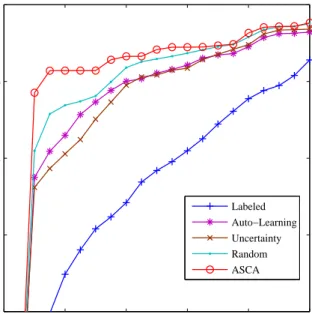
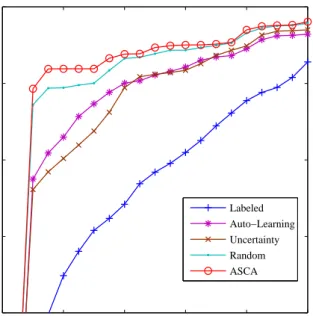
ASCA for three different values of the number of queriesq: 10, 50, 100. For this comparison, the other two parameters of ASCA were fixed as follows: the number of clusterscwas set to 50, and the propagation ratep was set to 0.1. The effect of these two parameters on the behavior of ASCA will be investigated in next subsection. The results are shown in figures 1–3 (note that the curve corresponding to auto-learning only is the same in all figures). From these results, we can see that ASCA always outperformed the standard SpamAssassin for low FP rates, as well as the two alterna-tive criteria for email selection during the acalterna-tive learning step. In particular, an unexpected result is that random sampling outperformed uncertainty sampling. The reason seems that in uncertainty sampling the distribution of the selected emails is biased towards scores close to the decision threshold, and is thus not representative of the testing set. In particular, these emails may be very similar, and thus they could provide limited information. Another possible explanation for poor performance of uncertainty sampling is that the naive bayes classifier is only one of the SpamAssas-sin components. Therefore, if the emails are selected based on the output of SpamAssassin, it is possible to select simi-lar emails even if the classifier is re-trained after each query. Moreover, ASCA does not need to re-train the classifier after each user query and re-scan all unlabeled emails, as uncer-tainty sampling. The ROC curves of ASCA for the three differentq values are shown also in figure 4, together with the ones of SpamAssassin with and without auto-learning, to make the comparison easier. It can be seen that the advantage of ASCA over SpamAssassin, for low FP rates, increases as the number of users queries increases.
4.3
Parameter Selection
We carried out some experiments to study the behavior of ASCA with respect to its parameters: the number of queries
q, the number of clustersc, and the propagation ratep. As in the above experiments, our evaluation was focused on the low-FP rate part of the ROC curve. The number of queriesq
depends on how many emails the user would like to label. As shown by the above results, the performance of ASCA seems to improve for increasing values ofq, which is reasonable.
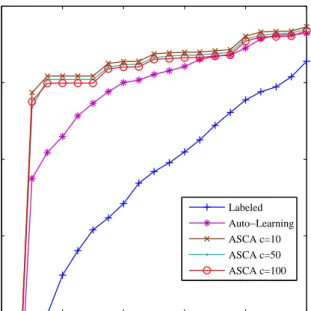
The number of clusters cspecifies into how many clus-ters ASCA will subdivide the emails which remain unlabeled after auto-learning. Three possible values were investigated in the experiments: c = 10, 50, 100, and compared under nine different combinations of values ofq: 10, 50, 100, and ofp: 0.1, 0.5 ,1.0. For the sake of brevity, we report only results on two of the nine combinations above (figure 5 and 6). Under seven combinations out of nine, the results were similar to the ones of figure 5. The results of the other two combinations (q = 50, p = 0.5,1.0) are show in Fig 6. In principle, the choice of the number of clusters can af-fect ASCA performance. However no significant differences were observed whencwas in the considered range, between 10 and 100. The possible reason is that for the purpose of this application it is not necessary to identify the “best” emails clustering nor to obtain only pure clusters, namely clusters in which all emails are given the same label by the spam filter. The clustering results just convey some useful information to guide the selection of queries and to iden-tify neighboring emails to propagate the labels given by the user. Even if clustering results are not so good with respect
0 0.02 0.04 0.06 0.08 0.1 0.9 0.92 0.94 0.96 0.98
False Positive Rate
True Positive Rate
Labeled Auto−Learning Uncertainty Random ASCA
Figure 1: Average test set ROC curves of the
pro-posed method (ASCA) with q = 10 user queries,
c = 50 clusters and propagation rate p = 0.1. Also shown the ROC curves of the same method with two alternative email selection criteria (random selec-tion and uncertainty sampling), and of the standard SpamAssassin filter, using only the original training set of labeled emails (Labeled) and using also auto-learning (Auto-Learning). 0 0.02 0.04 0.06 0.08 0.1 0.9 0.92 0.94 0.96 0.98
False Positive Rate
True Positive Rate
Labeled Auto−Learning Uncertainty Random ASCA
Figure 2: The same ROC curves as in figure 1, with
0 0.02 0.04 0.06 0.08 0.1 0.9 0.92 0.94 0.96 0.98
False Positive Rate
True Positive Rate
Labeled Auto−Learning Uncertainty Random ASCA
Figure 3: The same ROC curves as in figure 1, with
q= 100 user queries. 0 0.02 0.04 0.06 0.08 0.1 0.9 0.92 0.94 0.96 0.98
False Positive Rate
True Positive Rate
Labeled Auto−Learning ASCA q=10 ASCA q=50 ASCA q=100
Figure 4: Average test set ROC curves of our
method for the three different q values considered (10, 50, 100) and of SpamAssassin (see captions of figures 1–2). 0 0.02 0.04 0.06 0.08 0.1 0.9 0.92 0.94 0.96 0.98
False Positive Rate
True Positive Rate
Labeled Auto−Learning ASCA c=10 ASCA c=50 ASCA c=100
Figure 5: Average test set ROC curves of SpamAs-sassin (see caption of figure 1), and of our method for q= 10user queries and propagation ratep= 0.5, for different number of clustersc.
to a clustering perspective, they nevertheless allow to iden-tify enough informative emails, which is more important for ASCA. Taking into account that in our experiments around 3,700 unlabeled emails were used by ASCA, and the three consideredcvalues (10, 50, 100) did not exhibit significant differences, we can suggest that setting cas one percent of the number of unlabeled emails might be a reasonable choice.
The propagation rate pis the ratio of emails in a given pure cluster to which the label of the query email is prop-agated by ASCA. Three possible values, 0.1, 0.5, 1.0, were investigated in our experiments. Whenp= 1.0, all emails in a pure cluster are given the same label as the query email. The performance of ASCA for these threepvalues are eval-uated under nine different combinations of values of q (10, 50, 100) andc(10, 50, 100). Again, for the sake of brevity only two representative results are reported in figures 7 and 8. It can be seen that for most parameters values the best performance was attained forp= 0.1, while propagating la-bels to all emails in a cluster does not seem to be a good choice. This raises the question whether label propagation is really useful. To answer this question, we evaluated ASCA performance with p= 0 (no label propagation). The per-formance of ASCA without label propagation is shown in figures 7 and 8. Whencandqwere set to{10,50},{10,100},
{50,50},{50,100}, i.e. c≤q, the performance was close to the one attained withp= 0.1. Instead, whencandq were set to {10,10}, {50,10},{100,10},{100,50}, {50,100}), i.e.
c≥q (except for the last pair of values), the performance was worse than using label propagation, and sometimes it was even worse than the baseline performance of SpamAs-sassin with auto-learning only. These results suggest that,
0 0.02 0.04 0.06 0.08 0.1 0.9 0.92 0.94 0.96 0.98
False Positive Rate
True Positive Rate
Labeled Auto−Learning ASCA c=10 ASCA c=50 ASCA c=100
Figure 6: The same ROC curves of figure 5, for
q= 50 user queries and propagation rate p= 0.5.
when the number of queriesq is very small, around ten in our experiments, a limited label propagation turns out to be useful to enlarge the training set without introducing la-beling errors. Instead, when the number of queries is large enough, at least 50 in our experiments, active learning can provide enough labeled emails and label propagation does not provide a significant improvement.
5.
CONCLUSION
In this paper we addressed the problem of updating ma-chine learning-based spam filters components exploiting the usually large amount of unlabeled emails processed during filter operation, and asking the user to manually label only a small number of such emails. In particular, we addressed this problem under the viewpoint of providing an algorithm which can be easily implemented as a plug-in of existing spam filters, without modifying their structures. Methods based either on active learning or on semi-supervised learn-ing techniques were previously proposed to this aim by other authors. We proposed a simple, hybrid active learning and semi-supervised learning method to exploit the strengths of both methods and avoid some of their weaknesses.
In particular, while most active learning methods for spam filtering are based on uncertainty sampling, our method is based on clustering unlabeled emails and then selecting a representative email from each cluster. The rationale is that spam emails are often constructed by adding random changes to a given template. Moreover, a moderate label propagation brings further benefit when the user is willing to manually label only a small number of emails, as it often happens in practice.
The proposed method can be implemented in real spam
fil-0 0.02 0.04 0.06 0.08 0.1 0.9 0.92 0.94 0.96 0.98
False Positive Rate
True Positive Rate
Active Learning No Propagation ASCA p=0.1 ASCA c=0.5 ASCA p=1.0
Figure 7: Average test set ROC curves of SpamAs-sassin (see caption of figure 1), and of our method for q= 100 user queries and c= 10 clusters, for dif-ferent values of the propagation rate p.
0 0.02 0.04 0.06 0.08 0.1 0.9 0.92 0.94 0.96 0.98
False Positive Rate
True Positive Rate
Active Learning No Propagation ASCA p=0.1 ASCA c=0.5 ASCA p=1.0
Figure 8: The same ROC curves of figure 7, for
ters without modifying their original structures. We investi-gated its performance using the well known and widespread open source SpamAssassin filter, on a large and publicly available collection of real ham and spam emails. Exper-imental results showed that our method can improve the performance of SpamAssassin with respect to the use of the standard self-training procedure only. We also discussed the behavior of the proposed method with respect to the val-ues of its three parameters, namely the allowed number of queries, the number of clusters and the label propagation ratio, and suggested some guidelines for the choice of the latter two.
Acknowledgements
The authors would like to thank the anonymous reviewers for helpful suggestions, and Battista Biggio for helpful dis-cussion. This research was partially supported by the Na-tional Science Foundation of China (60635030, 60721002), Jiangsu Science Foundation (BK2008018) and the Founda-tion for the Author of NaFounda-tional Excellent Doctoral Disser-tation of China (200343).
6.
REFERENCES
[1] O. Chapelle, V. Sindhwani, and S. S. Keerthi. Branch and bound for semi-supervised support vector machines. In B. Sch¨olkopf, J. Platt, and T. Hofmann, editors,Advances in Neural Information Processing Systems 19, pages 217–224. MIT Press, Cambridge, MA, 2007.
[2] G. V. Cormack. Harnessing unlabeled examples through iterative application of dynamic markov modeling. InProceedings of the ECML-PKDD 2006 Discovery Challenge Workshop, pages 10–15, Berlin, Germany, 2006.
[3] T. Joachims. Transductive inference for text classification using support vector machines. In
Proceedings of the 16th International Conference on Machine Learning, pages 200–209, Bled, Slovenia, 1999.
[4] D. Mavroeidis, K. Chaidos, S. Pirillos, and
M. Vazirgiannis. Using tri-training and support vector machines for addressing the ecml-pkdd 2006 discovery challenge. InProceedings of the ECML-PKDD 2006 Discovery Challenge Workshop, pages 39–47, Berlin, Germany, 2006.
[5] A. McCallum and K. Nigam. Employing EM and pool-based active learning for text classification. In
Proceedings of the 15th International Conference on Machine Learning, pages 350–358, Madison, WI, 1998. [6] S. Minton and C. A. Knoblock. Active +
semi-supervised learning = robust multi-view learning. InProceedings of the 19th International Conference on Machine Learning, pages 435–442, Sydney, Australia, 2002.
[7] H. T. Nguyen and A. Smeulders. Active learning using pre-clustering. InProceedings of the 21st International Conference on Machine learning, pages 623–630, Banff, Canada, 2004.
[8] K. Nigam, A. K. McCallum, S. Thrun, and T. Mitchell. Text classification from labeled and unlabeled documents using EM.Machine Learning, 39(2-3):103–134, 2000.
[9] B. Pfahringer. A semi-supervised spam mail detector. InProceedings of the ECML-PKDD 2006 Discovery Challenge Workshop, pages 48–52, Berlin, Germany, 2006.
[10] D. Sculley. Online active learning methods for fast label-efficient spam filtering. InProceedings of the 4th Conference on Email and Anti-Spam, Mountain View, CA, 2007.
[11] R. Segal, T. Markowitz, and W. Arnold. Fast
uncertainty sampling for labeling large e-mail corpora. InProceedings of the 3rd Conference on Email and Anti-Spam, pages 84–89, Mountain View, CA, 2006. [12] W. Wang and Z.-H. Zhou. On multi-view active
learning and the combination with semi-supervised learning. InProceedings of the 25th International Conference on Machine Learning, pages 1152–1159, Helsinki, Finland, 2008.
[13] I. H. Witten and E. Frank.Data Mining: Practical machine learning tools and techniques. Morgan Kaufmann, San Francisco, 2nd edition, 2005. [14] D. Zhou, O. Bousquet, T. N. Lal, J. Weston, and
B. Sch¨olkopf. Learning with local and global consistency. In S. Thrun, L. Saul, and B. Sch¨olkopf, editors,Advances in Neural Information Processing Systems 16. MIT Press, Cambridge, MA, 2004. [15] Z.-H. Zhou, K.-J. Chen, and H.-B. Dai. Enhancing
relevance feedback in image retrieval using unlabeled data.ACM Transactions on Information Systems, 24(2):219–244, 2006.
[16] Z.-H. Zhou, K.-J. Chen, and Y. Jiang. Exploiting unlabeled data in content-based image retrieval. In
Proceedings of the 15th European Conference on Machine Learning, pages 525–536, Pisa, Italy, 2004. [17] Z.-H. Zhou and M. Li. Semi-supervised learning by
disagreement.Knowledge and Information Systems, in press.
[18] X. Zhu. Semi-supervised learning literature survey. Technical Report 1530, Department of Computer Sciences, University of Wisconsin at Madison, Madison, WI, 2006.
[19] X. Zhu, Z. Ghahramani, and J. Lafferty.
Semi-supervised learning using Gaussian fields and harmonic functions. InProceedings of the 20th International Conference on Machine Learning, pages 912–919, Washington, DC, 2003.