Final Report
Review of French as a Second Language Programs,
Elementary Phase
Prepared By
Quality Assurance
Quality Assurance
© 2007 Ottawa-Carleton District School Board
Copyright of this work is owned by the Ottawa-Carleton District School Board. No reproduction in whole or in part may be made without express authorization of the Ottawa-Carleton District School Board.
Quality Assurance
i
ACKNOWLEDGEMENTSAd Hoc Committee Members
Jennifer McKenzie, Trustee – Zone 10, Chair of the FSL Review Ad Hoc Committee Cathy Curry, Trustee – Zone 2
David Moen, Trustee – Zone 12
Members of the FSL Review Support Team and Contributors of Information for this Report Jennifer Adams, Superintendent of Curriculum
Lynn Laide, Administrative Assistant to Superintendent Adams Joan Oracheski, Manager, Quality Assurance
Susan MacDonald, Principal, Curriculum Services David Dancey, Finance Officer, Finance
Lisa Gowans, Planning & Statistical Analyst, Planning Steve McKibbin, Research Officer, Quality Assurance Bill McNeely, Human Resources Officer, Human Resources Johanne Proulx, FSL Consultant, Curriculum Services
Yasmin Sankar Khan, Research Officer, Quality Assurance
Tara Shahparaki, ESL/ELD Consultant, Curriculum Services Lorraine Whitby, Learning Support Consultant, Special Education Sandra Stewart, Principal, W.O. Mitchell Elementary School Jocelyne Beaulieu, Principal, Le Phare Elementary School Evelyn Daghofer, Principal, Bayshore Public School Nicole Charette, Teacher, Dunlop Public School May Tannous, Teacher, Agincourt Public SchoolDiane Richard, Teacher, Featherstone Drive Public School Suzanne Fournier, Teacher, Glashan Public School
Quality Assurance
ii
TABLE OF CONTENTS ACKNOWLEDGEMENTS... i TABLE OF CONTENTS... ii EXECUTIVE SUMMARY... iv INTRODUCTION... 1 METHODOLOGY... 1Analysis of Survey Data... 2
Characteristics of Respondents... 2
School Organization ... 2
Language of Instruction ... 3
Special Education/English Language Learning Supports ... 4
Language Spoken at Home ... 4
EFFECTIVE FSL DELIVERY MODELS AND INSTRUCTIONAL PRACTICES... 4
Types of Programs... 5
Core French... 5
Extended French/French Immersion... 6
Intensive French... 8
Motivating Factors to Enrol in/be Successful in French Immersion Programs... 9
Teaching Requirements/Qualifications ... 9
French Proficiency of the Teacher ... 10
Professional Development Opportunities ... 11
Learning Environment... 12
Pedagogical Considerations ... 13
Interaction with Francophones... 14
Language of Instruction ... 14 Resource Allocation/Supports ... 15 School Organization ... 16 Student Outcomes... 17 Language Proficiency ... 17 Academic Achievement ... 19 Employment/Work... 24 Section Summary ... 25
EQUITABLE ACCESS TO FSL PROGRAMS & VIABILITY AND SUSTAINABILITY IN STUDENT ENROLMENTS... 28
Characteristics of Students Enrolled in FSL Programs ... 28
Socioeconomics ... 29
Gender... 29
Students with Special Needs... 30
Quality Assurance
iii
Enrolment Patterns ... 31 Accessibility of FSL Programs... 31 Attrition/Retention Rates... 31 Split-Grade Classes ... 32 Section Summary ... 33 COST EFFECTIVENESS... 34 Revenues ... 34 Costs ... 36 Section Summary ... 36 CONCLUSIONS... 37 REFERENCES... 40 APPENDIX A: RESULTS OF THE STAKEHOLDER SURVEYSAPPENDIX B: FSL PROGRAM OFFERINGS IN OTHER DISTRICTS
Quality Assurance
iv
EXECUTIVE SUMMARYIn April 2006, Education Committee received the first in a series of reports seeking approval for a French Immersion review in the Ottawa Carleton District School Board (OCDSB, 2006). In December 2006, the French as a second Language (FSL) Review Ad Hoc Committee was established and tasked with
developing a framework for a review of FSL programs in the district. It was agreed that the review would focus on all FSL programs (i.e., immersion and core) and would initially focus on key aspects at the elementary panel (i.e., entry points, locations of programs, and program framework). As such, the objectives for this initial phase of the FSL review were:
• to improve the effectiveness of delivery and instruction for FSL programs; • to ensure that students throughout the school district have equitable access to FSL
programs;
• to ensure that FSL programs have viable and sustainable enrolments; and, • to ensure that FSL programs are cost effective.
METHODOLOGY
As part of the review process, staff has conducted a review of the literature that is relevant to these goals and objectives. In addition, all elementary principals, vice-principals and teachers were invited to complete an on-line survey; a random sample of parents of both elementary and secondary students were mailed a paper-and-pencil survey asking similar questions as those posed to staff, but in relation to a specific child. Return rates ranged from 26% for parents of secondary students to 58% for elementary school administrators; the characteristics associated with the various respondent groups (e.g., school organization, language of instruction/program offerings) indicate that the results from the surveys are representative of the opinions of elementary administrators, teachers, and parents throughout our district.
EFFECTIVE FSL DELIVERY MODELS AND INSTRUCTIONAL PRACTICES One of the primary objectives of the FSL review is to improve the effectiveness of delivery and instruction in FSL programs. The Ontario Ministry of Education (MOE) outlines a number of program options that are available to elementary and secondary students within the publicly funded school system in Ontario (Ministry of Education, 2001), including core French, extended French, and French immersion. Although curriculum documents produced by the Ministry describe the purpose of each of these options and specific requirements (e.g., time allocation) there is some latitude given to school districts to provide programming that meets the particular needs of their students. As part of this review, therefore, it was important to seek opinions from various stakeholder groups regarding various aspects of the current FSL program delivery options. The following is a synopsis of the feedback received:
• Core French: Junior kindergarten was the most frequently selected entry point for the core French program. Parents were more likely than staff to feel that more time should be devoted to French instruction and that there should be longer instructional blocks.
• French immersion: The OCDSB is the only school board in Ontario to offer three separate entry points for French immersion. When asked to rate the entry points in terms of preference, the majority of teachers and parents preferred EFI, whereas school administrators were more likely to choose MFI; LFI was the least preferred entry point across all four groups. When the elementary parent group was further divided according to the program in which their child was enrolled, parents of students in EFI and MFI were more likely to prefer the entry point they selected for their son/daughter, whereas the majority of parents of LFI students preferred an EFI entry point. Generally speaking, respondents seem satisfied with the grade level at which students currently enter EFI, MFI, and LFI.
Quality Assurance
v
• Motivating factors to enroll in/be successful in a French immersion program: All stakeholder groups identified: the ability to adjust to challenging situations, first language skills other than French, work habits, family support, emotional development, interest in learning French, and social skills as being important. Parents also indicated that the availability of the program in their local school was important, while French being spoken in the home and access to child care were not. Feedback with respect to transportation was mixed, with approximately equal proportions of parents indicating that it was/was not important.
Teaching Requirements/Qualifications
French Proficiency of the Teacher. Currently, there are no national benchmarks for minimum French proficiency requirements for FSL teachers, nor is there consistency in the language measures used by universities and school districts in their hiring practices. In 2005, over half of the school districts across Canada reported a shortage of French immersion teachers. In fact, the Ontario College of Teachers issues more letters of permission to uncertified instructors than any other teacher-governing council in Canada. Research has shown that proficiency of the teacher in the target language is critical for program success, particularly in terms of being able to: (i) plan and implement language programs and teach curriculum in specific content areas; (ii) model language for students; and, (iii) provide corrective feedback on
grammatical errors.
Professional Development Opportunities. Nationally, one of the most frequently cited challenges for FSL teachers is the lack of PD opportunities. Some areas that have been identified as requiring further support from school districts to enhance teachers’ knowledge of effective second-language teacher methodologies include: (i) experientially-based teaching approaches; (ii) designing more interactive classroom activities with a focus on communication; (iii) providing students with more opportunities for contact with
francophone speakers/culture; (iv) better integration of grammar instruction with content; and, (v) more student-centred learning.
Learning Environment
Pedagogical Considerations. Research suggests different teaching strategies are typically used in EFI (i.e., communicative) compared to LFI (i.e. formative). Further, in many immersion programs, language models are limited to teachers, their anglophone peers and the school context – an environment that often leads to semantic confusion and comprehension difficulties.
Interaction with Francophones. Research suggests that frequent interactions with francophones may lead to a better understanding of non-standard variants of formal French. Indeed, francophone teachers could provide students with an environment that is less prone to communication errors as well as a wider range of options in French conversation as a result of their authentic real-life experiences.
Language of Instruction. It’s generally believed that subjects such as history and geography should be taught in French because they better lend themselves to oral communication than math and science. A review of practices in other school boards and opinions provided through the stakeholder surveys do in fact tend to support this belief. Nevertheless, researchers have found that the effectiveness of a subject being taught in French is influenced more by the pedagogical approach of the teacher.
Resource Allocation/Supports. There is concern amongst FSL teachers across Canada regarding: (i) the amount and availability of French resource materials; (ii) the need for French speaking teachers with specialist qualifications in special education; and, (iii) the need for the staffing allocation for special needs resource teachers to be equivalent to that for the regular English program. Responses from OCDSB administrator and teacher surveys suggest that while parent volunteers and peer mentoring supports were available at their site, Special Education Learning Centres, Learning Support Teachers, and Educational Assistants were not.
Quality Assurance
vi
School Organization. As part of the stakeholder surveys, OCDSB respondents were asked to indicate which type of school organization (i.e. single track – English or French immersion vs. dual track – English and French immersion) they thought was best for student learning. Across all four groups, the dual track model was the most frequently cited option in that it provides a more balanced learning environment, it is less disruptive to students should they wish to change programs, it providesparents/students with more program options from which to choose in order to best meet their needs, and it allows for greater access to learning support services for students with special needs and greater
opportunity for staff collaboration. Student Outcomes
Language Proficiency. Immersion programs expose students to more authentic use of language, typically resulting in higher levels of communicative competence compared to their peers who receive French as the object of study (i.e., core French). Research has demonstrated that proficiency is closely related to the amount of time spent learning the language and the level of intensity, and that EFI tends to produce better outcomes with respect to speaking ability and listening skills when compared to later entry points. Research has also shown, however, that MFI learning outcomes could approximate those of the EFI programs if a sufficient amount of French instructional hours were delivered. In terms of writing skills, students in the MFI and LFI programs tend to perform better on some tests focusing on the mechanical aspects of writing. When writing is scored using a more holistic approach, EFI students tend to perform better. When asked to indicate which entry point they felt offered students the best opportunity to develop their skills in French, most respondents chose EFI or MFI.
Although there is no national consensus for language proficiency benchmarks or assessment measures for the French skills of students graduating from high school, work is currently underway to investigate this possibility. Despite the difficulty in defining and measuring French proficiency, the federal government has reported that 24% of Canadian secondary school graduates are considered to be bilingual.
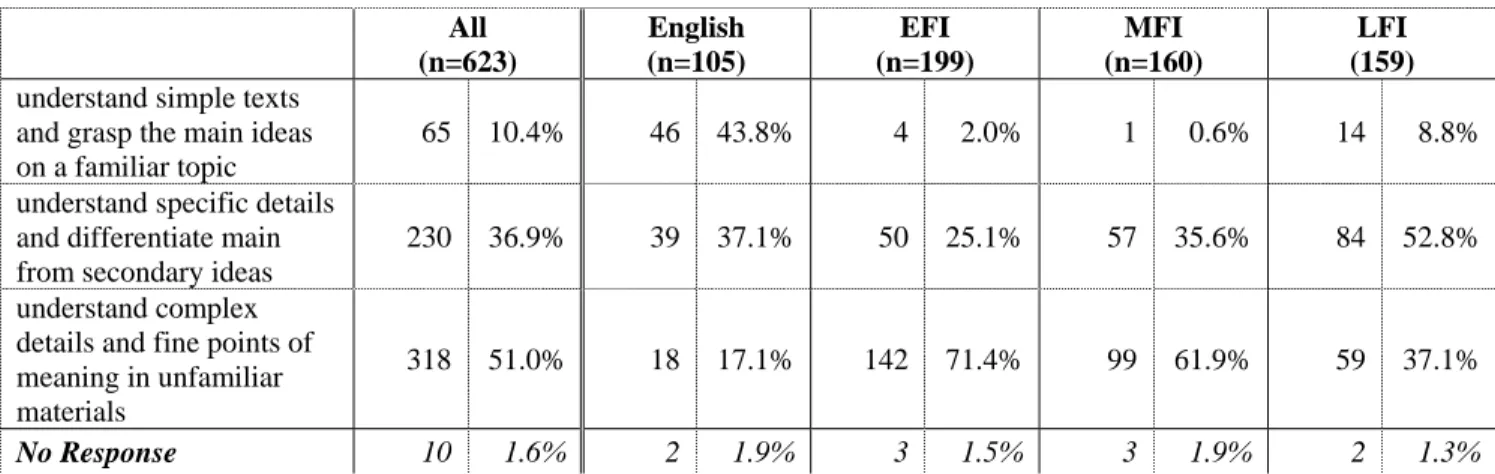
When OCDSB parents were asked to identify the level of French proficiency they expected their child to achieve upon completion of an immersion program, elementary parents were more likely to expect a higher level of proficiency in reading, writing, and oral communications compared to parents of secondary students.
Academic Achievement. Research has repeatedly found that an immersion environment does not adversely affect academic achievement. In fact, although the introduction of a French immersion program will initially result in deficits in subject-matter learning and a temporary lag in English development, the extent of the delay will be temporary and will depend on the amount of prior learning in a core French program and the intensity of the immersion program in the first two years. Further, studying a second language actually facilitates the development of cognitive flexibility, creativity, and meta-linguistic awareness – skills that are beneficial to all students, including those who have been identified with special needs and English Language Learners.
Research studies that have used EQAO results as a measure of English language literacy skills have found that students in school districts with the most intensive EFI programs demonstrated weaker skills in grade 3 compared to students in less intensive programs, but by grade 6 the differences in reading, writing and mathematics disappeared.
Employment/work. One of the main reasons parents consider an immersion program for their child is the belief that the programs are enriching and advantageous for their child’s future career path. Similarly, students are motivated to register in FI in hopes of providing better access to jobs. A study conducted through the Ontario Institute for Studies in Education (OISE) that looked at bilingual job opportunities in the metropolitan Toronto area, however, found that while there were many advertised positions for bilingual high-school graduates, employers have a tendency to prefer hiring university graduates for these
Quality Assurance
vii
positions. Further, French language skills were not rated as important for promotion within theseorganizations, and there was skepticism that graduates of school-based immersion programs were not suitable candidates for bilingual positions. Additional research into this phenomenon in the Ottawa region may be warranted given the bilingual nature of the area and the widespread popularity of French
immersion programs within the region.
Many school boards in Ontario that offer an immersion program award additional certification to students who complete a specific number of credits in French. Over the past three years, 35-42% of students enrolled in an immersion program in grade 8 have earned either an immersion or an extended French certificate upon graduation from high school.
EQUITABLE ACCESS TO FSL PROGRAMS &
VIABILITY AND SUSTAINABILITY IN STUDENT ENROLMENTS
Equity of access to immersion programs is a major challenge for school districts in Ontario, primarily due to the inconsistency of FSL program offerings across districts which impacts on enrollment patterns and retention rates in immersion programs.
Characteristics of Students Enrolled in FSL Programs
Nationally, immersion programs have typically been viewed as being elitist. Researchers have argued that while this may have been the case in the initial stages of implementation, EFI typically serves a more heterogeneous student population in terms of cognitive ability and social background since there is little knowledge of a child’s academic ability at the age of entry into the program. In MFI and LFI programs, parental decisions to register their child in immersion tend to be swayed by academic ability – MFI also tends to be more attractive to parents of immigrant children, whereas LFI tends to attract students that are of higher academic ability and who are highly motivated.
Socioeconomic Status (SES). National studies have demonstrated a strong relationship between reading and achievement and SES, with a greater proportion of families of high SES enrolled in immersion programs compared to non-immersion.
Gender. Information from international assessment data has shown that a greater proportion of girls than boys are enrolled in immersion programs. Our own statistics provide further evidence of this, with 10% more girls than boys enrolled in EFI, 14% in MFI, and 26% in LFI.
Students with Special Needs/English Language Learners. Research has also demonstrated that all students can be successful in an immersion program, given the appropriate supports. Again, district level statistics show that although there are exceptional students and students for whom English is not their first
language enrolled in each of the elementary program streams, the majority are in an English program and not in immersion.
Enrolment Patterns
Despite the decline in elementary enrolment in OCDSB schools since October 2001, there has been an increase in enrolment for students opting for EFI and MFI during the same period.
Accessibility of FSL Programs. All students in the OCDSB have designated schools for English, EFI, and LFI programs, but not for MFI. Further, the geographic area/boundaries for each of the MFI programs are significantly larger than those for English, EFI, and LFI. Although students who do not have a designated MFI school (i.e., those who reside in the southern and eastern-most regions of our jurisdiction) may apply for a cross-boundary transfer, the current transportation policy does not offer transportation.
Quality Assurance
viii
Attrition/Retention Rates. In the OCDSB, students from all three elementary program streams merge into a common program in secondary school, posing some challenges as a result of the differences in linguistic compentency among students. According to the federal government, both core French and Frenchimmersion programs experience a high rate of attrition at the high school level as a result of: (i) a lack of a wide range of course options; (ii) the perception that preparation for university is best done in English; (iii) a general fatigue from studying in French; and, (iv) teaching methods that do not always promote active, communicative learning. When it comes to the reporting of attrition rates by program, the research is mixed with some studies showing higher attrition rates in EFI compared to LFI, and others
demonstrating the reverse trend. Within our own jurisdiction, year-over-year retention rates tend to be highest in the English program due in part to students exiting immersion programs. Year-over-year attrition rates in immersion programs, averaged over a 3-year period, are as follows: 6% in EFI, 10% in MFI, and 7% in LFI. Because the length of the program varies from nine years in EFI to five years in MFI and two years in LFI, the cohort retention rates based on a 3-year average are: 59% in EFI, 61% in MFI, and 93% in LFI.
Split-grade Classes. The presence of split-grade classes is often assumed to be an indicator of program viability/sustainability (i.e., if there are insufficient numbers of students in a particular grade and program within a school, it may necessitate the merging of multiple grades into a single class). There are other factors, however, that may result in the decision to create split-grade classes such as student needs, availability of qualified staff, class size caps, and collective agreements. Like other school districts in Ontario, the proportion of elementary split-grade classes in the OCDSB is on the rise and is projected to continue to rise next year. Classes comprised of multiple-grades are most prominent in the Alternative program followed by the regular English stream and least prominent in MFI.
CONCLUDING REMARKS
Overall, all FI programs promote advanced French language skills. Generally, immersion students that proceed through to the end of secondary school yield high levels of French proficiency, but not as high as native French speakers. Within the body of research, it has been suggested that districts should provide a feasible threshold level of bilingualism for different situations in which one might require two languages and that perhaps a greater emphasis should be placed on French speaking skills.
There are several factors that influence the particular program and/or framework that a district can offer. Specifically, the board’s requirements for qualified teaching staff are influenced by teachers French proficiency levels and professional development needs, pedagogical differences in immersion programs, interaction with francophones, correct mix of language of instruction within the classroom, and the availability and allocation of resources and supports for both teachers and students. When determining French immersion entry point(s), research recommends a focus on equitable and accessible programs for all students.
Quality Assurance 1 INTRODUCTION
In April 2006, Education Committee received the first in a series of reports seeking approval for a French Immersion review in the Ottawa Carleton District School Board (OCDSB, 2006). In December 2006, the French as a second Language (FSL) Review Ad Hoc Committee was established and tasked with
developing a framework for a review of FSL programs in the district. It was agreed that the review would focus on all FSL programs (i.e., immersion and core) and would initially focus on key aspects at the elementary panel (i.e., entry points, locations of programs, and program framework). As such, the objectives for this initial phase of the FSL review were:
• to improve the effectiveness of delivery and instruction for FSL programs; • to ensure that students throughout the school district have equitable access to FSL
programs;
• to ensure that FSL programs have viable and sustainable enrolments; and, • to ensure that FSL programs are cost effective.
METHODOLOGY
As part of the review process, staff has conducted a review of the literature that is relevant to the goals and objectives identified by the FSL Review Ad Hoc Committee and approved by Board on 31 January 2007. Many of these issues have been under investigation for a number of years and addressed in previous comprehensive literature reviews (Edwards, 1989 as part of a study conducted in the Carleton Board of Education; Wesche et al., 1996 as part of a study conducted by the Ottawa Board of Education; Lapkin, 1998). More recent research studies have also been included that provide new evidence in relation to FSL programs.
In addition to the review of literature, information was gathered from central departments/divisions within the OCDSB (i.e., Curriculum Services, Finance, Human Resources, Planning, Quality Assurance, and Special Education), as well as from other school boards in Ontario. Stakeholder surveys of OCDSB parents, elementary teachers, and elementary administrators helped to provide an understanding of current perceptions regarding existing FSL programs and suggestions for improvement. The following table shows the return rates for the various groups surveyed:
Table 1: Return rates for completed surveys
Group Surveys Distributed Surveys Received Return Rate Margin of Error1 Elementary Principals/VPs 179 104 58% +/- 6.2 Elementary Teachers 3035 1161 38% +/- 2.3
Parents/Guardians of Elementary Students 1308 623 48% +/- 3.9
English 327 105 32% +/-9.6
Early French Immersion 327 199 61% +/-6.9
Middle French Immersion 327 160 49% +/-7.2
Late French Immersion 327 159 49% +/-7.0
Parents/Guardians of Secondary Students 1278 337 26% +/- 5.3 1
The margin of error provides information as to the reliability of survey findings from a random sample of the population under study. Using the information in the table, therefore, we can be reasonably confident (i.e., 95% of the time, or 19 times out of 20) that responses from a random sample of parents selected from the same population would fall between +/- 3.9 percentage points. (e.g., if 43% of elementary parents were in agreement with a particular statement, the response to that question for the entire elementary parent population would most likely fall between 39% and 47%).
Quality Assurance 2 Analysis of Survey Data
Responses to the quantitative components of the stakeholder surveys are reported throughout this
document as frequencies for the four primary respondent groups (i.e., prinicpals/vice-principals, teachers, elementary parents, and secondary parents). For some questions, frequencies have been reported for sub-groups of parents according to the program in which their child is enrolled. For key questions in which the number of parental responses was sufficient to perform tests of statistical significance, an Analysis of Variance (ANOVA)2 was performed; significant differences between groups of parents were followed up by conducting post hoc comparisons using the Scheffé3 method.
Qualitative analyses of the open-ended questions posed to stakeholders on the survey involved the coding of comments into themes/categories. Only those opinions/ideas that were offered by a sizeable proportion of respondents have been incorporated into this report – that is, ideas that were given by only a few individuals from any particular group have not been reported.
Characteristics of Respondents
All respondent groups were asked to provide some general information about themselves to determine whether or not certain groups of staff or parents were more likely to respond to the survey than others.
School Organization. Half of the principals and vice-principals who responded to the survey indicated
that they were in a school having Junior Kindergarten (JK) through grades 3, 4, 5, or 6; approximately one-third of administrators reported being in a JK-8 school, and 13.5% reported being in a more
intermediate setting (i.e., grades 4, 6, 7, and/or 8) (OCDSB FSL Survey, Appendix A, Table A-2).These figures are representative of the elementary administrators across the district (i.e., principals and vice-principals at schools offering JK through grades 3, 4, 5, or 6 comprise 49% of all elementary
administrators in the district, followed by those at JK-8 schools (37%), and those at grades 4, 6, 7, and/or 8 schools (14%).
Completed surveys were received from parents of students in all grades from JK through grade 12. While the distribution of parents of secondary students was equally dispersed across grades 9 through 12, the majority of elementary parents were of students in grades 7 and 8 (39.8%), followed by parents of students in the junior division (33.6%), and then JK through primary (25.7%) (OCDSB FSL Survey, Appendix A, Table A-6). These figures indicate that: (i) parents of students in the intermediate grades were over-represented in our sample compared to the population of students enrolled in grade 7 or 8 (i.e., 20.5% of OCDSB elementary students are enrolled in grade 7 or 8); and, (ii) parents of students in grades JK through 3 were under-represented (i.e., 46.4% of elementary students are enrolled in one of these grades).
2
Analysis of variance (ANOVA) is used to uncover the main and interaction effects of categorical independent variables (called "factors") on an interval dependent variable. The key statistic in ANOVA is the F-test of difference of group means, testing if the means of the groups formed by values of the independent variable (or combinations of values for multiple independent variables) are different enough not to have occurred by chance. If the group means do not differ significantly then it is inferred that the independent variable(s) did not have an effect on the dependent variable. If the F test shows that overall the independent variable(s) is (are) related to the dependent variable, then multiple comparison tests of significance are used to explore just which values of the independent(s) have the most to do with the relationship. www.statisticssolutions.com/ANOVA.htm
3
The Scheffé test is a widely-used method of controlling Type I errors in post hoc testing of differences in group means. This comparison is a conservative estimate of group differences in that it maintains an experimentwise 0.05 level of significance in the face of multiple comparisons. www.statisticssolutions.com/ANOVA.htm
Quality Assurance 3 The majority of principals/vice-principals (62.5%) reported having knowledge of, or experience teaching, all grade levels from kindergarten through intermediate compared to 15.2% of teachers. All principals, vice-principals and teachers reported being at least knowledgeable of the primary and junior divisions (OCDSB FSL Survey, Appendix A, Table A-4).
Language of Instruction and Program. Close to half of the principals/vice-principals and teachers who
responded to the survey indicated that they were in a school that offers both English and a French immersion program. The remaining respondents were relatively evenly divided between schools offering only the English program and those offering only a French Immersion program (OCDSB FSL Survey, Appendix A, Table A-3).Principals and vice-principals at schools offering both the English and French immersion program comprise 55% of all elementary administrators in the district, followed by those at schools offering only the English program (34%), and those at schools offering only a French Immersion program (11%).
Almost all principals and vice-principals surveyed (91.3%) reported having knowledge of, or experience teaching, the English program compared to only 54.8% of teachers. Principals and vice-principals were least knowledgeable of, or had experience with, the middle French immersion program; teacher
respondents were least experienced in both MFI and LFI (OCDSB FSL Survey, Appendix A, Table A-5a).
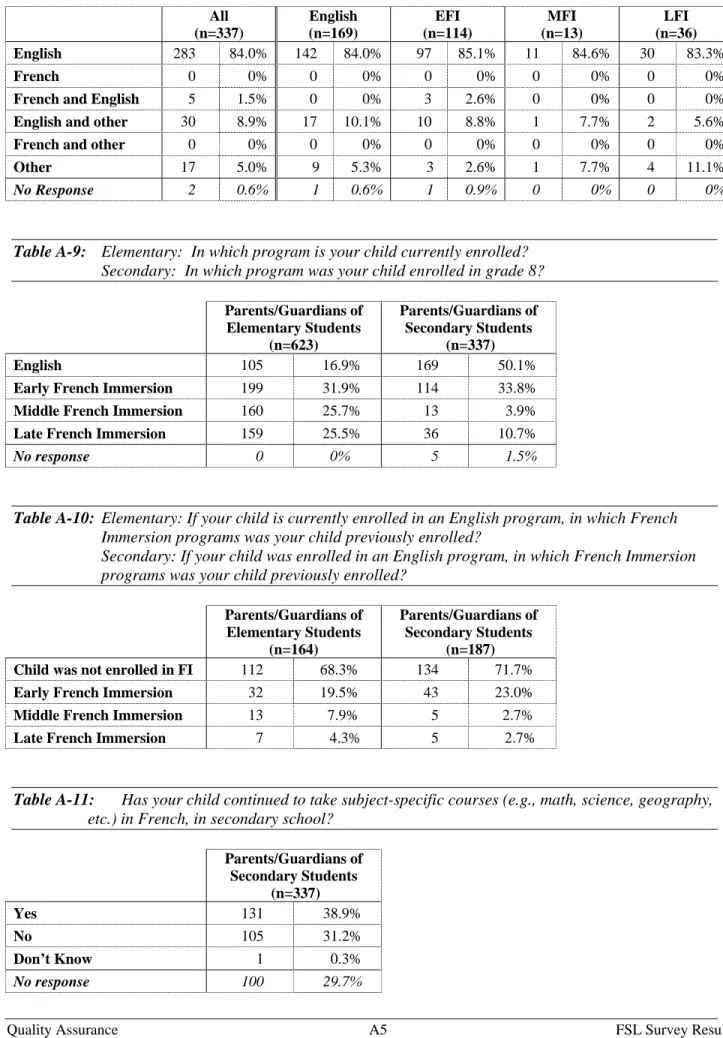
Approximately one-third of elementary parents who responded to the survey had children in the EFI program, one-quarter in each of MFI and LFI, and only 16.9% had children in the English program. Given that equal sampling across the four groups was required to produce reliable results at this level of reporting, these figures suggest parents of elementary EFI students were more likely to respond to the survey than parents of elementary students in the English program. Based on the student population, however, responses from parents of EFI students were proportional to the number of students enrolled in the program.
At the secondary level: (i) almost half of parents indicated that their child was in the English program in grade 8 (in 2006, the English program comprised 61.9% of the grade 8 enrolment); (ii) one-third indicated that their child had been in an EFI program in grade 8 (in 2006, the EFI program comprised 22.2% of the grade 8 enrolment); and, (iii) less than 15% reported that their child had been in an MFI or LFI program (in 2006, the MFI and LFI programs comprised 11.4% of the grade 8 enrolment) (OCDSB FSL Survey, Appendix A, Table A-9).
When parents of children in the English program were asked if their child had previously been enrolled in a French immersion program, almost one-third of both elementary and secondary parents reported that their child had previously been enrolled in a French immersion program, the majority having been in EFI (see Table 2 below). The most frequently cited reasons for withdrawing their child from French immersion included the difficulty of the program and/or the identification of a learning disability of their child. For parents of elementary school children, other reasons for withdrawing their child from the program included their inability to help their child with homework and the amount of homework. For parents of secondary students, the need for their child to concentrate on the acquisition of English-language skills was a key factor in their decision to withdraw from French immersion.
Quality Assurance 4 Table 2: French immersion program prior to English program
Parents/Guardians of Elementary Students (n=164) Parents/Guardians of Secondary Students (n=187)
Child was not enrolled in FI 112 68.3% 134 71.7%
Early French Immersion 32 19.5% 43 23.0%
Middle French Immersion 13 7.9% 5 2.7%
Late French Immersion 7 4.3% 5 2.7%
Special Education/English Language Learning Supports. Approximately 10% of elementary parents,
and 20% of secondary parents, indicated that their child was receiving support for English as a Second Language, Special Education, or Giftedness. For both groups, giftedness was the most frequently cited support being received by their child (OCDSB FSL Survey, Appendix A, Table A-7). These figures give us confidence that the opinions of parents of these students have been provided through the stakeholder survey, given that: (i) 12.1% of OCDSB elementary students have been formally identified as having special needs through the Identification Placement Review Committee (IPRC) process; and, (ii) 18.9% of OCDSB secondary students have been IPRC’d (OCDSB Planning Department, Appendix C).
Language Spoken at Home. The majority of elementary and secondary parents reported speaking only
English at home, with some also reporting that they spoke English and another language. Only 9% of elementary and 5% of secondary parents reported speaking a language other than English or French at home. The most common languages reported included Arabic, Chinese and Mandarin (OCDSB FSL Survey, Appendix A, Tables A-8a and A-8b).These figures are substantially lower than the 22% of elementary students who have indicated that they do not speak English or French at home (OCDSB Planning Department, Appendix C).
EFFECTIVE FSL DELIVERY MODELS AND INSTRUCTIONAL PRACTICES
One of the primary objectives of the FSL review is:
• to improve the effectiveness of delivery and instruction for FSL programs.
This objective speaks to the quality of program as well as to some measures of accountability, including whether or not:
• provincial guidelines are being followed, including hours of instruction; • teacher qualifications are clearly defined;
• the entry points into a program are established and consistent throughout the district; • research into FSL programs is encouraged;
• innovative approaches to programming are encouraged and evaluated for effectiveness; • there are adequate resources available to support the program;
• student attitudes and motivation are monitored;
• the outcomes/goals for second language (L2) achievement are clearly specified;
• there is special recognition for students enrolled in the program (e.g., bilingual certificate); • activities in which students use French outside the classroom are encouraged, funded and
publicized; and,
• there is a process for monitoring program operations and success (e.g., student achievement, supply of teachers, hours of instruction) (adapted from Canadian Parents for French, 2006).
Quality Assurance 5 The Ontario Ministry of Education (MOE) acknowledges the importance for students to be able to
communicate in French because: (i) Canada is an officially bilingual country; (ii) learning a second language may provide a competitive advantage in the workplace; and, (iii) research findings support the added academic benefits inherent in the language acquisition process. As such, there are a number of program options available to elementary and secondary students within the publicly funded school system in Ontario (Ministry of Education, 2001).
Types of Programs
Core French. The purpose of the core French program is to “develop basic communication skills in
French and an understanding of the nature of the language, as well as an appreciation of French culture in Canada and in other parts of the world.” It is recognized that the core French program offers students a starting point in terms of French language development which could be further expanded through other educational experiences within the school context (Ministry of Education, 1998).
Although the MOE does not mandate a core French program until grade 4, a minimum of 600 hours of French instruction must be accumulated by an individual student by the end of grade 8 (Ministry of Education, 1998). In the OCDSB, the equivalent of 100 minutes of French instruction per week is currently offered in junior and senior kindergarten, and 200 minutes per week is offered in grades 1 to 8, inclusive. A student who enters this program in JK and remains in it until the completion of grade 8 would accumulate 1,164 hours of French instruction.
While immersion and extended French represent the minority of FSL programs in Canada, their enrolments have been relatively stable over the last decade (CPF, 2006). Research has shown that a majority of FSL students (i.e., 85%) in Canada enrol in a core French program; however, fewer than 17% of students who begin this program in elementary school continue to grade 12 (MacFarlane, 2005). Therefore, it is generally recognized that in order to meet the Federal government’s stated objectives for bilingualism by 2013 (Government of Canada, 2004), core French programs will need to be examined for increased effectiveness (MacFarlane, 2005).
OCDSB principals/vice-principals, teachers and parents were asked to indicate the grade level at which they felt students should enter a core French program. The majority of respondents across all groups chose JK (ranging from 31% of elementary teachers to 58% of secondary parents) (OCDSB FSL Survey, Appendix A, Table A-36).
When asked whether they felt students in the core French program should receive more time in French instruction, the majority of both elementary (41%) and secondary (43%) parents of children in a core French program felt that they should compared to 34% and 32%, respectively, who did not. Staff was more likely than parents to say “no” (i.e., 44% of principals/vice-principals and 23% of elementary teachers); however, these groups also had higher rates of “non-response” (38% and 58%, respectively) (OCDSB FSL Survey, Appendix A, Table A-37).Similarly, elementary (35%) and secondary (40%) parents were more in favour of having longer instructional blocks in the core French program as well (i.e., compared to 18% of principals/vice-principals, and 15% of teachers) (OCDSB FSL Survey, Appendix A, Table A-38). Among the suggestions for improving the core French program, many OCDSB teachers and administrators recommended that the instructional time be adjusted according to the grade level of the student and based on learner needs (e.g., less French instruction for students in the primary grades). Many respondents also felt there should be greater implementation of the Accelerated Integrated Method
Quality Assurance 6 (AIM)4 program. Others identified the need to better align the primary core French program with the provincial curriculum and OCDSB balanced literacy initiatives.
Extended French/French Immersion. The Ministry of Education allows school boards to start an
extended French or French immersion program at any grade level provided that all policy and program requirements are met and that students enrolled in these programs are given the opportunity to achieve all of the expectations in French as a second language for the relevant program. The primary purpose of these programs is to:
“…provide students with the skills they need to communicate in a second language, and thereby to enhance their ability to perform effectively and meet with success in a rapidly changing global economy. Although the two programs are designed to help students achieve different levels of proficiency in French through instruction at different levels of intensity, both aim to develop strong fundamental skills in oral communication (listening and speaking), reading, and writing. Both aim as well to provide students with an understanding of the cultures of French-speaking societies by integrating cultural study into daily language instruction.” (Ministry of Education, 2001)
Both the extended and immersion programs require that students study French as a second language in addition to studying at least one (extended French) or two (French immersion) of the following subjects in French: the arts, social studies (grades 1 to 6) or history and geography (grades 7 and 8), mathematics, science and technology, and health and physical education. In the case of an extended French program, French must be the language of instruction for a minimum of 25% of the total instructional time at every grade level of the program, and a minimum of 1,260 hours of instruction in French must be completed by the end of grade 8. Program guidelines are designed based on a five-year period, starting in grade 4. In French immersion programs, French must be the language of instruction for a minimum of 50% of the total instructional time at every grade level of the program, and a minimum of 3,800 hours of instruction in French must be completed by the end of grade 8 (Ministry of Education, 2001).
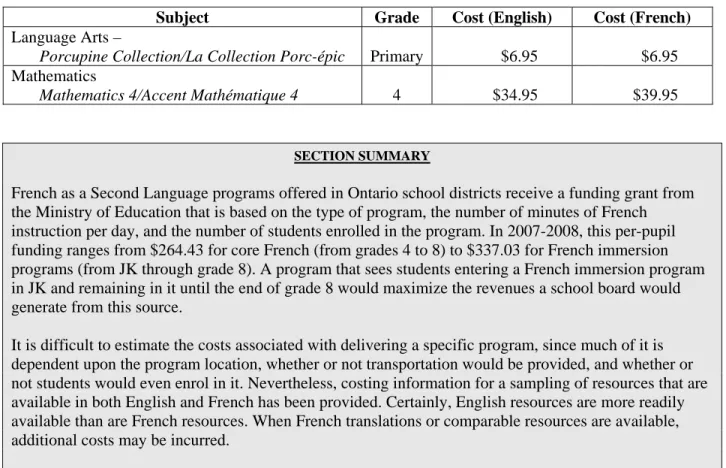
In the spring of 2006, information on French immersion programs was obtained for 56 of 65 English language school districts in Ontario (Appendix B). The following is a summary of the findings:
• 50 school districts offer French immersion, 45 of which have a single entry point and five have two entry points;
• the OCDSB is the only school board in Ontario to offer three different entry points into a French immersion program – early, middle, and late. In fact, one of the concerns raised by OCDSB educators was the number of entry points that are currently available in our district;
• 42 districts offer EFI, 10 offer MFI (grade 4 or 5 entry), and three offer LFI (grade 6, 7 or 8 entry); and,
• of the 5 districts that offer more than one entry point, two have EFI and MFI, two have EFI and LFI, and one has MFI and LFI.
As part of the stakeholder surveys, all respondent groups were asked to rate the French immersion entry points from “most preferred” to “least preferred” – the majority of respondents in all groups, with the exception of principals/vice-principals, preferred an EFI entry point; more principals/vice-principals
4
AIM is a method of teaching FSL developed in 2000 by an FSL teacher by the name of Wendy Maxwell. The goal of AIM is to make learning French more systematic and accelerated to improve linguistic competence of students by
transforming them into independent and confident communicators. To do this, students in the FSL program learn through stories, drama and music – one of the main features being the use of an invented gestural language that corresponds to the vocabulary being taught. This technique engages the learner, provides concrete meaning to abastract concepts, and seems to allow for better retention of new learning. www.aimlanguagelearning.com
Quality Assurance 7 preferred the MFI entry point. The LFI entry point was least preferred by a majority of respondents in all groups (i.e., 40-63% of respondents chose this as their least preferred entry option). When parents were divided by program, the majority of respondents with children in EFI chose the EFI entry point as most preferred and those with children in MFI chose the MFI entry point. For parents of children in LFI, however, more preferred an EFI entry point (OCDSB FSL Survey, Appendix A, Tables A-35a to A-35c). The primary reason for preferring an earlier entry point was that it is easier for younger children to learn a new language since they adapt/adjust more easily. Those who preferred a later entry point (i.e. MFI and LFI) indicated that it provides children with a good foundation in English and allows for the identification of learning disabilities. Many school administrators who expressed concerns with the existing French immersion programs felt that an EFI entry point was too early for students with special needs and those for whom English is not their first language, and that the LFI entry point was too late for acquiring French language competency.
When asked whether they felt the amount of time their child receives in French instruction is appropriate, the majority of both elementary (73%) and secondary (65%) parents of children in a French immersion program felt that it was “just right”. When responses were divided by program, parents/guardians of students in a French immersion program were generally more satisfied with the amount of time their child receives in French instruction, compared to parents/guardians of students in the core French program. (OCDSB FSL Survey, Appendix A, Tables A-13a to A-13b).
Early French Immersion (EFI). Students typically enter this program in senior kindergarten (SK). In both SK and grade 1, French constitutes 100% of the instructional day. When English is introduced in grade 2, French instruction is reduced to 80% and gradually diminishes to about 50% in grades 6 to 8.
A major issue that has emerged in the immersion debate is whether or not second language acquisition is appropriate for children as young as four years of age. In EFI, most of the emphasis is on oral French communication in the first three years of the program (Dube & MacFarlane, 1991). Walsh and Yeoman (1999) examined the use of exploratory talk in concept development with primary age children in EFI programs and found them beneficial for language development. Similarly, Pelletier (1998) supported the claim that Early French immersion programs are not too stressful for children of kindergarten age. OCDSB principals/vice-principals, teachers and parents were asked to identify the grade level at which they felt students should enter an EFI program; most respondents in all groups chose SK (ranging from 32% of principals/vice-principals to 67% of secondary parents). When parent responses were divided by program, 79-81% of those with children in EFI, 31-39% of those with children in MFI, and 42-45% with children in LFI chose SK. (OCDSB FSL Survey, Appendix A, Tables A-32a to A-32c).
Middle French Immersion (MFI). This program is intended for those students who have completed the grade 3 English program and wish to transfer to an immersion program. Currently, all subjects except English language arts are taught in French in grades 4, 5, and 6, with English accounting for
approximately 60 minutes per day. In grades 7 and 8, the program is 70% French and 30% English, with French language arts, mathematics, history, geography, health and physical education taught in French. Again, principals/vice-principals, teachers and parents were asked to identify the grade level at which they felt students should enter an MFI program. Staff was more likely to choose the current entry point of grade 4 (67% of principals/vice-principals; 44% of elementary teachers), whereas parent responses were mixed (i.e., 27-34% of parents selected grade 4, and 37% of parents chose grade 3). When elementary parent responses were divided by program, parents with children in EFI and LFI were more likely to choose grade 3 (43% and 39%, respectively), whereas 61% of parents with children in MFI chose the current entry point of grade 4. Similar trends were observed in the responses from parents of secondary students. (OCDSB FSL Survey, Appendix A, Tables A-33a to A-33c).
Quality Assurance 8 Late French Immersion (LFI). This program currently begins in grade 7 and builds on the skills and knowledge developed through the core French program from JK to grade 6. French instruction accounts for between 70 and 75% of the program in grades 7 and 8.
It has been suggested that older students learn French more efficiently because their advanced cognitive development facilitates some aspects of L2 learning. In other words, older students might be able to learn languages more quickly and catch up to younger learners (Edwards, 1989; Turnbull et al., 1998, in (ed) Lapkin 1998; Genesee, 1987 as cited in Wesche et al., 1996). In fact, LFI graduates themselves felt that an earlier entry point was more preferable than a later entry point (Bonyun 1983; Bonyun 1985;
MacFarlane & Wesche, 1995 as cited in Wesche et al., 1996).
When stakeholders were asked to identify the grade level at which they felt students should enter an LFI program, staff was more likely to choose the current entry point of grade 7 (33% of principals/vice-principals; 30% of teachers). Another 21% of principals/vice-principals and 19% of teachers, however, selected grade 6. Overall, opinions of parents/guardians of elementary students were varied, with a slight preference for a grade 5 entry point. One third of parents/guardians of secondary students also selected grade 5 as the best grade to enter LFI. When parent responses were divided by program, more
parents/guardians (both elementary and secondary) of children in EFI and parents of secondary students who had been in an LFI program chose grade 5; those with children in MFI and parents of elementary students in LFI were more evenly dispersed across the three grades (i.e., 5, 6 and 7) (OCDSB FSL Survey, Appendix A, Tables A-34a to A-34c).
Intensive French. The Intensive French (IF) program began in Montreal in1974, but never reached the
popularity of immersion programs as an FSL delivery model in Ontario (Netten & Germain, 2004).In 1998-1999, the Intensive French program was piloted in Newfoundland in an effort to address the high rates of attrition in core French in that province, and the challenges of effectively teaching communication skills within a core French program. Since 2003, this program has been implemented across Canada (with very limited uptake in Ontario) as an alternative delivery model to regular core French programs
(MacFarlane, 2005). While current Ontario Ministry of Education documents do not describe this model as a means of delivering FSL to students in Ontario, four catholic school boards in Ontario have recently received funding to pilot intensive core French classes beginning in September 2007 (Canadian
Association of Second Language Teachers (CASLT), 2007). All of these school districts are relatively small in nature, ranging from 32 to 53 elementary schools.
The IF program involves the delivery of French instruction during a concentrated period of the school year (usually the beginning), while the remainder of the school year sees the regular curriculum being delivered in a compact manner (Netten & Germain, 2004). Intensive French programs range between 260 and 420 instructional hours per yearand have the following features:
• increased instructional time for French during the day (i.e., 60-75%);
• concentrated scheduling of FSL instruction over five months in which the amount of time allotted to other subject areas is significantly reduced, particularly English language arts;
• offered in grade 5/6 when students do not rotate classrooms; and,
• pedagogy is focused on language as the object of learning specifically targeting oral communication.
Given that instructional activities are dedicated to learning the French language and not to the delivery of subject-specific content in French, the IF model cannot be considered an immersion program (Netten & Germain, 2004). Rather, the program was designed with the intent of re-integrating students back into core French, with a focus on accelerating communication.
Quality Assurance 9 Motivating Factors to Enrol in/be Successful in French Immersion Program
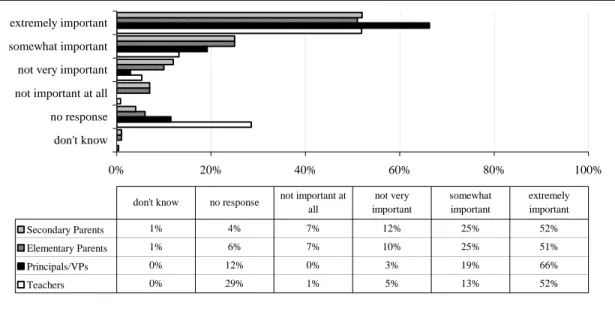
As part of the OCDSB stakeholder surveys (Appendix A, Charts A-1 to A-13), respondents were asked to indicate the factors they believed were most important in terms of making the decision to enroll their child in their program of choice (parents) or in terms of being successful in a French immersion program (principals/vice-principals and teachers). In general, all respondents felt that the ability to adjust to challenging situations (68% to 85%), first language skills other than French (65% to 85%), work habits (68% to 81%), family support (67% to 88%), emotional development (64% to 81%), an interest in learning French (61% to 87%), social skills (61% to 77%), and French skills (49% to 64%) were either “extremely” or “somewhat” important. French being spoken at home, however, was not deemed to be important (46% to 65%).
Parents also reported that the availability of the program in their local school (73% to 75%) was important in helping them select their child’s program in elementary school, whereas child care (71% to 73%) was not. Responses were mixed when asked if transportation was important, with 46-51% of parents reporting that transportation was not important and 41-48% reporting that it was.
When parent responses were grouped according to the elementary program in which their child was enrolled (i.e., English, EFI, MFI, or LFI), the following statistically significant differences were observed:
• Parents of children enrolled in the English program were more likely to report that their child’s first language skills were important in deciding their child’s program compared to parents of children enrolled in EFI, MFI, or LFI.
• Parents of children enrolled in MFI or LFI were more likely than parents of children in the English or EFI program to indicate that their child’s interest in learning French was important in their decision to enrol their son/daughter in their current program.
• Parents of children enrolled in the LFI program were more likely than other parents to indicate that their child’s French language skills were an important factor in their decision to enrol their child in the LFI program.
• Parents of children enrolled in LFI were more likely than parents of children in EFI to indicate that their child’s work habits were important in deciding their child’s program.
• Parents of children in the EFI and LFI programs were more likely than parents of children enrolled in an English or MFI program to indicate that the availability of the program in the local school was important to them.
• Parents of children in an MFI program were more likely than parents of children in an English or EFI program to report that the provision of transportation was important to them.
Teaching Requirements/Qualifications
According to MacFarlane (2005), there are no national benchmarks for what constitutes minimum French proficiency requirements for a FSL teacher. In Ontario, elementary teachers require at least a French-Part-one specialist certificate in order to teach core French. In other provinces, where the supply of fluently bilingual teachers is minimal (e.g., British Columbia), school districts must often waive language requirements in order to meet staffing demands (Carr, 1999).
Rehorick (2004) notes that the chronic second language teacher shortage in Canada has reached critical levels in recent years and is not projected to stabilize soon. Teacher shortages in specialized programs, such as FSL, are predicted, particularly in Ontario where the academic workforce is aging more rapidly than any other province (Grimmett & Echols, 2001). Further, Canadian faculties of education do not create sufficient places in their FSL teacher education programs to meet demand, and oftentimes teacher candidates switch to the English program because it is perceived as being less challenging (CPF, 2006). Although FI applicants are more numerous in urban areas, such as Ottawa-Carleton, over half of school
Quality Assurance 10 districts in Canada report a shortage of FI teachers (Veilleux & Bournot-Trites, 2005). Indeed, one of the concerns with the existing French immersion programs as identified by parents of OCDSB students was the lack of fluently bilingual teachers (including supply teachers) that often results in French not being taught or spoken consistently in the classroom. Similary, school administrators and teachers noted a need to improve teacher qualifications for both the core French and immersion programs and to revise the teaching strategies that are used.
The OCDSB has been actively recruiting FSL teachers since 1998 when the Carleton and Ottawa boards of education amalgamated. This process includes advertising in English and French newspapers that are circulated nationally, through the Apply to Teach electronic network, and through job fairs hosted at various faculties of education throughout the province (OCDSB Human Resources Department, personal communication).
In February of each year, the Human Resources Department organizes interview teams comprised of principals, vice-principals and department heads who prescreen candidates who have expressed an interest in teaching FSL in our district. Each year, upwards of 200 teachers go through this prescreening process which includes both a written component and a formal interview. The best candidates are
recommended for hire and results are made available to schools for use when hiring commences (OCDSB Human Resources Department, personal communication).
Over the years, the OCDSB has been able to meet its needs in staffing contract vacancies. There has been difficulty, however, in staffing extended occasional teaching assignments that result from leaves (e.g., pregnancy) that take place over the course of the year. Further, there has been greater difficulty in staffing FSL assignments in schools in the western-most region of the district, perhaps a result of demographics within the city. That is, a majority of Francophones live in the east end of the city and may be reluctant to drive long distances to their work location (OCDSB Human Resources Department, personal
communication).
Due to the lack of qualified FSL staff that possess both French proficiency and pedagogical knowledge, the Ontario College of Teachers issues more letters of permission to uncertified instructors than any other teacher-governing council in Canada. This is particularly true at the secondary level where knowledge of the second language and subject matter expertise are both required CPF (2006). In 2006-2007, the OCDSB hired 275 teachers (180 elementary, 95 secondary), 112 of whom were FSL teachers (87 elementary, 25 secondary). Almost one-quarter (25 of 112) of these teachers were hired on Temporary Letters of Approval5, all of whom taught in the elementary panel. During the same time, approximately 142 teachers have been employed in elementary extended occasional assignments and 31 in secondary assignments. Of those, close to one-third (51) are on a Temporary Letter of Approval (a breakdown by panel was unavailable). For the 2007-2008 school year, it is anticipated that approximately 70 FSL teachers will be hired in the elementary panel and 10 in secondary. While it is expected that these
positions can be filled with qualified staff, there continues to be concern with the ability to staff extended occasional FSL teaching positions (OCDSB Human Resources Department, personal communication).
French Proficiency of the Teacher. When staffing FSL programs, school boards consider it more
important that prospective second language teachers have strong French proficiency skills than to have content-based knowledge or subject-matter expertise. The latter is considered knowledge that can be acquired through instructional experience (MacFarlane, 2005). Research has suggested, however, that this could be dangerous in that once a less-qualified teacher is hired to temporarily fill an immersion position,
5
A Temporary Letter of Approval is issued by the Ontario College of Teachers and is valid for one year. They are typically given to teachers who are waiting for documentation to come from other jurisdictions or to provide a teacher with the opportunity to acquire additional qualifications that would allow him/her to teach in a specific subject area (e..g, FSL).
Quality Assurance 11 he/she might amass seniority giving them priority over someone who might possess better French
proficiency skills and/or pedagogical knowledge but who was hired at a later date (Veilleux & Bournot-Trites, 2005; Lapkin, 2004).
Research that has focused on teacher language proficiency has found that:
• there is no consistency in language measures used by universities and school districts in their hiring practices. For many of the measures that are used, the lack of validity and reliability can result in the lowering of teaching language competence in FI programs. At the school board level, for example, oral and written assessments have typically been administered by designated board personnel or relied on third party certification (e.g., transcripts, practicum reports). Tests of oral and written competency whose measures have already been deemed reliable and valid could be used to ensure that applicants are qualified for specialized positions (Veilleux & Bournot-Trites, 2005).
• of all the factors related to success on a faculty of education proficiency test (i.e., family
language background, formative educational experience, frequent use of French), interacting in a French speaking environment was the most influential (Bayliss & Vignola, 2000).
• a teacher’s lack of language competency (e.g., limited vocabulary, poor oral fluency) and/or lack of knowledge of FSL specific classroom methodologies may result in: (i) limited ability to plan and implement language programs and teach curriculum in specific content areas; (ii) poor language models for students; and, (iii) limited ability to provide corrective feedback on grammatical errors (Veilleux & Bournot-Trites, 2005; Carr, 1999; Lapkin, 2004; MacFarlane, 2005).
• proficiency in the target language is critical for program success (Evaluation Plus in report for Edmonton Public School Board, 2002); and,
• school boards need FSL teachers that graduate from faculties of education with a high level of French proficiency, thereby providing them with flexibility to teach in any French context, whether that be core French or FI (Bayliss & Vignola, 2000).
Based on this evidence, therefore, it can be concluded that both pedagogical knowledge and language proficiency are vital for delivering a quality FSL program.
Professional Development Opportunities.Generalist teachers teaching core French frequently cited the
following challenges in their role: lack of specialized training; implementing multiple cross-curricular changes; the need to accommodate ESL and/or special needs students; and, balancing classroom practice with advances in theories of language acquisition (Carr, 1999). Although lack of professional
development opportunities is frequently cited by many teachers as being a barrier to providing quality programs, Bayliss and Vignola (2000) found that the issue of teacher proficiency was more a matter of low-ability applicants (i.e., teacher candidates tend to be a homogeneous group in terms of their
background when applying for an FSL teaching program) than a lack of district-level PD opportunities. A national teacher survey conducted by Lapkin et al. (2006) with over 1,300 FSL teachers found that the majority of respondents had participated in at least one PD opportunity (i.e., workshop, reading
professional literature or collaboration with colleagues) each year.Nevertheless, according to MacFarlane (2005), more work is required at the district level to enhance teachers’ knowledge of effective second-language teaching methodologies, including: (i) experientially-based teaching approaches; (ii) designing more interactive classroom activities with a focus on communication; (iii) providing students with more opportunities for contact with francophone speakers/culture; (iv) integrating grammar instruction with content; and, (v) focusing more on student-centred learning.
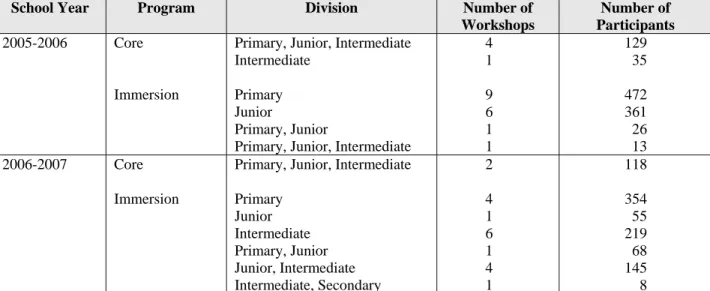
Quality Assurance 12 Within the OCDSB, professional development opportunities designed specifically for FSL teachers are provided centrally through the Curriculum Services Department6. Over the past two years, the majority of these workshops have been geared towards those in the French immersion program stream. In 2005-2006, the majority of FI teacher-participants were from the primary and junior levels, whereas in 2006-2007 there has been increased participation from intermediate FI teachers. In 2006-2007, there were also more opportunities for cross-panel collaboration (i.e., 6 of 17 workshops) compared to the previous year (i.e., 2 of 17 workshops). The following table provides an overview of the in-service opportunities offered to FSL teachers during 2005-2006 and 2006-2007.
Table 3: OCDSB Central Professional Development Opportunities Specific to FSL Teachers
School Year Program Division Number of
Workshops
Number of Participants
2005-2006 Core
Immersion
Primary, Junior, Intermediate Intermediate
Primary Junior
Primary, Junior
Primary, Junior, Intermediate
4 1 9 6 1 1 129 35 472 361 26 13 2006-2007 Core Immersion
Primary, Junior, Intermediate Primary Junior Intermediate Primary, Junior Junior, Intermediate Intermediate, Secondary 2 4 1 6 1 4 1 118 354 55 219 68 145 8 Despite these offerings, however, OCDSB teachers and administrators are still asking for more
professional development opportunities – particularly for those who are responsible for delivering the core French program and French immersion teachers who have students with special needs in their classrooms.
In sum, many researchers have examined the issue of linguistic standards required for FSL teachers, arguing that national benchmarks for language competence of FI teachers are needed in order to effectively address labour shortages of FSL teachers. In addition, stringent selection criteria or clearly defined competency criterion linked with specific FSL teaching positions are required for district hiring processes. School districts must ensure that FSL teachers receive adequate resources and professional development in order to effectively deliver FSL programming.
Learning Environment
Knaus and Nadasdi (2001) analyzed the attitudes of immersion students toward French culture and found some differences favoring EFI over MFI students; however these differences disappeared by grade 8. The authors argued that early entry immersion programs have several socio-cultural advantages including: (i) facilitating spontaneous contact with Francophones; (ii) reducing social distance; and, (iii) developing positive attitudes toward culture and people.
6
FSL teachers may also access PD through other in-service sessions offered centrally, by an outside organization, or through their school.
Quality Assurance 13
Pedagogical Considerations. An important issue in the research literature regarding FSL programs is
related to the different teaching strategies used in EFI and LFI programs (Edwards, 1989; Ewart & Straw, 2001). Specifically, Dicks (1994) argued that debate over the appropriate entry point for immersion ignores a larger question regarding teaching styles in immersion classrooms. That is, a more
communicative approach is used in EFI, whereas a more formative approach is used in LFI (Dicks, 1994, as cited in Wesche et al., 1996). Further, instructional methods used in LFI programs (and to a lesser degree MFI) tend to be more experiential and formal, which may explain why students in these two programs can perform relatively well on analytical tasks such as writing (Dicks, 1992, as cited in Wesche et al., 1996). Despite the functional communicative proficiency demonstrated by early immersion
students, they continue to have poor grammatical skills. Results from a study using a more formal approach (experiential) to second-language teaching in the early immersion classroom, however, have shown positive effects on French language proficiency in analytical tasks (Day & Shapson, 1990). Another important factor in the literature is sociolinguistic competence. Landry and Allard (1993) argued that the effects of bilingual education cannot be understood without taking into account the strong influences of the students' sociolinguistic environment. In a study of student-teacher classroom
interactions, Mondada and Pekarek Doehler (2004) found that second language proficiency is influenced by interactional, institutional, and sociocultural factors that took place through classroom talk. Nadasdi et al. (2005)discovered that immersion students sometimes mistakenly tend not to use vernacular forms of French in their speech patterns and, conversely, over-use more hyper-formal forms of communication. A more intensive use of instructional strategies that employ sociolingual variants of formal French could be a possible solution to support students in a French immersion program.
Interested in more than the oral communication element of FSL programs, Vignola (1995) examined the writing process of 17 first-year anglophone EFI graduates at the University of Ottawa. Participants were divided into different groups based on their level of writing proficiency (weak and strong) in their first language (L1) and on their level of writing proficiency (high and low) in their second language (L2). Think-aloud protocols and interviews were used for data collection which yielded information that could not normally be obtained by examining written compositions. A major finding of the study was that second-language written performance and L2 proficiency are distinct from one another. As a result, it was suggested that teachers should not use written texts as the sole basis for placement and that the following strategies could be used to help improve less proficient students’ French writing skills: (i) use critical self-assessment during the revision process; (ii) use resources, such as dictionaries more effectively; and, (iii) encourage students to be aware of the ‘multi-faceted’ nature of the writing act.
In many immersion programs, language models are limited to teachers, their anglophone peers and the school context. Research has shown that this environment often resulted in semantic confusion and comprehension difficulties as a by-product of numerous grammatical errors (e.g., gender, verb forms, pronouns) being made (Lyster, 1987, as cited in Edwards, 1989). Therefore, it is important for FSL teachers to be aware of the relative importance of communication error types so they can be corrected (Edwards, 1989). Cyclical curricular modifications to immersion programs could be implemented to avoid the features of the board’s FI programs which yield these errors (e.g., teaching strategies, curriculum). OCDSB parents also offered opinions regarding the current French immersion programs being offered, and expressed particular concern with the lack of emphasis on the teaching and practice of oral French skills. Suggestions for improvement included:
• integrate French into non-classroom activities (e.g., sports); • provide more interactive exercises;
• offer language exchanges to Quebec;
• offer French courses in writing, grammar, etc. on weekends or during the summer; and, • provide access to French movies, plays, and French culture.
Quality Assurance 14
Interaction with Francophones. Rehorick (2004) noted that anglophones have a limited number of native
or native-like French speakers as role models, particularly in their own age bracket and in elementary schools. As a result, the level of French competency obtained in an immersion program may be sufficient for communicating with peers and teachers, but it does not transfer to other contexts. As such, the author recommended that: (i) school-based and outreach programs be developed which use more sustained interaction among students of both the anglophone and francophone communities; and, (ii) schools should use the linguistic resources which exist in their community. In fact, MacFarlane (2005) reported that, as a result of the acute teacher shortage, fran