Volume 95 Issue 3
Article 3
Summer 2020
Blockchain Wills
Blockchain Wills
Bridget J. Crawford
Pace University School of Law, [email protected]
Follow this and additional works at: https://www.repository.law.indiana.edu/ilj
Part of the Elder Law Commons, Family Law Commons, and the Property Law and Real Estate Commons
Recommended Citation
Recommended Citation
Crawford, Bridget J. (2020) "Blockchain Wills," Indiana Law Journal: Vol. 95 : Iss. 3 , Article 3. Available at: https://www.repository.law.indiana.edu/ilj/vol95/iss3/3
This Article is brought to you for free and open access by the Law School Journals at Digital Repository @ Maurer Law. It has been accepted for inclusion in Indiana Law Journal by an authorized editor of Digital Repository @ Maurer Law. For more information, please contact
BRIDGET J.CRAWFORD*
Blockchain technology has the potential to radically alter the way that people have executed wills for centuries. This Article makes two principal claims—one
descriptive and the other normative. Descriptively, this Article suggests that traditional wills formalities have been relaxed to the point that they no longer serve the cautionary, protective, evidentiary, and channeling functions that scholars have used to justify strict compliance with wills formalities. Widespread use of digital technology in everyday communications has led to several notable cases in which individuals have attempted to execute wills electronically. These wills have had a mixed reception. Four states currently recognize electronic wills. The Uniform Law Commission approved a Uniform Electronic Wills Act in July 2019, so it is likely that even more states will permit these documents. This Article identifies some of the weaknesses in existing state statutes and the model law and considers how technology can address those problems.
This Article explores how blockchain, the open-source technology underlying cryptocurrency like Bitcoin, could be harnessed to create a distributed ledger of wills that would maintain a reliable record of a testator’s desires for the post-mortem distribution of estate assets. These blockchain instruments easily could qualify as wills under existing substantial compliance doctrine or the Uniform Probate Code’s harmless error rule. Blockchain wills would serve the true purpose of wills formalities—which is to authenticate a document as the one executed by the testator with the intention of having it serve as the binding directive for the distribution of her property. By uniting blockchain technology with the innovations of the best aspects of electronic wills legislation, a blockchain will could serve as a reliable, authentic, and secure record of a decedent’s last wishes for disposition of her property.
This Article’s account has important implications for the legal profession. As financial institutions and governments have moved to develop blockchain-based solutions for the delivery of services, lawyers have lagged behind. In some legal circles, attorneys have become interested in “smart contracts” and the possibility of using blockchain to create a more accurate record of real property deeds. But most lawyers have not yet invested the requisite time and energy needed to understand how blockchain works and to develop systems that would use the technology effectively. By demonstrating how blockchain could make wills cheaper to prepare and less susceptible to tampering, this Article also points to multiple other uses for blockchain in the legal profession, including authentication of chain of ownership, record-keeping, and drafting of all kinds. Even though lawyers have been slow to
* Bridget J. Crawford is a Professor of Law at the Elisabeth Haub School of Law at Pace University. David J. Herzig first introduced me to the possibility of “blockchain wills” and he played an indispensable role in the development of the ideas and structure of this Article. For helpful comments and conversations, I thank Noa Ben-Asher, Alex Boni-Saenz, Susan N. Gary, Jill I. Gross, David J. Herzig, Frances Simone Kratz, Katrina Fischer Kuh, William LaPiana, Ray Madoff, Thomas M. McDonnell, Vanessa H. Merton, Michael M. Mushlin, Jason Parkin, Margot J. Pollans, Audrey Rogers, Michelle S. Simon, Lee-ford Tritt, and Leslie Y. Tenzer.
harness blockchain’s potential, the technology holds the promise to transform the practice of law into a form that will be unrecognizable to today’s lawyer.
CONTENTS
INTRODUCTION... 736
I. THE TREND AWAY FROM TRADITIONAL WILLS FORMALITIES ... 740
A. Uniform Lawmakers Eschew Traditional Formalities ... 740
B. Everyday Testators Depart from Traditional Formalities ... 742
1. Cursive Font as a Signature ... 742
2. The Samsung Galaxy Will ... 744
3. The Unsigned LegalZoom Will ... 746
4. The Suicide Note ... 749
5. The Australian iPhone Note with Typed Name at End ... 750
6. The Australian Unsent Text Message ... 752
C. Moving Toward Electronic Wills ... 755
II. ELECTRONIC WILLS ACTS ... 756
A. Overview ... 756
B. The Uniform Electronic Wills Act ... 757
1. Simple but Revolutionary Changes ... 757
2. Anticipated Challenges to E-Wills Act ... 762
C. State-Specific Electronic Wills Laws ... 763
D. Lessons from the Florida Experiment: Electronic Wills Rejected and then Adopted ... 767
1. Objections of the Organized Bar of the Initial Florida Legislation767 2. Objections of the Governor... 768
3. Successful Legislation ... 769
E. Solving Open Questions About Electronic Wills ... 771
III. BLOCKCHAIN IN THE TWENTY-FIRST CENTURY ECONOMY ... 772
A. Overview of Blockchain ... 772
B. Questions and Problems Associated with Cryptocurrencies ... 776
C. Development of Distributed Ledgers for Financial Markets and Institutions ... 777
D. Other Uses of Blockchain ... 778
1. Corporate Applications ... 778
2. Governmental Applications ... 780
3. Other Applications ... 780
IV. BLOCKCHAIN WILLS ... 783
V. BLOCKCHAIN AND THE FUTURE OF ESTATE PLANNING ... 785
CONCLUSION ... 786
INTRODUCTION
Technological or design changes that are intended to benefit a limited group of people may have a salutary impact beyond the targeted population. Consider, for example, a curb cut: the modestly declining cement ramp that allows people in wheelchairs to move freely and independently across streets without navigating high curbs. Owing to advocacy by Jack H. Fischer, a disabled World War II veteran and
Harvard Law School graduate, the City Commission of Kalamazoo, Michigan, installed the first known curb cuts in the United States in 1945.1 After years of local and national organizing and advocacy by disabled individuals and their allies, Congress finally enacted the Americans with Disabilities Act of 1990,2 which requires, among other things, reasonable accommodations for all persons with known physical or mental disabilities in all places of employment and facilities, agencies, and businesses that serve the public.3 As a practical matter, this law meant that cities had to incorporate curb cuts into their planning efforts. Opposition to the Americans With Disabilities Act came from many corners.4 Chief among these critics were municipalities and local public transportation systems that believed they were unfairly forced to spend money to install curb cuts that would benefit a small group of individuals.5
Scholars subsequently have observed a curious positive externality, which some call the “curb-cut effect.”6 Sidewalk ramps benefit far more people than those who use wheelchairs. People with strollers, heavy groceries, delivery dollies, skateboards, and rolling luggage all take advantage of curb cuts as well.7 One recent study found that ninety percent of all “unencumbered” pedestrians at a shopping mall in Florida went a few steps out of their way in order to use a curb cut in lieu of making a step down.8 Thus, a fundamental design change in the urban landscape that was thought to have limited application turns out to be one that works to the advantage of many. The original intention of creating curb cuts and similar accommodations was to make travel easier for people in wheelchairs, but all different types of people benefit from curb cuts.
The lesson from the curb cut’s history is that a change or system design intended to benefit one population may have positive externalities for others, as well. This Article applies that paradigm by linking two unexpectedly related areas: the
twenty-1. Steven E. Brown, The Curb Ramps of Kalamazoo: Discovering Our Unrecorded History, 13 DISABILITY STUD.Q. 203, 205 (1999). The first of these allowed the many clients
of Mr. Fischer who were themselves disabled veterans to travel in the downtown area without risking substantial injury. Id. The earliest federal law prohibiting discrimination against disabled individuals was the Architectural Barriers Act of 1968, but that applied only to federal buildings. Architectural Barriers Act of 1968, 42 U.S.C. §§ 4151 (2012).
2. Americans with Disabilities Act of 1990, 42 U.S.C. §§ 12101–209 (2012).
3. See 42 U.S.C. § 12112(a) (2012) (making law applicable to “covered entities”); § 12111(2) (defining “covered entity”); §§ 12112(b)(5), 12182–84 (prohibiting discrimination against individuals with disabilities in any place of public accommodation).
4. See, e.g., Peter C. Bishop & Augustus J. Jones, Jr., Implementing the Americans with Disabilities Act of 1990: Assessing the Variables of Success, 53 PUB.ADMIN.REV. 121 (1993). 5. Id. at 124 (detailing Department of Transportation’s rejection of argument by local South Carolina bus company’s protest that accommodating disabled individuals would be too expensive).
6. Angela Glover Blackwell, The Curb-Cut Effect, 2017 STAN.SOC.INNOVATION REV. 28, 28, https://ssir.org/articles/entry/the_curb_cut_effect [https://perma.cc/5TX8-Z6T6].
7. See, e.g., Susan David deMaine, From Disability to Usability in Online Instruction, 106 LAW LIBR.J. 531, 546 (2014) (citing examples of some non-wheelchair users of curb cuts).
8. See, e.g., Frank Greve, Curb Ramps Liberate Americans with Disabilities—And Everyone Else, IMPACT2020:NEWS (Jan. 31, 2007, 3:00 AM), http://www.mcclatchydc.com
first century technology known as blockchain and the hidebound traditions governing the legal formalities for the execution of a last will and testament. Blockchain is the digital framework that undergirds a variety of new commodities and services, such as Bitcoin™ and other cryptocurrencies; proprietary banking, payment, and authentication systems;9 the monitoring and delivery of electricity to consumers;10 legal (and illegal) gambling;11 and even a municipal pilot program to store records and identification documents for homeless people in a way that is accessible to medical and social services providers.12 This Article argues that blockchain may be a solution to problems associated with will authentication. In connection with the recognition of digital signatures under the Uniform Electronic Wills Act (E-Wills Act), blockchain wills easily would qualify as wills under existing substantial compliance doctrine13 or the harmless error doctrine of the Uniform Probate Code (UPC), also incorporated into the uniform act.14
Up until now, the law has addressed will authentication issues by clumsily (and inappropriately) departing from the policy reasons behind wills formalities. In conjunction with the E-Wills Act’s embrace of new technologies,15 blockchain wills can provide evidence that the purposes of wills formalities are met, or that the decedent signed the document with the intention that it serve as her will.16 It is no understatement to say that blockchain also has the potential to transform all of legal practice. In identifying wills formalities as one specific (and largely undiscussed) area of law that would benefit immediately from the application of blockchain technology, this Article advances a nascent scholarly dialogue about how to harness
9. See, e.g., Ten Breakthrough Technologies 2018, MITTECH.REV. (Mar./Apr. 2018),
https://www.technologyreview.com/lists/technologies/2018/?_lrsc=abebec07-25ca-4ee3-87e 0-ba1011ed66ca [https://perma.cc/U2LH-ESYR] (describing zero-knowledge proof cryptoprotocol developed by innovators at Zcash, a digital currency business and quoting another popular user of blockchain technology as calling the new cryptoprotocol “absolutely game-changing technology”).
10. See, e.g., Kimberly Henderson, Emily Knoll & Matt Rogers, What Every Utility CEO Should Know About Blockchain, MCKINSEY &CO. (Mar. 2018), https://www.mckinsey.com /industries/electric-power-and-natural-gas/our-insights/what-every-utility-ceo-should-know-about-blockchain [https://perma.cc/YZ26-ZFKU] (providing overview of multiple ways that utility industries may benefit from blockchain development).
11. See, e.g., Cointelegraph, This Gambling Platform Forked its Own Blockchain to Beat the Competition, THE NEXT WEB (Mar. 23, 2018), https://thenextweb.com/money/2018/03/23
/this-gambling-platform-forked-its-own-blockchain-to-beat-the-competition/
[https://perma.cc/R82U-6EZF] (“[T]he competition among blockchain gambling operators to create the most innovative experience is getting intense.”).
12. Danny Crichton, Austin Is Piloting Blockchain to Improve Homeless Services, TECH
CRUNCH (Apr. 14, 2018, 1:27 PM),
https://techcrunch.com/2018/04/14/austin-is-piloting-blockchain-to-improve-homeless-services/ [https://perma.cc/NFW3-8U8Y] (explaining how blockchain technology will avoid confidentiality issues associated with paper records because of encryption of digital files and will facilitate access to complete social and medical histories of those without traditional formal identification).
13. See infra Section I.A. 14. See infra Section I.A. 15. See infra Section I.B. 16. See infra Part III.
the power of technology to make the law more responsive to the needs of twenty-first century legal actors and systems.17
Part I of this Article provides an overview of how the UPC has departed from the traditional rules that require a will to be in writing, signed by the testator, and have two witnesses (or a notary) that may (or may not) need to be present when the testator signs the document.18 In recent years, testators have begun to use personal technology, like home computers, tablets, and handheld devices to make electronic wills without the involvement of attorneys.19 Those documents have had mixed receptions in courts, but together the cases point to the need to modernize wills formalities to keep pace with the digital age. Traditionally, scholars justify wills formalities as serving multiple purposes (e.g., the evidentiary function; the channeling function; the cautionary (or ritual) function; and the protective function).20 Given that many states have moved away from demanding strict compliance with traditional wills formalities, there is reason to question whether some (or any) of these formalities serve their stated purposes.21 The departure from strict formalities suggests that the authenticity of a document as the decedent’s will should be the court’s primary concern when deciding whether to grant probate to a particular instrument.
Part II describes the E-Wills Act and the laws of four states that currently permit electronic wills.22 Even in Nevada, a state that has allowed electronic wills since 2001, probate courts have very little experience with these instruments. By identifying deficiencies in both specific state legislation and the uniform law, this Part sets the stage for exploring how blockchain technology in particular can act as a bridge between the goal of making digital wills a reality, while also guaranteeing that an electronic document presented as a decedent’s will is, in fact, authentic.
Part III explains the multiple ways that banks, clearinghouses, and other institutions, as well as private actors, rely on blockchain technology to conduct financial transactions.23 Blockchain has unique anti-fraud features that would allow a testator to authenticate a particular document as his last will and testament. Through this discussion, it becomes clear in Part IV that blockchain technology could be the missing link that could make electronic wills truly effective.24 Combined with the
17. That conversation has already begun with a small number of scholarly articles contemplating the use of blockchain technology in the legal context; many of these articles are written by those who are not full-time U.S. faculty members. See, e.g., Mark Fenwick, Wulf A. Kaal & Erik P.M. Vermeulen, Legal Education in the Blockchain Revolution, 20 VAN.J.
ENT.&TECH.L. 352, 363 (2017) (article written by one U.S.-based legal scholar and two international scholars). The majority of articles speculating on the impact of blockchain on the legal field have been written for the popular press or published in bar journals or other practice-oriented venues. See, e.g., Joe Dewey & Shawn Amuial, Blockchain Technology Will Transform the Practice of Law, BIG L.BUS. (June 25, 2015), https://biglawbusiness.com/block
chain-technology-will-transform-the-practice-of-law/ [https://perma.cc/3EPM-8YD5]. 18. Seeinfra Section I.A.2.
19. Seeinfra Section I.B. 20. Seeinfra Section I.A. 21. Seeinfra Section I.A. 22. See infra Part II. 23. See infra Part III. 24. See infra Part III.
best aspects of existing and uniform electronic wills legislation, blockchain has the potential to transform estate planning practice. Blockchain could both provide evidence surrounding the circumstances of a will’s execution and authenticate a will—and indeed a full range of legal documents, such as waivers, ordinary contracts, deeds, or just about any instrument that requires a signature to be binding. Designed for an entirely different purpose, blockchain may be the solution to problems that its creators never knew existed.25
Part V argues that blockchain wills serve the purposes of wills formalities and provide a superior option for providing an authentic record of a decedent’s last wishes for disposition of her property. The application of the harmless error rule exposes the relatively weak commitment to the policies allegedly served by requiring wills formalities in the first place. Blockchain can provide better evidence of the will’s execution, the decedent’s intention, the existence of witnesses, and digital signatures. This Article concludes with reflections on the way that blockchain wills might increase the availability of low-cost estate planning services for people of modest or limited means in the context of the larger access to justice movement.
I. THE TREND AWAY FROM TRADITIONAL WILLS FORMALITIES A.Uniform Lawmakers Eschew Traditional Formalities
For hundreds of years, the execution of a will had to comply with certain formalities in order for the document to be recognized as the decedent’s last will and testament.26 Most states adopted will execution rules that closely followed the UK Statute of Frauds (1677)27 and the Wills Act (1837).28 Valid wills had to be in writing, signed at the end by the testator (or another individual who signed on behalf of the testator, at the testator’s direction, and in the testator’s conscious presence) and signed and attested by two witnesses, each of whom were present together and saw each other sign the document.29
In the twentieth century, the UPC relaxed these formalities by permitting the testator’s acknowledgement of a written instrument as the testator’s will before a notary or two witnesses, without those witnesses having to be present together.30 Similarly, the UPC recognizes holographic wills, if the signature and “material portions” are in the decedent’s handwriting.31 Perhaps the most significant twentieth-century UPC innovation with respect to wills formalities is the adoption of the harmless error rule of UPC Section 2-503.32 According to that rule, a document that neither follows the UPC’s rules for execution (resulting in either a formally executed—also known as statutory—will or a holographic one), the document nevertheless is treated as legally valid and binding when the proponent of the
25. See supra notes 1–12 and accompanying text.
26. See, e.g., Wills Act, 7 Wm. 4 & Vict. c. 26 § 9 (1837) (Eng.).
27. An Act for Prevention of Fraud and Perjuries, 1677, 29 Car. 2, c. 3 (Eng.). 28. Wills Act, 7 Wm. 4 & Vict. (1837) (Eng.).
29. Id.
30. UNIF.PROB.CODE § 2-502(a) (1998) (amended 2013).
31. Id. § 2-502(b).
document can establish by clear and convincing evidence that the decedent intended the document or writing to constitute the decedent’s will, a partial or complete revocation of the will, an addition or alternation to the will, or a partial or complete revival of the decedent’s formerly revoked will or portion of the will.33
The harmless error doctrine allows courts to forgive the absence of the requisite number of witnesses,34 the complete absence of any witnesses,35 and perhaps even the testator’s signature itself.36 Eleven states have adopted the UPC’s harmless error doctrine; the Restatement (Third) of Property: Wills and Other Donative Transfers embraces it as well.37
If either or both of the absence of witnesses and the lack of a testator’s signature can be forgiven under the harmless error doctrine,38 the glaring question is whether a will must be in writing—or at least “writing” in a traditional sense—at all. Traditionally, wills are written by hand, on paper, or typed (in previous decades via a typewriter, and then later via a word processor and then printed on paper).39 Over the last thirty years, preprinted will forms (now mostly in the form of Internet-based, do-it-yourself wills) have become common, and so it may be that a testator fills in only certain “blanks” on a paper by hand or by fillable computer form and then prints out the completed will on paper.40 Yet the existence of a writing on paper is not necessary for a valid will. There are well-known cases of valid wills being written
33. Id.
34. See, e.g., Estate of Hall, 51 P.3d 1134, 1135 (Mont. 2002) (admitting will witnessed only by drafting attorney into probate).
35. See, e.g., Estate of Waterloo, 250 P.3d 558 (Ariz. Ct. App. 2011) (holding that document dictated by hospital patient to rabbi and signed by patient was deemed to be patient’s valid will although no individuals signed the document as witnesses, but witnesses filed court affidavits attesting to what they had seen or statements made to them by the testator).
36. See, e.g., David Horton, Wills Without Signatures, 99 B.U.L.REV.1623,1656 (2019). 37. RESTATEMENT (THIRD) OF PROPERTY: WILLS AND OTHER DONATIVE TRANSFERS
§ 3.3(d) (AM.LAW INST. 2003). 38. See Horton, supra note 36.
39. There are many law firms that still follow the traditional practice of “tying” together the pages of a written or printed will with a red satin ribbon, possibly accompanied by a wax or foil seal that secures the ribbon to the document. See, e.g., How to Tie a Will, INSTRUCTABLES LIVING (“[T]ying the Will is an extra security measure that prevents anyone
from removing pages, or otherwise tampering with the finished Will.”), http://www.instructables.com/id/How-To-Tie-A-Will/ [https://perma.cc/5UPB-X65H].
40. See, e.g., Gerry W. Beyer, Statutory Will Methodologies—Incorporated Forms vs. Fill-In Forms: Rivalry or Peaceful Coexistence?, 94 DICK. L. REV. 231, 266 (1990)
on a tractor bumper,41 paper plates,42 and even walls.43 These cases in turn invite the question of whether wills have to be written in three-dimensional space, or whether digital wills might qualify as “writings” for purposes of applicable state statutes.
B.Everyday Testators Depart from Traditional Formalities
As long as there have been legal instruments known wills, there have been questions about which, if any, document qualifies as a decedent’s will.44 These questions are especially salient when the traditional wills formalities are not met: there may be no traditional document or writing, the document may not be signed in a traditional manner, or the writing many not be signed at all.45 Six recent cases discussed in this Section involve some sort of electronic instrument that gave rise to questions about whether that instrument was the decedent’s will. These cases focus attention on the fact that testators are adapting twenty-first century technology to engage in the centuries-old process of memorializing one’s wishes for the post-mortem disposition of property. That twenty-first century instruments do not comply with formalities developed in a different era is perhaps unsurprising; these cases point to the need to modernize wills formalities to account for the widespread availability and convenience of electronic will-making.
1. Cursive Font as a Signature
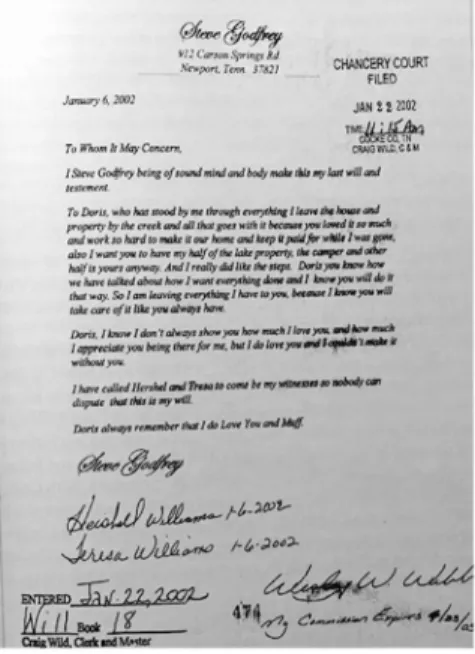
Like many people, Steve Godfrey prepared his own will on his home computer.46 He invited two neighbors to come to his home, and in their presence, Godfrey typed
41. E.g., Bre McAdam, Will Written on Tractor 65 Years Ago Celebrated by Saskatchewan Law College, STAR (Oct. 26, 2013), https://www.thestar.com/news/canada
/2013/10/26/will_written_on_tractor_65_years_ago_celebrated_by_saskatchewan_law_colle ge.html [https://perma.cc/F9QQ-73ME] (discussing the case of Harris Estate in which a Surrogate Court in Saskatchewan, Canada, permitted probate of tractor bumper on which farmer had carved, “In case I die in this mess, all to the wife,” while pinned under the immovable machine for over twelve hours, losing significant blood, and suffering multiple leg fractures). For more complete details of the case, see, e.g., Geoff Ellwand, An Analysis of Canada’s Most Famous Holograph Will: How a Saskatchewan Farmer Scratched His Way into Legal History, 77 SASK.L.REV.1,2 (2014) (providing multiple colorful details).
42. The Associated Press, Killer Wrote Will on Paper Plates, DENVER POST (Sept.13, 2007,10:34AM) (describing writing left by military veteran and Wyoming resident David M. Munis on cardboard box and multiple paper plates), https://www.denverpost.com/2007/09/13 /killer-wrote-will-on-paper-plates/ [https://perma.cc/3U7X-TQL9].
43. See JAN M.SMITS,ADVANCED INTRODUCTION TO PRIVATE LAW 109 (2016) (reporting
that Guinness Book of World Records has certified as the shortest will on record a Czech will in which a man wrote on his bedroom wall “Vše zene” (“everything to wife”)).
44. See, e.g., Reid K. Weisbord & David Horton, Inheritance Forgery, 69 DUKE L.J 855
(2020) (describing anti-forgery laws in ancient Rome designed to criminalize the creation of fake wills), https://papers.ssrn.com/abstract_id=333
0822 [https://perma.cc/8ZS8-PL8Z]. 45. See supra Section I.A.
his name in a cursive font at the end of the document.47 He then printed the document out, and the neighbors signed as witnesses and dated their signatures.48 One week later, Godfrey died.
The sole beneficiary of Godfrey’s will was his girlfriend, Doris Holt.49 Holt presented for probate as Godfrey’s last will and testament the document with Godfrey’s name typed in a cursive font and witnessed by the neighbors.50 Holt also presented the neighbors’ affidavits attesting to the circumstances of the will’s execution.51 Godfrey’s sister, his sole intestate heir, contested the probate of the document offered by Holt.52 Holt successful motioned for summary judgment on the grounds that the document complied with all applicable Tennessee laws concerning the execution and witnessing of a will.53
Figure 1: Last Will and Testament of Steven Godfrey with Cursive Signature
On appeal, Godfrey’s sister argued that Godfrey’s typed “signature,” even if in cursive font, did not constitute a signature on the will.54 The Court of Appeals of Tennessee noted that the statue specifically defined “signature” to include “a mark,
47. Id. 48. Id. at 830–31. 49. Id. at 830. 50. Id. at 831. 51. Id. 52. Id. 53. Id.
54. Id. The sister also argued that the disposition to Holt was invalid because the will referred to Holt by her first name only. As to this issue, the appellate court stated that it was irrelevant to the determination of whether the will was validly executed and witnessed in accordance with state law. Id. at 834.
the name written near the mark and witnessed, or any other symbol or methodology executed or adopted by a party with intention to authenticate a writing or record, regardless of being witnessed.”55 In this case, the court said that Godfrey intended the typed name in cursive font to be his signature and thus, it qualified as “any other symbol or methodology . . . adopted by a party with intention to authenticate a document.”56 The court noted that Godfrey had typed his name in cursive font in the presence of two witnesses, and thus, he “simply used a computer rather than an ink pen as the tool to make his signature.”57 The appellate court affirmed the trial court’s grant of summary judgment to Holt, finding that the will was executed in accordance with the statutory formalities.58 It is not clear whether the court would have reached the same conclusion had there not been testimony of the witnesses who saw Godfrey “sign” his will in this manner, although one assumes that such testimony increased the court’s confidence that Godfrey intended to sign this document and that he intended it to be his will.
2. The Samsung Galaxy Will
Consider also the case of Javier Castro, who went to a hospital in Lorain, Ohio, and was told that he needed a life-saving blood transfusion.59 For religious reasons, Castro declined to receive the blood transfusion.60 Later that month, after consulting with his brothers, Castro decided to prepare a will.61 Because there were no pens, pencils or paper readily available, Castro’s brother Miguel instead took up the Samsung Galaxy tablet computer belonging to Castro’s brother Albie.62 Javier dictated to Miguel what Javier wanted the will to say; Miguel “wrote” Javier’s wishes on the tablet using a stylus.63 Thus, Miguel produced a stored digital image of what would have been created had he been writing with a traditional implement on a piece of paper. Miguel and Albie each testified that all parts of the document were read to Javier.64 Before Javier could sign the document, he was transported back to the hospital.65 In the hospital, Javier later used the stylus to sign the tablet in the presence of Miguel and Albie.66 Javier’s nephew, Oscar DeLeon, subsequently arrived at the hospital and Javier acknowledged his signature on the will on the tablet.67 Oscar signed the tablet as a witness.68 Three other individuals also testified that Javier told
55. Id. at 833 (citing TENN.CODE.ANN. § 1-2-105(27) (1999)).
56. Id.
57. Id.
58. Id. at 833–34.
59. In re Estate of Castro, No. 2013ES00140, at 1 (Ohio Ct. Com. Pl. June 19, 2013). 60. Id. 61. Id. 62. Id. at 1–2. 63. Id. at 2. 64. Id. 65. Id. 66. Id. 67. Id. 68. Id.
them that he had signed the will on the tablet and that the writing on the tablet reflected his wishes.69 Javier died one month after he signed the tablet.70
Approximately two weeks after Javier’s death, Miguel Castro presented for probate a paper copy printout from the Galaxy tablet.71 There was testimony that the tablet was password protected, the document had been unaltered since the date Javier signed it, and the tablet had been in Albie’s continuous possession since Javier’s death.72 Miguel and Albie testified that the paper printout was a duplicate of the document on the tablet purporting to be Javier’s will.73
Figure 2: Last Will and Testament of Javier Castro Written on Samsung Galaxy Tablet
The Court of Common Pleas, Probate Division, of Lorain County, Ohio, framed the case as raising three issues: whether the decedent had committed his instructions to “writing,” whether the decedent “signed” the will, and whether there was sufficient evidence that the document presented was the decedent’s last will and testament.74 The court observed that Ohio law requires wills to be in writing,75 and that another provision of Ohio law, not directly applicable to wills, includes in the meaning of “writing” any “computer software . . . or [any] other thing having in or upon it any written, typewritten, or printed matter” in its definition of “writing.”76 Therefore, in the court’s view, the decedent had committed his wishes to writing. Citing the same definition of “writing,” the court ruled that the decedent’s handwritten signature
69. Id. at 3. 70. Id. 71. Id. 72. Id. at 2. 73. Id. 74. Id. at 4.
75. Id. (citing OHIO REV.CODE ANN. § 2107.03 (LexisNexis 2016)) (requiring wills other
than oral wills to be in writing).
stored on the tablet was a “graphical image of Javier’s signature,” and thus constituted as his “signature” for purposes of the will execution statute.77 The will was not formally “attested” by the witnesses (in the sense that there was no attestation clause), as required by Ohio law, but it was signed by witnesses and confirmed by testimony of others that the decedent intended the contents of the tablet to constitute as his will.78 For those reasons, under Ohio’s version of the harmless error statute the court found that the writing on the Samsung Galaxy tablet constituted the last will and testament of Javier Castro, thus resolving the final issue.79
The court admitted to probate the printout from the Samsung Galaxy tablet.80 Neither the decedent’s father nor his mother, who would have been his heirs had he died intestate, objected to the probate of the Galaxy tablet will.81 It is possible that if the family had not been in agreement about the distribution of the estate, the court might have been less likely to admit the tablet will to probate. This is, of course, only a speculation.
3. The Unsigned LegalZoom Will
In 2013, the intended beneficiary of an unsigned will unsuccessfully argued for the document’s admission to probate as the decedent’s will. Carole Berger, a Yale employee, had been friends for over ten years with two other Yale employees, Lawrence Litevich and Jeanette Sullivan.82 Berger was unmarried, had no siblings or children, and conducted a limited social life.83 Using the online platform LegalZoom, Berger prepared a will leaving her estate in equal shares to Sullivan and Litevich.84 She previously had named both Sullivan and Litevich as beneficiaries of several of her nonprobate assets, including life insurance policies and retirement accounts having a value of approximately $840,000.85
In the course of preparing the document on the LegalZoom platform, Berger input her social security number and a variety of other personal information, including her credit card number, for payment purposes.86 Litevich, one of the intended beneficiaries and the plaintiff in this case, claimed that Berger’s LegalZoom account “likely” required a password and that the program required her to confirm each of the documents after they were “drafted” by the computer system but before the
77. Id. at 5. 78. Id. at 5–6. 79. Id.
80. Id.
81. Id. at 3–4. Indeed, counsel who appeared on behalf of the decedent’s parents stated that if the tablet will was deemed invalid, and thus Javier Castro was treated as dying intestate, the parents would have distributed the property in accordance with the provisions of the tablet. Id.
82. Litevich v. Prob. Court, No. NNHCV126031579S, 2013 WL 2945055, at *1 (Conn. Super. Ct. May 17, 2013).
83. Id.
84. Id.
85. Id. at *3. 86. Id. at *2.
company printed and sent them to the client.87 In reality, Berger fell ill and was admitted to the hospital before she received the LegalZoom document in the mail.88 Although Sullivan retrieved the will from Berger’s home, Berger did not execute the document before she fell into a state of mental incapacity and died three days later in the hospital.89
Sullivan and Litevich presented the unexecuted LegalZoom document for probate. The charitable beneficiary of Berger’s will executed in 1991 presented that 1991 document for probate. Litevich argued that although Berger did not sign the LegalZoom will in a traditional sense, LegalZoom’s required Internet confirmation of the documents was tantamount to the decedent’s signature.90 When the court denied probate of the LegalZoom will, Litevich sued alleging, among other things, that the court should admit the LegalZoom will to probate because failure to recognize the unsigned will violated his constitutional rights or, alternatively, because Connecticut should adopt the harmless error rule of the UPC. Ordinarily, to be valid under Connecticut law, a will must be in writing, subscribed by the testator, and subscribed by two witnesses who each attest while in the presence of the testator.91 Connecticut is a strict compliance jurisdiction that does not forgive failure to comply with the necessary formalities.92
87. Id. 88. Id.
89. Id.
90. Id.
91. CONN.GEN.STAT.ANN. § 45a-251 (West 2014).
92. Litevich, 2013 WL 2945055, at *10 (indicating that the ability to transmit property at death is a positive right granted by statute (quoting Hatheway v. Smith, 65 A. 1058, 1060 (Conn. 1907)).
Figure 3: LegalZoom Pricing Packages
The court rejected both of Litevich’s claims, acknowledging that Connecticut law distinguished between those testators who follow the statutory requirements for the execution of wills and those who do not,93 but observing that similarly situated testators receive the same treatment.94 Even if the court had found that the law governing wills formalities treats similarly situated individuals differently, the court reasoned that such classification would survive rational basis review.95 The state has an interest in making sure that wills adequately represent the intentions of testators, and so a statutory distinction between those who do (or do not) follow the wills formalities would not be arbitrary or irrational.96 In rejecting the plaintiff’s arguments that Connecticut should adopt the harmless error rule, essentially “forgiving” the lack of a traditional signature in this case, the court said it was not free to deviate from unambiguous statutory language.97 Even if the court were inclined to permit probate in cases of nonconforming wills, it noted in dicta that statutory change was a legislative matter.98 And further, even if the court were inclined to put a “judicial gloss” on the statute (which it was not willing to do, despite the plaintiff’s arguments), the lack of a traditional signature on a document is an error that is the most difficult to excuse.99 The court therefore denied probate of the unsigned LegalZoom will and allowed the charitable beneficiary to proceed with probate of the decedent’s 1991 will.100
93. Id. at *11. 94. Id. at *13. 95. Id. at *15. 96. Id. at *14. 97. Id. at *22. 98. Id. at *20. 99. Id. at *22. 100. Id. at *23.
4. The Suicide Note
Duane Francis Horton II, age twenty-one, was a troubled, young man who kept a journal.101 In an undated entry written entirely in his own handwriting, Horton wrote, “I am truly sorry about this . . . My final note, my farewell is on my phone. The app should be open. If not look on evernote, ‘Last Note[.]’”102 Horton also provided the e-mail address and password he used to access the document storage site Evernote.103
The Evernote file on Horton’s phone contained a typed series of electronic personal messages and funeral instructions, as well as specific instructions regarding the disposition of his property:
Have my uncle go through my stuff, pick out the stuff that belonged to my dad and/or grandma, and take it. If there is something he doesn’t want, feel free to keep it and do with it what you will. My guns (aside from the shotgun that belonged to my dad) are your’s to do with what you will. Make sure my car goes to Jody if at all possible. If at all possible, make sure that my trust fund goes to my half-sister Shella, and only her. Not my mother. All of my other stuff is you’re do whatever you want with. I do ask that anything you well, you give 10% of the money to the church, 50% to my sister Shella, and the remaining 40% is your’s to do whatever you want with.104
The typed words existed entirely in electronic form (not on paper) and included Horton’s full name at the end of the file, arguably functioning as a signature (although not in the cursive font used by the testator in the Taylor case).105
During his lifetime, Horton had been the subject of a court-imposed conservatorship, with a company known as Guardianship & Alternatives, Inc. acting as his conservator.106 This Michigan company self-advertises as “[c]aring for at risk adults in Southwest Michigan.”107 In December 2015, after Horton committed suicide, Guardianship & Alternatives, Inc. presented the Evernote file for probate as the decedent’s will and requested that the company be appointed as personal representative of Horton’s estate.108 Horton’s mother filed a competing claim for appointment as personal representative of her son’s estate, and claimed that he died intestate. In other words, Horton’s mother argued that the Evernote file was not her son’s last will and testament.109
The Court of Appeals of Michigan acknowledged that the Evernote file did not meet Michigan’s requirements for a statutory will,110 but affirmed the probate court’s
101. In re Estate of Horton, 925 N.W.2d 207, 209 (Mich. Ct. App. 2018). 102. Id. (alteration in original).
103. Id.
104. Id.
105. See supra Section I.B.1. 106. Horton, 925 N.W.2d at 209.
107. GUARDIANSHIP &ALTERNATIVES,INC., http://www.guardianshipandalternatives.com [https://perma.cc/5XZX-W79T].
108. Horton, 925 N.W.2d at 209. 109. Id.
finding. In reaching its holding that the Evernote file was Horton’s last will and testament,111 the appellate court noted that Michigan law permits the probate of otherwise nonconforming documents (including holographic wills) if there is clear and convincing evidence that the decedent intended the document to be his will.112 The court of appeals considered Horton’s handwritten entry in his diary, the Evernote file, extrinsic evidence of Horton’s relationship with his mother, the circumstances of his death, and the discovery of the suicide note.113 The court emphasized that Horton clearly had written instructions in his diary to facilitate access to the Evernote file, and affirmed the probate court’s determination that Horton “clearly and unambiguously expressed his testamentary intent in the electronic document in anticipation of his impending death.”114 The dispositive provisions immediately followed Horton’s expression of his religious views, parting words to certain loved ones, apologies for his suicide, and instructions for his funeral.115 He had a strained relationship with his mother and made no provision in the Evernote file for any property to pass to her.116 Horton seemed to have written the diary entry, left at home the diary and the phone containing the Evernote file, and then promptly departed to kill himself.117 For those reasons, the Michigan Court of Appeals held the probate court did not err in finding that the Evernote file constituted a valid will for purposes of Michigan law.118
5. The Australian iPhone Note with Typed Name at End
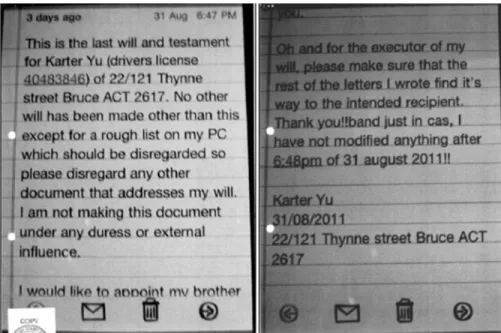
Cases involving electronic testamentary documents are not unique to the United States. Karter Yu was living in Queensland, Australia, when he opened the Notes feature on his iPhone and typed the words, “This is the last Will and Testament” and other language appointing his brother as executor and leaving property to certain friends and family members.119 Yu specifically instructed that any “rough list on my PC” be disregarded and detailed that “I have not modified anything after 6:48pm of 31 august 2011!!”120 He then typed his name, the date, and his address.121
Under Queensland law, if a document does not comply with the statutory formalities, it can be admitted to probate if the court is satisfied that the decedent
formalities required to execute a valid will). It is not clear whether the court considered the Evernote file to be a “writing,” but in any event it was not signed by Horton or by two witnesses. SeeHorton, 925 N.W.2d at 212.
111. Horton, 925 N.W.2dat 215.
112. Id. at 211; see § 700.2502(2) (permitting probate of wills if the testator’s “signature” and the document’s “material portions” are in the testator’s handwriting); § 700.2503 (echoing the UPC’s harmless error rule).
113. See Horton, 925 N.W.2d at 214. 114. Id. at 213. 115. Id. at 214. 116. Id. at 215. 117. Id. at 214. 118. Id. at 215. 119. InRe Yu [2013] QSC 322, ¶ 9 (Austl.). 120. Seeinfra Figure 4.
intended the document stating his testamentary intentions to be his will.122 The court admitted the iPhone Note to probate as Yu’s last will and testament, finding that three tests were satisfied: (a) it was a document; (b) the document stated the decedent’s testamentary intent; and (c) the decedent intended the document to be his will.123 Under Queensland law, a “document” includes any material from which writings are capable of being produced, including electronic devices.124 Thus, the iPhone Note clearly was a document.125 In the iPhone Note, Yu nominated an executor and disposed of all of his property. Ordinarily, the court noted, “a person does not attempt to dispose of the whole of the person’s property except upon the person’s death,” and so plainly the document stated Yu’s testamentary intent.126 The court also found that in writing the words, “This is the last Will and Testament,” Yu manifested a clear intention for the iPhone Note to operate legally as his will.127
Figure 4: Pages from Last Will and Testament of Karter Yu
The court made no mention of the lack of traditional signatures on the part of the testator or witnesses (and there is nothing in the record to suggest there were any witnesses).128 Instead, the Queensland court disposed of the case in ten relatively
122. Succession Act 1981 (Qld) ss 10, 18 (setting forth statutory formalities and permitting deviation from formalities when the court is satisfied that documented testamentary instructions intended to be the decedent’s will).
123. Yu [2013] QSC 322, ¶¶ 4, 6, 8.
124. Acts Interpretation Act 1954 (Qld) sch 1 s 36 (defining “document”). 125. Yu [2013] QSC 322, ¶ 5.
126. Id. ¶ 7. 127. Id. ¶ 9.
128. Seeid. (making no mention of lack of traditional signature by decedent or witnesses, or the absence of witnesses).
short paragraphs, admitting the iPhone Note to probate as the decedent’s will, as if there were nothing unusual about the situation.129
6. The Australian Unsent Text Message
Unlike the Yu case, a different Australian case generated significant controversy.130 Mark Nichol had been married to his wife, Julie Nichol, for approximately one year; they had been a couple for over two years prior to their marriage.131 By all accounts, the couple had a tempestuous relationship; Julie had left Mark twice before, and then moved out of the marital home two days before Mark’s death.132 At times in the past when they were not living together as a couple, Julie took Mark to his mental health apartments and they participated in activities together.133
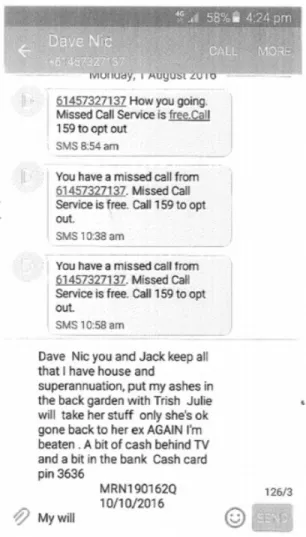
Some time prior to October 11, 2016, Mark composed a text message on his phone but did not send it.134 The message read:
Dave Nic you and Jack keep all that I have house and superannuation, put my ashes in the back garden with Trish Julie will take her stuff only she’s ok gone back to her ex AGAIN I’m beaten . A bit of cash behind TV and a bit in the bank Cash card pin 3636
MRN190162Q 10/10/2016 My will[.]135
It was undisputed in court that “Dave Nic” is Mark’s brother David Nichol,136 the letters “MRN” are Mark Nichol’s initials, and the numbers “190162” match Mark’s birth date of January 19, 1962.137 The text’s mention of “Trish” likely is a reference to Mark’s first wife, Patricia, who had predeceased him.138
Mark Nichol committed suicide.139 On October 10, 2016, Julie found Mark’s body in the shed located in the yard of the home they had shared.140 Mark’s phone was near his dead body.141 On October 11, 2016, Julie asked a friend to look through the
129. Id.
130. See, e.g, Chris Perez, Weird but True, N.Y.POST, Oct. 12, 2017, at 122 (describing
decision of Australian court).
131. SeeInre Nichol [2017] QSC 220, ¶ 2 (Austl.). 132. Id.
133. Id.
134. Id. ¶ 12. 135. Id. ¶ 13.
136. Id. ¶ 15 (“There is no dispute that the text message was addressed to the deceased’s brother, David Nichol, whose contact details were stored in the deceased’s mobile phone under the abbreviated name ‘Dave Nic.’”).
137. Id. ¶ 14. 138. See id. ¶ 22. 139. Id. ¶ 3. 140. Id. ¶ 12. 141. Id.
contacts on Mark’s phone for purposes of contacting others about Mark’s death.142 That friend found the unsent text message, then Julie gave Mark’s brother, Bradley Nichol, and Mark’s nephew, Jack Nichol, access to the phone in order to take a screenshot of the unsent text message, which they did.143
Julie brought a proceeding to have Mark Nichol declared intestate.144 If Mark were intestate, his estate would be shared equally by Julie and Anthony, Mark’s son from a prior relationship.145 The decedent’s brother David Nichol and nephew Jack Nichol brought a proceeding seeking to have the unsent text message treated as Mark’s last will and testament.146
Julie acknowledged that the text was testamentary in nature, but argued that the court could not be satisfied that Mark intended the text message, acting alone, to function as his will, in light of the fact that it was unsent.147 She also raised questions about his mental capacity to make a will.148 David Nichol and Jack Nichol argued that Mark likely did not send the text message because he did not want his suicidal plans and actions to be interrupted.149 They also claimed that even though Mark had a history of depression and at least one prior suicide attempt, there was insufficient evidence that the decedent lacked testamentary capacity.150 The court noted, in fact, that Julie presented no medical evidence whatsoever to suggest that Mark lacked mental capacity at the time he composed the text message.151
142. Id.
143. Id.
144. Id. ¶¶ 1–2.
145. Id. ¶ 27 (describing disposition of estate in event of intestacy). 146. Id. ¶ 1. 147. Id. ¶ 16. 148. Id. 149. Id. ¶ 20. 150. Id. ¶ 21. 151. Id. ¶ 36.
Figure 5: Unsent Text Message of Mark Nichol
The court ruled in favor of the decedent’s brother and nephew, admitting the unsent text to probate as Mark Nichol’s will.152 In reaching that conclusion, the court found that (a) the text message was a document;153 (b) the document stated the decedent’s testamentary intent;154 and (c) the decedent intended the document to be his will.155 In describing the text as containing testamentary intentions, the court
152. Id. ¶ 60 (“The text message addressed the disposition of his assets . . . and was specifically identified as his will. The terms of the text message reflect that the deceased wished the document to be his final will and was not merely an emotional expression of wishes.”); id. ¶ 72 (admitting unsent text message to probate as the decedent’s will). 153. Id. ¶ 40 (citing a broad definition of “document”).
154. Id. ¶ 60. 155. Id.
referred to the decedent’s use of the phrase “my will,” his identification of his assets, providing the personal identification number for his bank account, and giving specific instructions for the disposition of his ashes.156 The court interpreted the terms of the text itself, including the language “my will,” as evidence that the decedent understood the importance of his actions.157 Although Mark previously had shown signs of being “down” and was receiving counseling, the court noted that, “No-one including [Julie Nichol] describes the deceased as acting erratically, irrationally or being so afflicted by depression that it was affecting his ability to think or function.”158 That Mark Nichol suffered from depression or had previously attempted to kill himself did not mean he lacked the capacity to make a will.159 The unsent text message was admitted to probate as the decedent’s will.160
C.Moving Toward Electronic Wills
The law is moving (and must continue to move) in the direction of recognizing wills that are “written” in electronic form only.161 Companies like Legalzoom and Bequest, Inc. lobby actively in favor of such legislation, because of the potential lucrative market in fees for acting as “digital custodian” of the documents.162 Four jurisdictions—Nevada, Arizona, Indiana, and Florida—have enacted laws that specifically recognize electronic wills.163 In three of those jurisdictions—Nevada, Arizona, and Florida—an electronic will can be made self-proving if a “qualified custodian” (typically, but not necessarily, a commercial entity) stores the document until the time of the decedent’s death.164
The next Part considers the E-Wills Act, approved in July 2019 by the National Conference of Commissioners on Uniform State Laws.165 The E-Wills Act is an ambitious undertaking and sets the stage for many more states to modernize their laws to recognize electronic wills. The next Part explores how the E-Wills Act squares with, or calls into question, the traditional purposes of wills formalities. By departing from conventional platitudes about the cautionary, ritual, protective, and channeling functions of wills, it is possible to articulate a more nuanced understanding of the substantive goals served by wills formalities and, through that
156. Id. ¶ 43. 157. Id. ¶ 53. 158. Id. ¶ 52. 159. Id. ¶ 48. 160. Id. ¶ 60.
161. See supra Section I.B.
162. See Horton, supra note 36, at 30 n.248.
163. See ARIZ.REV.STAT.ANN. §§ 14-2516 to 14-2523 (effective July 1, 2019) (containing
the first electronic wills act in the country, enacted in 2011); FLA.STAT. §§ 732.521-526
(effective Jan. 1, 2020) (2019 Fla. Laws 41) (same); IND.CODE §§ 29-1-21-1 to 29-1-21-18 (effective July 1, 2018) (recognizing electronic wills); NEV.REV.STAT.§ 133.085 (2017)
(same).
164. See ARIZ.REV.STAT.ANN. § 14-2519 (2019) (containing provisions for an electronic
will to be self-proving if maintained by a qualified custodian); FLA.STAT. §§ 732.503, 523
(effective Jan. 1, 2020) (2019 Fla. Laws 37) (same); NEV.REV.STAT.§ 133.086 (2017) (same).
lens, evaluate the strengths and weaknesses of the model law. The Article then goes on to ask whether emerging technology—namely blockchain—offers an even better solution to some of the challenges that the E-Wills Act attempts to address.
II. ELECTRONIC WILLS ACTS A.Overview
In 2017, the Uniform Law Commission (ULC) took the unusual step of assembling a drafting committee for an Electronic Wills Act.166 Typically, the ULC appoints a Study Committee to research a topic and recommend whether or not to proceed with drafting a uniform law.167 But with the E-Wills Act, the ULC assembled a drafting committee immediately, and its three leaders prepared an “issues memo” in October 2017 to guide the work of a nascent committee.168 The ULC approved a final version of the E-Wills Act in July 2019.169 The law’s goals are: to (1) “allow a testator to execute a will electronically, while maintaining the protections for the testator that traditional wills law provides for wills executed on something tangible (usually paper);” (2) “create execution requirements that, if followed, will result in a valid will without a court hearing to determine validity, if no one contests the will;” and (3) “develop a process that would not enshrine a particular business model in the statutes.”170 The drafting committee had expressed concerns about specific commercial vendors lobbying for e-will legislation in several states and sought to draft legislation guided by the public interest, not corporate interests.171
The E-Wills Act seeks to facilitate a testator’s electronic execution of a will, while also providing customary safeguards against fraud, undue influence, and the like.172 The E-Wills Act drafters drew on the experiences of Nevada, which has permitted
166. REAL PROPERTY,PROBATE AND TRUST LAW SECTION OF THE FLORIDA BAR,WHITE
PAPER ON PROPOSED ENACTMENT OF THE FLORIDA ELECTRONIC WILLS ACT 3,
https://www.flprobatelitigation.com/wp-content/uploads/sites/206/2017/05/RPPTL-Electroni c-Wills-Act-White-Paper-Final.pdf [https://perma.cc/5WC4-3DUG].
167. How Are Subjects for New Acts Selected? About ULC, UNIFORM L.COMMISSION,
https://www.uniformlaws.org [https://perma.cc/JF42-FJBP].
168. Compare UNIF.L.COMM’N, Suzy Walsh, Turney Berry & Susan Gary, Memorandum
to Electronic Wills Drafting Committee (Oct. 2, 2017), https://www.uniformlaws.org/Higher Logic/System/DownloadDocumentFile.ashx?DocumentFileKey=db271b23-8200-d28d-1d55-987bcd262227&forceDialog=0 [https://perma.cc/8DD2-S9AE], with UNIF.L.COMM’N, UNIF.ELECTRONIC WILLS ACT (July 12–18, 2018), https://www.uniformlaws.org/HigherLogic
/System/DownloadDocumentFile.ashx?DocumentFileKey=a7011c26-ebd1-462d-9194-353e a7ee3cc4&forceDialog=0 [https://perma.cc/2XNL-MAP2] (marked “Draft for Approval”). 169. UNIF.ELEC.WILLS ACT (UNIF.L.COMM’N 2019).
170. Id. at pref. note.
171. UNIF. L. COMM’N, UNIF. ELEC. WILLS ACT 2 (May 29, 2019), https://www.uniformlaws.org/HigherLogic/System/DownloadDocumentFile.ashx?Document FileKey=a7011c26-ebd1-462d-9194-353ea7ee3cc4&forceDialog=0 [https://perma.cc/8JWK-4Q56](marked“Draft for Approval”) (“For-profit providers interested in offering services in electronic execution of wills and storage of electronic wills are promoting the idea of electronic execution of wills to state legislatures.”).
electronic wills since 2011.173 Indiana adopted electronic wills legislation in 2018.174 Arizona has allowed electronic wills since July 1, 2019.175 Florida has allowed electronic wills since January 1, 2020.176 This Part explores the contours of various state laws and the E-Wills Act. Beyond highlighting the legislative features that modernize the law of wills, this Part identifies aspects of existing state laws and the E-Wills Act that need further revision or attention in order to best serve the interests of testators in the twenty-first century.
B.The Uniform Electronic Wills Act
1. Simple but Revolutionary Changes
The ULC laid the groundwork for legal recognition of electronic signatures with the 1999 promulgation of the Uniform Electronic Transactions Act (UETA).177 The UETA has been adopted by forty-seven states and the District of Columbia178 and
173. See NEV.REV.STAT.§ 133.086 (2017).
174. IND.CODE §§ 29-1-21-1 to 29-1-21-18 .
175. ARIZ.REV.STAT.ANN. §§ 14-2516 to 14-2523.
176. FLA.STAT. §§ 732.503, 523 (effective Jan. 1, 2020) (2019 Fla. Laws 37). The Florida legislature had passed electronic wills legislation before in the 2018 Electronic Wills Act, but Governor Rick Scott vetoed the legislation four days before it was scheduled to take effect. Letter from Rick Scott, Florida Governor, to Ken Detzner, Florida Sec. of State (June 26, 2017), https://www.flgov.com/wp-content/uploads/2017/06/HB-277-Veto-Letter.pdf [https:// perma.cc/92ZD-JXE2]; see also Craig R. Hersch, Florida Governor Vetoes Electronic Wills Act, WEALTHMANAGEMENT.COM (June 28, 2017), http://www.wealthmanagement.com/estate-planning/florida-governor-vetoes-electronic-wills-act [https://perma.cc/7MY2-DEAX] (attributing the veto to the failure to strike balance between potential fraud by would-be wrongdoers and convenience to the public). The 2019 legislation, effective January 2020, received support from the AARP and the Florida Bar’s Elder Law Section, among other groups. SeeRemote Notary, Electronic Wills Legislation Starts Senate Journey, THE FLORIDA
BAR (Apr. 5, 2019), https://www.floridabar.org/the-florida-bar-news/remote-notary-electroni c-wills-legislation-starts-senate-journey [https://perma.cc/BFC3-Z9UE] (quoting a representative of the Florida Bar’s Elder Law Section as saying the new law addresses “concerns about vulnerable adults and individual[s] who are susceptible to coercion and undue influence”). The 2019 legislation permits remote notarization but not for certain comprehensive powers of attorney and a “vulnerable adult” may execute an electronic will only with witnesses in the live, physical presence of the testator. See 2019 Fla. Laws21, Electronic Legal Documents (creating Section 117.285(5)(g)). The Florida rules governing the execution of electronic wills relies on a separate provision of the state statutes that defines who is a “vulnerable adult.” See, e.g., id. (creating Section 117.285(3)(c) requiring notice to a “vulnerable adult” as defined in FLA.STAT. § 415.102).
177. UNIF.ELEC.TRANSACTIONS ACT (NAT’L CONFERENCE OF COMM’RS ON UNIF.STATE
LAWS 1999), https://www.uniformlaws.org/HigherLogic/System/DownloadDocumentFile.as hx?DocumentFileKey=ac2376fb-2b2f-c5c3-eec9-0a363c600956&forceDialog=0
[https://perma.cc/P6V4-Z4V6].
178. Electronic Transactions Act Enactment Status Map, UNIF. LAW COMM’N,
https://www.uniformlaws.org/committees/community-home?CommunityKey=2c04b76c-2b7d-4399-977e-d5876ba7e034 [https://perma.cc/Z7FM-NZUE]. Washington, Illinois, and New York have not adopted the Uniform Electronic Transaction Act. Id.
grants electronic signatures the same full force and effect as a traditional, in-person signature, as long as the parties to a transaction agreed.179 However, the UETA explicitly excludes from legal recognition electronic signatures to wills, codicils, or testamentary trusts.180
Congressional enactment of the Electronic Signatures in Global and National Commerce Act in 2000 extended the recognition of electronic signatures and records to interstate commerce.181 That law explicitly permits states to modify, change, or even supersede the federal rules on electronic signatures, as long as the alternative state-specified procedures are not inconsistent with the federal law.182 Like the UETA, the Electronic Signatures in Global and National Commerce Act excludes from its scope any contract or record subject to “a statute, regulation, or other rule of law governing the creation and execution of wills, codicils, or testamentary trusts.”183
The E-Wills Act recognizes as a valid will any “record that is readable as text at the time of signing” that has been “signed” by the testator (or another individual in the testator’s name, in the testator’s physical presence, and by the testator’s direction) and either “signed” by at least two witnesses, each of whom is resident of a state and physically located there, who either “signed in the physical [or electronic] presence of the testator within a reasonable time after witnessing the signing of the will . . . or the testator’s acknowledgement of the signing of the will.”184 Alternately, the testator may acknowledge his or her signature “in the physical [or electronic] presence of a notary public or other individual authorized by law to notarize records electronically.”185 The bracketed language is optional for states to adopt.186
Consider two important definitions in the statute: “record” and “sign.”187 A record is “information that is inscribed on a tangible medium or that is stored in an electronic
179. Electronic Transactions Act Summary, UNIF.LAW COMM’N, https://www.uniform
laws.org/committees/community-home?CommunityKey=a0a16f19-97a8-4f86-afc1-b1c0e0 51fc71 [https://perma.cc/W2RU-ALJD] (explaining the voluntary nature of Uniform Electronic Transactions Act).
180. UNIF.ELEC.TRANSACTIONS ACT § 3(b)(1) (explicitly exempting wills). Curiously,
though, the UETA seems to have left open the possibility for the electronic execution of an
inter vivos trust, even if intended to act as a will substitute. Seeid.
181. Electronic Signatures in Global and National Commerce Act, Pub. L. No. 106-229, 114 Stat. 464 (2000) (codified at 15 U.S.C. §§ 7001–7006, 7021, 7031).
182. 15 U.S.C. § 7002(a)(2)(A) (2012) (permitting non-conflicting state statutes or regulations).
183. Id. § 7003(a) (making federal law inapplicable to statutes governing wills, codicils, testamentary trusts, certain family law matters such as adoption and divorce, as well as the Uniform Commercial Code).
184. UNIF.ELEC.WILLS ACT § 5(a)(1)–(3) (UNIF.L.COMM’N 2019) (emphasis added).
185. Id.§ 5(a)(B) (emphasis added). Earlier discussion drafts of the Electronic Wills Act did not permit for notarization of the will in lieu of witnesses. See UNIF.L.COMM’N,ELEC.
WILLS ACT (Mar. 2–3, 2018), https://www.uniformlaws.org/viewdocument/march-2018-committee-meeting-draf?CommunityKey=cbc99bfb-d91f-4388-b410-6054d41132cf&tab =librarydocuments [https://perma.cc/VS88-E4PR] (marked “Draft for Discussion”).
186. See UNIF.ELEC.WILLS ACT § 5 leg. note (“A state that permits an electronic will only
when the testator and witnesses are in the same physical location, and therefore prohibits remote attestation, should omit the bracketed words ‘or electronic’ . . . .”).
or other medium and is retrievable in perceivable form.”188 An electronic will must be “a record that is readable as text at the time of signing.”189 Thus, a will prepared on a home computer, a tablet device, or even an iPhone could qualify as an electronic
will, but a video recording would not so qualify, because it is not “readable as text.”190
The broad definition of “record” in the E-Wills Act squares with the reality that people use electronic methods to accomplish many tasks in their everyday lives.191 It is not unusual for a person to send an e-mail or text to communicate with a friend or business colleague, for example. The ease with which one can do so might give rise to concerns about impulsive or imprecise testators making wills on their phones. But impulsive and imprecise communication is common in traditional written formats, too. For that reason, electronic wills need not be singled out and instead should receive the same treatment as traditional writings (something the drafting committee recognized). After all, the principal function of wills formalities is the determination of a document’s authenticity—i.e., the court needs to be satisfied that this particular instrument was executed by the testator and the testator intended it to be the testator’s will.192
To sign for purposes of the E-Wills Act means to either “execute or adopt a tangible symbol” or to “affix or logically associate with the record an electronic, symbol or process,” as long as either act is done with the intention to authenticate or adopt the record.193 Thus, a decedent’s typing his name in cursive font in a word processing program, writing his name on a tablet with a stylus, typing his name at the end of an iPhone note, or typing his initials in a text message all would constitute a “signature” for the purposes of the E-Wills Act.194
Notably, the E-Wills Act leaves to each adopting state the important decision about whether the testator and witnesses must sign in each other’s physical presence, or whether “electronic presence” will suffice. A state that wishes to maintain a traditional physical presence requirement may do so by disregarding the bracketed language in the statute.195 For purposes of the E-Wills Act, electronic means “relating
188. Id.§ 2(4). 189. Id.§ 5(a)(1).
190. See id.§§ 5(a)(1), 2(4); see also E-mail from Susan N. Gary, Reporter to the Drafting Committee on Uniform Electronic Wills Act, to Professor Bridget J. Crawford (Jan. 2, 2020, 9:46 PM) (on file with the Indiana Law Journal).
191. See supra notes188–92 and accompanying text; see also UNIF.ELEC.WILLS ACT pref.
note (“People increasingly turn to electronic tools to accomplish life’s tasks, including legal tasks).
192. See Bridget J. Crawford, Wills Formalities in the Twenty-First Century, 2019 WIS.L. REV. 269, 290–91 (2019) (arguing that determination of authenticity is the true purpose of
wills formalities); see alsoIn re Groffman, [1969] 2 All E.R. 108 (Eng.) (denying probate to will because both witnesses did not sign in the presence of each other, even though court expressed no doubt that decedent intended the document to be his will); Bell v. Crewes, [2011] NSWC 1159, ¶¶ 44–45 (Austl.) (denying probate to a will that decedent affirmed he wished to adopt but had not yet signed).
193. UNIF.ELEC.WILLS ACT § 2(5). It would seem, then, that an audio file could contain
both a “signature” and a “record.” See supra notes 188–92 and accompanying text. 194. See supra Sections I.B.1, 2, 5, 6.