
Competition and stability in banking
58
0
0
Full text
(2) The Public-Private Sector Research Center is a Research Center based at IESE Business School. Its mission is to develop research that analyses the relationships between the private and public sectors primarily in the following areas: regulation and competition, innovation, regional economy and industrial politics and health economics. Research results are disseminated through publications, conferences and colloquia. These activities are aimed to foster cooperation between the private sector and public administrations, as well as the exchange of ideas and initiatives. The sponsors of the SP-SP Center are the following: . Accenture Ajuntament de Barcelona Caixa Manresa Cambra Oficial de Comerç, Indústria i Navegació de Barcelona Consell de l’Audiovisual de Catalunya Departament d’ Economia i Finances de la Generalitat de Catalunya Departament d’ Innovació, Universitats i Empresa de la Generalitat de Catalunya Diputació de Barcelona Endesa Fundació AGBAR Garrigues Mediapro Microsoft Sanofi Aventis ATM, FGC y TMB. The contents of this publication reflect the conclusions and findings of the individual authors, and not the opinions of the Center's sponsors.. IESE Business School-University of Navarra.
(3) COMPETITION AND STABILITY IN BANKING* Xavier Vives1. Abstract I review the state of the art of the academic theoretical and empirical literature on the potential trade-off between competition and stability in banking. There are two basic channels through which competition may increase instability: by exacerbating the coordination problem of depositors/investors on the liability side and fostering runs/panics, and by increasing incentives to take risk and raise failure probabilities. The competitionstability trade-off is characterized and the implications of the analysis for regulation and competition policy are derived. It is found that optimal regulation may depend on the intensity of competition.. 1. Professor of Economics, Abertis Chair of Regulation, Competition and Public Policy, IESE. *. Public-Private Sector Research Center, IESE Business School. This paper has been prepared for the Thirteenth Annual Conference of the Central Bank of Chile “Monetary Policy under Financial Turbulence”, Santiago de Chile, November 2009. I am grateful to an anonymous referee for useful comments and to Jorge Paz for his helpful research assistance. The research leading to these results has received funding from the European Research Council under the European Advanced Grants scheme, project Information and Competition, Grant Agreement no. 230254. I also thank the Abertis Chair of Regulation, Competition and Public Policy, project ECO2008-05155 of the Spanish Ministry of Education and Science at the Public-Private Sector Research Center at IESE.. IESE Business School-University of Navarra.
(4) Competition and Stability in Banking. Xavier Vives * IESE Business School. January 2010. Abstract I review the state of the art of the academic theoretical and empirical literature on the potential trade-off between competition and stability in banking. There are two basic channels through which competition may increase instability: by exacerbating the coordination problem of depositors/investors on the liability side and fostering runs/panics, and by increasing incentives to take risk and raise failure probabilities. The competition-stability trade-off is characterized and the implications of the analysis for regulation and competition policy are derived. It is found that optimal regulation may depend on the intensity of competition.. *. Public-Private Sector Research Center, IESE Business School. This paper has been prepared for the Thirteenth Annual Conference of the Central Bank of Chile “Monetary Policy under Financial Turbulence”, Santiago de Chile, November 2009. I am grateful to an anonymous referee for useful comments and to Jorge Paz for his helpful research assistance. The research leading to these results has received funding from the European Research Council under the European Advanced Grants scheme, project Information and Competition, Grant Agreement no. 230254. I also thank the Abertis Chair of Regulation, Competition and Public Policy, project ECO2008-05155 of the Spanish Ministry of Education and Science at the Public-Private Sector Research Center at IESE..
(5) 1. Introduction Banking went from being one of the most regulated sectors in the economy after the crisis in the 1930s to a much more lightly regulated sector with the liberalization process started in the 1970s in the US. The first period was market by few crises while there has been much more instability in the second one, culminating with the 2007- subprime crisis. In the first period competition was thought to be detrimental to stability and in many countries competition policy was not applied fully to the sector until recently despite the importance of the banking sector in the economy and the costs and inefficiencies induced by financial repression. Indeed, until relatively recently central banks and regulators were complacent with collusion agreements among banks and preferred to deal with a concentrated sector with soft rivalry.. This changed with deregulation and the idea that competition enhances efficiency, be it productive, allocative, or dynamic (innovation). Competition policy is now taken seriously in the banking sector. 1 However, the crisis started in 2007 with subprime mortgages, becoming systemic after the demise of Lehman Brothers in September 2008, with cumulative banking losses estimated as 1,1 trillion € (up to November 2009) and massive bailouts (state aid with commitments in public interventions in the EU and US) of up to 30% of GDP, has overridden competition policy concerns. Indeed, the public help programs have distorted competition and created an uneven playing field in terms of the cost of capital and perception of safety and soundness. Market power concerns on mergers have been also overruled. In the UK Lloyds TBS took over the troubled HBOS (merger of Halifax and Bank of Scotland) in a merger opposed by the Office of Fair Trade creating a large entity, while the same Lloyds TBS had not been allowed to take over Abbey in 2001. The investment banking business has been consolidated in the US with the forced takeovers of Bear Sterns by JP Morgan and of Merrill Lynch by Bank of America. The result is potentially weak competition among the players left. Those. 1. In the US banking becomes subject to competition law in the 1960s with the end of its antitrust exemption. In the EU the European Commission has intervened since the 1980s against a range of restrictive practices, in mergers and in state aid. See Carletti and Vives (2009).. 2.
(6) consolidations add to the recent trend of increased consolidation within countries, across countries and across business lines (e.g. forming financial conglomerates). 2. Banking and financial markets display the whole array of classical market failures, due to externalities (fragility with coordination problems and contagion), asymmetric information (excessive risk taking with agency problems, moral hazard and adverse selection), and potential market power. This has led to regulation to protect the system, the small investor, and market competitiveness. The problem is that facilities like the lender of last resort, deposit insurance and “too big to fail” policies introduce further distortions and exacerbate the excessive risk taking problem. In fact, the crisis has uncovered massive regulatory failure as well and potential contradiction between regulatory intervention and competition policy.. This paper takes stock of what we know on the relationship between competition and stability, and suggests how to deal with the interplay of regulation and competition issues in banking in the aftermath of the systemic crisis started in 2007.. The plan of the paper is as follows. Section 2 examines the trends in the banking sector and in its regulation, taking into account the impact of the crisis. Section 3 explains the uniqueness of banks, why the banking system is fragile and the role of regulation. 3 Section 4 examines the trade-off between competition and stability in banking from a theoretical perspective both from the point of view of fragility and of potential excessive risk taking. Section 5 surveys the empirical evidence available. Section 6 ponders whether we can regulate away the competition-stability trade-off. Section 7 examines the policy response to the crisis and summary and concluding remarks close the paper.. 2. See, e.g. Group of Ten (2001).. 3. Sections 2 and 3 are partially based on Vives (2001, 2006).. 3.
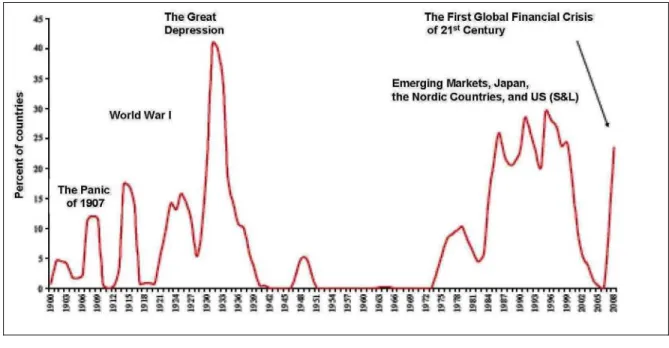
(7) 2. Trends in the banking sector Two periods can be distinguished in the recent history of the financial sector: Tight regulation, intervention, and stability, from the 1940s up to the 1970s, followed by a period marked by liberalization and greater instability. (See Figure 1.). From the 1940s to the 1970s, competition between financial institutions was severely limited by the regulation of rates, activities, and investments, the separation between commercial banking, insurance, and investment banking (Glass-Steagall Act of 1933 in the US) 4 , restrictions on the activity of the savings banks, and geographical segregation (in the US). Universal banking remained in some European countries. Deposit insurance was established, and the central bank acted as lender of last resort to the financial system.. The stability of this earlier period contrasts with the sizeable increase in the number of failures and crises in the later period, in which the sector was liberalized and competition introduced. 5 International evidence points at liberalization as one of the factors, together with inadequate macro policies, adverse macro shocks, and vulnerability of the foreign sector, to explain banking crises. That is, liberalization, even controlling for a wide range of factors, increases banking fragility. There are also strong indications that the institutional environment (e.g., in terms of the rule of law and contract enforcement) and inappropriate regulation that accompanies liberalization reinforce the development of crises. 6 This is consistent with banking crises in diverse places like the US (S&Ls), Japan, Scandinavia and Spain. In all those cases regulatory failure seems to have played an important role in the crisis. 7 Despite the crises episodes financial liberalization has helped in general financial development, and therefore output growth. 4. The Glass-Steagall Act prohibited any one institution from acting as any combination of an investment bank, a commercial bank, and/or an insurance company.. 5. See Reinhart and Rogoff (2008a, b).. 6. See, for example, Demirgüç-Kunt and Detragiache (1998, 2001)).. 7. See Dewatripont and Tirole (1994) for the US case and Hoshi and Kayshap (2000) for Japan. In both cases increased competitive pressures on financial institutions (e.g. competition from nonbank intermediaries allowed by deregulation) leads to overexpansion in risky lines of business (e.g. real state) which are not checked because of lax supervision and regulatory forbearance together with implicit protection of entities in trouble, In Scandinavia the roots of the early 1990s crisis are to be found in a conjunction of factors after the financial liberalization of the 1980's: lax enforcement of. 4.
(8) Figure 1. Proportion of countries with banking crises: 1900-2008, weighted by their share of world income. Source: Figure 1 in Reinhart and Rogoff (2008a).. Liberalization consisted on the lifting of controls on rates and on banking investment activities, and of geographical restrictions (with the Riegle-Neal Act in the US in 1994), the elimination of compulsory investment coefficients, and the convergence between the activities of institutions of various types (e.g. between savings banks and ordinary banks, between commercial banking and investment banking –definite repeal of Glass-Steagall Act with the Financial Services Modernization Act in 1999, between banking and insurance –up to a point). 8 Behind the process of liberalization and deregulation we find advances in information technology, in the processing of transactions (automatic teller machines, telephone and electronic banking), and in computational capacity, as well as in management techniques and risk coverage (e.g. the use of derivative instruments and securitization techniques). An integral part of the process was the liberalization of. capital requirements, poor supervision, lack of internal risk control methods, together with mistakes in fiscal and monetary policy in the context of an asset price bubble (See, e.g., Honkapohja (2009).) In Spain financial liberalization started in the 1970s and the banking crisis of the first half of the 1980s is explained by the large impact of the economic crisis derived from the oil shocks, the close links of banks with industrial firm, lack of diversification of banks' industrial portfolios, bad management and inadequate supervision (see Caminal, Gual and Vives (1990)). 8. For example, Citicorp (a commercial bank holding company) merged with Travelers Group (an insurance company) in 1998 to form the conglomerate Citigroup.. 5.
(9) international capital movements and the general reduction in transport costs and barriers to trade; financial globalization, in short.. The result of the liberalization process has been an increase in competition, both within and from outside the banking industry, with banks facing direct competition from financial markets and the development of disintermediation and financial innovation. Market integration (in Europe and elsewhere) has contributed decisively to the increase in competition in wholesale and investment banking. Interestingly, the share of assets held by banks relative to non-bank financial intermediaries is declining in developed economies (in the US up to 2007) although banks assets are not declining relative to total financial assets because the share of non-bank intermediaries grows at the expense of directly held assets. 9 (See Figure 2.). 100% Others 80% Mutual Funds. 60%. Pension and Retirement Funds Insurance Companies. 40%. Depository Institutions. 20%. 0% 1950. 1960. 1970. 1980. 1990. 1995. 2000. 2005. 2006. 2007. 2008. 2009 (Q3). Figure 2: Distribution of US financial assets by the main types of financial intermediaries. Source: Barth et al. (1997), and updated data from Flow of Fund Accounts, Board of Governors of the Federal Reserve System.. The liberalization process has resulted also in a tremendous expansion of financial intermediation with financial assets of intermediaries increasing sharply as a percentage 9. See also Berger, Kashyap, and Scalise (1995) and Allen and Santomero (2001).. 6.
(10) of GDP (in the US the percentage goes from less than 100% in 1950 to a peak of more than 300% in 2007, with assets in banks going from 50% to 100% in the same period, see Figure 3).. 350%. 300%. 250%. 200%. 150%. 100%. 50%. 0% 1950. 1960. 1970. Depository Institutions. 1980. 1990. 1995. 2000. Commercial Banks. 2005. 2006. 2007. 2008. 2009 (Q3). Total Financial Intermediary Assets. Figure 3. Relative size of the US financial sector and the banking industry (Financial assets/GDP). Source: “Flow of Funds Accounts”, Board of Governors of the Federal Reserve System.. This effective expansion of the financial market has implied that even banking, in spite of the advance of disintermediation, has grown in real terms (see Figure 4).. 7.
(11) Figure 4. Growth Rates in U.S. Real Financial Assets (Three year moving average: 1950-2008). Source: Federal Reserve Board of Governors.. Before the 2007 crisis banking was evolving from the traditional business of taking deposits and granting (and monitoring) loans to the provision of services to investors (investment funds/asset management, advice and insurance) and firms (consulting, insurance, mergers and acquisitions, underwriting of equity and debt issues, securitization, risk management), and proprietary trading. In a financial conglomerate we can distinguish a retail bank, an investment or corporate bank, asset management, proprietary trading, and insurance. The infamous model of “originate and distribute” banking, where banks try to get rid of credit risk by originating mortgage loans and quickly securitizing them leaving the monitoring of mortgages in a limbo, is a good example of the evolving banking process. At the same time even if banks created offbalance sheet vehicles (SIV, ABCP conduits) in the end they were insuring them with liquidity lines. In any case the financial margin made way for fee and commission revenue and there was a switch from investment in bricks and mortar (the branches) to investment in communication networks, information technology, and highly specialized human capital. Post crisis the financial margin has gained again importance (if nothing else because of the very low or zero interest rate policy of central banks) and the share of banks’ assets in financial assets is up from pre-crisis levels (see Figure 2). The return to 8.
(12) traditional banking is seen also in Figure 4 where recently commercial banking grows more than total financial intermediaries in real assets.. Restructuring is taking the form of consolidation, with similar declines in the US and Europe on the number of banks in 1997-2007 (22% decline in the US and a 29% decline in EU-15). In Europe there has been a predominance of domestic and, more recently, cross-border, mergers 10 and in the US of interstate mergers. A consequence is that despite an increase in national concentration at the US level in the last twenty years (see Figure 5 for assets) local concentration (measured in MSA and non-MSA counties for deposits) 11 shows, if anything, a decreasing tendency (Berger, Demsetz and Strahan (1999), Table 7 in White (2009)).. Figure 5. US CR5 ratio. Share of the five largest depositary institutions in % of total assets 12 Source: FDIC and Federal Reserve.. 10. For example, Hypobank-Vereinsbank in Germany, UBS-SBC in Switzerland, BNP-Paribas in France, IMI-San Paolo and Crédito Italiano-Unicrédito in Italy, Santander-BCH to form BSCH and BBVArgentaria to form BBVA in Spain. Exceptions are some cross-border deals in the Benelux and Scandinavia. Some cross-border mergers have failed because of political interference of national authorities. See Danthine et al. (1999).. 11. Metropolitan Statistical Areas (MSAs) are used as proxies for urban local markets while non-MSAs are used as proxies for rural local markets).. 12. The merger of Wells Fargo and Wachovia is accounted for in 2008.. 9.
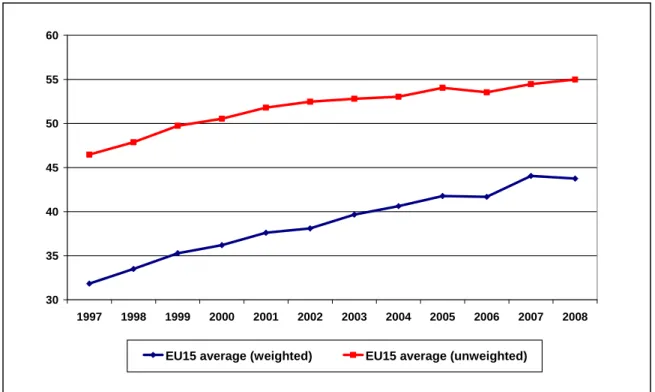
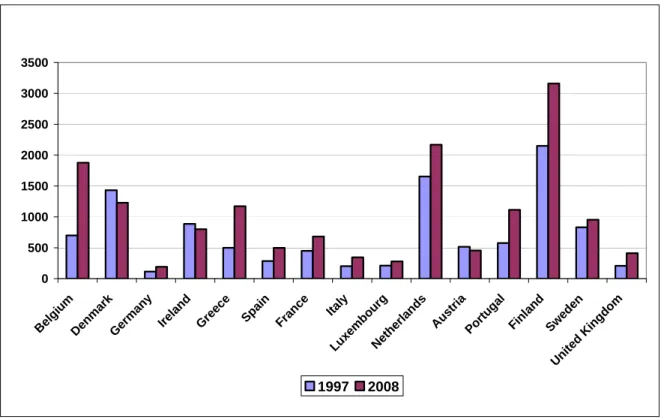
(13) In Europe the dominance of domestic mergers tends to increase local concentration (e.g., in 19 over 27 EU markets the CR5 in assets is above 50% in 2007).. 13. (See Figures 6, 7. for the EU-15).. 60. 55. 50. 45. 40. 35. 30 1997. 1998. 1999. 2000. 2001. 2002. EU15 average (weighted). 2003. 2004. 2005. 2006. 2007. 2008. EU15 average (unweighted). Figure 6. Share of CR5 in % of total assets. Source: ECB (2006, 2007, 2008).. 13. See Schildbach (2009) for the US.. 10.
(14) 3500 3000 2500 2000 1500 1000 500. Ita Lu ly xe m bo ur N g et he rla nd s A us tr ia Po rt ug al Fi nl an d S U w ni ed te en d K in gd om. Fr an ce. ai n Sp. e ec re G. B. el gi um D en m ar k G er m an y Ire la nd. 0. 1997. 2008. Figure 7: Herfindahl index (total assets). Source: ECB (2004, 2008). In the US the CR-5 ratio for assets has increased in 2008 to 36% (with several pots crisis operations including JP Morgan-Washington Mutual and Wells Fargo-Wachovia) from a level of 23% in 2001. 14 This contrasts with the movement in EU-15 from 52% to 54.5% (unweighted average) and from 37.6% to 44% (weighted average) in the same period. 15. In summary, liberalization has been associated with an increase in competition faced by financial intermediaries, but bank assets have not declined in relation to total financial assets, and with an increase in the incidence of crises. At the same time, banking has transformed itself towards services provision and restructuring has tended to increase aggregate concentration (although the consequences of this may have been different in relevant retail local markets in the US and Europe). The crisis marks a return to traditional banking and tends to exacerbate the consolidation trend.. 14. From 2000 to 2008 the CR-10 ratio for deposits goes from 36% to almost 51.5%.. 15. See Schildbach (2009) for the US.. 11.
(15) The introduction of competition in banking has been accompanied by checking risk taking with capital requirements, allowing banks to rely on their own internal models to assess and control risk, and including disclosure requirements for financial institutions in order to increase transparency and foster market discipline. A flexible view of capital requirements 16 , supervision, and market discipline are the pillars of the Basel II framework. The rationale of the reformed framework was to provide more risk sensitivity to capital requirements. Supervisors would assess how well banks are matching their capital to the risks assumed and banks would disclose information on its capital structure, accounting practices, risk exposures and capital adequacy. In summary, capital requirements plus appropriate supervision and market discipline were seen as the main ingredients to maintain a sound banking system. All this is under revision because of the crisis.. 3. The role of banks, fragility and regulation Banks provide transaction and payment system services, insurance, and risk sharing (transforming illiquid assets into liquid liabilities). A central function of banks is the financing and monitoring of entrepreneurial projects which are illiquid and opaque because of asymmetric information problems like adverse selection and moral hazard. A lender needs relationship-specific skills to collect those loans that are illiquid because the financed projects are opaque. Indeed, a main function of the banking and financial system is to help to overcome problems associated with asymmetric information in an economy.. 3.1 Fragility and the uniqueness of banks The essence of banks is that they create liquidity and this leaves them vulnerable to runs. Banks protect entrepreneurs from the liquidity needs of depositors/investors. There are different versions of the story but this is the building stone of modern banking theory (Diamond and Dyvbig (1983), Holmstrom and Tirole (1997, 1998), Diamond and Rajan (2001)). The demand deposit contract, redeemable at par, creates a coordination problem 16. Allowing banks to choose from a menu of approaches (for example, standardized and internal rating) to measure risk (credit, market and operational).. 12.
(16) for investors that either allows the banker not to extort rents on his abilities to collect illiquid loans (Diamond and Rajan (2001)) or disciplines bank managers subject to a moral hazard problem (Calomiris and Kahn (1991), Gale and Vives (2002)). Because of asymmetric information firms may get no funding because they do not have enough pledgeable income (fraction of their return that can be committed to be paid to outsiders). Banks come to the rescue, for example, by creating liquidity holding collateral and committing to make payments (Holmstrom and Tirole (1997, 1998)). In short, the standard deposit contract and loan provision to opaque entrepreneurial projects are complementary and central to the function of a bank.. At the base of the fragility of banking there is a coordination problem of investors, who may decide to call back their short-term deposits or CDs and make a sound bank fail. The literature has presented two views of crises: the multiple equilibrium panic view (Bryant (1980), Diamond and Dyvbig (1983)) and the information-based view (Gorton (1985, 1988) and Jacklin and Battacharya (1988)). According to the former, runs are triggered by sunspots, i.e. by events unrelated to the fundamentals, while according to the latter runs are triggered by bad news on the assets of the bank. Recently those views have been reconciled introducing asymmetric information and linking the probability of a run to the strength of fundamentals (Goldstein and Pauzner (2005), and Rochet and Vives (2004)). 17 (In Section 4.1 I will examine the impact of competitive pressure on instability in this context.) We have thus that a solvent bank may be subject to a panic, depositors withdrawing the funds invested and the bank being forced to quickly liquidate assets at a penalty. The cause of the problem is the dependence of banks on short-term debt.. In addition, there is the danger of systemic risk owing to contagion from the failure of an entity, which may give rise to a strong negative externality both for the financial sector and for the real sector of the economy. For example, the failure of one entity may, through interbank market commitments, lead to that of others (see Allen and Gale (2000)). Similarly, large variations in the price of assets such as an abrupt fall in the stock 17. Postlewaite and Vives (1987) provided an early model with a unique equilibrium where the probability of a crisis is determined by the realization of the liquidity needs of depositors, which are private information.. 13.
(17) market, or the failure of a major intermediary, may generate a domino effect and systemic crises affecting the payment system. 18. Crises, however, may have positive aspects and in some circumstances be optimal from an ex ante point of view by making payment to depositors contingent on returns and improving risk sharing (Alonso (1996), Allen and Gale (1998)) or helping control the incentives of the banker (Calomiris and Kahn (1991), Gale and Vives (2002)). For example, in the presence of a moral hazard problem incentive efficiency requires that the expected utility of investors/depositors be maximized subject to the constraint that the bank manager exerts effort. This can be accomplished by liquidating the project when observable interim returns are lower than a certain threshold (this is the minimal threshold that induces the manager to exert effort, a higher threshold would just increase the costs associated to liquidation). The threat of liquidation disciplines banks managers but typically there is excessive liquidation and fragility (i.e. “excessive” coordination failure – Rochet and Vives (2004)). The reason is that competitive banking will typically reward investors over and above the level which imply the optimal threshold for liquidation. The challenge of regulation and supervision is to induce an incidence of crises just enough to keep the right incentives of bankers taking into account the degree of competition in the market (we will return to this question in Section 6).. In summary, banks are unique because of their particular mix of features: High (short term) leverage, dispersed debtholders (implying a low level of monitoring), with opaque bank assets of long maturity which exacerbate moral hazard problems, fragile with a high social cost of failure, and subject to contagion (via interbank commitments or indirect market-based balance sheet linkages) with potentially systemic impact. At the same time banks have a central position in the economic system, they are indeed essential, when banks stop functioning a modern monetary economy stops.. 18. System-wide runs were usual in the US in the XIX century and the beginning of the XX century. More recently they have occurred in Brasil in 1990, Ecuador in 199), and Argentina in 2001.. 14.
(18) The situation may be even worse in an emerging economy where the role of banks is relatively more important since asymmetric information problems are bound to be more acute and financial markets less developed. Banks and their monitoring capacity are therefore at the center stage of economic development and their potential fragility may worsen downturns dramatically.. 3.2. Market failures and regulation Financial markets display the whole range of the major market failures: externalities, asymmetric information, and market power.. The inherent fragility in the banking system leads to the failure of institutions, panics, and systemic crises that potentially have a major impact because of economy-wide externalities. The great depression of the 1930s and the subprime crisis are good examples, as well as the episodes of financial crisis in the US, Scandinavia, Mexico, East Asia and Russia, and remind us of the potential for severe economic disruption. The failure of a bank has adverse consequences on non-financial firms precisely because individual bank-firm relationships are valuable (Petersen and Rajan (1994)). In fact, even a contraction of bank capital may induce a credit crunch with severe disruption to the private sector. A major market failure is therefore the lack of internalization by financial intermediaries of the social cost of bankruptcy and potential systemic risk. Contagion may obtain because of network effects in the payment system, interbank market, or derivatives markets. Market liquidity and funding liquidity may interact causing downward spirals. 19. Asymmetric information is in fact the raison d’être of financial intermediaries. However, as we will see in Section 4.2 the agency problem in a bank leads to excessive risk taking because of moral hazard and risk-shifting incentives. Adverse selection in credit and financial markets may lead to the failure of competition and even market breakdown. The small investor is left unprotected if the market is not regulated. 19. See Brunnermeier and Pedersen (2009) for a model of a liquidity spiral combining market and funding liquidity.. 15.
(19) Imperfect competition is the norm and not the exception in banking. Very important frictions prevent banking from being perfectly competitive. Indeed, asymmetric information creates barriers to entry or makes competition not to deliver efficient outcomes. An example may be provided by credit rating agencies where conflicts of interest due to the issuer-pays model, entry restrictions, and a failure of the reputation mechanism seems to lead to a race to the bottom. Other sources of frictions are switching costs, network effects (in retail banking, credit cards, or markets in general) and the ubiquity of two-sided competition in the banking sector.. Competitive banking will be in general excessively fragile and lender of last resort (LOLR) facilities, deposit insurance, “too big to fail” policies, and prudential regulation come to the rescue. They protect the system against negative economy-wide externalities. The aim of regulation has been to provide the banking and financial systems with stability to avoid the negative effects associated with failing institutions and systemic crises. Regulation also aims to protect the small investor. Other policies are established to promote the competitiveness of the system and to maintain competitive markets (competition policy).. Financial regulation is not without side effects. The most important one is the potential moral hazard induced by protection and bail outs extended to failing institutions. (We will come back to this issue in Sections 4.2 and 6 where we will see the effects of regulatory pitfalls.) The LOLR and deposit insurance are two of the basic instruments on which the stability of the banking system rests. However, often blanket insurance is offered to banks and depositors according to the too-big-to-fail (TBTF) policy. The TBTF policy is justified usually on the potentially systemic consequences of the failure of a large institution, but help may be a reflection of a problem of time-inconsistency. In the presence of a moral hazard problem in the banking sector (say, the level of effort in monitoring projects by the banker) a well-intentioned regulator will find it optimal ex post to help whenever this salvages the value of projects. Bankers, anticipating the help, will tend to exert suboptimal effort (see Gale and Vives (2002)). This is an instance of the timeinconsistency problem faced by a central bank, for example. Ex post, costly liquidation of. 16.
(20) the projects will not be optimal, so the central bank may be soft. The commitment problem is compounded by the interest of a bank manager in the continuation of the bank. Building a central bank with a “tough” reputation can alleviate the time-inconsistency problem. Similarly, suspension of convertibility may remove incentives of depositors to run (Diamond and Dybvig (1983)) but if the banking authority can not pre-commit to such a deposit freeze and uses an ex-post efficient (softer) intervention then runs will be encouraged (Ennis and Keister (2009)).. In emerging markets asymmetric information problems are more acute and the reliance on the banking system to try to overcome them more important. On top these economies face a more severe policy commitment problem that leads to excessive bailouts and potential devaluation of claims of foreign investors. This exacerbates the moral hazard problem and provides a reason for importing external discipline (for example, acquiring foreign short-term debt). However, external discipline may come at the cost of excessive liquidation of entrepreneurial projects (the tradeoffs involved are examined in Vives (2006)).. 4. Competition and stability Competition may influence stability basically through the liability or through the asset side of the balance sheet of a financial intermediary. In particular, competition may increase instability by (1) exacerbating the coordination problem of depositors/investors on the liability side and fostering runs and/or panics which may be of systemic nature, and (2) increasing the incentives to take risk (on either the liability or asset sides) and raise failure probabilities. I will examine those possibilities in turn. For (1) I will sketch a model since it is a point not yet well understood.. 4.1 Competition, runs and fragility The first thing to notice is that competition is not responsible for fragility. Indeed, vulnerability to runs may emerge independently of market structure. This result is obtained by Matutes and Vives (1996) in a model which combines the banking model of. 17.
(21) Diamond (1984) with a differentiated duopolistic structure à la Hotelling. In the model the probability of failure of a bank is determined endogenously by the expectations of depositors. Those are self-fulfilling due to diversification-based scale economies: a bank which is perceived to be safer commands a larger margin and attracts a higher market share allowing a better diversification. The model admits multiple equilibria with corner solutions where only one bank is active or an equilibrium where no bank is active like in a systemic confidence crisis. This arises due to the coordination problem between depositors (much as in the network externalities literature) and its presence does not depend on market structure. A monopoly bank may suffer a run. However, an increase in rivalry does increase the probability of failure in an interior equilibrium of the depositor’s game where banks have positive market shares. 20. Chang and Velasco (2001) present a model of financial crisis in emerging markets in the Diamond and Dybvig (1983) tradition and find that financial liberalization increases the expected welfare of depositors but may increase also fragility. Liberalization is modeled as moving from a monopoly to a competitive situation. A monopolist bank holds depositors to their reservation level which implies that they are kept indifferent to an autarchic system with no financial intermediation. The monopolist bank does so by reducing payments to depositors and therefore its short-run liabilities. Profits act as a buffer against unexpected withdrawals. The consequence is that the bank is less likely to fall in the range where a self-fulfilling crisis occurs than in a competitive situation. Furthermore, monopoly banking has to deliver a lower level of welfare since a competitive bank maximizes the ex ante utility of depositors, taking into account the probability of a run according to an exogenous sunspot probability, and autarchy is a feasible allocation. 21. The recent reconciliation of the self-fulfilling theory of crises with the information and fundamentals driven view delivers insights into the competition-stability relationship 20. Smith (1984) links instability in a model à la Diamond and Dybvig (1983) to the non-existence of equilibrium.. 21. Todd Keister has raised a similar point when discussing the paper.. 18.
(22) without having to resort to sunspot variables to explain how investors coordinate in one equilibrium.. Traditional bank runs were typically the outcome of massive deposit withdrawals by individual depositors. Modern bank runs are typically the outcome of non-renewal of short-term credit in the interbank market, like in the case of Northern Rock or the 2007 run on SIV.. Let us consider a stylized banking crisis model based on Rochet and Vives (2004) and Vives (2010a). The model has three dates: t 0,1, 2 . On date t 0 , the bank has equity E (or, more in general stable funds) and collects uninsured certificates of deposit (CDs) or short-term uninsured debt in amount D0 1 . These funds are used to finance risky investment I and cash reserves M . The returns I on these assets are collected on date t 2 and if the bank can meet its obligations, the CDs are repaid at their face value D ,. and the equityholders of the bank obtain the residual (if any). A continuum of fund managers makes investment decisions in the interbank market. At t 1 each fund manager, after the observation of a (conditionally independent) private signal about the future realization of , decides whether to cancel ( yi 1 ) or renew his CD ( yi 0 ). It is assumed that all random variables follow a Gaussian distribution with N , 1 and the private signal for investor i is si i with i.i.d. distributed noise i N 0, 1 . orthogonal to . Let y be the amount of withdrawals. If y M then the bank has to sell some of its assets to meet payments. A fund manager or investor adopts a behavioral rule of the type: cancel the investment if and only if the probability that the bank fails is above threshold. 0 ,1 . This will come about, for example, if the fund manager is rewarded for taking the right decision (that is, withdrawing if and only if the bank fails).. 19.
(23) Let m M / D be the liquidity ratio; L D M / I , the solvency threshold of the bank; 0 the fire sales premium of early sales of bank assets; and H 1 L the “supersolvency” threshold such that a bank does not fail even if no fund manager renews his CDs. Under these conditions the bank fails if L or y m . 1 m 1 L . For L . When taking into account the balance sheet constraint at t 0 , E D0 I M we have that L 1 m / 1 d 1 m , where D / E is the shortterm leverage ratio and d D D 0 the return of the short-term debt. An increase in the face value of debt D may be the outcome of the bank facing a more competitive environment.. The model can be reinterpreted replacing bank by country and the short-term debt by foreign-denominated short-term debt.. The game among investors is a symmetric binary action game of strategic complementarities. 22 If the state of the world is known, then if L it is a dominant strategy to withdraw; if H then it is a dominant strategy not to withdraw; and for. L , H both equilibria coexist. It can be shown that with incomplete information an equilibrium is characterized by two thresholds. s , . . with s yielding the signal. threshold below which an investor withdraws and L , H the state-of-the-world critical threshold, below which the acting mass of investors makes the bank fail. There are at most three equilibria. There is a critical liquidity ratio m 0 ,1 such that L for m m , and for m m we have that L and then the equilibrium is unique if and. 22. Related examples can be found in Morris and Shin (1998, 2004)) and Corsetti et al. (2006). In a game of strategic complementarities the marginal return of the action of a player is increasing in the level of the actions of rivals. This leads to best replies being monotone increasing. See Vives (2005).. 20.
(24) only if 1/ 2 2 1 d 1 m 1 . 23 The reason is as follows. Let R ˆs be the best reply threshold of a player to the (common) signal threshold ŝ used by the other players. The game is, indeed, of strategic complementarities with R' 0 : a higher threshold ŝ by others induces a player to use also a higher threshold. It can be shown that if. 1/ 2 2 1 d 1 m 1 then R'( ˆs ) 1 . This ensures that R( ) crosses the 45 º line only once and that the equilibrium is unique. In Figure 8 the uniqueness case is illustrated with the flatter reaction curve and the one with multiple equilibria (three) with the steeper reaction curve.. R( ). Figure 8: Best response of a player to the threshold strategy ŝ used by rivals.. Multiple equilibria come about when strategic complementarity is strong enough (the steeper best response in Figure 8) and this is a function of the slope of the best response.. . . The maximal value of the slope is 1 d 1 m 1 2 . Strategic complementarity will be larger in a more competitive situation ( d larger) and when the fire sales penalty is higher. It will be smaller with small noise in the signals in relation. 23. All the results presented in this section are to be found in Vives (2010).. 21.
(25) to the prior ( / ). With small noise in the signal a player faces greater of uncertainty about the behavior of others and the strategic complementarity is lessened. At equilibrium with threshold , when the acting mass of withdrawing investors make the bank fail and therefore the probability of occurrence of a “crisis” is Pr . A crisis occurs for low values of the fundamentals. In contrast, in the complete information model there are multiple self-fulfilling equilibria in the range L , H . In consequence the model builds a bridge between the self-fulfilling theory of crisis (e.g., Diamond and Dybvig (1983)) and the theory that links crisis to the fundamentals (e.g., Gorton (1985)). In the range L , there is coordination failure from the point of view of the institution attacked, the bank is solvent but illiquid, that is, the bank would have no problem if only investors would renew their CDs, but in the range they do not and the bank is illiquid. Correspondingly, the risk of illiquidity is therefore given by Pr L and the risk of insolvency by Pr L . . . L .. Whenever m m and there is a unique equilibrium and an increase in d or increases both and s , the probability of crisis P , and the range of fundamentals L , for which there is coordination failure (Vives (2010a)).24 An increase in the vulnerability of banks, be it the face value of deposits of bank or level of fire-sales premium for early liquidation, increases fragility by increasing the degree of strategic complementarity. Furthermore, a release of a public signal has a (negative) multiplier effect on equilibrium thresholds which is enhanced if d or are higher. Indeed, the. 24. Goldstein and Pauzner (2005) also show how increasing the deposit rate increases the probability of a run of depositors in a model of the global games type.. 22.
(26) equilibrium signal threshold is determined by R s* ; s* 0 . From which it follows that. r / r ds d 1 R' whenever the uniqueness condition R' 1 is met since R' 0 . In consequence, an increase in will have a larger effect on the equilibrium threshold s than the direct impact on the best response of a player R / . This multiplier effect is largest when R' is close to 1, that is, when strategic complementarities are strong, and we approach the region of multiplicity of equilibria. This is so when d or are large. Public information has a coordinating potential beyond its strict information content (as emphasized by Morris and Shin (2002)). Every investor knows that an increase in will shift downward the best replies of the rest of the investors and everyone will be more cautious in withdrawing.. Consistently with the result, there is experimental evidence that bank runs occur less frequently when banks face less stress in the sense of a larger number of withdrawals being necessary to induce insolvency. 25. The presence of market power in the interbank market may either facilitate liquidity provision (because liquidity is a public good and then sound banks may have an incentive to provide liquidity to a bank in trouble to avoid contagion (Allen and Gale (2004), Sáez and Shi (2004)) or may impede its provision (as banks with surplus funds underprovide lending strategically to induce fire-sales of bank-specific assets of needy intermediaries (Acharya et al. (2009)).. The comparative statics results hold even if there are multiple equilibria for the extremal (stable) equilibria. It can be shown that extremal equilibrium thresholds ,s decrease with and with decreases in stress indicator d or . Considering out-of-equilibrium 25. See Madies (2006) and Garratt and Keister (2009).. 23.
(27) adjustment in the form of best-reply dynamics where, at any stage after the perturbation from equilibrium, a new state of the world is drawn independently and a player responds to the strategy threshold used by other players at the previous stage, a similar result holds since the middle “unstable” equilibrium becomes irrelevant. Interestingly, the region of multiplicity 1/ 2 2 1 d 1 m 1 is enlarged with an increase in stress. indicator d or and/or an increase in the precision of the public signal in relation to the private ones / .. Regulation in the form of solvency and/or liquidity requirements may help to control the probabilities of insolvency and illiquidity (Vives (2010a)). Indeed, the probability of insolvency Pr L is decreasing in m M D (assuming that 1 1 d 1 0 as is usual in a commercial bank), the solvency ratio 1 E D , and d 1 since. L 1 m / 1 d 1 m . The probability of a crisis Pr (including the probability of illiquidity) is decreasing in m , 1 (and also in d 1 and 1 ) since is.. From this it follows that both the solvency and the liquidity requirements needed to control the probabilities of insolvency and illiquidity may have to become tighter in a more competitive environment where d is higher. Furthermore, the liquidity requirement may have to become tighter in a crisis situation where is higher. 26 However, account must be made that there is a partial substitutability between m and 1 since they both contribute to decrease L and . In the limit case of almost perfect signals, ,. which allows for a closed-form solution, it can be checked that in a more competitive environment (with higher return on short-term debt d ) the solvency requirement has to be strengthened (but not the liquidity ratio), while in a crisis situation (where the fire sales penalty increases) the liquidity requirement has to be strengthened while the solvency one relaxed.. 26. See Vives (2009).. 24.
(28) Consistently with the results presented there is evidence that banks with relied less on wholesale funding, and had higher capital cushions and liquidity ratios, fared better during the crisis. 27. In summary, runs can happen independently of the level of competition but more competitive pressure worsens the coordination problem of investors/depositors and increases: (i). Potential instability (enlarging the multiplicity of equilibria region).. (ii). The probability of a crisis.. (iii). The range of fundamentals for which there is coordination failure of investors (and the institution is solvent but illiquid).. (iv). The impact of bad news on fundamentals.. (v). The solvency requirement.. It is worth pointing out that the socially optimal probability of a crisis is positive in general because of its disciplining effect. Therefore the preceding results do not imply that competitive pressure has to be minimized.. 4.2 Competition and risk taking Banks will have excessive incentives to take risk in the presence of limited liability (for shareholders and managers) and moral hazard (non-observable risk on asset side). This is exacerbated by flat deposit insurance and the problem is particularly acute for banks close to insolvency/bankruptcy. Indeed, limited liability will imply that banks will take excessive risk on the asset side except if the risk position of the bank can be assessed (for example, by large holders of CDs). A bank then cannot increase its market share and profits by taking more risk because investors discount it. However, introducing flat premium deposit insurance (or bailouts) destroys the disciplining effect of the market because then investors do not care about the failure of the bank.. 27. See Ratnovski and Huang (2009) with evidence from the 72 largest commercial banks in OECD countries.. 25.
(29) Intense competition may worsen the excessive risk taking problem because high profits provide a buffer and increase the “charter value” of the bank. In a dynamic setting market power enhances the charter value of a bank and makes the bank more conservative. Indeed, a bank with more market power enjoys higher profits and has more to lose if it takes more risk, fails and its charter is revoked and if future profits weigh enough the bank will moderate its risk taking. Besanko and Thakor (1993) make this point with the value created with relationship banking, and Boot and Greenbaum (1993) with reputational benefits, both eroded with more competition.. 28. Matutes and Vives (2000). consider an imperfect competition model where banks are differentiated, have limited liability and there are social costs of failure (which could include a systemic component). The authors show that deposit rates are too high when competition is intense and the social cost of failure high. If the risk assumed by the investments of the bank is not observable then the incentives to take risk are maximal. Flat premium deposit insurance tends to make the banks more aggressive by increasing the elasticity of the residual supply of deposits faced by the bank (this is also the result in Matutes and Vives (1996)). Furthermore, with risk-insensitive insurance deposit rates will be too high with intense competition even with no social cost of failure and there is no discipline on the asset risk taken. Allen and Gale (2004) consider banks competing à la Cournot in the deposit market and choose a risk level on the asset side. With insured depositors they show that as the number of banks grows banks have maximal incentives to take risk on the asset side. 29. With heterogeneous borrowers tougher competition may lead to a more risky portfolio’s of banks and higher failure probabilities. This is so because more rivalry may reduce incentives to screen borrowers (the bank has less informational rents, Allen and Gale (2004)). A larger number of banks may increase also the chance that bad borrowers get. 28. A better reputation lowers the cost of outside finance to the bank.. 29. See also Hellman et al. (2000), and Cordella and Yeyati (2002).. 26.
(30) credit by reducing the screening ability of each bank due to adverse selection/winner’s curse problem (Broecker (1990), Riordan (1993), Gehrig (1998)). 30. However, competition tends to lower the rates that firms have to pay for loans and therefore may improve the average quality of loan applicants and/or lower the need to ration credit. For example, better terms for entrepreneurs means that they make more profits and become more cautious, affecting in turn the probability of failure of the bank (Caminal and Matutes (2002); Boyd and De Nicolò (2005)). Martinez-Miera and Repullo (2008) show that this argument does not take into account that lower rates also reduce the banks’ revenues from non-defaulting loans. When this is accounted for, there is a Ushaped relationship between competition and the risk of bank failure (in particular, when the number of banks is sufficiently large, the risk-shifting effect is always dominated by the margin effect). In summary, when both banks and firms have to monitor their investments there is a potential ambiguous relationship between market structure and risk taking.. A bank faces both adverse selection and moral hazard problems when lending to firms. A higher rate set by the bank will tend to draw riskier applicants (adverse selection) and/or induce the borrower firms, which have also limited liability, to choose riskier projects (moral hazard). We know that banks may find optimal then to ration credit instead of raising the interest rate. A bank with market power has more incentive to alleviate this asymmetric information problem by investing in monitoring the projects of firms and establishing long term relations with customers. 31 This effect tends to increase the availability of credit to firms. Market power has also the usual effect of increasing the lending rate and therefore increasing the tendency towards credit rationing to avoid the increase of the average risk in the pool of applicants. Even abstracting from the possibility of banking failure market power presents a welfare trade-off since more bank market clout diminishes the moral hazard problem faced by the bank but aggravates the 30. It should be taken into account also that endogenous fixed costs due to information gathered via lending may induce a natural oligopoly in banking (Dell’Ariccia et al. (1999), Dell’Ariccia (2001)).. 31. Besanko and Thakor (1993), Petersen and Rajan (1994, 1995).. 27.
(31) problem for the entrepreneur. The result is that some market power tends to be good unless monitoring is very costly. If banking failure is a possibility then the analysis becomes more complex. Higher lending rates due to market power tend to depress investment and, under plausible assumptions with multiplicative uncertainty, to decrease the overall portfolio risk of the bank. More rivalry should increase then the probability of failure of the bank. However, more competition may destroy also incentives to monitor and therefore reduce lending. If the latter effect is strong enough a monopolistic bank may be more exposed to aggregate uncertainty (because it tends to ration credit less) and be more likely to fail. 32. All in all, despite the complexity of the relationship between competition and risk taking it seems plausible to expect that, once a certain threshold is reached, an increase in the level of competition will tend to increase risk taking incentives and the probability of failure of banks. This tendency may be checked by reputational concerns, by the presence of private costs of failure of managers, or by appropriate regulation and supervision.. 5. Evidence. Increased competition after liberalization and deregulation in the US in the 1980s led to increased risk taking by banks (Keeley (1990), Edwards and Mishkin (1995), Demsetz et al. (1996), Galloway et al. (1997)). Keeley finds that a higher Tobin’s q (as a measure of charter value) is positively associated with high capital-to-asset ratios in US bank holding companies in the period 1971-1986. Furthermore, he finds that interest rates of large CDs for large banking holding companies between 1984 and 1986 are negatively related to q . It seems also that the increase in risk held in particular by large banks which were TBTF (Boyd and Gertler (1993)). However, there is controversy over whether this increase in competition led to lower or higher loan losses (see Jayaratne and Strahan (1998) and Dick (2007), respectively). Saurina et al. (2007) claim that non performing loans in Spanish. 32. Caminal and Matutes (2002).. 28.
(32) banks decrease with increases in the Lerner index in the loan market. 33 Salas and Saurina (2003) find that liberalization measures in Spain over 31 years have increased competition and eroded banks’ market power (measured again by Tobin’s q ), banks with lower charter values tend to have lower equity–assets ratios (lower solvency) and to experience higher credit risk (loan losses over total loans).. Liberalization in a weak institutional environment and/or with inadequate regulation leads to risk-shifting to the taxpayer and systemic crisis (Demirgüç-Kunt and Detragiache (1998, 2001)). A similar situation seems to have happened in the wake of the subprime crisis with declining lending standards associated to securitization (Dell’Ariccia et al. (2008)).. The relations between concentration and stability are complex. On the one hand, a concentrated banking system with a few large banks may be easier to monitor and banks are potentially better diversified. But on the other hand large banks may be TBTF, receive larger subsidies, and have incentive to take more risk. Furthermore, large banks tend to be more complex and harder to monitor as well as more interdependent (leading to more systemic risk). The evidence also points to a complex relationship between concentration and stability.. Several studies have attempted to provide cross-country evidence on the effects of liberalization and increase in competition on both individual and systemic bank failures. Berger et al. (2009) in a cross-country study of 23 developed nations show that market power (as measured by the Lerner index or the HHI on deposits/loans at national level) increases loan portfolio risk of banks but decreases overall risk because banks with market power hold more equity capital. Beck et al. (2006) in a cross-country study of 69 nations (1980-1997) show that systemic crises are less likely in concentrated banking systems (measured by the three-firm concentration ratio on total assets, controlling for macro, financial, regulatory, institutional and cultural characteristics) and that fewer 33. However, a problem with their approach is that the risk premium in the Lerner index is a function of loan losses ratio which is a measure of nonperforming loans.. 29.
(33) regulatory restrictions (on entry, activities, facility for competition) are associated with less systemic fragility. This would seem to indicate that concentration does not proxy for competition and puts into question that market power is stabilizing. However, the relevant connection is between concentration in relevant markets (which need not be directly linked with aggregate asset concentration) and competition. Furthermore, concentration is, in fact, endogenous and more competition may increase concentration in a free entry world (as there is less room for entrants). 34 In this sense to find both concentration and competition positively associated to stability should not be surprising. Concentrated systems tend to have larger and better-diversified banks (controlling for the size of the domestic economy eliminates the relationship between concentration and crises) but no connection is found with the ease of monitoring banks. The message of Beck et al. (2006) seems to be: “More competitive banking systems are associated with less fragility when controlling for concentration”. A similar conclusion is reached by Schaek et al. (2009) using the Panzar-Rosse H-statistic to proxy for competition with data for the period 1980-2005 and 45 countries. Those authors, however, find that concentration itself is associated with a higher probability of a crisis.. Boyd, De Nicolò, and Loukoianova (2009) in a cross-country study with individual bank data use a model-based definition of stress or crisis and find that more concentration leads to a higher probability of a systemic shock but not a larger probability of government intervention. The authors claim that indicators of banking crises in the literature are in fact indicators of the government response to the crisis (and that those are predicted by base indicators such as sharp reductions in profits, loans and deposits). According to the authors the interpretation of the results in Beck et al. (2006) would be that more concentration leads to less intervention (more forbearance by regulators) and more systemic crises, and that less barriers to entry lead to less intervention and less crises. Boyd, De Nicolò and Jalal (2009) in a cross-country study with individual bank data (in emerging economies and US banks) find also that more concentration leads to increased probability of failure of banks and that bank competition fosters willingness to lend. Shehzad and De Haan (2009) with cross-country data (1973-2002) find that certain 34. See Vives (2000).. 30.
(34) dimensions of liberalization reduce the likelihood of systemic crises conditional on adequate banking supervision.. Diversification can be achieved with mergers between financial institutions but large banks need not be better diversified. Empirical studies in the US find strong benefits of consolidation (improving profitability and production efficiency, and reducing insolvency risk) when the degree of macroeconomic (geographic) diversification increases (Hughes et al (1996, 1998)). 35 More precisely, those authors find that geographic diversification offsets the tendency of larger banks to take more insolvency risk (controlling for diversification). An expansion in asset size is associated with a less than proportionate increase in expected profit and a more than proportionate increase in risk. An expansion in asset size and the number of branches within the same state is associated with a more than proportionate increase in expected profit and a less than proportionate increase in risk. An expansion in asset size, branches and diversification across states is associated with an improvement in value efficiency and reduction of insolvency risk. Consolidation within the state reduces insolvency risk but does not improve market value. It has also been claimed that increased consolidation has led to increased systemic risk in the US by looking at the positive trend of stock returns correlations for large and complex banking organizations in the period 1988-1999 (De Nicolò and Kwast (2002)).. Internationalization is a way to achieve diversification. Furthermore, allowing multinational banks into previously protected markets may increase the range of financial services offered in the domestic market and lower margins. A side effect may be the erosion in the charter value of domestic banks inducing them to take on more risk. Both cross-border banking and foreign bank entry have been seen to improve financial intermediation, foster growth and reduce fragility (see Claessens (2006) and Barth et al. (2004)). The effects have happened both directly and indirectly with competitive reactions of domestic banks. However, some evidence points also at mixed distributional effects of foreign bank entry. Detragiache et al. (2008) find that foreign bank entry in. 35. See also Demsetz and Strahan (1997).. 31.
(35) poor countries may lower private credit growth. Berger et al. (2001) find that large foreign-owned institutions concentrate on large-scale projects and may leave aside small firms. Still, large well-capitalized foreign banks may have also an influence providing stability to the domestic financial system of an emerging economy. However, while the headquarters of foreign banks would provide help to a subsidiary when a problem develops (because the brand name and the franchise value of the bank are at stake), this need not hold when a systemic problem develops (as an example take the case of the collapse of the currency board in Argentina). 36 Furthermore, even if foreign bank headquarters were willing to help, they need not do so at the optimal social level, since they will not take into account the external effects of their help. For example, the headquarters of foreign banks may want to limit their exposure to a country that may face a currency crisis and therefore will tighten liquidity provision to branches or subsidiaries in the country. Finally, the incentives of a foreign lender of last resort and supervisor need not be in line with local interests. A foreign supervisor will not take into account the consequences (systemic or not) for domestic residents of a restructuring of a local branch or subsidiary but only the consequences for systemic stability at home of a crisis of a subsidiary abroad. 37. Finally, there is ample evidence that institutions close to insolvency have incentives to gamble for resurrection (e.g. S&Ls crisis).. It is worth noting that the financial crisis seems to have affected banks in countries with different concentration levels and market structures. Although it has been pointed out, for example, that concentrated banking systems like in Australia and Canada have fared better in the crisis than unconcentrated ones like in the US or Germany there have also been problems in concentrated countries like the Netherlands or the UK (for retail banking). Furthermore, other factors are at play, in Canada (and to a lesser extent both Australia) banks get their funds mostly from deposits and not in the wholesale market and. 36. Headquarters have to back the deposits in a branch, but need not do it for a subsidiary.. 37. See Vives (2006) for further discussion.. 32.
(36) in both countries are subject to strict regulatory requirements. Reliance on non-interest income has also proved to be a source of increased risk and vulnerability. 38 By the same token it is not evident that certain types of institutions have been more vulnerable than others. Both specialized investment banks (in fact, all the US ones have collapsed or converted to commercial banks), insurance companies like AIG, and universal banks (like UBS, Citigroup, or German and UK banks) have suffered. In conclusion, the evidence points to the following: (i). Liberalization increases the occurrence of banking crises while a strong institutional environment and adequate regulation mitigate them.. (ii). There is a positive association between some measures of bank competition (e.g. low entry barriers, openness to foreign entry) and stability.. (iii). The association of concentration and stability presents mixed results.. (iv). Larger banks tend to be better diversified but may take also more risk.. 6. Can we regulate away the competition-stability trade-off?. We have seen how limited liability will imply that banks will take excessive risk on the asset side except if the risk position is observable and market discipline works. Disclosure requirements may help making the risk position of the bank known (or more realistically, better assessed). This is represented by the top row in Table 1. If the asset risk position of the bank is not observable then incentives to take risk are much increased (second row of Table 1) and become maximal when risk-insensitive insurance is introduced since then monitoring incentives are destroyed (third row in Table 1). Riskbased deposit insurance moderates risk taking incentives and undo the limited liability charter of the bank but still banks may take too much risk in the presence of a large social cost of failure which they do not internalize (bottom row in Table 1). In the top and bottom rows an instrument like capital requirements may be sufficient to check risk. 38. See Baele et al. (2007), De Jonghe (2010), Demigüç-Kunt and Huizinga (2010), and Ratnosvski and Huang (2009).. 33.
(37) taking but in the middle rows we need to complement capital requirements with asset restrictions. 39. The general trend in banking regulation has been to check risk taking with capital requirements and appropriate supervision. Both risk-based (deposit) insurance and disclosure requirements have been proposed to limit risk-taking behavior. Advanced economies have tried to move towards the top and the bottom rows of Table 1. This movement was accompanied by a reform of the 1988 Basel Accord on capital requirements to adjust them better for risk (Basel II). Capital requirements together with supervision and market discipline are the three pillars on which Basel II regulatory reform is based. 40 Transparency has its limitations, however. While it is feasible to introduce disclosure requirements of the market positions of banks, it is more difficult to assess the risk level of the illiquid loan portfolio of a bank. Furthermore, more disclosure may in fact induce information-based runs of investors generating instability.. Risk-taking incentives Liability Asset (rates) (investment) Medium-low Absent. Banking regimes Free banking (observable risk/high disclosure) Free banking (unobservable Medium-high risk/low disclosure). Regulation Capital requirements. Maximal. Capital requirements and asset restrictions Capital requirements and asset restrictions Capital requirements. Risk-insensitive insurance. High. Maximal. Risk-based insurance. Low. Absent. Table 1. Possible banking regimes, the incentives to take risk on the liability and asset sides, and the necessary regulatory instruments when charter values have low values and the social cost of failure is high.. 39. See Matutes and Vives (2000), Hellmann et al. (2000), and Repullo (2004).. 40. According to Basel II’s guidelines on capital requirements that banks can either adopt a “standardized” approach in which external rating agencies will be used to set the risk weight for the different types of loans (say corporate, banks, and sovereign claims) or an internal-rating-based approach in which banks estimate the probability of default and also the loss given default in an advanced version of the method. The idea is to calibrate the capital requirement so that it covers the Value at Risk (expected and unexpected) from the loan under some assumptions.. 34.
(38) The present crisis is a testimony of the failure of the strategy to move towards the top and bottom rows of the table. Disclosure and risk assessment have been deficient (among other things because of the failure of rating agencies), and market discipline has been ineffective because of the blanket insurance offered by TBTF policies. Furthermore, capital regulation has not taken into account systemic effects (the social cost of failure) and assets restrictions have been lifted under the pressure of investment bank lobbies. 41. We are stuck in the “risk-insensitive insurance” row with maximal risk taking incentives. We need therefore to design appropriate capital requirements and asset restrictions. Optimal regulation would need a combination of risk-based insurance for deposits (which implies that insurance premiums are contingent on the rates offered by banks as well as their asset risk position and eliminates, or compensates exactly, limited liability) and systemic capital charges that internalize the social cost of failure of banks. If the asset risk position of banks is not observable then insurance can not be contingent on it and banks will be induced to take maximal risk on the asset side. This will have to be checked with asset restrictions (e.g., separation of banking and proprietary trading/investment banking activities). Furthermore, the appropriate level of the systemic capital charge will depend in general (in an increasing way) on the intensity of competition, and will be binding in a low-medium friction environment.. According to the analysis in Matutes and Vives (2000) the level of capital requirement will be an increasing function of both the social cost of failure K and the intensity of competition (inverse friction) in the market ( , which in the model goes from maximal differentiation 0 to no differentiation 1 ). This is so since typically the level of friction is not only a behavioral parameter but a parameter that enters the utility function. 42 In this case a capital requirement should be set as a function of the level of .. 41. Financial regulation is known to be subject to strong lobby pressure. For example, Kroszner and Strahan (1999) document it in the process of abandonment of branching restrictions in the US.. 42. For example, differentiation – a source of friction and market power- is valued by customers. Then an increase in differentiation will imply that banking customers value more the volume offered by the bank and therefore a more lenient capital requirement is appropriate.. 35.
(39) This result is consistent with the analysis in section 4.1 where the solvency requirement has to be tightened in a more competitive environment. Figure 9 depicts the regions in the space of intensity of competition (with 0 for an independent monopolies situation and 1 for perfect competition) and social cost of failure K for which it is optimal to disintermediate (“optimal disintermediation”), and for which deposit rates are too high ( r' r o ) or too low ( r' r o ) from the welfare point of view. For a give level of competition if K is very large it is optimal to disintermediate, if K is intermediate then banks are too aggressive and take too much risk on the liability side and a binding capital charge (as a function of ) has to be imposed, and if K is low then banks are not aggressive enough, the capital charge will not be binding and an increase in competitive pressure would be welfare-enhancing. Competition policy pressure is needed in a high friction environment.. Source: Figure 3 in Matutes and Vives (2000).. Figure 9: Comparison of market and optimal deposit rates as a function of the friction in the market ( 1 / ) and social cost of failure K .. 36.
Figure


+6



Related documents