ORBIT
-
O
nline
R
epository of
B
irkbeck
I
nstitutional
T
heses
Enabling Open Access to Birkbecks Research Degree output
Dividend policy : evidence from Turkey
http://bbktheses.da.ulcc.ac.uk/124/
Version: Full Version
Citation: Kilincarslan, Erhan (2015) Dividend policy : evidence from Turkey. PhD thesis, Birkbeck, University of London.
c
2015 The Author(s)
All material available through ORBIT is protected by intellectual property law, including copyright law. Any use made of the contents should comply with the relevant law.
Deposit guide
___________________________________________________________________________
DIVIDEND POLICY:
EVIDENCE FROM TURKEY
___________________________________________________________________________
A Thesis
by
ERHAN KILINCARSLAN
For the degree of Doctor of Philosophy of the University of London
School of Business, Economics and Informatics Department of Management
Birkbeck University of London London, United Kingdom
DECLARATION OF AUTHORSHIP
I, ERHAN KILINCARSLAN, declare that this thesis I am submitting is entirely my own original work except where otherwise specified.
Signed:
DIVIDEND POLICY: EVIDENCE FROM TURKEY
ERHAN KILINCARSLAN
ABSTRACT
The main aim of this doctoral thesis is to carry the dividend debate into an emerging market context, and contribute more evidence to dividend literature. This, however, is done different to prior research, by examining the dividend policy behaviour of an emerging market over a period of time, after implementing serious economic and structural reforms in order to integrate with world markets. Accordingly, therefore, attempting to uncover what behaviour the dividend policy of this emerging market shows. In particular, the dividend policies of the companies listed on the Istanbul Stock Exchange (ISE) are analysed. Turkey offers an ideal setting for studying dividend behaviour as a developing country, which implemented major reforms, starting with the fiscal year 2003 in compliance with the IMF stand-by agreement as well as adopting the EU directives and best-practice international standards for a better working of the market economy, outward-orientation and globalisation.
Research results suggest that the ISE-listed firms follow the same firm-specific determinants of dividend policy as proposed by dividend theories, and as suggested by empirical studies conducted in developed markets following Turkey’s adoption of the International Financial Reporting Standards (IFRS) and inflation accounting, starting with the fiscal year 2003. Specifically, the primary firm-specific determinants of dividend policy are profitability, debt level, firm size, investment opportunities and firm age in the context of an emerging Turkish market.
The findings of this thesis indicate that implementing major economic and structural reforms, adopting more flexible mandatory dividend policy regulations and attempting to prevent insider lending (non-arm’s length transactions) have led the ISE firms to adjust their cash dividends toward their target payout ratio by smoothing their dividends as suggested by Lintner (1956) and as exemplified by companies in developed markets. Hence, Turkish corporations have also been adopting stable dividend policies and using cash dividends as a signalling mechanism since 2003, with the implementation of severe economic and structural reforms.
Research evidence reveals that the ISE-listed firms have highly concentrated ownership structures; mostly owned by families followed by foreign investors, whereas other blockholders such as domestic financial institutions and the state, show relatively lower shareholdings. Moreover, evidence implies that the implementation of various major economic and structural reforms in cooperation with the IMF and the EU directives and best-practice international standards, which include the publication of the Capital Market Board (CMB) of Turkey’s Corporate Governance Principles in line with the World Bank and the OECD, starting with the fiscal year 2003, have resulted in significant improvements for the ISE-listed firms corporate governance, transparency and disclosure practices and better shareholder protection. Investors, in general, therefore, have preference for the potential long-run growth opportunity for the stocks they hold in the ISE, since Turkey is a fast-growing market, rather than requiring cash dividends as a monitoring mechanism or to control agency problems.
This thesis extends empirical research on dividend policy into an emerging market, which not only passed laws for financial liberalisation, but implemented serious reforms to integrate with world markets by using a large panel dataset from Turkey. Although the implementation of major reforms and regulatory changes may produce different results in different emerging markets, it is believed that this thesis can be a valuable benchmark for further longitudinal and cross-country research on this respect of the dividend puzzle.
ACKNOWLEDGEMENTS
There are a number of people who have contributed to my PhD thesis at Birkbeck University of London. First and foremost, I am particularly grateful to my supervisors, Dr. Basil Al-Najjar and Dr. Libon Fung, for giving me the opportunity to do my PhD project under their expert guidance. I would like to thank them for their conscientious supervision, support and encouragement during the entire PhD programme. I benefited greatly from their academic experience, suggestions, support and personal kindness. Without their guidance and persistent support, this thesis would not have been possible. I also benefited from the guidance and advice of other academic staff at Birkbeck College. I wish to express my thanks to Professor Xiaming Liu, Professor John Kelly and Dr. Frederick Guy, Management PhD Directors, for organising research seminars, providing practical research guidance and support through my PhD studies. I also wish to thank Professor Ron Smith, Department of Economics, Mathematics and Statistics at Birkbeck College, for providing me precious advice on statistical methods.
I would like to thank Professor Dr. Cahit Adaoglu, Department of Banking and Finance at Eastern Mediterranean University, for committing time and effort to answer my questions and provide me valuable information regarding dividend policy. I want to give a special thanks to Dr. Ozgur Ozdemir for being a good friend, and sharing his research experiences and knowledge with me. I would also like to thank Dr. Pierre Nadeau and Dr. Canan Salih for their kindness, help and contribution.
My gratitude is also due to the members of the viva examination committee; Professor Ephraim Clark, Accounting and Finance Department at Middlesex University, and Professor Frank Skinner, Economics and Finance Department at Brunel University of London, for their precious time and invaluable comments.
Last but not least, I would like to thank my father, Orhan, my mother, Munevver, my sister, Serife, my sister-in-law, Sermin, my niece, Yasemin, and my nephew, Emre, from the bottom of my heart for their steady support and unconditional offer of love. Without them, none of this would have been possible. I love you all.
This thesis is dedicated to the memory of my big brother,
Ekrem KILINCARSLAN
TABLE OF CONTENTS
CHAPTER 1
Introduction ... 12
1.1 Background of the Study ... 13
1.2 Motivation of the Study ... 17
1.3 Research Context in the Istanbul Stock Exchange (ISE) ... 19
1.3.1 Financial Liberalisation and Earlier Developments of the ISE ... 19
1.3.2 An Overview of the ISE during the period 1986-2002... 20
1.3.3 Market Integration Process of the ISE since 2003... 24
1.3.4 Historical Dividend Policy Regulations of the ISE ... 28
1.3.5 The Rationale in Examining Dividend Policy of the ISE-listed Firms... 30
1.4 The Importance of the Study ... 32
1.5 The Structure of the Thesis ... 36
CHAPTER 2 A Literature Survey on Dividend Policy ... 38
2.1 Introduction ... 39
2.2 Dividend Policy Theories ... 39
2.2.1 The Dividend Irrelevance Theory... 40
2.2.2 Signalling (Asymmetric Information) Hypothesis ... 42
2.2.3 Agency Cost Theory ... 44
2.2.4 Transaction Cost Theory ... 45
2.2.5 Tax Related Theories ... 46
2.2.6 The Bird-in-the-Hand Hypothesis ... 48
2.2.7 Pecking Order Theory ... 50
2.2.8 Residual Dividend Theory ... 51
2.2.9 Catering Theory of Dividends ... 51
2.2.10 Maturity Hypothesis ... 52
2.2.11 Conclusions of Main Dividend Policy Theories ... 53
2.3 Empirical Studies in Developed Markets ... 54
2.3.1 Empirical Studies of Signalling Theory in Developed Markets ... 54
2.3.1.1 Studies of the Partial Adjustment Model in Developed Markets ... 54
2.3.1.2 Studies of the Information Content of Dividends Hypothesis in Developed Markets .. 61
2.3.1.3 Conclusions for Empirical Studies of Signalling Theory in Developed Markets ... 67
2.3.2 Empirical Studies of Agency Cost Theory in Developed Markets ... 68
2.3.2.1 Studies of the Cost Minimisation Model in Developed Markets ... 68
2.3.2.2 Studies of the Capital Market Monitoring Hypothesis in Developed Markets ... 72
2.3.2.3 Studies of the Free Cash Flow Hypothesis in Developed Markets ... 76
2.3.2.4 Shareholders-Bondholders Conflict in Developed Markets ... 79
2.3.3 Empirical Studies of Tax Effect in Developed Markets ... 84
2.3.3.1 Studies of the Relationship between Dividend Yields and Risk-Adjusted Returns in Developed Markets ... 84
2.3.3.2 Studies of the Ex-Dividend Day Share Price Behaviour in Developed Markets ... 89
2.3.3.3 Conclusions for Empirical Studies of Tax Effect in Developed Markets ... 95
2.3.4 Conclusions of Empirical Studies in Developed Markets ... 96
2.4 Empirical Studies in Developing Markets ... 99
2.4.1 Studies of the Partial Adjustment Model in Developing Markets ... 99
2.4.2 Studies related to Agency Cost Theory of Dividends in Developing Markets ... 104
2.4.3 Studies of the Determinants of Dividend Policy in Developing Markets ... 111
2.4.4 Conclusions of Empirical Studies in Developing Markets ... 114
2.5 Conclusions ... 117
APPENDIX I: Literature Survey Tables……….………..119
CHAPTER 3 Firm-Specific Determinants of Dividend Policy: Evidence from Turkey ... 149
3.1 Introduction ... 150
3.2 Firm-Specific Determinants of Dividend Policy and Research Hypotheses ... 156
3.2.1 Profitability ... 156
3.2.2 Investment Opportunities ... 157
3.2.3 Business Risk... 159
3.2.4 Debt Policy ... 160
3.2.5 Free Cash Flow ... 160
3.2.6 Liquidity ... 161 3.2.7 Tangibility of Assets ... 162 3.2.8 Firm Age ... 162 3.2.9 Firm Size ... 163 3.3 Methodology ... 164 3.3.1 Sample Data... 164
3.3.2 Variables and Models ... 167
3.3.2.1 Variable Descriptions ... 167
3.3.2.2 Research Design and Models ... 171
3.3.2.3 Descriptive Statistics of the Variables ... 174
3.3.2.4 Correlation Matrix and VIF Values of the Independent Variables ... 175
3.4 Empirical Results ... 175
3.4.1 Results of the Logit Estimations ... 176
3.4.2 Results of the Tobit Estimations ... 182
3.4.3 Further Analyses ... 186
3.5 Conclusions ... 190
CHAPTER 4
Dividend Policy and Signalling Theory: Evidence from Turkey ... 196
4.1 Introduction ... 197
4.2 Previous Studies and Research Hypotheses... 204
4.3 Methodology ... 214
4.3.1 Sample Data... 214
4.3.2 Variables and Models ... 218
4.3.2.1 Variable Descriptions ... 218
4.3.2.2 Research Design and Models ... 219
4.3.2.3 Descriptive Statistics of the Variables ... 221
4.3.2.4 Correlation Matrix and VIF Values of the Independent Variables ... 222
4.4 Empirical Results ... 223
4.4.1 The Lintner (1956) Model Analyses ... 223
4.4.2 Robustness Check for the Lintner (1956) Model ... 226
4.4.3 Implications of the Linter (1956) Model in the Turkish Market ... 230
4.4.4 Further Analyses ... 232
4.4.4.1 The Effect of Adding Lagged Earnings in the Lintner (1956) Model ... 233
4.4.4.2 The Effect of Adding External Finance (Debt) in the Lintner (1956) Model ... 235
4.4.4.3 The Effect of Adding Year Dummies in the Lintner (1956) Model ... 237
4.5 Conclusions ... 240
CHAPTER 5 Agency Cost Theory, Ownership Structure Effect and Dividend Policy: Evidence from Turkey ... 243
5.1 Introduction ... 244
5.2 Previous Studies and Research Hypotheses... 250
5.2.1 Agency Problems and Dividend Policy ... 250
5.2.2 Family Control and Dividend Policy ... 253
5.2.3 Other Large Shareholders, Monitoring and Dividend Policy ... 257
5.2.3.1 Foreign Ownership and Dividend Policy ... 258
5.2.3.2 Institutional Ownership and Dividend Policy ... 259
5.2.3.3 State Ownership and Dividend Policy ... 261
5.2.4 Minority Shareholders and Dividend Policy ... 262
5.2.5 Research Context in Turkey and Hypotheses Development ... 264
5.3 Methodology ... 277
5.3.1 Sample Data... 277
5.3.2 Variables and Models ... 282
5.3.2.1 Variable Descriptions ... 282
5.3.2.2 Research Design and Models ... 285
5.3.2.3 Descriptive Statistics of the Variables ... 286
5.4 Empirical Results ... 288
5.4.1 Results of the Logit Estimations ... 288
5.4.2 Results of the Tobit Estimations ... 293
5.4.3 Further Analyses ... 298
5.5 Conclusions ... 302
APPENDIX III: Results of the Probit Estimations………...….….………....…..306
CHAPTER 6 Conclusion ... 309
6.1 Introduction ... 310
6.2 Overall Summary of Results ... 311
6.3 Recommendations for Practice ... 321
6.4 Study Limitations and Further Research ... 324
BIBLIOGRAPHY………....326
LIST OF TABLES
Table 1.1 Development of Main Indicators of the ISE during the period 1986-2002 ... 21Table 1.2 Development of Main Indicators of the ISE during the period 2003-2012 ... 27
Table 2.1 Security Responses to Unexpected Dividend Changes ... 80
Table 2.2 Studies of the Partial Adjustment Model in Developed Markets ... 120
Table 2.3 Studies of the Information Content of Dividends Hypothesis in Developed Markets ... 123
Table 2.4 Studies of the Cost Minimisation Model in Developed Markets ... 127
Table 2.5 Studies of the Capital Market Monitoring Hypothesis in Developed Markets ... 129
Table 2.6 Studies of the Free Cash Flow Hypothesis in Developed Markets ... 131
Table 2.7 Studies of the Shareholders-Bondholders Conflict in Developed Markets ... 133
Table 2.8 Studies of the Dividend Yield and Risk-Adjusted Return in Developed Markets ... 135
Table 2.9 Studies of the Ex-Dividend Day Share Price Behaviour in Developed Markets ... 138
Table 2.10 Studies of the Partial Adjustment Model in Developing Markets ... 141
Table 2.11 Studies of the Agency Cost Theory in Developing Markets ... 144
Table 2.12 Studies of the Determinants of Dividends in Developing Markets ... 147
Table 3.1 Selection Criteria and Distributions of the Sample across Time and Industries ... 166
Table 3.2 Firm Characteristics for the Sampled Turkish Companies... 168
Table 3.3 Variables and Definitions ... 170
Table 3.4 Descriptive Statistics of the Research Variables ... 174
Table 3.5 Correlation Matrix & VIF Values of Independent Variables ... 175
Table 3.7 Results of the Tobit Estimations on Dividend Payout Ratio ... 183
Table 3.8 Results of the Tobit Estimations on Dividend Yield ... 187
Table 3.9 Summary of Estimations Results for the Research Hypotheses ... 189
Table 3.10 Results of the Probit Estimations on Probability of Paying Dividends ... 195
Table 4.1 Dividend Policy Characteristics for the Sampled Turkish Companies ... 216
Table 4.2 Variables and Definitions ... 219
Table 4.3 Inflation Adjusted Descriptive Statistics of the Research Variables ... 222
Table 4.4 Correlation Matrix & VIF Values of Independent Variables ... 222
Table 4.5 Results of the Lintner (1956) Model applied on the Turkish Firms ... 224
Table 4.6 Summary of Empirical Studies on Lintner's (1956) Parameters ... 232
Table 4.7 Results of adding Lagged Earnings in the Lintner (1956) Model ... 233
Table 4.8 Results of adding External Finance in the Lintner (1956) Model ... 236
Table 4.9 Results of adding Year Dummies in the Lintner (1956) Model ... 238
Table 5.1 Taxation of Capital Gains and Dividends on Equities in Turkey ... 266
Table 5.2 Summary Statistics for Ownership Structure by Dividend Payment Groups ... 280
Table 5.3 Variables and Definitions ... 284
Table 5.4 Descriptive Statistics of the Research Variables ... 286
Table 5.5 Correlation Matrix & VIF Values of Independent Variables ... 287
Table 5.6 Results of the Logit Estimations on Probability of Paying Dividends ... 289
Table 5.7 Results of the Tobit Estimations on Dividend Payout Ratio ... 294
Table 5.8 Results of the Tobit Estimations on Dividend Yield ... 299
Table 5.9 Summary of Estimations Results for the Research Hypotheses ... 301
Table 5.10 Results of the Probit Estimations on Probability of Paying Dividends ... 308
Table 6.1 Summary of Theoretical Findings of Chapter 3 ... 315
Table 6.2 Summary of Best Models of Chapter 4 ... 317
CHAPTER 1
INTRODUCTION
1.1
Background of the Study
Corporate finance literature assumes that the main goal of financial management is to maximise the wealth of shareholders. Managers must, therefore, always consider how their decisions affect the value of their firms’ shares, since share prices are critical determinants of shareholders wealth (Ward, 1993; Bishop et al., 2000; Van Horne and Wachowicz, 2001). Dividend policy is one of the major categories of corporate financial decisions that managers face, and they can affect shareholders wealth through their dividend policy decisions (Glen et al., 1995; Brealey and Myers, 2003). More precisely, managers’ dividend policy decisions in determining the size and pattern of cash distributions to shareholders influence common share prices, and therefore, the wealth of shareholders over time (Lease et al., 2000).
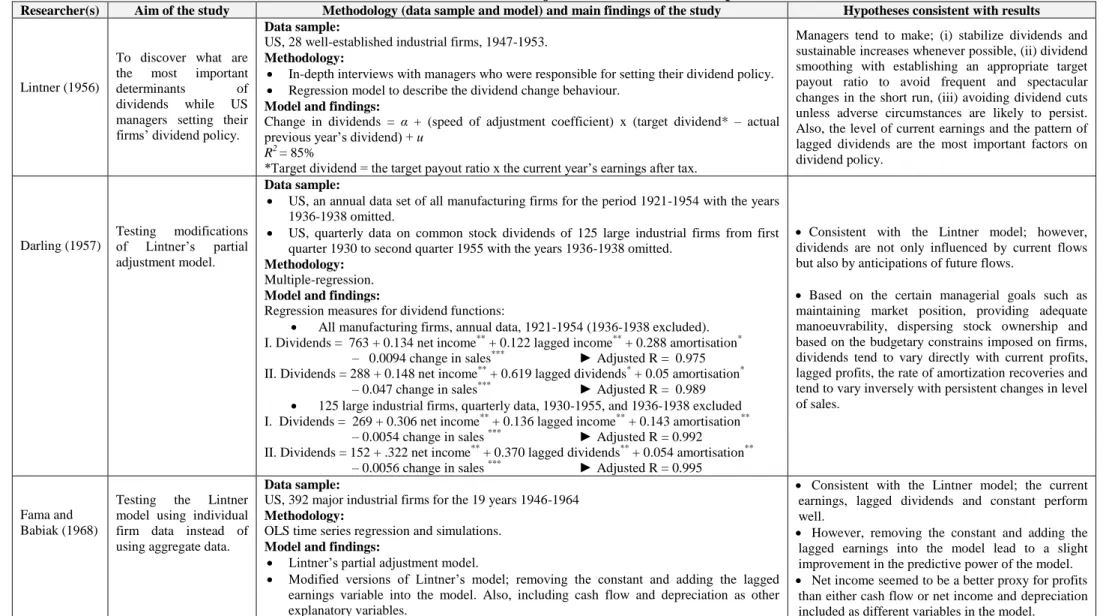
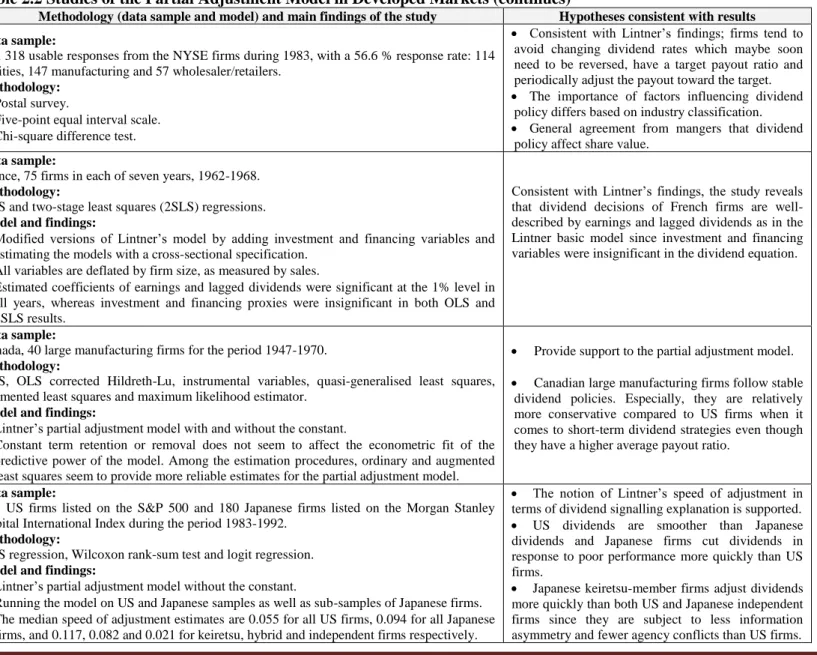
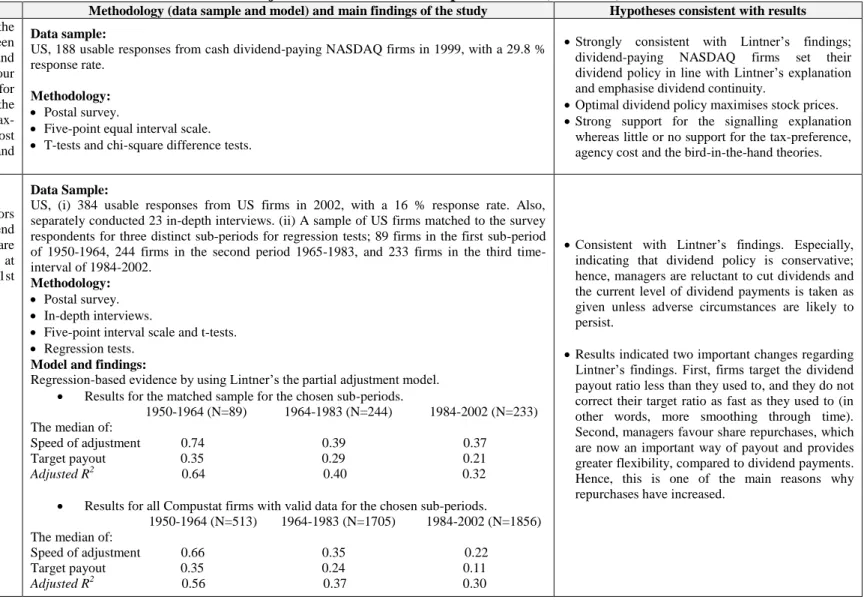
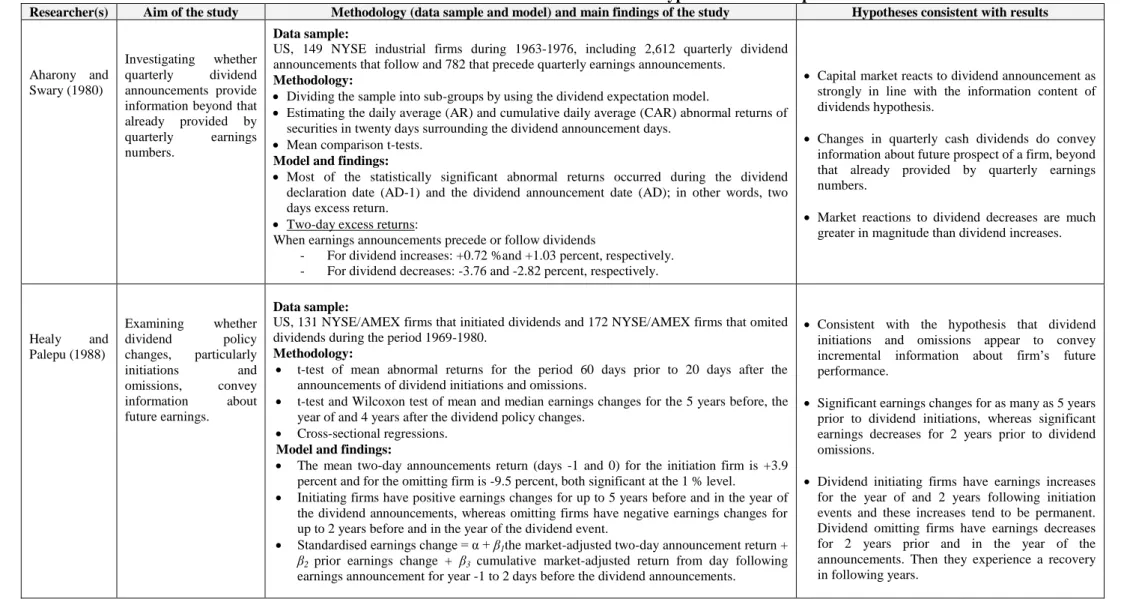
Accordingly, dividend policy has attracted a great deal of attention from financial economists in corporate finance literature. Questions such as why firms pay dividends, why investors care, and to what extent dividend policy may affect firm’s market value have been subject to a long-standing argument (Baker and Powell, 1999). Indeed, finance academics have dealt with various theories, such as the tax preference, signalling and agency cost theories, in order to explain why companies should pay or not pay dividends. Some researchers (Brennan, 1970; Elton and Gruber, 1970; Lintner, 1956; Rozeff, 1982) have built and empirically tested a great number of models to explain dividend behaviour. Others (Baker et al., 1985; Pruitt and Gitman, 1991; Baker and Powell, 1999; Brav et al., 2005; Baker and Smith, 2006) have surveyed corporate managers to find out their thoughts about dividends. Hence, dividend policy literature contains various theories, hypotheses and explanations for dividends.
Miller and Modigliani (M&M)’s (1961) propose the dividend irrelevance theory, which posits that all efforts spent on dividend decisions are wasted, and a managed dividend policy irrelevant under the circumstance of a perfect capital market, with rational investors and absolute certainty. Although M&M’s argument is logical and consistent within a perfect market, once this idealised world gives way to the real world, numerous market imperfections such as differential tax rates, information asymmetries, transaction costs, and conflicts of interest between managers and shareholders, render the irrelevance theory highly debatable. In fact, researchers have focused on the various market imperfections in order to respond to M&M’s irrelevance theory and offered many competing hypotheses about why companies pay, or not pay dividends (Lease et
Some researchers (Graham and Dodd, 1951; Gordon and Shapiro, 1956; Gordon, 1959; 1963) suggest that dividends can increase firms’ values and shareholders wealth. This is because, more certainty is attached to dividend payments received today, against earnings retention for investment in projects whose future earnings are not certain. Firms should, therefore, set a high dividend payout ratio and offer a high dividend yield to maximise their share prices - this explanation is labelled as the bird-in-the-hand
hypothesis. However, there are theories propose, which include the tax preference
theory (Brennan, 1970; Elton and Gruber, 1970; Litzenberger and Ramaswamy, 1979)
and the transaction cost theory (Higgins, 1972; Fama 1974; Rozeff, 1982; Scholz, 1992), whereby, in the existence of market imperfections such as transaction costs and uneven tax treatments, dividend payments can decrease firms value as well as can cause negative consequences for shareholders wealth. Based on these theories, firms should therefore avoid or make minimal dividend payments if they want to maximise their share prices.
Other researchers (Lintner, 1956; Bhattacharya, 1979; John and Williams, 1985; Miller and Rock, 1985) indicate that information asymmetry exists when a firm’s management has a better understanding about the firms’ true value than outsiders who have only access to public information. Hence, managers use dividend payments to convey useful information about the current and future prospects of their firm, which is called the
signalling hypothesis. Furthermore, Jensen and Meckling (1976), Rozeff (1982) and
Easterbrook (1984) developed the agency cost theory of dividends, which derives from problems associated with the separation of management and ownership, and differences in managerial and shareholder priorities. This suggests that an effective dividend policy minimises agency costs by reducing funds available from managers who may spend unnecessarily on unprofitable investments, or even misuse for their own personal consumption. Managers are therefore required to look for financing in capital markets. Many researchers have developed various competing theories such as the pecking order
theory (Myers, 1984; Myers and Majluf, 1984), residual dividend theory (Saxena, 1999;
Lease et al., 2000), catering theory of dividends (Baker and Wurgler, 2004a; 2004b) and
maturity hypothesis (Grullon et al., 2002), which add more complexity to the dividend
controversy.
Fischer Black (1976, p.5) once described this lack of consensus on the matter as the
dividend puzzle by stating that “The harder we look at the dividend picture, the more it
came to this conclusion almost four decades ago, his observation still seems valid since financial economists have not reached a definitive theory of dividends. Furthermore, Brealey and Myers (2003), in their textbook, listed dividends as one of the ten important unsolved problems in finance, supporting this conclusion. Allen and Michaely (1995, p.833) suggested that “Much more empirical and theoretical research on the subject of
dividends is required before a consensus can be reached.”
Dividend policy literature is extensive since researchers have developed and empirically tested various theories, models and hypotheses by contributing voluminous studies. However, despite countless research and extensive debates, the actual motivation for paying dividends still remains a puzzle (Baker and Powell, 1999). In addition to this, most of the theoretical and empirical evidence on dividend policy have been based on the developed markets, mainly the US and UK markets; therefore, less is known about dividend policy and the explanatory power of models for other countries, specifically developing countries (in other words, emerging markets). Considering the growing importance of emerging markets in terms of global equity investments, these markets have comparatively recently started attracting international investors. Accordingly, as emerging markets have begun to contribute to the dividend puzzle, researchers have started investigating the dividend behaviour of corporations in developing countries (Glen et al., 1995; Adaoglu, 2000). In fact, empirical studies, taken in the context of developing markets, have been increasing, especially during the last two decades. Studies have indicated that emerging markets, to a degree, are generally differentiated from developed markets in terms of their effectiveness in meeting requirements of their determined functions. This is because of various discords such as political and social instability, lack of adequate disclosure, poor laws and regulations, and weaker financial intermediaries that provide efficient monitoring due the ineffectiveness of their financial markets (La Porta et al., 1999; 2000; Aivazian et al., 2003a; 2003b; Yurtoglu, 2003). It is, therefore, not surprising that various aspects of dividend policy behaviour of companies listed in the emerging markets tend to differentiate from companies in developed markets.
For instance, renowned cross-country studies such as La Porta et al. (1999), Claessens
et al. (2000) and Faccio et al. (2001) provide evidence that concentrated ownership by
large controlling shareholders, generally families, is the dominant form of the ownership structure in most developing countries. This is in contrast to Berle and Means’s (1932) concept of widely held corporations with dispersed small shareholders
and a concentrated control in the hands of managers, which is extensively accepted in finance literature as a common ownership structure in developed countries. Accordingly, Daily et al. (2003) argued that agency cost theory might function differently in family-controlled publicly listed firms. Whereas prior findings from widely held companies might not readily be appropriate into this type of setting. In these firms, the salient agency problem might be the expropriation of the wealth from minority owners by the controlling owners, the principal-principal conflict, rather than
the principal-managers conflict. Similarly, a number of studies (Manos, 2002; Kouki
and Guizani, 2009; Ramli, 2010; Ullah et al., 2012; Huda and Abdullah, 2013; Thanatawee, 2013; Aguenaou et al., 2013; Gonzalez et al., 2014) emphasised that agency cost theory of dividends needs to be uniquely investigated in emerging markets and more importantly the ownership structure of the firms in these markets should specifically be taken into account while identifying the proxies for agency cost variables.
Aivazian et al. (2003a, 2003b), who are well-known scholars in investigating dividend policy behaviour in emerging markets, compared the dividend policies of firms operating in developing countries with the dividend policies of US firms. Aivazian et al.
(2003a) reported that Lintner’s (1956) model still works for US firms but it does not work very well for emerging market firms. Current dividends are much less sensitive to past dividends in these markets, which supports the notion that the institutional structures of developing countries compose corporate dividend policy a less feasible mechanism for signalling than for US firms operating in capital markets with arm’s length transactions. However, Mookerjee (1992), Pandey (2001), Al-Najjar (2009), Chemmanur et al. (2010), Al-Ajmi and Abo Hussain (2011) and Al-Malkawi et al.
(2014) found evidence supporting the Lintner model when explaining dividend behaviour in different emerging markets. They, however, generally reported higher adjustment factors, hence lower smoothing and less stable dividend policies compared to developed countries. Furthermore, Aivazian et al. (2003b) concluded that firms in emerging markets somehow follow the same determinants (either the same or different signs) of dividend policy that are suggested by the developed markets. Studies from different developing countries such as Al-Najjar (2009), Kirkulak and Kurt (2010), Imran (2011), Mehta (2012) and Kisman (2013) supported this conclusion. Nevertheless, as Aivazian et al. (2003b) stated that, because of various differences between developed and developing markets, even among those developing economies,
such as financial systems, ownership structures, laws and regulations and so on, their sensitivity to these determinants vary across countries.
Consequently, the debate on dividend policy is still unsolved and still remains as a puzzle. There is no doubt that emerging markets attach more pieces to this puzzle. As Glen et al. (1995) stated much more additional research is required to provide a better understanding of dividend behaviour in these developing countries. Therefore, this doctoral thesis is aimed at carrying the dividend debate into the emerging market context with its findings a contribution to dividend literature.
1.2
Motivation of the Study
The debate on dividend policy has now been extensively researched for more than half a century. Earlier research on dividends, in terms of developing theories and empirical tests, were focused on developed markets, mainly the US followed by the UK. However, researchers have also started investigating the dividend policy behaviour of corporations in developing countries, especially over the past two decades, due to the growing importance of these markets in terms of global equity investments (Glen et al.,
1995).
A rapid increase in magnitude of equity portfolio flows, to developing countries, results in serious efforts, shown by emerging markets, to converge with the global world-market portfolio (Bekaert, 1995; Kumar and Tsetsekos, 1999). In this respect, civil law countries, which typically developing markets that generally have weaker rules of law to protect investors (La Porta et al., 1997; 1999), have started to implement common laws in order to integrate with world markets (Karacan, 1998) and to attract foreign investors. Furthermore, Bekaert and Harvey (2002) suggested that emerging markets need integration, both in terms of economic and financial aspects, with world markets; economic integration involves the elimination of barriers to international trade, whereas financial integration desires the free flow capital across borders. Such integration requires a sequence of regulatory and institutional developments in the operations of financial markets. However, Bekaert and Harvey (2002) went on to argue that the concept of regulatory liberalisation and integration should be carefully distinguished. A country may pass a law that apparently drops all barriers to foreign involvement in local capital markets, which is liberalisation but this does not mean that regulatory liberalisation are necessarily defining events for market integration. Therefore, Bekaert
and Harvey (2002) emphasised that, for any empirical research, it is very important to know the approximate date emerging market undertook these structural changes in integrating world capital markets.
Empirical studies taken in the context of developing markets have mostly confirmed that dividend policy behaviour in emerging markets generally tend to be, not surprisingly, different from developed markets in many aspects. This is because of various factors such as political, social and financial instability, lack of adequate disclosure, poor laws and regulations, weaker financial intermediaries, newer markets with smaller market capitalisations, weaker corporate governance and different ownership structures (La Porta et al., 1999; 2000; Kumar and Tsetsekos, 1999; Aivazian
et al., 2003a; 2003b; Yurtoglu, 2003).
It is nevertheless exemplified that, while examining the dividend policy behaviour in different emerging markets, researchers have not clearly stated or distinguished, as suggested by Bekaert and Harvey (2002), between the concepts of regulatory liberalisation or integration undertaken in those emerging markets for their study sample periods. Furthermore, it could be argued that dividend policy decisions of companies in an emerging market should be better understood if researchers report whether the emerging market examined passes laws for financial liberalisation or attempts to implement serious economic and structural reforms to integrate with world markets. In addition, it is questionable whether dividend policies of companies may significantly differ based on the process of liberalisation or integration undertaken in the emerging market in which they operate.
Accordingly, the main aim of this doctoral thesis is to investigate dividend policy behaviour of an emerging market over the period after implementing serious economic and structural reforms, in order to integrate with world markets. In this respect, the dividend policies of the companies listed on the Istanbul Stock Exchange (ISE) will be examined, since Turkey offers an ideal setting for the study of dividend behaviour of a developing country. In particular, with its implementation of major reforms starting with the fiscal year 2003 in compliance with the IMF stand-by agreement, as well as its adoption of the EU directives and best-practice international standards for a better working of the market economy, outward-orientation and globalisation.
1.3
Research Context in the Istanbul Stock Exchange (ISE)
This section provides a summary of the important developments of the Istanbul Stock Exchange (ISE) and explains the rationale for choosing the ISE-listed companies as study samples.
1.3.1 Financial Liberalisation and Earlier Developments of the ISE
Financial markets in Turkey were strictly regulated until a financial liberalisation programme was implemented at the beginning of 1980, which comprised the liberalisation of the foreign exchange regime, deregulation of interest rates and establishment of financial markets (CMB, 2003; Odabasi et al., 2004). In the first half of the 1980s, the Turkish securities markets underwent serious major developments in terms of setting up both the legal and institutional structure fitting for sound capital movements. The Capital Markets Law (CML) was launched in 1981, followed by the establishment of the Capital Markets Board (CMB) in 1982, in order to regulate the founding and operations of stock exchanges. After the adoption of related regulations enacted and launched in the subsequent years, the Istanbul Stock Exchange (ISE) was officially established in December 1985 and commenced its operations on January 3, 1986 (CMB, 2003).
Despite long standing macro-economic imbalances, the Turkish capital markets attempted to make rapid progression in terms of political and regulatory changes during the two decades after 1980. Important institutional and regulatory developments are summarised below (Odabasi et al., 2004, p.511; TSPAKB, 2007, p.5).
1980-1985: Implementing liberalisation program, commencing of primary and secondary markets, employing the New Banks Act and Securities Markets Law. 1986-1987: First bonds were issued by the Treasury, commencing of the interbank
market, the Istanbul Stock Exchange and open market operations by the Central Bank.
1988-1990: Becoming a member of SWIFT (Society for Worldwide Interbank Financial Telecommunication), allowing convertibility of the Turkish Lira, relaxation of restrictions on capital flows, first ADR (American Depository Receipt) was issued in the NYSE and establishing ISE Clearing House.
1991-1992: Establishing the ISE bond market and repo market, implementing EFT (Electronic Funds Transfer) system and Insider Trading Law, and the ISE joined the WFE (World Federation of Exchanges).
1993-1994: First overseas exchange listing and rights market were opened as well as starting full computerised trading in the ISE, and recognition of the ISE by the US SEC (Securities and Exchange Commission).
1995-1996: Establishing Customs Unions with the EU, setting regulations for short sales, prosecution for first insider trading, starting Futures Market in the ISE and the ISE joined the FEAS (Federation of Euro-Asian Stock Exchanges).
1997-1998: Setting up various new sub-markets under the ISE and the ISE became project-leader in Southeast European Exchanges for substituting street-name by customer name.
1999-2000: Adoption of free-float regime and Banking Law on BIS (Bank for International Settlement)/Basel criteria.
2001-2002: Establishing the TSPAKB (The Association of Capital Market Intermediary Institutions of Turkey), Investors’ Protection Fund and Central Registry Agency. Remote trading was started at the ISE and pension system regulation was passed.
1.3.2 An Overview of the ISE during the period 1986-2002
With the rapid development since its establishment in 1986, the ISE became highly representative of a promising emerging market, with fast growth in terms of the number of listed firms, the annual trade volume and the annual market capitalisation, as well as indicating high volatility in returns. As can be observed from Table 1.1 on the next page, the number of listed firms on the ISE significantly increased from 80 in 1986 to 315 in 2000 and then decreased to 310 in 2001 and to 288 in 2002 due to the economic crises in the early 2000s in Turkey. The annual ISE stocks trading volume sharply increased from US$ 13 million in 1986 and reached to a peak of US$ 181.9 billion in 2000 and then again it considerably fell to US$ 80 billion in 2001 and US$ 70 billion in 2002 with the economic crises (CMB, 2003).
Similarly, the total market capitalisation of the ISE grew rapidly. It dramatically rose from US$ 0.9 billion at the end of 1986, reaching its peak to US$ 144 billion by the end of 1999, just before noticeably decreasing to US$ 69.5 billion by the end of 2000. In the following years, it further decline to about US$ 48 billion and US$ 34 billions, reflecting the economic crises in the Turkish market that occurred in the early 2000s. Odabasi et al. (2004) pointed out that emerging markets are characterised by high volatility and high average returns as evidenced by research on stock returns in these markets. In this case, they stated that the ISE is highly representative of an emerging market. Consistent with their statement, the figures of the annual rate of returns, calculated for the ISE-100 Index based on the closing prices in Table 1.1 indicate high volatility and extremely high returns in some years during the period, 1986-2002 (CMB, 2003).
Table 1.1 Development of Main Indicators of the ISE during the period 1986-2002
The table illustrates the development of the number of listed firms in the ISE, trading volume, total market capitalisation and annual rate of return for the ISE-100 Index based on closing prices according to the years. For the ISE-100 Index calculation, the value of the ISE-100 Index in January 1986 is taken as a base year.
No. of Volume of Trade
Total Market Capitalisation
Annual Rate of Return for the ISE-100 Index Listed
Total Annually Daily Average Firms
Year End of US$ US$ US$ (%)
Year (millions) (millions) (millions)
1986 80 13 0.05 938 71 1987 82 118 0.44 3,125 294 1988 79 115 0.45 1,128 -44 1989 76 773 3.03 6,756 493 1990 110 5,854 23.70 18,737 47 1991 134 8,502 34.42 15,564 34 1992 145 8,567 34.13 9,922 -8 1993 160 21,770 88.50 37,824 417 1994 176 23,203 91.71 21,785 32 1995 205 52,357 208.59 20,782 47 1996 228 37,737 152.78 30,797 144 1997 258 58,104 230.57 61,879 254 1998 277 70,396 283.85 33,975 -25 1999 285 84,034 356.08 114,271 485 2000 315 181,934 739.57 69,507 -38 2001 310 80,400 324.19 47,689 46 2002 288 70,756 280.78 34,402 -25
Source: Compiled from CMB (2003)
After its establishment in 1986, the ISE made rapid progress during the period of 1990-2000. In this period, the Turkish economy also often experienced global effects from a number of geopolitical, financial and economic crises; for instance, by the Gulf War Crisis in 1991, 1997 Asia Crisis, 1998 Russia Crisis and 2000 Argentina Crisis. However, the major financial crisis that strongly affected the ISE was the systemic banking crisis that the Turkish economy experienced in the early 2000s (BRSA, 2010). As well, persistently increasing public deficit, the issuance of government debt securities for financing public debt, high rates of real interest paid on these securities, high and volatile inflation and unstable governments, coupled with consistent intervention by the military that added political uncertainty, were some of the main public and macro-economic imbalances that prevented the Turkish capital markets from improving (CMB, 2003; IIF, 2005). Moreover, there were other reasons which had to do with the nature of Turkey’s civil law tradition and its inefficient, and inconsistent regulatory framework, which ensue paucity of the rule of law and its enforcement; particularly, the poor Turkish culture of corporate governance and transparency and disclosure practices (Aksu and Kosedag, 2006).
Studies show that Turkey is a civil law country1 where corporate ownership structure is
characterised by concentrated family ownership.2 Aksu and Kosedag (2006) emphasised
that the predicted benefits of good corporate governance and transparency and disclosure practices are especially important for emerging markets like Turkey, who are eager for external capital as their economies typically grow faster than that of more developed countries. Aksu and Kosedag, however, argued that the transparency and disclosure practices of the ISE firms were not impressive in terms of financial statement disclosure as well as disclosures of shareholder’s rights and board and management structures. It was because the ISE’s financial reporting standards (the Turkish Code of Commerce, dating back to 1957) were only based on the generally accepted principles of accounting and auditing, and the concept of full and fair disclosure. It did not therefore regulate financial reporting properly and remained weak in the enforcement of rules and lack of a disclosure philosophy in the Turkish business culture.3
Ararat and Ugur (2003) pointed out specific corporate governance problems and lack of efficient transparency and disclosure practices experienced by Turkish firms. These
1
Turkey is a civil law country where the present Turkish Commercial Code is adopted from the Continental European Business Law (civil law), dating back to 1957. It had a very late start in the liberalisation of its economy and the establishment of its stock market (ISE) whose history only dating back to 1986 compared to the developed stock exchanges with hundreds of years of historical development (Adaoglu, 1999; 2000; Aksu and Kosedag, 2006). Turkey has a history of poor structural and microeconomic policies as well as a poor culture of corporate governance and transparency and disclosure practices (IIF, 2005; Aksu and Kosedag, 2006). La Porta et al. (1997), well-known scholars for their research interest in emerging markets, also categorised Turkey as a French origin civil law country in their study and concluded that civil law countries generally have weaker rule of laws to protect investors than common law countries. In fact, they found evidence that French civil law countries tend to have poorer minority investors protection and relatively more corruptions among other types of civil law traditions.
2 Gursoy and Aydogan (1999) reported that around 44% of firms listed on the ISE belonged to a family or
a small group of families and other 30% of them were controlled by holding companies (in other words, business groups), showing predominant family involvement in approximately 74% of all firms between 1992 and 1998. Yurtoglu (2003) found that families ultimately owned about 80% of the 305 firms listed on the ISE as of 2001 and families typically tended to organise a large number of firms under a pyramidal ownership structure or through a complicated web of inter-corporate equity linkages and also often made the use of dual class shares or other corporate charter arrangements through which they can reduce their cash flow rights while they firmly have the control on their companies. Similarly, the task force report of the Institute of International Finance (2005) documented that as is the case in many other emerging markets, the largest domestically owned Turkish firms were mainly family-controlled and one shareholder generally controlled more than 50% of voting rights in 45% of the all firms listed on the ISE. It is also reported that at least three-fourths of all corporations are owned by families or a holding company controlled by a family. Therefore, the protection of minority shareholder interests relies primarily on full disclosure and accurate financial reporting (IIF, 2005).
3
In common law countries, the enforcement of high-quality financial reporting standards is compulsory and required for shareholder protection. However, in civil law countries, such as Turkey, standard-setting and enforcement are principally functions of government institutions and therefore there is a lower demand for high-quality financial reporting and disclosure in such economies, since the reporting requirements are oriented towards tax offices and financial institutions (UNCTAD, 2008). Hence, in Turkey, accounting and auditing principles were not good enough for enforcement of good shareholder protection.
included concentrated and pyramidal ownership structures dominated by families, ownership of many banks by these groups of companies, inconsistent and unclear accounting and tax regulations, and misinformation faced by investors because of the absence of inflation and consolidation accounting standards. In addition, Ararat and Ugur suggested that, as a result of this infrastructure, agency problems concentrate on asymmetric information, weak minority shareholders’ and creditors’ rights, inconsistent and unclear disclosure policies, and convergence of ownership and management, which create an environment that may foster corruption, share dilution, asset stripping, tunnelling, insider trading and market manipulation.
Indeed, during the late 1990s, a long list of cases in tunnelling became a prominent issue in the Turkish public. A majority of these cases were simple resource transfers of controlling shareholders from their firms in the form of outright theft or fraud. Whereas a number of listed firms’ minority shareholders were harmed by these events, a bigger proportion represented wealth transfers from state banks to controlling owners of unlisted firms, concerning, in many cases, evident involvement of politicians (Yurtoglu, 2003). Likewise, a number of well-publicised cases revealed that unfair treatment of minority shareholders was a serious corporate governance problem in Turkey, since controlling families had the opportunities to expropriate profits from them. This was done typically through the use of company assets or non-arm’s length related party transactions (IIF, 2005).4 In the following period, in the early 2000s, the Turkish
economy experienced a systematic banking crisis, which was the major financial crisis that strongly affected the ISE. As a result, 22 banks were transferred to the SDIF (Saving Deposit Insurance Fund). The cost of re-structuring these banks and the banking system was US$ 53.6 billion, which was equal to one-third of the national income in Turkey in 2001 (BRSA, 2010).
4
For instance, in 1999, the Capital Markets Board (CMB) of Turkey inspected related party transactions mutually between Turk Tuborg and its parent company, Yasar Holding, and affiliated companies. The CMB found that Tuborg shares held by Bimpas (Tuborg’s marketing company) were sold to Mr.Selcuk Yasar, who was the ultimate owner of Yasar Holding, and the price for this transaction was actually paid two years later. Tuborg also had a contract with the Altinyunus Hotel, which was another Yasar Group company, for a period of 15 years to rent 15 rooms at above published prices. Additionally, Tuborg donated a property to the Yasar Foundation in violation of its Articles of Association, whilst selling another property to another Yasar Group company (Desa) at a lower than its market price. Lastly, the CMB questioned that Turk Tuborg bought shares in Yasar Holding’s bank, namely Yasarbank, to help the bank from failing but Yasarbank did eventually fail and was taken over by the Savings Deposit insurance Fund (IIF, 2005).
1.3.3 Market Integration Process of the ISE since 2003
Following the November 2002 elections, which resulted in a one-party (non-coalition) government, the political uncertainty at some degree faded away and the economic programs and structural reforms were jointly carried out by the government and the International Monetary Fund (IMF), commencing in March 2003 (CMB, 2003). Turkey’s progress in achieving full membership of the EU in this period also provided the strongest motivation in establishing new reforms, rules and regulations to improve corporate governance and transparency and disclosure practices; therefore, to integrate its economy with Europe and to harmonise its institutions with those of the EU (IIF, 2005; Aksu and Kosedag, 2006).
According to the task force report provided by the IIF (2005), the legal and institutional environment for corporate governance, and transparency and disclosure practices in Turkey improved, particularly in the past few years, in line with the structural reforms implemented in collaboration with the IMF. In addition, Turkish government and the CMB, together with some private sector organisations such as the Turkish Industrialists and Businessmen’s Association (TUSIAD), the Corporate Governance Forum of Turkey (CGFT), the Corporate Governance Association (KYD) and the Foreign Investors Association (YASED), performed hard to improve the rules for corporate governance and transparency and disclosure.
The Capital Markets Board (CMB) attributed great importance to improve communications with investors, issuers and other institutions in 2003, in order to ensure that markets functioned in a safer, more transparent and efficient manner, in accordance with regulations that were adopted in harmony with international norms and developments (CMB, 2003). Accordingly, one of the most important developments was that, in line with the EU requirements, the CMB issued the Communiqué Serial: XI, No: 25 entitled “Accounting Standards in Capital Markets” in November 2003, adopting International Financial Reporting Standards (IFRS) and enforcing publicly owned and traded firms to use new rules. In addition, the CMB obliged the implementation of inflation-adjusted accounting at the same time (UNCTAD, 2008).
Moreover, in cooperation with the World Bank and the Organisation for Economic Cooperation and Development (OECD), the CMB’s Corporate Governance Principles were published in 2003, aiming to improve the ISE-listed firms’ corporate governance practices. The CMB Principles consisted of four major parts. The first part discussed
shareholders’ rights and their equal treatments involved with issues such as right to obtain and evaluate information, right to vote, right to join the general shareholders meeting and more minority rights detailed in this part. The second part included principles that were related to disclosure and transparency for establishing information policies in firms with respect to shareholders and the adherence of firms to these policies. The third part was concerned about firms’ obligations for their stakeholders, including their workers, creditors, customers, suppliers, institutions, non-governmental organisations, the government, and potential investors who may think of investing in these firms in order to regulate the relationship between the firms and their stakeholders. The fourth part discussed the functions, duties, obligations, operations and the structure of the board of directors as well as the committees to be created to support the board operations and executives (CMB, 2003; 2004; Caliskan and Icke, 2011).
Structural problems in the banking sector basically deepened during 2000 and turned to a systemic banking crisis in February 2001. Many amendments were passed to improve the transparency and quality of the banking sector. “The Banking Sector Restructuring Program” was implemented in May 2001 in order to restructure the public banks, resolve banks taken over by the SDIF, rehabilitate the private banking system, and to strengthen the surveillance and supervision frame to increase efficiency in the sector (BRSA, 2010). Several group banks, which previously funded much of their own business group companies’ financial needs, declared bankrupt. With the introduction of “the Regulation on Establishment and Operations of Banks” in July 2001, the risk group definition and calculation of loan limits for a single group (including banks, businesses and subsidiaries in the same group) considering direct and connected lendings were established in order to avoid credit risk concentration as well as improve the assets structure of the banking sector. As a result of preventing insider lending as a source of financing, the ISE firms turned to the equity market with a greater incentive for more transparent financing (IIF, 2005).
Other improvements also took place in order to improve the Turkish market in terms of corporate governance and disclosure practices, since it sought to integrate its economy with Europe and harmonise its institutions with those of the EU. The government, accordingly, accelerated “privatisation” of State Economic Enterprises, together with the elimination of legal barriers to market entry, and a general reduction in the state’s direct involvement in the economy, indicating the importance of corporate governance (IIF, 2005; Aksu and Kosedag, 2006). It is worth noting that 58% of the IPO proceeds
in the ISE, between 2003 and 2008, were raised by privatisation activities (TSPAKB, 2008). Moreover, since pension funds and other large institutional investors were not permitted to vote for corporate directors, there were only a few institutional investors in Turkey with an interest in good corporate governance, hence the sector was underdeveloped (IIF, 2005). However, “Individual Retirement Savings and Investments System” was implemented in 2003 (CMB, 2003) in the hope of creating pension funds that were expected to serve as institutional investors and increase monitoring in public firms (Aksu and Kosedag, 2006).
A brief timeline and some selected milestones of Turkish Capital Markets from 2003 and forward are summarised below (TSPAKB, 2007, p.5; 2008, p.40; 2012, p.1-2). 2003-2004: Corporate Governance Principles were published. Establishing first
private pension funds. Adoption of IFRS (International Financial Reporting Standards). First exchange traded fund was established.
2005-2006: Setting up Turkish derivatives exchange. Dematerialisations of equities, corporate funds and mutual finds were completed. Taxation of investment instruments was changed.
2007-2008: Opening auction introduced at the ISE. Mortgage law is passed. Eurobond market was established within the ISE. The ISE trading hours are extended by 30 minutes. New anti-money laundering regulations in line with the FATF (Financial Action Task Force).
2009-2010: Automated disclosure platform introduced. Emerging Companies Market and Collective Products Markets is established within the ISE. Regulations regarding IPOs are eased. Market was introduced for warrants and ETFs.
2011-2012: First Islamic bond and electricity futures were issued, FOREX regulations were introduced and Investor Education Campaign was initiated.
Reforms implemented after the major financial crisis, as well as a number of well-publicised unfair treatments experienced by minority shareholders, and the political stability obtained after 2002 all provided a significant improvement in fundamental indicators. Under the IMF-supported program, inflation fell spectacularly from triple digits in 2001 to single digits in 2004, and was realised as 7.7% as of 2005. Real GDP growth strikingly picked up and averaged 8% during 2002-2004. Additionally, the public sector primary surplus exceeded 5% of GNP, leading to an anticipated decrease in net public debt of a percentage of GNP from 92% in 2001 to 65% by the end of 2004. As the public debt burden was reduced, the short-term policy interest rates were declined below 20% by the end of 2005. These significant structural and macroeconomic improvements of Turkish economy greatly increased both competition and profitable investment opportunities. This resulted in an increase of interest of global
capital, and caused a strong capital entry, oriented directly to the country and formed as portfolio investment (IIF, 2005; BRSA, 2010). Indeed, after the implementation of major reforms in 2003, the Turkish stock market bounced back and generally had a rapid growth in terms of the number of listed firms, trading volume, market capitalisation (CMB, 2012) attracting a significant amount of foreign investments (Adaoglu, 2008) during the period 2003-2012.
Table 1.2 Development of Main Indicators of the ISE during the period 2003-2012
The table illustrates the development of the number of listed firms in the ISE, trading volume, total market capitalisation, equities traded by foreign investors and annual rate of return for the ISE-100 Index based on closing prices according to the years. For the ISE-100 Index calculation, the value of the ISE-100 Index in January 1986 is taken as a base year.
No. of Volume of Trade
Total Market Capitalisation Foreigners Stocks in Custody Foreigners to Total Stocks Ratio Annual Rate of Return for the ISE 100 Index
Listed Total Daily
Firms Annually Average
Year End of US$ US$ US$ US$ (%) (%)
Year (millions) (millions) (millions) (millions)
2003 285 100,165 407.17 69,003 8,690 51.5 80 2004 297 147,755 593.40 98,073 15,283 54.7 34 2005 306 201,763 794.35 162,814 33,812 66.3 59 2006 322 229,642 918.57 163,775 49,313 65.3 -2 2007 327 300,842 1,192.82 289,986 70,213 72.3 42 2008 326 261,274 1,040.93 119,698 42,152 67.5 -52 2009 325 316,326 1,255.26 235,996 56,246 67.3 97 2010 350 425,747 1,702.99 307,551 71,267 66.8 25 2011 373 423,584 1,674.25 201,924 45,919 62.2 -22 2012 395 347,854 1,374.92 309,644 78,545 65.8 53
Source: Compiled from CMB (2003, 2007, 2012)
Table 1.2 illustrates that the number of listed firms on the ISE significantly increased from 285 in 2003 to 395 in 2012. The annual ISE stocks trading volume rapidly grew from US$ 100 billion in 2003 and reached a peak of US$ 425.7 billion in 2010. It then stayed approximately at this level in 2011, followed by a noticeable decrease to US$ 348 billion in 2012. Moreover, the total market capitalisation of the ISE sharply increased from US$ 69 billion in 2003 to US$ 290 billion by the end of 2007, and then decreased to US$ 119.7 billion in 2008, due to the global financial crisis experienced in that year. From this point, the total market capitalisation of the ISE showed generally an increasing but fluctuating trend, and increased to US$ 309.6 billion by the end of 2012. Furthermore, Table 1.2 presents the total stocks held in custody by foreign investors and the ratio of stocks owned by foreigners to total stocks traded in the ISE by the end of each year during the period, 2003-2012. Indeed, this period has been greatly attracted to foreign investors. The ratio of stocks owned by foreign investors to total stocks in the ISE was 51.5% by the end of 2003 and steadily increased to 72.3% by the end of 2007.
Perhaps due to the 2008 global crisis, this ratio decreased to 67.5% in 2008 and showed a further slightly declining pattern in the following years to 65.8% by the end of 2012. This still revealed a serious contribution from foreign investors, holding about two-thirds of the total equities in custody in the ISE. Finally, the figures of annual rate of returns calculated for the ISE-100 Index, based on the closing prices in the table, indicate a high volatility and high returns in some years, as well as a considerably big loss in 2008 over the period 2003-2012.
1.3.4 Historical Dividend Policy Regulations of the ISE
Dividend payment decisions are not always solely depended on managers’ judgement to pay or not to pay, since factors such as regulations, financial crises and trends in the macro-economy might have implications for dividend policy (Kirkulak and Kurt, 2010). The evidence from cross-country studies (La Porta et al., 2000; Aivazian et al., 2003a) has revealed that there are regulatory differences related to the dividend policy making process forced by the governments throughout the world. Especially, as Glen et al.
(1995) stated, emerging market governments are likely to enforce constrains on the dividend policy in order to protect both minority shareholders and creditors.
Public corporations listed on the ISE are subject to the regulatory policies put into effect by the CMB of Turkey. Indeed, the dividend policy in the ISE was heavily regulated when it first started to operate in 1986. For the fiscal years 1985-1994, the first mandatory dividend policy was implemented by the enactment of Capital Markets Law in 1982 and, according to the first regulation on dividend payments, the ISE-listed firms were obliged to distribute at least 50% of their distributable income as a cash dividend, which was known as “first dividend” in the Turkish capital market. Without paying the “first dividend”, all other dividend payments such as the payments to employers or maintaining it as retained earnings were not legally possible (Adaoglu, 1999; 2000). The main purpose of this mandatory dividend payment regulation was to protect minority shareholders rights by providing them satisfactory levels of dividends. This was because the liquidity in the stock capital markets was almost non-existent as there was no stock exchange before 1986, and the only source of income for minority shareholders was the dividend income (Aytac, 1998).
In 1995, there was a major change in the dividend regulations implemented by the CMB, which abolished the mandatory cash dividends distribution requirement for the
listed firms in the ISE.5 The amended regulations provided greater flexibility to the
listed-firms since they were not forced to pay out a certain percentage of their income as cash dividends anymore. In fact, firms were allowed to decide between distributing dividends and keeping their profits as retained earnings. Furthermore, even if a firm decided to pay “first dividend”, payments could be in the form of cash dividends, stock dividends or both cash and stock dividends, which were subject to voting in the annual general meeting. The main purpose of the changes was to remove the restrictions forced on the dividend payments and therefore to allow the investors to interpret the dividend policy changes efficiently and to reflect their judgements in the shares prices (Adaoglu, 1999; 2008). In addition, the abolishment of the mandatory requirement of distributing 50% of the profits as cash dividends would lessen the firms’ liquidity problems and would increase the amount of internal financing for these firms (Aytac, 1998).
Turkey went through a major economic crisis in 2001, and in order to recover, signed a standby agreement with the IMF. As well as seeking to integrate with the EU, it started to implement major structural reforms as previously explained. However, the crisis resulted in substantial losses for investors, especially small Turkish shareholder who heavily invested in the ISE prior to the economic crisis. Although the stock market bounced back and attracted a substantial amount of foreign investments after implementing various major structural reforms, the fear of small Turkish investors continued. In order to attract these Turkish investors back to the stock market, the CMB replaced the mandatory dividend policy, beginning with fiscal year 2003 (Adaoglu, 2008). Kirkulak and Kurt (2010) pointed out that the purpose for mandatory dividend policy was to protect minority shareholders rights against the controlling shareholders. This is because Turkish firms are generally highly dominated by families and mainly attached to a group of companies, where the controlling shareholders, typically families, often use a pyramidal structures or dual-class shares to augment control of their firms. With the replacement of the second mandatory dividend policy, the ISE-listed firms were obligated to pay at least 20% of their distributable income as the “first dividend”. However, in a more flexible way from the first mandatory dividend payment policy between 1985 and 1994, the listed firms did not have to pay the “first dividend” in cash but had the option to distribute it in cash dividends or stock dividends or a mixture of both, which was subject to the board of directors’ decision. The total payment, however,
5 Decree issued by the CMB Serial: IV, No: 9 published in the Official Gazette dated 27/12/ 1994 and No:
could not be less than 20% of the distributable income for the fiscal year 2003. They were also given a right to distribute stock dividends with the requirement that the amount of stock dividends is added to the paid-in capital (Adaoglu, 2008; Kirkulak and Kurt, 2010).6
For the fiscal year 2004, the CMB increased the minimum percentage of mandatory dividend payments for the ISE-listed firms from 20% to 30%, which then stayed at this level for the fiscal year 2005. Then, the minimum percentage of mandatory dividend payment level was reduced to 20% again in the fiscal year 2006 and remained at this level for the fiscal years 2007 and 2008. Nevertheless, from the fiscal year 2009 onwards (2010, 2011 and 2012), the CMB decided to not determine a minimum dividend payout ratio and to abolish mandatory minimum dividend payment distribution requirement for the publicly-listed firms trading on the ISE. This provided total freedom to the ISE-listed firms to make their own dividend policy decisions to pay or not to pay, with the requirement that any decisions made regarding dividends should be publicly disclosed.7
1.3.5 The Rationale in Examining Dividend Policy of the ISE-listed Firms
Turkey had a very late start in the liberalisation of its economy and the establishment of its stock market, the ISE, whose history only dating back to 1986 compared to the developed stock exchanges with hundreds of years of historical development (Adaoglu, 1999; 2000; Aksu and Kosedag, 2006). Studies reveal that Turkey is a civil law country (La Porta et al., 1997), where corporate ownership structure is characterised by highly concentrated family ownership (Gursoy and Aydogan, 1999; Yurtoglu, 2003). There is also a history of poor structural and microeconomic policies as well as a poor culture of
6 The CMB decision number: 16535 and dated 30/12/2003, published in the CMB Weekly Announcement
Bulletin No: 2003/63.
7 Relating to the fiscal year 2004, the CMB decision number: 51/1747 and dated 30/12/2004 published in
the CMB Weekly Announcement Bulletin No: 2004/54.
Relating to the fiscal year 2005, the CMB decision number: 4/67 and dated 27/01/2006 published in the CMB Weekly Announcement Bulletin No: 2006/3.
Relating to the fiscal year 2006, the CMB decision number: 2/53 and dated 18/01/2007 published in the CMB Weekly Announcement Bulletin No: 2007/3.
Relating to the fiscal year 2007, the CMB decision number: 4/138 and dated 08/02/2008 published in the CMB Weekly Announcement Bulletin No: 2008/6.
Relating to the fiscal year 2008, the CMB decision number: 1/6 and dated 09/01/2009 published in the CMB Weekly Announcement Bulletin No: 2009/2.
Relating to the fiscal year 2009 and onwards, the CMB decision number: 02/51 and dated 27/01/2010 published in the CMB Weekly Announcement Bulletin No: 2010/4.
corporate governance and transparency and disclosure practices (IIF, 2005; Aksu and Kosedag, 2006). With the rapid development since the establishment in 1986, the ISE became highly representative of a promising emerging market, with fast growth in terms of the number of listed firms, trading volume, market capitalisation and foreign investment (Adaoglu, 2000) as well as indicating high volatility in returns especially during the period 1990-2000.
In this period, Turkish economy also often experienced global effects from a number of geopolitical, financial and economic crises; for instance, the Gulf War Crisis in 1991, 1997 Asia Crisis, 1998 Russia Crisis and 2000 Argentina Crisis. However, the major financial crisis that strongly affected the ISE was the systemic banking crisis that Turkish economy experienced in 2001 (BRSA, 2010), which resulted in substantial losses for shareholders, esp