The Arts and Humanities Data Service (AHDS) is a national service funded by the Joint Information Systems Committee (JISC) of the Higher and Further Education Funding Councils and the Arts and Humanities Research Council to collect, preserve and promote the electronic resources which result from research and teaching in the arts and humanities.
Digital Images Archiving Study
Authors: Sheila Anderson
Mike Pringle Mick Eadie Tony Austin Andrew Wilson Malcolm Polfreman Date: March 2006
Version: Final draft
Document Name: Digital Images Archiving Study
Notes: Limited circulation
Acknowledgements
Many thanks to those who contributed to this Archiving Study by participation in interviews and through responding to the survey promoted online through the AHDS Visual Arts.
Digital Image Archiving Study: Table of Contents
Page 1. Summary and Recommendations
1.1 Background and Focus 5
1.2 User Requirements 7
1.3 Properties and File Formats 9
1.3.i Vector Images 10
1.3.ii Raster Images 11
1.4 Preservation Methods 11
1.4.i Raster Images 13
1.4.ii Vector Images 13
1.5 Metadata 14
1.6 Life-cycle and Organisational Models 15
1.7 Assessing Costs 16
2. Introduction and Scope of Study
2.1 Outline and Scope of Study 18
2.2 JISC activity and initiatives 18 2.3 Outline scope of study and methodology 19
2.4 Project outcomes 19
3. Context and Background
3.1 Overview of Current Research 21
4. User Requirements
4.1 Introduction 23
4.2 Identifying users and potential usage of digital images 23
4.3 Who are they? 24
4.4 Targeted survey 27
4.5 Broad survey 28
4.6 Taxonomy of ‘user’s scenario’s’ 29
4.6.i Archetypal users 29
4.7 The users’ perpective 31
4.7.i Educational needs 31
4.7.ii Subject distinctions 32 4.8 Dissemination/access preferences 32 4.9 Impact of user requirements on preservation 34
methods and approaches
4.9.i Image Quality 34
4.9.ii Selection Procedure 35
4.9.iii Provenance 36
4.9.iv Permissions and Copyright 37
4.9.v Image Formats 37
4.10 Taking user needs into account – recommendations 38 5. Properties of Digital Images
5.1 Introduction 39
5.2 Vector Images: Overview 40
5.3 Vector Images: Significant Properties 41
5.3.i File Formats 41
5.3.ii Scale 41
5.3.iv Coordinate Systems 42
5.3.v Geometry 42
5.3.vi Objects and their relationships 42
5.3.vii Conventions 42
5.3.viii Associated Data 42
5.3.ix Methodology 43
5.4 Vector Images: File formats 43
5.5 Vector Images: Risk assessment and Recommendations 51 5.5.i PostScript and its variants 51 5.5.ii Computer Aided Design (CAD) 52 5.5.iii Geographic Information Systems (GIS) 52 5.5.iv Chemical and Molecular formats 52
5.6 Raster Images: Overview 53
5.6.i Resolution 54
5.6.ii Bit Depth 54
5.6.iii Colour Space 54
5.7 Raster Images: File Formats 55
5.8 Raster Images: Risk assessment and Recommendations 59
5.8.i TIFF 59 5.8.ii JPEG2000 59 5.8.iii PNG 59 5.8.iv DNG 60 6. Preservation Methods 6.1 Introduction 61
6.2 Overview and Assessment of Preservation Methods 62 6.2.i Bitstream preservation 62 6.2.ii Preservation of Technology 62
6.2.iii Migration 63
6.2.iv Emulation 64
6.2.v Migration on Request 64
6.2.vi Universal Virtual Computer 65
6.3 Summary of Image Basics 66
6.4 Raster Images 66
6.5 Vector Images 67
6.6 Recommendations for preservation approaches for 68 digital images
6.6.i Raster/Bitmap Images 68
6.6.ii Vector Images 69
7. Images Metadata Review and Requirements
7.1 Introduction 72
7.2 Technical metadata 72
7.3 Management metadata 73
7.4 Discovery metadata 73
7.5 Review of existing metadata standards 74
7.5.i Dublin Core84 74
7.5.ii DC Terms85 74
7.5.iii VRA Core 3.086 75
7.5.iv PREMIS87 75
7.5.v NISO Z39.8789 76
7.6 Standards for vector images 76
7.6.i CAD 76
7.6.ii GIS 77
7.6.iv Scalable Vector Graphics (SVG)102 78 7.7 Collection-level metadata for image collections 78
7.8 METS103 78
7.9 Contextual documentation 79
7.10 Metadata extraction and storage 79
7.10.i Creating metadata 79
7.10.ii JHOVE106 80
7.10.iii National Library of New Zealand Metadata 80 Extract tool107
7.11 Storing Metadata 80
7.11.i Embedding metadata in PNG110 81 7.11.ii Embedding metadata in JPEG200011 81 7.11.iii Embedding metadata in TIFF113 82 7.11.iv Embedding metadata in DNG116 82
7.12 Conclusion 83
7.13 A recommended minimum element set for use 84 with archival digital still images
8. Life Cycle and Organisational Models
8.1 Functional Requirements: OAIS 91
8.2 OAIS Functional Entities (Simplified) 91 8.3 Trusted Digital Repositories (TDR) 93 8.4 Digital Image Life-cycle Model: OAIS and TDR 94
8.4.i Creation 95
8.4.ii Transfer / Ingest 96
8.4.iii Curation / Preservation 97
8.4.iv Access and Use 98
8.4.v Technological Obsolescence 98 8.4.vi Reject or Withdraw Images 99
8.5 Organisational Models 99
8.5.i Single Institution Image Repository 100 8.5.ii Image Repository with Specialist Support 100 8.5.iii Image Repository with Outsourced 100
Preservation Services
8.5.iv Outsourced Image Repository Services 100
8.6 Disaggregated Models 100
9. Assessing Preservation Costs 102 Appendix One: User Surveys 106 Appendix Two: Research/Support Bodies 138 Appendix Three: Vector and Raster Collections 155 Overview of JISC Collections
1. Summary and Recommendations
1.1 Background and Focus
A growth in digital imaging technologies has meant that a vast number of digital images are produced every year. The scholarly community has made particular use of this new content, and is now strongly reliant on access to digital image resources. Digitisation of collections has allowed a radical shift in the manner in which libraries and cultural organisations can deliver their collections, enabling them to provide round the clock online access to multiple users from anywhere in the world.
While many images are “born-digital”, in particular vector images, vast quantities of digital images have been digitised. Over the last ten years, costly digitisation projects have been carried out in many HE/FE institutions. If this investment in digitisation is to pay off, then strategies for the long-term preservation and access of digital image files must be guaranteed. Digitisation projects need to consider the fact that digital obsolescence will have a negative impact on their digitised collections, in the same way that physical collections are subject to threats over time, and that the decisions they make at the point of digitisation or capture is likely to affect what they can do in the future.
Management and preservation requirements for digital materials are fundamentally different from analogue materials. Digital materials can be created using a wide range of technologies and formats, whether born digital or digital surrogates of existing analogue materials. They can be described and documented in a variety of ways – or not at all. They are subject to both physical deterioration and technical obsolescence. More than one copy can be easily and simply created. Access may be provided through more than one point, and may be distributed. All these factors will impinge upon the approach taken to their management and long-term preservation.
These differences present the curators of digital materials with some fundamental challenges. The way in which materials are created, particularly the technologies used, will determine how conducive to long-term preservation the materials are, and will present varied challenges to curators charged with the subsequent management and preservation of the materials. Curators will need adequate metadata about the resource if they are to successfully manage, preserve and make the materials accessible. Multiple copies may also imply multiple versions – the digital resource curator must somehow ensure the integrity and authenticity of the resource. They must be aware of changing technologies and fragility of media and take these into consideration from an early stage in the ingest process.
Access and preservation of digital content are of course closely linked. The conversion of binary data into meaningful information relies on a complex chain of hardware, software and formats, all of which are subject to on-going technological change. Consequently, providing long-term access to digital content inevitably involves the challenges of digital preservation. Content in a digital repository must be protected from the problems of data corruption and technological obsolescence, and the authenticity of the content must be ensured in some way.
Jones and Beagrie define digital preservation as: “…the series of managed activities necessary to ensure continued access to digital materials for as long as necessary.
Digital preservation….refers to all the actions required to maintain access to digital materials beyond the limits of media failure or technological change.”1
All this suggests that digital curation and preservation requires a more pro-active approach beginning at an earlier stage in the material’s lifecycle than would traditionally be the case with analogue materials. Within the digital preservation community, the concept of the life-cycle (or continuum as it is sometimes called) management of digital resources has emerged to describe and document the active management processes that need to take place, and the key decision making and intervention points along the continuum. The life-cycle concept has been incorporated into OAIS Reference Model, now adopted as an ISO standard for digital preservation. The OAIS model is proving a strong foundation for the development of digital archiving projects and services, and is increasingly being implemented by digital libraries and archives, including the AHDS.
However, despite these developments, the difficulty for those undertaking preservation or with responsibility for providing access in the long term to digital is the lack of practical advice, and of robust tools and mature techniques for digital preservation. A number of digital preservation strategies have been proposed, but there is no definitive approach to the problem of maintaining digital content across multiple generations of technology. Unfortunately, information on the likely costs, possible limitations and long-term sustainability of different strategies is far from complete – partly it must be said, for the very valid reason that no one has yet had the time to gain the experience needed to answer these questions.
The work undertaken for this report sets out to overcome some of these limitations, and to provide a firm foundation for the JISC in its future decision making. The report should also act as a valuable resource for those creating, managing, curating, providing access to and preserving digital images.
The definition of a digital image used in this study is as follows:
“Digital (still) images are non-moving representations of visual information” That is, still images that convey their meaning in visual terms, e.g. photographs, posters, diagrams, drawings. The study considers both the familiar raster image and the perhaps less well known vector image. The former include the products of digital photography and scanning with file formats such as TIFF and JPEG. The latter is considered less when thinking of digital images, but a large volume of digital content is created including maps, drawings, and the almost ubiquitous PDF file.
Both can be said to be geometric or spatial but any similarities end there. Raster (or bitmapped) images are grid-based with information being held about each point or pixel within the grid, whereas vector images have information about any number X, Y, Z spatially defined coordinates and are made up of scalable objects—lines, curves, and shapes—defined in mathematical terms, often with typographic insertions.
The report focuses on a number of practical issues related to the preservation of images. First among these is the nature of digital images themselves – their content, format, size, metadata requirements, and potential preservation methods to ensure long term access and use. The report also addresses user community requirements,
1 Jones, M and Beagrie, N, ‘Preservation Management of Digital Materials: a Handbook’, British Library,
both for those creating digital images and for subsequent users of digital images. The final section endeavours to bring many of these issues together focusing upon a life-cycle model and some discussion of costs.
What is surprising is the lack of focused research dedicated to researching the preservation of digital images, and the lack of practical advice, and of robust tools and mature techniques for digital preservation, particularly for vector images. Research tends to be theoretically-based, and although testbed projects have begun to emerge, but overall research tends to be general in nature rather than say, investigating TIFF as an image preservation format. Work specific to digital image preservation is rare, although the programme to develop a decision support framework for the preservation of a range of content types currently underway at the Library of Congress is providing useful, focused research and practical guidance. We recommend that JISC seriously consider funding work to complement and add to this programme in collaboration with the LoC, format registry work such as PRONOM and the Global Digital Format Registry. Further work of this kind to identify the complexities, the risk factors and risk assessment processes, would be of enormous value to the preservation community, and would facilitate informed decision making at all stages of the digital life-cycle.
1.2 User Requirements
It is now widely understood that the development of digital systems, like any non-digital system, should be led by an understanding of the needs of those people who will use the system. This report gives great weight to what we have termed end-users, but it also includes within this remit those who are engaged with digitising or creating born digital images – the so-called start-users. The report argues that consideration must be given in the digital image preservation process to the users of those images, and must also engage with the creators of image collections wherever possible.
The research undertaken for this report highlights that user concerns are dominated by worries, some founded and some speculative, relating to, first and foremost, access and the metadata required to facilitate access, followed closely by the difficult issue of copyright/IPR, and the more transient nature of quality and changes in technology. We would therefore argue that it is not just the technology and systems that must be considered but also the connection between technological facility and human factors. Just as the different image formats develop, change or migrate into emerging formats, so a system must adapt and grow in response to issues relating to change of use, copyright, wider accessibility, and even metadata, within the communities that the system is designed to serve.
The concept of the lifecycle model developed for the report identifies that preservation starts with the data creation process, and must include regular monitoring and response to user needs and requirements if the right preservation decisions are to be made. For example, it is pointless for an image repository to migrate its content to one format, when the community doesn’t use that format or have access to software that accepts that format. Similarly, an archive might concentrate on creating technical metadata that fits it preservation needs, but if that isn’t accompanied by metadata that enables discovery and use, then it is questionable if the repository is fulfilling its remit.
Furthermore, preservation decisions must be based on the content and nature of the image and different preservation decisions and actions may be taken depending on these factors. For example, if the content of an image is unique (an original artwork for example, or a set of architectural drawings) then the approach to preservation may well be different to something that is more common, or has less value in terms of use (although assessing value is very difficult). Similarly, the nature of the image will affect preservation approaches and actions. For example, if precise colour depth and accuracy are not essential characteristics (as may be the case with many vector graphics) then the preservation approach is likely to reflect this. The concept of fitness for purpose is crucial to these ideas, and should be factored into the preservation life-cycle approach.
There seems to be a general assumption that we must preserve all digital content and every digital image that has been created. Indeed, that assumption was reflected in the ITT for this research. The concept of fitness for purpose brings that idea into question. What is fit for purpose now, may not remain so in the future. The need for different types of content may change over time for example, and if past experience is anything to go by standards of digitisation and image capture will continue to improve well beyond what is acceptable now. This may well render the nature of the object obsolete in terms of quality and/or functionality even though it can still be rendered and used in the technological sense.
Selection of images for preservation, and their subsequent retention require more attention than seems to have been given to them thus far. We would recommend that JISC investigate issues of selection and retention with the idea of fitness of purpose in mind. This should include assessing where the costs of digitisation of images lie. It may be that the most costly part is the creation of metadata rather than the capture of the digital image. In that case, JISC might recommend or require properly managed preservation of the metadata and surrounding information, alongside a programme to re-digitise the image content at such time as the nature of the object no longer meets the needs of the user communities.
However, if the cost of digitising the object is high, and the image content is born digital, or digitised from a fragile or very rare and hard to access analogue, then a different approach is necessary, where the image is created to the highest possible standards, and properly preserved into the future, alongside the metadata. This report recommends that JISC moves away from a ‘one-size-fits-all’ approach to preservation and investigates a range of different approaches that reflect the requirements for the future community of users, as well as the more prosaic technological requirements.
To address these issues JISC is recommended is undertake further research into the selection and retention of digital images, the associated costs of re-digitising against the costs of preserving, and how it might implement an on-going assessment process of user needs and fitness for purpose of digital image content.
JISC should require that all digital image content which it funds should be created to the highest standards possible to ensure usability for as long as possible.
JISC may also wish to consider:
• Capturing and analysing user and usage data to monitoring changes in practice that can feed back into the development of systems
• Requiring image collections which it funds to conform to agreed standards, and providing monitoring services to ensure compliance
1.3 Properties and File Formats
Access and preservation of digital content are of course closely linked. The conversion of binary data into meaningful information relies on a complex chain of hardware, software and formats, all of which are subject to on-going technological change. Consequently, providing long-term access to digital content inevitably involves the challenges of digital preservation. Content in a digital repository must be protected from the problems of data corruption and technological obsolescence, and the authenticity of the content must be ensured in some way.
However, as the chapter on user requirements demonstrates digital content must also be fit for purpose over time. This means that attention must be paid to establishing the significant properties and addressing the issue of file formats. To enable decision making about preservation this report has used the following three-tiered representation:
1. Preservation of the bit stream (basic sequences of binary digits) that ultimately represent the information stored in any digital resource
2. Preservation of the information content (images, sounds, moving images etc.) stored as bits and defined by a logical data model, embodied in a file or media format.
3. Preservation of the experience (speed, layout, display device, input device characteristics etc.) of interacting with the information content
All three still present challenges for digital preservation.
File (or data) formats define the rules used by application software to convert bits (the fundamental unit of digital data) into meaningful information that can be viewed and manipulated by a user. Most application software developers produce file format documentation for the formats they design and develop. Not all of them make this documentation available and even if they do, it is not always accurate (see Lawrence et al., 2000, pp. 13-15 for examples of attempts to retrieve the Lotus 1-2-3 and TIFF file formats from their developers.).
Based on the availability and stability of the format specification, file formats can be classified as proprietary, open or standard formats. Proprietary file formats are not public and are developed and maintained by software producers. Larger software producers may sometimes publish their format specifications (PAS – Publicly Available Specification) or several firms may join together in a consortium to define interface standards so that they can develop mutually compatible products. These are called open or public file formats. Some file formats are developed to become international standards (standard file formats) which are then public and fixed or stable until the next release of the standard. It is not unusual that software companies produce their own modified, proprietary, versions of standard file formats – these will be based on standards, but will have extensions that are proprietary and generally not public (e.g., Microsoft’s version of XML). Many proprietary formats are, nevertheless, widely used and provide extensive compatibility with application software – these formats are often classified as de facto standards (cf. DLM 1997, pp. 50-52).
Successful and cheap long-term preservation of a digital file depends on the openness, level of standardisation and compatibility with other software products of the file format. Without a format specification the vital rendering tools that enable the use of digital files over longer time cannot be developed. Reverse engineering of software or the digital objects themselves can provide some answers, although legal constraints may well prevent this kind of action. Even where reverse engineering is
possible, without any file format documentation, the process is likely to be too laborious and expensive (Leeds, 2003, p. 4).
The preservation risks associated with file formats are mostly related to loss of data and cost. Both migration and emulation — the two best digital preservation strategies currently in use — rely on file format specification being known and accurate. If it is not, then preservation actions risk introducing distortion, loss of quality or data, or not being able to render the file usable at all. The risk management of file formats for preservation has to account for all these considerations.
1.3.i Vector Images
This report identifies significant challenges for the preservation of vector images. The file formats and software applications used to create vector images are numerous, are frequently proprietary, and many generate binary files which can be problematic for longer term preservation. Fortunately many, but not all, allow for export as structured ASCII text which is generally accepted as being the most stable of formats.
However, an ASCII export is not enough in itself. Its meaning has to be openly documented in order that the data can be re-constructed for use in another software application. This can be expensive and time consuming as it usually involves a great deal of human effort to capture the correct information. It may also place a significant burden on subsequent users of the data as a relatively high level of expertise is likely to be required to manipulate and import the data. Moreover, the risk over the longer term of degradation and loss of functionality associated with this approach is unknown. We therefore recommend that JISC undertakes further research and experimentation to test the suitability of this approach and to assess the risk of degradation and distortion that may occur during this process.
Whist this would make significant strides towards ensuring the long term preservation of much vector data there is also a need to work alongside the recommended research to maintain information on the most suitable software to render these data in the future. Therefore this report also recommends the creation of a registry of common file formats which is updated regularly with comments on new and emerging formats and their suitability for use. This goes beyond the usual format registry which advises on suitable preservation formats and provides technical details, to include information useful to users when making decisions about which formats and software to use. There is a requirement with many of these formats to capture additional information that may not necessarily appear in the structured metadata. For example, CAD files require fairly detailed information about the methodology and tools used to capture the image. If this additional information is not captured it can affect the long-term understandability of the data and thus degrade the value of the image. JISC is also recommended to investigate the ISO StEP standard for the exchange of CAD files.
Issues also exist with PDF files. Although Adobe is developing PDF+A as a standard to archive PDF files, it isn’t yet certain how effective this will be. We therefore recommend that JISC investigates the viability of the PDF+A standard and works with the vendor to ensure it meets preservation and re-use requirements.
The issues with the preservation of vector image data identified throughout this report make it advisable that JISC regards further research and development in this area a priority for future action.
1.3.ii Raster Images
The situation with raster images is less complex. TIFF is widely regarded as a de-facto preservation standard and the emergence of JPEG2000 may well prove to be an acceptable standard for preservation. However, it is still worrying that little research has been undertaken to test the use of TIFF and this report would recommend that such research into both TIFF and JPEG2000 be commissioned. It is important in this context that this research involves the computer science community working alongside curatorial staff. It would also be appropriate to define a common set of significant properties to be adhered to by JISC projects creating digital raster images.
Specific recommendations include:
Colour issues need careful recording and working in RGB is recommended There is a need to undertake further work to investigate the variability of TIFF and the consequences of not including additional functionality that is available in some revisions. Similarly PNG may offer potential but has little industry support and has the same problem of additional functionality. DNG has been developed by adobe to work with RAW files, primarily from digital cameras and may become a standard archive format. We recommend that JISC undertake a tech watch / File format watch in this area, and that JISC engages with the industry in order to influence developments in this area, and to ensure representation of the JISC community
1.4 Preservation Methods
Digital image data in whichever format remains useful only for as long as it can be correctly rendered (displayed, played-back, interacted with) into meaningful content such as text, images and video clips. The process of rendering is performed by a complex mix of hardware and software, which is subject to rapid obsolescence. As a rule of thumb, it is reasonable to predict that current hardware and software will be able to correctly render a file for around ten years after its creation. By the end of this period, repositories need to have adopted a more active preservation strategy than simply preserving the bit stream of the file if they are to maintain access to information content held in the file. Either old data must be altered to operate in a new technical environment (migration, format standardisation) or the new environment must be modified so that it can render the old data (emulation, virtual computers). Within these two broad approaches there are many different techniques:
ap p lic ab ilit y sp ec if ic g en er al approach
preserve technology preserve information content maintain original technology programmable chips emulation viewer re-engineer software virutal machine univeral vitual computer typed object conversion Rosetta Stone translation object interchange formats persistent archives format standarisation format migration
Digital Preservation Strategies (based on Thibodeau, 2002)2
This report discusses the relative merits of technology preservation, migration, emulation, migration on request, and the universal virtual computer. Format migration and format standardisation appear to be the most common approaches for both vector and raster images, although significant problems arise when dealing with vector image files.
Emulation, migration on request, and UVC all pose significant problems and the injection of major programmes (and cash) to create the necessary migration and rendering tools, and decoders. At the present time it seems unlikely that these methods will be viable for repositories and unless and until the tools exist to undertake these processes they are likely to remain only in testbed environments rather than as working methods in actual repositories. The difficulty with emulation, migration on request and UVC approaches is the technical effort required to create the tasks to emulate or migrate on request. Whilst in theory all these approaches have merit, and look very attractive in some cases, the fundamental problem arises that unless there is a coordinated effort to create the tools (and as opensource so all can use) to archive the tools, and to make them widely and freely available through tools registries, it is difficult to see how they can be fully relied upon and implemented within working repositories.
We recommend a watching brief should be kept on developments in this area through the Digital Curation Centre and should suitable tools emerge then funding for developmental implementation in working repositories might be funded. It seems therefore, that for the time being, either format migration and format standardisation should be implemented. JISC may also wish to investigate the feasibility of developing a consortium of commercial players, repository and archives technicians, and other interested parties to undertake a programme of developing these tools for the most used image formats. However, experience with the KB suggests that this may well prove to be problematic and time-consuming, and should only be undertaken after careful consideration and consultation.
In terms of preservation practice, we would recommend that curators archive a copy of the original file in the event that emulation or other techniques become viable in
2 Thibodeau, K. 2002. ‘Overview of Technological Approaches to Digital Preservation and Challenges in
Coming Years’ in proceedings of The State of Digital Preservation: An International Perspective.
the future. Retention of source bitstreams is a necessary component of any preservation approach to safeguard against migration errors and choices of preservation formats which might prove to be incorrect over time. It is also important to bear in mind that preservation formats are not necessarily distribution / delivery formats (although dissemination / delivery versions of digital images may be in the same file format as the preservation copies), and very careful consideration needs to be given to selecting the ‘master copy’ for preservation.
Some other points need to be made:
• There is no single best way to preserve any digital resource;
• Decisions about preservation approaches depend on resources available, current and future use of the resources, and the cultural/historical/social/legal significance of the resources;
• Decisions made about the recommended preservation formats for individual resources can change over time.
1.4.i Raster Images
At the present time the most reliable form of preservation for raster images is the format migration approach. This report recommends this as the default but archives and repositories are strongly recommended to also keep copies of images in their original format as create/deposited. This would ensure that should other preservation methods such as emulation or UVC became viable options in the future these can be adapted as necessary. The use of uncompressed TIFF version 6 is the best strategy at the current time, but a watching brief should be maintained on JPEG2000 as an emerging preservation format. Should as seems likely, industry support JPEC2000 format grow then this may well sit alongside TIFF, as the format of choice. A similar watching brief should be conducted for PNG and DNG.
1.4.ii Vector Images
The situation with regards to Vector files is much more complicated, primarily due to the large number of vector image software applications in use, and the fact that may of these use proprietary binary formats. These difficulties are compounded by the lack of non-proprietary open formats. Whilst support for the OGC data formats is growing, it is not yet widespread. JISC should work with the OGC community to encourage development in this area and to promote more widespread uptake and use across the industry.
Recommending a suitable preservation format is much more difficult for vector images and the approach will differ according to the purpose of the original data and the approaches listed in this report should be regarded as interim suggestions only and should not be relied upon for preservation of such files in excess of 10 years. The lowest common denominator approach would be to export the data as structured ASCII text with the creation of additional documentation that describes the meaning of the ASCII text structure and how to recompose it for use. There is an added complication in that this is not a particularly user friendly approach and does not encourage re-use of these materials. It is also a fairly labour intensive approach and hence adds to the costs. Unfortunately it is difficult at this stage to recommend any other approach and JISC is strongly recommended to conduct more research into this area as a matter of priority.
1.5 Metadata
This report discusses three types of metadata, all of which must be considered in the preservation of digital images. These are technical metadata, management (administrative) metadata, and discovery/use metadata. Technical metadata is necessary to describe the physical attributes of digital objects and is particularly important for preservation and rendering. Management metadata is essential to ensure authenticity, rights, ownership and provenance are properly addressed. Discovery and use metadata is essential to ensure future use of digital objects – being able to locate, access and use digital content in the long-term is arguably the raison d’être of preservation.
For raster images a range of metadata standards exist that might be used to capture and structure metadata, starting with basic Dublin Core for discovery and use, through more comprehensive standards such as VRA Core 3.0, PREMIS, and NISO Z39.87. Each has its strengths and weaknesses. For example VRA Core is very well suited for describing digital representations as it also provides a facility to describe the original work and any surrogate analogue such as a slide. However, it does not include a comprehensive set of technical metadata element and cannot therefore meet the requirements for preservation. Z39.87 provides a comprehensive metadata set. However, it may prove too comprehensive to enable wide take-up. The burden placed upon creators and curators of digital images to create metadata to this standard may be too high. Similarly, the costs involved may also prove too high. This report therefore has taken a somewhat pragmatic approach and recommends a generic standard that maps across these more comprehensive standards. A convergence between the generic elements of PREMIS and the mostly mandatory file information section of 239.87 is therefore proposed. We also recommend the use of METS as a flexible wrapper within which the different element sets could be combined and preserved.
However, vector image formats present more of a problem. There are a number of emerging standards at different levels of development and acceptance for CAD, GIS, URML and SVG. We therefore recommend that JISC should undertake a study to identify the common properties applicable to most (if not all) vector formats, and to work with the standards community to achieve this aim.
Further recommendations in this area include the following:
A pragmatic study should be undertaken to identify common properties applicable to all or most vector formats.
Efforts should be made to create or modify metadata extraction tools (e.g. JHOVE, NLNZ Metadata Extractor Tool) so that they generate standardized and compatible metadata compliant with PREMIS and key format-specific schemas, such as Z39.87/MIX. Such tools should adopt elements from established namespaces and avoid the use of application-specific schemas.
Work should be performed to improve the tools used for metadata extraction to simplify the process of batch processing a large number of files in a collection and generating distinct XML records for each object. To maintain the validity of the original collection, XML records should be output to a directory structure that mirrors the original.
Further work should be undertaken to extend the range of common file formats recognized by metadata extraction tools.
Work should be undertaken to assess the feasibility of automatic extraction of subject keywords using pattern recognition software.
Scenarios for integrating the manual and automatic production of metadata for digital still images and possible workflow issues should be investigated further.
1.6 Life-cycle and Organisational Models
The penultimate chapter brings together much of what has preceded it into a discussion of the practical aspects of managing digital image content over its lifetime, and the repository infrastructure that is needed to support that management. It provides a summary of the OAIS model and the Attributes of a Trusted Digital Repository framework, and attempts to bring these into a simple schematic life-cycle model that identifies the key events that take place during the life-cycle, the activities that are likely to take place at those event points, and the policies and processes which support the activities and the events.
The life-cycle identifies six key events:
2 transfer / ingest 3 use 5 technical obsolescence & media migration
Policies and Procedures
Policy & Procedures Tech Watch Audit Requirements Risk assessment creation 1 User / creator requirements Cost Resources Selection policy Rights 4 6 reject / withdraw File Formats Metadata Quality Fit for purpose Rights Selection Assessment Viability Virus check Checksums Preservation policy & procedures User requirements Creator requirements Repository remit & responsibilities curation / preservation Conversion? Process use version Process preservation version Persistent ID Metadata Verification and integrity Audit Trails
Fit for purpose Monitor use & users Retain
Delete Re-create
User Community Usage statistics Fitness for purpose
Refresh media Migrate / Emulate Validate Audit Digitisation Born digital
At each key event a range of actions are, or should, be taken that will affect the future of the digital images. Many of these actions will affect the longer term survival of the images and will determine if they are merely a collection of bits, or something that remains fit for purpose over time and changing requirements. The key concept is the construction of ‘a managed environment’ that facilitates the ongoing decision making and actions required to sustain accessibility and usability and to preserve digital objects themselves. The model identifies the key events that take place, the
activities that should take place at those events, and the policies and processes which underpin them. Thus the top layer conveys the idea that this is part of continuum where key actions points are identified; the second layer outlines the actions and decisions that are likely to made at this time; and the third layer identifies the requirements, policies and processes on which these decisions are likely to be based.
This section emphasises the concept of fitness for purpose and questions whether we should blindly seek to preserve digital image collections without considering if they are still fit for purpose. It is, of course, essential that we can render and understand the image, but it may be that the quality is such that its value to the user community is so low as to make its continued preservation meaningless. Bringing into the loop user requirements and practices and factoring these into preservation decisions is essential. We suggest that repositories should question whether to continue to preserve the existing image, or whether it may be more useful, and perhaps cost effective, to re-digitise - where this is possible of course - to improve its quality and to take advantage of new technologies and methods for improving the colour space or the resolution. At the present time we have no formal methodology and decision making process built into archival and preservation practice to undertake these kinds of decisions. We therefore recommend that JISC consider commissioning research into when this type of approach might be appropriate, along with the associated costs. This should form part of a wider research agenda to consider selection and retention policies in the digital age.
The chapter also discusses a range of organisational models for consideration, ranging from single site models through to a number of different formations of disaggregation. These include:
• Single Institution Image Repositories
• Image Repository with specialist support for preservation • Image Repository with outsourced preservation services • Outsourced image repository services
It makes the case that two key factors need to be considered if both fitness for purpose, and the concept of the managed environment are to be addressed. These are that images arise from and are used by subject specialists – visual arts practitioners, architecture students, geographers, and so on. Users of these images will also come with a subject ‘eye’, and thus subject requirements must be considered for preservation. In addition, there are technical characteristics, many outlined in this report, that define digital images, and these must also be considered when preserving them. We therefore recommend that some form of disaggregated model that can encompass both these needs should be developed. JISC is recommended to investigate the feasibility and form of possible disaggregated models for the preservation of digital images that can encompass subject, technical and infrastructure requirements.
1.7 Assessing Costs
Lastly, the report discusses the likely costs associated with the preservation of digital images. It provides a brief overview of the methods for assessing costs but is unable to give figures, largely because we do not yet have the practical experience to do so. However, there are an increasing number of studies and reports on assessing costs, and some repositories have identified the costs of establishing and running a repository. It would be useful if the community had access to these studies and
reports in a single place, alongside a commentary on the work undertaken so far. This would enable image repositories at least to define their methodology for assessing likely costs and assist in the development of appropriate business plans that would ensure financial stability and sustainability – essential if a repository is to conform to the TDR requirements. We therefore recommend that the JISC build on the outcomes of the LIFE project and the ERPANET Cost Orientation Tool to build an on-line tool that would enable repositories to assess likely costs against a range of variables and outcomes, and to review reports and papers discussing cost issues. The DCC might be an appropriate body to take this work forward.
2. Introduction and Scope of Study
2.1 Outline and Scope of Study
UK Higher and Further Education institutions, alongside many other cultural heritage and other organisations have invested considerable effort and resources into digitising or capturing in digital form raster and vector images for use in research, teaching and learning. To secure the long-term future of these digital assets, significant effort must now be put into ensuring that they are preserved and continue to be accessible in the future.
2.2 JISC activity and initiatives
JISC has played a significant role in advancing the digital preservation agenda both in the UK and internationally:
• Funding a series of seven digital preservation research studies as part of the eLib programme
• Jointly (with the AHRC and the ESRC) funding the Arts and Humanities Data Service (AHDS), and the Economic and Social Data Service (ESDS)
• Funding the Cedars digital preservation project, and the CAMilEON digital preservation project
• Establishing the JISC Digital Preservation Focus in June 2000 to develop the JISC Preservation Strategy that outlined activities from 2002-2005
• Funding the FAIR Programme, including a preservation stream
• In partnership with other organisations and sectors, establishing a Digital Preservation Coalition aimed at developing the UK digital preservation agenda in an international context
• In partnership with the e-Science Programme, establishing the Digital Curation Centre to help solve the extensive challenges of digital preservation and to provide research, advice and support services to UK institutions
• Funding a number of studies into the preservation of different digital objects, inlcuding e-prints and teaching and learning objects
JISC recognises that the increasing scale and complexity of digital resources now requires a shift in emphasis from relatively modest funding for research into digital preservation towards the establishment and on-going support of shared services and tools. Digital preservation represents a complex set of challenges, which are exceptionally difficult for institutions to address individually. National action in this field is therefore appropriate to the community and remit and mission of the JISC. JISC’s continuing commitment to developing the UK digital preservation agenda was set out in the JISC Continuing Access and Digital Preservation Strategy 2002-5 (Beagrie, 2002). In this Strategy JISC envisaged responsibility for digital preservation activities spread between national services, individual institutions and, potentially, institutional consortia. The Digital Curation Centre (DCC) arose from the Strategy and will act as a conduit for sharing expertise and developing best practice. The DCC will itself not hold digital resources, but will provide a set of central services, standards and tools for digital repositories.
This study follows on from the numerous activities outlined above. The authors expect it to impact in two key areas:
• First, as a source of knowledge and information available to the creators and curators of both vector and raster digital images
• As a source of information and knowledge for JISC as it develops its priorities for preservation activities over the coming years.
2.3 Outline scope of study and methodology
The study was conducted from August to December 2005 by a team from the Arts and Humanities Data Service (AHDS), including the AHDS Executive, AHDS Visual Arts and AHDS Archaeology. It was conducted in response to the JISC Invitation to Tender for a Digital Image Archiving Study, the purpose of which was to:
“Carry out a scoping exercise on the preservation of digital image files as well as determining archiving methodologies and future research possibilities. The study will include both ‘born digital’ and digitised material.”
The definition of a digital image used in this study is as follows:
“Digital (still) images are non-moving representations of visual information”
That is, still images that convey their meaning in visual terms, e.g. photographs, posters, diagrams, drawings. The study considers both the familiar raster image and the perhaps less well known vector image. The former include the products of digital photography and scanning with file formats such as TIFF and JPEG. The latter, although it may be considered less when thinking of digital images, is probably more common as the almost ubiquitous PDF file, a subset of PostScript, is a vector-based format. Both can be said to be geometric or spatial but any similarities end there. Raster (or bitmapped) images are grid-based with information being held about each point or pixel within the grid, whereas vector images have information about any number X, Y, Z spatially defined coordinates and are made up of scalable objects— lines, curves, and shapes—defined in mathematical terms, often with typographic insertions.
2.4 Project Outcomes
This report presents the findings of the study, arranged into four main areas: • User requirements
• Technical Characteristics of Digital Images
• Metadata and Preservation Methodology for Digital Images • Modelling the Life-cycle for the Preservation of Digital Images
The study focuses on the requirements for the long-term preservation of digital images, which is defined, for the purposes of this report, as the period of time during which the hardware, software, and standards used to create and access digital objects become obsolete and can no longer be obtained. Digital objects store meaningful information encoded as a stream of binary digits (bits). In addition to preserving the bit stream (bit preservation), and ensuring that it is not destroyed or corrupted, digital preservation involves ensuring that the bit stream can be correctly decoded and converted into meaningful information again (functional preservation). This report considers both these aspects of digital preservation.
However, the study also brings a user driven approach, seeking to identify user requirements and the role these must play when developing preservation strategies and implementations. Digital preservation involves active intervention across the life-cycle of a digital object. The long-term survival of digital objects will be affected by the priorities and actions of all those who have an interest in it. There are three main stakeholder groups with an interest in digital images: creators, users, and repository managers. The study team sought to contact and receive feedback from a wide range of stakeholders, including those creating image content, those using image content and those responsible for managing and preserving image content. We recognise that many of the stakeholders contributing to the study combine one or more of these functions.
The recommendations made in this report will primarily affect repository managers, but in some cases are also highly relevant to both creators and users. It is the belief of the authors of this report that all those with an interest in using digital content, whether in the short-term or the long-term should be concerned about ensuring continued access to digital content – and by default, its preservation.
Even when recommendations are targeted at those who fund, plan and manage repositories, the importance of ensuring appropriate involvement from creators and users of digital images should not be forgotten. Ultimately, the value of digital images is in their value to users, both now and in the future. Repository managers must meet the needs of long-term preservation in a way that does not conflict with the requirements of the user. Any preservation strategy must keep user requirements in mind and be responsive to actual needs in the present, and changing needs over time. The logical conclusion to draw from this approach is that any preservation strategy and actions must be flexible. Preservation is not a one-time activity – it is an ongoing and changing process where policies and practices will need to be adapted and change.
Comments on this report may be directed to: Sheila Anderson
Director
Arts and Humanities Data Service King's College London
26-29 Drury Lane London, WC2B 5RL
Email: [email protected] URL: http://ahds.ac.uk
3. Context and Background
3.1 Overview of Current Research
Librarians and archivists have studied digital preservation issues for the last twenty years, but no consensus has been reached regarding a shared digital preservation strategy.3 A number of digital preservation strategies have been proposed, but there
is no definitive approach to the problem of maintaining digital content across multiple generations of technology.
Management and preservation requirements for digital materials are fundamentally different from analogue materials. Digital materials can be created using a wide range of technologies and formats, whether born digital or digital surrogates of existing analogue materials. They can be described and documented in a variety of ways – or not at all. They are subject to both physical deterioration and technical obsolescence. More than one copy can be easily and simply created. Access may be provided through more than one point, and may be distributed. All these factors will impinge upon the approach taken to their management and long-term preservation.
These differences present the curators of digital materials with some fundamental challenges. The way in which materials are created, particularly the technologies used, will determine how conducive to long-term preservation the materials are, and will present varied challenges to curators charged with the subsequent management and preservation of the materials. Curators will need adequate metadata about the resource if they are to successfully manage, preserve and make the materials accessible. Multiple copies may also imply multiple versions the digital resource curator must somehow ensure the integrity and authenticity of the resource. They must be aware of changing technologies and fragility of media and take these into consideration from an early stage in the ingest process.
Within the digital preservation community, the concept of the life-cycle (or continuum as it is sometimes called) management of digital resources has emerged to describe and document the active management processes that need to take place, and the key decision-making and intervention points along the continuum. The life-cycle concept has been incorporated into OAIS Reference Model, now adopted as an ISO standard for digital preservation. The OAIS model is proving a strong foundation for the development of digital archiving projects and services, and is increasingly being implemented by digital libraries and archives, including the AHDS.
Some studies suggest that a national preservation policy is a necessity,4 whilst
others embrace diversity in preservation policies. A recent article, ‘Eternal Bits: How Can We Preserve Digital Files and Save Our Collective Memory?’ states that ‘There is no right way to preserve digital content. Just as biodiversity is good for the natural environment, different digital preservation policies and strategies are good for the preservation environment’.5 A number of digital preservation strategies have been
proposed, but there is no definitive approach to the problem of maintaining digital
3 Seamus Ross, ‘Changing Trains at Wigan: Digital Preservation and the Future of Scholarship’, NPO
Preservation Guidance Occasional Papers’, (London, National Preservation Office, 2000) p. 13.
4 See for instance Barbara Bültman, Rachel Hardy, Adrienne Muir and Clara Wictor,
Digitised Content in the UK Research Library and Archives Sector: A Report to the Consortium of Research Libraries and the JISC, (London, 2005).
5 Mackenzie Smith, ‘Eternal Bits: How Can We Preserve Digital Files and Save Our Collective Memory’?
content across multiple generations of technology. Unfortunately, information on the likely costs, possible limitations and long-term sustainability of different strategies is far from complete – partly it must be said, for the very valid reason that no one has yet the time to gain the experience needed to answer these questions.
Current and upcoming research is flagged up through the Digital Preservation Coalition’s quarterly, ‘What’s new in digital preservation’. The DPC have launched the UK Digital Preservation Needs Assessment Survey, to reveal the extent of the risk of loss or degradation to digital material held in the UK’s public and private sectors. ’Preservation Strategies’ are to be featured in the DCC Digital Curation Manual (http://www.dcc.ac.uk/resource/curation-manual/). This instalment will examine some of the technical issues surrounding digital preservation and also explore some of the philosophical issues that may hinder effective uptake and implementation of digital preservation strategies. Research Libraries Group DigiNews have reviewed digital preservation and digitisation research and development projects around the world and have compiled a list of 10 initiatives in progress that have the potential to contribute to the broader cultural heritage community. These include:
•
The National Digital Information Infrastructure and Preservation Program (NDIIPP) - ECHO Depository Project•
The Digital Archiving and Long-Term Preservation (DIGARCH) program•
Supporting Digital Preservation and Asset Management in Institutions program of the Joint Information Systems Committee (JISC) project DAAT: Digital Asset Assessment Tool•
Metadata Generation Research (MGR), 2005-•
The SURF funded Digital Academic Repositories (DARE), 2003-2006•
Australian Partnership for Sustainable Repositories (APSR),2004-2006
•
Digital Curation Centre (DCC), 2004-2006•
The Andrew W. Mellon Foundation supported Auditing and Certification of Digital Archives, 2005-2006•
DELOS Digital Preservation Cluster, 2004-2006•
The NARA Virtual Archives Laboratory (VAL)A number of these projects are examined in greater detail in Appendix A.
Nevertheless, despite these developments, the difficulty for those undertaking preservation or with the responsibility for providing access in the long term or digital is the lack of practical advice, and of robust tools and mature techniques for digital preservation. Research tends to be theoretically-based. Testbed projects have begun to emerge, but overall research tends to be general in nature. Work specific to digital image preservation is rare. A select list of support and advisory bodies with preservation responsibilities, JISC activity, research and practical research projects are available in Appendix A. At this stage the number of projects underway have not reached the critical level required to push the preservation agenda forward. It can be assumed that continued practical experimentation, conferences and awards will advance the preservation agenda. This expectation is a feature of recent preservation studies.
4. User Requirements
4.1 Introduction
This chapter examines the considerations that must be given, in the digital image preservation process, to the users of those images. In light of Neil Beagrie’s identification, in 2000, of a need to establish strategies and services for long-term access of digital resources in UK HE/FE communities,6 the section considers how access is driven by user needs.
It is now widely understood that the development of digital systems, like any non-digital system, should be led by an understanding of the needs of those people who will use the system. The JISC-funded Digital Repositories Review states that “it is vital that repositories meet the needs of users; there is a need to explore user requirements and prioritise them in the development of repositories; the process needs to engage the user community in a real way.”7 On a bigger scale, the House
of Commons’ Education & Skills Committee report following the low uptake of the £50m UK e-University noted that it “failed largely because it took a supply-driven rather than demand-led approach”8. Consequently, this section explores the impact
that taking a user-led perspective has on the development and implementation of digital preservation processes. Obviously, the needs of end-users are of primary importance, i.e. those groups of people who will require access to the preserved images at some time in the future. The preservation process must necessarily meet not only the end-user needs integral to the image object itself (e.g. file size, colour attributes), but also those relating to accessibility, integrity and authentication. Furthermore, it is equally important for the process to make consideration to the original users, or creators of images, particularly since they make decisions that will, inevitably, impact on the success or failure of any onward preservation and access of those images; for example, decisions about quality, metadata or usage rights. These are discussed here in terms a user requirements analysis, but more detail regarding explicitly technical issues for creators, is given in the State of Art Review section of this paper.
4.2 Identifying users and potential usage of digital images
In order to deal with issues for users of digital images, we must first define what we mean by users and, subsequently, identify just who the actual people involved might be.
Broadly speaking, users of digital images can be divided into two categories: those who create digital images or are involved in their creation through commissioning, managing or perhaps financing the creation; and those who make use of those images as part of their work through, for example, manipulation of the image, study of the subject matter or interest in the digital object itself. Although any system or resource should be developed in light of its end-user (it’s raison d’être), imperatives from ‘behind the scenes’ can often be more influential; for example, the requirements of legal entities, branding experts or funding bodies. In terms of a preservation process, it is therefore necessary to explore the needs of both sets of users, and to establish the impact that each will have on the other’s needs or requirements. Both
6 Neil Beagrie, JISC Digital Preservation Focus and the Digital Preservation Coalition. 7 S. Anderson and R. Heery, 2005, ‘Digital Repositories Review’ (2005), p. 15.
groups are ‘stakeholders’ in the strategies, processes and systems needed for preserving digital images.
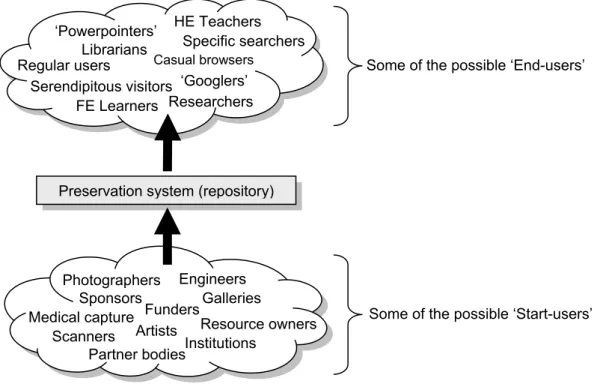
Perhaps, for ease of reference, the behind-the-scenes participants should be referred to as ‘Start-users’: the individuals or organisations who contribute to the development, deployment or expansion of the resource to be preserved, or to the preservation system itself. Figure 1 suggests some examples of the differing end and start users that may have to considered in the development and/or implementation of an image preservation process, though it is important to recognise that there will always be overlap between the two groups (some users will wear different hats at different times).
Figure 1. Examples of stakeholders on both sides of the digital image preservation process.
4.3 Who are they?
As the figure above demonstrates, users of digital images can be defined as two simple groups. However, the figure also illustrates just how varied the participants in those two groups can be.
There are a number of ways that user groups can be identified to provide a cross section of the UK HE community as relevant to the JISC. They can be considered in respect to both larger scale environments and to smaller, more specific areas of usage. A comprehensive list of content creators that affect the JISC community can be found in State of Art Review, but some of the broad categories are presented here as the basis for subsequent analysis.
The users whose needs must be considered are described here in terms of the HE education sector as well as particular aspects of the collateral environment; for example, users of museums/galleries or staff/students of Further Education institutions. However, usage of images will clearly cover a broad spectrum of
Regular users Specific searchers ‘Powerpointers’ HE Teachers Casual browsers Researchers FE Learners
Some of the possible ‘End-users’ Librarians
‘Googlers’
Preservation system (repository)
Funders Resource owners Sponsors Partner bodies Galleries Photographers Artists Engineers Institutions
Some of the possible ‘Start-users’ Medical capture
Serendipitous visitors
different approaches, and it is necessary to think of a ‘user’ in a number of diverse ways. The following list breaks down the potential users of images in UK education according to several broad and distinct perspectives.
Users of online, education-led services:
• JISC-funded collections (e.g. BioMed, AHDS Visual Arts, Education Images Online);
• International collections (e.g. MOMA - New York, PictureAustralia, the Louvre);
• National institutions (e.g. National Gallery, Victoria & Albert Museum, English Heritage);
• Regional institutions (e.g. Glasgow Museums, Manchester Art Gallery);
• Commercial/subscription-based providers (e.g. Bridgeman Art Library, Wellcome Trust);
• Higher Education institute external providers (e.g. Birkbeck, Courtauld Institute).
Users of internal institution provision: • Intranets
• Institutional repositories
• Virtual Learning Environments (e.g. Blackboard, WebCT) • Shared drives
• Digital slide libraries
Users of images in different areas of education: • Non-vocational; • Lifelong learning; • Further education; • Higher education; • Masters study; • PhD study;
• Post doctoral research. Users with different roles:
• Students; • Researchers; • Support staff; • Practitioner; • Lecturers; • Managers; • Librarians.
Users with different learning needs: • Dyslexia
• Colour blindness • Physical impairment
Users with different subject needs (based on HERO subject oriented directories9): • Creative arts and sport
• Humanities
• Engineering, applied sciences and technology • Languages, linguistics and literature
• Library and information technology • Philosophy and Psychology
• Religion and Theology
• Social Sciences, Law and Government
Three other, more general, ways of breaking down user groups will also need consideration:
• Users of born digital vs. Users of digitised.
Different preservation criteria may be important to users depending on whether the image is a digitised surrogate of an analogue object, or an object originally created in a computer environment;
• Users of different generations.
Diverse age groups may consider different things to be important, in terms of what a preservation process provides. Rather than make assumptions about different age groups, this section will refer only to differences between the needs of ‘digital natives’ – those who have grown up in the digital environment, and ‘digital immigrants’ – those for whom the digital environment has been a relatively recent introduction.10
• Users of different types of images.
As this paper has expressed elsewhere, images themselves come in different formats; for example, bitmap and vector. It is likely that the users of differing image types or formats will have differing views on the inherent preservation needs of each.
Considering the breadth of possible use-case scenarios that the above list could produce is, at the least, daunting and, at best, impractical. Particularly given that for every item on the list there will be an equally complex list of further possible scenarios; for example, a category comprising creative arts and sport clearly represents an extremely wide range of different people with a correspondingly wide range of circumstances for using digital images. Furthermore, it is true to say that user needs could be defined in a wider way; for example, the particular needs that an institution or a VLE might have. Nonetheless, for pragmatic reasons this paper will identify needs according to the people who actually define those needs.
In order to deal with the potential complexity of trying to establish all user needs in the JISC environment relating to the preservation of digital images, four approaches have been taken:
1. Targeted survey with representatives from a cross-section sample of the above groups with an emphasis on talking to users with some level of understanding of digital image preservation needs for their particular area;
9 http://www.hero.ac.uk/uk/reference_and_subject_resources/subject_oriented_directories3810.cfm
10 Marc Prensky, ‘Digital Natives, Digital Immigrants’, in On the Horizon ( Vol. 9 No. 5, October 2001)
2. A non-prescriptive broad survey was made available through AHDS websites and via email lists, to elicit unprompted preservation needs and specialist requirements.;
3. Creation of profiles of archetypal users covering a range of different perspectives and levels of understanding regarding digital image preservation;
4. Desk-top research examining previous work on digital image preservation user needs (references are given throughout this paper).
4.4 Targeted survey
To gain a detailed view of a cross-section of the JISC community’s perspectives on digital image preservation, a questionnaire was created to enable a number of targeted surveys to take place. The research deliberately targeted people who should, by way of their position, have some understanding of the use of digital images and, hopefully, some understanding of the needs and possible