Financial Structure, Informality and Development
∗
Pablo N D’Erasmo
†University of Maryland
Hernan J Moscoso Boedo
‡University of Virginia
November 9, 2009
Abstract
This is a theory of total factor productivity based on measured capital market im-perfections and costs of creating and operating formal sector firms. We develop a firm dynamics model with endogenous formal and informal sectors where firms face a technol-ogy adoption opportunity. The model predicts that countries with a low degree of debt enforcement and high costs of formality are characterized by low allocative efficiency and a large share output produced by low productivity firms in the informal sector. We find that this mechanism is quantitatively important. When frictions are parameterized using the World Bank Doing Business database, the model explains up to 60% of total factor productivity differences between the US and developing economies.
Keywords: Financial Structure, Informal Sector, Productivity, Policy Distortions.
JEL Classifications: D24, E26, L11, O16, O17
∗We thank Cristina Arellano, Russell Cooper, V.V. Chari, Dean Corbae, John Haltiwanger, Bob Lucas, Ellen McGrattan, Toshihiko Mukoyama, Fabrizio Perri, Diego Restuccia, Nancy Stokey, Vincenzo Quadrini, Erwan Quintin, Pierre-Daniel Sarte, Eric Young and the seminar participants of the 2009 Midwest Macroeconomics Meetings, the 2009 North American Econometric Society Meetings and Federal Reserve Banks of Dallas, Min-neapolis and Richmond for their very helpful comments. We also thank Laura Alfaro for sharing her data and Javier Miranda for helping with BDS data. All errors are of course ours. We acknowledge the use of the computer cluster of the Economics Department, University of Texas at Austin financed by NSF grant MRI-0521499.
†Correspondence: University of Maryland, Department of Economics, 3105 Tydings Hall, College Park, MD 20742, (301)405 3529, [email protected]
‡Financial support from the Bankard Fund for Political Economy is gratefully acknowledged. Correspondence: University of Virginia, Department of Economics, PO Box 400182, Charlottesville, VA 22904, (434)924 7654, [email protected]
1
Introduction
In this paper, we develop a theory of total factor productivity (TFP) based on measured insti-tutional differences across countries. In particular, we consider institutional heterogeneity in terms of entry costs to the formal sector, differences in the tax structure (not only tax rates but also cost of tax compliance), and also in the efficiency of debt enforcing mechanisms (measured
as debt recovery rate and debt enforcing costs). The question we are after is: how much of
the international differences in total factor productivity can be explained by measured costs of doing business?
We build a model of firm dynamics with endogenous entry and exit that incorporates capital financing and bankruptcy decisions. The model allows for the existence of a formal and an informal sector. Entering and operating in the formal sector is costly, but allows firms to produce at a larger scale, while providing the firms with access to credit markets with better commitment (given by observed recovery rates and associated costs). The degree of debt enforcement varies across countries and affects the interest rate that firms face. Countries have access to the same production possibilities but we impose country-specific institutions, which we base on those
measured by the World Bank as reported in its Doing Business database. We find that, by
increasing capital misallocation, the frictions explain up to 60% of total factor productivity differences between the US and developing economies.
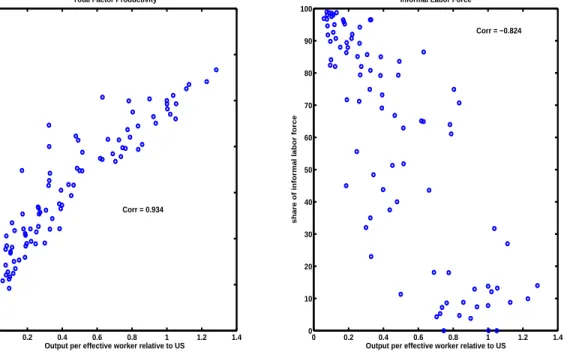
As Figure 1 shows, informal activity is a feature that, around the world, seems to be
cor-related to productivity and output per worker. Agents involved in the informal sector make explicit efforts not to be detected, which makes measuring the informal sector extremely chal-lenging. Of the various measures of informal activity, we focus on the fraction of the labor force that participates in the underground economy.1
1Measured as the fraction of the labor force not covered by a pension scheme. We focus on the the share of
labor force not covered by pension schemes because it provides a better direct measure of informality for the US, the country we use for our benchmark calibration. Schneider and Enste (2000) report various measures of the informal sector across countries (highly correlated with our measure), and is the most comprehensive study to our knowledge regarding informality in a cross country setting. They include indirect estimates of informal output from energy consumption or money demand or from discrepancies between official and actual employment from household surveys.
The fraction of the labor force that is engaged in production outside of the formal sector ranges from around 10% in developed countries to almost 100% at the low end of the income distribution. Even when measures of informal activity are extremely noisy, such a large sector of the economy cannot be ignored if we want to better understand economic development around the world. Pratap and Quintin (2008) describe the empirical literature on informal economic activity and document that the size of the informal sector is strongly correlated with the level of economic development, tax burden and rule of law. They also argue that the informal sector is mainly composed by small-scale, self-financed, unskilled intensive activities. Regarding market segmentation, the evidence points towards segmentation in the financial markets and not in the labour markets. 0 0.2 0.4 0.6 0.8 1 1.2 1.4 0 10 20 30 40 50 60 70 80 90 100
Output per effective worker relative to US
share of informal labor force
Informal Labor Force
0 0.2 0.4 0.6 0.8 1 1.2 1.4 0 0.2 0.4 0.6 0.8 1 1.2 1.4
Output per effective worker relative to US
TFP rel to US
Total Factor Productivity
Corr = 0.934
Corr = −0.824
Figure 1: Total Factor Productivity and Size of the informal sector.
Note: Output per effective worker refers to output per unit of human capital as reported by Hall and Jones (1999). Total Factor productivity refers to the value reported by Hall and Jones (1999) raised to the power (1−α). The share of informal labor force
corresponds to the share of the labor force not covered by a pension scheme as reported by theWorld Development Indicators2006
It should not be surprising to observe a large number of firms producing in the underground economy in countries where the costs of entering and operating in the formal sector are extremely
high and the benefits (the ability to enforce contracts) are almost negligible. Under these conditions, firms endogenously choose to operate in the informal sector and are subject to restrictions as well. They do not pay taxes, but have limited access to credit markets. When the firm cannot borrow, the size and growth of the firm are limited. That is, production ends up taking place at an inefficient scale and therefore output and productivity are below the optimal levels. If the mechanism we describe is present across countries, the level of informal activity is a response to the institutional frictions. Conditional on the level of development, countries
with larger informal sectors should have lower level of total factor productivity.2 The idea
that informal activity can be understood as an optimal response to the economic environment originated in Rauch (1991) and Loayza (1996).
In this paper we trace our steps back to the ideas in De Soto (2000), where the process by which a firm enters the formal sector in Peru is described. De Soto (2000) argues that costly entry mechanisms in the formal sector prevent firms from producing at an efficient level. He measures the entry cost in time and resources and concludes that one of the reasons production is undertaken in the informal sector has to be the high costs associated with becoming formal. On the other hand, he argues that the benefit of formality lies in the ability to use physical capital’s “parallel life”as collateral with which to secure the interests of third parties in the event of breaches of contract.
Building on this idea, the World Bank launched the Doing Business project. Under this
project, the costs associated with many dimensions of doing business are recorded across coun-tries. They measure, among other things, costs to register a firm, to obtain construction permits, to hire workers, to pay taxes, and to close the business. The interesting feature of this project is that instead of collecting observed data for each aspect of doing business in a country (which depends on endogenous aspects such as the size of a firm), they run an experiment in which they try to operate the same standardized firm across countries. This way the different costs across countries can be directly compared.
2Regressing relative total factor productivity on a constant, GDP per capita relative to US and informal labor
force as a fraction of total labor force delivers exactly that. The parameter of informal labor force is equal to -0.24, with a standard deviation of 0.13.
Our approach to firm dynamics originated with Hopenhayn (1992) and Hopenhayn and Rogerson (1993), and is close to Cooley and Quadrini (2001) who studied the effects of financial constraints in a similar set up. Recent related literature on the distributional consequences of frictions in this context include Hsieh and Klenow (2007), Restuccia and Rogerson (2008) and Arellano, Bai, and Zhang (2008). In all cases, they back up the implied frictions in the firm’s environment necessary to generate the observed distribution of firms. In this paper, as in Barseghyan and DiCecio (2009) and Moscoso Boedo and Mukoyama (2008), the frictions that the firms face are those observed in the data collected by the World Bank. This paper introduces imperfect capital markets, and along that dimension the most closely related papers include Antunes and Cavalcanti (2007), Castro, Clementi, and MacDonald (2008), Erosa and Hidalgo Cabrillana (2008), and Quintin (2008). Castro et al. (2008) and Erosa and Hidalgo Cabrillana (2008) study the effects of financial contracts in environments with asymmetric information. Antunes and Cavalcanti (2007) and Quintin (2008) study endogenous informal sectors that result from imperfect contract enforcement. This paper builds on this literature by analyzing a model of firm dynamics with idiosyncratic uncertainty and endogenous technology adoption. We also consider different financial contracts where default costs are constrained by limited liability. The relevant empirical literature regarding firm dynamics across countries include Tybout (2000), Foster, Haltiwanger, and Krizan (2001), and Alfaro, Charlton, and Kanczuk (2007). Tybout (2000) is the only one that reports data on firm characteristics in the informal sector, while the other two use different data sources but are focused on firms operating in the formal sector.
The paper is organized as follows. In Section 2, we present the institutional differences across countries as measured by the World Bank. We consider differences in the costs of entry to the formal sector, tax codes, and efficiency of the contract enforcement mechanisms. In Section 3 we present the theoretical model, based on Hopenhayn and Rogerson (1993), with physical capital and credit markets. Section 4 describes the stationary equilibrium of the model. Section 5 is devoted to the calibration of the model to the US data. In Section 6, we experiment with different measured institutions and compute their impact in terms of total factor productivity
0 0.2 0.4 0.6 0.8 1 1.2 1.4 0.2 0.4 % of profits 1.− Profit Tax τ 0 0.2 0.4 0.6 0.8 1 1.2 1.4 20 40 annual wages 2.− Cost of Entry κ 0 0.2 0.4 0.6 0.8 1 1.2 1.4 0.2 0.4 % of payroll 3.− Payroll Tax τ w 0 0.2 0.4 0.6 0.8 1 1.2 1.4 .5 1 % of debt 4.− Recovery Rate λ 0 0.2 0.4 0.6 0.8 1 1.2 1.4 1 0.5
GNI per capita relative to US
annual wages
5.− Cost of Tax Compliance Cτ
0 0.2 0.4 0.6 0.8 1 1.2 1.4 0.25
0.5
GNI per capita relative to US
% of estate
6.− Cost of Default Proceedings φ
Corr=−0.01 Corr=−0.25 Corr=−0.25 Corr=0.78 Corr=−0.13 Corr=−0.19
Figure 2: Cost to entry, income tax rate, cost of tax compliance, recovery rate, and cost of default proceedings from the Doing Business Database. Outliers omitted.
and firm dynamics. Finally, Section 7 concludes.
2
Institutional Differences across Countries
What firms have to do in order to enter, operate in, and exit from the formal sector varies across countries. In order to compare these different costs the World Bank, through itsDoing Business
project, follows a standardized firm across countries and measures regulations to entry, opera-tions, and exit. They measure the costs in terms of time and resources along many dimensions affecting the firm, such as starting a business, getting construction permits, employing workers, obtaining credit, protecting investors, paying taxes, trading across borders, enforcing contracts, and closing a business. Of particular interest to us in this paper are the cost of entering the formal sector, the tax rate and the level of tax compliance difficulty (while operating in the formal sector), and the efficiency of the debt enforcing mechanisms if the firm decides to default on its debt. These costs are depicted in Figure 2 against GNI per capita relative to the US.
Entry Cost: The cost of entering the formal sector is constructed as in Moscoso Boedo and Mukoyama (2008). It is the sum of two parts. It includes the costs of registering a business
and of dealing with licences to operate a physical locale.3 Both costs have a monetary cost
and a time cost (which is translated to monetary units by assuming that one worker has to be employed full time in order for the firm to go through the entry process). The cost of entering the formal sector as a fraction of the wage (denoted bywκ) varies greatly across countries, with high levels of κ observed only at the low end of the income distribution. Registering a business in the US costs 0.7% of GNI per capita, while in Sierra Leone it is over 1000% of GNI per capita. In terms of time, in the US a business can be started immediately while in Yemen and Syria it takes more than five years to start a formal business. Dealing with licenses also displays great variation across countries. The cost is 13% of GNI per capita in the US and 600 times per capita income in Liberia and 100 times in Zimbabwe. In terms of time, it takes 40 days to obtain a license in the US and up to 1000 days in Haiti.
Tax Structure: The tax rate paid on profits by the firms (τ) and payroll taxes (τw) do not seem to exhibit a pattern over the distribution of income per capita, as shown by panels 1 and 3 in Figure2. What does exhibit a similar pattern to the entry cost is the cost of tax compliance
(wcτ). This cost reflects the time that it takes to pay taxes in each country. We assume
that there is a full time worker during this time devoted to the tasks related to tax compliance, and therefore translate time into costs as the worker’s annual wages. The cost of paying taxes only displays levels above 10 weeks for countries below 20% of the US GNI per capita. Paying taxes takes no time in the Maldives, 12 hours in the UAE, 187 hours in the US, and more than 1000 hours in Vietnam, Bolivia, Belarus, Cameroon, and Brazil. This indicates a great deal of variation across countries in terms of the complexity of their tax code. Firms have to bear not only the tax rate per se but also the cost of complying with the tax code, which at the low end of the income distribution is not insignificant.
3The data used to generate the cost of dealing with licenses to operate a physical local is obtained from the
World Bank Doing Business database as “Dealing with Construction Permits”. Part of the elements involved in construction permits, such as the cost of connection to basic services, are present when operating a physical locale
Bankruptcy efficiency: The efficiency of the system in the event of default has two
com-ponents, a cost component and a recovery rate. The cost of the system (φ), reported as a
percentage of the estate’s value, includes court fees and the cost of insolvency practitioners, such as legal and accounting fees. It ranges from 1% of the estate’s value in countries like Norway and Singapore to more than 40% in Sierra Leone, Liberia, and the Ukraine, and above 70% in the Central African Republic. The recovery rate refers to what external lenders obtain once the firm decides to default on its debt (λ). It is effectively zero for many extremely poor
countries in sub-Saharan Africa. On the other hand, only in developed countries it is above
75%. Note that this is the return obtained by the external creditor conditional on the borrower defaulting. It measures the cents on the dollar recovered from that point on, and includes differ-ent channels to resolve the contract breach such as foreclosure, liquidation, and reorganization, as reported by Djankov et al (2008).
3
Environment
We build a standard firm dynamics model based on Hopenhayn (1992) and incorporate capital and credit markets as in Cooley and Quadrini (2001). Time is discrete, and we set one period to be one year. There are three kinds of entities in the economy: firms, lenders and consumers. Firms produce the consumption and capital goods used in the economy. They are the capital owners and pay dividends to the consumers. Lenders make loans to the firms. Consumers supply labor to the firms, and receive their profit net of entry costs. We focus on the stationary equilibrium.
3.1
Consumers
There is an infinitely lived representative consumer who maximizes the expected utility:
U=E " ∞ X t=0 βtu(Ct) # ,
where E[·] is the expectation operator,Ct is consumption and β ∈(0,1) is the discount factor. The household is endowed with one unit of labor which it provides to the firm at the market wage rate w, and receives the profits of the operating firms and a lump sum transfer from taxes collected on these firms. The consumer is also responsible for the creation cost of new firms. All of the saving and borrowing decisions are made by firms, so effectively the household is not allowed to borrow or save.
3.2
Technology
The unit of production is a single establishment firm, also understood as a unique investment project. Each project is described by a production functionf(z, k, n) that combines productivity z capitalk and laborn. We assume that the production function has decreasing returns to scale. In particular, we let f(z, n, k) =zkαnγ with 0< α+γ <1 and α, γ ∈(0,1).
There are two processes for z: one that allows for large scale operations (l), and one that restricts production to asmall scale (s). The productivity process open for large scale operations is given by
ln(zt+1) = (1−ρ) ln(µl) +ρln(zt) +ǫt+1
with ǫt+1 ∼ N(0,(1−ρ2)σl2), where σl2 is the variance, µl is the mean and ρ the
autocorrela-tion parameter of the process. We denote the condiautocorrela-tional cumulative distribuautocorrela-tion of zt+1 by
ηl(zt+1, zt). The productivity process for small scale operations is assumed to be a constant
given by µs ≤µl.
We assume that projects whose productivity is drawn from the large scale process can only be operated in the formal sector, whereas those from the small one can be operated in both the formal and informal sector. This assumption captures the fact that the government is capable of detecting only large scale production operations.
Having two productivity processes is one of the channels that allows the model to generate capital missallocation together with small informal establishments as observed in the data by
Bartelsman et. al. (2008) and Perry et. al. (2007).4
Firms maximize expected discounted dividends d:
E " ∞ X t=0 βtdt # ,
at the rate of the representative consumer’s β.5
Firms are created by the consumer paying a cost ce. Once launched, firms face a
technol-ogy adoption decision. They draw one investment opportunity from the initial productivity distribution of the l process νl(z0). Draws from this distribution are assumed to be i.i.d across
firms. Firms then compare z0,l to µs and choose between staying out of the market or operat-ing one of the projects as a formal or informal firm,, i.e the project choice is non-reversible.6
Unimplemented projects go back to the pool.
There is a random fixed cost of productioncf, measured in units of output, that is iid across firms and over time with distribution ξ(cf). A firm that does not pay this fixed cost is not allowed to produce. Firms own their capital and can borrow from financial intermediaries in the
form of non-contingent debt b ≥0. They finance investment with either debt or internal funds.
If the firm operates in the formal sector, it is subject to a proportional tax on profits τ, a cost in labor units of filling those taxes cτw, and a payroll tax τw. Creating a formal sector firm requires an entry cost κw. In the calibration, taxes and the costs are set directly from the
corresponding measures in the Doing Business database.7
4Having only one productivity process that can be operated in both sectors generated some frictions for young
firms, but eventually the economy allocates more resources to the more productive firms and the impact in terms of total factor productivity is negligible.
5In a stationary equilibrium, firm’s optimization is consistent with household’s optimization when the discount
factors coincide.
6This is consistent with the evidence presented in Atkeson and Kehoe (2007) who argue that manufacturing
plants needed to be completely redesigned in order to make good use of the new technologies.
7While government policies can be endogenous, in this paper we focus on measuring their effects on aggregates
and policies are taken as exogenous. However, the equilibrium we find is consistent with the solution to a model that incorporates a one time political game with full commitment and the government optimally chooses the taxes and costs reported by the World Bank.
3.3
Credit Markets
The credit industry makes loans to the formal and informal sector firms. Creditors are risk-neutral and competitive. Each country behaves as a small open economy where intermediaries
can borrow or lend at the exogenous risk-free rate r. Asset markets are incomplete. In each
period, firms borrow using only one period non-contingent debt denoted by b. Since there
is perfect information, prices depend on firm’s characteristics given by their choice of sector (formal or informal), their future level of capital (k′
), their level of borrowing (b′
), and their current technology (zj where j =l, s). In particular, firms in the formal sector borrow at price qjf(k′
, b′
, z) and firms in the informal sector borrow at price qi(k′
, b′
). In each period, firms can default on their debt. A default triggers a bankruptcy procedure that liquidates the firm. When making a loan to a formal sector firm, lenders take into account that in the case of default they
can recover up to a fraction λ of the original loan. The formal bankruptcy procedure has an
associated cost equal to a fraction φ of the firm capital. The values of the recovery rate λ and
the bankruptcy cost φ are obtained from the Doing Business database. Because the capital of
the informal firm is not legally registered, the recovery rate of a loan to an informal sector firm that defaults is assumed to be zero. This assumption follows the evidence presented in Pratap and Quintin (2008) where it is suggested that there is segmentation in the financial markets across formal and informal sectors.
Consistent with bankruptcy law across countries, we follow the limited liability doctrine. This limits the owner’s liability to the firm’s capital.
4
Equilibrium
We focus on the stationary equilibrium of the model. In this equilibrium the wage rate and the schedule of loan prices are constant. Every equilibrium function depends on the set of loan prices and the wage rate. For ease of exposition we avoid making this dependence explicit. Before defining the equilibrium concept we study the problem of the agents in the economy. First, we describe the problem of incumbent firms in the formal sector and informal sector, respectively.
Then, we describe the entrants’ problem, the lender’s problem, and the representative consumer’s problem.
4.1
Formal Sector Incumbent
An incumbent firm in the formal sector with operating a project j ∈ {l, s} (large scale and
small scale respectively), starts the period with capital k, debt b, and previous productivityz−1. Then, the firm draws the fixed cost that is required for continuing the operation, cf, and decides to operate the project, exit after repayment of debts, or default and liquidate the firm. If the firm decides to exit after repayment, it receives k−b. If it decides to default and liquidate the firm, it receives the maximum of the remainder of the capital after paying the recovery rate (net of the costs associated with default proceedings) to the outside investors and zero. The value function of an firm at this stage is denoted as Wjf(z−1, k, b, cf). If it decides to remain in business, it pays cf and observes the current period’s productivity z. The value function of a firm operating in the formal sector is denoted asVjf(z, k, b, cf). If the firm decides to operate, it decides the amount of employment in the current period, n, capital and assets for the following period, k′
and b′
, and produces. Recall that in the formal sector it is then subject to income taxes τ, the cost of preparing those taxes cτw, and the payroll tax τw.
The incumbent solves the Bellman equation
Wjf(z−1, k, b, cf) = max ( Z Vjf(z, k, b, cf)dηj(z|z−1),max{0,(1−φ)k−λb}, k−b ) and Vjf(z, k, b, cf) = max n,k′,b′d f j(z, k, b, cf) +β Z Wjf(z, k′, b′, c′ f)dξ(cf) s.t. dfj(z, k, b, cf) = (1−τ) [zkαnγ−cf −w(1 +τw) (n+cτ)] −k′ + (1−δ)k+qjf(k′, b′, z)b′−b ≥0
The solution to this problem provides the exit decision rule χfj(z−1, k, b, cf) that takes the value of 0 if the firm continues to operate, 1 if the firm decides to default, and 2 if the firm decides to exit after repayment. We also obtain the optimal capital and debt decision rules k′f
j (z, k, b, cf) and b′f
j (z, k, b, cf), respectively, for a firm in the formal sector.
4.2
Informal Sector Incumbent
An incumbent firm in the informal sector, after observing the fix operating cost cf, can choose
to stay informal, to pay the formal entry cost κw and switch operations to the formal sector,
or to exit the market after a default. More specifically, the informal incumbent firm solves the
following Bellman equation 8
Wi(k, b, cf) = max
(
Vi(k, b, cf),Vesf(µs, k, b, cf), k
)
where the value of remaining in the informal sector is given by
Vi(k, b, cf) = max n,k′,b′d i(k, b, c f) +β Z Wi(k′, b′, c′ f)dξ(cf) s.t. di(k, b, cf) =µskαnγ−cf −wn −k′ + (1−δ)k+qi(k′, b′)b′ −b≥0.
The value of switching to the formal sector is
e Vjf(z, k, b, cf) = max n,k′,b′ e dfj(z, k, b, cf) +β Z Wjf(z, k′, b′, c′ f)dξ(cf)
s.t.
e
dfj(z, k, b, cf) = (1−τ) [zkαnγ−cf −w(1 +τw) (n+cτ +κ)]
−k′ + (1−δ)k+qsf(k′, b′, z)b′ −b≥0
The solution to this problem provides the exit decision rule χi(k, b, c
f) that takes the value of 0 if the firm continues to operate in the informal sector, 1 if the firm decides to default, and 2 if it decides to switch its operations to the formal sector. We also obtain the optimal capital and debt decision rules k′i
(k, b, cf) and b′i(k, b, cf) for a firm operating in the informal sector, and capital and debt decision rules ek′
j(z, k, b, cf) andeb′j(z, k, b, cf) for a firm that switches from the informal to the formal sector.
4.3
Entrants
The value of a potential entrant (net of entry cost) We is given by:
We = Z Z max j=s,x ( Wi(0,0,0),Vexf(z0,l,0,0,0) ) dνs(z0)dνx(z0)−ce.
Effectively, an entrant has no capital, no debt, and the cost of production cf equals zero. The entrant chooses between projects, conditional on the restriction that the large scale project cannot be operated in the informal sector. The sector and project adoption decisions are made after payingceand observing the productivity levelz0,l, which affects the conditional distribution
from which the first productivity parameter will be drawn. Differences in the volatility of the process together with differences in initial productivity are going to generate differences in the decisions by the entrants and by the potential lenders. That introduces differences in behavior as a function of volatility and contract enforceability. In equilibrium, under free entry, We = 0 will hold.
The solution to this problem provides the entry decision rule Ξe(z
4.4
Lenders
Lenders make loans to formal and informal firms while taking prices as given. Profit for a loanb′ to a firm in the formal sector with future capitalk′
, productivity z, and operating the a project j ∈ {s, l} is πfj(k′, b′, z) =−qjf(k′, b′, z)b′ + 1−p f j(k ′ , b′, z) 1 +r b ′ +p f j(k ′ , b′, z) 1 +r min{λb ′ ,(1−φ)k′ }, where pfj(k′ , b′
, z) denotes the default probability of this borrower. Profit for a loan b′
to a firm in the informal sector with future capital k′ is πi(k′, b′) = −qi(k′, b′)b′ + 1−pi(k′ , b′ ) 1 +r b ′ where pi(k′ , b′
) denotes the default probability of the informal borrower. In equilibrium, the schedule of prices will adjust so πfj(k′
, b′ , z) = 0 and πi(k′ , b′ ) = 0 for all (j, k′ , b′ , z).
4.5
Consumer’s Problem
Because we are looking for the stationary equilibrium, aggregates in the economy are constant. This, and the fact that the consumer supplies its unit of labor inelastically, implies that the consumer maximizes expected discounted utility subject to the following budget constraint:
C =w+ Π +T −E+X,
where Π is the total profit, T is the lump-sum transfer from the income and payrroll taxes, E
is the aggregate creation cost, and X is the exit value of firms. Note that the consumer is not making any decision, only receiving transfers, profits, and wages which are consumed period by period.
4.6
Definition of equilibrium
A stationary competitive equilibrium is a set of value functions {Wjf, Wi, Vf
j , Vi,Vej}, decision rules (capital, debt, default, exit and sector), a wage ratew, aggregate distributions of firms in the formal ϑ(k, b, z, j;M) and informal ϑb(k, b, M) sectors, and a mass of entrants M such that: 1. Given prices, the value function of the firms and the decision rules are consistent with
firms’ optimization.
2. The free entry condition is satisfied: We = 0. 3. Lenders make zero profit for every type of loan. 4. Invariant distributions ϑ and ϑbare stationary.
5. Aggregate consumption: C =w+ Π +T −E+X.
6. The labor market clears:
1 = Z n(z, k)dϑ(k, b, z, j;M) + Z n(k)dϑb(k, b;M) .
5
Calibration
In this section we calibrate the model to the US economy. The basis for this calibration can be found in Moscoso Boedo and Mukoyama (2008) and D’Erasmo (2009).
The volatility of the large scale production processσlis set to 0.2305 and the autocorrelation
parameterρto 0.885 as estimated for the U.S. manufacturing sector by Cooper and Haltiwanger
(2006).9 The process will be discretized to obtain the grid forz and the transition probabilities
ηl(z′
|z) following the method explained in Tauchen (1986). The number of grid points for z
9These parameters were estimated from registered manufacturing firms. In the model, the formal sector
could include establishments operating both technologies, sand l. However, for the calibrated parameters, all establishments in the formal sector operate technologyl.
is set to 17. From the transition matrix ηl(z′
|z) we can derive the unconditional probabilities η∗
l(z). We set the distribution of initial shocks νl(z0) =ηl∗(z).
The labor share γ is set to 0.64, a standard value, and the capital share is based on previous estimates of the degree of decreasing returns to scale at the firm level. In particular, we set α= 0.21, soα+γ = 0.85 as in Restuccia and Rogerson (2008). The risk free interest rater is set to 4% per year to match the average real return on a 5 year T-bill over the last 30 years. We assume that β = 1+1r. The depreciation rate δ is set to 7%. The value of the entry cost ce is calibrated as in Hopenhayn and Rogerson (1993). In particular, we normalize the wage rate to 1 and find the value ofce that, in equilibrium, satisfies the free entry condition with equality. We assume that the operating fixed cost can take values of {0,cbf,+∞}.
The parameters {τ, cτ, τw, κ, λ, φ} are taking directly from the values reported in the Doing
Business data base for the U.S. economy (see Table 4 below). We set the tax rates τ = 0.23, cτ = 0.09 and τw = 0.20; the entry cost κ = 0.26; and the bankruptcy parameters to λ = 0.77 and φ = 0.07.
We are left with five more parameters to calibrate: the mean of the productivity process of the large scale and small scale projects µl and µs respectively, the operating cost cbf, and the associated probabilities ξ(cbf) and ξ(∞). To obtain values for these parameters, we target the size of the informal labor force, measured as those workers not covered by a pension scheme (as reported by World Development Indicators 2006), the average size of formal establishments in the U.S. and the exit rates distribution across the size of firms. The data regarding the size distribution of establishments (in the formal sector) and exit rates in the US comes from the
Statistics of US Business (SUBS) data set for the years 2003-2004. It is the same data used in
Moscoso Boedo and Mukoyama (2008).10
Table 1displays the calibrated parameters and a summary of the moments used.
10A description of this data set can be found inhttp://www.census.gov/epcd/susb/introusb.htm. Statistics
of U.S. Businessesbasic data items are extracted from the Business Register, a file of all known single and
multi-establishment employers maintained and updated by the U.S. Census Bureau. The annual Company Organization Survey provides individual establishment data for multiestablishment companies. Data for single-establishment companies are obtained from various Census Bureau programs, such as the Annual Survey of Manufactures and Current Business Surveys, as well as from administrative records of the Internal Revenue Service, the Social Security Administration, and the Bureau of Labor Statistics.
Table 1: Model Parameters
Parameter Value Moment (US economy)
Discount Factor β 0.9615 Avg. yearly return 5-year T-Bill
Depreciation Rate δ 0.07 Manufacturing Sector
Labor Share γ 0.64 Labor Share
Capital Share α 0.21 Degree of Decreasing Returns
Std Dev σl 0.2305 Manufacturing Sector
Autocorrelation ρ 0.885 Manufacturing Sector
Creation Cost ce 0.11 Entry Condition
Mean process µl 1.62 Avg. Operating Establishment
Small Scale productivity µs 0.762 Size Informal Sector
Positive Operating Cost cbf 8.0 Exit Rate Distribution
Distribution Op. Costs {ξ(cbf), ξ(∞)} {.10, .042} Exit Rate Distribution
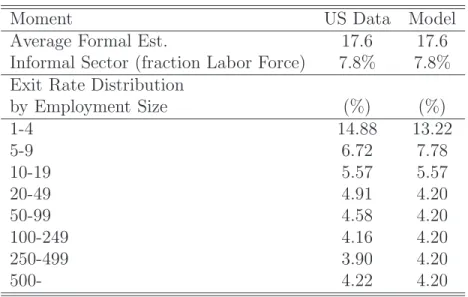
Table 2 shows moment values from the data, used for the calibration, and those produced
by the model.
Table 2: Target Moments
Moment US Data Model
Average Formal Est. 17.6 17.6
Informal Sector (fraction Labor Force) 7.8% 7.8%
Exit Rate Distribution
by Employment Size (%) (%) 1-4 14.88 13.22 5-9 6.72 7.78 10-19 5.57 5.57 20-49 4.91 4.20 50-99 4.58 4.20 100-249 4.16 4.20 250-499 3.90 4.20 500- 4.22 4.20
Note: the size of the informal labor force is measured as those workers not covered by a pension scheme (World Development Indicators 2006). The data regarding the size distribution of establishments (in the formal sector) and exit rates in the US comes from theStatistics of US Business (SUBS) data set for the years 2003-2004 (see Moscoso Boedo and Mukoyama 2008).
After the calibration exercise is done, we test the model in different dimensions. In particular, we ask how the distribution of operating establishments in the formal sector over size and age generated by the model compares with that of the US (obtained from Business Dynamics
Statistics for the year 2004). Table 3 shows the joint distribution of age and size of operating establishments as well as the unconditional distributions of establishment size and age (far right column and bottom row respectively).
Table 3: Distribution of US Formal Establishments by Age and Employment Size
Age Young Middle Old Total Size Dist.
Data Model Data Model Data Model Data Model Employment Size (%) (%) (%) (%) (%) (%) (%) (%) 1-4 13.6 0.04 20.6 9.0 14.4 19.6 48.6 28.9 5-9 2.5 1.3 9.8 10.1 9.5 9.8 21.8 25.1 10-19 1.2 7.2 6.2 10.5 6.8 5.3 14.2 20.1 20 - 49 0.7 5.0 3.9 11.1 5.0 2.9 9.6 18.4 50 - 99 0.2 1.2 1.2 3.9 1.8 0.5 3.2 5.1 100 - 249 0.1 0.3 0.6 1.8 1.0 0.1 1.8 2.1 250 + 0.0 0.02 0.2 0.2 0.5 0.01 0.7 0.2
Total Age Dist. 18.4 14.9 42.6 46.7 39.0 38.3 100 100
Note: Data corresponds to the distribution of establishments by firm size and age for the year 2004 from Business Dynamics Statistics. “Young” corresponds to 0-1 years in operation,“Middle” corresponds to 2-10 years, and “Old” corresponds to 11 years or more.
The model does a good job generating the right distributions of operating establishments in the formal sector for both size and age. Regarding size, it generates the right number of small establishments (with less than 19 employees), but misses at the very low end of the distribution (less than 5 employees). With respect to the age distribution of formal establishments, the model is on target when compared to the fraction of young, middle and old establishments. A deeper look at the joint distribution shows that the model under predicts the fraction of young establishments in the smallest size category. The reason is that the productivity threshold to enter the formal sector endogenously generates young establishments that are relatively more productive and therefore bigger than observed in the data. On the other hand, the model yields a distribution of middle and old establishments across sizes that closely resembles that of the data.
By construction, the average entry rate and exit rate in the model are identical. Their value equals 8%. The entry and exit rates in the data are 11.1% and 10.2% respectively. Thus, compared to the US data, the model average entry and exit rates are three and two percentage
points lower respectively. The distance between the model and data entrant size distribution, entry and exit rates is partly due to the way the data is collected. In the data, establishments are observed at one point in time. Those establishments that are less than one year old, are considered entrants. However, the model counterpart for entrant establishments is defined as those establishments that are exactly one year old.
6
The Effects of Country Specific Institutions
In this paper, we ask whether institutional differences, quantified by differences in the cost of entry to the formal sector, the tax structure, and the efficiency of debt enforcing mechanisms can help explain aggregate productivity differences across countries. Due to the high computational burden of the exercise, we limit the number of observations and group countries by income level following the World Bank’s definition. The World Bank distinguishes between High Income Countries (HIC) and Developing Countries. In turn, Developing Countries are classified as Upper Middle Income Countries (UMIC), Lower Middle Income Countries (LMIC) and Low Income Countries (LIC).11
In order to implement this experiment, we use the Doing Business database for the year 2009 to obtain the median (λ, φ, τ, cτ, τw, κ) for each income group. Table 4 shows parameter values for the US economy (used in the benchmark calibration) and those of High, Upper Middle, Lower Middle and Low Income countries.
We then compare the benchmark case (calibrated to the US) with the equilibrium across income groups. Our experiment can be described as follows. First, calibrate the model to the US economy by using (λ, φ, τ, cτ, τw, κ)U S. In this case, we normalizew= 1 to then iterate on the set of loan pricesqjf(k′
, b′
, z) andqi(k′ , b′
) until lenders make zero profit on each contract and find the
mass of potential entrantsM that clears the labor market. Next, for each income group, we
ad-just the group specific parameters to (λ, φ, τ, cτ, τw, κ)g, whereg ∈ {HIC, UMIC, LMIC, LIC}
11Roughly, countries are classified as HIC if their GNI per capita is higher than 25% of the US, UMIC if their
GNI per capita falls between 8% and 25% of the US, LMIC if their GNI per capita falls between 2% and 8% of the US and LIC if their GNI per capita is below 2% of the US.
Table 4: Frictions across income groups
λ φ τ cτ τw κ
US 0.77 0.07 0.23 0.09 0.20 0.26
High (HIC) 0.72 0.08 0.18 0.07 0.28 1.08
Upper Middle (UMIC) 0.30 0.15 0.17 0.10 0.37 1.33
Lower Middle (LMIC) 0.25 0.15 0.17 0.14 0.31 5.08
Low (LIC) 0.15 0.09 0.20 0.13 0.23 7.03
Note: Countries are classified following the World Bank’s income groups. Countries are HIC if their GNI per capita is higher than 25% of the US, UMIC if their GNI per capita falls between 8% and 25% of the US, LMIC if their GNI per capita falls between 2% and 8% of the US and LIC if their GNI per capita is below 2% of the US. Median values for each group and friction are reported.
and iterate on the wage rate w, and loan prices qjf(k′, b′, z) and qi(k′
, b′) until lenders make
zero profits and the labor market clears (given M obtained for the US). Finally, we adjust the
creation cost for each income group ce until the free entry condition is satisfied. Table 5: Main Results
Developing Countries
HIC UMIC LMIC LIC
Data Model Data Model Data Model Data Model
TFP 0.95 0.90 0.63 0.79 0.54 0.72 0.36 0.72
Informal labor force (%) 8.8 29.8 45 72.0 71.7 92.3 95 93.9
Output per eff. worker 0.94 0.87 0.45 0.71 0.32 0.63 0.12 0.52
Note: TFP and Output per effective worker are reported relative to the US value. Data is from Hall and Jones (1999). One unit of effective worker equals one unit of human capital. Model TFP is calculated asT F P≡ Y
Kαe whereαe= 1/3 is also taken from Hall
and Jones (1999). The size of the informal labor force is taken from theWorld Development Indicators(2006) as the share of the labor force not covered by a pension scheme.
Table 5 displays the main results for each income group and compares the model to the
data for the median country in each group. Values of total factor productivity and output per
effective worker are taken from Hall and Jones (1999).12 The informal labor force is reported
by the 2006 World Development Indicators by the World Bank as the share of the labor force
not covered by a pension scheme.
The most important result of the paper is that the model accounts for up to 60% of TFP differences between the US and Developing Countries. In particular, it accounts for 58%, 60% and 44% of total factor productivity differences between the US and the median Upper Middle,
Lower Middle and Low Income Country respectively.13 We will extensively analyze the sources
of observed productivity differences and the role of each friction in what follows. In short, we find that allocative efficiency and the share of output produced by small scale firms in the informal sector play a crucial role.
In terms of informal activity, the model generates sizable informal sectors that are negatively correlated with GDP per worker, as observed in the data. The model delivers an informal labor force that is on target across income levels, ranging from around 10% in the US to almost 94% at the low end of the income distribution. However, the model overshoots the data in the middle of the income distribution.14
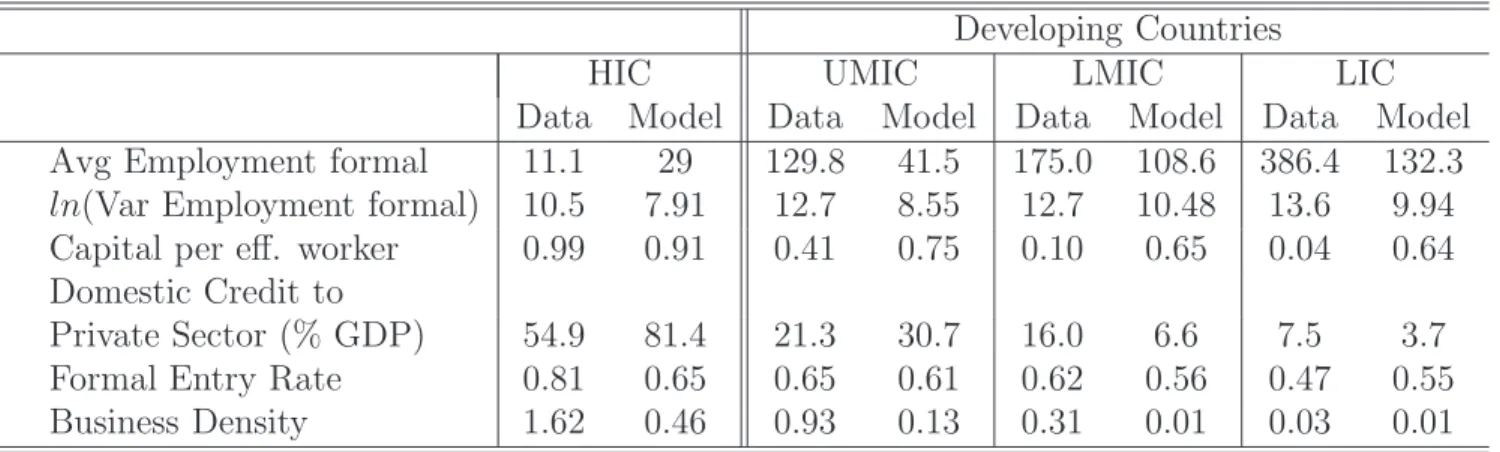
The model output per effective worker values are up to five times higher than what is seen in the data, in the case of the Low Income Countries. This discrepancy comes from differences of the same order of magnitude in terms of capital per effective worker that result from the fact that lenders in each country have access to the same risk free rate (see Table 6 below).
Table 6: Differences across Income Groups
Developing Countries
HIC UMIC LMIC LIC
Data Model Data Model Data Model Data Model
Avg Employment formal 11.1 29 129.8 41.5 175.0 108.6 386.4 132.3
ln(Var Employment formal) 10.5 7.91 12.7 8.55 12.7 10.48 13.6 9.94
Capital per eff. worker 0.99 0.91 0.41 0.75 0.10 0.65 0.04 0.64
Domestic Credit to
Private Sector (% GDP) 54.9 81.4 21.3 30.7 16.0 6.6 7.5 3.7
Formal Entry Rate 0.81 0.65 0.65 0.61 0.62 0.56 0.47 0.55
Business Density 1.62 0.46 0.93 0.13 0.31 0.01 0.03 0.01
Note: Capital per effective worker, Formal Entry Rate, Business Density and Domestic Credit to Private Sector are reported relative to the US value. Data on average employment and variance of employment is taken from Alfaro et. al. (2007). Capital per effective worker is from Hall and Jones (1999). One unit of effective worker equals one unit of human capital. Data on the Formal Entry Rate and Business Density are taken from the 2008 World Bank GroupEntrepreneurship Survey and Database. The model counterpart is obtained as total formal labor force over the average size of formal establishments which equals the measure of formal establishment to total population. Domestic Credit to GDP is also taken from theWorld Development Indicators(average 2004-2007). Domestic credit to private sector in the model is computed as the ratio of formal debt to total output.
13These values are obtained by taking the ratio of the model difference in relative TFP to the data difference
in relative TFP. For example, for UMIC: 0.58 =(1−0.79)
(1−0.63).
14The model can generate the right size of the informal sector by including tax enforcement. We experimented
In Table 6, we present other important moments across income groups that are relevant for two reasons. First, frictions affecting the endogenous distribution of firms over capital and debt will impact moments such as capital per worker, credit to GDP, and mean and variance of employment. Second, since data is available across countries for these variables, they provide a natural test of the performance of our model.
With regards to the distribution of establishments in the formal sector, the model is on target both on average size and variance of size (measured by employees) as reported by Alfaro et. al. (2007). Lower wages and higher productivity thresholds to enter the formal sector generate larger and more dispersed firms in countries with large frictions.
Similar to what we observe in the data, the model generates a sharp decrease in the stock of domestic credit to private sector as a percentage of GDP. In the data for developing economies, domestic credit to private sector ranges from 21% (UMIC) to 7.5% (LIC) relative to the US, whereas the model counterpart goes from 31% to 4%. The model moment includes only the stock of formal credit because the data contains loans from formal entities, and to our knowledge there is no accurate measure of the stock of informal credit across countries. It is important to note that data on private domestic credit includes not only business loans but also personal loans, so these values should be taken as an approximation of the observed relationship between firms credit and country income.
Differences in measured TFP are the result of capital being inefficiently distributed in the economy. One of the main channels affecting capital reallocation is the process of entry into and exit out of the formal sector. We observe that as frictions increase, the exit rate (and the entry rate, by construction) decreases. For example, the exit rate in the US is about 180% of that of LMIC as observed in the data. This implies that even though the entry threshold to the formal sector is higher for Low Income Countries and only the most productive firms in those countries operate the large scale technology, firms stay in business for much longer, preventing the natural process of churning of unproductive firms. Also, the model generates a relative business density that is in line with the observed one (measured as the number of registered businesses as a percentage of the active population). The business density drops to 1% of the
US’s for the Low Income Countries. High frictions generate low density, which generates low competitive pressures in the labor markets, generating low turnover in the formal sector (as observed by the low entry rate in developing economies), and lower average productivity.
6.1
TFP differences and Misallocation
In this section, we provide different measures of misallocation and study how they vary across income groups. We start by showing a simple (but informative) picture with the output weighted productivity across countries. Then, we explore two measures that address the level of resource misallocation. First, we analyze a decomposition of productivity originally proposed by Olley and Pakes (1996). Second, we investigate the dispersion of marginal product of capital, a measure recently proposed in an influential paper by Hsieh and Klenow (2007). We find that allocative efficiency and the share of output produced by small scale firms in the informal sector play a crucial role in explaining TFP differences.
0.5 1 1.5 2 2.5 3 3.5 4 4.5 5 5.5 0 20 40 60 80 100 120 Firm Productivity (z)
Cumulative Distribution Output (%)
US HIC UMIC LMIC LIC
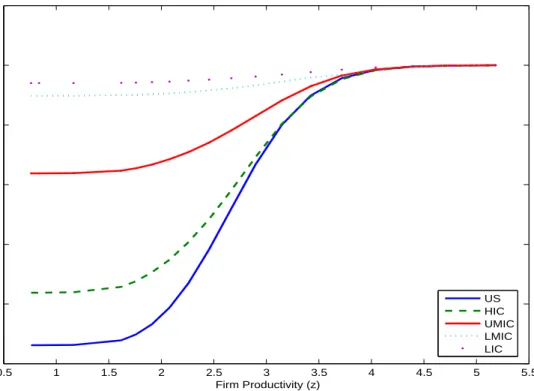
Figure 3: Distribution of Output over Productivity across Income Groups
in the entry cost κ raises the entry threshold to the formal sector15, generating a reallocation
towards more productive firms in that sector. However, as this cost rises the share of production in the informal sector (less productive firms) also increases. We observe that the latter effect dominates, that is when distortions are higher the share of output produced by low productivity firms increases. For example, firms with productivity less than or equal to 1.5 (z ≤1.5) account for about 10% of output in the US, 25% in HIC, 55% in UMIC and around 90% in LMIC and LIC.
It is crucial to provide a measure that captures how efficiently resources are allocated in the economy. To address this issue we use a decomposition of weighted average plant-level productivity originally proposed by Olley and Pakes (1996) (used also by Bartelsman et al (2008) for example):
b z =
Z
ziωidi= Ωµs+ (1−Ω)[z+cov(zi, ωi)]
where zbis the average of plant level productivity weighted by output share, Ω is the informal
share of output, ωi are the output shares of each establishment in the formal sector, and z
is the un-weighted mean productivity in the formal sector. Therefore, the output weighted productivity can be decomposed in three terms. First is the effect of informal activity given by Ω, and then the formal weighted productivity which can be decomposed into the un-weighted average of firm-level productivity plus a covariance between output share and productivity . The covariance captures allocative efficiency within the formal sector because it reflects the extent to which firms with higher than average productivity have a greater market share. Table7displays the values of this decomposition across income groups.
We observe that the value of output-weighted productivity correlates with our value of
measured TFP. As distortions increase, the value of zb decreases. This effect is generated by
massive shifts to the informal economy, which goes from 7% in the US to 94% in the median Low Income Country. However, the output-weighted productivity of the formal sector increases in the poorer countries (the sum of z and cov(zi, ωi)). This is the direct result of higher productivity
15The productivity entry threshold to the formal sector goes from 2.88 standard deviations from the mean of
entry thresholds to the formal sector together with lower wages in the poorer countries. The threshold productivity level to enter the formal sector increases by almost 40% when we compare the US to the LMIC or LIC and the wage rate decreases by 28 %. This endogenous difference in the distribution of productivity in the formal sector across countries makes comparisons difficult. At first glance it would look as if the formal sectors in the poorer countries are more efficient in assigning resources since the covariance between productivity and output share increases. However, as we show in the next paragraph, formal sectors become less efficient in assigning resources across productivity levels as frictions increase.
Table 7: Firm Productivity Decomposition
Group bz Ω z cov(zi, ωi) US 2.69 0.07 2.22 0.60 HIC 2.37 0.25 2.14 0.73 UMIC 1.56 0.65 2.17 0.81 LMIC 1.03 0.90 2.23 1.15 LIC 0.91 0.94 2.21 1.10
Understanding how capital is allocated across establishments in the formal sector is central to the analysis, because all measured institutional differences across countries relate to firms in this sector. In their influential paper, Hsieh and Klenow (2007) measure the dispersion of marginal product of capital for registered manufacturing establishments in the US, China and India. They observe that the standard deviation of log of marginal product of capital is greater in India and China that in the US and conclude that TFP would increase between 30% and 60% if the dispersion was to adjust to US levels.16 This paper generates comparable dispersion
in the marginal product of capital to that documented by Hsieh and Klenow (2007).
Table 8 shows that the variance of the marginal product of capital in the LMIC and LIC is
23% and 29% higher than in the US. In the case of China and India (countries that are close to our LMIC and LIC respectively), Hsieh and Klenow find that the dispersion of marginal
16Note that more dispersion in the marginal product of capital reflects a lower degree of allocative efficiency
product of capital is 13% and 46% higher than in the US. In our case it is the country specific institutions that generate endogenously this dispersion and point towards inefficiencies in the allocation of capital and labor even within formal sector.17
Table 8: Dispersion of Marginal Product of Capital - Formal sector
US HIC UMIC LMIC LIC
var(ln(MP K)) 0.24 0.25 0.28 0.30 0.31
Still in the formal sector, the allocation of capital and labor across establishments with heterogeneous productivity can be analyzed against a frictionless benchmark economy with commitment. In a frictionless world with commitment, the Modigliani-Miller theorem applies and optimal allocations can be derived from a static problem. Conditional on surviving, firms solve:
max k,n
(1−τ)(zkαnγ−w(1 +τw)n)−(r+δ)k
The solution to this problem implies that the capital-labor ratio for each country is constant across firms and depends only on factor prices, i.e independent of productivity. More specifically,
^
(k/n) = α γ
w(1−τ)(1 +τw)
(r+δ) .
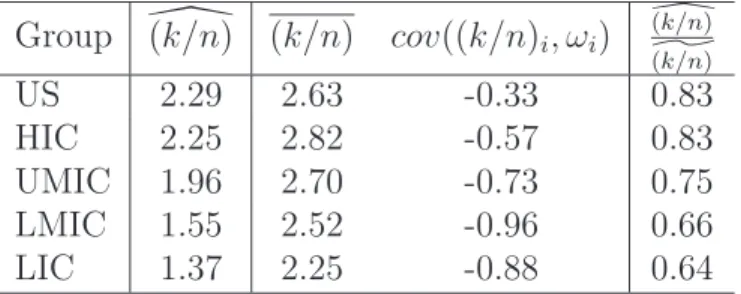
Using a notion of efficiency that is similar to the one we use to study productivity, we define a measure of the capital to worker ratio in the formal sector as follows:
\
(k/n) = (k/n) +cov((k/n)i, ωi)
This measure captures differences in prices, and as before can be decomposed in a “mean” effect and “variation” effect. An efficient allocation will imply a covariance equal to zero. Table
17To keep the consistency with other tables in the paper, we reported the dispersion of marginal product of
capital across income groups. However, we also conducted the exercise for the China and India specific measured frictions and find values that are similar to those reported by Hsieh and Klenow (2007). More specifically, we find that var(ln(M P K)) for China equals 0.257 (7.4% higher than U.S.) andvar(ln(M P K)) for India equals 0.3267 (36.13% higher than U.S.).
9 displays the values of \(k/n) and its decomposition for each income group. Table 9: Capital Per Worker Decomposition in the Formal Sector
Group (\k/n) (k/n) cov((k/n)i, ωi) (\^k/n) (k/n) US 2.29 2.63 -0.33 0.83 HIC 2.25 2.82 -0.57 0.83 UMIC 1.96 2.70 -0.73 0.75 LMIC 1.55 2.52 -0.96 0.66 LIC 1.37 2.25 -0.88 0.64
We observe that the output-weighted capital to labor ratio decreases in the formal sector as we move from the US to less developed economies. Part of this decrease is related to the decreases in after-tax wages across countries that affect the efficient ratio, ^(k/n), as well as the
model average, (k/n). But as the last column of Table 9 shows, the departure from optimal
levels increases as we move towards lower income countries. This suggests the existence of higher effective average interest rates in the poorer countries completely generated by financial frictions heterogeneity. We also note that most of this decrease in \(k/n) comes from the covariance. Low income countries display a larger covariance term (in absolute value), implying that large firms substitute away from capital and towards labor more than small firms. This is the result of differences in the endogenous firm specific schedule of loan prices.
Restuccia and Rogerson (2008) emphasized that heterogeneity in prices faced by establish-ments can lead to sizeable decreases in TFP and output per worker. Our model generates these differences endogenously.
As the wage rate decreases and credit terms adjust to incorporate changes in default prob-abilities. These differences are reflected in the debt to capital ratios, average employment, and total capital stock by sector. Figure 4displays loan prices qlf(k, b′
, z) for the US and LMIC. On
the x-axis we have future debt b′
, on the y-axis we have future capital k′
and a darker color implies a lower price (higher interest rate). We note that firms in the formal sector in the US face lower interest rates (higher q) for most combinations of future capital and debt. This implies
tighter borrowing limits for firms in less developed countries. 0 100 200 300 400 500 0 200 400 600 future debt (b′)
US Equilibrium Price qf for Productivity z=2.8983
future capital (k ′ ) 0 100 200 300 400 500 0 200 400 600 future debt (b′)
LMIC Equilibrium Price qf for Productivity z=2.8983
future capital (k ′ ) 0.2 0.4 0.6 0.8 0.2 0.4 0.6 0.8
Figure 4: Differences In Financial Structure (US vs LMIC)
Changes in prices directly impact the optimal combination of debt and capital (especially in the formal sector). Figure 5shows the distribution of firms over the debt to capital ratio (b/k) for each income group in the formal sector. As we move from the US to countries with lower income, we observe that this distribution shifts towards small values. Two effects are present here. First, as firms face higher interest rates, they are able to borrow much less. For example,
we observe that in LMIC, compared to the US, the number of firms atb/k = 0 increases by 46%
(57% vs 39% respectively). Second, since the price function is much steeper for countries with more frictions, firms over-accumulate capital in order to avoid reaching a constrained region, i.e. where they face a high price for debt. Due to decreasing returns, firms that are bigger than optimal reduce efficiency in the economy.
−0.20 0 0.2 0.4 0.6 0.8 1 1.2 10 20 30 40 50 60 70
Debt to Capital Ratio (b/k)
Fraction of Firms (%) US HIC UMIC LMIC LIC
Figure 5: Distribution of Debt to Capital Ratio (Formal Sector) across Income Groups
6.2
Effects of each friction
In order to understand the individual effects of each institution (entry costs, tax structure and bankruptcy efficiency), we change them one by one and calculate the effects of these individual changes on the aggregates generated by the model. We measure the impact on US moments to one by one changes in institutions to LMIC values. LMIC parameter values provide a natural benchmark for understanding the results for various reasons. While keeping the parameters within the observed range, they are noticeably different from those of the US (our calibrated economy). Furthermore, the model has its maximum explanatory power in terms of TFP for the case of the LMIC country.
We find that each friction affects aggregate moments through different channels. The entry costs affect total factor productivity by generating large shifts to the informal sector, while producing small changes to the allocative efficiency of the formal sector. On the other hand, the bankruptcy efficiency parameters affect total factor productivity by shifting production to the informal sector but also by disrupting the efficiency by which the formal sector allocates resources. Taxes seem to be of no quantitative importance in explaining total factor productivity
differences. In summary, we find that when we move from US parameters to LMIC parameters, the entry costs are responsible for roughly 2/3 of the gap in total factor productivity generated by the model and the bankruptcy efficiency parameters are responsible for 1/3 of that gap.
Table 10: Effect of Each Friction
US κLM IC {λ, φ}LM IC {τ, cτ, τw}LM IC LMIC
TFP 1 0.818 0.913 0.986 0.724
Informal labor force (%) 7.8 54.2 30.3 9.35 92.3
Output per eff. Worker 1 0.734 0.844 1.011 0.63
var(ln(MP K)) 0.24 0.257 0.281 0.244 0.3
Note: TFP and Output per effective worker are reported relative to the US value. Model TFP is calculated
asT F P≡ Y
Kαe whereαe= 1/3 is taken from Hall and Jones (1999). See Table4for specific parameters.
Entry cost: The second column of table 10 reports the effects of only changing the entry costs to the formal sector from US to LMIC levels. Changes in the entry cost directly affects the productivity threshold that makes firms indifferent between the formal and informal sector. This change and the general equilibrium forces that affect the prices that firms face produce a large shifts to the informal sector and a relatively small effect on the efficiency of the formal sector in allocating resources. In particular, the share of the informal labor force changes from 7.8% to 54.2% and the variance of the marginal product of capital only increases by 5.8%. These effects are responsible for the 18% and 27% decreases in TFP and output per worker respectively.
Bankruptcy efficiency: The third column of table 10reports the effects of only changing the bankruptcy efficiency parameters in the formal sector from US to LMIC levels. We change both
the recovery rate λ and the cost of bankruptcy proceedings φ. In this case, TFP drops 8.3%
and output per worker drops 15.6%. These effects are due to an increase in informal activity (informal labor force increases to 30.3%) but also in an inefficient resource allocation within the formal sector. The variance of the log of the marginal product of capital increases 15.6% (almost triple the effect when compared to the effects of entry costs). This is responsible for almost 70% of the gap in terms of marginal product of capital in the formal sector between the US and the LMIC.
Tax structure: The fourth column of table 10 reports the effects of only changing the tax
structure parameters in the formal sector from US to LMIC levels (we change τ, cτ and τw
jointly). Although there are big changes in the parameters (26% decrease in the profit tax rate and 55% increase in the payroll tax rate the cost of tax compliance) the results in terms of total factor productivity are negligible. Informal activity increases mildly from 7.8% to 9.35% but output, and productivity remain almost unchanged. In the formal sector the dispersion of the marginal product of capital is also unaffected by the changes in the tax structure.
7
Conclusion
In this paper, we study a theory of total factor productivity based on measured capital market imperfections and costs of creating and operating formal sector firms. We developed a general equilibrium firm dynamics model with imperfect credit markets and endogenous formal and informal sectors. Entering and operating in the formal sector is costly, but allows firms to produce at a larger scale, while providing firms access to credit markets with better commitment (given by observed recovery rates and associated costs).
The model predicts that countries with a low degree of debt enforcement and high costs of formality are characterized by low allocative efficiency and a large share output produced by low productivity firms in the informal sector. We show that, even when the technology available is the same across income groups, production moves towards less productive firms as endogenous differences in prices arise across income groups as the result of an increase in distortions
We find that this mechanism is quantitatively important. When frictions are parameterized
using the World Bank Doing Business database, the model explains up to 60% of total factor
productivity differences between the US and developing economies. Consistent with the data, we find a strong negative correlation between income per-worker and the size of the informal sector. We also isolate the effects of each friction, finding that high entry costs affect total factor productivity through shifts to informality while bankruptcy efficiency impacts both, informal activity and formal efficiency in assigning resources across firms.
One of the main differences with previous papers in the literature is that we discipline the
changes in parameters with the Doing Business Data Set. In particular, differences across
countries are derived from their measure of recovery rates, cost of bankruptcy, tax structure and formal entry costs. We also restrict the ex-ante heterogeneity to be identical across countries, so differences in the ex-post distribution of firms are completely endogenous.
8
References
Alfaro, Laura, Charlton, Andrew and Kanczuk, Fabio (2007). “Firm-Size Distribution and Cross-Country Income Differences.”Mimeo, Harvard Business School, London School of Eco-nomics and Universidade de Sao Paulo.
Antunes, Antonio and Cavalcanti, Tiago (2007). “Start up costs, limited enforcement, and
the hidden economy.”European Economic Review 51: 203-224.
Arellano, Cristina, Yan Bai and Jing Zhang (2008). “Firm Dynamics and Financial Devel-opment.”Manuscript, University of Minnesota.
Atkeson, Andrew and Kehoe Patrick (2007). “Modeling the transition to a new
econ-omy: lessons from two technological revolutions.”American Economic Review, March 2007, Vol.
97(1):64-88
Barseghyan, L. and DiCecio R. (2009). “Entry Costs, Misallocation, and Cross-Country Income and TFP Differences.”Working Paper 2009-005A, Federal Reserve Bank of St. Louis.
Bartelsman, E., Haltiwanger J. and Scarpetta, S. (2008). “Cross-country differences in productivity: The role of allocative efficiency.”Manuscript, University of Maryland.
Castro, Rui, Clementi, Gian Luca and MacDonald, Glenn (2008). “Legal Institutions,
Sec-toral Heterogeneity, and Economic Development.”Forthcoming on theReview of Economic
Stud-ies.
Cooley, Thomas and Vincenzo Quadrini (2001). “Financial Markets and Firm Dynamics”.
American Economic Review91(5), 1286-1310.
Cooper, Russell and John C. Haltiwanger (2006) “On the Nature of Capital Adjustment
Costs.”Review of Economic Studies 73(3), 611-633.
D’Erasmo, Pablo (2009). “Investment and Firm Dynamics.”Mimeo. University of Maryland. De Soto, Hernando (2000). “The Mystery of Capital.”New York: Basic Books.
Djankov, Simeon, Rafael La Porta, Florencio Lopez-De-Silanes, Andrei Shleifer, 2002. “The
Regulation Of Entry.”The Quarterly Journal of Economics, MIT Press, vol. 117(1), pages 1-37,
Djankov, Simeon, Hart, Oliver, McLiesh, Caralee and Shleifer, Andrei (2008). “Debt
En-forcement Around the World.”Journal of Political Economy, forthcoming.
Erosa, Andres and Hidalgo Cabrillana, Ana (2008). “On Finance as a Theory of TFP,
Cross-Industry Productivity Differences, and Economic Rents.”Forthcoming at The
Interna-tional Economic Review.
Foster, Lucia, Haltiwanger, John and Krizan C. J. (2001). “Aggregate Productivity Growth: Lessons from Microeconomic Evidence.”In Charles R. Hulten, Edwin R. Dean, and Michael J. Harper (eds) “New Developments in Productivity Analysis.”Chicago, University of Chicago Press.
Hall, R. and Jones, C. “Why do some countries produce so much more output per worker
than others?”Quarterly Journal of Economics 114(1), 83-116.
Hopenhayn, Hugo (1992). “Entry, exit, and firm dynamics in long run equilibrium.”Econometrica
60(5), 1127-1150.
Hopenhayn, Hugo and Rogerson, Richard (1993). “Job Turnover and Policy Evaluation: A
General Equilibrium Analysis.”Journal of Political Economy 101, 915-938.
Hsieh, Chang-Tai and Klenow, Peter (2007). “Misallocation and Manufacturing TFP in China and India.”Mimeo, University of California, Berkeley and Stanford University.
Loayza, Norman (1996). “The economics of the informal sector: a simple model and some
empirical evidence from Latin America. ”Carnegie-Rochester Conference Series on Public Policy
45: 129-162
Moscoso Boedo, Hernan and Mukoyama, Toshihiko (2008). “Evaluating the Effects of En-try Regulations and Firing Costs on International Income Differences.”Mimeo. University of Virginia.
Olley, Steven and Pakes, Ariel (1996). “The Dynamics of Productivity in the
Telecommuni-cations Equipment Industry.”Econometrica, 64(6): 1263-1297.
Perry, Guillermo, Maloney, William, Arias, Omar, Fajnzylber, Pablo, Mason, Andrew, and Saavedra-Chanduvi, Jaime (2007). “Informality: Exit and Exclusion.”World Bank, Washington DC.