IEEE Proof
AUTHOR QUERIES
AUTHOR PLEASE ANSWER ALL QUERIES
PLEASE NOTE: We cannot accept new source files as corrections for your paper. If possible, please annotate the PDF proof we have sent you with your corrections and upload it via the Author Gateway. Alternatively, you may send us your corrections in list format. You may also upload revised graphics via the Author Gateway.
If you have not completed your electronic copyright form (ECF) and payment option please return to the Scholar One “Transfer Center.” In the Transfer Center you will click on “Manuscripts with Decisions” link. You will see your article details and under the “Actions” column click “Transfer Copyright.” From the ECF it will direct you to the payment portal to select your payment options and then return to ECF for copyright submission.
AQ1: Author: Please confirm or add details for any funding or financial support for the
research of this article.
AQ2: Please check the sentence “To visually illustrate the. . . ” as only three components are
listed here.
AQ3: Please provide the volume number and page range for Reference [11].
AQ4: Please provide the publisher location for Reference [29].
AQ5: Please provide the complete details and exact format for Reference [53].
AQ6: Please specify the field of the study for the Ph.D. degree of the author H. Chen.
AQ7: Please specify the field of study for the degrees attained by the authors R. Cheng
IEEE Proof
Solving Many-Objective Optimization Problems
via Multistage Evolutionary Search
Huangke Chen , Ran Cheng , Member, IEEE, Witold Pedrycz , Fellow, IEEE, and Yaochu Jin , Fellow, IEEE
Abstract—With the increase in the number of optimization
1
objectives, balancing the convergence and diversity in
evolution-2
ary multiobjective optimization becomes more intractable. So
3
far, a variety of evolutionary algorithms have been proposed to
4
solve many-objective optimization problems (MaOPs) with more
5
than three objectives. Most of the existing algorithms, however,
6
find difficulties in simultaneously counterpoising convergence and
7
diversity during the whole evolutionary process. To address the
8
issue, this paper proposes to solve MaOPs via multistage
evolu-9
tionary search. To be specific, a two-stage evolutionary algorithm
10
is developed, where the convergence and diversity are highlighted
11
during different search stages to avoid the interferences between
12
them. The first stage pushes multiple subpopulations with
differ-13
ent weight vectors to converge to different areas of the Pareto
14
front. After that the nondominated solutions coming from each
15
subpopulation are selected for generating a new population for
16
the second stage. Moreover, a new environmental selection
strat-17
egy is designed for the second stage to balance the convergence
18
and diversity close to the Pareto front. This selection
strat-19
egy evenly divides each objective dimension into a number of
20
intervals, and then one solution having the best convergence in
21
each interval will be retained. To assess the performance of the
22
proposed algorithm, 48 benchmark functions with 7, 10, and 15
23
Manuscript received October 19, 2018; revised March 23, 2019; accepted July 17, 2019.
AQ1 This work was supported in part by the National Key Research and Development Program of China under Grant 2017YFC0804002, in part by the Program for Guangdong Introducing Innovative and Entrepreneurial Teams under Grant 2017ZT07X386, in part by the Shenzhen Peacock Plan under Grant KQTD2016112514355531, in part by the Science and Technology Innovation Committee Foundation of Shenzhen under Grant ZDSYS201703031748284, and in part by the Program for University Key Laboratory of Guangdong Province under Grant 2017KSYS008. This paper was recommended by Associate Editor B. Derbel. (Corresponding author: Ran Cheng.)
H. Chen is with the College of Systems Engineering, National University of Defense Technology, Changsha 410073, China (e-mail: [email protected]). R. Cheng is with the Shenzhen Key Laboratory of Computational Intelligence, University Key Laboratory of Evolving Intelligent Systems of Guangdong Province, Department of Computer Science and Engineering, Southern University of Science and Technology, Shenzhen 518055, China (e-mail: [email protected]).
W. Pedrycz is with the Department of Electrical and Computer Engineering, University of Alberta, Edmonton, AB T6G 2V4, Canada, also with the Department of Electrical and Computer Engineering, Faculty of Engineering, King Abdulaziz University, Jeddah 21589, Saudi Arabia, and also with the Systems Research Institute, Polish Academy of Sciences, 01447 Warsaw, Poland (e-mail: [email protected]).
Y. Jin is with the Department of Computer Science, University of Surrey, Guildford GU2 7XH, U.K. (e-mail: [email protected]).
Color versions of one or more of the figures in this paper are available online at http://ieeexplore.ieee.org.
Digital Object Identifier 10.1109/TSMC.2019.2930737
objectives are used to make comparisons with five representative 24
many-objective optimization algorithms. 25
Index Terms—Evolutionary algorithm, many-objective 26
optimization, multistage optimization. 27
I. INTRODUCTION 28
R
EAL-WORLD optimization problems, such as paral- 29lel machine scheduling [1], hybrid electric vehicle 30
optimization [2], and workflow scheduling in clouds [3], 31
often need to simultaneously optimize multiple conflicting 32
objectives, known as the multiobjective optimization problems 33
(MOPs) [4], [5] 34
Minimize F(x)=[f1(x),f2(x), . . . ,fm(x)] 35
s.t. x∈ (1) 36
where x=(x1,x2, . . . ,xn)represents the decision vector, and 37
⊆ Rn stands for the set of all the feasible decision
vec-38
tors. The symbols n and m denote the number of decision 39
variables and optimization objectives, respectively. The func- 40
tion fi(x) ∀i ∈ {1,2, . . . ,m} is used to map to R, i.e., 41
fi : → R. Specifically, an MOP with four or more objec- 42
tives (i.e., m≥4) often refers to a many-objective optimization 43
problem (MaOP) [6]. 44
Due to the conflicts among the objectives of MOPs, improv- 45
ing one objective typically leads to the deterioration of the 46
others [7]–[9]. Thus, there exists no single solution that can 47
minimize all the objectives [10], [11], but a set of compromise 48
solutions making tradeoffs among different objectives can be 49
obtained. Regarding two solutions x1,x2∈of an MOP, x1 50
is considered to dominate x2 (expressed as x1 ≺ x2) if x1 51
is better than or equal to x2 in all the objectives and x1 is 52
strictly superior to x2 in at least one objective. One solution 53
x∗ ∈ is Pareto optimal if and only if there is no solution 54
dominating it. In general, all the Pareto-optimal solutions com- 55
prise the Pareto optimal set, where the Pareto set (PS) and the 56
Pareto-front (PF) are the images in the decision space and the 57
objective space, respectively. 58
To obtain the Pareto optimal solutions for MOPs, a variety 59
of multiobjective evolutionary algorithms (MOEAs) have been 60
proposed over the past three decades [12], [13]. These existing 61
algorithms are broadly divided into three categories: 1) Pareto 62
dominance-based; 2) indicator-based; and 3) decomposition- 63
based [12]. Pareto dominance-based MOEAs are often first 64
sort the candidate solutions into many nondominated fronts, 65
and then employ a secondary criterion to sort the solutions in 66
the last accepted front. The classical works of this category 67
2168-2216 c 2019 IEEE. Personal use is permitted, but republication/redistribution requires IEEE permission. See http://www.ieee.org/publications_standards/publications/rights/index.html for more information.
IEEE Proof
are NSGA-II [14], MOPSO [15], etc. Regardingindicator-68
based MOEAs (e.g., HypE [16], AR-MOEA [17], BiGE [18],
69
and others), a smaller number of indicators (e.g., one or
70
two) related to the objective number are often used to sort
71
the candidate solutions. For decomposition-based algorithms
72
(e.g., MOEA/D and its variants [13], [19]–[21]), they
parti-73
tion the original MOP into many subproblems to be solved in
74
a collaborative manner.
75
Although the existing MOEAs exhibit excellent
76
performance in solving MOPs, their performance suffers
77
from the curse of dimensionality with respect to the number
78
of objectives in MaOPs, which can be attributed to three
79
main reasons. First, the objective space of an MaOP expands
80
exponentially with increasing number of objectives [22], [23],
81
thus, resulting in a sparse distribution of the candidate
solu-82
tions in the objective space, which poses a challenge to the
83
diversity assessment [10]. Second, the increasing number of
84
objectives leads to the dominance resistance [17], [24], [25],
85
i.e., the percentage of nondominated candidate solutions in a
86
population will sharply increase as the number of objectives,
87
causing the failure of the dominance-based environmental
88
selection strategies in MOEAs (e.g., NSGA-II, MOPSO, etc.)
89
in distinguishing the candidate solutions. In addition, the PFs
90
of MaOPs have various shapes, which will further challenge
91
the tradeoffs between the convergence and the diversity. For
92
example, some recent works have been demonstrated that the
93
performance of the decomposition-based algorithms is greatly
94
influenced by the PF shapes of MaOPs [17], [26].
95
To remedy the deficiency of MOEAs in solving the MaOPs,
96
so far, a number of many-objective optimization algorithms
97
(MaOEAs) have been reported [10], [12], [22], [27]. These
98
MaOEAs typically follow the framework of MOEAs, mostly
99
aiming to simultaneously strike a balance between
conver-100
gence and diversity during the whole evolutionary process.
101
However, as pointed in [10], despite that the convergence
102
and diversity are two key factors to the performance of an
103
MaOEA, they play different roles during different stages of
104
the evolutionary process. Specifically, since the population of
105
an MaOEA at the early search stage is still far from
con-106
vergence, a higher convergence pressure is more desirable to
107
push the population toward the PF. By contrast, at the later
108
search stage, since the solutions are already near the PF, a
109
wider spreading of the candidate solutions (i.e., diversity) is
110
more preferable. Therefore, this motivates us to partition the
111
whole evolutionary process into two stages, and the
conver-112
gence is emphasized at the first stage, then the balance of
113
convergence and diversity close to PF is emphasized at the
114
second stage. This can avoid the negative effect of potential
115
conflicts between the convergence and diversity. In summary,
116
the key contributions of this paper are as follows.
117
1) A novel two-stage evolutionary algorithm, named TSEA,
118
is proposed to partition the whole evolutionary search
119
process into two stages. The first stage leverages
120
multiple populations to accelerate the convergence
121
toward the PF, followed by the balance of convergence
122
and diversity at the second stage.
123
2) We design a novel environmental selection scheme for
124
the second stage in TSEA to balance the convergence
125
and diversity. This selection scheme evenly divides each 126
objective dimension into a number of intervals and 127
retains one candidate solution having the best conver- 128
gence from each interval. 129
3) We conduct extensive experiments to compare the 130
proposed TSEA with five representative algorithms on 131
48 test instances with various PF shapes, where the 132
objective number ranges from 7 to 15. The experimen- 133
tal results demonstrate the superiorities of the proposed 134
TSEA. 135
This paper is organized as follows. The recent works on 136
MOEAs and MaOEAs are summarized in Section II. Then, 137
the proposed TSEA is described in Section III, followed by 138
extensive studies to verify and quantify the superiority of the 139
TSEA. At last, Section V concludes this paper and provides a 140
challenging direction. 141
II. RELATEDWORK 142
Over the past three decades, intensive attention has been 143
given to the area of multiobjective evolutionary optimization, 144
and a number of MOEAs have been developed and improved. 145
Most existing MOEAs have focused on environmental selec- 146
tion strategies for balancing convergence and diversity. On 147
the basis of the environmental selection strategies, the exist- 148
ing MOEAs are roughly grouped into the following three 149
classes [12], [28]: 1) Pareto dominance-based; 2) indicator- 150
based; and 3) decomposition-based. 151
For the Pareto dominance-based MOEAs, they first sort 152
solutions into a series of nondominated levels are based on 153
their dominance relationships, and then employ a secondary 154
criterion to sort solutions in the last accepted level. The rep- 155
resentative MOEAs of this category are the NSGA-II [14], 156
PESA-II [29], MOPSO [15], and SPEA2 [30]. Besides, the 157
Pareto dominance-based MOEAs have been widely used to 158
solve various practical problems. For instance, Chen and 159
Chou [31] modeled the crew roster recovery problems as 160
multiobjective constrained combinational optimization prob- 161
lems and proposed a new version of the NSGA-II to search 162
the Pareto solutions. To optimize the crude oil operations, 163
Hou et al. [32] improved the NSGA-II using a new chro- 164
mosome to model the feasible space. These algorithms show 165
promising performance in solving problems having two or 166
three objectives. Nevertheless, when increasing the number 167
of objectives in MaOPs, the candidate solutions in a pop- 168
ulation often become incomparable with respect to their 169
dominance relationships, which severely deteriorates their 170
performances [25], [33]. To address the drawback of the 171
Pareto dominance in distinguishing candidate solutions with 172
many objectives, some new versions of Pareto dominance 173
relation are designed, such as corner-sort-dominance [34], 174
θ-dominance [33], grid-based dominance [35], fuzzy Pareto 175
dominance [36], and alike. In addition, Chen et al. [37] 176
proposed a hyperplane-assisted strategy to distinguish the 177
nondominated solutions for many-objective optimization. 178
The indicator-based MOEAs often compare solutions using 179
low-dimensional indicators (e.g., a single indicator [17] or 180
IEEE Proof
directly. For instance, Zitzler and Künzli [38] defined a binary182
performance indicator to measure the solutions, and then
183
designed a framework for indicator-based evolutionary
algo-184
rithms. Beume et al. [39] combined the hypervolume indicator
185
and the concept of nondominated sorting to form a
selec-186
tion strategy. However, the computation of the hypervolume
187
indicator is time consuming when the number of objectives
188
is large. To reduce the computational time of hypervolume,
189
Bader and Zitzler [16] employed the Monte Carlo simulation
190
for the hypervolume calculation. Bringmann et al. [40]
empir-191
ically analyzed the performance impact of hypervolume-based
192
Monte Carlo approximations on MOEAs, and concluded that
193
the performance of MOEAs does not suffer from the
inex-194
act hypervolume. However, with the increasing number of
195
objectives, the hypervolume calculation is still considerably
196
expensive. Recently, Tian et al. [17] developed a new MOEA
197
on the basis of an improved inverted generational distance
198
indicator, and then designed a strategy to adaptively alter the
199
reference vectors according to the indicator contributions of
200
candidate solutions in the external archive. Zhou et al. [41]
201
designed a co-guided MaOEA and used an indicatorε+I and
202
reference points to improve the convergence and diversity.
203
Li et al. [18] designed two indicators to, respectively, measure
204
the convergence and diversity of the candidate solutions, and
205
then employed the nondominated sorting method to balance
206
the convergence and diversity based on these two indicators.
207
The decomposition-based MOEAs employ a set of weight
208
vectors to decompose the MOP into a number of
sub-209
problems, which are solved in a collaborative way [13].
210
For instance, Zhang and Li [19] suggested the MOEA/D,
211
which is among the most representative algorithms of this
212
type. Wang et al. [42] suggested a preference-inspired
algo-213
rithm to search interesting solutions for decision makers.
214
Li et al. [43] combined the dominance-based strategy into
215
the decomposition-based MOEAs to achieve good
trade-216
offs between the convergence and diversity. To adapt the
217
MOEA/D to deal with the MOPs having complex PF shapes,
218
Qi et al. [44] designed a strategy to adaptively adjust
219
the weight vectors according to the geometric
relation-220
ship between the weight vectors and the optimal solutions.
221
Wang et al. [9] also proposed an adaptive adjustment
strat-222
egy to adjust weight vectors for MOEA/D on the basis of
223
the distribution of population located in the objective space.
224
Wang et al. [45] demonstrated the importance of p-value in
225
the Lp methods and designed a Pareto adaptive scalarizing
226
strategy to find the near-optimal p-value. Cai et al. [46]
sug-227
gested to use the angles between the objective vectors to
228
improve the performance of MOEA/D in maintaining
diver-229
sity. Cai et al. [47] proposed a constrained decomposition
230
with grids to avoid the decomposition-based MOEAs being
231
sensitive to the shapes of PFs. Elarbi et al. [48] designed a
232
decomposition-based dominance relation and a diversity
mea-233
surement for many-objective optimization. Wang et al. [49]
234
used a localized weighted sum strategy to improve the
235
performance decomposition-based MOEA in solving
noncon-236
vex problems.
237
A new direction of the decomposition-based approach
238
is to divide the objective space of an MOP into many
239
subspaces using a set of reference vectors, and then evolve 240
the subpopulation belonging to each subspace coopera- 241
tively. The classical algorithms in this branch are the 242
MOEA/D-M2M [20], MOEA/D-AM2M [50], and RVEA [10]. 243
Chen et al. [51] proposed an indicator to measure the con- 244
tribution of each subspace, and then designed an adaptive 245
strategy to allocate computational resources for each sub- 246
space. To deal with the complicated PF shapes, Liu et al. [50] 247
designed a new strategy to dynamically adjust the subregions 248
of each subproblem on the basis of the obtained solutions. 249
Kang et al. [52] improved the MOEA/D-M2M by designing a 250
strategy to dynamically distribute computational resources to 251
each subproblem according to their frequency of updating the 252
external archive. 253
In summary, the aforementioned MOEAs strive to improve 254
the population convergence and diversity simultaneously dur- 255
ing the whole evolutionary process. However, emphasizing 256
diversity during the early search stage will naturally weaken 257
population convergence toward the PF, which is particularly 258
serious when the PF has a complex shape. To address this 259
issue, there also exist several works dedicated to solve MaOPs 260
by multistage strategies. For instance, Cai et al. [53] improved 261
the MOEA/D using a new strategy that first optimizes the 262
boundary subproblems to obtain the corner solutions, then con- 263
ducts the explorative search to extend the PF approximation. 264
Hu et al. [54] designed a two-stage strategy to first obtain 265
several extreme Pareto-optimal solutions, and then extend 266
these obtained solutions to approximate the PF. In addition, 267
Sun et al. [55] developed a two-stage strategy that strengthens 268
the convergence at the first stage using an aggregation method, 269
and then improves diversity using the decomposition-based 270
approach. Similar to the above works, the proposed TSEA in 271
this paper also partitions the whole evolutionary process into 272
two stages. Different from these existing works, the first stage 273
is proposed to push multiple subpopulations to different areas 274
of the PF, and then at the second stage, a new environmen- 275
tal selection strategy is designed to balance convergence and 276
diversity close to the PF. 277
So far, the angle-based methods have been widely used to 278
measure the diversity of the candidate solutions. For example, 279
the acute angles between solutions and reference vectors were 280
used to associate solutions to different subspaces to maintain 281
the population diversity [10], [20], [50]. Besides, the angles 282
among solutions in objective space were utilized to measure 283
the diversity of solutions [25], [56]. In the proposed TSEA, 284
the angles between the solutions are also used as the diversity 285
measurement. In addition, a new selection strategy is designed 286
for TSEA to select solutions from each objective dimension, 287
such that it can strike a good balance between convergence 288
and diversity. 289
III. TWO-STAGEEVOLUTIONARYALGORITHM 290
The proposed algorithm TSEA is detailed in this section. 291
First, the main procedure of algorithm TSEA is given. Then, 292
we describe the proposed two-stage evolutionary strategy. In 293
the sequential, the novel environmental selection strategy is 294
IEEE Proof
Fig. 1. Illustration of the proposed two-stage strategy. (a) At stage one,the subpopulations P1,P2, . . . ,PM are pushed close to the PF with respect
to a set of weight vectors and (b) at stage two, the candidate solutions are diversified near the PF.
A. Main Procedure of TSEA
296
Before describing the proposed TSEA in detail, we provide
297
a visual example in Fig. 1 to illustrate the main idea. The stage
298
one of TSEA will randomly initialize a series of
subpopula-299
tions, denoted by P1,P2, . . . ,PM in Fig. 1(a), and then pushes
300
these subpopulations to different area of PF with respect to a
301
set of weight vectors. After that the TSEA enters stage two to
302
diversify the candidate solutions near the PF, which is shown
303
in Fig. 1(b).
304
The framework of the algorithm TSEA is given in
305
Algorithm 1. The main inputs of TSEA are: the optimization
306
problem; the maximum number of function evaluations; the
307
size of the output population; the number of subpopulations
308
and the size of each subpopulation; and the convergence
309
threshold for subpopulations. Similar to other
evolution-310
ary algorithms [10], [22], the output of algorithm TSEA is the
311
final population with N individuals.
312
As shown in Algorithm 1, the proposed TSEA first finds
313
the diversity-related decision variables, and the set Id is used
314
to record all the diversity-related variables (line 1). Similar
315
to [57] and [58], a decision variable is defined as diversity
316
related if perturbing it only generates nondominated
solu-317
tions. Then, M subpopulations with a size of Nare generated
318
randomly (lines 3 and 4). To accelerate the convergence of
319
each subpopulation toward the PF at the first stage, each
sub-320
population merely emphasizes the convergence, and we use
321
different weight vectors to guide them toward different areas
322
of the PF. Thus, an m-dimensional weight vector between 0
323
and 1 is randomly generated for each subpopulation (line 5).
324
The arrays bestF and conT are used to record the best
fit-325
ness and convergence status of each subpopulation (line 7).
326
For each subpopulation, the well-known simulated binary
327
crossover (SBX) and the polynomial mutation (PM) operators
328
are applied to generate a new subpopulation (line 12). With
329
respect to the subpopulation Pk, if the new solution in the new
330
subpopulation Qk has better fitness, it will replace the original
331
solution in Pk(lines 13–15). The fitness of a solution p coming
332
from subpopulation Pk is defined as Fit(p) = m
i=1Wk,i·fi,
333
where Wk,i represents the ith element of weight vector Wk,
334
and fi denotes the ith objective value of solution p. Note that
335
pjk and qjk represent the jth solution in Pkand Qk, respectively
336
(line 14). In addition, the best fitness of a subpopulation Pk
337
Algorithm 1: Main Procedure of the Proposed TSEA Input: MaOP; maximal number of function evaluations
(MFEs); population size N; number of subpopulations M; subpopulation size N; threshold;
Output: The final population A;
1 Id←Find the diversity-related variables;
2 Initialize the used function evaluations as FEs←0;
3 for k=1→M do
4 Initialize a subpopulation Pk with size N randomly; 5 Randomly generate a m-dimensional vector Wk
between 0 and 1; 6 A← ∅;
7 bestF1×M ← +∞; conT1×M ← FALSE;
8 while FEs<MFEs do
9 for k=1→M do
10 if conT(k)==TRUE then
11 CONTINUE; 12 Qk← SBX+PM(Pk); 13 for j=1→N do 14 if Fit(pj k)≥Fit(q j k)then 15 pjk ←qjk;
16 if|bestFit(Pk)−bestF(k)|< then
17 conT(k)← TRUE;
18 A←APk;
19 Update A by removing dominated solutions; 20 else
21 bestF(k)←bestFit(Pk);
22 if all the elements in conT are TRUE then
23 R← Apply SBX and PM operator on Id of A; 24 A←EnvironmentalSelection(AR,N);
is denoted as bestFit(Pk), i.e., bestFit(Pk) = minp∈PkFit(p). 338
For a subpopulation, it is deemed to be converged in case the 339
improvement of the best fitness among all the individuals is 340
lower than the predetermined threshold(line 16). 341
After all the subpopulations at the first stage have con- 342
verged, all the nondominated solutions coming from the M 343
subpopulations are selected to form a new population R (lines 344
18 and 19). Then, the algorithm enters the second stage 345
(lines 22–24). During each iteration at this stage, a new pop- 346
ulation R is generated by applying SBX and PM operators on 347
diversity-related variables Id (line 23). Afterward, an environ- 348
mental selection strategy is triggered to improve the population 349
diversity (line 24), which is detailed in Algorithm 2. 350
B. Environmental Selection Approach 351
As shown in Algorithm 2, the proposed environmental selec- 352
tion strategy employs a three-step policy: 1) the first step is 353
to remove dominated solutions from the combined population 354
(line 1); 2) the second step evenly selects candidate solutions 355
from each objective dimension (lines 2–16); and 3) the third 356
IEEE Proof
Algorithm 2: EnvironmentalSelection(Q, N)
Input: Combined population Q; size of population N;
Output: A selected population A;
1 Discard all the dominated solutions from Q; 2 A←∅; S←∅;
3 T ← N m;
4 for j=1→m do
5 l←The minimal value in the j-th objective of population Q;
6 u← The maximal value in the j-th objective of population Q; 7 len← u−l T−1; 8 for t=1→T do 9 I←∅; 10 for i=1→ |Q|do
11 if l+(t−1)×lenFi,j<l+t×len then 12 I←I{i};
13 if I!=∅& IS==∅then
14 i←Select the solution having the minimal sum of objective values among the set I; 15 S←S{i}; 16 A←AQ(i); 17 Q←Q\A; 18 while |P|<N & Q!=∅do 19 minCos←1; s←1; 20 for i=1→ |Q|do 21 maxCos←0; 22 for j=1→ |P| do
23 cosθi,j← Calculate the cosine between solution Q(i)and P(i);
24 if maxCos<cosθi,j then
25 maxCos←cosθi,j;
26 if maxCos<minCos then
27 minCos←maxCos; s←i;
28 A←AQ(s); 29 Q←Q\Q(s);
30 Return the selected population A;
of the angles between the selected candidate solutions and the
358
remaining ones (lines 17–29).
359
The set A, which is used to record the selected candidate
360
solutions, is initialized as empty (line 2). Then, the set S is also
361
initialized as empty (line 2), and it is used to record the indices
362
of the selected solutions in the second step. Next, the number
363
of solutions that are selected from each objective dimension
364
is computed and denoted as T (line 3). Then, the objective
365
values in each dimension are evenly divided into T intervals.
366
For each interval, if there is no candidate solution selected in it
367
(line 13), the one having the best convergence will be selected
368
then (line 14), where the convergence is defined as the sum
369
of its objective values. In addition, the symbol Fi,j represents
370
the value of the jth objective of the ith candidate solution in 371
the population Q. 372
Afterward, all the selected candidate solutions are removed 373
from Q (line 17), and the environmental selection strategy 374
enters the third step, which will be iterated until the number 375
of the selected candidate solutions |P| reaching the popula- 376
tion size N or the set Q becomes empty (line 18). During 377
each iteration, the environmental selection strategy associates 378
each remaining candidate solution with the maximal cosine 379
value between it and all the selected candidate solutions 380
(lines 21–25), and then selects the candidate solution hav- 381
ing the minimal associated cosine value (lines 26 and 27). 382
Next, the selected candidate solution will be added to the set 383
A (line 28) and discarded from the set Q (line 29). Once the 384
number of the selected candidate solutions reaches the pop- 385
ulation size or the set Q becomes empty, the third step will 386
stop iterating and the selected population A will be returned 387
(line 30). 388
IV. EXPERIMENTALSTUDIES 389
To quantitatively verify the effectiveness of the proposed 390
TSEA, it is compared with five representative algo- 391
rithms for many-objective optimization: 1) NSGA-III [22]; 392
2) RVEA [10]; 3) MaOEA-R&D [59]; 4) VaEA [25]; and 393
5) SPEA/R [27]. The five algorithms are briefly described as 394
follows. 395
NSGA-III is the tailored version of the NSGA-II [14]. In 396
NSGA-III, a new reference vector-based scheme is developed 397
to strengthen the convergence when selecting candidate solu- 398
tions in the last accepted front. 399
RVEA employs a set of reference vectors to divide the 400
objective space of an MOP into a number of subspaces and 401
associates each candidate solution with a reference vector hav- 402
ing the minimal angle. Also, a new indicator, namely, angle 403
penalized distance, is proposed to sort all the solutions in a 404
subspace. Besides, the RVEA includes a strategy to adaptively 405
adjust reference vectors according to the distribution of the 406
candidate solutions. 407
MaOEA-R&D first searches for several solutions along m 408
directions and construct the objective space boundary, and 409
then adopts a diversity improvement strategy to improve the 410
population diversity within the objective space boundary. 411
VaEA first employs the nondominated sorting approach to 412
divide the candidate solutions into a number of fronts. For 413
the solutions in the last accepted front, the solution having 414
the largest acute angle to the selected solutions is iteratively 415
selected until the number of selected solutions reaches the 416
population size. 417
SPEA/R proposes a reference-based density assessment 418
method and a fitness calculation method, then employs the 419
diversity-first-and-convergence-second strategy to balance the 420
convergence and diversity. 421
For these five algorithms in comparison, their source codes 422
have been embedded into the PlatEMO,1 which is an open- 423
source MATLAB-based platform for multiobjective evolution- 424
ary optimization. The experiments in this paper follow the 425
IEEE Proof
settings of these algorithms and problems in their published426
edition.
427
A. Experimental Settings
428
1) Benchmark Problems: To compare the performance of
429
the six MOEAs, we utilize the following 16 benchmark
func-430
tions: MaF1–MaF7 [60] and WFG1–WFG9 [57]. The
bench-431
mark functions MaF1–MaF7, which are specially designed for
432
evaluating many-objective optimization, cover diverse
proper-433
ties, e.g., complicated Pareto front shapes, search landscapes,
434
and alike. In addition, the nine benchmarks WFG1–WFG9 in
435
the second test suite are widely used in the existing literature.
436
In the experiments, a test instance refers to an MaOP with
437
a specific number of objectives, e.g., benchmark WFG1 with
438
seven objectives.
439
2) Performance Indicators: The hypervolume (HV) [61]
440
and inverted generational distance (IGD) [62] are two widely
441
used indicators to measure the effectiveness of MOEAs. The
442
experimental studies in this paper also utilize them to compare
443
the effectiveness of the six algorithms.
444
1) HV: It is defined as the volume of space, which
con-445
sists of a reference point and all the output solutions
446
in the objective space. The larger HV value means the
447
better performance of the corresponding algorithm with
448
respect to both the convergence and diversity. For each
449
test instance, we set the reference point as 1.5 times of
450
the upper bounds of its PF.
451
2) IGD: For an output population P, this metric is generally
452 defined as 453 IGD(P)= v∈P∗d(v,P) |P∗| (2) 454
where P∗stands for a set of sample Pareto optimal
solu-455
tions on the PF, and d(v,P) is the minimal distance
456
between point v and all the points in P. Based on the
457
definition in (2), a lower IGD value indicates the
bet-458
ter performance of the corresponding algorithm. In our
459
experiments, the P∗is set to contain around 8000 points
460
for each test instance.
461
3) General Settings: For fair comparisons, the population
462
sizes and termination conditions are set as follows.
463
1) Population Size: Similar to the existing works [10], [22],
464
[25], [27], [59], the population size of the six algorithms
465
is set according to the number of objectives of the test
466
instances, i.e., 168, 230, and 240 for problems with 7,
467
10, and 15 objectives, respectively.
468
2) Termination Condition: For all the six algorithms, their
469
termination conditions are set as the maximum
num-470
ber of function evaluations, i.e., 800 000 for MaF3 and
471
MaF4; and 400 000 for the other benchmark functions.
472
B. Experimental Results
473
For statistical comparisons, the mean and standard
devia-474
tion (in parentheses) of the HV and IGD values on all the test
475
instances are summarized in Tables I and II, respectively. The
476
Wilcoxon rank-sum test with α=0.05 is employed to verify
477
the significant differences. The symbols−,+, and≈indicate
478
that the indicator value of the corresponding algorithm has 479
significantly worse, better, and similar performance in com- 480
parison with the proposed TSEA, respectively. For each test 481
instance, the best HV and IGD values are highlighted. 482
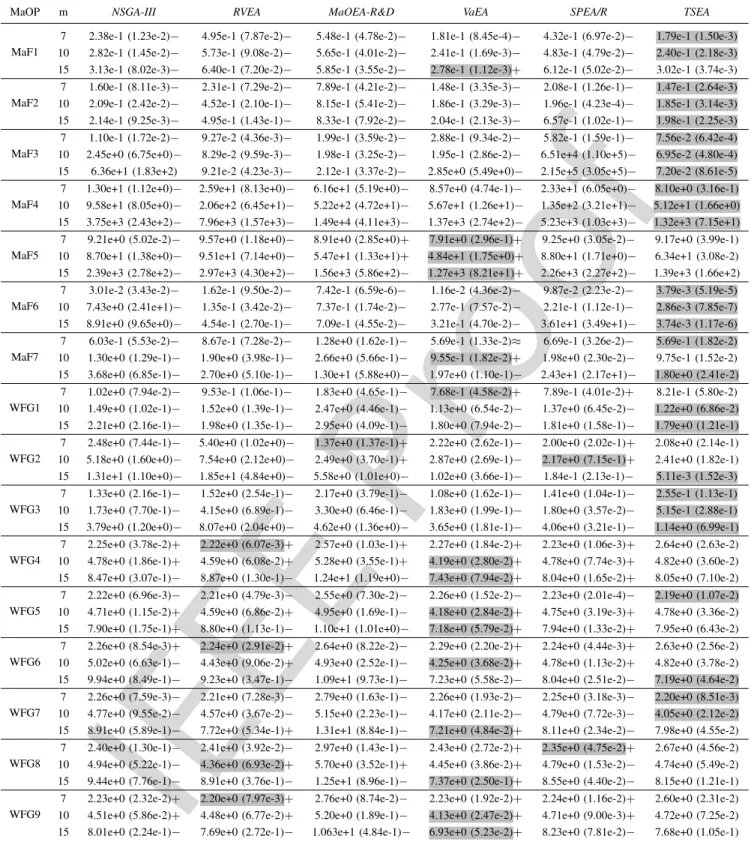
The HV values of the six algorithms on the 16 benchmark 483
functions with 7, 10, and 15 objectives are reported in Table I. 484
From these experimental results, in summary, we can observe 485
that the proposed TSEA shows generally the better performance 486
in comparison with the other five algorithms with respect to 487
the HV indicator. For the 48 test instances, TSEA significantly 488
performs the best on 33 of them. To be specific, the TSEA out- 489
performs NSGA-III, RVEA, MaOEA-R&D, VaEA, and SPEA/R 490
on 43, 42, 48, and 36 of 34 test instances, respectively. Such 491
better results illustrate the superiorities of the proposed TSEA 492
with respect to both the convergence and diversity. 493
For the MaF test instances, except three test instances, 494
namely, 7-objective MaF5, 10-objective MaF5, and 495
15-objective MaF7, the proposed TSEA generates sig- 496
nificantly higher HV than the other algorithms on all the 497
other test instances. For example, the HV value obtained by 498
TSEA on 7-objective MaF1 on average is higher than algo- 499
rithms NSGA-III, RVEA, MaOEA-R&D, VaEA, and SPEA/R 500
by 74.06%, 358.42%, 1096.38%, 3.81%, and 371.97%, 501
respectively. This is due to the fact that the stage one of 502
TSEA only focuses on the population convergence and thus 503
accelerates the convergence speed by avoiding the negative 504
influence of the complicated PF shapes. By contrast, for the 505
five algorithms in comparison, they employ the framework of 506
traditional MOEAs to form tradeoffs between the population 507
convergence and diversity simultaneously during the whole 508
search process, which fails to work properly on problems 509
with complicated PF shapes. 510
The WFG1–WFG9 benchmark functions are widely used to 511
assess the effectiveness of MOEAs in solving many-objective 512
problems. To further test the effectiveness of the algorithm 513
TSEA, these 9 test functions with 7, 10, and 15 objectives 514
are also used in the experimental comparisons. As shown in 515
Table I, algorithm TSEA still significantly performs better than 516
the five comparative algorithms on more than half of the test 517
instances. Compared with SPEA/R, the proposed TSEA gen- 518
erates significantly higher HV values on 16 out of the 27 519
test instances. Regarding the NSGA-III, RVEA, MaOEA-R&D, 520
and VaEA, the proposed TSEA performs better on even more 521
instances. 522
For IGD indicator, the results of the six algorithms are sum- 523
marized in Table II. Among the 48 test instances, the proposed 524
TSEA generates significantly lower IGD values than NSGA- 525
III, RVEA, MaOEA-R&D, VaEA and SPEA/R on 41, 39, 41, 27, 526
and 35 test instances, respectively. In summary, TSEA outper- 527
forms the five compared algorithms on 25 out of the 48 test 528
instances with respect to IGD indicator. These results again 529
illustrate the promising performance of the algorithm TSEA. 530
To visually illustrate the distribution of the solution sets 531
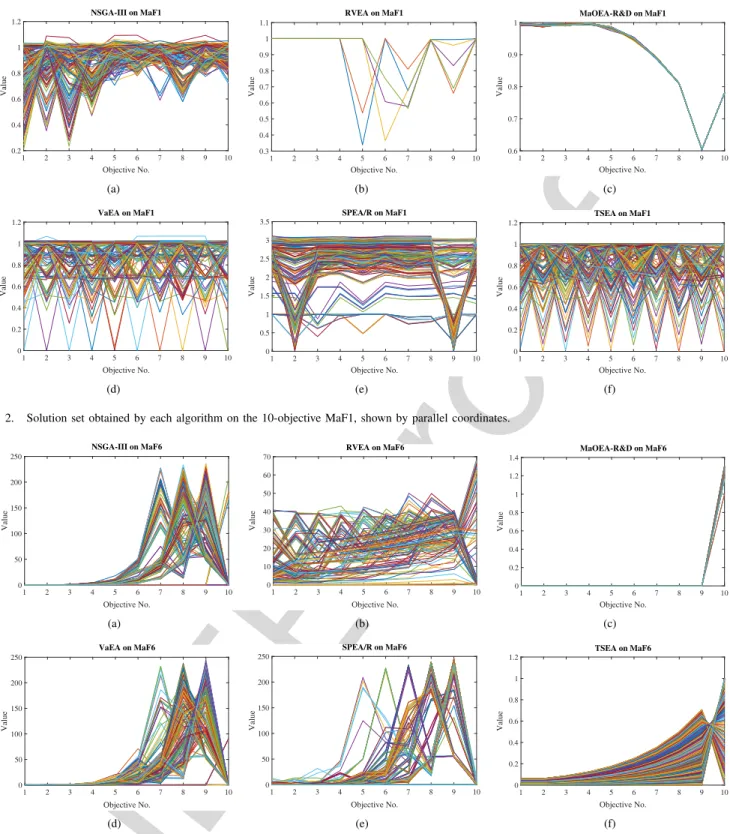
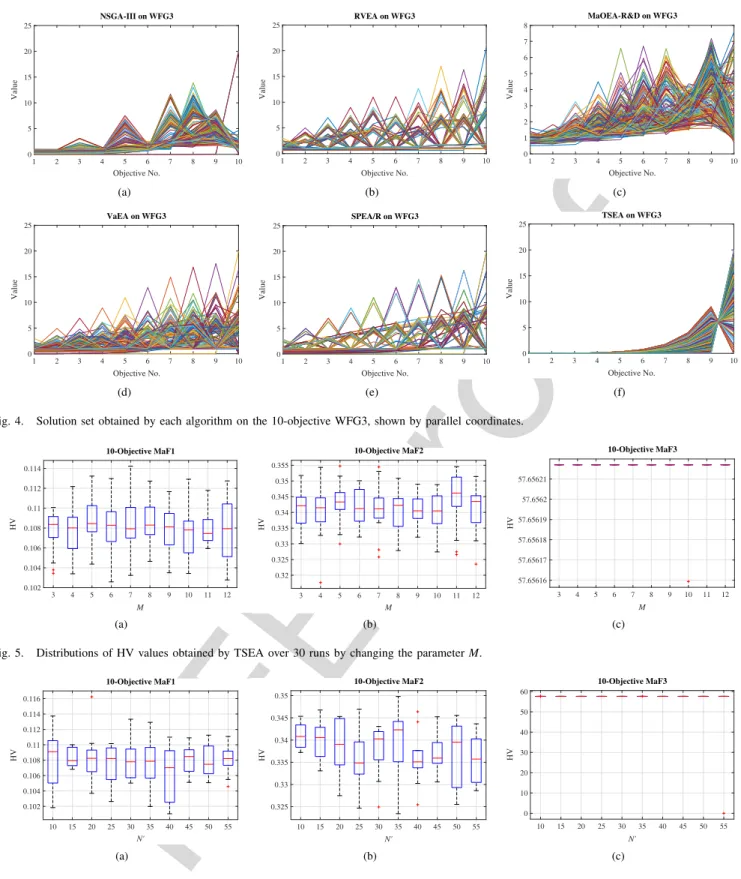
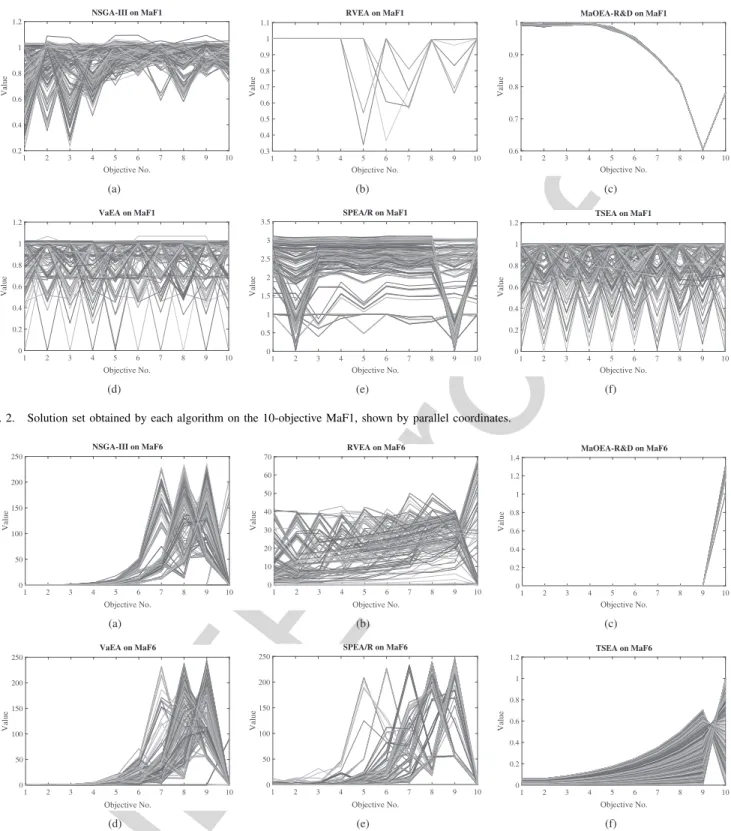
obtained by the six algorithms, we choose four test instances, 532AQ2
i.e., MaF1, MaF6, and WFG3 with ten objectives, to depict the 533
objective vectors in parallel coordinates. For each algorithm, 534
the solution sets with the lowest IGD value among 30 runs 535
IEEE Proof
TABLE IHV VALUES OF THESIXALGORITHMS ONBENCHMARKFUNCTIONSMAF1–MAF7ANDWFG1–WFG8 WITH7, 10,AND15 OBJECTIVES
As shown in Fig. 2, the distribution of the output
solu-537
tion sets of the six algorithms is quite different. Fig. 2(a)
538
shows that NSGA-III has good convergence and diversity in
539
the first, second, third, and fifth objectives. For RVEA, the size
540
of the solution set is much smaller than the predefined
pop-541
ulation size, referring to Fig. 2(b). The reason is that RVEA
542
decomposes the objective space into a series of subspaces, 543
and each subspace will retain at most one candidate solution. 544
However, on the problems with complicated PF shapes, some 545
subspaces may contain more than one representative candidate 546
solutions, while some subspaces are completely empty. Except 547
IEEE Proof
TABLE IIIGD VALUES OF THESIXALGORITHMS ONBENCHMARKFUNCTIONSMAF1–MAF7ANDWFG1–WFG8 WITH7, 10,AND15 OBJECTIVES
of the output solution set obtained by RVEA are very poor.
549
The complicated PF shape of MaF1 also weakens the
conver-550
gence and diversity of MaOEA-R&D and SPEA/R, which is
551
illustrated in Fig. 2(c) and (e). Fig. 2(d) shows that VaEA has
552
better convergence and diversity than the other four
compar-553
ison algorithms. By comparing Fig. 2(e) with Fig. 2(f), we
554
can note that the distribution of the solution set obtained by 555
the proposed TSEA is much better than VaEA. This also can 556
explain why the HV and IGD values obtained by TSEA are 557
much better than that obtained by the other five algorithms 558
on the 10-objective MaF1, which are illustrated in the second 559
IEEE Proof
Fig. 2. Solution set obtained by each algorithm on the 10-objective MaF1, shown by parallel coordinates.Fig. 3. Solution set obtained by each algorithm on the 10-objective MaF6, shown by parallel coordinates.
Since benchmark function MaF6 is a representative of
561
MOPs with degenerate PFs, we also show the distribution
562
of populations obtained by the six algorithms. As
illus-563
trated in Fig. 3, the convergence of NSGA-III, RVEA, VaEA,
564
and SPEA/R is outperformed by the proposed TSEA. The
565
algorithm MaOEA-R&D is similar to TSEA with respect
566
to convergence, but the diversity of the proposed TSEA is
567
better than that of MaOEA-R&D. This comparison results 568
demonstrate the superiority of TSEA in solving MaOPs with 569
disconnected PFs. In addition, the benchmark function WFG3 570
has also degenerate PF. For the test instance, i.e., 10-objective 571
WFG3, it can be clearly observed that the proposed TSEA also 572
outperforms the other five compared algorithms in terms of 573
IEEE Proof
Fig. 4. Solution set obtained by each algorithm on the 10-objective WFG3, shown by parallel coordinates.Fig. 5. Distributions of HV values obtained by TSEA over 30 runs by changing the parameter M.
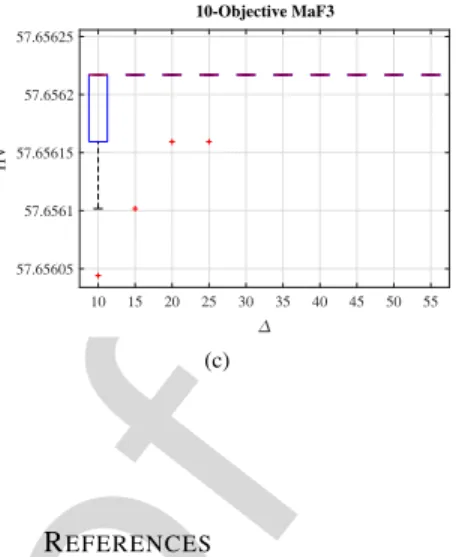
Fig. 6. Distributions of HV values obtained by TSEA over 30 runs by changing the parameter N.
C. Sensitivity Analysis for Parameters M, N, and
575
In the proposed TSEA, there are three tunable
param-576
eters: 1) the number of subpopulations M; 2) the size
577
of a subpopulation N; and 3) the convergence threshold
578
. To analyze the impact of these three parameters, in
579
each experiment, we change the value of one parameter
580
and fix the other two parameters. Besides, each experi- 581
ment is repeated 30 times, and the box plots of the three 582
parameters on 10-objective MaF1–MaF3 are illustrated in 583
Figs. 5–7. 584
To test the impact of parameter M, it is varied from 3 585
IEEE Proof
Fig. 7. Distributions of HV values obtained by TSEA over 30 runs by changing the parameter.to 20 and 1e-10, respectively. Fig. 5 shows that the HV
587
values obtained by TSEA on the three test instances
basi-588
cally remain unchanged when varying parameter M. This
589
result demonstrates that the parameter M has little impact on
590
the performance of the proposed TSEA when it is between
591
3 and 12. A similar observation can be found in Fig. 6. When
592
the size of each subpopulation is changed from 10 to 55, the
593
HV values of TSEA on 10-objective MaF1, MaF2, and MaF3
594
are stable around 0.108, 0.336, and 57.656, respectively. This
595
result illustrates that the parameter Nalso has little impact on
596
the performance of TSEA.
597
For parameter, we change it from 1e-3 to 1e-12 to
ana-598
lyze its impact on the performance of the proposed TSEA. As
599
shown in Fig. 7, we can see that the mean HV values obtained
600
by TSEA on 10-objective MaF1 and MaF2 increase slightly
601
with the decrease of parameter. This can be attributed to the
602
fact that lowerenables TSEA to push the subpopulations at
603
the first stage closer to the PF, which is more helpful for
bal-604
ancing the convergence and diversity at the second stage. On
605
the basis of the above analysis, we recommend the parameter
606
be lower than 1e–10 for the proposed TSEA.
607
V. CONCLUSION
608
This paper has proposed to solve MaOPs by
partition-609
ing the whole evolutionary search process into two stages,
610
where the first stage focuses on the population convergence,
611
and the second stage strives to improve the population
diver-612
sity. To avoid the negative influence of the complicated PF
613
shapes and accelerating the convergence speed of the
popu-614
lation, all subpopulations at first stage only focuses on the
615
convergence, and different weight vectors were used to guide
616
them converge to different areas of PF. Then, to improve the
617
population diversity, an environmental selection strategy has
618
also proposed for the second stage to select the candidate
619
solutions with promising diversity. Using such a multistage
620
evolutionary search strategy, the proposed TSEA
demon-621
strated ascendant performance over the five representative
622
algorithms.
623
With the increase of the number of decision variables,
624
the search spaces of optimization problems are exponentially
625
exploded, which seriously challenge the performance of
evo-626
lutionary algorithms. Thus, solving MaOPs having thousands
627
of decision variables is an interesting direction.
628
REFERENCES 629
[1] X.-L. Zheng and L. Wang, “A collaborative multiobjective fruit fly 630
optimization algorithm for the resource constrained unrelated parallel 631
machine green scheduling problem,” IEEE Trans. Syst., Man, Cybern., 632
Syst., vol. 48, no. 5, pp. 790–800, May 2018. 633
[2] R. Cheng, T. Rodemann, M. Fischer, M. Olhofer, and Y. Jin, 634
“Evolutionary many-objective optimization of hybrid electric vehicle 635
control: From general optimization to preference articulation,” IEEE 636
Trans. Emerg. Topics Comput. Intell., vol. 1, no. 2, pp. 97–111, 637
Apr. 2017. 638
[3] H. Chen, X. Zhu, G. Liu, and W. Pedrycz, “Uncertainty- 639
aware online scheduling for real-time workflows in cloud ser- 640
vice environment,” IEEE Trans. Services Comput., to be published. 641
doi:10.1109/TSC.2018.2866421. 642
[4] Z. Wang, Y.-S. Ong, J. Sun, A. Gupta, and Q. Zhang, “A gen- 643
erator for multiobjective test problems with difficult-to-approximate 644
Pareto front boundaries,” IEEE Trans. Evol. Comput., to be published. 645
doi:10.1109/TEVC.2018.2872453. 646
[5] Y. R. Naidu and A. K. Ojha, “Solving multiobjective optimization prob- 647
lems using hybrid cooperative invasive weed optimization with multiple 648
populations,” IEEE Trans. Syst., Man, Cybern., Syst., vol. 48, no. 6, 649
pp. 821–832, Jun. 2018. 650
[6] M. Farina and P. Amato, “On the optimal solution definition for many- 651
criteria optimization problems,” in Proc. IEEE Annu. Meeting North 652
Amer. Fuzzy Inf. Process. Soc., 2002, pp. 233–238. 653
[7] L. Zhen, “A bi-objective model on multiperiod green supply chain 654
network design,” IEEE Trans. Syst., Man, Cybern., Syst., to be published. 655
doi:10.1109/TSMC.2017.2690444. 656
[8] Z. Wang, Y.-S. Ong, and H. Ishibuchi, “On scalable multiobjective 657
test problems with hardly-dominated boundaries,” IEEE Trans. Evol. 658
Comput., vol. 23, no. 2, pp. 217–231, Apr. 2019. 659
[9] R. Wang, R. C. Purshouse, and P. J. Fleming, “Preference-inspired 660
co-evolutionary algorithms using weight vectors,” Eur. J. Oper. Res., 661
vol. 243, no. 2, pp. 423–441, 2015. 662
[10] R. Cheng, Y. Jin, M. Olhofer, and B. Sendhoff, “A reference vector 663
guided evolutionary algorithm for many-objective optimization,” IEEE 664
Trans. Evol. Comput., vol. 20, no. 5, pp. 773–791, Oct. 2016. 665
[11] H. Chen, R. Cheng, J. Wen, H. Li, and J. Weng, “Solving large-scale
AQ3
666
many-objective optimization problems by covariance matrix adapta- 667
tion evolution strategy with scalable small subpopulations,” Inf. Sci., 668
Oct. 2018. doi:10.1016/j.ins.2018.10.007. 669
[12] B. Li, J. Li, K. Tang, and X. Yao, “Many-objective evolutionary algo- 670
rithms: A survey,” ACM Comput. Surveys, vol. 48, no. 1, pp. 1–35, 671
2015. 672
[13] A. Trivedi, D. Srinivasan, K. Sanyal, and A. Ghosh, “A survey of 673
multiobjective evolutionary algorithms based on decomposition,” IEEE 674
Trans. Evol. Comput., vol. 21, no. 3, pp. 440–462, Jun. 2017. 675
[14] K. Deb, A. Pratap, S. Agarwal, and T. Meyarivan, “A fast and elitist 676
multiobjective genetic algorithm: NSGA-II,” IEEE Trans. Evol. Comput., 677
vol. 6, no. 2, pp. 182–197, Apr. 2002. 678
[15] C. A. Coello Coello, G. T. Pulido, and M. S. Lechuga, “Handling 679
multiple objectives with particle swarm optimization,” IEEE Trans. Evol. 680
Comput., vol. 8, no. 3, pp. 256–279, Jun. 2004. 681
[16] J. Bader and E. Zitzler, “HypE: An algorithm for fast hypervolume-based 682
many-objective optimization,” Evol. Comput., vol. 19, no. 1, pp. 45–76, 683
IEEE Proof
[17] Y. Tian, R. Cheng, X. Zhang, F. Cheng, and Y. Jin, “An indicator685
based multi-objective evolutionary algorithm with reference point
adap-686
tation for better versatility,” IEEE Trans. Evol. Comput., vol. 22, no. 4,
687
pp. 609–622, Aug. 2018.
688
[18] M. Li, S. Yang, and X. Liu, “Bi-goal evolution for many-objective
689
optimization problems,” Artif. Intell., vol. 228, pp. 45–65, Nov. 2015.
690
[19] Q. Zhang and H. Li, “MOEA/D: A multiobjective evolutionary algorithm
691
based on decomposition,” IEEE Trans. Evol. Comput., vol. 11, no. 6,
692
pp. 712–731, Dec. 2007.
693
[20] H.-L. Liu, F. Gu, and Q. Zhang, “Decomposition of a multiobjective
694
optimization problem into a number of simple multiobjective
sub-695
problems,” IEEE Trans. Evol. Comput., vol. 18, no. 3, pp. 450–455,
696
Jun. 2014.
697
[21] Z. Wang, Q. Zhang, A. Zhou, M. Gong, and L. Jiao, “Adaptive
replace-698
ment strategies for MOEA/D,” IEEE Trans. Cybern., vol. 46, no. 2,
699
pp. 474–486, Feb. 2016.
700
[22] K. Deb and H. Jain, “An evolutionary many-objective optimization
701
algorithm using reference-point-based nondominated sorting approach,
702
part I: Solving problems with box constraints,” IEEE Trans. Evol.
703
Comput., vol. 18, no. 4, pp. 577–601, Aug. 2014.
704
[23] H. Ishibuchi, N. Akedo, and Y. Nojima, “Behavior of multiobjective
705
evolutionary algorithms on many-objective knapsack problems,” IEEE
706
Trans. Evol. Comput., vol. 19, no. 2, pp. 264–283, Apr. 2015.
707
[24] R. C. Purshouse and P. J. Fleming, “On the evolutionary optimization of
708
many conflicting objectives,” IEEE Trans. Evol. Comput., vol. 11, no. 6,
709
pp. 770–784, Dec. 2007.
710
[25] Y. Xiang, Y. Zhou, M. Li, and Z. Chen, “A vector angle-based
evolu-711
tionary algorithm for unconstrained many-objective optimization,” IEEE
712
Trans. Evol. Comput., vol. 21, no. 1, pp. 131–152, Feb. 2017.
713
[26] H. Ishibuchi, Y. Setoguchi, H. Masuda, and Y. Nojima, “Performance
714
of decomposition-based many-objective algorithms strongly depends
715
on Pareto front shapes,” IEEE Trans. Evol. Comput., vol. 21, no. 2,
716
pp. 169–190, Apr. 2017.
717
[27] S. Jiang and S. Yang, “A strength Pareto evolutionary algorithm based on
718
reference direction for multi-objective and many-objective optimization,”
719
IEEE Trans. Evol. Comput., vol. 21, no. 3, pp. 329–346, Jun. 2017.
720
[28] A. Zhou, B.-Y. Qu, H. Li, S.-Z. Zhao, P. N. Suganthan, and Q. Zhang,
721
“Multiobjective evolutionary algorithms: A survey of the
state-of-the-722
art,” Swarm Evol. Comput., vol. 1, no. 1, pp. 32–49, 2011.
723
[29] D. W. Corne, N. R. Jerram, J. D. Knowles, and M. J. Oates, “PESA-II:
AQ4 724 Region-based selection in evolutionary multiobjective optimization,”
725
in Genetic and Evolutionary Computation, Morgan Kaufmann, 2001,
726
pp. 283–290.
727
[30] E. Zitzler, M. Laumanns, and L. Thiele, “SPEA2: Improving the strength
728
Pareto evolutionary algorithm,” in Proc. Evol. Methods Design Optim.
729
Control Appl. Ind. Problems, 2002, pp. 95–100.
730
[31] C.-H. Chen and J.-H. Chou, “Multiobjective optimization of airline
731
crew roster recovery problems under disruption conditions,” IEEE Trans.
732
Syst., Man, Cybern., Syst., vol. 47, no. 1, pp. 133–144, Jan. 2017.
733
[32] Y. Hou, N. Wu, M. Zhou, and Z. Li, “Pareto-optimization for scheduling
734
of crude oil operations in refinery via genetic algorithm,” IEEE Trans.
735
Syst., Man, Cybern., Syst., vol. 47, no. 3, pp. 517–530, Mar. 2017.
736
[33] Y. Yuan, H. Xu, B. Wang, and X. Yao, “A new dominance
relation-737
based evolutionary algorithm for many-objective optimization,” IEEE
738
Trans. Evol. Comput., vol. 20, no. 1, pp. 16–37, Feb. 2016.
739
[34] H. Wang and X. Yao, “Corner sort for Pareto-based many-objective
740
optimization,” IEEE Trans. Cybern., vol. 44, no. 1, pp. 92–102,
741
Jan. 2014.
742
[35] S. Yang, M. Li, X. Liu, and J. Zheng, “A grid-based evolutionary
algo-743
rithm for many-objective optimization,” IEEE Trans. Evol. Comput.,
744
vol. 17, no. 5, pp. 721–736, Oct. 2013.
745
[36] Z. He, G. G. Yen, and J. Zhang, “Fuzzy-based Pareto optimality for
746
many-objective evolutionary algorithms,” IEEE Trans. Evol. Comput.,
747
vol. 18, no. 2, pp. 269–285, Apr. 2014.
748
[37] H. Chen, Y. Tian, W. Pedrycz, G. Wu, R. Wang, and L. Wang,
749
“Hyperplane assisted evolutionary algorithm for many-objective
750
optimization problems,” IEEE Trans. Cybern., to be published.
751
doi:10.1109/TCYB.2019.2899225.
752
[38] E. Zitzler and S. Künzli, “Indicator-based selection in multiobjective
753
search,” in Proc. Parallel Problem Solving Nat., 2004, pp. 832–842.
754
[39] N. Beume, B. Naujoks, and M. Emmerich, “SMS-EMOA: Multiobjective
755
selection based on dominated hypervolume,” Eur. J. Oper. Res., vol. 181,
756
no. 3, pp. 1653–1669, 2007.
757
[40] K. Bringmann, T. Friedrich, C. Igel, and T. Voß, “Speeding up
many-758
objective optimization by Monte Carlo approximations,” Artif. Intell.,
759
vol. 204, pp. 22–29, Nov. 2013.
760
[41] C. Zhou, G. Dai, M. Wang, and X. Li, “Indicator and reference 761
points co-guided evolutionary algorithm for many-objective optimization 762
problems,” Knowl. Based Syst., vol. 140, pp. 50–63, Jan. 2018. 763
[42] R. Wang, R. C. Purshouse, and P. J. Fleming, “Preference-inspired 764
coevolutionary algorithms for many-objective optimization,” 765
IEEE Trans. Evol. Comput., vol. 17, no. 4, pp. 474–494, 766
Aug. 2013. 767
[43] K. Li, K. Deb, Q. Zhang, and S. Kwong, “An evolutionary many- 768
objective optimization algorithm based on dominance and decompo- 769
sition,” IEEE Trans. Evol. Comput., vol. 19, no. 5, pp. 694–716, 770
Oct. 2015. 771
[44] Y. Qi, X. Ma, F. Liu, L. Jiao, J. Sun, and J. Wu, “MOEA/D with adap- 772
tive weight adjustment,” Evol. Comput., vol. 22, no. 2, pp. 231–264, 773
2014. 774
[45] R. Wang, Q. Zhang, and T. Zhang, “Decomposition-based algorithms 775
using Pareto adaptive scalarizing methods,” IEEE Trans. Evol. Comput., 776
vol. 20, no. 6, pp. 821–837, Dec. 2016. 777
[46] X. Cai, Z. Yang, Z. Fan, and Q. Zhang, “Decomposition-based- 778
sorting and angle-based-selection for evolutionary multiobjective and 779
many-objective optimization,” IEEE Trans. Cybern., vol. 47, no. 9, 780
pp. 2824–2837, Sep. 2017. 781
[47] X. Cai, Z. Mei, Z. Fan, and Q. Zhang, “A constrained decomposition 782
approach with grids for evolutionary multiobjective optimization,” IEEE 783
Trans. Evol. Comput., vol. 22, no. 4, pp. 564–577, Aug. 2018. 784
[48] M. Elarbi, S. Bechikh, A. Gupta, L. B. Said, and Y.-S. Ong, “A 785
new decomposition-based NSGA-II for many-objective optimization,” 786
IEEE Trans. Syst., Man, Cybern., Syst., vol. 48, no. 7, pp. 1191–1210, 787
Jul. 2018. 788
[49] R. Wang, Z. Zhou, H. Ishibuchi, T. Liao, and T. Zhang, “Localized 789
weighted sum method for many-objective optimization,” IEEE Trans. 790
Evol. Comput., vol. 22, no. 1, pp. 3–18, Feb. 2018. 791
[50] H.-L. Liu, L. Chen, Q. Zhang, and K. Deb, “Adaptively allocat- 792
ing search effort in challenging many-objective optimization prob- 793
lems,” IEEE Trans. Evol. Comput., vol. 22, no. 3, pp. 433–448, 794
Jun. 2018. 795
[51] H. Chen, G. Wu, W. Pedrycz, P. N. Suganthan, L. Xing, and X. Zhu, 796
“An adaptive resource allocation strategy for objective space partition 797
based multiobjective optimization,” IEEE Trans. Syst., Man, Cybern., 798
Syst., to be published. doi:10.1109/TSMC.2019.2898456. 799
[52] Q. Kang, X. Song, M. Zhou, and L. Li, “A collaborative resource 800
allocation strategy for decomposition-based multiobjective evolutionary 801
algorithms,” IEEE Trans. Syst., Man, Cybern., Syst., to be published. 802
doi:10.1109/TSMC.2018.2818175. 803
[53] X. Cai, H. Sun, C. Zhu, Z. Li, and Q. Zhang, “Locating the boundaries of
AQ5
804
Pareto fronts: A many-objective evolutionary algorithm based on corner 805
solution search,” arXiv preprint arXiv:1806.02967, 2018. 806
[54] W. Hu, G. G. Yen, and G. Luo, “Many-objective particle swarm 807
optimization using two-stage strategy and parallel cell coordinate 808
system,” IEEE Trans. Cybern., vol. 47, no. 6, pp. 1446–1459, 809
Jun. 2017. 810
[55] Y. Sun, B. Xue, M. Zhang, and G. G. Yen, “A new two-stage evolu- 811
tionary algorithm for many-objective optimization,” IEEE Trans. Evol. 812
Comput., to be published. doi:10.1109/TEVC.2018.2882166. 813
[56] Y. Liu, D. Gong, J. Sun, and Y. Jin, “A many-objective evolutionary 814
algorithm using a one-by-one selection strategy,” IEEE Trans. Cybern., 815
vol. 47, no. 9, pp. 2689–2702, Sep. 2017. 816
[57] S. Huband, P. Hingston, L. Barone, and L. While, “A review 817
of multiobjective test problems and a scalable test problem 818
toolkit,” IEEE Trans. Evol. Comput., vol. 10, no. 5, pp. 477–506, 819
Oct. 2006. 820
[58] X. Ma et al., “A multiobjective evolutionary algorithm based on decision 821
variable analyses for multiobjective optimization problems with large- 822
scale variables,” IEEE Trans. Evol. Comput., vol. 20, no. 2, pp. 275–298, 823
Apr. 2016. 824
[59] Z. He and G. G. Yen, “Many-objective evolutionary algorithm: Objective 825
space reduction and diversity improvement,” IEEE Trans. Evol. Comput., 826
vol. 20, no. 1, pp. 145–160, Feb. 2016. 827
[60] R. Cheng et al., “A benchmark test suite for evolutionary many- 828
objective optimization,” Complex Intell. Syst., vol. 3, no. 1, pp. 67–81, 829
2017. 830
[61] E. Zitzler and L. Thiele, “Multiobjective evolutionary algorithms: A 831
comparative case study and the strength Pareto approach,” IEEE Trans. 832
Evol. Comput., vol. 3, no. 4, pp. 257–271, Nov. 1999. 833
[62] P. A. N. Bosman and D. Thierens, “The balance between proximity and 834
diversity in multiobjective evolutionary algorithms,” IEEE Trans. Evol. 835
IEEE Proof
Huangke ChenAQ6 837 received the B.S. degree in manage-ment science and engineering and the M.S. degree in
838
operations research from the College of Information
839
and System Management, National University of
840
Defense Technology, Changsha, China, in 2012 and
841
2014, respectively, where he is currently
pursu-842
ing the Ph.D. degree with the College of Systems
843
Engineering.
844
He was a visiting Ph.D. student with the
845
University of Alberta, Edmonton, AB, Canada, from
846
2017 to 2018. His current research interests include
847
computational intelligence, multiobjective evolutionary algorithms, large-scale
848
optimization, and task and workflow scheduling.
849
Ran Cheng (M’16)
AQ7 850 received the B.Sc. degree from
Northeastern University, Shenyang, China, in 2010,
851
and the Ph.D. degree from the University of Surrey,
852
Guildford, U.K., in 2016.
853
He is currently an Assistant Professor with the
854
Department of Computer Science and Engineering,
855
Southern University of Science and Technology,
856
Shenzhen, China. His current research interests
857
include evolutionary multiobjective optimization,
858
model-based evolutionary algorithms, large-scale
859
optimization, swarm intelligence, and deep learning.
860
Dr. Cheng was a recipient of the 2018 IEEE TRANSACTIONS ON
861
EVOLUTIONARYCOMPUTATIONOutstanding Paper Award, the 2019 IEEE
862
Computational Intelligence Society Outstanding Ph.D. Dissertation Award,
863
and the 2020 IEEE Computational Intelligence Magazine Outstanding Paper
864
Award. He is the Founding Chair of IEEE Symposium on Model-Based
865
Evolutionary Algorithms.
866
Witold Pedrycz (F’99) received the M.Sc., Ph.D., 867
and D.Sc. degrees in computer science from the 868
Silesian University of Technology, Gliwice, Poland. 869
He is a Professor and the Canada Research 870
Chair of CRC-Computational Intelligence with the 871
Department of Electrical and Computer Engineering, 872
University of Alberta, Edmonton, AB, Canada, 873
also with the Department of Electrical and 874
Computer Engineering, Faculty of Engineering, 875
King Abdulaziz University, Jeddah, Saudi Arabia, 876
and also with the Systems Research Institute, Polish 877
Academy of Sciences, Warsaw, Poland. His current research interests 878
include computational intelligence, fuzzy modeling and granular computing, 879
knowledge discovery and data mining, fuzzy control, pattern recognition, 880
knowledge-based neural networks, relational computing, and software engi- 881
neering. He has published numerous papers in the above areas. 882
Prof. Pedrycz is the Editor-in-Chief of Information Sciences and serves as 883
an Associate Editor for the IEEE TRANSACTIONS ONSYSTEMS, MAN,AND 884
CYBERNETICS: SYSTEMSand IEEE TRANSACTIONS ONFUZZYSYSTEMS. 885
He is also on the editorial board of other international journals. 886
Yaochu Jin (M’98–SM’02–F’16) received the 887
B.Sc., M.Sc., and Ph.D. degrees from Zhejiang 888
University, Hangzhou, China, in 1988, 1991, and 889
1996, respectively, and the Dr.-Ing. degree from 890
Ruhr University Bochum, Bochum, Germany, in 891
2001. 892
He is a Professor of Computational Intelligence 893
with the Department of Computer Science, 894
University of Surrey, Guildford, U.K., where 895
he heads the Nature Inspired Computing and 896
Engineering Group. He is also a Finland 897
Distinguished Professor funded by the Finnish Agency for Innovation (Tekes) 898
and a Changjiang Distinguished Visiting Professor appointed by the Ministry 899
of Education, Beijing, China. He has coauthored over 200 peer-reviewed 900
journal and conference papers and been granted eight patents on evolutionary 901
optimization. His current research is funded by EC FP7, U.K. EPSRC, and 902
industry. He has delivered over 20 invited keynote speeches at international 903
conferences. His science-driven research interests include interdisciplinary 904
areas that bridge the gap between computational intelligence, computational 905
neuroscience, and computational systems biology. He is also particularly 906
interested in nature-inspired and real-world-driven problem solving. 907
Prof. Jin was a recipient of the Best Paper Award of the 2010 908
IEEE Symposium on Computational Intelligence in Bioinformatics and 909
Computational Biology and the 2014 and 2017 IEEE Computational 910
Intelligence Magazine Outstanding Paper Award. He is the Editor-in-Chief 911
of the IEEE TRANSACTIONS ON COGNITIVE AND DEVELOPMENTAL 912
SYSTEMS and Complex and Intelligent Systems. He is also an Associate 913
Editor or an Editorial Board Member of the IEEE TRANSACTIONS ON 914
EVOLUTIONARYCOMPUTATION, IEEE TRANSACTIONS ONCYBERNETICS, 915
IEEE TRANSACTIONS ON NANOBIOSCIENCE, Evolutionary Computation, 916
BioSystems, Soft Computing, and Natural Computing. He is an IEEE 917
Distinguished Lecturer from 2013 to 2015 and from 2017 to 2019, and 918
was the Vice President for Technical Activities of the IEEE Computational 919
IEEE Proof
AUTHOR QUERIES
AUTHOR PLEASE ANSWER ALL QUERIES