ELECTRICAL UTILITIES
G
ERHARDUS
H. K
OCH
P
H
.D.
1SUMMARY AND ANALYSIS OF RESULTS
Corrosion Control and Prevention
The total cost of electricity sold in the United States in 1998 was 3.24 million gigawatt hours (GWh) at a cost to consumers of $218.4 billion. Electricity generation plants can be divided into seven generic types: fossil fuel, nuclear, hydroelectric, cogeneration, geothermal, solar, and wind. The majority of electric power in the United States is generated by fossil and nuclear steam supply systems. The fossil fuel sector (including gas turbines and combined cycle plants) is the largest, with a generating capacity of approximately 488 gigawatts (GW), and a total generation of 2.227 million GWh in 1998. In 1998, approximately 102 nuclear stations were operation, with a generating capacity of 97.1 GW and a total generation of 673,700 GWh.
Two different types of nuclear reactors are currently in use in the United States, namely the boiling water reactor (BWR) and the pressurized water reactor (PWR). The fuel for these types of reactors is similar, consisting of long bundles of 2 to 4 percent enriched uranium dioxide fuel pellets stacked in zirconium-alloy cladding tubes. The BWR design consists of a single loop in which the entering water is turned directly to steam for the production of energy. The PWR design is a two-loop system that uses high pressure to maintain an all-liquid-water primary loop. Energy is transferred to the secondary steam loop through two to four steam generators. The PWR also uses a wet steam turbine. The electric power industry uses three different types of fossil fuel power plants. The most common and widely used is the pulverized coal-fired steam power plant. Fuel oil can be used instead of coal. Gas turbines are usually smaller units that are used for peak loads and operate only for a few hours per day. Combined-cycle plants using both steam and gas turbines are generally used for baseload service, but also must be capable of addressing peak loads. Hydraulic power systems include both hydroelectric and pumped storage hydroelectric plants. In both processes, water is directed from a dam through a series of tapering pipes to rotate turbines that create electricity. In principle, the potential energy held in the dam converts into kinetic energy when it flows through the pipes. The concept behind the development of pumped storage plants is the conversion of relatively low-cost, off-peak energy generated in the thermal plant into high-value, on-peak power. Water is pumped from a lower to a higher reservoir when low-cost pumping is available from large, efficient thermal plant generation. It is released during periods of high power demand and displaces the use of inefficient, costly alternative sources of generation.
The total cost of electricity of $218.4 billion can be divided into operation and maintenance (O&M), depreciation, and forced outages. The corrosion-related cost of forced outages in the nuclear power industry was estimated at $670 million. The total cost of depreciation based on the 1998 Federal Energy Regulatory Commission (FERC) Form No. 1 data was $35.7 billion. Based on an evaluation of depreciation by facility type, a percentage due to corrosion was estimated. This cost percentage due to corrosion as part of the total utility depreciation in 1998 was 9.73 percent or $3.433 billion, with nuclear facilities at $1.546 billion, fossil fuel facilities at $1.214 billion, transmission and distribution at $607 million, and hydraulic and other power at $66 million. The corrosion portion of the annual O&M cost was estimated at $698 million for fossil fuel, $2.013 billion for nuclear facilities, and $75 million for hydraulic power, for a total of $2.786 billion. Thus, the total cost of corrosion in the electrical utilities industry in 1998 is estimated at $6.889 billion per year.
1
A study for the Electric Power Research Institute(4) to estimate the cost of corrosion for electrical utilities estimated that the cost of corrosion to consumers of electricity was approximately $17.27 billion per year, which represents approximately 7.9 percent of the total cost of electricity to the consumers of $218.4 billion. The significant difference in the direct cost of corrosion to the utilities owners of about $6.9 billion and the cost to consumers of approximately $17.27 billion can be attributed to overhead and management costs and taxes.
Opportunities for Improvement and Barriers to Progress
Because of the complex and often corrosive environments in which power plants operate, corrosion has been a serious problem, with a significant impact on the operation of the plants. In the 1970s and 1980s, major efforts were made to understand and control corrosion in both nuclear and fossil fuel steam plants, and significant progress was made. However, with the aging of several plants, old problems persist and new ones appear. For example, corrosion continues to be a problem with electrical generators and turbines. Specifically, stress corrosion cracking in steam generators in PWR plants and boiler tube failures in fossil fuel plants continue to be problems. There are further indications that buried structures, such as service water piping, start to show leaks that cannot be tolerated. Environmental requirements and deregulation of the power industry often result in less attention being paid to corrosion and deterioration of materials of construction. If corrosion issues are not addressed in a timely manner, these materials will corrode to the point that major repair and rehabilitation will be required. The cost of corrosion will then increase significantly.
Recommendations and Implementation
It is recommended that economic corrosion control programs to provide a strategic cost-effective approach be developed. These programs need to focus on the following areas: (1) implementation of corrosion control in equipment design and the application of corrosion-resistant alloys, (2) selection of proper on-line corrosion monitoring techniques, (3) implementation of corrosion maintenance programs, and (4) development of educational and training programs for corrosion control and prevention. The Electric Power Research Institute (EPRI) should develop programs to address these four items where they affect the entire electrical utilities industry. EPRI could further lend their expertise to assist individual utilities in developing tailored programs.
Of specific importance is the awareness of corrosion control and prevention that is raised among plant personnel at all levels by providing education and training. This provides the plant personnel with the necessary knowledge to make the right decisions to prevent or mitigate corrosion.
Summary of Issues
Increase consciousness ofcorrosion costs and potential savings.
Maintain and update corrosion cost records, which will raise awareness of the effects of corrosion on the bottom line. This should result in implementation of best engineering practices, which will reduce corrosion costs.
Change perception that nothing can be done about corrosion.
Educate engineers, technicians, and management on corrosion prevention strategies and methodologies.
Advance design practices for better corrosion management.
Selection of corrosion-resistant alloys and proper welding procedures are well defined to avoid corrosion and cracking-related failures. Coatings and cathodic protection are also available to help control corrosion. Change technical practices to
realize corrosion cost-savings.
Corrosion research on the technological needs of the electrical utilities industry will improve technical practices.
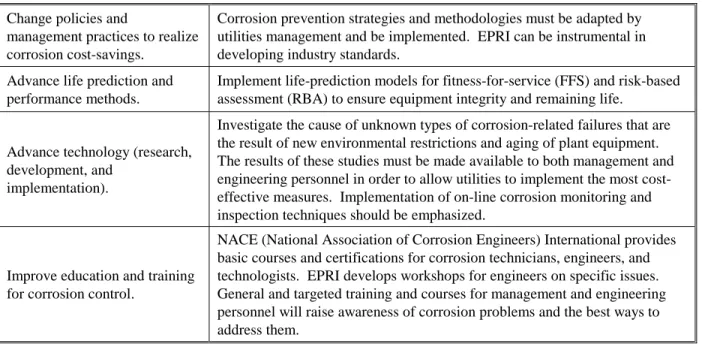
Change policies and
management practices to realize corrosion cost-savings.
Corrosion prevention strategies and methodologies must be adapted by utilities management and be implemented. EPRI can be instrumental in developing industry standards.
Advance life prediction and performance methods.
Implement life-prediction models for fitness-for-service (FFS) and risk-based assessment (RBA) to ensure equipment integrity and remaining life.
Advance technology (research, development, and
implementation).
Investigate the cause of unknown types of corrosion-related failures that are the result of new environmental restrictions and aging of plant equipment. The results of these studies must be made available to both management and engineering personnel in order to allow utilities to implement the most cost-effective measures. Implementation of on-line corrosion monitoring and inspection techniques should be emphasized.
Improve education and training for corrosion control.
NACE (National Association of Corrosion Engineers) International provides basic courses and certifications for corrosion technicians, engineers, and technologists. EPRI develops workshops for engineers on specific issues. General and targeted training and courses for management and engineering personnel will raise awareness of corrosion problems and the best ways to address them.
TABLE OF CONTENTS
SECTOR DESCRIPTION ... L1 DESCRIPTION OF THE DIFFERENT TYPES OF PLANTS... L1 Nuclear Steam Supply Systems... L1 Fossil Fuel Steam Supply Systems... L2 Hydraulic Plants ... L4 Transport and Distribution Systems ... L4 AREAS OF MAJOR CORROSION IMPACT... L4 Total Cost of Operation, Maintenance, and Depreciation ... L5 Operation and Maintenance Costs by Facility Type... L5 Corrosion Percentage of Operation and Maintenance ... L6 Nuclear Steam Supply Systems ... L6 Fossil Fuel Steam Supply Systems ... L8 Hydraulic Production ... L9 Depreciation Costs by Facility Type ... L10 Nuclear Steam Production... L10 Fossil Fuel Steam Production... L12 Hydraulic Production (Including Pumped Storage) ... L14 Other Production ... L15 Transmission ... L16 Distribution ... L16 General and Miscellaneous ... L17 Summary of Corrosion Costs for Depreciation ... L18 TOTAL COST OF CORROSION... L19 CASE STUDY... L19 Buried Condenser Circulating Water Piping ... L19 REFERENCES ... L23
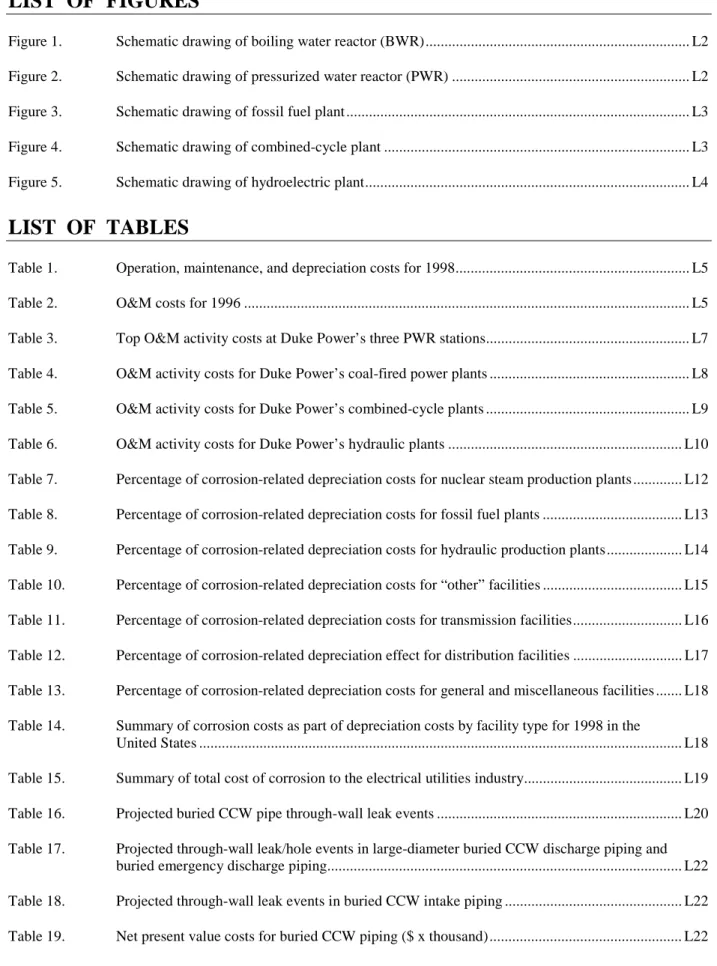
LIST OF FIGURES
Figure 1. Schematic drawing of boiling water reactor (BWR)... L2 Figure 2. Schematic drawing of pressurized water reactor (PWR) ... L2 Figure 3. Schematic drawing of fossil fuel plant ... L3 Figure 4. Schematic drawing of combined-cycle plant ... L3 Figure 5. Schematic drawing of hydroelectric plant... L4
LIST OF TABLES
Table 1. Operation, maintenance, and depreciation costs for 1998... L5 Table 2. O&M costs for 1996 ... L5 Table 3. Top O&M activity costs at Duke Power’s three PWR stations... L7 Table 4. O&M activity costs for Duke Power’s coal-fired power plants ... L8 Table 5. O&M activity costs for Duke Power’s combined-cycle plants ... L9 Table 6. O&M activity costs for Duke Power’s hydraulic plants ... L10 Table 7. Percentage of corrosion-related depreciation costs for nuclear steam production plants ... L12 Table 8. Percentage of corrosion-related depreciation costs for fossil fuel plants ... L13 Table 9. Percentage of corrosion-related depreciation costs for hydraulic production plants... L14 Table 10. Percentage of corrosion-related depreciation costs for “other” facilities ... L15 Table 11. Percentage of corrosion-related depreciation costs for transmission facilities... L16 Table 12. Percentage of corrosion-related depreciation effect for distribution facilities ... L17 Table 13. Percentage of corrosion-related depreciation costs for general and miscellaneous facilities ... L18 Table 14. Summary of corrosion costs as part of depreciation costs by facility type for 1998 in the
United States ... L18 Table 15. Summary of total cost of corrosion to the electrical utilities industry... L19 Table 16. Projected buried CCW pipe through-wall leak events ... L20 Table 17. Projected through-wall leak/hole events in large-diameter buried CCW discharge piping and
buried emergency discharge piping... L22 Table 18. Projected through-wall leak events in buried CCW intake piping ... L22 Table 19. Net present value costs for buried CCW piping ($ x thousand)... L22
SECTOR DESCRIPTION
The Battelle-NBS study indicated that the corrosion costs for the electric power industry in 1975 was approximately $4 billion or 0.24 percent of the gross national product (GNP).(1) In the mid-1980s, corrosion in steam-generating plants in the United States was reported to be responsible for about fifty percent of the forced outages and $3 billion annually in additional operating and maintenance (O&M) costs.(2) O&M includes general maintenance, repair, and replacement of corroded components, and corrosion activities such as inhibitor dosing, protective coating application, cathodic protection, water chemistry control, and corrosion monitoring. In the nuclear systems, the cost associated with exposure of maintenance staff to radiation was largely attributed to corrosion. Another significant contributor to the cost of corrosion is the cost of replacement power. When repair or replacement of a corroded component necessitates partial or complete shutdown of the plant, power must be purchased elsewhere to satisfy the customer demands.
DESCRIPTION OF THE DIFFERENT TYPES OF PLANTS
Electricity-generation plants can be divided into seven generic types: fossil fuel, nuclear, hydroelectric, cogeneration, geothermal, solar, and wind. The majority of electric power in the United States is generated by fossil and nuclear steam supply systems. The fossil fuel sector (including gas turbines and combined-cycle plants) is the largest. It has a generating capacity of about 488 GW and it had a total generation of 2.227 million GWh in 1998.(3) In 1998, approximately 102 nuclear stations were operational, with a generating capacity of 97.1 GW and they generated a total of 673.7 thousand GWh. The total cost of electricity sold in the United States in 1998 was $218.4 billion for 3.24 million GWh(3) at an average cost of $0.067 per kWh.
Nuclear Steam Supply Systems
Two different types of light-water reactors (LWR) are currently in use in the United States, namely the boiling water reactor (BWR) and the pressurized water reactor (PWR). The fuel for these types of reactors is similar, consisting of long bundles of 2 to 4 percent (by weight) enriched uranium dioxide fuel pellets stacked in zirconium-alloy cladding tubes. The BWR fuel assembly, however, has a smaller number of fuel pins and is surrounded by a metal flow channel. The larger PWR fuel assemblies are not enclosed.
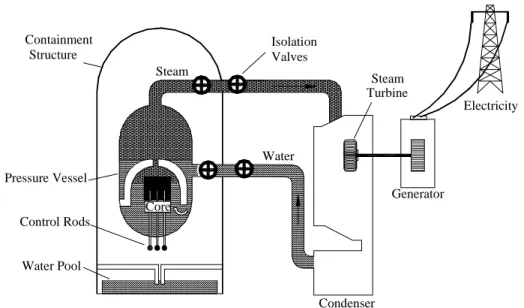
The BWR design (see figure 1) consists of a single loop in which the entering water is turned directly into steam for the production of electricity. Since operating temperatures must remain below the critical temperature for water, steam separators and dryers are used with a “wet-steam” turbine.
The PWR design (see figure 2) is a two-loop system that uses high pressure to maintain an all-liquid-water primary loop. Energy is transferred to the secondary steam loop through two to four steam generators. The PWR design also uses a wet-steam turbine.
Steam Core Condenser Water Generator Turbine Electricity Control Rods Water Pool Isolation Valves Pressure Vessel Containment Structure Steam
Figure 1. Schematic drawing of boiling water reactor (BWR).
Hot Water Reactor Core Control Rods Pressurized Water Reactor Steam Generator Steam Water Condenser Generator Electricity Turbine Containment Structure
Figure 2. Schematic drawing of pressurized water reactor (PWR).
Fossil Fuel Steam Supply Systems
The electric power industry uses three types of fossil fuel power plants: coal-fired steam, gas turbine, and combined-cycle power plants. The most common and widely used is the pulverized coal-fired steam power plant. Fuel oil can be used instead of coal. The schematic drawing in figure 3 shows the basic operation of a
few hours per day. Combined-cycle plants using both steam and gas turbines are generally used for baseload service, but must be capable of addressing peak loads (see figure 4).
Generator Turbine Electricity Combustion Gases Steam Pulverized Coal Air Condenser Stack Boiler Steam Water
Figure 3. Schematic drawing of fossil fuel plant.
Generator Water Boiler Condenser Steam TurbineSteam Electricity Generator Turbine Electricity Hot Combustion Gases
Gas Turbine Cycle Compressor Fuel Gas Combustion Chamber Air Exhaust Gases Steam Turbine Cycle
Hydraulic Plants
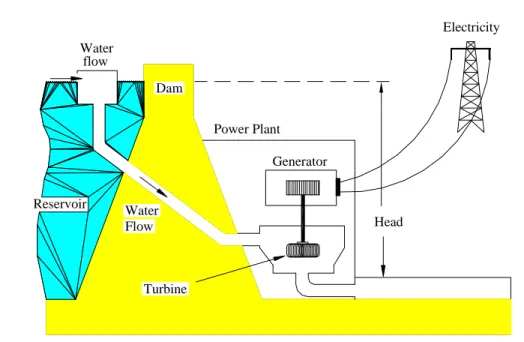
Hydraulic power systems include both hydroelectric and pumped storage hydroelectric plants. In both
processes, water is directed from a dam through a series of tapering pipes to rotate turbines and create electricity. In principle, the potential energy held in the dam converts into kinetic energy when it flows through the pipes (see figure 5). Generator Turbine Electricity Dam Water flow Head Reservoir Water Flow Power Plant
Figure 5. Schematic drawing of hydroelectric plant.
The concept behind the development of pumped storage plants is the conversion of relatively low-cost, off-peak energy generated in thermal plants into high-value, on-peak power. Water is pumped from a lower reservoir to a higher reservoir when low-cost pumping is available from large, efficient thermal plant generation. It is released during periods of high power demand and displaces the use of inefficient, costly alternative sources of generation. If the difference between the off-peak and on-peak energy cost values is large, the process can result in a savings. An additional benefit of pumped storage is the potential reduction in the need for additional peaking power generation capacity.
Transport and Distribution Systems
The electrical utilities transport systems include switchyard equipment, overhead towers, poles and conductors, and underground conductors and equipment. The types of structures and equipment that are included in electric distribution systems are switchgear and batteries, overhead towers, poles and conductors, underground conductors and equipment, transformers, connecting wires, meters, and street lighting.
AREAS OF MAJOR CORROSION IMPACT
The impact of corrosion on electric utility systems can be divided into the fraction of utility costs for
depreciation and operation and maintenance that are attributable to corrosion. The estimated costs discussed for this sector are based on detailed analysis of facilities and work activities, using input from Duke Power, an energy
company serving more than 2 million customers in North Carolina and South Carolina, and the Electric Power Research Institute (EPRI) reports, technical literature, and other utilities.(4) These fractions are then applied to the statistics for operation, maintenance, and depreciation of the entire utilities industry.
Total Cost of Operation, Maintenance, and Depreciation
The total 1998 cost of electricity of $218.4 billion can be divided into three main categories: operation, maintenance, and depreciation. The fraction of the cost for these categories for the major investor-owned and publicly-owned utilities for 1998 are reported in various government-compiled statistics.(4) Table 1 shows the distribution between the three categories and indicates that the majority of the cost is for the Operation category.
Table 1. Operation, maintenance, and depreciation costs for 1998.
CATEGORIES PERCENT COST OF ELECTRICITY ($ x billion)
Operation 75.2 164.3
Maintenance 8.4 18.4
Depreciation 16.3 35.7
TOTAL 99.9% $218.4
Operation and Maintenance Costs by Facility Type
O&M costs, including fuel costs, are broken down by facility type using data published in Energy Information Administration, U.S. Department of Energy (EIA/DOE) reports. The latest report for major investor-owned utilities is for 1996.(5) Using data from that report and using data for 1996 from the latest report for publicly-owned utilities (1997),(6) provides the following cost data for O&M by facility or function type (see table 2).
The data indicate that the highest percentage of O&M cost is for the fossil fuel category, with the smallest percentage for hydraulic utilities.
Table 2. O&M costs for 1996.(5)
CATEGORY PERCENT 1998 O&M COSTS ($ x billion)
Fossil Fuel 64.4 117.6
Nuclear 21.1 38.6
Hydraulic* 1.3 2.4
Other Power Generation 3.3 6.0
Transmission 3.0 5.4
Distribution 6.9 12.6
TOTAL 100% $182.6
Corrosion Percentage of Operation and Maintenance
In the following section "corrosion percentages" will be applied to the above costs to determine the cost of corrosion in 1998. To do this, corrosion percentages will be developed for both O&M and depreciation costs for each of the facility types
Nuclear Steam Supply Systems
The corrosion costs in nuclear plants are divided among three main categories: 1. Corrosion-related causes of partial power outages.
2. Corrosion-related causes of zero power outages. 3. Contribution of corrosion to O&M.
Partial Power Outages
Duke Power performed a detailed analysis of their operating and outage records to determine the total number of hours of lost production in 1998 at the seven PWRs and also the fraction due to corrosion.(6) Initially, the outage histories of Duke Power’s Oconee, McGuire, and Catawba Nuclear Stations (seven PWRs) were reviewed for the 1998 calendar year with respect to partial power outages. These stations are PWRs with generating capacities of 2.541 GW, 2.2 GW, and 2.254 GW, respectively, which is 7.2 percent of the total nuclear generating capacity in the United States. The outages are defined as cases of power reduction at the plants without reaching the zero power threshold. It was assumed that a minimum loss of 5,000 MWh was required for any partial outage to be included. Although there are significant industry differences in the methodologies for converting MWh to dollars, an average cost of $17 per MWh is considered reasonable.
The total lost generation from partial power outages for the three nuclear stations in 1998 was 358.598 GWh. Of this lost generation, 6 percent or 21.389 GWh ($363,613) was attributed to corrosion-related issues.
Extrapolating this cost to a total number of 102 nuclear steam supply systems, using the ratio of Duke Power nuclear generating capacity to total U.S. nuclear generating capacity yields a total estimated corrosion cost for partial power reduction of $5.05 million ($363,613 / 7.2%).
Zero Power Outages
Similarly, the outage histories at the Oconee, McGuire, and Catawba Nuclear Stations were reviewed for the 1998 calendar year with respect to zero power outages. These outages are defined as cases of power reduction at the nuclear plants that resulted in the generator being detached from the generation grid. The lost generation for zero power outages for the three stations in 1998 was 7,687 GWh, of which 35.6 percent or 2,740 GWh ($46,572,741) was attributed to corrosion-related causes. This represents 35.6 percent of the total zero power outage losses or 4.5 percent of the overall capacity for the three stations. Extrapolating this cost to the total number of 102 nuclear steam supply systems, using the ratio of Duke Power generating capacity (7.2 percent) to total U.S. nuclear generating capacity yields a total corrosion cost for zero power of $665 million ($46,572,741 / 7.2%).
Operation and Maintenance
For each nuclear station, the O&M cost is divided into specific work activities. For Oconee, McGuire, and Catawba, a total of 83, 83, and 91 work activities were reviewed, respectively. Table 3 ranks the activities with the 10 highest corrosion costs, as well as the remainder of the work activities. The corrosion cost estimates for the three Duke Power nuclear stations were made based on interviews with Duke Power subject matter experts.
Table 3. Top O&M activity costs at Duke Power’s three PWR stations.
COST FRACTION ATTRIBUTED
TO CORROSION
COST OF CORROSION WORK ACTIVITIES
$ % % $
OCONEE NUCLEAR STATION
Steam Generators 22,757,765 8.26 95 21,619,877
Maintenance Engineering Support 13,204,783 4.79 33 4,357,578
Radiation Protection 12,116,142 4.4 80 9,692,914
Mechanical Components 10,709,285 3.89 33 3,534,064
Maintenance Function Support 10,675,567 3.87 33 3,522,937
Work Control 6,073,111 2.2 33 2,004,127
Chemistry 5,570,659 2.02 60 3,342,395
Pipes 2,391,285 0.87 60 1,434,771
Coatings & Paintings 2,279,358 0.83 45 1,025,711
Decontamination 1,216,689 0.46 80 973,351
Remaining Activities 188,590,607 68.41 - 17,122,624
SUBTOTAL $275,585,251 100% 25% $68,630,349 MCGUIRE NUCLEAR STATION
Maintenance Engineering Support 11,348,449 6.4 33 3,744,988
Radiation Protection 8,331,379 4.7 80 6,665,103
Work Control 7,555,778 4.26 33 2,493,407
Maintenance Function Support 7,089,933 4 33 2,339,678
Chemistry 5,460,571 3.08 60 3,276,343
Steam Generators 2,771,692 1.56 85 2,355,938
Maintenance Training 2,510,014 1.42 33 828,305
Coatings & Paintings 1,727,397 0.97 45 777,329
Pipes 1,286,856 0.73 60 772,114
Decontamination 656,478 0.37 80 525,182
Remaining Activities 128,507,745 72.51 - 12,063,839
SUBTOTAL $177,246,292 100% 20% $35,842,226 CATAWBA NUCLEAR STATION
Work Control 9,225,851 4.84 33 3,044,531
Radiation Protection 8,800,640 4.62 80 7,040,512
Chemistry 6,595,992 3.47 60 3,957,595
Maintenance Engineering Support 5,518,379 2.89 33 1,821,065
Steam Generators 4,336,795 2.27 85 3,686,276
Maintenance Function Support 3,913,114 2.05 33 1,291,328
Mechanical Components 3,394,573 1.78 33 1,120,209 Pipes 2,763,982 1.45 60 1,658,389 Heat Exchangers 1,493,915 0.78 55 821,653 Decontamination 1,089,281 0.57 80 871,425 Remaining Activities 143,552,673 75.28 - 15,099,089 SUBTOTAL $190,685,195 100% 21% $40,412,072 TOTAL $643,516,738 TOTAL $144,884,647
The table indicates that steam generator costs are very large at Oconee Nuclear Station. About 95 percent of this cost was corrosion-related and can be largely attributed to corrosion of the sensitized Alloy 600 tubing, which needs more frequent inspection due to the risk of intergranular attack and stress corrosion cracking. Steam generator costs do not show up in the table for McGuire and Catawba Nuclear Stations; the lower cost is related to the use of more corrosion-resistant tube materials (either thermally treated Alloy 600 or Alloy 690). Radiation protection is a significant cost and is mostly due to corrosion, since the main source of radiation that must be dealt with is activated corrosion products. Finally, chemistry control is a significant cost. It is mainly attributed to corrosion since the primary function of chemistry control is to minimize corrosion damage.
The total corrosion-related O&M cost for the three Duke Power PWR stations in 1998 was $144.9 million. Extrapolation of the costs to the 102 nuclear units in the United States using the ratio of Duke Power nuclear
generating capacity to total U.S. nuclear generating capacity results in a total cost of $2.013 billion ($144.9 million / 0.072).
Fossil Fuel Steam Supply Systems
Duke Power owns and operates eight fossil fuel and six combined-cycle plants, with total installed generating capacities of 7.573 GW and 2.081 GW, respectively. The fossil fuel stations have coal as fuel, while the
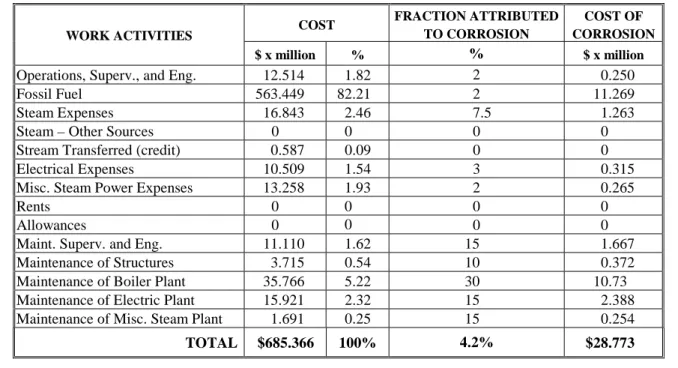
combined-cycle units use natural gas. The basis for estimation of the O&M costs is the annual financial data documented by Duke Power and reported to the Federal Energy Regulatory Commission (FERC). The percentage of O&M cost attributed was obtained through interviews with Duke Power subject matter experts. Tables 4 and 5 show the 16 cost categories, which are defined in the Code of Federal Regulations.(6) The tables indicate that the majority of the production costs for the coal plants and combined-cycle plants are related to fuel costs, at approximately 82 and 83 percent, respectively. For the coal plants, the highest corrosion cost is for boiler
maintenance at 30 percent, followed by maintenance supervising and engineering, maintenance of the electric plant, and maintenance of the steam plant at 15 percent each. Ten percent is related to the maintenance of structures. For the combined-cycle plants, the highest corrosion costs are in maintenance of the electric plant and maintenance supervising and engineering at 15 percent each and maintenance of structures at 10 percent. The percentage of generating capacity of combined-cycle plants is about 4.3 percent of the total generating capacity.
Table 4. O&M activity costs for Duke Power’s coal-fired power plants.
COST FRACTION ATTRIBUTED TO CORROSION
COST OF CORROSION WORK ACTIVITIES
$ x million % % $ x million
Operations, Superv., and Eng. 12.514 1.82 2 0.250
Fossil Fuel 563.449 82.21 2 11.269
Steam Expenses 16.843 2.46 7.5 1.263
Steam – Other Sources 0 0 0 0
Stream Transferred (credit) 0.587 0.09 0 0
Electrical Expenses 10.509 1.54 3 0.315
Misc. Steam Power Expenses 13.258 1.93 2 0.265
Rents 0 0 0 0
Allowances 0 0 0 0
Maint. Superv. and Eng. 11.110 1.62 15 1.667
Maintenance of Structures 3.715 0.54 10 0.372
Maintenance of Boiler Plant 35.766 5.22 30 10.73
Maintenance of Electric Plant 15.921 2.32 15 2.388
Maintenance of Misc. Steam Plant 1.691 0.25 15 0.254
Table 5. O&M activity costs for Duke Power’s combined-cycle plants. COST FRACTION ATTRIBUTED TO CORROSION COST OF CORROSION WORK ACTIVITIES $ x million % % $ x million
Operations, Superv., and Eng. 0.523 1.41 2 0.010
Fossil Fuel 30.847 83.01 2 0.617
Steam Expenses 0 0 0 0
Steam – Other Sources 0 0 0 0
Stream Transferred (credit) 0.085 0.23 0 0
Electrical Expenses 1.890 5.09 3 0.057
Misc. Steam Power Expenses 0 0 0 0
Rents 0 0 0 0
Allowances 0 0 0 0
Maint. Superv. and Eng. 0.324 0.87 15 0.049
Maintenance of Structures 0.632 1.70 10 0.063
Maintenance of Boiler Plant 0 0 0 0
Maintenance of Electric Plant 2.951 7.94 15 0.443
Maintenance of Misc. Steam Plant 0 0 0 0
TOTAL $37.252 100% 3.3% $1.239
The total cost of corrosion in fossil stations with coal as fuel is estimated at $28.773 million and in combined-cycle plants at $1.239 million. Extrapolating these costs to the U.S. fossil fuel steam supply systems, using the ratio of Duke Power fossil fuel generating capacity, (4.3 percent) to the total U.S. fossil fuel generating capacity, results in $669.14 million ($28.773 million / 0.043) for the coal-fired plants and $28.81 million ($1.239 million / 0.043) for the combined cycle plants, for a total cost of corrosion of $698 million per year.
Hydraulic Production
Duke Power owns and operates 21 hydrostations. The individual power stations are relatively small, with a total generating capacity of 2.756 GW. As with the fossil fuel plants, the basis of the O&M costs is the annual financial data documented by Duke Power and reported to FERC. The percentage of the cost due to corrosion was estimated by Duke Power subject matter experts. Table 6 shows 11 cost categories, which are defined in the Code of Federal Regulations.(6) The highest costs are associated with electrical expenses at 26 percent, miscellaneous hydraulic power generation at 23 percent, and maintenance of reservoirs, dams, and waterways, and maintenance of the electric plant at 18 percent each. The highest corrosion cost is in the maintenance of the electric plant at 15 percent of the O&M cost. The electric plant includes waterwheels, turbines, and generators.
The total cost of corrosion in hydraulic power stations is estimated at $1.571 million. Extrapolating these costs to U.S. hydraulic power generation using the ratio of Duke Power hydraulic generating capacity (2.1 percent) to the total U.S. generating capacity results in a total cost of $75 million.
Table 6. O&M activity costs for Duke Power’s hydraulic plants.
COST FRACTION ATTRIBUTED TO CORROSION
COST OF CORROSION WORK ACTIVITIES
$ x million % % $ x million
Operations, Superv., and Engr. 0.967 4.49 2 0.019
Water for Power 0 0 0 0
Hydraulic Expenses 0.745 3.46 5 0.037
Electrical Expenses 5.712 26.51 5 0.286
Misc. Hydraulic Power Gen. Exp. 4.987 23.15 2 0.1
Rents 0.251 1.17 0 0
Maintenance Superv. and Engr. 0.493 2.29 12 0.059
Maintenance of Structures 0.057 0.26 10 0.006
Maint. of Reserv., Dams, Waterw. 3.855 17.89 10 0.386
Maintenance of Electric Plant 3.847 17.86 15 0.577
Maintenance of Misc. Hydr. Plant 1.014 4.71 10 0.101
TOTAL $21.928 100% 7.2% $1.571
Depreciation Costs by Facility Type
The depreciation costs are broken down by facility type using data compiled from FERC Form No. 1 reports for major investor-owned utilities for 1998.(7) In addition to facilities for fossil fuel, nuclear and hydraulic power production, power transmission, and power distribution, the FERC data identify intangible plant, general plant, and common plant categories, which are combined as “miscellaneous and general.” The hydraulic production plant category includes both conventional and pumped storage categories.
In the following sections, the fractions of depreciation due to corrosion are discussed for the different facility types. Increases in the original costs of these facilities due to corrosion result from two main factors: the increase in cost of individual items to make them more resistant to corrosion (e.g., increase in wall thickness and the use of more expensive material than carbon steel), and the use of redundant equipment to allow for downtime to
accommodate corrosion-induced inspections, maintenance, and repairs. For all facility types, corrosion of property is considered to have no impact on the capital cost of land. Property is thus assigned a corrosion fraction of 0 percent.
Structures of all facilities include reinforced and prestressed concrete buildings, meta- roofed and metal-sided buildings, reinforced concrete docks, intake and discharge structures, etc. The main effects of corrosion on the capital costs of these items for all facilities are for initial protective coatings and for the use of more
corrosion-resistant materials (e.g., aluminum siding versus steel sheet siding). Based on industry experience, the increase in cost due to corrosion of these facilities is about 2 percent.
Nuclear Steam Production
A detailed breakdown of capital costs for nuclear steam production plants provided in a Nuclear Regulatory Commission (NRC) report, is used as the basis for the analysis given below.(8) The estimated effect of corrosion on each of the major categories of structures, equipment, and property under Nuclear Steam Production facilities is discussed below.
Reactor Vessel and Reactor Coolant System (Nuclear Steam Supply System): Corrosion affects the initial cost of the reactor coolant system by requiring the use of either corrosion-resistant materials or corrosion-resistant cladding. Water chemistry control equipment that is used to control corrosion of the system and core is also an extra cost due to corrosion. This equipment includes make-up water purification equipment, letdown heat exchangers, demineralizers, and chemistry laboratory and chemistry monitoring equipment. Another design feature required mostly as a result of corrosion is the accommodation of post-shutdown radiation levels caused by the spread of irradiated corrosion products (crud). This requires many design features to provide shielding and to accommodate semi-remote maintenance. It is estimated that corrosion increases the cost of the reactor coolant system, including associated water chemistry control, by 20 percent.
Reactor Auxiliary Systems: Reactor auxiliary systems include emergency injection systems, chemical and volume control systems, radioactive waste treatment systems, etc. The radioactive waste treatment system is required mainly because of corrosion, i.e., to treat crud produced by corrosion. The other systems have to be made of corrosion-resistant materials in order to minimize the input of corrosion products into the core. It is estimated that corrosion increases the cost of these systems by 20 percent.
Turbine Generator System: Corrosion affects the turbine generator system mainly by requiring the design to be modified to prevent stress corrosion and corrosion fatigue of rotors, disks, blades, and bolting. This requires use of more resistant materials, tighter control of water chemistry, and special design features to reduce stresses and eliminate crevices (e.g., use of monoblock design versus shrunk-on-disk design). These features are estimated to increase the cost of the equipment by 20 percent.
Heat Exchangers and Piping: Corrosion, including erosion-corrosion or environmentally assisted cracking, affects the cost of heat exchangers, such as condensers, feedwater heaters, and moisture separators, by: (1) requiring the use of more corrosion-resistant materials (e.g., copper alloys, stainless steels, or titanium versus carbon steel) in many applications, (2) placing limits on flow velocities if carbon steel or copper are used, thereby increasing equipment size, (3) requiring the installation of flow baffles to prevent impingement effects, and (4) increasing required wall thicknesses to allow for corrosion, thereby decreasing efficiency and increasing original equipment size. For heat exchangers cooled using raw service-water, corrosion control concerns often require installation of water treatment systems (e.g., for biocides, or even the use of dual systems, with only one heat exchanger exposed to raw water and the other cooled using a closed cooling water system). For condensers, corrosion concerns often require the installation of sponge ball cleaning systems. These features are estimated to increase the cost of heat exchangers by 20 percent.
Corrosion, including erosion-corrosion or environmentally assisted cracking, affects piping systems by: (1) requiring thicker walls to provide corrosion allowances, (2) requiring the use of more corrosion-resistant materials in some areas, especially steam drains, (3) requiring the use of more corrosion-resistant materials for special applications such as valve seats and trim, and (4) requiring the use of more stress corrosion- and corrosion fatigue-resistant materials for special parts such as pump shafts, valve stems, and bolting. These features are estimated to increase the cost of piping systems by 10 percent.
The total effect of corrosion on heat exchangers and piping is estimated at 15 percent.
Electric Power and Instrumentation and Control: Corrosion affects the costs of electric power and
instrumentation and control equipment mainly by requiring design features to exclude corrosive atmospheres and the use of special materials for some corrosion-sensitive parts, such as switches. These features are estimated to increase costs by 5 percent.
Miscellaneous Power Plant Equipment: This equipment includes the main condenser heat removal system, cranes for lifting and moving waterwheels and electric generators for maintenance, and machine shop equipment. Corrosion affects the original cost of this equipment by requiring the use of protective coatings and some design features to protect sensitive parts. These features are estimated to increase costs by 2 percent. Compiled corrosion cost estimates for nuclear steam production plants based on the above discussion are shown in table 7.
Table 7. Percentage of corrosion-related depreciation costs for nuclear steam production plants.
CATEGORY PLANT COST % CORROSION EFFECT, % OF PLANT COST WEIGHTED % OF CORROSION EFFECT Property 0.5 0 0.0
Structures, inc. Containment 26.3 2 0.5
Reactor Vessel & Reactor Core System 18.5 20 3.7
Reactor Auxiliary Systems 9.0 20 1.8
Turbine Generator 19.5 20 3.9
Heat Exchangers & Piping 7.0 15 1.1
Electric Power & Instrumentation, and
Controls 11.5 5 0.6
Misc. Power Plant Equipment 7.7 2 0.2
TOTAL 100% 11.8%
Fossil Fuel Steam Production
A detailed breakdown of capital costs for fossil fuel steam production plants is provided in an NRC report and is used as the basis for the analysis given below.(7)
Boiler: Corrosion affects the initial cost of the boiler by requiring the use of thicker walls on the carbon steel-tubed water walls and by requiring the use of more expensive corrosion-resistant materials for the superheater and reheater tubes. However, use of the more expensive materials is also required to provide creep resistance; thus, the entire extra cost is not chargeable to corrosion. Water chemistry control equipment that is used to control corrosion of the boiler materials is also an extra cost due to corrosion. This equipment includes make-up water purification equipment, condensate demineralizers, and chemistry laboratory and chemistry monitoring equipment. It is estimated that corrosion increases the cost of boilers, including water chemistry control systems, by 10 percent. Turbine-Generator System: Corrosion affects the turbine generator system mainly by requiring the design to be modified to prevent stress corrosion and corrosion fatigue of rotors, disks, blades, and bolting. This requires use of more resistant materials (e.g., alloy 17-4 PH versus carbon steel for blades), tighter control of water chemistry, and special design features to reduce stresses and eliminate crevices (e.g., use of monoblock design versus shrunk-on-disk design). These features are estimated to increase the cost of the equipment by 20 percent.
Heat Exchangers and Piping: Corrosion, including erosion-corrosion or environmentally assisted cracking, affects the cost of heat exchangers, such as condensers, feedwater heaters, and moisture separators, by: (1) requiring the use of more corrosion-resistant materials (e.g., copper alloys, stainless steels, or titanium versus carbon steel) in many applications, (2) placing limits on flow velocities if carbon steel or copper are used, thereby increasing equipment size, (3) requiring installation of flow baffles to prevent impingement effects, and (4) increasing required wall thicknesses to allow for corrosion, thereby decreasing efficiency and increasing original equipment size. For heat exchangers cooled using raw service-water, corrosion control concerns often require installation of water treatment systems (e.g., for biocides, or even the use of dual systems, with only one heat exchanger exposed to raw water and the other cooled using a closed cooling water system). For condensers, corrosion concerns often require the installation of sponge ball cleaning systems. These features are estimated to increase the cost of heat exchangers by 20 percent.
Corrosion, including erosion-corrosion or environmentally assisted cracking, affects piping systems by: (1) requiring thicker walls to provide corrosion allowances, (2) requiring the use of more corrosion-resistant materials in some areas, especially steam drains, (3) requiring the use of more corrosion-resistant materials for special applications such as valve seats and trim, and (4) using more stress corrosion- and corrosion fatigue-resistant materials for special parts, such as pump shafts, valve stems, and bolting. These features are estimated to increase the cost of piping systems by 10 percent.
The total effect of corrosion on heat exchangers and piping is estimated at 15 percent.
Coal-Handling Equipment: This equipment includes conveyor belts, pulverizers, and similar equipment. Corrosion is considered to have little impact on this equipment since most of the problems, and thus the design, are dominated by mechanical wear and fatigue. However, some original cost increase does result from the need for coatings. The corrosion impact on this equipment is estimated as 1 percent.
Flue Gas Systems: Flue gas systems, especially the wet flue gas desulfurization systems, are strongly affected by corrosion because of the corrosive nature of flue gas impurities (e.g., sulfur dioxide). This requires use of expensive corrosion-resistant materials for the scrubber equipment, such as the nickel-base alloys C-276 and C-22. It is estimated that flue gas systems with scrubbers are increased in cost by 50 percent as a result of corrosion.
Ash-Handling Equipment: Ash-handling equipment takes ash from the bottom of the boiler and transports it to locations where it can be transferred to off-site storage. The ash is typically handled as a water slurry to allow pumping or similar transport. While the slurries are corrosive, they are typically designed using carbon steels and are not affected much by anti-corrosion design considerations. The relatively small consideration given to corrosion is estimated to increase the cost of the equipment by 5 percent.
Electric Power and Instrumentation and Control: Corrosion affects the costs of electric power and
instrumentation and control equipment mainly by requiring design features to exclude corrosive atmospheres and the use of special materials for some corrosion-sensitive parts, such as switches. These features are estimated to increase costs by 5 percent.
Miscellaneous Power Plant Equipment: This equipment includes the main condenser heat removal system, cranes for lifting and moving waterwheels and electric generators for maintenance, and machine shop equipment. Corrosion affects the original cost of this equipment by requiring the use of protective coatings and some design features to protect sensitive parts. These features are estimated to increase costs by 2 percent.
Compiled corrosion cost estimates for fossil fuel steam production plants based on the above discussion are shown in table 8. The values in the “Percent of Plant Cost” column are based on estimates contained in capital costs for a coal plant with flue gas desulfurization equipment, which were taken from a report developed for the NRC.(9)
Table 8. Percentage of corrosion-related depreciation costs for fossil fuel plants.
CATEGORY PLANT COST % CORROSION EFFECT, % OF PLANT COST WEIGHTED % OF CORROSION EFFECT Property 0.7 0 0.0 Structures 13.8 2 0.3 Boiler 23.9 10 2.4 Turbine Generator 16.3 20 3.3
Heat Exchangers & Piping 7.2 15 1.1
Coal-Handling Equipment 3.1 1 0.0
Flue Gas Systems 13.8 50 6.9
Ash-Handling Systems 1.8 5 0.1
Electric Power & I&C 11.8 5 0.6
Misc. Power Plant Equipment 7.6 2 0.2
Hydraulic Production (Including Pumped Storage)
The types of structures, equipment, and property included in this category are land; structures and improvements (e.g., office buildings); reservoirs, dams, and waterways; waterwheels, turbines, and generators; accessory electric equipment; miscellaneous power plant equipment; and roads, railroads, and bridges. The effect of corrosion on each of the major categories of structures, equipment, and property for hydraulic plants is discussed below.
Reservoirs, Dams, and Waterways: The main impact of corrosion on the original costs of these items is for initial protective coatings on reinforcing bars, and design and fabrication provisions to minimize corrosion of rebar, forms, etc. during the construction process. The estimated increase in cost due to corrosion is 1 percent.
Waterwheels, Turbines, and Generators: Corrosion affects waterwheels, turbines, and associated piping systems (e.g., valves) by requiring the use of corrosion- and erosion-corrosion-resistant materials such as specialty grades of stainless steels (e.g., Nitronic 60) for either the pressure boundary or for trim.(10) The electric generator is affected by the need to have a chemistry control system for the cooling water system, and by the need for protective coatings for steel parts. These features are estimated to increase the cost of the equipment by 10 percent.
Accessory Electric Equipment and Instrumentation and Control: Corrosion affects the costs of electric power and instrumentation and control equipment mainly by requiring design features to exclude corrosive atmospheres and the use of special materials for some corrosion-sensitive parts, such as switches. These features are estimated to increase costs by 5 percent.
Miscellaneous Power Plant Equipment: This equipment includes cranes for lifting and moving waterwheels and electric generators for maintenance, and machine shop equipment. Corrosion affects the original cost of this equipment by requiring the use of protective coatings and some design features to protect sensitive parts. These features are estimated to increase costs by 2 percent.
Roads, Railroads, and Bridges: Corrosion affects the original cost of this equipment by requiring the use of protective coatings, and some design features to provide for drainage to minimize water-induced corrosion. These features are estimated to increase costs by 2 percent.
Compiled corrosion cost estimates for hydroelectric production plants, including pumped storage, based on the above discussion are shown in table 9.
Table 9. Percentage of corrosion-related depreciation costs for hydraulic production plants.
CATEGORY % OF PLANT COST CORROSION EFFECT, % OF PLANT COST WEIGHTED % OF CORROSION EFFECT Property 10 0 0.0 Structures 5 2 0.1
Reservoirs, Dams, & Waterways 40 1 0.4
Waterwheels, Turbines, & Generators 25 10 2.5
Electric Power & I&C 5 5 0.3
Misc. Power Plant Equipment 5 2 0.1
Roads, Railroads, & Bridges 10 2 0.2
Other Production
The types of structures, equipment, and property included in this category are land, structures and improvements (e.g., office buildings), fuel holders and accessories, prime movers (e.g., diesels, combustion turbines), generators, accessory electric equipment, and miscellaneous power plant equipment. The effect of corrosion on each of the major categories of structures, equipment, and property is discussed below.
Fuel Holders and Accessories: Corrosion affects the initial cost of fuel oil tanks and oil pumping equipment by requiring the use of protective coatings and a small amount of water detection and removal equipment. It is
estimated that corrosion increases the cost of this category by 3 percent.
Prime Movers: Corrosion affects the cost of combustion turbines (the main prime mover in this category) by requiring the use of more corrosion-resistant materials. This is estimated to increase the cost of the equipment by 5 percent.
Generators: Corrosion affects the cost of generators by requiring the use of more corrosion-resistant materials (copper alloys) for the cooling system and by requiring a water chemistry control system for the cooling system. In addition, coatings are used on steel parts to provide resistance to corrosion for the casing and support structure. These features are estimated to increase the cost of the equipment by 5 percent.
Electric Power and Instrumentation and Control: Corrosion affects the costs of electric power and I&C equipment mainly by requiring design features to exclude corrosive atmospheres and the use of special materials for some corrosion-sensitive parts, such as switches. These features are estimated to increase costs by 5 percent.
Miscellaneous Power Plant Equipment: This equipment includes cranes for lifting and moving waterwheels and electric generators for maintenance, and machine shop equipment. Corrosion affects the original cost of this equipment by requiring the use of protective coatings and some design features to protect sensitive parts. These features are estimated to increase costs by 2 percent.
Compiled corrosion cost estimates for other production plants based on the above discussion are shown in table 10.
Table 10. Percentage of corrosion-related depreciation costs for “other” facilities.
CATEGORY % OF PLANT COST CORROSION EFFECT, % OF PLANT COST WEIGHTED % OF CORROSION EFFECT Property 10 0 0.0 Structures 15 2 0.3
Fuel Holders and Accessories 10 3 0.3
Prime Movers 30 5 1.5
Generators 25 5 1.3
Electric Power & I&C 5 5 0.3
Misc. Power Plant Equipment 5 2 0.1
Transmission
The types of structures, equipment, and property included in this category are land, structures and
improvements (e.g., office buildings), switchyard equipment, overhead towers, poles and conductors, underground conductors and equipment, and roads and trails. The effect of corrosion on each of the major categories of structures, equipment, and property for transmission facilities is discussed below.
Switchyard Equipment: Corrosion affects the initial cost of transformers and switching equipment by requiring the use of protective enclosures, protective coatings, and more corrosion-resistant materials for some applications. It is estimated that corrosion increases the cost of this category by 5 percent.
Overhead Towers, Poles, and Conductors: Corrosion affects the cost of this equipment by requiring the use of more corrosion-resistant materials, protective coatings, and cathodic protection systems for towers. This is
estimated to increase the cost of the equipment by 5 percent.
Underground Conductors and Equipment: Corrosion affects the cost of this equipment by requiring the use of protective coatings and cathodic protection systems. These features are estimated to increase the cost of the equipment by 10 percent.
Roads and Trails: Corrosion is considered to have no impact on roads and trails. This category is thus assigned a corrosion fraction of 0 percent.
Compiled corrosion cost estimates for transmission plants based on the above discussion are shown in table 11.
Table 11. Percentage of corrosion-related depreciation costs for transmission facilities.
CATEGORY % OF PLANT COST CORROSION EFFECT, % OF PLANT COST WEIGHTED % OF CORROSION EFFECT Property 15 0 0.0 Structures 10 2 0.2 Switchyard Equipment 10 5 0.5
Overhead Towers, Poles, and Conductors 50 5 2.5
Underground Conductors and Equipment 10 10 1.0
Roads and Trails 5 0 0.0
TOTAL 100% 4.2%
Distribution
The types of structures, equipment, and property included in this category are land; structures and improvements (e.g., office buildings); switchgear and batteries, overhead towers, poles, and conductors; underground conductors and equipment; transformers, connecting wires, meters, and connections; and street lighting. The effect of corrosion on each of the major categories of structures, equipment, and property for transmission plants is discussed below.
Switchgear and Batteries: Corrosion affects the initial cost of switching equipment and batteries by requiring the use of protective enclosures, protective coatings, and more corrosion-resistant materials for some applications. It is estimated that corrosion increases the cost of this category by 5 percent.
Overhead Towers, Poles, and Conductors: Corrosion affects the cost of this equipment by requiring the use of more corrosion-resistant materials, protective coatings, and cathodic protection systems for towers. This is
estimated to increase the cost of the equipment by 5 percent.
Underground Conductors and Equipment: Corrosion affects the cost of this equipment by requiring the use of protective coatings and cathodic protection systems. These features are estimated to increase the cost of the equipment by 10 percent.
Connecting Wires, Meters, and Connections: Corrosion requires the use of weathertight enclosures, protective coatings, and, in some applications, corrosion-resistant materials. These features are estimated to increase the cost of the equipment by 10 percent.
Compiled corrosion cost estimates for distribution facilities based on the above discussion are shown in table 12.
Table 12. Percentage of corrosion-related depreciation effect for distribution facilities.
CATEGORY % OF PLANT COST CORROSION EFFECT, % OF PLANT COST WEIGHTED % OF CORROSION EFFECT Property 10 0 0.0 Structures 10 2 0.2
Switchgear and Batteries 10 5 0.5
Overhead Towers, Poles, and Conductors 50 5 2.5
Underground Conductors and Equipment 10 10 1.0
Connecting Wires, Meters, and
Connections 10 10 1.0
TOTAL 100% 5.2%
General and Miscellaneous
The types of structures, equipment, and property included in this category are land, structures and
improvements (e.g., office buildings), office furniture and equipment, and tools and miscellaneous equipment of various types (e.g., shop, garage, laboratory, communications, and power-operated equipment). The effect of corrosion on each of the major categories of structures, equipment, and property for the general facilities is discussed below.
Property: Corrosion is considered to have no impact on land. Property is thus assigned a corrosion fraction of 0 percent.
Structures: Structures include reinforced concrete buildings, metal-roofed and metal-sided buildings, reinforced concrete docks, intake and discharge structures, etc. The main effects of corrosion on the costs of these items are for initial protective coatings and for the use of more corrosion-resistant materials (e.g. aluminum siding versus steel sheet siding). Based on industry experience, the increase in cost due to corrosion is approximately 2 percent.
Office Furniture and Equipment: Corrosion affects the initial cost of office furniture and equipment by requiring the use of protective coatings and more corrosion-resistant materials for a few applications. It is estimated that corrosion increases the cost of this category by 1 percent.
Tools and Miscellaneous Equipment: Corrosion affects the cost of this equipment by requiring the use of more corrosion-resistant materials, protective coatings, and weatherproof enclosures. This is estimated to increase the cost of the equipment by 5 percent.
Compiled corrosion cost estimates for general plants based on the above discussion are shown in table 13.
Table 13. Percentage of corrosion-related depreciation costs for general and miscellaneous facilities.
CATEGORY % OF PLANT COST CORROSION EFFECT, % OF PLANT COST WEIGHTED % OF CORROSION EFFECT Property 20 0 0.0 Structures 50 2 1.0
Office Furniture and Equipment 10 1 0.1
Tools and Miscellaneous Equipment 20 5 1.0
TOTAL 100% 2.1%
Summary of Corrosion Costs for Depreciation
Table 14 shows a summary of the depreciation costs, as calculated in the previous text. The table shows that the largest corrosion costs are incurred in nuclear and fossil fuel power generation, due to both the significant annual depreciation costs and the relatively large percentages of the cost attributed to corrosion. Power distribution systems and transmission systems have lower percentages; however, with their significant depreciation costs, there are still considerable corrosion costs. The corrosion costs for hydraulic and other power production are lower than for the other facility types, which is consistent with the smaller portion of the energy generated by those facilities.
Table 14. Summary of corrosion costs as part of depreciation costs by facility type for 1998 in the United States.
FACILITY TYPE 1998 DEPRECIATION COSTS ($ x billion) CORROSION EFFECT, % OF COST CORROSION COST ($ x billion)
Nuclear Steam Production 13.1 11.8 1.546
Fossil Fuel Steam Production 8.2 14.8 1.214
Hydraulic Production 0.9 3.6 0.032
Other Production 0.9 3.8 0.034
Transmission 2.7 4.2 0.113
Distribution 9.5 5.2 0.494
Miscellaneous and General - 2.1 -
TOTAL $35.3 9.73% $3.433
TOTAL COST OF CORROSION
The total direct cost of corrosion to U.S. electrical utilities owners can be divided into the corrosion fractions of forced outages, depreciation, and O&M. Table 15 shows the sum of these direct costs to be $6.889 billion per year.
Table 15. Summary of total cost of corrosion to the electrical utilities industry.
FACILITY REASON FOR CORROSION COST CORROSION COST PER YEAR ($ x billion) O&M 2.013 Depreciation 1.546 Forced Outage 0.670 Nuclear SUBTOTAL $4.229 O&M 0.698 Depreciation 1.214 Forced Outage 0 Fossil Fuel SUBTOTAL $1.912 O&M 0.075 Depreciation 0.066 Forced Outage 0
Hydraulic & Other Products
SUBTOTAL $0.141
O&M 0 Depreciation 0.607
Forced Outage 0
Transmission & Distribution
SUBTOTAL $0.607 TOTAL $6.889 billion
A study for the Electric Power Research Institute (EPRI)(4) to estimate the cost of corrosion for the electrical utilities industry estimated that the cost of corrosion to consumers of electricity was approximately $17.27 billion per year, which represents approximately 7.9 percent of the total cost of electricity to consumers of $218.4 billion. The significant difference in the direct cost of corrosion to the electrical utilities owners of $6.889 billion and the cost to consumers of approximately $17.27 billion can be attributed to overhead and management costs and taxes.
CASE STUDY
Buried Condenser Circulating Water Piping
The following case study is presented to illustrate the possible reductions in corrosion-related costs that can occur from appropriate corrosion management.(11)
The Oconee Nuclear Station has three 846-MW PWRs. The buried condenser circulating water (CCW) piping system for each unit consists of four circulating water pumps, which take cooling water from a lake; two 335-cm-
(132-in-) diameter intake lines, which are buried for most of their length; a 472-cm- (186-in-) diameter line in the turbine building; 198-cm- (78-in-) diameter feeders to and from the condensers; and two 335-cm- (132-in-) diameter discharge lines, which are buried for most of their length. Also, the CCW includes an emergency discharge line. The buried lines are coated on both the outside diameter (OD) and inside diameter (ID) surfaces with a 0.41-mm- (16-mil-) thick coal tar epoxy coating.
A review of operating records indicated that from 1992 to 1999, three through-wall leaks or holes had occurred in the CCW piping:
• In 1992, standing water was found in the transformer yard, with substantial amounts of water flowing down the turbine basement wall. The source of the water was found to be a small hole in the emergency discharge line. The root cause of the leak was determined to be galvanic or pitting corrosion at a pinhole in the exterior coating, possibly accelerated by the close proximity of copper grounding wires in the transformer yard.
• In 1997, a through-wall hole was detected in one of the discharge pipes. The 2.5-cm- (1-in-) diameter hole was found during routine removal of the internal coating. The hole, which was located in a deep portion of the piping, 10.7 m (35 ft) below the surface and a few feet from the reinforced concrete turbine wall, had developed from the outside.
• In 1999, a through-wall hole was detected in one of the discharge pipes during routine removal of the internal coating. Again, it was determined that the hole had developed from the outside.
The risk of these leaks/holes developing in the CCW piping could be significant. The buried CCW piping is essential for maintaining production. Parts of the piping deliver water required for response to accidents, so they are required to be operational at all times. Leaks that form in the intake sections of the buried CCW piping could require a plant shutdown. Leaks that are tolerable from a nuclear safety point of view, e.g., a leak in the discharge piping, might still be unacceptable because of the economic consequences of the leak. For example, a leak in the discharge piping could wash away the soil supporting the pipe, eventually resulting in a cave-in. Thus, the performance goals for the CCW piping are to operate with 100 percent availability during plant operation, not to cause plant shutdowns or power reductions, not to experience leakage, and to cost-effectively maintain the piping while meeting the first three goals.
The CCW piping is both internally and externally coated with coal tar epoxy. Where the pipe diameter is sufficiently large to allow it, the internal coating is periodically inspected, and deteriorated coatings are blasted off and replaced. This, however, cannot be done with the outside surface of the buried piping. An estimate was made of the future occurrence of leaks/holes if no preventive actions were taken by fitting the three failure data points to a two-parameter Weibull distribution (see table 16). The table indicates that leaks will occur at an increasing rate with increasing service life. Thus, unless corrective measures are taken, it was predicted that there will be an increasing number of through-wall leaks/holes from exterior corrosion, which may eventually result in costly shutdowns.
Table 16. Projected buried CCW pipe through-wall leak events.
SERVICE YEARS CUMULATIVE LEAKS ANNUAL RATE OF LEAKS 18 1 0.15 23 2 0.3 25 3 0.4 40 17 1.6 60 81 5.2
In order to address the anticipated CCW pipe through-wall leak/hole events, options to monitor and control the external corrosion were explored. Upon review of several inspection and corrosion control methods, ranging from nondestructive inspection techniques, such as magnetic flux leakage, pressure and hydrostatic testing, and
excavation of the pipe to recoat or replace, the following alternative approaches were selected for economic evaluation:
• Current maintenance practices of internal inspections and recoating of the internal surfaces of the large-diameter piping and fixing of the leaks as they occur.
• Cathodic protection program (for protection against corrosion on the external surfaces) added to the current maintenance plan.
• Current maintenance plan substantially extended to include nondestructive sampling
inspections (spot checks) of pipe wall thickness. These would be performed from the internal surface of the tube.
• Cathodic protection and nondestructive sampling inspections added to the current maintenance plan.
Cost inputs were estimated for the following options to monitor and control corrosion on the various piping systems. The uncertainty of these estimates is considered to be high, on the order of 50 percent less to 100 percent more than the dollar amounts presented in the following paragraphs.
Cathodic Protection Design, Installation, and Operation: The costs to design and install cathodic protection on the intake piping, discharge piping, and emergency discharge piping were assumed to be $100,000, $100,000, and $30,000, respectively. The annual costs to operate these piping systems were assumed to be $20,000, $20,000, and $6,000, respectively.
Inspections: The annual cost of current visual inspections of the internal surfaces of the large-diameter piping is $2,000. The cost of performing sampling type nondestructive evaluation (NDE) of the external surface of the large-diameter piping is estimated at $100,000 initial cost and $10,000 annually, divided equally between intake and discharge piping. The cost of visual inspection of the internal surfaces of the emergency discharge piping is
estimated at $100,000 initially, and $10,000 every 5 years. The cost of NDE of essentially all emergency discharge piping using smart pigs is estimated at an initial cost of $500,000, with an annual inspection cost of $10,000.
Failures: The cost of repairing a through-wall leak/hole is assumed to be $100,000. The cost of repairing an incipient leak, i.e. detected with NDE before the actual leak occurs, is assumed to be $50,000. The cost of repairing a major failure of an inlet or discharge pipe is assumed to be $2 million plus 10 days of lost production per event. The cost of repairing a major failure of the emergency discharge piping is assumed to be $1 million in indirect costs per anticipated event, with no lost production, and $500,000 in direct costs per anticipated event, with no lost production.
Preventive Repairs: The cost of recoating the inside surfaces of the inlet and discharge piping is assumed to be $2 million per unit, while the cost of recoating the internal surface of the emergency discharge piping is assumed to be $1 million.
Failure rates for the various piping systems, assuming different O&M approaches, were estimated with roughly the same uncertainty as the equivalent cost estimates. For example, for the case in which present practices are continued, the results of estimated rates of leak formation for the different piping systems are summarized in tables 17 and 18. The tables reflect the assumption that degradation of the coating and development of corrosion leaks/holes in the inlet pipe lag that of the discharge piping by a factor of two, because of lower temperatures.
Other failure rate estimates were made for piping with cathodic protection, sampling NDE, 100 percent remote NDE, and cathodic protection plus internal visual inspection. Finally, the probabilities of major failures and failures
at local repairs were determined for current practices and for the various other inspection and corrosion control approaches.
Table 17. Projected through-wall leak/hole events in large-diameter buried CCW discharge piping and buried emergency discharge piping.
SERVICE YEARS DISCHARGE PIPING (CUMULATIVE LEAKS/HOLES) EMERGENCY DISCHARGE PIPING (CUMULATIVE LEAKS/HOLES) 25 2 1 30 3.5 1.8 40 11 5.5 50 27 13 60 54 27
Table 18. Projected through-wall leak events in buried CCW intake piping.
SERVICE YEARS CUMULATIVE LEAKS/HOLES
37.5 2 45 3.3 60 11
Based on the estimated costs, failure rates, and failure probabilities, a life-cycle management economic model developed by EPRI (LCMVALUE, Version 1.0)(12) was used to calculate the net present value costs of the buried CCW piping for the life of the station, assumed to be 60 years. The results of the calculations are presented in table 19.
Table 19. Net present value costs for buried CCW piping ($ x thousand).
CASE PREVENTIVE MAINTENANCE CORRECTIVE MAINTENANCE LOST PRODUCTION CONSEQUENTIAL LOSS TOTAL
Large-Diameter Discharge Piping
Current Practices $609 $1,289 $395 $0 $2,293
Cathodic Protection $947 $129 $39 $0 $1,115
Sampling NDI $717 $548 $3 $0 $1,268
Emergency Discharge Piping
Current Practices $146 $584 $0 $0 $730
Cathodic Protection $247 $196 $0 $0 $443
100% Remote NDI $731 $292 $0 $0 $1,023