A KERNEL MAXIMUM UNCERTAINTY DISCRIMINANT
ANALYSIS AND ITS APPLICATION TO FACE RECOGNITION
Carlos Eduardo Thomaz
Department of Electrical Engineering, Centro Universitario da FEI, FEI, Sao Paulo, Brazil [email protected]
Gilson Antonio Giraldi
Department of Computer Science, National Laboratory for Scientific Computing, LNCC, Rio de Janeiro, Brazil [email protected]
Keywords: Non-linear discriminant analysis, limited sample size problems, face recognition.
Abstract: In this paper, we extend the Maximum uncertainty Linear Discriminant Analysis (MLDA), proposed recently for limited sample size problems, to its kernel version. The new Kernel Maximum uncertainty Discriminant Analysis (KMDA) is a two-stage method composed of Kernel Principal Component Analysis (KPCA) fol-lowed by the standard MLDA. In order to evaluate its effectiveness, experiments on face recognition using the well-known ORL and FERET face databases were carried out and compared with other existing kernel dis-criminant methods, such as Generalized Disdis-criminant Analysis (GDA) and Regularized Kernel Disdis-criminant Analysis (RKDA). The classification results indicate that KMDA performs as well as GDA and RKDA, with the advantage of being a straightforward stabilization approach for the within-class scatter matrix that uses higher-order features for further classification improvements.
1
INTRODUCTION
The primary purpose of Linear Discriminant Analy-sis (LDA) is to separate samples of distinct groups by maximizing their between-class separability while minimizing their within-class variability (Fukunaga, 1990; Devijver and Kittler, 1982).
However, in limited sample and high dimensional problems, such as face recognition, the within-class scatter matrix is either singular or mathematically un-stable and the standard LDA cannot be used to per-form the separating task. In the last years, a number of linear methods have been proposed to overcome this difficulty (Swets and Weng, 1996; Belhumeur et al., 1997; Chen et al., 2000; Yu and Yang, 2001; Yang and Yang, 2003; Thomaz et al., 2006), making LDA applicable to limited sample size problems that have been assumed to be linearly separable in the original space.
More recently, in order to make LDA applicable to non-linearly separable data as well, kernel-based methods have been applied. The main idea of kernel-based methods is to map the original input data to a feature space by a non-linear mapping where inner products in the feature space can be computed by a
kernel function without knowing the non-linear map-ping explicitly (Park and Park, 2005). Works in this area include the Kernel Principal Component Anal-ysis (KPCA) (Scholkopf et al., 1998), Generalized Discriminant Analysis (GDA)(Baudat and Anouar, 2000), and Regularized Kernel Discriminant Analy-sis (RKDA) (Lu et al., 2003), among others. In the specific case of GDA, it has been demonstrated in (Yang et al., 2004) that GDA is in fact equivalent to the two-stage method composed of KPCA followed by the standard LDA.
In this paper, we extend the Maximum uncer-tainty Linear Discriminant Analysis (MLDA) ap-proach (Thomaz et al., 2006), proposed recently for solving limited sample size problems in discriminant analysis, to its kernel or linear version. This non-linear version of MLDA, here called Kernel Maxi-mum uncertainty Discriminant Analysis (KMDA), is a two-stage method composed of Kernel Principal Component Analysis (KPCA) followed by the stan-dard MLDA. The effectiveness of KMDA is evaluated on face recognition through comparisons with KPCA, GDA and RKDA, using the well-known Olivetti-Oracle Research Lab (ORL) (Samaria and Harter, 1994) and FERET face databases (Phillips et al.,
1998). One advantage of the proposed method for face images is the possibility of improving classifica-tion performance by using more non-linear interme-diate features than pixels in the images. In addition, KMDA does not require the selection of parameters, like RKDA, for within-class scatter matrix stabiliza-tion.
The paper is organized as follows. In section 2 we review briefly the LDA and MLDA approaches. Then, in section 3, we explain how we have extended the MLDA approach to its non-linear version using the mathematical result described in (Yang et al., 2004). The set up of the experiments carried out in this work as well as the classification results on face recognition are presented respectively in sections 4 and 5, comparing the KMDA recognition rates with KPCA, GDA and RKDA. In section 6, we analyze and discuss the non-linear classification results of KMDA with the MLDA ones published in (Thomaz et al., 2006). Finally, in section 7, we conclude the pa-per, summarizing its main contribution and indicating possible future work.
2
LINEAR DISCRIMINANT
ANALYSIS (LDA)
Let the scatter matrices between-classSband
within-classSwbe defined, respectively, as
Sb= g
∑
i=1 Ni(xi−x)(xi−x)T (1) and Sw= g∑
i=1 (Ni−1)Si= g∑
i=1 Ni∑
j=1 (xi,j−xi)(xi,j−xi)T, (2) wherexi,j is then-dimensional pattern (or sample) jfrom classi,Niis the number of training patterns from
classi, andgis the total number of classes or groups. The vectorxi and matrixSi are respectively the
un-biased mean and sample covariance matrix of classi (Fukunaga, 1990). The grand mean vectorxis given by x= 1 N g
∑
i=1 Nixi= 1 N g∑
i=1 Ni∑
j=1 xi,j, (3)whereN is the total number of samples, that is,N=
N1+N2+. . .+Ng. It is important to note that the
within-class scatter matrixSwdefined in equation (2)
is essentially the standard pooled covariance matrix
Spmultiplied by the scalar(N−g), whereSpcan be
written as Sp= 1 N−g g
∑
i=1 (Ni−1)Si =(N1−1)S1+ (N2−1)S2+. . .+ (Ng−1)Sg N−g . (4) The main objective of LDA is to find a projection matrixWldathat maximizes the ratio of the determi-nant of the between-class scatter matrix to the deter-minant of the within-class scatter matrix (Fisher’s cri-terium), that is,Wlda=arg max
W WTSbW |WTS wW| . (5)
The Fisher’s criterium described in equation (5) is maximized when the projection matrix Wlda is
composed of the eigenvectors ofS−w1Sbwith at most (g−1) nonzero corresponding eigenvalues (Fuku-naga, 1990; Devijver and Kittler, 1982).
However, in limited sample and high dimensional problems, such as face recognition,Swis either
singu-lar or mathematically unstable and the standard LDA cannot be used to perform the separating task. To avoid both critical issues, Thomaz et al. have cal-culatedWldaby using a maximum uncertainty LDA-based approach (MLDA) that considers the issue of stabilizing theSwestimate with a multiple of the
iden-tity matrix (Thomaz et al., 2004; Thomaz et al., 2006). The MLDA algorithm can be described as fol-lows:
1. Find theΨeigenvectors andΛeigenvalues ofSp,
whereSp=NS−wg;
2. Calculate theSpaverage eigenvalueλ, that is,
λ=1 n n
∑
j=1 λj= Tr(Sp) n ; (6)3. Form a new matrix of eigenvalues based on the following largest dispersion values
Λ∗=
diag[max(λ1,λ),max(λ2,λ), . . . ,max(λn,λ)]; (7) 4. Form the modified within-class scatter matrix
S∗w=S∗p(N−g) = (ΨΛ∗ΨT)(N−g). (8)
The MLDA method is constructed by replacingSw
withS∗win the Fisher’s criterium formula described in equation (5).
3
A KERNEL MLDA (KMDA)
Since the non-linear mapping of the original space to a higher dimensional feature space would commonly lead to an ill-posed within-class scatter matrix, the aforementioned MLDA approach might be suitable for solving not only the singularity and instability is-sues of the linear Fisher methods, but also the Fisher discriminant analysis with kernels.
Let a non-linear function φ that maps the input
sample spaceRninto the feature spaceF, as follows: φ:x∈Rn→φ(x)∈F. (9)
The between-class and within-class scatter matri-ces in the feature spaceFcan be defined, respectively, as ˜Sb= g
∑
i=1 Ni(φi−φ)(φi−φ)T (10) and ˜Sw= g∑
i=1 Ni∑
j=1 (φ(xi,j)−φi)(φ(xi,j)−φi)T, (11)whereφiis the mean of the training samples of classi
mapped into the feature space, that is,
φi= 1 Ni Ni
∑
j=1 φ(xi,j), (12)andφis the grand mean vector of all the training sam-ples mapped into the feature space, that is,
φ= 1 N g
∑
i=1 Ni∑
j=1 φ(xi,j). (13)It is important to note that whenφ(x) =xequations (10) and (11) reduce to their corresponding linear ver-sions described in equations (1) and (2), respectively. Thus, according to the Fisher’s criterium de-scribed in equation (5), the kernel LDA projection matrix W˜lda can be determined by calculating the
eigenvectors of ˜S−1
w ˜Sbwith at most(g−1)nonzero
corresponding eigenvalues. These eigenvectors are then the optimal linear discriminant directions on the feature space, which represent non-linear discrimi-nant directions in the input sample space.
To extend the MLDA approach to its non-linear (or kernel) version, we need essentially to replace˜Sw
with˜S∗w, using the MLDA algorithm described in the previous section. One way to do this would be to perform the eigen-analyzes of ˜Sband ˜Sw in the
fea-ture space, as proposed in (Lu et al., 2003). Alterna-tively, we could use the more intuitive mathematical result described in (Yang et al., 2004). According to
Yang et al. (Yang et al., 2004), the kernel LDA is in fact equivalent to the two-stage method composed of KPCA (Scholkopf et al., 1998) followed by the stan-dard LDA.
Therefore, instead of solving the eigenvalue prob-lem of ˜Sb and ˜S∗w directly in the feature space, we
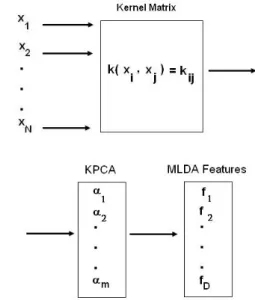
perform firstly KPCA (Scholkopf et al., 1998) in the input sample space, changing the dimension of fea-ture space tom, and next the standard MLDA to ex-tract the linear discriminant features in the non-linear transformed spaceRmgiven by the KPCA projection.
The whole process is summarized in Figure 1.
Figure 1: Pipeline of the KMDA method. Firstly, the ker-nel matrix is generated from input samples and KPCA is applied. Then, the standard MLDA is used to extract theD discriminant features in the space given by KPCA projec-tion, whereD≤(g−1).
The goal of KPCA is to diagonalize the covariance matrix ˜Sdefined as (Zheng et al., 2005):
˜S= 1 N g
∑
i=1 Ni∑
j=1 (φ(xi,j)−φ)(φ(xi,j)−φ)T. (14)For simplicity, let us suppose thatφ=0. So, we must find the eigenvectors v and the corresponding eigenvaluesλ≥0, solutions of the eigenequation:
λv=˜Sv. (15)
However, in kernel methods we do not know the functionφexplicitly but a kernelksuch thatk(x,y) = φ(x)T·φ(y). Thus, we must obtain a kernel version of expression (15). In fact, it can be shown that the eigenvectorsv can be written as follows (Scholkopf et al., 1998):
v= g
∑
i=1 Ni∑
j=1 αi jφ(xi,j) =F(X)α, (16) where F(X) = φ(x1,1)φ(x1,2)· · ·φ(xg,Ng) , and α=α11α12· · ·α1N1· · ·αg1αg2· · ·αgNg . By substi-tuting (16) into (15), we obtain the KPCA eigenvalue problem: Nλα=Kα, (17) whereK= kω,γ=k(xi,j,xs,t) , withω= j+Ni−1+ Ni−2+...+N1andγ=t+Ns−1+Ns−2+...+N1, is aN×Nmatrix called kernel matrix.
The proposed strategy, that is KPCA+MLDA or simply KMDA, is particularly useful when solving limited sample and high-dimensional problems, be-causem is upper bounded byN, i.e. m≤(N−1). Since the MLDA approach deals with the singular-ity and instabilsingular-ity of the within-class scatter matrix in such limited sample size situations, we have selected m= (N−1)to reproduce the total variability of the samples in the feature space.
4
EXPERIMENTS
To evaluate the effectiveness of KMDA on face recog-nition, comparisons with KPCA (Scholkopf et al., 1998), GDA (Baudat and Anouar, 2000), and RKDA (Lu et al., 2003), were performed using the well-known Olivetti-Oracle Research Lab (ORL) (Samaria and Harter, 1994) and FERET (Phillips et al., 1998) face databases. Figure 2 shows some samples of these datasets.
(a)
(b)
Figure 2: (a) A set of ten images of one subject from the ORL face database. (b) Sets of four images of two subjects from the FERET database.
We have implemented the KPCA, GDA and RKDA using the respective authors’ Matlab codes available at the following website: http://www.kernel-machines.org/software.
For simplicity, an Euclidean distance classifier was used to perform classification in the non-linear feature space. Also, we have used only the well-known Gaussian kernel
k(x1,x2) =exp(
−kx1−x2k2
δ ) (18)
to compute indirectly the non-linear transforma-tions, where the δ parameter range was taken to be [0.001,0.002,0.004,0.008,0.01, ...,1.0]times the di-mension of the input sample spacenfor all the afore-mentioned algorithms tested.
To determine the regularization parameter η of
the RKDA approach (Lu et al., 2003), experimen-tal analyzes were carried out based on the best clas-sification accuracy given the following parameter set[0.001,0.01,0.1,0.2, ...,0.9,0.99,0.999,1.0]. The best results were obtained whenη=0.001 for both
ORL and FERET experiments.
Each experiment was repeated 25 times using sev-eral features. Distinct training and test sets were ran-domly drawn, and the mean and standard deviation of the recognition rate were calculated. The classifica-tion of the ORL 40 subjects was computed using for each individual 5 images to train and 5 images to test. In the FERET database with 200 subjects, the train-ing and test sets were respectively composed of 3 and 1 frontal images.
Analogously to the experiments carried out in (Thomaz et al., 2006), to represent a recognition prob-lem where the within-class scatter matrix is singular, the ORL face images were resized to 32x32 pixels, that is, the total number of training observations was N =200 and the dimensionality of the original im-ages wasn=1024. The FERET images were resized to 16x16 pixels in order to pose an alternative pat-tern recognition problem where the within-class scat-ter matrix is non-singular but poorly estimated, i.e., N=600 andn=256.
5
RESULTS
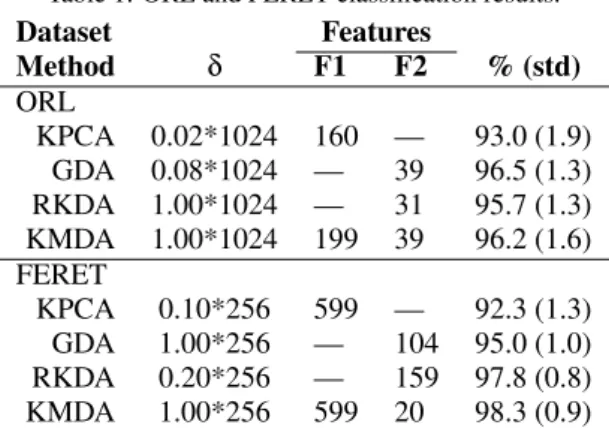
Table 1 shows the maximum test average recognition rates with standard deviation (std) of the ORL and FERET datasets over the Gaussian kernel parameter
δ, and the corresponding number of principal (F1)
and discriminant (F2) features. The notation ’—’ in the rows of Table 1 indicates that the corresponding method has been calculated using either F1 or F2
features, but not both. In fact, KMDA is the only discriminant kernel method investigated in this work that is explicitly composed of a two-stage non-linear transformation.
As we should expect, all non-linear discriminant methods (GDA, RKDA and KMDA) led to higher classification results than KPCA.
Table 1: ORL and FERET classification results.
Dataset Features Method δ F1 F2 % (std) ORL KPCA 0.02*1024 160 — 93.0 (1.9) GDA 0.08*1024 — 39 96.5 (1.3) RKDA 1.00*1024 — 31 95.7 (1.3) KMDA 1.00*1024 199 39 96.2 (1.6) FERET KPCA 0.10*256 599 — 92.3 (1.3) GDA 1.00*256 — 104 95.0 (1.0) RKDA 0.20*256 — 159 97.8 (0.8) KMDA 1.00*256 599 20 98.3 (0.9)
In the ORL experiments, the best classification result was reached by GDA (96.5%), followed by
KMDA (96.2%) and RKDA (95.7%). Given the
similarity of these recognition rates and their corre-sponding standard deviations, we cannot see clearly an overall best classification performance of any ker-nel discriminant method in these experiments. Since the ORL face database contains only 40 subjects to be separated, the discriminant features of the kernel Fisher-based methods were limited to 39 components. Although in such experiments, wheren(=1024)> N(= 200), the intermediate KPCA transformation of KMDA allows the within-class and between-class scatter matrices to be calculable in computers with a standard memory size, KMDA requires a two-stage final transformation that uses more features than the GDA and RKDA one-stage methods.
One advantage of using a non-linear two-stage method such as KMDA in limited sample and high dimensional problems can be seen in the FERET re-sults. In this case, the discriminant features of the ker-nel Fisher-based methods were limited to 199 compo-nents, because the FERET dataset contains only 200 subjects to be separated. However, sinceN(=600)> n(=256), the classification performance of KMDA can be further improved by using more non-linear in-termediate features (N−1=599) than there are pix-els in the 16x16 images. In this application, where the within-class scatter matrix was non-singular but poorly estimated, KMDA achieved the best classifi-cation accuracy (98.3%) using a higher-order KPCA transformation with 599 principal components
fol-lowed by an MLDA transformation composed of only 20 discriminant components.
Another KMDA advantage, comparing specifi-cally with the other regularized Fisher discriminant method RKDA, is the fact that KMDA is based on a straightforward stabilization approach for the within-class scatter matrix, avoiding the RKDA optimization for which the user has to select experimentally the bestηregularization parameter.
6
DISCUSSION
We have used the same ORL and FERET face databases and carried out the same training and test experiments described in (Thomaz et al., 2006) for the standard MLDA. So, it is possible to compare the classification results of KMDA with the ones pre-sented in (Thomaz et al., 2006) for MLDA.
Table 2 highlights the MLDA maximum test aver-age recognition rates with standard deviation (std) of the ORL and FERET datasets over the corresponding number of principal (F1) and discriminant (F2) fea-tures, as published in (Thomaz et al., 2006), and also the KMDA results described previously in Table 1.
Table 2: MLDA versus KMDA classification results.
Dataset Features Method F1 F2 % (std) ORL MLDA — 39 95.8 (1.6) KMDA 199 39 96.2 (1.6) FERET MLDA — 10 95.4 (1.4) KMDA 599 20 98.3 (0.9)
As can be seen, for the ORL dataset with face im-ages resized to 32x32 pixels, there is no significant classification improvement in using KMDA rather than MLDA in these experiments, because the corre-sponding MLDA and KMDA recognition rates (and standard deviations) are very similar. In such small sample and high-dimensional problem, where the two-stage KMDA could not extract higher-order fea-tures becauseN(=200)<n(=1024), MLDA seems the best choice because it is simpler and much faster to compute.
However, the superiority of KMDA compared to MLDA is clear in the FERET dataset with face im-ages resized to 16x16 pixels. The KMDA classi-fier performed better than its linear version, achiev-ing a higher maximum average classification accuracy with lower standard deviation. In these experiments,
KMDA outperformed MLDA by seeking discrimi-nant hyperplanes not in the 256-dimensional origi-nal space, but in a much higher 599-dimensioorigi-nal fea-ture space composed of non-linear transformations of the original pixels. In such limited sample and high-dimensional problem, whereN(=600)>n(=256), it seems that we can further improve the classification accuracy by exploring more features than is possible in the linear case.
7
CONCLUSION
In this work, we extended the MLDA approach to its non-linear version. This non-linear version of MLDA, here called KMDA, is a KPCA+MLDA two-stage method. To evaluate the KMDA effectiveness, ex-periments on face recognition using the well-known ORL and FERET face databases were carried out and compared with other existing kernel discrimi-nant methods, such as GDA and RKDA. The classi-fication results indicate that KMDA performs as well as GDA and RKDA, with the advantages of being a straightforward stabilization approach for the within-class scatter matrix that uses a pre-defined number of higher-order features whenever the number of train-ing samples is larger than the original dimensionality of the input data.
As future work, we intend to directly regularize the eigen-analysis of the within-class scatter matrix in the feature space, without a KPCA intermediate step.
ACKNOWLEDGEMENTS
The authors would like to thank the support provided by PCI-LNCC, FAPESP (2005/02899-4), CNPq (472386/2007-7) and CAPES (094/2007). Also, por-tions of the research in this paper use the FERET database of facial images collected under the FERET program.
REFERENCES
Baudat, G. and Anouar, F. (2000). Generalized discriminant analysis using a kernel approach. Neural Computa-tion, 12(10):2385–2404.
Belhumeur, P. N., Hespanha, J. P., and Kriegman, D. J. (1997). Eigenfaces vs. fisherfaces: Recognition us-ing class specific linear projection. IEEE Transac-tions on Pattern Analysis and Machine Intelligence, 19(7):711–720.
Chen, L., Liao, H., Ko, M., Lin, J., and Yu, G. (2000). A new lda-based face recognition system which can solve the small sample size problem. Pattern Recog-nition, 33(10):1713–1726.
Devijver, P. and Kittler, J. (1982).Pattern Classification: A Statistical Approach. Prentice-Hall.
Fukunaga, K. (1990). Introduction to Statistical Pattern Recognition. Morgan Kaufmann, San Francisco, 2nd edition.
Lu, J., Plataniotis, K. N., and Venetsanopoulos, A. N. (2003). Face recognition using kernel direct discrimi-nant analysis algorithms. IEEE Transactions on Neu-ral Networks, 14(1):117–126.
Park, C. H. and Park, H. (2005). Nonlinear discriminant analysis using kernel functions and the generalized singular value decomposition. SIAM J. Matrix Anal. Appl., 27(1):87–102.
Phillips, P. J., Wechsler, H., Huang, J., and Rauss, P. (1998). The feret database and evaluation procedure for face recognition algorithms.Image and Vision Computing, 16:295–306.
Samaria, F. and Harter, A. (1994). Parameterisation of a stochastic model for human face identification. In Proceedings of 2nd IEEE Workshop on Applications of Computer Vision.
Scholkopf, B., Smola, A., and Muller, K.-R. (1998). Non-linear component analysis as a kernel eigenvalue prob-lem.Neural Computation, 10(5):1299–1319. Swets, D. L. and Weng, J. J. (1996). Using
discrimi-nant eigenfeatures for image retrieval. IEEE Trans-actions on Pattern Analysis and Machine Intelligence, 18(8):831–836.
Thomaz, C. E., Gillies, D. F., and Feitosa, R. Q. (2004). A new covariance estimate for bayesian classifiers in biometric recognition.IEEE Transactions on Circuits and Systems for Video Technology, Special Issue on Image- and Video-Based Biometrics, 14(2):214–223. Thomaz, C. E., Kitani, E. C., and Gillies, D. F. (2006). A
maximum uncertainty lda-based approach for limited sample size problems - with application to face recog-nition. Journal of the Brazilian Computer Society, 12(2):7–18.
Yang, J., Jin, Z., yu Yang, J., Zhang, D., and Frangi, A. F. (2004). Essence of kernel fisher discriminant: Kpca plus lda.Pattern Recognition, 37:2097–2100. Yang, J. and Yang, J. (2003). Why can lda be performed in
pca transformed space?Pattern Recognition, 36:563– 566.
Yu, H. and Yang, J. (2001). A direct lda algorithm for high dimensional data - with application to face recogni-tion. Pattern Recognition, 34:2067–2070.
Zheng, W., Zou, C., and Zhao, L. (2005). An improved al-gorithm for kernel principal component analysis. Neu-ral Process. Lett., 22(1):49–56.