p.S. chubik
certification and registration Based
on the apEc EnginEEr rEgiStEr
international Standard
National Research Tomsk Polytechnic University
Petr S. Chubik, Alexander I. Chuchalin, Alexander V. Zamyatin
iintErnational EXpEriEncE
the two-tier system of education (Bachelor - Master), as an integral part of the higher education in a number of developed countries rely heavily on the two-level system of quality assurance in engineering education. While the first step implies the accreditation of engi-neering programmes at universities, the second one deals with the certification and registration of professional engineers by independent, non-governmental public professional organizations (such as aBEt in the usa, EcuK in great Britain, JaBEE in Japan, etc.) which use a number of relevant procedures and criteria [1].
as a rule, the basis of such criteria and procedures is a law on professional engineering activities in a country that regulates the rights and responsibilities of professional engineers, establishing
the rules of maintaining national register of professional engineers, defining the qualifications of engineers and the procedure for evaluation, certification and registration. in some countries, legislation governing practical enginee-ring activities, does not apply to federal jurisdiction.
for example, in germany, such laws are within the competence of the particular land (the law on engineering activities in lower saxony [2], Branden-burg [], etc.) in the u.s. a.-within the competence of the state (normative documents regulating engineering activi-ties in texas [4] Mississippi [5], etc.).
one of the leading centers for international recognition of professional engineers is the aPEc Engineer re-gister, established by the international organization for asia-Pacific Economic cooperation (aPEc) to ensure profes-sional mobility of engineers in member
the quality assurance system in engineering education based on the
certification and registration of professional engineers has proved its
efficiency in a large number of developed countries all over the world.
international experience on the matter and the first results in the attempt
to develop a similar system in russia on the base of the international
standard apEc Engineer register are presented in the article.
a.i. chuchalin
6’2010
51
National Research Tomsk Polytechnic University
Petr S. Chubik, Alexander I. Chuchalin, Alexander V. Zamyatin
economies (usa, canada, china, Japan, australia, etc.). until recently, russia, being a member of asia-Pacific Eco-nomic cooperation, was not a part of aPEc Engineer register system thereby limiting the competitiveness of russian experts in the field of engineering and technology.
according to the aPEc Engineer Manual the title of “aPEc Engineer” is awarded to those applicants, who suc-cessfully passed examinations and match the following criteria:
applicant should be a graduate of HEi who completed an accredited education.
applicant shall have the right to carry out individual engineering activity.
applicant should have not less than 7 years of engineering prac-tice dealing with a complex and innovation problem and not less than 2 years of experience working as an executive manager carrying out an engineering project. applicant should continuously develop professional skills and knowledge.
applicant shall adhere to the code of aPEc Engineer Professional Ethics.
firSt rESultS in ruSSia
in connection with the reforms based on a shift to the two-tier system of education in the field of engineering and technology as well, russia needs to maintain a special status for those en-gaged in practical engineering activities within the national system of certifica-tion and registracertifica-tion of professional engineers [6].
in 2008, russian association for Engineering Education (raEE), acting as the Washington accord associated member, received an official proposal to join the aPEc Engineer register, which allows it to award the title of “aPEc Engineer” to russian specialists in engi-neering and technology.
registration of engineers in the aPEc Engineer register is carried out on the basis of the aPEc Engineer Manual procedures and entails recognition of their competencies meeting international standards and complying with the crite-ria of the aPEc Engineer agreement [7].
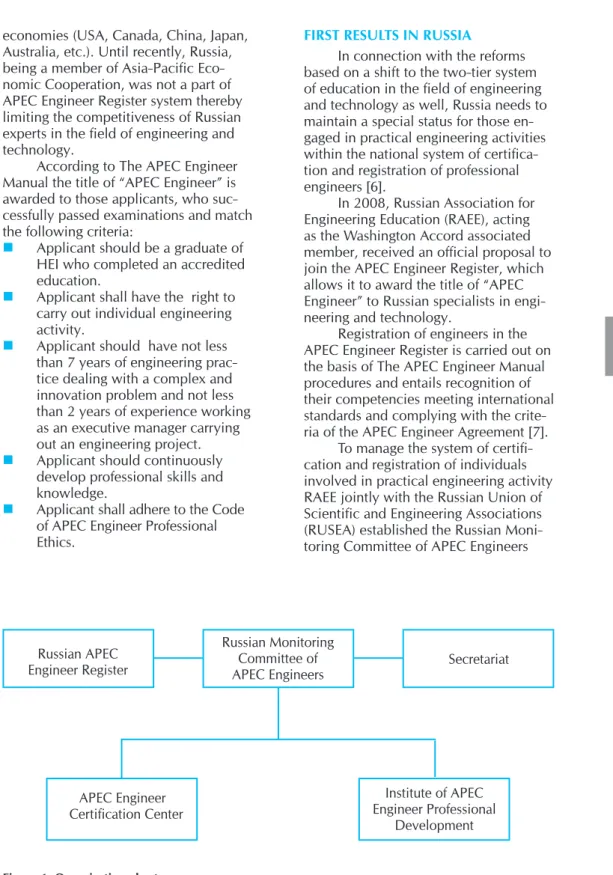
to manage the system of certifi-cation and registration of individuals involved in practical engineering activity raEE jointly with the russian union of scientific and Engineering associations (rusEa) established the russian Moni-toring committee of aPEc Engineers
figure 1. organisation chart
the system of certification and registration in the russian apEc Engineer register russian aPEc
Engineer register
russian Monitoring committee of
aPEc Engineers secretariat
aPEc Engineer certification center
institute of aPEc Engineer Professional
6’2010
52
in compliance with the aPEc Engineer Manual. it consists of representative legislative and executive authorities, public and professional organizations, universities and research institutions. figure 1 presents the organization chart of the system.
the russian Monitoring commit-tee of aPEc Engineers developed and approved guidelines and documents regulating functioning of the system [7]:
regulations on certification and registration in the russian aPEc Engineer register and international aPEc Engineer register;
list of practical activities of aPEc Engineers in russia;
aPEc Engineer standard; regulation on evaluation proce-dure of practical engineering acti-vity indicators for their compliance with the aPEc Engineer standard; regulation on examination of com-petences necessary for carrying out the individual practical enginee-ring activity in a certain discipline within the framework of the aPEc Engineer standard;
list of transferable, professional and special competences necessary for carrying out individual practical engineering activity in accordance with the aPEc Engineer standard; form of aPEc Engineer certificate; form of presenting personal data and indicators of practical activi-ties of the Engineer in the russian aPEc Engineer register;
regulation on suspending and termination of engineer’s registra-tion in the russian aPEc Engineer register and the international aPEc Engineer register; code of aPEc Engineer Profes-sional Ethics;
application form for registration within the russian aPEc Engineer register and the international aPEc Engineer register;
regulation on the арес Engineer certification center;
regulation on the institute of aPEc Engineers Professional develop-ment.
certification and registration of a person involved in practical engineering activity on the territory of the russian federation is carried out according to the following 12 areas agreed with the aPEc Engineer Manual:
aerospace Engineering Bioengineering chemical Engineering civil Engineering Environmental Engineering Electrical Engineering geotechnical Engineering information Engineering Mechanical Engineering Mining Engineering Petroleum Engineering transportation Engineering
the web site of the aPEc Engineer certification center was created within the web portal of national research tomsk Polytechnic university (www. tpu.ru), where all regulating documents and the description of the certification and registration system are available. the possibility of the active communication with the stakeholders - applicants who seek certification and registration in the russian aPEc Engineer and the international aPEc Engineer register is foreseen.
in accordance with the aPEc register regulations an applicant for the title of “aPEc Engineer” fills in and sends an application form to the secretariat of the russian Monitoring committee of aPEc Engineers together with the electronic copies of the accompanying documents confirming indicators of his/her professional competence and engineering practice. the secretariat verifies the accuracy of the presented information and compares it against the criteria of the aPEc Engineer standard and sends the documents to the aPEc Engineer certification center. the certification center sets the Examination Boards
6’2010
5
to check transferable, professional and special competencies in various disciplines of engineering activity. the examination consists of two stages - written and oral (interview) forms.
the results of the written examinations are sent to the certification center, which decides whether engineering practice indicators of the applicant comply with the aPEc Engineer standard. the decision of the certification is approved by the russian Monitoring committee of aPEc Engineers. if the decision is positive, the personal data and indicators of practical engineering activity of the applicant are recorded in the russian aPEc Engineer register. the applicant is given the certificate on awarding him/her the title of aPEc Engineer.
an applicant should meet one of the main requirements and follow the code of aPEc Engineer Professional Ethics. in line with the code of Ethics aPEc Engineer shall:
act for each employer or client in a polite, fair and faithful manner, as well as maintain confidentiality and avoid conflicts;
provide moral incentives to colleagues and handle any fair criticism in a positive way; have an unbiased attitude to all clients and colleagues irrespective of their ethnic belonging, religious views, age, mental and physical abilities, marital status and nationality;
publish the outcomes of his/her work, as well let their subordinates and colleagues do so;
strive for continuous professional development, knowledge enrichment, acquisition of professional skills and
competences, enhancing general communication culture and amenity;
act in organized and disciplined way of thinking and behavior; be responsible for assumed obligations, ideas implementation and consequences of engineering
activity; open acknowledgement of his/her errors.
rESultS of piloting
in accordance with the agreement on joint activities between the russian union of scientific and Engineering associations (rusEa) and the national research tomsk Polytechnic university it has been decided to establish the center for international certification in the field of technical education and engineering profession on the base of tomsk Polytechnic university. in May 2010 a pilot project on practical implementation of all components of the system of certification and registration in the russian aPEc Engineer register and international aPEc Engineer register was carried out within the center. in particular, the examinations for applicants from Zheleznogorsk and tomsk were organized and set by the center.
there were 42 candidates who took part in the pilot project. all of them are engaged in practical engineering activities in different areas (aerospace engineering, electrical engineering, mechanical engineering, chemical engineering) in several enterprises: information satellite systems after academician M.f. reshetnikov (Zheleznogorsk), tomsk Vakhrushev Electromechanical Plant, sibelektromotor (tomsk) and others. on May 26, 2010 according to the decision of the russian Monitoring committee of aPEc Engineers, 27 applicants who successfully passed the test were certified and registered as first russian Professional aPEc Engineers.
the meeting of the aPEc steering committee took place on 24 June 2010 in ottawa, canada within international Engineering alliance interim Meeting 2010. russia represented by the russian association for Engineering Education was unanimously accepted to aPEc Engineering register, that significantly increases the competitive opportunities for local professional engineers, as well
6’2010
54
as enterprises which economic interests are connected with the asia-Pacific region.
concluSion
certification and registration of russian engineers in the aPEc Engineer register is a part of the activities aimed at creating internationally recognized national frameworks of engineering occupations. an important step towards a comprehensive solution of the problem of increasing “de facto” and worldwide recognition “de jure” the training quality of russian engineers was made. it will definitely encourage: development of engineering education and engineering profession in the country and
enhancement of their attractiveness, improvement of quality of gradu-ates’ training within engineering educational programmes in russia higher educational institutions, promotion of continuous profes-sional development and improve-ment of professional competencies among practicing engineers, education of highly qualified en-gineers for further development of production and national economy, improvement of international pres-tige, competitiveness and mobility of russian engineers.
rEfErEncES 1 Чучалин А.И., Боев О.В., Криушова А.А. Гарантии качества инженерного обра-зования: мировой опыт.- Платное образование. – 2007.- №1-2. – С. 48-5. 2. niederschsisches ingenieurgesetz (ningg) in der neufassung vom 12.7.2007. http://www.recht-niedersachsen.de
. Brandenburgisches ingenieurgesetz (Bbgingg) Vom 29. Juni 2004. http://www. bravors.brandenburg.de
4. the state of texas. texas engineering Practice act und rules concerning the Practice of Engineering and Professional Engineering licensure. Режим доступа: http:// www.tbpe.state.tx.us/downloads.htm
5. Mississippi Board of licensure for Professional Engineers and surveyors. rules and regulations of Procedure. Режим доступа: www.pels.ca.gov/about_us/meetings/ 07novmin.pdf
6. diploma is not enough: - newspaper of the research community Poisk april 0, 2010. http://www.poisknews.ru/articles/712-diploma-malo.html (14.05.2010) 7. guidelines and documents regulating certification and registration of professional
engineers in the russian and international aPEc Engineer register / P.s chubik, a.i . chuchalin, a.V. Zamyatin, national research tomsk Polytechnic university. - tomsk: Publishing House of tomsk Polytechnic university, 2010. – p.80.
6’2010