Effect of Internal Control Systems on Implementation of Projects
at County Government in Kenya
AnnroseGakenia Maina1, Willy Muturi2, Wallace Atambo3, Dennis Nyamasege4*
1,2&3. Jomo Kenyatta University Of Agriculture and Technology, School of Human Resource Development, Department of Economics and Business Studies, P. O. Box 62000-00200, Nairobi
4. Kisii University, School of Business and Economics, Department of Accounting and Finance, P.O. Box 408-40200, Kisii
Abstract
Over the years, there has being a problem of incorrect and unreliable financial record which has led to loss of organizational integrity, therefore affecting the implementation of projects in institutions and organizations. While financial management is a practically central concern in internal management of finances, its successful implementation remains an essential challenge for virtually any county government in developing counties. In situations where the environment is changing, the county itself is faced with a need to change. The fact that local authorities in Kenya were in transition following promulgation of the new constitutional dispensation, require an appropriate and detailed understanding on previous and existing financial challenges so that a new shift is established. This research was conducted in Nyamira County, Kenya which is amongst the 47 counties established in 2013. The study used explanatory survey design. The study used secondary data available at the county government databases..Data was analyzed using inferential statistic method of simple and multi variantregression analysis was used to determine the effect of internal control system on implementation of project at the county government. Results were presented in the form of tables for ease of interpretation. The study confirmed that internal control system has a significant effect on the implementation of projects at the county governments in Kenya. With adequate internal control measure in place at the county government then resources will be safeguarded and directed optimally to the right projects as planned.
1.0 INTRODUCTION
Financial control is an integral part of financial management which is concerned with the acquisition financing, and management of assets with overall goal (Koitabu 2013). The most goals of financial control is the effective and appropriate use of public funds and the development of financial management and systematic implementation of the administrative aspects of activities(Geoges,Assis) The responsibility for good internal control rest with all managers, management sets the objectives put the control mechanisms and activities in place, monitor and evaluates the control. However all personnel in the organization play important roles in making accountability happen. The role of internal control therefore, provides support for management in safeguarding company assets, elimination of wastes MUSYA (2014) Financial resource is considered as an important resource to many institutions and establishments (Allis, et al, 2004). This means that it must be effectively and efficiently managed to bring about the needed change and results from the activity for which the funds have been made available. However, sometimes this important resource is mismanaged and misappropriated by those put in charge (Rosen & Gayer, 2010). The embezzlement of funds from public institutions, particularly in essential services is becoming more such scandals, have raised concerns about their internal control systems.
Recent reports on the mismanagement of funds by the media coupled with exposure of the complex web of rot and poor control system has raised curtains on internal control system. These developments have called into question the internal control system found in public utility. Internal control is affected by people; people are what make internal control work. According to Prowle (2010) public sector organizations deal with large amounts of public funds and operate in a largely political environment, thereby necessitating a need for a high degree of confidence in the way in which their financial affairs are being conducted. Furthermore, all other aspects of finance management in the public sector should be done prudently. The goal of having a strong system of financial control is to promote the institution’s ability to reach its objectives providing reliable financial data, safeguarding assets and records, evaluating operational efficiency through budget, organizational control and encouraging adherence to prescribed policies and regulations. A sound system of financial control contributes
towards safeguarding the stakeholders’ investment and the institution’s assets. Financial controls facilitate effectiveness and efficiency of operations, thus helping to ensure the reliability of internal and external financial reporting and assist in compliance with laws and regulations (Hayles, 2005). An institution encourage adherence to prescribed policies and regulations. An institutions system of financial control has a key role in the management of risks that are significant to the fulfillment of operational objectives (khoove, 2010). Walters and Dunn (2001) have stated that obtaining sufficient knowledge of the internal financial controls, both information technology controls and application controls, are needed to facilitate the determination of the audit strategy and to carrying out subsequent steps it’s generally recognized that most developing countries have ineffective governmental financial control system. The
serious deficiency in the financial control systems in most developing countries generally n these countries (El- Nafali, 2008). Management uses internal control as a check of its staff due to the fact that managers are not able to monitor the activities of the organization. It therefore adopts the internal control in such a way that the system checks itself and any irregularity within the system is detected and corrected. To ensure that the system is detected check itself and use devices such as segregation, supervisions of work and knowledge of performance. The effective arrangement and implementation of this control system would ensure proper management (chuke 2012). For example in Zambia, there has been no specific financial improvement for public sector (El-Nafbi, 2008). Historically the public sector has faced capacity constraints compounded by inadequate information process and systems. In addition, non- compliance with internal controls has lend to poor predictability of government expenditure and lack of analytical capacity. Whereas the issue for the Zambian government was the need to improve financial reporting and auditing systems, the challenges for Zimbabwe was dealing with an acute shortage of qualified professionals working within the public sector Botswana also had very similar issues to those in Zimbabwe. Although a relatively wealthy country, Botswana’s public sector was challenged by its failure to match the rewards offered to professional staff by the private sector (El-Nafbi, 2008). Kenya is considered to have the largest, most diversified and innovative economy in East Africa (Karanja&Ng’ang’a, 2014). . But the most unfortunate in Kenya, corruption is a key constraint towards greater growth and prosperity. Corruption assumes two forms, that is, petty corruption and large scale corruption.
Large scale corruption is purchase made at inflated prices, public benefit landed out to people who are not entitled; fictitious companies being paid for contracts that they never executed and therefore value for money is not achieved on public funds. Moreover, Kenya is at a critical stage of implementing the devolved system of governance as espoused in the Constitution of Kenya 2010 (Wanjau, Muiruri&Ayodo, 2012).To meet the enlarged financing demands of both the National and 47 County Governments there is need for increased efficiency and effectiveness in utilization of scarce public resources (Mugambi&Theuri, 2014). Therefore, management of every organization has the line responsibility for designing, implementing and monitoring their internal control system in order to achieve its objectives Mwindi (2008), this study intended to provide useful highlights on the effects of financial controls of financial management in implementation of county Government projects in Kenya a case of Nyamira County.
Whittington (2001) has defined that a system of internal control extends beyond those matters which relate directly to the functions of accounting and the financial statements. In addition, he notes that internal control is a systematic procedure which will lead to evaluate the degree of correlation between those established criteria and the real results of the business. Internal Control, as defined from the APC (Auditing Practices Committee, 1980), is an independent examination and certification from an inspector appointed by the business to control the finances according to the legal framework established each time. From the forgoing therefore, the objective purpose of Internal Control is on the one hand, the allowance of specific and high level of services offered towards the management, and on the other hand, the allowance of assistance towards the members of the organization for the most effective practicing of their duties.Hongming and Yanan (2012), adds that Internal Control System resembles the human nervous system which is spread throughout the business carrying orders and reactions to and from the management. It is directly linked to the organizational structure and the general rules of the business. Internal Control Systems are being implemented in businesses as tools that add up value to the company. In this way, we can achieve a systematic approach towards the most effective operation of the organization, as a unity (Schleifer and Greenwalt, 1996).According to Hamed (2009), Internal Control System refers to an organized amalgamation of functions and procedures, within a complete system of controls established by the management and whose purpose is the successful function of the business. Internal Control System is all the methods and procedures followed by the management in order to ensure, to a great extent, as much successful cooperation as possible with the director of the company, the insurance of the capital, the prevention and the detection of fraud, as well as the early preparation of all the useful financial information (Keitany, 2000). Finally, as mentioned by the COSO report internal control is defined as a procedure which
offers fundamental security to the business concerning the credibility of financial affairs. The report defines internal control and describes a framework for internal control. But the difference of this report is that it also provides criteria for the management to utilize so as to evaluate controls.
One of the major weaknesses with present decentralized structures is that community participation is negligible at the project implementation phase. A social audit conducted in four constituencies in Nairobi in October 2010 revealed that community participation was relatively high during the identification cycle.
Another challenge facing community participation in implementation processes is the failure or apathy of the middle class and local elite to engage in development processes. The middle class rarely attend chiefs’ barazas, and there is need to sensitize and animate them to their social responsibility. There may also be need to create incentives to encourage their participation. Incentives need not be in monetary terms; the benefits of development of the region can be aggressively marketed and recognition of service awards given. Lack of suitable facilities to hold consultative meetings may also deter individuals from participation. Each ward should have a functional social hall with accessible grounds to enable proper organization of local meetings and activities.
At present, implementation is characterized by a thin spread of human and financial resources across many devolved funds projects. Projects are thus typified by high incompletion rates, poor quality, price inflation, collusion and other forms of mismanagement. Relevant legislation should thus deal comprehensively with the issues of human resource management, technical expertise and performance management
2.0 LITERATURE REVIEW 2.1 Theoretical Framework
Financial management practices are put in place to keep an organization on course towards profitability goal and achievement of its mission and to minimize surprises along the way. Financial management practices promotes transparency, accountability, efficiency, reduce risk of asset loss, and ensure reliability of financial statements and compliance with laws and regulations. It therefore calls for better financial management because of its importance purposes as transparency, accountability and efficiency (Koitaba 2013)
Responsibility of the sound management of financial resources is as important both for the people and other resources of the county government objectively. Otherwise resources corruption, inadequate planning, failure to prioritize, duplication of services and programs, inadequate leadership capacity, lack of professional fundraising endeavors and poor governance which would lead and contribute to corruption of county government.
2.1.1 Agency Theory
Agency theory identifies the agency relationship where one party, the principal delegates work to another party, the agent and gives agent authority and mandate to act on the principals benefit. The actions of agent are binding on the principal. There are various reasons why principal are not involved in management, they may lack skills and expenditure of managing the firm, they may be geographically dispersed to manage the firm, may be too many to manage a firm like in this case principal are the citizens of Nyamira county while agent are the officials of county government. Agents are given capital authority and other resources to use so that they can give services in return. Usually a conflict of interest arise when the agent pursue their own interest at the expenses of the principal’s. in county government various causes of conflict are consumption of perks/perquisites this refers to the high salaries and generous fringe benefits which county officials give themselves e.g expensive cars, expensive holidays, expensive assistance etc. all these will constitute an expense to the county therefore services not delivered. There is also the problem of information asymmetry whereby the principal and the agent have access to different levels of information and in practice this means that the principal is at a disadvantage because the agent has more information. As mentioned in the agency theory, the problem which always exists when agents report to principals is can owners believe the report? The report may contain errors, not disclose fraud, be inadvertently and fail to confirm to regulations. The solution to this problem of credibility in reports and accounts lies appointing independent professionals called auditors to investigate and report their findings(millichamp&taylor,2008) Agency theory is useful theoretical framework for the study of internal auditing, it does not only help to explain and predict the existence of internal audit but also helps explain the role and responsibilities assigned to internal auditors by the organizations, it also predicts how internal audit function are and is likely to be affected by organization.
2.1.2Theory of Financial Control
This theory stipulates that existing and possible functions of financial tools to organizations are most essential. The theory of financial control for organizations places a natural focus on the firms such that they are viewed from several latitudinal areas. First regard on human beings function, activities and output. Second is the structure of the organization activities and the transactions that various parties have with each other. Third is the control systems in the sense of recurring procedures and methods that are employed to relate present and future functions to resources both externally and internally. Financial control is argued to be both crucial to individual organizations and large economic systems. The theory further states that structure and financial control system works together. The financial control theory is very relevant to the current study given that it assists in better understanding of the intricacies surrounding financial management organization. (Wakiriba, Ngahu, Wagoki, 2014)
The whole system of interest, functions and payments which organizations are parts of may be viewed as a construction for handling economic scarcity. Financial control systems concerns the ways in which functions and visions are related to resources within that structure. Structure and financial control systems are analytical concepts they should be viewed together when financial control is discussed (Otman, 2009).
2.2 Empirical Literature review
Koitabu (2013) analyzed financial control as an integral part of financial management which is concerned with the acquisition, financing and management of assets with overall goal. The objectives of the study were to analyze the factors influencing financial control practice of CBOs in Baringo County, examine the influence of technical skills of CBO officials on financial control practice of CBO’s in Baringo County. Analyze the influence of internal control systems and budgeting on financial control practices of CBOs in Baringo County. Examine the influence of auditing on financial control practices of CBOs in Baringo County.
The study concluded that that there is need to lay on the internal control systems and budgeting as most of internal control systems and budgeting techniques have not reached the desired level. The researcher recommend that stakeholders including donors and government need to provide more training to have effective and efficient control.
Brian (2013) analyzed a system of effective control as a critical component of company management and a foundation for the safe and sound operation of an organization. The study aims at evaluating internal controls which have been put in place by Kenya Revenue Authority and their impact on revenue collection. The study concluded that there is a direct correlation between the level of internal controls and the amount of revenue correction by KRA. The level of internal controls can be measured by the effectiveness of those controls. The research recommends that; future study should link KRA to level of compliance by tax payers to ascertain how the two relate in respect to each other. The study should also be done with comparison to other revenue bodies to recommend for other revenue collection measures. The researcher also recommended that top management hierarchy to be reviewed to curb duplication of duties which has been evidenced by the study.
Musya (2014) analyzed the role played by internal control systems, with the aim of establishing the effect of internal controls on revenue collection in county governments. The study concluded county governments should recognize contributions of internal control systems. The study also recommend that the county government should apply internal control systems in their operations to effectively ensure that revenue collected meets the target set, further recommended that county governments should put in place internal control systems to realize set objectives with ease.
3.0 RESEARCH METHODOLOGY
The research design that was used in the study was explanatory in nature. The research design provided the overall structure or plan for the procedure followed by the research in trying to come up with answers with the research hypotheses. The survey research is helpful in indicating trends in attitudes and behavior and enables generalizations of findings of the research study to be done (Kuter&Yilmaz, 2001). This design was appropriate for this study because it would save time, expenses and generate quality information (Mellenbergh& Hand, 2008). Financial statements from the finance department at the county of Nyamira were used in this study. These constituted of cash flow statements and county budgets for 2013-2016. The researcher prepared a worksheet to
capture the relevant data for the study. Estimates of cost and actual expenditure figures, county debt levels over the years of study, expenditure on training and the value of investment projects were obtained for the years of study.The researcher obtained the requisite information from the county records upon written permission from the university. These records are at the county offices and others are published in the county website.The researcher used experts and supervisors opinion in structuring the worksheet to be used in data collection.Data was analyzed using descriptive statistics where maximum, mean and standard deviation were used to determine variable characteristics and significance. Data was presented using tables for ease of interpretation.Simple regression and multivariate regression analysis were used to determine the effect of independent variables and dependent variables.
4.0 FINDINGS AND INTERPRETATION
4.1 Effect of Internal Control Systems on Implementation of Projects
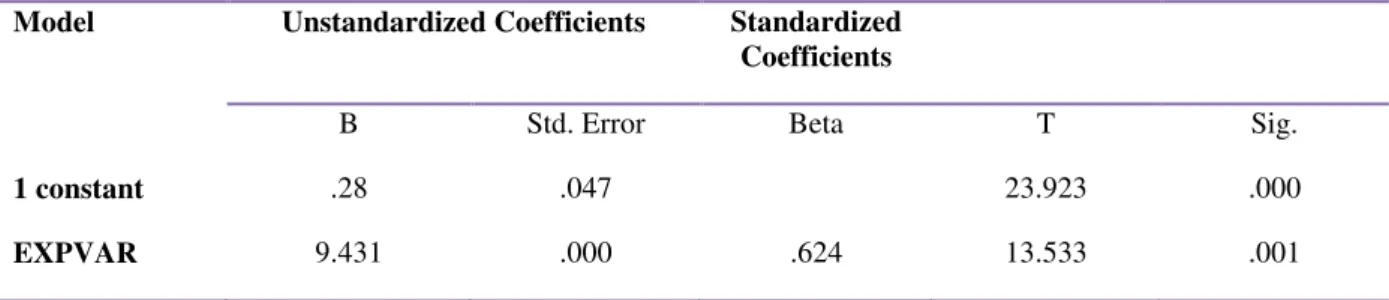
To determine the effect of internal control systems on implementation of projects of county governments a simple regression model of the form y=a+bx was used. While y represented financial performance, a was a constant of y intercept and b is the coefficient of internal control systems as measured by expenditure variance. The results are as shown in table 4.1.1
Table 4.1.1 Coefficients of Internal Control Systems
Model Unstandardized Coefficients Standardized Coefficients
B Std. Error Beta T Sig.
1 constant .28 .047 23.923 .000
EXPVAR 9.431 .000 .624 13.533 .001
The regression equation derived from the results was therefore Y= 0.28+9.431X. This means that increase in expenditure variance by 1 shilling increases the county’s project implementation by shs.9.431. The standardized beta value of .624 indicates that an increase in expenditure variance by 1% causes an increase in county implementation by 62.4%.
4.1.1 Testing of Hypothesis I-Ho1
The calculated t value as indicated in table 4.2.1 shows a value of 23.923 while the critical table value at 5% level of significance is 2.341. This indicates that the calculated value was higher than the critical value in the table. Therefore the null hypothesis that there is no significant effect of internal control system on implementation of projects for county governments fails to be accepted. This implies that there is a significant effect of internal control system on implementation of projects for county governments in Kenya. Further the p-value is less than 0.05 of significance level showing that internal control system has a significant effect on project implementation at the county governments..
To test goodness of fit of the regression model used on internal control system F value was used and the results as shown in table 4.1.2
Table 4.1.2 Expenditure Variance ANOVA
Moodel Sum of Squares
Df
Mean Square F Sig.
1 Regression .162 1 .182 34.550 .002
Residual .466 5 .023
Total .628 6
The F value in table 4.2.2 indicates a substantially high figure of 34.550 implying that the model is valid and can hold. The p-value of 0.002 is less than 0.05 significance level and therefore the model is a good model.
Table 4.1.3 Expenditure Variance Model Summary
Model R R Square Adjusted R Square Std. Error of the Estimate
1 .624 .389 .251 .2767355
Further the r squared value as shown in table 4.2.3 shows that a change in internal control systems causes a 38.9% variation in implementation of projects by the county governments. This means that 61.1% of the variation in project implementation can be explained by other factors.
The findings revealed that internal control system is a vital determinant on implementation of projects at the county government. The higher the expenditure variance the higher is the effect on implementation of projects at the county government. This finding confirms the work of Koitabu (2013) who analyzed financial control as an integral part of financial management which is concerned with the acquisition, financing and management of assets with overall goal. The study concluded that that there is need to lay on the internal control systems and budgeting as most of internal control systems and budgeting techniques have not reached the desired level. The researcher recommended that stakeholders including donors and government need to provide more training to have effective and efficient control. Brian (2013) analyzing a system of effective control as a critical component of company management and a foundation for the safe and sound operation of an organization , concluded that there is a direct correlation between the level of internal controls and the amount of revenue correction by KRA. has been evidenced by the study.
4.2 Multi-linear Regression Model
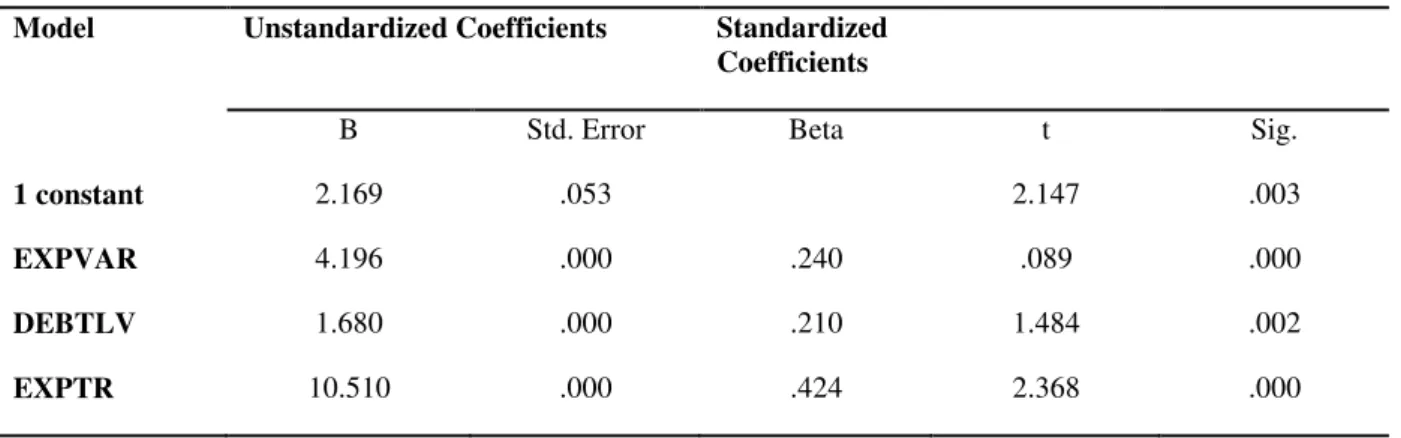
To find out the effect of internal control system on implementation of projects at the county a multi-linear regression model of the form Y=β0+β1X1+β2X2+β3X3+ei was used taking expenditure variance, debt level and expenditure on training as the proxy variables for internal control.
Table 4.2.1 Multi-linear Regression Coefficients
Model Unstandardized Coefficients Standardized Coefficients
B Std. Error Beta t Sig.
1 constant 2.169 .053 2.147 .003
EXPVAR 4.196 .000 .240 .089 .000
DEBTLV 1.680 .000 .210 1.484 .002
The multi-linear regression equation derived from the results was therefore
Y= 2.169+4.196X1+1.680X2+10.510X3. Using the standard beta coefficients it is evident that when debt levels and expenditure on training are held constant expenditure variance can explain 24 % of the variation in project implementation at the county governments. On the other hand holding expenditure variance and expenditure on training constant, change in debt levels can explain 21 % of the variation in project implementation by the county governments in Kenya. Also holding expenditure variance and debt levels constant expenditure on training can explain 42.4% of the variation in project implementation. The results show that expenditure on training h had the highest effect on project implementation at the county government while debt levels had the lowest effect on project implementation.
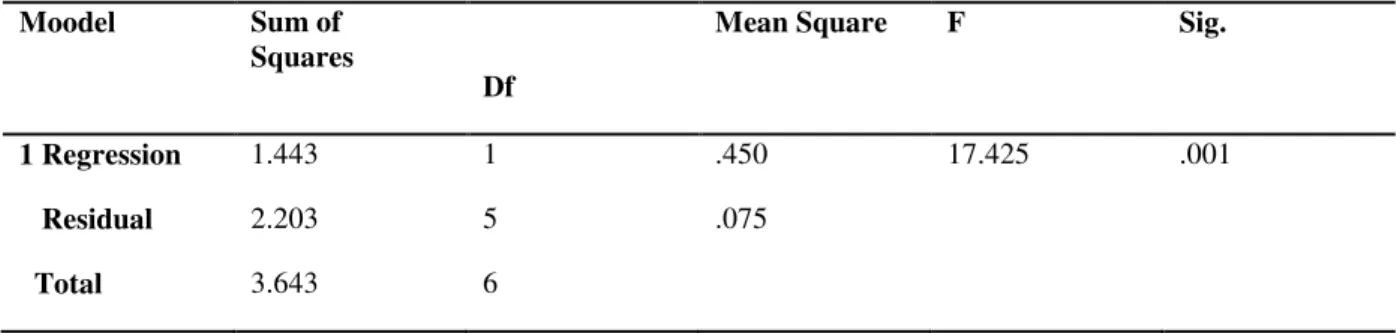
To test the goodness of fit of the multi-linear regression model used F value was used. The results are in the ANOVA table 4.2.2
Table 4.2.2 Multi-linear Regression ANOVA
The F value of 17.425 in table 4.5.2 is significantly high and the model is considered valid and can hold. The p-values returned a value less than 0.05 level of significance meaning that the variables have significant effect on the value of the firm.
Table 4.2.3 Multi-linear Model Summary
Model R R Square Adjusted R Square Std. Error of the Estimate
1 .747 .559 .362 .0833079
The coefficient of determination r2of 0.559 shown in the table 4.5.3 indicates that 55.9% of the variation in project implementation can be explained by the changes in internal control systems, financial management and professionalism
5.0 Summary
This study concentrated on determining the effect of financial control on implementation of county projects. The study adopted the parameter of internal control system as the keyindicator of financial control in county governments. This study used secondary data from published financial reports of county government of Nyamira and financial records of Nyamira county government for a period of 2013 to 2016. The findings of the study confirmed that internal control system affects project implementation significantly. This implies that county governments that have tight internal control systems are in a position to generate more revenue through safeguarding of resources both received from the national government and locally generated. Internal control systems can be sustained through establishment of the right structures with clear reporting structures.
Moodel Sum of Squares
Df
Mean Square F Sig.
1 Regression 1.443 1 .450 17.425 .001
Residual 2.203 5 .075
5.1 Conclusion
Internal control systems remain vital safeguarding organization resources and county governments are part of this. Internal control systems are highly supported by structures in place at the organization. These structures establish a reporting system and aligns operations in these organizations.County governments must stick to their budgets to avoid variations in expenditure. Adequate internal control systems ought to be in place to ensure that county finances are utilized for the right course. County governments administration must ensure that the right policies that emphasize on procedures are implemented to the letter.
REFERENCES
Chuke (2012).Basic principles of financial management. Ibadan prentice hill international
Whittington, P. and Pany (2001).Principle of auditing and other assurance services new.York mc graw-kill Wanjau K, N.Muiruri ,B. W. and Ayodo, E. (2012). Factors affecting provisions of service quality in the public
health sector.A case of Kenyatta national hospital. International journey of humanities and social science
El- Nafbi H.M (2008). The role of public sector audit and financial control systems in safeguarding public funds in Sudan, Journal of Economics and Administration
Koitaba E.K (2013) Analysis of factors influencing financial control practices in community based organizations in Baringo county, Kabarak Public sector in Maringine sub County Kenya.
Hayles R (2005) Principles of auditing London, Pearson education limited Kothari CR (2008) research methodology, New Delhi,
Prakasham PVT Ltd. ,CR (2004) Research methodology methods and techniques, New Delhi; New age International publishers
NdiforEjoh and Mwindi (2008) Impact of internal control activities on financial performance of tertiary Institutions in Nigeria.
Mill champ and Taylor (2008) External audit relevance in the growth of Banking Industry in Nigeria
Mwindi (2008) impact of internal control activities on financial performance of tertiary institutions in Nigeria
Wakiriba, Ngahu, Wanyoike (2015) effect of financial controls on financial management in key public areas. Nairobi. Kenya
Ndunda, Ngahu, Wanyoike (2015) Analysis of factors influencing optimal revenue collection of county governments in Kenya a case of Nakuru County
Mwaura, Ngugi (2014) Factors affecting performance of community based organizations projects in Kisii county Kenya
Okongo (2015) Factors influencing the implementation of county government mandates in Kenya; a case of Bungoma County.
Amaka P. (2010) .Impact of internal control system on financial management on an organization; a case study of Nigeria.
Koitabu (2013) An analysis of factors influencing financial control practices in community based organizations in Baringo county Kenya.
Rotich K and Ngahus (2015) Factors affecting budget utilization Kericho county government Kenya
Chae J and Chung K (2015) The effects of human resource investment in internal accounting control on cost stickiness journal of applied business South Korea.
Ejohin and Ejom P (2014) The impact of internal control activities on financial performance of tertiary institutions in Nigeria.