LICENTIATE T H E S I S
Luleå University of Technology
Department of Civil and Environmental Engineering
Risk management in
small construction projects
Acknowledgements
This study has been made possible thanks to the many persons in my surroundings. It began with trusting my idea of doing research in the field of risk management with a focus on the everyday project in the construction sector. Thank you Assistant Professor Lennart Apleberger, my supervisor, Professor Jan Borgbrant my scientific supervisor and examiner, Luleå University of Technology, and Jan Byfors, NCC, for trusting me and supporting me in this work, taking my idea to a complete licentiate thesis. There has also been great support from my wonderful group of reference persons, Peter Gjörup and Ingegerd Simonsson from NCC, Anders Lundgren, LKAB, PO Larsson-Kråik, Banverket, and Kalle Nylén, Byrå Idun, and Richard Espling from Skanska, thank you for all the energy you give me each time we meet. I also want to thank my assistant supervisor, Assistant Professor Per Anders Akersten, for his clever and valuable discussions about risks. As well, a special thanks to Kalle Nylén for his invaluable help throughout this work – Kalle, I wouldn’t have done it without you!
The research school Competitive Building has also been invaluable for my work and from this network, I would especially like to thank Professor Brian Atkin for his generously shared networks and time spent on reading my papers. I am also grateful for the invitation and supervision that I have received from Professor Martin Skitmore at Queensland University of Technology, Brisbane, Australia.
This thesis would also have been hard to produce without the support of my mother who has helped with everything from taking care of the children to discussions of linguistic matters – Thank you mum!
I also want to mention all of you not mentioned by name. My colleagues at NCC who I have visited and tried to keep close contact with despite my work at the university regarding somewhat abstract matters such as research, my colleagues at the university with whom I occasionally discussed risk and other matters of importance, my friends and family who have given me energy by being the ones you are, beautiful and caring persons.
And finally, amongst all the persons supporting me, Jörgen, Emil and Hilda are the most precious ones – You are my sunshine and meaning of life, I love you!
Many thanks as well to the organizations that have supported me and my project financially, namely SBUF, Formas and NCC.
Luleå, Oktober 2006 Kajsa Simu
Sammanfattning
Den svenska byggsektorn har brottats med problem som resulterar i fördyrade byggkostnader, förseningar och byggfel. För att komma till rätta med dessa problem tillsatte regeringen en kommission som 2002 presenterade sin rapport Skärpning gubbar. I rapporten konstateras att det trots insatser på kvalitetssystem och utökad egenkontroll inte gett önskvärda resultat.
Riskhantering handlar om att kunna förutse och beräkna risker och osäkerheter i ett projekt och ofta utgör det en del av de kvalitetssystem som tillämpas i företagen idag. De system som tagits fram har i huvudsak fokuserat på medelstora till stora projekt och de små projektens behov, förutsättningar och tillämpning av systemen har lämnats därhän. De små projekten utgör dock en väsentlig del av den svenska byggbranschen, 83 % av antalet projekt är mindre än 15 miljoner sek. Många små förluster här ger i slutändan stort ekonomisk utfall på grund av antalet små projekt under ett år.
I den här studien har forskningsfrågorna fokuserat på att ta reda på hur de små projekten hanterar risker samt hur väl de teoretiska ramverken inom riskhantering stämmer med de rutiner och riktlinjer som finns i de undersökta byggföretagen. Utöver detta inkluderar studien en genomgång av tidigare forskning inom riskhantering i byggprojekt. Slutligen har även studien sökt svar på vad som verkar som hinder och drivkrafter för att tillämpa riskhantering i små projekt.
För att få svar på dessa forskningsfrågor har en intervjustudie genomförts och triangulerats med dokument- och litteraturstudier. Utifrån 10 entreprenadprojekt har tre nyckelroller; platschef, arbetschef1 och byggledare, i varje projekt intervjuats, totalt 28 intervjuer.
Resultaten från den här studien visar att;
x det finns behov av förbättringar av riskhantering i små projekt x det finns brister i såväl systematik som tillämpning
x att utbildning inom riskhantering är låg, näst intill obefintlig, i de undersökta projekten
x att tilliten till egen erfarenhet och bakgrund är hög
x att de verktyg som används mest är olika former av checklistor
Det visar sig även att systemen i sig upplevs mer som hinder än som stöd för en effektiv riskhantering. Det finns en frustration över alltför omfattande rutiner. De arbetssätt som används kan dock knappast anses uppfylla kriterierna för systematisk riskhantering. Det som är av betydelse för hur riskhanteringen har fungerat i dessa projekt beror till stor del
1
på individen och dennes personliga bedömningar. De verksamhetssystem som finns har inte varit avgörande eller i vissa fall ens till någon nytta. Sammanställning från tidigare forskning visar på liknande resultat
Såväl rapporten Skärpning gubbar, tidigare forskning och resultaten från den här forskningen visar att användandet av verksamhetssystem inte räcker för att få en effektiv styrning av byggprojekt. I den här rapporten föreslås att den fortsatta forskningen inom detta område ska fokuseras på individer och deras riskattityder, samt på riskkulturen och riskmognaden inom företag och bransch.
Abstract
The Swedish construction sector has for some time struggled with problems that result in increased costs, delays and faults. To sort out and analyse these problems, the federal government appointed a commission that produced the report “Skärpning gubbar” (2002). This report highlights that despite ongoing work with quality management and internal quality surveillance, improvements still lack. Risk management is about thinking ahead and calculating the risks and uncertainties involved in a project, which is most often part of the quality management system in an organization. The systems available have been developed to focus on medium to large sized projects, leaving behind the smaller projects needs, conditions and application. However, the smaller projects are an essential part of the construction sector, with 83% of all projects smaller than 15 MSEK.
In this study the research questions have focused on the smaller projects and their tools and methods to handle risks, and how the theoretical framework in the field of risk management corresponds to routines in the involved companies. The study also presents previous research in the field of risk management in construction. Finally, the drivers and obstacles for risk management in small projects are also focused upon.
An interview study was carried out to answer the research questions. Triangulation was done using document and literature searches. Ten projects were involved with three key role individuals in each; site manager and project managers from the client and construction company, totaling 28 interviews.
The results from this study show a need for improvements regarding risk management in small sized construction projects. Present risk management lacks both system and application. The results also show that risk management education and training is low, almost non-existent, in the studied projects. Also, the management system is more of an obstacle than of beneficial use for efficient risk management, with frustrating routines that are too extensive. Previous research similar to this study shows that the reliance on the individual experience and background is high and that the most commonly used tools are different types of checklists. This could, however, not be considered systematic risk management. Critical to how risk management works at site are the individuals and their judgments. The management systems adopted on site have not been essential or in some cases not even of any use.
This thesis, as well as the report “Skärpning gubbar” (2002), and previous research, show that merely using management systems is not enough to attain efficient control of construction projects. This thesis suggests continuing with research that focuses on the individuals and their attitudes, the organizations culture and the maturity in relation to risk and risk management.
1 INTRODUCTION ... 1
1.1 BACKGROUND AND PROBLEM FORMULATION... 1
1.2 AIM AND RESEARCH MOTIVES... 6
1.3 DELIMITATIONS... 7
2 METHOD ... 9
2.1 RESEARCHER’S BACKGROUND... 9
2.2 LITTERATEUR REVIEW... 10
2.3 RESEARCH DESIGN... 12
2.4 SELECTIONS WITHIN THE STUDY... 14
2.5 THE TRUSTWORTHINESS OF THIS THESIS... 18
3 THEORETICAL FRAMEWORK ... 19
3.1 RISK AND UNCERTAINTY DEFINITION... 19
3.2 RISKMANAGEMENT SYSTEMS... 23
3.2.1 Risk identification... 24
3.2.2 Risk assessment ... 24
3.2.3 Risk response... 25
3.3 RISK PERCEPTION IN CONSTRUCTION... 26
4 RESULTS AND ANALYSIS ... 29
4.1 THE COMPANIES INVOLVED... 29
4.2 THE PROJECTS INVOLVED... 29
4.3 KEY ROLE INDIVIDUALS... 33
4.4 RESULTS FROM THE INTERVIEWS... 39
4.4.1 Client representatives... 39
4.4.2 Analysis of clients work with risk process ... 43
4.4.3 Construction management – the site managers and the contractors project managers... 44
4.4.4 Analysis of the results from interviews with contractors ... 51
4.4.5 Perceived obstacles and drivers for risk management ... 53
4.4.6 Analysis of results from questions about obstacles and drivers ... 55
4.5 RESULTS AND ANALYSIS FROM STUDIES OF DOCUMENTATION... 56
4.5.1 Results from studies of documentation ... 56
4.5.2 Analysis from studies of documentation ... 57
4.6 SUMMARY... 58
5 DISCUSSIONS AND CONCLUSIONS ... 59
5.1 CLOSING THE LOOP... 59
5.2 HOW TO USE THESE RESULTS... 64
5.3 FURTHER RESEARCH... 64
Appendix
Appendix 1 Companies involved
Appendix 2 Conference paper from pre-study
Appendix 3 Interview questions Site managers (Swedish)
Appendix 4 Interview questions Contractors project manager (Swedish) Appendix 5 Interview questions Clients project manager (Swedish)
Description of expressions
AB Allmänna bestämmelserGeneral agreements on construction contracts applicable in Sweden
AB04
General agreements valid from 2004, applicable for general contracts.
ABT94
General agreements valid from 1994, for build and design contracts.
AML
Arbetsmiljölagen, the Work Environmental Act passed by Sweden parliament.
Aleatory risk
Random risk, possible set of outcomes is known but the quantities of consequence and probability is not known even though they are calculable
CAR
Construction all risk, insurance that covers the building contract, the existing property and the work aid at site.
Client
Person or organization that commission buildings or constructions for themselves or for someone else.
‘Doers’
Category of individuals in this thesis that have a practical way of controlling the construction project.
Epistemic risk
Lack of knowledge about possible outcomes. Lack of knowledge about what you do not know.
‘Frustrated’
Category of individuals in this thesis that show much frustration in their work regarding their quality management systems.
Inflicted uncertainty
Uncertainty that is inflicted in project organisations by actors’ inability to learn from previous projects
Management system
The structured way, in which organizations chose to control their business, including such ingredients as economy, organization and problem solving. Examples of management systems are quality management systems, environmental management systems, knowledge management system.
Project Manager
Person that is closely involved in the construction project either as superior to the site manager or as the clients representative, closest to the project.
Risk
Risk is defined as something that occurs and which was neither foreseen in the project description nor in the contract, often being caused by lack of knowledge with one or many of the parties involved.
Site manager
‘Sytem users’
Category of individuals in this thesis that use and benefit from their companies quality management systems.
Uncertainty
An overarching term that could have two possible outcomes, a risk or an opportunity
‘Wanna bes’
Category of individuals in this thesis that would prefer having a management system but lack it in their present work situation.
1
Introduction
The construction industry has a long history. Housing has been built ever since humans left caves and the construction project as a business branch has probably been around since before the
pyramids. There have always been considerations about uncertainties and risk. This is a study that captures the work in minor construction projects today regarding risk management. The aim of this chapter is to give an understanding of the context and purpose of the study.
1.1 Background and problem formulation
The construction sector in Sweden has for some time suffered from poor performance and a lack of control in various steps of the process. Due to the sector’s problems with numerous faults and the increased costs for buildings, the Swedish government initiated the Building Commission, whose assignment was to focus on where the problems were and how to increase the effectiveness instead of the costs. They found, amongst other things, problems with cost and faults related to the construction. Risks and other uncertainties can cause losses that lead to increased costs, time delays and lack of quality during the progression of the projects and at their end. The Commission also found that quality management systems according to the ISO standard 9000 have not been enough to decrease the problems in the sector ("Skärpning Gubbar" SOU_2002:115, 2002).
Risks and uncertainties appear in various shapes. In projects the objectives are most often related to time, cost, quality and function and client satisfaction (Hillson, 2004). In organisations, depending on the risk management focus, different relations between the objectives and the definition of risk exist. The risk definition is therefore highly dependent on the choice of applied management focus in the organisation. In the construction industry the management focus on site is closest related to what Hillson describe as project risk management and safety risk management. At other levels, apart from the project site, the focus is somewhat different.
Risk management is generally a part of other management systems such as quality, environmental or work environmental management systems. Some core values are common in many quality and environmental management systems viz. the commitment of all employees, customer focus, management commitment, focus on process, continuous improvement and fact-based decisions. These core values are closely connected and could easily be found in the theoretical framework of risk management. The current focus on risk management should be regarded as a complement and a development of the already implemented quality management systems used by companies. Either way, risk management is a crucial part of the total project management system regardless of the focus on quality, environment or work environment.
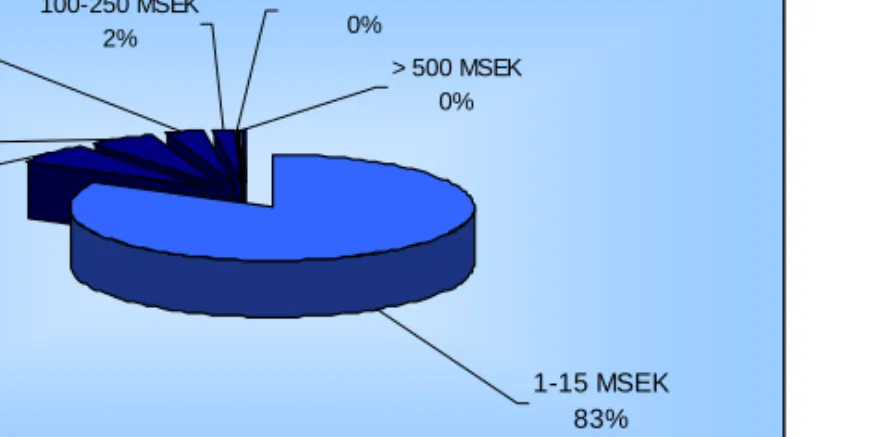
In the Swedish construction sector, the most common project is less than 15 MSEK (roughly €1.65m). According to Sveriges Byggindustrier (Hultén, 2004), as much as 83% of all projects range from 1-15 MSEK for 2003. At NCC the same figure was 68% (statistics from 2003 in NCC’s internal economical control system).
)LJXUH 1XPEHU RI SURMHFWV GLYLGHG LQWR VHJPHQWV LQ UHODWLRQ WR WKHLU VL]H6YHULJHV E\JJLQGXVWULHUVWDWLVWLFVIURP+XOW«Q
The distribution of projects in each segment, sorted by monetary value, instead of the number of projects is also interesting. For the Swedish construction sector, the figure would then be 21% (Hultén, 2004) and for NCC 24%. Clearly, a large portion of the work done in the construction sector concerns the small-scale projects environment. The projects in the span 1-15 MSEK are not as dominant in Figure 2 but still represent countable volumes. Projects up to 50 MSEK represent half of the sector turnover. The smaller projects, regardless of the definite limit, represent countable volumes in both numbers and monetary value.
Number of projects 83% 0% 0% 2% 5% 3% 7% 1-15 MSEK 15-25 MSEK 25-50 MSEK 50-100 MSEK 100-250 MSEK 250-500 MSEK > 500 MSEK
)LJXUH 0RQHWDU\YDOXHLQHDFKVHJPHQW6WDWLVWLFVIURP6YHULJHVE\JJLQGXVWULHU +XOW«Q
Management systems, where risk management is or should be included, are widely used in the sector. From the researcher’s experience of working with management systems the knowledge of the special conditions for the small projects is derived. For small projects, it is more or less the same system used as for larger projects within the same organisation. There are routines and forms to be used regardless of the project’s context. In small projects a common reaction is that the system interferes in the crucial planning of the project instead of supporting it. In the larger projects, the project’s organisation has the resources and time to use the management system in a different way and thus achieve support from it. There is also more time during the larger projects to plan and think several steps ahead, as well as more people involved who increase the benefits from meetings and teamwork. Management systems are often written with focus on a project’s size to include at least two managers on site. For smaller projects, site managers often run two projects simultaneously, leaving little time to sit down and follow the management systems’ routines and guidelines. This might not be a problem, but could lead to the smaller projects making shortcuts that are fatal to the risk outbreak in the project. It is then interesting to find out how these possible shortcuts are done. Finding out how construction project managers handle risks and uncertainties everyday could increase the possibilities to work more efficiently.
The standard agreement for contracts in the construction industry in Sweden is Allmänna Bestämmelser (AB), with different agreements depending on the form of the contract undertaken. AB04 is for general contracts and ABT94 is for build and design contracts. The Construction Contracts Committee (Byggandets Kontraktskommitté, BKK) representing various actors in the Swedish construction industry prepares these general agreements.
Monetary value in each segment
9% 21% 8% 12% 13% 15% 7% 15% 0-1 MSEK 1-15 MSEK 15-25 MSEK 25-50 MSEK 50-100 MSEK 100-250 MSEK 250-500 MSEK > 500 MSEK
The general agreements regulate the responsibilities and undertakings in the contracts based on a balance between rights and responsibilities between the actors (contractor and client) with the purpose to achieve an optimal risk distribution regarding the finances. Who is responsible for design and who is responsible for construction are clearly defined. In the general contract, only the contractor is responsible for the construction and any uncertainty in the design is the client’s responsibility. This gives the contractor the right to get any adjustments and occasionally compensation within the contract. This right is in some cases regarded as a possibility to compensate for a poor contract, and the willingness to alleviate any uncertainties before signing the contract is limited from the contractors’ perspective. However, the clients are well aware of this and regard any questions and discrepancies from contractual documents as attempts to squeeze out some more money for the work to be done. Small projects are more vulnerable to changes and additions in contractual agreements; hence, the need to plan ahead for uncertainties should be high. The hypothesis that this is not working as effectively as it should highlights the need to know more about how risks and uncertainties are handled in small projects.
Actors in the Swedish construction sector are strongly recommended to not deviate from the general agreements. One reason is the insurance agreements within the sector. Contracts that deviate from the general agreements of AB are not covered by insurance today (Hellström, 2006). It is therefore of great importance that the individuals who sign the contracts be fully aware of this. The smaller the project the more responsibility on the site and project manager due to the limited personnel resources of the smaller projects. By comparison, there is often more support from specialists in a larger project and the probability of discovering deviations from the general agreements (AB) is therefore greater.
Insurances within the sector are divided into Construction All Risk, CAR and Liability insurances, each in excess is 100,000 SEK (10,000 €). According to M Hellström (Hellström, 2006), Risk Manager at NCC Group AB, there are at least as many losses in the segment of 25,000- 100,000 SEK as there are in the segment 100,000 – 200,000 SEK, with the only difference being that no follow up exists with losses below 100,000 SEK. Hellström makes his estimates the contacts taken by production managers when they are at a loss situation. For a small contract, the excess of 100,000 SEK could be quite large, in regards to percent of the contract sum. The security of the CAR or Liability incurrence is therefore limited. The other limitation and problem with the available insurances are their limited extent, or rather, the limited knowledge about their scope (Hellström, 2006).
Previous studies in the field of risk management in construction tend to cover large-scale projects, often with many different participants (Ahlenius, 1999; Staffan Hintze, 1994; S
Hintze et al., 2003; Jaafari, 2001). The risks cover a spectrum of events from financial, political and legal to technical, often related to complex constructions. There are also studies that focus on the usage of risk management in construction, with the client and contractor perspective but have a top-down approach. No research found focuses on small sized projects, from the project site perspective. In small sized projects, the risks are more moderate and the consequences are less dramatic. These projects are more vulnerable to changes that have an impact on time, since there is less chance of catching up if the schedule slips. However, the nature of the construction work and the project environments are often rather straightforward and the technical challenge is limited. This picture of small sized construction projects is based on the researcher’s personal observations and that of the study’s reference group2.
Risks related to the work environment are highly regulated by laws and regulations. The Swedish Work Environment Authority works under the statuary foundations laid in the Work Environment Act (AML) passed by the Riksdag (Sweden’s parliament). The detailed regulations on the subject are then issued by the Work Environment Authority through Provisions and General recommendations. There are clear descriptions for what is to be done and by whom. In the construction sector, these laws and regulations are well established and the client and contractor take common responsibility for these tasks. The usual way is for the clients to delegate the practical work to the main contractor, who coordinates this work on site. The main contractor then works out the documents declared by the AML, such as risk analyses regarding work environmental risks and a management plan for work environment.
With this description of the context for the small sized projects the problem formulation has emerged. There is not one cause for the problems described as there is probably not one single solution. In this introduction the scene and the different matters affecting the project situation is set for the reader to understand where and why the aims and research questions have been developed.
1.2 Aim and research motives
In this research the aim is to uncover how risk management is carried out in small sized projects. The contribution of the study is to reach an understanding of the risk process. If a greater understanding about the issues in small sized projects is achieved, it will be easier to focus on the right efforts of the companies to increase value in the construction process. The research questions for this study are:
x What are the methods and tools for risk management in small construction projects?
x How are these methods and tools used?
x What kind of risk management is applied in the construction companies’ management systems?
x What are the results from previous research done in the field of risk management in construction processes?
x What are the obstacles and drivers for risk management in small sized construction projects?
These research questions are formulated with the ambition to enlighten the work with risks in construction projects. The first two questions address the practical work at site level, whose answers are sought after in the empirical results of the study. The third question addresses the relation between risk management and applied management systems in the construction companies. The answers to this are relevant, since this is part of the project context for the projects involved and the answers are sought in the empirical results and theories of risk management. The fourth research question addresses theories in the field of risk management, with the answers being sought in the subject literature. The relation between the research questions is illustrated in Figure 3, where the fifth research question ties them all together. The research questions cover different parts of the context for risk management in construction projects. Their relation and interference is tied together through a focus on obstacles and drivers for applying risk management
)LJXUH 7KHGLIIHUHQWIRFXVHVLQWKHUHVHDUFKTXHVWLRQV 1.3 Delimitations
In this study, projects in the range of 1-15 MSEK have been chosen. The characteristics of a small sized project were subsequently discussed and agreed upon within this study’s reference group. The resulting description is enough to distinguish these projects from very small projects that are more of continuous business operations and from larger projects at the other end of the scale. The characteristics of small sized projects agreed upon in the reference group, for the purpose of this study, are:
x contract value between 1-15 MSEK
x a site manager responsible for a maximum of two projects simultaneously x limited construction time, maximum 12 months
x established technique, no development work x project environment is independent
x personnel involved are more generalist than specialist
Projects in the range of 0-1 MSEK have been excluded because they are less interesting from a project risk management perspective. Their nature is inherently more like a continuous business than project-based. The upper limitation at 15 MSEK is chosen in accordance with the other parameters for a small sized project. When a project increases in volume, the organisation also increases. However, the absolute number for this is not defined, since it is related to the rest of the project context. To have a set number for obtaining the statistic data, the size limit of 15 MSEK was chosen.
Theory Theoretical framework
Previous research
Practice Tools and methods for risk
management Project Obstacles and drivers Policies Management system for risk management
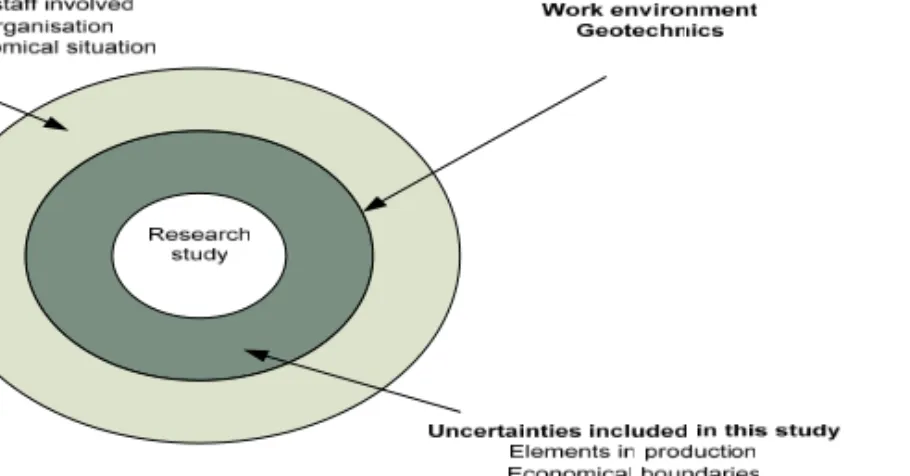
The perspective sought is from the construction project’s viewpoint at site level. The management systems used at projects are those of the construction companies and the clients’ management system has therefore not been in focus. The projects are situated in a larger context as shown in Figure 4, where the project and the site managers are the main characters. The context of each project is briefly described and the empirical results for this study are collected from interviews and documents.
)LJXUH 'HOLPLWDWLRQVIRUWKLVVWXG\DQGWKHFRQVWUXFWLRQSURMHFWLQLWVFRQWH[WZLWKWKHVLWH SHUVSHFWLYHLQIRFXV Risk management at project site Small projects Policies
Quality management
Ris km anag em ent t heor y Contr
actor management system
Gu idel ines Ch eckl ists C o n trac tors proj ect m anager
Project prerequisite
C li en tp roje ctma nager Ro utine s
ManageClient organisationment systems General MarketCo nsul tan ts R isk attitude C om pan y cu lt u re s Po lic ies AB 04 AB T94 AM L R u le s and re gu la tio ns from soc iety
Cul
tur
e i
n
co
ns
tr
uc
ti
o
n
se
ct
o
r
General management theories2 Method
This chapter describes the method applied in this study, which is qualitative where matters such as influence from the researcher and chosen sources of information play an important role in the final results. In this chapter, the researcher, outlines for the interview survey and the selection of data sources are described in a chronological order.
2.1 Researcher’s background
It is not possible to conduct research or analyse data in research without considering and being aware of the biases due to the researcher’s background and the subjectivity of the researcher (Merriam, 1998). The knowledge derived in a study like this is most dependent on the researcher’s skills and background. As (Kuhn, 1996) notes, `what a man sees depends both upon what he looks at and also upon what his previous visual-conceptual experience has taught him to see´.
My background is a MSc Civil Engineering, structural engineering, and thus my understanding of research is from the natural science. I started my career in the construction industry in 1995 as a trainee at NCC, one of Sweden’s lager construction companies. During the trainee period, I worked as a site foreman and learned about project management from the practical side. After finishing my trainee period, I started working with and being part of developing NCC’s environmental management system. In 2000, when NCC Civil Engineering, Sweden received accreditation for its environmental system ISO 14001, I was Chief Environmental Officer. The years prior to beginning this research project, I worked with quality and environmental management systems at a regional level of NCC Construction, situated in Luleå. This experience can be of strength if used properly. In this study, I have been able to tune into the respondents’ use of language and terminology considered necessary in an interview situation. I have also used my years of experience and observation throughout the study to describe the background and problem formulation and to use as a complement to the empirical results. My background has permitted a better understanding of matters ‘between the lines’. A potential bias is that the researcher could jump to conclusions based on her own experience instead of using/listening to information from the respondent. By being aware of this, I have made an effort to ask questions in a way that seeks explanations rather than `yes and no´ answers. I have also been aware of not talking in a language that is full of “professional expressions” from management systems. I have adapted to the practical environment found on a construction site.
2.2 Litterateur review
The literature review started out according to the delimitations set up in Chapter 1, Figure 4 and the chosen research questions. This study did not start with a literature search as a way to determine the research questions. The research questions were formulated from the background knowledge of the researcher.
Within the field of general management systems this study includes minor studies of quality management systems and thorough studies in the field of risk management. The literature review narrows down the area of risk management to the specific area of risk management in construction projects. The field of risk management is wide and spans from insurance and financial risk to the area of risks in work environment. The literature research delimits basically all research done outside the field of risk management in construction projects. For definitions, wider searches are conducted, though for the process the narrower approach is used, Figure 5 below. Between the areas of project risk management (PRM) and uncertainty management and PRM in construction there are connections. Also between research on large scale projects and other specified types of projects there are relations. These relations are illustrated with connecting arrows in Figure 5. The main sources for this literature research are literature databases, such as Ebsco, Emerald, Elsevier Science Direct, ByggDok, Compendex and Google Scholar. The searches for articles are complemented with searches within libraries in Sweden through Libris and at the university library at Queensland University of Technology, QUT. )LJXUH 3URFHVVRIOLWHUDWXUHVHDUFKLQILHOGRIULVNPDQDJHPHQW Risk management Uncertainty management Project risk management Project risk management in construction RM in large scale projects RM in specified types of projects, ex geotechnics, work environment, steel structures, dams RM in small constructions project
Wide area, many hits
Hits with variety of fields of business Development of risk management concept Construction management in general
Some results covering specified areas from different view points for example, client, project
managers No results of small constructions project
To get an overview of the theoretical field the different authors are grouped in relation to their contribution to the knowledge. Figure 6 shows the authors that have had the greatest influence in the theoretical framework; it is not a summary of the full results from the literature review. The fields that form the basis of the theoretical framework in this study are those to the left, i.e. risk definition, risk management systems and risk management in construction. The fields to the right are very interesting and important but are excluded from further research in this thesis due to previous delimitations.
)LJXUH 3DUWVRIWKHUHVXOWVIURPWKHOLWHUDWXUHUHYLHZ Risk management systems ISO Standard PMBOK Chapman & Ward Risk management in construction Jaafari
Flanagan & Norman
A Mills
Flanagan & Norman
Martin Skitmore Terry Lyons Hintze, Stille & Täljsten N J Smith Akintoye A & MacLeod M
Tah & Carr Graham Winch & E Maytorena Risk definition Risk maturity ISO Standard Aven Hopkins Hillson Risk vs Uncertainty management Hillson Hillson & Murray-Webster Chapman & Ward
Risk attitude Chapman
2.3 Research design
The research design is determined by considering how to link the research questions with the data collection and analysis and the yield of results. There are different ways to determine the best research design. The definitions of the different designs vary as well as the boundaries between them (Fellows & Liu, 2003). In this study the research design was decided with help from the suggestion that the research style is dependent on the formulation of the research question (Yin, 1994); see Table 1.
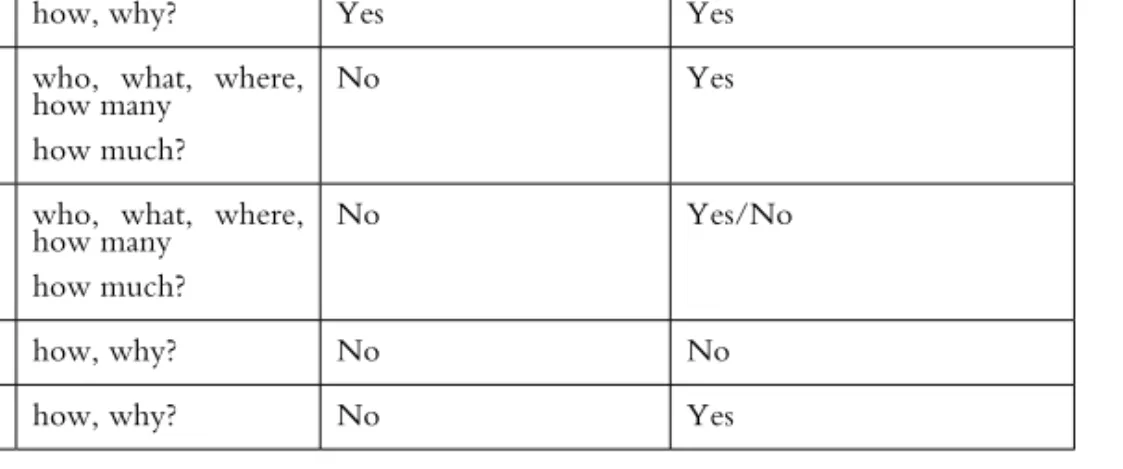
Table 1. Relevant situations for different research strategies(Yin, 1994)3
Strategy Form of research
question Requires control of behavioural events Focus on contemporary events
Experiment how, why? Yes Yes
Survey who, what, where,
how many how much?
No Yes
Archival analysis who, what, where, how many
how much?
No Yes/No
History how, why? No No
Case study how, why? No Yes
All of the research questions in this study, apart from question two that is a ‘how’ question, are formulated as ‘what’ questions. According to Yin’s theory illustrated in Table 1, the best way to answer these questions would be with a survey.
The method chosen for this research is an interview survey, with influences from the case study strategy. The choice of an interview survey and ending up with qualitative data is a strategic choice. Common knowledge about risk management and its terminology is limited at construction projects, especially at site level. To avoid any misinterpretations, having a dialog about risk management issues rather than filling in inquiries has been important. By using the semi-structured open-ended interviews, the respondents were free to add additional information and the researcher was free to adjust the interview questions for each situation and over time.
To answer the research questions through interviews, the interview questions are key to success. The process to develop the right interview questions is described in Figure 7 where the major inputs to the interview questions come from three areas, viz. research questions, theoretical framework and theories of research methods, and the applied
3
method. The background and delimitations for the thesis also give certain guidelines for both the research and interview questions. The format and function of the interview questions then set the scene for the interview, as does the overall context for the interviews, such as the number of interviews, selection of projects involved and selection of key individuals to interview.
)LJXUH 7KHEDVLVIRUIRUPXODWLQJWKHLQWHUYLHZTXHVWLRQV
To test the interview question and the form of the interview, a pre-study consisting of nine interviews was made. This pre-study included only site managers and the questions focused on which risks they actually felt were the most common in small projects. The site managers in the pre-study represented the large construction companies NCC and Skanska, situated in Luleå. The results from this pre-study were presented at CIB 2005 Helsinki Symposium (Berggren4, 2005). During the pre-study interviews, it became clear that the theoretical terminology had to be reformulated into more a applied and situation related language. The interview questions in the main study were prepared with this knowledge in mind.
In each project it was important to find information about risk management processes as well as reveal information about the project context and the individuals. Information concerning the risk management process detailed questions about ‘what, how and who’ was important, see Figure 8. The project and individual information was received through direct questions, where the respondents answered open-ended questions. The information from these questions depended highly on the respondents’ willingness and motivation to talk about themselves. The information about obstacles and drivers from the first interviews was received through indirect questions and ‘reading between the lines’. This did not produce as sharp results as desired and the consequence was that complementary questions were added in the following interviews.
4
Researchers maiden name, changed to Simu, July 2005 Research questions
Questions for semi structured interviews Theoretical framework Research method Background Delimits
)LJXUH 5LVNPDQDJHPHQWDSSURDFKDWVLWHOHYHO 2.4 Selections within the study
This study focuses on the site level of construction projects. To ascertain where the information about risk management in these projects is kept, discussions were held with the reference people5 of this study. In accordance with the theories, the best way to get information was to talk with those involved in the projects. Triangulation in research is all about finding multiple sources of evidence (Yin, 1994), and in this study, different sources of information were used to collect data, such as documents and interviews, see Figure 9. The interviews were held with three individuals having different roles in each project.
The key role individuals to be interviewed were to be the site manager, the project’s manager from the construction company and the project manager from the client. As a complement to the interviews, some documentation about each project was studied. A chart of the basic information in the projects is shown in Figure 9.
5
Group of reference is made up of representatives from Construction related industry in Sweden Risk process in project Identification Assessement Respons What How Risk or risk source Who Identification Assesment How Who Response Which risks What Who decide Who is kept responsible Other measures From where are those coming from
Which criterion
)LJXUH &KDUWRYHUZKHUHWKHLQWHUHVWLQJLQIRUPDWLRQLQWKHSURMHFWLVNHSW
It was decided that a sufficient number of projects would be about ten, since ten would be enough to achieve information saturation but still few enough to collect the sought information through interviews and document studies. Data collection would thus be based on approximately 30 interviews. At the end, 28 interviews were made, since two of the project managers were responsible for two projects each.
The approach for the study was to get information having the construction project in focus. The selection of projects was made from construction company contacts in eight of the projects and from client contacts in two of the projects.
Three of the companies act on a national market, i.e. NCC, Skanska and Vägverket Produktion. The other companies act locally to regionally, where Nåiden and GLB are in Norrbotten and act in a small town market. SH Bygg and Friijo entreprenad are in Stockholm/Uppsala and act on a more urban market. The selection of the ten projects was based on a spread of geography, size of construction company and urban/rural area. The chosen projects and the selection of companies represent the Swedish construction sector fairly well. The ambition was not to have any conclusions regarding differences in market situation, geography or company size, but merely to find a good representative
Project
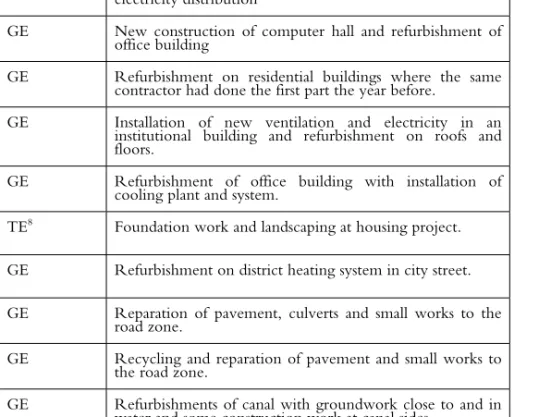
Key role individuals Document Construction documents Management plans on site Risk analysis on site Memos from meetings Detailed work plans Site manager Project manager Superior to site manager Client project manager Experience Background Education Age Gender Delimitations 1-15 miljoner SEK Contractors perspektivselection. The aim was to have two projects from each participating construction company. No particular type of project was chosen and the overrepresentation on groundwork and refurbishment work is explained by the size limits of 15 MSEK in the projects. Hardly any new production of housing or civil engineering is 15 MSEK or less.
Table 2. Type of project related to contractual form and extent of activities
Type of project Contractual
form Extent of activity
New construction GE6 Foundation work and concrete construction of building for electricity distribution
ROT7 GE New construction of computer hall and refurbishment of
office building
ROT GE Refurbishment on residential buildings where the same
contractor had done the first part the year before.
ROT GE Installation of new ventilation and electricity in an
institutional building and refurbishment on roofs and floors.
ROT GE Refurbishment of office building with installation of
cooling plant and system.
Ground work TE8 Foundation work and landscaping at housing project. Ground work GE Refurbishment on district heating system in city street. Ground work GE Reparation of pavement, culverts and small works to the
road zone.
Ground work GE Recycling and reparation of pavement and small works to the road zone.
Ground work GE Refurbishments of canal with groundwork close to and in water and some construction work at canal sides.
Contacts were taken with the two major construction companies in Sweden, Skanska and NCC, and with local companies in Luleå, Stockholm and Uppsala. Skanska represented the large company in Luleå and NCC in Stockholm, to minimize any bias from the fact that NCC in Luleå employs the researcher. The reason to only choose one project from each large company is the assumption that their systems and methods for dealing with risks are similar. This assumption was made from the interviews in the pre-study with Skanska and NCC in Luleå.
There were difficulties to get local construction companies in Luleå to take part in the interviews. Three of the five companies contacted declined to participate due to not
6
GE, General contract
7 ROT, Repair, alteration and extension 8
having the time, pressed circumstances amongst personnel and lack of interest from staff at site level. However, all the companies that were contacted declared an interest in the risk management area, even though they rejected further engagement after weeks of thought. Due to the difficulties in finding an appropriate project that fitted the project size limitations of less than 15 MSEK (roughly 1,5 MEuro), an additional two companies participated with only one project each.
Interviews were conducted as meetings with the exception of two interviews where videoconferencing equipment was used instead. The time varied between 35 to 90 minutes, depending on how much information and how talkative each respondent was.
The transcripts of the interviews were made in two steps. During the interview the dialog was recorded and the researcher focused on the dialog and the respondent. After the interview the researcher listened to the interview and made a transcript of the answers to the interview questions and other issues relevant to the research topic. The interview was not transcribed word for word, but only the essence according to the researcher. The transcripts were then typed out and sent to the respondents for proofreading.
To sort and handle the information collected in the interviews the software program N5 was used. N5 analyses qualitative data, making it possible to be handled systematically (Robson, 2002). The transcripts from the interviews were transformed as plain text documents and imported into the N5 database. The coding occurred in two different approaches, one tree node structure following the general information about the projects and the other tree node structure following the research questions. Additional free nodes have been coded, since they related to interesting information not obviously connected to any of the tree node structures. N5 has been used as a tool to sort information in different categories and see patterns related to the research questions. There has been no use of text searches, but only reports on information that is coded at the different nodes.
The analyses are done in two different approaches. The first step was a deductive approach where the results were compared to the theoretical framework. As the results from the interviews gave more information than merely the answers to the interview questions, these results were also disclosed in the analyses in Chapter 4. The headings for those sections in Chapter 4 have been developed through an inductive approach.
2.5 The trustworthiness of this thesis
Validity in research is how well the results match the aim of the study. How well the target is hit. Did the results of the study answer the research questions? Reliability is about how reliable the results of the study are and refers to if the study is replicated. Validity and reliability are all about how trustworthy a research study is.
In this study multiple sources of evidence were used, i.e. interviews, documentary studies and researchers background knowledge. The model for analysis was built up by using the theoretical framework and the definitions made there. The analysis model is then taken to the next step, where the interview questions are formulated and then back to the presentation of the interview results. The final step to close the research question loop is done in the final chapter of conclusions. Other studies have also been used to compare the theoretical framework and results. This comparison shows that other researchers chose the same framework for studies within construction projects. The conclusion for this study is that the chosen theoretical framework is well established and the right one. The results from previous studies were made through quantitative methods and have focused on other organisational levels. Despite this, the results are comparable, thereby ensuring that the results in this study are trustworthy.
3 Theoretical framework
This chapter presents the theoretical framework used in this thesis. The definitions of risk and risk management process used in this thesis are described as well as previous research in the field of risk management in construction. The definitions are used to set the scene and background for the collection of empirical data. Previous research is used as a reference to similar results but in different contexts. The aims of this chapter are to;
x define the risk definition used in this thesis
x define the risk process used in this thesis and how it is merged from presented theories
x give a brief presentation of risk perception and usage of risk management in construction
found in previous research
3.1 Risk and uncertainty definition
Since there are many different definitions on ‘risk’ as well as ‘uncertainty’ this section aims to give a theoretical overview as well as pinpointing the definition used in this thesis, Figure 10.
Project risk is defined as a “combination of probability of an event occurring and its consequences for project objectives”, according to the international standard IEC 62198:2001. This is a rather technical definition of a matter that is quite individual and also somewhat philosophical. To set the scene for the risk definition chosen in this thesis the different approaches to risk and uncertainty is presented.
)LJXUH 7KHUH DUH PDQ\ GLIIHUHQW VRXUFHV IRU GHILQLWLRQV DQG GHVFULSWLRQV RQ WKH WHUPV ULVNDQGXQFHUWDLQW\
Uncertainty is part of everyday life, since we are unable to accurately predict the future. The amount of uncertainty and how we can handle this uncertainty could, however, be defined and structured. Risk is closely connected to uncertainty and is a commonly used term in all kinds of contexts, but is often related to the negative outcome of a certain event. There is a trend towards the usage of uncertainty instead of risk, since it is
Risk definition in this thesis Terje Aven
David Hillson Roger Flanagan
George Norman ISO Standard PMBOK Chris Chapman Steven Ward Hansson
regarded as more appropriate for the means of the work to be done (Ward & Chapman, 2003). Ward and Chapman state that there is a need for a clearer focus on the upside effects, i.e. the opportunities. They believe that it is desirable to let go of the close connections to historical events, conditions and sets of circumstances and instead focus on the different sources of uncertainty that could lead to threats of failure or, equally, opportunities. Instead of closely connecting specific objectives of the risks and uncertainties involved, they suggest that uncertainty management is about anything that matters for the project success. It could then be objectives but also the perception of risk and uncertainty that are given in a project. Their opinion is that it is vital to understand where and why uncertainty is important in a given project context and to not focus solely on the threats and opportunities connected to given events, conditions or circumstances. They continue their line of argument with the suggestion that `uncertainty management´ should replace `traditional risk management´ to indicate that a wider perspective is being sought. It is also important to realise that the key issues help to understand where and why uncertainty plays an important role in a specific project and its context. Regardless of this development in the field the term risk has been preferred in this thesis because it is more established in both theory and practical use. The term uncertainty was tested in the pre-study interviews and its usage instead of risk confused the respondents. Nevertheless, further definitions between the two concepts are needed before leaving the subject.
According to the Project Management Institute, PMI (PMBOK, 2000), a definition of risk should consider both the positive and negative effects of a project objective. This is a broad view in terms of threats and opportunities and how they are connected to an event, a condition or a specific circumstance. This is the definition that works in theory but fails in practice. Despite the enlightened definition, opportunity is neglected when it comes to practical use. According to PMI, risk includes upside effects, the opportunities, but tradition focuses on the downside, i.e. the negative effects.
Risk and uncertainty could also be described in a more theoretical sense. They could be addressed as either aleatory or epistemic. An aleatory risk is a risk that could be regarded as random, estimated with probabilities and consequences to a set of possible known outcomes, but still, in the end, with a random outcome. To get a better understanding one can view this as something made in the right way, in the right system, but with the wrong outcome because the outcome is random and not predictable. An epistemic risk or uncertainty is more related to a lack of knowledge about matters having an influence on the outcome. These uncertainties are more about lacking the essential knowledge or using the wrong methods and tools to identify or assess risks and uncertainties. It could also be that there is a lack of information to identify or assess. An epistemic `uncertainty´ is thus an “unknown event from an unknown set of possible outcomes” (Hillson, 2004). This way of describing epistemic uncertainty leaves the door open for an interpretation
that uncertainty is prior to risk in some sort of logical process, Figure 11. Hence, the concept of uncertainty could lead to opportunities as well as risks.
This way of regarding risk is also found in the book ‘Risk Management in Construction’ (Flanagan & Norman, 1993) and in the philosophical view of decision theory (Hansson, 1994). Risk is somewhat calculable in their view, since it has to do with probabilities, whereas uncertainty has no previous history to relate any probabilities to. Uncertainty is rather an epistemic uncertainty, since it has to do with uncertainty of outcome and related to system performance (Aven, 2003).
)LJXUH (SLVWHPLFXQFHUWDLQW\DOHDWRU\ULVNRSSRUWXQLW\G\QDPLFDQGVWDWLFULVNDQGWKHLU UHODWLRQWRWKHULVNPDQDJHPHQWSURFHVVLQDWLPHORJLFDOVHQVH
Risk and uncertainties are handled everyday on a construction project, but not all are of the type that needs special attention. A dynamic risk is a risk where there is a possibility to gain something at the end, whereas a static risk is only associated with losses in some way (Flanagan & Norman, 1993). Both types of risks could call for special attention depending on the project context and relate to concrete risks sorted to their outcome, the effect of the risk. However, the epistemic and aleatory risk addresses risk and uncertainty in a theoretical perspective. They are important during the early stages of the process, since they emphasise the difference between risk and uncertainty, see Figure 11 and Table 3. According to this interpretation, it is possible, but not necessary, to start with high degree of epistemic uncertainty that develops into aleatory risk as knowledge about the world increases. With a high degree of background knowledge the amount of epistemic uncertainty decreases, and knowledge about the quantities of probability and consequence is the only part remaining uncertain. It is, however, essential that project managers are aware of both epistemic uncertainty and aleatory risk because both could greatly impact the project outcome and call for different management approaches.
Risk management
process
Opportunity Epistemic risk Aleatory risk Dynamic risk Static riskTable 3. The relations between uncertainty, risk, and opportunity
Uncertainty
An overarching term that could have two possible outcomes, a risk or an opportunity Epistemic risk and uncertainty
Lack of knowledge about possible outcomes. Lack of knowledge about what you do not know.
Example: lack of knowledge about that you should consider ground pollution when acquisitioning property.
Dynamic risk
Is a risk where there could be both a positive and a negative outcome.
Examples are fluctuations of prices on material, technical solutions, weather
Example: Ground pollution where you have a good solution for solving such problems, but are unsure if it works in this specific environment.
Aleatory risk
Random risk, possible set of outcomes is known, but how much consequence and probability are not known even though they are calculable.
Example: Knowledge about the risk of ground pollution, but uncertain regarding the possibilities and consequences for such an event.
Static risk
Or ‘pure risk’ and is related to losses and negative outcome of an event. Examples are damage, injuries and losses.
Example: Ground pollution of such a character that it severely threatens to pollute the groundwater or be hazardous to workers on site when dealt with, regardless of method used.
Opportunity
Uncertainty with positive effects Example: Ground pollution where you have a unique and good solution for solving such problems.
In this study uncertainty is used to point out the possibilities for both ‘risks’ with the negative effects and ‘opportunities’ with the positive effects. The definition of risk used here focuses on the negative outcome of an uncertainty.
Risk is defined as something that occurs and which is foreseen neither in the project description nor in the contract, often being caused by lack of knowledge of one or many of the parties involved. These risks could be dynamic or static, aleatory or epistemic, and could be an event that occurs during the project. It could also be something known from the beginning that makes the project unique, i.e. makes it different from the standard procedure. This definition is well in line with results from a questionnaire study in the UK carried out by Akintoye and MacLeod (Akintoye & MacLeod, 1997). They found that general contractors’ perception of risk is closely connected to the objectives of the projects in terms of cost, time and quality.
3.2 Risk Management systems
Risk management systems are used in companies and organisations to ensure the control of risks in the business process. In this thesis the simplest possible approach to describe the risk management process is chosen due to the context of the construction sector.
Risk management systems literature has different ways to relate to the risk management process. There is no common definition on the scope of risk analysis, risk management or the risk process in the literature, since each one has its own twist (C. Chapman & Ward, 2003; Flanagan & Norman, 1993; IEC62198:2001, 2001; Ingvarsson & Roos, 2003; Smith et al., 1999). It is therefore essential to describe how the risk management process is chosen to be presented in this thesis.
The risk management process in its simplest approach has been chosen. The risk process consists of the risk analysis followed by the risk response. Risk analysis refers to the inclusion of identification and assessment, see Figure 12.
)LJXUH 7KHVLPSOHVWDSSURDFKWRULVNPDQDJHPHQWV\VWHP
Risk identification Risk Assessment Risk response
Risk analysis
3.2.1 Risk identification
This step has the least systems and tools related to it. Still, it may be the most important and time-consuming step in the above process. In the literature, the identification step has received the least attention, and the tools and techniques to increase the effectiveness has focused on risk register, RBS (risk breakdown structure) and brainstorming (Maytorena, 2005). The consequences of incorrectly identifying risks are that when these risks are considered in the management system, incorrect assessments and responses will follow.
The SHAMPU9 model introduced by Chapman and Ward (C. Chapman & Ward, 2003) emphasizes the importance of correctly and extensively identifying risks and uncertainties, aleatory as well as epistemic. They do not restrict themselves to risk events, but include all sources of uncertainty and associated responses. This is a very thorough approach that includes many steps regarding risks and uncertainties related to who, why, what, which way, wherewithal, when and the Project Life Cycle. By using a model that includes all of these factors, the threat of missing risks along the way becomes minimal or is at least decreased. The disadvantage of using such an extensive approach is the threat of loosing users on the way. For this research project the SHAMPU model was too theoretical and extensive to apply on site or even to compare with what is done on site according to the results in the pre-study and of the previous experiences of the researcher.
In the process of identifying risks in a project, it is necessary to consider the different sources of risks present in the project and the different classifications of risks that could be of current interest. It is also important that there is a clear distinction between the risk source and a risk effect (Flanagan & Norman, 1993).
3.2.2 Risk assessment
Risk assessment is done in numerous ways. There are tools and techniques that have been developed to consider probabilities and consequences, using either historical data, statistical data or estimated judgement translated to numerical information (Aven, 2003; Grey, 1995). There are also judgments grading certainty in rare-almost certain and low-extreme. Common are the estimation of probability and consequence and the usage of software tools to manage the data. This thesis will not give an extensive presentation of the various tools and techniques for risk assessment, only a brief overview and some references for further reading.
Scoring techniques (Grey, 1995) are developed checklists that include the judgement of both probability and consequence of a risk breakdown. This is a common technique for risk assessment in construction projects that is widely used due to its simple approach.
9
The disadvantage with this is, as with checklists, that matters become forgotten. The bias that also needs to be considered is that different judgement will appear depending on the individuals carrying out the assessment.
Using models or simulation to assess risks is another way to proceed. Models are simply a breakdown of a complex project into manageable bits and pieces, often by using mathematics to show how these bits and pieces are linked together. The disadvantage with any model using figures is that they could easily blend the user with exact figures, without having more precise information than a more qualitative answer. It is important to be aware that with models and simulations, the saying that ‘what goes in is what comes out’ is very applicable.
3.2.3 Risk response
In the risk response step the action is taken to control the risks analysed in the first two steps. In this thesis the response step covers both the planned response and the monitoring of the responses. Responses is often graded in four levels, namely risk retention, risk reduction, risk transfer and risk avoidance (Flanagan & Norman, 1993). Risk retention concerns accepting the presence of risk and still conducting business as usual. The reasons for retaining the risk could be that the estimated probability, consequence or the combination of the two is low and at an acceptable level. A good everyday life example is when it comes to the choice of insurance premium. Either one takes a high premium and then gets reduced excess or chooses a lower premium and gets a higher excess. Still, the risk is there and retained.
Risk reduction is about decreasing the probability, the consequences or a combination thereof for a risk to breakout. This could be done in several ways, of which sharing with other parties or taking some action where the probabilities or consequences become reduced is common. One action to reduce risks is through educational training of personnel to increase the awareness about possible risks and to make people think in terms of ‘what if’. Having personnel with this way of thinking decreases the disadvantages of shortcomings in supporting system. Checklists and different types of scoring techniques can be used as support without the risk of being in too much control. Other actions can be to physically reduce the risk by building systems, rails to eliminate falls, sprinklers to eliminate fire and so on. There could also be involvement of a third party as an extra assurance and quality control of projects to ensure that nothing is forgotten or overlooked. A common way to reduce risks at construction sites is through work planning. The work plans consist of timetables and allocation of resources such as staff and equipment.
Transferring the risk to another party is a fairly common way to deal with risks in the construction sector. It is transferred from the client to the contractor through the agreements in the contract, or from the contractor to the sub-contractor. In the Swedish construction sector, general contracts are less risky for the contractor, since the client is
held responsible for the building documents according to Allmänna bestämmelser, AB10. In Design and Build contracts, great risk is on the contractor, since they take the full responsibility for both the design and construction.
Another way to transfer the risk is to have insurance, which is a way to transfer the uncertain cost for a potential loss to a certain cost of money for the premium.
Risk avoidance is about refusing to accept a risk. This is either done by simply refusing a project that is too risky to proceed with or by writing exceptional clauses in the tender.
3.3 Risk perception in construction
Previous researches in the field of risk management and the perception of risk in construction have established common risks and risk sources for projects. This section will briefly describe the risks and risk sources as well as similar research in construction.
Risk perception is an individual judgement based on a person’s beliefs and attitudes. Risk perception cannot be reduced to mathematical models using probabilities and consequences (Risk: analysis, 1992). In many of the earlier described definitions in this thesis, probabilities and consequences are used and applied in literature. However, the practical branch of construction does not correlate to this theoretical approach. In a questionnaire survey in the UK (Akintoye & MacLeod, 1997), the perception of risk was closely connected to the objectives of the projects, time, cost and quality. Their perception of risk was the occurrence of something unforeseen that would have adversely affected the successful completion of the project. The connection to probability and consequence is concealed and other matters settle the perception of risk.
In another study, the relation to knowledge management is highlighted as a means to get beyond the traditional approach with its logical structure based on identification, assessment and response. The motivation for this is the conclusion that the traditional way to manage risks does not give the sought after results in construction projects (Tah & Carr, 2001).
10
The attitudes and usage of risk management systems in construction have been examined frequently from 1987 to 2004 (Lyons & Skitmore, 2004; Mills, 2001). Lyons and Skitmore have used four surveys from various papers between 1994 and 2001 (Akintoye & MacLeod, 1997; Baker et al., 1999; Raz & Michael, 2001; Uher & Toakley, 1999), when conducting their survey in the Queensland engineering construction industry 2002. Lyons and Skitmore compared the different surveys and made some conclusions about the usage and development of risk management in construction;
x Risk management usage in the execution and planning stages of the project life cycle is higher than in the conceptual or termination phase. This contrasts with the view that application of risk management in the conceptual phase is the most important.
x Risk identification and risk assessment are the most often used risk management elements, ahead of risk response and risk documentation
x Brainstorming is the most common risk identification technique used. Consistent with previous survey findings, intuition/judgement/experience are the most frequently used assessment techniques. That no single risk assessment technique is best for all cases may in part be why the respondents have opted for the simplest approach.
x Qualitative methods of risk assessment are used most frequently, ahead of quantitative and semi-quantitative methods.
x Project teams are the most frequent group to be used for risk analysis, ahead of in-house specialists and consultants. The level of training in risk management techniques is low to moderate.
These conclusions are from a survey sample covering senior managers in the Queensland construction industry comprising owners, property developers, consultants and contractors. The response rate was all in all 22% and for the group of contractors almost 18%.
Mills emphasises the importance of having a systematic approach to risk management early in the construction process, by the developers and designers (Mills, 2001).