PARTNERING BETWEEN MAIN CONTRACTORS AND SUB-CONTRACTORS IN CONSTRUCTION PROJECTS
Maisarah Ali1, Yahaya Mohd Yunus2, Liban Hassan Sheikhaden3
1
Department of Building Technology, Kulliyyah of Architecture and Environmental Design, 2Department ofQuantity Survey
3
Center For Built Environment, Kulliyyah of Architecture and Environmental Design, International Islamic University Malaysia
ABSTRACT
In many construction projects, main contractors usually sublet most of their construction works to domestic sub-contractors especially specialist works in order to lower their overhead costs in terms of employment and equipment costs. The sub-contractors are hired only when their services are needed to undertake the certain works in the project and they are usually hired based on competitive biddings. This is one of the reason identified causing poor relationship between main contractors and domestic sub-contractors. Another problem with such an arrangement is the lack of early involvement of domestic sub-contractors in the construction process. Partnering was identified as one of the solution to this adversarial relationship.The objective of this study is to look at the possibility of partnering between main contractors and sub-contractors and identify benefits from partnering between the two. The results of the study indicate that Malaysia construction business environment is based on competitive bidding, confirming that the Malaysian construction industry is very competitive and business relations are short-termed in nature. The main contractors in Malaysia normally place more emphasis on the consideration of lowest bid price ahead of relationship factors in the selection of domestic sub-contractors although most of them acknowledge the benefit of partnering with their sub-contractors.
Keywords: Partnering, main contractor, domestic sub-contractor,competitive bidding
INTRODUCTION
There are three principal players in the construction industry; the client or developer who is the project sponsor or initiator, the consultants who draw out the project designs, and the contractor who transforms the project design into practical reality. The conversion of the designs into practical reality involved different teams with diverse skills performing various specialized or
common tasks.Most of these services are traditionally performed by main contractors internally. However, there has been a gradual change in this traditional nature of construction industry due to the emergence of specialized sub-contractors offering construction services needed to complete any construction project. This has become possible as main contractors now prefer sub-contracting portions of the original contract to different sub-contractors to carry out the construction work independently in their areas of specialization respectively.
There are two categories of contractors; nominated contractors and domestic sub-contractors. Nominated sub-contractors are those selected by the client or employer through contract administrator. The selected sub-contractors will then enter into a sub-contract with the main contractor. A domestic sub-contractor on the other hand is one selected by the main contractor with no input from the employer; the employer only gives consent if it is included under the terms of the main contract (Murdoch et al. 2000).
The possible reasons main contractors would opt to sub-contract rather than employ the capacity to provide the services themselves are as a mean of responding to uncertainties and the unique nature of every construction project, and the high level of customized and on-site production required for every single project. Winch, (1989) further explains the dilemma as a “make or buy” problem. Main contractors were forced to innovate to better meet their future requirements and considered “buying” the construction services through outsourcing rather than “making” and providing it themselves internally. Pietroforte (1997) supports this view by arguing that sub-contracting offers advantages over internalization such as organizational flexibility and production efficiency. Through sub-contracting, main contractor are able to estimate their future employee requirements more accurately and thus reduce overhead cost. This is a clear indication that sub-contracting offers organizational flexibility although production efficiency cannot be achieved with sub-contracting alone without developing the sub-contractors and putting in place strategies to indirectly enhance their organizational performance as contractors.
Today’s main contractors mainly focus on site operations management rather than employing and supervising direct labor. According to Cooke et al. (2004), main contractors oversee the work progression on site as well as coordinate the activities of different specialized sub-contractors who execute majority of on-site construction activities. Therefore, the selection of competent sub-contractors is a necessity, and to a greater extent determines the success or failure of a construction project (Shiauet al. 2002).According to Dainty et al. (2001), sub-contractors’ contribution to the total construction process stands at about 57% of the total value of the construction project. Miller et al (2002) argues that the figure is higher, that is 75-80% of the gross work done in construction industry, making it ahead of any other industry in terms of outsourcing. Despite of this huge contribution and importance to the production efficiency, little attention is paid to the need of improved relationship and the development and satisfaction of domestic subcontractors (Miller et al. 2002).
The complex nature of modern buildings makes it imperative to employ specialized domestic subcontractors (Peace et al. 2003a). As a result, short-term project teams of contractors and domestic sub-contractors, are usually brought together to execute a particular project (Cooke
et al. 2004). However, the relationships and understandings created over the duration of a project are normally lost and expertise and experience gained during the project are not transferable to the next project because the project team is disbanded once the contract has been completed (Haksever et al. 2001).
Competitive tendering based on price is a common mean of selecting the main/sub-contractors. It is still an ongoing practice, but Sir John Egan (1998) in his “Rethinking Construction” report proposed that competitive tendering to be replaced with partnering based on performance measurement and continuous improvement in quality and efficiency. This view is supported by Bridge et al. (2004) by stating that intense competitive tendering and awarding contracts to the lowest bidder does not guarantee value for money, where value is defined as the perceived benefits to the client and the cost of inputs. It is evident that many construction projects today are not completed in time and at the right price (Jaggeret al. 2002). As a result, many construction clients are very cautious and are not satisfied with the quality of projects delivered, given the amount of money spent and the delay in time of delivery Winch, (1989)
Subcontracting in the construction industry is shrewd and often characterized as being strained with mistrust, conflicts, and with the concept of “their” and “our” responsibilities (Humphreys et al. 2003). The transactional relationship between both parties is mostly discrete in nature and is regarded as short termed because it is an activity carried out to satisfy an immediate need.Thus the main contractors perceive their relationship with domestic sub-contractors as that of a “master” and “slave” situation and as a tool to save cost and transfer risk to domestic sub-contractors (Miller et al. 2002).
In comparison to other manufacturing sectors, main contractors in the construction industry remain comparatively primitive or behind in their approach to partnering with sub-contractors (Akintoye et al. 2000, Briscoe et al. 2001). Nevertheless, partnering arrangements has become an increasingly popular form of business relationship within construction industry over the last decade (Crane et al. 1997). In general, there is a variety of partnering definitions, but in construction it could be defined based on the following features adopted from Naoum (2002) as follows:
1. Mutually agreed objectives and goals. 2. Inter-organizational trust.
3. Mechanism for problem resolution.
Black et al. (2000) adds that the aim of partnering is to eliminate adversarial relationships between the various participants and encourage them to work towards shared objectives and achieve a win-win outcome for both parties. Partnering is a vital tool for developing long term relationship between main contractors and domestic sub-contractors where it represents a deliberate business action that seeks business benefits through closer ties between both parties. The long term relationship aspect is associated with “strategic” and is not only based on the principals of trust and commitment, but also with additional values such as dependence, and expectation of future working relationship.
Strategic partnering is a long term relationship between two parties based on dependence, trust, commitment and expectation of future working relationship. Strategic partnering could prove to be very beneficial as it would enable main contractor to further reduce costs by accumulating skills and knowledge gained from working with the same sub-contractor and therefore create tacit knowledge and ultimately maximize production efficiency. In fact, many researchers have suggested that forming long term relationship with sub-contractors is a way to enhance team spirit, make more profits and enjoy mutual goals with domestic sub-contractors and ultimately lead to the success of the main contractor. Researchers such as Kale et al. (2001) recommended that main contractors should harness partnering relationship with their domestic sub-contractors and view them as a strategic asset to their organization if they want to gain all the benefits associated with sub-contracting and at the same time avoid the pit falls and it is ramifications.
Malaysian construction industry is also very competitive with many available domestic sub-contractors and the competitive tendering system fosters discrete transactional relationship with financial benefits. As a result, business relationships between both parties are heavily based on narrow short term interest where price is often the main issue and indicator to do business. Problems may arise between the main contractor and the subcontractors in the course of their relationship since the main contractor takes all the major decisions pertaining to the project (Chong, JF, 2006). Tensions between the main contractor and a sub-contractor may also arise due to one or a combination of various reasons, namely, master and slave syndrome, poor communication, lack of trust, conflict of information on site. Of course, this would lead to deterioration in overall project management, poor final product quality, cost and time overrun, and other conflicts. Because of the competitive tendering system it is difficult to introduce partnering between main contractors and domestic sub-contractor although such arrangements could promote project success, production efficiency, trust, commitment, shared risks and possibility of future business interactions.
The objective of this study is to look at the possibility of partnering between main contractors and sub-contractors and identify benefits from partnering between the two.
Data collection
The primary data were collected through structured interviews with selected respondents who are the top management personals and project managers of grade G5 to G7 contractors. However, getting the responses of this group were not easy tasks due to certain limitations such as their busy schedules, commitment with other appointments and the time frame of the study,. As a result, only 10 respondents were interviewed for this study. Due to their positions in their companies (some of them are decision maker in their companies) they are in a better position and knowledgeable on this particular topic and they present the best chance for getting actual scenario in the construction industry.
Structured interview questionnaire
The structured interview questionnaire was designed as two sections. Section 1 is to collect general information on the background of respondents, while Section 2 was further divided into three sub-sections; current practice in procurement of sub-contractors in Malaysian construction industry, whether main contractors in Malaysia value negotiation and relationship factors over competitive bidding when awarding subcontract works and benefits of practicing partnership with their domestic sub-contractors. The questions were designed based on the objective of the study and information obtained from literature review.
Data Analysis
The data on background of the respondents and questions 1-4 of Section 2 were analysed using frequency technique.
For question 5 in section 2 a three-level scale of not important, important and very important, were used to indicate the level of importanceon the important factors in selecting subcontractors.A weightage was given to every level of important i.e. not important 1, important -2, and very important -3. A relative importance score for each factor was calculated by the following formula:
n = the total number of respondents giving that particular answer w = the weightage of that particular answer.
For question 6 in section 2, a 5-point Likert scale method to indicate the level of agreement of the respondents to the perceived benefits of partnering. This technique has been used by Holt et al. (1995) in the same context of application. The ratings for the level of agreement are as follow:
1 = Very low degree of agreement 2 = low degree of agreement 3 = Neutral in agreement 4 = High degree of agreement 5 = Very high degree of agreement
For question on the perceived benefits of partnering, the data was analysed using Relative indices (RI) technique.
Where:
RI = Relative Index n
5, n4, n3, n2, n1 = number of respondent giving that answer
The computation of RI using this formula yielded the value RI ranging from 0.2 to 1 where 0.2 represents the minimum strength and 1 represents the maximum strength (Holt et al. 1995). The RI range and what it represents are shown in Table1
Table 1Categories for Range of Relative Index
Category Relative Index Range
Very Low level of agreement 0.20 - 0.35
Low level of agreement 0.36 - 0.51
Neutral in agreement 0.52 - 0.67
High level of agreement 0.68 - 0.83
Very High level of agreement 0.84 - 1.00
Background of respondents
70% of the respondents interviewed were project managers and/or senior project managers, while 20% of the respondents are contract mangers and/or senior quantity surveyors. 80% of the respondents have more than 5 years of working experience while the other 20% has less than 3 years of experience.80% of them are working for G7 companies while 20% in G5 companies. Respondents Role in Domestic Sub-contractor Selection
When asked about their role in domestic sub-contractor selection, 70% of the respondents affirmed that they were involved in planning and/or recommending for the selection and pre-qualification of domestic sub-contractors, while 30% were involve in the decision making for selection and prequalification of domestic sub-contractor.
The respondents for the study are professionals working with construction companies who majority have more than 5 years of experience and are involve in decision making of the of the company. Thus their answers and opinions on the subject matter are quite reliable and reflect the actual current condition in the construction industry.
Procurement of Domestic Sub-Contractors in the Malaysian Construction Industry Main Contractors’ Method of Selecting Sub-contractors
Results from the interview indicate that 70 % of main contractors prefer to use competitive bidding during the selection of domestic sub-contractors, while 30% of the main contractors surveyed normally select sub-contractors by negotiation with sub-contractor.
Mode of Tendering for Domestic Sub-contractors
70% of the respondents said they tender to ‘few domestic subcontractors for each trade’, 20% of the main contractors use ‘open tender’, while 10% prefer to tender to a long list of domestic subcontractors. None of the main contractors give tender to‘single domestic sub-contractor’. This shows that Malaysian main contractors like to keep their options open, and are only comfortable with tendering their job to few domestic sub-contractors for each trade.
When Domestic Sub-contractors are Appointed
From the interview it is found that 60% of the main contractors select their domestic sub-
contractors before the main tender, while 30% select after the main tender and only 10% of main contractors selected domestic subcontractors after the start of construction project.
Main Contractors Treatment on Domestic Sub-contractors in Term of Partnering
60% of the respondents said ‘Yes’ when asked whether they treat domestic sub-contractors as partners when working with them on construction projects. However the remaining 40% did not treat their domestic sub-contractors as partner when working with them on construction projects.
From the above finding, it can be concluded that Malaysian construction industry is a very competitive with many available domestic sub-contractors. The competitive tendering system fosters discrete transactional relationship with financial benefits. Although some of the main contractors begin to treat their domestic subcontractor as partner but the methods of procurement for domestic sub-contractor are still on competitive bidding which make the partnering concept difficult to implement.
Factors for Selection of Domestic Sub-contractors
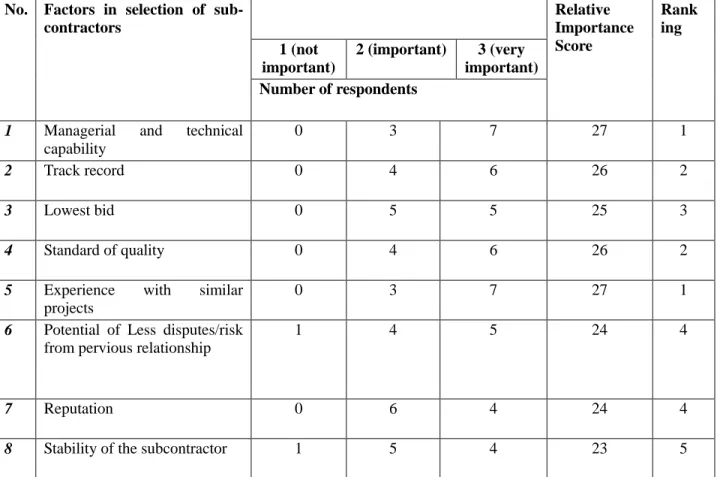
Thirteen factors for selection of domestic sub-contractors were identified from the literature review. Main contractors interview were asked to give the level of important to the factors based on their experiences. The results are as tabulated in Table 2.
Table 2Factors in Selection of Domestic Sub- contractors No. Factors in selection of
sub-contractors Relative Importance Score Rank ing 1 (not important) 2 (important) 3 (very important) Number of respondents
1 Managerial and technical
capability
0 3 7 27 1
2 Track record 0 4 6 26 2
3 Lowest bid 0 5 5 25 3
4 Standard of quality 0 4 6 26 2
5 Experience with similar
projects
0 3 7 27 1
6 Potential of Less disputes/risk from pervious relationship
1 4 5 24 4
7 Reputation 0 6 4 24 4
9 Close relationship with subcontractor
2 3 5 21 6
10 Current work load 0 7 3 23 5
11 Health and safety 2 6 2 20 7
12 Pervious working experience relationship
0 7 3 23 5
13 Financial & resources soundness
0 3 7 27 1
Based on Table 2, the main contractors surveyed considered ‘managerial and technical capability’, ‘experience with similar projects’ and ‘financial & resources soundness’ as the most important factors in selecting domestic sub-contractors. The relative importance score of this three items are 27 out of 30.This is not a surprise because all the three factors are very important that to perform the construction work successfully. Furthermore, main contractors identified ‘track record’ and ‘standard of quality’ as second most important selection factors of domestic sub-contractors with a relative importance score of 26 out of 30.‘Lowest bid’ ranked third with relative importance score of 25 out of 30.
Conversely, all three relationship factors such as ‘potential of less disputes/risk from pervious relationship’, ‘previous working experience relationship’, and ‘close relationship with subcontractor’ at 4th,
5th and 6th with relative importance scores of 24, 23, and 21 respectively which is lower than technical and financial factors.
Characteristics of domestic sub-contractors in the aspects technical capabilities, relevant expertise, financial capability and cheaper cost were considered more important by Malaysian main contractors. ‘Lowest bid’ factor was considered more important than relationship factors. This reflected the short term and financially driven attitude of the Malaysian construction industry. It also confirms earlier studies that the Malaysian construction industry’s attitude is not different, at least as far as main contractors are concerned.
Experienced Benefits from Partnering with Domestic Sub-contractors
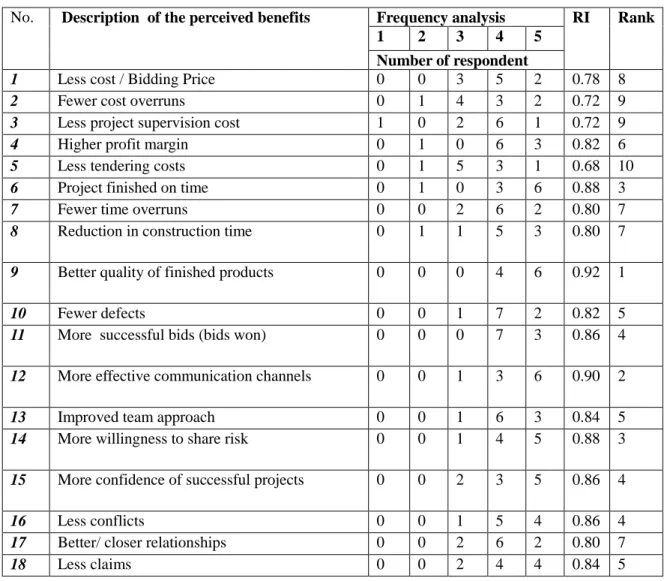
From the literature, 18 benefits of partnering between main contractorsand domestic sub-contractors were identified. Main sub-contractors were asked to evaluate the 18 benefits based on their experiences in the Malaysian construction industry. The results are as tabulated in Table 3.
Table 3Relative index of the benefits from partnering with domestic subcontractors
No. Description of the perceived benefits Frequency analysis RI Rank
1 2 3 4 5
Number of respondent
1 Less cost / Bidding Price 0 0 3 5 2 0.78 8
2 Fewer cost overruns 0 1 4 3 2 0.72 9
3 Less project supervision cost 1 0 2 6 1 0.72 9
4 Higher profit margin 0 1 0 6 3 0.82 6
5 Less tendering costs 0 1 5 3 1 0.68 10
6 Project finished on time 0 1 0 3 6 0.88 3
7 Fewer time overruns 0 0 2 6 2 0.80 7
8 Reduction in construction time 0 1 1 5 3 0.80 7
9 Better quality of finished products 0 0 0 4 6 0.92 1
10 Fewer defects 0 0 1 7 2 0.82 5
11 More successful bids (bids won) 0 0 0 7 3 0.86 4
12 More effective communication channels 0 0 1 3 6 0.90 2
13 Improved team approach 0 0 1 6 3 0.84 5
14 More willingness to share risk 0 0 1 4 5 0.88 3
15 More confidence of successful projects 0 0 2 3 5 0.86 4
16 Less conflicts 0 0 1 5 4 0.86 4
17 Better/ closer relationships 0 0 2 6 2 0.80 7
18 Less claims 0 0 2 4 4 0.84 5
All the 18 benefits have Relative Index (RI) equal or higher than 0.68 which from Table 1 shows that the respondents have a high level of agreement. Therefore, it could be concluded that main contractors agreed that there are many benefits could be obtained by partnering with their domestic sub-contractors.
Results from Table 3 indicate that the top five most benefits obtained by partnering with domestic sub-contractor are as follow:
1. Better quality of finished products 2. More effective communication channels
4. More successful bids (bids won), more confidence of successful project andless conflicts and
5. Improved team approach and less claims
The RI for the top five most experienced benefits are 0.92, 0.90, 0.88, 0.86, and 0.84 respectively. The RI for the top 5 benefits lie in therange of ‘very high degree of agreement’ (0.84 – 1.00). This means that Malaysian main contractors base on their experience agreed that the above are benefits that can be easily achieved if partnering with the sub-contractors is carried out.
From the top five benefits only two are related to direct benefits such as quality and time. All others are related to indirect benefits such as better and more effective working environment, less conflicts, and reduction of risks associated with subcontracting. Financial benefits (i.e. ‘higher profit margin’, or ‘less cost/ bidding price’) lie middle to bottom. However, the chances of achieving ‘higher profit margin’ are greatly enhanced with the formation of partnership with domestic subcontractors, as the indirect benefits eventually will contribute to direct benefits. CONCLUSION AND RECOMMENDATION
Most of the main contractors in Malaysia used competitive bidding over negotiation during the selection of domestic sub-contractors. They normally tender to a few domestic subcontractors for each trade.The domestic sub-contractors are identified before the main tender. However 60% of the respondents indicated that they treat their domestic sub-contractors as partners when working with them on construction projects.
From the thirteen factors identified from the literature review for the reason to choose domestic sub-contractors, ‘managerial and technical capability’, ‘experience with similar projects’ and ‘financial & resources soundness’ has the highest score. Commercial factor (lowest bid) came third, while the relationship factors ranked middle to bottom.
The findings of the study suggest that although partnering between main contractor and domestic sub-contractor is a good move and has been adopted by some main contractors, the Malaysian construction scenario is that the relationship factors are not considered as important as commercial and technical factors at the point of sub-contracting. Hence, relationship between main contractors and domestic sub-contractors are short term in nature and price (lowest bid) driven.
However Malaysian main contractors have acknowledged benefiting from partnering with their domestic sub-contractors. The five top benefits are better quality finished products, more effective communication channels, more willingness to share risk andproject finished on time.Even though, ‘better quality of finished products’ ranked first, butbenefits which are related to time, and cost such as ‘less cost/ bidding price’ and ‘higher profit margin’ are ranked middle
to bottom. On the other hand, indirect benefits which are related to risk, conflicts and communication are ranked in top five benefits. This is in line with previous studies, and confirms that benefits related to less risk, less conflicts, improved team approach and communication are greatly experienced from partnering.
Main contractors should adopt partnering with domestic subcontractors because they are critical to their operations. Partnering provides main contractors better control over their strategic area of operation at construction sites. Moreover, partnering increases efficiency through improved communication and coordination activities and therefore the chances of delivering quality construction products is drastically enhanced.
REFERENCES
Akintoye, A.; McIntosh, G. and Fitzgerald, E. (2000).A Survey of Supply Chain Collaboration and Management in the UK Construction Industry.European Journal of Purchasing & Supply Management.6(3-4): 159-168.
Briscoe, G.; Dainty, A. and Millett, S. (2001).Construction Supply Chain Partnerships: Skills Knowledge and Attitudinal Requirements.European Journal of Purchasing & Supply Management, 7(4): 243-255.
Black, C., Akintoye, A., Fitzgerald, E. (2000).An Analysis of Success Factors and Benefits of Partnering In Construction. International Journal of Project Management, Vol. 18 pp.423-34.
Bridge, A.J. and Tisdell, C. (2004).The Determinants of the Vertical Boundaries of theConstruction Firm. Construction Management and Economics, Vol. 22 No. 8, pp. 807-25.
Cooke, B. and Williams, P. (2004), Construction Planning Programming & Control, 2nd edition.Blackwell, Oxford.
Chong, JF (2006). A Study on Domestic Sub-contractor. Universiti Teknologi Malaysia.p.19.
Crane, T.G., Felder, J.P., Thompson, P.J., Thompson, M.G. and Sanders, S.R. (1997).Partnering Process Model. Journal of Management in Engineering, Vol. 13 No. 3, pp. 57-63.
Dainty, A. R. J.; Briscoe, G. H. and Millett, S. (2001).Subcontractor Perspective of Supply Chain Alliances.Construction Management andEconomics, Vol. 19, 2001, pp. 841 – 848.
Holt G.D, Dlmolaiye, P.D and Harris FC (1995).A Review of Contractor SelectionPractice in the UK.Journal Building and EnvironmentVol. 30 pp 553-561.
Haksever, M., Demir, I. and Giran, O. (2001). Assessing the Benefits of Long-Term Relationships between Contractors and Subcontractors in the UK.International Journal for Construction Marketing, Vol. 3 No. 1, pp. 1-10.
Humphreys, P., Matthews,J. and Kumaraswamy, M. (2003). Supply Chain Management: An International Journal, Vol.2, pp. 166-178.
Jaggar, D., Ross, A., Smith, J. and Love, P. (2002).Building Design Cost Management. BlackwellScience, Oxford.
Kale, S. and Arditi, D. (2001).General Contractors’ Relationships with Subcontractors: A
Strategic Asset.Construction Management and Economics, Vol. 19 No. 5, pp. 541-9.
Murdoch, J. and Hughes, W. (2000) Construction Contract: Law and Management.3rd Edition. Spoon Press, p. 259.
Miller, C.; Packham, G. and Thomas, B. (2002).Harmonization between Main Contractors and Subcontractors: A Prerequisite for Lean Construction? Journal of Construction Research 3(1): 67-82.
Naoum, S. (2002).An Overview into the Concept of Partnering. International Journal of Project Management, 20, p 1-7
Peace, S. and Bennett, J. (2003).How to Use a Traditional Approach for a Construction Project:A Client Guide.Chartered Institute of Building, Ascot.
Pietroforte, R. (1997).Communication and Governance in the Building Process. Construction Management and Economics 15(1): 71-82.
Shiau, Y.C., Tsai, T.P., Wang, W.C. and Huang, M.L. (2002).Use Questionnaire and AHP Techniques to Develop Subcontractor Selection System Vol. 989. National Institute of Standards and Technology, SP, pp. 35-40.
Winch, G. (2000).Institutional Reform in British Construction: Partnering and Private Finance.