by
Jacobina Taukondjele Anghuwo
Thesis presented in partial fulfilment of the requirements for the degree Masters in Public Administration in the faculty of Management Science
at Stellenbosch University
Supervisor: Dr Zwelinzima Ndevu
i Declaration
By submitting this thesis electronically, I declare that the entirety of the work contained therein is my own, original work, that I am the sole author thereof (safe to the extent explicitly otherwise stated), that reproduction and publication thereof by Stellenbosch University will not infringe any third party rights and that I have not previously in its entirety or in part submitted it for obtaining any qualification.
Date: March 2018
Copyright © 2018 Stellenbosch University All rights reserved
ii
ABSTRACT
Performance management refers to a continuous communication process between staff and supervisors to assist, unleash potential and improve organisational performance. The purpose of this study was to explore and describe the perceptions of the employees of the Directorate of Customs and Excise about the Performance Management System of the public service in Namibia. The study sought to answer the following four broad questions: (1) What is Performance Management System (PMS) in general and in the Namibia context? (2) What are the models for Performance Management System? (3) How do employees of the Directorate of Customs and Excise perceive the implementation of the Performance Management System in their workplaces? (4) How can the implementation of the Performance Management System be improved in the public service in Namibia?
The study also addressed the following research objectives, namely to: (a) Determine the general meaning of PMS in the Namibian context. (b) Explore the different models for PMS. (c) Explore how employees of the Directorate of Customs and Excise perceive the implementation of the Performance Management System in their workplaces. (d) Determine how the implementation of the Performance Management System in the public service in Namibia can be improved.
The study adopted an exploratory, qualitative research design making use of semi-structured questions administered by researcher through face-to-face interviews involving 20 employees of the Directorate of Customs and Excise in various positions who were selected by means of a convenience sampling technique.
Findings of the study show that questions 1, 3, and 4 were answered effectively and objectives a, c, and d achieved successfully, while question 2 was partially answered and objective b partially achieved.
iii
The study recommended several measures to minimise the impact of negative perceptions that can hinder the implementations of Performance Management System in the public service in Namibia as follows: (a) Promote employee engagement. (b) Improve internal management and leadership practices. (c) Initiate peer education in the Directorate of Customs and Excise. (d) Design reliable monitoring and reporting procedures.
iv
OPSOMMING
Prestasiebestuur verwys na 'n deurlopende kommunikasieproses tussen personeel en toesighouers om potensiaal te bevorder, en om organisatoriese prestasie te verbeter. Die doel van hierdie studie was om die persepsies van die werknemers van die Direktoraat Doeane en Aksyns oor die Prestasiebestuurstelsel van die staatsdiens in Namibië te ondersoek en te beskryf. Die studie het gepoog om die volgende vier vrae in die breë te beantwoord: (1) Wat behels die Prestasiebestuurstelsel in die algemeen en in die Namibiese konteks? (2) Wat is die modelle vir ‘n Prestasiebestuurstelsel? (3) Hoe beskou werknemers van die Direktoraat vir Doeane en Aksyns die implementering van die Prestasiebestuurstelsel in hul werkplek? (4) Hoe kan die implementering van die Prestasiebestuurstelsel in die staatsdiens in Namibië verbeter word?
Die studie het ook die volgende navorsingsdoelwitte aangespreek, naamlik om: (a) Die algemene betekenis van Prestasiebestuurstelsel in die Namibiese konteks te bepaal. (b) Die verskillende modelle vir Prestasiebestuurstelsel te ondersoek. (c) Te bepaal wat die persepsie is van werknemers van die Direktoraat vir Doeane en Aksyns wat betref die implementering van die Prestasiebestuurstelsel in hul werkplek (d) Bepaal hoe die implementering van die Prestasiebestuurstelsel in die staatsdiens in Namibië verbeter kan word.
Die studie het 'n ondersoekende, kwalitatiewe navorsingsontwerp aangeneem wat gebruik maak van semi-gestruktureerde vrae wat deur die navorser geadministreer is. Hierdie vraertelling het deur middel van aangesig-tot-aangesig onderhoude geskied en met 20 werknemers van die Direktoraat vir Doeane en Aksyns in verskeie posisies of poste wat deur middel van 'n geriefsteekproefnemingstegniek gekies is.
Bevindinge van die studie toon dat vrae 1, 3 en 4 effektief beantwoord is en doelwitte a, c en d suksesvol behaal is, terwyl die vraag 2 gedeeltelik beantwoord is en doelwit b gedeeltelik behaal is.
v
Die studie het verskeie maatreëls aanbeveel om die impak van negatiewe persepsies te verminder wat die implementering van Prestasiebestuurstelsel in die staatsdiens in Namibië kan belemmer. Die aanbevelings is soos volg: (a) Bevorder werknemerbetrokkenheid. (b) Verbeter interne bestuurs- en leierskapspraktyke. (c) Inisieer groepsonderrig van werknemers in die Direktoraat Doeane en Aksyns. (d) Ontwerp betroubare moniterings- en rapporteringsprosedures.
vi
ACKNOWLEDGEMENTS
First and foremost, I would like to thank God for the grace bestowed upon my life and for his wisdom at work in me throughout the duration of my studies.
I express my sincere appreciation to my supervisor, Dr. Zwelinzima Ndevu for invaluable advice and support during the course of my studies and without whom this thesis would not have been successfully completed.
Mr. Daniel Kandiado, thank you for inspiration and care throughout my studies. I also wish to extend my sincere thanks to my colleagues at the Directorate of Customs and Excise for their willingness to participate in the interviews of this study.
Last, but not least, I express my deepest gratitude to my family especially my mother, Ms. Kredula Andowa for the support and encouragement throughout the duration of my studies.
vii
TABLE OF CONTENTS
DECLARATION ... i ABSTRACT ...ii OPSOMMING ...iv ACKNOWLEDGEMENTS ...viTABLE OF CONTENTS ... vii
LIST OF FIGURES ... xii
LIST OF TABLES ...xiii
CHAPTER 1: BACKGROUND TO AND RATIONALE OF THE STUDY ... 1
1.1 Background to and Rationale of the study ... 1
1.2 Vision and Purposes of Namibia’s Performance Management System ... 2
1.3 Objectives of PMS in Namibia ... 3
1.4 Legal Framework of the implementation of the Performance Management System (PMS) in Namibia ... 4 1.5 Research problem ... 5 1.6 Research questions ... 6 1.7 Research objectives ... 6 1.8 Research methodology ... 7 1.9 Chapter outlay ... 7
CHAPTER 2: LITERATURE REVIEW OF PMS ... 10
2.1 Introduction ... 10
2.2 Defining performance management ... 10
2.3 Models of performance management ... 12
2.3.1 The Balanced Scoreboard as a measuring instrument for organisational performance ... 12
2.3.2 Cornell University PMS Model ... 17
2.3.3 Public Service Performance Management System ... 18
2.3.4 Spangenberg’s Integrated Model of Performance ... 19
viii
2.5 A Theoretical Framework for evaluating performance ... 23
2.5.1 Clarity of goals ... 23
2.5.2 Challenging goals ... 24
2.5.3 Commitment ... 24
2.5.4 Feedback ... 25
2.5.5 Task Complexity ... 25
2.6 Challenges of implementing a performance management system ... 27
2.6 Performance appraisal ... 29
2.8 Benefits of performance appraisals ... 31
2.8.1 Human resource planning ... 31
2.8.2 Recruitment and selection ... 32
2.8.3 Training and development ... 32
2.8.4 Career planning and development ... 32
2.8.5 Compensation programmes ... 33
2.8.6 Internal employee relations ... 33
2.8.7 Assessment of employee potential ... 33
2.9 Factors influencing performance appraisals ... 34
2.10 Performance Appraisal Process ... 35
2.10.1 Establish performance criteria ... 36
2.10.1.1 Traits ... 36
2.10.1.2 Behaviours ... 37
2.10.1.3 Competencies ... 37
2.10.1.4 Goal achievement ... 38
2.10.1.5 Improvement potential... 39
2.11 Responsibility for performance appraisal ... 39
2.11.1 Immediate supervisor ... 39
2.11.2 Peers and team members ... 40
2.11.3 Subordinates ... 40
2.11.4 Self-appraisal ... 41
2.11.5 Customer appraisal ... 41
ix
2.12.1 360-Degree feedback evaluation method ... 42
2.12.2 Rating scales method ... 43
2.12.3 Critical incident method ... 43
2.12.4 Essay method ... 44
2.12.5 Work standards method ... 44
2.12.6 Ranking method ... 44
2.12.7 Forced distribution method ... 45
2.12.8 Behaviourally anchored rating scale method ... 45
2.12.9 Results-based system ... 46
2.13 Challenges of performance appraisal ... 46
2.13.1 Appraiser discomfort ... 47
2.13.2 Lack of objectivity ... 47
2.13.3 Halo/horn ... 47
2.13.4 Leniency/strictness ... 48
2.13.5 Central tendency ... 49
2.13.6 Recent behaviour bias ... 49
2.13.7 Personal bias ... 49
2.13.8 Manipulating the evaluation ... 49
2.13.9 Employee anxiety ... 50
2.14 Common strategies to avoid performance appraisal challenges ... 50
2.14.1 Develop accurate performance measures ... 51
2.14.2 The need to train evaluators ... 51
2.14.3 Use multiple raters ... 51
2.15 Summary ... 52
CHAPTER 3: LEGAL FRAMEWORK OF THE PERFORMANCE MANAGEMENT SYSTEM IN NAMIBIA ... 54
3.1 Introduction ... 54
3.2 Legal framework for the implementation of the Performance Management System (PMS) in Namibia ... 55
3.2.1 The Constitution of the Republic of Namibia, (Act No. 1 of 1990) ... 55
3.2.2 The Public Service Act, (Act No. 13 of 1995)... 55
x
3.2.4 The Affirmative Action Act, (Act No. 29 of 1998) ... 57
3.2.5 The Labour Act, (Act No. 11 of 2007) ... 58
3.2.6 The State Finance Act, (Act No. 31 of 1991) ... 59
3.2.7 Treasury Instructions manual guidelines ... 60
3.2.8 Public Service Charter, 1997 ... 60
3.3 Performance Management System Process ... 62
3.4 Case study (Directorate of Customs and Excise)... 63
3.4.1 Background of the Directorate of Customs and Excise, Ministry of Finance. ... 64
3.4.4 Organisational structure of the Directorate of Customs and Excise ... 65
3.5 Performance management system practices within the Directorate of Customs and Excise ... 66
3.5.1 Signing of Performance Agreement within the Directorate of Customs and Excise .... 67
3.5.2 Assessment of performance within the Directorate of Customs and Excise ... 68
3.6 Summary ... 69
CHAPTER 4: RESEARCH DESIGN AND METHODOLOGY AND DATA ANALYSIS .. 70
4.1 Introduction ... 70
4.2 Research design ... 70
4.3 The sample and sampling procedures ... 70
4.4 Research instruments ... 71
4.5 Data collection procedures ... 72
4.6 Data analysis procedures ... 72
4.7 Verification of qualitative data ... 73
4.7.1 Credibility ... 73
4.7.2 Dependability ... 73
4.8 Ethical considerations ... 73
4.9 Access issues ... 74
4.10 Data analysis ... 74
4.11 Section - A Background Information ... 75
4.12 Semi-structured questionnaire responses ... 79
4.13 Summary ... 109
xi
5.1 Introduction ... 112
5.2 Summary of findings ... 114
5.3 Recommendations ... 115
5.3.1 Set achievable and realistic targets ... 116
5.3.2 Authorities should develop and use objective measures to determine employees’ performance ... 116
5.3.3 Use the performance management process to motivate top-performing employees 117 5.3.4 Supervisors should not use the performance appraisal process as a tool to victimise subordinates ... 117
5.3.5 Managers in the Directorate of Customs and Excise should not use the PMS and the performance appraisal process to create unwanted fear among employees ... 118
5.3.6 The Directorate of Customs and Excise should shorten the performance appraisal process... 118
5.3.7 The Directorate of Customs and Excise should improve on the review and feedback of the performance appraisal process ... 119
5.3.8 The Directorate of Customs and Excise should conduct capacity building programmes to ensure that employees understand the objectives and processes of the Performance Management System ... 119 5.4. Summary ... 121 REFERENCES ... 122 APPENDIX 1 ... 131 APPENDIX 2 ... 133 APPENDIX 3 ... 135
xii LIST OF FIGURES
FIGURE 2.1:THE BALANCE SCORECARD AS A STRATEGIC FRAMEWORK FOR
ACTION………16
FIGURE 2.2: CORNELL UNIVERSITY PMS MODEL ………...17
FIGURE 2.3: PERFORMANCE APPRAISAL PROCESS………35
xiii LIST OF TABLES
TABLE 2.1: SPANGENBERG’S INTEGRATED MODEL OF PERFORMANCE……….19 TABLE 4.1: CHARACTERISTICS OF PARTICIPANTS………..76 TABLE 4.2: UNDERSTANDING OF PERFORMANCE MANAGEMENT SYSTEM (PMS)………79 TABLE 4.3: YEAR OF FIRST IMPLEMENTATION OF PMS IN NAMIBIA………...82 TABLE 4.4: CHALLENGES ASSOCIATED WITH THE PMS IMPLEMENTATION……84 TABLE 4.5: IMPORTANCE OF THE PMS IN ORGANISATIONS……….89 TABLE 4.6: STRENGTHS AND WEAKNESSES OF THE PMS IN NAMIBIA………….96 TABLE 4.7: PARTICIPANTS’ SUGGESTIONS………..104
1
CHAPTER 1: BACKGROUND TO AND RATIONALE OF THE STUDY
1.1 Background to and Rationale of the study
Prior to independence in 1990, performance appraisals in the Public Service of Namibia were done through the Merit Assessment and Efficiency Rating Systems. The Merit Assessment System was applicable to all staff below the management cadre; whereas the Efficiency Rating System was meant for the management cadre (Office of the Prime Minister, 2005:22).
The two systems continued in the early years after independence until the establishment of the Wages and Salary Commission (WASCOM) in 1996. Under WASCOM a new system called the Performance Appraisal System (PAS) was introduced. In 1998 three milestones which had an effect on the future of the PerformanceManagementSystem (PMS) in Namibia were noted.
First, after a short implementation, Cabinet suspended the Performance Appraisal System (PAS) in 1998. A report compiled by the Office of the Ombudsman identified lack of a supporting organisational culture and insufficient training of staff in respect of the system prior to implementation as the main reasons for the suspension of the PMS (Office of the Prime Minister, 2005:22).
Second, while the Performance Appraisal System (PAS) was suspended, the Office of the Prime Minister (OPM), with assistance of the Centre for Public Service Training (CPST), conducted a training needs analysis among Senior Management across the Public Service of Namibia. The results of the training needs analysis identified the need to introduce a Performance Management System (PMS) in the Public Service of Namibia.
Third, during the same period the OPM also facilitated the development of Strategic and Management Plans for Offices/Ministries/Agencies (O/M/A) and underscored the key
2
role the PerformanceManagement Systemcould play in the effective implementation of the developed plans inthepublicsector.
Therefore, based on the recommendations of the training needs analysis and the Government commitment, the OPM assembled a project team in April 2001 to develop a Performance Management System (PMS) framework for the Public Service of Namibia. The next section presents the purposes and objectives of the Performance Management System framework developed for the Public Service of Namibia.
1.2 Vision and Purposes of Namibia’s Performance Management System
In Namibia, the PMS as a chosen approach for human development and management of public sector employees has multiple visions and purposes (Office of Prime Minster, 2005:23-24).
First, the PMSwas developed to assist public servants to achieve a shared vision of the purpose and objectives of public organisations, to help staff members to understand and recognise their contribution to the strategic intent and thus to manage and enhance the performance of public organisations.
Second, the PMS was devised as a management tool that would facilitate the achievement of results by planning staff performance, implementing strategic staff development and reviewing performance.
Third, the PMS as an approach was introduced as a tool for articulating organisational objectives in terms of individual performance, results and priorities, and as a strategy for motivating staff members to achieve their full potential in line with the organisation’s objectives.
Fourth, the PMS as a systematic approach was meant to translate organisational intent into unit or team objectives and individual results. Also the system was developed to
3
improve individual and team performance in order to achieve organisational objectives through a shared understanding of objectives, results, values and priorities.
Fifth, designers of the PMS hoped that the approach would provide relevant human development and focused coaching based on genuine feedback from supervisors.
Sixth and finally, by choosing the PMS approach, government hoped that the system would assist to establish a shared process between supervisors and managers, units/teams and individuals; manage public sector employees by contract rather than by demand; and establish a focused strategic competency-based workforce.
The section below presents a link between the purpose of PMS in Namibia and the objectives.
1.3 Objectives of PMS in Namibia
The PM Policy identifies the following nine objectives that should be achieved during its five-year period of implementation (Office of the Prime Minister, 2011:9):
promote a performance culture in the Public Service of Namibia;
convey strategic plans to everyone in the organisation in the form of Performance Agreements which align individual and organisational objectives;
create a platform for constructive dialogue between supervisors and their employees;
inform an Office, Ministry, Agency or Regional Council’s human resource practices;
manage service delivery against agreed targets and intended outputs;
enable the early identification of unsatisfactory performance and the taking of corrective action;
identify learning and development needs and appropriate interventions at organisational and individual levels;
provide feedback to staff members on their performance; and
4
1.4 Legal Framework of the implementation of the Performance Management System (PMS) in Namibia
The implementation of the PMS is guided by the Constitution of the Republic of Namibia (Act No. 1 of 1990) (Republic of Namibia, 1990a); the Public Service Act, (Act No. 13 of 1995) (Republic of Namibia, 1995); the Regulations and Public Service Staff Rules promulgated under the Public Service Act, (Act No. 13 of 1995) (Republic of Namibia, 1995); the Public Service Commission Act, (Act No. 2 of 1990) (Republic of Namibia, 1990b); the Affirmative Action Act, (Act No. 29 of 1998) (Republic of Namibia, 1998a); the Labour Act, (Act No. 11 of 2007) (Republic of Namibia, 2007); the State Finance Act, (Act No. 31 of 1991) (Republic of Namibia, 1991); and Treasury Instructions (Office of the Prime Minister, 2011:6; 2005:19).
In terms of the Constitution of the Republic of Namibia (Act No. 1 of 1990) (Republic of Namibia, 1990a), for example, Article 95 provides for the promotion of the welfare of the people. The Public Service of Namibia and other regulatory instruments have thus translated this constitutional provision through the promotion of an efficient, effective and accountable public service (Office of the Prime Minister, 2011:4).
On the basis of the Constitution of the Republic of Namibia (Act No.1 of 1990), the PMS is applicable to all public servants appointed under the Public Service Act (Act No. 13 of 1995). The Act, for instance, provides for the appointment of civil servants, who in essence once appointed must provide quality service delivery to the citizenry, which strategically underpins the purpose and objectives of the Performance Management Policy. Similarly, the Performance Management System is legally sound as it has been brought in line with Namibia’s contemporary legislative framework (Office of the Prime Minister, 2011:4).
It is evident from the preceding discussion that Namibia, like most countries in Sub-Saharan Africa, has taken steps through various laws, policies and procedures to improve service delivery through the introduction of the Performance Management
5
System in the public sector. However, the implementation of these Performance Management Systems to improve service delivery in the public sector remains questionable.
For instance, in his study of the effectiveness of the performance management system with regard to service delivery of the Zimbabwean civil service, Zvavahera (2014:1) noted that most African governments continue to offer poor services to ordinary citizens of their countries.
In Namibia, the quest for effective service delivery has been much debated since independence in 1990. However, 12 years since the revamped Performance Management System for the Public Service of Namibia was introduced in 2005, the debate continues. The next section presents the statement of the problem encountered in this study.
1.5 Research problem
Since the implementation of the Performance Management System in 2005, the media including newspapers, radio and television stations have and continue to report negative sentiments about poor service delivery in various government institutions. It appears that negative public sentiments are against the purposes and objectives of the PMS, which under the mandate of the Public Service Act (Act No. 13 of 1995) (Republic of Namibia, 1995) was thought would empower appointed public servants to provide quality service delivery to the citizenry. As stated above, negative employees’ perceptions regarding the implementation of the Performance Management System might be affecting the implementation of the Performance Management System in the public service (Office of Prime Minster, 2005:58).
However, a literature search to determine the influence of perceptions of employees on the implementation of the Performance Management System in Namibia yielded no
6
results on this topic. This study, therefore, intends to explore how Customs and Excise employees’ perceptions are affected by the implementation of the Performance Management System in the public service in Namibia. The study hopes to obtain feedback on Customs and Excise Officers’ experiences of the Performance Management System in their work places. The study will also contribute to national and international debates on the efficacy of the Performance Management System in the public service. The study will also provide recommendations for PMS policy in government and the Directorate of Customs and Excise about how to implement the PMS in the finance sector, thereby helping to improve the twin challenges of raising quality in service delivery and staff motivation.
1.6 Research questions
The main research question of the study is: How do Customs and Excise employees perceive the implementation of the Performance Management System in public service of Namibia? The study attempted to answer the following four broad questions:
1. What is PMS in general? 2. What are the models for PMS?
3. How do employees of the Directorate of Customs and Excise in Namibia perceive the implementation of the Performance Management System in their workplaces?
4. How can the implementation of the Performance Management System be improved in the public service in Namibia?
1.7 Research objectives
This study addressed the following research objectives, namely to: a. Determine the general meaning of PMS;
7
c. Explore how employees of the Directorate of Customs and Excise in Namibia perceive the implementation of the Performance Management System in their workplaces; and
d. Determine how the implementation of the Performance Management System in the public service in Namibia can be improved.
1.8 Research methodology
This section briefly discusses the methodological approach of this study. The present study explored and described the perceptions of employees regarding the implementation of Performance Management System in the public service in Namibia. To accomplish this aim, the researcher employed mainly the qualitative approach. The qualitative approach was adopted to assist in understanding the subject and in defining concepts, which included the legal framework and policies as well as previous research and books relevant to the topic. Thus the primary sources of data collection were written or oral accounts of direct witnesses of, or participants in the Performance Management System implemented in the Directorate of Customs and Excise, Ministry of Finance in Namibia. Twenty participants selected through a convenience sampling technique took part in this study and were each interviewed in their respective offices after permission was granted by the Permanent Secretary of the Ministry of Finance.
1.9 Chapter outlay
This study is divided into five chapters as follows:
Chapter 1 provides the background of and rationale of the study. It includes Vision and Purposes of Namibia’s Performance Management System, Objectives of PMS in Namibia, Legal Framework of the implementation of the Performance Management System (PMS) in Namibia, problem statement, research questions, research objectives and research methodology.
8
Chapter 2 explores the literature of Performance Management System in relation to various definitions and models of performance management.
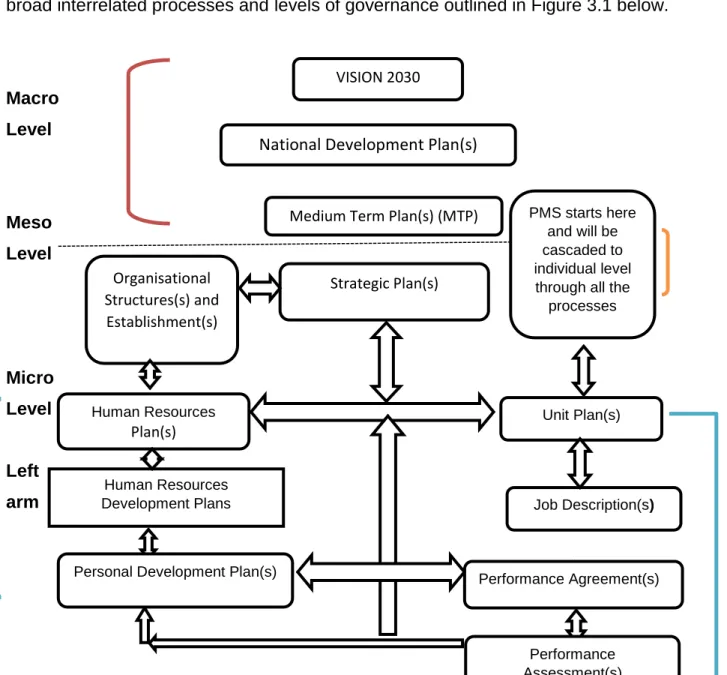
Chapter 3 focusses on legal framework of the Performance Management System in Namibia with specific reference to the Constitution of the Republic of Namibia (Act No. 1 of 1990) (Republic of Namibia, 1990) , the Public Service Act (Act No. 13 of 1995) (Republic of Namibia, 1995), the Public Service Commission Act (Act No. 2 of 1990) (Republic of Namibia, 1990), the Affirmative Action Act (Act No. 29 of 1998) (Republic of Namibia, 1998), the Labour Act (Act No. 11 of 2007) (Republic of Namibia, 2007), the State Finance Act (Act No. 31 of 1991) (Republic of Namibia, 1991), and the Treasury Instructions manual guidelines. Also the chapter presents the Performance Management System Process, which describes the different governance levels of the PMS in Namibia. Further, the chapter presents an overview of the Directorate of Customs and Excise, the case pursued in this study.
Chapter 4 outlines the research design and methodology and how data were analysed. The chapter outlines the sample and sampling procedures, research instruments, data collection and analysis procedures including strategies of how qualitative data were verified. Moreover, the chapter discusses how ethical considerations and access issues were dealt with in this study. Further, the chapter presents a summary of the findings of the study.
Chapter 5 presents the conclusions and recommendations of the study.
List of references: This section presents a list of the references quoted in the thesis according to the Harvard referencing style.
Appendices: This section comprises of the research interview questions, letter permitting the researcher to conduct the study and consent to participate in research.
9
The next chapter discusses the literature on performance management that guided this study.
10 CHAPTER 2: LITERATURE REVIEW OF PMS
2.1 Introduction
This chapter presents the literature reviewed for the study. The definition of performance management, challenges of implementing a Performance Management System and the theoretical framework that underpins this study are presented in the chapter. In addition, the concept of performance appraisal, benefits of performance appraisals, and factors influencing performance appraisals are discussed.
Moreover, the chapter provides a discussion of the performance appraisal process, and entities that may be responsible for performance appraisals. Furthermore, this chapter presents the methods that are used to conduct performance appraisals, their inherent challenges and lastly, the common strategies used by employees to avoid performance appraisal challenges.
2.2 Defining performance management
Despite diverse definitions in literature of what constitutes performance management, most researchers agree that performance management is a goal-oriented process directed toward ensuring that organisational processes are in place to maximize the productivity of employees, teams, and ultimately, the organisation (Giannetto, 2009:12). In addition, there is recognition among researchers that performance management plays a major role in accomplishing organisational strategy. Performance management involves measuring and improving the efficacy of the workforce and attaches incentives to employees (Giannetto, 2009:12).
Tyler (2005:58–63), for instance, notes that performance management is the single largest contributor to organisational effectiveness. Thus, Tyler (2005:58–63) believes that organisations fail if they ignore performance management.
11
Grobler, Warnich, Carrell, Elbert and Hartfield (2011:293) define performance management as a meaningful practice towards organisational success which requires managers and employees to work together to set expectations, review results and reward performance.
Although in agreement with the above explanations, Lussier and Hendon (2012:285) define performance management as the process of identifying, measuring, managing, and developing the performance of the human resources in an organisation. This means that management tries to discover how well employees perform so as to ultimately improve their performance level. Lussier and Hendon (2012:285) further claim that when used correctly, performance management is a systematic analysis and measurement of workers’ performance, which includes the communication of assessment processes to individual employees.
From the above-mentioned definitions it is also evident that a performance management system operates within a systems approach, hence the name ‘performance management system’. In the context of Namibia, performance management system is defined as a comprehensive tool for the management of the effectiveness and efficiency of the delivery of customer-focused services across the Public Service of Namibia (Republic of Namibia, 2005:2).
In this study, performance management is defined as the process of identifying, measuring, managing, and developing the performance of the human resources in an organisation. This definition is relevant because the performance management process in private and public organisations must be used to assist managers to discover how well employees are performing in the discharge of their daily responsibilities so as to ultimately improve their performance level. In addition, this aforementioned definition is relevant to this study as it assumes that performance management is a systematic analysis and measurement of workers’ performance, which as a process includes the communication of assessment processes to individual employees (Lussier & Hendon, 2012:285).
12 2.3 Models of performance management
Literature provides numerous models demonstrating how PMS could be implemented in different organisations. This study explores four such models which are briefly described below.
2.3.1 The Balanced Scoreboard as a measuring instrument for organisational performance
Robert S. Kaplan and David P. Norton introduced the Balanced Scoreboard in 1990. The intention was to measure both the short- and long-term objectives of organisations and provide a holistic view of how organisations are performing (Kaplan & Norton, 1996: viii). According to Whittaker (2001:149), a balanced-scoreboard approach allows an organisation to consider all the important operational measures at the same time; letting one see whether improvement in one area is achieved at the expense of another area. Kaplan and Norton (1996:181) regard a Balanced Scoreboard as a model for clarifying, communicating and managing an organisation’s strategy by focussing on high-impact measures.
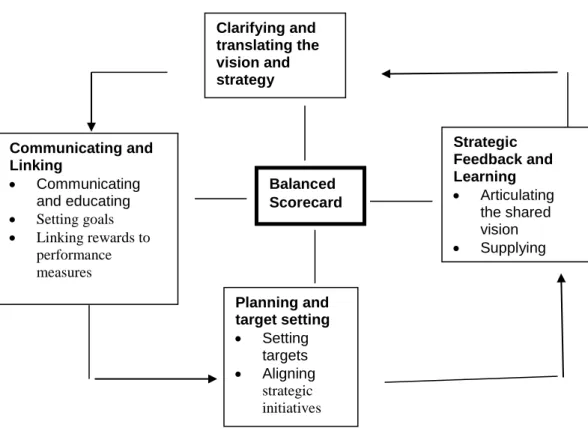
The organisation’s vision and strategy are the starting point in the Balanced Scoreboard approach. The vision and mission are then translated into performance measures, which are tracked down to ascertain whether the vision and strategy have been implemented. This is achieved by setting objectives and measures in the four distinct scoreboard perspectives discussed below and illustrated in Figure 2.1.
2.3.1.1 Financial perspective
According to De Waal and Fourman (2000:48) the financial perspective measures the bottom line of an organisation, such as growth, return on investment and other traditional measures of business performance. It looks at the results already achieved
13
and is therefore a lagging perspective. Kaplan and Norton (1996:8) suggest that whereas front-line employees must understand the financial consequences of their decisions and actions; senior managers must understand the drivers of long-term financial success.
2.3.1.2 Customer perspective
The customer perspective specifies what customers/stakeholders will be served, including how they will be satisfied. De Waal and Fourman (2000:48) state that the customer perspective measures performance in terms of how the customer experiences the value created by the organisation. Williams (2002:48) therefore notes that organisations must undertake stakeholder analysis to help understand major stakeholders’ needs. However, once stakeholders’ needs have been identified organisations must maintain good relationships with major stakeholders by keeping their needs in some kind of balance (Williams, 2002:49).
2.3.1.3 Internal business perspective
Internal business perspective focuses on processes that are critical to providing value and satisfaction to customers (Kaplan & Norton, 1996:26). De Waal & Fourman (2000:48) on the other hand, contend that this perspective measures the ability of the organisation to create value by implementing and managing effective processes, as well as to determine how effectively these processes operate. Authors on the internal business perspective indicate that this aspect reflects what public sector organisations must excel at to satisfy their customers (Williams, 2002:66; De Waal & Fourman, 2000:48; Kaplan & Norton, 1996:27).
14 2.3.1.4 Learning and growth perspective
The last perspective of the Balanced Scoreboard, learning and growth represent what is done to maintain the ability to change and improve. Organisations should look at opportunities to create a climate that ensures continuous improvement and creates value for future performance and survival. To ensure continuous improvement, organisations should concentrate on a people perspective, and then measure people’s well-being, commitment and qualities (like internal partnership teamwork, knowledge-sharing), as well as aggregate individual qualities (like leadership, competency, and use of technology) (Kaplan & Norton, 1996:28-29).
Within the context of the four perspectives discussed above, Kaplan and Norton (1996:10) note that organisations may use the Balanced Scoreboard as a strategic management tool to accomplish critical management processes over a long period of time. In order to achieve any of the four perspectives outlined above either singly or holistically, the Balanced Scoreboard model suggests that executive management teams should honour four interrelated processes (see Figure 2.1).
2.3.1.4.1. Clarity and translate the vision and strategy
According to Kaplan and Norton (1996:10), the scorecard process starts with the senior executive management team whose responsibility it is to translate the public sector’s strategy into strategic objectives. At this stage it is important for management to clarify the performance for customers and stakeholders, which are the basis upon which the success of the strategy of the organisation will be judged.
In addition, it is at this stage of the scorecard that the executive management promotes a harmonious teamwork and consensus on organisational objectives among different functional departments in order to establish team-based management processes (Kaplan & Norton,1996:12).
15
2.3.1.4.2. Communicating and link strategic objectives and measures
This component of the scoreboard approach suggests that once strategic objectives have been agreed upon, the executive management should communicate the critical public sector objectives to all employees in the organisation. In other words, all employees in the organisation should understand the high-level objectives and measures so that they in turn can establish local objectives that support the organisation’s global strategy (Kaplan & Norton,1996:13).
These authors further suggest that as communication and gaining employees’ commitment to organisational strategy and objectives are a vital process of the Scoreboard, executives may communicate departmental measures via newsletters, bulletin boards, videos, including electronically through groupware and networked personal computers (Kaplan & Norton, 1996:13).
2.3.1.4.3. Plan, set targets and align strategic initiatives
The Balanced Scorecard can only have an impact on the organisation if it is implemented to effect change. As a result Kaplan and Norton (1996:15) suggest that managers should carry out a planning and target-setting management process aimed at quantifying the long-term outcomes they wish to achieve; identify mechanisms and allocate resources for achieving those outcomes and establish long-term milestones for the financial and non-financial measures on the scorecard. Moreover, it is important for managers to ensure that employees are measured on the basis of their ability to meet or exceed customer expectations.
2.3.1.4.4. Enhance strategic feedback and learning
According to Kaplan and Norton (1996:15) this final management process enables managers to monitor and adjust the implementation of their strategy and make fundamental changes in the strategy itself. In other words, the strategic feedback and
16
learning process feeds into the vision and the strategy process where the objectives in the various perspectives are reviewed, updated and replaced in accordance with the most current view of the strategic outcomes.
Figure 2.1: The Balanced Scorecard as a Strategic Framework for Action (Source: Kaplan and Norton, 1996:11)
It is evident from the discussion above that the balanced scoreboard model is an advanced tool that public organisations can use to achieve their set of strategic objectives. It has an advantage in goal clarity and promotes communication at different levels within the organisation. At the same time the researcher observes that the senior executive management teams who are the forbearers of the vision of the organisation have the potential to impose their strategic objectives on employees. Furthermore, the researcher is of the opinion that the balanced scoreboard model as discussed in this study might be more effective in profit-orientated business organisations and less effective in bureaucratic government-run institutions. It is therefore the researcher’s
Clarifying and translating the vision and strategy Clarify the vision Gaining consensus Balanced Scorecard Strategic Feedback and Learning Articulating the shared vision Supplying strategic feedback Facilitating strategy review and learning Planning and target setting Setting targets Aligning strategic initiatives Allocation resources Establishing milestones Communicating and Linking Communicating and educating Setting goals Linking rewards to performance measures
17
contention that in the private sector, the Balanced Scoreboard performance management model may be easy to implement in the private sector because it is concerned with issues of input and output and the related remuneration, which cannot be said for public government institutions.
2.3.2 Cornell University PMS Model
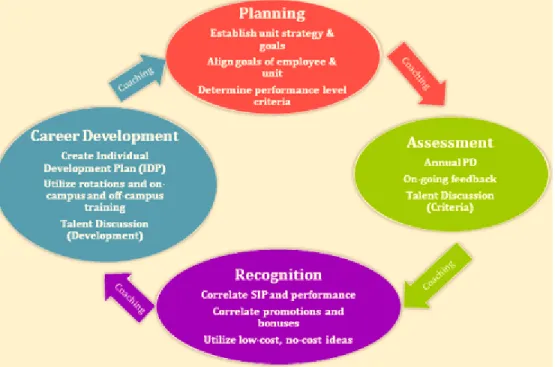
The second model is the Cornell University PMS Model illustrated below.
Figure 2.2: Cornell University PMS Model (Source: Cornell University, 2010)
As shown in Figure 2.2 above, this cyclical model comprises four major components, namely planning, assessment, recognition and career development. Advocates of this model have argued that coaching connects each stage to the next component of the framework. Flanagan and Finger (1998:153), for instance, indicated that “coaching is a key step in building an effective team, but cannot be done offhandedly or haphazardly”.
18
Another important feature of the Cornell University Model is that it calls for the alignment of employees’ goals to those of the unit/organisation during the planning phase.
A key advantage of the model above is that if used according to plan it contributes to employees’ career development. Critics of the Cornell model have, however, argued that it does not graphically show how it is linked to the strategic goals of the organisation. This weakness has been alluded to. Critics have suggested that the model might have been designed mainly for educational institutions and thus its use outside the university environment may require further enhancement.
2.3.3 Public Service Performance Management System
A third model is that of the Public Service Performance Management System (PSPMS) presented and discussed in Section 3.3 of this thesis. As illustrated in Figure 3.1 the model outlines various steps that government institutions and employees should follow to attain Namibia’s Vision 2030 of: “A prosperous industrialised country by 2030, developed by our people, enjoying peace, harmony and political stability” (Office of the Prime Minister, 2004:14). Namibia’s PMS calls f o r, amongst others, performance management at all levels of government, development of performance agreements, performance measurements, assessments and formulation of employees’ development plans (Office of the Prime Minister, 2005:25). The present study contends that if all the stages outlined in the existing PMS had been implemented as planned, there would have been improvements in Namibia’s public service delivery system.
The researcher’s contention is that even though the operationalisation of the new PSPMS is viewed to have taken long, training on its usage should be continuous to allow for its successful implementation and maintenance.
19
Critics of this model argue that despite the well-articulated stages of the model, from its graphic form, the model is crowded and difficult to understand as its stages are not clearly linked.
2.3.4 Spangenberg’s Integrated Model of Performance
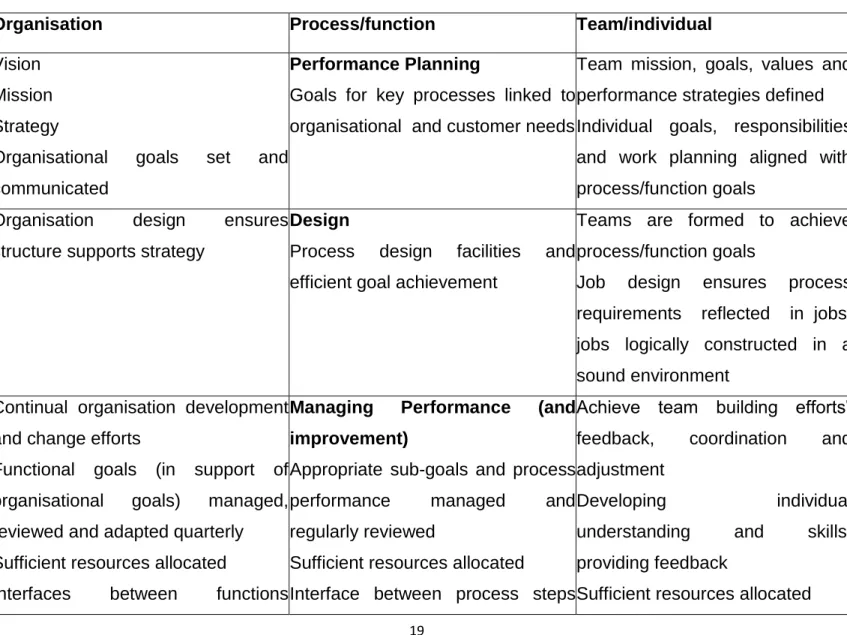
The present study also reviewed Spangenberg’s Integrated Model of Performance adapted from Maila (2006:15).
Table 2.1: Spangenberg’s Integrated Model of Performance
Organisation Process/function Team/individual
Vision Mission Strategy
Organisational goals set and communicated
1. Performance Planning
Goals for key processes linked to organisational and customer needs
Team mission, goals, values and performance strategies defined Individual goals, responsibilities
and work planning aligned with process/function goals
Organisation design ensures structure supports strategy
2. Design
Process design facilities and efficient goal achievement
Teams are formed to achieve process/function goals
Job design ensures process requirements reflected in jobs; jobs logically constructed in a sound environment
Continual organisation development and change efforts
Functional goals (in support of organisational goals) managed, reviewed and adapted quarterly Sufficient resources allocated
Interfaces between functions
3. Managing Performance (and improvement)
Appropriate sub-goals and process
performance managed and
regularly reviewed
Sufficient resources allocated
Interface between process steps
Achieve team building efforts‟ feedback, coordination and adjustment
Developing individual
understanding and skills, providing feedback
20
managed managed
Annual review, input into strategic planning 4. Reviewing Performance Annual Review Annual review Financial performance of organisation 5. Rewarding Performance
Function rewards commensurate with value of organisational
performance and function
contribution
Rewards commensurate with value of organisation performance and for team function and team contribution; for individual – function/team performance and individual contribution
Adapted from Maila (2006:16) – Source: Spangenberg 1994:30-31
Advocates of Spangenberg’s model have indicated three advantages that this model has over the three other frameworks discussed above. For instance, the Integrated Model establishes the link between performance at an organisational as well as individual levels and their alignment to the strategic objectives. Also the model provides a clear mapping between strategic planning and strategy implementation through team/individual operational performance plans. Based on Table 2.1 above the researcher infers that performance management processes involve performance planning, design, managing, reviewing and rewarding, which conform to the earlier definitions with a new element of design.
Critics of the Integrated Model contend that while the model makes provision for rewarding performance, it does not sanction non-performance, an element that is regarded as the main shortcoming of the model.
While the researcher acknowledges the contribution by the four Models of performance management, she has found the last model to be simple and easy to adapt to any working environment; however, as mentioned earlier, there is room for improvement,
21
especially if consideration is given to certain aspects when dealing with non-performance.
In sum, Performance Management Model Frameworks should clearly establish linkages between operational plans of teams and individuals in respect of the objectives/targets in the strategic plan of an organisation. It should also make provision for all inputs and processes required to attain the output.
As is evident from the various models reviewed above, frameworks guide the strategic direction of organisations. However, their success or failure depends on, amongst others, how they are perceived by employees, whose behaviour are meant to regulate within an organisations.
The next section thus explores literature pertaining to employees’ perceptions about the implementation of PMS in their work environment.
2.4 Employee perceptions of PMS
There are limited studies in Namibia that have explored employees’ perceptions of the implementation of PMS in the public sector. Nonetheless, literature research found that perceptions play a critical role in how individuals reason, construe situations and assign meaning to life’s phenomena, society in general and organisations. Perceptions influence people’s life experiences, attitudes, and feelings. According to Mullins (2010:209) perception forms the basis of organisational behaviour and that situations can be evaluated in terms of its perceptual inferences.
Kalashe (2016:22) contends that there are different perceptions of the implementation of the Performance Management System that can affect the whole system and its intended purpose negatively. Matlala (2011:63) who investigated employees’ perceptions of performance management system in South Africa found that both
22
subordinates and supervisors view the performance management system as time-consuming. Additionally, Matlala (2011:63) reported that in some instances the conflict between employees and their supervisors was due to different perceptions of how to implement the PMSheld by subordinates and their supervisors.
Empirical findings from Matlala’s (2011:63) study further reported that while 67% of subordinates perceived performance management as a tool used to determine employees’ performance, 100% of supervisors perceived performance management as a tool used to assess employees’ performance and determine the department’s effectiveness. Supervisors in Matlala’s (2011:63) study indicated that the Performance Management System encourages employees when rewards for good performance are involved.
Zvavahera’s (2014:14) study of teachers in Zimbabwe, on the other hand, found that lack of clarity of the goals of the performance management system introduced by government led to negative perceptions of its effectiveness among most practicing teachers.
Evidence from the foregoing discussion shows that managers and their employees employed in the public sector may have different perceptions of the implementation of the PMS. Thus, the researcher’s view is that to improve employees’ support for a new PMS initiative requires the public sector to set clear goals that use specific and measurable standards. Additionally, the researcher suggests that organisations should rather create the perception that there are no winners and losers, but only winners if the total organisation effectively implements the PMS.
The next section presents a theoretical framework, which outlines critical success factors for evaluating the performance of employees in an organisation.
23
2.5 A Theoretical Framework for evaluating performance
In line with Kaplan and Norton’s (1996:18-24) Balanced Scoreboard discussed in section 2.4.1, this study adopted the goal-setting theory developed by Edwin Locke to explore the key success factors applicable to the implementation of PMS in an organisation (Locke & Latham, 2002:705-717; O’Neil & Drillings, 1994:85).
Consistent with the Balanced Scoreboard perspectives, which are translated into strategic action demonstrated in Figure 2.1, Locke and Latham (2002:49-52) suggested five factors that may play a key role in the evaluation and management of performance in organisations, namely setting clear and challenging goals, commitment, feedback and task complexity (Locke & Latham, 2002:49-52).
2.5.1 Clarity of goals
In their work Locke and Latham (2002:49-52) indicate that clear goals should be measurable and unambiguous. They further contend that when a goal is clear and specific, with a certain time set for completion, there is less confusion about what to reward in respect of employees’ behaviours. Moreover, when a goal is vague it becomes difficult to determine what behaviours should or should not be evaluated and evaluations may have limited motivational value for both the employers and employees.
Based on this assumption, an assigned goal influences employees’ views about being able to perform the task at hand and if it becomes certain that recent performance is not achieving desired goals, employees will be motivated to increase effort or change their strategy (Schultz, 2006:27).
24 2.5.2 Challenging goals
One of the most important characteristics of goal setting theory is that employees may appreciate a system if they know what is expected of them. In this context, therefore, employees may have positive perceptions of the performance management system if they are aware of the financial and non-financial measures and objectives towards which they should direct their efforts (Locke and Latham, 2002:49-52).
Thus as in the case of the Kaplan and Norton’s (1996:18-24) Balanced Scorecard, managers need to communicate the organisational strategy and objectives in order to ensure that all employees support the strategy because they know not only the nature of the tasks to pursue but also the rewards that may accrue after the completion of a milestone.
2.5.3 Commitment
Locke and Latham (2002:49-52) contends that employees are more likely to "buy into" a goal if they feel they were part of creating that goal. Juxtaposed against Kaplan and Norton’s (1996:18-24) Balanced Scorecard, Locke and Latham (2002:49-52) agrees that participative management rests on the idea of involving employees in setting goals and making decisions, which will result in consensus building and a team-based management process that will drive the achievement of organisational goals after agreed goals lead to employee commitment.
Although not every goal has to be discussed with and agreed by employees, Locke and Latham (2002:49-52) believes that goals should be consistent and aligned with organisational expectations and concerns in order to promote total employee commitment.
25 2.5.4 Feedback
Feedback is a strategic last step in Kaplan and Norton’s (1996:18-24) Balanced Scorecard process. However, for Locke and Latham (2002:49-52) feedback is a regular activity which is continuously used to provide chances to clarify expectations, adjust goal difficulty, and gain recognition based on organisational benchmarks or targets. Feedback helps individual employees determine for themselves their performance through regular progress reports, which measure specific success along the way based on intermediate milestones.
Thus, to motivate employees, organisations should build in time for providing formal feedback through informal check-ins aimed at providing employees regular encouragement and recognition whereas formal meeting should be conducted to discuss goal performance necessary for long-term performance improvement. In addition, feedback should help and allow employees set their personal goals, which are consistent with the overall vision and purpose of the organisation (Locke and Latham, 2002:49-52).
2.5.5 Task Complexity
This factor assumes that employees may develop positive perceptions towards a performance system if first they are given sufficient time to meet the goal or improve their performance; and, second, if they are provided enough time to practice or learn what is expected and required for their success (Locke and Latham, 2002:49-52).
As with the Balanced Scorecard management process discussed above, the whole point of goal setting theory is to facilitate success within a team-oriented environment. Thus, organisations should create conditions where employees are involved in the development of departmental goals so that they do not get frustrated once they set out
26
to implement and accomplish the organisational strategy and objectives (Locke and Latham, 2002:49-52).
Thus, in terms of the goal setting theory, various methods are followed in order for the appraisal to take place. First, the individual staff members will meet with their supervisors to plan the goals, set standards for appraisal, define values as well as outline strategies to achieve these. Second, the individual staff member’s goals and standards are designed in line with those of the organization. Third, during the year, the individual staff member meets with his/her appraiser to evaluate progress and amend goals and strategies if necessary.
From this account, the goal setting theory is applicable to this study because the performance management system is among other things a process of setting specific performance goals for the employee, which in turn helps as a potent motivating force for the employee.
The goal setting theory has been found to have some benefits for both individual employees and organisations. First, Heystek, Roos and Middlewood (2005:77) stated that this theory is effective because it depends on the ability of individuals in an organisation to combine their efforts towards a coordinated goal.
Secondly, Zvavahera (2014:14) contended that individual autonomy is the major advantage of this model. However, Zvavahera (2014:14) admitted that some individuals may set weak or over-ambitious goals which may actually misrepresent performance. Despite this caveat, performance management is necessary to maintain the strength of the organisation. It is grounded on the principle of management by agreement or participative management rather than management by command (Bezuidenhout, 2000:56). Under the PMS, supervisors and employees jointly work out performance goals, review performance, provide feedback and work out corrective actions. The performance management system therefore emphasizes the development and the
27
initiation of self-managed learning plans and the combination of the individual and corporate objectives (Berry, 1998:256).
However, in his study on employees in Zimbabwe, Mandishona (2003:75) concluded that the success of the performance management system depends on how employees perceive the system. Buchner (2007:59-73) reported that in most instances, public sector employees always have an opposing feeling about performance management systems.
Verspoor (2004:5-8), on the other hand, perceived that the success of the PMS may be based on a number of factors, including the way the system is communicated to employees; level of staff training on PMS; quality of coaching and guidance employees receive from their supervisors and the Human Resource Department; accessibility of resources in the department and the nature of staff development programmes implemented in workshops on PMS. Verspoor (2004:5-8) therefore stresses that the reality of these conditions is important to help individual employees in the organisation understand the procedures and processes of the PMS.
2.6 Challenges of implementing a performance management system
Human resource practitioners have found that despite its perceived usefulness, the performance management system has raised some controversy in many organisations. First, in public organisations, the origin of the concept of PMS resonates with ideas inherited from private business. Heystek et al. (2005:68), for example, argued that the performance management system was inherited from the private sector where performance is linked to monetary compensation.
As Gerber, Nel and Van Dyk (1998:193) briefly put it: in the private sector, the performance management system may be easy to implement because it is concerned with matters of input and output and the interrelated remuneration, which cannot be said for public government institutions. Other authors on human resource management
28
contend that time and the lack of universally agreed measuring criteria are some of the main challenges to the effective implementation of the performance management system (Heystek et al., 2005:54; Riches & Morgan, 1998:99).
Sergiovani and Starrat (1993:71) observed that the most sensitive subject pertaining to evaluation is the criteria, which should be used to make the variables more tangible and measurable. These authors believe that evaluation instruments are susceptible to the halo effect of being too generous or too strict when evaluating. They further argue therefore that the practice of appraising, measuring or evaluating human performance is value-laden and brings the issue of objectivity and validity to the fore.
These concerns led Robbins (2007:36) to advise that, in evaluating or measuring performance, appraisers should always realise that they are attempting to measure the invisible and the subjective side of measurement, and therefore the process that requires extreme caution particularly in the public sector institutions.
Armstrong (1996:15) on the other hand, regards performance management as a means of getting improved results from the organisation, teams and individuals by understanding and managing performance within an agreed framework of planned goals, standards and competence requirements. The same author notes that performance management is concerned with the interrelated processes of work, management development and reward. It covers activities that start with goal setting at the organisational level and finish with appraisal of performance of employees, followed by rewards and consequence management (Sallis, 2002:25).
This section contributed to the knowledge that there are numerous possible challenges that implementers of the PMS might encounter in their line of duty. Also the section helped to understand that most challenges might be value-laden; for instance, there are some of those responsible for performance evaluation who might decide to use subjective rather than objective measures.
29
The next section discusses the relationship between performance management and performance appraisal.
2.7 Performance appraisal
From the definitions in section 2.6 above, it is clear that performance is a means of attaining organisational or individual goals. Therefore, achievement is about predetermined goals that can be measured and not the result of an accidental event.
Boxall, Purcell and Wright (2007:366) concur, stating that performance is behaviour or action relevant to the attainment of organisational goals that can be scaled and measured. This is underscored by Johnson, Penny & Gordon (2009:23) who argue that performance is a sequence of responses aimed at modifying the environment in a specific way. They argue that performance can be evaluated both in oral assessment and demonstrations or what is commonly known as performance appraisal.
Coens and Jenkins (2000:12) agree and defined Performance Appraisal (PA) as "the process or evaluating or judging the way in which someone is functioning" and "the purpose of evaluating an employee must be useful and must have purpose". However, available literature has stressed the fact that Performance Management "is not Performance Appraisal" (Chaudhuri (2002: XXIII) cited in Rao, 2004:33).
Proponents of Performance Appraisal (PA) regard it as a formal system of review and evaluation of individual or team task performance. A critical point in the definition is the word formal, because in actuality, managers should be reviewing an individual’s
performance on a continuing basis (Credit Union Magazine, 2009:12).
Boxall, Purcell and Wright (2007:365), on the other hand, pointed out that the distinguishing factor between performance management and performance appraisal is that while performance management is an unending process, performance
30
appraisal is done at distinct time intervals. Performance management cannot therefore be a substitute to performance appraisal, or vice versa.
Within this context therefore performance appraisal should be understood as a part of the performance management process. Performance management as a holistic approach to performance is more concerned with the achievement of institutional goals and improving institutional service delivery. Performance Appraisal, on the other hand, is more concerned with the valuation of the individuals’ past and current performance for the purpose of assessing their performance and developing developmental plans.
Foot and Hook (2011:237) indicate that PA is especially critical to the success of performance management. Although performance appraisal is but one component of performance management, it is vital in that it directly reflects the organisation’s strategic plan. Moreover, the two authors state that although evaluation of team performance is critical when teams exist in an organisation, the focus of PA in most organisations remains on the individual employee. Regardless of the emphasis, an actual appraisal system evaluates accomplishments and initiates plans for development, goals, and objectives (Foot & Hook, 2011:237).
Research shows that performance appraisal, despite its good intentions, is often a negative, disliked activity and one that seems to elude mastery (Russell & Russell, 2010:42-48). Managers, for instance, may not like giving performance appraisals and employees may not like to receive the results of their appraisals (Houghton, 2010:11). In fact, in one survey, almost 80 percent of workers stated that they were dissatisfied with their PA process (HR Focus, 2009:86).
Despite the dislike of performance appraisals among some managers and employees, there is no evidence that signify that appraisals are less important in organisations. In fact, performance appraisals serve many purposes that include providing feedback, encouraging performance improvement, and helping to make valid decisions. In addition, performance appraisals help to justify terminations, identify training and
31
development needs, and defend personnel decisions (Fox, 2009:52–56). The views provided in the section above demonstrates that despite the definitional differences between performance management and performance appraisal, the two processes intertwined and need each other in order for any performance management system to be effectively implemented. The researcher concurs with the conclusion that in spite of technical and conceptual differences between performance management and performance appraisal, appraisals in their various forms and instruments are critical, if correctly used to enhance the effective implementation of the PMS at organisational level.
The next section presents and discusses the benefits of performance appraisals to improve organisational performance.
2.8 Benefits of performance appraisals
In many institutions performance appraisals are used to improve individual and organisational performance. In their book Introduction to Human Resources, Foot and Hook (2011:237-238) suggest seven benefits of performance appraisals in organisations, which are discussed below.
2.8.1 Human resource planning
Foot and Hook (2011:237) believe that a well-designed appraisal system can provide a profile of the organisation’s human resource strengths and weaknesses. For example, data obtained from performance appraisals of an organisation’s human resources may help to identify individual employees who qualify for promotion. Also performance appraisals can assist management to determine current and future succession plans and developments of the organisation.