Cleveland State University
EngagedScholarship@CSU
ETD Archive2017
Writer Self-Efficacy and Student Self-Identity in
Developmental Writing Classes: a Case Study
Bridget Ann KrinerCleveland State University
Follow this and additional works at:https://engagedscholarship.csuohio.edu/etdarchive Part of theAdult and Continuing Education Commons
How does access to this work benefit you? Let us know!
This Dissertation is brought to you for free and open access by EngagedScholarship@CSU. It has been accepted for inclusion in ETD Archive by an authorized administrator of EngagedScholarship@CSU. For more information, please [email protected].
Recommended Citation
Kriner, Bridget Ann, "Writer Self-Efficacy and Student Self-Identity in Developmental Writing Classes: a Case Study" (2017).ETD Archive. 1000.
WRITER SELF-EFFICACY AND STUDENT SELF-IDENTITY IN DEVELOPMENTAL WRITING CLASSES: A CASE STUDY
BRIDGET ANN KRINER
Bachelor of Arts in English Cleveland State University
May 2003
Master of Arts in English Cleveland State University
August 2005
Submitted in partial fulfillment of requirements for the degree DOCTOR OF PHILOSOPHY IN URBAN EDUCATION
at
CLEVELAND STATE UNIVERSITY December 2016
We hereby approve the dissertation of
Bridget Ann Kriner
Candidate for the Doctor of Philosophy in Urban Education degree in Adult, Continuing and Higher Education
This Dissertation has been approved for the
Office of Doctoral Studies, College of Education and Human Services and
CLEVELAND STATE UNIVERSITY College of Graduate Studies by
______________________________________________________ Dissertation Chairperson: Catherine H. Monaghan, Ph.D.
C.A.S.A.L. ___________________ Department & Date
______________________________________________
Methodologist: Catherine A. Hansman, Ed.D. C.A.S.A.L. _____________________
Department & Date
_______________________________________________
Anne Galletta, Ph.D.
Curriculum and Foundations _____________________ Department & Date
________________________________________________
Wendy Green, Ph.D.
C.A.S.A.L. ______________________ Department & Date
________________________________________________
Mary M. McDonald, Ph.D.
English ___________________________ Department & Date
December 9, 2016 Student’s Date of Defense
iii
WRITER SELF-EFFICACY AND STUDENT SELF-IDENTITY IN DEVELOPMENTAL WRITING CLASSES: A CASE STUDY
BRIDGET ANN KRINER
ABSTRACT
The purpose of this qualitative case study was to explore how instructional approaches to teaching developmental writing at a large urban community college foster the
development of college students’ efficacy regarding academic writing and self-identity as college students. The case study examined the perspectives of four instructors and six students. The research considered: 1) how students experience the development of efficacy related to their academic writing; 2) how students experience their self-identity as college students; 3) how writing instructors foster students’ development of self-efficacy as writers; and 4) how writing instructors foster students’ self-identities as college students. The findings of this study provided a description of some of the specific ways students enrolled in developmental writing courses experienced the development of self-efficacy and self-identity. The study illuminated some of the practices that instructors use to facilitate both self-efficacy and self-identity in their approaches to teaching. With regard to students, what emerged in the analysis of this data was a sense that they felt both more empowered toward writing in an academic context and more self-identified as college students. The significance of the study demonstrated that fostering relationships among students and with the institution itself, along with scaffolding and contextualizing assignments, builds effective pathways to student success.
iv
TABLE OF CONTENTS
ABSTRACT ... iii
LIST OF TABLES ... vii
CHAPTER I ... 1
INTRODUCTION... 1
The Problem... 1
Purpose of Study... 4
Research Questions ... 4
Significance of the Study ... 4
Definition of Terms ... 5
CHAPTER II ... 9
LITERATURE REVIEW ... 9
Study Purpose & Research Questions ... 9
Introduction ... 9
Terminology ... 10
Developmental Education ... 12
A Brief History of Developmental Education ... 13
Early period ... 13
Middle period. ... 15
Current Approaches to Developmental Education ... 17
Prerequisite models. ... 18
Bridge programs. ... 18
Course sequences. ... 19
Co-requisite models. ... 20
Accelerated learning program. ... 20
Accelerated approaches in California. ... 21
Developmental Education Placement ... 22
Developmental Education in the Future ... 23
Community College Context ... 25
Student population. ... 27
Theorizing Developmental Education in Community Colleges ... 29
Liminal Space. ... 29
Non-place. ... 30
Heteroglossia... 32
Approaches to Developmental Writing ... 34
Basic Writing Theory ... 34
Teacher-Centered Instruction ... 35
Learner-Centered Instruction ... 36
Communities of Practice ... 38
Affective factors ... 49
v
Self-Efficacy as Academic Writers. ... 51
Conclusion ... 52
CHAPTER III ... 53
METHODS ... 53
Study Purpose & Research Questions ... 53
Introduction ... 54
Research Design Rationale ... 55
Qualitative Case Study ... 56
Philosophical Stance/Interpretive Framework ... 60
Theoretical Framework... 63
Data Collection Process ... 64
Sampling (Case & Participant Selection) ... 64
Case Selection. ... 64
Participant Selection. ... 66
Method of Data Collection ... 68
Semi-structured interviews. ... 68
Classroom Observations. ... 71
Document Study... 73
Trustworthiness, Credibility, Rigor ... 75
Protection of Human Subjects ... 79
Data Analysis ... 80
Transcription ... 80
Field Notes ... 81
Coding/Theme Development ... 81
Researcher Bias ... 81
Limitations of the Study ... 84
Summary ... 85
CHAPTER IV... 86
FINDINGS ... 86
Study Purpose & Research Questions ... 86
Introduction ... 87 Background ... 88 Institution ... 88 Participants ... 93 Themes... 100 Research Question 1 ... 101 Research Question 2 ... 110 Research Question 3 ... 121 Research Question 4 ... 138 Chapter Summary ... 146
vi
CHAPTER V ... 149
DISCUSSION ... 149
Summary of the Study ... 149
Conversations with Literature ... 152
Limitations of study ... 160 Further Research ... 162 Implications ... 164 Final Thoughts ... 166 REFERENCES ... 168 APPENDICES ... 185
A. Email to Prospective Instructor Participants ... 186
B. Instructor Participant Interview Protocol ... 187
C. Student Questionnaire ... 190
D. Student Participant Interview Protocol ... 191
E. Observation Protocol ... 195
vii
LIST OF TABLES
Table Page
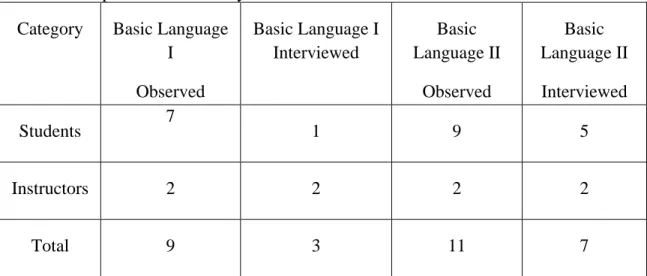
I. Participant Information by Course……….94 II. Participant Information Detail………94
1 CHAPTER I INTRODUCTION
The Problem
When some students enter institutions of higher education, they lack certain prerequisite skills, such as basic writing, reading and mathematics skills. Regardless of the reason why students enter higher education without the necessary skills to be
successful in college-level coursework, they must be further prepared prior to enrollment in such coursework. Institutional approaches to preparing students in advance of credit-bearing coursework vary widely—some institutions require prerequisite or co-requisite coursework to help prepare students, and some institutions require students to seek remediation prior to enrollment. Programming that prepares students within the context of the specific institution at which they are enrolled is referred to variably—as remedial, developmental or basic. Such programming has existed in higher education since the formation of many higher educational institutions. However, in the latter half of the twentieth century, many institutions of higher learning expanded such programming to accommodate enrollment from a more diverse range of students. During this period, many community colleges with open admissions policies were founded. Such open admissions policies meant that programming needed to be available to address the needs of students underprepared for study at the college-level. This need at these institutions
2
still exists today, as community colleges continue to be places where students in need of remediation prior to achieving a college degree are welcomed. Community colleges provide educational opportunities for a diverse population of students seeking workforce development, associate degrees, and transfer to four-year institutions ("Federal and State Funding of Higher Education," 2015).
Large numbers of students attend community colleges seeking educational and economic opportunities. Many of these students—nearly 52% of all students enrolled in two-year colleges—require remediation (Complete College, 2012). Students from minority and lower SES groups require remediation at higher percentages (Complete College, 2012). Current approaches to remediate students are largely unsuccessful, and those students who require remediation are less likely to be successful in their higher educational endeavors (Complete College, 2012).
In addition, students who occupy developmental (remedial) classes, are stuck in a liminal educational space—they are in academic non-places betwixt and between. In other words, they are enrolled in classes that they must complete in order to gain entry to college-level classes that actually help them to progress toward educational goals. Many students are stuck in remedial courses for multiple semesters or even years.
While many policymakers and program developers at community colleges are seeking ways to better help students with respect to mastery of specific academic competencies, the recognition of the role affective factors, such as the development of self-identity and self-efficacy, is noticeably lacking in the conversation. These factors play an important role in student success and should be considered in conjunction with the formation of academic skill mastery. Both self-efficacy and self-identity are important
3
in an individual’s success in the academic setting (Bandura, 1977; Weidman, DeAngelo, & Bethea, 2014).
One framework that might be useful is one with a more self-directed,
collaborative approach, such as a community of practice (Monaghan, 2011; Wenger, 1999). This approach could help with the development of these critical affective factors in a basic writing class, as this framework is known for its effectiveness in fostering affective development in a self-directed, collaborative pedagogy. Students in
developmental education courses within higher education are often not given the type of educational activities that foster self-directed learning, a skill that can lead to greater success in college-level coursework. Students in developmental education coursework are usually not encouraged to develop their own self-identities as college students. Within developmental educational programming, students are not always given tools that foster their ability to take ownership of their own learning. Instead, programming defaults to a more didactic and teacher-centered approach. Learner-centered approaches, such as those derived from a community of practice framework, might be effective in developing better self-efficacy related to academic writing and student self-identity. There are few
qualitative studies that examine the influence of self-directed and collaborative versus traditional pedagogical approaches to the instruction of basic writing. Further, a study is needed that will provide a deeper understanding of how these two different pedagogical approaches influence students’ development of specific affective factors. If these
affective factors contribute to student success at the college-level, then an understanding of how they are influenced by pedagogy is essential.
4
Purpose of Study
The purpose of this qualitative case study was to explore how instructional approaches to teaching basic (i.e., developmental or remedial) writing courses at a large urban community college foster the development of college students’ self-efficacy regarding academic writing and self-identity as college students.
Research Questions
The following research questions were addressed by the study:
1. In what ways do community college students enrolled in developmental English courses experience the development of self-efficacy related to their academic writing at the college level in basic writing classrooms?
2. In what ways do community college students enrolled in developmental English courses experience their self-identity as college students in basic writing
classrooms?
3. In what ways do developmental writing instructors use instructional approaches that foster community college students’ development of self-efficacy as writers? 4. In what ways do developmental writing instructors use instructional approaches
that foster community college students’ development of student self-identity?
Significance of the Study
The findings of this study contribute to both the theory and practice of
developmental writing in a community college environment. Theoretically, the study illustrates a case where scaffolding theory in the construction of assignments contributed to the development of self-efficacy in a particular group of students. Further, the study illustrates how the framework of future possible selves operates in student identity. A student’s self-efficacy and self-identity are important in an individual’s success in the
5
academic setting (Bandura, 1977; Weidman et. al., 2014). This study’s examination of basic writing classes is an important vehicle to examine the best practices for achieving optimal development of these specific affective factors.
Practically, instructors might consider how the use of scaffolding in the construction of assignments could foster the development of self-efficacy in their students. Self-efficacy toward academic writing is an essential affective dimension that can help students as they progress beyond developmental education courses. Further, the study illustrates how instructors’ views of the situation of developmental writing can differ from that of their students. Building instruction and choosing materials that foster students’ future-focused self-identities could help to strengthen student identities and lead to greater levels of success.
Definition of Terms
Remedial Education: According to Arendale (2007), consists of “a group of courses and/or activities to assist learners to achieve secondary school level basic skills in their identified academic deficit areas” (p. 26).
Developmental Education: Arendale (2007) defines developmental education programs as those that “commonly address academic underpreparedness, diagnostic assessment and placement, affective barriers to learning, and development of general and discipline-specific learning strategies (p. 18).
Learning Assistance: A program that “enables a student to develop the attitudes and skills required for successful achievement of academic goals” (Arendale, 2007, p. 22).
Basic Skills: Broadly refers to a competency level in areas of reading, writing, and mathematics that are necessary for success in higher education and/or the workforce at
6
the entry level. It is the expectation that these competencies are achieved in primary and/or secondary education. Often refers to literacy programming taking place outside of higher education.
Basic Writing: Shaunessey (1977) attempted to re-frame the experience of remedial education in order to de-stigmatize it. She writes, “the territory I am calling basic writing (and that others might call remedial or developmental writing)” (p. 4).
Preparatory Education: A historical term used in higher education to refer to programming intended to prepare students for college-level courses.
Academically underprepared: Students who have “the potential for success in college when appropriate educational enrichment and support services are provided” (Arendale, 2007, p. 13).
College-ready: Students that have an adequate level of preparedness; this term describes those who do not require developmental coursework, but it is frequently used as negation (e.g. “students who are not college ready”).
Self-efficacy: An individual’s belief that she/he is capable of executing a particular action (Bandura, 1997).
Self-identity: One's self-identity in a psychological sense is a collection of beliefs that a person holds about herself/himself—this construct is also referred to as self-concept in the literature (Baumeister, 1999).
Community of Practice: A community of practice is defined by six key characteristics: “1) self-forming and self-governing, 2) Members share a common interest or passion for a particular topic, 3) Members are involved in the creation of new knowledge, 4)
7
of an individual’s life, and 6) A community of practice facilitates the development of shared meaning and identity formation for professionals” (Monaghan, 2011, p. 430). Learning Community: “The learning community approach fundamentally restructures the curriculum, and the time and space of students. Many different curricular restructuring models are being used, but all of the learning community models intentionally link together courses or coursework to provide greater curricular coherence, more
opportunities for active teaming, and interaction between students and faculty” (Smith, 2004, p. 32).
Self-directed Learning: “Self-directed learning is learning in which the conceptualization, design, conduct and evaluation of a learning project are directed by the learner. This does not mean that self-directed learning is highly individualized learning always conducted in isolation. Learners can work in self-directed ways while engaged in group-learning settings, provided that this is a choice they have made believing it to be conducive to their learning efforts” (Brookfield, S. D., 2009, p. 2615).
Collaborative Learning: “an umbrella term for a variety of educational approaches involving joint intellectual effort by students, or students and teachers together. Usually, students are working in groups of two or more, mutually searching for understanding, solutions, or meanings, or creating a product…Collaborative learning represents a significant shift away from the typical teacher-centered or lecture-centered milieu in college classrooms. In collaborative classrooms, the lecturing/ listening/note-taking process may not disappear entirely, but it lives alongside other processes that are based in students’ discussion and active work with the course material” (Smith & MacGregor, 1992, p. 9).
8
Direct Instruction: “There are five overlapping uses of the term direct instruction:
1. Academic instruction that is led by a teacher regardless of the quality of instruction, 2. The instructional procedures that were used by effective teachers in the teacher effects research, 3. Instructional procedures used by teachers when they taught cognitive strategies to students, 4. Instructional procedures used in the Distar (Direct Instruction Systems in Arithmetic and Reading) programs, 5. Instruction where direct instruction is portrayed in negative terms such as settings where the teacher lectures and the students sit passively” (Rosenshine, 2008, p. 1). For the purposes of this study, the first and fifth of these are relevant.
9
CHAPTER II LITERATURE REVIEW Study Purpose & Research Questions
The purpose of this qualitative case study was to explore how instructional approaches to teaching basic (i.e., developmental or remedial) writing courses at a large urban community college foster the development of college students’ self-efficacy regarding academic writing and self-identity as college students.
The following research questions were addressed by the study:
1. In what ways do community college students enrolled in developmental English courses experience the development of self-efficacy related to their academic writing at the college level in basic writing classrooms?
2. In what ways do community college students enrolled in developmental English courses experience their self-identity as college students in basic writing
classrooms?
3. In what ways do developmental writing instructors use instructional approaches that foster community college students’ development of self-efficacy as writers? 4. In what ways do developmental writing instructors use instructional approaches
that foster community college students’ development of student self-identity?
Introduction
The goal of this chapter is to explore literature related to developmental education in a community college context, basic writing instruction, and learner-centered pedagogy.
10
The chapter will begin with a brief discussion of the terminology relevant to
developmental education within higher education; such terminology has been nebulous at times and is not used consistently throughout the literature. Following this discussion of terminology, I will explore the construct of developmental education—its history and its current situation in higher education, particularly in community college contexts. While I will explore the current programming approaches to developmental education in general, my specific focus in this section will be on developmental writing programs and models. The next section of this literature review will focus on the context of community college and specifically how students in developmental education courses in these institutions are situated. Within this section, I will introduce three theoretical frames—liminal space, non-place, and heteroglossia—with which to conceptualize the situation of
developmental education in a community college context. The last major section of this chapter will focus on literature related to learner-centered pedagogy and basic writing instruction. Within this final section, I will discuss the theoretical framework of a community of practice as one tool to understand self-directed, collaborative learning in the context of higher education. Finally, I will discuss the specific affective factors, i.e., self-efficacy and self-identity, as they relate to academically underprepared college students.
Terminology
There are a number of terms that are associated with this area of postsecondary education. Remedial, developmental, and learning assistance are used throughout the literature to refer to the types of programs that operate between secondary and
11
education program, according to Arendale (2007), is “a group of courses and/or activities to assist learners to achieve secondary school level basic skills in their identified
academic deficit areas” (p. 26). He defines developmental education programs as those that “commonly address academic underpreparedness, diagnostic assessment and placement, affective barriers to learning, and development of general and discipline-specific learning strategies (p. 18). Finally, he defines a learning assistance program as one that “enables a student to develop the attitudes and skills required for successful achievement of academic goals” (p. 22). Here the nuanced distinction between each term is elucidated, though it should be acknowledged neither researchers nor those actually naming programs at various postsecondary institutions necessarily use any of the above-mentioned language consistently. However, there is utility in recognizing the overlapping terminology and the widespread inconsistency in the literature that exists, prior to
discussing this programming in further detail. Further, sometimes such programming is referred to as basic skills education or broadly as preparatory education, although the former usually refers to literacy education outside the context of higher education and the latter term to programming that existed earlier in the history of higher education.
There is also widespread inconsistency as to how to best refer to the student population in need of this type of postsecondary educational programming. Such students are referred to as academically underprepared, developmental, or remedial. As is true for the programs intended for bringing them success in college-level coursework, each of these terms has a subtly different meaning; although all of the definitions, according to Arendale (2007), refer to students who have “the potential for success in college when appropriate educational enrichment and support services are provided” (p. 13). Recently,
12
the term college-ready has emerged to refer to students that have an adequate level of preparedness; this term describes those who do not require developmental coursework, but it is frequently used as negation (e.g., “students who are not college ready”). It should be noted as well that many college-ready students might at some point require some form of learning assistance—for example, tutoring or counseling.
For the purposes of this analysis, I will keep my discussion consistent with the terms as they are used in individual sources as I mention them. In other cases, where I am not explicitly referring to the work of another researcher, I will use the term
developmental education to refer to programs that prescribe specific coursework as a remedy for academic underpreparedness. When appropriate, I will employ the term learning-assistance to refer to those programs that offer support outside of actual coursework. I will refer to students enrolled in developmental education or learning assistance programs as students academically underprepared in a specific subject area, as students enrolled in developmental coursework, or as students participating in learning assistance programs. I will also discuss that very little critical language analysis has been done with regard to the pejorative tone of much of the language used to refer to both this programming and this population of students. The pejorative tone of much of the
language used in this field needs to be given thorough consideration through further research as future programming evolves.
Developmental Education
This section will explore developmental educational programs from a historical perspective along with a taxonomy of current models of developmental education in higher education. In addition, I will explore the mechanism for placement in
13
developmental education; I will end with a brief discussion of considerations germane to the future of such programming in higher education.
A Brief History of Developmental Education
Both Arendale (2011) and the ASHE Higher Education Report (2010) recognize six distinct phases in the history of developmental education in U.S. higher education. Each chronological phase is delineated on the basis of the type of offerings that were available during the time period in question. Programming for students academically underprepared for college-level work began in the early history of the creation of higher educational institutions in the United States. This is classified as “Phase One: 1600s-1820s.” A second phase runs from 1830s to 1860s and a third until the mid 1940s—for the purposes of my discussion, I shall refer to these three phases collectively as “The Early Period.” I will discuss the phases comprising the mid-1940s through the 1990s as the “The Middle Period,” and the final phase as “Current Approaches.” In each of these cases I will provide an overview of the programming available during the given time period as well as at least one salient example of the type of program being discussed.
Early period. The need to remediate or develop students in order to ensure successful completion of college degree programs actually emerged as early as the fifteenth century in the higher educational institutions of the United States. Interestingly, developmental education emerged almost immediately in the history of higher education in the United States. It not merely a twentieth century phenomenon, but has been a component of higher educational institutions in the United States throughout their entire history (Arendale, 2011; Rose, 2012). At one point in time, tutoring programs were offered in various forms to prepare students for the demanding academic coursework at
14
institutions like Harvard and Yale. Prospective students would seek tutoring so that they could gain admission to said universities; students also sought to learn languages
necessary for academic study, like Greek and Latin (ASHE Higher Education Report, 2010). In fact, Harvard continued to offer and even required supplementary study and tutoring for its first-year students in the form of recitation sessions. As such, Harvard was the first institution to require some kind of remediation of its students (Boylan &
Appalachian State U, 1988).
Tutoring programs remained the primary form of learning assistance for academically underprepared students from the fifteenth through the mid-nineteenth century. It is worthwhile to note that many, if not most, students required some form of learning assistance in order to be admitted to college during this period, as the “quality of primary and secondary education was missing or uneven in most of the United States” (ASHE Higher Education Report, 2010, p. 27). It is also notable that developmental education programs existed only to support the educational objectives of the privileged classes of white males.
During this period, separate institutions emerged to assist in preparing
academically underprepared students for college-level study. Appropriately, these schools were called preparatory academies. While many of them were closely associated with a particular school, they were funded and administered independently (Ignash, 1997). Then, in the mid nineteenth century, the University of Wisconsin (UW) instituted an internal department designed to address student underpreparedness in higher education. It was called “The Department of Preparatory Studies” and offered courses in reading, writing, and mathematics. Many colleges and universities soon followed the lead of UW
15
and created their own departments designed to make up for deficiencies in the public school system. This was a way for them to both increase enrollment and maintain certain levels of academic standards (Brier, 1984). Thus, developmental education programming was broadly integrated into colleges and university curricula. While these programs helped to make a college degree accessible to more people, the majority of people enrolled in colleges and universities were still white males, even with the help that developmental programs offered.
Middle period. It was not until the middle of the twentieth century that new populations of students began to seek the educational advantage of a college degree. Veterans of twentieth century American wars, children of late-nineteenth and early twentieth century immigration waves, African Americans, and women all sought degrees at colleges and universities in increasing numbers during this period. As such, new types of educational programming emerged to meet their needs. While preparing students to successfully complete college coursework was still the goal, these new programs were not focused exclusively on academics—they augmented remediation with a
consciousness of racial, ethnic, gender-based, or socio-economic factors. In essence, programs were now imbued with an awareness of the social and cultural circumstances of its student population (ASHE Higher Education Report, 2010).
After World War II, compensatory educational programs emerged; the intention of such programs was to compensate for the social and environmental factors that brought some students to higher education underprepared for the work ahead of them. During this period, colleges and universities began to educate a far more diverse population of learners than ever before. Some were the first in their families to attend
16
college. This meant that supportive services offered by higher education were far more important than they had been in the past. Compensatory programs sought to equalize opportunity to higher education completion by helping students from traditionally underrepresented populations acculturated to higher education—a problem that their privileged white male counterparts did not have.
A salient example of an emergent compensatory educational program in this period are the TRiO programs, which originally included Upward Bound, Talent Search, and Student Support Services programs. TriO emerged as a result of the 1969 civil rights law and now extends to a total of eight programs. TRiO and other compensatory
educational programs offered special developmental educational services to students who met certain criteria (parents not college graduates, disability, or from a lower SES). These programs were similar in some ways to the previous models in content; they offered tutoring, counseling, and supplemental coursework (ASHE Higher Education Report, 2010). What distinguished this programming was not its approach to education, but the fact that it was intended for an entirely new population of learners, as previous
remediation was not aimed at populations traditionally underrepresented in higher education.
It was also during this time that the term developmental emerged to replace remedial, a term that carried some amount of stigma by this point. Developmental
education as both a term and an approach to programming became prevalent in the 1970s. “Proponents of developmental education view it as more comprehensive model regarding the student because it focuses on the development of the person in both the academic and affective domains” (Arendale, 2005, p. 72). While remedial and compensatory programs
17
looked at students as deficient in skills, developmental education viewed students as inherently capable. Developmental education sought to assist students with a natural progression toward college-level skills. The developmental model integrates other types of encouragement such as career exploration and the building of academic “soft-skills,” like time-management and good study habits. In some cases developmental education offers a “variety of courses that teach material not typically offered in high school but frequently necessary for success in college” (Boylan & Bonham, 2007, p. 2). Examples of such programming are courses like “freshman seminar” or other courses that have curriculum focused on learning strategies and study skills. Critical to the developmental educational model is this recognition that affective skill development alongside the development of academic skills can foster student success.
Current Approaches to Developmental Education
While many higher educational institutions offer some kind of developmental education or learning assistance to students who are underprepared for college-level courses, there are many differences in the types of programming that are currently available and have been available historically. Recently, programming intended to serve students who are academically underprepared for college-level coursework has come under some scrutiny by institutional administrators and policy makers—as funding models for public institutions have been evolving. Programs are losing funding, being forced to reduce available services, or being eliminated altogether—this is especially true at four-year, public universities ("Federal and State Funding of Higher Education," 2015). This trend continues despite the fact that enrollments, especially among students needing supportive programming, continue to rise (ASHE Higher Education Report, 2010). Many
18
institutions are seeking to accelerate the time students spend in developmental education, as funding is now being tied to graduation rates instead of enrollment rates. As
participation in developmental education increases the overall time a student will take to graduate with a degree, it is seen as an impediment to maximizing funding for many public institutions.
Programming designed to serve students who are academically underprepared for college-level coursework takes several forms. Some models focus on preparing students in advance of their enrollment in college courses, while others offer supportive services concurrently with college coursework. Both of these approaches have existed throughout the history of higher education.
Prerequisite models. In prerequisite approaches, students are required to
complete at least one, but sometimes a sequence of courses, prior to enrolling in college-level coursework. In some cases, students complete this coursework at a separate facility, such as a preparatory school. In other cases, developmental courses are offered on a credit basis within the actual institution of higher education. The credits students earn for completion of these courses do not, however, count toward graduation requirements (ASHE Higher Education Report, 2010). Further, students who depend on financial aid can use up their maximum allowance prior to finishing their degree program.
Bridge programs. In this accelerated approach to developmental education, students who are not academically prepared for college-level courses take a short course in advance of the start of the academic term. These programs typically do not span an entire term, but only a few intensive weeks. Often these bridge programs are offered during the summer prior to the beginning a new school year. Bridge curricula can consist
19
of both academic and affective components (McCurrie, 2009). Administrators favor this approach to remediation as it is relatively cost-effective, while writing instructors view the programs less favorably in many contexts—in short, teachers felt bridge programs were effective only when they were well integrated with the relevant college-level course and not merely skill-development workshops (McCurrie, 2009).
Course sequences. At many institutions offering developmental education, students complete a series of courses that prepare them to be successful in college-level courses. Students are placed into a particular course based on their performance on a prescribed placement test and then complete the series from that point of placement. While some are only required to take one course in advance of college-level courses, others—those with lower scores—are relegated to taking a number of courses prior to enrolling in college-level courses (Bailey, Jeong, & Cho, 2009). One example of such a program, among many (this is the most common model in use at community colleges) is at Landmark College (ASHE Higher Education Report, 2010). At this institution,
students who are academically underprepared are enrolled in a “pre-credit developmental skills program,” which consists of two courses (reading and writing) that are aligned with “skills support” programming (i.e., tutoring, technological resources). Engstrom (2005) claimed that this program is successful because it allows students “opportunities to participate in a variety of reading and writing experiences, understand the multifaceted process of reading, and be active observers of their own reading styles so that they can develop the skills, strategies, and confidence to be successful students” (p. 38).
Supporters of prerequisite course sequences see this programming as necessary
20
coursework. Opponents of this approach believe that multiple course sequences decrease the likelihood that students will persist to graduation, as they must complete additional coursework that does not count toward graduation requirements, thus extending the total time that it takes to complete a degree program.
Co-requisite models. Programs offering supportive services alongside college coursework take two forms—voluntary and non-voluntary. Voluntary services include tutoring and counseling services; students elect to participate in them as they deem necessary. Non-voluntary co-requisite models either embed developmental curricula within the college level course itself or offer a supplemental session for students who are academically underprepared. Supporters of co-requisite approaches argue that students are more likely to be successful when they are moved through college coursework more quickly, a direct counterpoint to the problems that some have with prerequisite models. According to Hern (2012), “nationwide studies have shown that the more semesters of remediation that a student is required to take, the less likely that student is to ever
complete a college-level math or English course” (p. 60). Thus, co-requisite models aim to decrease the amount of time a student spends in developmental courses, thereby increasing their likelihood of success (i.e., degree attainment).
Accelerated learning program. A co-requisite approach to developmental writing instruction, the Community College of Baltimore County (CCBC) program claims to have dramatically increased the success rates of its academically underprepared students in college-level writing courses. Here students enroll in a complementary course designed to scaffold the requirements of the actual college-level Composition course, which is a nearly universal requirement across all higher-educational institutions for the attainment
21
of either an associate or bachelor’s degree. In CCBC’s Accelerated Learning Program (ALP), students were successful because they were supported contextually (Adams et al., 2009). In other words, they were given direct support alongside the required college course, which proponents argue is one of the primary reasons why ALP works. They argue that prerequisite models have lower success rates because completion of
developmental courses do not necessarily lead to the ability to succeed in college-level courses because there can be a prolonged period between the completion of a prerequisite and enrollment in the relevant college course. Further, ALP works because it is, in fact, “accelerated.” Proponents argue that students often fail to complete lengthy
developmental course sequences because they “gave up at some point in the process”— not because they lacked the necessary ability to complete the coursework (Adams et al., 2009, p. 62). Adams el al (2009) argued that underprepared students give up on the prospect of completion for a variety of reasons, but that in general models with long “pipelines,” such as those with multiple prerequisite courses are the least successful because students have many opportunities to stop along the way.
Accelerated approaches in California. Other institutions have adopted
approaches similar to that of the ALP in practice at CCBC. The California Acceleration Project (CAP) is a program in place in the community college system of California that aims to increase the utilization of accelerated programs like ALP across the entire system. CAP advocates such approaches be used in both Mathematics and English departments. CAP programs are not all identical; instead, participating institutions craft programming according to shared principles of acceleration: backwards design, just-in-time
22
have seen increased success rates among student participants, which Hern (2009) attributes to the implementation of the shared principles of acceleration. She argues that most of the knowledge and skills that are taught in developmental course sequences are not used by students in the correlating college-level courses, and therefore, the type of contextual support offered by CAP programs is far more effective.
Developmental Education Placement
Students who are referred or placed in developmental education programs are deemed lacking in at least one essential skill: reading, writing, or mathematics. Generally, the need for developmental education is determined only by the absence of
well-developed skills in one or more of these areas. Little to no attention is paid to the reasons why students might lack certain academic skills, which is problematic, as these causal factors could have a direct bearing on the effectiveness of programming. In a given developmental course, students could be returning to school after a significant hiatus, have an untreated learning disability, have a behavioral or emotional condition, speak English as a second language, or have dropped out of high school without ever learning the skill in question. Other systemic factors that contribute to students’ need for
remediation at the college level include having attended an under-resourced secondary school, lower socioeconomic status, and being a first-generation college student.
Regardless of previous educational experiences, students are placed in
developmental education on the basis of standardized tests. In some cases, students are placed using standard college admissions test, such as ACT or SAT. In other cases, they are asked to take a placement exam as part of the admissions process. Community colleges use a range of testing tools for this purpose; some examples include
23
ACCUPLACER and COMPASS. These placement tools are popular at institutions where all matriculating students have not necessarily taken the standard college entrance exams (ACT or SAT) because the opportunity was not provided to them at their high school or because many years have elapsed since they completed high school. Many students place into developmental education programs because they do not have the requisite skills to be successful in college-level coursework, even though they have successfully completed high school, including college preparatory coursework (Hoyt & Sorenson, 2001). In short, there is a preparation gap between high school completion and college placement that exists, especially in areas where public school districts are low performing.
Developmental Education in the Future
As the previous discussion of history elucidates, developmental education and the surrounding debate are not new in the realm of higher education. Programs intended to prepare otherwise underprepared students have existed in some form throughout the history of higher education. “The controversy over [developmental education] is certainly not new. Bridging the academic preparation gap has been a constant in the history of American higher education and the controversy surrounding it is an American
educational tradition” (Arendale, 2011, p. 67). Given this history, it is imperative that programs for students underprepared for college level work continue to be funded and improved upon. It is time to stop looking at developmental education programs as ancillary services offered as a courtesy and begin seeing them as a fundamental and inextricable component of higher educational programming.
While most community colleges do offer some kind of developmental education or learning assistance to students who are underprepared for college-level courses, there
24
are many differences in the types of programming that is currently available and has been available historically. Recent trends in educational policies and funding strategies have forced community college administrators to re-evaluate the success of developmental education with the goal of increasing graduation rates. “A shift in funding formulas toward performance-based funding for community colleges has increased the importance for institutions to improve students’ success in developmental courses” (Polk-Conley & Squires, 2012, p. 14). However, despite the focus upon developmental education, there is little comprehensive data on the programming— “Most studies draw generalizations based on single-institution data or surveys, do not control for student preparation levels, and lack information about indicators of effectiveness and/or the selection of institutional sites” (Handel & Williams, 2011, p. 30). This is an appropriate starting place for any discussion over the reform of developmental education; policy makers need to consider the heterogeneous populations of developmental education programs, as well as
consideration of multiple sites and programs before drawing conclusions. Emergent developmental education programs should have a clear learner-centered consciousness that places student needs at the top of the pyramid, as well as clear consideration of the heterogeneity of the population in a given developmental education program. A
recognition of the varying needs of students who are categorically “academically underprepared” is noticeably lacking in developmental educational programming. As Rose (2012) says, “we have to know [students who place into developmental education] better, move beyond ready-made labels and explanations and understand how they go into Basic English, Basic Math, or Reading” (p. 45). Moving in this direction, however,
25
would require that institutions look at students differently, not as standardized outcomes on a placement exam, but as individuals with unique needs and challenges.
Community College Context
The purpose of this section is to examine developmental education programs in the community college context—to explore how developmental education is situated in community colleges as institutions and among community college students. The
discussion that follows will briefly examine institutional characteristics that shape developmental education in community colleges, as well as a description of the student population that participates in developmental educational programming in two-year community colleges.
Two-year colleges were originally developed in order to support the needs of larger four-year schools by offering freshman and sophomore courses, thus allowing the four-year schools to concentrate on both research interests and the teaching of more advanced students with fewer needs (Cohen & Kisker, 2010). These institutions were originally private and called junior colleges. When two-year public colleges, called community colleges, emerged in the second half of the twentieth century, their private counterparts largely disappeared—they either merged with community colleges or ceased to operate. During this period, two-year institutions offered open enrollment, which meant students with any level of preparedness were free to enroll. Community colleges began to focus on offering programs to serve students academically underprepared for college-level coursework (ASHE Higher Education Report, 2010).
The intentions of such preparatory education programs are laudable, as they strive to offer opportunities to all students seeking the economic benefits of a college degree—a
26
credential that is increasingly seen as a requirement for middle-class employment in the United States (Georgetown U Center on Education and Workforce Analysis, 2012). According to Keene (2008), “the community college represents the only form of
universal access to education, and is thus purported to be the gateway to low-income and minority students’ realization of the ‘American Dream’” (p. 65). As such, the purpose of this section is to explore the history of developmental education programs, as such programs have recently come under intense scrutiny by educational policy makers, as well as college administrators. In order to foster a complete understanding of such programs, a brief discussion of relevant terminology precedes the discussion of the history of developmental education. Finally, a taxonomy of different approaches to programming in this realm will provide an overview of the types of programs that exist and the arguments that support their existence and continued relevance in higher education.
Community colleges champion philosophies of open-access to students of all backgrounds. In fact, “all publically funded community colleges offer developmental education programs, and almost half provide contracted remedial courses to business and industry” (Perin, 2006, p. 340). Accepting all students who apply means that the promise of a college education is available to all who seek it—anyone willing to do the work necessary to complete a given program and pay tuition fees. Recent trends in the way that public funding is allocated to community colleges have caused many institutions to question this philosophy. Pressure from policy makers to show results, i.e., an increase in completion and graduation rates, has led to an increased focus on the standards at
27
the K-12 education system and the four-year college system. Thus, funding is now being allocated to many public colleges and universities based on the number of students who graduate, not the number who are enrolled. Further, developmental education programs are being scrutinized because students enrolled in them have significantly lower
completion rates than their college-ready counterparts (Perin, 2006). According to Daiek, Dixon, and Talbert (2012), “developmental education as it is now practiced is not very effective at overcoming academic weaknesses” (p. 37). Their assertion is supported by data compiled in 2012 by Complete College Now, that reports only 22.3% of students who enroll in remedial coursework complete it and associated coursework in two years, while only 9.5% of those students actually graduate within three years.
Student population. Many students enrolled in developmental courses at
community colleges occupy a type of liminal space (Boys, 2011)—they are enrolled, but not earning credit toward a degree. They are not in high school, but studying concepts traditionally associated with secondary curriculum. In some cases, these students have earned diplomas and passed standardized tests. In other cases, they have earned a General Educational Development (GED) diploma, which is the educational equivalent of a high school diploma. Still, for various reasons, these students have not been able to
demonstrate the necessary skills on a placement exam as administered by a postsecondary institution. Adequate scoring on such an exam would allow students to enroll in the college courses that count toward degree requirements, such as college-level composition or mathematics. Instead, these students are relegated to spend a semester or even an entire academic year taking courses intended to prepare them for such college-level courses.
28
Many students who are underprepared for college-level coursework matriculate at community colleges (NCES, 2012; Bailey, Jeong, & Cho, 2008; Bettinger & Long, 2009), almost all of which offer programming for academically underprepared students (AACC, 2013). While open-access four-year public colleges and universities do
remediate some students, a great number of students needing remediation matriculate to community colleges (Complete College America, 2012).
Students enrolled in developmental education at community colleges are a diverse population. In general, students from populations traditionally underrepresented in higher education—African American, Hispanic, and lower socioeconomic status—are more likely to participate in developmental education programs (Complete College America, 2012). As such, open access is particularly important, since community colleges offer underprepared students some of the only opportunities available to obtain a college degree and by extension the economic and social mobility such a degree affords. There is diversity in students’ academic needs as well; students enter developmental education with varying needs, requiring skill development in mathematics, writing, and/or reading.
Several studies (Koch, Slate, & Moore, 2012; VanOra, 2012) have examined the attitudes and perceptions of students participating in developmental education in
community college settings. VanOra (2012) gathered data pertaining to the challenges and motivations experienced by these students. He concludes that students find
assignments, particularly writing assignments, to be too difficult. In addition, students find it difficult to balance multiple demands upon their time and note that the quality of teaching in developmental courses were inadequate. Koch, Slate, and Moore (2012) observed that affective factors, such as self-efficacy, were in need of development in
29
addition to academic ones within this student population. Further, students enrolled in developmental courses are likely to bring “many complicating life issues to the educational setting including employment and familial responsibilities” (Crews & Aragon, 2007, p. 638). While these few qualitative analyses do provide some description of the psychology of students enrolled in developmental education, they are seriously outnumbered by the preponderance of research that looks at developmental education quantitatively, computing enrollment and graduation rates.
Theorizing Developmental Education in Community Colleges
The urban space of the developmental writing classroom in the context of the community college can be seen through three theoretical lenses. First, it can be seen as a type of liminal or transitional space (Boys, 2011). Second, it can be seen as a non-place as expressed by Augé (2008). Finally, it can be viewed as a heteroglossia as theorized by Bakhtin (1988). The question of developmental education in this context is indeed a complex one, as the classroom is called upon to equalize lifetimes of social and educational inequity in order to afford economic opportunity to those who inhabit it. Students in need of developmental education at the college level face enormous barriers in their attempts to become college-ready, while educators and policy makers charged with crafting effective programming are equally challenged. By looking at the
developmental education classroom through these three lenses, one can begin to
understand the enormous importance of these educational spaces, as well as some of the difficulties that they face in contemporary higher education.
Liminal Space. Boys (2011) describes learning in the contemporary time as both liminal and transitional: “It has been shown that learning is articulated in contemporary
30
educational theory as transitional and liminal space, where participants negotiate their way via particular boundary conditions and specific social and spatial practices and repertoires” (p. 121). This is particularly true of the developmental education classroom, where students are negotiating their way from underpreparedness to being college-ready. The concept of liminality emerges from the work of Turner (1987), who studied rites of passage in indigenous people—defining liminality as the state of passage from one role in society to another. The identity of a person in such a state is both the old identity and the new one simultaneously. Field and Morgan-Klein (2010) point out the liminality of studenthood:
Studenthood is a distinctive form of identity because educational programmes themselves are almost invariably associated with transition. The formal status of being a “student” is relatively clear-cut in higher education, where people are required to undergo prescribed procedures, which clearly designate them as being students. The status of student is also a transitory status, after which most will expect to become something else – a graduate, who will enjoy graduate status in a credentialist labour market (p. 1).
If being a student is itself a transitional experience, then being a student who attends classes at the institution and pays tuition but does not yet earn credits towards the educational goals they have is a special kind of transitional space—it is educational liminality.
Non-place. Augé’s (2009) theory of non-place, while originally intended to apply to spaces such as airports, bus stations, and grocery stores, seems an appropriate
31
He defines a non-place in relationship to a place as follows: “If a place can be defined as relational, historical, and concerned with identity, then a space which cannot be defined as relational, historical, or concerned with identity will be a non-place” (p. 77-78). Non-places, according to Augé, are places of transit from one place to another—they are not actual destinations, but spaces one occupies temporarily in order to move to the next place. Because developmental education is itself a transit from one educational
destination to the next, it can be seen as a non-place, particularly because it is generally not credit bearing. So, students are enrolled in the courses, but are not actually earning credit toward a degree—the assumed purpose of their enrollment in college-level courses. The developmental education course, much like Augé’s non-place, is a point of transit, but not a destination. A student must travel through a course like English 99 or
Mathematics 80 in order to get to the traditional freshman level course like English 101 or Mathematics 100. Failure to succeed in the developmental course means the student never really arrives to the college level—they never become a college student. This is what makes Augé’s framework so interesting, as he defines place so clearly as being connected to identity. Developmental education classrooms are non-places in that they do not allow the students to develop an identity as college students—instead they are poised on the edge of such an identity. Further, Auge’s framework is applicable when one relates developmental education using the following thought: “Clearly non-place designates two complementary, but distinct realities: spaces formed in relation to certain ends (transit, transport, commerce, leisure), and the relationships individuals have with these spaces” (p. 94). Developmental education, as it is currently practiced, is surely a transit from one’s previous educational context to college-level curriculum. However, what is
32
problematic about this transit-state is that it can delay a student’s progress toward a degree and ultimately a more lucrative place in the workforce. It is because of this delay that many institutions are reconsidering the approach that is taken with the education of underprepared students.
Heteroglossia. Bakhtin’s theory of heteroglossia emerged as a tool of literary analysis; it was his analytic approach to the literary genre of the novel. He argued that the novel was a collection of fractured language, i.e., that the novel was a collection of
diverse discourses that coalesce in the genre. He argued that the diversity of voices within the novel were one of its essential characteristics, as it differentiated the novel as literary form from poetic and dramatic forms (Bakhtin, 1988). The heteroglossia, he contends, is the interaction of these different voices within a single language that makes the novel a powerful literary genre. “These distinctive links and interrelationships between utterances and languages, this movement of the theme through different languages and speech types, its dispersion into the rivulets and droplets of social heteroglossia, its dialogization—this is the basic distinguishing feature of the stylistics of the novel” (Bakhtin, 1988).
When applied to the developmental education classroom in the context of the community college, one can see how the various voices co-exist. The developmental education classroom brings together heterogeneous voices and is distinct from other classroom spaces in the community college. It is my argument that the developmental education classroom is the interaction of the distinct voices in the heteroglossia—students occupy the space of the developmental education classroom for many reasons. Some never developed the requisite skills to be deemed college-ready in their previous
33
formal education. In other cases, students have learning impairments that preclude them from becoming fully college-ready alongside their peers. Each of these distinct voices make up a heteroglossia of sorts, as each of their backgrounds is so distinct, yet each of them find themselves within the same educational space. This is a clear strength of this educational space, as there is a vibrant diversity that forms in the classroom space—there is not a homogenous population, but a group of diverse learners that can all add their voices to the overall discourse of the classroom.
The value of moving through these three distinctive conceptual frames is to develop a more enlightened view of developmental education practices in community college contexts. Instead of looking at the developmental educational classroom as merely a curricular issue, looking at it conceptually as a type of urban space that is occupied by urban dwellers is an important distinction. Theorizing the community college classroom as liminal, non-place, and heteroglossia allows one to reflect on how space contributes to both institutional and individual identities, as the occupation of space is a mechanism of identity—where a person is in space is often indicative of both how they view themselves and how others view them. In the case of students in a
developmental educational context, is it clear they are occupying that particular space with the intention of creating better economic opportunities for themselves. As such, it is important to approach the development of programming with both sensitivity and
practicality in a way that allows for students to identify fully as college students and travel through the educational space to their career goals as expediently as possible.
34
Approaches to Developmental Writing
This section will begin with a brief discussion of three key theorists—Shaunessey, Bartholomae, and Rose—whose work on basic writing has shaped the field. Next, I will discuss the pedagogical paradigm of learner-centered instruction, which will lead to a detailed discussion of communities of practice in higher education. Through the discussion of these two theoretical bodies, I hope to show how a learner-centered paradigm, specifically one imagined through the framework of a community of practice (i.e., one that is both self-directed and collaborative in nature) can help to foster the development of the affective domain in students. I will conclude my discussion with an exploration of conceptualizations of self-identity and self-efficacy.
Basic Writing Theory
The field of Basic Writing is a subset of the broader field of College Composition. Basic Writing focuses on the remediation of students underprepared for academic writing at the college level. Shaunessey’s (1977), Errors and Expectations, was developed at a time in the history of higher education when open admissions policies became prominent, as many community colleges and other institutions saw increased enrollments,
particularly of underprepared students. Her work served to define what she saw as the patterns of errors that marked basic students as operating with sets of incorrect or
misunderstood grammatical and syntactical rules. Bartholamae’s (1986) work pointed to a different problem with regard to basic writers at the college level. He argued that a student has to better understand the conventions of academic discourse to be able to imagine herself/himself into the position where she/he can write in the appropriate academic voice. “He has to learn to speak our language, to speak as we do, to try on the peculiar ways of knowing, selecting, evaluating, reporting, concluding, and arguing that
35
define the discourse of our community” (p. 4). He concluded that basic writers progress to more skilled academic writers when they are able to imitate and ultimately internalize the voice(s) of academic discourse. Drawing on the work of Bartholamae, Bird (2014) asserted, “We all want to help our basic writing students gain access to the academic community and gain the confidence and expertise necessary to represent themselves in academic conversations. This access and expertise requires immersion in academic texts and in concepts that lead students from mimicking academic discourse (Bartholomae) to participating holistically, self-identifying as academic writers” (p. 89). Finally, Rose (2005) argued that cultural, socio-historical, cognitive, and linguistic factors are what can help or hinder student success in basic writing context. In addition, Rose made an
argument for the use of the term basic writing to characterize coursework intended to remediate students underprepared for college-level writing.
Teacher-Centered Instruction
Teacher-centered instruction is defined as instruction where the teacher or instructor is the most active, while students are passive participants in the learning process. The teacher-centered model places the teacher, not the learner, at the center of the teaching-learning exchange (Weimer, 2013). In teacher-centered instruction, the balance of power in the learning relationship shifts heavily in the direction of the teacher. The teacher has most or all of the decision-making authority in the relationship. Within this paradigm, content is static and must be acquired by a learner through the transaction with the teacher—learners memorize facts and other discrete pieces of information. In teacher-centered models, the teacher’s role is to control the learning process by transmitting knowledge to students—this typically occurs via direct instructional