University of Nebraska at Omaha
DigitalCommons@UNO
Criss Library Faculty Publications Dr. C.C. and Mabel L. Criss Library
11-3-2017
Collaborative Approaches to Digital Projects:
Enhancing Collections Through Effective Access
and Promotion
Yumi Ohira
University of Nebraska at Omaha, [email protected]
Amy C. Schindler
University of Nebraska at Omaha, [email protected]
Follow this and additional works at:https://digitalcommons.unomaha.edu/crisslibfacpub
Part of theLibrary and Information Science Commons
This Article is brought to you for free and open access by the Dr. C.C. and Mabel L. Criss Library at DigitalCommons@UNO. It has been accepted for inclusion in Criss Library Faculty Publications by an authorized administrator of DigitalCommons@UNO. For more information, please [email protected].
Recommended Citation
Ohira, Yumi and Schindler, Amy C., "Collaborative Approaches to Digital Projects: Enhancing Collections Through Effective Access and Promotion" (2017).Criss Library Faculty Publications. 30.
Collaborative Approaches to Digital Projects: Enhancing Collections Through
Effective Access and Promotion
Yumi Ohira
Digital Initiatives Librarian University of Nebraska at Omaha
Amy C. Schindler
Director of Archives & Special Collections University of Nebraska at Omaha
Abstract
Academic libraries house a variety of primary historical materials in their archives and special collections. Increasingly, archivists and librarians charged with curation have turned to
digitization, an effective access tool that addresses institutional constraints while offering worldwide access to collections. In addition, these digital collections can support the teaching and research mission of the university by ensuring the accessibility of the university’s historical materials of enduring value. Moreover, by using existing digital collections as a foundation for digital scholarship and digitizing physical collections in order to enhance their accessibility and visibility, libraries promote their teaching and research mission. Digitization facilitates
collaboration with and between interuniversity departments and community organizations. This article addresses: how libraries engage the campus, local, and global community with digital collections or projects; how libraries serve the needs of these communities; and how libraries
establish community partnerships and digital collaborations.
Keywords: digitization, archives, special collections, collaborations, digital collections, community engagement, partnerships
Introduction
Academic libraries house a variety of archival materials and special collections. In a time of web-based information seeking, academic libraries are digitizing their unique and specialized collections to make these materials accessible to the public. Academic libraries are contributing their skills and expertise to collaborative digital projects with their diverse communities.
Librarians bring an expertise for digital initiatives and scholarship including digitization
methods, digital preservation, open access, and digital repositories. Collaborative digital projects serve as a model for providing access to historic records and facing the challenges of cultural heritage organizations operating with finite resources. This environment directly impacts the availability of the stories found in the historical records in local and global communities.
Background
Digitization and digital preservation are part of UNO Libraries’ Archives & Special Collections’ core purposes of providing access and preservation for historical material. The developing vision
includes expanding and sustaining digital collections, while promoting and strengthening partnerships and collaborations with the UNO and Omaha communities. By engaging with their communities, UNO Libraries’ Archives & Special Collections offered community partners opportunities to share their own stories and voices through digital collections.
UNO Libraries’ Archives & Special Collections’ digital platforms include CONTENTdm®
(http://www.oclc.org/en/contentdm.html) hosted by OCLC as the primary platform for archival and special collections materials. Archives & Special Collections uses the Omeka.net
(https://www.omeka.net/) platform for sharing digital collections with a specialized outreach focus. These platforms are part of the libraries’ efforts to build and maintain unique digital collections and provide online access. The selection of platforms on which to present digital collections employs a needs assessment to ensure that the wishes of the community, content characteristics, digital platform system functionalities, and institutional system capacity are sufficient for it to be successful in making digital collections more visible and accessible. As of
June 2017, UNO Libraries presents over 5,000 digital objects on the CONTENTdm® and Omeka
platforms, including collaborative digital projects.
Engagement with community partners is key to the UNO Libraries’ fulfillment of the
university’s mission. The community engagement goal in part calls for the university to “build and expand partnerships with community partners” (“Strategic Plan,” 2016). Community
engagement initiatives, including partnerships and collaborations, are also a priority in the UNO Libraries’ 2017 strategic plan. UNO Libraries’ Archives & Special Collections uses digital collections to create and enhance digital engagement opportunities with community partners including other cultural heritage organizations.
Review of Literature
The primary purpose of archives and special collections repositories in academic libraries is to preserve the history of the institution and regional communities and make these memories available. Archival materials document local and regional histories, cultures, and traditions. Schwartz and Cook describe archives as records that “wield power over the shape and direction of historical scholarship, collective memory, and national identity, over how we know ourselves as individuals, groups, and societies” (2002, p. 2). As networking and presentation technologies have made more libraries’ historical materials accessible online, digitized collections can be more widely used and provide considerable impact, defined as “the measurable a change in the life or life opportunities of the community for which the resource is intended (Marsh, Punzalan, Leopold, Butler, & Petrozzi, 2015, p. 330)”, within a local or the global community. Libraries, archives, and museums are able to engage with their communities through collaborative digital projects (Marsh et al., 2015, p. 329-330).
Academic libraries commonly support digital collections through the expansion of their collections within both academic environments and regional communities. Effective outreach and communication are critical to building trust with these communities (VandeBurgt & Rivera, 2016, p. 260). Building relationships at the individual staff and organizational levels with community partners is vital to the success of cooperative digital projects. And by creating
cooperative digital collections, libraries also assist communities in preserving their local histories (Johnson, 2015, p. 2).
As part of the mission of academic libraries, it is important to raise the awareness of digitization methods and services, which can empower communities and help them understand the benefit of digital preservation and web-based presentations of materials (VandeBurgt & Rivera, 2016, p. 261). Community involvement through outreach is beneficial for academic libraries. For example, volunteers from a community can provide expert descriptions about their own materials, which enables discoverable and properly contextualized material (VandeBurgt & Rivera, 2016, p. 262).
Digital Collections at UNO Libraries
Community participation with digital collections maximizes visibility and the impact of one’s stories and histories, as well as the opportunity to participate in archives. Through these individual and organizational partnerships, libraries provide public access and easily
understandable digital content for diverse audience, connect people with digital collections, and continue to grow digital collections. Digital collections can cultivate community engagement and expand inclusive communities by welcoming a wide audience to view and use libraries’ digital collections.
The goals for web-based presentations include bringing together diverse digital collections and integrating access to digital and physical resources for distinct audiences. For online
presentation, as well as digital preservation, using appropriate digitization tools maintain appropriate levels of quality assurance control for these digital objects and the long-term accessibility of the digital objects. The type of equipment used in digitization depends on the condition and format of the materials, such as physical dimensions, characteristics, and fragility. Therefore, it is important to establish guidelines for digitization, including digital imaging resolution, file formats, file naming conventions, and file management. Receiving digitized materials directly from a donor (as opposed to born digital collections) can present challenges as these materials were digitized outside of the library. These digital objects often lack the quality assurance control procedures that the library has in place as part of their digitization guidelines. Community partnerships and relationships are an integral part of most archives and the work of most archivists including collection development, documentation strategies, collection access, and outreach. According to Bastian, archivists “care, not only because all of us are part of
communities but also because in archival terms, all communities are communities of records and of memories. Understanding those records and that memory and creating relationships between archivists and communities is critical if archivists hope to document society in holistic and inclusive ways” (2016, p. 10). UNO Libraries’ Archives & Special Collections’ focus on community engagement and digital engagement comes from this reasoning, reinforced daily by the missions and strategic plans of the university, library, and department. The relationships between the department and community partners include providing consulting and advising services to volunteer-run archives that are part of churches and historical societies as well as providing digitization services for small, one-time projects. Archives & Special Collections’ recent one-time digitization projects include working with a small, volunteer-run historical
society to digitize a handful of newspapers recently donated to the organization that had not been previously microfilmed. One-time projects have also been undertaken with mid-size cultural heritage organizations. For example, Omaha’s Durham Museum wished to digitize a single 16th century Milanese manuscript chant book from its collection to enable students to more easily use it for a research project. Inquiries from organizations about these types of projects began after Archives & Special Collections purchased a new overhead scanner. Moving the department from these one-time projects to larger or ongoing community partnerships that make use of staff expertise, equipment, and collections is the basis of creating meaningful and lasting digital and community engagement.
Queer Omaha Archives
The Queer Omaha Archives was conceived by UNO students, UNO employees, and Omaha community members to address the underrepresentation of the LGBTQ+ communities in the collections of cultural heritage organizations in Omaha, including UNO Libraries’ Archives & Special Collections. The initiative emerged from a presentation by Josh Burford, co-hosted by UNO’s Gender and Sexuality Resource Center, during LGBTQ History Month. The presentation was about queering history and archives, which included Burford’s work at the University of North Carolina at Charlotte, to collect historical material and oral history interviews for the university’s archives. Members of the UNO community became interested in supporting a similar initiative in Omaha. After an organizing meeting attended by students, UNO employees, and representatives of community organizations, active collecting of historical material began in 2016 with a successful community celebration to officially launch the collecting initiative and raise awareness in the Omaha and campus communities. The core mission of the Queer Omaha Archives is to preserve and provide access to material of enduring value, preserving the legacy of LGTBQ+ communities in greater Omaha. The collection of photographs, posters, scrapbooks, videos, oral histories, correspondence, and other historical material ensures that the public can hear the underrepresented voices and witness historical events specific to the region’s LGBTQ+ communities. This act of collecting material is a testament to these often omitted and disregarded histories of Omaha. The Queer Omaha Archives is an effort to combat an archival silence in the community particularly by utilizing digital collections and digital engagement to make LGBTQ+ communities aware that the archives would welcome their records. The Queer Omaha Archives is presented online by the UNO Libraries using Omeka.net.
The magazine The New Voice of Nebraska was published from 1984 to 1998 and a complete set
of the magazine was donated to the Queer Omaha Archives shortly after the initiative launched. The magazine was digitized by a community member not affiliated with the magazine several years before the Queer Omaha Archives collecting initiative began and distributed on CDs. A copy of the JPEG files created for this digitized collection was donated to the archives by a member of the editorial staff for inclusion on the Queer Omaha Archives website
(http://queeromahaarchives.omeka.net/). As part of the quality assurance process to verify the quality of digitized collections, UNO Libraries’ Archives & Special Collections librarian conducted image inspections, re-scanned materials when necessary to offset the poor quality of JPEG images received, converted the JPEG files of each magazine page to PDF files, and combined the PDF pages into single issues.
When records do not exist, the archives may have to see that they are created through
documentation or an initiative such as an oral history project. The Queer Omaha Archives works with community partners to consciously collect and support the creation of new oral history interviews by working with UNO faculty and community members. The UNO Libraries does not have an active oral history program and creating oral history interviews to document Omaha LGBTQ+ communities is one means of addressing the archival silences surrounding these communities. Archives must listen for silences and sometimes take action or seek others who may take action (with or without the archives) to address these silences (Carter, 2006, p. 231). The first oral history interviews for the Queer Omaha Archives were collected in partnership with UNO sociology professor Jay Irwin and students in his Introduction to LGBT Studies course. Dr. Irwin worked with Archives & Special Collections to provide an introduction to the archives along with resources for conducting oral history interviews including biographical questionnaires and release documents for the students to use. The intention was for students to participate in creating content for the archives as well as connecting community members to the existing archives as well as the university. Working in pairs, the students interviewed community members and served as ambassadors for the archives and in most cases were the first contact the narrators had with the Queer Omaha Archives. While some of the interviews were imperfect, this initiative is important in part because it partners the archives with faculty, students, and
community members.
While identifying potential narrators for students to interview, Dr. Irwin learned that one planned narrator was in hospice and could not wait until the middle of the semester to be interviewed. Not wanting to miss capturing their story for the archives, Dr. Irwin and archivist Amy Schindler interviewed the emeritus faculty member before the semester. Dr. Irwin went on to collect a second oral history interview from another community member and due to their continuing interest in and support of the initiative also intends to continue gathering oral history interviews in the future.
The Queer Omaha Archives’ LGBTQ+ Oral History Collection will be presented on the
CONTENTdm® platform using the Oral History Metadata Synchronizer (OHMS) viewer and
SoundCloud. Oral history interviews from other collections were successfully made available online using the OHMS viewer and SoundCloud
(http://unomaha.contentdm.oclc.org/cdm/landingpage/collection/p16383coll8) in a 2017 pilot project. Using OHMS and SoundCloud, the oral history interviews will be delivered together with the corresponding time tag description of the interview. The OHMS viewer helps to advance the access and use of the oral history interviews by making them widely available and easier to navigate. The oral history project is a major way the archives is creating documentation of LGBTQ+ communities when collections of personal papers and organizational records have
not yet been located.
Metadata provides information about digital collections and helps users to both locate relevant material and understand its content and context. Since digitized photographs do not have text (like a magazine or letter) indicating their content in the words of their creators so appropriate metadata is required to properly identify and retrieve digital material. Part of the challenge with presenting digitized photographs is knowing how to correctly describe the photographs and
deliver the stories they present. To address these challenges, UNO Libraries identifies people by their name when known and includes identification of their presumed race or ethnicity when the people in the photograph are unidentified. Over time, the repository sees the value of creating extensive metadata that can be corrected and expanded outweighing the drawbacks of incomplete metadata. Also, as photographs sharing the stories of Omaha’s diverse communities are
encountered, whenever possible the story about a community is described in detail to provide context about the creation of a photograph as part of what aspires to be an inclusive and constructive dialogue about descriptive practices (see Figure.1).
Figure.1 Metadata for photographs from the Queer Omaha Archives.
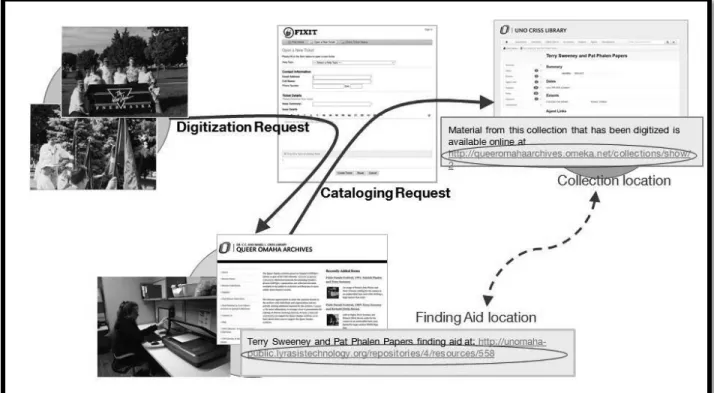
A new challenge for metadata practice in UNO Libraries’ Archives & Special Collections is the necessity to link between digital collections and their finding aids so that the finding aids can be accessible to users viewing a single digital object on an online platform outside of the context provided by its larger collection. Utilizing the open source support ticket system osTicket, UNO Libraries’ Archives & Special Collections established systematic workflows to request and complete the digitization and cataloging of digital objects, so that staff activities can be more efficient and focused. With the ticket system, staff supervising digitization and cataloging communicate with each other as well as with other staff as needed to add the URLs of finding aids to records for digital objects and of digital objects to finding aids or records in the library catalog (see Figure. 2).
Figure 2. Linking between digital collections and finding aids.
Accessing finding aids from the digital object record allows users to learn more about the contents of the single digital object’s collection of personal papers or organizational records. It also allows users to navigate and retrieve information more efficiently and effectively between the separate databases for finding aids and digital collections.
Episcopal Diocese of Nebraska Collaboration
The Episcopal Diocese of Nebraska Newspaper Collection consists of TheGuardian and The
Diocese of Nebraska. These newspapers from 1873-1897 are the primary source of information on the early history of the Episcopal Church and Diocese of Nebraska. The original newspapers and other historical material are available in the archives of the Episcopal Diocese of Nebraska (EDON). The EDON archives does not have regular hours when it is open to the public and is staffed by a volunteer less than one day per week. The volunteer archivist approached UNO Libraries’ Archives & Special Collections about a possible community partnership to digitize selected material from the EDON archives. A letter of understanding, signed in 2016, granted UNO Libraries permission to make the historical material available online with an attribution approved by the EDON. In 2016-2017, 125 issues of EDON’s 19th century newspapers were digitized, described in the library catalog, and made available via UNO Libraries’ Digital
Collections CONTENTdm® platform
(http://unomaha.contentdm.oclc.org/cdm/landingpage/collection/p16383coll4).
The EDON community partnership benefits EDON by sharing a portion of its early records online as well as drawing attention to the fact that the EDON archives exist and hold further
material. The UNO Libraries and EDON jointly drafted a news article about the partnership in 2017, which was distributed to both EDON’s members through its newsletter and
communication channels and through the UNO Libraries’ communication channels
(https://www.unomaha.edu/criss-library/news/2017/04/episcopal-diocese-of-nebraska-partners-with-archives.php). The collaboration is useful to EDON as it prepares to mark its
sesquicentennial in 2018 and benefits researchers, genealogists, and others who would not otherwise have access to these historical records. The UNO-EDON digital engagement project will continue on an ongoing basis with newspaper volumes and other historical material loaned to UNO Libraries for digitization, description, and online access.
Omaha Public Library Collaboration
The UNO Libraries partnered with the Omaha Public Library (hereafter OPL) to digitize issues
of the World War II-era Glenn L. Martin Plant company newsletter The Martin Marauder. UNO
held several issues of the newspaper-style publication in Archives & Special Collections, while OPL held more than twice as many issues in its collection. OPL approached Archives & Special Collections to launch the project to digitize all known issues of the publication to assist
researchers who were forced to visit multiple repositories, as well as remote researchers who would not otherwise have access to the publication. UNO agreed that the proposed digitization project would also benefit UNO students in a World War II history course who regularly used
material from Archives & Special Collections. After the OPL and UNO issues of The Martin
Marauder were digitized, UNO contacted a third library in another state which held the most
complete set of Martin Marauders in or to borrow the publication for digitization. In the end,
over 100 issues of The Martin Marauder were made available online through this community
partnership (http://unomaha.omeka.net/collections/show/27). This is a limited scope community
partnership unless more issues of The Martin Marauder should be discovered in the hands of
other repositories or individuals in the future.
Conclusion
Academic libraries support campus, local, and global communities to meet research demands for online access to unique collections. Creating honest, inclusive, and detailed descriptions of digital collections while understanding the context of the materials can be a challenge. Description plays an essential role in delivering and preserving the story and history of communities. It is important to provide easy access and easily understood digital content for diverse audiences, connect with those people through the digital collections, and continue to grow digital collections through community partnerships. UNO Libraries’ Archives & Special Collections has been collaborating across university departments and community organizations to create digital collections and expand digital initiatives and engagement. Digital projects document local and regional histories as well as present the memories, cultures, and traditions that make communities unique.
References
Bastian, J. (2016). Only connect: Communities, archives, and the making and keeping of
memory, Provenance, Journal of the Society of Georgia Archivists,33(2), 5-16.
Retrieved from http://digitalcommons.kennesaw.edu/provenance/vol33/iss2/3 Carter, R. (2006). Of things said and unsaid: Power, archival silences, and power in silence.
Archivaria, 61, 215-233. Retrieved from
http://archivaria.ca/index.php/archivaria/article/view/12541
Johnson, J. (2015). Creating digital cultural heritage collections in an urban academic library
setting. Urban Library Journal, 21(1). Retrieved from
https://scholarworks.iupui.edu/handle/1805/7010
Marsh, D. E., Punzalan, R. L., Leopold, R., Butler, B., & Petrozzi, M. (2015). Stories of impact:
the role of narrative in understanding the value and impact of digital collections. Archival
Science, 16(4), 327-372. doi:10.1007/s10502-015-9253-5
Schwartz, J. M., Cook, T. (2002). Archives, records, and power: the making of modern memory.
Archival Science, 2(1-2), 1–19. doi:10.1007/BF02435628
University of Nebraska at Omaha. (2016). Strategic plan. Retrieved from
https://www.unomaha.edu/strategic-plan/index.php
VandeBurgt, M. M., & Rivera, K. (2016). Effective communication to aid collaboration for
digital collections: A case study at Florida Gulf Coast University Library. New Review of