Sentiment Analysis on Monolingual, Multilingual and Code-Switching
Twitter Corpora
David Vilares, Miguel A. Alonso and Carlos G´omez-Rodr´ıguez
Grupo LyS, Departamento de Computaci´on, Universidade da Coru˜na Campus de A Coru˜na s/n, 15071, A Coru˜na, Spain
{david.vilares, miguel.alonso, carlos.gomez}@udc.es
Abstract
We address the problem of performing po-larity classification on Twitter over differ-ent languages, focusing on English and Spanish, comparing three techniques: (1) a monolingual model which knows the language in which the opinion is written, (2) a monolingual model that acts based on the decision provided by a language iden-tification tool and (3) a multilingual model trained on a multilingual dataset that does not need any language recognition step. Results show that multilingual models are even able to outperform the monolingual models on some monolingual sets. We introduce the first code-switching corpus with sentiment labels, showing the robust-ness of a multilingual approach.
1 Introduction
Noisy social media, such as Twitter, are especially interesting forsentiment analysis(SA) and polar-ity classification tasks, given the amount of data and their popularity in different countries, where users simultaneously publish opinions about the same topic in different languages (Cambria et al., 2013a; Cambria et al., 2013b). Some expressions are written in different languages, making the po-larity classification harder. In this context, han-dling texts in different languages becomes a real need. We evaluate three machine learning mod-els, considering Spanish (es), English (en) and its multilingual version, English-Spanish (en-es):
1. Multilingual approach (en-es model): A model does not need to recognise the lan-guage of the text. Theenandestraining and development corpora are merged to train an uniqueen-essentiment classifier.
2. Monolingual approach (en and es models): The ideal case where the language of the text
is known and the right model is executed. Each language model is trained and tuned on a monolingual corpus.
3. Monolingual pipeline with language detec-tion (pipe model): Given an unknown text, we first identify the language of the message throughlang.py(Lui and Baldwin, 2012). The output language set was constrained to Spanish and English to make sure every tweet is classified and guarantee a fair comparison with the rest of the approaches. The training was done in the same way as in the monolin-gual approach, as we know the language of the texts. Lang.pyis just needed for eval-uation. The language is predicted, the corre-sponding monolingual classifier is called and the outputs are joined to compare them to the gold standard.
The approaches are evaluated on: (1) an English monolingual corpus, (2) a Spanish monolingual corpus (3) a multilingual corpus which combines the two monolingual collections and (4) a code-switching (Spanish-English) corpus, that is intro-duced together with this paper.
2 Related work
The problem of multilingual polarity classifica-tion has already been addressed from different perspectives, such as monolingual sentiment anal-ysis in a multilingual setting (Boiy and Moens, 2009), cross-lingual sentiment analysis (Brooke et al., 2009) or multilingual sentiment analysis (Balahur and Turchi, 2014). Banea et al. (2010) shows that including multilingual information can improve by almost 5% the performance of subjectivity classification in English. Davies and Ghahramani (2011) propose a language-independent model for sentiment analysis of Twit-ter messages, only relying on emoticons; that out-performed abag-of-wordsNaive Bayes approach.
Cui et al. (2011) consider that not only emoticons, but also character and punctuation repetitions are language-independent emotion tokens. A differ-ent way of evaluating multilingual SA systems is
posed by Balahur et al. (2014). They translate the English SemEval 2013 corpus (Nakov et al., 2013) into Spanish, Italian, French and German by means of machine translation (MT) systems. The resulting datasets were revised by non-native and native speakers independently, finding that the use of machine translated data achieves similar results as the use of native-speaker translations.
3 Multilingual sentiment analysis
Our goal is to compare the performance of super-vised models based on bag-of-words, often used inSAtasks. We trained our classifiers using a L2-regularised logistic regression (Fan et al., 2008).
3.1 Feature Extraction
We apply Natural Language Processing (NLP) techniques for extracting linguistic features, using their total occurrence as the weighting factor (Vi-lares et al., 2014). Four atomic sets of features are considered:
• Words (W): Simple statistical model that counts the frequencies of words in a text.
• Lemmas (L): Each term is lemmatised to re-duce sparsity, using lexicon-based methods that rely on the Ancora corpus (Taul´e et al., 2008) for Spanish and Multext (Ide and V´eronis, 1994) and a set of rules1for English.
• Psychometric properties (P): Emotions, psy-chological concepts (e.g. anger) or topics (e.g. job) that commonly appear in mes-sages. We rely on the LIWC dictionaries (Pennebaker et al., 2001) to detect them.
• Part-of-speech tags (T): The grammatical cat-egories were obtained using the Stanford Maximum Entropy model (Toutanova and Manning, 2000). We trained anenand anes
tagger using the Google universal PoS tagset (Petrov et al., 2011) and joined the Spanish and English corpora to train a combined en-es tagger. The aim was to build a model that does not need any language detection to tag samples written in different languages,
1http://sourceforge.net/p/zpar/code/
HEAD/tree/src/english/morph/aux_lexicon. cpp
or even code-switching sentences. Table 1 shows how the three taggers work on a real code-switching sentence from Twitter, illus-trating how theen-estagger effectively tack-les them. The accuracy of theenand es tag-gers was 98.12%2 and 96.03% respectively. The multilingual tagger obtained 98.00% and 95.88% over the monolingual test sets.
These atomic sets of features can be combined to obtain a rich linguistic model that improves per-formance (Section 4).
3.2 Contextual features
Syntactic features
Dependency parsing is defined as the process of obtaining a dependency tree given a sentence. Let
S = [s1s2...sn−1sn]be a sentence3 of length n, where si indicates the token at the ith position; a dependency tree is a graph of binary relations,
G = {(sj, mjk, sk)}, where sj and sk are the head and dependent tokens, and mjk represents the syntactic relation between them. To obtain such trees, we trained anen,esand anen-esparser (Vilares et al., 2015b) using MaltParser (Nivre et al., 2007). In order to obtain competitive results for a specific language, we relied on MaltOpti-mizer (Ballesteros and Nivre, 2012). The parsers were trained on the Universal Dependency Tree-banks v2.0 (McDonald et al., 2013) and evaluated against the monolingual test sets. The Labeled At-tachment Score (LAS) of the Spanish and English monolingual parsers was 80.54% and 88.35%, re-spectively. The multilingual model achieved a
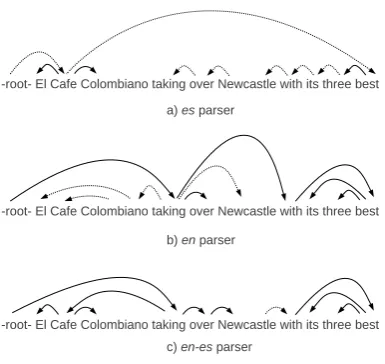
LASof 78.78% and 88.65% (significant improve-ment with respect to the monolingual model, using Bikel’s randomised parsing evaluation compara-tor and p < 0,05). Figure 1 shows an example how the en,esanden-esparsers work on a code-switching sentence.
In the next step, words, lemmas, psychomet-ric properties and PoS tags are used to extract
enriched generalised triplet features (Vilares et al., 2015a). Let (sj, mij, sk) be a triplet with
sj, sk ∈ W and a generalisation function, g :
W → {W, L, P, T}, a generalised triplet is de-fined as(g(sj), mij, g(sk)).
2Note that Toutanova and Manning reported 97.97% on
the Penn Treebank tagset, which is bigger than the Google Universal tagset (48 vs 12 tags).
3An artificial tokens
El Cafe Colombiano taking over Newcastle with its three best
es DET NOUN ADJ X X X X X X X
en NOUN NOUN NOUN VERB PTR NOUN ADP PRON NUM ADJ
[image:3.595.82.275.188.370.2]es-en DET NOUN ADJ VERB ADP NOUN ADP PRON NUM ADJ
Table 1: Performance of taggers on a code-switching sentence from Twitter: adjective(ADJ), preposi-tionsandpostpositions(ADP),determinant(DET),noun(NOUN),particles(PTR)pronoun(PRON),verb
(VERB) andother category(X)
Figure 1: Example with the en, es and en-es dependency parsers. Dotted lines represent incorrectly-parsed dependencies
N-gram features
N-gram features capture shallow structure of sen-tences, identifying local relations between words (e.g.‘not good’becomes‘not good’).
4 Experimental framework
The proposed sets of features and models are eval-uated on standard monolingual corpora, taking ac-curacy as the reference metric. These monolingual collections are then joined to create a multilingual corpus, which helps us compare the performance of the approaches when tweets come from two different languages. An evaluation over a code-switching test set is also carried out.
4.1 Monolingual corpora
Two corpora are used to compare the performance of monolingual and multilingual models:
• SemEval 2014 task Bcorpus (Rosenthal et al., 2014): A set of English tweets4 split into a
4Due to Twitter restrictions some of the tweets are not
available anymore, so the corpus statistics may vary slightly from those of other researchers that used the corpus.
training (8,200 tweets), development (1,416) and a test set5(5,752). Each tweet was man-ually classified aspositive,noneornegative.
• TASS 2014 corpus (Rom´an et al., 2015): A corpus of Spanish tweets containing a train-ing set of 7,219 tweets. We split it into a new training and a development set (80:20). Two different test sets are provided: (1) ageneral test set of 60,798 tweets that was made by pooling and (2) a small test-set of 1,000 man-ually labelled tweets, named1K test set. The tweets are labelled withpositive, none, neg-ativeand mixed, but in this study themixed
class was treated asnone, following the same criteria as in SemEval 2014.
4.2 Multilingual corpora
These two test sets were merged to create a syn-thetic multilingual corpus. The aim was to com-pare the multilingual and the monolingual ap-proach with language detection under this config-uration. The unbalanced sizes of the test sets re-sult in a higher performance when correctly clas-sifying the majority language. We do not consider that as a methodological problem, but rather as a challenge of monitoring social networks in real en-vironments, where the number of tweets in each language is not necessarily balanced.
4.3 Code-switching corpus
We created a polarity corpus with code-switching tweets based on the training collection6 (en-es) presented by Solorio et al. (2014). Each word in the corpus is labelled with its language, serving as the starting point to obtain a collection of multilin-gual tweets. We first filtered the tweets containing both Spanish and English words, obtaining 3,062 tweets. Those were manually labelled by three an-notators according to the SentiStrength strategy, a
5
It also contained short texts coming fromSMSand mes-sages from LiveJournal, that we removed as they are out of the scope of this study.
dual score(p,n)from 1 to 5 wherepandnindicate the positive and the negative sentiment (Thelwall et al., 2010). Krippendorf’s alpha coefficient indi-cated an inter-annotator agreement from 0.629 to 0.664 for negative sentiment and 0.500 to 0.693 for positive sentiment. To obtain the final score, we applied an average strategy with regular round: if p > nthen the tweet is labelled as positive, if
p < nthen it is labelled asnegativeand otherwise it is labelled as none. After the transformation to the trinary scheme, we obtained a corpus where: thepositiveclass represents the 31.45% of the cor-pus, thenegativeone represents a 25.67% and the remaining 42.88% belongs to thenoneclass.
To the best of our knowledge, this is the first code-switching corpus with sentiment anno-tations.7, which presents several challenges. It is an especially noisy corpus, were many gram-matical errors occur in each tweet. There is also an overuse of subjective clauses and abbreviations (e.g. ‘lol’, ‘lmao’, . . . ) whose subjectivity was considered a controversial issue by the annotators. Finally, a predominant use of English was detected (lang.pyclassified 59.29% of the tweets as En-glish). We believe this is because the Solorio et al. (2014) corpus was collected by downloading tweets for people from Texas and California.
5 Experimental results
5.1 Results on the English corpus
[image:4.595.309.526.62.231.2]Features en pipe en-es Words (W) 66.72 66.71 66.22 Lemmas (L) 66.74 66.71 66.48 Psychometric (P) 62.52 62.53 61.47 PoS-tags (T) 51.82 51.80 52.03 Bigrams ofW 60.99 61.00 61.47 Bigrams ofL 61.75 61.77 61.32 Bigrams ofP 61.32 61.32 60.41 Triplets ofW 56.40 56.38 57.84 Triplets ofL 58.69 58.67 59.16 Triplets ofP 58.26 58.24 57.60 Combined (W,P,T) 68.52 68.58 68.48 Combined (L,P,T) 68.43 68.38 68.34 Combined (W,P) 68.72 68.74 68.52 Combined (L,P) 68.57 68.53 68.32
Table 2: Accuracy (%) on the SemEval 2014
Table 2 shows the performance of the three models on the SemEval test set. The differences between the monolingual model and the mono-lingual pipeline with language detection are tiny.
7Freely available in grupolys.org/software/
CS-CORPORA/cs-en-es-corpus-wassa2015.txt
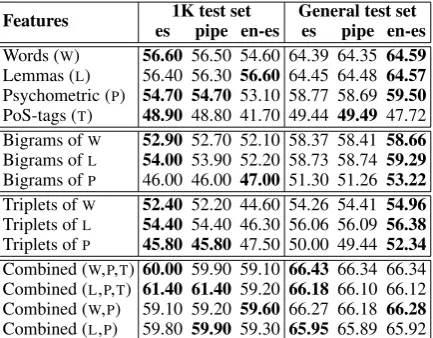
Features 1K test set General test set es pipe en-es es pipe en-es Words (W) 56.60 56.50 54.60 64.39 64.35 64.59 Lemmas (L) 56.40 56.30 56.60 64.45 64.48 64.57 Psychometric (P) 54.70 54.70 53.10 58.77 58.69 59.50 PoS-tags (T) 48.90 48.80 41.70 49.44 49.49 47.72 Bigrams ofW 52.90 52.70 52.10 58.37 58.41 58.66 Bigrams ofL 54.00 53.90 52.20 58.73 58.74 59.29 Bigrams ofP 46.00 46.00 47.00 51.30 51.26 53.22 Triplets ofW 52.40 52.20 44.60 54.26 54.41 54.96 Triplets ofL 54.40 54.40 46.30 56.06 56.09 56.38 Triplets ofP 45.80 45.80 47.50 50.00 49.44 52.34 Combined (W,P,T) 60.00 59.90 59.10 66.43 66.34 66.34 Combined (L,P,T) 61.40 61.40 59.20 66.18 66.10 66.12 Combined (W,P) 59.10 59.20 59.60 66.27 66.18 66.28 Combined (L,P) 59.80 59.90 59.30 65.95 65.89 65.92
Table 3: Accuracy (%) on the TASS test sets
This is due to the high performance oflang.py
on this corpus, where only 6 tweets were misclas-sified as Spanish tweets. Despite of this issue, the
en-esclassifier performs very competitively on the English monolingual test sets, and the differences with respect to the en model range from 0.2 to 1.05 percentage points. With certain sets of fea-tures, consisting of triplets, the multilingual model even outperforms both monolingual models, rein-forcing the validity of this approach.
5.2 Results on the Spanish corpus
With respect to the evaluation on the TASS 2014 corpus, the tendency seems to remain on the TASS 2014-1k, as illustrated in Table 3. It general terms the es model obtains the best results, fol-lowed by the pipe and the en-es models. In this version of the corpus, the system misclassified 17 of the manually labelled tweets, and the im-pact of the monolingual model with language de-tection is also small. Results obtained on the TASS 2014 general set give us more information, since a significant number of tweets from this col-lection (842) were classified as English tweets. Some of these tweets actually were short phrases in English, some presented code-switching and some others were simply misclassified. Under this configuration, the multilingual model outperforms monolingual models with most of the proposed features. This suggests that multilingual mod-els present advantages when messages in different languages need to be analysed.
[image:4.595.111.258.485.647.2]Features pipe en-es pipe en-es Words (W) 64.93 64.20 64.55 64.71 Lemmas (L) 65.03 64.76 64.66 64.72 Psychometric (P) 61.17 60.02 59.03 59.66 PoS-tags (T) 51.28 50.23 49.69 48.11 Bigrams ofW 59.55 59.84 58.63 58.90 Bigrams ofL 60.40 59.73 59.00 59.46 Bigrams ofP 58.65 58.08 52.19 53.88 Triplets ofW 55.65 55.54 54.57 55.21 Triplets ofL 57.93 56.92 56.31 56.62 Triplets ofP 56.08 55.84 50.25 52.81 Combined (W,P,T) 67.07 66.85 66.52 66.52 Combined (L,P,T) 67.17 66.75 66.28 66.30 Combined (W,P) 67.08 66.97 66.39 66.47 Combined (L,P) 67.03 66.75 66.11 66.12
Table 4: Accuracy (%) on the multilingual test set
languages might appear. The results are coherent across different languages and corpora, and also robust on a number of sets of features. In this respect, for contextual features the performance was low in all cases, due to the small size of the employed training corpus. Vilares et al. (2015a) explain how this kind of features become useful when the training data becomes larger.
5.3 Results on a synthetic multilingual corpus
Table 4 shows the performance both of the mul-tilingual approach and the monolingual pipeline with language detection when analysing texts in different languages. On the one hand, the re-sults show that using a multilingual model is the best option when Spanish is the majority language, probably due to a high presence of English words in Spanish tweets. On the other hand, combin-ing monolcombin-ingual models with language detection is the best-performing approach when English is the majority language. The English corpus con-tains only a few Spanish terms, suggesting that the advantages of having a multilingual model cannot be exploited under this configuration.
5.4 Results on the code-switching corpus
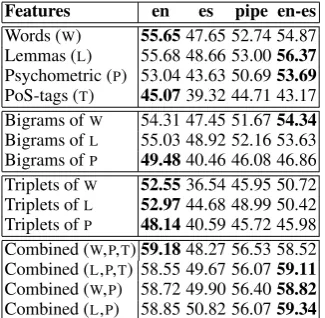
Table 5 shows the performance of the three pro-posed approaches on the code-switching test set. The accuracy obtained by the proposed models on this corpus is lower than on the monolingual corpora. This suggests that analysing subjectivity on tweets with code-switching presents additional challenges. The best performance (59.34%) is ob-tained by theen-esmodel using lemmas and psy-chometric properties as features. In general terms, atomic sets of features such as words, psychome-tric properties or lemmatisation, and their
[image:5.595.336.499.62.221.2]com-Features en es pipe en-es Words (W) 55.6547.65 52.74 54.87 Lemmas (L) 55.68 48.66 53.0056.37 Psychometric (P) 53.04 43.63 50.6953.69 PoS-tags (T) 45.0739.32 44.71 43.17 Bigrams ofW 54.31 47.45 51.6754.34 Bigrams ofL 55.03 48.92 52.16 53.63 Bigrams ofP 49.4840.46 46.08 46.86 Triplets ofW 52.5536.54 45.95 50.72 Triplets ofL 52.9744.68 48.99 50.42 Triplets ofP 48.1440.59 45.72 45.98 Combined (W,P,T)59.1848.27 56.53 58.52 Combined (L,P,T) 58.55 49.67 56.0759.11 Combined (W,P) 58.72 49.90 56.4058.82 Combined (L,P) 58.85 50.82 56.0759.34
Table 5: Accuracy (%) on the code-switching set
binations, perform competitively under the en-es
configuration. The tendency remains when the atomic sets of features are combined, outperform-ing the monoloutperform-ingual approaches in most cases.
The pipeline model performs worse on the code-switching test set than the multilingual one for most of the sets of features. These results, to-gether with the ones obtained on the monolingual corpora, indicates that a multilingual approach like the one proposed in this article is more ro-bust on environments containing code-switching tweets and tweets in different languages. The
es model performs poorly, probably due to the smaller presence of Spanish words in the corpus. The annotators also noticed that Spanish terms present a larger frequency of grammatical errors than the English ones. Surprisingly, theenmodel performed really well in many of the cases. We hypothesise this is due to the higher presence of English phrases, that made it possible to extract the sentiment of the texts in many of the cases.
6 Conclusions
Acknowledgments
This research is supported by the Ministerio de Econom´ıa y Competitividad (FFI2014-51978-C2) and Xunta de Galicia (R2014/034). The first au-thor is funded by the Ministerio de Educaci´on, Cultura y Deporte (FPU13/01180).
References
A. Balahur and M. Turchi. 2014. Comparative experi-ments using supervised learning and machine trans-lation for multilingual sentiment analysis. Com-puter Speech and Language, 28(1):56–75, January.
A. Balahur, M. Turchi, R. Steinberger, J. M. Perea-Ortega, G. Jacquet, D. Kucuk, V. Zavarella, and A. E. Ghali. 2014. Resource Creation and Evalu-ation for Multilingual Sentiment Analysis in Social Media Texts. In Nicoletta Calzolari (Conference Chair), Khalid Choukri, Thierry Declerck, Hrafn Loftsson, Bente Maegaard, Joseph Mariani, Asun-cion Moreno, Jan Odijk, and Stelios Piperidis, ed-itors, Proceedings of the Ninth International Con-ference on Language Resources and Evaluation (LREC’14), Reykjavik, Iceland, May. European Language Resources Association (ELRA).
M. Ballesteros and J. Nivre. 2012. MaltOptimizer: an optimization tool for MaltParser. In Proceed-ings of the Demonstrations at the 13th Conference of the European Chapter of the Association for Com-putational Linguistics, pages 58–62. Association for Computational Linguistics.
C. Banea, R. Mihalcea, and J. Wiebe. 2010. Multilin-gual Subjectivity: Are More Languages Better? In Chu-Ren Huang and Dan Jurafsky, editors,COLING 2010. 23rd International Conference on Computa-tional Linguistics. Proceedings of the Conference, volume 2, pages 28–36, Beijing, August. Tsinghua University Press.
E. Boiy and M. Moens. 2009. A machine learning approach to sentiment analysis in multilingual Web texts. Information Retrieval, 12(5):526–558, Octo-ber.
J. Brooke, M. Tofiloski, and M. Taboada. 2009. Cross-Linguistic Sentiment Analysis: From English to Spanish. InProceedings of the International Con-ference RANLP-2009, pages 50–54, Borovets, Bul-garia. ACL.
E. Cambria, D. Rajagopal, D. Olsher, and D. Das. 2013a. Big social data analysis. Big data comput-ing, pages 401–414.
E. Cambria, B. Schuller, B. Liu, H. Wang, and C. Havasi. 2013b. Knowledge-based approaches to concept-level sentiment analysis. IEEE Intelligent Systems, (2):12–14.
A. Cui, M. Zhang, Y. Liu, and S. Ma. 2011. Emo-tion Tokens: Bridging the Gap Among Multilingual Twitter Sentiment Analysis. In Mohamed Vall Mo-hamed Salem, Khaled Shaalan, Farhad Oroumchian, Azadeh Shakery, and Halim Khelalfa, editors, Infor-mation Retrieval Technology. 7th Asia InforInfor-mation Retrieval Societies Conference, AIRS 2011, Dubai, United Arab Emirates, December 18-20, 2011. Pro-ceedings, volume 7097 of Lecture Notes in Com-puter Science, pages 238–249. Springer, Berlin and Heidelberg.
A. Davies and Z. Ghahramani. 2011. Language-independent Bayesian sentiment mining of {Twitter}. In The 5th SNA-KDD Workshop’11 (SNA-KDD’11), San Diego, CA, August. ACM.
R. Fan, K. Chang, C. Hsieh, X. Wang, and C. Lin. 2008. LIBLINEAR: A library for large linear clas-sification. The Journal of Machine Learning Re-search, 9:1871–1874.
N. Ide and J. V´eronis. 1994. Multext: Multilingual text tools and corpora. InProceedings of the 15th conference on Computational linguistics-Volume 1, pages 588–592. Association for Computational Lin-guistics.
M. Lui and T. Baldwin. 2012. langid.py: An off-the-shelf language identification tool. InProceedings of the ACL 2012 system demonstrations, pages 25–30. Association for Computational Linguistics.
R. McDonald, J. Nivre, Y. Quirmbach-Brundage, Y. Goldberg, D. Das, K. Ganchev, K. Hall, S. Petrov, Hao Zhang, O. T¨ackstr¨om, C. Bedini, N. Castell´o, and J. Lee. 2013. Universal Dependency Anno-tation for Multilingual Parsing. InProceedings of the 51st Annual Meeting of the Association for Com-putational Linguistics, pages 92–97. Association for Computational Linguistics.
P. Nakov, S. Rosenthal, Z. Kozareva, V. Stoyanov, A. Ritter, and T. Wilson. 2013. SemEval-2013 Task 2: Sentiment Analysis in Twitter. InSecond Joint Conference on Lexical and Computational Seman-tics (*SEM), Volume 2: Seventh International Work-shop on Semantic Evaluation (SemEval 2013), pages 312–320, Atlanta, Georgia, June. ACL.
J. Nivre, J. Hall, J. Nilsson, A. Chanev, G. Eryigit, S. K¨ubler, S. Marinov, and E. Marsi. 2007. Malt-Parser: A language-independent system for data-driven dependency parsing. Natural Language En-gineering, 13(2):95–135.
J. W. Pennebaker, M. E. Francis, and R. J. Booth. 2001. Linguistic inquiry and word count: LIWC 2001.
Mahway: Lawrence Erlbaum Associates, page 71.
J. Rom´an, E. Mart´ınez-C´amara, J. Garc´ıa-Morera, and Salud M. Jim´enez-Zafra. 2015. TASS 2014-The Challenge of Aspect-based Sentiment Analysis.
Procesamiento del Lenguaje Natural, 54:61–68.
S. Rosenthal, P. Nakov, A. Ritter, and V. Stoyanov. 2014. Semeval-2014 task 9: Sentiment analysis in Twitter. In Proceedings of The 8th International-Workshop on Semantic Evaluation (SemEval 2014), pages 411–415.
T. Solorio, E. Blair, S. Maharjan, S. Bethard, M. Diab, M. Gohneim, A. Hawwari, F. AlGhamdi, J. Hirschberg, A. Chang, and P Fung. 2014. Overview for the first shared task on language iden-tification in code-switched data. InProceedings of The First Workshop on Computational Approaches to Code Switching, pages 62–72, Doha, Qatar. As-sociation for Computational Linguistics.
M. Taul´e, M. A. Mart´ı, and M. Recasens. 2008. An-Cora: Multilevel Annotated Corpora for Catalan and Spanish. In Nicoletta Calzolari, Khalid Choukri, Bente Maegaard, Joseph Mariani, Jan Odjik, Stelios Piperidis, and Daniel Tapias, editors,Proceedings of the Sixth International Conference on Language Re-sources and Evaluation (LREC’08), pages 96–101, Marrakech, Morocco.
M. Thelwall, K. Buckley, G. Paltoglou, D. Cai, and A. Kappas. 2010. Sentiment Strength Detection in Short Informal Text. Journal of the American Society for Information Science and Technology, 61(12):2544–2558, December.
K. Toutanova and C. D Manning. 2000. Enriching the knowledge sources used in a maximum entropy part-of-speech tagger. InProceedings of the 2000 Joint SIGDAT conference on Empirical methods in nat-ural language processing and very large corpora: held in conjunction with the 38th Annual Meeting of the Association for Computational Linguistics-Volume 13, pages 63–70.
D. Vilares, M. Hermo, M. A. Alonso, C. G´omez-Rodr´ıguez, and Y. Doval. 2014. LyS : Porting a Twitter Sentiment Analysis Approach from Spanish to English. InProceedings og The 8th International-Workshop on Semantic Evaluation (SemEval 2014), pages 411–415.
D. Vilares, M. A Alonso, and C. G´omez-Rodr´ıguez. 2015a. On the usefulness of lexical and syntactic processing in polarity classification of Twitter mes-sages. Journal of the Association for Information Science Science and Technology, 66:1799–1816.