D S Sharma, R Sangal and A K Singh. Proc. of the 13th Intl. Conference on Natural Language Processing, pages 239–248, Varanasi, India. December 2016. c2016 NLP Association of India (NLPAI)
Learning to Identify Subjective Sentences
Girish K. Palshikar, Manoj Apte, Deepak PanditaTCS Research, Tata Consultancy Services Pune 411013
{gk.palshikar, manoj.apte, deepak.p7}@tcs.com
Vikram Singh
M. Tech., Computer Science & Engineering Indian Institute of Technology, Patna [email protected]
Abstract
Subjective sentences describe people’s opinions, points-of-view, interpretations, comparisons, sentiments, judgments, ap-praisals or feelings toward entities, events and their properties. Identifying subjec-tive sentences is the basis for opinion min-ing and sentiment analysis and is impor-tant in applications like political analy-sis, social media analytics and product re-view analytics. We use standard classi-fiers to build models of SUBJECTIVE vs. NON-SUBJECTIVE sentences and demon-strate that they outperform the approaches reported in the literature on several inter-esting datasets. We discuss two novel ap-plications of this work: prevalence of sub-jective sentences in performance appraisal text and scientific papers. We demonstrate that scientific papers also contain a sub-stantial fraction of subjective sentences. We compare the nature of subjective sen-tences in performance appraisals text and scientific papers, and observedifferent rea-sons why some sentences in these domains are subjective. We propose the need to fur-ther investigate the linguistic and semantic basis for subjective sentences across dif-ferent domains.
1 Introduction
Documents contain a mixture of facts, opinions and other kinds of sentences, such as questions or instructions. Factual sentences include objective expressions about entities, events and their prop-erties. Opinion sentences usually include subjec-tive expressionsthat describe people’s sentiments,
judgments, appraisals or feelings toward entities, events and their properties (Liu, 2010). Ob-jective information is typically fact-based, mea-surable, observable and verifiable. For exam-ple, (S1) (Table1) is a factual sentence. In con-trast, most opinion sentences express some senti-ment, usually having a positive or negative polar-ity. However, some opinion sentences areneutral i.e., they do not explicitly express any particular sentiment. For example, (S2) is an opinion sen-tence that expresses some sentiment (mostly posi-tive), whereas (S3), (S4) and (S5) are opinion sen-tences that do not express any particular sentiment. Some factual sentences may be mixed i.e., they may also contain subjective expressions, with or without the presence of an explicit sentiment po-larity. Sentences (S6) and (S7) are mainly factual, but (S6) contain an opinion along with a positive sentiment whereas (S7) expresses an opinion with-out much sentiment. Any expression abwith-out the private (internal) state of mind of a person is, by definition, a subjective sentence; e.g., (S8). Opin-ion sentences often contain subjective expressOpin-ions other than sentiments, such as opinions, points of view (S4), judgements (S5), predictions (S9), in-terpretations, comparisons (S10) etc.
In this paper, we are interested in automatically identifying subjective sentences, which contain subjective expressions, but which may or may not contain explicit sentiment markers. We are also in-terested in detecting mixed sentences, which con-tain both facts and opinions. In this paper, we in-clude mixed sentences in the class of subjective sentences. The remaining sentences (i.e., of the other class) either express pure facts or they may express neither facts nor opinions (e.g., they may be instructions or questions).
S1 On April 24, 1975, the West German embassy in Stockholm was seized by members of the RAF; two of the hostages were murdered as the German government under Chancellor Helmut Schmidt refused to give in to their demands.
S2 Windows 7 is quite simply faster, more stable, boots faster, goes to sleep faster, comes back from sleep faster, manages your files better and on top of that it’s beautiful to look at and easy to use.
S3 More than 98 bank entities are expected to be serviced under the Web based PaySys application.
S4 With Spy Kids 2, the Spy Kids franchise establishes itself as a part of the movie landscape for children.
S5 The security cover for deputy ministers can be reduced.
S6 The ninth seed Sindhu took 40 minutes to dismantle the eighth seeded Tai and gave her medal chances a boost in her maiden Olympic appearance.
S7 Google Duo isn’t much different from the other video chatting services, except that it gives a glimpse at who is making the call, helping the recipient decide whether to answer.
S8 John found his sorrow receding in the cool breeze.
S9 The Independence Day holiday will boost the film’s biz further.
S10 The Mi 5 camera in performs better in most outdoor situations than OnePlus 3. S11 Baseball writer Bill James, in the The New Bill James Historical Baseball
Abstract, ranked Robinson as the 32nd greatest player of all time strictly on the basis of his performance on the field, noting that he was one of the top players in the league throughout his career.
Table 1: Some example sentences.
non-subjective has many practical applications. Information extraction, question-answering and document summarization are often interested in factual sentences, and hence would use the clas-sification of sentences to remove subjective sen-tences, which can improve the system perfor-mance and effectiveness. Some real-life applica-tions explicitly need to mark and summarize sen-timents and opinions (which are inherently subjec-tive); for example, identifying features facing crit-icism from product reviews, identifying extreme positions from political views, and marketing ori-ented anaysis of web contents.
Classification of sentences from different per-spectives is a well-explored problem. Syntacti-cally, a sentence is typically classified into classes such as DECLARATIVE, IMPERATIVE, INTERROG-ATIVE, EXCLAMATIVE, COMMUNICATIVE, INFOR-MATIVE etc., with further sub-classes. Other structurally-oriented sentence classes include MA-JOR (has subject and predicate), MINOR (with-out a finite verb; e.g.,The more, the merrier.),
PERIODIC (meaning is not complete until the fi-nal clause or phrase; e.g., Silent and soft, and slow, descends the snow.) etc.
Seman-tically classifying sentences (based on the sen-tence’s purpose) is a much harder task, and is gain-ing increasgain-ing attention from lgain-inguists and NLP researchers (Zhou et al., 2004), (Wang et al., 2005), (McKnight and Srinivasan, 2003), (Co-hen et al., 2004), (Corston-Oliver et al., 2004),
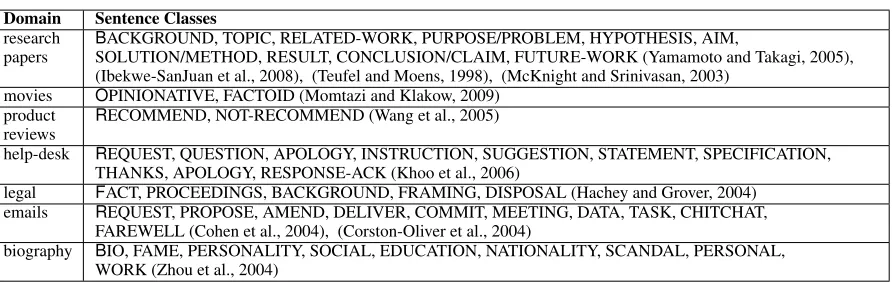
(Ivanovic, 2006), (Khoo et al., 2006), (Ya-mamoto and Takagi, 2005), (Hachey and Grover, 2004), (He et al., 2006), (Naughton et al., 2010), (Kadoya et al., 2005), (Momtazi and Klakow, 2009). Most work in this area has used super-vised learning approaches (e.g., using SVM, de-cision trees, maximum entropy based classifier, naive Bayes etc.), with the exception of (Ito et al., 2004) (semi-supervised) and (Teufel and Moens, 1998), (Ibekwe-SanJuan et al., 2008) (knowledge-based) and (Deshpande et al., 2010) (rule-(knowledge-based). Sentence classification has been applied to tasks such as summarization, information extraction, IR, automatic ontology creation (Hearst, 1998) and text entailment (Zanzotto and DellArciprete, 2009). Sentence classification has been used on documents in several practical application do-mains such as biomedical papers, legal judge-ments, product reviews, customer complaints in help-desk, emails etc. The sentences classes have also been more domain dependent (Table 2).
In this paper, we use a variety of standard classifiers to build models of SUBJECTIVE vs. NON-SUBJECTIVEsentences. We demonstrate that some of the standard classifiers outperform the ap-proaches reported in the literature on several in-teresting datasets, including one real-life dataset from us1. We discuss two novel applications of
this work, which have not been reported in the literature to our knowledge. We perform
tive identification (and a subsequent analysis) of the prevalence of subjective sentences in two inter-esting domains: the first in performance appraisal text and the other in scientific papers.
The rest of the paper is organized as follows. We review the related work in Section 2. Then, we describe the features used for a classification based approach to identify subjective sentences in Section 3. The experiments performed and the re-sults are described in Section 4. In Section 5 we apply the classifiers learned earlier to identify sub-jective sentences in two novel domains: (i) perfor-mance appraisal text; and (ii) scientific papers. Fi-nally, we discuss the conclusions of our work and identify some further work in Section 6.
2 Related Work
There has been a considerable amount of research work in the field of Sentiment Analysis and Opin-ion Mining. We focus here on predictive identi-fication of subjective text, which can be done at document, sentence and phrase level by using fea-tures like presence of a pronoun, adjective, seman-tic orientation etc. Often the other class is ob-jective or factual text (as against a general non-subjective class, as in this paper).
(Yu and Hatzivassiloglou, 2003) presented a Bayesian classifier for discriminating between Opinion or Factual articles. Then, three ap-proaches to classify opinions from facts at the sen-tence level were proposed. The first approach was based on the similarity of the given sentence to the opinion or fact documents. In the second ap-proach, a Naive Bayes classifier was trained using the sentences in opinion and fact documents. The features included words, bigrams, trigrams and the parts of speech, as well as the presence of seman-tically oriented words combined with the polarity information and the average semantic orientation of the words in a sentence. In the third approach multiple Naive Bayes classifiers were trained us-ing iterative trainus-ing process relyus-ing on different set of features.
In a classic paper (Pang and Lee, 2004), the au-thors have used Naive Bayes and SVM to detect subjective sentences and used these sentences for sentiment analysis and proposed a novel graph-cut based method for assigning the overall polarity to a document, based on the sentiments in these indi-vidual sentences.
(Kim and Hovy, 2005) developed a
collec-tion of opinion bearing and non-opinion bearing words using multiple collections like Wordnet, WSJ Data, Columbia wordlist and then combined these lists into a single collection with averaging the score of individual lists. Score of a sentence was computed using these scores in two ways. In the first approach the scores of all the words in the sentence were added and in second approach pres-ence of a single strong valpres-ence word was used as the score.
(Stepinski and Mittal, 2007) classified news ar-ticles into facts and opinions by training a classi-fier on opinion/fact stories. Sentences in an article were labeled as factual and opinion and an over-all score was computed as the average of these la-bels. Label was weighed based on the confidence of the classification. Then a Passive-Aggressive algorithm (Crammer et al., 2006) was trained on unigram, bigram and trigram features. An itera-tive training process in which a classifier is trained using a subset of the desired features was used. Based on the results of classifying the training set with the classifier, the misclassified sentences were removed and the classifier was trained again using a larger set of features.
(Kim and Myaeng, 2007) introduced a lexical information based methodology for opinion anal-ysis. The task of classifying sentences into Sub-jective or ObSub-jective was done by using a combina-tion of rule-based approach and a machine learn-ing based method. First, a trainlearn-ing set was ob-tained using the rules based on lexical clues and then a SVM-based classifier was trained on the same. Polarity or semantic orientation of the sub-jective sentences was determined and the opinion holders were also found by using Named-Entity Recognition with extracted lexical clues.
(Godbole et al., 2007) use co-occurrence of an entity and a sentiment word in the same sentence to mean that the sentiment is associated with that entity. Mentioning that it can lead to inaccuracies they claim that due to the volume text that is pro-cessed by them enables them to generate accurate sentiment words. They create two scores for each entity polarity score and subjectivity score. Polar-ity indicates percentage of positive sentiment ref-erences among total sentiment refref-erences, while Subjectivity indicates proportion of sentiment to frequency of occurrence.
Domain Sentence Classes
research
papers BSOLUTION/METHOD, RESULT, CONCLUSION/CLAIM, FUTURE-WORK (Yamamoto and Takagi, 2005),ACKGROUND, TOPIC, RELATED-WORK, PURPOSE/PROBLEM, HYPOTHESIS, AIM, (Ibekwe-SanJuan et al., 2008), (Teufel and Moens, 1998), (McKnight and Srinivasan, 2003)
movies OPINIONATIVE, FACTOID (Momtazi and Klakow, 2009) product
reviews RECOMMEND, NOT-RECOMMEND (Wang et al., 2005)
help-desk REQUEST, QUESTION, APOLOGY, INSTRUCTION, SUGGESTION, STATEMENT, SPECIFICATION, THANKS, APOLOGY, RESPONSE-ACK (Khoo et al., 2006)
legal FACT, PROCEEDINGS, BACKGROUND, FRAMING, DISPOSAL (Hachey and Grover, 2004) emails REQUEST, PROPOSE, AMEND, DELIVER, COMMIT, MEETING, DATA, TASK, CHITCHAT,
FAREWELL (Cohen et al., 2004), (Corston-Oliver et al., 2004)
[image:4.612.96.542.33.174.2]biography BIO, FAME, PERSONALITY, SOCIAL, EDUCATION, NATIONALITY, SCANDAL, PERSONAL, WORK (Zhou et al., 2004)
Table 2: Examples of Sentence Classes (modified from (Deshpande et al., 2010)).
be used to train a sentiment classifier. The corpus contains both positive and negative sentiments as well as objective text (no sentiments). For posi-tive and negaposi-tive sentiments help was taken from emoticons used in the tweets and for objective text the messages from twitter accounts of pop-ular newspapers and magazines were considered. They first conduct basic statistical analysis of the collected corpus and then run multinomial naive based classifier that uses N-Gram and POS Tags as features on the data collected.
3 Classification of Subjective Sentences
We adopt a feature-based classification approach to classify the sentences into facts and opinions. We extract several features from each sentences and thus represent each sentence as a numeric fea-ture vector. We then use several standard classi-fiers for the task of classifying a sentence as SUB-JECTIVE or NON-SUBJECTIVE and compare their results.
Number of adjectives: An interesting relation between presence of adjectives in a sentence and its subjectivity has been explored in the litera-ture (Wiebe et al., 1999), (Hatzivassiloglou and Wiebe, 2000), (Wiebe, 2000). (Wiebe et al., 1999) demonstrated that adjectives are statistically significantly, and positively correlated with sub-jective sentences in the corpus on the basis of the log-likelihood ratio. The probability that a sen-tence is subjective, given that there is at least one adjective in the sentence, is 0.545, even though there are more objective than subjective sentences in the corpus. Therefore, we use number of ad-jectives in a sentence as a feature. Note that if the same adjective occurs multiple times in a sentence, then we count each occurrence separately.
Number of nouns: (Riloff et al., 2003) re-ported the effectiveness of nouns for identification of subjective sentences. Hence, we use number of nouns, including proper nouns, as a feature.
Word count: Opinions and subjective sen-tences tend to be more elaborate and hence longer. So we use number of words in the sentences, ex-cluding stop words and punctuations, as a feature. Number of strongly subjective words: Most of the systems developed for subjectivity classi-fication and sentiment analysis, such as (Liu, 2010), (Syed et al., 2010), use a lexicon of opinion-bearing words. Two of the most com-monly used lexicons are the SentiWordNet (Bac-cianella et al., 2010) and the Subjectivity Lexi-con (Wilson et al., 2005b). The Subjectivity Lex-icon classifies a word as strongly subjective (e.g.,
beautiful) or weakly subjective (e.g.,benefit).
We use the number of strongly subjective words from the Subjectivity Lexicon present in a sen-tence divided by word count as a feature. We also use the number of words from SentiWordNet (having either nonzero positive polarity score or nonzero negative polarity score) present in a sen-tence divided by word count as another feature.
Number of named entities: A commonly ob-served characteristics of a factual or objective sen-tence is then it tends to use more number of named entities. Hence we use number of named entitied present in a sentence as a feature. We use Stanford NER tool for this purpose.
Number of comparatives: This feature rep-resents the number of comparative words (e.g.,
faster) used in the sentence.
Number of superlatives:This feature refers to the number of superlative words (e.g., fastest)
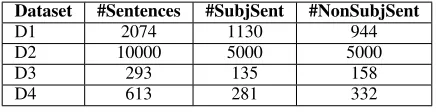
Dataset #Sentences #SubjSent #NonSubjSent
D1 2074 1130 944
D2 10000 5000 5000
D3 293 135 158
[image:5.612.81.299.37.93.2]D4 613 281 332
Table 3: Dataset Description
Tense: Sentences in future tense tend to be more subjective. Hence we use the major tense (past, present or future) of the sentence as a fea-ture.
Number of adverbs: This feature represents the number of adverbs (e.g.,simply, back) in the
sentence.
Number of date, time and numbers: The intuition behind this is that the factual informa-tion generally has lots of dates and numeric data. Such a sentence has a higher probability of being non-subjective than subjective. Therefore, we use number of date, time and number entities present in the sentence as a feature.
As an example, the feature vector for the non-subjective sentence S11 is [3,18,25,0.08,0.32,2,0,1,0,1,1]. This sen-tence has number of adjectives = 3 (Historical, 32nd, top), number of nouns = 18, word count
= 25, fraction of strongly subjective words as per Subjectivity Lexicon =2/25 = 0.08 (greatest, strictly), fraction of sentiment words as per
SentiWordNet= 8/25 = 0.32, number of named
entities = 2 (Bill James, Robinson), number
comparatives = 0, number of superlatives = 1 (greatest), tense = 0 (past), number of adverbs =
1 (strictly), number of date, time and numbers
= 1 (one).
4 Experiments and Results
4.1 Datasets
Table 3 lists the datasets we have used in this paper. Dataset D1 contains 1130 subjective sen-tences taken from the opinosis dataset (Gane-san et al., 2010), to which we added 944 non-subjective sentences that contain factual informa-tion about various domains like science, history, sports etc. Dataset D2 is the subjectivity dataset published in (Pang and Lee, 2004), and con-tains 5000 subjective and 5000 non-subjective sen-tences. Dataset D3 and D4 are explained later.
4.2 Results
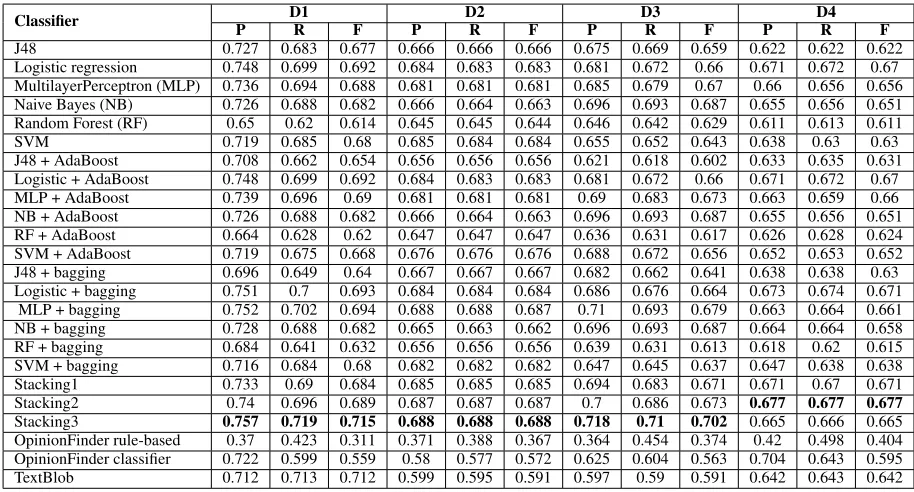
We train a number of classifiers from the WEKA toolset on dataset D2, using 10-fold cross vali-dation. For stacking-based classification, we use Logistic as a meta-classifier (combiner of base classifiers). In Stacking1, we used Naive Bayes, SVM, MultilayerPerceptron and Random Forest as base classifiers. In Stacking2, we use Naive Bayes, SVM, Logistic regression, MultilayerPer-ceptron and Random Forest as base classifiers. In Stacking3, we used MultilayerPerceptron + bag-ging, Logistic + AdaBoost as base classifiers.
For comparison, we use OpinionFinder and TextBlob. OpinionFinder is a system that au-tomatically identifies subjective sentences, as well as various aspects of subjectivity within sentences, including agents who are sources of opinion, direct subjective expressions and speech events, and sentiment expressions. Opin-ionFinder has two classifiers for subjectivity classification, one is rule-based and the other is a model trained on MPQA corpus (Wilson et al., 2005a), (Riloff and Wiebe, 2003), (Wiebe and Riloff, 2005), (Wilson et al., 2005b), (Riloff and Wiebe, 2003). TextBlob is a Python library for processing textual data and provides an API for common natural language processing (NLP) tasks such as part-of-speech tagging, noun phrase extraction and sentiment analysis (https://textblob.readthedocs.io/en/dev/).
The results given by various classifiers trained on dataset D2 using 10-fold cross validation are shown in Table 4. As seen, Stacking3 shows the bestF-measure on D2, which is much better than
the baselines of both the OpinionFinder subjectiv-ity classifiers and TextBlob. The F-measure of
Stacking2 and MLP + bagging classifier on D2 is also quite close to Stacking3. We then use the classifiers trained on D2 and apply them to D1 as the test dataset. Once again, Stacking3 shows the bestF-measure on D1, which is much better than
the baselines of both OpinionFinder subjectivity classifiers but, is very close to TextBlob. The F -measures of the MLP + bagging and Logistic + Bagging on D1 are also quite close to Stacking3.
5 Applications
5.1 Performance Appraisal Text
Classifier P D1R F P D2R F P D3R F P D4R F
J48 0.727 0.683 0.677 0.666 0.666 0.666 0.675 0.669 0.659 0.622 0.622 0.622 Logistic regression 0.748 0.699 0.692 0.684 0.683 0.683 0.681 0.672 0.66 0.671 0.672 0.67 MultilayerPerceptron (MLP) 0.736 0.694 0.688 0.681 0.681 0.681 0.685 0.679 0.67 0.66 0.656 0.656 Naive Bayes (NB) 0.726 0.688 0.682 0.666 0.664 0.663 0.696 0.693 0.687 0.655 0.656 0.651 Random Forest (RF) 0.65 0.62 0.614 0.645 0.645 0.644 0.646 0.642 0.629 0.611 0.613 0.611 SVM 0.719 0.685 0.68 0.685 0.684 0.684 0.655 0.652 0.643 0.638 0.63 0.63 J48 + AdaBoost 0.708 0.662 0.654 0.656 0.656 0.656 0.621 0.618 0.602 0.633 0.635 0.631 Logistic + AdaBoost 0.748 0.699 0.692 0.684 0.683 0.683 0.681 0.672 0.66 0.671 0.672 0.67 MLP + AdaBoost 0.739 0.696 0.69 0.681 0.681 0.681 0.69 0.683 0.673 0.663 0.659 0.66 NB + AdaBoost 0.726 0.688 0.682 0.666 0.664 0.663 0.696 0.693 0.687 0.655 0.656 0.651 RF + AdaBoost 0.664 0.628 0.62 0.647 0.647 0.647 0.636 0.631 0.617 0.626 0.628 0.624 SVM + AdaBoost 0.719 0.675 0.668 0.676 0.676 0.676 0.688 0.672 0.656 0.652 0.653 0.652 J48 + bagging 0.696 0.649 0.64 0.667 0.667 0.667 0.682 0.662 0.641 0.638 0.638 0.63 Logistic + bagging 0.751 0.7 0.693 0.684 0.684 0.684 0.686 0.676 0.664 0.673 0.674 0.671
MLP + bagging 0.752 0.702 0.694 0.688 0.688 0.687 0.71 0.693 0.679 0.663 0.664 0.661 NB + bagging 0.728 0.688 0.682 0.665 0.663 0.662 0.696 0.693 0.687 0.664 0.664 0.658 RF + bagging 0.684 0.641 0.632 0.656 0.656 0.656 0.639 0.631 0.613 0.618 0.62 0.615 SVM + bagging 0.716 0.684 0.68 0.682 0.682 0.682 0.647 0.645 0.637 0.647 0.638 0.638 Stacking1 0.733 0.69 0.684 0.685 0.685 0.685 0.694 0.683 0.671 0.671 0.67 0.671 Stacking2 0.74 0.696 0.689 0.687 0.687 0.687 0.7 0.686 0.673 0.677 0.677 0.677
[image:6.612.79.536.36.282.2]Stacking3 0.757 0.719 0.715 0.688 0.688 0.688 0.718 0.71 0.702 0.665 0.666 0.665 OpinionFinder rule-based 0.37 0.423 0.311 0.371 0.388 0.367 0.364 0.454 0.374 0.42 0.498 0.404 OpinionFinder classifier 0.722 0.599 0.559 0.58 0.577 0.572 0.625 0.604 0.563 0.704 0.643 0.595 TextBlob 0.712 0.713 0.712 0.599 0.595 0.591 0.597 0.59 0.591 0.642 0.643 0.642
Table 4: Results (Precision, Recall and F-Measure) of various classifiers on different datasets.
mance and also to drive performance improve-ments. While the use of IT-based PA systems is fairly common in modern organizations, the use of text-mining techniques to derive insights from PA data is relatively less explored in academic re-search (Apte et al., 2016), (Ramrakhiyani et al., 2016). In most PA processes, the communica-tion contains 2 major steps: (i) inself-appraisal, where an employee records his/her achievements, activities, tasks handled etc.; and (ii) infeedback, where the supervisor provides the criticism, appre-ciation, judgement, evaluation and suggestions for improvement of performance etc.
We have selected a small set of sentences from feedback step in a real performance appraisal in a large IT organization. This dataset D3 has 293 sentences, which were manually tagged by two people independently. We trained the classifier Stacking3 on Dataset D2 and applied the learned model to test on this dataset D3. The results are shown in Table 4.
One may expect many sentences in the PA dataset to be subjective, full of opinions and sen-timents, since these sentences are related to the evaluation of one person’s work by another per-son. However, that does not quite seem to be the case - only 46% sentences are marked as SUBJEC-TIVE by annotators. Further, the human annota-tors seem to be using a somewhat broader notion of subjectivity here. Note that the annotators have marked 135 sentences asSUBJECTIVEwhereas the
classifier has predicted only 98 sentences as SUB-JECTIVE. Moreover, out of 135 sentences marked as SUBJECTIVE by annotators, the classifier has marked 61 asNON-SUBJECTIVE.
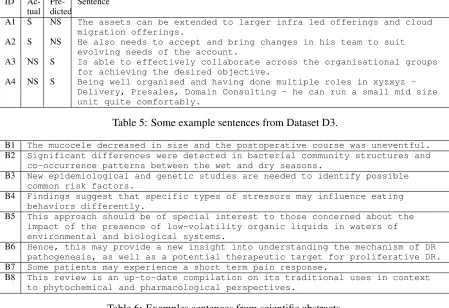
The main observations from an analysis of the results are as follows. First, many sentences are suggestions or recommendations made by the su-pervisors, which might be inherently considered as subjective (A1, A2 in Table 5). Human anno-tators have marked 52 sentences as suggestions, out of which they have marked 48 asSUBJECTIVE. On the other hand, the classifier identified only 19 sentences (out of these 52) as SUBJECTIVE, indi-cating that it is weak in identifying suggestions. This may be because the training dataset (D2) did not have too many suggestions (the sentences are from movie reviews). Thus we might improve the accuracy by adding a Boolean feature, regarding whether a sentence is a suggestion or not. Work such as (Pawar et al., 2015) may be useful to com-pute this feature automatically.
Second, several sentences contain ambiguous fragments, such as very good team player, very large teams, constantly engaged, the right stakeholders etc.; see also
ambiguous fragments. However, the classifier has marked many such sentences asSUBJECTIVE, indicating that the role of ambiguous text in subjective sentences needs to be explored more from a linguistic perspective.
5.2 Scientific Abstracts
Factual observations and objective descriptions are important in scientific literature, and hence it is expected that it would not contain much subjec-tivity. To validate this hypothesis, we downloaded 1440 abstracts for biomedical literature taken from Medline (www.ncbi.nlm.nih.gov/pubmed).
To-tal number of sentences in these abstracts is 18261. Average number of words per sentence is 19 and the average number of words per abstract is 239. Our dataset D4 consists of 613 sentences taken randomly from these abstracts and labeled manually. There were 281 (46%) SUBJECTIVE sentences and 332 (54%) NON-SUBJECTIVE sen-tences. Some of the SUBJECTIVE sentences are shown in Table 6. Table 4 shows the results for various classifiers on this dataset D4. Stacking2 classifier seem to give the best results. We then applied the Stacking3 classifier (trained on Dataset D2 where it gives the best results) to all the 18261 (unlabeled) sentences in the abstracts. It classi-fied 3532 (19.3%) sentences asSUBJECTIVE. Thus preliminary results show that there is a significant prevalence ofSUBJECTIVEsentences in scientific literature, contrary to popular belief. We now look closely at theseSUBJECTIVEsentences.
Some sentences seem to be comments, judge-ments, opinions or evaluations (of some experi-ments, say), which are inherently subjective; see B1, B4, B7. Suggestions are another class of sen-tences often marked asSUBJECTIVE by our clas-sifier; see B3, B4. The third class of marked SUBJECTIVE sentences is about conclusions or predictions; see B5, B6. Some sentences, such as B8, seem to be classified as SUBJECTIVE be-cause of the use of ambiguous expressions such aspossible, common, potential. A common
scenario where the classifier seems to be going wrong is when sentences (e.g., B2) include words like significant, which actually refer to
rigor-ous notion of statistical significance and not to any vague ideas about significance of something.
In the PA dataset D3, we naturally expect a high fraction of sentences to beSUBJECTIVE;D3 had 46% SUBJECTIVE sentences. Surprisingly,
the scientific abstracts also seem to contain a fairly high fraction (19.3%) of SUBJECTIVE sentences. We have also observed that the context and domain play an important role in terming a sentences as SUBJECTIVE or NON-SUBJECTIVE. A single sentence can be termed as SUBJECTIVE when it is taken as an isolated sentence. However the context, i.e. accompanying sentences and domain, can be used to interpret the sentence as NON-SUBJECTIVE. For example, B1 is marked as SUBJECTIVE as an isolated sentence. The paragraph in which it appears is as follows:
The mucocele decreased in size and the postoperative course was uneventful. No recurrence was observed at 6 months’ follow-up.A possible reasons why this sentence
is marked as subjective is because of vague word like uneventful. The next sentence provides
a more objective basis, which can make this sentenceNON-SUBJECTIVE.
6 Conclusion
ID
Ac-tual Pre-dicted Sentence
A1 S NS The assets can be extended to larger infra led offerings and cloud migration offerings.
A2 S NS He also needs to accept and bring changes in his team to suit evolving needs of the account.
A3 NS S Is able to effectively collaborate across the organisational groups for achieving the desired objective.
A4 NS S Being well organised and having done multiple roles in xyzxyz -Delivery, Presales, Domain Consulting - he can run a small mid size unit quite comfortably.
Table 5: Some example sentences from Dataset D3.
B1 The mucocele decreased in size and the postoperative course was uneventful. B2 Significant differences were detected in bacterial community structures and
co-occurrence patterns between the wet and dry seasons.
B3 New epidemiological and genetic studies are needed to identify possible common risk factors.
B4 Findings suggest that specific types of stressors may influence eating behaviors differently.
B5 This approach should be of special interest to those concerned about the impact of the presence of low-volatility organic liquids in waters of environmental and biological systems.
B6 Hence, this may provide a new insight into understanding the mechanism of DR pathogenesis, as well as a potential therapeutic target for proliferative DR. B7 Some patients may experience a short term pain response.
[image:8.612.82.531.41.349.2]B8 This review is an up-to-date compilation on its traditional uses in context to phytochemical and pharmacological perspectives.
Table 6: Examples sentences from scientific abstracts.
scientific papers. Rather surprisingly, we found that scientific papers also seem to contain a sub-stantial fraction of subjective sentences. Finally, we compared the nature of subjective sentences in the human-centric text (such as performance ap-praisals) and scientific papers, and reported that there seem to bedifferentreasons why some sen-tences in these domains are subjective.
For further work, we are developing additional techniques for subjectivity detection, based on co-training and label propagation. We are also ex-ploring detection of subjectivity in different do-mains, such as financial reports and political news. It is already known, and we have also found in our work, that there is substantial variation and dis-agreement in the human annotators’ perception of subjective sentences. That is, the basis of subjec-tivity may itself be subjective! It would be inter-esting to explore the nature of subjective expres-sions by taking into account context and human psychological factors. To get a deeper understand-ing of the notion of subjectivity, we propose the need to further investigate the linguistic and se-mantic basis for subjective sentences, and their variations across different domains.
References
M. Apte, S. Pawar, S. Patil, S. Baskaran, A. Shrivas-tava, and G.K. Palshikar. 2016. Short text
match-ing in performance management. InProc. 21st Int.
Conf. on Management of Data (COMAD), pages 13– 23.
Stefano Baccianella, Andrea Esuli, and Fabrizio Sebas-tiani. 2010. Sentiwordnet 3.0: An enhanced lexical resource for sentiment analysis and opinion mining. InProc. LREC, pages 2200–2204.
W.W. Cohen, V.R. Carvalho, and T.M. Mitchell. 2004. Learning to classify email into ”speech acts”. In
Proc. Empirical Methods in Natural Language Pro-cessing (EMNLP-04), pages 309–316.
S. Corston-Oliver, E. Ringger, M. Gamon, and R. Campbell. 2004. Task-focused summarization
of email. InProc. ACL-04 Workshop on Text
Sum-marization Branches Out, pages 43–50.
Koby Crammer, Ofer Dekel, Joseph Keshet, Shai Shalev-Shwartz, and Yoram Singer. 2006. Online
passive-aggressive algorithms. Journal of Machine
Learning Research, 7:551–585.
S. Deshpande, G.K. Palshilkar, and G. Athiappan. 2010. An unsupervised approach to sentence classi-fication. InProc. Int. Conf. on Management of Data (COMAD), pages 88–99.
Kavita Ganesan, ChengXiang Zhai, and Jiawei Han. 2010. Opinosis: a graph-based approach to
tive summarization of highly redundant opinions. InProc. 23rd Int. Conf. Computational Linguistics, pages 340–348.
Namrata Godbole, Manja Srinivasaiah, and Steven Skiena. 2007. Large-scale sentiment analysis for
news and blogs. InProc. ICWSM, pages 219–222.
B. Hachey and C. Grover. 2004. Sentence classifi-cation experiments for legal text summarisation. In
Proc. 17th Annual Conference on Legal Knowledge and Information Systems (Jurix-2004), pages 29–38.
Vasileios Hatzivassiloglou and Janyce M. Wiebe. 2000. Effects of adjective orientation and gradabil-ity on sentence subjectivgradabil-ity. InProc. 18th Int. Conf. Computational Linguistics, pages 299–305.
Q. He, K. Chang, and E.-P. Lim. 2006. Anticipatory event detection via sentence classification. InProc. IEEE Int. Conf. on Systems, Man and Cybernetics (SMC-06), pages 1143–1148.
M. A. Hearst. 1998. Automated discovery of word-net relations. Inin C. Fellbaum (Ed.), WordNet: An Electronic Lexical Database and Some of its Appli-cations. MIT Press.
F. Ibekwe-SanJuan, S. Fernandez, E. SanJuan, and E. Charton. 2008. Annotation of scientific sum-maries for information retrieval. InProc. ESAIR-08.
T. Ito, M. Shimbo, T. Yamasaki, and Y. Matsumoto.
2004. Semi-supervised sentence classification
for medline documents. IEIC Technical Report,
104(486):51–56.
E. Ivanovic. 2006. Using dialogue acts to suggest re-sponses in support services via instant messaging. In Proc. 2006 Australasian Language Technology Workshop (ALTW2006), pages 159–160.
Y. Kadoya, K. Morita, M. Fuketa, M. Oono, E.-S. At-lam, T. Sumitomo, and J.-I. Aoe. 2005. A sen-tence classification technique using intention asso-ciation expressions. Int. J. Computer Mathematics, 82(7):777–792.
A. Khoo, Y. Marom, and D. Albrecht. 2006.
Ex-periments with sentence classification. In Proc.
2006 Australasian Language Technology Workshop (ALTW2006), pages 18–25.
Soo-Min Kim and Eduard Hovy. 2005. Automatic de-tection of opinion bearing words and sentences. In
Proc. Int. Joint Conf. Natural Language Processing (IJCNLP), pages 61–66.
Youngho Kim and Sung-Hyon Myaeng. 2007. Opin-ion analysis based on lexical clues and their expan-sion. InProc. NTCIR-6, pages 347–354.
Bing Liu. 2010. Sentiment analysis and subjectivity. InHandbook of natural language processing, vol. 2, pages 627–666.
L. McKnight and P. Srinivasan. 2003. Categoriza-tion of sentence types in medical abstracts. InProc. American Medical Informatics Association Annual Symposium, pages 440–444.
S. Momtazi and D. Klakow. 2009. Language model-based sentence classification for opinion question
answering systems. In Proc. International
Multi-conference on Computer Science and Information Technology, pages 251–255.
M. Naughton, N. Stokes, and J. Carthy. 2010.
Sentence-level event classification in unstructured texts.Information Retrieval, 13(2):132–156.
Alexander Pak and Patrick Paroubek. 2010. Twitter as a corpus for sentiment analysis and opinion mining. InProc. LREC, pages 1320–1326.
Bo Pang and Lillian Lee. 2004. A sentimental educa-tion: Sentiment analysis using subjectivity
summa-rization based on minimum cuts. InProc. 42nd
an-nual meeting on Association for Computational Lin-guistics, page 271.
S. Pawar, N. Ramrakhiyani, G. K. Palshikar, and
S. Hingmire. 2015. Deciphering review
com-ments: Identifying suggestions, appreciations and complaints. InProc. 20th Int. Conf. Applications of Natural Language to information Systems (NLDB), LNCS 9103, pages 204–211.
N. Ramrakhiyani, S. Pawar, G.K. Palshikar, and M. Apte. 2016. Aspects from appraisals! a la-bel propagation with prior induction approach. In
Proc. 21st Int. Conf. Applications of Natural Lan-guage to information Systems (NLDB), LNCS 9612, pages 301–309.
Ellen Riloff and Janyce Wiebe. 2003. Learning ex-traction patterns for subjective expressions. InProc. Conf. on Empirical methods in natural language processing (EMNLP), pages 105–112.
Ellen Riloff, Janyce Wiebe, and Theresa Wilson. 2003. Learning subjective nouns using extraction pattern
bootstrapping. InProc. 7th Conf. Natural Language
Learning (HLT-NAACL), pages 25–32.
Adam Stepinski and Vibhu Mittal. 2007. A
fact/opinion classifier for news articles. In Proc. 30th ACM Conf. Research and development in in-formation retrieval (SIGIR), pages 807–808.
Afraz Z. Syed, Muhammad Aslam, and Ana Maria Martinez-Enriquez. 2010. Lexicon based sentiment analysis of urdu text using sentiunits. InProc. Mex-ican Int. Conf. on Artificial Intelligence, pages 32– 43.
S. Teufel and M. Moens. 1998. Sentence extraction and rhetorical classification for flexible abstracts. In
Proc. AAAI-98.
C. Wang, J. Lu, and G. Zhang. 2005. A semantic clas-sification approach for online product reviews. In
Proc. IEEE/WIC/ACM International Conference on Web Intelligence, pages 276–279.
Janyce Wiebe and Ellen Riloff. 2005. Creating subjec-tive and objecsubjec-tive sentence classifiers from unanno-tated texts. InProc. Int. Conf. Intelligent Text Pro-cessing and Computational Linguistics, pages 486– 497.
Janyce M. Wiebe, Rebecca F. Bruce, and Thomas P. O’Hara. 1999. Development and use of a gold-standard data set for subjectivity classifications. In
Proc. 37th annual meeting of the Association for Computational Linguistics, pages 246–253.
Janyce Wiebe. 2000. Learning subjective adjectives
from corpora. InProc. AAAI/IAAI, pages 735–740.
Theresa Wilson, Paul Hoffmann, Swapna Somasun-daran, Jason Kessler, Janyce Wiebe, Yejin Choi, Claire Cardie, Ellen Riloff, and Siddharth Patward-han. 2005a. Opinionfinder: A system for
subjec-tivity analysis. InProc. Conf. on Human Language
Technology and Empirical Methods in Natural Lan-guage Processing interactive demonstrations, pages 34–35.
Theresa Wilson, Janyce Wiebe, and Paul Hoffmann. 2005b. Recognizing contextual polarity in
phrase-level sentiment analysis. In Proc. Conf. on
Hu-man Language Technology and Empirical Methods in Natural Language Processing, pages 347–354.
Y. Yamamoto and T. Takagi. 2005. Experiments with sentence classification: A sentence classifica-tion system for multi biomedical literature summa-rization. InProc. 21st International Conference on Data Engineering Workshops, pages 1163–1168. Hong Yu and Vasileios Hatzivassiloglou. 2003.
To-wards answering opinion questions: Separating facts from opinions and identifying the polarity of opinion
sentences. InProc. Conf. on Empirical methods in
natural language processing (EMNLP), pages 129– 136.
F.M. Zanzotto and L. DellArciprete. 2009. Efficient kernels for sentence pair classification. In Proceed-ings of the 2009 Conference on Empirical Meth-ods in Natural Language Processing (EMNLP-09), pages 91–100.
L. Zhou, M. Ticrea, and E. Hovy. 2004.
Multi-document biography summarization. InProc.
Em-pirical Methods in Natural Language Processing (EMNLP-04), pages 434–441.