MetaNet: Deep semantic automatic metaphor analysis
Ellen Dodge and Jisup Hong
Elise Stickles
International Computer Science Institute University of California, Berkeley 1947 Center Street Ste. 600 1203 Dwinelle Hall
Berkeley, CA 94704 Berkeley, CA 94720-2650
[email protected] [email protected]
Abstract
This paper describes a system that makes use of a repository of formalized frames and met-aphors to automatically detect, categorize, and analyze expressions of metaphor in corpora. The output of this system can be used as a ba-sis for making further refinements to the sys-tem, as well as supporting deep semantic analysis of metaphor expressions in corpora. This in turn provides a way to ground and test empirical conceptual metaphor theory, as well as serving as a means to gain insights into the ways conceptual metaphors are expressed in language.
1 Introduction
Recognition of the ubiquity of metaphor in lan-guage has led to increased interest in automatic identification of metaphoric expressions in lan-guage. Typical approaches to metaphor analysis in linguistics comprise (a) theory-driven introspective top-down methods, and (b) bottom-up corpus ap-proaches with an emphasis on analyzing how met-aphors are used in discourse. Computational approaches tend to focus on the task of metaphor detection (i.e. determining whether a particular expression metaphoric or not) rather than attempt-ing to identify and analyze which conceptual met-aphors are being expressed.
The MetaNet approach described here bridges the two linguistic methodologies above by provid-ing (a) a lprovid-inguist-friendly interface for formally representing conceptual metaphor theoretic anal-yses and principles, and (b) an automatic metaphor detection system that applies those analyses and principles to identify metaphoric expressions
with-in large-scale corpora. What results is an with-integrated system that connects the output of the metaphor detection process to rich information that enables further semantic analysis. This serves as a means for advancing and refining conceptual metaphor theory, and increasing our understanding of how metaphors are used in language.
1.1 Related work
Our work addresses two important criticisms that have been directed toward much previous lingutic work in conceptual metaphor analysis. One is-sue is that such analyses are often idiosyncratic, with methods of analysis and representations of metaphor varying from analyst to analyst; to ad-dress this, metaphor study needs rigorous meth-odological analyses that can be replicated (Pragglejaz 2007, Kövecses 2011). Another criti-cism is that metaphor theorists often take a top-down approach that relies on analysis of data gath-ered from introspection; this tends to limit discov-ery of new metaphors, and focus analysis on those metaphors the analyst has already identified or vet-ted from the literature. This contrasts with a bot-tom-up, corpus-based approach espoused by Stefanowitsch (2006), Deignan (2005), Martin (2006), and others, who argue that identifying as many metaphors as possible in a corpus leads to a clearer picture of the full inventory of metaphoric expressions, as well as providing a measure of their relative frequency of use. Furthermore, such a method can serve to verify theories based on pre-viously-identified metaphors, as well as aiding the discovery of previously-unidentified metaphors.
Various computational approaches have been applied to the task of metaphor detection. Among the first systems, Fass (1991) used selectional
erence violations as a cue for nonliteralness, and then relied on comparisons to a knowledge base for further disambiguation. Gedigian et al. (2006)’s system achieved high accuracy at classifying verbs in PropBank annotated texts, though only from a limited domain for a small range of source domain frames, using features consisting of the verb plus its argument filler types expressed as WordNet synsets. In a larger-scale system, Shutova et al. (2010) used unsupervised clustering methods to create noun and verb clusters that represent target and source concepts, respectively. Mappings be-tween them, established by metaphoric seed ex-pressions, were then used to generate novel target-source expressions. Similarly, Mohler et al. (2013)’s system builds semantic signatures that map text to areas in a multidimensional conceptual space and represent associations between concepts. These are compared to known metaphoric ones to detect novel metaphoric expressions. Other sys-tems, such as Turney et al. (2011) and Tsvetkov et al. (2014) determine metaphoricity based on lexi-cal features such as abstractness/concreteness, im-ageability, and supersenses derived from WordNet.
Our approach to metaphor detection differs from previous approaches in its deliberate depend-ence on formalization of a particular theory of metaphor and the correctness and completeness of a conceptual metaphor repository expressed in that formalism. By design, we expect the system to succeed at identifying metaphoric expressions to the extent that the formalism and the repository are consistent and correct. The approach thus inte-grates top-down linguistic and bottom-up computa-tional approaches to metaphor identification and annotation, combining the strengths of each. A significant outcome is that in addition to detecting metaphors in text, our system also yields semantic information about each of these expressions, in-cluding identification of source and target domains and links to underlying conceptual metaphors.
1.2 System overview
There are three key components in our system: (1) a repository of formalized metaphors, frames, met-aphor constructions, and metmet-aphoric relational pat-terns; (2) an automated metaphor extraction system that utilizes information from the repository to identify expressions of metaphor in text and anno-tate them for additional semantic information; and
(3) computational tools to evaluate, analyze, and visualize the extracted metaphor data. Together, these are used to form a ‘cycle’ of analysis, in which analysis of extracted data serves as a means to refine and expand the repository, which in turn improves metaphor extraction results. The system is currently in development for analysis of Ameri-can English, MexiAmeri-can Spanish, and Russian.
2 Improvements to Extraction Based on For-malization of Metaphor Theory
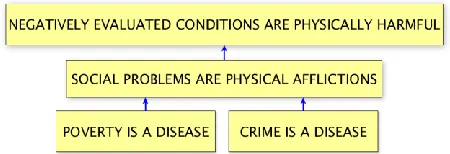
[image:2.612.314.539.418.495.2]Since Lakoff and Johnson’s first book on concep-tual metaphor theory (1980), the field has come to recognize the hierarchical and taxonomic nature of metaphors and the concepts that comprise their source and target domains. For example, consider the phrases poverty infects society and crime is plaguing the nation, which instantiate the specific metaphors POVERTY IS A DISEASE and CRIME IS A DISEASE, respectively. However, they inherit much of their semantics from a more general metaphor, SOCIAL PROBLEMS ARE AFFLICTIONS; this in turn inherits from a yet more general metaphor, NEGATIVELY EVALUTED CONDITIONS ARE PHYSICALLY HARMFUL, as shown in Figure 1.
Figure 1. Metaphor inheritance network
system of representation that can be computation-ally implemented and leveraged for improved met-aphor detection.
2.1 Repository of metaphors and frames
[image:3.612.316.540.353.542.2]The MetaNet project represents an effort to formal-ly represent and categorize metaphors and frames that comprise their source and target domains, and relations between them. Frames are coherent, con-ceptual gestalts organized in a hierarchical struc-ture. These range from experiential universal structures such as Motion Along a Path and Verti-cality, to more specific situations such as Physical Restraints and Disease; they also include less phys-ically concrete culturally-based frames like Pov-erty and Corruption. More-specific frames incorporate the semantics and internal structure of the more-general frames they inherit from, forming a complex network of related concepts. Relations between frames define how elements of a parent frame are incorporated by the child frame. For in-stance, the ‘subcase of’ relation indicates that the child fully inherits and elaborates the structure of the parent frame. In addition to traditional ontolog-ical relations, we also include relations specific to frame semantics and metaphor theory. A fragment of this network is illustrated in Figure 2.
Figure 2. Non-metaphoric frame network pattern
Sub-networks like the group of Physical Afflic-tion frames in Figure 2 are further grouped togeth-er to form families of frames, which define collections of broader, but still coherent, conceptu-al domains.
In addition to relations between frames, struc-ture within frames is also represented in the reposi-tory. This includes such elements as participant
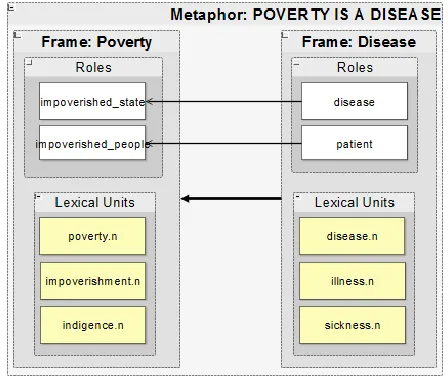
roles, aspectual and causal structures, relationships between roles, and lexical units that evoke the frame. Figure 3 illustrates partial frame representa-tions of the Poverty and Disease frames. Internal frame structure not only enables improved analysis by requiring the analyst to consider the details of each frame, but also provides additional infor-mation in metaphor detection. As the detection system identifies the frames that contribute to the identified metaphor, the detailed semantics of those concepts can be accessed via these frame entries.
Metaphors are essentially representations of mappings between frames. The structure of the source domain frame maps onto the structure of the target domain frame (Figure 3); hence, in POVERTY IS A DISEASE, the impoverished people of the Pov-erty frame are understood as the patient experienc-ing the disease in the Disease frame. Specifically, the roles of the Disease frame map onto their coun-terparts of the Poverty frame.
Figure 3. Metaphor structure
Furthermore, just as frame-frame relations de-fine how one frame incorporates the semantics of another, metaphor-metaphor relations define the hierarchy of metaphors (Figure 1). The result is a complex, lattice-like inheritance network of con-cepts and metaphors.
The computational architecture used for this purpose is a Wiki, based on the Semantic Me-diawiki format (Krötzsch et al. 2006). Linguists trained in conceptual metaphor theory create frame and metaphor entries as individual pages,
specify-Physical Affliction
subcase of
subcase of subcase of
Treating A Physical Affliction Disease
Cancer Polio
[image:3.612.75.301.431.582.2]ing for each metaphor its source and target domain frames, role-to-role mappings, and relations be-tween that metaphor and others in a network. Ini-tially the repository was seeded from metaphors previously identified in the past 30 years of meta-phor literature; including comprehensive analysis of primary metaphors provides broad coverage of conceptual metaphors that are applicable to many target domains. For example, the metaphor MORE IS UP can be found in such varied expressions as
prices skyrocketed, she had high hopes, and study-ing boosted his GPA. Following this initial stage, additional metaphors are added as analysts find them via focused study of particular target do-mains; however, the system can identify metaphor-ic language even in the absence of specifmetaphor-ic metaphors by utilizing the frame network to find more general-level metaphors, as will be shown in section 3.2.
2.2 Metaphor constructions
Previous research has demonstrated that metaphors tend to be expressed in certain regular construc-tional patterns (Croft 2002; Sullivan 2007, 2013). For example, the noun phrase poverty trap has the source domain lexeme trap modified by the target domain lexeme poverty; these noun-noun metaphor constructions consistently appear in this dependen-cy relation. In contrast, the reverse construction with the source modifying the target is not ob-served in corpus data (Sullivan 2013). Building on this research, our project has defined a set of grammatical constructions that represent several different types of frequently occurring patterns. In each, the construction specifies which construc-tional element evokes the source domain, and which evokes the target domain (Table 1). The source term fills different slots in these various patterns; the source may appear not only as a verb, but also as a noun or adjective. As described in section 3.1, these constructions enable us to link a broad range of potentially metaphoric expressions (e.g. lexical units, expressed in some construction-al pattern) to the frames and conceptuconstruction-al metaphors in our repository. However, while this process eliminates much data that is not metaphoric, it does not positively identify expressions that are meta-phoric: for example, the same noun-noun pattern that identifies poverty trap also returns the literal
expression bear trap. Hence, disambiguating be-tween these two types of expressions requires a second step of metaphoricity evaluation.
Constructional pattern Examples
T-subj_S-verb poverty infects
T-subj_S-verb-conj poverty infects and maims
T-subj-conj_S-verb homelessness and poverty infect
S-verb_T-dobj escape poverty
S-verb_T-dobj-conj escape despair and pov-erty
S-verb_Prep_T-noun slide into poverty / pull up out of poverty
S-noun_of_T-noun trap of poverty
T-noun_poss_S-noun poverty's undertow
S-noun_prep_T-noun path to poverty
T-noun_mod_S-noun poverty trap
S-adj_mod_T-noun burdensome poverty
T-noun_cop_S-noun-adj
[image:4.612.313.545.120.346.2]poverty is a disease / poverty is burdensome
Table 1. Constructional Patterns
3 Metaphor Extraction and Identification
Our automatic metaphor identification system di-vides into two main phases. In the first, we use a set of manually defined metaphoric constructional patterns to identify candidate expressions with ex-plicitly realized potential target and source ele-ments. In the second, we identify the frames that are evoked by these elements, and use our concep-tual network of frames and metaphors, along with a set of patterns of relationships between nodes in the network, to determine the likelihood of a can-didate expression being metaphoric. These phases are presented in detail below.
3.1 Matching constructional patterns
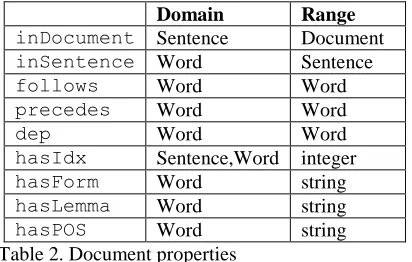
specify document structural constraints, including grammatical constraints. To search texts for con-structional matches, we construct Resource De-scription Framework (RDF) models of each sentence in terms of an ontology defined in the Web Ontology Language (OWL). The ontology defines the classes Document, Sentence, and Word, and properties, some of which are shown in Table 2 and with their domain and range.
Domain Range
inDocument Sentence Document
inSentence Word Sentence
follows Word Word
precedes Word Word
dep Word Word
hasIdx Sentence,Word integer
hasForm Word string
hasLemma Word string
hasPOS Word string
Table 2. Document properties
The resulting RDF representation of the input text constitutes a graph structure in which words, sentences, and documents are nodes in the graph. Properties serve to characterize nodes in terms of string or integer information, such as form, lemma, part of speech (POS), or position, as well as in terms of a node’s relation to other nodes. Such re-lations, with respect to Word nodes, include order-ing relations and grammatical dependency relations. While Table 2 shows only the root of the dependency relations, dep, the ontology includes a grammatical relations hierarchy that represents a merger of the hierarchies used by the Stanford (De Marneffe et al., 2006), RASP (Briscoe et al., 2006), and Spanish Freeling (Lloberes et al., 2010) dependency parsers.
Generating this representation requires that NLP tools such as lemmatizers, POS taggers, and dependency parsers be available for the language in question. Because dependency parsing is the most computationally expensive step in this pro-cess, in cases where the metaphor extraction is be-ing run only for certain target or source domains, a preprocessing step identifies sentences of interest based on the presence of a word from those do-mains.
In order to search large volumes of text using SPARQL constructional pattern queries, docu-ments are converted to RDF and uploaded to an
OpenRDF Sesame triplestore. Constructional pat-tern matching queries are run in succession over each document, with queries written so that each match result includes a sentence index, as well as the lemma and word index of the potentially meta-phoric lexical elements. Documents are processed in parallel to the extent possible given hardware limitations. With six compute servers each provid-ing 16 cores and runnprovid-ing a local triplestore, we were able to run metaphor detection on a pre-processed 500 million word subset of the English Gigaword corpus (Graff & Cieri 2003) in 6 hours.
3.2 Evaluating metaphoricity
The preceding phase of the metaphor extractor re-turns pairs of words that are related to each other by a constructional pattern where one word may be the source domain of a metaphor, and the other word may be the target domain of that metaphor. While the constructional patterns represent a nec-essary constraint on metaphoric expression, they are not sufficient to guarantee metaphoricity. Hence, the second phase of metaphor detection makes use of the network of frames and metaphors instantiated in the metaphor repository in order to disambiguate between metaphoric and non-metaphoric expressions in the pool of candidates.
The content of the wiki repository (as described in Section 2.1) is converted to an RDF representa-tion, also in terms of an OWL-defined ontology, and loaded into a triplestore repository. Entries for candidate lexical items in the repository are associ-ated with the frames that they evoke; if the lexical items for English are not already present in the sys-tem, FrameNet (https://framenet.icsi.berkeley.edu), WordNet (https://wordnet.princeton.edu), and Wiktionary (https://www.wiktionary.org) data are used to expand the search for the most relevant frame present in the system. After these frames are identified, the system performs searches through the network to determine how the frames are relat-ed to one another. If a repository search of the chain of relations that connect the frames includes codified metaphoric mappings, the extractor rec-ognizes the candidate expression as metaphoric.
SPARQL and stored in the Semantic MediaWiki, along with the constructional patterns. These pat-terns fall into two basic types.
The first type are relational configurations that constitute negative evidence for metaphoricity— i.e. they suggest that the expression is not meta-phoric. For example, if the potential source and target lexical units evoke the same frame, the sys-tem could conclude that the expression is not met-aphoric. Similarly, the system can also disregard cases where the frames are too closely related at some point in the network, e.g., if the candidate target lemma evokes a frame that is inherited by the candidate source frame. For example, in the phrases to cure a disease and to cure polio, cure
evokes the Treating a Physical Afflictionframe, in which one of the roles is the physical affliction being treated. The potential target lemmas disease
and polio evoke the Disease and Polio frames, which inherit from Physical Affliction as shown in Figure 2. The constructional pattern matching phase of the system would identify the expressions as candidates, with cure as the source word in both cases, and with disease and polio as the target words for each phrase. The system, however, is able to exclude these on the basis of a rule that de-fines a known non-metaphoric network pattern,
TargetIsRoleInSource, where the frame evoked by the potential target term either directly or recursively inherits from a frame that is incorpo-rated as a role into the frame evoked by the poten-tial source term.
The second type of network relational patterns are a set of rules that constitute positive evidence for metaphoricity. For example, if the two lemmas evoke frames that are defined as target and source frames of a specific conceptual metaphor in the network, then that expression is positively evaluat-ed as a metaphor.
However, it is not necessary that the evoked frames are immediately related to a metaphor entry in the repository. It is not unusual for specific met-aphoric mappings not to be present in the concep-tual network. This can be due to practical limitations as is often the case with manually cre-ated resources, or for principled reasons—for ex-ample, in cases where specific metaphors can be predicted from general ones, or for novel exten-sions that can be interpreted using general meta-phors. In those cases, the system is often still able assess metaphoricity on the basis of general
[image:6.612.319.541.261.394.2]map-pings defined at a higher level. For example, in the phrase to cure poverty, poverty evokes the Poverty frame and cure the Treating a Physical Affliction frame. In the conceptual network, Poverty is de-fined as a subcase of Social Problem. Furthermore, Treating a Physical Affliction incorporates the Physical Affliction frame as a role within it. In this case, although the more specific metaphor ADDRESSING POVERTY IS TREATING A DISEASE is not present in the repository network, the system can still identify the candidate pair cure poverty as metaphoric on the basis of the higher-level meta-phoric mapping SOCIAL PROBLEMS ARE PHYSICAL AFFLICTIONS, as illustrated in Figure 4.
Figure 4. Structures accessed by phrase cure poverty.
Consequently, the system is often able to be re-silient in the case of specific level gaps in the con-ceptual network as in the example above.
In addition, the relational patterns are assigned scores that represent the level of confidence that a linguistic expression with a matching frame and metaphor network pattern would actually be meta-phoric or non-metameta-phoric. These scores are used to produce a metaphoricity score for each candidate expression. Although the scores presently as-signed to the relational patterns are based on intui-tion, plans are underway to determine them empirically.
4 Analysis and Evaluation of Data
the name of the conceptual metaphor identified during the metaphor evaluation process. The pur-pose for which the extraction is being performed will affect which types of input are used (gold standard data vs. corpora).
4.1 System evaluation and improvements us-ing gold standard
To evaluate the accuracy of the metaphor extractor, linguists collected attested sentences and annotated metaphoric expressions for the target domains Government, Bureaucracy, Democracy, Poverty, Taxation, and Wealth; they annotated all in-domain metaphoric expressions in the sentences where both the target and source were explicitly realized. Sentences were manually annotated for source and target word forms, source and target frames, and the constructional pattern used to ex-press the metaphor. The metaphor extractor was run on these collected gold standard sentences, and the output compared to the annotations entered by the linguists. Table 3 shows the number of annota-tions in the gold standard, the recall (percentage of gold standard examples that were identified), and the precision (percentage of extracted examples that were correct) of the system for three lan-guages.
Lang. Anno. Recall Precision
[image:7.612.321.532.119.174.2]English 301 0.86 (258/301) 0.85 (258/305) Spanish 122 0.88 (107/122) 0.86 (107/125) Russian 148 0.41 (60/148) 0.90 (60/67)
Table 3. Performance over gold standard data
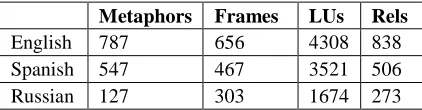
As shown in Table 3, the system exhibits signif-icantly lower recall for Russian than for the other languages. One of the reasons for this is that our instantiation of the conceptual network of frames and metaphors is not as well developed for Russian as for English and Spanish, containing significant-ly fewer metaphors and frames, as well as lexical units (LUs) which belong to them.1 For example, Table 4 below shows the number of metaphors, frames, LUs, and the total number of frame-frame relations of the types used for metaphoricity
1
As linguists continue to work on the repository, these numbers will grow.
ation. These relations include ‘incorporates as a role,’ ‘subcase of,’ and ‘makes use of.’
Metaphors Frames LUs Rels
English 787 656 4308 838 Spanish 547 467 3521 506 Russian 127 303 1674 273 Table 4. Summary of repository content
It should be noted, however, that all the sys-tems, including Russian, identified metaphoric ex-pressions with a high degree of precision. Since the functioning of the metaphor detector depends on the correctness of conceptual metaphor theory, of its formalization in our system, and of the meta-phor, frame, constructional pattern, and metaphor relational pattern representations in the repository, this result provides positive indication as to the validity in general of these aspects of the system. The metaphor detector thus in some sense imple-ments the predictions of the formalized theory.
This has the added benefit that results contrary to expectation provide invaluable data for refining the system. For example, it is widely accepted that the government is often conceptualized a kind of physical structure, e.g. foundation of government,
the government collapsed overnight, etc. The met-aphor detector, based on representations captured in the repository, searching through a large corpus, turned up volumes of expressions such as govern-ment building and government house that are not metaphoric. This becomes a starting point of in-vestigation to correct some aspect of the content of the repository, of the theory, or of its formaliza-tion.
4.2 Corpus-based analysis of metaphor
The richness of the extracted data and the struc-tural relations identified via our repository enable us to analyze data at varying levels of specificity. For instance, a search of the English Gigaword corpus (Graff & Cieri 2003) for metaphor expres-sions with the target domain ‘poverty’ revealed several interesting patterns. Firstly, at the very general level of frame families, we observe that the most frequently occurring source terms were either location/motion related (e.g. being at a location, translational motion, motion impediments) or in-volved physical harm (e.g. disease, physical com-bat, or other harmful encounters). Figure 5 shows the relative frequency of these frame families.
Figure 5. Most frequently occurring source families within poverty data.
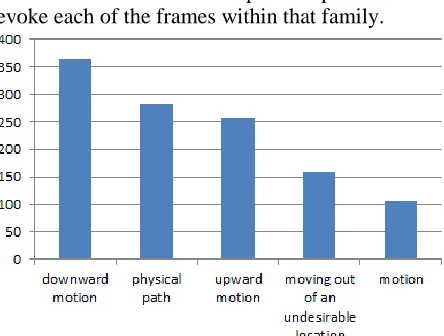
At a somewhat more specific level, we can ex-amine which specific frames within one of these families are being evoked. Figure 6 looks within the Translational Motion family, and shows the number of extracted metaphor expressions that evoke each of the frames within that family.
Figure 6. Number of extracted metaphor expressions that evoke various translational motion frames
Looking at a yet more specific level, we can ex-amine which lexical items are used to evoke a giv-en frame. Figure 7, below, shows this data for the Downward Motion frame.
Figure 7. Number of different lexical units in extracted data that evoke the Downward Motion frame.
It is also possible to search for the conceptual metaphor that was discovered during the meta-phoricity evaluation phase of the extraction pro-cess. For instance, Downward Motion lexemes such as fall and slip are used in expressions of the conceptual metaphor BECOMING IMPOVERISHED IS MOTION DOWNWARDS (e.g. the young family fell/slipped into poverty).
5 Conclusions
[image:8.612.315.539.144.300.2] [image:8.612.77.294.256.412.2] [image:8.612.74.296.513.681.2]Acknowledgments
The MetaNet Analysis and Repository teams: George Lakoff, Eve Sweetser, Oana David, Karie Moorman, Patricia Lichtenstein, Kristina Despot, Luca Gilardi, Collin Baker, Jim Hieronymous, et al.
Supported by the Intelligence Advanced Re-search Projects Activity (IARPA) via Department of Defense US Army Research Laboratory contract number W911NF-12-C-0022. The U.S. Govern-ment is authorized to reproduce and distribute re-prints for Governmental purposes notwithstanding any copyright annotation thereon.
Disclaimer: The views and conclusions contained herein are those of the authors and should not be interpreted as necessarily representing the official policies or endorsements, either expressed or im-plied, of IARPA, DoD/ARL, or the U.S. Govern-ment.
References
Briscoe, T., Carroll, J., & Watson, R. (2006, July). The second release of the RASP system. In Pro-ceedings of the COLING/ACL on Interactive presentation sessions (pp. 77-80). Association for Computational Linguistics.
Deignan, A. (2005). Metaphor and corpus linguis-tics. Amsterdam/Philadelphia: John Benja-mins.
De Marneffe, M. C., MacCartney, B., & Manning, C. D. (2006). Generating typed dependency parses from phrase structure parses. In Proceedings of LREC (Vol. 6, No. 2006, pp. 449-454).
Feldman, J., Dodge, E. & Bryant, J. (2009). Em-bodied Construction Grammar. In Heine B., Narrog H., (eds). The Oxford Handbook of Lin-guistic Analysis. Oxford: Oxford U Press, 111– 38.
Fillmore, C. J. 1976. Frame semantics and the na-ture of language. In Origins and Evolution of Language and Speech, ed. by Stevan R. Har-nad, Horst D. Steklis, & Jane Lancaster, 20-32. Annals of the NY Academy of Sciences, Vol. 280.
Graff, D. & Cieri, C. (2003). English Gigaword LDC2003T05. Web Download. Philadelphia: Linguistic Data Consortium.
Kövecses, Z. (2011). Methodological issues in conceptual metaphor theory. In S. Handl & H-J. Schmid (Eds.), Windows to the Mind: Meta-phor, metonymy and conceptual blending (pp. 23-40). Berlin/New York: Mouton de Gruyter. Krötzsch, M., Vrandečić, D., & Völkel, M. (2006).
Semantic mediawiki. In The Semantic Web-ISWC 2006 (pp. 935-942). Springer Berlin Hei-delberg.
Lakoff, G. (1993). The Contemporary Theory of Metaphor. In A. Ortony (Ed.), Metaphor and Thought. Cambridge: Cambridge University Press, 202–251.
Lakoff, G. (1993b). How metaphor structures dreams: The theory of conceptual metaphor ap-plied to dream analysis. Dreaming, 3(2), 77. Lakoff, G., & Johnson, M. (1980). Metaphors We
Live By. Chicago: University of Chicago Press. Lakoff, G., & Johnson, M. (1999). Philosophy in
the flesh: The embodied mind and its challenge to western thought. Basic books.
Lakoff, G. (2008). The neural theory of metaphor.
The Cambridge handbook of metaphor and thought, 17-38.
Lakoff, G. (2014). Mapping the brain’s metaphor circuitry: metaphorical thought in everyday rea-son. Frontiers in Human Neuroscience, 8, 958. Lloberes, M., Castellón, I., & Padró, L. (2010,
May). Spanish FreeLing Dependency Grammar. In LREC (Vol. 10, pp. 693-699).
Martin J. H.. (2006). “A corpus-based analysis of context effects on metaphor comprehension”. In Anatol Stefanowitsch and Stefan Th. Gries (Eds.), Corpus-Based Approaches to Metaphor and Metonymy (pp. 214-236). Berlin and New York: Mouton de Gruyter.
Mason, Z. J. (2004). “CorMet: A computational, corpus-based conventional metaphor extraction system.” Computational linguistics, 30(1), 23-44.
Mohler, M., Bracewell, D., Hinote, D., & Tomlin-son, M. (2013). Semantic signatures for exam-ple-based linguistic metaphor detection.
Meta4NLP 2013, 27.
Pragglejaz Group. (2007). MIP: A method for identifying metaphorically used words in dis-course. Metaphor and Symbol, 22(1), 1–39. Ruppenhofer, J., Ellsworth, M., Petruck, M. R.,
Berkeley, California: International Computer Science Institute
Shutova, E., Sun, L., & Korhonen, A. (2010, Au-gust). Metaphor identification using verb and noun clustering. In Proceedings of the 23rd In-ternational Conference on Computational Lin-guistics (pp. 1002-1010). Association for Computational Linguistics.
Stefanowitsch, Anatol. (2006). “Words and their metaphors: A corpus-based approach”. In Ana-tol Stefanowitsch and Stefan Th. Gries (Eds.),
Corpus-Based Approaches to Metaphor and Metonymy (pp. 63-105). Berlin and New York: Mouton de Gruyter.
Sullivan, K. S. (2007). Grammar in Metaphor: A Construction Grammar Account of Metaphoric Language. PhD dissertation, University of Cali-fornia Berkeley.
Sullivan, K. S. (2013). Frames and Constructions in Metaphoric Language. Amster-dam/Philadelphia: John Benjamins Publishing. Turney, P. D., Neuman, Y., Assaf, D., & Cohen,
Y. (2011). Literal and metaphorical sense identi-fication through concrete and abstract context. In Proceedings of the 2011 Conference on the Empirical Methods in Natural Language Pro-cessing (pp. 680-690).