Proceedings of the Tenth Workshop on Innovative Use of NLP for Building Educational Applications, 2015, pages 196–206,
Judging the Quality of Automatically Generated Gap-fill Question using
Active Learning
Nobal B. Niraula and Vasile Rus
Department of Computer Science and Institute for Intelligent Systems The University of Memphis
Memphis, TN, 38152, USA
{nbnraula,vrus}@memphis.edu
Abstract
In this paper, we propose to use active learn-ing for trainlearn-ing classifiers to judge the qual-ity of gap-fill questions. Gap-fill questions are widely used for assessments in education con-texts because they can be graded automatically while offering reliable assessment of learners’ knowledge level if appropriately calibrated. Active learning is a machine learning frame-work which is typically used when unlabeled data is abundant but manual annotation is slow and expensive. This is the case in many Nat-ural Language Processing tasks, including au-tomated question generation, which is our fo-cus. A key task in automated question gen-eration is judging the quality of the generated questions. Classifiers can be built to address this task which typically are trained on human labeled data. Our evaluation results suggest that the use of active learning leads to accurate classifiers for judging the quality of gap-fill questions while keeping the annotation costs in check. We are not aware of any previous ef-fort that uses active learning for question eval-uation.
1 Introduction
Recent explosion of massive open online courses (MOOCs) such as Coursera1 and Udacity2 and the
success of Intelligent Tutoring Systems (ITSs), e.g. AutoTutor (Graesser et al., 2004) and DeepTutor (Rus et al., 2013), at inducing learning gains compa-rable to human tutors indicate great opportunities for
1http://www.coursera.org 2http://www.udacity.com
online education platforms. These systems typically deliver knowledge to learners via video streaming or direct interaction with the system, e.g. dialogue based interaction. If adaptive to individual learners, such online platforms for learning must assess learn-ers’ knowledge before, during, and after students’ interaction with the platform. For instance, in or-der to identify knowledge deficits before and/or af-ter a session a pre- and/or post-test can be used. The knowledge deficits discovered based on the pre-test can guide the online platform to select appropriate instructional tasks for the learner. Furthermore, the pre- and post-test can be used to measure the learn-ing gains with the online platform, e.g. by subtrac-tic the pre-test score from the post-test score. The bottom line is that assessment is critical for adap-tive instruction. Various kinds of questions are used to assess students’ knowledge levels varying from True/False questions to multiple choice questions to open answer questions.
al., 2005), and academic writing(Liu et al., 2012). Consequently, particular attention has been paid by Natural Language Processing (NLP) and educa-tional researchers to automatically generating sev-eral types of questions. Some examples include mul-tiple choice questions(Mitkov et al., 2006; Niraula et al., 2014),gap-fillquestions (Becker et al., 2012) and free-response questions (Mazidi and Nielsen, 2014a; Heilman and Smith, 2009). The more gen-eral problem of question generation has been sys-tematically addressed via shared tasks (Rus et al., 2010).
Mitkov et al. (2006) reported that automatic ques-tion construcques-tion followed by manual correcques-tion is more time-efficient than manual construction of the questions alone. Automated method for judging the question quality would therefore make the question generation process much more efficient. To this end, we present in this paper an efficient method to rank
gap-fillquestions, a key step in generating the ques-tions. We formulate the problem next.
1.1 Gap-fill Question Generation
Gap-fill questions are fill-in-the-blank questions consisting of a sentence/paragraph with one or more gaps (blanks). A typical gap-fill question is presented below:
Newton’s law is relevant after the mover doubles his force as we just established that there is a non-zero net force acting on the desk then.
The gap-fill question presented above has a word missing (i.e. a gap). A gap-fill question can have one more than one gaps too. Students (test takers) are supposed to predict the missing word(s) in their an-swer(s). Gap-fill questions can be of two types: with alternative options (key and distractors) and without choices. The former are calledclozequestions and the latter are calledopen-clozequestions. In this pa-per, we use the term gap-fill question as an alterna-tive to open-cloze question.
[image:2.612.316.549.63.142.2]The attractiveness of gap-fill questions is that they are well-suited for automatic grading because the correct answer is simply the original word/phrase corresponding to the gap in the original sentence. As a result they are frequently used in educational contexts such as ITSs and MOOCs.
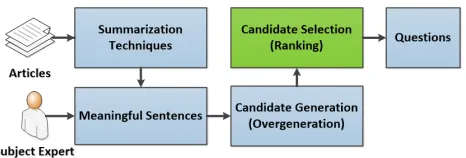
Figure 1: A pipeline for gap-fill question generation
A typical pipeline to automatically generate gap-fill questions is shown in Figure 1. It follows the three steps paradigm for question generation (Rus and Graesser, 2009) :Sentence Selection,Candidate Generation (overgeneration) and Candidate Selec-tion(ranking).
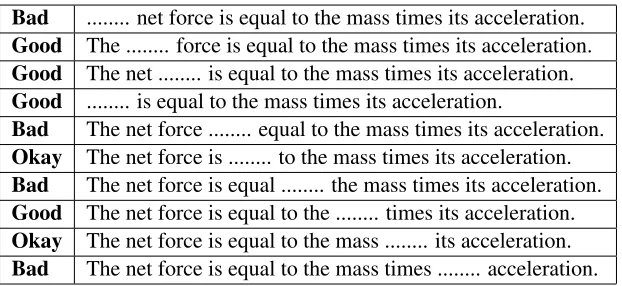
Step 1 - Sentence Selection: To generate gap-fill questions, a set of meaningful sentences are needed first. The sentences can be selected from a larger source, e.g. a chapter in a textbook, using particular instructional criteria such as being difficult to com-prehend or more general informationl criteria such as being a good summary of the source (Mihalcea, 2004) or directly from subject matter experts. Step 2 - Candidate Generation: This step gener-ates a list of candidate questions (overgeneration) from the target sentences selected in Step 1. The simplest method might be a brute force approach which generates candidate questions by considering each word (or a phrase) as a gap. A more advanced technique may target the content words as gaps or exploit the arguments of semantic roles for the gaps (Becker et al., 2012). An example of overgeneration of questions is shown in Table 1.
Step 3 - Candidate selection: Not all of the ques-tions generated in the candidate generation step are of the same quality. The classes can beGood,Okay
andBadas in Beckeret al. (2012) or simply the bi-nary classesGoodandBad. Good questions are the questions that ask about key concepts from the sen-tence and are reasonable to answer,Okayquestions are questions that target the key concepts but are difficult to answer (e.g. too long, ambiguous), and
em-Bad ... net force is equal to the mass times its acceleration. Good The ... force is equal to the mass times its acceleration. Good The net ... is equal to the mass times its acceleration. Good ... is equal to the mass times its acceleration.
[image:3.612.152.463.64.207.2]Bad The net force ... equal to the mass times its acceleration. Okay The net force is ... to the mass times its acceleration. Bad The net force is equal ... the mass times its acceleration. Good The net force is equal to the ... times its acceleration. Okay The net force is equal to the mass ... its acceleration. Bad The net force is equal to the mass times ... acceleration.
Table 1:Typical overgenerated questions from a sentence with their ratingsGood,OkayandBad.
ployed in the form of classifiers to label the candi-date questions as Good, Okay, or Bad.
1.2 Question Quality
Question quality can be judged linguistically or ped-agogically. In linguistic evaluation, questions are evaluated with respect to whether they are grammat-ically and semantgrammat-ically correct. In pedagogical eval-uation, questions are evaluated to see whether they are helpful for understanding and learning the target concepts. Our focus here is on the pedagogical eval-uation of automatically generated gap-fill questions since they are always linguistically correct.
The third step i.e. candidate selection is expen-sive when supervised approaches are used because model building in supervised learning requires large amount of human annotated examples. The advan-tage of supervised methods, however, is that their performances are in general better than, for instance, that of unsupervised methods. As such, ideally, we would like to keep the advantages of supervised methods while reducing the costs of annotating data. Such a method that offers a good compromise be-tween annotation costs and performance is active learning, which we adopt in this work. Such models are always attractive choices especially when there is a limited budget e.g. fixed annotation time / cost, a highly probable case.
Active learning andinteractive learning are two well-known approaches that maximize performance of machine learning methods for a given budget. They are successfully applied for rapidly scaling di-alog systems (Williams et al., 2015), parts-of-speech tagging (Ringger et al., 2007), sequence labeling
(Settles and Craven, 2008), word sense disambigua-tion (Chen et al., 2006), named entity tagging (Shen et al., 2004), etc. Instead of selecting and present-ing to an annotator a random sample of unlabeled instances to annotate, these approaches intelligently rank the set of unlabeled instances using certain cri-teria (see Section 3) and present to the annotator the best candidate(s). This characteristic of active learning and interactive labeling hopefully demands fewer instances than random sampling to obtain the same level of performance.
In this paper, we propose an active learning based approach to judge the quality of gap-fill questions with the goal of reducing the annotation costs. We are not aware of any previous effort that uses active learning for question generation. We chose active learning particularly because it is well-suited when unlabeled data is abundant but manual annotation is tedious and expensive. As mentioned, this is the case in gap-fill question question generation in over-generation approaches when plenty of questions are available but their quality needs to be specified. The remaining challenge is to judge the quality of these questions. Our plan is to build a probabilistic classi-fier at reduced costs that would automatically label each candidate questions as good or bad using an active learnign approach.
2 Related Works
Currently, statistical and machine learning based ap-proaches are the most popular apap-proaches that are used to rank the automatically generated questions of various kinds e.g. free-response (e.g. What, When etc.) and gap-fill questions. For example, Heilman et al. (2010) used logistic regression, a supervised method, to predict the acceptability of each free-response question candidate. The candi-date questions were automatically generated by us-ing a set of rules. They used fifteen native English-speaking university students for the construction of training examples required for building the logistic regression model.
Hoshino and Nakagawa (2005) proposed a ma-chine learning approach to generate multiple-choice questions for language testing. They formed a ques-tion sentence by deciding the posiques-tion of the gap i.e. missing word(s). To decide whether a given word can be left blank (i.e. serve as a gap) in the declar-ative stem, they trained classifiers using the training instances which were generated by collecting fill-in-the-blank questions from a TOEIC preparation book. The positive examples were the exact blank positions in the question from the book whereas the negative examples were generated by shifting the blank position.
Similarly, Beckeret al.(2012) proposedMind the Gapsystem that applied logistic regression to rank automatically generated gap-fill questions. They used text summarization technique to select useful sentences from text articles for which gap-fill ques-tions are to be generated. From each of the selected sentence, it generated potential gap-fill candidates using semantic constraints. Each candidate ques-tion was then labeled by four Amazon’s Mechani-cal Turkers to one of Good,Bad andOkayclasses. In total, 85 unique Turkers were involved in the an-notation. The data set was used to build a logistic regression classifier and ranked the candidate ques-tions. They reported that the classifier largely agreed with the human judgment on question quality.
In recent works Mazidi and Nielsen (2014a; 2014b) generated free-response questions from sen-tences by using the patterns which were manu-ally authored by exploiting the semantic role labels. They evaluated the questions linguistically and
ped-agogically using human annotators and reported that their systems produced higher quality questions than comparable systems. The main limitation of their approaches is that they do not exploit the examples obtained from the annotation process to evaluate un-seen (or not yet evaluated) questions. Moreover, their approaches do not provide any ranking for the questions they generated using those patterns.
3 Active Learning for Judging Question Quality
As mentioned before, active learning fits well when abundant data can be available but manual labeling costs are high. As a result, the technique has been applied to many NLP tasks such as text classifica-tion, Word Sense Disambiguaclassifica-tion, sequence label-ing, and parsing. We use active learning for guiding our annotation process for judging the quality of au-tomatically generated gap-fill questions.
3.1 Active Learning Algorithms
An active learning system mainly consists of a clas-sification model and querying algorithm. Typically the classification models are the probabilistic classi-fiers such as Na¨ıve Bayes and Logistic Regression which provide a class probability distribution for a given instance. Querying algorithms/functions ac-tively choose unlabeled instance samples by exploit-ing these probabilities.
We follow the standard pool-based active learning algorithm as shown in Algorithm 1. It starts with a set of initially labeled instances (seed examples) and a set of unlabeled instances (U). A new model is built using the labeled examples inL. Next, a batch of instances are extracted from the unlabeled setU using a query functionf(.)and then the selected in-stances are labeled by human judges. The new la-beled instances are added to the lala-beled listL. The process repeats until a stopping criterion is met. The criteria could be the number of examples labeled, expected accuracy of the model, or something else.
3.1.1 Querying Algorithms
Input:Labeled instancesL, unlabeled
instancesU, query batch sizeB, query function f(.) ;
whilesome stopping criteriondo
θ= Train the model usingL; fori= 1 toBdo
b∗
i = arg maxu∈Uf(u);
L=L∪< b∗
i, label(b∗i)>;
U =U −b∗
i;
end end
Algorithm 1: Pool-based active learning algo-rithm
A. Query By Uncertainty or Uncertainty Sam-pling
Uncertainty sampling chooses the samples for which the model’s predictions are least certain. These examples reside very near to the decision boundary. We use three functions that predict the samples in the decision boundary.
(a) Least Confidence: This function chooses the sample x that has the highest fLC(.) score and is
defined as : fLC(x) = 1−P(y∗|x;θ)where y∗ is
the most likely class predicted by the model (Settles and Craven, 2008).
(b) Minimum Margin: This function chooses the sample x that has the least fMM(.) score and is
defined as: fMM(x) = |P(y1∗|x;θ)−P(y2∗|x;θ)| where y∗
1 and y2∗ are the first and the second most likely classes predicted by the model (Chen et al., 2006).
(c) Entropy: This function chooses the sample x that has the highest entropy i.e. fEN(.) score and
is defined as: fEN(x) = −PCc=1P(yc|x;θ) ∗ log(P(yc|x;θ)) where C is the total number of
classes (Chen et al., 2006). B. Query By Committee
Our query by committee sampling algorithm con-sists of a committee of models. These models are trained on the same labeled examples but learn dif-ferent hypotheses. We compute for a given instance the class distribution mean over all committee mem-bers and assume that the mean scores represent the votes received from the committee. Next we apply fLC(.) , fMM(.) and fEN(.) over the mean class
distribution and view them as selection scores.
4 Experiments
In this section we describe our experiments in detail. 4.1 Data set
Although an active learning system doesn’t require all the unannotated instances to be labeled initially, having such an annotated data set is very useful for simulations since it allows us to conduct exper-iments to inverstigate active learning, in our case, for judging the quality of automatically generated questions. To this end, we used the existing data set calledMind the Gap data setwhich was created and made publicly available by Beckeret al.(2012)
3. The data set consists of 2,252 questions generated
using sentences extracted from 105 Wikipedia’s ar-ticles across historical, social, and scientific topics. Each question was rated by four Amazon Mechani-cal Turkers asGood,Okay, orBad (see definitions in Section 1.1).
For our experiments, we binarized the questions intopositiveandnegativeexamples. We considered a questionpositivewhen all of its ratings wereGood
or at most one rating wasOkayorBad. The rest of the questions were considered asnegativeexamples. This way we obtained 747 positive and 1,505 were negative examples. The chosen requirement for be-ing a positive example was needed in order to focus on high quality questions.
4.2 Features
In order to build models to judge the quality of ques-tions, we implemented five types of features as in Becker et al. (2012) includingToken Count, Lexi-cal, Syntatic, SemanticandNamed Entity. In total we had 174 features which are summarized in Table 2. The numbers inside parentheses are the indices of the features used.
Type Features
Token Count - 5 no. of tokens in answer(1) and in sentence(2), % of tokens in answer (3), no.(4)and %(5) of tokens in answer matching with non-answer tokens
Lexical - 9
% of tokens in answer that are capitalized words(6), pronouns(7), stopwords(8), and quantifiers(9), % of capitalized words(10) and pronouns(11) in sentence that are in answer, does sentence start with discourse connectives ?(12), does answer start with quantifier ?(13), does answer end with quantifier ?(14)
Syntatic - 116
is answer before head verb ? (15), depth of answer span in constituent parse tree (16), presence/absence of POS tags right before the answer span(17-54), presence/absence of POS tags right after the answer span(55-92), no. of tokens with each POS tag in answers(93-130)
Semantic - 34 Answer covered by (131-147), answer contains(148-164) the semantic roles:A1, A2, A3, A4, AM-ADV, AM-CAU, AM-DIR, AM-DIS, AM-LOC, AM-MNR,{A0, AM-PNC, AM-REC, AM-TMP, CA0, CA1, Predicate}
Named Entities - 11
[image:6.612.318.549.415.571.2]does answer contain a LOC(165), PERS(166), and ORG(167) named entities ? does non-answer span contain a LOC(168), PERS(169), and ORG(164) named entities ? no. (170) and % (171) of tokens in answer that are named entities, no. (172) and % (173) of tokens in sentence that are named entities, % of named entities in sentence present in answer (174)
Table 2: List of features used
statistics of pronouns, stop words, quantifiers, capi-talized words, and discourse connectives. Similarly, we used 116 Syntatic features that include mostly binary features indicating presence/absence of a par-ticular POS tag just before the gap and just after the gap, and number of occurrences of each POS tag inside the gap. Our semantic features includes 34 binary features indicating whether the answer con-tained a list of semantic roles and whether seman-tic roles cover the answer. In addition, we used 11
Named Entitiesfeatures to capture presence/absence of LOC, PERS and ORG entities inside the answer and outside the answer. We also computed the en-tity density i.e. number of named entities present in the answer. We used Senna tool for getting semantic roles (Collobert et al., 2011) and Stanford CoreNLP package (Manning et al., 2014) for getting POS tags and named entities.
5 Results and Discussions
We conducted a number of experiments to see how active learning performs at judging the quality of
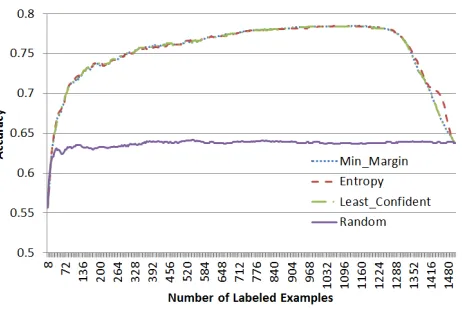
Figure 2: Full Simulation for Na¨ıve Bayes Accuracy
Figure 3: Close-up view of Na¨ıve Bayes Accuracy
Figure 4: Full Simulation for Na¨ıve Bayes F1
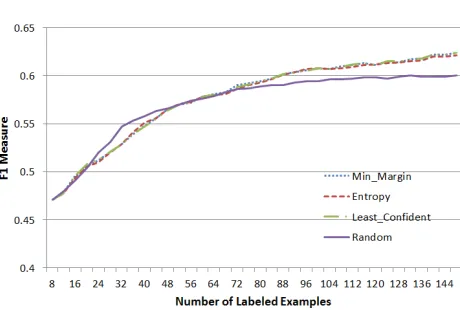
Figure 5: Close-up view of Na¨ıve Bayes F1
merged the other two to construct theunlabeled data set (U). Remember that our data set is already la-beled but we pretended that it is unlala-beledU. Typ-ically, the selected instances fromU have to be la-beled by a human. Since we already know all the labels in the data set, we mimic the human labeling
by simply using the existing labels. This allows us to conduct several experiments very efficiently.
In the first experiment, we compared the various sampling techniques in terms of their impact of the overall performance of question quality classifier. To this end, we randomly selected 8 examples (four positive and 4 negative) fromUfor the seed data set, removed them fromU and put them into the labeled data set (L). We then built a Na¨ıve Bayes model for judging the quality of questions usingL. All the ma-chine learning algorithms we used are available in Weka (Hall et al., 2009). Next, we applied a given sampling strategy to select 4 best examples (i.e. a batch of size 4) to be labeled. These new labeled examples were added toLand the question quality classifier was retrained with this extended data set. We used the test data subset to evaluate the question quality classifier at each iteration and report accu-racy and F-measure. The process was iterated until the unlabeled data setU was empty.
We used the four sampling algorithms (i.e. least confidence, minimum margin, entropy and random) and report results in terms of average across 100 dif-ferent runs; in each such run we ran the active learn-ing approach entirely on all the data we had avail-able. Figure 2 and Figure 4 present the accuracy and F1 scores of Na¨ıve Bayes for each of the sampling algorithms with respect to the number of labeled in-stances used. Figure 3 and Figure 5 are close-ups of leftmost part of the curves in Figure 2 and Figure 4, respectively. As we can see, all uncertainty sampling methods (Min-margin, Entropy and Least confident) outperformed random sampling for both accuracy and F1 measures after few annotations were made. For instance, with 200 examples selected by active learning, the model provided 10% more in accuracy and 4% more in F1 measure compared to the case when the same number of instances were used by sample randomly. It is a promising observation that can save annotation budgets significantly. Moreover, close-up graphs show that all three uncertainty sam-pling approaches rival each other. Note that all the sampling methods converged (i.e. have same accu-racy and F1 measure) at the end of the simulation. It is normal because they would have the same set of labeled instances by then.
Na¨ıve Bayes, Logistic Regression, and SMO. These classifiers learnt different hypotheses from the same set of training examples. As discussed in Section 3.1.1, we generated three models from the same la-beled set of examples and computed mean probabil-ity distributions. For this experiment, we set seed size of 8, batch size of 4, and 100 runs as in ex-periment 1 and measured the performances of the sampling algorithms. Figure 6 and Figure 8 show the accuracy and F-measure for several sampling strategies as a function of the number of annotated examples. Figure 7 and Figure 9 are the close-up views for Figure 6 and Figure 8 respectively. Again, the uncertainty based sampling algorithms are very competitive to each other and they outperform ran-dom sampling significantly in both accuracy and F-measure. This suggests that committee based active learning is also useful for checking question quality. To get an idea of the level of annotation sav-ings when using active learning, consider we have a budget for annotating about 160 instances. With this budget (in Figure 6), uncertainty sampling algo-rithms provide 70% accuracy whereas random sam-pling provides only 65% accuracy. To attain 70% accuracy, random sampling needs at least 360 sam-ples (i.e. 200 examsam-ples more) to be labeled. With 360 samples, uncertainty sampling algorithms pro-vide 74% accuracy. Similar observations can be made when focusing on the F-measure. These ob-servations clearly show the effectiveness of using ac-tive learning for judging the quality of automatically generated questions.
Figure 6: Full Simulation for Committee Accuracy
[image:8.612.316.550.253.403.2]In a third experiment, we focused on the effect of
[image:8.612.317.549.430.585.2]Figure 7: Close-up view of Committee Accuracy
Figure 8: Full Simulation for Committee F1
Figure 9: Close-up view of Committee F1
[image:8.612.77.305.513.665.2]from all the available labeled instances. The new model is generally a better one as it is trained on a larger training set than the previous one. However, the smaller the batch size the larger the computa-tional cost because we need to generate a model fre-quently. So, a balance between the computation cost and the better model should be determined.
Figure 10: Effect of Batch Size
To this end, we chose Na¨ıve based active learning with entropy based sampling. We varied the batch size from 1, 2, 4 and 8 and ran the experiment for 50 runs. The plot can be seen in Figure 10. As the plot suggests, the performances are less sensitive to batch sizes. A reasonable choice could be a batch size of 4. But again, it depends on the amount of computation cost available for model construction.
Figure 11: Effect of seed data
In the last experiment, we varied initial seed size to see its effect of the initial seed size on our ac-tive learning approach. We experimented with seed sizes of 4, 8, 16 and 32. We applied Na¨ıve based ac-tive learning with the batch size of 4 and 100 runs. The plot in Figure 11 shows F1 measures of Entropy based sampling at different seed set sizes. It can be seen that the smaller the seed size, the smaller the F1 score initially. Having a larger seed data initially is beneficial which is obvious because in general the larger the training set the better. We also included a plot of the F1 measure corresponding to random sampling with 32 seeds in Figure 11. It is interest-ing to note that although random samplinterest-ing with 32 seeds has larger F1 score initially, it eventually per-forms poorly when more data is added.
6 Conclusion
In this paper, we proposed to use active learning for training classifiers for judging the quality of auto-matically generated gap-fill questions, which is the first attempt of its kind to the best of our knowledge. Our experiments showed that active learning is very useful for creating cost-efficient methods for train-ing question quality classifiers. For instance, it is ob-served that a reasonably good classifier can be built with 300-500 labeled examples using active learning (a potential stopping criteria) that can provide about 5-10% more in accuracy and about 3-5% more in F1-measure than with random sampling. Indeed, the proposed approach can accelerate the question gen-eration process, saving annotation time and budget.
Although the proposed method is investigated in the context of judging the quality of gap-fill ques-tions, the method is general and can be applied to other types of questions e.g., stem generation for multiple choice questions and ranking of free-response questions. We plan implement the re-maining steps (i.e. sentence selection and candidate generation) of the question generation pipeline and make it a complete system.
Acknowledgments
[image:9.612.84.292.530.689.2]References
Lee Becker, Sumit Basu, and Lucy Vanderwende. 2012. Mind the gap: learning to choose gaps for question generation. In Proceedings of the 2012 Conference of the North American Chapter of the Association for Computational Linguistics: Human Language Tech-nologies, pages 742–751. Association for Computa-tional Linguistics.
Jonathan C Brown, Gwen A Frishkoff, and Maxine Es-kenazi. 2005. Automatic question generation for vo-cabulary assessment. InProceedings of the conference on Human Language Technology and Empirical Meth-ods in Natural Language Processing, pages 819–826. Association for Computational Linguistics.
Jinying Chen, Andrew Schein, Lyle Ungar, and Martha Palmer. 2006. An empirical study of the behavior of active learning for word sense disambiguation. In
Proceedings of the main conference on Human Lan-guage Technology Conference of the North American Chapter of the Association of Computational Linguis-tics, pages 120–127. Association for Computational Linguistics.
Ronan Collobert, Jason Weston, L´eon Bottou, Michael Karlen, Koray Kavukcuoglu, and Pavel Kuksa. 2011. Natural language processing (almost) from scratch.
The Journal of Machine Learning Research, 12:2493– 2537.
Sarah H Eason, Lindsay F Goldberg, Katherine M Young, Megan C Geist, and Laurie E Cutting. 2012. Reader– text interactions: How differential text and question types influence cognitive skills needed for reading comprehension. Journal of educational psychology, 104(3):515.
Arthur C Graesser, Shulan Lu, George Tanner Jackson, Heather Hite Mitchell, Mathew Ventura, Andrew Ol-ney, and Max M Louwerse. 2004. Autotutor: A tutor with dialogue in natural language. Behavior Research Methods, Instruments, & Computers, 36(2):180–192. Mark Hall, Eibe Frank, Geoffrey Holmes, Bernhard
Pfahringer, Peter Reutemann, and Ian H Witten. 2009. The weka data mining software: an update. ACM SIGKDD explorations newsletter, 11(1):10–18. Michael Heilman and Noah A Smith. 2009.
Ques-tion generaQues-tion via overgenerating transformaQues-tions and ranking. Technical report, DTIC Document.
Michael Heilman and Noah A Smith. 2010. Good question! statistical ranking for question generation. InHuman Language Technologies: The 2010 Annual Conference of the North American Chapter of the As-sociation for Computational Linguistics, pages 609– 617. Association for Computational Linguistics. Ayako Hoshino and Hiroshi Nakagawa. 2005. A
real-time multiple-choice question generation for language
testing: a preliminary study. InProceedings of the sec-ond workshop on Building Educational Applications Using NLP, pages 17–20. Association for Computa-tional Linguistics.
Ming Liu, Rafael A Calvo, and Vasile Rus. 2012. G-asks: An intelligent automatic question generation system for academic writing support. Dialogue & Dis-course, 3(2):101–124.
Christopher D Manning, Mihai Surdeanu, John Bauer, Jenny Finkel, Steven J Bethard, and David McClosky. 2014. The stanford corenlp natural language process-ing toolkit. InProceedings of 52nd Annual Meeting of the Association for Computational Linguistics: System Demonstrations, pages 55–60.
Karen Mazidi and Rodney D Nielsen. 2014a. Linguis-tic considerations in automaLinguis-tic question generation. InProceedings of Association for Computational Lin-guistics, pages 321–326.
Karen Mazidi and Rodney D Nielsen. 2014b. Pedagogi-cal evaluation of automatiPedagogi-cally generated questions. In
Intelligent Tutoring Systems, pages 294–299. Springer. Rada Mihalcea. 2004. Graph-based ranking algorithms for sentence extraction, applied to text summarization. InProceedings of the ACL 2004 on Interactive poster and demonstration sessions, page 20. Association for Computational Linguistics.
Ruslan Mitkov, Le An Ha, and Nikiforos Karamanis. 2006. A computer-aided environment for generating multiple-choice test items. Natural Language Engi-neering, 12(2):177–194.
Nobal B Niraula, Vasile Rus, Dan Stefanescu, and Arthur C Graesser. 2014. Mining gap-fill questions from tutorial dialogues. pages 265–268.
MJ Pollock, CD Whittington, and GF Doughty. 2000. Evaluating the costs and benefits of changing to caa. InProceedings of the 4th CAA Conference.
Eric Ringger, Peter McClanahan, Robbie Haertel, George Busby, Marc Carmen, James Carroll, Kevin Seppi, and Deryle Lonsdale. 2007. Active learning for part-of-speech tagging: Accelerating corpus annotation. In
Proceedings of the Linguistic Annotation Workshop, pages 101–108. Association for Computational Lin-guistics.
Vasile Rus and Arthur C Graesser. 2009. The question generation shared task and evaluation challenge. In
The University of Memphis. National Science Founda-tion.
Vasile Rus, Nobal Niraula, Mihai Lintean, Rajen-dra Banjade, Dan Stefanescu, and William Baggett. 2013. Recommendations for the generalized intelli-gent framework for tutoring based on the development of the deeptutor tutoring service. InAIED 2013 Work-shops Proceedings, volume 7, page 116.
Burr Settles and Mark Craven. 2008. An analysis of ac-tive learning strategies for sequence labeling tasks. In
Proceedings of the Conference on Empirical Methods in Natural Language Processing, pages 1070–1079. Association for Computational Linguistics.
Dan Shen, Jie Zhang, Jian Su, Guodong Zhou, and Chew-Lim Tan. 2004. Multi-criteria-based active learning for named entity recognition. In Proceedings of the 42nd Annual Meeting on Association for Computa-tional Linguistics, page 589. Association for Compu-tational Linguistics.