Using a Keyness Metric for Single and Multi Document Summarisation
Mahmoud El-Haj School of Computing and
Communications Lancaster University
United Kingdom
Paul Rayson School of Computing and
Communications Lancaster University
United Kingdom
Abstract
In this paper we show the results of our participation in the MultiLing 2013 summarisation tasks. We participated with single-document and multi-document corpus-based summarisers for both Ara-bic and English languages. The sum-marisers used word frequency lists and log likelihood calculations to generate sin-gle and multi document summaries. The single and multi summaries generated by our systems were evaluated by Arabic and English native speaker participants and by different automatic evaluation met-rics, ROUGE, AutoSummENG, MeMoG and NPowER. We compare our results to other systems that participated in the same tracks on both Arabic and English lan-guages. Our single-document summaris-ers performed particularly well in the auto-matic evaluation with our English single-document summariser performing better on average than the results of the other participants. Our Arabic multi-document summariser performed well in the human evaluation ranking second.
1 Introduction
Systems that can automatically summarise docu-ments are becoming ever more desirable with the increasing volume of information available on the Web. Automatic text summarisation is the process of producing a shortened version of a text by the use of computers. For example, reducing a text document or a group of related documents into a shorter version of sentences or paragraphs using automated tools and techniques.
The summary should convey the key contri-butions of the text. In other words, only key sentences should appear in the summary and the
process of defining those sentences is highly de-pendent on the summarisation method used. In automatic summarisation there are two main ap-proaches that are broadly used, extractive and ab-stractive. The first method, the extractive sum-marisation, extracts, up to a certain limit, the key sentences or paragraphs from the text and or-ders them in a way that will produce a coherent summary. The extracted units differ from one summariser to another. Most summarisers use sentences rather than larger units such as para-graphs. Extractive summarisation methods are the focus method on automatic text tion. The other method, abstractive summarisa-tion, involves more language dependent tools and Natural Language Generation (NLG) technology. In our work we used extractive single and multi-document Arabic and English summarisers.
A successful summarisation approach needs a good guide to find the most important sentences that are relevant to a certain criterion. Therefore, the proposed methods should work on extracting the most important sentences from a set of related articles.
In this paper we present the results of our par-ticipation to the MultiLing 2013 summarisation tasks. MultiLing 2013 was built upon the Text Analysis Conference (TAC) MultiLing Pilot task of 2011 (Giannakopoulos et al., 2011). MultiL-ing 2013 this year asked for participants to run their summarisers on different languages having a corpus and gold standard summaries in the same seven languages (Arabic, Czech, English, French, Greek, Hebrew or Hindi) of TAC 2011 with a 50% increase to the corpora size. It also intro-duced three new languages (Chinese, Romanian and Spanish). MultiLing 2013 this year intro-duced a new single-document summarisation pilot for 40 languages including the above mentioned languages (in our case Arabic and English).
In this paper we introduce the results of our
single-document and multi-document summaris-ers at the MultiLing 2013 summarisation tasks. We used a language independent corpus-based word frequency technique and the log-likelihood statistic to extract sentences with the maximum sum of log likelihood. The output summary is ex-pected to be no more than 250 words.
2 Related Work
2.1 Automatic Summarisation
Work on automatic summarisation dates back more than 50 years, with a focus on the English language (Luhn, 1958). The work on Arabic au-tomatic summarisation is more recent and still not on par with the research on English and other Eu-ropean languages. Early work on Arabic summari-sation started less than 10 years ago (Conroy et al., 2006; Douzidia and Lapalme, 2004).
Over time, there have been various approaches to automatic text summarisation. These ap-proaches include single-document and multi-document summarisation. Both single-multi-document and multi-document summarisation use the sum-marisation methods mentioned earlier, i.e. ex-tractive or absex-tractive. Summarising a text could be dependent on input information such as a user query or it could be generic where no user query is used.
The approach of single-document summarisa-tion relies on the idea of producing a summary for a single document. The main factor in single-document summarisation is to identify the most important (informative) parts of a document. Early work on single-document summarisation was the work by Luhn (1958). In his work he looked for sentences containing keywords that are most frequent in a text. The sentences with highly weighted keywords were selected. The work by Luhn highlighted the need for features that reflect the importance of a certain sentence in a text. Bax-endale (1958) showed the importance of sentence-position in a text, which is understood to be one of the earliest extracted features in automatic text summarisation. They took a sample of 200 para-graphs and found that in 80% of the parapara-graphs the most important sentence was the first one.
Multi-document summarisation produces a sin-gle summary of a set of documents. The docu-ments are assumed to be about the same genre and topic. The analysis in this area is performed typi-cally at either the sentence or document level.
2.2 Corpus-based and Word Frequency in Summarisation
Corpus-based techniques are mainly used to com-pare corpora for linguistic analysis (Rayson and Garside, 2000; Rayson et al., 2004). There are two main types of corpora comparisons, 1) com-paring a sample corpus with a larger standard corpus (Scott, 2000). 2) comparing two corpora of equal size (Granger, 1998). In our work we adopted the first approach, where we used a much larger reference corpus. The first word list is the frequency list of all the words in the document (or group of documents) to be summarised which is compared to the word frequency list of a much larger standard corpus. We do that for both Ara-bic and English texts. Word frequency has been proven as an important feature when determining a sentence’s importance (Li et al., 2006). Nenkova and Vanderwende (2005) studies the impact of fre-quency on summarisation. In their work they in-vestigated the association between words that ap-pear frequently in a document (group of related documents), and the likelihood that they will be selected by a human summariser to be included in a summary. Taking the top performing summaris-ers at the DUC 20031they computed how many of the top frequency words from the input documents appeared in the system summaries. They found the following: 1) Words with high frequency in the input documents are very likely to appear in the human summaries. 2) The automatic summaris-ers include less of these high frequency words. These two findings by Nenkova and Vanderwende (2005) tell us two important facts. Firstly, it con-firms that word frequency is an important factor that impacts humans’ decisions on which content to include in the summary. Secondly, the overlap between human and system summaries can be im-proved by including more of the high frequency words in the generated system summaries. Based on Nenkova’s study we expand the work on word frequency by comparing word frequency lists of different corpora in a way to select sentences with the maximum sum of log likelihood ratio. The log-likelihood calculation favours words whose fre-quencies are unexpectedly high in a document.
2.3 Statistical Summarisation
The use of statistical approaches (e.g. log-likelihood) in text summarisation is a common
technique, especially when building a language in-dependent text summariser.
Morita et al. (2011) introduced what they called “query-snowball”, a method for query-oriented extractive multi-document summarisation. They worked on closing the gap between the query and the relevant sentences. They formulated the sum-marisation problem based on word pairs as a max-imum cover problem with Knapsack Constraints (MCKP), which is an optimisation problem that maximises the total score of words covered by a summary within a certain length limit.
Knight and Marcu (2000) used the Expectation Maximisation (EM) algorithm to compress sen-tences for an abstractive text summarisation sys-tem. EM is an iterative method for finding Maxi-mum Likelihood (ML) or MaxiMaxi-mum A Posteriori (MAP) estimates of parameters in statistical mod-els. In their summariser, EM was used in the tences compression process to shorten many sen-tences into one by compressing a syntactic parse tree of a sentence in order to produce a shorter but maximally grammatical version. Similarly, Mad-nani et al. (2007) performed multi-document sum-marisation by generating compressed versions of source sentences as summary candidates and used weighted features of these candidates to construct summaries.
Hennig (2009) introduced a query-based la-tent Semantic Analysis (LSA) automatic text sum-mariser. It finds statistical semantic relationships between the extracted sentences rather than word by word matching relations (Hofmann, 1999). The summariser selects sentences with the highest likelihood score.
In our work we used log-likelihood to select sentences with the maximum sum of log likeli-hood scores, unlike the traditional method of mea-suring cosine similarity overlap between articles or sentences to indicate importance (Luhn, 1958; Barzilay et al., 2001; Radev et al., 2004). The main advantage of our approach is that the auto-matic summariser does not need to compare sen-tences in a document with an initial one (e.g. first sentence or a query). Our approach works by cal-culating the keyness (or log-likelihood) score for each token (word) in a sentence, then picks, to a limit of250words, the sentences with the highest sum of the tokens’ log-likelihood scores.
To the best of our knowledge the use of corpus-based frequency list to calculate the log-likelihood
score for text summarisation has not been reported for the Arabic language.
3 Dataset and Evaluation Metrics
3.1 Test Collection
The test collection for the MultiLing 2013 is avail-able in the previously mentioned languages.2 The dataset is based on WikiNews texts.3 The source documents contain no meta-data or tags and are represented as UTF8 plain text les. The multi-document dataset of each language contains (100-150) articles divided into 10 or 15 reference sets, each contains 10 related articles discussing the same topic. The original language of the dataset is English. The organisers of the tasks were re-sponsible for translating the corpus into differ-ent languages by having native speaker partici-pants for each of the 10 languages. In addi-tion to the news articles the dataset also provides human-generated multi-document gold standard summaries. The single-document dataset contains single documents for 40 language (30 documents each) discussing various topics and collected from Wikipedia.4
3.2 Evaluation
Evaluating the quality and consistency of a gen-erated summary has proven to be a difficult prob-lem (Fiszman et al., 2009). This is mainly because there is no obvious ideal, objective summary. Two classes of metrics have been developed: form met-rics and content metmet-rics. Form metmet-rics focus on grammaticality, overall text coherence, and organ-isation. They are usually measured on a point scale (Brandow et al., 1995). Content metrics are more difficult to measure. Typically, system out-put is compared sentence by sentence or unit by unit to one or more human-generated ideal sum-maries. As with information retrieval, the per-centage of information presented in the system’s summary (precision) and the percentage of impor-tant information omitted from the summary (re-call) can be assessed. There are various mod-els for system evaluation that may help in solving this problem. This include automatic evaluations (e.g. ROUGE and AutoSummENG), and human-performed evaluations. For the MultiLing 2013 task, the summaries generated by the participants
2
http://multiling.iit.demokritos.gr/file/all 3
were evaluated automatically based on human-generated model summaries provided by fluent speakers of each corresponding language (native speakers in the general case). The models used were, ROUGE variations (ROUGE1, ROUGE2, ROUGE-SU4) (Lin, 2004), the MeMoG varia-tion (Giannakopoulos and Karkaletsis, 2011) of AutoSummENG (Giannakopoulos et al., 2008) and NPowER (Giannakopoulos and Karkaletsis, 2013). ROUGE was not used to evaluate the single-document summaries.
The summaries were also evaluated manually by human participants. For the manual evalua-tion the human evaluators were provided with the following guidelines: Each summary is to be as-signed an integer grade from 1 to 5, related to the overall responsiveness of the summary. We con-sider a text to be worth a 5, if it appears to cover all the important aspects of the corresponding doc-ument set using fluent, readable language. A text should be assigned a 1, if it is either unreadable, nonsensical, or contains only trivial information from the document set. We consider the content and the quality of the language to be equally im-portant in the grading.
Note, the human evaluation results for the En-glish language are not included in this paper as by the time of writing the results were not yet pub-lished. We only report the human evaluation re-sults of the Arabic multi-document summaries.
4 Corpus-based Summarisation
Our summarisation approach is a corpus-based where we use word frequency lists to compare cor-pora and calculate the log likelihood score for each word in the list. The compared corpora include standard Arabic and English corpora in addition to the Arabic and English summarisation datasets provided by MultiLing 2013 for the single and multi-document summarisation tasks. The subsec-tions below describe the creation of the word lists and the standard corpora we used for the compar-ison process.
4.1 Word Frequencies
We used a simple methodology to generate the word frequency lists for the Arabic and English summarisation datasets provided by MultiLing 2013. The datasets used in our experiments were single-document and multi-document documents in English and Arabic. For the multi-document
[image:4.595.319.521.67.224.2](a) Arabic Sample (b) English Sample
Figure 1: Arabic and English Word Frequency List Sample
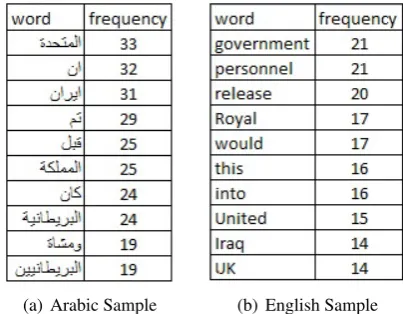
dataset we counted the word frequency for all the documents in a reference set (group of related cles), each set contains on average 10 related arti-cles. The single-document dataset was straightfor-ward, we calculated word frequencies for all the words in each document. Figure 1 shows a sam-ple of random words and their frequencies for both Arabic and English languages. The sample was se-lected from the MultiLing dataset word frequency lists. As shown in the figure we did not eliminate the stop-words, we treat them as normal words.
4.2 Standard Corpora
In our work we compared the word frequency list of the summarisation dataset against the larger Arabic and English standard corpora. For each of the standard corpora we had a list of word fre-quencies (up to5,000words) for both Arabic and English using the frequency dictionary of Ara-bic (Buckwalter and Parkinson, 2011) and the Cor-pus of Contemporary American English (COCA) top 5,000 words (Davies, 2010).
word frequency list, we used the top 5000 words from the 450 million word COCA corpus.
5 Summarisation Methodology
In our experiments we used generic single-document and multi-single-document extractive sum-marisers that have been implemented for both Arabic and English (using identical processing pipelines for both languages). Summaries were created by selecting sentences from a single doc-ument or set of related docdoc-uments. The following subsections show the methods used in our exper-iments, the actual summarisation process and the experimental setup.
5.1 Calculating Log-Likelihood
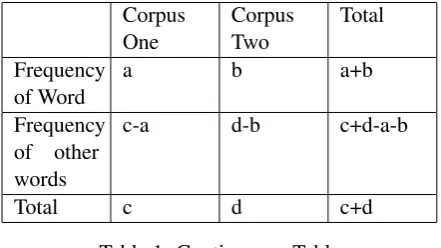
We begin the summarisation process by calculat-ing the log likelihood score for each word in the word frequency lists (see Section 4.1) using the same methodology described in (Rayson and Gar-side, 2000). This was performed by constructing a contingency table as in Table 1.
Corpus One
Corpus Two
Total
Frequency of Word
a b a+b
Frequency of other words
c-a d-b c+d-a-b
[image:5.595.71.292.374.498.2]Total c d c+d
Table 1: Contingency Table
The valuescanddcorrespond to the number of words in corpus one and corpus two respectively. Whereaand bare the observed values (O). For each corpus we calculated the expected value E using the following formula:
Ei=
NiP
i
Oi
P
i
Ni
Ni is the total frequency in corpusi (i in our
case takes the values1(c) and2(d) for the Multi-Ling Arabic Summaries dataset and the frequency dictionary of Arabic (or MultiLing English Sum-maries dataset and COCA corpus) respectively.
The log-likelihood can be calculated as follows:
LL= 2∗((a∗ln( a
E1)) + (b∗ln(
b E2)))
5.2 Summarisation Process
We used the same processing pipeline for both the single-document and multi-document summaris-ers. For each word in the MultiLing summari-sation dataset (Arabic and English) we calculated the log likelihood scores using the calculations de-scribed in Section 5.1. We summed up the log likelihood scores for each sentence in the dataset and we picked the sentences (up to 250 word limit) with the highest sum of log likelihood scores. The main difference between the single-document and multi-document summarisers is that we treat the set of related documents in the multiling dataset as one document.
6 Single-Document Summarisation Task
MultiLing 2013 this year introduced a new single-document summarisation pilot for 40 languages including (Arabic, Czech, English, French, Greek, Hebrew, Hindi, Spanish, Chinese, Romanian ...etc). In our case we participated in two lan-guages only, English and Arabic.
The pilot aim was to measure the ability of au-tomated systems to apply single document sum-marisation, in the context of Wikipedia texts. Given a single encyclopedic entry, with several sections/subsections, describing a specific subject, the pilot guidelines asked the participating sys-tems to provide a summary covering the main points of the entry (similarly to the lead section of a Wikipedia page). The MultiLing 2013 single-document summaries dataset consisted of (non-parallel) documents in the above mentioned lan-guages.
For the English language, there were 7 partici-pants (peers) including a baseline system (ID5). The Arabic language had 6 participants including the same baseline system.
7 Multi-Document Summarisation Task
The set of documents were available in 10 lan-guages (Arabic, Czech, English, French, Greek, Hebrew, Hindi, Spanish, Chinese and Romanian). In our case we participated using the Arabic and English set of documents only.
For the English language, there were 10 partic-ipants (peers) including a baseline (ID6) and a topline (ID61) systems. The Arabic language had 10 participants as well, including the same base-line and topbase-line systems.
The baseline summariser sorted sentences based on their cosine similarity to the centroid of a clus-ter. Then starts adding sentences to the summary, until it either reaches 250 words, or it hits the end of the document. In the second case, it continues with the next document in the sorted list.
The topline summariser used information from the model summaries (i.e. cheats). First, it split all source documents into sentences. Then it used a genetic algorithm to generate summaries that have a vector with maximal cosine similarity to the cen-troid vector of the model summary texts.
8 Results and Discussion
Our single-document summarisers, both English and Arabic, performed particularly well in the au-tomatic evaluation. Ranking first and second re-spectively.
Tables 2 and 3 illustrate the AutoSummEng (AutoSumm), MeMoG and NPowER results and the ranking of our English and Arabic single-document summarisers (SystemID2).
System AutoSumm MeMoG NPowER
ID2 0.136 0.136 1.685
ID41 0.129 0.129 1.661
ID42 0.127 0.127 1.656
ID3 0.127 0.127 1.654
ID1 0.124 0.124 1.647
ID4 0.123 0.123 1.641
ID5 0.040 0.040 1.367
Table 2: English Automatic Evaluation Scores (single-document)
The evaluation scores of our single-document summarisers confirm with (Li et al., 2006) and (Nenkova and Vanderwende, 2005) findings, were they found that word frequency is an important feature when determining sentences importance and that words with high frequency in the input
System AutoSumm MeMoG NPowER
ID3 0.092 0.092 1.538
ID2 0.087 0.087 1.524
ID41 0.055 0.055 1.418
ID42 0.055 0.055 1.416
ID4 0.053 0.053 1.411
[image:6.595.310.521.61.161.2]ID5 0.025 0.025 1.317
Table 3: Arabic Automatic Evaluation Scores (single-document)
System Score
ID6 3.711
ID3 3.578
ID2 3.578
ID4 3.489
ID1 3.467
ID11 3.333
ID21 3.111
ID51 2.778
ID5 2.711
[image:6.595.374.458.209.367.2]ID61 2.489
Table 4: Arabic Manual Evaluation Scores (multi-document)
documents are very likely to appear in the hu-man summaries, which explains the high correla-tion between our single-document and the human (model) summaries as illustrated in the evalua-tion scores (Tables 2 and 3). The single-document summaries were evaluated automatically only.
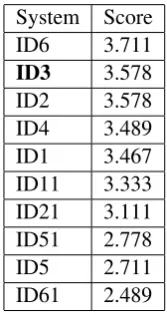
Our Arabic multi-document summariser per-formed well in the human evaluation ranking sec-ond jointly with System ID2. Table 4 shows the average scores of the human evaluation process, our system is referred to as ID3. On the other hand, we did not perform well in the automatic evaluation of the multi-document summarisation task for both English and Arabic. Our systems did not perform better than the baseline. The auto-matic evaluation results placed our Arabic and En-glish summariser further down in the ranked lists of systems compared to the human assessment. This is an area for future work as this seems to suggest that the automatic evaluation metrics are not necessarily in line with human judgements.
our summaries as selecting the sentences with the maximum sum of log likelihood score lead to many important sentences being overlooked. This can be solved by running the summariser on each document to suggest candidate sentences and then selecting the top sentence(s) of each document to generate the final summary. Second, we did not work on eliminating redundancies. Finally, the log-likelihood score might be improved by the in-clusion of a dispersion score or weighting to exam-ine the evenness of the spread of each word across all the documents.
9 Conclusion
In this paper we presented the results of our par-ticipation in the MultiLing 2013 summarisation task. We submitted results for single-document and multi-document summarisation in two lan-guages, English and Arabic. We applied a corpus-based summariser that used corpus-corpus-based word frequency lists. We used a list of the 5,000 most frequently used words in Modern Standard Ara-bic (MSA) and English. Using the frequency dic-tionary of Arabic and the corpus of contemporary American English (COCA).
Based on the automatic evaluation scores, we found that our approach appears to work very well for Arabic and English single-document summari-sation. According to the human evaluation scores the approach could potentially work for Arabic multi-document summarisation as well. We be-lieve that the approach could still work well for multi-document summarisation following the sug-gested solutions in Section 8.
References
R. Barzilay, N. Elhadad, and K. McKeown. 2001. Sen-tence Ordering in Multidocument Summarization. InProceedings of the First International Conference on Human Language Technology Research, HLT’01, pages 1–7, Stroudsburg, PA, USA. Association for Computational Linguistics.
P. Baxendale. 1958. Machine-made index for technical literature: an experiment. IBM Journal of Research and Development, 2(4):354–361.
R. Brandow, K. Mitze, and Lisa F. Rau. 1995. Automatic Condensation of Electronic Publications by Sentence Selection. Inf. Process. Manage., 31(5):675–685.
T. Buckwalter and D. Parkinson. 2011. A Frequency Dictionary of Arabic: Core Vocabulary for Learn-ers. Routledge, London, United Kingdom.
J. Conroy, J. Schlesinger, D. O’Leary, and J. Goldstein. 2006. Back to Basics: CLASSY 2006. In Pro-ceedings of the 6th Document Understanding Con-ferences. DUC.
M. Davies. 2010. The Corpus of Contemporary Amer-ican English as the First Reliable Monitor Corpus of English. Literary and Linguistic Computing, 25:447–464.
F. Douzidia and G. Lapalme. 2004. Lakhas, an Ara-bic Summarising System. InProceedings of the 4th Document Understanding Conferences, pages 128– 135. DUC.
M. Fiszman, D. Demner-Fushman, H. Kilicoglu, and T. Rindflesch. 2009. Automatic Summarization of MEDLINE Citations for Evidence-based Medical Treatment: A Topic-oriented Evaluation. Jouranl of Biomedical Informatics, 42(5):801–813.
G. Giannakopoulos and V. Karkaletsis. 2011. Au-toSummENG and MeMoG in Evaluating Guided Summaries. InThe Proceedings of the Text Analysis Conference, MD, USA. TAC.
G. Giannakopoulos and V. Karkaletsis. 2013. Sum-mary evaluation: Together we stand npower-ed. In Alexander Gelbukh, editor,Computational Linguis-tics and Intelligent Text Processing, volume 7817 of Lecture Notes in Computer Science, pages 436–450. Springer Berlin Heidelberg.
G. Giannakopoulos, V. Karkaletsis, G. Vouros, and P. Stamatopoulos. 2008. Summarization Sys-tem Evaluation Revisited: N–Gram Graphs. ACM Transactions on Speech and Language Processing (TSLP), 5(3):1–39.
G. Giannakopoulos, M. El-Haj, B. Favre, M. Litvak, J. Steinberger, and V. Varma. 2011. TAC 2011 Mul-tiLing Pilot Overview. InText Analysis Conference (TAC) 2011, MultiLing Summarisation Pilot, Mary-land, USA. TAC.
S. Granger. 1998. The computer learner corpus: A versatile new source of data for SLA research. pages 3–18.
L. Hennig. 2009. Topic-based multi-document sum-marization with probabilistic latent semantic analy-sis. InProceedings of the International Conference RANLP-2009, pages 144–149, Borovets, Bulgaria, September. Association for Computational Linguis-tics.
T. Hofmann. 1999. Probabilistic latent semantic in-dexing. In Proceedings of the 22nd annual inter-national ACM SIGIR conference on Research and development in information retrieval, SIGIR ’99, pages 50–57, New York, NY, USA. ACM.
on Innovative Applications of Artificial Intelligence, pages 703–710, Menlo Park, CA. AAAI Press.
W. Li, B. Li, and M. Wu. 2006. Query Focus Guided Sentence Selection Strategy.
C. Lin. 2004. ROUGE: A Package for Automatic Evaluation of Summaries. In Proceedings of the Workshop on Text Summarization Branches Out (WAS 2004), pages 25–26. WAS 2004).
H. Luhn. 1958. The Automatic Creation of Literature Abstracts. IBM Journal of Research and Develop-ment, 2(2):159–165.
N. Madnani, D. Zajic, B. Dorr, N. Ayan, and J. Lin. 2007. Multiple Alternative Sentence Compressions for Automatic Text Summarization. InProceedings of the 7th Document Understanding Conference at NLT/NAACL, page 26. DUC.
H. Morita, T. Sakai, and M. Okumura. 2011. Query Snowball: A Co-occurrence-based Approach to Multi-document Summarization for Question An-swering. InProceedings of the 49th Annual Meet-ing of the Association for Computational LMeet-inguis- Linguis-tics: Human Language Technologies: short papers - Volume 2, HLT’11, pages 223–229, Stroudsburg, PA, USA. Association for Computational Linguis-tics.
A. Nenkova and L. Vanderwende. 2005. The impact of frequency on summarization. Microsoft Research, Redmond, Washington, Tech. Rep. MSR-TR-2005-101.
D. Radev, H. Jing, M. Sty, and D. Tam. 2004. Centroid-based Summarization of Multiple Docu-ments. Information Processing and Management, 40:919–938.
P. Rayson and R. Garside. 2000. Comparing corpora using frequency profiling. In Proceedings of the workshop on Comparing corpora - Volume 9, WCC ’00, pages 1–6, Stroudsburg, PA, USA.
P. Rayson, D. Berridge, and B. Francis. 2004. Ex-tending the cochran rule for the comparison of word frequencies between corpora. InProceedings of the 7th International Conference on Statistical analysis of textual data (JADT 2004, pages 926–936.