Towards a Surface Realization-Oriented Corpus Annotation
Leo Wanner ICREA and
Universitat Pompeu Fabra Roc Boronat 138 Barcelona, 08018, Spain [email protected]
Simon Mille Universitat Pompeu Fabra
Roc Boronat 138 Barcelona, 08018, Spain [email protected]
Bernd Bohnet Universit¨at Stuttgart IMS, Pfaffenwaldring 5b Stuttgart, 70569, Germany
Abstract
Until recently, deep stochastic surface realiza-tion has been hindered by the lack of seman-tically annotated corpora. This is about to change. Such corpora are increasingly avail-able, e.g., in the context of CoNLL shared tasks. However, recent experiments with CoNLL 2009 corpora show that these popu-lar resources, which serve well for other ap-plications, may not do so for generation. The attempts to adapt them for generation resulted so far in a better performance of the realizers, but not yet in a genuinely semantic generation-oriented annotation schema. Our goal is to initiate a debate on how a generation suit-able annotation schema should be defined. We define some general principles of a semantic generation-oriented annotation and propose an annotation schema that is based on these prin-ciples. Experiments shows that making the semantic corpora comply with the suggested principles does not need to have a negative im-pact on the quality of the stochastic generators trained on them.
1 Introduction
With the increasing interest in data-driven surface realization, the question on the adequate annota-tion of corpora for generaannota-tion also becomes increas-ingly important. While in the early days of stochas-tic generation, annotations produced for other ap-plications were used (Knight and Hatzivassiloglou, 1995; Langkilde and Knight, 1998; Bangalore and Rambow, 2000; Oh and Rudnicky, 2000; Langkilde-Geary, 2002), the poor results obtained, e.g., by
(Bohnet et al., 2010) with the original CoNLL 2009 corpora, show that annotations that serve well for other applications, may not do so for generation and thus need at least to be adjusted.1 This has also been acknowledged in the run-up to the surface re-alization challenge 2011 (Belz et al., 2011), where a considerable amount of work has been invested into the conversion of the annotations of the CoNLL 2008 corpora (Surdeanu et al., 2008), i.e., PropBank (Palmer et al., 2005), which served as the reference treebank, into a more “generation friendly” annota-tion. However, all of the available annotations are to a certain extent still syntactic. Even PropBank and its generation-oriented variants contain a significant number of syntactic features (Bohnet et al., 2011b).
Some previous approaches to data-driven genera-tion avoid the problem related to the lack of seman-tic resources in that they use hybrid models that im-ply a symbolic submodule which derives the syntac-tic representation that is then used by the stochas-tic submodule (Knight and Hatzivassiloglou, 1995; Langkilde and Knight, 1998). (Walker et al., 2002), (Stent et al., 2004), (Wong and Mooney, 2007), and (Mairesse et al., 2010) start from deeper structures: Walker et al. and Stent et al. fromdeep-syntactic structures(Mel’ˇcuk, 1988), and Wong and Mooney and Mairesse et al. from higher order predicate logic structures. However, to the best of our knowledge,
1
Trained on the original ConLL 2009 corpora, (Bohnet et al., 2010)’s SVM-based generator reached a BLEU score of 0.12 for Chinese, 0.18 for English, 0.11 for German and 0.14 for Span-ish. Joining the unconnected parts of the sentence annotations to connected trees (as required by a stochastic realizer) improved the performance to a BLEU score of 0.69 for Chinese, 0.66 for English, 0.61 for German and 0.68 for Spanish.
none of them uses corpora annotated with the struc-tures from which they start.
To deep stochastic generation, the use of hybrid models is not an option and training a realizer on syntactically-biased annotations is highly problem-atic in the case of data-to-text NLG, which starts from numeric time series or conceptual or seman-tic structures: the syntacseman-tic features will be simply not available in the input structures at the moment of application.2. Therefore, it is crucial to define a theoretically sound semantic annotation that is still good in practical terms.
Our goal is thus to discuss some general prin-ciples of a semantic generation-oriented annotation schema and offer a first evaluation of its possible impact on stochastic generation. Section2 details what kind of information is available respectively not available during data-to-text generation. Sec-tion 3 states some general principles that constrain an adequate semantic representation, while Section 4 formally defines their well-formedness. Section 5 reports then on the experiments made with the pro-posed annotation, and Section6 offers some conclu-sions.
2 What can we and what we cannot count on?
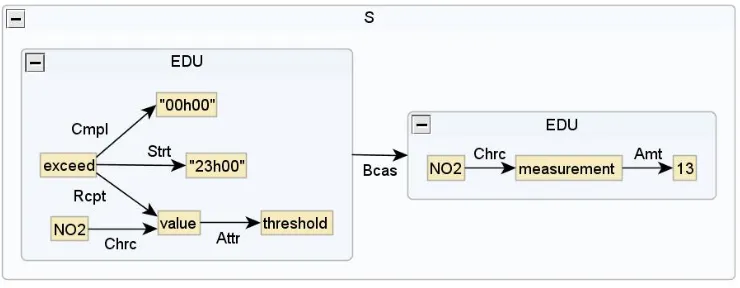
In data-to-text or ontology-to-text generation, with the standard content selection–discourse structur -ing—surface generation pipeline in place, and no hard-wired linguistic realization of the individual chunks of the data or ontology structure, the input to the surface realization module can only be an ab-stract structure that does not contain any syntactic (and even lexical) information. Conceptual graphs in the sense of Sowa (Sowa, 2000) are structures of this kind;3 see Figure 1 for illustration (‘Cmpl’ = ‘Completion’, ‘Rcpt’ = ‘Recipient’, ‘Strt’ = ‘Start’, ‘Attr’ = Attribute, ‘Chrc’ = ‘Characteristic’, and ‘Amt’ = ‘Amount’). Content selectionaccounts for the determination of the content units that are to be communicated andDiscourse Structuringfor the de-limitation of Elementary Discourse Units (EDUs)
2
Even though in this article we are particularly interested in data-to-text generation, we are convinced that clean semantic and syntactic annotations also facilitate text-to-text generation.
3But note that this can be any other content structure.
and their organization and for the discursive rela-tions between them (e.g.,Bcas(Because) in the Fig-ure).
In particular, such a structure cannot contain:
• non-meaningful nodes: governed prepositions (BECAUSE of, CONCENTRATION of), auxil-iaries (passivebe), determiners (a,the);
• syntactic connectors (betweenAandB), rela-tive pronouns, etc.
• syntactic structure information: A modifies B, A is the subject of B, etc.
In other words, a deep stochastic generator has to be able to produce all syntactic phenomena from generic structures that guarantee a certain flexibil-ity when it comes to their surface form (i.e., without encoding directly this type of syntactic information). For instance,a concentration of NO2can be realized asa NO2 concentration,between 23h00 and 00h00 as from 23h00 until 00h00, etc. This implies that deep annotations as, for instance, have been derived so far from PennTreeBank/PropBank, in which ei-ther all syntactic nodes of the annotation are kept (as in (Bohnet et al., 2010)) or only certain syntac-tic nodes are removed (as THAT complementizers and TO infinitives in the shared task 2011 on sur-face realization (Belz et al., 2011)) still fall short of a genuine semantic annotation. Both retain a lot of syntactic information which is not accessible in genuine data-to-text generation: nodes (relative pronouns, governed prepositions and conjunctions, determiners, auxiliaries, etc.) and edges (relative clause edges, control edges, modifier vs. argumen-tal edges, etc.).
This lets us raise the question how the annotation policies should look like to serve generation well and to what extent existing resources such as Prop-Bank comply with them already. We believe that the answer is critical for the future research agenda in generation and will certainly play an outstanding role in the shared tasks to come.
Figure 1: Sample conceptual structure as could be produced by text planning (Because of a concentration of NO2 of 13µg/m3, the NO2 threshold value was exceeded between 23h00 and 00h00)
scope, presupposition, etc.: this information is ob-viously necessary, but it is not absolutely vital for a sufficient restriction of the possible choices faced during surface generation. Further efforts will be re-quired to address its annotation in appropriate depth.
3 The principles of generation-suitable semantic annotation
Before talking about generation-suitable annotation, we must make some general assumptions concern-ing NLG as such. These assumptions are necessary (but might not always be sufficient) to cover deep generation in all its subtleties: (i) data-to-text gener-ation starts from an abstract conceptual or semantic representation of the content that is to be rendered into a well-formed sentence; (ii) data-to-text gener-ation is a series of equivalence mappings from more abstract to more concrete structures, with a chain of inflected words as the final structure; (iii) the equiva-lence between the source structureSsand the target
structure St is explicit and self-contained, i.e., for the mapping fromSs toSt, only features contained in Ss and St are used. The first assumption is in
the very nature of the generation task in general; the second and the third are owed to requirements of sta-tistical generation (although a number of rule-based generators show these characteristics as well).
The three basic assumptions give rise to the fol-lowing four principles.
1. Semanticity:The semantic annotation must
cap-ture the meaning and only the meaning of a given sentence. Functional nodes (auxiliaries, determin-ers, governed conjunctions and prepositions), node
duplicates and syntactically-motivated arcs should not appear in the semantic structure: they re-flect grammatical and lexical features, and thus al-ready anticipate how the meaning will be worded. For example,meet-AGENT→the(directors),meet -LOCATION→in (Spain), meet-TIME→in (2002) cited in (Buch-Kromann et al., 2011) as semantic annotation of the phrasemeeting between the direc-tors in Spain in 2002 in the Copenhagen Depen-dency Treebank does not meet this criterion: the, and both ins are functional nodes. Node dupli-cates such as the relative pronounthat in the Prop-Bank annotation (But Panama illustrates that their their substitute is a system) that←R-A0-produces (an absurd gridlock) equally reflect syntactic fea-tures, as do syntactically-motivated arc labels of the kind ‘R(elative)-A0’.
The PropBank annotation of the sentence cited above also intermingles predicate-argument rela-tions (‘Ai’) with syntactico-functional relarela-tions (‘AM-MNR’): gridlock−AM-MNR→absurd. The predicate-argument analysis of modifiers suggests namely that they are predicative semantemes that take as argument the node that governs them in the syntactic structure; in the above struc-ture: absurd−A1→gridlock. This applies also to locatives, temporals and other “circumstan-tials”, which are most conveniently represented as two-place semantemes: house←A1−location− A2→Barcelona, party←A1−time−A2→yes
2. Informativity:A propositional semantic annota-tion must be enriched byinformation structure fea-tures that predetermine the overall syntactic struc-ture (paratactic, hypotactic, parenthetical, . . . ), the internal syntactic structure (subject/object, clefted or not, any element fronted or not, etc.), determiner dis-tribution, etc. in the sentence. Otherwise, it will be always underspecified with respect to its syntactic equivalence in that, as a rule, a single semantic ture will correspond to a number of syntactic struc-tures. This is not to say that with the information structure in place we will always achieve a 1:1 cor-respondence between the semantic and syntactic an-notations; further criteria may be needed—including prosody, style, presupposedness, etc. However, in-formation structure is crucial.
The most relevant information structure features are those of Thematicity, Foregroundedness and Givenness.4
Thematicity specifies what the utterance states
(marked as rheme) and about what it states it (marked as theme).5 Theme/rheme determines, in the majority of cases, the subject-object structure and the topology of the sentence. For instance,6
[J ohn]theme←A1−[see−A2→M aria]rheme may
be said to correspond to J ohn←subject−see− dir.obj→M aria and [J ohn←A1−see]rheme−A2
→[M aria]theme to J ohn ←obj−seepass−subject
→M aria. For the generation of relative sentence structures such asJohn bought a car which was old and ugly, we need to accommodate for a recursive definition of thematicity:[J ohn]theme←A1−[buy−
A2→[c1 : car]theme←A1−[old]rheme; c1←A1
−[ugly]rheme]rheme.7 With no recursive (or
sec-ondary in Mel’ˇcuk’s terms) thematicity, we would
4
We use mainly the terminology and definitions (although in some places significantly simplified) of (Mel’ˇcuk, 2001), who, to the best of our knowledge, establishes the most detailed cor-relation between information structure and syntactic features.
5
Similar notions are topic/focus (Sgall et al., 1986) and topic/comment(Gundel, 1988).
6
As in PropBank, we use ‘Ai’ as argument labels of predica-tive lexemes, but for us, ‘A1’ stands for the first argument, ‘A2’ for the second argument, etc. That is, in contrast to PropBank, we do not support the use of ‘A0’ to refer to a lexeme’s exter-nal argument since the distinction between exterexter-nal and interexter-nal arguments is syntactic.
7
c1is a “handle” in the sense ofMinimal Recursion Seman-tics(Copestake et al., 1997).
getJohn bought an old and ugly car.8
It is quite easy to find some counter-examples to the default theme/rheme–syntactic feature cor-relation, in particular in the case of questions and answers. For instance, the neutral answer to the question What will John bake tomorrow?, John will bake a cake, would be split as follows:
[J ohn←A1−bake]theme −A2→[cake]rheme. In
this case, the main verb at the surface, bake, is in-cluded in the theme and not in the rheme. Consider also the sentenceIn a cross-border transaction, the buyer is in a different region of the globe from the target, where the main theme is in a cross-border transaction, i.e., not the subject of the sentence (with the subjectthe buyerbeing the embedded theme of the main rheme). In these cases, the correlation is more complex, but it undoubtedly exists and needs to be distilled during the training phase.
Foregroundedness captures the “prominence”
of the individual elements of the utterance for the speaker or hearer. An element is ‘fore-grounded’ if it is prominent and ‘back‘fore-grounded’ if it is of lesser prominence; elements that are neither foregrounded nor backgrounded are ‘neu-tral’. A number of correlations can be iden-tified: (i) a ‘foregrounded’ A1 argument of a verb will trigger a clefting construction; e.g.,
[J ohn]f oregr;theme←A1−[see−A2→M aria]rheme
will lead toIt was John who saw Maria; similarly,
[J ohn←A1−bake]f oregr;theme −A2→[cake]rheme
will lead to What John will bake is a cake; (ii) a ‘foregrounded’ A2 argument of a verb will corre-spond to a clefting construction or a dislocation: It was Maria, whom John saw; (iii) a ‘foregrounded’ A1 or A2 argument of a noun will result in an argu-ment promotion, as, e.g., John’s arrival(instead of arrival of John); (iv) a ‘foregrounded’ circumstan-tial will be fronted: Under this tree he used to rest; (v) marking a part of the semantic structure as ‘back-grounded’ will lead to a parenthetical construction: John (well known among the students and professors alike) was invited as guest speaker. If no elements
are marked as foregrounded/backgrounded, the de-fault syntactic structure and the dede-fault word order are realized.
Givennesscaptures to what extent an information
element is present to the hearer. The elementary givenness markers ‘given’ and ‘new’ correlate in syntax with determiner distribution. Thus, the ‘new’ marker of an object node will often correspond to an indefinite or zero determiner of the correspond-ing noun: A masked man was seen to enter the bank(manis newly introduced into the discourse). The ‘given’ marker will often correlate with a defi-nite determiner: The masked man(whom a passer-by noticed before) was seen to enter the bank. To distinguish between demonstratives and definite de-terminers, a gradation of givenness markers as sug-gested by Gundel et al. (Gundel et al., 1989) is nec-essary: ‘given1/2/3’.
As already for Thematicity, numerous examples can be found where the giveness-syntactic feature correlation deviates from the default correlation. For instance, inI have heard a cat, the cat of my neigh-bour, there would be only one single (given) node cat in the semantic structure, which does not pre-vent the first appearance ofcatin the sentence to be indefinite. InA warrant permits a holder that he ac-quire one share of common stock for$17.50 a share, warrantis given, even if it is marked by an indefinite determiner. Again, this only shows the complexity of the annotation of the information structure, but it does not call into question the relevance of the infor-mation structure to NLG.
As one of the few treebanks, the Prague Depen-dency Treebank (PDT) (Hajiˇc et al., 2006) accounts for aspects of the information structure in that it an-notatesTopic-Focus Articulationin terms of various degrees of contextual boundness, which are corre-lated with word order and intonation (Mikulov´a et al., 2006, p.152).
3. Connectivity: The semantic annotation must
ensure that the annotation of an utterance forms a connected structure: without a connected struc-ture, generation algorithms that imply a traver-sal of the input structure will fail to generate a grammatical sentence. For instance, the Prop-Bank annotation of the sentence But Panama il-lustrates that their substitute is a system that pro-duces an absurd gridlock (here shown partially)
does not comply with this principle since it con-sists of four unconnected meaning-bearing sub-structures (the single node ‘but’ and the subtrees governed by ‘illustrate’, ‘produce’ and ‘substi-tute’): but | Panama←A0−illustrate−A1→that | system←A0−produce−A1→gridlock− AM-MNR→absurd|substitute−A0→their.
4 Outline of a Generation-Oriented Annotation
The definitions below specify the syntactic well-formedness of the semantic annotation. They do not intend to and cannot substitute a detailed annotation manual, which is indispensable to achieve a seman-tically accurate annotation.
Definition 1: [Semantic Annotation of a sentence
S,SA]
SA of S in the text T in language L is a pair hSsem, Sinfi, whereSsem is the semantic structure
ofS (ensuring Semanticity and Connectivity), and
Sinf is the information structure ofS (ensuring
In-formativity).
Let us define each of the two structures of the se-mantic annotation in turn.
Definition 2: [Semantic Structure of a sentenceS,
Ssem]
Ssem of S is a labeled acyclic directed connected
graph (V, E, γ, λ) defined over the vertex label al-phabetL:=LS∪MC∪MT ∪Mt∪Ma(such that LS ∩(MC ∪MT ∪Mt∪Ma) = ∅) and the edge
label alphabetRsem ⊆ {A1, A2, A3, A4, A5, A6}, with
–V as the set of vertices; –Eas the set of directed edges;
–γ as the function that assigns eachv ∈ V an ele-mentl∈L;
–λas the function that assigns each e∈ E an ele-menta∈Rsem;
–LS as the meaning bearing lexical units (LUs) of S;
– MC ⊆ {LOC, TMP, EXT, MNR, CAU, DIR, SPEC, ELAB, ADDR}as the “circumstantial meta semantemes” (with the labels standing for ‘locative’, ‘temporal’, ‘temporal/spatial extension’, ‘manner’, ‘cause’, ‘direction’, ‘specification’, ‘elaboration’, and ‘addressee’);
‘time constituency’);
–Mt⊆ {past∗,present∗,future∗}as the “time value semantemes”;
– Ma ⊆ {imperfective∗, durative∗,
semelfactive∗, iterative∗, telic∗,atelic∗,
nil∗}as the “aspectual value semantemes”9
such that the following conditions hold:
(a)the edges inSsemare in accordance with the
va-lency structure of the lexical units (LUs) in S: If
lp−Ai→lr ∈ Ssem (lp, lr ∈ LS,i ∈ {1,2,3, . . .}), then the semantic valency oflp possesses at least i
slots andlrfulfils the semantic restrictions of the
i-th slot
(b) the edges in Ssem are exhaustive: If γ(nr) = lr ∈ Linstantiates inS the i-th semantic argument
ofγ(np) =lp, thenlp−Ai→lr ∈Ssem
(c)Ssem does not contain any duplicated argument edges: Ifγ(np)−Ai→γ(nr),γ(np)−Aj→γ(nq)∈ Ssem(withnp, nr, nq ∈N) then Ai6=Aj andnr6=
nq
(d)circumstantial LUs inS are represented inSsem
by two-place meta-semantemes: If lr ∈ Lsem is
a locative/temporal/ manner/cause/direction/specifi-cation/elaboration/addressee LU and in the syntac-tic dependency structure of S, lr modifies lp, then lr←A2-α-A1→lp ∈ Ssem (with α ∈ LOC, TMP, MNR, CAU, DIR, SPEC, ELAB, ADDR)
(e)verbal tense is captured by the two-place predi-cate TIME: Iflp ∈Lsemis a verbal LU thenlr← A2-TIME-A1→lp∈Ssem, withlr∈ Mt
(f)verbal aspect is captured by the two-place predi-cate TCST: Iflp ∈Lsemis a verbal LU thenlr←
A2-TCST-A1→lp ∈Ssem, withlr ∈ Ma.
(a) implies that no functional node is target of an ar-gument arc: this would contradict the semantic va-lency conditions of any lexeme inS. (b) ensures that no edge inSsemis missing: if a given LU is an
argu-ment of another LU in the sentence, then there is an edge from the governor LU to the argument LU. (c) means that no predicate inSsempossesses inS two different instances of the same argument slot. The circumstantial meta-semantemes in (d) either cap-ture the semantic role of a circumstantial that would otherwise get lost or introduce a predicate type for a name. Most of the circumstantial meta-semantemes
9
The aspectual feature names are mainly from (Comrie, 1976).
reflect PropBank’s modifier relations ‘AM-X’ (but in semantic, not in syntactico-functional terms), such that their names are taken from PropBank or are in-spired by PropBank. LOC takes as A1 a name of a location of its A2:Barcelona←A1-LOC-A2→live -A1→John; TMP a temporal expression: yesterday ←A1-TMP-A2→arrive-A1→John; MNR a man-ner attribute: player←A1-MNR-A2→solo; CAU the cause: accept←A1-CAU-A2→reason in This is the reason why they accepted it; DIR a spa-tial direction: run around←A2-DIR-A1→circlesin I’m running around in circles; SPEC a “context specifier”: should←A2-SPEC-A1→thought in You should leave now, just a thought; ELAB an appos-itive attribute company←A1-ELAB-A2 →bank in This company, a bank, closed; and ADDR direct ad-dress: come←A1-ADDR-A2→JohninJohn, come here!
Definition 3: [Information Structure of a sen-tenceS,Sinf]
Let Ssem of S be defined as above. Sinf of S is
an undirected labeled hypergraph(V, I) with V as the set of vertices ofS andI the set of hyperedges, withI := {themei (i = 1, 2, . . . ), rhemei(i = 1, 2,
. . . ), givenj (j = 1,. . . ,3), new, foregrounded,
back-grounded}. The following conditions apply:
(a) thematicity is recursive, i.e., a thematic hyper-edge contains under specific conditions embedded theme/rheme hyperedges: If∃nk∈themeisuch that γ(nk) = lp is a verbal lexeme and lp -A1→lr ∈ Ssem, then∃themei+1, rhemei+1∈themei
(b) theme and rheme hyperedges of the same re-cursion level, given and new hyperedges, and fore-grounded and backfore-grounded hyperedges are dis-joint: themei ∩rhemei = ∅ (i = 1, 2, . . . ), givenj
∩new=∅(j = 1,. . . ,3), foregr. ∩backgr.=∅
(c)any node in Ssem forms part of either theme or rheme:∀np ∈Ssem :np∈theme1∪rheme1.
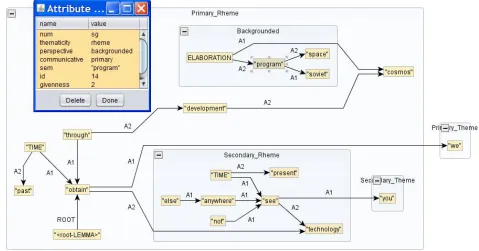
Consider in Figure 2 an example ofSA with its two structures.10 All syntactic nodes have been re-moved, and all the remaining nodes are connected in terms of a predicate–argument structure, with no use of any syntactically motivated edge, so as to en-sure that the structure complies with the Semantic-ity and ConnectivSemantic-ity principles. Figure 2 illustrates the three main aspects of Informativity: (i)
ity, with the two theme/rheme oppositions; (ii) fore-groundedness, with the backgrounded part of the primary rheme; and (iii) givenness, with the attribute givennessand the value2on the nodeprogram. The information structure constrains the superficial real-ization of the sentence in that the primary theme will be the subject of the sentence, and the main node of the primary rheme pointing to it will be the main verb of the same sentence. The secondary theme and rheme will be realized as an embedded sen-tence in whichyouwill be the subject, that is, forc-ing the realization of a relative clause. However, it does not constrain the appearance of a relative pro-noun. For instance: we obtained technologies you do not see anywhere elseandwe obtained technolo-gies that you do not see anywhere elseare possible realizations of this structure. Leaving the relative pronoun in the semantic structure would force one realization to occur when it does not have to (both outputs are equally correct and meaning-equivalent to the other). Similarly, marking the Soviet space program as backgrounded leaves some doors open when it comes to surface realization: Cosmos, the Soviet space programvs.Cosmos(the Soviet space program) vs. the Soviet space program Cosmos(if Cosmos is backgrounded too) are possible realiza-tions of this substructure.
ELABORATION is an example of a meta-node needed to connect the semantic structure: Cosmos andprogramhave a semantic relation, but neither is actually in the semantic frame of the other—which is why the introduction of an extra node cannot be avoided. In this case, we could have a nodeNAME, butELABORATIONis much more generic and can actually be automatically introduced without any ad-ditional information.
5 Experiments
Obviously, the removal of syntactic features from a given standard annotation, with the goal to ob-tain an increasingly more semantic annotation, can only be accepted if the quality of (deep) stochas-tic generation does not unacceptably decrease. To assess this aspect, we converted automatically the PropBank annotation of the WSJ journal as used in the CoNLL shared task 2009 into an annotation that complies with all of the principles sketched above
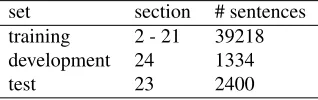
for deep statistical generation and trained (Bohnet et al., 2010)’s generator on this new annotation.11 For our experiments, we used the usual training, development and test data split of the WSJ cor-pus (Langkilde-Geary, 2002; Ringger et al., 2004; Bohnet et al., 2010); Table 1 provides an overview of the used data.
set section # sentences training 2 - 21 39218 development 24 1334
[image:7.612.348.507.159.209.2]test 23 2400
Table 1: Data split of the used data in the WSJ Corpus
The resulting BLEU score of our experiment was 0.64, which is comparable with the accuracy re-ported in (Bohnet et al., 2010) (namely, 0.659), who used an annotation that still contained all functional nodes (such that their generation task was consider-ably more syntactic and thus more straightforward). To assess furthermore whether the automatically converted PropBank already offers some advantages to other applications than generation, we used it in a semantic role labeling (SRL) experiment with (Bj¨o rkelund et al., 2010)’s parser. The achieved overall accuracy is 0.818, with all analysis stages (including the predicate identification stage) being automatic, which is a rather competitive figure. In the original CoNLL SRL setting with Oracle reading, an accu-racy of 0.856 is achieved.
Another telling comparison can be made between the outcomes of the First Surface Realization Shared Task (Belz et al., 2011), in which two different input representations were given to the competing teams: a shallow representation and a deep repre-sentation. The shallow structures were unordered syntactic dependency trees, with all the tokens of the sentence, and the deep structures were predicate-argument graphs with some nodes removed (see Section 2). Although the performance of shallow generators was higher than the performance of the deep generators (the StuMaBa shallow generator (Bohnet et al., 2011a) obtained a BLEU score of 0.89, as opposed to 0.79 of the StuMaBa deep
gen-11
Figure 2: Illustration of the semantic annotation of the sentenceThrough the development of Cosmos, the Soviet space program, we obtained technologies you do not see anywhere else.
erator), the difference is not as striking as one would expect.12
6 Conclusions
Our experiments and the Surface Realization Shared Task 2011 suggest that making the deep annotation more semantic does not necessarily imply an unsur-mountable problem for stochastic generation. We can thus conclude that deriving automatically a deep semantic annotation from PropBank allowed us to obtain very promising results, both for NLG and SRL. By sticking to universal predicate-argument structures, as PropBank does, we maintain the po-tential of the corpus to be mapped to other, more id-iosyncratic, annotations. Still, automatic conversion will always remain deficient. Thus, a flawless iden-tification of semantic predication cannot be guaran-teed. For instance, when an actancial arc points to a preposition, it is not clear how to deduce whether this preposition is semantic or lexical. Also, the treatment of phraseological nodes is problematic, as is the annotation of a comprehensive
informa-12Note that our results mentioned above cannot be directly compared with the StuMaBa results during the Generation Challenges 2011 because the realizers are different.
tion structure: the criteria for the automatic deriva-tion of the informaderiva-tion structure from the syntactic structure and the topology of a sentence can only be superficial and likely to be even less efficient in longer and complex sentences. The annotation of intersentential coreferences and the identification of gapped elements are further major hurdles for an au-tomatic derivation of a truly semantic resource. As a consequence, we believe that new annotation poli-cies are needed to obtain a high quality semantic re-source. The best strategy is to start with a conver-sion of an existing semantically annotated treebank such as PropBank, revising and extending the result of this conversion in a manual concerted action— always following truly semantic annotation policies.
Acknowledgments
annota-tion from another angle and revise some of our ini-tial assumptions.
References
S. Bangalore and O. Rambow. 2000. Exploiting a Proba-bilistic Hierarchical Model for Generation. InProc. of COLING ’00.
A. Belz, M. White, D. Espinosa, D. Hogan, and A. Stent. 2011. The First Surface Realization Shared Task: Overview and Evaluation Results. InENLG11. A. Bj¨orkelund, B. Bohnet, L. Hafdell, and P. Nugues.
2010. A high-performance syntactic and semantic de-pendency parser. In Proc. of COLING ’10: Demon-stration Volume.
B. Bohnet, L. Wanner, S. Mille, and A. Burga. 2010. Broad coverage multilingual deep sentence generation with a stochastic multi-level realizer. InProc. of COL-ING ’10.
B. Bohnet, S. Mille, B. Favre, and L. Wanner. 2011a.
<STUMABA>: From Deep Representation to Sur-face. InENLG11.
B. Bohnet, S. Mille, and L. Wanner. 2011b. Statisti-cal language generation from semantic structures. In
Proc. of International Conference on Dependency Lin-guistics.
M. Buch-Kromann, M. Gylling-Jørgensen, L. Jelbech-Knudsen, I. Korzen, and H. M¨uller. 2011. The inventory of linguistic relations used in the Copen-hagen Dependency Treebanks. www.cbs.dk/ con-tent/download/149771/1973272/file.
B. Comrie. 1976. Aspect. Cambridge University Press, Cambridge.
P. Cook and J. Payne. 2006. Information Structure and Scope in German. InLFG06.
A. Copestake, D. Flickinger, and I. Sag. 1997. Minimal recursion semantics. Technical report, CSLI, Stanford University, Stanford.
J. Gundel, N. Hedberg, and R. Zacharski. 1989. Give-ness, Implicature and Demonstrative Expressions in English Discourse. In CLS-25, Part II (Parasession on Language in Context), pages 89–103. Chicago Lin-guistics Society.
J.K. Gundel. 1988. “Universals of Topic-Comment Structure”. In M. Hammond, E. Moravˇcik, and J. Wirth, editors, Studies in Syntactic Typology. John Benjamins, Amsterdam & Philadelphia.
J. Hajiˇc, J. Panevov´a, E. Hajiˇcov´a, P. Sgall, P. Pa-jas, J. ˇStˇep´anek, J. Havelka, M. Mikulov´a, and Z. ˇZabokrtsk´y. 2006. Prague Dependency Treebank 2.0.
K. Knight and V. Hatzivassiloglou. 1995. Two-level, many paths generation. InProc. of ACL ’95.
I. Langkilde and K. Knight. 1998. Generation that ex-ploits corpus-based statistical knowledge. InProc. of COLING/ACL ’98.
I. Langkilde-Geary. 2002. An empirical verification of coverage and correctness for a general-purpose sen-tence generator. InProc. of 2nd INLG Conference. F. Mairesse, M Gaˇsi´c, F. Juriˇc´ıˇc, S Keizer, B. Thomson,
K. Yu, and S. Young. 2010. Phrase-based statistical language generation using graphical models and active learning. InProc. of ACL ’10.
I.A. Mel’ˇcuk. 1988. Dependency Syntax: Theory and Practice. SUNY Press, Albany.
I.A. Mel’ˇcuk. 2001. Communicative Organization in Natural Language (The Semantic-Communicative Structure of Sentences). Benjamins Academic Pub-lishers, Amsterdam.
M. Mikulov´a et al. 2006. Annotation on the tectogrammatical level in the Prague Dependency Treebank: Reference book. www.cbs.dk/content/download/149771/ 1973272/file. A.H. Oh and A.I. Rudnicky. 2000. Stochastic language
generation for spoken dialogue systems. In Proc. of ANL/NAACL Workshop on Conversational Systems. M. Palmer, D. Gildea, and P. Kingsbury. 2005. The
proposition bank: An annotated corpus of semantic roles.Computational Linguistics, 31(1):71–105. E. Ringger, M. Gamon, R.C. Moore, D. Rojas, M. Smets,
and S. Corston-Oliver. 2004. Linguistically informed statistical models of constituent structure for ordering in sentence realization. InProceedings of COLING, pages 673–679.
P. Sgall, E. Hajiˇcov´a, and J. Panevov´a. 1986. The Mean-ing of the Sentence in its Semantic and Pragmatic As-pects. Reidel Publishing Company, Dordrecht. J. F. Sowa. 2000. Knowledge Representation:
Logi-cal, PhilosophiLogi-cal, and Computational Foundations. Brooks Cole Publishing Co., Pacific Grove, CA, USA. A. Stent, R. Prasad, and M. Walker. 2004. Trainable sen-tence planning for complex information presentation in spoken dialog systems. InProc. of ACL ’04. Mihai Surdeanu, Richard Johansson, Adam Meyers,
Llu´ıs M`arquez, and Joakim Nivre. 2008. The CoNLL-2008 shared task on joint parsing of syntactic and semantic dependencies. In Proceedings of the 12th CoNLL-2008.
M.A. Walker, O.C. Rambow, and M. Rogati. 2002. Training a sentence planner for spoken dialogue using boosting. Computer Speech and Language, 16:409– 433.