Mixing in Some Knowledge: Enriched Context Patterns
for Bayesian Word Sense Induction
Rachel Chasin MIT CSAIL Cambridge, MA [email protected]
Anna Rumshisky
Department of Computer Science University of Massachusetts, Lowell, MA
Abstract
Bayesian topic models have recently been shown to perform well in word sense in-duction (WSI) tasks. Such models have al-most exclusively used bag-of-words features, and failed to attain improvement by includ-ing other feature types. In this paper, we investigate the impact of integrating syntac-tic and knowledge-based features and show that both parametric and non-parametric mod-els consistently benefit from additional fea-ture types. We perform evaluation on the Se-mEval2010 WSI verb data and show statisti-cally significant improvement in accuracy (p <0.001) both over the bag-of-words baselines and over the best system that competed in the SemEval2010 WSI task.
1 Introduction
The resolution of lexical ambiguity in language is essential to true language understanding. It has been shown to improve the performance of such ap-plications as statistical machine translation (Chan et al., 2007; Carpuat and Wu, 2007), and cross-language information retrieval and question answer-ing (Resnik, 2006). Word sense induction (WSI) is the task of automatically grouping the target word’s contexts of occurrence into clusters corresponding to different senses. Unlike word sense disambigua-tion (WSD), it does not rely on a pre-existing set of senses.
Much of the classic bottom-up WSI and thesaurus construction work – as well as many successful systems from the recent SemEval competitions –
have explicitly avoided the use of existing knowl-edge sources, instead representing the disambiguat-ing context usdisambiguat-ing bag-of-words (BOW) or syntac-tic features (Sch¨utze, 1998; Pantel and Lin, 2002; Dorow and Widdows, 2003; Pedersen, 2010; Kern et al., 2010).
This particularly concerns the attempts to in-tegrate the information about semantic classes of words present in the sense-selecting contexts. Se-mantic roles (such as those found in PropBank (Palmer et al., 2005) or FrameNet (Ruppenhofer et al., 2006)) tend to generalize poorly across the vo-cabulary. Lexical ontologies (and WordNet (Fell-baum, 2010) in particular) are not always empiri-cally grounded in language use and often do not rep-resent the relevant semantic distinctions. Very often, some parts of the ontology are better suited for a par-ticular disambiguation task than others. In this work, we assume that features based on such ontology seg-ments would correlate well with other context fea-tures.
be useful in disambiguating the verb ’deny’, unless our model can select the appropriate nodes of the subtree rooted at the synset ’message, content, sub-ject matter, substance’. Our model should also infer the associations between such nodes and other con-text relevant features that select the sense ’refuse to grant’ (such as the presence of ditransitive construc-tions, etc.)
In this paper, we use the topic modeling approach to identify ontology-derived features that can prove useful for sense induction. Bayesian approaches to sense induction have recently been shown to per-form well in the WSI task. In particular, Brody and Lapata (2009) have adapted the Latent Dirich-let Allocation (LDA) generative topic model to WSI by treating each occurrence context of an ambigu-ous word as a document, and the derived topics as sense-selecting context patterns represented as col-lections of features. They applied their model to the SemEval2007 set of ambiguous nouns, beating the best-performing system in its WSI task. Yao and Van Durme (2011) used a non-parametric Bayesian model, the Hierarchical Dirichlet Process (HDP), for the same task and showed that following the same basic assumptions, it performs comparably, with the advantage of avoiding the extra tuning for the num-ber of senses.
We investigate the question of how well such models would perform when some knowledge of syntactic structure and semantics is added into the system, in particular, when bag-of-words features are supplemented by the knowledge-enriched syn-tactic features. We use the SemEval2010 WSI task data for the verbs for evaluation (Manandhar et al., 2010). This data set choice is motivated by the fact that (1) for verbs, sense-selecting context patterns often most directly depend on the nouns that occur in syntactic dependencies with them, and (2) the nom-inal parts of WordNet tend to have much cleaner on-tological distinctions and property inheritance than, say, the verb synsets, where the subsumption hierar-chy is organized according how specific the verb’s manner of action is.
The choice of the SemEval2010 verb data set was motivated by the fact that SemEval2007 verb data is dominated by the most frequent sense for many target verbs, with 11 out of 65 verbs only having one sense in the combined test and training data.
All verbs in the SemEval2010 verb data set have at least two senses in the data provided. The im-plications of this work are two-fold: (1) we con-firm independently on a different data set that para-metric and non-parapara-metric models perform com-parably, and outperform the current state-of-the-art methods using the baseline bag-of-words feature set (2) we show that integrating populated syntactic and ontology-based features directly into the gen-erative model consistently leads to statistically sig-nificant improvement in accuracy. Our system out-performs both the bag-of-words baselines and the best-performing system in the SemEval2010 com-petition.
The remainder of the paper is organized as fol-lows. In Section 2, we review the relevant related work. Sections 3 and 4 give the details on how the models are defined and trained, and describe the in-corporated feature classes. Section 5 describes the data used to conduct the experiments. Finally, in Section 6, we describe the evaluation methods and present and discuss the experimental results.
2 Related Work
Over the past twenty years, a number of unsuper-vised methods for word sense induction have been developed, both for clustering contexts and for clus-tering word senses based on their distributional sim-ilarity (Hindle, 1990; Pereira et al., 1993; Sch¨utze, 1998; Grefenstette, 1994; Lin, 1998; Pantel and Lin, 2002; Dorow and Widdows, 2003; Agirre et al., 2006).
One of the recent evaluations of the state of the art in word sense induction was conducted at Se-mEval2010 (Manandhar et al., 2010). The partici-pant systems focused on a variety of WSI improve-ments including feature selection/dimensionality re-duction techniques (Pedersen, 2010), experiments with bigram and cooccurrence features (Pedersen, 2010) and syntactic features (Kern et al., 2010), and increased scalability (Jurgens and Stevens, 2010).
as-sumption that words within the same topic will share synset paths within WordNet, i.e. each topic will be associated with walks that prefer different “neigh-borhoods”of WordNet. One problem with their ap-proach is that it relies fully on the integrity of Word-Net’s organization, and has no way to disprefer cer-tain segments of WordNet, nor the ability to reorga-nize or redefine the senses it identifies for a given lexical item.
Brody and Lapata (2009) have proposed another adaptation of the LDA generative topic model to the WSI task. Text segments that contain instances of the target word are treated as documents in the clas-sical IR setup for the LDA. The target word’s senses are then similar to the hidden topics and are associ-ated with a probability distribution over context fea-tures.
LDA assumes that each instance has been pro-duced by a process that generates each of its con-text features by picking a sense of the target word from a known set of senses and then picking a fea-ture for the context based on a sense-specific under-lying probability distribution over context features. Importantly, the same prior distribution is assumed for all the features of an instance. However for many feature classes, for example, words vs. part-of-speech tags, this is false. Thus these algorithms do not immediately adapt well to being given fea-tures from many classes.
Brody and Lapata (2009) used part-of-speech and word n-grams as well as syntactic dependencies in addition to bag-of-words features, and used a multi-layer LDA model to handle the different classes sep-arately in different “layers”, bringing them together when necessary in a weighted combination. Their best model, however, showed very similar perfor-mance to the LDA model using only bag-of-words features. Yao and Van Durme (2011) reproduced some of their LDA experiments using HDP, a non-parametric model that induces the number of topics from data, over bag-of-words context representation.
3 Methods
We applied the LDA model (Brody and Lapata, 2009) and the the HDP model (Yao and Durme, 2011) over a set of features that included popu-lated syntactic dependencies as well as
knowledge-enriched syntactic features. Note that unlike the model proposed by Boyd et al (2007), which relies fully on the on the pexisting sense structure re-flected in WordNet, under this setup, we will only incorporate the relevant information from the ontol-ogy, while allowing the senses themselves to be de-rived empirically from the distributional context pat-terns. The assumption here is that if any semantic features prove relevant for a particular target word, i.e. if they correlate well with other features char-acterizing the word’s context patterns, they will be strongly associated with the corresponding topic.
In reality, the topics modeled by LDA and HDP may not correspond directly to senses, but may rep-resent some subsense or supersense. In fact, the in-duced topics are more likely to correspond to the sense-selecting patterns, rather than the senses per se, and quite frequently the same sense may be ex-pressed with multiple patterns. We describe how we deal with this in Section 6.1.
3.1 Model Description
The LDA model is more formally defined as fol-lows: Consider one target word with M instances andK senses, and let the context of instancej be described by some set ofNj features from a vocab-ulary of size V. These may be the words around the target or could be any properties of the instance. LDA assumes that there areM probability distribu-tionsθj = (θj1, θj2, . . . , θjK), withθjk =the prob-ability of generating sensekfor instance j, and K probability distributionsφk = (φk1, φk2, . . . , φkV), withφkf =the probability of generating featuref from sensek. This makes the probability of generat-ing the corpus where the features for instancejare fj1, fj2, . . . , fjNj:
P(corpus) = M Y
j=1 NJ
Y
i=1 K X
k=1
θjkφkfji
The goal of LDA for WSI is to obtain the distri-butionθj∗ for an instancej∗of interest, as this gives
each sense’s probability of being picked to generate some feature in the instance, which corresponds to the probability of being the correct sense for the tar-get word in this context.
sense distribution (corresponding to LDA’sθj) via a
Dirichlet Process whose base distribution is deter-mined via another Dirichlet Process, allowing for an unfixed number of senses because the draws from the resulting sense distribution are not limited to a preset range. The concentration parameters of both Dirichlet Processes are determined via hyperparam-eters.
3.2 Model Training LDA
Our process for training an LDA model uses Gibbs sampling to assign topics to each feature in each instance, utilizing GibbsLDA++ (Phan and Nguyen, 2007). Initially topics are assigned ran-domly and during each subsequent iteration, as-signments are made by sampling from the prob-ability distributions resulting from the last itera-tion. Following the previous work in applying topic-modeling to WSI, we use hyperparameters α = 0.02, β = 0.1(Brody and Lapata, 2009). We train the model using 2000 iterations of Gibbs sampling (GibbsLDA++ default). To obtainθfor an instance of interest, the inference mode initializes the train-ing corpus with the assignments from the model and initializes new test documents with random assign-ments. We then run 20 iterations of Gibbs sampling on this augmented corpus. 5 models are trained for each target using the same parameters and data. This is done to reduce the effect of randomization in the training algorithms on our results. Although the randomization is also present in the inference algo-rithms and we do not perform more than one infer-ence run per model.
HDP
The HDP training and inference procedures are similar to LDA, but using Gibbs sampling on topic and table assignment in a Chinese Restaurant Pro-cess. We use Chong Wang’s program for HDP (Wang and Blei, 2012) running the Gibbs sam-pling for 1000 iterations during training and an-other 1000 during inference (the defaults), and using the hyperparameters suggested in previous work (Yao and Durme, 2011) of H = 0.1, α0 ∼ Gamma(0.1,0.028), γ∼Gamma(1,0.1).
This software does not directly produce θvalues but instead produces all assignments of words to
top-ics. This output is used to compute
θjk =
count(words in document j labeled k) count(words in document j) .
Since new topics can appear during inference, we smooth these probabilities with additive smoothing using a parameter of 0.02 to avoid the case where all words are labeled with unseen topics, which would make prediction of a sense using our evaluation methods impossible.
4 Features
We used three types of features: bag-of-words with different window sizes, populated syntactic features, and ontology-populated syntactic features. Instead of using a multi-layered LDA model, we attempt to mitigate the effects of using multiple classes of fea-tures by choosing extra feafea-tures whose distributions are sufficiently similar to the bag-of-words features. We describe these classes in more detail below.
Preprocessing done on the data includes: (1) to-kenization, (2) identifying stopwords, (3) stemming tokens, (4) detecting sentence boundaries, (5) tag-ging tokens with their parts of speech, and (6) ob-taining collapsed dependencies within sentences in-cluding the target words. For tokenization, sen-tence boundary detection, and part-of-speech tag-ging, we use OpenNLP (OpenSource, 2010). We remove the stop words and stem using the Snow-ball stemmer. For collapsed syntactic dependencies we use the Stanford Dependency Parser (Klein and Manning, 2003).
Bag of Words Following previous literature (Brody and Lapata, 2009), we use a 20 word window (excluding stopwords) for BOW features. In our ex-periments, a smaller window size failed to produce better performance.
Ontology-Based Populated Syntactic Features
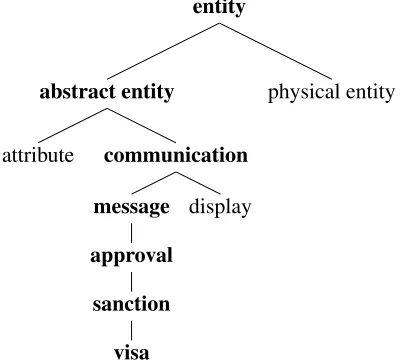
entity
abstract entity
attribute communication
message
approval
sanction
visa
display
[image:5.612.86.287.75.257.2]physical entity
Figure 1: WordNet hierarchy path for “actor”.
we visit. We use collapsed relations produced by the Stanford Dependency Parser (Klein and Manning, 2003).
For example, consider the path up the hierarchy for the word “visa”, given in Figure 1. If the noun “visa” is found in direct object position of the target verb, traversing the tree to the root would produce features such asnoun-approval dobj, etc.
5 Data
We evaluate our methods on the 50 verb targets from the SemEval2010 dataset. The evaluation data is split into 5 mapping/test set pairs, with 60% for mapping (2179 instances) and 40% for testing (1451 instances). Each split is created randomly and inde-pendently each time, and 3354 out of 3630 instances appear in a test set at least once.
We train our topic models on unlabeled data from SemEval2010, which contains a total of 162,862 instances for all verbs. The targets “happen” and “regain” have the most and fewest instances with 11,286 and 266 respectively. We use this data to train our topic models. We limit each target to 50,000 instances for training HDP models, in order to maintain reasonable processing time.
6 Results
We show the comparisons of our systems with (1) the most-frequent-sense (MFS) (MFS in the map-ping set predicted for all instances in the test set), (2)
BOW baseline models, and (3) the best-performing system from SemEval2010. Since HDP performs better overall, we chose the HDP model to exper-iment with syntactic and ontological features. For completeness, we include results for the WordNet-populated syntactic features with the LDA model.
6.1 Evaluation Measures
Following the established practice in SemEval com-petitions and subsequent work (Agirre and Soroa, 2007; Manandhar et al., 2010; Brody and Lapata, 2009; Yao and Durme, 2011), we conduct super-vised evaluation. A small amount of labeled data is used to map the induced topics to real-world senses; for a description of the method see (Agirre and Soroa, 2007). The resulting mapping is proba-bilistic; for topics1, . . . , Kand senses1, . . . , S, we compute theKSvalues
P(s|k) = count(instances predicted k, labeled s)
count(instances predicted k) .
Then givenθj∗, we can make a better prediction for
instancej∗ than just assigning the most likely sense to its most likely topic. Instead, we compute
argmaxSs=1 K X
k=1
θj∗kP(s|k),
the sense with the highest probability of being cor-rect for this instance, given the topic probabilities and theKSmapping probabilities.
The supervised metrics traditionally reported in-clude precision, recall, and F-score, but since our WSI system makes a prediction for every instance, we report accuracy throughout this section.
6.2 Cross-Validation
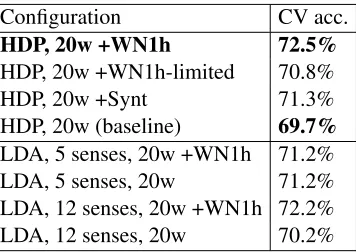
Configuration CV acc.
HDP, 20w +WN1h 72.5%
HDP, 20w +WN1h-limited 70.8% HDP, 20w +Synt 71.3% HDP, 20w (baseline) 69.7%
[image:6.612.76.254.70.196.2]LDA, 5 senses, 20w +WN1h 71.2% LDA, 5 senses, 20w 71.2% LDA, 12 senses, 20w +WN1h 72.2% LDA, 12 senses, 20w 70.2%
Table 1: Cross-validation accuracies using the Se-mEval2010 mapping sets.
evaluation data. Table 1 shows cross-validation re-sults for some of the relevant configurations on the SemEval2010 dataset.
Since the evaluation data has 5 different mapping sets, one for each 60/40 split, we do cross-validation on each and average the results. We perform this process for each of our 5 trained models and again average the results.
The best HDP configuration outperforms the LDA configurations with low numbers of top-ics. This configuration combines the 20 closest non-stopwords bag-of-words (20w) with WordNet-populated syntactic dependencies (+WN1h) and achieves 72.5% accuracy. We evaluate two other configurations using HDP as well: 20w +WN1h-limited, which is 20w +WN1h minus those fea-tures from WordNet within 5 hops of the hierar-chy’s root; and 20w +Synt, which is the 20 closest non-stopwords bag-of-words plus syntactic depen-dencies 1 hop away from the target word populated with the stemmed token appearing there. As shown in Table 1, WordNet-based populated features do in-troduce some gain with respect to the syntactic fea-tures populated only at the word level. Interestingly, removing the top-level WordNet-based features, and therefore making the possible restrictions on the se-mantics of the dependent nouns more specific, does not lead to performance improvement.
Each topic produced by the model is a distribution over all feature types, and is comprised by a mix of bag-of-words and ontology-populated syntactic fea-tures. Each node on the path from a given synset to the root generates its own ontological feature, so when many nodes that activate the same sense have a common hypernym, that hypernym is likely to “float
to the top” - become more strongly associated with the corresponding topic.
To illustrate this, consider the following two senses of the verb ‘cultivate’: “prepare the soil for crops” and “teach or refine”. Topic 1 generated by the HDP 20w +WN1h model corresponds to the first sense and is associated with examples about cultivat-ing land, earth, grassland, waste areas. Topic 5 gen-erated by the same model corresponds to the second sense and is associated with examples about cultivat-ing knowledge, understandcultivat-ing, habits, etc. One of the top-scoring features for Topic 1 islocation dobj
which corresponds to the direct object position being occupied by one of the ‘location’ synsets, with direct hyponym nodes for ‘region’ and ‘space’ contribut-ing the most. For topic 5,cognition dobjis selected as one of the top features, with direct hyponyms for ‘ability’, ‘process’, and ‘information’ contributing the most.
In this best configuration, HDP produces an aver-age of 18.6 topics, far more than the number of real-world senses. We investigated the possibility that its improvement over LDA might be due to this larger number of topics, testing the same feature combi-nation on LDA with 12 topics. This does produce a similar accuracy, 72.2%, and the simpler bag-of-words features with 12 topics yield an accuracy drop to 70.2%, similar to the drop seen between HDP 20w +WN1h and HDP 20w.
6.3 Evaluation Set Results
For the five SemEval2010 test sets, senses are as-signed slightly differently than in cross-validation. Instead of averaging over five models trained per tar-get, for each instance, we predict the sense assigned by the majority of these models.
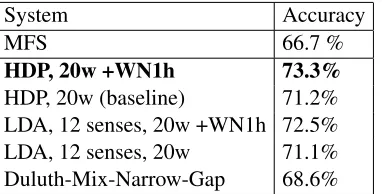
System Accuracy
MFS 66.7 %
HDP, 20w +WN1h 73.3%
[image:7.612.74.265.71.168.2]HDP, 20w (baseline) 71.2% LDA, 12 senses, 20w +WN1h 72.5% LDA, 12 senses, 20w 71.1% Duluth-Mix-Narrow-Gap 68.6%
Table 2: Test set accuracies, SemEval2010 verbs
The improvements obtained by the best configura-tion are statistically significant by paired two-tailed t-test, treating each of the 3354 distinct test instances as separate samples. We consider a system’s predic-tion on one such instance to be the sense it predicted in the majority of the test sets in which the instance appears. Significance levels are as follows:
• The best HDP configuration (20w +WN1h) vs. Duluth-Mix-Narrow-Gap:p <0.0001
• The best HDP configuration (20w +WN1h) vs. HDP 20w:p <0.001
• 12-sense LDA configuration 20w +WN1h vs. Duluth-Mix-Narrow-Gap:p <0.0001
• 12-sense LDA configuration 20w +WN1h vs. 12-sense LDA 20w:p <0.05.
7 Conclusion
We have presented a system that uses an adapta-tion of two Bayesian topic modeling algorithms to the task of word sense induction. Both the para-metric and the non-parapara-metric versions, when en-riched with WordNet-based populated syntactic fea-tures, outperform the baseline bag-of-words models as well as the current state of the art in the WSI task for verbs. The next step for this system is an im-proved integration of knowledge-based features that would not require assuming a similar distribution on different feature types.
References
Eneko Agirre and Aitor Soroa. 2007. Semeval-2007 task 02: Evaluating word sense induction and discrimina-tion systems. In Proceedings of the Fourth Interna-tional Workshop on Semantic Evaluations (SemEval-2007), pages 7–12.
Jordan Boyd-Graber, David Blei, and Xiaojin Zhu. 2007. A topic model for word sense disambiguation. In
Proceedings of the 2007 Joint Conference on Empir-ical Methods in Natural Language Processing and Computational Natural Language Learning (EMNLP-CoNLL), pages 1024–1033.
Samuel Brody and Mirella Lapata. 2009. Bayesian word sense induction. In Proceedings of the 12th Con-ference of the European Chapter of the Association for Computational Linguistics, EACL ’09, pages 103– 111, Stroudsburg, PA, USA. Association for Compu-tational Linguistics.
M. Carpuat and D. Wu. 2007. Improving statistical ma-chine translation using word sense disambiguation. In
Proc. of EMNLP-CoNLL, pages 61–72.
Y. S. Chan, H. T. Ng, and D. Chiang. 2007. Word sense disambiguation improves statistical machine transla-tion. In Proc. of ACL, pages 33–40, Prague, Czech Republic, June.
B. Dorow and D. Widdows. 2003. Discovering corpus-specific word-senses. InProceedings of the 10th Con-ference of the European Chapter of the Association for Computational Linguistics, pages Conference Com-panion pp. 79–82, Budapest, Hungary, April.
Christiane Fellbaum. 2010. Wordnet. Theory and Ap-plications of Ontology: Computer ApAp-plications, pages 231–243.
David Jurgens and Keith Stevens. 2010. Hermit: Flexi-ble clustering for the semeval-2 wsi task. In Proceed-ings of the 5th International Workshop on Semantic Evaluation, pages 359–362, Uppsala, Sweden, July. Association for Computational Linguistics.
Roman Kern, Markus Muhr, and Michael Granitzer. 2010. Kcdc: Word sense induction by using grammat-ical dependencies and sentence phrase structure. In
Proceedings of the 5th International Workshop on Se-mantic Evaluation, pages 351–354, Uppsala, Sweden, July. Association for Computational Linguistics. Dan Klein and Christopher D. Manning. 2003. Accurate
unlexicalized parsing. InProceedings of the 41st An-nual Meeting on Association for Computational Lin-guistics - Volume 1, ACL ’03, pages 423–430, Strouds-burg, PA, USA. Association for Computational Lin-guistics.
Suresh Manandhar, Ioannis Klapaftis, Dmitriy Dligach, and Sameer Pradhan. 2010. Semeval-2010 task 14: Word sense induction & disambiguation. In Proceed-ings of the 5th International Workshop on Semantic Evaluation(SemEval), pages 63–68, Uppsala, Sweden, July. Association for Computational Linguistics. George A. Miller, Richard Beckwith, Christiane
OpenSource. 2010. Opennlp: http :
//opennlp.sourcef orge.net/.
Martha Palmer, Daniel Gildea, and Paul Kingsbury. 2005. The proposition bank: An annotated corpus of semantic roles. Computational Linguistics, 31(1):71– 106.
P. Pantel and D. Lin. 2002. Discovering word senses from text. InProceedings of ACM SIGKDD02. Ted Pedersen. 2010. Duluth-wsi: Senseclusters applied
to the sense induction task of semeval-2. In Proceed-ings of the 5th International Workshop on Semantic Evaluation, pages 363–366, Uppsala, Sweden, July. Association for Computational Linguistics.
Xuan-Hieu Phan and Cam-Tu Nguyen. 2007. Gibb-slda++: A c/c++ implementation of latent dirichlet al-location (lda).
P. Resnik. 2006. Word sense disambiguation in NLP ap-plications. In E. Agirre and P. Edmonds, editors,Word Sense Disambiguation: Algorithms and Applications. Springer.
J. Ruppenhofer, M. Ellsworth, M. Petruck, C. Johnson, and J. Scheffczyk. 2006. FrameNet II: Extended The-ory and Practice.
H. Sch¨utze. 1998. Automatic word sense discrimination.
Computational Linguistics, 24(1):97–123.
Chong Wang and David M. Blei. 2012. A Split-Merge MCMC Algorithm for the Hierarchical Dirichlet Pro-cess, January.