Exploring MWEs for Knowledge Acquisition
from Corporate Technical Documents
Bell Manrique Losada
Carlos M. Zapata Jaramillo
Diego A. Burgos
Universidad de Medellín Universidad Nacional de Colombia Wake Forest University
Cra. 87 30-65 Belén Cra. 80 65-223 Robledo Greene Hall, P.O. Box 7566
Medellín, AQ, Colombia Medellín, AQ, Colombia Winston Salem, NC 27109, USA
[email protected] [email protected] [email protected]
Abstract
High frequency can convert a word sequence into a multiword expression (MWE), i.e., a collocation. In this paper, we use collocations as well as syntactically-flexible, lexicalized phrases to analyze ‘job specification ments’ (a kind of corporate technical docu-ment) for subsequent acquisition of automated knowledge elicitation. We propose the defini-tion of structural and funcdefini-tional patterns of specific corporate documents by analyzing the contexts and sections in which the expression occurs. Such patterns and its automated pro-cessing are the basis for identifying organiza-tional domain knowledge and business information which is used later for the first in-stances of requirement elicitation processes in software engineering.
1
Introduction
In software engineering, business knowledge and the needs of a system’s users are analyzed and specified by a process called requirement elicita-tion (RE). Tradielicita-tionally, RE has been carried out by human analysts through techniques such as interviews, observations, questionnaires, etc. The information obtained by the analyst is then con-verted to a controlled language used further stages of software implementation. These techniques, however, necessarily increase costs and imply a certain degree of subjectivity. Sometimes, as an alternative approach for RE, human analysts elicit requirement from documents instead of from cli-ents or users. The present work, proposes the use multiword expressions (MWEs) such as colloca-tions and syntactically-flexible, lexicalized phrases to detect relevant patterns in ‘job specification
documents’ (a kind of corporate technical docu-ment). The approach contributes to the task of generating controlled language used in subsequent automated knowledge representation.
MWEs are lexical items which can be decom-posed into multiple lexemes with lexical, syntactic, semantic, pragmatic, and/or statistical idiomaticity
(Baldwin et al., 2010). According to Bauer (1983),
MWEs can be broadly classified into lexicalized phrases and institutionalized phrases. Institutional-ized phrases, or collocations, basically require a high frequency of co-occurrence of their compo-nents. Lexicalized phrases (LP), on the other hand, may present other kind of idiomaticity, but not only statistical. Along with collocations, out of the set of lexicalized phrase types, we find syntactical-ly-flexible, lexicalized phrases and semi-fixed phrases of special interest for the present work.
Based on an experimental corpus, we identify when and how a MWE is used in order to identify patterns, infer organizational relationships, and generate corporate information and/or conceptual models for further requirement elicitation.
We propose context analysis—in which MWEs occur—would contribute by adding essential in-formation to the pattern definition. Such patterns are conceived from the structural and functional components inherent to corporate documents. This means that we classify MWEs according to the section in the document where they prevail. We expect the automated processing of such patterns helps in the identification and understanding of domain knowledge and business information from an organization.
The remainder of this paper is organized as fol-lows: in Section 2 we describe the conceptual
framework and background. Section 3 presents examples and analysis of the MWEs used for this study. Last, Section 4 draws conclusions and out-lines future work.
2
Conceptual Framework and
Back-ground
Two main lines converge on this study, namely requirements elicitation belonging to software engineering and linguistic description and parsing related to natural language processing.
Requirements elicitation (RE) is the initial pro-cess from requirement engineering in the software development process lifecycle. RE involves seek-ing, uncoverseek-ing, capturseek-ing, and elaborating re-quirements, based on activities of the business analysis initially performed. This process compris-es functional, behavioral, and quality properticompris-es of the software to be developed (Castro-Herrera et al., 2008). In order to accomplish RE, an analyst should increasingly and iteratively develop several actions involving natural language analysis and modeling (Li et al., 2003).
On the other hand, a user of a language has available a large number of pre-constructed phrases conforming single choices, even though they might appear to be analyzable into segments (Sinclair, 1991). Such phrases are known as lexical phrases (LPs) and may have a pragmatic function. According to Pérez (1999), the importance of LPs lies in their usage and domain, which constitute an integral part of the communicative competence. In the same line of thought, López-Mezquita (2007) categorizes LPs into polywords, institutionalized expressions, phrasal constraints, and sentence builders.
For this study, we use the classification of
MWEs proposed by Baldwin et al. (2010). This
and other classifications have been used in natural language processing techniques for text-mining and information extraction. They also have been applied to the analysis of many kinds of
docu-ments, e.g., technical documents, patents, and
software requirement documents.
Cascini et al. (2004) present a functional analy-sis of patents and their implementation in the PAT-Analyzer tool. They use techniques based on the extraction of the interactions between the entities described in the document and expressed as
sub-ject-action-object triples, by using a suitable syn-tactic parser.
Rösner et al. (1997) use techniques to
automat-ically generate multilingual documents from knowledge bases. The resulting documents can be represented in an interchangeable, reusable way. The authors describe several techniques for knowledge acquisition from documents by using particular knowledge structures from particular contexts. Breaux et al. (2006) describe the extrac-tion of rights and obligaextrac-tions from regulaextrac-tion texts restated into restricted natural language statements. In this approach, the authors identify normative phrases that define what stakeholders are permitted or required to do, and then extract rights and obli-gations by using normative phrases.
For knowledge acquisition, several authors have applied NLP techniques for handling MWEs.
Jackendoff (1997) and Aussenac-Gilles et al.
(2000) extract knowledge from existing documents and demonstrate its usage on the ontological engi-neering research domain.
Some other contributions are related to the ex-traction of multiword expressions from corpora, empirical work on lexical semantics in compara-tive fields, word sense disambiguation, and ontolo-gy learning (Bannard, 2005). In the intersection of NLP and requirement elicitation, Lee and Bryant (2002) use contextual techniques to overcome the ambiguity and express domain knowledge in the DARPA agent markup language (DAML). The resulting expression from the linguistic processing is a formal representation of the informal natural language requirements.
For processing technical and organizational documentation, Dinesh et al. (2007) propose the description of organizational procedures and the validation of their conformance to regulations, based on logical analysis. Lévy et al. (2010) pre-sent an environment that enables semantic annota-tions of document textual units (e.g., words, phrases, paragraphs, etc.) with ontological infor-mation (concepts, instances, roles, etc.). This ap-proach provides an ontology-driven interpretation of the document contents.
documents looking for pedagogical implications of its usage; and Henry and Roseberry (2001) observe English application letters.
In other lines of thought, we found language models accounting for documents oriented to audit linguistic expertise and analyze communicative and health texts (Fernández & García, 2009).
3
Exploration of MWEs in Corporate
Documents
3.1 Corpus and Analysis Tools
We collected and analyzed a set of documents from the corporate domain in different subject fields such as medicine, forestry, and laboratory. The corpus used as the basis for this preliminary study consists of 25 English-written documents with independence of its variety.
The documents selected are a small sample be-longing to the ‘Job Specification Document’ (JSD) category and were collected following representa-tiveness and ecological criteria, i.e., looking for the collection of documents produced, created, or promoted in the corporate or business environ-ment. All the documents were taken from different corporations and sum 31627 tokens and 3839 types.
The initial exploration of this experimental cor-pus was supported by AntConc 3.3.5w® (Anthony, 2009) and TermoStatWeb™ (Drouin, 2003). AntConc was used to manually and systematically find frequent expressions and select their contexts, and TermoStatWeb™ was used to list most fre-quent verbs, nouns, and adjectives which could become part of MWEs.
3.2 Identification of Relevant MWEs
Relevant MWEs are identified in the experimental corpus according to the flow chart shown in Figure 1. From each technical document belonging to the corpus, we carried out the task of LP extraction (institutionalized expressions or lexicalized expres-sions) and classification (analysis by categories).
[image:3.612.327.538.61.129.2]We classify the extracted expressions based on the document section where they prevail (see Table 1). Each section corresponds to a structural com-ponent of the JSD which also reflects the commu-nicative intention of the writer.
Figure 1. Flow chart for identifying MWEs
No. Description section
i Job purpose / objective
ii Main responsibilites / functions
iii Knowledge and skills
[image:3.612.339.513.160.252.2]iv Requirements
Table 1. Sections of JSD
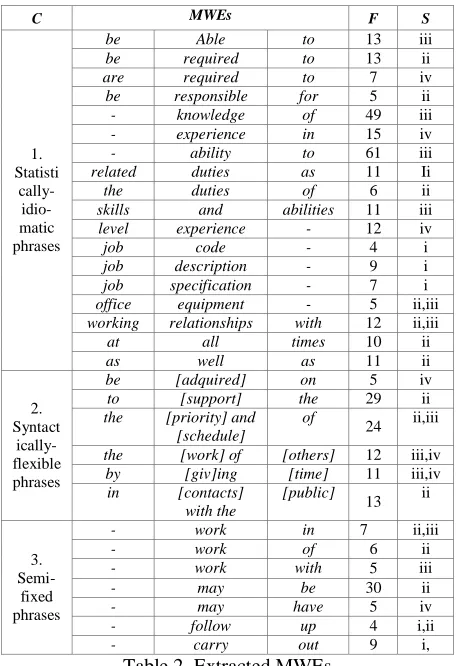
Table 2 shows the relevant MWEs identified, as follows: i) the selected expressions with the corre-sponding MWE category (C) according to the clas-sification proposed by Baldwin et al. (2010); ii) the frequency (F) of occurrence for each expression; and, iii) the section number (S) where the expres-sion prevails in the JSD (from the Table 1).
C MWEs F S
1. Statisti
cally- idio-matic phrases
be Able to 13 iii
be required to 13 ii
are required to 7 iv
be responsible for 5 ii
- knowledge of 49 iii
- experience in 15 iv
- ability to 61 iii
related duties as 11 Ii
the duties of 6 ii
skills and abilities 11 iii
level experience - 12 iv
job code - 4 i
job description - 9 i
job specification - 7 i
office equipment - 5 ii,iii
working relationships with 12 ii,iii
at all times 10 ii
as well as 11 ii
2. Syntact
ically-flexible phrases
be [adquired] on 5 iv
to [support] the 29 ii
[image:3.612.313.541.349.682.2]the [priority] and [schedule]
of
24 ii,iii
the [work] of [others] 12 iii,iv
by [giv]ing [time] 11 iii,iv
in [contacts]
with the
[public]
13 ii
3.
Semi-fixed phrases
- work in 7 ii,iii
- work of 6 ii
- work with 5 iii
- may be 30 ii
- may have 5 iv
- follow up 4 i,ii
- carry out 9 i,
Table 2. Extracted MWEs
LP extraction Classification
Institut. phrases
Lexicalized phrases
Doc_1
Doc_2
Doc_n
Analysis by categories
We use brackets for indicating semi-fixed phrases or variable uses of the expression (they can take values with the same conjugation). In this way, we identify and prioritize the most frequents MWEs and patterns in each category, as follows:
1. ability to, knowledge of, experience in, be able to, be required to
2. to-V-the, the-N-and-N-of, in-N-with-the-N 3. may be, carry out, work in, work of
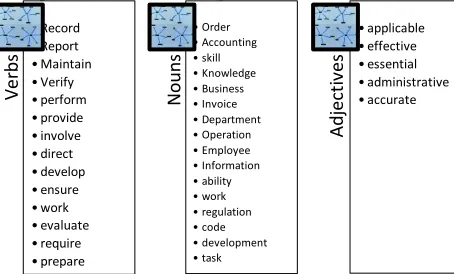
[image:4.612.76.303.265.402.2]Likewise, we also found useful identifying the most frequent lexical items that could become part of MWEs and alternate with the expressions and patterns presented above. For that purpose, Ter-moStatWeb was used to generate a map with the most frequent verbs, nouns, and adjectives. Some examples are shown in Figure 2.
Figure 2. Some frequent verbs, nouns, and adjectives.
The high frequency of these items in the corpus suggests that they could probably be part of MWEs conveying corporate information. Also, when placed in the slots of the patterns observed in Table 2, they increase their chance to become relevant MWEs useful to detect specific corporate knowledge.
The following paragraph is an example of how this can happen. The source text belongs to a JSD from our corpus and shows how two frequent items (evaluate and work) co-occur in a collocation. Then, identified corporate information is expected to be generated by other means into specific organ-izational information in a controlled language:
Source paragraph
…A City Manager plans, organizes, evaluates, and controls the work of all City departments to ensure that operations
and services comply with the policies…
Generated organizational information:
[City_manager plans work. City_manager organizes work. City_manager evaluates work City_manager controls work]
[City_department has work] [City_manager ensures
opera-tions] [City_department has operations] [City_department
has services] [operations comply policies]
In terms of organizational knowledge, an analyst can find information from JSDs about roles, re-sponsibilities, actions, and constraints, as an ap-proach for understanding an organizational domain. Such entities are expressed in a JSD as subject, actions, and object triples, as suggested by some instances in Table 2. This information can be represented either into models or controlled lan-guage discourses, among other specifications.
4
Conclusions
This study aims at characterizing JSDs by reveal-ing key MWEs used in an English corpus. We proposed a set of MWEs of a JSD, as a corporate technical document, which can be processed as input for further knowledge engineering processes. The appropriateness of JSDs in requirements elici-tation was verified with this study.
The analysis shows frequencies and patterns of relevant MWEs as well as their contexts and in-flectional forms extracted via a concordance tool. The performed analysis is a preliminary study for knowledge acquisition and understanding of organ-izational domains. Such knowledge is expected to be readily available to future applications in specif-ic domains in order to validate the findings and then to automate the process.
As future work, we expect to increase the num-ber of documents in the corpus and refine the study of lexical and textual features. Statistical associa-tion measures can be also considered as a way to reinforce MWEs and term identification and ex-traction in the frame of knowledge acquisition from corporate documents. Likewise, given the importance of the syntactic structure given by the triple subject-verb-object, dependency parsing seems to be a promising approach for the identifi-cation of roles and responsibilities in JSDs.
Acknowledgments
This work is funded by the Vicerrectoría de Investiga-ción from both the Universidad de Medellín and the Universidad Nacional de Colombia, under the project: “Método de transformación de lenguaje natural a len-guaje controlado para la obtención de requisitos, a partir de documentación técnica”.
V
er
b
s
• Record • Report • Maintain • Verify • perform • provide • involve • direct • develop • ensure • work • evaluate • require • prepare
N
o
u
n
s
• Order • Accounting • skill • Knowledge • Business • Invoice • Department • Operation • Employee • Information • ability • work • regulation • code • development • task
Ad
je
ct
iv
es
References
Anthony, L. 2009. Issues in the design and development of software tools for corpus studies: The case for col-laboration. Contemporary corpus linguistics, Lon-don: P. Baker Ed.: 87-104.
Aussenac-Gilles, N. Biébow, B. and Szulman, S. 2000. Revisiting Ontology Design: A Method Based on Corpus Analysis. Knowledge Engineering and Knowledge Management. Methods, Models, and Tools, 1937:27–66.
Baldwin, Timothy and Su Nam Kim (2010) Multiword Expressions, in Nitin Indurkhya and Fred J. Damerau (eds.) Handbook of Natural Language Processing, Second Ed., CRC Press, USA, pp. 267-292.
Bannard, C. 2005. Learning about the meaning of verb– particle constructions from corpora. Computer Speech & Language, 19(4): 467-478.
Bauer, L. 1983. English Word-Formation. London: Cambridge University Press, 311.
Breaux, T.D., Vail, M.W. and Antón, A.I. 2006. To-wards Regulatory Compliance: Extracting Rights and Obligations to Align Requirements with Regulations. North Carolina State University TR-2006-6.
Cascini, G. Fantechi, A. and Spinicci, E. 2004. Natural Language Processing of Patents and Technical Doc-umentation. Lecture Notes in Computer Science, 3163:508-520.
Castro-Herrera, C., Duan, C., Cleland-Huang, J. and Mobasher, B. Using data mining and recommender systems to facilitate large-scale, open, and inclusive requirements elicitation processes. Proceedings of 16th IEEE Inter. Requirements Eng. Conference, pp.165–168, 2008.
Dinesh, N. Joshi, A. Lee, I. and Sokolski, O. 2007. Logic-based regulatory conformance checking. In 14th Monterey Workshop, ScholarlyCommons Penn. Drouin, P. 2003. TermoStat Web 3.0. Désormais utilisa-ble qu'après enregistremen. Available in: http://olst.ling.umontreal.ca/~drouinp/termostat_web/ Fernández, L. and García, F.J. 2009. Texto y empresa. Applied Linguistics Now: Understanding Language and Mind, pp.655-665. Universidad de Almería, Es-paña.
Flowerdew, J. 1993. Concordancing as a Tool in Course Design. System, 21(2): 231-244.
Henry, A. and Roseberry, R.L. 2001. Using a Small Corpus to Obtain Data for Teaching a Genre. In Ghadessy/Henry/Roseberry: 93-133.
Jackendoff, R. 1997. The architecture of the language faculty. MIT Press, Cambridge, MA, USA.
Lam, P. Y. 2007. A Corpus-driven Léxico-grammatical Analysis of English Tourism Industry Texts and the Study of its Pedagogic Implications in ESP. In Hidal-go/Quereda/Santana: 71-90.
Lee, B. and Bryant, B. R. 2002. Contextual Natural Language Processing and DAML for Understanding
Software Requirements Specifications. In 19th Inter-national Conference on Computational Linguistics, Taipei, Taiwan.
Levy, F. Guisse, A. Nazarenko, A. Omrane, N. and Szulman, S. 2010. An Environment for the Joint Management of Written Policies and Business Rules. 22nd IEEE International Conference on Tools with Artificial Intelligence. IEEE Computer Society, 2:142-149.
Li, K., Dewar, R.G. and Pooley, R.J. Requirements capture in natural language problem statements. Her-iot-Watt University, 2003. Available in http://www.macs.hw.ac.uk:8080/techreps/docs/files/ HW-MACS-TR-0023.pdf
López-Mezquita, M.T. 2007. La evaluación de la com-petencia léxica: tests de vocabulario. Su fiabilidad y validez. Centro de Investigación y Documentación Educativa, 177(1): 488.
López Rodríguez, C. I., Faber, P., León- Araúz, P., Prieto, J. A. and Tercedor, M. 2010. La Terminolo-gía basada en marcos y su aplicación a las ciencias medioambientales: los proyectos MarcoCosta y Eco-sistema. Arena Romanistica, 7 (10): 52-74.
Peleg, M. Gutnik, L.A. Snow, V. and Patel, V.L. 2005. Interpreting procedures from descriptive guidelines. Journal of Biomedical Informatics, 39(1):184–195. Perez, C. 1999. La enseñanza del vocabulario desde
una perspectiva lingufstica y pedagogica. In S. Sala-berri (Ed.), Lingutstica Aplicada a las Lenguas Ex-tranjeras, Almería: Univ. de Almería: 262-307. Rösner, D., Grote, B., Hartmann, K. and Höfling. B.
1997. From Natural Language Documents to Shara-ble Product Knowledge: A Knowledge Engineering Approach. Journal of Universal Computer Science. 3(8): 955-987.
Sinclair, J. 1991. Corpus, concordance, colloca-tion. Oxford: Oxford University Press.