Verification of Quality Requirement Method Based on the
SQuaRE System Quality Model
Kazuhiro Esaki
Faculty of Science and Engineering, Hosei University, Tokyo, Japan Email: [email protected]
Received December 28, 2012; revised January 20, 2013, accepted January 25,2013
ABSTRACT
For a purpose of suitable system product development and acquisition successfully, it is extremely important to specify the quality requirement for target system during system design phase, and developing or selecting a most suitable prod- uct finally from among the alternative candidate products. However, the quality requirements analysis is a very difficult matter because it is non-formulaic and demands much of product customer’s technical perceptiveness. Traditionally, analysis of quality requirements of a product has been conducted through questionnaires or interviews with customers based on survey investigator’s personal experience. This kind of lack of structure and incompleteness in the traditional approach introduced missing requirements and errors in prioritizing requirements to implement in the requirement analysis of a product. On the other hand, we have been working on developing the techniques (SQuaRE) for quality requirements and evaluation for system and software product for a long time in ISO/IECJTC1/SC7WG 6. For the pur-pose of specify the quality requirement of system product, the method of quantitative quality requirement definitions based on ISO/IEC9126 [1] quality model that includes six characteristics is widely recognized. However, independ- ency among each quality characteristic is not sure and the suitability of method by using these six quality characteristics for quality requirement is not certified statistically. In this paper, we propose the concept of quality requirements defini- tion method based on the SQuaRE quality models define in ISO/IEC25030 [2,3]. Also, this paper proposes the result of verification about effectiveness of quantitative quality requirement definition approach from the view point of six qual- ity characteristics described in ISO/IEC9126.
Keywords: System; Software; Quality Requirement; Quality Evaluation; Quality Model; Quality in Use; Quality Characteristic; Quality Measure; Requirement Process; Evaluation Process; Customer Needs; Developers; Acquirers; Target Product
1. Introduction
In order to implement or acquiring information system successfully, it is very important to specify the quality requirement and realize the most suitable system product correspond to real customer needs in to the target system product during possible early stage of development.
If we take the wrong approach of quality requirement in accord with the real needs of the customer, it may cause a big loss for a purpose of investment. However, the quality requirements analysis is a very difficult mat- ter because it is non-formulaic and demands much of product customer’s technical perceptiveness, sense in balance and experiences. Traditionally, analysis of qual- ity requirements of a product has been conducted through questionnaires or interviews with customers.
If the result of requirements analysis reveals problems such as miss-predictions /miss-estimation of purpose conformance and/or importance and/or a failure in com- pleteness in the established target system product, cus-
tomers could not obtain the effectiveness equivalent of investments worth which they truly expect.
Generally, survey items on questionnaires were se- lected either from previous questionnaires of similar sys- tem or based on survey investigator’s personal experi- ence with and preference of product requirements. This kind of lack of structure and incompleteness in the tradi- tional approach introduced missing or biased product requirements and errors in prioritizing requirements to implement in the requirement analysis of a product, re- sulting in failing to assure the completeness of the quality requirement definition of a product.
committee, working group six).
As part of this project, we have also worked on the developments of ISO/IEC9126 and ISO/IEC14598 series, which are the standards to provide supporting technology for above-mentioned works, and also the developments of ISO/IEC25030 quality requirements standards, which was enacted lately for the first time in the world as the standards that assist requirements specifications based on the software and system quality model described in ISO/IEC9126. Currently, the method of quantitative quality requirement definitions based on ISO/IEC9126 quality model that includes six characteristics is widely recognized and used in worldwide for the purpose of specify the quality requirement and evaluation of sys- tem/software product. ISO/IEC9126 (This standard has revised to ISO/IEC25010:2011 [4]) defines the six qual- ity characteristics of the system and software. These six quality characteristics are described based on the model of Boehm [5] or McCall [6], or from the view point of a stakeholder’s wide experience, which are considered as necessary and independent from user’s point of view. This model introduced in ISO/IEC9126 was formulated with almost perfect quality target-establishment and eval- uation perspective of the system, which covers both structure and completeness based on the hypothesis of a company, even with specific quality target, being “a kind of system”. Through analyzing customer requirements based on these six quality characteristics, it becomes possible to perform complete and objective evaluation of customer quality requirements for a system/software product. Although a certain level of improvement is ex-pected in the completeness of describing product qual- ity objectives by using the ISO/IEC9126 quality model. However, independency among each six quality charac- teristic is not sure and the suitability of method by using these six quality characteristics for quality requirement is not certified statistically. Ambiguity and lack of verifica- tion of the ISO/IEC9126quality model make it impossi- ble to assure that quality objectives of a product are completely described to satisfy the customer quality re- quirements.
In recent years, an increasing number of consumers post their reviews on a web-site. This study focuses on negative review of system products posted by consumers, classifies and analyzes such negative reviews based on the six quality characteristics.
For example, an online negative review may relate to a serious concern that affects the operation of the laptop computer, or it may relate to a relatively minor concern that does not affect the operation of the system, but ex- presses personally preference. In other words, different online negative reviews carry different levels of impor- tance (i.e., different degrees of customer quality re- quirement). Therefore, the degree of customer dissatis-
faction may not be accurately obtained by simply classi- fying online negative reviews into the six quality charac- teristics. Above assumption, in this paper, we would like to introduce the concept of quality requirements defini- tion method based on the SQuaRE quality model de- scribed in ISO/IEC25030. And, this study verifies the validity of using the six quality characteristics described in ISO/IEC9126, and proposes the result of verification about effectiveness of quantitative quality requirement definition approach from the view point of six quality characteristics described in ISO/IEC9126.
Also, this study used the statistical analysis approach based on the previous study of software process im- provement [7].
1.1. Organization of SQuaRE Series
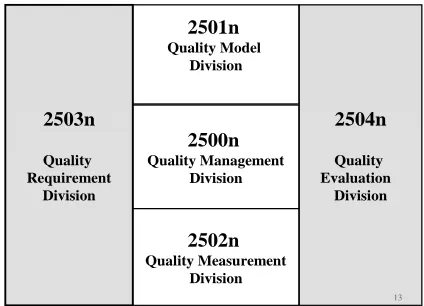
The purpose of the SQuaRE (ISO/IEC25000 [8,9]) series of standards is to assist developing and acquiring system products with the specification of quality requirements and evaluation. Figure 1 shows the organization of the ISO/IEC25000series of standards.
The SQuaRE includes five core divisions: quality re- quirements, and quality evaluation, quality management, quality model, quality measurement, as well as extension division. The SQuaRE set of standards supports two main processes i.e. software quality requirements speci- fication and software quality evaluation.
It also provides two main tools such as system/soft- ware product quality models and quantitative quality measures in order to support system quality requirements and evaluation processes.
[image:2.595.316.528.553.706.2]1.2. Concept of Quality Requirement and Evaluation
Figure 2 shows the concept of system/software product quality requirements and evaluations by using SQuaRE series.
13
2500n Quality Management
Division 2501n Quality Model
Division
2503n
Quality Requirement
Division
2504n
Quality Evaluation
Division
2502n Quality Measurement
Division
Figure 1. Organization of the SQuaRE series of interna-tional standards—ISO/IEC25000.
Customers have needs for quality requirement for sys- tems product development or acquisition. In order to perform development, at first, stakeholders should spec- ify a quality requirement from the view point of cus- tomer’s needs. After development, developer should evaluate the target system product based on the quality requirement specification in order to assure the devel- oped product quality. From Figure 2, ISO/IEC25030 provides the requirements and recommendations for de- fining quality requirements specification from selected and described customer’s needs. The specified quality requirements should be used as the criteria of system and software product evaluation.
2502n—Quality measurement division of SQuaRE series. ISO/IEC2502n provides the quality measure element and the quality measures, which intended to provide quality measures for product quality, quality in use and data quality. The quality measures described in ISO/ IEC2502n are useful for quantifying the quality require- ments.
[image:3.595.308.540.270.450.2]1.3. Concept of System Quality Models
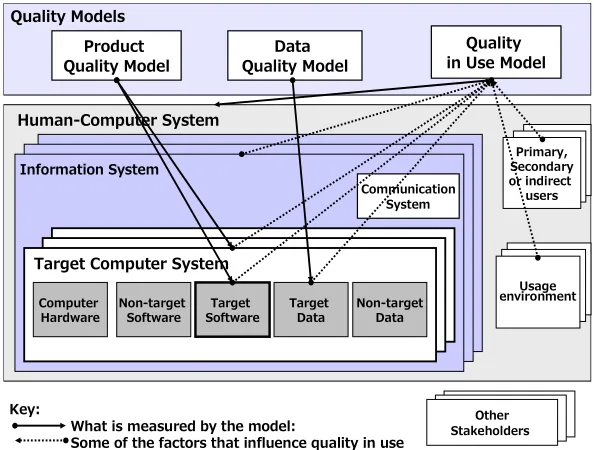
Figure 3 shows the target entities of the quality models and the related entities. The SQuaRE series provides quality in use model and systems and software products quality model described in ISO/IEC9126, as well as data quality model described in ISO/IEC25012 [13].
Quality requirements for system/software can be spe- cified using the process described in ISO/IEC25030 based on the system/software product quality model.
Constrains
Budget, Schedule, Environment System/software product quality model include six
quality characteristics described in ISO/IEC9126 (25010: 2011), and sub-characteristics described in ISO/IEC-
25020 [10]. Specification
of quality requirement From Figure 2, system quality evaluation can be per-
formed by using ISO/IEC25040 [11] and 25041 [12] based on the specified quality requirements, which are specified by using ISO/IEC25030 during system design phase. ISO/IEC25040 provides the standardized common evaluation process for systems products quality evalua- tion. ISO/IEC25041 provides the quality evaluation guides for developers, acquirers and independent evaluators from the view point of each stakeholder’s role and re- sponsibility by using common evaluation process de- scribed in ISO/IEC25040.
Quality requirement
ISO/IEC 25030
Quality evaluation
ISO/IEC 25040 25041
Quality evaluation
report
Stake-holders needs
Development
Target product Static Dynamic
Resources
ISO/IEC 9126 (25010), 25020, 2502n Currently, ISO/IEC JTC1/SC7/WG6 is developing in-
[image:3.595.149.446.494.719.2]ternational standards on quality measures as ISO/IEC
Figure 2. Conceptual model of quality requirement and eva- luation.
Human-Computer System Quality Models
Quality in Use Model Product
Quality Model Quality ModelData
Informati
Primary, Secondary or indirect users
Usage environment
Key:
What is meas
Some of the factors that influence quality in useured by the model: Information System
Communication System
Target Computer System
Computer
Hardware Non-target Software SoftwareTarget Target Data Non-targetData
Other Stakeholders
Any system, in general, composes hierarchical struc- ture. ISO/IEC25010 define the human-computer system as the highest level. It includes the information systems, which can include customers and other technical and physical environments, such as machines and buildings. The information system includes the target computer system and can also include one or more other computer systems and communication systems.
The system and software product quality model fo- cuses on the target computer system that includes the target software product. The target computer system also includes computer hardware, non-target software prod- ucts, non-target data, and target data.
The system and software product quality model de- fines six quality characteristics: functionality, usability, reliability, efficiency, portability and maintainability.
Each quality characteristic is composed of a set of re- lated sub-characteristics.
[image:4.595.159.437.512.718.2]1.4. ISO/IEC25030 Quality Requirement
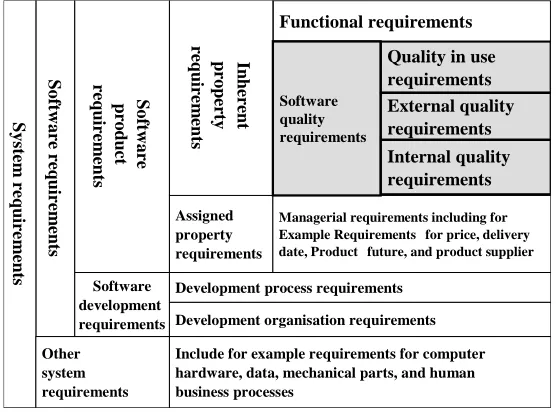
Figure 4 shows an example of categorization of sys- tem/software requirements based on the consideration of
Figure 3. Usually, customers’ needs for systems should be selected and transformed into both functional re- quirements and non-functional requirements.
Non-functional requirements could include quality re- quirements and other requirements such as hardware, data, and business requirements so on. ISO/IEC25030 mainly focuses on system product quality and applies to organizations in their role as both acquirers and develop- ers. However, it does not cover specification of other requirements.
As shown in Figure 4, software requirements include software product requirement and software development
process requirements. Software product requirements include inherent property requirement of software and assigned property requirements of software. Inherent property requirement of software include functional re- quirements and software quality requirements.
Functional requirements include the application do- main specific requirements as well as functional re- quirements that support quality requirements.
Software quality requirements include requirements for quality in use, external and internal quality. Assigned property requirements of software may include price and delivery date of software. Software development re- quirements may include requirements for artifacts, de- velopment processes, project, development organization, and developers.
1.5. Process of Quality Requirement
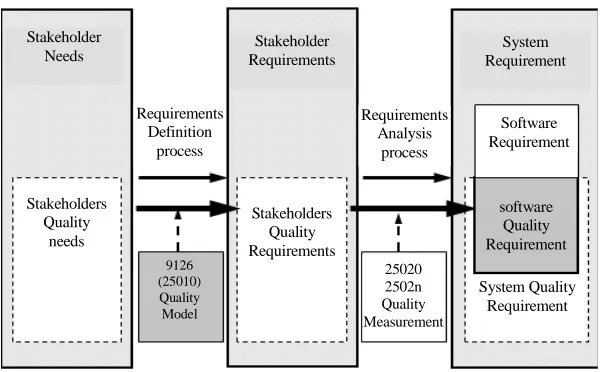
Figure 5 shows the system and software product quality requirement definition process and analysis process de- scribed in ISO/IEC25030.
Figure 5 shows how system/software quality require- ments are derived as part of the requirements processes described in ISO/IEC15288 [14].
The definition process focuses on stakeholder re- quirements to the system. The stakeholder quality re- quirement can be defined based on the system/software product quality model described in ISO/IEC9126(25010: 2011) and ISO/IEC25020. The analysis process assumes some architectural decisions, which makes it possible to identify requirements relevant for the software included in the system. The software quality requirement can be defined based on the system/software product quality measures described in ISO/IEC2502n.
10
S
o
ftw
are
prod
uct
requ
ire
m
ent
s
Software development requirements
Softw
are req
uire
m
en
ts
S
y
st
e
m
r
eq
ui
re
me
nt
s
Other system requirements
Assigned property requirements
Quality in use requirements External quality requirements Internal quality requirements
Development process requirements
Development organisation requirements
Functional requirements
In
here
nt
pr
op
er
ty
requ
ire
m
ent
s
Software quality requirements
Managerial requirements including for Example Requirements for price, delivery date, Product future, and product supplier
Include for example requirements for computer hardware, data, mechanical parts, and human business processes
Figure 4. System requirements categorisation—ISO/IEC 25030:2007.
1.6. System/Software Product Quality Model
uct
roduct to provide func- tio
software is used under specified conditions.
maintain a sp
ty of the software product to be under- st
of the software product to provide ap- pr
[image:5.595.148.448.328.514.2]e software product to be modified. M
Figure 6 shows the structure of system/software prod quality model described in ISO/IEC9126.
In defining the customer quality requirements of a sys- tem/software product, through identifying and clearly differentiating customer quality requirements of a prod- uct based on the product quality model and only through setting quality objectives of a product in the design phase, it becomes possible to assure the integrity and complete- ness in describing customer quality requirements of a product and to avoid incorrectly prioritizing or missing quality objectives of a product resulting in improvement in accuracy of describing customer quality requirements. Following is the definition of six quality characteristics such as Functionality, Reliability, Usability, Efficiency, Portability and Maintainability.
1) Functionality
the software p The capability of
ns which meet stated and implied needs when the
2) Reliability
of the software product to The capability
ecified level of performance when used under specified conditions.
3) Usability The capabili
ood, learned, used and attractive to the user, when used under specified conditions.
4) Efficiency The capability
opriate performance, relative to the amount of re- sources used, under stated conditions.
5) Maintainability The capability of th
odifications may include corrections, improvements or adaptation of the software to changes in environment, and in requirements and functional specifications.
6) Portability
Stakeholder Needs
Stakeholders Quality
needs
System Quality Requirement
software Quality Requirement 9126
(25010) Quality Model
System Requirement Stakeholder
Requirements
Requirements Definition
process
Requirements Analysis
process
Stakeholders Quality Requirements
25020 2502n Quality Measurement
Software Requirement
Figure 5. System/Software quality requirement definition analyses—ISO/IEC25030:2007.
external and internal
quality
functionality reliability
maturity fault tolerance recoverability
usability
understandability learnability operability attractiveness
efficiency
time behaviour resource utilisation
maintainability
analys change
stab testab
portability
ability ability ility
ility
adaptability installability co-existence replaceability
ability liance
portability compliance
suitability accuracy interoperability
security functionality compliance
reliability compliance
usability compliance
efficiency compliance
[image:5.595.112.485.544.715.2]maintain comp
The capability of the softwa
2. Verification of Quality Model
llects customer complaints, i.e., ex-
omer com- pl
sis of the de
ression an
velops a model that actually pr
2.2. Target Data
to the explosion of the Internet, pur-
f a product customers are satis-
face-to-face interviews of
haracteristics of the ISO/ IE
ntitatively requirements of
uters are
se ry
sh
concrete category of interest of la
aracteris- tic
re product to be trans- standing which aspects o ferred from one environment to another.
2.1. Summaries
This study first co
pression of customer dissatisfaction, posted on a review web-site where customers who actually purchased laptop computer related products post their reviews.
The study, then, classifies the posted cust
aints from the view point of the six quality characteris- tics described in the ISO/IEC9126 quality model, obtains from questionnaires a weight for each quality character- istic to represent how important the quality characteristic is to the customer, applies the weights to the six quality characteristics, and quantifies the degree of customer dissatisfaction for each quality characteristics.
The study, then, performs correlation analy
gree of customer satisfaction over the six quality char- acteristics for each system product and verifies that the six quality characteristics are mutual independent and that the approach of using the six quality characteristics helps understand the customer satisfaction.
In addition, the study performs multiple-reg alyses in which the degree of customer satisfaction for one of the six quality characteristics is chosen as an ob- jective variable and the degrees of customer satisfaction for the remaining five quality characteristics are chosen as an explanatory variable.
Furthermore, the study de
edicts the degree of customer satisfaction of a particu- lar quality characteristic from the remaining five quality characteristics. Finally, the study discusses the validity of ISO/IEC9126quality model based on the significance of the developed prediction model.
In recent years, due
chasing behaviors of customers have significantly changed. For example, an increasing number of custom- ers order a product directly from an electric commerce site without visiting brick-and-motor shops while re- maining at home. The quality of the service that the online distribution system provides may be evaluated by the degree of satisfaction of the customers who have ac- tually purchased products through the online distribution system. The degree of customer satisfaction is a measure used in marketing that represents how a product or ser- vice produced by a company meets or surpasses cus- tomer expectation. While questionnaires may help un- derstand the impression of customers who actually pur- chased and used the product or service (such as under-
fied with), face-to-face interviews with customers may enable understanding potential issues of the product or service in more concrete terms.
This study focuses on online reviews posted on the In- ternet, an effective alternative to
customers, and uses the online negative reviews of a system product as data to investigate. This study also focuses on laptop computers. Reasons for choosing lap- top computers are as follows.
First, laptop computers have characteristics that cor- respond to the six quality c
C9126product quality model.
Second, there is a large amount of data available on the non-functionality and non-qua
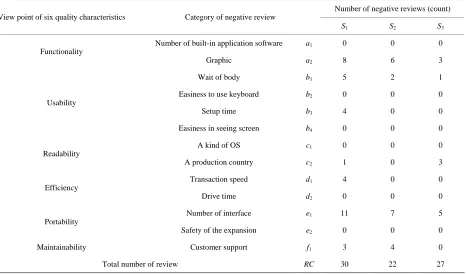
laptop computers on online review web-sites. Third, available data are relatively easy to collect. The reason for focusing on is that laptop comp miconductor products whose product life cycle is ve ort. Laptop computers released in different years might differ significantly in their quality; quality of a laptop computer released in a given year may improve signifi- cantly from that of a laptop release in the previously year. Then, this study only collects online negative reviews regarding the laptop computers that were released in 2011. This study collects and uses online reviews of products posted at a web-site, kakaku.com [15] as cus- tomer’s expression of his/her dissatisfaction of system products. Table 1 shows the part of collection data con- cerning negative review from web-site, which total num- ber of type of laptop computers is “35” and total number of review is about “457”.
From Table 1, this study counts the number of online negative reviews for each
ptop computers from the view point of the six quality characteristics. For instance, this study considers an online review of “slow operation, frustratingly slow” as customer’s expression of his/her dissatisfaction in the efficiency quality characteristic and counts it towards the number of online negative reviews for this quality char- acteristic. This study also considers an online review of “too heavy to carry, uneasiness to use Keyboard” as cus- tomer’s expression of dissatisfaction in the usability characteristic and counts it towards the number of online negative reviews for this quality characteristic.
This study collects and classifies online negative re- views from the view point of the six quality ch
s in this manner. The study excludes online negative reviews for products that received less than 4 online re- views in order to remove potential bias due to the small number of online reviews. Furthermore, for each prod- uct, this study obtains the degree of customer dissatis- faction for each of the six quality characteristics taking into account both the online negative reviews from the
Table 1. Example of negativ review from web-site.
Number of negative reviews (count)
e
View point of six quality characteristics Category of negative review
S1 S2 S3
Number of built-in application software a1 0 0 0
Functionality
W y Easin d Usability
Easiness in seeing screen
Readability
A pr try
Efficiency
Num ace Portability
S Maintainability
Total number of review
Graphic a2 8 6 3
ait of bod b1 5 2 1
ess to use keyboar b2 0 0 0
Setup time b3 4 0 0
b4 0 0 0
A kind of OS c1 0 0 0
oduction coun c2 1 0 3
Transaction speed d1 4 0 0
Drive time d2 0 0 0
ber of interf e1 11 7 5
afety of the expansion e2 0 0 0
Customer support f1 3 4 0
RC 30 22 27
Sn: Example of target laptop computers
computers
(n: Sample number).
eb-site and the interest of attribute of laptop w
(i.e., weight for) correspond to the six quality character- istic obtained from questionnaire. By applying the weight for each of the six quality characteristics, this study quantitatively calculates the degree of customer satisfac- tion for each characteristic. For example, the degree of customer satisfaction for the quality characteristic of ef- ficiency is quantitatively obtained as following Equations (1) and (2).
i i
d xp dd
RC
(1)
2 2
1 2
1
DD dd dd (2)
DD of efficiency
ncy by each ca
ber of negative review of efficiency by each ca
rtance of efficiency (weight);
a given product.
on
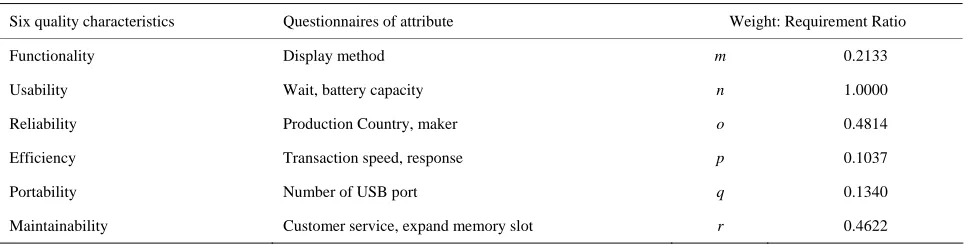
Table 2 shows the questionnaires and result of impor-
tance of quality requirement by each six quality charac-
n a numeric number be
e analysis as follows: views posted on
s “35” online reviews for d 4 or
m ber of
tant?” Using the result of the survey, this study qu
six quantity characteristics as shown in Table 2.
: Customer satisfaction ;
ddi: Ratio of un-satisfaction of efficie tegory;
di: Num tegory;
P: Impo
RC: Total number of online reviews of
Add your equation here where RC is the number of line reviews of a given product, and p is the weight for the quality characteristic of efficiency determined from the questionnaires as shown in Table 2. This study ob- tains the degree of customer dissatisfaction for the other five quality characteristics in a similar manner.
teristics obtain from questionnaires.
The questionnaires asked customers the question of “in purchasing a laptop computer, what attributes are impor- tant?” and have the customers assig
tween 1 and 6 based on the importance as shown in
Table 2. In addition, this study determines the weight for each of the six quality characteristics; the weight is 1 for the most important quality characteristic, and the weights for the other quality characteristics are normalized in the range of from 0 to 1.
2.3. Data Analysis Process
This study conducts th
[Step 1] Among the online re kakaku.com, this study identifie
the products that were released in 2011 and receive ore online reviews. This study counts the num online reviews in each of the six quality characteristics among the “35” identified online reviews as shown in
Table 1.
[Step 2] This study conducts questionnaires with 100 students and asks “in purchasing a laptop, what attributes are impor
Table 2. Importance of quality require nt by each six quality characteristics.
Six quality characteristics equirement Ratio
me
Questionnaires of attribute Weight: R
Functionality Display method m 0.2133 Usability Wait, battery capacity n 1.0000 Reliability Production Country, maker o 0.4814 Efficiency Transaction speed, response p 0.1037 Portability Number of USB port q 0.1340 Maintainability Customer service, expand memory slot r 0.4622
e level of importan
ustomer quality requirement) obtained in Step 2 is nor- m
in Step 1 is
in Step 4, th
dence between the six quality ch
stomer satisfaction for one of
s variance for each of the six quality characteristics, m
n Step 8, the re
ty characteristics. Th study also co e sig- nificance of the prediction model using F-Test in the
Table 3 shows the result of correlation analysis based on
of six charac-
t is small (at most 0.28 about po
alysis for the s that the maxi-
22 and 0.178, re- sp
shows the F values that indicate the signifi- ca
ibed in the previous sub clause 2.3.
than 5% si
[Step 3] Th ce (i.e., the degree of quali c
alized with the highest value to be 1 and with the other values between 0 and 1. The resulting normalized values of the level of importance are called “weights.”
[Step 4] The number of online negative reviews in each of the six quality characteristics obtained
multiplied by the weight for the quality characteristic obtained in Step 3. The degree of customer dissatisfac- tion is quantitatively obtained by Equation (1). The de- gree of customer satisfaction is obtained by subtracting the degree of customer dissatisfaction from 1.
[Step 5] In obtaining the degree of customer satisfac- tion for each of the six quality characteristics
is study considers two cases; one where the weight of each quality characteristic is considered, and the other where it is not. This study, then, performs correlation analysis between these two cases for each of the six quantity characteristics.
[Step 6] From the result in Step 5, this study examines correlation and indepen
aracteristics, as well as the additivity of the degree of customer satisfaction for each of the six quality charac- teristics as shown in Table 3.
[Step 7] The study performs multiple-regression anal- ysis in which the degree of cu
the six quality characteristics obtained in Step 4 is chosen as an objective variable and the degrees of cus- tomer satisfaction for the other five quality characteris- tics are used as explanatory variables as shown in Table 4.
[Step 8] Using the results from Step 7, this study anal- yze
ultiple-regression coefficients and determination coef- ficients, to verify a causal relationship between the ob- jective variable and explanatory variables.
[Step 9] Using the results from Step 8, the study de- velops a model that predicts the results i
sults of variance analysis of the six quality characteris- tics, and the degree of customer satisfaction for one of the six quality characteristics from the remaining five
multiple-regression analysis.
3. Analysis of Six Quality Characteristics
3.1. Correlation Analysis
e nfirms th
the Step 5 in clause 2.3.
correlation among each From Table 3, there is not a
customer satisfaction from the view point
teristics and independency of each are recognized. Since the correlation coefficien
rtability), there is no apparent correlation among the six quality characteristics. In other words, the degree of customer satisfaction for each of the six quality charac- teristics is independent of each other.
3.2. Multiple Regression Analysis
Table 4 shows the result of multiple-regression analysis based on the Step 7 in subclasses 2.3.
From Table 4, multiple-regression an other five quality characteristics show
mum value of the multiple-regression coefficients and the determination coefficients are 0.4
ectively.
Since these values are small, this study confirms that no causal relationship exists among the six quality char- acteristics.
Table 4
nce of the multiple-regression analyses for each of the six quality characteristics. These values are obtained in Step 8 descr
In addition, multiple-regression analysis of the cus- tomer satisfaction between a given quality characteristic and the other five quality characteristics show that the maximum value of F-test is 1.26. Since it is less
gnificance level F0 = 2.545, this study confirms that there is no significance in predicting the degree of cus- tomer satisfaction for one quality characteristic and that for any of the other five quality characteristics.
Table 3. Correlation matrix between six quality characteristics.
Functionality Usability Reliability Efficiency Portability Maintainability Functionality 1.0000 0.1924 –0.2180 0.0313 0.2811 0.1110 Usability 0.1924 1.0000 0.0297 0.1014 0.1406 –0.0940 Reliability –0.2180 0.0297 1.0000 –0.1763 0.0467 0.2076 Efficiency 0.0313 0.1014 –0.1763 1.0000 –0.2528 –0.0570 Portability 0.2811 0.1406 0.0467 –0.2528 1.0000 0.1046 Maintainability –0.1110 –0.0940 0.2076 –0.0570 0.1046 1.0000
Ta sult of multiple regression analysis.
Functionality Maintainability
ble 4. Re
Usability Reliability Efficiency Portability
Multiple regression ratio 0.4078 0.2788 0.3455 0.3374 0.4228 0.2694
R2 0.1663 0.0777 0.1187 0.1139 0.1787 0.0716
F value 1.1567 0.4889 0.7810 0.7452 1.2622 0.4537
*Multiple-regression analysis of the customer satisfaction between a given quality characteristic and the other five quality characteristics.
f the introduced method mer quality requirements
members of production sys-e School of Factory of
[1] ISO/IEC 9126, “Software Engineering—Software Quality
are Prod-
uct Quality R ation (SQuaRE)—
Quality Requ Organization for
, pp. 57-63.
zation, 2011.
1, 2012, pp. 43-50.
4. Concluding Remarks
REFERENCES
This study verifies the validity o of quantitatively obtaining custo
using the negative reviews of customer and using wei- ghts for the degree of customer requirements for each of the six quality characteristics included in the quality model described in ISO/IEC9126.
In the introduced method, the classified customer sat- isfaction is confirmed to be independent from each six quality characteristics and have no additivity.
Then, total quality assessment indicator of system could be calculated by accumulation of quantitative cus- tomer satisfaction, which be introduced from the view point of each six characteristics. And also, this study confirm the effectiveness of quality requirement specifi- cation method by using ISO/IEC25030 based on the viewpoint of six quality characteristics described in ISO/ IEC9126.
In the future work, the author plans to develop a model to quantitatively predict the degree of customer satisfac- tion from the attributes of system product based on the result of actual study should achieve.
5. Acknowledgements
The authors are grateful to tem research office of Graduat
Science and Engineering HOSEI University. The authors also express appreciations to editors of ISO/IEC 250 nn- SQuaRE series of international standard and SC7/WG6 members who contributed to develop the series.
Evaluation—Software Quality Evaluation,” International Organization for Standardization, 1992.
[2] ISO/IEC 25030, “Software Engineering—Softw equirements and Evalu
irement,” International Standardization, 2007.
[3] J. Boegh, “A New Standard for Quality Requirements,”
IEEE Computer Society, Vol. 25, No. 2, 2008
[4] ISO/IEC 25010, “Software Engineering—System and Soft- ware Quality Requirements and Evaluation (SQuaRE)— System and Software Quality Model,” International Or-ganization for Standardi
[5] B. W. Boehm, et al., “Quantitative Evaluation of Soft- ware Quality,” 2nd International Conference on Software Engineering, 1976, pp. 596-605.
[6] J. A. McCall, et al., “Factors in Software Quality,” RADC, TR-77369, 1977.
[7] K. Esaki1, Y. Ichinose and S. Yamada, “Statistical Analy- sis of Process Monitoring Data for Software Process Im- provement and Its Application,” American Journal of Operations Research, Vol. 2, No.
doi:10.4236/ajor.2012.21005
[8] ISO/IEC 25000, “Software Engineering—Software Prod-
od- d Evaluation (SQuaRE)— uct Quality Requirements and Evaluation (SQuaRE)— Guide to SQuaRE,” International Organization for Stan-dardization, 2005.
[9] ISO/IEC 25001, “Software Engineering—Software Pr uct Quality Requirements an
Planning and Management,” International Organization for Standardization, 2007.
[image:9.595.56.545.261.337.2]uct Quality Requirements and Evaluation(SQuaRE)—
and Evaluation (SQuaRE)—
(SQuaRE)—
l,” International Organization for
for Standardization, 2002. dard
Measurement Reference Model and Guide,” International Organization for Standardization, 2007.
[11] ISO/IEC 25040, “Software Engineering—System and Soft- ware Quality Requirements
Evaluation process,” International Organization for Stan-dardization, 2011.
[12] ISO/IEC 25041, “Software Engineering—System and Soft- ware Quality Requirements and Evaluation
Evaluation Guide for Developers, Acquirers and Inde- pendent Evaluators,” International Organization for Stan-
ization, 2012.
[13] ISO/IEC 25012, “Software Engineering—Software Prod- uct Quality Requirements and Evaluation (SQuaRE)— Data Quality Mode
dardization, 2006.
[14] ISO/IEC 15288, “Information Technology—Life Cycle Management—System Life Cycle Processes,” Interna- tional Organization
[15] http://www.kakaku.com