Effect of Language and Error Models on Efficiency of Finite-State
Spell-Checking and Correction
Tommi A Pirinen University of Helsinki Department of Modern Languages FI-00014 Univ. of Helsinki, PO box 24
Sam Hardwick University of Helsinki Department of Modern Languages FI-00014 Univ. of Helsinki, PO box 24
Abstract
We inspect the viability of finite-state spell-checking and contextless correction of non-word errors in three languages with a large de-gree of morphological variety. Overviewing previous work, we conduct large-scale tests involving three languages — English, Finnish and Greenlandic — and a variety of error mod-els and algorithms, including proposed im-provements of our own. Special reference is made to on-line three-way composition of the input, the error model and the language model. Tests are run on real-world text ac-quired from freely available sources. We show that the finite-state approaches discussed are sufficiently fast for high-quality correction, even for Greenlandic which, due to its mor-phological complexity, is a difficult task for non-finite-state approaches.
1 Introduction
In most implementations of spell-checking, effi-ciency is a limiting factor for selecting or discard-ing spell-checkdiscard-ing solutions. In the case of finite-state spell-checking it is known that finite-finite-state lan-guage models can efficiently encode dictionaries of natural languages (Beesley and Karttunen, 2003), even for polysynthetic languages. Most contem-porary spell-checking and correction systems are still based on programmatic solutions (e.g. hun-spell1, and its *spell relatives), or at most specialised
algorithms for implementing error-tolerant traver-sal of the finite-state dictionaries (Oflazer, 1996; Huld´en, 2009a). There have also been few fully
1http://hunspell.sf.net
finite-state implementations that both detect and cor-rect errors (Schulz and Mihov, 2002; Pirinen and Lind´en, 2010). In this paper we further evaluate the use of state dictionaries with two-tape finite-state automatons as a mechanism for correcting mis-spellings, and optimisations to the finite-state error models, intending to demonstrate that purely finite-state algorithms can be made sufficiently efficient.
To evaluate the general usability and efficiency of finite-state spell-checking we test a number of possible implementations of such a system with three languages of typologically different morpho-logical features2 andreference implementations for
contemporary spell-checking applications: English as a morphologically more isolating language with essentially a word-list approach to spell-checking; Finnish, whose computational complexity has been just beyond the edge of being too hard to implement nicely in eg. hunspell (Pitk¨anen, 2006); and Green-landic, a polysynthetic language which is imple-mented as a finite-state system using Xerox’s orig-inal finite-state morphology formalism (Beesley and Karttunen, 2003). As a general purpose finite-state library we use HFST3, which also contains our
spell-2We will not go into details regarding the morphological fea-tures of these languages. We thank the anonymous reviewer for guiding us to make a rough comparison using a piece of trans-lated text. We observe from the translations of theUniversal Declaration of Human Rights(with pre-amble included) as fol-lows: the number of word-like tokens for English is 1,746, for Finnish 1,275 and for Greenlandic 1,063. The count of the 15 most frequent tokens are for English 120—28, for Finnish 85— 10 and for Greenlandic 38—7.
The average word length is 5.0 characters for English, 7.8 for Finnish and 14.9 for Greenlandic. For the complexity of computational models refer to Table 2 in this article.
3http://hfst.sf.net
checking code.
As neither Finnish nor Greenlandic have been successfully implemented in the hunspell formal-ism, we mainly use them to evaluate how the com-plexity of a language model affects the efficiency of finite-state spell-checking. For a full-scale survey on the state-of-the-art non-finite-state spell-checking, refer to Mitton (2009).
The efficiency results are contrasted with the ex-isting research on finite-state spell-checking in Has-san et al. (2008) and the theoretical results on finite-state error-models in Mitankin (2005). Our contri-bution primarily comprises the addition of morpho-logically complex languages with actual cyclic dic-tionary automata (i.e. infinite dictionaries formed by compounding and recurring derivation) and more complex structure in general, compared to those of English and Arabic. Our goal is to demonstrate that finite-state spelling is tractable for these complex languages, to document their implications for per-formance and to present an algorithm for the task. We also point out that previous approaches have ne-glected to simultaneously constrain the error model and the dictionary with each other in on-line com-position, which affords a significant speed benefit compared to generating the two component compo-sitions.
The rest of the paper is organised as follows. In Section 2 we discuss the spell-checking task, current non-finite-state spell-checkers and previously used finite-state methods for spell-checking and correc-tion and propose some possible speed optimisacorrec-tions for the error models. We also investigate algorith-mic limitations of finite-state approaches and ways to remedy them. In Section 3 we present the lan-guage models, error models and the testing corpora. In Section 4 we present the comparisons of speed and quality with combinations of different language and error models and corpora for spell-checking. In Section 5 we summarise our findings and results, and outline future goals.
2 Methods
A finite-state spell-checker is typically (Pirinen and Lind´en, 2010) composed of at least two finite-state automata; one for the dictionary of the language, or thelanguage model, which contains valid strings of
the language, and one automaton to map misspelt words into correct strings, or theerror model. Both the language model and the error model are usu-ally (Pirinen and Lind´en, 2010) weighted finite-state automata, where the weights represent the prob-abilities are of a word being correctly spelled in the language model and of specific misspellings, respectively. We evaluate here the effect of both the language and error model automatons’ structure and complexity on the efficiency of the finite-state spelling task.4
2.1 Language Models
The most basic language model for a spell-checking dictionary is a list of correctly spelled word forms. One of the easiest ways of creating such a spell-checker is to collect the word forms from a reason-ably large corpus of (mostly) correctly spelt texts. Additionally we can count the frequency of words and use that as the likelihood,P(w) = P c(w)
w∈Dc(w) wherec(w)is the count of the wordwandDis the
set of corpus word forms. For morphologically more isolating languages such as English, this is often a sufficient approach (Norvig, 2010), and we use it to create a dictionary for our English spell-checker as well. As a non-finite-state reference point we use hunspell.
For agglutinative languages like Finnish, for which the word-list approach is likely to miss a much greater number of words, one of the most common approaches is to use right-linear gram-mars, possibly combined with finite-state rule lan-guages to implement morphophonological alter-ations (Koskenniemi, 1983). This approach also ap-plies to the newest available free / open source and full-fledged finite-state Finnish morphological dic-tionary we found (Pirinen, 2011). This language model features productive derivations, compound-ing and rudimentary probabilistic models. We take, as a reference non-finite state language model for Finnish, Voikko’s implementation in Malaga, which is currently used as a spell-checking component in open source software. It is implemented in a
left-associative grammar formalism, which is a po-tentially less efficient system with more expressive power. It’s similar to finite-state formulations in terms of linguistic coverage.
For polysynthetic languages it will be obvious that the coverage of any word-list-based approach will be even lower. Furthermore, most simple ex-tensions to it such as affix stripping (as in hun-spell) are not adequate for describing word forms. To our knowledge, the only approaches that have been widely used for spell-checking and morpho-logical analysis of Greenlandic have been based on traditional finite-state solutions, such as the Xe-rox formalisms. In our case we have obtained a freely available finite-state morphology imple-mentation from the Internet5. For further
de-tails we refer to the authors’ website http:// oqaaserpassualeriffik.org/.
2.2 Error Models
The ubiquitous formula for modeling typing er-rors since computer-assisted spelling correction be-gan has been the edit distance metric sometimes attributed to Levenshtein (1966) and/or Damerau (1964). It maps four typical slips of the fingers on a keyboard to events in the fuzzy matching of mis-spelt word forms to correct ones, that is, the deletion of a character (i.e. failing to press a key), addition of a character (i.e. hitting an extra key accidentally), changing a character (i.e. hitting the wrong key) and transposing adjacent characters (i.e. hitting two keys in the wrong order).
When modeling edit distance as a finite-state au-tomaton, a relatively simple two-tape automaton is sufficient to implement the algorithm (Hassan et al., 2008). The automaton will consist of one arc for each type of error, and additionally one state for each transposition pair. This means that the trivial nondetermistic finite-state automaton implementing the algorithm is of space complexityS(V, E,Σ) = O(|Σ|2|V|+|Σ|2|E|), where Σ is the alphabet of language,V is the set vertices in automaton andEis
the set of edges in automaton. This edit distance for-mulation is roughly feature equivalent to hunspell’s
TRYmechanism.
5https://victorio.uit.no/langtech/trunk/
st/kal
To further fine-tune this finite-state formulation of the edit distance algorithm, it is possible to at-tach a probability to each of the error events as a weight in a weighted finite-state automaton, corre-sponding to the likelihood of an error, or a con-fusion factor. This can be used to implement fea-tures like keyboard adjacency or an OCR confusion factor to the error correction model. This will not modify the structure of the finite-state error mod-els or the search space—which is why we did not test their effects in this article—, but introduction of non-homogenous weights to the resulting finite-state network may have an effect on search time. This ad-dition is equivalent to hunspell’sKEYmechanism.
For English language spelling correction there is also an additional type of error model to deal with competence-related misspellings—as opposed to models that mainly deal with mistypings— implemented in the form of phonemic folding and unfolding. This type of error is very specific to cer-tain types of English text and is not in the scope of this experiment. This is thePHONpart of the hun-spell’s correction mechanism.
After fine-tuning the error models to reimplement hunspell’s feature set, we propose variations of this edit distance scheme to optimise the speed of er-ror correction with little or no negative effect to the quality of the correction suggestions. The time re-quirement of the algorithm is determined by the size of the search space, i.e. the complexity of the result-ing network when the error model is applied to the misspelt string and intersected with the dictionary6.
To optimise the application of edit distance by limiting the search space, many traditional spell checkers will not attempt to correct the very first let-ter of the word form. We investigated whether this decision is a particularly effective way to limit the search space, but it does not appear to significantly differ from restricting edits at any other position in the input.
Dividing the states of a dictionary automaton into
classes corresponding to the minimum number of input symbols consumed by that state, we found that the average ambiguity in a particular class is somewhat higher for the first input symbols, but then stabilises quickly at a lower level. This was accomplished by performing the following state-categorisation procedure:
1. The start state is assigned to class 0, and all
other states are assigned to a candidate pool. 2. All states to which there is an (input) epsilon
transition from the start state are assigned to class0and removed from the candidate pool.
3. This is repeated for each state in class0 until no more states are added to class0. This
com-pletes class 0as the set of states in which the
automaton can be before consuming any input. 4. For each state in class0, states in the candidate
pool to which there is a non-epsilon transition are assigned to class 1 and removed from the candidate pool.
5. Class1is epsilon-completed as in (2-3).
6. After the completion of class n, class n+ 1
is constructed. This continues until the candi-date pool is empty, which will happen as long as there are no unreachable states.
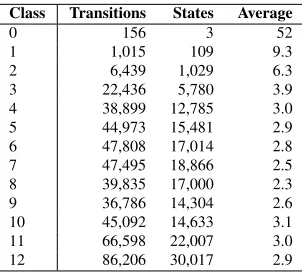
With this categorisation, we tallied the total num-ber of arcs from states in each class and divided the total by the number of states in the class. This is intended as an approximate measure of the ambigu-ity present at a particular point in the input. Some results are summarized in Table 1.
Class Transitions States Average
0 156 3 52
[image:4.612.110.261.493.629.2]1 1,015 109 9.3 2 6,439 1,029 6.3 3 22,436 5,780 3.9 4 38,899 12,785 3.0 5 44,973 15,481 2.9 6 47,808 17,014 2.8 7 47,495 18,866 2.5 8 39,835 17,000 2.3 9 36,786 14,304 2.6 10 45,092 14,633 3.1 11 66,598 22,007 3.0 12 86,206 30,017 2.9
Table 1: State classification by minimum input consumed for the Finnish dictionary
Further, the size of a dictionary automaton that is restricted to have a particular symbol in a particular
position does not apparently depend on the choice of position. This result was acquired by intersecting eg. the automatone.+with the dictionary to restrict the first position to have the symbole, the automa-ton.e.+to restrict the second position, and so on. The transducers acquired by this intersection vary in size of the language, number of states and number of transitions, but without any trend depending on the position of the restriction. This is in line with the rather obvious finding that the size of the restricted dictionary in terms of number of strings is similarily position-agnostic.
Presumably, the rationale is a belief that errors predominately occur at other positions in the input. As far as we know, the complete justification for this belief remains to be made with a high-quality, hand-checked error corpus.
On the error model side this optimisation has been justified by findings where between 1.5 % and 15 % of spelling errors happen in the first character of the word, depending on the text type (Bhagat, 2007); the 1.5 % from a small corpus of academic texts (Yan-nakoudakis and Fawthrop, 1983) and 15 % from dic-tated corpora (Kukich, 1992). We also performed a rudimentary classification of the errors in the small error corpus of 333 entries from Pirinen et al. (2012), and found errors at the first position in 1.2 % of the entries. Furthermore, we noticed that when evenly splitting the word forms in three parts, 15 % of the errors are in the first third of the word form, while second has 47 % and third 38 %, which would be in favor of discarding initial errors7.
A second form of optimisation that is used by many traditional spell-checking systems is to apply a lower order edit distance separately before trying higher order ones. This is based on the assumption that the vast majority of spelling errors will be of lower order. In the original account of edit distance for spell-checking, 80 % of the spelling errors were found to be correctable with distance 1 (Pollock and Zamora, 1984).
The third form of optimisation that we test is omitting redundant corrections in error models of higher order than one. Without such an
tion, higher order error models will permit adding and deleting the same character in succession at any position, which is obviously futile work for error correction. Performing the optimisation makes the error model larger but reduces the search space, and does not affect the quality of results.
2.3 Algorithms
The obvious baseline algorithm for the task of find-ing which strfind-ings can be altered by the error model in such a way that the alteration is present in the lan-guage model is generating all the possible alterations and checking which ones are present in the language model. This was done in Hassan et al. (2008) by first calculating the composition of the input string with the error model and then composing the result with the language model.
If we simplify the error model to one in which only substitutions occur, it can already be seen that this method is quite sensitive to input length and al-phabet size. The composition explores each combi-nation of edit sites in the input string. If any number of edits up todcan be made at positions in an input
string of lengthn, there are
d
X
i=1
n i
ways to choose the edit site, and each site is subject to a choice of|Σ|−1edits (the entire alphabet except
for the actual input). This expression has no closed form, but as d grows to n, the number of choices has the form2n, so the altogether complexity is
ex-ponential in input length and linear in alphabet size (quadratic if transpositions are considered).
In practice (whendis small relative ton) it is
use-ful to observe that an increase of1in distance results
in an additional term to the aforementioned sum, the ratio of which to the previously greatest term is
n!/(d!·(n−d!))
n!/((d−1)!·(n−d+ 1)!) =
n−d+ 1 d
indicating that whendis small, increases in it
pro-duce an exponential increase in complexity. For an English 26-letter lowercase alphabet, edit dis-tance2and the8-letter word “spelling”,700strings
are stored in a transducer. With transpositions, deletions, insertions and edit weights this grows to
100,215 different outputs. We have implemented
this algorithm for our results by generating the edited strings by lookup, and performing another lookup with the language model on these strings.
Plainly, it would be desirable to improve on this. The intuition behind our improvement is that when editing an input string, say “spellling”, it is a wasted effort to explore the remainder after generating a prefix that is not present in the lexicon. For example, after changing the first character to “z” and not edit-ing the second characted, we have the prefix “zp-”, which does not occur in our English lexicon. So the remaining possibilities - performing any edits on the remaining7-character word - can be ignored.
This is accomplished with a three-way composi-tion in which the input, the error model and the lan-guage model simultaneously constrain each other to produce the legal correction set. This algorithm is presented in some detail in Lind´en et al. (2012). A more advanced and general algorithm is due to Al-lauzen and Mohri (2009).
3 Material
For language models we have acquired suitable free-to-use dictionaries, readily obtainable on the Inter-net.
We made our own implementations of the al-gorithms to create and modify finite-state error models. Our source repository contains a Python script for generating error models and an extensive
Makefile for exercising it in various permuta-tions.
(al-most always) not correctable by standard error mod-els.
The Wikipedia corpora were sourced from
wikimedia.org. For exact references, see our previously mentioned repository. From the dumps we extracted the contents of the articles and picked the first 100,000 word tokens for evaluation.
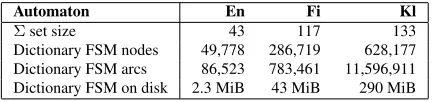
In Table 2 we summarize the sizes of automata in terms of structural elements. On the first row, we give the size of the alphabet needed to represent the entire dictionary. Next we give the sizes of automata as nodes and arcs of the finite-state automaton en-coding the dictionary. Finally we give the size of the automaton as serialised on the hard disk. While this is not the same amount of memory as its loaded data structures, it gives some indication of memory usage of the program while running the automaton in ques-tion. As can be clearly seen from the table, the mor-phologically less isolating languages do fairly con-sistently have larger automata in every sense.
Automaton En Fi Kl
Σset size 43 117 133
[image:6.612.318.536.53.189.2]Dictionary FSM nodes 49,778 286,719 628,177 Dictionary FSM arcs 86,523 783,461 11,596,911 Dictionary FSM on disk 2.3 MiB 43 MiB 290 MiB
Table 2: The sizes of dictionaries as automata
In Table 3 we give the same figures for the sizes of error models we’ve generated. TheΣsize row here
shows the number of symbols left when we have re-moved the symbols that are usually not considered to be a part of a spell-checking mechanism, such as all punctuation that does not occur word-internally and white-space characters8. Note that sizes of error
models can be directly computed from their parame-ters; i.e., the distance, theΣset size and the
optimi-sation, so this table is provided for reference only.
4 Evaluation
We ran various combinations of language and error models on the corpora described in section 3. We give tabular results of the speed of the system and the effect of the error model on recall. The latter
8The method described here does not handle run-on words or extraneous spaces, as they introduce lot of programmatic complexity which we believe is irrelevant to the results of this experiment.
Automaton En Fi Kl
Σset size 28 60 64
[image:6.612.78.294.340.391.2]Edit distance 1 nodes 652 3,308 3,784 Edit distance 1 arcs 2,081 10,209 11,657 Edit distance 2 nodes 1,303 6,615 7,567 Edit distance 2 arcs 4136 20,360 23,252 No firsts ed 1 nodes 652 3,308 3,784 No firsts ed 1 arcs 2,107 10,267 11,719 No firsts ed 2 nodes 1,303 6,615 7,567 No firsts ed 2 arcs 4,162 20,418 23,314 No redundancy and 1st ed 2 nodes 1,303 6,615 7,567 No redundancy and 1st ed 2 arcs 4,162 20,418 23,314 Lower order first ed 1 to 2 arcs 6,217 30,569 34,909 Lower order first ed 1 to 2 nodes 1,955 9,923 11,351
Table 3: The sizes of error models as automata
is to establish that simpler error models lead to de-graded recall—and not to more generally evaluate the present system as a spell-checker.
The evaluations in this section are performed on quad-core Intel Xeon E5450 running at 3 GHz with 64 GiB of RAM memory. The times are averaged over five test runs of 10,000 words in a stable server environment with no server processes or running graphical interfaces or other uses. The test results are measured using thegetrusageC function on a system that supports the maximum resident stack size ru maxrss and user time ru utimefields. The times are also verified with the GNU time
command. The results for hunspell, Voikkospell and foma processes are only measured with time
and top. The respective versions of the soft-ware are Voikkospell 3.3, hunspell 1.2.14, and Foma 0.9.16alpha. The reference systems are tested with default settings, meaning that they will only give some fixed number of suggestions whereas our sys-tem will calculate all strings within the given error model.
As a reference implementation for English we use hunspell’s en-US dictionary9 and for a finite-state
implementation we use a weighted word-list from Norvig (2010). As a Finnish reference implementa-tion we use Voikko10, with a LAG-based dictionary
using Malaga11. The reference correction task for
Greenlandic is done with foma’s (Huld´en, 2009b)
9http://wiki.services.openoffice.org/
wiki/Dictionaries
10http://voikko.sf.net
11http://home.arcor.de/bjoern-beutel/
apply medfunction with default settings12.
The baseline feature set and the efficiency of spell-checking we are targeting is defined by the cur-rently de facto standard spelling suite in open source systems, hunspell.
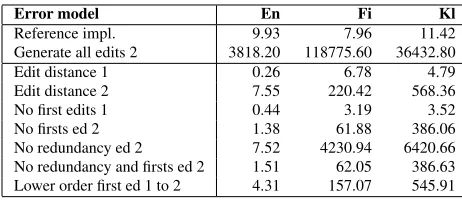
In Table 4 we measure the speed of the spell-checking process on native language Wikipedia text with real-world spelling errors and unknown strings. The error model rows are defined as fol-lows: on theReference impl. row, we test the spell-checking speed of the hunspell tool for English, and Voikkospell tool for Finnish. On theedit distance 2
row we use the basic traditional edit distance 2 with-out any modifications. On theNo first editsrow we use the error model that does not modify the first character of the word. On theNo redundancy row we use the edit distance 2 error model with the re-dundant edit combinations removed. On theNo re-dundancy and firsts rows we use the combined er-ror model ofNo first editsandNo redundancy func-tionalities. On the rowLower order firstwe apply a lower order edit distance model first, then if no re-sults are found, a higher order model is used. In the tables and formulae we routinely use the language codes to denote the languages: enfor English,fifor Finnish andklfor Greenlandic (Kalaallisut).
Error model En Fi Kl
Reference impl. 9.93 7.96 11.42 Generate all edits 2 3818.20 118775.60 36432.80 Edit distance 1 0.26 6.78 4.79 Edit distance 2 7.55 220.42 568.36 No first edits 1 0.44 3.19 3.52 No firsts ed 2 1.38 61.88 386.06 No redundancy ed 2 7.52 4230.94 6420.66 No redundancy and firsts ed 2 1.51 62.05 386.63 Lower order first ed 1 to 2 4.31 157.07 545.91
Table 4: Effect of language and error models to speed (time in seconds per 10,000 word forms)
The results show that not editing the first posi-tion does indeed give significant boost to the speed, regardless of language model, which is of course caused by the significant reduction in search space. However, the redundancy avoidance does not seem to make a significant difference. This is most likely because the amount of duplicate paths in the search space is not so proportionally large and their traver-sal will be relatively fast. The separate application
12http://code.google.com/p/Foma/
of error models gives the expected timing result be-tween its relevant primary and secondary error mod-els. It should be noteworthy that, when thinking of real world applications, the speed of the most of the models described here is greater than 1 word per sec-ond (i.e. 10,000 secsec-onds per 10,000 words).
We measured memory consumption when per-forming the same tests. Varying the error model had little to no effect. Memory consumption was almost entirely determined by the language model, giving consumptions of 13-7 MiB for English, 0.2 GiB for Finnish and 1.6 GiB for Greenlandic.
To measure the degradation of quality when us-ing different error models we count the proportion of suggestion sets that contain the correct correction among the corrected strings. The suggestion sets are the entire (unrestricted by number) results of correc-tion, with no attempt to evaluate precision13. For
this test we use automatically generated corpus of spelling errors to get the large-scale results.
Error model En Fi Kl
[image:7.612.71.302.417.517.2]Edit distance 1 0.89 0.83 0.81 Edit distance 2 0.99 0.95 0.92 Edit distance 3 1.00 0.96 — No firsts ed 1 0.74 0.73 0.60 No firsts ed 2 0.81 0.82 0.69 No firsts ed 3 0.82 — —
Table 5: Effect of language and error models to quality (recall, proportion of suggestion sets containing a cor-rectly suggested word)
This test with automatically introduced errors shows us that with uniformly distributed errors the penalty of using an error model that ignores word-initial corrections could be significant. This con-trasts to our findings with real world errors, that the distribution of errors tends towards the end of the word, described in 2.2 and (Bhagat, 2007), but it should be noted that degradation can be as bad as given here.
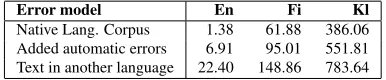
Finally we measure how the text type used will affect the speed of spell-checking. As the best-case scenario we use the unmodified texts of Wikipedia, which contain probably the most real-istic native-language-speaker-like typing error
tribution available. For text with more errors, where the majority of errors should be recoverable, we introduce automatically generated errors in the Wikipedia texts. Finally to see the performance in the worst case scenario where most of the words have unrecoverable spelling errors we use texts from other languages, in this case English texts for Finnish and Greenlandic spell-checking and Finnish texts for English spell-checking, which should bring us close to the lower bounds on performance. The effects of text type (i.e. frequency of non-words) on speed of spell-checking is given in Table 6. All of the tests in this category were performed with er-ror models under the avoid redundancy and firsts ed 2row in previous tables, which gave us the best speed/quality ratio.
Error model En Fi Kl
[image:8.612.89.282.284.324.2]Native Lang. Corpus 1.38 61.88 386.06 Added automatic errors 6.91 95.01 551.81 Text in another language 22.40 148.86 783.64
Table 6: Effect of text type on error models to speed (in seconds per 10,000 word-forms)
Here we chiefly note that the amount of non-words in text directly reflects the speed of spell-checking. This shows that the dominating factor of the speed of spell-checking is indeed in the correct-ing of misspelled words.
5 Conclusions and Future Work
In this article, we built a full-fledged finite-state spell-checking system from existing finite-state lan-guage models and generated error models. This work uses the system initially described in Pirinen and Lind´en (2010) and an algorithm described in Lind´en et al. (2012), providing an extensive quan-titative evaluation of various combinations of con-stituents for such a system, and applying it to the most challenging linguistic environments available for testing. We showed that using on-line composi-tion of the word form, error model and diccomposi-tionary is usable for morphologically complex languages. Fur-thermore we showed that the error models can be au-tomatically optimised in several ways to gain some speed at cost of recall.
We showed that the memory consumption of the spell-checking process is mainly unaffected by the
selection of error model, apart from the need to store a greater set of suggestions for models that generate more suggestions. The error models may therefore be quite freely changed in real world applications as needed.
We verified that correcting only the first input let-ter affords a significant speed improvement, but that this improvement is not greatly dependent on the po-sition of such a restriction. This practice is some-what supported by our tentative finding that it may cause the least drop in practical recall figures, at least in Finnish. It is promising especially in con-junction with a fallback model that does correct the first letter.
We described a way to avoid having a finite-state error model perform redundant work, such as delet-ing and insertdelet-ing the same letter in succession. The practical improvement from doing this is extremely modest, and it increases the size of the error model.
In this research we focused on differences in au-tomatically generated error models and their optimi-sations in the case of morphologically complex lan-guages. For future research we intend to study more realistic error models induced from actual error cor-pora (e.g. Brill and Moore (2000)). Research into different ways to induce weights into the language models, as well as further use of context in finite-state spell-checking (as in Pirinen et al. (2012)), is warranted.
Acknowledgements
We thank the anonymous reviewers for their com-ments and the HFST research team for fruity discus-sions on the article’s topics. The first author thanks the people ofOqaaserpassualeriffik for introducing the problems and possibilities of finite-state appli-cations to the morphologically complex language of Greenlandic.
References
Cyril Allauzen and Mehryar Mohri. 2009. N-way com-position of weighted finite-state transducers. Interna-tional Journal of Foundations of Computer Science, 20:613–627.
Meenu Bhagat. 2007. Spelling error pattern analysis of punjabi typed text. Master’s thesis, Thapar University. Eric Brill and Robert C. Moore. 2000. An improved error model for noisy channel spelling correction. In ACL ’00: Proceedings of the 38th Annual Meeting on Association for Computational Linguistics, pages 286–293, Morristown, NJ, USA. Association for Com-putational Linguistics.
Fred J Damerau. 1964. A technique for computer detec-tion and correcdetec-tion of spelling errors. Commun. ACM, (7).
Ahmed Hassan, Sara Noeman, and Hany Hassan. 2008. Language independent text correction using finite state automata. InProceedings of the Third International Joint Conference on Natural Language Processing, volume 2, pages 913–918.
M˚ans Huld´en. 2009a. Fast approximate string match-ing with finite automata. Procesamiento del Lenguaje Natural, 43:57–64.
M˚ans Huld´en. 2009b. Foma: a finite-state compiler and library. InProceedings of the 12th Conference of the European Chapter of the Association for Compu-tational Linguistics: Demonstrations Session, EACL ’09, pages 29–32, Stroudsburg, PA, USA. Association for Computational Linguistics.
Kimmo Koskenniemi. 1983. Two-level Morphology: A General Computational Model for Word-Form Recog-nition and Production. Ph.D. thesis, University of Helsinki.
Karen Kukich. 1992. Techniques for automatically cor-recting words in text. ACM Comput. Surv., 24(4):377– 439.
Vladimir I. Levenshtein. 1966. Binary codes capable of correcting deletions, insertions, and reversals. Soviet Physics—Doklady 10, 707710. Translated from Dok-lady Akademii Nauk SSSR, pages 845–848.
Krister Lind´en, Erik Axelson, Senka Drobac, Sam Hard-wick, Miikka Silfverberg, and Tommi A Pirinen. 2012. Using hfst for creating computational linguistic applications. In Proceedings of Computational Lin-guistics - Applications, 2012, page to appear.
Petar Nikolaev Mitankin. 2005. Universal levenshtein automata. building and properties. Master’s thesis, University of Sofia.
Roger Mitton. 2009. Ordering the suggestions of a spellchecker without using context*. Nat. Lang. Eng., 15(2):173–192.
Peter Norvig. 2010. How to write a spelling corrector. referred 2011-01-11, available http://norvig.
com/spell-correct.html.
Kemal Oflazer. 1996. Error-tolerant finite-state recog-nition with applications to morphological analysis and spelling correction. Comput. Linguist., 22(1):73–89.
Tommi A Pirinen and Krister Lind´en. 2010. Finite-state spell-checking with weighted language and error mod-els. InProceedings of the Seventh SaLTMiL workshop on creation and use of basic lexical resources for less-resourced languagages, pages 13–18, Valletta, Malta. Tommi Pirinen, Miikka Silfverberg, and Krister Linden.
2012. Improving finite-state spell-checker suggestions with part of speech n-grams. InInternatational Jour-nal of ComputatioJour-nal Linguistics and Applications IJ-CLA (to appear).
Tommi A Pirinen. 2011. Modularisation of finnish finite-state language descriptiontowards wide collab-oration in open source development of morphological analyser. In Proceedings of Nodalida, volume 18 of NEALT proceedings.
Harri Pitk¨anen. 2006. Hunspell-in kes¨akoodi 2006: Fi-nal report. Technical report.
Joseph J. Pollock and Antonio Zamora. 1984. Auto-matic spelling correction in scientific and scholarly text.Commun. ACM, 27(4):358–368, April.
Klaus Schulz and Stoyan Mihov. 2002. Fast string cor-rection with levenshtein-automata. International Jour-nal of Document AJour-nalysis and Recognition, 5:67–85. Emmanuel J Yannakoudakis and D Fawthrop. 1983. An