Hybrid methods for ICD-10 coding of death certificates
Pierre Zweigenbaum LIMSI, CNRS, Universit´e Paris-Saclay,
F-91405 Orsay, France [email protected]
Thomas Lavergne LIMSI, CNRS, Univ. Paris-Sud
Universit´e Paris-Saclay, F-91405 Orsay, France [email protected]
Abstract
ICD-10 coding of death certificates has re-ceived renewed attention recently with the or-ganization of the CLEF eHealth 2016 clini-cal information extraction task (CLEF eHealth 2016 Task 2). This task has been addressed either with dictionary projection methods or with supervised machine learning methods, but none of the participants have tried to de-sign hybrid methods to process these data. The goal of the present paper is to explore such hybrid methods. It proposes several hy-brid methods which outperform both plain dictionary projection and supervised machine learning on the training set. On the official test set, it obtains an F-measure of 0.8586 which is 1pt above the best published results so far on this corpus (p < 10−4). Moreover, it does so
with no manual dictionary tuning, and thus has potential for generalization to other languages with little effort.
1 Introduction
Biomedical information processing crucially relies on a normalized representation of medical infor-mation in the form or standardized terminologies and ontologies, be it for clinical care (SNOMED, LOINC), for public health statistics and health man-agement (International Classification of Diseases) or for literature search (MeSH). Automatically gener-ating such a normalized representation from natu-rally occurring sources such as text is therefore a long-studied goal (Wingert et al., 1989). Basically, it consists in deciding which concepts in the target representation (e.g., signs and symptom concepts in SNOMED CT, or disease classes in the ICD-10 classification) best represent the contents of a given text (e.g., a patient discharge summary). It can
be decomposed into the detection of text mentions of biomedical concepts of the suitable types (en-tity recognition) and the determination of the target concepts (concept normalization) which best repre-sent the text mentions in the context of the source text and the given use case. The state of the art of biomedical entity recognition and biomedical con-cept normalization has been established and pub-lished in a number of shared tasks which addressed clinical texts (Pestian et al., 2007; Uzuner et al., 2007; Uzuner et al., 2011; Suominen et al., 2013), biomedical literature (Kim et al., 2011; N´edellec et al., 2015), sometimes in multiple languages (Suomi-nen et al., 2013; N´ev´eol et al., 2016).
This paper focuses on ICD-10 coding. ICD cod-ing has been studied in the past (e.g., as early as (Wingert et al., 1989)), but only recently has a large dataset been released for ICD-10 coding of death certificates (N´ev´eol et al., 2016). In that context, N´ev´eol et al. (2016) mention that participants in the CLEF eHealth 2016 ICD-10 coding task either used dictionary-based methods or supervised ma-chine learning methods, and that none tried hybrid methods. The goal of this paper is to explore this direction. Our contributions are the following:
• We explore hybrid methods for ICD-10 coding which combine dictionary projection and su-pervised machine learning.
• We show that simple hybrid combinations with union and intersection yield improved results. • We propose methods which improve the
preci-sion of dictionary projection, including hybrid ‘calibration’ methods.
• The methods which fare best on the training corpus, when applied to the test corpus, are
on par with the best published results on this corpus, with no manual dictionary tuning, and have thus potential for generalization to other languages with little effort.
In the remainder of the paper, we report the meth-ods used by the best-performing participants in the CLEF eHealth 2016 shared task (Section 2), present the methods we explored and the data on which we applied them (Section 3), the results we obtained on the development and test data (Section 4), discuss them (Section 5) and conclude (Section 6).
2 Related Work
When producing normalized concepts from medi-cal texts, most methods use dictionary-based lexi-cal matching or supervised machine-learning. Most dictionary-based methods use the UMLS (Bodenrei-der, 2004) or one of its included vocabularies, such as the ICD-10 classification. MetaMap (Aronson and Lang, 2010) is the most used system for English: it takes advantage of the term variants present in the UMLS MetaThesaurus and of the morphological knowledge provided by the UMLS Specialist Lex-icon. Knowledge-lean methods based on approx-imate dictionary look-up have also been proposed (Zhou et al., 2006).
Some studies have addressed the ICD-10 coding of death certificates. Koopman et al. (2015a) clas-sified Australian death certificates into 3-digit ICD-10 codes such as E10 with SVM classifiers based on n-grams and SNOMED CT concepts, and with rules. They also trained SVM classifiers (Koop-man et al., 2015b) to find ICD-10 diagnostic codes for death certificates. In contrast to the above-mentioned CLEF eHealth shared task, they only addressed cancer-related certificates: they set-up a first-level classifier to detect cases of cancer then a second-level classifier to refine it into a specific type. Another difference from CLEF eHealth is that they remained at the level of 3-digit ICD-10 codes (e.g., C00,C97) instead of the full 4-digit level usually re-quired for ICD-10 coding (e.g.,C90.9). Another im-portant difference is that they targeted the underly-ing cause of death, i.e., one diagnosis per death cer-tificate, whereas the CLEF eHealth task requires to determine all the diagnoses mentioned in each state-ment of a given death certificate.
Two ICD coding shared task were organized so far. The Computational Medicine Center (CMC) challenge (Pestian et al., 2007) targeted ICD-9-CM disease coding from outpatient chest x-ray and re-nal procedures, whose clinical history and impres-sion sections provide most support for coding. The dataset contained 978 documents for training and 976 documents for testing. It targeted a small subset of 45 ICD-9-CM codes, designed in such a way that every one of the 94 distinct combination of codes present in the test set were seen in the training set. The best system was based on a supervised classifier (a Decision Tree) and obtained an F-measure of 0.89 on the test set.
The CLEF eHealth 2016 ICD-10 coding task (N´ev´eol et al., 2016) provided a dataset which con-sisted of death certificates in French. These death certificates were provided by C´epiDc, the WHO col-laborating center which manages ICD-10 coding of death certificates in France. We reproduce the cor-pus statistics from the task organizers’ paper in Ta-ble 1. The task was defined at the level of each statement (line) in a death certificate: one statement could be associated with 0, 1 or more ICD-10 codes which represent causes of death at various levels in the causal chain which led to the death. Statements have a length which varies from 1 to 30 words, with outliers at 120 words and the most frequent length at 2 tokens. They are thus much shorter than the CMC challenge texts.
Training Test
(2006–2012) (2013)
Documents 65,844 27,850
Lines 195,204 80,899
Tokens 1,176,994 496,649
Total ICD codes 266,808 110,869
Unique ICD codes 3,233 2,363
Table 1:The C´epiDC French Death Certificates Corpus (from N´ev´eol et al.).
therefore no guarantee that a code needed in 2013 had been used in 2006-2012: a posteriori analysis reveals that 224 of the 2,363 unique codes used in 2013 were not used in 2006–2012. Besides, as can be seen in Table 1, the size of the corpus is much larger than that of the CCMC challenge, as well as the number of target codes.
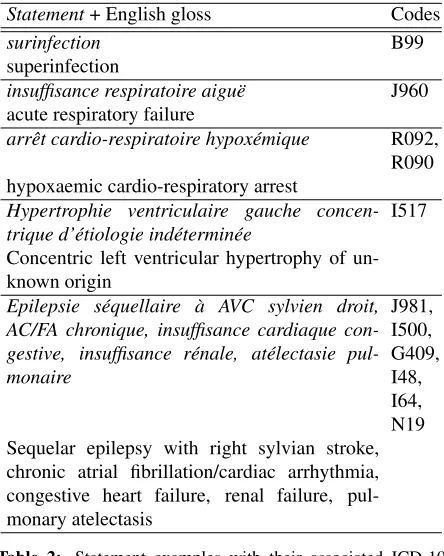
Table 2 shows examples statements from the dataset; we provided English translations for the reader’s convenience.
Statement+ English gloss Codes
surinfection B99
superinfection
insuffisance respiratoire aigu¨e J960 acute respiratory failure
arrˆet cardio-respiratoire hypox´emique R092, R090 hypoxaemic cardio-respiratory arrest
Hypertrophie ventriculaire gauche concen-trique d’´etiologie ind´etermin´ee I517 Concentric left ventricular hypertrophy of un-known origin
Epilepsie s´equellaire `a AVC sylvien droit, AC/FA chronique, insuffisance cardiaque con-gestive, insuffisance r´enale, at´electasie pul-monaire
[image:3.612.76.298.205.483.2]J981, I500, G409, I48, I64, N19 Sequelar epilepsy with right sylvian stroke, chronic atrial fibrillation/cardiac arrhythmia, congestive heart failure, renal failure, pul-monary atelectasis
Table 2: Statement examples with their associated ICD-10 codes, with English glosses. Code order does not necessarily align with text order.
CLEF participants were also provided with dic-tionaries created by C´epiDc for their own use. Each dictionary included (term, ICD-10 code, related code 1, related code 2) quadruplets. We did not use the two ‘related codes’, hence only consider (term, ICD-10 code) pairs in the remainder of this paper. Four dictionaries were provided: one used over the years 2006–2010 (157,001 lines), one for 2011 (156,937 lines), one for 2012 (158,163 lines), and one for 2013 (144,905 lines). These dictionar-ies reflect changes in coding practice over the years, either caused by changes in international ICD con-tents or coding rules, or by newly encountered
ex-pressions which were not covered in previous years, or by improvements in C´epiDc’s dictionary manage-ment.
The top two systems at the CLEF eHealth ICD-10 coding task used two different methods.
Van Mulligen et al. (2016) relied on ICD dictio-naries built from the shared task data. Their baseline dictionary used the term-code associations seen in the shared task training set, and their expanded tionary also used the above-mentioned C´epiDc tionaries. Various filters were applied to these dic-tionaries, based on the ambiguity of the term-code associations. Their dictionary projection method used the Solr information-retrieval system to cope with the large number of entries in the lexicon ef-ficiently. After measuring its performance on the training corpus, they post-processed their system output to block term-code associations with a pre-cision on the training set lower than a given thresh-old selected by optimizing F-measure on the training set. They obtained the top precision, recall, and F-measure published so far on this dataset: P=0.886, R=0.813, F=0.848 in their top run using the ex-panded dictionary, or P=0.890, R=0.803, F=0.844 in their second run using the baseline dictionary.
As mentioned in the introduction, N´ev´eol et al. (2016) observed that no participant in the CLEF eHealth 2016 ICD-10 coding task tried hybrid meth-ods which would combine dictionary projection and supervised machine learning. Exploring this direc-tion is the goal of this paper.
3 Methods
We set up a simple dictionary projection method and a supervised machine learning method, then de-signed hybrid methods based on one or both of them. We first processed each statement as follows: con-version to lower case, tokenization (with an NLTK regular expression), stop word removal (French NLTK); diacritic removal (Unicode ‘NFD’ normal-ization), correction of some spelling errors based on the words present in the training corpus and in the C´epiDc dictionaries, stemming (Snowball French stemmer).
3.1 Dictionary projection
Dictionary projection relies on the expressions present in a dictionary to spot mentions of concepts in a text. We pre-processed the C´epiDc dictionaries in the same way as the death certificate statements: as a result, each dictionary entry links a sequence of normalized tokens to one or more ICD codes. For term matching efficiency, each dictionary was stored as a Trie. Given a dictionary, an input sequence of tokens is processed as follows. The input sequence of tokens is scanned for the first match. In case of multiple matches, the longest match is retained. Af-ter a match, scanning resumes right afAf-ter the end of the match. The output of the process is a (possibly empty) list of matched dictionary entries together with their positions in the input sequence.
No processing of negations was performed be-cause statements are very short and negations are in-frequent. For instance, only 82 occurrences of the negationpas(no/not) were found in the training cor-pus (i.e., in 0.04% of the statements), and 240 oc-currences of the negationsans(without) (0.12%).
A dictionary entry may lead to0:n codes. De-pending on how the dictionary was built, the same code may have been recorded multiple times: this number of times is recorded in the dictionary. We have tested the following selection strategies in case
of multiple outputs for a given entry:
all All codes are returned.
best The most frequently recorded code is returned. In case of a tie, a random choice is performed.
boiu (Best Only If Unambiguous): The most fre-quently recorded code is returned only if there is no tie, else no result is returned.
Dictionary projection can use any available dictio-nary which links terms to ICD codes. Here we tested only those provided by C´epiDc to the CLEF eHealth participants: the use of other dictionaries which could be built for instance from the training corpus, from the ICD-10 terms themselves, or from the UMLS, is left for future work.
3.2 Supervised classification
Supervised classification is not the focus of this pa-per, therefore we only present here our best current model. It uses a linear SVM classifier and the fol-lowing method and features:
• Linear SVM (scikit-learn’s LinearSVC with default parameters, which relies on liblinear) • Tokens (t), obtained after the above-mentioned
pre-processing step. We also tested token n-grams up to 5, but this did not improve the re-sults.
• Character trigrams (c3): spelling errors are fre-quent in the certificates; representing a state-ment by its overlapping character trigrams pro-vides a degree of robustness to spelling errors. • Coding Year (y): coding rules change over the
years, and the same statement seen at two dif-ferent dates may be coded difdif-ferently because of such changes. Therefore we found it use-ful to include 2 ×9 features instantiated for
y∈[2006. . .2014]: ‘> y’ or ‘≤y’ depending on the value of the Coding Year (e.g., a state-ment of 2011 will have ‘>2006’, . . . ‘>2010’, ‘≤2011’, . . . ‘≤2014’.
3.3 Union and intersection of classifiers
The union of the outputs of two classifiers is a very simple method to combine them. It is useful when the individual classifiers lack recall, and preferably have a high enough precision. The ideal situation oc-curs when individual classifiers output different cor-rect predictions (in which case the resulting recall will be higher than the best recall of the individual classifiers) and when the individual classifiers make errors on the same inputs (in which case the result-ing number of false positives will be lower than the sum of the individual false positives).
Conversely, the intersection of two classifiers is a possible method to increase their precision. A high-precision classifier is useful for pre-annotation. In the actual coding process at C´epiDc, human coders spend a sizable part of their time assigning codes which are easy to determine. Pre-annotating these codes with a reliable, high-precision system before presenting death certificates to human coders would enable them to browse through these pre-assigned codes quickly. This would save human coding time which could be reassigned to solving more difficult cases.
3.4 Calibration
A prediction method, for instance dictionary projec-tion, can be ‘calibrated’ by training a classifier to detect its errors. Calibration takes into account the distribution of codes and of prediction success in the training split, thereby adding data-driven knowledge to the application of the expert-produced dictionary. It automatically spots the main deficiencies of the dictionary projection and blocks them. In this re-spect, it is closely related to the error analysis pro-cess which a human expert performs when applying their dictionary to a new dataset: error spotting, then correction. In the human process, correction can take the form of simple post-processing rules which filter out output codes known to be often erroneous. It can also come from data-driven tuning of the dic-tionary by measuring the performance of its entries on the training corpus and selecting an appropriate threshold to prune low-performance entries, as in (Van Mulligen et al., 2016). This is exactly what is performed automatically by the classifier we train.
We trained a classifier with the following
condi-tions:
• Classifier: Linear SVM (scikit-learn’s Lin-earSVC with default parameters).
• Features: individual code predicted by the C´epiDc dictionary (see below Section 3.5), pre-fixed bycode:(e.g.,code:R068); we also tested the addition of the statement tokens (obtained by the same process as described above).
• Classes: True (meaning the predicted code is correct) / False (meaning it is incorrect).
• Training: our training split (see below: 185k statements) for development, the full training corpus for testing.
When testing, the trained classifier was applied to each individual code predicted by the dictionary pro-jection. If the classifier’s output was the False class, the predicted code was removed from the dictionary projection output.
3.5 Data
We used the C´epiDc data provided by the CLEF eHealth 2016 clinical information extraction task (CLEF eHealth 2016 Task 2) to the challenge par-ticipants (N´ev´eol et al., 2016). The statistics of the training and test corpora are described in Section 2. To emulate the test conditions in our development phase, we also split the training corpus based on the dates of the certificates: the last 10,000 statements (1141 unique codes) made up our test split, while the first 185,204 statements (13,300 codes, 3,200 unique) constituted our training split. Only 11 codes were present in the test split but absent from the training split.
Python 3.5.2 was used for the programs, with scikit-learn 0.17.1, within Anaconda 4.0.0.
3.6 Experimental protocol and evaluation
we retrained them on the full training corpus with a more recent dictionary:
• The supervised classifier (Linear SVM, tc3y) was trained on the full training corpus.
• Dictionary projection methods used the 2012 dictionary instead of the 2011 dictionary.
• Dictionary projection was calibrated on the full training corpus.
• Supervised classifier and calibrated dictionary projection were applied to the test corpus.
• The union of their results was computed and used as final predictions.
Precision, recall and F-measure were computed for each experiment, by our own programs for conve-nience during development; when applied to the test corpus, they were computed with the official scoring program provided to the CLEF eHealth participants.
4 Results
4.1 Development: results on the test split of the training corpus
The SVM classifier with tokens, character trigrams, and year coded (henceforthtc3y), was trained on our training split and applied to our test split, on which it obtained P=0.9010, R=0.6774, and F=0.7734.
We tested the four dictionaries and our three dic-tionary output selection methods on our test split. Table 3 shows that the 2011 dictionary obtains the best precision, recall and F-measure, closely fol-lowed by the 2012 dictionary. As could be ex-pected, the all method always produced the high-est recall, whereas theboiumethod always produced the highest precision.boiualso obtained the highest F-measure. The top F-measure was thus obtained with the 2011 dictionary and boiu, at P=0.8048, R=0.6475 and F=0.7176. We therefore retained the 2011 dictionary for further experiments on our test split (2012 data). We also assumed that follow-ing the same pattern for the official test data, dated in 2013, the 2012 dictionary should be most suit-able. As a safety check, we tested the 2012 dictio-nary on our test split in the same conditions as the
2011 dictionary, and observed that it obtained sim-ilar results—slightly inferior, by a maximum of 0.1 pt P, R or F.
Dict Sel # Sys TP P R F
2006 boiu 10720 8470 0.7901 0.6368 0.7052 2006 best 12977 9117 0.7026 0.6855 0.6939 2006 all 18458 10133 0.5490 0.7619 0.6381
2011 boiu 10701 8612 0.8048 0.6475 0.7176
2011 best 12978 9335 0.7193 0.7019 0.7105
2011 all 18722 10491 0.5604 0.7888 0.6552
2012 boiu 10580 8485 0.8020 0.6380 0.7106
2012 best 12970 9276 0.7152 0.6974 0.7062
2012 all 18520 10469 0.5653 0.7871 0.6580
2013 boiu 10550 8106 0.7683 0.6095 0.6797 2013 best 13095 8951 0.6835 0.6730 0.6782 2013 all 19285 9956 0.5163 0.7486 0.6111 Table 3:Dictionary experiments on our test split: C´epiDc dic-tionaries (Dict), 10,000 statements, 13,300 codes: all statements date from year 2012. Sel = Selection method: boiu = best only if unambiguous, best = most frequent code (random choice in case of tie), all = all codes. # Sys = number of system-predicted codes. TP = true positives. P = precision, R = recall, F = F-measure.
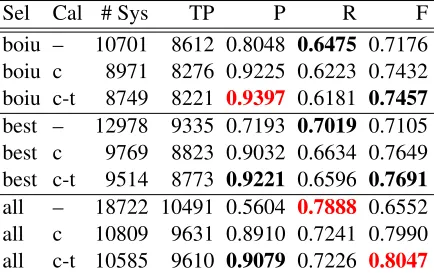
Table 4 shows the 2011 dictionary results with-out (–) and with (c, c-t) calibration. Calibration based only on the dictionary-proposed code (Cal=c) boosts precision by 12pt (boiu) to 33pt (all) and F-measure by 2.6pt (boiu) to 14pt (all), while only reducing recall by 2.5pt (boiu) to 6pt (all). Addi-tionally taking into account the tokens of the coded statement in calibration (Cal=c-t) adds another 1.7pt (boiuor all) to 1.9pt (best) to precision and 0.25pt (boiu) to 0.6pt (all) to F-measure, with a decrease of recall by 0.15pt (all) to 0.4pt (boiuorbest). Alto-gether, calibration is therefore highly efficient on our test split to increase precision and F-measure. The highest precision is obtained withboiu, c-twhile the highest F-measure is obtained withall, c-t.
We performed the union and the intersection of the outputs of the SVM supervised classifier and of the dictionary projection. The results are reported in Table 5.
Sel Cal # Sys TP P R F
boiu – 10701 8612 0.8048 0.6475 0.7176
boiu c 8971 8276 0.9225 0.6223 0.7432
boiu c-t 8749 8221 0.9397 0.6181 0.7457
best – 12978 9335 0.7193 0.7019 0.7105
best c 9769 8823 0.9032 0.6634 0.7649
best c-t 9514 8773 0.9221 0.6596 0.7691
all – 18722 10491 0.5604 0.7888 0.6552
all c 10809 9631 0.8910 0.7241 0.7990
[image:7.612.79.296.61.198.2]all c-t 10585 9610 0.9079 0.7226 0.8047
Table 4: 2011 dictionary calibration experiments on our test split. Cal = calibration: – (none), c (dictionary code), t (source tokens).
the same time boosting recall by 12 to 20pt, reach-ing a maximum of 0.9048. Union with the cali-brated dictionary projection decreased its precision by at most 5pt (boiu, c-t), maintaining a very rea-sonable P=0.86–0.89. Recall was boosted by 14 to 19pt, leading to a record F-measure of 0.8666.
Again,allobtained the highest recall and also the highest F-measure, achieving records of R=0.8661 (–) and F=0.8666 (c-t, both with quite balanced P, R, F. Theall c-tcombination was thus a natural can-didate to run on the official test corpus.
With intersection, the obtained precision gained 3.5pt over the best so far, reaching 0.96–0.97, while losing 16–19pt of recall at 0.46–0.54 compared to the calibrated dictionary projection. Here again, boiuobtained the highest precisions with the top at 0.9749 (c-t). Intersection yields a 58% reduction of the best error rate so far from 6% to 2.5%. With such a low error rate, pre-annotation becomes viable and would cater for not far from one half of the number of codes to produce (R=0.4620). For information, we added this precision-oriented configuration (boiu c-t) to the three F-measure-oriented configurations to be run on the official test corpus.
4.2 Results on the test corpus
The best F-measure on the training corpus was ob-tained by the union of the SVM classifier and the alldictionary projection calibrated with token fea-tures (all-c-t), therefore we selected this method as our Run 1. We wanted to diversify our tests, there-fore also selected two more precise runs: (ii) the union of the SVM classifier and theboiudictionary
Sel Cal # Sys TP P R F
svm (linear) tc3y 9010 0.9010 0.6774 0.7734 Union
boiu – 14188 11303 0.7967 0.8498 0.8224 boiu c 12670 11153 0.8803 0.8386 0.8589 boiu c-t 12447 11087 0.8907 0.8336 0.8612 best – 15894 11566 0.7277 0.8696 0.7924 best c 13017 11313 0.8691 0.8506 0.8597 best c-t 12719 11224 0.8825 0.8439 0.8628 all – 20836 12034 0.5776 0.9048 0.7051 all c 13414 11519 0.8587 0.8661 0.8624 all c-t 13142 11457 0.8718 0.8614 0.8666
Intersection
[image:7.612.322.527.68.330.2]boiu – 6293 6128 0.9738 0.4608 0.6255 boiu c 6291 6127 0.9739 0.4607 0.6255 boiu c-t 6302 6144 0.9749 0.4620 0.6269 best – 7084 6779 0.9569 0.5097 0.6651 best c 6752 6520 0.9656 0.4902 0.6503 best c-t 6795 6559 0.9653 0.4932 0.6528 all – 7886 7467 0.9469 0.5614 0.7049 all c 7395 7122 0.9631 0.5355 0.6883 all c-t 7443 7163 0.9624 0.5386 0.6906 Table 5: 2011 dictionary experiments on our test split: Union and intersection of Linear SVM and dictionary results.
projection calibrated with token features (boiu-c-t), and (iii) the union of the SVM classifier and the boiudictionary projection calibrated with no extra features (boiu-c). We applied these methods to the test corpus in the manner presented above.
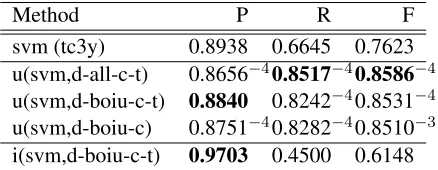
The results obtained on the official test corpus are very close to those on our test split of the training corpus: there is a constant difference of only –0.8pt in F-measure, and a similarly small de-crease of less than 1pt in precision and recall for the three runs. This shows that the tested meth-ods do not overfit the training corpus. As a conse-quence, the order of results on the test corpus repro-duces that of the test split: highest F-measure and recall for u(lsvcd(tc3y),d2012-all-c-t), highest pre-cision foru(lsvcd(tc3y),d2012-boiu-c-t).
ap-Method P R F
svm (tc3y) 0.8938 0.6645 0.7623
u(svm,d-all-c-t) 0.8656−40.8517−40.8586−4
u(svm,d-boiu-c-t) 0.8840 0.8242−40.8531−4
u(svm,d-boiu-c) 0.8751−40.8282−40.8510−3
[image:8.612.80.299.60.145.2]i(svm,d-boiu-c-t) 0.9703 0.4500 0.6148
Table 6:Tests on the official test corpus. Evaluation with the official program. u(a,b) = union(a,b). i(a,b) = intersection(a,b). svm is a linear SVM with features tc3y. d- = dictionary (2012). In Union results, superscripts represent the power of the p-value of significance testing for the difference with the best published result so far (Van Mulligen et al., 2016): −3 = p < 10−3,
−4 = p < 10−4. Note that the values of P are higher in
(Van Mulligen et al., 2016) (the difference is significant in two cases out of three) whereas the values of R and F are better in the present Union results (differences are always significant).
proximate randomization with 10,000 permutations,
p = 10−4 for all except p = 0.6 ×10⁻³ for the
difference of 0.3pt in F-measure), except the differ-ence of 0.2pt in precision (p = 0.104). Note how-ever that the methods and experiments presented in the present paper benefited from extra time invested after the official CLEF eHealth run submissions, so that a comparison with results obtained during the shared task time frame does not reflect differences in quality of the involved teams.
5 Discussion
5.1 Calibration
Calibration proved highly efficient in the present set-ting.
For instance, calibration ofboiuoutput with only code-based classification (boiu cin Table 4) filters out 258 instances of ICD-10 codeC809,Malignant neoplasms of ill-defined, secondary and unspecified sites which dictionary projection assigned to our test split, among which only 15 were true positives and 243 were false positives. The dictionary happens to have 509 entries for this code, among which the sin-gle wordcancer. Because of the longest match strat-egy, this entry generally does not fire because longer entries including this word exist and will match in-stead. However, it acts as a default entry which may be used in inappropriate contexts.
Because we applied calibration to filter out some
target codes, it blocks full sets of dictionary entries (for instance, the 509 entries for C809). A finer-grained method might try to filter out specific entries instead, and maybe still obtain a good increase in precision while limiting the associated loss in recall.
5.2 Union and intersection
Union and intersection are very simple combination methods. They played their expected roles in our experiments. Because we started from predicted re-sults with precisions above 0.90, union was able to keep a high enough precision (up to 0.89 on the training set and 0.88 on the test set). The fact that it also led to a strongly increased recall shows that dictionary projection and our mono-label supervised classifier produced complementary results.
Given that we started from high-precision re-sults, intersection was interesting to obtain very-high-precision classifiers. On the training set, the obtained precision ranged from 0.94 to 0.97, with associated recalls decreasing from 0.56 to 0.46. A study of the 3% resisting codes is left for future work. The highest-precision configuration, when applied to the test set, also reached a 0.97 preci-sion with a 0.45 recall. This means that nearly one half of the test statements can be annotated automat-ically with an error rate of only 3%. This makes pre-annotation of death certificates with these methods a viable proposal to save human coding time.
5.3 Dictionary projection as a classifier feature
other union F-measures, but obtained a lower best intersection precision (–0.4pt at 0.9711,boiu, boiu-c-t). The influence of the selection method used in dictionary projection for feature creation was minor. This additional combination might increase again the F-measure on the test corpus, but was not tested in this paper.
5.4 Generalizability
The ICD-10 coding of death certificates is a process which is performed world-wide in a variety of lan-guages. Efforts have been spent in various countries to develop dictionaries such as that of the C´epiDc in France. An important feature of the methods we have presented here is that they are readily portable to other languages. The only language-dependent parts of our methods are diacritic removal (which generalizes to all Unicode languages to which the ‘NFD’ normalization applies), stemming (which is readily available for dozens of languages), some of-fline spelling correction (which generalizes to many alphabetic languages), and the use of character tri-grams (which generalizes to alphabetic languages). No manual dictionary entry development or tuning was performed at all. Moreover, the supervised method already yields a high precision even without any dictionary at all, provided a sufficient number of training examples are available.
Therefore our methods and system should be ap-plicable with no or little effort to a number of other languages.
6 Conclusion
We explored hybrid methods which combine sim-ple dictionary projection and mono-label supervised classification. Our starting point was a dictionary projection method which obtained a higher recall and a supervised classification method which ob-tained a higher precision. Calibration strongly im-proved the precision of dictionary projection, mak-ing it higher than that of the supervised classifier. Union of calibrated dictionary projection results and supervised classification results improved the recall of both of them while keeping a high enough preci-sion, leading to the highest F-measure on the train-ing corpus. Intersection of calibrated dictionary pro-jection results and supervised classification results
obtained a record precision of 0.97 while produc-ing codes for a little less than one half of the state-ments. This is a suitable configuration for automatic pre-annotation of death certificates which could save time to human coders. These experiments were performed on the training corpus: when applying the best development configurations to the test cor-pus, they led to three runs (F=0.8510–0.8586) which are all above the best published F-measure so far (F=0.848, significant atp < 10−4) on this dataset.
An important advantage of these methods is that they only relied on the data provided by the French coding center, C´epiDc: if similar organizations in other countries have similar data, these methods should be readily applicable with little change to these new data.
In future work we plan to improve the individ-ual methods and test more hybrid methods. Using more complete dictionaries is a way to improve the recall and maybe precision too of dictionary projec-tion. Changing the supervised classification to per-form multi-label classification is a direction to im-prove the recall of the supervised classifier. Calibrat-ing the dictionary at the level of individual entries instead of target codes might also limit the loss of dictionary projection recall when increasing its pre-cision.
Acknowledgments
We thank the CLEF eHealth challenge organizers for providing the data used in the present work and Jan Kors (ERASMUS team) for giving us ac-cess to their results for significance testing. This work was partially funded by the European Union’s Horizon 2020 Marie Sklodowska Curie Innova-tive Training Networks—European Joint doctor-ate (ITN-EJD) Under grant agreement No:676207 (MiRoR). Finally, we thank the anonymous review-ers for their very relevant comments which helped improve the paper.
References
Olivier Bodenreider. 2004. The Unified Medical Lan-guage System (UMLS): Integrating biomedical ter-minology. Nucleic Acids Research, 32(Database issue):D267–270.
Mohammed Dermouche, V Looten, R´emy Flicoteaux, Sylvie Chevret, J Velcin, and Namik Taright. 2016. ECSTRA-INSERM @ CLEF eHealth2016-task 2: ICD10 code extraction from death certificates. In CLEF 2016 Online Working Notes. CEUR-WS. Jin-Dong Kim, Sampo Pyysalo, Tomoko Ohta, Robert
Bossy, Ngan Nguyen, and Jun’ichi Tsujii. 2011. Overview of BioNLP shared task 2011. In Proceed-ings of BioNLP Shared Task 2011 Workshop, pages 1– 6, Portland, Oregon, USA, June. Association for Com-putational Linguistics.
Bevan Koopman, Sarvnaz Karimi, Anthony Nguyen, Rhydwyn McGuire, David Muscatello, Madonna Kemp, Donna Truran, Ming Zhang, and Sarah Thack-way. 2015a. Automatic classification of diseases from free-text death certificates for real-time surveillance. BMC Med Inform Decis Mak, 15:53.
Bevan Koopman, Guido Zuccon, Anthony Nguyen, An-ton Bergheim, and Narelle Grayson. 2015b. Auto-matic ICD-10 classification of cancers from free-text death certificates. Int J Med Inform, 84(11):956–965, November.
Claire N´edellec, Jin-Dong Kim, Sampo Pyysalo, Sophia Ananiadou, and Pierre Zweigenbaum. 2015. BioNLP Shared Task 2013: Part 1. BMC Bioinformatics, 16(Suppl 10), July.
Aur´elie N´ev´eol, Kevin Bretonnel Cohen, Cyril Grouin, Thierry Hamon, Thomas Lavergne, Liadh Kelly, Lor-raine Goeuriot, Gr´egoire Rey, Aude Robert, Xavier Tannier, and Pierre Zweigenbaum. 2016. Clinical in-formation extraction at the CLEF eHealth evaluation lab 2016. InCLEF eHealth Evaluation Lab.
John P. Pestian, Chris Brew, Pawel Matykiewicz, DJ Hovermale, Neil Johnson, K. Bretonnel Cohen, and Wlodzislaw Duch. 2007. A shared task involving multi-label classification of clinical free text. In Bi-ological, translational, and clinical language process-ing, pages 97–104, Prague, Czech Republic, June. As-sociation for Computational Linguistics.
Hanna Suominen, Sanna Salanter¨a, Wendy W. Sumitra Velupillai Chapman, Guergana Savova, Noemie El-hadad, Sameer Pradhan, Brett R. South, Danielle L. Mowery, Gareth J.F. Jones, Johannes Leveling, Li-adh Kelly, Lorraine Goeuriot, David Martinez, and Guido Zuccon. 2013. Overview of the ShARe/CLEF eHealth evaluation lab 2013. InProceedings of CLEF 2013, Lecture Notes in Computer Science, Berlin Hei-delberg. Springer.
¨Ozlem Uzuner, Yuan Luo, and Peter Szolovits. 2007.
Evaluating the state-of-the-art in automatic de-identification.J Am Med Inform Assoc, 14:550–563. ¨Ozlem Uzuner, Brett R. South, Shuying Shen, and Scott L
DuVall. 2011. 2010 i2b2/VA challenge on concepts, assertions, and relations in clinical text.J Am Med In-form Assoc, 18(5):552–556, Sep-Oct. Epub 2011 Jun 16.
E Van Mulligen, Z Afzal, S A Akhondi, D Vo, and J A Kors. 2016. Erasmus MC at CLEF eHealth 2016: Concept recognition and coding in French texts. In CLEF 2016 Online Working Notes. CEUR-WS. F. Wingert, David Rothwell, and Roger A Cˆot´e. 1989.
Automated indexing into SNOMED and ICD. In Jean Raoul Scherrer, Roger A. Cˆot´e, and Salah H. Mandil, editors,Computerised Natural Medical Lan-guage Processing for Knowledge Engineering, pages 201–239. North-Holland, Amsterdam.