Introducing DR
AIL: a Step Towards Declarative Deep Relational Learning
Xiao Zhang∗, Maria Leonor Pacheco∗, Chang Li and Dan Goldwasser {zhang923, pachecog, li1873, dgoldwas}@cs.purdue.edu
Abstract
We introduce DRAIL, a new declarative
framework for specifying Deep Relational Models. Our framework separates structural considerations, which express domain knowl-edge, from the learning architecture to sim-plify the process of building complex struc-tural models.
We show the DRAIL formulation of two
NLP tasks, Twitter Part-of-Speech tagging and Entity-Relation extraction. We compare the performance of different deep learning archi-tectures for these structural learning tasks.
1 Introduction
Building statistical models capable of dealing with realistic problems require making predictions over multiple, often interdependent, variables. In such settings, correctly capturing the dependencies be-tween these variables often takes precedence to the specific algorithm used for estimating the models’ parameters. Capturing these dependencies relies on compiling expert knowledge about the problem do-main into the statistical model, and in recent years several machine learning systems offering intuitive interfaces for defining the dependencies between predictions were suggested (Domingos et al., 2006; McCallum et al., 2009; Rizzolo and Roth, 2010; Bach et al., 2015; Kordjamshidi et al., 2015).
On the other hand, end-to-end deep learning methods, which are becoming increasingly popu-lar, take an almost opposite approach. These meth-ods map the complex input object to desired outputs
∗
* Equal contribution.
directly, without decomposing the decision process into parts and modeling their dependencies. The re-cent advances in deep learning allow these meth-ods to successfully learn such mappings over very high dimensional latent features space (Duchi et al., 2011; Srivastava et al., 2014; Bahdanau et al., 2014). At first glance these two trends seem almost con-tradictory, as the first highlights the importance of an easy-to-define, interpretable models, and the sec-ond focuses on finding complex non-linear mapping from the raw inputs to outputs that are difficult to in-terpret, and its definition requires considerable tech-nical expertise. However, as we argue in this paper, these two objectives are not at odds, but rather ex-press the specific considerations required at different levels of abstraction. We suggest to break the depen-dency between the two layers, and present a frame-work for supporting it, by separating the definition of structural elements and their dependencies from the specific learning architecture used for learning them. In this paper we describe the steps we took towards building adeclarativeframework forDeep
RelationalLearning (DRAIL).
DRAIL is a declarative modeling language for defining structured prediction problems, that sep-arates between the modeling layer, which defines the high level dependencies between variables, and the learning layer, which defines the learning archi-tecture that will be used and its parameters. From a modeling perspective, DRAIL is very similar to other declarative languages such as Markov Logic Networks (MLN) (Domingos et al., 2006) and Prob-abilistic Soft Logic (PSL) (Bach et al., 2015), and uses first order logic as a template language for defining factor graph templates, which are
ated from given data.
A DRAIL program is defined over a set of predi-cates, which can represent either observed values or output predictions. We can define complex depen-dencies by connecting these predicates using rules of the following form:
O(x,c)∧O(x,d)⇒P(x,y) P(x,a)⇒ ¬P(x,b)
In this example, a,b,c are constant symbols,
x,yare variables,O(·)is a predicate capturing ob-served properties of the input, andP(·)is a predi-cate, representing a predicted property. The first de-cision rule, captures the mapping between observed properties of an input object and a prediction, while the second rule captures the dependency between two predictions (specifically, it states one output as-signment for an input object prevents the asas-signment of another). Each one of the rule templates is as-sociated with a score, either learned from data, or determined by the user, and the overall decision is made by finding the optimally scored assignments of output values to variables, by performing MAP inference. This flexible framework allows DRAIL to include both soft constraints, which quantify the dependency between different output decisions, and hard constraints, which force these dependencies by manually assigning the rule the highest possible weight.
Once the structural dependencies between the el-ements of the model are determined using the deci-sion rules, we can turn our attention to learning con-siderations. From that perspective each rule defines a factor graph template, and using data we learn a scoring function for it. We learn the parameters of the scoring function for each rule using a deep learn-ing architecture, which can be different for each rule, and normalized into a probability distribution, to al-low global inference over all competing values. This flexibility is the key difference between DRAIL and other declarative learning frameworks: as it makes no distinction between base classifiers and soft con-straints, the scoring function for both can be learned using highly expressive models.
We experimented with two well-known natu-ral language processing structured prediction tasks, Twitter Part-of-Speech tagging (Gimpel et al., 2011) and Entity-Relation extraction (Roth and Yih, 2007). In section 3 we show how to define these tasks as
DRAIL instances, and associate them with learning architectures. In section 4 we explain our inference procedure, converting a DRAIL instance into an In-teger Linear program. We explain our learning ap-proach in section 5. In our current experiments we used both Multi-layer Perceptron networks (MLP) and Recurrent Neural networks (RNN). We report our results in section 6.
2 Related Work
The difficulty of building complex machine learn-ing models over relational data has attracted con-siderable attention in the machine learning commu-nity, and several high level languages for specify-ing the structure of different graphical models have been suggested. For example, BLOG (Milch et al., 2005) and CHURCH (Goodman et al., 2012) were suggested for generative models, and MLN (Domin-gos et al., 2006), PSL (Bach et al., 2015), FACTO-RIE (McCallum et al., 2009), and CCM (Rizzolo and Roth, 2010; Kordjamshidi et al., 2015) were suggested for conditional models.
In this paper we look into combining such declar-ative frameworks with deep learning models. Com-bining deep learning with structured models was studied by several works, typically in the context of a specific task or a specific inference procedure. These include dependency parsing (Chen and Manning, 2014; Weiss et al., 2015), transition systems (Andor et al., 2016) named entity recognition and sequence labeling systems (Ma and Hovy, 2016; Lample et al., 2016), and models for combining deep learning and graphical models for vision tasks (Zheng et al., 2015; Chen et al., 2015).
3 DRAIL Modeling Language
observed variables. To further illustrate these defini-tions, we begin our explanation with two concrete examples of NLP applications.
[image:3.612.304.540.176.376.2]Example 1: Part-of-Speech (POS) Tagging This task aims to map each word in a given sentence to its corresponding POS category (e.g., noun, verb, ad-jective, etc.).
Figure 1 describes an example of a simple model definition for the POS tagging task. Words and their corresponding POS tags have sequential dependen-cies that can easily be expressed in a declarative way. Our model consists of two rules: the first rule (line 1) conditions the POS tag only on the current word (i.e., similar to anemissionfeature), and the second rule (line 5) extends the dependency to both the pre-vious word in the sentence and its tag assignment (similar to atransition). In these rules,xis the cur-rent word,yis the previous word,zis the POS tag assignment of the previous word, andkis the POS tag of the current word to be predicted.
1 rule:
2 def: Word(x) ⇒ HasPos(x,k) 3 network: MultiLayer, MultiClass 4 features: ["extract_twitter_glove"] 5 rule:
6 def: Word(x) ∧ HasPrevWord(x,y) ∧ HasPos(y,z) ⇒ HasPos(y,k) 7 network: MultiLayer, MultiClass 8 features: ["extract_twitter_glove", "
extract_tag"]
Figure 1:Modeling POS Tagging using DRAIL
In this example script, both rules are defined as multi-class prediction problems and are associated with Multi-layer neural network architectures (lines 3,7 respectively). We represent each word as a vector using Twitter Glove embedding (Pennington et al., 2014). We also use a vector representation for the previous POS tag (lines 4,8 respectively).
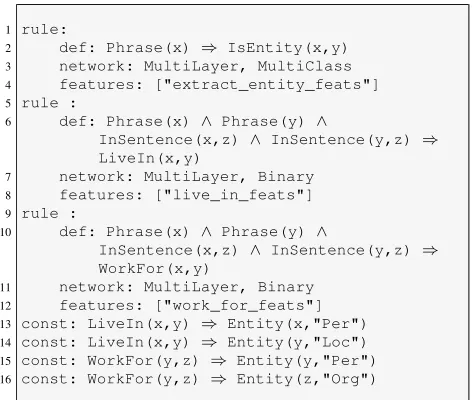
Example 2: Entity-Relation Extraction Our sec-ond example focuses on a simplified version of the relation extraction task (Roth and Yih, 2007; Kord-jamshidi et al., 2015), which identifies named enti-ties and their categories (PER, LOC, ORG) and two types of relations (LIVEIN, WORKFOR) over these entities. In Figure 2 we illustrate the model defini-tion for this task, and write the structural
dependen-cies of the problem using DRAIL. The model con-sists of three rules: the first rule (line 1) is used for predicting the entity category of a given phrase, and the second and third rules (lines 5 and 9, respec-tively) describe the two possible relations between pairs of phrases. We force the consistency between the entity and relation prediction types by encoding this knowledge as hard constraints (lines 13-16).
1 rule:
2 def: Phrase(x) ⇒ IsEntity(x,y) 3 network: MultiLayer, MultiClass 4 features: ["extract_entity_feats"] 5 rule :
6 def: Phrase(x) ∧ Phrase(y) ∧
InSentence(x,z) ∧ InSentence(y,z) ⇒
LiveIn(x,y)
7 network: MultiLayer, Binary 8 features: ["live_in_feats"] 9 rule :
10 def: Phrase(x) ∧ Phrase(y) ∧
InSentence(x,z) ∧ InSentence(y,z) ⇒
WorkFor(x,y)
11 network: MultiLayer, Binary 12 features: ["work_for_feats"] 13 const: LiveIn(x,y) ⇒ Entity(x,"Per") 14 const: LiveIn(x,y) ⇒ Entity(y,"Loc") 15 const: WorkFor(y,z) ⇒ Entity(y,"Per") 16 const: WorkFor(y,z) ⇒ Entity(z,"Org")
Figure 2:Modeling the Relation Extraction problem using DRAIL
DRAIL Elements The elementary units of the
model are predicates, which represent relations in the domains. These can be binary relations be-tween two variables (e.g., HasPos(x,z) where a word x has a POS tag z), or unary relations (e.g.,Phrase(x)). The predicates can correspond to hidden or observed variables. In the latter case, the data corresponding to each predicate is loaded from raw files into a relational database that can later be automatically queried to instantiate groundings for each rule template. Otherwise, the assignment of predicted values is determined in an inference pro-cedure afterwards.
The overhead of DRAIL is considerably light, considering the size of the tested data sets. We im-plemented a compiler to translate formatted rules provided by the user to rule templates speedily. DRAIL then creates a simple in-memory relational database instance by loading raw data, based on the rule templates created. In order to construct the training, validation and testing data sets, DRAIL queries the database to create inputs for models cor-responding to designated rule templates. The over-head of DRAIL majorly lies on the database queries process, which can be alleviated by using a more so-phisticated database that handles queries efficiently for larger volumes of data. As far as we know, a vari-ety of matured industrialized database systems carry this merit. After the data sets are created, the train-ing procedure will be the same as usual. Hence, we intend to improve this aspect in later formal releases. We use several neural network architectures to learn a probability distribution over the different out-put value predictions. Our main idea is to have a model definition that is agnostic of the network ar-chitecture used. In this way, the type of network (e.g., MLP, CNN or RNN) as well as other hyper-parameters (e.g., the number of layers, the number of hidden units, the learning rate, etc.) can be easily tuned without changing the dependencies between output variables.
To be able to learn from observations, each ob-served grounding must generate features to feed into the associated neural network. Currently, we provide a basic feature extractor interface for users to extend. Features are programmable in the Python language and there is no limit as to which types of features can be included for a rule. We also provide a set of out-of-the-box features that can be directly used, such as word embedding and one-hot vector representations for predicate arguments. Since features are added programmatically, external resources can be easily incorporated.
Finally,construles define hard constraints over the general problem. These constraints allow the user to inject domain or common-sense knowledge into the prediction problem. For example, in the re-lation extraction task, the LIVEIN relation can only be predicted between an entity phrase of type PER -SONand an entity phrase of type LOCATION. These constraints do not require any learning, and they can
be directly translated into inference constraints. 4 Inference
Given a specific instance, we assign values to the output variables by running an inference procedure, formulated as an Integer Linear Programming (ILP) problem over rule groundings.
A rule grounding is an instantiation of a rule tem-plate. We generate rule grounding by enumerating all possible values for the rule’s variables given its domain. For example, the rule templateWord(x)
⇒ HasPos(x,y), will be instantiated with each possible part-of-speech tag for each observed word. We score the rule groundings by associating each template with a neural net. We denote the score of each rule grounding as wi, the weight associated
with rule grounding i. These weights are used as coefficients of the corresponding ILP variables in the objective function when performing global in-ference.
We introduce rule variables ri for each rule
groundingiand head variableshjfor each different
head predicatej (and its negation(¯hj)) to indicate the activation of the variable. The objective function can then be expressed as
arg max ∀ri
X
i
wi·ri
.
Note that in the objective function, we do not as-sign any weights to head variables as their values are entirely determined by constraints that ensure con-sistency.
In order to enforce consistency between variable assignments and dependencies among them, the fol-lowing five types of constraints are taken into con-sideration in an ILP formulation.
negation constraints The first type constraints en-sure exclusive activation of a head predicate and its negation at the same time. For example,
hHasPos(a,b)+ ¯hHasPos(a,b) = 1.
implied constraints Each rule template defines the dependency between body and head. This de-pendency is reflected between the rule ground-ings variable and the head variables in the body. For example, in the rule groundingWord(a)
⇒HasPos(a,q), wherea, bare words and
p, q are part-of-speech tags, the constraint
rrule ≤ hHasPos(b,p) is needed, as the whole rule is true only when the body is activated.
rule/head constraints One head predicate can be associated with multiple rule grounding vari-ables. Let ri, i ∈ ruleset(j) denote the rule
variables associated with the same head vari-able hj, where ruleset(j) is the set of rule
groundings that share the same head predicate
j. Activation of any rules in ruleset(j) en-sures the activation of the head variable, i.e.
hj ≥ ri,∀i ∈ ruleset(j). On the other hand,
the activation of the head variable ensures the activation of at least one of its corresponding rule variables, i.e.hj ≤Piri.
binary/multi-class/multi-label constraints In many problems, we are facing multi-class or multi-label decisions. DRAIL guarantees this by adding suitable constraints. For instance, in the multi-class case, among all head variables
hj (j ∈ decision(d)) on the same entity,
only one of them is activated while the others remain inactive, as a decision is made on which class to choose, i.e. Pjhj = 1. Note
that the constraints for binary predicates can be covered by the negation constraints mentioned above.
hard constraints from rule definitions Users can define hard constraints in the rule templates, which usually infuse prior knowledge and thus improve the prediction capacity. Rule groundings of these templates are dealt dif-ferently as the activation of such a rule de-pends on the activation of all body predi-cates. As an example, a hard constraint for entity-relation extraction problem discussed in this paper isLiveIn(x,y)⇒Entity(x, ‘‘Per’’).
We used the Gurobi Optimizer (Gurobi Optimiza-tion, 2015) to implement the inference module. As in many real world problem settings, the optimiza-tion problem based on the ILP formulaoptimiza-tion is com-putationally intractable, hence in practice we relax the inference procedure to linear programming (LP)
problem by adapting the variable type from binary to continuous, within the range[0,1].
5 Learning
Each rule template in a DRAIL model file defines a learning problem, for scoring the mapping of the variables defined in rule body to its head. We de-signed the rules to include flexible definitions for the representation and architecture used for learning this scoring function.
In the training stage, rule groundings are unfolded from the data, using rule templates. For each rule template, the neural networks map the LHS (left hand side) of a rule to the RHS (right hand side) with some probability, given all possible groundings for the right hand side. This mapping is learned using a deep learning model, which uses a logistic regres-sion on top and the output probability distribution will be used as scores over the multi-class classifica-tion problem in an succeeding inference procedure.
One of the main advantages of DRAIL is that the neural network architecture is separate from the structural model. For each deep neural network model, all the hyper-parameters (e.g., the type of neural network, the learning rate, etc.) can be config-ured and optimized. Consequently we can associate different deep neural network architectures with different rule templates, as suits the sub-problems best. This design not only grants more flexibility when dealing with a structural learning problem, but also enables users to experiment with more feasible choices. For example, in the entity relation classifi-cation problem, we can create a LSTM (long-short-term-memory) model for entity tagging and then a Multi-layer Perceptron model for relation classifica-tion. In our experiments we used two different archi-tectures, a Multi-layer Perceptron model and a Re-current neural network, which are briefly described in the following sections.
5.1 MLP (Multi-layer Perceptron)
ap-proximating any function (Cybenko, 1989), hence it can be directly applied to data that are linearly insep-arable. In our experiments we used a simple three-layer MLP that can be formulated as follows:
hs=sigm(W[x1;x2;ps]),
ys=softmax(hs),
where the ;operator means concatenation of input vectors, andpsis the feature representation of a
hid-den variables.Visually, this model can be illustrated by Figure 3.
x2 Hidden
Layer
x1 ps
[image:6.612.355.496.109.246.2]y
Figure 3:Multi-layer Perceptron Model for DRAIL.
5.2 RNN (Recurrent Neural Networks)
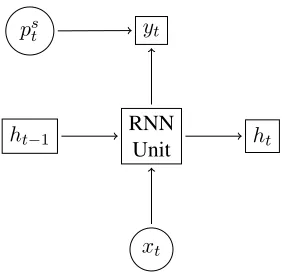
It has been repeatedly demonstrated that Recurrent Neural Networks are a good fit for sequence label-ing tasks (Elman, 1990; Graves, 2013). We there-fore used it for tackling the POS tagging task. Since our model (see section 3) for the POS task captures the dependency between the previous prediction and the current one, we formulate the RNN to accommo-date this prediction task by including the unobserved predicates on the LHS of the rule templates as hid-den variables. In order to break the depenhid-dency of the hidden predicates and the recurrent information in the model, we concatenated feature representa-tions of the hidden variable with the recurrent rep-resentations that entail the history information and feed them to the final softmax layer to yield scores. This can be defined by the following equations:
ht= [sigm(Wxxt);sigm(Whht−1)],
hs
t = [ht;pst],
yst =softmax(hst) (1)
whereps
tis the feature representation of hidden
vari-able sat stept. A graphical demonstration of this model is shown in Figure 4.
xt
RNN Unit
ht−1 ht
yt ps
t
Figure 4:Recurrent Neural Network Model for DRAIL.
Possible future extension of deep neural network models include but are not limited to: LSTM (Long short term memory) model, GRU (Gated Recurrent Unit) model, Recursive Neural Network and Atten-tion models. In addiAtten-tion, though our current learning implementation is training local learning models in the training stage combined with global inference in the testing stage, which is analogous to an MEMM model, in future work we plan to extend DRAIL to global learning in the training stage, similar to Con-ditional Random Fields (CRF).
6 Experiments
To demonstrate the generalization ability of our system to a variety of NLP tasks, we evaluated DRAIL on two structured prediction problems: Twitter Part of Speech (POS) tagging task (Gimpel et al., 2011) and the Entity-mention-Relation extrac-tion task (Roth and Yih, 2007).
6.1 Part of Speech Tagging for Twitter
To tackle the Twitter POS tagging problem, Gimpel et al. (2011) used a CRF and defined a comprehen-sive set of features specific to the Twitter domain. We modeled the POS tagging problem in DRAIL as described on section 3 and tested it on the same data. This data set contains1,827tweets (26,436tokens) in total, divided in three folds: train, validation and test and it encompasses25different tags.
We used different features in our experiments, in-cluding pre-trained word embeddings1 (Mikolov et
[image:6.612.115.253.235.369.2]al., 2013; Pennington et al., 2014) to take advantage of our deep learning system as well as the base fea-tures defined by (Gimpel et al., 2011): a feature type for each word, suffixes of size 1 to 3, capitalization patterns, and features to indicate whether the word contains digits and hyphens.
We built deep neural network models for each template separately and trained them locally us-ing different configurations of the enumerated fea-ture sets. The same set hyper-parameters were used across both models: a MLP model with one hidden layer of100hidden units. We used batched stochas-tic gradient descent (SGD) with batch size 200 to train the models. Additionally, to prevent over fit-ting, we applied an early-stop paradigm to deter-mine the appropriate number of training epochs by using the validation set. In the prediction stage, In-teger Linear Programming (ILP) was used to per-form global inference on the test set and decide the POS tag for all words in a sentence. In order to speed up the inference, we relaxed ILP to Linear Program (LP), approximating the{0,1} variables as a float number within the range[0,1].
Results Experimental results can be observed in tables 1 and 2. Table 1 shows the advantage of us-ing deep neural networks over a Maximum Entropy Markov Model (MEMM) and the CRF results re-ported by (Gimpel et al., 2011). We obtained an im-provement of 4.51% and 2.31% respectively, even by training Neural Networks locally, with zero tun-ing effort and performtun-ing global inference only at prediction time. In addition, we defined two mod-els, alocalbaseline, using only the emission features (i.e., without inference), and a skyline that used the goldprevious POS tags (i.e., no inference is required to determine this information). DRAIL’s results af-ter global inference got quite close to using the gold dependencies in the same MLP model, missing the skyline by just0.37%.
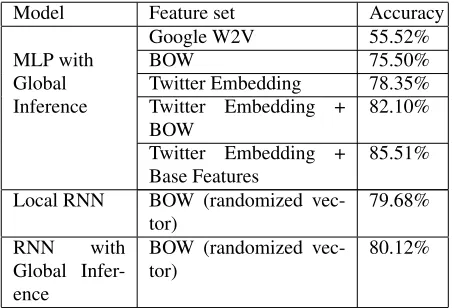
One of the main advantages of deep neural net-works is the way they can exploit feature embed-ding. By looking at table 2 we can observe that word embeddings pre-trained on Twitter data help boost the performance of this task considerably. In con-trast, the pre-trained word embeddings from Google news negatively impact the results, decreasing the performance drastically. We attribute this result to et al (2014) asTwitter Embedding
the linguistic style and language characteristics of tweets, which greatly differ from those of news arti-cles. To confirm this hypothesis, we did a subsequent qualitative analysis and discovered that a great num-ber of twitter tokens are not present in the Google news corpus.
These results provide evidence that training sim-ple MLP models locally, using suitable pre-trained embeddings and applying global inference for pre-diction, can outperform shallow models with global training procedures, even without additional man-ual efforts to tune hype-parameters. Furthermore, we extended our deep neural networks model to Re-current Neural networks in DRAIL, and integrated it with global inference. Due to time limitation, DRAIL is only tested with simple features, while still demonstrating comparable performance on this task.
Model Feature set Accuracy
CRF (Gimpel
et al., 2011) Base Features 83.38%
MEMM Base Features 81.00%
DRAIL Local
Prediction (Baseline)
Base Features + Twitter
Embedding 84.20%
DRAIL Gold
Dependencies (Skyline)
Base Features + Twitter
Embedding 85.88%
DRAIL MLP
with Global Inference
Base Features + Twitter
[image:7.612.312.539.314.471.2]Embedding 85.51%
Table 1:Comparison of DRAIL to other models
Model Feature set Accuracy
MLP with Global Inference
Google W2V 55.52%
BOW 75.50%
Twitter Embedding 78.35% Twitter Embedding +
BOW 82.10%
Twitter Embedding +
Base Features 85.51% Local RNN BOW (randomized
vec-tor) 79.68%
RNN with Global Infer-ence
BOW (randomized
vec-tor) 80.12%
[image:7.612.313.540.511.665.2]6.2 Entity-Relation Extraction
We used DRAIL to describe a joint model to extract named entities and relations between them. The data set used was created by (Roth and Yih, 2004). It contains 1441 sentences and 37261 phrases. There are four types of entities: People (1691), Location (1968), Organization (984), and Other (706) and five types of relations. Similar to previous work on this data set, we focused on two specific relations: LIVEIN(521) indicates a Person lives in a Location, and WORKFOR(401) indicates a Person works for an Organization. All other pairs of phrases do not hold any relation between them, which means the data set is highly skewed.
We used the model configuration outlined in Fig-ure 2. For the entity classifier, a set of featFig-ures were extracted from phrases with a window of size 4 around the target including itself. These features in-clude words, word embedding, part-of-speech tags, suffix, prefix, gazetteers and capitalization patterns. For the relation classifier, we included the same set of features mentioned above for both phrases as well as a small list of indicator words additionally, like “live”, “native”, “employ”, and its relative position to the two target phrases. We also used features from the path between two phrases on the depen-dency parsing tree. A deep neural network model was trained locally for each rule. These networks have one hidden layer and 100 hidden units (300 for relation classifiers). We used stochastic gradient de-cent with batch size 100 and AdaGrad (Duchi et al., 2011) to adapt the learning rate in training. Softmax probabilities from the neural networks were used as scores in each ILP instance to find the optimal solu-tion.
Results The results using 5-fold cross-validation are shown in Table 3. We report the F1 score of the positive class, i.e. Fβ=1. To show the model-ing capacity and expressiveness of DRAIL, we also tested using0-order MEMM for local models. For each configuration, we report the result obtained di-rectly from locally trained classifiers, and the results after global inference. As it shows, the deep archi-tecture has a higher impact on the relation extrac-tion problem than on entities, demonstrating its ef-ficacy on difficult decisions. Also, the global infer-ence procedure helps improve the performance on relation extraction significantly. Even without
incor-porating numerous handcrafted features, the perfor-mance of DRAIL is commensurate to or better than previous work, including (Kordjamshidi et al., 2015) and (Roth and Yih, 2007). Note that results are not directly comparable because their data splits specifi-cations were not available.
Model PER LOC ORG WorkFor LiveIn MEMM
Local 93.96 88.80 78.82 54.12 43.56 MEMM
Global 93.43 89.02 79.36 54.68 53.09 MLP
Local 92.32 89.78 80.60 54.80 51.19 MLP
Global 92.30 90.05 79.86 62.84 56.86 Table 3:The F1 of different local models with and without in-ference on Entity-Relation Extraction task using DRAIL, 5-fold cross validation
7 Discussion and Conclusion
This paper introduces DRAIL, an open-source2 declarative framework for defining structural depen-dencies between probabilistic concepts trained us-ing deep learnus-ing models. The experimental results on the Twitter POS tagging problem and the Entity-mention-Relation extraction task demonstrate the flexibility of our framework, which can be used for quick prototyping and evaluating the interplay be-tween representation complexity and structural com-plexity. DRAIL takes advantage of both building de-pendencies between structures and mapping com-plex inputs to outputs, resulting in a richer and more flexible hypothesis class, and enriched fea-ture representations at the same time. These merits enhance the prediction ability of DRAIL. Our cur-rent work looks into including efficient and effective joint training (CRF Neural Networks) into DRAIL, by taking into account assigning values to all the variables in a global model and back-propagating error to the whole structure simultaneously. A po-tential advantage is that we can pre-train the mod-els locally, and use global training to boost the per-formance using the same set of parameters, by only changing the objective function. Our DRAIL frame-work carries the capacity to incorporate this training paradigm into itself without additional effort.
2we intend to release the code and data used in our
References
Daniel Andor, Chris Alberti, David Weiss, Aliaksei Severyn, Alessandro Presta, Kuzman Ganchev, Slav Petrov, and Michael Collins. 2016. Globally normal-ized transition-based neural networks.
Stephen H. Bach, Matthias Broecheler, Bert Huang, and Lise Getoor. 2015. Hinge-loss markov random fields and probabilistic soft logic. arXiv:1505.04406 [cs.LG].
Dzmitry Bahdanau, Kyunghyun Cho, and Yoshua Ben-gio. 2014. Neural machine translation by jointly learning to align and translate. arXiv preprint arXiv:1409.0473.
Danqi Chen and Christopher D Manning. 2014. A fast and accurate dependency parser using neural net-works. InProc. of the Conference on Empirical Meth-ods for Natural Language Processing (EMNLP). L.-C. Chen, A. G. Schwing, A. L. Yuille, and R.
Urta-sun. 2015. Learning deep structured models. InProc. of the International Conference on Machine Learning (ICML).
G Cybenko. 1989. Approximation by superpositions of a sigmoidal function.Mathematics of Control, Signals and Systems, 2(4):303–314.
Pedro M Domingos, Stanley Kok, Hoifung Poon, Matthew Richardson, and Parag Singla. 2006. Uni-fying logical and statistical ai. InProc. of the National Conference on Artificial Intelligence (AAAI).
John Duchi, Elad Hazan, and Yoram Singer. 2011. Adaptive subgradient methods for online learning and stochastic optimization.Journal of Machine Learning Research, 12(Jul):2121–2159.
J Elman. 1990. Finding structure in time. Cognitive Science, 14(2):179–211, jun.
Kevin Gimpel, Nathan Schneider, Brendan O’Connor, Dipanjan Das, Daniel Mills, Jacob Eisenstein, Michael Heilman, Dani Yogatama, Jeffrey Flanigan, and Noah A. Smith. 2011. Part-of-Speech Tagging for Twitter: Annotation, Features, and Experiments. pages 42–47.
Noah Goodman, Vikash Mansinghka, Daniel M Roy, Keith Bonawitz, and Joshua B Tenenbaum. 2012. Church: a language for generative models.
Alex Graves. 2013. Generating sequences with recurrent neural networks.CoRR, abs/1308.0850.
Inc. Gurobi Optimization. 2015. Gurobi optimizer refer-ence manual.
Parisa Kordjamshidi, Dan Roth, and Hao Wu. 2015. Saul: Towards declarative learning based program-ming.
Guillaume Lample, Miguel Ballesteros, Sandeep Subra-manian, Kazuya Kawakami, and Chris Dyer. 2016.
Neural architectures for named entity recognition. arXiv preprint arXiv:1603.01360.
Xuezhe Ma and Eduard Hovy. 2016. End-to-end se-quence labeling via bi-directional lstm-cnns-crf. arXiv preprint arXiv:1603.01354.
Andrew McCallum, Karl Schultz, and Sameer Singh. 2009. FACTORIE: Probabilistic programming via im-peratively defined factor graphs. InThe Conference on Advances in Neural Information Processing Systems (NIPS).
Tomas Mikolov, Ilya Sutskever, Kai Chen, Gregory S Corrado, and Jeffrey Dean. 2013. Distributed Rep-resentations of Words and Phrases and their Composi-tionality. InAdvances in Neural Information Process-ing Systems 26: 27th Annual Conference on Neural In-formation Processing Systems 2013.
Brian Milch, Bhaskara Marthi, Stuart Russell, David Sontag, Daniel L Ong, and Andrey Kolobov. 2005. Blog: probabilistic models with unknown objects. In Proc. of the International Joint Conference on Artifi-cial Intelligence (IJCAI).
Jeffrey Pennington, Richard Socher, and Christopher D Manning. 2014. GloVe: Global Vectors for Word Representation. InEmpirical Methods in Natural Lan-guage Processing (EMNLP), pages 1532–1543. N. Rizzolo and D. Roth. 2010. Learning based java for
rapid development of nlp systems. InLREC.
Dan Roth and Wen-tau Yih. 2004. A linear program-ming formulation for global inference in natural lan-guage tasks. In Hwee Tou Ng and Ellen Riloff, editors, HLT-NAACL 2004 Workshop: Eighth Conference on Computational Natural Language Learning (CoNLL-2004), pages 1–8, Boston, Massachusetts, USA, May 6 - May 7. Association for Computational Linguistics. D. Roth and W. Yih. 2007. Global inference for entity and relation identification via a linear programming formulation.
Nitish Srivastava, Geoffrey E Hinton, Alex Krizhevsky, Ilya Sutskever, and Ruslan Salakhutdinov. 2014. Dropout: a simple way to prevent neural networks from overfitting. Journal of Machine Learning Re-search, 15(1):1929–1958.
David Weiss, Chris Alberti, Michael Collins, and Slav Petrov. 2015. Structured training for neural net-work transition-based parsing. InProc. of the Annual Meeting of the Association Computational Linguistics (ACL).